I. INTRODUCTION
The policy of Southern Reconstruction (1865–1877) after the American Civil War was a noble experiment in civil and political equality.Footnote 1 After the former black slaves of the South were granted their freedom and extended national citizenship, an attempt was made to integrate the races and alter the fabric of southern life. This attempt was led by the governing Republican Party, specifically the “Radicals” within the party, and carried out under the watchful eye of the Union army stationed throughout the former Confederacy. There were many successes associated with the Radicals' vision of a remade South—notably the significant voter participation among the newly enfranchised Freedmen and the election of a number of blacks to local, state, and federal positions (including more than a dozen to Congress)—but none would be lasting. By the early 1870s, southern white conservatives, initially under the boot of the new cross-racial Republican regimes in the region,Footnote 2 were re-integrated into the political system and began reasserting themselves. A strategy of violence toward and intimidation of black voters, coupled with a severe economic depression following the Panic of 1873, led to significant Democratic victories in the midterm elections of 1874, culminating in the Democrats' capture of the House of Representatives and a number of southern state legislatures. By 1877, all state legislatures within the former-Confederate South would be “redeemed.”
Although the Republican-led Reconstruction policy would officially end with the election of 1876—and the subsequent “bargain” that led to Rutherford Hayes's ascension to the presidency and the removal of the U.S. army as electoral watchdog in the South—a number of Republican politicians were unwilling to ignore their promise to the Freedmen and cede control of the South completely to the Democrats. As black civil and political gains were stripped away in the late 1870s and 1880s, Republican leaders continued to use whatever resources they could muster—such as executive patronage and seat “flips” in Congress resulting from contested election cases—to maintain a partisan foothold in the South.Footnote 3 Finally, the Republicans would score a significant blow in the elections of 1888, winning the presidency as well as majorities in both the House and Senate; as a result, the 51st Congress (1889–91) would offer the party a renewed opportunity to promote black civil rights and combat Democratic dominance in the South. The result was a new Federal Elections Bill, offered by Henry Cabot Lodge (R-MA), which would have placed national elections—specifically House elections—under federal control (thus superceding state control). The Lodge Bill passed by a slim margin in the House but was bottled up in the Senate, thanks to the concerted efforts of Democrats and a small group of western (silver) Republicans.Footnote 4 This was a crushing defeat for the party, as the Republicans would lose control of first, the House—and thus unified control of government—in the midterm elections of 1890 and, second, all reins of government in 1892.
Historical scholarship often suggests that the Lodge Bill was the last nail in the coffin of the Republicans' grand Reconstruction experiment. Moreover, the Lodge Bill is typically viewed as the last major effort to promote black civil rights until the mid-twentieth century. As a consequence, the five decades between the failure of the Lodge Bill in 1891 and the early civil rights forays begun under FDR and extended by Truman in the 1940s are something of a mystery—scholars typically ignore this period in their discussion of civil rights policy, leading readers to infer that national lawmakers completely ignored the plight and demands of black citizens during these years. More specifically, the core of scholarship on race and civil rights either skips over the 1900–1940 period entirely, or in the instances where this period is discussed, the focus remains solely on the mainly symbolic appeals of presidents.Footnote 5 In much the same way, the conventional wisdom among a rich literature in political science on how the parties realigned around racial issues has concluded that black voters were largely unimportant to the parties during this period and that the issue of civil rights did not begin to divide the parties until the height of the modern civil rights movement.Footnote 6
Our goal in this paper is to shed some light on this mysterious period, specifically to investigate the role Congress played in civil rights policy during the 1891–1940 era. Our investigation leads us to identify three key periods of party contestation on issues salient to the black electorate. In the first, during the first decade and a half of the twentieth century, black political participation was limited, thanks to small population numbers in the North, the advent of Jim Crow and widespread disenfranchisement in the South, and the absence of a strong NAACP. As a consequence, blacks faced a Republican Party—aside from a few individuals—that was largely unwilling to fight for meaningful civil rights legislation (or prevent anti-black legislation) and a Democratic Party that was solidly hostile to legislation that would aid blacks (and actively sought racial exclusions) in the few instances when substantive race-related bills were initiated. In the second period (1918–1930), a significant number of southern blacks had migrated north and collected in various urban areas; they increasingly took part in the political process, creating and joining organizations to push for anti-lynching legislation. Moreover, northern blacks demonstrated a willingness to demand anti-lynching legislation from the Republican Party and close ranks and threaten defection when they perceived that support to be lukewarm. In this period, we find the beginning of black frustration with their supposed GOP allies along with a simultaneous move by a few northern Democrats to support the most salient black issue at the time—protecting blacks from the horror of lynch law. The northern Democrats' willingness to break from the southern wing of their party on this crucial issue sent an important signal to disgruntled black voters. This shift, although subtle, would continue to grow in the third and final period with renewed attention to a federal lynching statute. By that time (1930–1940), increased tension between black leaders and the Republican Party, combined with continuing black migration into northern states, eventually ruptured the historic alliance between blacks and the GOP and led northern Democrats to make explicit appeals for black votes. Taken together, these periods demonstrate the evolution of a partisan realignment on civil rights; in the early period, the Republicans were the protectors and purveyors of black interests, but by the end of this period, the Democrats had taken on that role and responsibility. Unlike existing accounts, we demonstrate that race not only remained on the congressional agenda but also was the place where the origins of a later party realignment can first be seen.
To demonstrate how and when the partisan landscape shifted on the issue of black interests, we track the central pieces of civil rights legislation introduced in each period. Using a variety of sources—such as bill-introduction data, statements by members in the Congressional Record, roll-call votes, and newspaper articles, among others—we show how individual members of Congress conceived of civil rights legislation and the burgeoning influence of black voters. These and other sources allow us to track patterns of participation among black voters. In this way, we add to a recent and exciting set of studies that challenges the traditional periodization on party realignment,Footnote 7 finding that party shifts on racial issues began earlier than prevailing historical accounts have assumed.
The paper proceeds as follows. In Section II, we discuss the two decades after the failure of the Lodge Bill, focusing on Republican efforts to combat disenfranchisement by seeking to reduce southern representation in the House and Democratic efforts to pass a federal anti-miscegenation law after their return to power during the Wilson administration. In Section III, we discuss the first major anti-lynching bill passed in the House (the Dyer bill in 1921), the politics surrounding it, and its eventual failure in the Senate. In Section IV, we discuss two additional anti-lynching bills that passed in the House in 1937 and 1940, but, like the Dyer bill that preceeded them, were subsequently stymied in the Senate. In discussing the politics over these fifty years, and across the various sections, we also pay close attention to the changing nature of partisan coalitions. What began as a Republican coalition in favor of blacks' civil rights culminated in a Democratic-led coalition by the 1930s, with partisan contestation for blacks' electoral support beginning in the early 1920s.
II. THE AFTERMATH OF THE LODGE BILL, 1891–1918
The early 1890s were an especially difficult time for black citizens in the South. Apart from the failed Lodge Bill, two other developments were occurring that would shape southern life—and black citizens' misfortunes—for decades to come. First, after gaining unified control of the national government for the first time since the late 1850s, the Democrats acted quickly in the 53rd Congress (1893–95) to scuttle the remnants of the Republicans' Reconstruction policy. The three Enforcement Acts passed between May 1870 and April 1871, which provided for federal supervision of state elections, were repealed in February 1894.Footnote 8 Although these laws had not been enforced for some time,Footnote 9 many Democrats viewed their repeal as an important, symbolic act—wiping the vestiges of Reconstruction from the statute books further signified (in their minds) the ultimate redemption of the white South. Second, and perhaps more importantly, southern state legislatures and constitutional conventions began systematically disenfranchising black voters, beginning in 1890.Footnote 10 Although violence and intimidation had been the Democrats' major tactic to dampen black voter participation in the 1870s and 1880s, party leaders sought legal remedies thereafter. These legal remedies—which included poll taxes, literacy tests, residency requirements, and grandfather clauses, among others—would form the basis of Jim Crow rule in the South, which lasted into the 1960s.
Thus, as black Americans entered the twentieth century, their fortunes had changed considerably in a few short decades. They had gone from a state of slavery, to a state of political equality with whites, to a state of semi-citizenship in less than two generations. While the Republicans regained a firm hold on the national government following the elections of 1896, maintaining a partisan foothold in the South would no longer be considered an electoral necessity. The agrarian revolt within the Democratic Party, and the selection of former Rep. William Jennings Bryan (D-KS) as the Democratic standard bearer, resulted in a partisan realignment throughout the country; “Bryanism” was summarily rejected outside of the South and parts of the West, as the Republicans made strong inroads throughout the country, even in former Democratic strongholds like the Border South.Footnote 11 As a result, Republican leaders in Congress believed that the South could be written off, as the benefits of maintaining a “southern strategy” no longer exceeded the costs. While Republicans would continue to add a few southern House seats via contested-election seat flips through the late 1890s, this practice would no longer continue after President McKinley's re-election in 1900.Footnote 12
Despite the Republican leadership effectively ceding the southern states to the Democrats and eschewing its responsibilities to black citizens in the South and throughout the country, attempts would be made over the first two decades of the twentieth century to rekindle the party's historic origins. Such attempts would be sporadic and voiced by individual or small groups of Republicans. In addition, when the Democrats returned to power during the Woodrow Wilson years, the issue of black civil rights was also on their minds, albeit not in a progressive sense.
Reduction in Congressional Representation
As southern states began their systematic disenfranchisement of black voting rights in the 1890s, not all Republicans were willing to sit on the sidelines and watch the party's Civil War and Reconstruction legacy wither away. Beginning in 1899, a small movement sought to confront the disenfranchisement issues head on. If white southerners wished to deny voting rights to black citizens, these Republicans argued, they should accept the consequences of their actions; and those consequences were laid out clearly in the Constitution, specifically in Section 2 of the Fourteenth Amendment:
Representatives shall be apportioned among the several States according to their respective numbers, counting the whole number of persons in each State, excluding Indians not taxed. But when the right to vote at any election for the choice of electors for President and Vice President of the United States, Representatives in Congress, the Executive and Judicial officers of a State, or the members of the Legislature thereof, is denied to any of the male inhabitants of such State, being twenty-one years of age, and citizens of the United States, or in any way abridged, except for participation in rebellion, or other crime, the basis of representation therein shall be reduced in the proportion which the number of such male citizens shall bear to the whole number of male citizens twenty-one years of age in such State.
Stated simply, southern states that pursued a systematic disenfranchisement campaign against black citizens would find their share of House seats reduced. White southerners could not have it both ways.
The first formal attempt to demand enforcement of Section 2 of the Fourteenth Amendment was pushed by Senators Marion Butler (P-NC) and Jeter C. Pritchard (R-NC) in late 1899, just as the state of North Carolina was preparing to follow Mississippi (1890), South Carolina (1895), and Louisiana (1898) in amending its constitution to limit blacks' voting rights.Footnote 13 Both Butler and Pritchard had been elected on Populist-Republican fusion tickets, relying heavily upon the votes of the state's black residents, and both viewed the current situation through a lens of self interest. Specifically, Butler and Pritchard “saw in the Democratic disenfranchisement efforts a threat to their base of political power.”Footnote 14
Butler would lay the early groundwork for a Fourteenth Amendment challenge in October 1899, arguing that North Carolina's move toward Jim Crow was unconstitutional. Pritchard followed up in December 1899 by filling out more specific details, arguing that North Carolina's decision to disenfranchise its black citizens was proof that the state did not possess a “republican form of government.”Footnote 15 This led to angry back-and-forth discussions between Butler, Pritchard, and southern Democratic leaders, mainly Sen. John T. Morgan (D-AL), regarding interpretations of the Constitution. Butler and Pritchard relied upon the text of the Fourteenth Amendment to make their anti-republican case, whereas Morgan and his colleagues clung to the notion that states possessed the authority to determine suffrage requirements, based on the Constitution's general silence on the matter (the Fourteenth Amendment notwithstanding).
After almost four months of off-and-on discussion, Pritchard's resolution was referred to the Committee on Privileges and Elections in late April, 1900. In early June, Sen. William Eaton Chandler (R-NH), chairman of the committee, reported that a majority of the committee favored a weaker form of Pritchard's resolution, and he sought on two occasions to have this weaker resolution considered on the Senate floor. However, each time, unanimous consent was blocked by multiple southern senators, and the committee's resolution was buried on the Senate calendar.Footnote 16
Although Pritchard and Butler were disappointed by the outcome, a more ominous sign emerged during the disenfranchisement debate. Only one fellow Republican, Chandler, supported Pritchard and Butler on the Senate floor. Every other Republican senator was silent during the debate. A decade after the defeat of the Federal Elections Bill, the “Party of Lincoln” no longer appeared to view the protection of blacks' civil rights as a priority. The political lay-of-the-land, as November and the presidential election of 1900 neared, is nicely summarized by Richard B. Sherman:
A determined attempt by the Republicans to protect the Negro's vote would have wrecked [President] McKinley's efforts at reconciliation, and the immediate political gains for such a move would not have compensated for the losses. Republicans could not control the South by Negro votes alone, and congressional interference would have destroyed the prospects of building up GOP strength among southern whites.Footnote 17
Although Republican leaders' dreams of a southern “lily white” movement in presidential elections would prove to be a chimera, their decision to forego active opposition to disenfranchisement would be maintained into the future.
These leadership strategies aside, some individual Republicans in Congress were unwilling to ignore the disenfranchisement issue. Shortly after McKinley's re-election, in the lame-duck session of the 56th Congress (1899–1901), the issue of voting-rights restrictions was raised again, this time in the House. The locus of the debate revolved around new apportionment legislation, which was based on the recently completed twelfth census. Two attempts would be made to stem the tide of disenfranchisement: (a) an investigatory measure by Rep. Marlin E. Olmsted (R-PA) and (b) a punitive measure by Rep. Edgar D. Crumpacker (R-IN). Both dealt with limiting southern representation in the House, based on violations of the Fourteenth Amendment.
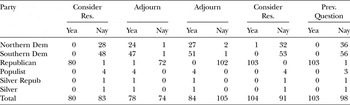
The Olmsted measure was offered on 3 January 1901, as the House began consideration of the apportionment bill. News reports suggest that Olmsted's resolution—offered as a matter of privilege, to instruct the Committee on the Census to investigate suffrage restrictions/violations in the South and present such findings in a report to Congress (which could then be used, should Congress choose, to restrict representation by state in accordance with Section 2 of the Fourteenth Amendment)—took the Republican leadership by surprise, and, as a result, created some confusion on the House floor.Footnote 18 After some order had been restored, the roll call to consider Olmsted's resolution failed 80–83, after which a move to adjourn, offered by Rep. Oscar Underwood (D-AL), passed 78–74.Footnote 19 Partisan data on these two votes appear in Table 1. Although it seems that the Republicans uniformally opposed the Democrats, the roll-call data tell only part of the story. In fact, twice as many Republicans abstained—“absent and unpaired”—as Democrats (32 to 16).Footnote 20 This indicates that a number of Republicans, including the leadership, did not view representational reduction as a serious goal, especially if it got in the way of a Republican-crafted apportionment plan.
House Roll Calls on Voting Rights Restrictions in the South, 56th Congress

Source: Congressional Record, 56th Congress, 2nd Session, (3 Jan. 1901): 521; (4 Jan. 1901): 553–55.
The next day, 4 January, a turnaround occurred. Rep. Albert Hopkins (R-IL), chairman of the Committee on the Census, hinted at this about-face the evening before when he predicted that the Olmsted measure would pass, even though “he did not think the idea of reducing the representation of the Southern States was practicable.”Footnote 21 Thus, once their initial surprise had dissipated, the Republican leadership decided that an effort was needed—even if only a symbolic one—to signal publicly that the party was solidly opposed to the practice of disenfranchisement.Footnote 22 Furthermore, as Hopkins predicted, Olmstead offered his resolution again, and this time the outcome would be different. After an adjournment motion, offered again by Underwood, failed 84–105, a motion to consider passed 104–91, and a previous question motion succeeded 103–98. (See Table 1 for the marginals on these three roll calls.) On each of these votes, an additional thirty Republicans (roughly) participated and supported the pro-civil rights side on the roll call. Finally, a vote to refer the Olmstead measure to the Committee on the Census passed without even a recorded roll call.Footnote 23
These roll-call successes notwithstanding, the real benefits associated with the resolution were negligible. As a reporter for the Washington Post noted in his coverage of the events surrounding the Olmstead resolution: “it was well understood nothing definite will ever come of it … [although Olmstead] tried to persuade Chairman Hopkins to promise that a special meeting would be called within a week to consider the resolution … it is certain that the new apportionment of Representatives will be made before any such data as the resolution calls for can be collected.”Footnote 24 In short, the Republican leadership was willing to make a symbolic gesture to the nation's black citizenry but would take no meaningful action that would put its legislative policy goals—notably passage of new pro-GOP apportionment legislation—at risk.Footnote 25
Four days later, on 8 January, the apportionment issue was considered on the House floor. As predicted, the Olmstead resolution had no bearing on the debate, as it was safely buried in committee—Chairman Hopkins seeing to this personally. After some wrangling, a GOP-supported apportionment bill passed.Footnote 26 Still, the reduction-in-representation issue was not dead, as Rep. Crumpacker raised the disenfranchisement issue once again, moving to recommit the apportionment bill to committee with instructions to ascertain which states had unconstitutionally abridged the right to vote and determine how much congressional representation (that is, how many House seats) should be reduced as a result. Crumpacker's motion was thus one step beyond Olmstead's, which (as written) had been mainly informational. A contentious debate followed, with a number of southern Democrats denouncing the motion, but only two Republicans—Reps. George White (NC) and Charles Grosvenor (MA)—supporting Crumpacker.Footnote 27 Just as in the Olmsted case, the Republicans were unwilling to put their legislative agenda in jeopardy (and risk undoing the policy victory just achieved on the apportionment issue) to support a measure that would penalize disenfranchisement efforts and thus promote blacks' political rights.
Finally, debate ceased and Crumpacker's motion to recommit was considered via a division vote. It failed 94–136. Rep. James Stewart (R-NJ) demanded the yeas and nays, but only fourteen members seconded, thus falling short of the required minimum. Although individual-level data does not exist on division votes, news reports suggested that “several Republicans, including Messrs. Pearson (NC), Littlefield (ME), Allen (ME), Hill (CT), Jenkins (WI), and Joy (MO) voted with the Democrats against the motion.”Footnote 28
Thus, like the Senate Republicans earlier in the 56th Congress, the House Republicans had largely abandoned black voting rights, outside of strictly symbolic initiatives. Republican party leaders saw few benefits in being responsive to black voters. Given the rise of Jim Crow, the South was considered beyond the party's reach, and too few blacks lived in the North to matter politically. Sporadic attempts to investigate suffrage restrictions and reduce southern representation in Congress would be made in the next few years, but none made any headway.Footnote 29 This was due, in part, to the view of President Theodore Roosevelt, who opposed an activist approach in dealing with southern disenfranchisement and representational reduction more generally.Footnote 30
Anti-Miscegenation in the District of Columbia
After the Democrats returned to power—controlling the presidency and both chambers of Congress during the first six years of President Wilson's administration—the subject of black civil rights reemerged, this time focused on curtailment. That is, efforts were made by Democrats in Congress to enact additional civil rights restrictions. Not content with maintaining the harsh Jim Crow system in the former Confederacy, many Democrats sought to further subjugate the nation's black citizenry by limiting their civil rights in other parts of the nation. The focus during the early Wilson years was on segregating the races in areas of federal jurisdiction—examples included the federal civil service, the military, and public transportation in Washington, DC.Footnote 31 The most prominent attempt at segregation, however, occurred in the social domain, specifically on racial intermarriage between blacks and whites, or “miscegenation.” This would be the Democrats' prime focus between 1912 and 1915.
In December 1912, during the lame-duck session of the 62nd Congress (1911–13), Rep. Seaborn Roddenberry (D-GA) gained the House floor and offered a proposal to amend the Constitution of the United States by prohibiting interracial marriage.Footnote 32 Roddenbery's proposal came at a time of racial unrest, as race riots had broken out throughout the country in 1912. This unrest was tied to the athletic success of Jack Johnson, the black boxing champion who recently retained his title against Jim Jeffries, the white former world champion. If Johnson's athletic triumph was not enough for white southerners to stomach, he also pursued a risqué personal life with his many affairs with (and two marriages to) white women. Roddenberry even mentioned Johnson by name in his floor diatribe, laying the blame at the foot of the northern states that allowed intermarriage and thus Johnson's racially subversive behavior.Footnote 33 Roddenbery, although likely grandstanding, hoped to force southern views on the rest of the nation—or, at a minimum, pressure additional northern states to pass anti-miscegenation legislation. (At the time of Roddenbery's proposal, twenty-nine of the forty-eight states possessed anti-miscegenation laws.) In the end, Roddenbery's proposal went nowhere, as it was referred to the Judiciary Committee and was not reported out.Footnote 34 Moreover, his attempt to push additional northern states to adopt anti-miscegenation laws would prove to be a failure, as only one additional state—Wyoming in 1913—adopted such legislation (though many state legislatures did consider it).
Although Roddenbery's efforts were in vain, the issue of miscegenation emerged again later in the lame-duck session. On 10 February 1913, H. R. 5948, a bill introduced by Rep. Thomas Hardwick (D-GA) that would “prohibit in the District of Columbia the intermarriage of whites with negroes or Mongolians” and make intermarriage a felony (with penalties up to $500 and/or 2 years in prison) was called up and considered on the House floor.Footnote 35 Thus, the Democratic opponents of black civil rights narrowed the scope of their attack; rather than a sweeping constitutional amendment, they pushed a proposal that would ban interracial marriage specifically within the District of Columbia. Unlike Roddenbery's prior proposal, a constitutional amendment would not be necessary to alter policy in this case because Article 1, Section 8, Clause 17 of the Constitution gave Congress explicit jurisdiction to govern on matters involving the District of Columbia.
Somewhat surprisingly, the Hardwick anti-miscegenation bill was passed in “less than five minutes,” with absolutely no debate.Footnote 36 Moreover, a simple voice vote was going to decide the matter, before Rep. James Mann (R-IL) asked for a division, whereupon it was reported that there were 92 votes in favor and 12 votes opposed.Footnote 37 In explaining the outcome and general lack of debate on the bill, a correspondent for the New York Times reported: “Almost every State has a law prohibiting such marriages, and the feeling generally among House members is that the Nation's capital should be in line with the general sentiment of the States on this subject.”Footnote 38 Thus, Republicans in the House, perhaps intimidated by the Democrats' bluster and worried about shifting public opinion and further state-legislative activism in the North, quietly acquiesced and allowed the Democrats to quickly pass their D.C. anti-miscegenation bill. However, in the end, nothing would come of the legislation, as it was referred to the Senate Judiciary Committee and never reported out before the session expired less than a month later.Footnote 39
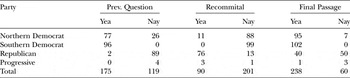
Just two years later, in the lame-duck session of the 63rd Congress (1913–15), the Democrats would push D.C. anti-miscegenation legislation yet again. This time, the bill (H.R. 1710) was offered by Rep. Frank Clark (D-FL), and it would be even more draconian than the 1913 version with penalties for miscegenation escalating to $5,000 and/or 5 years in prison.Footnote 40 Clark's anti-miscegenation bill was considered on 11 January 1915, and, unlike the Hardwick bill two years earlier, elicited a short discussion.Footnote 41 Clark argued that enactment of his bill “was in the interest of both of the races” and that maintaining racial purity was paramount. This was especially important, as Clark believed “the future of the world is dependent upon the preservation of [the white race's] integrity.”Footnote 42 Rep. Mann (R-IL) answered Clark for the Republican side, stating that although he opposed interracial marriage, he also opposed making such marriages a crime. Moreover, Mann articulated what he believed the more basic intent of the anti-miscegenation legislation to be: “The purpose of this law is to further degrade the negro, to make him feel the iron hand of tyranny so long practiced against his race.”Footnote 43 After a few additional brief remarks, the previous question was ordered, which carried 175–119; Mann quickly moved to recommit the legislation to committee, which failed 90–201; and Clark's anti-miscegenation bill was then passed 238–60.Footnote 44
Before examining these votes in detail, a brief discussion of the differences in context surrounding the Hardwick and Clark anti-miscegenation bills is warranted. Whereas the Hardwick bill was adopted without debate and via a simple division vote, the Clark bill elicited some sharp debate and necessitated three roll-call votes before an outcome was generated. What explains these contextual differences? There is considerable evidence to suggest that pressure from black citizens—via newspaper editorials along and individual and group initiatives—increased after the passage of the Hardwick bill and ramped up considerably after Clark re-introduced the miscegenation issue. For example, a number of public meetings were scheduled post-Hardwick to ensure that additional segregationist legislation would meet active resistance.Footnote 45 Additionally, groups like the Independent Equal Rights League, led by civil rights luminaries like Ida B. Wells, were actively engaged, lobbying Congress generally and individual House Republicans specifically during Clark's anti-miscegenation mission.Footnote 46 Thus, black voices had raised the visibility of the issue and, thus, the stakes in Washington, forcing members of both parties to reveal—through public statements and recorded roll-call votes—their preferences to their constituents.
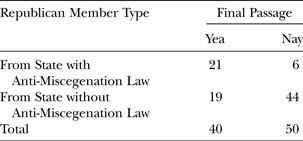
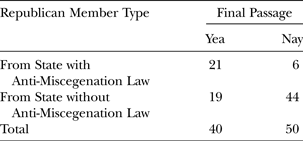
A breakdown of the three roll calls appears in Table 2. All three were cross-regional “party votes”: a majority of northern Democrats joined with a majority (all) southern Democrats against a majority of Republicans. However, some interesting variation appears within the two parties. Roughly a quarter of northern Democrats opposed shutting off debate on H.R. 1710; this opposition largely melted away across the remaining two votes.Footnote 47 Although Republicans were nearly unanimous in opposing the initial previous question motion, the party's solidarity crumbled thereafter; on the final-passage roll call, almost half (44.4 percent) of the Republican membership defected and voted in favor of the anti-miscegenation legislation. Republican voting on the final-passage roll call is broken out further in Table 3, based on type of state represented (that is, with or without a state-level anti-miscegenation law). More than half of the Republican votes in favor of the federal anti-miscegenation legislation—21 of 40—came from members who represented states with an anti-miscegenation law on the books. In total, a majority of Republican House members from states with anti-miscegenation laws (21 of 27, or 77.8 percent) voted for the federal legislation, whereas a minority of Republican House members from states without anti-miscegenation laws (19 of 63, or 30.2 percent) supported the measure. Thus, when push came to shove, many Republicans eschewed the party's historical connection to black voters and focused on representing the (anti-miscegenation) interests of the whites who elected them.
House Roll Calls on Anti-Miscegenation Legislation, 63rd Congress

Source: Congressional Record, 63rd Congress, 3rd Session, (11 Jan. 1915): 1366–68.
Republican Breakdown on Final Passage of Anti-Miscegenation Legislation
The following day, 12 January 1915, the Senate received H.R. 1710 from the House and referred it to the (Senate) Committee on the District of Columbia. It was never reported out of committee before the lame-duck session ended. Thus, the House Democrats' actions were for naught. Although a symbolic victory was achieved, a federal anti-miscegenation policy was not produced. The District of Columbia would continue to be a haven for interracial couples in the South who wished to marry. Indeed, Richard and Mildred Loving, the interracial (white-black) couple who would be at the center of the Loving v. Virginia (1967) Supreme Court case that struck down state-level anti-miscegenation laws, were married in the District of Columbia in 1958.
Coda
The nearly three decades after the failure of the Lodge Bill in 1891 witnessed black Americans struggling to have their voices heard and their (remaining) civil rights protected. Neither party in Congress was receptive to their needs; the Republicans, aside from a few individual members, no longer considered them an important or vital electoral constituency, and the Democrats were overtly hostile. In the post-slavery era, these three decades were probably the bleakest for black Americans, as they were truly wandering alone in the “political wilderness.”
Beginning in 1918, however, black Americans' fortunes would take a turn for the better. Their status as an “unimportant electoral constituency” would begin to change, as many southern blacks began migrating to the North after World War I. These new demographic patterns would first make Republicans in Congress take notice, and later, Democrats as well. For the succeeding two decades—from the end of World War I to 1940—civil rights would reemerge on the congressional agenda and would follow the same basic form. That is, the goal of black leaders, and their congressional supporters, would be to pass a federal anti-lynching bill. This would be the litmus test for civil rights success prior to World War II and would serve as the early foundation for the construction of a civil rights coalition.
III. THE FIRST CAMPAIGN FOR ANTI-LYNCHING LEGISLATION IN CONGRESS, 1918–1922
The first serious consideration of a federal anti-lynching bill was a matter of foreign policy, deriving from concerns regarding black soldiers in World War I.Footnote 48 Officials in the War Department worried that the brutal and frequent lynchings occurring in domestic life would create disgruntled black soldiers who could not be expected to adequately defend the United States abroad if they were worried about their family members receiving summary justice at home. It was from this concern that two members of the Army General Staff and Military Intelligence crafted a bill to protect “potential soldiers and their relatives” during wartime from the crime of lynching. The Hornblower-Spingarn bill was proposed in 1918 by Rep. Warren Gard (D-OH) and gave the federal government the power to protect black soldiers and their families because lynching threatened its constitutional power to “raise and maintain armies.”Footnote 49 Although the initiative was soon dropped without any action by Congress, the foreign policy concerns provoked by lynching remained, and in July 1918, President Wilson delivered a speech condemning mobs and vigilante violence against blacks: “Every mob contributes to German lies about the United States what her gifted liars can not improve upon by the way of calumny.”Footnote 50 Early bills tied to the war effort were soon expanded and would seek to protect not only black soldiers and their families during wartime but all black citizens regardless of wartime necessity.
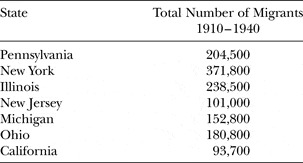
The series of anti-lynching bills proposed in the next decade depended on several important historical shifts, from the growth of the black press to the return of WWI servicemen. Perhaps none was as important, however, as the political empowerment resulting from the migration of a few million southern blacks to urban centers in the North. Prevented from exercising their suffrage in the South, these black migrants immediately became important voting blocs in many of their new northern destinations. For example, black voters would be a key group in several northern and border states in 1920. In fact, the Crisis magazine sent a detailed questionnaire on issues important to black voters to over a dozen potential presidential candidates and several congressional candidates in the lead-up to the 1920 election; this was as much a signal to candidates of blacks' voting power as a genuine request for information on their positions.Footnote 51
In part resulting from black migration, the fledgling NAACP, founded in 1909 and possessing just nine thousand members in 1916, saw their membership increase tenfold by 1920.Footnote 52 Led by the renowned civil rights champion Moorfield Storey, the NAACP began a campaign to bring the horrors of lynching to the conscience of Americans, organizing a national anti-lynching conference in Carnegie Hall where the keynote speaker was Charles Evans Hughes (the 1916 Republican presidential nominee).Footnote 53 The conference carried the endorsement of several governors, state attorneys general, and other influential politicians and adopted resolutions demanding that Congress investigate mob violence and pass legislation making lynching a federal crime. The conference also produced the report, “An Address to the Nation on Lynching,” signed by former President Taft. That same year the NAACP published its first book, Thirty Years of Lynching in the United States, 1889–1919, which would become an important statistical resource for legislators in congressional hearings on lynching over the next few years.
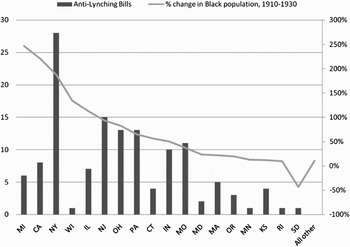
Largely reflecting the growing importance of the black electorate and the NAACP influence, anti-lynching bills in the 1920s were exclusively sponsored by Republicans, specifically those Republicans from districts that had seen their black populations increase substantially during the first black migration north. For example, Rep. Martin Ansorge (R-NY) represented the congressional district in Manhattan that included the largely black area of Harlem; his district (the twenty-first) was the same one that the later anti-lynching crusader Joseph Gavagan (D-NY) would represent. Reps. Joseph McCormick and Martin Madden (who was not a sponsor but was a crucial supporter in the House) represented the congressional district encompassing the south side of Chicago; this district (the first) today has the highest proportion of blacks residing within its boundaries and has been represented continuously by black members since 1929, when Oscar de Priest (R-IL) was first sworn in.
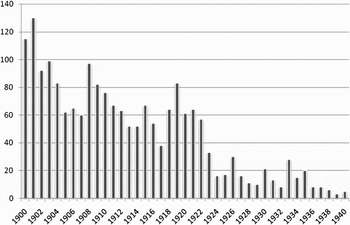
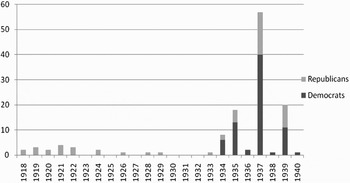
Blacks' newfound political influence in the North occurred alongside increasingly brutal racial violence against blacks and the tremendous post-war growth of the Ku Klux Klan (to a membership of four million). As Figure 1 shows, lynchings rose from 60 in 1918 to 76 in 1919, their highest level since 1909. These episodes were often public events, announced in advance by local papers, with local authorities playing an active role and hundreds of spectators, including women and children, in attendance. In one case, over 3,000 spectators attended a lynching in Tennessee after it had been advertised in the local paper as a burning of a “live Negro.”Footnote 54 More broadly, black soldiers faced lynching in Georgia and Mississippi for appearing in public in military attire;Footnote 55 John Shillady, the executive secretary of the NAACP, was brutalized by a mob in Texas that included local court officials, leading him to later resign his position;Footnote 56 and, in a particularly gruesome case in Georgia, a pregnant woman mourning her lynched husband was burned alive in front of a crowd.Footnote 57 Riots also broke out against blacks in over two dozen cities during the “Red Summer” of 1919, which, according to John Hope Franklin, “ushered in the greatest period of interracial strife the nation had ever witnessed.”Footnote 58
Frequency of Lynching, 1900–1940.

Initial Success: The Dyer Bill in the House
Increasing black electoral influence and growing violence toward blacks were both important considerations for one politician in particular in 1918: Rep. Leonidas Dyer (R-MO) who sought (with the help of the NAACP) to sponsor the first serious anti-lynching proposal since the Hornblower-Spingarn bill. Dyer represented the twelth congressional district, which comprised a heavily black area of St. Louis; at the time, 28 percent of blacks in Missouri lived in St. Louis, and they were heavily concentrated in Dyer's district.Footnote 59 Between 1911, Dyer's inaugural year in Congress, and 1920, approximately 26,000 blacks had relocated to St. Louis, a 58 percent increase over the decade.Footnote 60 Dyer's district was also important because it was adjacent to East St. Louis, IL—a city that experienced a threefold increase in its black population from 1900 to 1910Footnote 61—which was the site of a horrific riot in 1917, where whites unleashed a wave of racial violence that killed over 100 blacks and left several thousand blacks homeless.Footnote 62 Following the riot, black “refugees” relocated to Dyer's district.Footnote 63 Dyer's district went from 10.7 percent black to 12 percent black between 1910 and 1920.Footnote 64 After a visit to the riot area, Dyer was moved by the plight of blacks victimized by vigilante violence; he subsequently sought to form a committee to investigate the violence and to establish federal power over the riot area.Footnote 65 In a very short amount of time, Dyer would become the strongest advocate of a federal anti-lynching program in Congress and the institutional voice for the NAACP.
In early 1918, during the 65th Congress (1917–19), Dyer introduced the first of several anti-lynching bills in the House. This bill (H.R. 11279) cast lynching as a denial of the “equal protection of the laws,” thereby making lynching a federal crime to be prosecuted in federal court, punishable by up to five years in prison.Footnote 66 The bill also provided for the punishment of negligent local officials for not acting to stop the crime and for collecting a fee (to be given to the victim's family) from counties where the lynching occurred or where the mob had passed through.Footnote 67 A similar bill (H.R. 11354) was introduced by Rep. Merrill Moores (R-IN). It was significant because it included seven sections to prevent lynching, in addition to establishing penalties for the crime. The bill allowed for potential victims to petition for federal protection if they had “reasonable cause” to believe they would not be given equal protection by the state, after which the petitioner would then be taken into custody by federal marshals.Footnote 68 The Dyer and Moores bills also indicated that the anti-lynching issue had evolved. These anti-lynching proposals rested not on justifications related to war but on the Equal Protection clause of the Fourteenth Amendment, an important change that subjected the bills to difficult constitutional terrain.
Unfortunately for Dyer, southerners controlled key House committees through which any anti-lynching bill would have to travel. The year of Dyer's first bill, the House Judiciary Committee consisted of twelve Democrats, nine of whom were from the South, and only nine Republicans. Not surprisingly, Dyer's bill was buried in committee and never reported out.
This situation was soon altered by the 1920 elections (to the 67th Congress), in which Republicans won majorities in both chambers (299 members in the House, 59 in the Senate) as well as the presidency. Soon thereafter, James Weldon Johnson, the executive secretary of the NAACP and one of the few blacks on the GOP's National Advisory Committee, urged newly elected President Harding to make good on the 1920 platform promise regarding lynching, which stated, “We urge Congress to consider the most effective means to end lynching in this country which continues to be a terrible blot on our American civilization.”Footnote 69 President Harding obliged and raised the issue in his first annual message to Congress in 1921, saying: “Congress ought to wipe the stain of barbaric lynching from the banners of a free and orderly, representative democracy.”Footnote 70 His statement was followed by three new bills, introduced by Reps. Dyer, Moores, and Frank Dallinger (R-MA) with Dyer's generating the most momentum.
Faced with a sizeable Republican advantage in the House, southern Democrats, with a few allies from the North and West, offered a range of arguments against the Dyer bill. Many focused on blatant opportunism, arguing that Republicans were only proposing anti-lynching legislation in order to secure black votesFootnote 71 and that this partisan electoral ploy would have the dire effect of encouraging black lawlessness in the South. In particular, they claimed that without the threat of lynching, black “brutes” would not be restrained from attacking and raping white women.Footnote 72 These emotional ploys aside, no argument was as crucial to the bill's fate as the constitutionality issue. Led by Rep. Hatton W. Sumners (D-TX), anti-lynching opponents argued that the Dyer bill was a violation of the Constitution, as it infringed on the sovereign power of states to police crime within their borders. Of course, it was not simply states' rights that Southerners were concerned about, if their previous action in other cases of federal intrusion is any guide; one such case was prohibition.Footnote 73 As one expert notes, “What hypocrisy when they sanctified state police power in arguing against the Dyer bill, whose invasion of state jurisdiction was not as great as that effected by the Eighteenth Amendment.”Footnote 74 However, congressional supporters, including Dyer himself, might have anticipated the importance of constitutionality, given the fate of the bill's predecessor in 1901, which had been negatively reported by the Judiciary Committee largely on constitutional grounds.
The constitutional argument was particularly important to southern Democrats because if anti-lynching legislation was passed and upheld as constitutional, such a measure would “accustom the nation to federal antilynching jurisdiction;” moreover, by logical extension, this meant that “southerners faced not just a threat to Lynch Law but to their segregationist society which federalism, in theory and in practice, guarded.”Footnote 75 Thus, the congressional battle over lynching was seen as determining the future path of civil rights and the viability of federal action.
The constitutional arguments were largely on the side of the anti-lynching opponents, as the Supreme Court had established a powerful doctrine in the Civil Rights Cases (1883) that the Fourteenth Amendment only applied to official state actions. Opponents argued that lynching was an individual action, like murder, and as such should be dealt with at the state level. Federal intrusion would thus be a breach of the Constitution. This rhetorical strategy provided anti-lynching opponents with a unique cover so as not to appear to sanction or celebrate the burning and maiming of black citizens. No matter how much they abhorred the lawlessness of lynching, they disliked sacrificing the supreme law of the land even more, or so the argument went.
Anti-lynching supporters recognized the constitutional minefield and sought to create a solid rationale for federal action. Attorney General Harvey Daugherty argued that the absence of state action to protect lynching victims or prosecute lynchers amounted to the same denial of equal protection as an official state law. If the Court struck down the law, they could propose it as a constitutional amendment.Footnote 76
The Dyer bill now had the backing of several strong proponents in the House, including Rep. Martin Madden (R-IL), the chair of the Appropriations Committee, who had gained a reputation for helping blacks. The bill also faced a more favorable House Judiciary Committee, which now included fifteen Republicans and only six Democrats (all of whom were from the South, including the leader of the opponents, Hatton Sumners of Texas). Moreover, Rep. Andrew Volstead (R-MN), a prominent and vocal supporter, was chair of the committee, and Dyer was chair of the subcommittee on lynching. This Republican dominance, however, was marred by two party members who refused to support the bill, C. Frank Reavis (NE) and Ira Hersey (ME), who thought their GOP colleagues were being unduly pressured by black constituents. Hersey refused to be convinced by his fellow Republicans, saying, “We as a party owe the colored people nothing, and for one I refuse to be politically blackmailed.”Footnote 77
Hersey was right about the importance of the (increasingly strained) hold of the Republican Party on black votes. The NAACP also knew that black votes could be used as a credible threat and undertook a major campaign urging the bill's passage in the lead-up to the midterm elections. James Weldon Johnson lobbied House members in 1921, warning them that slowing the bill, watering it down with amendments, or abandoning it would be viewed as a “betrayal” of blacks.Footnote 78 In addition, twenty-seven state branches of the NAACP sent letters to eighty-seven representatives demanding action on Dyer's bill, and the national NAACP office issued a statement, repeated by the Chicago Defender, that “A Vote Against the Dyer Bill is a Vote for Lynching.”Footnote 79 The Crisis magazine also issued a strong warning to its readers: “If your Congressman votes against the Dyer Bill mark him down as your betrayer in the hour of trial and defeat him by every legitimate means when he asks your suffrage next fall. In the same way, reward those who met the tests without flinching.”Footnote 80 Similar stories of black Republicans threatening to vote Democrat in places like Ohio, Missouri, and Michigan were routinely reported in the press.Footnote 81
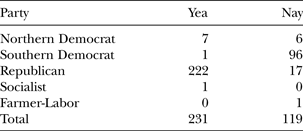
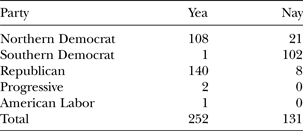
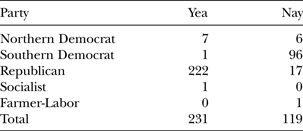
As Dyer's bill was readied for floor consideration, the Republicans succeeded in limiting debate to ten hours, with five minutes per speaker, through a special resolution introduced by Philip Campbell (R-KS), to the great consternation of southern Democrats who tried unsuccessfully to have the bill recommitted to the Judiciary Committee. Southerners also attempted to leave the House without enough bodies present to proceed—a dilatory tactic known as the “disappearing quorum”—but the Speaker ordered the chamber locked and dispatched the sergeant at arms to locate the missing members and expedite their return. Finally, on 26 January 1922, with a cheering crowd of several hundred black onlookers, the Dyer bill (H.R. 13) was passed 231 to 119.Footnote 82 As illustrated in Table 4, the vote was straight party line and sectional. Only 8 Democrats—all northern, except one from the border state of Kentucky—voted for the bill, and 7 of these were from the urban areas of Boston, Buffalo, Chicago, Pittsburgh, and greater New York; 102 Democrats voted against the bill, all from the South, border areas, or California. On the Republican side, one southerner from Texas voted for the bill and only 17 of the 222 GOP members voted against it, including Hersey from Maine.
House Passage of H.R. 13 (Dyer Bill), 67th Congress
Source: Congressional Record, 67th Congress, 2nd Session, (26 Jan. 1922): 1795–96.
One important and heretofore unnoticed (based on our investigation of the literature) point deserves mention here: a bare majority of those northern Democrats who participated on the Dyer bill roll call voted in favor of passage (7 in favor, 6 against).Footnote 83 Although most of these pro-Dyer Northern Democrats were relatively quiet during floor debate, preferring to let Republican leaders advocate for the bill, two did voice their support. Rep. William Bourke Cockran (D-NY) gave a lengthy speech, which was greeted with applause, and refused to give up the floor when his southern colleagues attempted to interrupt. Cockran blamed northern migration of blacks on “their horror of death by lynching.”Footnote 84 Calling lynching the “last phase of the race problem,” he went on to defend the constitutionality of the bill, saying, “If the Federal Government can step in to take a mug of wholesome beer from the hand of the workingman, it can step in to take a murderous halter from the hands of the lyncher.”Footnote 85 Rep. Anthony Griffin (D-NY) also took the floor in an impassioned speech and went even further than Cockran in depicting the hypocrisy of southerners who would use the Constitution when it satisfied their prejudices but were happy to “surrender their police power” for the Eighteenth Amendment. Though Griffin did not cast a vote on the final roll call, he warned his southern colleagues not to “destroy the Democratic Party in the North,” stating that
it is a fatal error on the part of my colleagues on this side of the aisle to take a stand in opposition to this measure… . To make opposition to this legislation the test of loyalty to Democratic principles would be … the most futile and ill-considered act of party leadership in the past 30 years. I warn you that Democrats of the North can not be dragooned into such policies.Footnote 86
Both Cockran and Griffin represented districts that included parts of the Bronx and Manhattan, where a large number of black voters resided. (Both districts were later redistricted to become a seat held by Adam Clayton Powell.)
This small northern Democratic majority in support of the Dyer bill illustrates the early stages of a partisan realignment on the issue of black civil rights; more specifically, this indicates that, as early as 1921, some Democratic politicians in the North began reaching out to black voters in key districts where the black population was beginning to possess electoral clout. This is considerably earlier than most historians document, as the typical accounts suggest that Democratic courting of black voters first began in the mid- to late 1920s. Indeed, those seven northern Democrats who voted for the Dyer bill could be seen as especially prescient, as black electoral mobilization around the Dyer bill—and subsequent reactions to congressional voting on the bill—would actually lead more northern Democrats to realize the importance of black voting power in the North. In Dyer's home state of Missouri, for example, black electoral mobilization—spurred on by urgings from black newspapers—helped defeat Democratic House incumbent J. F. Fulbright (D, 12th District) in 1924 and nearly cost Henry B. Hawes (D, 11th District) his seat as well. Hawes, in particular, was targeted by black leaders, based mainly on his unwillingness to support the Dyer bill.Footnote 87 In the end, Hawes won re-election by fewer than 2,000 votes, after winning by over 7,500 two years earlier.Footnote 88
Franklin D. Mitchell captures the Democrats' situation in mid-1920s Missouri—and, by extension, other northern states as well—nicely:
The continuing influx into Missouri of persons traditionally recruited to the Republican party, particularly Southern Negroes, threatened to relegate the once dominant Democratic party to permanent impotence. The party's return to power demanded the construction of a broader, united coalition.Footnote 89
A more concerted Democratic effort to reach out to black voters began in 1925–26 in Missouri.Footnote 90 Democratic politicians in other northern states, like Indiana and New York, made similar decisions around the same time,Footnote 91 whereas the national Democratic Party first actively courted northern blacks, as part of a general urban strategy, in Al Smith's bid for the presidency in 1928.Footnote 92
In addition to highlighting the early “reaching out” by northern Democratic politicians (the “supply side”), the politics of the Dyer bill also indicate the new electoral leverage exhibited by black voters in the North (the “demand side”), spurred along by the ambitions of black political leaders. Since Reconstruction, blacks had been loyal members of the Republican Party; by the early 1920s, they demanded action on civil rights policy (as embodied in a federal anti-lynching bill), and they were willing to use their electoral clout to make it happen. This included actively opposing Republicans—and supporting Democrats—if their policy demands were not met. (We discuss this at more length shortly.) More generally, black leaders saw the northern black electorate as being determinative in a host of northern elections, and they reveled in this status as a “pivotal group” throughout the remainder of the 1920s and most of the 1930s before gradually becoming loyal Democrats. In short, this was a period in which the black electorate was not “captured” by a single party, as Paul Frymer argues was the case later in the twentieth century.Footnote 93
Ultimate Failure: The Dyer Bill in the Senate
With the anti-lynching bill through the House and now under consideration in the Senate, Dyer, Johnson, and other supporters expressed confidence in its prospects for passage. According to Martin Madden, President Harding had stated: “If the Senate of the United States passes the Dyer anti-lynching bill, it won't be in the White House three minutes before I'll sign it; and having signed it, I'll enforce it.”Footnote 94 Proponents believed the threat of a filibuster was unlikely, and the 1920 elections had given the Republicans a majority of 22 seats in the Senate. However, even with every Republican senator behind the measure—itself not likely—the anti-lynching bill would need votes from five Democratic senators to achieve the necessary two-thirds to invoke cloture and overcome a filibuster. (Still, this was considered possible given that 11 of the 36 Democratic senators were not from the South). However, other problems also existed. For example, while Republicans were the majority on the Senate Judiciary Committee, none represented states with large black constituencies (Connecticut, Rhode Island, Idaho, Iowa, South Dakota, and Nebraska) and none was actively supportive of the NAACP. Moreover, the subcommittee that would handle the bill was comprised of members from states where blacks were either not a large constituency (Vermont, Rhode Island, and Idaho) or were populous but effectively disenfranchised (North Carolina and Tennessee). More generally, Senate Republicans were less responsive to black interests than their House counterparts, in part because blacks were concentrated in House districts but less influential in statewide elections, and few Republican senators were up for re-election in 1922 anyway.
In fact, Dyer and Johnson would find it difficult to maintain support for the bill in the Senate. One notable example was Henry Cabot Lodge, the majority leader, who was once a friend of black interests (sponsoring the famous Lodge Bill in 1891) but was now a lukewarm supporter and had to be coerced into toeing the party line on the Dyer bill. On the whole, the weak support of northern Republican senators stood in bold contrast to the unwavering and disciplined opposition of southern Democrats, which together sealed the bill's fate.
Among Senate Republicans, many were indifferent to the bill and a few powerful senators were strongly opposed on constitutional grounds. One such senator was William Borah (R-ID) who chaired the five-person subcommittee that would report the bill and affect the timing of Senate action. Borah told Moorfield Storey and James Weldon Johnson that he would not support the anti-lynching bill unless he could be assured of its constitutionality. After several failed attempts by Storey and Johnson in making such a case—a difficult undertaking given that the Supreme Court's reigning doctrine on civil rights did not make their upholding a federal anti-lynching measure likely—Borah remained steadfastly opposed, saying that he “would do anything possible to stop lynching short of violating the Constitution.”Footnote 95 After considering the bill, Borah's subcommittee sent a negative report to the full Judiciary Committee. Although there seemed to be a narrow committee majority in favor of the bill, Borah postponed consideration for several months until Henry Cabot Lodge, pressured by the NAACP and other Senate Republicans with (relatively-speaking) large black electorates, forced his hand.Footnote 96 Finally, after full consideration in the Judiciary Committee and an 8–6 favorable vote—with Borah joining the Democratic members in opposition—the bill was released. Borah's vote, the subcommittee report, the narrow committee margin, and the fact that some members of the Judiciary Committee reserved the right to change their vote under full Senate consideration signaled to opponents that Republicans were not united in their defense of the bill and that doubts about its constitutionality could be exploited. In this weakened condition, the bill was not brought to the floor for three months after being reported.Footnote 97
To keep hope for the anti-lynching bill alive, Moorfield Storey and Walter White, James Weldon Johnson's assistant at the NAACP, would try to take advantage of the approaching 1922 midterms in which one-third of Senators would be up for re-election. Republican leaders' aggressiveness in the struggle for the bill's passage would become a test of their loyalty to black voters. Because bill advocates rightly believed that the lukewarm support of Lodge and other Republicans would evaporate further without a significant electoral incentive, they sought to have it come to a vote before the election cycle had passed. If the bill were not considered until after November, there would be little chance for success. According to Storey:
We must get it passed before the election if at all. Nothing can be expected at the short session, and our main weapon, the Negro vote, will be gone… . Our policy is to unite that vote there and elsewhere in the announced resolve to vote against every Republican who does not do his bit to pass the bill. The Republicans have an overwhelming majority, and unless they use their power and keep their promise, they are not our friends.Footnote 98
In this context, the NAACP engaged in a multi-faceted lobbying effort for the legislation.Footnote 99 James Weldon Johnson drafted a petition and obtained the signatures of prominent politicians and leaders throughout the country, including 39 mayors, 24 governors, 30 editors, 88 preachers, 2 attorneys general, 47 prominent lawyers and judges, 29 university professors and presidents, and many other influential writers and editors.Footnote 100 This petition, along with newspaper accounts and NAACP reports about lynching, were sent directly to senators' DC offices. The NAACP also reminded the GOP of its platform promise at the annual convention:
The Republican Party has always received the bulk of the negro vote; the Republican Party is in power; the Republican Party has promised by its platform and its President to pass the Dyer bill. Unless the pledge is kept we solemnly pledge ourselves to use every avenue of influence to punish the persons who defeated it. We will regard no man as our friend who opposes this bill.Footnote 101
Moreover, in June 1922, thousands of blacks marched in Washington, DC, in support of the bill.
Dyer also campaigned for his bill. He recognized Lodge's wavering support, and in an “extraordinary move against a senior member of his own party,” he courted an audience in Massachusetts, recommending they vote against Lodge if he did not support the anti-lynching bill.Footnote 102 Lodge faced a difficult re-election battle in Massachusetts, which had a relatively sizable black electorate; though only 1.2 percent of the state population was black, over half of all New England blacks resided there and the population had grown since the last census. Other Senate Republicans were in a similar spot as Lodge. Senators Joseph France (R-MD) and Charles Townsend (R-MI) were also up for re-election—France in a state where 17 percent of the population was black, and Townsend in a state that had seen its black population more than triple in size from the 1910 to 1920 census (though blacks were still only 1.6 percent of the population).Footnote 103 Sen. William Calder (R-NY) was also up for re-election, and news reports indicated that black Republicans had attacked him for allegedly not supporting the Dyer bill. Calder responded with assurances: “I am quite certain that the colored voters understand my position on questions affecting their race.”Footnote 104
Senate Republicans were in a difficult position. They understood that they needed to do something on the anti-lynching bill to deliver on their 1920 platform pledge to halt lynching through federal action. However, they also knew that if the vote on the bill could be stalled until after the November elections, they could avoid black voting power in several important states like Indiana, Illinois, Michigan, New York, and Pennsylvania. If they could appear to genuinely endorse the Dyer bill amidst southern opposition and obstruction, they could curry favor with blacks at the polls while not creating unnecessary delays on their other legislative priorities, provoking hostility from white constituents, or destroying any possibility of improving the weak position of their party in the South. In the words of one historian who observed this latent motivation: “A constitutional reason for killing the bill or avoiding a vote on it could benefit political careers as well as the Republican party's hope of cracking the Solid South.”Footnote 105
Although the bill only had lukewarm support in the Senate, there were several additional reasons for its languishing there. As in the House, there were lingering concerns over the constitutionality of the bill. The institutional rules of the Senate also favored bill opponents who would enjoy unlimited debate unless Republican leaders could marshal the necessary votes for cloture. Southern Democrats in the House, defeated, fully expected their counterparts in the Senate to use all the parliamentary tactics at their disposal to block the bill's passage. Southern Democrats believed that much more dire events would follow if the federal anti-lynching measure passed. As Keith Finley notes, southern Democrats viewed the federal anti-lynching proposal as
the initial act in a play that might culminate in the demise of Jim Crow … southern senators believed that by defeating bills that threatened only the periphery of the Jim Crow edifice, such as antilynching legislation, they could halt a broadening of the civil rights agenda by preventing the formation of an “opening wedge” through which more sweeping proposals would flow.Footnote 106
Moreover, the responsibility for shepherding the bill on the floor was given not to a senator experienced in overcoming obstructionism but to a political neophyte and unseasoned floor leader, Sen. Samuel Shortridge (R-CA), who was serving in his very first Congress. Shortridge was “a fighter” and had his “heart in the legislation,” according to James Weldon Johnson, and it was hoped these traits would make up for his lack of parliamentary experience.Footnote 107
Shortridge performed his role diligently, but after moving to take up the bill on 27 November 1922, he was quickly interrupted by several senators who wished to have other business considered.Footnote 108 Shortridge and France protested, struggling to maintain order; when Shortridge finally regained the floor, dozens of senators had left the chamber. While a quorum was present at the start of Shortridge's speech, only 27 senators remained once the procedural dust had settled, which meant that his motion would not get consideration.Footnote 109 Even Lodge, the majority leader and erstwhile supporter, was absent. Only Howard Sutherland (R-WV) protested and asked members to remain and consider the bill, stating that lynching was a “a blot upon our boasted civilization” that
begets a contempt for law and breeds a disposition upon the part of those inflamed by passion, even on account of minor offenses, to commit murder under the guise of wreaking vengeance for the protection of society. If we admit this principle, how can any one of us or our families be safe?Footnote 110
Despite Sutherland's avowals that the bill was constitutional, national (and not sectional), and necessary to preserve the “fundamental principles of government,” none of the senators responded. As a result, the Senate adjourned and the Dyer bill was pushed to the next session after the election.
The NAACP was deeply disappointed in the disappearance of their Republican allies. Moorfield Storey observed that “so many of the persons supposed to be our active supporters did not take enough interest to remain in their seats when the bill was called.”Footnote 111 It was a significant setback for NAACP leaders who publicized their disappointment in the Crisis, listing the names of every senator who did not respond to the quorum call and warning GOP senators that if the bill was not passed in the post-election session, they would consider it as a broken promise to blacks.
When the Senate reconvened in late November 1922, consideration of the Dyer bill began again, and it faced a precarious situation. The November elections had resulted in the loss of some anti-lynching proponents, including Volstead and Ansorge in the House and Sutherland, France, Townsend, and Calder in the Senate. Overall, Republicans lost 8 Senate seats and 74 House seats, reducing the GOP majority from 22 to 6 in the Senate and from 167 to 15 in the House. For a federal anti-lynching bill to be passed, therefore, it had to be brought up for a vote while Republicans still had a large numerical advantage in the few remaining weeks of the 67th Congress (that is, the lame-duck session). In order to pressure the lame-duck Republicans in the Senate to support the Dyer bill, the NAACP ran a page-length advertisement about lynching in nine major newspapers including the New York Times and the Atlanta Constitution. The ad was entitled “The Shame of America” and encouraged constituents to contact their senators with telegrams in support of the anti-lynching legislation. They also unleashed a massive publicity campaign to exert additional pressure. Examples included open letters to the Senate, press releases, and newspaper editorials, among other techniques. Their objective was to prevent the GOP from abandoning the bill. If it failed now, the Dyer bill would have to be reintroduced and passed by the House again in the following (68th) Congress.
The NAACP and anti-lynching proponents faced a determined Senate filibuster led by Senate Minority Leader Oscar Underwood (D-AL), Pat Harrison (D-MS), and Thaddeus Caraway (D-AR). They threatened to halt any Senate business unless the matter was put to rest and repeatedly referred to the anti-lynching measure as a “force” bill.Footnote 112 In recognition of the filibuster, Underwood (who was a critical player in the opposition to representational reduction in 1901) proclaimed:
We are not disguising what is being done on this side of the chamber. It must be apparent, not only to the Senate, but to the country, that an effort is being made to prevent the consideration of a certain bill, and I want to be perfectly candid about it… . We are going to transact no more business until we have an understanding about this bill… . If you gentlemen want to continue, after this candid statement of the case, and keep this bill before the Senate, when you know it is going to be blocked and can not be passed … Go ahead, and we will have roll calls and move adjournments day and night … we might as well come to an understanding and lay the bill aside, because you can not pass it. You know you can not pass it.Footnote 113
The Democrats unleashed several parliamentary tactics, including skirting quorums, reading the daily journal ad nauseum, adding amendments to the journal, and introducing procedural motions to delay the proceedings; several newspaper accounts claimed it was the most organized and efficient filibuster since the failed Lodge Bill.Footnote 114 Ultimately, the GOP yielded to the filibuster, as a caucus of Republican senators met in the evening of 2 December 1922 and voted to abandon the Dyer bill;Footnote 115 although debate in the caucus was contentious, only 9 of the over 50 Republicans supported continuing the fight against the filibuster.Footnote 116 The Republican Conference minutes document that only a few days prior (28 November) the caucus had met and decided to keep pressing for passage of the anti-lynching legislation; not one of the Republican senators voted against it.Footnote 117 The fact that, only a few days later, the caucus met and decided to abandon the bill suggests that the Senate Republicans had become wary of its prospects for passage and worn down by the filibuster. Lodge thanked the caucus for being willing to sacrifice the anti-lynching bill so that the Senate could resume its business.
When Senate proceedings resumed on 4 December 1922, Lodge announced that he would not seek any further action on the Dyer bill. In an embarrassing moment, he was pressed by Underwood to promise not to raise the bill again in the future. Lodge responded that although he believed that the bill ought to pass, he also felt that “[t]he bill could not pass, as it would be impossible to change the rules now; and the conference decided that they would not press the bill further” in the expiring session or the following one.Footnote 118 Underwood reminded Lodge that if the Dyer bill came up again, “we would renew the fight.”Footnote 119
Leaders of the NAACP immediately blamed both parties for the failure of the anti-lynching measure, but were more embittered toward Senate Republicans whose non-action and indifference was viewed as a betrayal.Footnote 120 The Republicans had a sizeable majority in the Senate, but only five had given speeches to advance the bill—Shortridge, Walter Edge (NJ), Frank Willis (OH), Harry New (IN), and Albert Cummins (IA)—and only nine had supported holding out against the filibuster until March of the next year (the end of the session) if necessary.Footnote 121 Not one senator stood when Kenneth McKellar (D-TN) asked that any and all lawyers on the Senate floor (aside from Shortridge) rise if they thought the bill was constitutional; Shortridge himself could not answer McKellar's challenge to give the name of another senator who believed the bill was entirely constitutional.Footnote 122 Finally, President Harding had failed to actively support the bill in the final moments. The New York Times even suggested that Senate Republicans were relieved by the emergence of the filibuster, because it allowed them to blame southern obstructionism for the defeat of a bill that they did not care much for anyway.Footnote 123
The NAACP Annual Report reprinted communication between NAACP leaders and the secretary to President Harding. The NAACP had telegraphed the president an urgent message to continue support of the bill immediately before it was abandoned, to which Secretary George Christian replied after defeat of the bill:
I also feel that our colored citizens will justly place the responsibility for this where it belongs, to wit, upon the Democratic minority … As you know, the President recommended the Anti-Lynching Bill to Congress. The Republican House passed it. The Republican majority in the Senate has labored earnestly and sincerely … to bring about its enactment. The bill is blocked by the Democratic filibuster … It will avail no one to deceive himself about the inability of the Senate to sweep aside the filibuster tactics of the determined minority.Footnote 124
In a response that did not conceal his anger, James Weldon Johnson wrote back that the feeling among blacks was “one of more than disappointment” and was “a feeling of chagrin and resentment”:
But colored citizens also know that the Republicans in the Senate exerted almost no aggressive effort; that they practically sat mute and allowed the Democrats to assume responsibility for the failure of the Bill. The colored people of the country expected and had the right to expect more than this of the large Republican majority in the Senate. The Republican leadership really accepted defeat at the opening of the fight … This lukewarmness on the part of the Republicans is as much resented by the colored people as the aggressive tactics of the Southern Democrats … The present state of mind of the colored people will be far-reaching in its effects.Footnote 125
The belief that the Republican Party had sacrificed the lynching fight through sheer disinterest would not go unpunished by the NAACP. Johnson, who to this point had largely concealed his frustration, was now openly chilly to the party; he wrote an “Open Letter to Every Senator of the United States,” wherein he indicated that several lynchings had occurred after the Dyer fiasco and blamed obstructionism and Republicans' legislative impotence for those deaths.Footnote 126 The NAACP also aggressively campaigned against several Republicans who had been absent in the Senate on the crucial roll call or had voted against the bill in either chamber, including Senators Joseph Frelinghuysen (NJ) and Joseph McCormick (IL), and Reps. C. Bascom Slemp (VA), E. Wayne Parker (NJ), Caleb R. Layton (DE), Patrick H. Kelley (MI), and W.H. Stafford (WI).Footnote 127 All of them ultimately lost. Kelley ran against Charles Townsend for a Senate seat and the NAACP threw their support to Townsend.
The failure of the Dyer bill marked the beginning of black disaffection with the GOP, which would continue throughout the decade.Footnote 128 In an article entitled, “Political Effect of the Dyer Bill – Delay in Enacting Anti-Lynching Law Diverted Thousands of Negro Voters,” Ernest Harvier of the New York Times discussed the black disaffection at length:
The action of the Republicans in passing the bill was regarded by their negro followers as belated and the delay over its adoption as an evidence of bad faith. Hence their defection last year from the Republicans in New York City and in many other cities throughout the country and this year in Chicago, Kansas City and Philadelphia.Footnote 129
In addition, several black organizations had sent telegrams to Curtis, Shortridge, Lodge, and Watson, charging that their efforts for the anti-lynching bill were “half-hearted,” to which a defensive Curtis responded: “We did everything that was possible under the rules in an effort to jam through the antilynching bill and we only gave up the fight when we saw that it was useless to keep up the struggle, which was blocking the passage of important legislation of noncontroversial nature.”Footnote 130 The Republicans' sincere intentions cannot be known; however, it is clear that black leaders were not convinced that the GOP had labored as intensely as it could have. As a result, black leaders began to reevaluate their ties to the Republican Party, and they also began a search for new allies.
Only a few months after the Dyer bill's defeat, the National Negro Republican Conference met in New Jersey and considered the question of how to exert political pressure to secure black interests (including the Dyer anti-lynching legislation); according to newspaper coverage of the meeting, discussion of blacks “bolting” from the Republican Party was a prominent theme.Footnote 131 Another group of leading black Republicans from several states convened under the direction of Dr. George Cannon, in charge of the National Colored Republican Conference, which had become upset about the Dyer bill failure.Footnote 132 The year after the Dyer bill's defeat, a new group called the Non-Partisan National Association of Colored Voters convened in Chicago with delegates representing 17 states. This new group, as Zangrando notes, was “designed to break black voters from Republican ranks,” and sent messages throughout the country in pursuit of its goal.Footnote 133 One of the messages commended the actions of several Democrats in Indiana, Maryland, and New York who had endorsed the conference's support of anti-lynching legislation. Furthermore, in 1923, the NAACP issued a message to its members recommending political independence and the abandonment of historic party labels; later, it passed a formal resolution against Republican allegiance and support for a third party movement.Footnote 134 That same year, black leaders protested President Coolidge's appointment of former Rep. C. Bascom Slemp (R-VA) as his personal secretary on the grounds that Slemp was one of the 17 Republicans to vote against the Dyer bill, calling the appointment a “repudiation” of black Republican voters.Footnote 135 The activities of these various group all indicated the same thing: black loyalty to the Republican Party was becoming unhinged.
Coda
The tortured death of the Dyer bill in 1922 would prove to be the last gasp of anti-lynching action for another decade and a half. After defeat of H.R. 13, ten more anti-lynching bills were introduced, including three by Dyer himself, but none generated much momentum.Footnote 136 The 1924 and 1928 Republican platforms contained requests for congressional legislation on lynching, and President Coolidge asked Congress for a bill after being elected in 1924, but these were largely pro forma. Although an anti-lynching bill ultimately failed to successfully navigate the Congress, it was one of the only pieces of pro-black legislation introduced during this period.Footnote 137
Perhaps the Dyer bill's greatest legacy was in helping to reduce blacks' allegiance to the Republican Party. While the GOP had been the sole sponsors of anti-lynching legislation, the lukewarm support of Republican rank-and-file members and leaders like Lodge during the campaign for the Dyer bill generated resentment among prominent black leaders. This disaffection grew at a time when black political power was on the rise, thanks to the expansion of the black electorate in northern states and large urban centers. The diminished reputation of the GOP among black elites soon trickled down to black voters who, by the 1928 election, had begun to defect in large (and growing) proportions throughout the North.Footnote 138 To reiterate an earlier point, by the end of the 1920s, blacks had no alliance and were not “captured” (in Paul Frymer's language).Footnote 139 As congressional Democrats reemerged in the North in the 1930s, thanks to FDR's coattails, they would be poised to be the “friendly party” to blacks, a title they could not actively compete for given their small numbers in the 1920s. In fact, the largely party-line votes in the Dyer years would become more divided in the 1930s, as northern Democrats would sponsor and support new anti-lynching legislation, much to the chagrin (and vocal opposition) of the party's southern wing.Footnote 140 These successors to the Dyer bill would expose a widening sectional rift in the Democratic Party. It is to this later episode that we now turn.
IV. THE SECOND CAMPAIGN FOR ANTI-LYNCHING LEGISLATION IN CONGRESS, 1930–1940
As the preceding sections have noted, the push for civil rights legislation did not disappear with the failure of the Lodge Bill and then reappear, as some have argued, because of World War II.Footnote 141 The politics surrounding Dyer's anti-lynching proposal in the early 1920s demonstrated the increasing electoral clout of black voters, their growing dissatisfaction with the Republican Party, and the salience of civil rights issues. With continuing black migration to northern urban centers and an ascendant urban-based Democratic coalition in northern states, anti-lynching emerged again in the 1930s as a potent political issue. This time, however, political contestation over civil rights would fracture the historic linkage between black voters and the Republican Party—already weakened by the events of the 1920s—thereby allowing Democratic members to make significant political inroads long before the historic civil rights battles of the 1950s and 1960s.Footnote 142
We argue that the legislative battle over federal anti-lynching legislation during the 1930s contributed significantly to the shift, or realignment, in blacks' party loyalty. Prior to WWII, black voters did not embrace the Democratic Party simply as a consequence of FDR's economic policy; rather, northern Democrats repeatedly used federal anti-lynching legislation as a tool to capitalize on the weakened link between blacks and the Republican Party. In so doing, the Democratic Party won the political loyalty of black voters despite the fact that a filibuster—sustained by a coalition of Southern Democrats and Republicans—again stymied final passage of any anti-lynching measure.
Back on the Agenda: The Anti-Lynching Effort Renewed
Between 1910 and 1960, five million blacks left southern states for northern cities. As Douglas McAdam documents, the North and West saw exponential increases in black population over this half-century, with large numbers of black migrants settling in seven “key northern (or western) industrial states.”Footnote 143Table 5 documents the total number of migrants entering these key states. Moreover, both McAdam and Alan Ware identify these states as highly contested and ones that that proved necessary for the construction of winning Electoral College coalitions for both parties during this era.Footnote 144 The drive to pass anti-lynching legislation was one strategy for winning the loyalty of these new voters.
Black Migration Patterns, pre-World War II

Source: McAdam, Political Process, 80.
Responding to this influx of new voters, Democratic politicians in a number of northern cities began “actively courting the black vote.”Footnote 145 Such appeals were commonplace for Republican politicians, and (as noted earlier) a small number of Democratic politicians had begun reaching out to black voters in the 1920s. However, with FDR's landslide election in 1932, the political landscape had changed; the new northern Democratic coalition, which rode into office on FDR's coattails, was significantly more liberal than previous incarnations. Almost overnight, this energetic group of northern New Dealers took ownership of the anti-lynching agenda in Congress. As Figure 2 illustrates, the first piece of anti-lynching legislation introduced by a Democrat in the House occurred in 1934, and by 1937 individual Democrats had introduced 40 anti-lynching bills. Additionally, as Figure 3 demonstrates, members from the states deemed pivotal by McAdam and Ware authored much of the anti-lynching legislation introduced in the 1930s.
Anti-Lynching Legislation Bills Introduced by Party, 1918–1940.

Anti-Lynching Legislation Bills by Author's Home State, 1930–1940.

The demand for anti-lynching legislation increased as racial violence intensified during the Great Depression years. Although the total number of lynchings had steadily dropped through the 1920s—to as few as 7 in 1929—an uptick occurred in the 1930s, with 28 reported in 1933.Footnote 146 As a consequence, a number of civil rights organizations pressed Congress for federal legislation to prevent and punish the crime.Footnote 147 In 1933, the Committee on Interracial Cooperation called attention to the problem of lynching by publishing two tracts, The Tragedy of Lynching and Lynching and the Law, which they distributed to “every Southern editor, library, and college.”Footnote 148 In addition, a number of advocacy groups including the Young Women's Christian Association, the Federal Councils of Churches of Christ, the Women's Missionary Council of the Methodist Episcopal Church, the American Civil Liberties Union, and the Writers' League Against Lynching also made public appeals for federal legislation.Footnote 149 The support offered by religious organizations proved particularly important. For in a speech to the Federal Councils of the Churches of Christ, President Roosevelt offered his first thoughts on lynching through a denunciation of the practice as a “vile form of collective murder” and the claim that “America … seeks a government of its own that will be sufficiently strong to protect the prisoner and at the same time to crystallize a public opinion so clear that government of all kinds will be compelled to practice a more certain justice.”Footnote 150 Although Roosevelt famously withheld support for a federal law, legislators would use indirect shows of support like the one above as they fought to pass an anti-lynching bill.
Of course, the most influential advocacy organization pushing for a federal anti-lynching bill in the 1930s was once again the NAACP. Walter White, now executive secretary of the NAACP, spearheaded a public-education campaign, which he believed could “mobilize support within and beyond the black community” that would pressure legislators to pass a federal law.Footnote 151 White also publicly declared that he had asked Sen. Edward P. Costigan (D-CO), a former member of the Progressive Party, to introduce legislation that would enhance federal authority to punish lynching.Footnote 152 According to T.H. Watkins, the efforts of White and the NAACP to demonstrate widespread support for the measure, when combined with his ideological predispositions, “persuaded” Costigan to offer a bill.Footnote 153 Sen. Robert Wagner (D-NY), a leader in the early New Deal movement, was brought in as a co-sponsor shortly thereafter.
On 4 January 1934, during the second session of the 73rd Congress, Costigan and Wagner introduced S. 1978, which largely reflected the goals first elucidated by the 1921 Dyer proposal.Footnote 154 It also became the model used by anti-lynching advocates in both the Senate and House in the proceeding years. The Costigan-Wagner bill empowered the federal government to “invade state jurisdictions” when state or local officials “fail or refuse” to prevent a lynching; created a federal penalty of five years in prison or $5,000 fine for any officer “failing to exercise diligence in preventing or punishing mob violence”; mandated “imprisonment from five years to life for any state officer who affirmatively abets such mob violence” and “any county in which a lynching occurs is to be liable for a $10,000 fine, to be devoted to the victims family;” and gave federal courts “jurisdiction where state instrumentalities give evidence of failure.”Footnote 155 It thus represented an effort to expand federal police power into the individual states, a fact that did not go unnoticed by southern Democrats.
On 20–21 February 1934, the Senate Judiciary Committee held hearings on the bill, taking testimony from a wide range of witnesses including spokespeople from the American Civil Liberties Union (ACLU), Young Women's Christian Association, Women's International League for Peace and Freedom, as well as academics, lawyers, and state officials from around the country. Also testifying were Walter White and other representatives from the NAACP. White sought to demonstrate the political support for anti-lynching legislation by highlighting the NAACP's membership numbers—378 branches and 85,000 individual members—and by presenting letters of support from the governors of 12 states.Footnote 156 He went on to invoke the “long, drawn out filibuster” that had brought down the Dyer bill in 1922 but suggested that “far-reaching and subtle changes” had taken root in the succeeding dozen years that simultaneously increased the importance of the bill and its potential to be passed. Specifically, White cited shifting public opinion in the South on the acceptability of lynching as well as changing views on the appropriate size of the federal government.Footnote 157 Here he anticipated the appeal to “states rights” that members frequently used to undermine civil rights legislation by arguing that “no ‘state rights’ arguments are ever raised when the states seek financial aid for relief, public works, and other boons for the federal government.”Footnote 158
On 12 April 1934 the Judiciary Committee favorably reported the Costigan-Wagner bill to the floor on a voice vote.Footnote 159 At the time, the committee was skewed toward the interests of the South and Midwest; yet, according to Chairman Ashurst (D-AZ), there were only “two or three votes against it.”Footnote 160 By the end of May, however, the Senate still had not considered the bill. With summer and adjournment looming, Costigan took to the floor and—citing the “approximately 40,000,000 American citizens” who voiced support for the measure either directly or indirectly through the spokesmen of supportive organizations—sought to demonstrate the political risks facing those who worked to prevent consideration of his measure.Footnote 161 Walter White echoed this appeal in a New York Times letter to the editor, which highlighted broad public support for the bill and Roosevelt's December speech.Footnote 162 Still, even with language changes and these direct appeals, southern senators threatened to filibuster and the Democratic leadership refused to take up the bill for full debate. As a consequence, the Senate adjourned in June without considering the measure.Footnote 163
Not to be deterred, Costigan and Wagner reintroduced their bill (S. 24) on 4 January 1935, a day after the 74th Congress opened, and on 12 February, they made a fifteen-minute radio address on CBS radio network.Footnote 164 Two days later, the Senate Judiciary Committee again held hearings to discuss the bill. Walter White appeared with other supporters, including Charles H. Houston, dean of Howard University; newspaperman H.L. Mencken; Reps. Caroline O'Day (D-NY) and Thomas Ford (D-CA); and Sen. Joseph Guffey (D-PA). White used his testimony to demonstrate broad support for the bill, presenting the committee with a petition signed by “327 prominent Americans” that asked President Roosevelt “to make the Costigan-Wagner lynching bill a ‘must pass’ piece of legislation.”Footnote 165
Although the committee reported the Costigan-Wagner bill to the floor with full consideration scheduled for April, southern senators would not acquiesce. Led by Josiah Bailey (D-NC), Ellison Smith (D-SC), and Tom Connolly (D-TX), a week-long filibuster was instituted. Sen. Bailey even invoked northern General Ulysses Grant when he stated his readiness to “fight it out on this line if it takes all summer.”Footnote 166 The filibuster effort was strategic, as it prevented consideration of other legislation deemed important to the Democratic majority—specifically a bill to provide cash assistance to veterans. As a consequence, the Majority Leader Joseph Robinson (D-AR) sought to displace the Costigan-Wagner bill by scheduling adjournment votes, which, if passed, would clear the legislative agenda for consideration of other measures. On 26 April 1935, supporters of the bill narrowly defeated this tactic, 33–34. By 1 May, however, the filibuster effort had taken its toll, and a second effort to adjourn passed by a vote of 48–32.Footnote 167
As a tactic of procedural delay, adjournment votes benefit the filibustering minority, because as “adjournment looms the resolve level required to kill legislation falls considerably” because the time necessary to obstruct is limited by a procedural rule.Footnote 168 In this way, the threats made by southern members to filibuster all summer likely convinced many members to switch sides and vote for adjournment.Footnote 169
Nevertheless, as Table 6 demonstrates, the effort to displace the Costigan-Wagner bill could not have succeeded without the support of northern Democrats who, up to that point, had fought to ensure full consideration of the bill. Although no single account can explain the rationale behind each member's decision to switch, The New York Times reported that with Sen. William Borah's (R-ID) decision to support adjournment, other marginal members also switched their votes.Footnote 170 Despite his opposition to the underlying bill, Borah had previously supported full consideration of the measure. As the filibuster proceeded, however, he had come to believe that the bill “would never be brought to a final vote” so it was necessary to “consider other matters.”Footnote 171 As a result, advocates of the Costigan-Wagner bill had no choice but to wait and reintroduce it in the next session.
Senate Adjournment Roll Calls during Consideration of Walker-Costigan Bill, 74th Congress

Source: Congressional Record, 74th Congress, 1st Session, (26 Apr. 1935): 6469; (1 May 1935): 6687.
On 3 January 1935, Rep. Joseph Gavagan (D-NY) followed the lead of Senators Costigan and Wagner by introducing similar anti-lynching legislation in the House.Footnote 172 Gavagan represented a district that included Harlem and had won his seat in 1929 against Hubert Delaney, “a black lawyer and future NAACP Board member.”Footnote 173 Gavagan's re-election interests were thus bound up with support from the black community. Indeed, as NAACP member Roy Wilkins recounts in his autobiography, Gavagan emerged as one of the “main allies” of the NAACP within Congress.Footnote 174 Accordingly, he worked with White and the NAACP to push for federal anti-lynching legislation. Gavagan was not the lone supporter of a federal ban, however, as House members from New York, Kansas, California, Indiana, Illinois, Connecticut, Pennsylvania, Ohio, New Jersey, and Minnesota—states that saw the largest influx of black migrants between 1910 and 1940—introduced nineteen additional pieces of anti-lynching legislation in 1935 alone. Thus, like Gavagan, these members realized their re-election interests were tied to black votes.
As the debate over anti-lynching legislation began in the House, members in both parties acknowledged the shifting partisan allegiance of black voters. In 1936, Rep. Arthur Mitchell (D-IL), the only black member of the House, took to the floor and called for “the early passage of a bill which will make … [lynching] punishable by a Federal law enacted by Congress.”Footnote 175 In the same speech, however, he also declared that “for more than 50 years my people have been almost solidly registered in the Republican Party. It is only during the past 4 or 5 years that Negroes have found that the Democratic Party is a safe place to live and vote.”Footnote 176 He went on to argue that the Republican Party had “abused the Negroes more than it [had] abused the country” and that in the 1936 election, black voters would “give the Democratic Party and the great President … the largest vote that any Negro group has ever given a President of the United States.”Footnote 177
This speech sparked a defensive response from Rep. Albert Engel (R-MI) who, in a speech of his own, challenged Mitchell's claims by recounting the history of Democrat-sponsored oppression of blacks.Footnote 178 He also pointed out that
when the Costigan-Wagner anti-lynching bill came up at the last session of Congress in the other body, it was defeated by a filibuster conducted by Democratic members … that there are 315 Democrats and only 103 Republicans in the House and 70 Democrats and only 23 Republicans in the Senate; that the Committee on the Judiciary, which has the bills under consideration, consists of 18 Democrats and 7 Republicans. If the Democratic Party is such a good friend of the Negro, why has it buried this legislation in which the Negro race is so deeply interested?
With his response to Mitchell, Rep. Engel gave voice to Republican concerns over the shifting partisan allegiance of black voters. As a representative of the state that received the fifth largest number of black migrants, Engel was intimately aware of the political ramifications of a wholesale black party switch. Indeed, in his re-election campaign in 1936, Engel defeated his Democratic Party opponent by a slim 580 votes out of 81,085 votes cast, while in 1934, he had won by 2,709 votes out of 63,940 votes cast.Footnote 179 This was a lesson that was not lost on other members.
Despite the back-and-forth over who best represented black interests, Engel's observation about the Democrats being responsible for blocking anti-lynching legislation rang true, as the Gavagan bill was bottled up in the Judiciary Committee due to the opposition of its Chairman, Rep. Hatton Sumners (D-TX).Footnote 180 Sumners had a long history of opposing anti-lynching measures, going back to the Dyer proposal in the early 1920s. More recently, in the 1934 Senate hearings on the Costigan-Wagner bill, Sumners appeared as the only witness testifying in opposition to the bill, as he rehashed states' rights arguments and attempted to make the case that federal legislation would undermine state-level efforts to curb lynching.Footnote 181 Now, Sumners would strike yet again, using his committee influence to stall legislative action on the Gavagan measure for the remainder of the 74th Congress.
Stymied in the Senate: The Pivotal Anti-Lynching Debate of 1937–1938
All was not lost, however, for the anti-lynching forces. While Sumners was operating as a procedural roadblock, Walter White continued to cultivate support by using the anti-lynching battle as a fundraising tool and by getting members to publicly declare their support for the bill.Footnote 182 This effort proved to be critical as Gavagan reintroduced his bill (H.R. 1507) in 1937, during the 75th Congress. He also took steps to circumvent opponents on the Judiciary and Rules Committees by filing a discharge petition to release his bill from both committees.Footnote 183 On 29 March 1937, he filed the petition with the signatures of 218 House members—cultivated in part thanks to White's efforts—and on 12 April 1937, the House took up consideration of H.R. 1507. At the same time, the lynching of two blacks in Mississippi focused the nation's attention on the brutality of this crime. White and Gavagan both used these murders to highlight the importance of federal legislation, and on 15 April 1937, the House passed Gavagan's bill by a vote of 277–120.Footnote 184
This vote is important because it represented the first Democrat-sponsored anti-lynching bill to pass the House. The roll-call data appear in Table 7 and illustrate a sentiment expressed by one member who noted that “not in fifteen years … had there been such a display of sectional feeling,”Footnote 185 as northern Democrats and Republicans voted overwhelmingly against southern Democrats. Also interesting is that this vote came after Chairman Sumners sought to undermine Gavagan's legislation by bringing to the floor a weaker bill, authored by Arthur Mitchell. Sumners later admitted to Walter White that “quite frankly … he had not believed that … [the NAACP] would have the nerve to oppose passage of a bill introduced by the one Negro member of Congress.”Footnote 186 The NAACP did, however, oppose the Mitchell bill because
[it] applied only to victims seized from official custody; the Gavagan bill covered all instances of mob violence against life and person. For officials found guilty of conspiring or cooperating within the mob, the Mitchell bill proposed imprisonment from two to ten years; the Gavagan bill carried a term of from five to twenty-five years. While Mitchell's bill remained silent about initial federal jurisdiction, Gavagan's invoked action by the United States District Court thirty days after the crime, if state and local officials had failed to respond. The Mitchell bill provided only for a $2,000 to $10,000 fine on the county of death; Gavagan's version held both the county of abduction and the county of death liable. Finally, unlike Mitchell's the Gavagan bill explicitly exempted from creditors' claims any damages assessed against the county(s) on behalf of the victim's survivors.Footnote 187
As the roll-call data in Table 7 illustrate, the Mitchell bill split the Democratic Party, with northerners supporting it and southerners opposing it, whereas the Republicans demonstrated near uniform opposition to the “compromise” measure. Here we see strong support for strong anti-lynching legislation among House Republicans.
House Roll Calls on Gavagan Bill (H.R. 1507) and Mitchell Compromise Bill (H.R. 2251), 75th Congress

Source: Congressional Record, 75th Congress, 1st Session, (15 April 1937): 3563–64; (7 April 1937): 3253.
While Gavagan's measure became the primary vehicle through which the anti-lynching effort would operate, it is important to remember that in 1937, individual House members introduced fifty-eight pieces of anti-lynching legislation (see Figure 2). Further, Democrats authored a vast majority of these bills, thus demonstrating their increased willingness to embrace ameliorative civil rights policy. This was due in large part to the new constituency demands placed on these members by black voters. For, as Engel's re-election demonstrated, those House members from states facing an influx of black residents could not afford to rely on their traditional re-election coalitions. Nancy Weiss provides a more systematic analysis of the new political dynamics facing members like Engel by reporting the dramatic increase in support for Democratic candidates in Illinois, Ohio, Michigan, New York, Pennsylvania, and Tennessee between 1932 and 1936.Footnote 188 Additionally, contemporaneous accounts in black newspapers highlighted the increasing political influence of black voters.Footnote 189
The increasing political influence of black voters also did not go unnoticed by opponents of the bill. Specifically, southern Democrats couched their opposition as a defensive move against northern members who aimed to use black voters as a tool to supplant the southern coalition. For example, Rep. Rankin (D-MS) argued that Gavagan's bill represented a “demagogic aspersion on the south” and that it was designed to “make Harlem safe for Tammany,” whereas Rep. Sumners (D-TX) argued that the bill undermined the “70 year effort” to stop lynchings in the South.Footnote 190 Other southern Democrats classified the bill as “the collection of a bill for services rendered,” as northern Democrats sought to repay a debt they owed to blacks for their support in the 1936 elections.Footnote 191
With House approval of the Gavagan bill, the scene shifted to the Senate. In June 1937, the Senate Judiciary Committee successfully reported the bill after a 12–3 vote, with only Senators Borah (R-ID), Pittman (D-NV), and Connally (D-TX) voting in opposition. Still, with debate scheduled for August, Sen. Wagner again found himself fighting to ensure that it would be considered before adjournment.Footnote 192 In August, as the Senate began debate on the District of Columbia Airport bill, after which the chamber would begin an “orderly adjournment free of controversy,” Wagner secured the floor and called for consideration of the anti-lynching bill.Footnote 193 Senate Majority Leader Alben Barkley (D-KY) immediately called for adjournment, but anti-lynching advocates prevented the measure from passing. Intraparty squabbling then broke out, threatening further legislative action and the previously hoped-for “orderly adjournment.” Wagner then worked with Barkley to postpone debate and have the Senate begin consideration during a special session called for November, whereupon the anti-lynching bill would be made a special order of business.Footnote 194 Upon return, however, southern members began a six-week filibuster, sustained by a coalition of southern Democrats and Republicans. Republican cooperation in this obstruction effort, combined with increasing northern Democratic support for anti-lynching proposals, is illustrative of the civil rights initiated party switch.
The first cloture vote, held on 27 January 1938, failed 37–51 along sectional and party lines with every southern Democrat and all but 1 Republican opposing cloture.Footnote 195 A second cloture vote failed 42–46 on 16 February 1938, with 1 Republican and 3 Democrats switching sides to support it.Footnote 196 Support for cloture came almost exclusively from northern Democrats, reflecting the new political dynamic in the nation. These cloture votes, details of which appear in Table 8, are also important because they demonstrate a dramatic reversal in Republican Party positioning on the anti-lynching issue. In its reporting on the failed cloture votes, the Chicago Tribune noted that with Republican opposition to cloture “the historic roles of the Republican and Democratic parties were reversed” because for the first time since the end of the Civil War, the Republican Party opposed federal anti-lynching legislation.Footnote 197
Senate Cloture Votes on Gavagan Bill (H.R. 1507), 75th Congress

Source: Congressional Record, 75th Congress, 1st Session, (27 Jan. 1938): 1166; (16 Feb. 1938): 2007.
The rhetoric used by southern Democrats in the Senate during the filibuster echoed the House debate insofar as those opposing the bill railed against the political influence of black voters within the Democratic Party. Sen. Byrnes (D-SC) warned that if Walter White of the NAACP could “order” this bill to pass, “what legislation will he next demand of Congress and the United States?”Footnote 198 Sen. Carter Glass (D-VA) argued that the bill was “merely for the purpose of aiding Negrophilists to gain Negro votes in doubtful states,”Footnote 199 and Sen. Theodore Bilbo (D-MS) asserted that “we are now confronted by … rising generations of discontented and trouble-making hybrids, mulattos, quadroons, and octroons, seeking the elective franchise and conniving with deluded whites, negrophilists, and miscegationists, for the balance of power in determining political issues.”Footnote 200
Republican Minority Leader Charles McNary (R-OR) couched his opposition to the measure in different terms, claiming that the effort to invoke cloture amounted to the imposition of a “gag rule” on the minority party.Footnote 201 The right to uninterrupted debate, he argued, represented the “last barrier to tyranny.”Footnote 202 He also made clear that his party's opposition to cloture did not indicate opposition to the underlying bill. Indeed, he argued that Republicans supported the anti-lynching measure but were unwilling to relinquish their minority rights to support it.Footnote 203
McNary used floor speeches to disclaim any GOP responsibility for the sustained filibuster—despite the party's near-uniform votes against cloture—while also signaling support for the underlying bill. In a January 1938 floor speech, McNary argued that “the entire Republican membership of the Senate, save two, sincerely desire to see the antilynching [sic] bill passed” but that its fate was sealed by the “timidity … shown in pushing it forward.”Footnote 204 In February, he again sought to excuse Republican opposition to cloture by arguing that “if all the Republicans who refused to vote for cloture had voted for it,” it would have still lacked the votes necessary to stop debate. “Under what reasoning” he went on, “can a little minority of 15 or 16 Republicans be blamed for not controlling a situation when there are 80 Democratic Senators?”Footnote 205 In this speech he also took aim at President Roosevelt, arguing that “if the President wanted this bill passed he could easily have sent word to that effect up to members of the Senate, and the bill would have been passed a few days after it came before the Senate.”Footnote 206 This was a point not lost on black leaders. Indeed, as Walter White recounts in his autobiography, upon being pushed to publicly support anti-lynching legislation, President Roosevelt cited southern opposition to the measure: “the Southerners, by reason of the seniority rule in Congress are chairmen or occupy strategic places on most of the Senate and House committees. If I come out for the anti-lynching bill now, they will block every bill I ask Congress to pass to keep America from collapsing. I just can't take that chance.”Footnote 207
Even with Roosevelt's acknowledgment that the Democratic Party had itself to blame for the filibuster, McNary's effort to lead the Republican Party in simultaneously aiding Southern filibusterers and appealing to black voters did not meet with success in widely read black news outlets. The Atlanta Daily World argued that most Republican senators voted against cloture “in order to further embarrass their political opponents and prevent passage of legislation their party was never able to enact.”Footnote 208 The Philadelphia Tribune reprinted part of a letter written by James Weldon Johnson to John D. Hamilton, chairman of the National Republican Committee, in which Johnson stated that the Republican decision to place a
mere technical and political expedient above a measure that deals with the basic and most vital rights of the Negro will serve to strengthen the doubt that has for a number of years been in the minds of so many Negro Americans that the Republican Party has any sincere interest in their rights as citizens.Footnote 209
Similarly, the Pittsburgh Courier presented Republican opposition to cloture as representative of an effort to “get even with the Negro” for his increasing affiliation with the Democrats.Footnote 210
Thus, by 1938, the Democratic Party's sustained effort to pass anti-lynching legislation had helped them win the political loyalty of black voters throughout the North.Footnote 211 As the aforementioned newspaper reports suggest, black voters proved willing to excuse the Democrats' sectional conflicts even as they condemned the Republican Party's political maneuvering.
The mainstream press also presented Republican opposition to cloture as a political strategy designed to allow the party to nod toward black voters while siding with the filibusterers, thus bringing the Senate to a halt. A full-page spread in the Washington Post presented the filibuster debate in strategic terms, arguing that “it would profit the Republican Party nothing if a Democratic Congress passed the anti-lynching bill. But it would profit them much in their fight to regain colored losses if they could demonstrate their loyalty to the bill and yet have it laid aside by a Democratic Congress.” The article goes on to make the point that
Republicans stand to gain everything and lose nothing by keeping the anti-lynching bill constantly before the Senate, but letting the Democrats do the talking—particularly if it is the kind of talking that spreads Democratic dissension. Sweet words to the impoverished minority are these Democratic forecasts of a Democratic rift.Footnote 212
Sen. George Norris (I-NE) saw in these rifts the potential for “open wounds” that would place FDR's entire legislative program at risk. Here, therefore, we see potential evidence for Keith Finley's claim that Republican opposition to this legislation represented the emergence of a “conservative coalition born [sic] of political necessity.”Footnote 213 Indeed, reports that the successful filibuster had “strengthened anti-New Deal senators in the South and embarrassed New Dealers from Southern states” suggest that Republican opposition to cloture may have served as a formative moment for the coalition that would emerge to oppose future New Deal legislation.Footnote 214
The Decade's Final Push
Despite the success of yet another filibuster, anti-lynching advocates did not give up. On 3 January 1939, the opening day of the 76th Congress, Rep. Gavagan once again introduced an anti-lynching bill (H.R. 801) that had the backing of the NAACP.Footnote 215 (Overall, 22 anti-lynching bills were introduced in 1939, during the first session of the 76th Congress; see Figure 2). As with his previous effort, Gavagan would successfully use the discharge petition to force his bill out of the Judiciary Committee and onto the floor for consideration. The NAACP aided in this effort by sending letters to 326 representatives, asking them to support the discharge motion.Footnote 216 Still, before Gavagan's petition could garner the necessary 218 signatures, Rep. Hamilton Fish (R-NY) submitted his own discharge motion that split supporters of the underlying bill.Footnote 217 On 18 July 1939, Fish introduced a letter into the Congressional Record requesting signatures from fellow Republicans and outlining a dual purpose for pursuing a discharge motion. In July, the House had passed legislation forbidding President Roosevelt from sending munitions to Europe. FDR responded to this legislation by calling on the Senate to reverse the House's action even if it meant continuing the legislative session until September.Footnote 218 Angered by Roosevelt's request, Fish declared in his letter that
if we are to be kept in session any longer, because President Roosevelt is mad at the decisive action of the House in favor of retaining an arms embargo, I suggest we take steps at once to provide Speaker Bankhead and Majority Leader Rayburn with such an important piece of legislation as the federal anti-lynching bill.Footnote 219
He went on in a “sardonic vain” to argue that passing the bill would give the Senate “plenty to talk about.”Footnote 220 In this way, therefore, the anti-lynching bill served a dual partisan purpose: it was beneficial for those Republicans like Fish who represented states with large black populations, and it could be used as a tactic for undermining FDR's agenda. Despite this wrangling, by 28 July 1939, Gavagan and Fish had worked out a compromise, and the bill was discharged from the House Judiciary Committee.Footnote 221
Debate over the anti-lynching measure did not begin in the House until January 1940, but when it did, the political implications of the bill took center stage. For on 9 January 1940, Rep. Arthur Mitchell (D-IL) gained the floor and once again launched an attack on the Republican Party for using the anti-lynching bill as a tool to manipulate black voters. Specifically, he accused Republicans of “trying to buy back the Negro vote” by supporting Gavagan's measure. When Rep. Fish responded by asking Mitchell if “the Negro vote is for sale,” Mitchell responded by claiming that Republicans “had been very busy during the last 3 or 4 months trying to find some approach by which they can bring the Negro vote back to their party” but that the day had come when Republicans “cannot fool the Negro” like they “used to.”Footnote 222 This claim, bolstered by Fish's decision to use the anti-lynching bill as a tool to undermine FDR, suggests that Republicans by 1940 were beginning to give up on a sincere outreach effort to blacks. Indeed, as Robert Zangrando notes, by the end of the 1930s, reports emerged suggesting that leaders in the Republican Party had “decided against any further efforts to woo black voters … [and to] make a bid instead for white Southerners.”Footnote 223
Despite the partisan battles between House Democrats and Republicans, Gavagan's bill passed by a vote of 252–131 on 10 January 1940, with the same party and geographic splits that characterized previous roll calls on this bill (see Table 9).Footnote 224 The bill then moved to the Senate where the Judiciary Committee held yet another round of hearings on 6–7 February and 5, 12, and 13 March to discuss it. At these hearings, members heard testimony in support of the bill from Arther Raper, field secretary of the Commission on Interracial Cooperation, as well as from citizen supporters and from Walter White. White once again tried to make the case for a federal law by arguing that the states could not be relied upon to punish lynching. Recognizing the precarious international position facing the U.S., he also highlighted how those hostile to American interests in Japan and Europe were using lynching as a propaganda tool.Footnote 225 After a series of tough questions from Sen. Thomas Connally (D-TX), the Committee once again voted to send the bill to the floor for consideration by the full Senate.Footnote 226
House Passage of Gavagan Bill (H.R. 801), 76th Congress
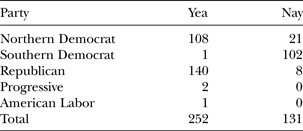
Source: Congressional Record, 76th Congress, 3rd Session, (10 Jan. 1940): 253–54.
Despite the Judiciary Committee's favorable vote and a series of communications between the NAACP and Majority Leader Alben Barkley regarding the association's hope that the bill would be brought up for consideration, H.R. 801 languished in the Senate. On three different occasions between April and September, it was “passed over” despite being next on the agenda,Footnote 227 as Barkley conceded to pressure from those who threatened to tie up the Senate if he moved to schedule the bill. More specifically, southern Democrats threatened that any effort to debate the bill would “waste about half of the time of this session,” and based on the history of Republican support for such actions, they knew that a filibuster would successfully bring all other Senate business to a halt.Footnote 228 Even newspapers editorialized that “to avoid another filibuster and serious disruption of their legislative program,” Senate leaders should keep the bill off the agenda.Footnote 229 By October, with the NAACP continuing to call for a vote, Barkley took the floor and declared (like Lodge had in the Dyer episode) that “in the midst of our international situation, our defense program, and the condition in which the world and our country find themselves, it is impractical at this time to make a futile effort to obtain a vote on the bill when it is known in advance that a vote cannot be had.”Footnote 230 With this decision, Barkley brought to a close a continuous, decade-long effort to pass federal anti-lynching law.
Coda
The causes and consequences of the successive debates over anti-lynching legislation suggest that by tracking the effort to pass federal anti-lynching legislation, we can also follow the transformation of black partisan affiliation and observe the growing influence of black voters. As the decade opened, blacks remained loyal to the Republican Party and its Civil War legacy. By the end of the decade, however, Democrats in both the House and Senate had worked with the NAACP to pass federal anti-lynching legislation. At the same time, black migration to northern cities gave these citizens newfound political influence, which Democrats sought to win over by demonstrating a willingness to push for civil rights. As a consequence, Republicans proved willing to sacrifice these voters and instead align with southern Democrats in an effort to oppose New Deal legislation. In this way, we see that the civil rights coalition that would emerge in the 1960s was not forged because of World War II or New Deal economic policies alone, but was instead generated far earlier by congressional entrepreneurs who used anti-lynching legislation to break the historic alliance between blacks and the Republican Party and win the support of this increasingly important constituency.
V. CONCLUSION
The period between the First and Second Reconstructions is routinely skipped over in the scholarship on civil rights. In this paper, we begin to unearth the civil rights agenda, the role Congress played, and the growing import of black interests in the landscape of American politics in the interregnum between 1891 and 1940. In contrast to the received wisdom, we find that civil rights issues animated congressional debates, and although mostly unsuccessful, these early contests helped rupture a preexisting political coalition between blacks and the Republican Party and provided the material to construct a new one between blacks and the Democratic Party. In this way, the political dynamics captured in each period collectively proved crucial for beginning a partisan transformation that would set the stage for the important Civil Rights battles of the 1960s.
The collapse of the First Reconstruction brought with it nearly six decades of black inequality institutionalized in legal norms and practices until the Second Reconstruction. However, it is a mistake to conclude that the issue of black equality disappeared from the political agenda. From 1900 until 1940, the Congress considered over a hundred bills to ensure the protection of blacks from mob violence. In three of those many cases, Congress came within reach of actually providing federal punishments for lynching, passing measures in the House but falling short in the Senate, where southern Democrats obstructed to protect the racial arrangements in their states. Congress also wrangled over whether black and white citizens should be able to marry and whether the disenfranchisement of blacks in southern states should lead to a reduction in House representation. In short, as the preceding analysis shows, legislation that was pivotal to black equality was again and again introduced by legislative entrepreneurs and taken up by the Congress. Although these interim years were a dark period of Jim Crow segregation, eugenics and race science, widespread disenfranchisement, and state-sanctioned terrorism against blacks in the South, legislators were quite responsive to black interest groups and efforts to lobby for legislation that would protect them from summary justice. Nevertheless, scholarship on racial politics, parties, and American political development has passed over these failures as unimportant, placing most of their emphasis on the symbolic efforts of presidents and leaving the impression that congressional action on civil rights had effectively ended after the First Reconstruction, not to return until the civil rights movement half a century later.
These failed episodes did not leave the racial landscape untouched or the development of party politics unchanged. Rather, the legislative initiatives on black equality during this early era demonstrate important partisan shifts and the rising influence of the black electorate. This paper argues that the parties' reorientation on racial issues happened both earlier and differently than the received wisdom implies. Republican initiatives in the 1920s transformed into Democratic-led campaigns for anti-lynching legislation by the 1930s. However, digging even deeper, we also find that a majority of northern Democrats began voting against the party's dominant southern wing as early as 1921 (earlier than is argued in the literature) and that black voters operated in a largely independent fashion during much of the 1920s and 1930s (rarely discussed, and typically ignored, in the literature).
By the late 1930s, northern Democrats had succeeded in winning the allegiance of a majority of blacks. Northern Democratic efforts on behalf of blacks would ramp up in the 1940s, with congressional battles over the poll tax and the Fair Employment Practices Committee. By the 1950s, civil rights legislation was back on the congressional agenda, and in 1957 a civil rights bill was passed into law, the first since 1875. This was followed up with another Civil Rights Act in 1960, and then two major acts in the mid-1960s: the 1964 Civil Rights Act and the 1965 Voting Rights Act. The battles over civil rights legislation in the first four decades of the twentieth century, especially those over anti-lynching legislation—and their failures—laid the groundwork for the later civil rights successes of the mid-twentieth century.
In 2005, the Senate again took up the issue of anti-lynching legislation. This time, however, leaders passed a resolution apologizing for their institution's inability to pass a federal anti-lynching measure when this tactic was still being used to intimidate and terrorize black citizens.Footnote 231 This analysis has attempted to consider the institutional and partisan dynamics that made such an apology appropriate. In so doing, however, it has also attempted to demonstrate that the failed efforts to pass a federal anti-lynching law represent an early attempt to enact civil rights legislation generated by the increasing electoral influence of black citizens. The legislative wrangling over each bill and the tendency for a specific subset of members to use anti-lynching legislation as a tool for winning black votes demonstrates an early indication of the partisan “switch in time” that would pick up steam in the 1940s as blacks increasingly found a home within the Democratic Party. Moreover, as noted, the emergent coalition that is identified here would prove influential in later, and more successful, civil rights battles.
Future Work
Believing we have broken new and interesting ground in this paper, we conclude by highlighting some of the challenges and areas calling out for more investigation. One direction for future research will be to examine the political dynamics and roll-call votes associated with civil rights initiatives more systematically, using multivariate analysis. This will require collecting geographic-based constituency data (from census records) for all members of Congress for the 1910–1940 era.Footnote 232 The chief difficulty will be assembling district-level data for any House-based analyses. Most districts are based on “clean” county mappings, wherein districts are constructed out of whole counties. However, a number of urban districts are carved out of portions of counties. Some of these “problem” districts can be reconstructed using ward or precinct mappings—geographic units that allow for census-based data collection. (Dyer's district, which is based on precinct-level mappings, is an example.) Others are even more fine grained, however, and are based on street-level mappings, which do not correspond to any census-based data categories. Areas in Chicago and New York City are prime examples of this.Footnote 233 Given that much of the interesting variation in our story is driven by urban representatives from places like Chicago and New York City, among other northern cities, constructing constituent-based measures for these districts is both crucial and (as of now, in our estimation) problematic.Footnote 234 In addition, we will need to gather specific data on black participation rates in these regional units in order to determine whether blacks participated at levels high enough to generate an appropriate response from elected officials.
Another direction will be to dig deeper into the nuances of various aspects our story. For example, our finding that a majority of northern Democrats supported the Dyer bill in 1921, as part of an initial attempt to reach out to the growing coalition of black voters, is likely only one piece of evidence. It is possible (and likely reasonable) that such “reaching out” occurred on other issues and in other ways (other than casting votes). This may call for a more detailed accounting of state-level NAACP operations during this period. It would be useful to know whether the NAACP had branch offices in these districts or if these members had contact with NAACP officials. It might also be useful to determine how much the Republican Party's links to the Ku Klux Klan in various northern states drove black voters to embrace the Democrats.
Another puzzle raised by some of our findings is that Republican strategy toward blacks and civil-rights legislation varied by chamber in the 1930s, with House Republicans continuing to support anti-lynching legislation and Senate Republicans defecting (by opposing the cloture attempt on the Democratic filibuster). It is unclear whether these were in fact separate strategies, or two parts of a more elaborate party-based strategy. Deeper archival research might yield an answer to this puzzle and in doing so might provide a clearer picture of intrabranch dynamics between the Senate and the House of Representatives.
Finally, this research ends prematurely. It remains to be seen how the parties wrangled over (and how the black electorate responded to) the host of race-related issues during the next decade (the 1940s)—from debates over the poll tax to the soldier's voting bill to discrimination in school lunch programs and federal employment. We hope that future scholarship will continue to explore the period between the two Reconstructions.