Introduction
Mental disorders are important contributors to the global burden of disease (WHO, 2016). They cause personal distress and carry major consequences for social activities which render appropriate treatment and prevention all the more necessary. The largest international community-based study, to date, to investigate the treatment of mental disorders is the World Mental Health (WMH) surveys, carried out so far in 27 countries under the leadership of WHO and Harvard Medical School. The results from this cross-national study show that the rates of consulting a health care professional (general practitioner or mental health specialist) is globally low and ranges, over a 12-month period, from 0.8% in Nigeria to 15.3% in the USA (Demyttenaere et al., Reference Demyttenaere, Bruffaerts, Posada-Villa, Gasquet, Kovess, Lepine, Angermeyer, Bernert, de Girolamo, Morosini, Polidori, Kikkawa, Kawakami, Ono, Takeshima, Uda, Karam, Fayyad, Karam, Mneimneh, Medina-Mora, Borges, Lara, de Graaf, Ormel, Gureje, Shen, Huang, Zhang, Alonso, Haro, Vilagut, Bromet, Gluzman, Webb, Kessler, Merikangas, Anthony, Von Korff, Wang, Brugha, Aguilar-Gaxiola, Lee, Heeringa, Pennell, Zaslavsky, Ustun and Chatterji2004).
Low- and middle-income countries are the least able to bear the burden of health in general, including mental disorders, due to factors including inappropriate governmental resources and poor awareness (Tomlinson et al., Reference Tomlinson, Rudan, Saxena, Swartz, Tsai and Patel2009; Semrau et al., Reference Semrau, Evans-Lacko, Koschorke, Ashenafi and Thornicroft2015). The Arab countries are no exception (although a few belong to the higher income brackets). Data on the treatment of mental disorders from that region are scarce and when available focus more on specific issues such as hospital treatments or type of medicines used (Nasser and Salamoun, Reference Nasser and Salamoun2011). Only two countries so far (Lebanon and Iraq) have assessed the patterns of seeking help for mental disorders in the Arab region on a national level and they are part of the WMH Consortium. One more country is currently conducting fieldwork for a similar survey (Saudi Arabia). In Iraq, the results showed a high level of unmet need for treatment (defined as any attempt to consult anyone be it a physician, or herbalist, priest, etc.). Only 10.8% of respondents in Iraq with one or more 12-month Diagnostic and Statistical Manual of Mental Disorders, Fourth Edition (DSM-IV) mental disorder sought any help for their condition during the prior 12-month period (Alhasnawi et al., Reference Alhasnawi, Sadik, Rasheed, Baban, Al-Alak, Othman, Othman, Ismet, Shawani, Murthy, Aljadiry, Chatterji, Al-Gasseer, Streel, Naidoo, Mahomoud Ali, Gruber, Petukhova, Sampson and Kessler2009).
The Lebanese Evaluation of the Burden of Ailments and Needs Of the Nation (L.E.B.A.N.O.N.) study also showed a high level of unmet need for treatment: only about one-tenth of those who had any mental disorder in the previous year in Lebanon sought any kind of help (Karam et al., 2006). Seeking any type of help since the onset of the disorder was delayed by a range of 3–28 years. The average delays to treatment were: impulse control: 3 years, mood: 6 years, substance disorder: 9 years, anxiety: 28 years (Karam et al., Reference Karam, Mneimneh, Dimassi, Fayyad, Karam, Nasser, Chatterji and Kessler2008). Even though the rate of seeking any help for mental health was low, the vast majority (88%) of the Lebanese who did seek help, for 12 months disorders, did so in the health sector (general medical or mental health care sectors) (Karam et al., Reference Karam, Mneimneh, Karam, Fayyad, Nasser, Chatterji and Kessler2006). This present study from the L.E.B.A.N.O.N. study is the first of its kind in the region and the aim of the paper is to investigate the determinants and barriers of seeking help for mental disorders.
Study sample
A nationally representative and multistage clustered area probability household sample of non-institutionalised adults who had no cognitive or physical impairment preventing participation (n = 2857) and aged 18 years and older was recruited with a 70% response rate. Details of the sampling procedure are found elsewhere (Karam et al., Reference Karam, Mneimneh, Karam, Fayyad, Nasser, Chatterji and Kessler2006; Karam et al., Reference Karam, Mneimneh, Dimassi, Fayyad, Karam, Nasser, Chatterji and Kessler2008). The sample comprised of 45.4% males and 54.4% females. In total, 33.8% of the respondents were 18–34 years old, 32.6% were 35–49 years old, 33.7% were 49–63 years old and 14.3% were older than 64 years.
Interviews
Face-to-face interviews were conducted between September 2002 and September 2003. The instrument used was the Arabic Composite International Diagnostic Interview 3.0 (CIDI) (Kessler and Ustun, Reference Kessler and Ustun2004; Karam et al., Reference Karam, Mneimneh, Karam, Fayyad, Nasser, Chatterji and Kessler2006). The CIDI diagnosed lifetime and 12-month DSM-IV anxiety, mood, impulse-control and substance-use disorders. Childhood disorders (conduct, attention-deficit and hyperactivity disorders) were constrained to respondents in the age range 18–44 years to control for possible recall bias. DSM-IV organic exclusion and diagnostic hierarchy rules were applied. Additional details on the CIDI measures can be found elsewhere (Karam et al., Reference Karam, Mneimneh, Karam, Fayyad, Nasser, Chatterji and Kessler2006; Karam et al., Reference Karam, Mneimneh, Dimassi, Fayyad, Karam, Nasser, Chatterji and Kessler2008).
Interviews were conducted in two parts. Part I represented a diagnostic assessment of core disorders and was completed by all respondents (n = 2857). Part II assessed other disorders and correlates of core disorders and was administered to respondents who screened positive on any lifetime core disorder plus a probability sub sample of other respondents with no disorders (n = 1031).
Measures
Sociodemographic information collected from all respondents included age cohort at time of interview (18–34, 35–49, 50–64, ≥65 years), gender, education: low (none/only primary), middle-low (intermediate/some secondary), middle (completed secondary without university), high (university degree), and income cohorts (low/low average/high average/high).
All respondents were asked to rate their current mental health as: excellent, very good, good, fair or poor. The 12-month mental disorders were classified into different severity levels: mild, moderate or severe. They were classified as severe if they had any of the following: suicide attempt within the previous 12 months, bipolar I disorder, substance dependence with a physiological dependence syndrome, severe impairment in at least two areas of role functioning assessed by the Sheehan Disability Scales (SDS), or role functioning at a level consistent with a Global Assessment of Functioning 19 score of 50 or less. Moderately severe cases included individuals that had either substance dependence without a physiological dependence syndrome or at least moderate role impairment in two or more SDS domains. Remaining cases were classified as mild (Karam et al., Reference Kessler and Ustun2008).
Respondents who met criteria for a lifetime disorder were asked if they had ever sought help from a professional for symptoms of that disorder, and about the type of professional they sought help from. They were then asked if they were ever hospitalised at least overnight for these symptoms. As for respondents who met the criteria for a disorder in the past 12 months and had not sought help in the past year prior to the interview, they were asked about their perceived need of seeking treatment, and if they ever thought about seeking treatment for a period of 4 weeks or more. Respondents who thought about seeking treatment for a period of 4 weeks or more were also questioned on a list of potential barriers that stopped them from doing so.
Additionally, a randomly selected sub-sample of respondents (n = 603) who were administered part II of the CIDI were asked about their subjective opinion regarding seeking help from a professional. This was assessed by asking if they would seek professional help in case of a serious emotional problem (definitely/probably/probably not/definitely not), as well as about how comfortable they would feel talking about personal problems with a professional (very/somewhat/not very/not at all). Respondents were also asked if they would be embarrassed if their friends knew that they were getting professional help for an emotional problem (very/somewhat/not very/not at all).
Statistical analysis
Weighted analyses were conducted controlling for the clustering and stratification of the sample: part I was weighted for differential probability of selection and was post stratified to government population data on sociodemographic and geographic variables (Central Administration for Statistics 1998) and part II was additionally weighted for differential probability of selection from the part I sample. Descriptive analyses were conducted to identify the rates of: lifetime treatment and hospitalisation for specific mental disorders, professionals contacted for help, respondent's attitudes towards seeking mental health help and barriers for 12-month help. Weighted logistic regression was used to assess associations at the bivariate level, and then multivariate models were built. In these regression models, the correlates of respondent's attitudes towards seeking help for mental health were assessed including gender, age, education and income cohorts. In addition to these same factors, self-rated mental health and severity of mental disorders were also correlated with treatment-seeking habits among respondents with 12-month mental disorders. Additionally, due to small numbers, only bivariate regressions were conducted to assess the correlates of perceived need of treatment (thinking about it). Odds ratios (ORs) and statistical significance were set at an α level of 0.05. The analysis was conducted using SAS version 9.
Results
Rates of lifetime seeking help and hospitalisation for specific mental disorders
Rates of seeking help (and hospitalisation) varied with the types of disorders. Of respondents with lifetime panic disorder, 57.4% sought help for their condition at some point in their lives (and 26.3% were hospitalised), compared with 29.7% of those with lifetime major depression (4.1% were hospitalised). The seeking help rate was lower than 20% for all other disorders: 19.2% for agoraphobia (11.8% were hospitalised), 17.5% for generalised anxiety disorder (2.7% were hospitalised), 13.5% for bipolar disorders (2.7% were hospitalised), 12.5% for intermittent explosive disorder (6.2% were hospitalised), 6% for substance-use disorders (4.3% were hospitalised), 5.6% for specific phobia (0% hospitalisation rate), 3.9% for post-traumatic stress disorder (PTSD) (1.5% were hospitalised), 1.5% for attention-deficit/hyperactivity disorder (ADHD) and 0% for conduct disorder. For ADHD and conduct disorder, hospitalisation rates were not assessed.
Types of professionals contacted for help
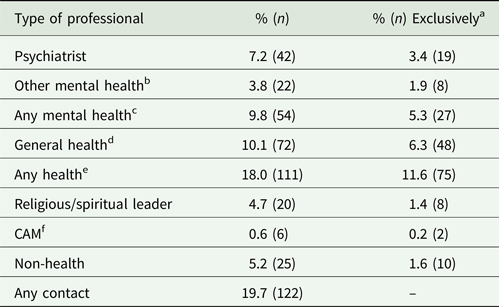
For those with a lifetime mental disorder, 19.7% sought some help at one point in their lives: 9.8% sought help from any mental health professional, 18.0% from any health professional and 5.2% from a non-healthcare professional. For those with a 12-month mental disorder, 9.3% sought some help at one point in the past year: 3.0% sought help from any mental health professional, 8.1% from any health professional and 1.2% from a non-healthcare professional. More details, including mutually exclusive help seeking, are presented in Table 1.
Types of professionals contacted for help in subjects with lifetime mental disorders

a Exclusively by this type of professional.
b Psychologist, psychotherapist, psychiatric social worker, mental health nurse, mental health counsellor.
c Combination of the previous two mental health categories.
d General medical doctor, nurse, other health professional not in mental health setting.
e Combination of all previous categories.
f Complementary and alternative medicine: any other healer, like an herbalist, chiropractor or spiritualist.
Respondents’ attitudes towards seeking help for mental health
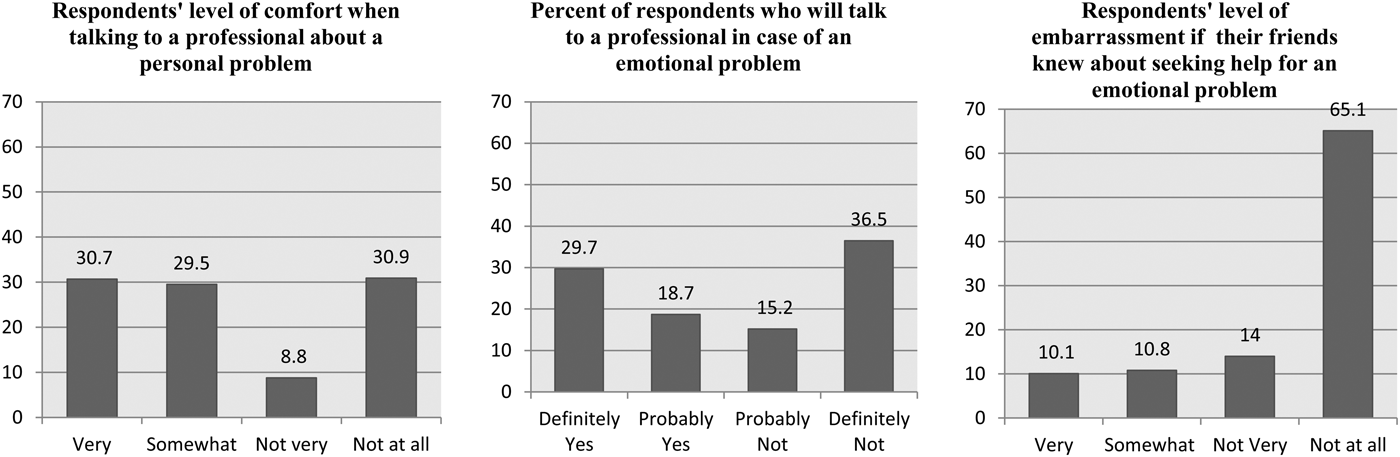
Respondents were asked about their attitudes towards seeking help. A little more than half (59.4%) stated that they would feel comfortable (very/somewhat) when talking to a professional about personal problems. Almost half (49.7%) of the respondents stated that they would (definitely or probably) talk to a professional for mental problems and 79.1% stated that they would not feel embarrassed (not at all or not very) if their friends found out that they were talking to a professional, specifically, for mental problems (Fig. 1).
Respondents’ attitudes about seeking help.

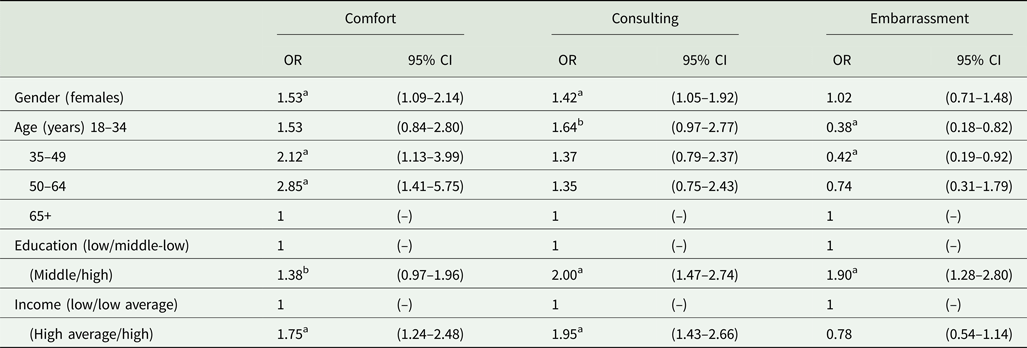
The correlates for each attitude question were assessed. The factors studied were: sex, age, education and income. The likelihood of respondents feeling comfortable talking to a professional about personal problems was significantly higher among: women (v. men) (OR 1.53, p 0.014) higher income (OR 1.75, p 0.002) and almost significant in education (OR 1.38, p 0.07). Age was also significant but non-monotonically related to level of comfort with increased comfort among the middle-aged groups (35–64) when compared with 65+ (OR 2.12, p 0.019 and OR 2.84, p 0.004). Likelihood of talking to a professional in case of psychological problems was higher in females (OR 1.42, p 0.024), higher income (OR 1.95, p < 0.001) and higher education (OR 2.00, p < 0.001), and a trend for youngest cohorts. Embarrassment if friends knew respondents were seeking help for psychological problems was less likely in older cohorts and higher education brackets (Table 2).
Multivariate regressions on respondents’ attitudes towards seeking treatment

a Significant at the 0.05 level, two-sided test.
b Borderline significance 0.07.
Profile differences in perceiving the need of seeking treatment (thinking about it) among respondents with 12-month mental disorders
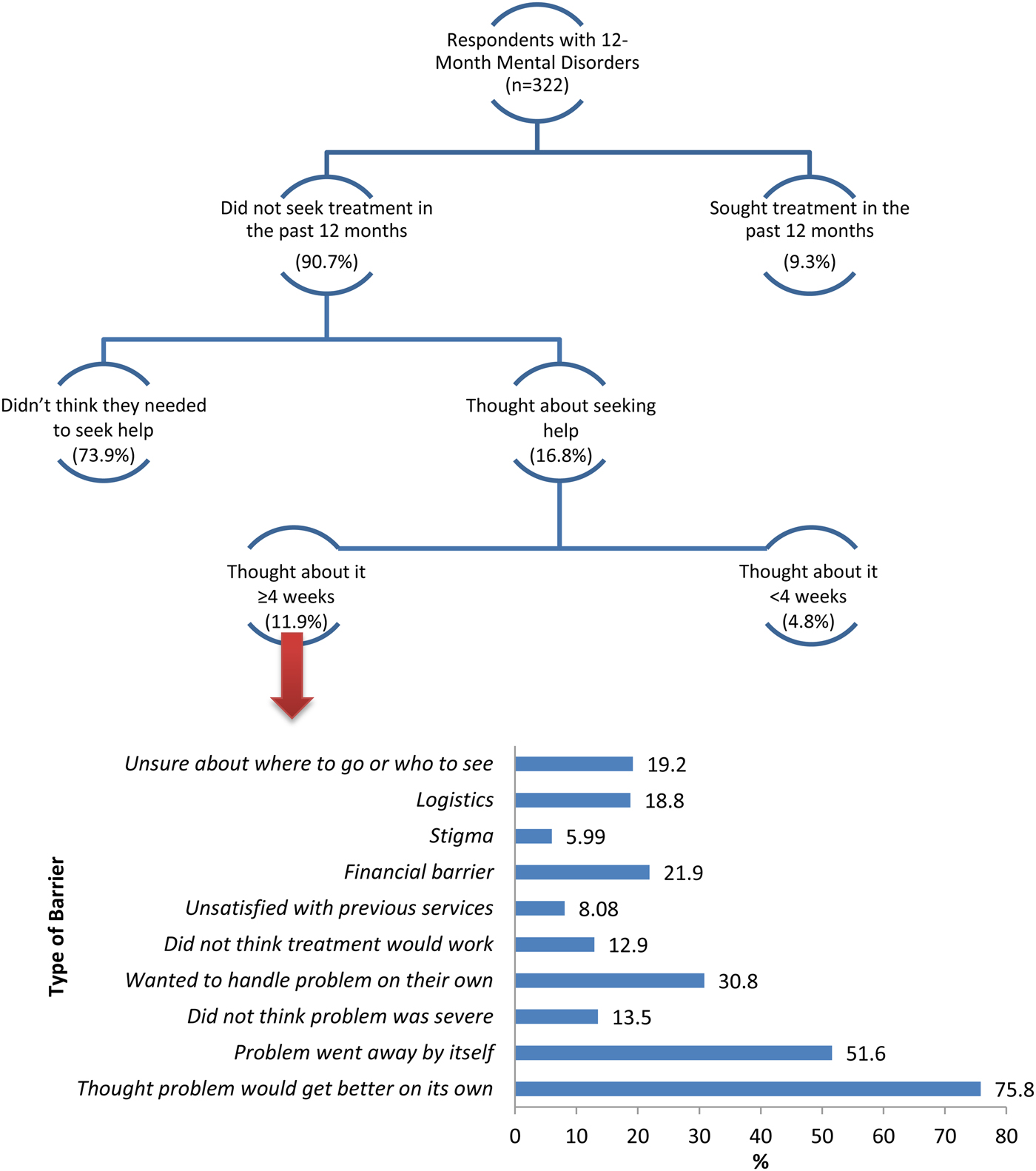
In the past 12 months, 16.8% of respondents with 12 months disorders thought they needed to seek treatment and 71.4% of them thought about it for 4 weeks or more, a total of 11.9% of the total group of subjects with 12 months disorders (Fig. 2). At the bivariate level, younger age and higher education were positively associated with thinking of needing treatment for a period of 4 weeks or more. There was a clear trend for subjects with more severe disorders to do so too (p = 0.09). Multivariate models could not be computed because of small numbers (N = 32).
Twelve-month treatment-seeking patterns and barriers among respondents with 12-month mental disorders.

Barriers to seeking help for mental health
Barriers for 12-month help were assessed specifically among respondents with 12-month mental disorders and thought about seeking treatment for a period of 4 weeks or more. Nearly 60% of these subjects reported at least two barriers and the remaining 40% reported having four or more barriers (maximum seven barriers reported). The most common reported barriers were related to the perception of the ‘problem’ itself; 93.5% reported at least one of the following: ‘thought problem would get better on its own’, or ‘problem went away by itself’, or ‘thought the problem was not severe’ or ‘wanted to handle the problem on their own’. The second most common barrier was the ‘financial barrier’, reported by 21.9% of respondents. Other reported barriers were uncertainty of where to go or who to see (19.2%), followed by logistic problems (transportation or inconvenience related to taking appointments) (18.8%). Lastly 12.9% of those who thought for more than 4 weeks and did not seek treatment were dissatisfied with previous services and 5.9% because of stigma. By far, ‘not thinking at all about seeking help’ is the single most reported barrier (73.8%) among subjects with 12-month mental disorders.
Differences in treatment-seeking patterns among respondents with 12-month mental disorders
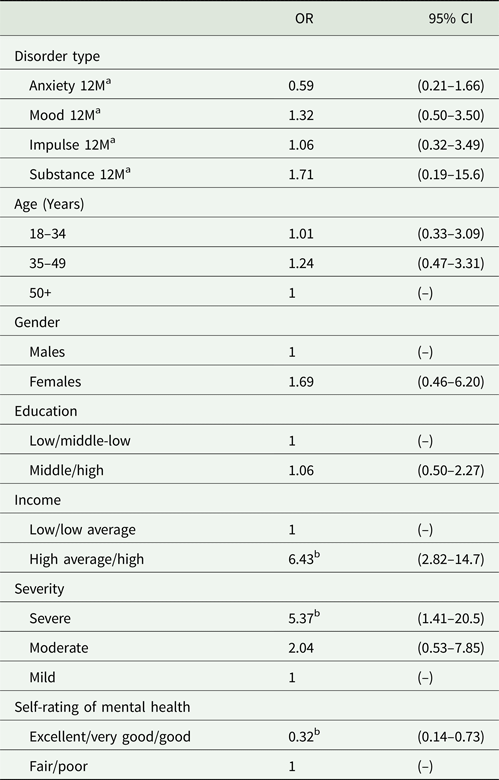
At the bivariate level, the predictors of help seeking in subjects with 12 months disorders were: 12-month mood disorders (v. other disorders), higher income, severity of disorder and poorer self-rated mental health. All predictors identified at the bivariate level for treatment seeking in the past 12 months, except for disorder type, remained significant in the multivariate model (Table 3).
Multivariate regression for seeking treatment in the past 12 months v. not seeking treatment (among respondents with 12-month mental disorders)

M, month.
a Reference: other disorders in this regression.
b Significant at the 0.05 level, two-sided test.
Discussion
The impact of mental disorders, in the form of distress or dysfunction, is embedded in current definitions of mental disorders. As such, seeking help in some form would seem a reasonable reaction for people who are diagnosed with mental disorders. Nevertheless, a series of facilitating or barrier factors can influence help-seeking decisions and behaviour (Ginzburg et al., Reference Ginzburg, Bohn, Höfling, Weck, Clark and Stangier2012; Clement et al., Reference Clement, Schauman, Graham, Maggioni, Evans-Lacko, Bezborodovs, Morgan, Rüsch, Brown and Thornicroft2015) including severity of the disorders, availability and affordability of reliable sources of help, cultural attitudes as well as personal willingness to seek help and above all a recognition that there is a disorder and for which treatment is effective. Mental health treatment by specialists has progressed over the past decades with rigorous research studies designed to evaluate several aspects of the variety of treatments (mostly medical and psychological therapies including the use of modern technology) (Ginzburg et al., Reference Ginzburg, Bohn, Höfling, Weck, Clark and Stangier2012; Leucht et al., Reference Leucht, Hierl, Kissling, Dold and Davis2012; Stott et al., Reference Stott, Wild and Grey2013; Mortberg et al., Reference Mortberg, Hoffart, Boecking and Clark2015).
Traditionally, other forms of help have been used to treat people with mental disorders including those offered by religious advisors and other culturally established systems, although the latter have not benefited from the same degree of scrutiny of effectiveness as the health care approaches.
The world has witnessed increasing attempts by governments and civil society to spread knowledge about mental disorders including their treatment (Clement et al., Reference Clement, Lassman, Barley, Evans-Lacko, Williams, Yamaguchi, Slade, Rüsch and Thornicroft2013). It is beyond the scope of this article to review this issue; nevertheless, it is a fact that most western and industrialised societies have integrated to a large degree the care of mental disorders in their policy. It becomes imperative to focus the attention of policy makers as well as activists and mental health providers on the causes that underlie the huge treatment gap that exists between the prevalence of disorders and that of help seeking (Wang et al., Reference Wang, Angermeyer, Borges, Bruffaerts, Tat Chiu, DE Girolamo, Fayyad, Gureje, Haro, Huang, Kessler, Kovess, Levinson, Nakane, Oakley Brown, Ormel, Posada-Villa, Aguilar-Gaxiola, Alonso, Lee, Heeringa, Pennell, Chatterji and Ustün2007). The same holds true to Arab countries which although quite diverse in their economic and political systems share several aspects of cultural history. The rate of seeking help is available only in two Arab countries so far and is quite similar as we have pointed above; in both Iraq and Lebanon where this has been studied within the WMH Consortium, only about 10% of subjects with 12 months disorders have sought any help, even once and from any source being medical, psychological, religious, herbalists, etc.
The rates of seeking help in one's lifetime in Lebanon are higher (19.7%) than in the previous 12 months, for the obvious reason of longer time span but probably due also to the delay in seeking help that we previously reported. Health care sectors were the most commonly used for help seeking: 91% of those who ever sought care did so within the health sector (80% doing so exclusively) and the majority of those who sought care outside the health sector consulted religion professionals (16% of those who sought care, 6% doing so exclusively).
Not only was the severity of disorder a major predictor in seeking help, but also the perceived severity of these disorders. Seeking help in one's lifetime varied by disorder, the highest being interestingly for panic disorder, where more than half of subjects (57.3%) sought help, and more than a quarter (26.4%) were hospitalised. The abrupt presentation of this disorder is probably the cause of such high rates of help seeking, since the symptoms of this disorder are frequently perceived by the subject and his/her entourage as life threatening. The rates of ever seeking help for major depression and bipolar disorders were low.
In addition to severity of disorders, income and self-rated mental health showed up to be important factors related to seeking help for mental disorders. Even though income was considered to be a barrier to initiate treatment by only a small number of responders (2.9%), the role of income would become quite important in following with treatments since mental healthcare is not covered by most private insurers in Lebanon. Although still in its infancy, the Ministry of Health of Lebanon has initiated recently a major push to fill this gap by training general practitioners in the various centres it runs (MOPH, 2015; El Chammay e t al., Reference El Chammay, Karam and Ammar2016).
Stigma was reported to be the reason behind not asking for any help by <6% of those who thought for 4 weeks or more to seek treatment. When asked about seeking help from a professional, about half of the Lebanese would rather prefer not consult for an ‘emotional’ problem probably because of a personal choice rather than social stigma if discovered to having done so; while half do not feel comfortable consulting, 80% would not feel embarrassed if their friends knew they were doing so. The personal choice to seek help was more prevalent in younger generations and associated with higher education pointing out to the importance of awareness in seeking help. Embarrassment did not vary with income levels, an optimistic predictor of the probability of success in spreading care for the less wealthy sectors of the population.
The greatest barrier to seeking help for 12 months disorders (regardless of onset in the past year or not) was ‘low perceived need for treatment’ (73.8%), namely a demand-side rather than a supply-side barrier. These results were similar to the pooled data of a cross-national WMH study, where this barrier was also the most commonly reported one (61.5%). This same cross-national study, however, showed between country variations with respect to the most commonly reported type of barrier (Andrade et al., Reference Andrade, Alonso, Mneimneh, Wells, Al-Hamzawi, Borges, Bromet, Bruffaerts, de Girolamo, de Graaf, Florescu, Gureje, Hinkov, Hu, Huang, Hwang, Jin, Karam, Kovess-Masfety, Levinson, Matschinger, O'Neill, Posada-Villa, Sagar, Sampson, Sasu, Stein, Takeshima, Viana, Xavier and Kessler2014). It is to be noted here that we had offered a free consultation by the mental health specialists in our institutions for those who desired or for any member of their families: of the almost 3000 interviewees, less than a handful did so. This flies against the financial and availability barriers and points more towards lack of recognition or personal choices. It is difficult to say which factor is more important since subjects were not asked directly if they thought they had a mental health problem, although 32.8% had stated that their mental health was fair to poor, which had predicted help seeking.
The results of this study should be interpreted in light of some limitations. First, the CIDI does not include some of the mental disorders in its assessment (e.g. schizophrenia and dementia). Moreover, the study excluded institutionalised respondents. In addition, social desirability may have limited the reporting of symptoms of mental disorders as well as help seeking. Notwithstanding these limitations, several recommendations related to the treatment of mental disorders arise based on our results. In Lebanon, there is a need to increase awareness about the burden of mental health disorders and the importance of treating them by targeting clinics, health care institutions, schools, universities and others. Enhancing primary care physicians’ knowledge regarding mental disorders is also needed in order to increase the referral rates from general medicine to mental health services. Since there is an under-utilisation of mental health services, monitoring and tracking mechanisms could be set up to develop indicators related to mental health utilisation. A referral system or network must also be developed based on the principles of continuity of care and geographic access. Moreover, policies need to be developed to promote parity between mental and physical disorders in health care programmes in both public and private sector domains.
Acknowledgements
The Lebanese Evaluation of the Burden of Ailments and Needs Of the Nation (L.E.B.A.N.O.N.) is supported by the Lebanese Ministry of Public Health, the WHO (Lebanon), National Institute of Health/Fogarty International Center (R03 TW006481-01), anonymous private donations to IDRAAC, Lebanon, and unrestricted grants from, Algorithm, AstraZeneca, Benta, Bella Pharma, Eli Lilly, Galaxo Smith Kline, Lundbeck, Novartis, Servier, OmniPharma, Phenicia, Pfizer, UPO.
Financial support
The World Health Organization (WHO) World Mental Health (WMH) Survey Initiative is supported by the National Institute of Mental Health (NIMH; R01MH070884), the John D. and Catherine T. MacArthur Foundation, the Pfizer Foundation, the US Public Health Service (R13-MH066849, R01-MH069864 and R01 DA016558), the Fogarty International Center (FIRCA R03-TW006481), the Pan American Health Organization, Eli Lilly and Company, Ortho-McNeil Pharmaceutical, GlaxoSmithKline and Bristol-Myers Squibb. The authors thank the staff of the WMH Data Collection and Data Analysis Coordination Centers for assistance with instrumentation, fieldwork and consultation on data analysis. None of the funders had any role in the design, analysis, interpretation of results or preparation of this paper. A complete list of all within-country and cross-national WMH publications can be found at http://www.hcp.med.harvard.edu/wmh/.
Conflict of interest
None.
Ethical standard
The authors assert that all procedures contributing to this work comply with the ethical standards of the relevant national and institutional committees on human experimentation and with the Helsinki Declaration of 1975, as revised in 2008.
Availability of data and materials
All relevant data are available without any restriction. Requests for data can be sent to Dr Elie Karam at egkaram@idraac.org.