Introduction
Current first-line treatments for depression are antidepressant medication and psychotherapy, but 70% of patients do not respond to the first choice of treatment (Carvalho et al. Reference Carvalho, Berk, Hyphantis and McIntyre2014). Non-response to two or more antidepressant regimens of adequate duration and dosage is considered to denote a ‘treatment-refractory’ depression (El-Hage et al. Reference El-Hage, Leman, Camus and Belzung2013). Several lines of pharmacological augmentation are available, but even with optimal drug regimen and augmentation 10–30% of patients remain refractory (Rakofsky et al. Reference Rakofsky, Holtzheimer and Nemeroff2009). Many of these patients will still get – at least temporary – relief from electroconvulsive therapy (ECT) (UK ECT Review Group, 2003). However, some patients will not respond to any of these interventions even after years of treatment (Schlaepfer et al. Reference Schlaepfer, Bewernick, Kayser, Madler and Coenen2013). For such completely treatment-refractory patients, neurosurgical approaches can be considered. With such invasive approaches, which entail a lesion or implantation of a device without previous demonstration of underlying brain pathology, careful evaluation of risk–benefit ratios, patients’ consenting capacity, ethical aspects and national legal regulation are paramount (Nuttin et al. Reference Nuttin, Wu, Mayberg, Hariz, Gabriels, Galert, Merkel, Kubu, Vilela-Filho, Matthews, Taira, Lozano, Schechtmann, Doshi, Broggi, Regis, Alkhani, Sun, Eljamel, Schulder, Kaplitt, Eskandar, Rezai, Krauss, Hilven, Schuurman, Ruiz, Chang, Cosyns, Lipsman, Voges, Cosgrove, Li and Schlaepfer2014).
Over the last decade deep brain stimulation (DBS), first developed for pain, later mainly for movement disorders and then for obsessive compulsive disorder (OCD), has emerged as a possible invasive treatment for depression (Mayberg et al. Reference Mayberg, Lozano, Voon, McNeely, Seminowicz, Hamani, Schwalb and Kennedy2005). The main DBS target sites for treating psychiatric disorders have been in the anterior limb of the internal capsule, nucleus accumbens, subgenual cingulate gyrus and the medial forebrain bundle (MFB) (Schlaepfer et al. Reference Schlaepfer, Bewernick, Kayser, Madler and Coenen2013). Most studies of DBS for depression have reported responder rates between 50% and 60% and remission rates around 35%. However, lack of control conditions in the studies published so far, limited follow-up and a number of surgical and psychiatric side-effects need to be taken into consideration when evaluating the clinical scope of this method (Schlaepfer et al. Reference Schlaepfer, Bewernick, Kayser, Hurlemann and Coenen2014; Kocabicak et al. Reference Kocabicak, Temel, Hollig, Falkenburger and Tan2015).
The other surgical approach is based on stereotactic lesions to key components of the cortical-subcortical networks. Stereotactic lesions of the cingulum bundle (cingulotomy) and anterior limb of the internal capsule (capsulotomy) have been performed on many hundreds of patients, mainly for the indication of OCD (Greenberg et al. Reference Greenberg, Rauch and Haber2010). The main stereotactic procedure for depression has been subcaudate tractotomy (Schoene-Bake et al. Reference Schoene-Bake, Parpaley, Weber, Panksepp, Hurwitz and Coenen2010). All these stereotactic procedures disrupt connections between frontal and subcortical/limbic areas of the brain (Rauch, Reference Rauch1995; Greenberg et al. Reference Greenberg, Rauch and Haber2010). One common feature of all these approaches may be that they disrupt the MFB, which carries the dopaminergic projections from the midbrain to the frontal lobe (Schoene-Bake et al. Reference Schoene-Bake, Parpaley, Weber, Panksepp, Hurwitz and Coenen2010; Coenen et al. Reference Coenen, Schlaepfer, Maedler and Panksepp2011).
The success rates (significant improvement) for inferior frontal (subcaudate and orbitomedial) tractotomy in depression in older studies have varied between 34% and 72.7% (Göktepe et al. Reference Göktepe, Young and Bridges1975; Hodgkiss et al. Reference Hodgkiss, Malizia, Bartlett and Bridges1995; Sachdev & Sachdev, Reference Sachdev and Sachdev2005). A more recent study included 33 patients with depression who had all undergone bilateral cingulotomy. About 75% of patients were classified as partial or full responders. In addition, this study included formal clinical rating scales and found a significant improvement on the BDI (Shields et al. Reference Shields, Asaad, Eskandar, Jain, Cosgrove, Flaherty, Cassem, Price, Rauch and Dougherty2008). In a cingulotomy case series of eight depressed patients from Dundee, Scotland, two patients had responded and three remitted after 1 year (Steele et al. Reference Steele, Christmas, Eljamel and Matthews2008).
Capsulotomy for depression has been studied in fewer and smaller studies. After an initial positive report from Sweden (Herner, Reference Herner1961), there was a publication gap of half a century until a group in Scotland (Christmas et al. Reference Christmas, Eljamel, Butler, Hazari, MacVicar, Steele, Livingstone and Matthews2011) published their series of 20 cases from 1992 to 1999. Their generally positive clinical impression was supported by significant and long-term improvements on clinical ratings of depression severity. However, not all measures were available for the same patients pre- and post-operatively and thus had to be imputed. Another smaller study of eight patients was published by the Vancouver Limbic Surgery Group (Hurwitz et al. Reference Hurwitz, Honey, Allen, Gosselin, Hewko, Martzke, Bogod and Taylor2012) and their main finding was the reduction or abolition of suicidal ideation experienced by all the patients. In the present study we report on the other British case series of capsulotomy, covering 45 operations conducted in Cardiff, Wales, between 1993 and 2008.
Method
Design and patients
We carried out a retrospective study on 45 patients who underwent bilateral stereotactic anterior capsulotomy at the University Hospital of Wales (UHW), Cardiff from 1993 to 2008 for treatment-resistant depression (TRD). This surgery is regulated under the Mental Health Act, 1983, which ensures that all other appropriate treatment has been exhausted. All patients had received adequate periods of treatment with a tricyclic antidepressant, an SSRI, a monoamine oxidase inhibitor, augmentation strategies and ECT (except for two patients) with no or insufficient benefit. Patients were referred by psychiatrists across the UK and assessed by the psychiatrist and neurosurgeon on the team and if suitable referred to the Mental Health Act Commission (MHAC), as required by UK law (Mental Health Act 1983, Section 57). Once assessed and approved by the MHAC panel (comprising a psychiatrist and two non-medical members who reviewed all the case notes and conferred with the referring consultant and with two other professionals involved with the case, and interviewed the patient, before confirming that the surgery was appropriate, and consent was freely given and fully informed) patients gave their written consent for the surgery.
Patients were discharged back to the care of the referring psychiatrist 1–2 weeks after surgery and followed up clinically at 1, 3, 6 months and 1 year where possible and some (nine patients) up to 6 years for clinical assessment. Psychometric assessment was carried out in most cases between 6 and 12 months after surgery.
Here we report on the audit and clinical follow-up of this capsulotomy programme. Because of the nature of the evaluation, the local Research and Development Office confirmed that this study was exempt from ethical approval.
Staging of TRD
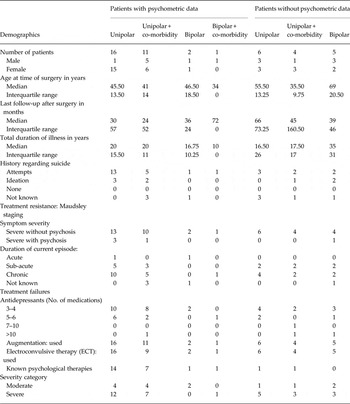
All patients who underwent surgery were diagnosed as treatment-resistant by the clinical team. For this study we applied the Maudsley staging method which was used to determine the level of treatment resistance. This method takes into consideration the duration of the presenting depressive episode, symptom severity and treatment failures (Table 1).
Demographics and treatment resistance according to the Maudsley staging method: N = 45

All patients had had psychiatric hospital admissions but details were not available in all cases.
Surgical procedure
All patients were operated at the UHW by neurosurgeon B.A.S. Under general anaesthesia and with a Leksell stereotactic frame applied, computerized tomographic (CT) guidance located the targets in the anterior limbs of the internal capsules. Anatomical variation/asymmetry required bespoke coordinates. These were based on the foramen of Monro–posterior commissure (FMPC) plane. Via twist-drill holes, a stack of three (two in the first four cases) radiofrequency-generated thermocoagulative lesions was made bilaterally at a single operation. Electrode tip 4 × 1.6 mm; each lesion 75 °C (first 12 cases) or 80 °C (later cases) for 60 s (40 s in the first seven cases). The 12 mm column of targets was centred on the middle third (in the axial plane) of the anterior limb of the internal capsule. The depth was increased during the series: in the later cases the deepest target was 12 mm below FMPC, 5 mm deeper than in the early cases. This would have been approximately 4–7 mm below the anterior commissure (AC) level (the relation to AC was not specifically recorded).
Second operations
Eleven of the 45 patients (of whom six are included in the psychometric analysis group; see Statistical analysis section below) had a second operation. All of them had initially experienced post-operative improvement in their depression but this was lost, typically after approximately 6–8 weeks. This may reflect the effects of perilesional oedema and neuropraxia and their subsequent resolution. In these 11 cases magnetic resonance scanning at 6 months post-operatively indicated one or more lesions, on one or both sides, to be significantly smaller than the others or even not visible, emphasised by any left-right asymmetry. These lesions were then enlarged at a second operation after obtaining MHAC approval.
Clinical imaging
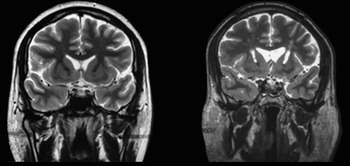
All patients underwent CT scanning approximately 1 week post-operatively for an initial assessment of lesion position, reactive oedema and any haemorrhage. Clinical MRI (T1 and T2 sequences) was performed at 6 months follow-up (Fig. 1).
T2 weighted MRI coronal scans. Left: unoperated; right: 6 months post-surgery.

Clinical and cognitive measures
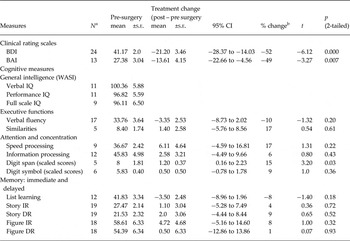
Pre- and post-surgical data were available on the Beck Depression Inventory (BDI), Montgomery–Asberg Depression Rating Scale (MADRS) and Beck Anxiety Inventory (BAI) for subgroups of patients (see Table 2). A neuropsychological battery of tests was also administered before and after surgery for some patients. Measures used were the Wechsler Abbreviated Scale of Intelligence (WASI), Adult Memory and Information Processing Battery, test of verbal fluency and tests of attention and concentration. With a sample size of N = 17 (which is our largest sample for complete cognitive data: verbal fluency category) we had 80% power to detect medium effects on cognitive functioning (estimated required effect size for one-tailed t test: 0.53). (See Supplementary Table S1 for all available data on the clinical and cognitive measures.)
Pre- and post-surgery clinical and cognitive measures

BDI, Beck Depression Inventory; BAI, Beck Anxiety Inventory; WASI, Wechsler Abbreviated Scale of Intelligence; IR, immediate recall; DR, delayed recall.
a N = number of patients.
b A negative score on the clinical scales indicates an improvement and for the cognitive measures a positive score indicates an improvement.
Statistical analysis
Of the 45 operated patients demographic details, basic clinical information (Table 1) and adverse outcomes are reported for all while psychometric measures are reported for 30 patients, as no psychometric files were available for the remaining (early) cases.
The time of post-surgery psychometric follow-up varied for the measures. Follow-up MADRS evaluations were performed between 1 and 4 years after surgery (except for three patients who had follow-up of 3–6 months). Post-surgery BDI scores were from 3 to 6 months for half of the patients and >6 months follow-up for the other half of the patients. Follow-up of the other cognitive measures varied from 3 months to >1 year.
For patients who had undergone a second operation where BDI pre and post-surgery scores were available (four patients) the later scores were used in the analysis.
The outcome measures were analysed using the SPSS statistical package (version 20; IBM Corp., USA). For all measures we computed % change from pre- to post-surgery and confidence intervals (Table 2). We also carried out a paired-samples t test on the outcome measures to determine any statistically significant change in the group as a consequence of surgery.
Ethical standards
The authors assert that all procedures contributing to this work comply with the ethical standards of the relevant national and institutional committees on human experimentation and with the Helsinki Declaration of 1975, as revised in 2008.
Results
The Maudsley treatment-resistant staging shows that all patients were categorised as having moderately to severely treatment-resistant depression (Table 1). It is likely that our retrospective staging process underestimated the severity of treatment resistance because information on duration of current episode and medication treatment was incomplete for the patients classified as moderately treatment resistant.
We compared the duration of illness and age at time of surgery between the patients with and without psychometric measures using an independent-samples t test. There was no difference in the duration of illness (t 43 = −0.94, p = 0.35) although those without psychometric measures were older at the time of surgery (t 43 = −2.03, p = 0.05). As shown in Table 1, the groups with and without psychometric data did not differ on any relevant parameter. For example, a χ2 test for severity of treatment refractoriness yields χ2(1) = 0.207, p = 0.65 and thus no significant group difference.
Even for the thirty patients for whom we had the psychometric files, data are in some cases incomplete. This was due to difficulties in motivating them to attend to the full battery of tests. Patients often requested testing to be terminated resulting in incomplete acquisition of data. Table 2 gives a summary of the psychometric analysis.
Clinical outcomes
Pre and post-operative BDI scores were available for 24 patients. These showed an improvement by −21.20 points (95% confidence interval −28.37 to −14.03) which represents a −52% change. A paired-samples t test (2-tailed) showed a statistically significant difference between pre- and post-surgery BDI scores (t 23= −6.12, p = 0.00).
Based on the BDI scores, 10 improved >75%, three improved between 51% and 75%, five improved between 26% and 50%, three improved by ⩽25%. Three patients were worse than before surgery, by 3%, 14% and 38%.
This subgroup of 24 patients incorporated a stepwise increase in lesion depth. Initially, one lesion was placed 5 mm above the FM-PC plane and two deep to it. However, over time the lesions were placed more deeply; in the later cases the highest was on the FMPC plane, one 6 mm below and one 12 mm below. Of the last 10 patients (those with the deepest lesion sites), improvement by >75% was seen after one operation in six; in the first 10 (those with the highest lesion sites) this occurred in one after one operation, and subsequently in two more following a second operation. We regard this as anecdotal evidence for an effect of lesion depth although our data do not allow for a more formal investigation of a relationship between lesion depth and clinical improvement.
The BAI, available pre- and post-surgery for 13 patients, showed an improvement of 49%, which was significant (t 12 = −3.27, p = 0.007) (Table 2).
Neuropsychological outcomes
Measures of executive functions, memory, concentration and attention showed no significant change after surgery except for a small decline of digit span but very few patients (N = 5) were included in the digit span analysis (Table 2).
Adverse events (Table 3)
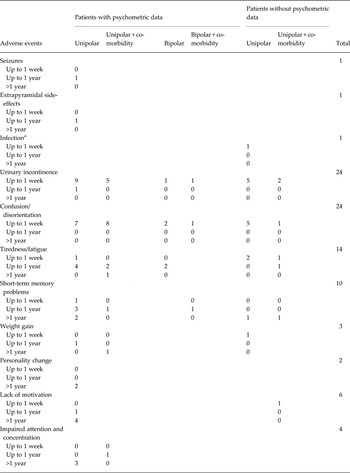
One, chronically anorectic, patient died from pneumonia within a month of surgery. No motor or sensory deficits occurred. One patient had transient focal seizures but one with medically-controlled epilepsy had no seizures after either of his two operations. Another exhibited mildly increased muscle tone and ‘cogwheeling’ in both upper limbs for several months, which did not recur after a second operation 16 months later and was not related to antipsychotic medication. Some patients showed transient and mild confusion, transient incontinence of urine, fatigue and weight gain [similar to the Dundee series (Christmas et al. Reference Christmas, Eljamel, Butler, Hazari, MacVicar, Steele, Livingstone and Matthews2011)]. Data beyond 12 months are incomplete.
Frequency and duration of adverse effects (N = 45)

a A superficial pin-site infection occurred in a type-1 diabetic.
Data beyond 1 year are incomplete.
Phone interviews
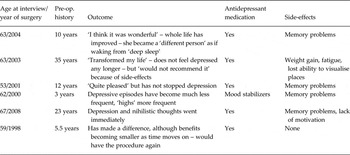
Psychiatrist D.E.J.L. conducted phone interviews with six patients who responded to letters from the neurosurgeon inviting them for follow-up interviews in 2013. All had surgery for unipolar depression except one (unipolar + co-morbidity). These covered patients’ experience between 5 and 15 years post-surgery. This group reported a generally positive experience. Their mood symptoms had improved considerably, and they had required many fewer hospital admissions than before the operation, if any. Most of them did not need further ECT, although all of them continued to take antidepressant medication. Memory problems and fatigue were reported as important side-effects (Table 4).
Interviewed patients

Discussion
The clinical outcome data from the capsulotomy series show considerable improvement of depression and anxiety symptoms in this group of patients with otherwise treatment-refractory depression. We found an improvement of 20 points on the BDI, which is similar to, or even larger than, the effects commonly observed for ECT (Feliu et al. Reference Feliu, Edwards, Sudhakar, McDougald, Raynor, Johnson, Byrd, Whitfield, Jonassaint, Romero, Edwards, Wellington, Hill, Sollers and Logue2008) which is regarded to be the most effective antidepressant treatment. It is thus remarkable that we found these antidepressant benefits from capsulotomy in the present sample of patients who had been refractory to ECT. Importantly, anxiety symptoms improved to a similar extent. Anecdotally, increasing lesion depth improved the outcomes.
The profile of intra- and post-operative side-effects was relatively favourable. There were no surgical deaths and no motor or sensory deficits. One patient had focal seizures transiently, controlled with medication. This incidence of seizures was similar to that reported after implantation of DBS electrodes (Pouratian et al. Reference Pouratian, Reames, Frysinger and Elias2011). One patient experienced transient extrapyramidal features. The only infection, in a patient with diabetes, was superficial. Transient post-operative confusion and urinary incontinence were relatively common. We did not detect deterioration in executive functions, attention and concentration or memory functions on formal psychometric testing, but cannot rule out changes in other cognitive domains (Dalgleish et al. Reference Dalgleish, Yiend, Bramham, Teasdale, Ogilvie, Malhi and Howard2004). Some patients reported fatigue, memory problems and lack of motivation, which had also been commonly reported problems in previous studies of psychiatric surgery. Although we did not have formal long-term follow-up data, the relatively high rate of memory complaints at the follow-up phone interviews suggests that cognitive deficits may develop late.
Anhedonia, the core symptom of inability to experience pleasure, may be linked to a dysregulation of networks of the reward system including the MFB and the anterior thalamic radiation (ATR). Both these pathways are likely to be affected by anterior capsulotomy (Coenen et al. Reference Coenen, Schlaepfer, Maedler and Panksepp2011; Bracht et al. Reference Bracht, Horn, Strik, Federspiel, Schnell, Hofle, Stegmayer, Wiest, Dierks, Muller and Walther2014). The MFB is traditionally considered as the major ‘reward pathway’ and the adjacent ATR may mediate the experience of ‘grief’ (Coenen et al. Reference Coenen, Schlaepfer, Maedler and Panksepp2011). There is also some evidence for altered structural connectivity of the MFB (Bracht et al. Reference Bracht, Horn, Strik, Federspiel, Schnell, Hofle, Stegmayer, Wiest, Dierks, Muller and Walther2014) and ATR (Henderson et al. Reference Henderson, Johnson, Vallejo, Katz, Wong and Gabbay2013) in depression. DBS targeting the MFB led to marked clinical improvements in treatment-refractory patients with major depressive disorder (Schlaepfer et al. Reference Schlaepfer, Bewernick, Kayser, Madler and Coenen2013). Clinical improvement of patients with depression following surgical interventions affecting these pathways may therefore be an effect of rebalancing activation between the reward and grief system (Schlaepfer et al. Reference Schlaepfer, Bewernick, Kayser, Madler and Coenen2013).
Diffusion tensor imaging (DTI)-based fibre-tracking enables the in vivo reconstruction of connection pathways of the human brain (Catani et al. Reference Catani, Howard, Pajevic and Jones2002) and may therefore be used for preoperative planning and post-operative evaluation of putatively dissected pathways (Schlaepfer et al. Reference Schlaepfer, Bewernick, Kayser, Madler and Coenen2013). In three patients of our data set pre- and postoperative DTI data were available. We demonstrate and discuss the potential use of DTI data for future operations in a separate supplementary material (see Supplementary material).
Although patients with depression who do not respond to any non-invasive treatment continue to pose a considerable clinical challenge, the number of patients undergoing surgery for depression worldwide is at present very low. Cost and local availability of the procedures, evaluation of risk/benefit ratios, lack of knowledge about this treatment modality for severely refractory patients and fear of a potentially irreversible intervention are likely to contribute to this relatively low uptake. However, the recent development of several DBS procedures for depression and other mental disorders is likely to boost the interest in psychiatric surgery amongst patients and clinicians. The published evidence base for DBS (Delaloye & Holtzheimer, Reference Delaloye and Holtzheimer2014) and stereotactic lesion surgery for depression is broadly similar – clinical improvements in uncontrolled studies with an acceptable side-effect profile, but with little supporting evidence from randomized controlled studies. The failure of a recent DBS trial (Dougherty et al. Reference Dougherty, Rezai, Carpenter, Howland, Bhati, O'Reardon, Eskandar, Baltuch, Machado, Kondziolka, Cusin, Evans, Price, Jacobs, Pandya, Denko, Tyrka, Brelje, Deckersbach, Kubu and Malone2015) to demonstrate superiority over sham stimulation in depression may further rekindle interest in the results of ablative surgery.
The present study contributes a well-documented patient sample for the evaluation of adverse events of psychiatric surgery and suggests that capsulotomy can be effective in the long term for patients with otherwise refractory depression.
Supplementary material
The supplementary material for this article can be found at https://doi.org/10.1017/S0033291716003159.
Acknowledgements
The authors were funded by Cardiff & Vale University Health Board, Cardiff University, and grants from the Wales Office of Research and Development (WORD) (Grant number SG02/012) and the Swiss National Science Foundation (SNF) (Grant number PBBEP3_144797). The funders had no involvement in the study.
Declaration of Interest
None.