1. Introduction
Research on laser–plasma interaction is a very important part of plasma physics (Kruer Reference Kruer1988). It is known that a light beam possesses optical angular momentum (Allen et al. Reference Allen, Beijersbergen, Spreeuw and Woerdman1992; Allen, Barnett & Padjet Reference Allen, Barnett and Padjet2003): intrinsic orbital angular momentum, extrinsic orbital angular momentum and spin angular momentum, which are determined by the helical phase, the motion of the centre of gravity of light and the polarization, respectively. There is angular momentum conservation in the light–matter interaction (Marrucci, Manzo & Paparo Reference Marrucci, Manzo and Paparo2006; Zhao et al. Reference Zhao, Edgar, Jeffries, McGloin and Chiu2007). Mendonca et al. investigated the exchange of angular momentum between electromagnetic and electrostatic waves in stimulated Raman and Brillouin backscattering processes in plasma (Mendonca, Thidé & Then Reference Mendonca, Thidé and Then2009b ) and showed that there is conservation of the angular momentum in the laser–plasma interaction. Mendonca et al. also investigated electron plasma waves carrying orbital angular momentum in an unmagnetized collisionless plasma (Mendonca, Ali & Thidé Reference Mendonca, Ali and Thidé2009a ; Mendonca Reference Mendonca2012) and quantum plasmas (Khan, Ali & Mendonca Reference Khan, Ali and Mendonca2013). One knows that the electron plasma waves can be described by a paraxial equation (Mendonca et al. Reference Mendonca, Ali and Thidé2009a ,Reference Mendonca, Thidé and Then b ), which is like the optical beams being described by the Helmholtz equation in the paraxial approximation. It means that the electron plasma waves share some similar properties with the electromagnetic waves.
An Airy beam is a non-diffracting light beam which was introduced by Berry and Balazs in the context of quantum mechanics as a non-spreading solution of the Schrödinger equation in 1979 (Berry & Balazs Reference Berry and Balazs1979). The Airy beam exhibits two interesting characteristics, the transverse acceleration (Siviloglou & Christodoulides Reference Siviloglou and Christodoulides2007; Siviloglou et al. Reference Siviloglou, Broky, Dogariu and Christodoulides2007) and the self-healing (Broky et al. Reference Broky, Siviloglou, Dogariu and Christodoulides2008), and it has attracted immense attention due to its fascinating behaviours. One knows that, besides the optical Airy beam, there are some Airy-like waves in different backgrounds, e.g. the Airy surface plasmon waves (Salandrino & Christodoulides Reference Salandrino and Christodoulides2010; Bleckmann et al. Reference Bleckmann, Minovich, Frohnhaus, Neshev and Linden2013), the electron Airy beams (Bloch et al. Reference Bloch, Lereah, Lilach, Gover and Arie2013), the acoustic Airy beams (Lin et al. Reference Lin, Guo, Tu, Ma, Wu and Zhang2015), the Airy water-wave pulses (Fu et al. Reference Fu, Tsur, Zhou, Shemer and Arie2015) and the Airy vortex beams (Dai et al. Reference Dai, Liu, Luo and Sun2010, Reference Dai, Liu, Luo and Sun2011). All these Airy-like waves have similar propagation properties to the optical Airy beams.
In this paper, we investigate an Airy-like electron plasma wave in an unmagnetized collisionless plasma, which is a non-diffracting wave like the optical Airy beam. Starting from the paraxial equation of the electron plasma wave which was obtained in Mendonca et al. (Reference Mendonca, Ali and Thidé2009a ), the Airy-like plasmon mode is obtained. In analogy with the optical Airy beam, the Airy-like plasmon also has the properties of the transverse acceleration and the self-bending. We calculate the electrostatic potential of the Airy-like plasmas waves and give a numerical illustration of the distribution of the electrostatic potential. We obtain that, when the propagation distance increases, the electrostatic potential decreases in the propagation direction, but increases in the transverse direction.
The paper is structured as follows. In § 2, according to the paraxial equation of the electron plasma wave, we obtain the Airy wave solution of the electron plasma wave and discuss the general properties of the Airy-like electron plasma wave. In § 3, we investigate the electrostatic potential distribution of the Airy-like electron plasma wave. Finally, the main conclusions are given in § 4.
2. The wave equation of the electron plasma waves
Let us consider an unmagnetized collisionless plasma which consists of inertial electrons and a neutralizing ion background. The perturbation of the electron density leads to the excitation of an electron plasma wave. It is known that the wave equation of the electron plasma wave has the following form (Mendonca et al. Reference Mendonca, Ali and Thidé2009a ):
 $$\begin{eqnarray}\left(\frac{\partial ^{2}}{\partial t^{2}}-S_{e}^{2}{\rm\nabla}^{2}+{\it\omega}_{pe}^{2}\right){\tilde{n}}=0,\end{eqnarray}$$
where
 ${\tilde{n}}$
is the perturbed electron density with the equilibrium value
 $n_{0}$
,
 $S_{e}=(3k_{b}T_{e}/m_{e})^{1/2}$
is the electron thermal speed,
 $k_{b}$
is the Boltzmann constant,
 $T_{e}$
is the electron temperature,
 $m_{e}$
is the electron mass and
 ${\it\omega}_{pe}=(4{\rm\pi}e^{2}n_{0}/m_{e})^{1/2}$
is the electron plasma frequency. The beam solution of (2.1) can be taken in the form
 $$\begin{eqnarray}{\tilde{n}}(\boldsymbol{r},t)={\tilde{n}}_{0}(\boldsymbol{r})\exp (\text{i}kz-\text{i}{\it\omega}t),\end{eqnarray}$$
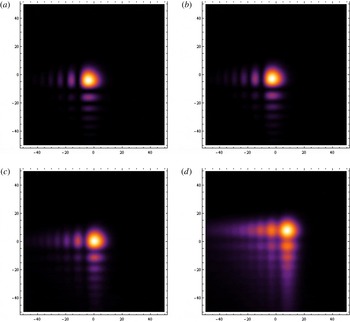
The electron density distribution of the finite-energy Airy-like plasmon mode in the
 $x{-}y$
plane when the unperturbed electron density of plasma
 $n_{e0}=10^{15}~\text{cm}^{-3}$
, the electron temperature
 $T_{e}=10^{6}~\text{K}$
, the electron density perturbation
 ${\tilde{N}}_{0}\sim 0.1\times n_{e0}$
, the decay factor
 $a=0.2$
,
 $w_{0}=5{\it\lambda}$
,
 $z=0$
(a),
 $z=150{\it\lambda}$
(b),
 $z=300{\it\lambda}$
(c),
 $z=500{\it\lambda}$
(d).

where
 ${\tilde{n}}_{0}(\boldsymbol{r})$
is a slowly varying function of the spatial coordinates and describes the wave profile. Replacing (2.2) in the wave equation (2.1), the paraxial equation of the electron plasma wave is obtained (Mendonca et al.
Reference Mendonca, Ali and Thidé2009a
):
 $$\begin{eqnarray}\left({\rm\nabla}_{\bot }^{2}+2\text{i}k\frac{\partial }{\partial z}\right){\tilde{n}}_{0}(\boldsymbol{r})=0,\end{eqnarray}$$
where the longitudinal wavenumber
 $k$
is assumed to satisfy the linear dispersion relation
 $k^{2}S_{e}^{2}={\it\omega}^{2}-{\it\omega}_{pe}^{2}$
. According to this paraxial equation, the electron plasma waves with finite orbital angular momentum have been investigated in Mendonca et al. (Reference Mendonca, Ali and Thidé2009a
) and Mendonca (Reference Mendonca2012). In analogy with the optical Airy beam, the Airy-like solution of (2.3) can be written in the following form:
 $$\begin{eqnarray}\displaystyle {\tilde{n}}_{0} & = & \displaystyle {\tilde{N}}_{0}\text{Ai}\left[s_{x}-\left(\frac{{\it\xi}}{2}\right)^{2}+\text{i}a{\it\xi}\right]\text{Ai}\left[s_{y}-\left(\frac{{\it\xi}}{2}\right)^{2}+\text{i}a{\it\xi}\right]\nonumber\\ \displaystyle & & \displaystyle \times \exp \left[a(s_{x}+s_{y})-a{\it\xi}^{2}+\text{i}\frac{{\it\xi}}{2}(s_{x}+s_{y})+\text{i}a^{2}{\it\xi}-\text{i}\frac{{\it\xi}^{3}}{6}\right],\end{eqnarray}$$
where
 $\text{Ai}[\cdots ]$
is the Airy function,
 ${\tilde{N}}_{0}$
is the maximum amplitude of plasma waves,
 $a$
is the decay factor,
 $s_{x}=x/w_{0}$
and
 $s_{y}=y/w_{0}$
are the dimensionless transverse coordinates,
 $w_{0}$
is an arbitrary transverse scale and
 ${\it\xi}=z/k_{z}w_{0}^{2}$
is a normalized propagation distance. Figure 1 shows a numerical illustration of the electron density distribution of the Airy-like plasmon mode in the
 $x{-}y$
plane. Obviously, there is the transverse acceleration of the Airy-like plasmon with the increase of the propagation distance. The Airy-like electron wave propagates along a curved trajectory and it is weakly diffractive along its trajectory and retains the basic structure for longer distances in the propagation direction.
3. The electrostatic potential and transverse acceleration of the Airy-like electron plasma wave
The electron density perturbation is associated with the electrostatic potential
 $V(\boldsymbol{r},t)$
. The potential equation is satisfied in the following expression (Mendonca et al.
Reference Mendonca, Ali and Thidé2009a
):
 $$\begin{eqnarray}{\rm\nabla}^{2}V=4{\rm\pi}e{\tilde{n}}.\end{eqnarray}$$
In the paraxial approximation, the potential function
 $V(\boldsymbol{r},t)$
has the same form as the electron density fluctuations:
 $$\begin{eqnarray}V(\boldsymbol{r},t)=\tilde{V}(\boldsymbol{r})\exp (\text{i}kz-\text{i}{\it\omega}t).\end{eqnarray}$$
Substituting (3.2) in (3.1) and considering
 ${\rm\nabla}^{2}\simeq {\rm\nabla}_{\bot }^{2}-k^{2}+2\text{i}k\partial /\partial z$
in the paraxial approximation, where
 ${\rm\nabla}_{\bot }^{2}=\partial ^{2}/\partial x^{2}+\partial ^{2}/\partial y^{2}$
, the potential equation (3.1) becomes
 $$\begin{eqnarray}\left({\rm\nabla}_{\bot }^{2}+2\text{i}k\frac{\partial }{\partial z}\right)\tilde{V}-k^{2}\tilde{V}=4{\rm\pi}e{\tilde{n}}_{0}.\end{eqnarray}$$
The electrostatic potential
 $\tilde{V}(\boldsymbol{r})$
also satisfies the paraxial equation, which is analogous to (2.3). The beam solution of (3.3) can be described by the Airy function as the electron plasma wave solution (2.4), and then (3.3) reduces to
 $$\begin{eqnarray}k^{2}\tilde{V}=-4{\rm\pi}e{\tilde{n}}_{0};\end{eqnarray}$$
the electrostatic potential for the Airy-like plasmon mode has the following form:
 $$\begin{eqnarray}V(\boldsymbol{r})=-\frac{4{\rm\pi}e}{k^{2}}{\tilde{n}}_{0}.\end{eqnarray}$$
According to the expression of the electrostatic potential
 $V(\boldsymbol{r},t)$
, one can obtain that
 $V(\boldsymbol{r},t)=V(\boldsymbol{r})\exp (\text{i}kz-\text{i}{\it\omega}t)$
and the electrostatic field
 $\boldsymbol{E}(\boldsymbol{r},t)=-\boldsymbol{{\rm\nabla}}V(\boldsymbol{r},t)$
. According to (2.4), the electron density perturbation
 ${\tilde{n}}_{0}$
can be taken in the following form:
 $$\begin{eqnarray}{\tilde{n}}_{0}={\tilde{N}}_{0}{\tilde{n}}_{0x}{\tilde{n}}_{0y},\end{eqnarray}$$
and
 $$\begin{eqnarray}\displaystyle & \displaystyle {\tilde{n}}_{0x}=\text{Ai}\left[s_{x}-\left(\frac{{\it\xi}}{2}\right)^{2}+\text{i}a{\it\xi}\right]\exp \left[as_{x}-\frac{a}{2}{\it\xi}^{2}+\text{i}\frac{{\it\xi}}{2}s_{x}+\text{i}\frac{a^{2}}{2}{\it\xi}-\text{i}\frac{{\it\xi}^{3}}{12}\right], & \displaystyle\end{eqnarray}$$
 $$\begin{eqnarray}\displaystyle & \displaystyle {\tilde{n}}_{0y}=\text{Ai}\left[s_{y}-\left(\frac{{\it\xi}}{2}\right)^{2}+\text{i}a{\it\xi}\right]\exp \left[as_{y}-\frac{a}{2}{\it\xi}^{2}+\text{i}\frac{{\it\xi}}{2}s_{y}+\text{i}\frac{a^{2}}{2}{\it\xi}-\text{i}\frac{{\it\xi}^{3}}{12}\right], & \displaystyle\end{eqnarray}$$
where
 ${\tilde{n}}_{x0}$
and
 ${\tilde{n}}_{y0}$
can be considered as the distributions of the electron density in
 $x$
and
 $y$
, respectively. Then the electrostatic potential
 $V(\boldsymbol{r})$
can be written in the form
 $$\begin{eqnarray}V(\boldsymbol{r})=V(x,z)V(y,z),\end{eqnarray}$$
where
 $V(x,z)$
and
 $V(y,z)$
describe the electrostatic potentials of the Airy-like plasmon in the planes
 $x{-}z$
and
 $y{-}z$
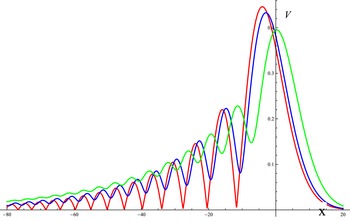
, respectively. Figure 2 displays the evolution of the electrostatic potential
 $V(\boldsymbol{r})$
for the same decay factor
 $a$
and different propagation distances
 $z$
. It should be noticed that the principal maximum of the electrostatic potential decreases gradually with the increase of the propagation distance, but the electrostatic potential in the transverse direction
 $x$
(or
 $y$
) increases. According to (3.5), the evolution of the electrostatic potential
 $V(\boldsymbol{r})$
is the same as the evolution of the electron density
 ${\tilde{n}}_{0}$
. Then, we know that the electron density increases in the transverse direction
 $x$
(or
 $y$
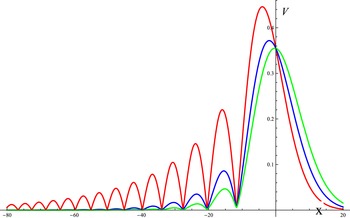
) with the increase of the propagation distance. It is because the energy flow of the Airy wave follows the tangent line of the direction of propagation (Sztul & Alfano Reference Sztul and Alfano2008), and the energy is conserved. Figure 3 depicts the evolution of the electrostatic potential
 $V(\boldsymbol{r})$
for different decay factors
 $a$
and the same propagation distance
 $z$
. With increase of the decay factor
 $a$
, the principal maximum of the electrostatic potential decreases gradually, and the electrostatic potential in the transverse direction decreases gradually.
The electrostatic potential of the Airy-like plasmon in the direction of
 $x$
(or
 $y$
) for the same decay factor
 $a=0.2$
and
 $w_{0}=5{\it\lambda}$
and different propagation distances,
 $z=10{\it\lambda}$
(the red line),
 $z=150{\it\lambda}$
(the blue line),
 $z=300{\it\lambda}$
(the green line).

The electrostatic potential of the Airy-like plasmon in the direction of
 $x$
(or
 $y$
) for the same propagation distance
 $z=10{\it\lambda}$
and
 $w_{0}=5{\it\lambda}$
and different decay factors,
 $a=0.2$
(the red line),
 $a=0.5$
(the blue line),
 $a=0.7$
(the green line).

4. Conclusions
In summary, we have given a theoretical investigation of an Airy-like electron plasma wave in an unmagnetized collisionless plasma. Just like the optical Airy beam, the Airy-like electron plasma wave also has the propagation properties of being diffraction-free and having transverse acceleration. We know that the Airy-like electron plasma wave propagates along a curved trajectory and retains the basic structure for longer distances in the propagation direction. Just like the optical Airy beam, the total energy of the Airy-like electron plasma wave is conserved. We also gave numerical simulations of the electrostatic potential of the Airy-like electron plasma wave, and showed that the electrostatic potential decreases in the propagation direction, but increases in the transverse direction. According to the results in Sztul & Alfano (Reference Sztul and Alfano2008), the Poynting vector of the Airy wave possesses non-zero transverse components, which leads to the increase of the electron density and the electrostatic potential in the transverse direction. The present study may be relevant to the study of the laser–plasma interaction such as the laser wake field acceleration. Due to the asymmetric distribution of the Airy-like electron plasma wave, its excitation is an interesting challenge in theory and experiment. In further work, we will investigate the possible excitation method of the Airy-like electron plasma wave in theory.
Acknowledgements
This work was supported by the Foundation of He’nan Educational Committee of China (grant no. 15A140021), the National Natural Science Foundation of China (grant no. 61205086) and the Foundation of He’nan University of Science and Technology for young teachers (grant no. 2015QN023).