1 Introduction
Lenition has been a topic of debate in phonological theory and historical linguistics for a long time, and much of the debate centres on the criteria for classifying an observed pattern as an instance of lenition or otherwise (see Honeybone Reference Honeybone2008 for a historical overview). In this paper, we focus on the classification of plosive affrication, whose status in relation to lenition appears particularly unclear, and report on a case study of /t/-affrication in spontaneous British English Received Pronunciation (RP).
While there is widespread agreement that lenition is a useful cover term for diachronic changes that involve the progressive ‘weakening’ of sounds, defining what constitutes weakening has proved a challenge. Attempts to formulate a unified account of the various processes involved have long focused on the phonetic parameters of sonority (Taylor Reference Taylor, Anderson and Jones1974, Cser Reference Cser2003, Vijayakrishnan Reference Vijayakrishnan, van de Weijer, van Heuven and Hulst2003, Szigetvári Reference Szigetvári2008), articulatory effort (Donegan & Stampe Reference Donegan, Stampe and Dinnsen1979, Hock & Joseph Reference Hock and Joseph1996, Kirchner Reference Kirchner2001a, Reference Kirchner and Lombardib) and degree of obstruction to airflow (Lass & Anderson Reference Lass and Anderson1975, Lass Reference Lass1984, Honeybone Reference Honeybone2001). Recent studies have highlighted the relevance of duration (e.g. Marotta Reference Marotta2008), and several authors have adopted definitions referring to both constriction degree and duration (Lavoie Reference Lavoie2001, Kirchner Reference Kirchner, Hayes, Kirchner and Steriade2004, Bye & de Lacy Reference Bye and de Lacy2008). Most recently, Bauer (Reference Bauer2008) has proposed that, to qualify as lenition, a pattern of change – or to be more precise, its actuation in synchronic phonology – should lend itself to an explanation in terms of local articulatory underachievement: that is, the failure on the speaker's part to reach the target articulatory configuration for the sound in question.
Bauer (Reference Bauer2008) does not formulate an accompanying definition of diachronic fortition or its correspondent in synchronic phonology, although his argument implies that this should refer to articulatory ‘overachievement’. In fact, much of the literature plays down the concept of fortition, which is considered ‘vanishingly rare’ in sound change (Honeybone Reference Honeybone2008: 9). As we will show, the uncertainty surrounding the status of plosive affrication hinges as much on the question of what fortition is as on the more familiar question: ‘what is lenition?’.
1.1 Plosive affrication: fortition or ‘weak’ lenition
Some processes are classifiable as lenition according to most definitions. Plosive frication – realising a target plosive without reaching a complete closure of the articulators, so that the resulting sound is a fricative – is a clear example of this: fricatives are generally considered more sonorous than plosives, they obviously have less of an obstruction to airflow and they can easily be seen as resulting – at least initially, before being adopted as production targets (cf. Simpson Reference Simpson2001) – from a failure to establish or maintain a target closure. Other processes are more difficult to classify.
The status of plosive affrication, in which a plosive is released into a period of frication at the place of articulation of the preceding closure (e.g. /t/→[tˢ]), is particularly unclear. As Szigetvári (Reference Szigetvári2008) points out, affricates are among a number of sound types generally omitted from sonority hierarchies, and it is not immediately obvious how affricated plosives compare to ‘plain’ or aspirated plosives in terms of articulatory effort, obstruction to airflow, target achievement and so on. For some, the fact that affricates can be analysed as sequences of a plosive and a fricative makes it ‘reasonable to assume that voiceless affricates are the strongest of the consonants’ (Hooper Reference Hooper1976: 206); therefore, affrication must be fortition rather than lenition (Foley Reference Foley1977, Kirchner Reference Kirchner2001a, Lavoie Reference Lavoie2001, Bauer Reference Bauer2008). For others, it makes affricated plosives natural ‘intermediates’ between plain and fricated plosives – in other words, the result of lenition. Under this view, affrication can be seen as ‘the least radical lenition of a voiceless stop’ (Lass & Anderson Reference Lass and Anderson1975: 152), and a first step on lenition trajectories involving frication (Lass Reference Lass1984, Harris Reference Harris1990, Sangster Reference Sangster2001, Honeybone Reference Honeybone, Carr, Durand and Ewen2005, Watson Reference Watson2007a).
The debate is complicated by differences among researchers in the interpretation of distributional evidence. It is widely accepted that consonantal lenition phenomena are more frequently observed in some phonological environments than in others (for recent overviews, see Bauer Reference Bauer2008, Ségéral & Scheer Reference Ségéral and Scheer2008 and Szigetvári Reference Szigetvári2008). The initial position is commonly considered the ‘strongest’ position: it is ‘phonologically conservative, retaining stronger pronunciations’ (Bauer Reference Bauer2008: 618). Therefore, initial segments in stressed syllables are unlikely to undergo lenition. The post-stress intervocalic position, on the other hand, is ‘a prime weakening environment: all things being equal, we expect lenition here’ (Lass Reference Lass1984: 181).
It would seem that the recognition of ‘strong’ and ‘weak’ environments provides a useful diagnostic for processes whose status is debatable: if they are observed in environments that favour lenition, they can be classed as instances of lenition. However, it is less clear how processes that are observed in ‘strong’ environments should be classified. According to some, processes associated with strong positions must be instances of fortition. Since plosive affrication is observed in initial position in a number of diachronic processes, such as the High German Consonant Shift (Szigetvári Reference Szigetvári2008: 118), its status as a fortition process seems confirmed (Foley Reference Foley1977). Others, however, leave open the possibility that strong positions host lenition, although they might ‘inhibit’ its extent. Ségéral & Scheer (Reference Ségéral and Scheer2008: 140) suggest that ‘the strong position does not generate phonological processes’; rather, processes ‘will be able to affect segments more or less according to the position in which they occur: the output will never be weaker in the strong position than it is in weak positions’. This means that if a lenition process is seen to apply in weak positions, variation in strong positions can also be attributed to lenition – albeit of a restricted kind.
Honeybone's (Reference Honeybone2001, Reference Honeybone, Carr, Durand and Ewen2005) treatment of Liverpool English plosive affrication is consistent with Ségéral & Scheer's (Reference Ségéral and Scheer2008) approach to relative positional strength. In this variety, affrication occurs alongside frication, and is associated with strong syllabic-prosodic environments – while frication is associated with weak ones (see Watson Reference Watson2007b: 353). Honeybone's conclusion is that affrication is a ‘weak’ form of spirantisation: an instance of lenition whose extent is inhibited by the relative strength of its hosting environment. The High German Consonant Shift similarly involved affrication in strong environments and frication in weak ones, and it seems a matter of opinion as to whether it should be treated as ‘an across-the-board lenition which affects consonants in strong position to a lesser degree’, or as a conspiracy of two separate processes: ‘fortition in strong position and lenition in weak position’ (Szigetvári Reference Szigetvári2008: 118).
1.2 Synchronic variation and criteria for fortition
A situation in which the same distributional evidence can be used to support two mutually exclusive theoretical interpretations – in this case, plosive affrication is lenition vs. plosive affrication is fortition – is clearly unsatisfactory. An important question is, of course, whether we can identify independent criteria to decide between the two interpretations.Footnote 1 In what follows, we examine several criteria which inform our analysis of /t/-affrication in spontaneous British English RP.
To start with, following Bauer (Reference Bauer2008), we take seriously the idea that the phonetic basis for diachronic lenition and fortition is to be found in synchronic patterns of inter- and intra-speaker variation (see also Honeybone Reference Honeybone2001), and therefore that we can improve our understanding of processes whose status is debatable, such as plosive affrication, by analysing their phonetic and phonological characteristics in patterns of synchronic variation. We also take seriously Szigetvári's (Reference Szigetvári2008) suggestion that plosive affrication may have different phonetic and phonological characteristics in different languages or language varieties, or even in different phonological environments in the same language. Both positions are consistent with current thinking on variation and change in experimental, exemplar-based and constraint-based phonological frameworks (e.g. Ohala Reference Ohala and Jones1993, Silverman Reference Silverman2004, Reference Silverman, Goldstein, Whalen and Best2006, Boersma & Hamann Reference Boersma and Hamann2008, Hansson Reference Hansson2008), which offer explanations of diachronic patterns that are grounded in observations of the synchronic behaviour of speakers and listeners.
Thus we assume that decisions as to whether a given case of plosive affrication is best interpreted in terms of lenition or fortition should ideally be based on a thorough phonetic analysis of the process, along with distributional analysis, and should take into consideration, where possible, relevant findings in the fields of experimental phonetics and laboratory phonology. For example, various production studies have provided evidence of ‘domain-initial articulatory strengthening’, as well as ‘phrase-final lengthening’ (Beckman et al. Reference Beckman, Edwards, Fletcher, Docherty and Ladd1992, Fougeron & Keating Reference Fougeron and Keating1997, Keating et al. Reference Keating, Cho, Fougeron, Hsu, Local, Ogden and Temple2003, Cho et al. Reference Cho, McQueen and Cox2007, Kuzla & Ernestus Reference Kuzla and Ernestus2011): these studies show that consonants in initial positions in domains such as the syllable, the word, the foot and the phonological phrase tend to be articulated with tighter stricture, greater initiation effort and increased duration relative to non-initial consonants, while phrase-final consonants are frequently lengthened relative to phrase-medial ones. Accounts in terms of the enhancement of phonological contrasts in perceptually salient positions seem appropriate (see Smith Reference Smith2005, Vaux & Samuels Reference Vaux and Samuels2005, Smiljanić & Bradlow Reference Smiljanić and Bradlow2009) – but for our purposes, it is reasonable simply to assume, as Harris & Kaisse (Reference Harris and Kaisse1999: 154) and Bye & de Lacy (Reference Bye and de Lacy2008: 175–176) do, that if the phonetic details and phonological distribution of a variant pronunciation are consistent with an analysis in terms of articulatory strengthening, an account in terms of ‘weak’ lenition is dispreferred.
Since lenition and fortition (as well as strengthening and lengthening) are relative concepts, an analysis of a given variant pronunciation, such as [tˢ] for /t/, must involve a comparison of that variant to what can be considered the unmarked, ‘default’ realisation of the phoneme under consideration. In theory, the finding that a given variant is associated with strong environments and has several characteristics of articulatory strengthening relative to variants associated with weak environments is amenable to three interpretations: the former variant can be explained in terms of fortition relative to the latter variants, the latter variants can be explained in terms of lenition relative to the former, or both explanations are appropriate. Recognising one of the variants involved as the unmarked realisation allows one to decide between these alternative interpretations. Thus, Harris & Kaisse (Reference Harris and Kaisse1999: 146–147) account for the [j]~[ʒ] alternation in Argentinian Spanish in terms of a strengthening process, on the understanding that [j] constitutes the ‘default realisation’ of the phoneme in question. To revisit our earlier assumption, then, if the phonetic details and phonological distribution of a variant pronunciation, such as [tˢ] for /t/, are consistent with an analysis in terms of articulatory strengthening relative to the unmarked realisation of the phoneme in question, we would suggest that an account in terms of ‘weak’ lenition is untenable, and an account in terms of fortition appropriate. By ‘an account in terms of fortition’, we mean one which maintains that if there is evidence of diachronic change involving the variant pronunciation in question, that change is best labelled an instance of fortition.Footnote 2
In what follows, we illustrate the approach sketched here in an analysis of /t/-affrication in contemporary, spontaneous RP. Our aim is to establish whether the phonetic and phonological characteristics of this synchronic case of plosive affrication are compatible with an account in terms of lenition, fortition, both (depending on the phonological environment) or neither. §2 describes our data and analysis parameters. §3 to §5 present the results of the analysis, followed by discussion and a conclusion in §6.
2 Data and method
2.1 Corpus and variant selection
For the purpose of this study, we randomly sampled approximately 1000 realisations of /t/ from a corpus of spontaneous RP English speech uttered by a total of 20 speakers. The corpus is described in more detail in the Appendix. While /t/-affrication, as in /t/→[tˢ],Footnote 3 does not feature in recent descriptions of RP consonant allophony (e.g. Roach Reference Roach2004, Collins & Mees Reference Collins and Mees2008), wider treatments of English phonetics have long suggested that it is commonplace: for example, Gimson (Reference Gimson1970: 163) writes that ‘/t, d/ are especially liable to affrication (particularly in the south of England)’, and Ogden (Reference Ogden2009: 111) that ‘most speakers [of English] have some degree of frication in their release of the closure for [t], giving a sound that is sometimes transcribed as [tˢ]’. Our data confirm these observations: affricated realisations of /t/ constitute approximately 10% of our sample, and as such, the sample contains more examples of /t/-affrication than, for example, /t/-glottalling and /t/-voicing, which do receive comment in the literature on RP (see Roach Reference Roach2004: 240 and Collins & Mees Reference Collins and Mees2008: 86 respectively). Moreover, while relative frequencies of variants vary from speaker to speaker, all 20 produce at least one instance of [tˢ], and most have multiple occurrences – in other words, if our speakers are representative of the wider population of RP speakers, the productivity of /t/-affrication is not restricted to a small number of idiosyncratic individuals.Footnote 4
We selected [tʰ] as the ‘default’ realisation of /t/ to compare [tˢ] with. Plain [t] would perhaps seem a more obvious choice; however, this realisation is comparatively uncommon in our sample, accounting for fewer than 10% of instances. By contrast, aspirated [tʰ] is the second most frequent realisation of /t/ after fricated [ ] in our data, accounting for over 20% of our sample. Moreover, [t] occurs in a narrow range of phonological environments – mostly onset and coda /st/ clusters and word-final preconsonantal positions – while [tʰ] has a wide distribution across phonological environments, as we will see below. It does not seem unreasonable, therefore, to treat [tʰ] as the ‘elsewhere’ realisation of /t/ in our data, as Vaux & Samuels (Reference Vaux and Samuels2005) do for English generally.Footnote 5 In practical terms, [tʰ] provides a more robust point of comparison for [tˢ] than [t] does.Footnote 6
In addition, we observed that /t/-frication is highly frequent in our data (as suggested by Simpson Reference Simpson2001, Shockey Reference Shockey2003 and Cruttenden Reference Cruttenden2008: 160, among others): instances of [] constitute the most common realisation of /t/, making up over 20% of our sample.Footnote 7 Since plosive frication is an uncontroversial example of lenition, as indicated in §1.1, we included [] in our comparison. Comparing affricated instances of /t/ to aspirated and fricated ones allows us to relate their phonetic and phonological characteristics to those of two realisations of /t/ that occupy different ends of a putative lenition scale, as Sangster (Reference Sangster2001: 407) does for /t/ in Liverpool English. We extracted all potential instances of [tˢ], [tʰ] and [] from our sample and transcribed them independently. There was uncertainty as to the classification of a small minority of instances (<3%). These were excluded from further analysis, although we will briefly discuss them in §3.Footnote 8 The resulting dataset contains a total of 471 realisations of /t/: 109 affricated, 164 aspirated and 198 fricated.
2.2 Parameters used in the analysis
In order to get a clear impression of how affricated realisations of /t/ compare to aspirated and fricated ones, we analysed all instances in the dataset along multiple phonetic parameters, as well as examining their distribution across speakers and phonological environments – in particular those known to ‘favour’ or ‘disfavour’ lenition processes.
Starting with the phonetic analysis, Lavoie (Reference Lavoie2001: 158–159) suggests that ‘a weak consonant would exhibit some or all of the following characteristics: decreased duration, decreased linguopalatal contact, increased formant structure, incomplete stop closures, weaker or absent bursts, increased periodic energy (voicing), decreased aperiodic energy, including intensity of frication and aspiration’. Since our comparison includes no voiced segments, and we undertook auditory and acoustic analysis only, formant structure and periodic energy are of no relevance, and linguopalatal contact could not be measured. Our phonetic analysis focused on the remaining parameters listed by Lavoie. In particular, we investigated the duration and amplitude characteristics of the three variants, and examined the nature of the hold and release phases of [tˢ] and [tʰ]. Throughout, we looked for evidence of gradience between the allophonic categories [tˢ] and [tʰ] on the one hand and [tˢ] and [] on the other, on the assumption that the existence of ‘ambiguous’ instances provides evidence for the close relationship between the processes involved. Methodological details of our acoustic analyses are given in the Appendix.
As indicated in §1.2, it is widely accepted that some phonological environments are more likely to host lenition processes than others. The positional strength hierarchy in (1), adapted from Honeybone (Reference Honeybone, Carr, Durand and Ewen2005: 170; see also Ségéral & Scheer Reference Ségéral and Scheer2008: 135), provides a frame of reference for our distributional analysis. As stated, the hierarchy refers to positions within words, where positional strength increases from (a) to (f). The hierarchy glosses over several more fine-grained strength relations (see Ségéral & Scheer Reference Ségéral and Scheer2008), some of which we will return to in our analysis. (Here and elsewhere, ‘.’ denotes a syllable boundary.)
(1)


The aim of our analysis was to establish the extent to which /t/-affrication in RP English can be said to be favoured or disfavoured in any of the environments in (1), and, of course, how the distribution of [tˢ] compares to that of [tʰ] and []. Of particular relevance is the order of frequencies in individual environments. We assume that if /t/-affrication lends itself to an account in terms of ‘weak’ lenition, one might expect to find that in lenition-promoting environments frication and affrication together account for the majority of instances, and that [tʰ] is rare; and that in lenition-inhibiting environments, aspirated instances form the majority, and [tˢ] is more readily observed than []. One might not expect to find lenition-inhibiting environments in which [tˢ] is more common than [tʰ], or lenition-promoting environments in which the opposite is true (cf. Ségéral & Scheer Reference Ségéral and Scheer2008: 140).
We classified all realisations of /t/ in our dataset according to their position in syllable structure and their position relative to stress: in each case, we noted whether /t/ is in a syllable onset or coda, whether the syllable it is affiliated with is stressed or not, and what segments are immediately adjacent to it. Our classification criteria are given in the Appendix. We carried out two rounds of classification: one considering positions within word boundaries only, as is common in the literature on lenition (see in particular Escure Reference Escure1977, Szigetvári Reference Szigetvári2008), and one looking across word boundaries. As Honeybone (Reference Honeybone2001: 232) points out, positions immediately adjacent to a word boundary cannot be said to be lenition-promoting or inhibiting per se, but should be considered in the wider, phrasal context – especially when considering data sampled from continuous speech, in which resyllabification of word-final consonants is expected to occur. We will report results of both analyses in what follows.
The following sections provide an overview of our analysis results. In §3, we offer a general phonetic description of the variants under consideration, with particular reference to the nature of the hold and release phases of [tˢ] and [tʰ] and the issue of gradience. In §4, we describe the distribution of [tˢ], [tʰ] and [] across phonological environments, and in §5 we present the results of our acoustic analysis, focusing on duration and amplitude, in which we test statistically whether observed differences between variants are robust across the phonological environments in which they occur. This will allow us to establish the extent to which the phonetics of /t/-affrication is context-sensitive.
3 General phonetic comparison
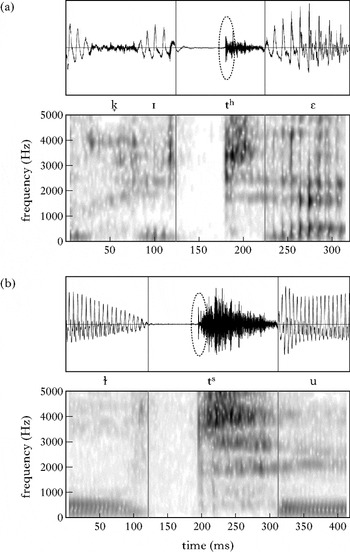
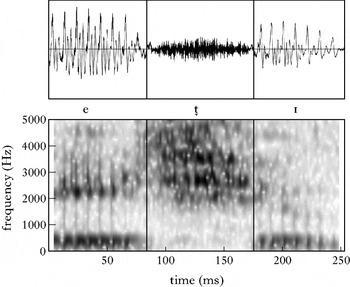
We first offer a general phonetic description of [tˢ], [tʰ] and [] in our data. Instances of [tˢ] and [tʰ] both have a silent hold phase, followed in most cases by a transient burst and a period of frication. In the case of [tʰ], the frication is produced at the glottis; in the case of [tˢ] at the alveolar ridge. Figure 1 shows an example of each. In both cases, the transient burst is clearly visible as a spike in the waveform; these are found in 92% of instances of [tˢ] and 95% of instances of [tʰ]. Fricated realisations of /t/ are different from [tˢ] and [tʰ] in that they lack a silent hold phase: no complete closure is established, so there is frication throughout. Figure 2 shows a representative example.
Waveform and spectrogram of (a) an instance of [tʰ], in architects, and (b) an instance of [tˢ], in temple to, with boundaries marking the onset of the hold phase and the start of vocal fold vibration for the next vowel. The ovals highlight the transient bursts.

Waveform and spectrogram of an instance of [], in creative, with boundaries marking the transitions between vocal fold vibration for the vowels and the voiceless frication for /t/.

These observations have some noteworthy implications. First, [tˢ] and [tʰ] display very little difference in degree of stricture during the hold phase and in the nature of the burst that marks the onset of the release phase: neither appears clearly ‘stronger’ or ‘weaker’ than the other. Second, [tˢ] and [tʰ] are clearly distinct from [], because of the absence of complete closure in the latter. In fact, the small number of realisations of /t/ whose classification we could not reach agreement on (see §2.1) mostly involved a choice between ‘aspirated’ and ‘affricated’. Moreover, a sizeable subset of instances that we treat as affricated in the analyses presented below (33 out of 109) is also aspirated: the period of alveolar frication is followed by a brief period of glottal frication as the tongue moves away from the alveolar ridge. Together, these facts are indicative of a high degree of similarity – and suggestive of some degree of gradience – between [tˢ] and [tʰ]. The products of /t/-affrication and /t/-frication, on the other hand, appear qualitatively quite distinct.
4 Comparison according to phonological environment
For the purpose of our distributional analysis, we classified each instance of /t/ in our dataset according to its syllabic-prosodic environment, both word-internally and assuming resyllabification across word boundaries. (A full description of our classification criteria can be found in the Appendix.) As explained in §2.2, we also inspected the data for any effects of melodic environment, i.e. adjacent segments favouring or disfavouring particular realisations of /t/. In what follows, we first discuss the latter effects (§4.1). We then exclude the instances explained by these effects and describe the distribution of the remaining instances of [tˢ], [tʰ] and [] according to syllabic-prosodic environment (§4.2).
4.1 Melodic conditioning effects
Our data reveal strong conditioning effects of two specific segment types. First, a preceding /s/ or /z/ strongly favours []. Our dataset contains a total of 93 instances of /t/ preceded by /s/ or /z/. In most cases, /t/ is preceded by /s/ in the same word, as in stand, lasting and journalist (n=64). In the remaining cases it is preceded by /s/ or /z/ across a word boundary, as in this time and he's talking (n=29). The conditioning effect of /s/ is very strong word-internally: in 63 out of the 64 word-internal /st/ sequences (98%), /t/ is fricated.Footnote 9 Across word boundaries, the effect is less striking, but 16 out of 29 instances of /t/ preceded by a word-final /s/ or /z/ (55%) are fricated. Affricated and aspirated realisations are similarly uncommon in the latter environment, with seven and six instances respectively.Footnote 10
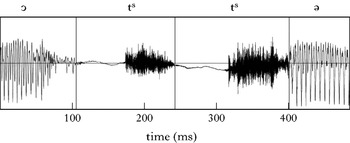
Second, an adjacent /t/ or /d/ favours [tˢ] and [tʰ]. Our data contain 40 /t t/ or /d t/ sequences across word boundaries, in phrases such as ought to, can't tell and wanted to. In five of the /t t/ sequences, both instances of /t t/ have a discrete segmental realisation; in the remaining cases the sequence is realised as a single segment. For the five /t t/ sequences realised as two segments, the first segment is [tˢ] in all cases. The second segment varies. In two cases both instances of /t/ are realised as [tˢ]; Fig. 3 shows a segmented waveform for one of these. In two other cases the second segment is [], and in one case the second realisation of /t/ is [tʰ]. Turning to the 35 sequences with a single segmental realisation, generalising across /t t/ and /d t/ the majority variant is [tʰ] (20 instances; 57%), followed by [tˢ] (8 instances; 23%) and [] (7 instances; 20%).
Segmented waveform of a double affricated release for /t t/, in ought to.

A relevant question at this point is whether these melodic effects tell us anything about the status of plosive affrication qua lenition or fortition. Starting with the preference for [] following /s/ or /z/, an account in terms of perseverative assimilation of degree of stricture seems plausible. If this is accepted, and if we follow Bauer (Reference Bauer2008), whose proposed account of lenition processes in terms of phonetic underachievement effectively makes assimilation a subtype of lenition, we can confirm that /t/-frication in this particular melodic environment can be treated as an instance of lenition. With reference to /t/-affrication, it should be noted that [tˢ] is not more frequent than [tʰ] in this environment. As suggested in §2.2, if affrication is a weak degree of frication, we might expect frication-favouring environments to weakly favour [tˢ] – i.e. to favour [] over [tˢ], and [tˢ] over [tʰ]. This is not what we observe in this particular case. In the case of adjacent /t/ and /d/, we have seen that [tˢ] is a recurrent realisation of the first /t/ in /t t/ sequences in which both instances of /t/ are realised as discrete segments. While the first /t/ in a two-segment /t t/ sequence is in a word-final, pre-consonant coda position, which is usually considered relatively weak, it is difficult to see these sequences as an environment associated with phonetic underachievement. After all, these sequences result from speakers choosing not to implement the more economical alternative – that of realising the two underlying segments as a single surface segment.
4.2 Distribution according to syllabic-prosodic environment
We observe no further conditioning effects of specific adjacent segments, so our remaining discussion will focus on the distribution of the three variants across syllabic-prosodic environments, not counting the instances of /t/ in the melodic environments we have just covered. This reduces the dataset to 333. We first consider instances of /t/ adjacent to a word boundary (§4.2.1 and §4.2.2), before covering post-coda onset, intervocalic and preconsonantal environments (§4.2.4 and §4.2.5).
4.2.1 Word and phrase-initial onset
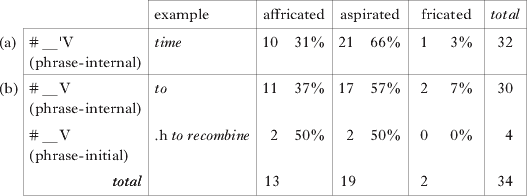
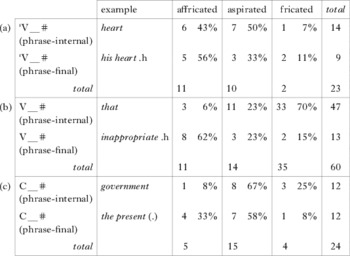
Starting with the initial onset environment, which is generally considered unlikely to host lenition processes, our dataset contains 66 word-initial instances of /t/ followed by a vowel, four of which are also phrase-initial. The phrase-initial instances all occur in the function word to, followed by an unstressed vowel; the non-phrase initial instances occur both in stressed and unstressed syllables. Table I shows that overall, [tʰ] is the majority variant in this environment, followed by [tˢ]. There is little apparent difference between stressed and unstressed syllables: in both, [tʰ] accounts for at least 50% of instances, [tˢ] for at least 30% and [] for less than 10%. The preference for [tʰ] and [tˢ] over [] is also seen in the subset of phrase-initial instances, in which [tʰ] and [tˢ] are equally represented, while [] is not attested. We might say, then, that the initial onset environment provides some support for the idea that [tˢ] is weaker than [tʰ] and stronger than []: in this strong environment, it is intermediate in frequency between the other two realisations of /t/. Of course, the 62 phrase-internal word-initial instances of /t/ may undergo resyllabification in connected speech, and may well fall into distinct subgroups when considered in their phrasal context. We will return to the relevant subgroups below.
Numbers and proportions of affricated, aspirated and fricated realisations of /t/ in word-initial and phrase-initial onsets, followed by (a) a stressed vowel and (b) an unstressed vowel. Proportions are calculated by row. ‘.h’ denotes an audible inbreath.

4.2.2 Word and phrase-final coda
Turning to the final coda environment, which is generally considered much more likely than the initial onset environment to host lenition processes, our dataset contains 83 instances of /t/ in a word-final coda preceded by a vowel, of which 22 are also phrase-final. In addition, it contains 24 instances of /t/ in a word-final coda preceded by a consonant, of which twelve are also phrase-final. Table II shows that [tˢ] is the majority variant in two out of the three phrase-final positions listed – preceded by a stressed vowel, as in his heart.h, and preceded by an unstressed vowel, as in inappropriate. h.Footnote 11 Frication is rare in these positions, as well as in the third phrase-final position listed – preceded by a consonant, as in the present (.).
Numbers and proportions of affricated, aspirated and fricated realisations of /t/ in word-final and phrase-final codas, preceded by (a) a stressed vowel, (b) an unstressed vowel and (c) a consonant in an unstressed syllable. Proportions are calculated by row. ‘.h’ denotes an audible inbreath, ‘(.)’ a pause.

[tʰ] is the majority variant in two out of three phrase-internal positions listed – preceded by a stressed vowel, as in heart, and preceded by a consonant, as in government. When /t/ is immediately preceded by an unstressed vowel, [] is clearly the majority variant, accounting for 70% of realisations. This is probably because 29 out of the 47 instances of /t/ in this position are followed directly by an unstressed vowel-initial syllable. In other words, considered in phrasal context these instances are in a foot-internal intervocalic onset, which, as we will see in §4.2.4 below, strongly favours /t/-frication. It is worth noting that in this position, [tˢ] is considerably less frequent than [tʰ] (6% vs. 23% respectively). As suggested in §4.1 above, if affrication is a weak degree of frication, we might expect frication-favouring environments to weakly favour [tˢ] – that is, to favour [] over [tˢ], and [tˢ] over [tʰ]. This is again not what we observe in our data.
4.2.3 Post-coda onset
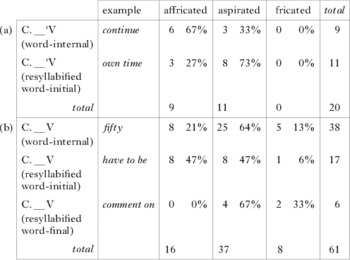
As seen in the positional strength hierarchy in (1) above, the post-coda onset environment is generally considered a relatively strong environment, in which lenition is not expected to be promoted. Within word boundaries, our dataset contains a small number of instances of post-coda /t/ followed by a stressed vowel, as in continue (n=9), and a larger number of instances of post-coda /t/ followed by an unstressed vowel, as in fifty (n=38). As /t/ is foot-initial in the former, but not in the latter, we would expect the former to be less lenition-promoting. As seen in Table III, our data are consistent with this to the extent that [] is observed only in words such as fifty.Footnote 12 The same pattern is observed across word boundaries: /t/-frication is attested in phrases such as have to be (n=23), but not in own time (n=11). [tˢ] is observed in both foot-initial and foot-internal post-coda positions, but the majority variant is [tʰ]. In the post-coda onset environment, then, the distribution of variants appears consistent with [tˢ] being intermediate in strength between [tʰ] and []. However, note that [tˢ] – not [tʰ] – is the majority variant in words such as continue. If we accept the idea that a lenition process cannot affect segments in strong environments more than segments in weak environments, and we take this to mean that in cases of synchronic variation, we should not observe a greater predominance of weak variant realisations in strong environments than in weak ones, we are forced to question whether continue constitutes a stronger prosodic environment for /t/ than fifty – or whether [tˢ] should be seen as a weaker realisation of /t/ than [tʰ]. Of course, we would argue there are good reasons for questioning the latter.
Numbers and proportions of affricated, aspirated and fricated realisations of /t/ in post-coda onsets, followed by (a) a stressed vowel and (b) an unstressed vowel. Proportions are calculated by row.

4.2.4 Intervocalic onset
The intervocalic onset environment is one in which we may expect to find interesting interactions between phrasal, word-internal and prosodic position. Firstly, as shown in the positional strength hierarchy in (1) above, the foot-internal intervocalic position – i.e. one in which the intervocalic consonant is the onset of an unstressed syllable – is more likely to host lenition processes than the foot-initial one – that is, one in which the intervocalic consonant is the onset of an stressed syllable. Secondly, we might expect that the position is stronger when the intervocalic consonant is word-initial than when it is word-medial or word-final. The application of American English /t/-flapping is consistent with these predictions: firstly, flapping occurs in water (foot-internal), but not in articulate (foot-initial); secondly, it does not occur in no tomorrow (arguably foot-internal, but word-initial), but it does in at all (arguably foot-initial, but word-final) (see Harris Reference Harris1994, De Jong Reference De Jong, van Oostendorp, Ewen, Hume and Rice2011).
We can see some evidence of these interactions in our data. The dataset contains 55 instances of intervocalic /t/ followed by a stressed vowel, and a considerably larger number of instances followed by an unstressed vowel (n=127). Table IV shows that across the three foot-initial positions, in words and phrases such as determined, they took and not only, [tʰ] is the majority variant, followed by [tˢ] and []. Across the three foot-internal positions, by contrast, [] is clearly the majority variant, followed by [tʰ] and [tˢ]. On the one hand, this confirms that foot-internal intervocalic positions are weaker than foot-initial ones. On the other hand, it provides further evidence that in RP, environments which favour /t/-frication do not weakly favour /t/-affrication – which is arguably unexpected if affrication is a weak degree of frication. Our data also provide some evidence of a difference between word-initial and word-final positions along the lines of that observed in American English /t/-flapping. When /t/ is followed by an stressed vowel, /t/-frication is proportionally more common in word-final position (not only; 17%) than in word-initial position (they took; 5%), although the numbers are too small for us to be certain that this reflects a true tendency. When /t/ is followed by an unstressed vowel, there are considerable differences between the most frequent realisations of word-initial and word-final instances. Consistent with American /t/-flapping, the word-final position patterns with the word-internal one in strongly favouring [], while the word-initial position patterns with the foot-initial one in favouring [tʰ]. It is worth noting that affrication is proportionally more common in the latter position (23%) than in the former (7%) – that is, in the stronger of the two.
Numbers and proportions of affricated, aspirated and fricated realisations of /t/ in intervocalic onsets, followed by (a) a stressed vowel and (b) an unstressed vowel. Proportions are calculated by row.

4.2.5 Pre-onset coda
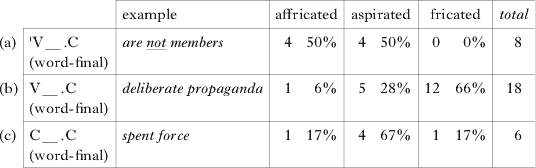
Finally, we consider the pre-onset coda environment. Our dataset does not contain word-internal instances of /t/ in this environment, and only a relatively small number of instances resulting from a word-final /t/ being followed by a word-initial consonant with which it cannot form a complex onset, as in not mine and a bit poor (n=30). In this environment, the prosodic status of a preceding vowel appears to be of consequence for the realisation of /t/, as can be seen in Table V. When a stressed vowel precedes /t/, as in are not members (n=8), [] is not attested, and [tʰ] and [tˢ] are equally common, with four instances each. When an unstressed vowel precedes /t/, as in deliberate propaganda (n=18), [] is the majority variant, accounting for 66% of instances. This is most likely due to the fact that the following onset consonant is /h/ in 13 out of the 18 cases. In fact, in nine out of twelve cases of /t/-frication (75%) the following consonant is /h/, and no segmental realisation of /h/ can be observed; furthermore, in all nine cases the following vowel is unstressed. In other words, these instances of /t/ are in a surface (foot-internal) intervocalic position, which favours frication. There is little to conclude from the distribution of the remaining variants with regards to their relative strength. In the final position listed in Table V, between two consonants, /t/ is mostly realised as [tʰ]. Again, it is difficult to draw conclusions about the relative strength of variants in this highly restricted environment.
Numbers and proportions of affricated, aspirated and fricated realisations of /t/ in pre-onset codas, preceded by (a) a stressed vowel, (b) an unstressed vowel and (c) a consonant. Proportions are calculated by row.

4.3 Discussion
To summarise the findings presented in this section, we have seen that in our data, /t/-affrication is relatively rare in environments that strongly favour frication, most notably when /t/ is adjacent to /s/ or /z/ and in foot-internal intervocalic position. [tˢ] is the majority variant in three environments: /t t/ sequences in which both plosives are realised as a separate segment, across phrase-final positions and in word-internal pre-stress post-coda onset position (as in continue). The latter is generally considered a relatively strong environment, as shown in the positional strength hierarchy in (1) above. As for /t t/ sequences, in which affrication is the norm for the first /t/, and phrase-final positions, it is debatable whether these constitute relatively strong or weak environments. Still, it is difficult to see them as environments associated with phonetic underachievement. As we have suggested in §4.1, the segmental realisation of both instances of /t/ in a /t t/ sequence is in itself a form of hyperarticulation, since the option of realising the sequence as a single plosive is readily available to the speaker. Moreover, the phrase-final environment has been found in many production studies to be associated with a relative lengthening of segments (Fougeron & Keating Reference Fougeron and Keating1997, Turk & Shattuck-Hufnagel Reference Turk and Shattuck-Hufnagel2007), while it is shortening that is generally associated with phonetic underachievement and lenition (Lavoie Reference Lavoie2001, Bauer Reference Bauer2008, Marotta Reference Marotta2008). In other words, there is some evidence in our data of /t/-affrication being accommodated in relatively strong environments, and little evidence of it being accommodated in particularly weak ones.
We have suggested that if /t/-affrication is to be accounted for in terms of ‘weak’ lenition, one would not expect to find lenition-inhibiting environments in which [tˢ] is more common than [tʰ], or lenition-promoting environments in which the opposite is true. In fact, however, we have seen examples of both. The foot-internal intervocalic position clearly favours /t/-frication, both word-internally and across word boundaries. However, [tˢ] is less frequently attested here than [tʰ].Footnote 13 By contrast, the post-coda onset position can reasonably be considered to be prosodically stronger when the onset is in a stressed syllable (as in continue) than when it is in an unstressed one (as in fifty) – yet [tˢ] outnumbers [tʰ] in the former, but not in the latter. Our findings for these environments are inconsistent with a treatment of /t/-affrication as a ‘weak’ degree of /t/-frication.
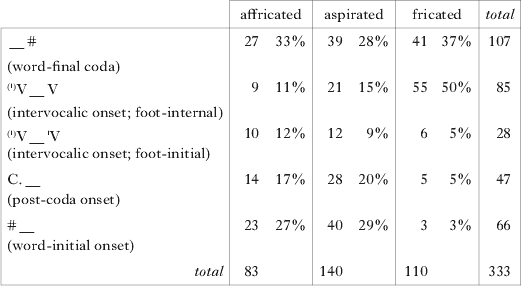
Finally, we have so far considered the distribution of affricated, aspirated and fricated instances of /t/ in terms of the question: ‘what proportion of instances in environment x does variant y constitute?’. Given that the total number of [tˢ] realisations in our dataset is considerably smaller than the total numbers of [tʰ] and [] realisations, so that [tˢ] is considerably less likely than [tʰ] and [] to be the majority variant in any given environment, it is also instructive to consider the distributions in terms of the question: ‘what proportion of instances of variant x occurs in environment y?’. As illustrated in Table VI, which summarises the distribution of the three variants across the major word-internal positions listed in the positional strength hierarchy in (1),Footnote 14 this consideration reveals that [tˢ] and [tʰ] are very similarly distributed among the positions. In fact, a Pearson's χ-square test reveals no significant difference between the two distributions (χ2=1·98, df=4, p=0·74). In particular, for both [tˢ] and [tʰ], a majority (about 60%) of instances occurs in the word-initial onset and word-final coda positions. When these are resyllabified into intervocalic, pre-onset coda and post-coda onset positions, the post-coda onset position emerges as most favourable to [tˢ] and [tʰ], hosting about 30% of all affricated and aspirated realisations (not shown in Table VI). The distribution of [] is significantly different from that of [tˢ] (χ2=53·87, df=4, p<0·001) and [tʰ] (χ2=62·43, df=4, p<0·001). Only a very small minority of instances occurs in word-initial onset position, and a large majority in foot-internal intervocalic onset position. Under resyllabification of word-initial and word-final instances of /t/ across word boundaries, the proportion of instances associated with this relatively weak environment grows to 59% (not shown in Table VI).
Numbers and proportions of affricated, aspirated and fricated realisations of /t/ in the word-internal environments listed in (1). Proportions are calculated by column.

These observations are consistent with [tˢ] and [tʰ] being associated with relatively strong environments, and [] with relatively weak ones. With reference to the relative strength of [tˢ] and [tʰ], it should be noted that a marginally higher proportion of the former occurs in the foot-initial intervocalic onset position compared with the foot-internal one (12% vs. 11%), while the proportions are the other way around for [tʰ] (9% and 15% respectively). When resyllabified word-initial and word-final instances of /t/ are added to the numbers in Table VI, this difference becomes more pronounced: 17% of both affricated and aspirated realisations occur in foot-initial intervocalic position; for affricated ones this is larger than the proportion in foot-internal intervocalic position (13%), while for aspirated ones it is smaller (22%). This suggests that if anything, [tˢ] shows a stronger affiliation with relatively strong syllabic-prosodic environments than [tʰ].
5 Comparison according to acoustic characteristics
Of the various phonetic criteria for consonant strength mentioned in §2.2, following Lavoie (Reference Lavoie2001), we have so far discussed the nature of the hold and release phases of [tˢ] and [tʰ], and the issue of gradience between [tˢ] and [tʰ] on the one hand and [tˢ] and [] on the other (see §3). We now turn to the duration and amplitude characteristics of the three variants, which we analysed acoustically. For the purpose of this analysis, we segmented each realisation of /t/ in our dataset: for instances of [tˢ] and [tʰ] we delimited the hold and release phases, and for [] we delimited the total period of frication. We then took duration measurements for the delimited segments, and amplitude measurements for part of the release phases of [tˢ] and [tʰ] and part of the frication period of []. We normalised measurements, in an attempt to minimise interfering effects of local speech rate on duration values, and of local loudness on amplitude values. A fuller description of our segmentation, measurement and normalisation procedures can be found in the Appendix. Notice that our duration-normalisation method also allows us to assess whether /t/-affrication is associated with relatively fast or relatively slow speech, and whether it differs from /t/-frication in this respect. The latter is usually seen as a characteristic of ‘rapid, familiar speech’ (Cruttenden Reference Cruttenden2008: 160; see also Shockey Reference Shockey2003).
In what follows we report on linear mixed model analyses to establish the statistical significance of observed differences in acoustic values for [tˢ], [tʰ] and []. Our models contain the fixed factors Variant (affricated vs. aspirated vs. fricated), Environment and Stress (as described in §4) and the random factor Speaker.Footnote 15 We first present the main results of the duration analysis (§5.1), then those of the amplitude analysis (§5.2).
5.1 Duration characteristics
As indicated in §1 and §2.2, duration is an important parameter in establishing whether an observed pattern of variation can be accounted for in terms of lenition: it is generally agreed that weakening processes involve shortening (Lavoie Reference Lavoie2001, Kirchner Reference Kirchner, Hayes, Kirchner and Steriade2004, Marotta Reference Marotta2008). In the case of our data, we would therefore expect fricated realisations of /t/ to be shorter than aspirated ones. Moreover, if /t/-affrication is to be explained in terms of ‘weak’ lenition, we would expect [tˢ] to be shorter than [tʰ].
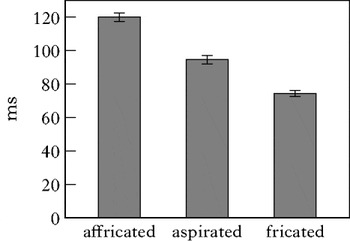
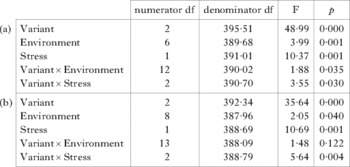
Figure 4 shows the mean (normalised) duration of [tˢ], [tʰ] and [], generalising over speakers and phonological environments. It can be seen that, as expected, [] has the lowest mean duration of the three variants (74 ms). However, [tˢ] has a higher, rather than a lower, mean duration than [tʰ] (120 vs. 94 ms). A mixed model analysis indicates that the difference between variants is highly significant, as shown in Table VII.
Mean normalised duration (in ms) of affricated, aspirated and fricated realisations of /t/. Error bars represent one standard error.

Linear mixed models with mean normalised duration as dependent variable and fixed factors for variant (affricated vs. aspirated vs. fricated), phonological environment and stress, with Environment defined (a) wordinternally and (b) assuming resyllabification across word boundaries.

Paired comparisons show that each of the three means is significantly different from the other two (Tukey HSD, p<0·001). The factors Environment and Stress also have significant effects on duration, whether Environment is defined word-internally or across word boundaries. Our models reveal significant interactions between Variant and Stress, under both definitions of Environment. The factor Environment only interacts significantly with Variant when its levels are defined word-internally. In other words, the relationship between affricated, aspirated and fricated realisations of /t/ in terms of duration depends to some extent on the phonological environment, in particular whether the syllable /t/ is affiliated with is stressed or not. Further inspection of our data suggests that these significant effects are due partly to the fact that the relationship between aspirated and fricated realisations varies across contexts. When Environment is defined within word boundaries, [tˢ] has the highest mean duration in all phonological contexts except word-internal onsets, where the very small number of fricated instances (n=3, as shown in Table I) has a higher mean duration.
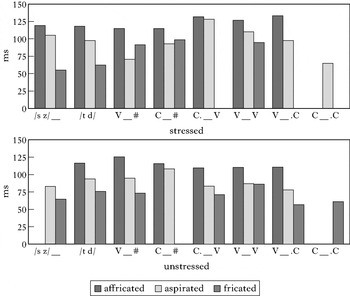
Figure 5 confirms that [tˢ] consistently has a high duration: when phonological environment is defined across word boundaries, assuming resyllabification of word-initial and word-final consonants, affricated realisations have the highest mean duration in all contexts distinguished in §4. The significant effect of stress is mainly due to the fact that in phrase-final codas (V__# and C__#) preceded by a stressed vowel, fricated instances have a longer mean duration than aspirated ones. Finally, the effect of the random factor Speaker is marginal (not shown in Table VII). [tˢ] is longest, on average, for all 20 speakers, and [] is shortest for 18; only for two speakers is [] longer than [tʰ].
Mean normalised duration (in ms) of affricated, aspirated and fricated realisations of /t/ according to syllabic-prosodic environment defined across word boundaries. From left to right: preceded by /s/ or /z/, adjacent to /t/ or /d/, phrase-final coda preceded by a vowel, phrase-final coda preceded by a consonant, post-coda onset, intervocalic onset, pre-onset coda preceded by a vowel, pre-onset coda preceded by a consonant.

Our segmentation and normalisation methods allow us to make two further useful comparisons. First, we can further compare [tˢ] and [tʰ] in terms of the relative durations of their hold and release phases. On average, [tˢ] has a marginally longer hold phase, and a considerably longer release phase than [tʰ] (47 vs. 44 ms and 72 vs. 49 ms respectively).Footnote 16 A paired-sample t-test (two-tailed) shows that only the latter difference is statistically significant (t(208)=−7·69, p<0·001). As pointed out in §2.1, some instances of [tˢ] have a release phase in which the coronal frication is followed by glottal frication – in other words, the transcription [tˢʰ] would be appropriate. These aspirated affricate realisations of /t/ tend to be particularly long in our data: the mean release phase duration across these instances (n=30) is 83 ms, while the mean across non-aspirated instances of [tˢ] is 67 ms (t(80)=−3·08, p=0·003). These comparisons confirm that [tˢ] and [tʰ] differ mainly in their release phases, and that it is very long release phases that can be characterised by both affrication and aspiration.
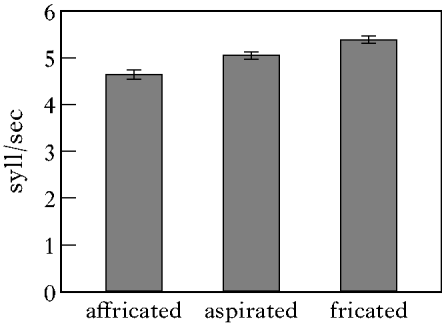
Second, we can examine the association between the three variants and speech rate. If lenition can be understood in terms of local articulatory underachievement, following Bauer (Reference Bauer2008), we might expect ‘lenited’ variants in synchronic patterns of variation to occur more readily at higher speech rates: the more temporally compressed articulatory gestures become, the higher the likelihood that their targets will not be attained (Browman & Goldstein Reference Browman, Goldstein, Kingston and Beckman1990, Lindblom Reference Lindblom, Hardcastle and Marchal1990, Shockey Reference Shockey2003). In our data, we would expect higher speech rates to promote /t/-frication, and if /t/-affrication is to be explained in terms of lenition, we would expect [tˢ] to be associated with higher local speech rates than [tʰ]. This is not what we find in our dataset, as illustrated in Fig. 6. As expected, interpausal stretches in which instances of [] occur have a higher mean speech rate than those in which [tʰ] is attested (5·38 vs. 5·04 syllables per second). However, stretches in which instances [tˢ] occur have the lowest mean rate, at 4·63 syllables per second. As in the case of our duration measurements, a mixed model analysis with the fixed factors Variant, Environment and Stress and the random factor Speaker confirms that the difference between variants is significant (F(2, 426)=5·54, p=0·004 with Environment defined word-internally; F(2, 421)=3·70, p=0·026 with Environment defined across word boundaries), with each of the three means significantly different from the other two (Tukey HSD, p<0·01). Our models reveal no significant interactions between Variant and Environment on the one hand, and Variant and Stress on the other. In other words, the pattern in Fig. 6 is highly robust across phonological environments.
Mean speech rate (in syllables per second) of interpausal stretches containing affricated, aspirated and fricated realisations of /t/. Error bars represent one standard error.

5.2 Amplitude characteristics
As indicated in §2.2, plosives with a relatively strong burst are considered stronger than plosives with a weak or absent burst (Lavoie Reference Lavoie2001: 158). Therefore, we might expect the alveolar frication of fricated realisations of /t/ to have a lower average amplitude than the glottal frication of aspirated realisations. Again, if /t/-affrication is to be explained in terms of ‘weak’ lenition, we might expect the alveolar frication of [tˢ] to be associated with an intermediate range of amplitude values.
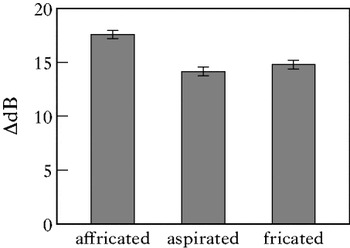
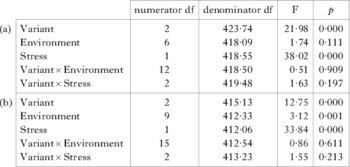
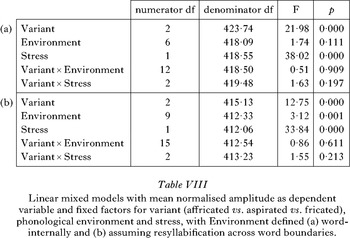
Figure 7 shows the mean (normalised) amplitude for the release phases of [tˢ], [tʰ] and [], generalising over speakers and phonological environments. It can be seen that instances of [tˢ] have the highest mean (17·56 ΔdB), while instances of [tʰ] and [] have similar mean values (14·12 and 14·76 ΔdB respectively). A mixed model analysis indicates that the difference between variants is highly significant, as shown in Table VIII, although paired comparisons reveal that the effect is due to the mean for [tˢ] being significantly higher than those for [tʰ] and [] (Tukey HSD, p<0·001), which are not significantly different from each other.
Mean normalised amplitude (in ΔdB) of affricated, aspirated and fricated realisations of /t/. Error bars represent one standard error.

Linear mixed models with mean normalised amplitude as dependent variable and fixed factors for variant (affricated vs. aspirated vs. fricated), phonological environment and stress, with Environment defined (a) wordinternally and (b) assuming resyllabification across word boundaries.

Again, the fixed factors Environment and Stress also have significant effects on amplitude values – although in the case of Environment only if its levels are defined assuming resyllabification across word boundaries. Notably, there are no significant interactions of these effects with that of Variant. The effect of the random factor Speaker (not shown in Table VIII) is marginal, too. Instances of [tˢ] are associated with the highest mean amplitude for 16 out of the 20 speakers. Some speakers produce [] with unexpectedly high amplitudes, but, crucially, 19 out of 20 produce [tˢ] with a higher mean amplitude than [tʰ]. Figure 8 confirms that the pattern in Fig. 7 is observed in most phonological environments in which values for the variants could be reliably obtained. The only contexts in which the amplitude of [tˢ] is not the highest are adjacent to a /t/ or /d/ in stressed syllables, and in pre-onset coda position in unstressed syllables. In the former context our dataset contains only one instance of [], which happens to have a particularly high amplitude; in the latter, there is only one instance of [tˢ]. In other words, in both of these apparently exceptional contexts our empirical basis for comparing the three variants is rather weak. Figure 8 further shows that the relationship between [tʰ] and [] varies across environments, but is often one of minimal difference. Notice, for example, /t/ in intervocalic onset position: [tʰ] has a marginally higher mean amplitude than [] in stressed syllables, and a marginally lower one in unstressed syllables. Interestingly, the difference is particularly striking in phrase-final positions (V__# and C__#).Footnote 17
Mean normalised amplitude (in ΔdB) of affricated, aspirated and fricated realisations of /t/ according to syllabic-prosodic environment defined across word boundaries. From left to right: preceded by /s/ or /z/, adjacent to /t/ or /d/, phrase-initial onset, phrase-final coda preceded by a vowel, phrase-final coda preceded by a consonant, post-coda onset, intervocalic onset, pre-onset coda preceded by a vowel, pre-onset coda preceded by a consonant.

5.3 Summary
To summarise the results of our acoustic analysis of /t/-affrication, we have seen that [tˢ] has a higher mean (normalised) duration than [tʰ] and [], as well as occurring in interpausal stretches with the lowest mean speech rate. As expected, [] has the lowest mean duration, and is associated with the highest mean speech rate. This means that unlike /t/-frication, /t/-affrication is common in relatively slow speech, and that even when the effect of speech rate on duration is controlled for, instances of [tˢ] are long compared with [] and, importantly, [tʰ]. Comparing the durations of hold and release phase in [tˢ] and [tʰ], we have seen that the difference in overall duration is due to a significant difference in release-phase duration, while hold-phase durations are similar across the two variants. The release phase of [tˢ] also has a significantly higher mean amplitude than those of [tʰ] and [], while the relationship between [tʰ] and [] is variable. While our amplitude findings do not clearly confirm that /t/-frication is associated with a decrease in frication amplitude relative to the glottal frication of [tʰ], they do confirm that /t/-affrication is rather different from /t/-frication, producing consistently high burst-amplitude values across speakers and phonological environments.
6 Conclusions
In the preceding sections, we have offered a range of empirical observations on /t/-affrication in RP English, through a comparative analysis of instances of [tˢ], [tʰ] and [] attested in a corpus of spontaneous speech, using multiple phonetic and phonological parameters. We are now in a position to answer the question that motivated this study – namely, whether /t/-affrication in contemporary RP English is a realistic synchronic basis for diachronic lenition, fortition, both or neither. We address this question first (§6.1), and then consider the wider implications of our findings (§6.2).
6.1 /t/-affrication in RP English: fortition, not ‘weak’ lenition
The phonetic and phonological characteristics of /t/-affrication which we have reported are clearly difficult to reconcile with an account in terms of lenition, and consistent with one in terms of fortition. In fact, given the number of parameters we have considered, our results are remarkably coherent. The distribution of [tˢ] alone is arguably inconclusive, for the reason highlighted in §1.1: an association with strong environments such as the pre-stress word-initial position could be understood in terms of lenition inhibition as well as fortition promotion (Honeybone Reference Honeybone2001, Reference Honeybone, Carr, Durand and Ewen2005, Szigetvári Reference Szigetvári2008). Still, if [tˢ] is weaker than [tʰ], it is difficult to explain why instances of [tˢ] should outnumber those of [tʰ] in the relatively strong pre-stress post-coda onset position (e.g. continue), and vice versa in the relatively weak foot-internal intervocalic position (e.g. shorter): this would be inconsistent with the notion that process outputs can never be weaker in strong positions than in weak positions (Ségéral & Scheer Reference Ségéral and Scheer2008: 140). On the other hand, the relative frequencies are as expected if /t/-affrication is interpreted as strengthening relative to [tʰ].
Moreover, all phonetic parameters considered in our investigation reveal patterns that point in the same direction. We have seen that RP English [tˢ] generally has a clearly audible burst, which is followed by a relatively long and strong release phase in comparison with that of [tʰ]. Affrication shows no association with fast speech in our data; in fact, [tˢ] occurs in interpausal stretches with a lower mean speech rate than those in which [tʰ] tends to occur. Leaving aside the question of whether affricated instances are more or less ‘sonorous’ than aspirated ones, on account of the uncertainty surrounding the phonetic basis of sonority (see Clements Reference Clements, Raimy and Cairns2009 for discussion), it is difficult to find a phonetically grounded definition of lenition that accommodates /t/-affrication as we observe it in our data. The relative lengthening and strengthening of the release phase seem incompatible with a weakening of overall articulatory effort, however the latter is quantified (Kirchner Reference Kirchner2000, Reference Kirchner2001a). Compared with aspirated instances, affricated ones also show a greater overall degree of obstruction to airflow: they involve a complete closure and a clearly audible transient burst, followed by oral frication as opposed to – or in addition to – glottal frication. The presence of a transient burst in most instances of [tˢ] is crucial: this makes it particularly difficult to see /t/-affrication in our data in terms of a relative opening of stricture (Lass Reference Lass1984, Honeybone Reference Honeybone2001, Reference Honeybone, Carr, Durand and Ewen2005). Indeed, if lenition is defined in terms of a ‘reduction in constriction degree or duration’ (Kirchner Reference Kirchner, Hayes, Kirchner and Steriade2004: 313; see also Lavoie Reference Lavoie2001, Bye & de Lacy Reference Bye and de Lacy2008), /t/-affrication in RP clearly does not qualify, while /t/-frication does. Finally, there is no obvious sense in which the production of [tˢ] in our data involves articulatory underachievement (Bauer Reference Bauer2008), as its hold phase is generally indistinguishable from that of [tʰ]. Moreover, if the target configuration for a plosive is a complete oral closure which causes air pressure to build up behind it (Stevens Reference Stevens1998: 324–331), /t/-affrication can hardly be seen as target undershoot in our data.
We suggested in §2.2 that in addition to treating [tˢ], [tʰ] and [] as discrete variants for the purpose of the comparative phonetic and phonological analysis we have undertaken, it is instructive to identify any evidence of gradience between them. We have seen that, on the one hand, there is considerable evidence of similarity and overlap between the sets of realisations we have classified as [tˢ] and [tʰ], and, on the other, little evidence of overlap between these and []. We take the existence of realisations of /t/ which cannot conclusively be classified as [tˢ] or [tʰ], or which are best classified as [tˢʰ], as well as the similar frequencies of [tˢ] and [tʰ] in multiple phonological environments, to be indicative of a close relationship between [tˢ] and [tʰ]. [tˢ] and [], on the other hand, behave more like discrete variants in our data, both in terms of their phonetic correlates and in terms of their phonological distribution.
In the light of these findings, we propose that instead of viewing RP English /t/-affrication as a weak degree of /t/-frication, as Honeybone (Reference Honeybone2001, Reference Honeybone, Carr, Durand and Ewen2005), Sangster (Reference Sangster2001) and others do for Liverpool English, we should treat the affricated realisations of /t/ in our data as aspirated realisations with a strong and slow release – that is, realisations of /t/ with a long-lag voice onset time produced with a relatively high degree of initiation effort and a relatively slow release gesture following the alveolar closure, which results in strong homorganic frication. In most cases, the speed of the release gesture is such that the entire release portion is audible as coronal; in some, the voice onset time is long enough to allow the tongue tip to move away from the alveolar ridge before the onset of voicing or the cessation of frication noise, resulting in the perception of a period of aspiration following the affricated release. This interpretation is consistent with descriptions of affricated plosive release which emphasise its slow and partial reduction in oral stricture following the burst, compared with a plain or aspirated plosive release (e.g. Catford Reference Catford2001: 107).
With reference to our main research question, we suggested in §1.2 that if the phonetic details and phonological distribution of a variant pronunciation, such as [tˢ] for /t/, are consistent with an analysis in terms of articulatory strengthening relative to the unmarked realisation of the phoneme in question, an account in terms of fortition is appropriate – in the sense that if there is additional evidence of diachronic change involving the variant in question, that change should be labelled an instance of fortition. Our empirical findings strongly support such an account for /t/-affrication in contemporary RP.
6.2 Implications and outlook
Looking beyond RP, the account we have outlined is consistent with Lavoie's (Reference Lavoie2002: 51) informal observation on the utterance-final plosive releases of US National Public Radio announcers, which ‘are so robust that the stops seem to be affricated’. It is inconsistent, however, with the analysis of plosive affrication in the literature on Liverpool English (Knowles Reference Knowles1973, Honeybone Reference Honeybone2001, Reference Honeybone, Carr, Durand and Ewen2005, Sangster Reference Sangster2001, Marotta & Barth Reference Marotta and Barth2005, Watson Reference Watson2007a, Reference Watsonb), to which we have referred throughout this paper, as well as with that of plosive affrication in Pisan Italian, as described by Marotta (Reference Marotta2008) .
A survey of the literature on Liverpool English plosive affrication suggests it is similar to /t/-affrication in RP English in a number of respects. The distribution of affricated realisations is similarly concentrated in strong environments such as initial, pause-adjacent and postconsonantal, and similarly different from the distribution of fricated ones: ‘for /t/, affrication is common word-initially, whilst spirantisation is common in intervocalic and word-final positions’ (Watson Reference Watson2007b: 353; see also Honeybone Reference Honeybone2001: 243, Marotta & Barth Reference Marotta and Barth2005: 393). Affricated plosives also tend to be longer than aspirated ones, which are in turn longer than fricated ones (Marotta & Barth Reference Marotta and Barth2005: 401), and realisations with both affrication and aspiration are attested (Knowles Reference Knowles1973: 210, Watson Reference Watson2007a: 111). However, Liverpool plosive affrication is different from RP /t/-affrication in that affricate plosive realisations frequently lack a transient burst (Marotta & Barth Reference Marotta and Barth2005: 390, Watson Reference Watson2007b: 354). Moreover, they have been described as having relatively short hold phases (Marotta & Barth Reference Marotta and Barth2005: 384) and relatively ‘lax’ articulation throughout (Knowles 1973: 107), although we are not aware of acoustic studies corroborating these descriptions. These characteristics would seem to make Liverpool [tˢ] phonetically closer to [] than RP English [tˢ] is, and, following Lavoie's (Reference Lavoie2001) criteria, phonetically weaker. Finally, if Honeybone (Reference Honeybone2001: 228) is right in describing Liverpool English plosive affrication as ‘an optional alternative to spirantization’ in some phonological environments, then it is clear that it displays a rather different set of phonetic and phonological characteristics from /t/-affrication as we have described it in this paper.
Plosive affrication in Pisan Italian (Marotta Reference Marotta2008) appears similar to that observed in Liverpool English, in that the affricate realisations generally lack a transient release burst. In fact, Marotta (Reference Marotta2008: 247) prefers the label ‘semifricativisation’ to affrication, and interprets the occurrence of ‘semifricativised’ realisations in Pisan Italian as the fossilised result of a ‘primitive stage’ of a lenition process which in closely related varieties resulted in widespread plosive frication in similar phonological environments. Interestingly, Marotta argues that the presence vs. absence of a transient burst is crucial in deciding on the relevant strength of plosive variants, and proposes the partial strength hierarchy in (2), in which ranking depends on the presence vs. absence of voice onset time delay, the presence vs. absence of a burst, and the state of the glottis. On this interpretation, Liverpool English affricate plosive realisations arguably occupy the position of Pisan ‘semifricatives’, while RP [tˢ] occupies the position of ‘aspirated stops’ – or should perhaps be placed above them.
(2)
Our findings confirm that a process such as plosive affrication may display a considerable amount of cross-linguistic variation, both in terms of its domains of application and in terms of the details of its phonetic implementation. In the particular case of plosive affrication, this means that its status qua lenition or fortition cannot be decided once and for all (cf. Szigetvári Reference Szigetvári2008), and we should resist the temptation of generalising observations from one language – or one variety of a language – to another. It is arguably only the false expectation that this type of generalisation is possible that has led to the status of plosive affrication being labelled ‘ambiguous’ (Lavoie Reference Lavoie2001: 45). We believe that our RP English data do not allow much scope for ambiguity as to the strength relationships between [tˢ], [tʰ] and []. The case of Liverpool English is possibly less clear-cut, as plosive affrication appears to be associated with lengthening on the one hand, and opening of stricture on the other (Marotta & Barth Reference Marotta and Barth2005). Further empirical work is needed to establish the extent to which the parameters of consonant strength considered here, following Lavoie (Reference Lavoie2001), pattern together in synchronic cases of plosive affrication. Until we have a better view of the range of phonetic and phonological variation associated with this process, assessing the status of historical cases of plosive affrication, such as those of the High German Consonant Shift (Honeybone Reference Honeybone2001, Reference Honeybone, Carr, Durand and Ewen2005, Reference Honeybone2008, Szigetvári Reference Szigetvári2008), can only be done with caution.
Appendix: Methodological details
1 Dataset
Corpus. To create a corpus of spontaneous RP English speech of sufficient quality to allow for acoustic analysis, we downloaded podcasts of programmes such as In our time, Front row, Money box, Politics UK, Law in action, Midweek and Start the week from the BBC Radio 4 website, between March and October 2009.Footnote 18 The selected programmes all involve two or three invited speakers talking freely about topics they have expert knowledge of and interacting with each other and the presenter. The speakers are generally highly educated, and RP accents are commonly heard, as observed by Roach (Reference Roach2004: 239). While it is difficult to ascertain the extent to which speakers rely on written notes, the podcasts contain little speech that is obviously read out; in other words, most of the speech can be called ‘unscripted’, if not spontaneous.
Data selection and classification. We focused our analysis on 20 speakers, all of whom were judged by two independent academics with particular expertise in English phonetics as having an RP accent – ranging from ‘stereotypical’ RP (as described in Wells Reference Wells1982: 279) to ‘modern’ RP (Trudgill Reference Trudgill and Trudgill2002). To obtain a random sample of plosives across speakers, we sampled all instances of /t/ in the first minute of speech for each speaker. This resulted in a dataset of 1008 voiceless alveolar plosives, which were then analysed phonetically to identify all aspirated, affricated and fricated variants of /t/. This analysis was initially carried out by the first author on the basis of repeated listening and inspection of waveforms and spectrograms; a sample of tokens was also transcribed by two independent academic phoneticians to ensure consistency. The first author identified a total of 486 relevant instances of /t/ as either aspirated, affricated or fricated, not counting instances of /t/ followed by /s ʃ j w ɹ/ within and across word boundaries. These were then independently classified by the second author. Our classifications matched in 471 realisations of /t/: 109 affricated, 164 aspirated and 198 fricated. Only these instances were included in the analyses reported on in this paper.
2 Distributional analysis
Words, phrases and syllable affiliation. We carried out two rounds of coding for the distributional analysis. In the first round, we looked only at word-internal contexts, classifying each instance of /t/ as belonging to a word-initial onset, a post-coda onset, an intervocalic onset, a pre-onset coda or a word-final coda. In the second round, we looked at the phrasal context of word-initial and word-final instances of /t/ and assumed resyllabification following the principle of ‘onset maximisation’, as formulated by Clements & Keyser (Reference Clements and Keyser1983) and Harris (Reference Harris1994), among others (see Ewen & van der Hulst Reference Ewen and van der Hulst2001: 127), which holds that ‘syllable-initial segments are maximized to the extent consistent with the syllable structure conditions of the language in question’ (Harris Reference Harris1994: 54). In other words, a VCV sequence is syllabified V.CV rather than VC.V, and a sequence VCCV is syllabified V.CCV if the CC sequence constitutes a well-formed onset in the language in question. We applied this principle across word boundaries, so that word-final coda /t/ in what a was treated as an intervocalic onset unless an audible inbreath or pause exceeding 0·1 second intervened, which we took to mark phrase boundaries. In this way we could consider effects of word position and effects of phrasal position separately. In the paper we present the principal results of the two analyses.
Stress. We considered lexical stress in the first instance, and phrasal stress if necessary. That is, we treated the syllable in which /t/ occurs as stressed if it is part of a polysyllabic word and receives lexical stress, or if it constitutes a monosyllabic word which receives phrasal stress. In the latter case, onset maximisation was applied. As a result, /t/ is classified as affiliated with a stressed vowel in words such as pretend and expect, as well as words such as type and two in most phrasal contexts; and as affiliated with an unstressed syllable in words such as tomorrow and appropriate (adj), as well as the word to in most phrasal contexts. Lexical stress appeared variable in the case of only one word: our dataset contains several instances of into, some with stress on the first syllable and some with stress on the second. In this case, our perception of the surface pattern determined the classification.
Melodic context. We noted the immediately preceding and immediately following vowel or consonant. We report on two melodic conditioning effects in the paper.
3 Acoustic analysis
Segmentation. The 474 realisations of /t/ in the dataset were segmented manually in Praat (Boersma & Weenink Reference Boersma and Weenink2009), following the general conventions described by Olive et al. (Reference Olive, Greenwood and Coleman1993) . Aspirated and affricated instances were segmented into a hold phase and a release phase, while fricated instances were segmented as single portions.
For instances of [tˢ] and [tʰ], segmentation criteria depended crucially on the nature of adjacent sounds. When /t/ was preceded by a sonorant consonant or vowel, the hold phase was segmented from the sudden drop in amplitude at the end of visible formant structure associated with the sonorant to the first zero-crossing at the onset of aperiodic burst energy. When /t/ was preceded by a released plosive, its hold phase was segmented only if the end of the release phase of the preceding stop could be clearly identified; otherwise only the release phase was segmented. When /t/ was preceded by a pause, an unreleased plosive or an alveolar nasal consonant, the onset of the hold phase was generally impossible to determine, so again only the release phase was segmented. When /t/ was followed by a sonorant, the end marker for the release phase was placed at the onset of periodicity associated with the sonorant. In the case of a pause following /t/, the marker was placed at the cessation of frication noise above 3000 Hz.
Instances of [] were segmented from the beginning of high-frequency aperiodic energy to its end. As indicated above, when /t/ is immediately preceded by /s/ it is mostly fricated in our dataset. These sequences of a target /s/ and a fricated /t/ were in many cases impossible to segment reliably. Where a reliable segmentation was not possible and [] had a sufficiently long duration, a central portion was segmented for the purpose of amplitude measurement, but the instance was not included in the duration analysis.
Measurements. We measured the duration of [tˢ] and [tʰ] from the beginning of the hold phase to the end of the release phase. For [], we measured the whole duration of the frication noise. Instances in which start or end markers could not be reliably placed, as explained above, were excluded; this reduced the dataset for duration analysis to a total of 426 instances (93 affricated, 139 aspirated, 194 fricated).
We measured mean amplitude in a temporal window of half the release phase in the case of [tˢ] and [tʰ], and half the entire segment in the case of [], centred at the mid-point. Again, instances for which relevant portions could not be segmented reliably were excluded; this reduced the dataset for amplitude analysis to a total of 457 instances (104 affricated, 159 aspirated, 194 fricated).
Normalisation. In order to prevent differences in speech tempo skewing the duration results, we normalised each measurement for local speech rate. We counted the number of syllables per second in the smallest interpausal stretch containing /t/. The duration of these stretches ranged between 0·5 and 5 seconds, though the great majority were between 1 and 3 seconds. The speech-rate figure for each interpausal stretch can then be divided by the grand mean across all stretches, giving a range of proportional values centred around 1; values below 1 indicate that /t/ is in a relatively slow stretch, and values above 1 indicate that it is in a relatively fast one. We multiplied the raw duration of each instance of /t/ by its corresponding proportional speech-rate value, with the effect of expanding durations in relatively fast stretches, and compressing those in relatively slow stretches.
In order to prevent differences in loudness skewing the amplitude results, we normalised each amplitude measurement using the maximum amplitude of the vowel in the same syllable as reference measure. The classification of syllable affiliation was the same as that used for the distributional analysis described above: word boundaries were ignored and the principle of onset maximisation was applied where relevant. In a small number of instances the nucleus of the syllable could not be segmented, due to vowel reduction. In these cases the nearest following vowel was segmented. Segmentation was done manually. We subtracted the amplitude for each instance of /t/ from the maximum amplitude of the corresponding vowel, obtaining figures between 0 and 29 dB. The disadvantage of this method is that consonants with a higher relative amplitude – i.e. an amplitude closer to that of the vowel – have a lower value. To revert this, we subtracted each individual value from the overall maximum, 28·26 dB. We report the resulting values in ‘ΔdB’.