Implications
In several species including the human, poor intrauterine development of the endocrine pancreas increases predisposition to metabolic diseases in the offspring during later life. The objective of the present study was to determine factors that are associated with major insulin traits in newborn Holstein calves. In addition to calf gender and season of birth, milk production levels during gestation, lactation length and length of the dry period in cows were indicated as decisive factors of insulin traits in the calves. The latter may provide a basis for developing managerial interventions to improve long-term health of the offspring.
Introduction
Dam nutrition during gestation in mammals has been recognized as a key to metabolic programming in utero. An impaired nutrient supply during intrauterine development leads to metabolic adaptations to enhance survival in the short term but may become detrimental in postnatal life (Fleming et al., Reference Fleming, Lucas, Watkins and Eckert2012). The unique metabolic adaptations to reduced nutrient supply in utero are well coordinated in an attempt to maximize the uptake and use of nutrients by the most vital organs like the brain (Fleming et al., Reference Fleming, Lucas, Watkins and Eckert2012). As a consequence, these adaptations often occur at the expense of those organs that are less critical for survival (e.g. the pancreas) (Long et al., Reference Long, Prado-Cooper, Krehbiel and Wettemann2010; Gutierrez et al., Reference Gutierrez, Espasandin, Astessiano, Casal, Lopez-Mazz and Carriquiry2012; Limesand et al., Reference Limesand, Rozance, Macko, Anderson, Kelly and Hay2013). Hence, suboptimal intrauterine nutrition may end up in birth of growth restricted newborns with an impaired β-cell mass, visualized by a lowered insulin secretion when challenged with a standard glucose bolus (Rozance et al., Reference Rozance, Limesand and Hay2006; Owens et al., Reference Owens, Gatford, De Blasio, Edwards, McMillen and Fowden2007; Limesand et al., Reference Limesand, Rozance, Macko, Anderson, Kelly and Hay2013). Epigenetic mechanisms such as DNA methylation and histone modification of the fetal genome are likely mediators of such postnatal expression of intrauterine events (Wu et al., Reference Wu, Bazer, Wallace and Spencer2006). The environmental sensitivity of the epigenome is viewed as an adaptive mechanism by which the developing organism adjusts its metabolic and homeostatic systems to suit the anticipated postnatal environment. The long-term effects of these adaptations predispose the offspring to adiposity and metabolic diseases in later life if nutrition in postnatal life does not match that foreseen by the fetus on the basis of its intrauterine environment (De Rooij et al., Reference De Rooij, Painter, Phillips, Osmond, Michels, Godsland, Bossuyt, Bleker and Rojeboom2006; Micke et al., Reference Micke, Sullivan, McMillen, Gentili and Perry2011).
Relatively high incidence of metabolic disorders and reduced longevity in high-yielding cows present major challenges in today’s dairy industry (Wu et al., Reference Wu, Bazer, Wallace and Spencer2006; Berry et al., Reference Berry, Lonergan, Butler, Cromie, Fair, Mossa and Evans2008; Gutierrez et al., Reference Gutierrez, Espasandin, Astessiano, Casal, Lopez-Mazz and Carriquiry2012). Decrease in insulin responsiveness and insulin secretion are considered to be etiologic key mechanisms in the association between high yield and transition metabolic disorders (De Koster and Opsomer, Reference De Koster and Opsomer2013). Recently, we have described the adaptations that take place in the transition period both in terms of insulin responsiveness as well as of insulin secretion (De Koster and Opsomer, Reference De Koster and Opsomer2013), while we also have demonstrated (epi)genetic backgrounds to be involved herein (Bossaert et al., Reference Bossaert, Leroy, De Campeneere, De Vliegher and Opsomer2009). However, very little is known about the epigenetic background of the insulin-dependent glucose metabolism in calves, although their dams may vary immensely in nutritional milieu both at conception and later during gestation. Moreover, the level of milk production during gestation in cows has been suggested to be an important contributor to the nutritional milieu for the developing embryo and fetus, since available nutrients need to be partitioned between milk production by the dam and the intrauterine growth of the offspring (Berry et al., Reference Berry, Lonergan, Butler, Cromie, Fair, Mossa and Evans2008; Funston and Summers, Reference Funston and Summers2013). Earlier studies examining the effect of milk production at different stages of gestation revealed that higher production levels during embryonic and fetal development are associated with reduced performance and longevity of the offspring (Berry et al., Reference Berry, Lonergan, Butler, Cromie, Fair, Mossa and Evans2008; Gonzalez-Recio et al., Reference Gonzalez-Recio, Ugarte and Bach2012; Funston and Summers, Reference Funston and Summers2013). The reduced performance and longevity of the offspring have been linked to an impaired endocrine profile during their postnatal life as a consequence of poor intrauterine environment (Micke et al., Reference Micke, Sullivan, McMillen, Gentili and Perry2011; Gutierrez et al., Reference Gutierrez, Espasandin, Astessiano, Casal, Lopez-Mazz and Carriquiry2012). Moreover, abundant postnatal nutrition can challenge the homeostatic mechanisms of the offspring adapted to a poor intrauterine environment and lead to the development of deleterious metabolic conditions. Hence, evidence exists to suggest that an increasing proportion of transition disorders occur in cows for which intrauterine programming of the endocrine pancreas may be a causative factor. Although the underlying causes of this rather new phenomenon are not yet fully elucidated, managerial factors typically associated with a high level of milk production during gestation are often referred to as potential candidates. Moreover, while several papers report on the effect of the maternal environment and nutrition on the metabolic and endocrine profiles of their calves (Long et al., Reference Long, Prado-Cooper, Krehbiel and Wettemann2010; Gutierrez et al., Reference Gutierrez, Espasandin, Astessiano, Casal, Lopez-Mazz and Carriquiry2012; Radunz et al., Reference Radunz, Fluharty, Relling, Felix, Shoup, Zerby and Loerch2012), information on parameters such as milk production during gestation in cows and their effect on insulin traits in their newborn calves has, to the best of our knowledge not been documented yet. Furthermore, despite the multifactorial nature of intrauterine growth, the current literature is lacking studies in which a multifactorial approach has been used to identify factors associated with insulin traits in Holstein calves.
The objective of the present study was to evaluate potential associations between environmental factors and dam characteristics and major insulin traits in newborn Holstein calves. Our main interest went to the hypothesis that the level of milk production during gestation in cows affects the intrauterine development of the fetal endocrine pancreas and hence programs the level of insulin secretion in newborn calves.
Material and methods
Farms, animals and management
Calves and their dams involved in the current study also participated in a larger study reported elsewhere (Kamal et al., Reference Kamal, Van Eetvelde, Depreester, Hostens, Vandaele and Opsomer2014). Briefly, data were collected from four small dairy herds (on average 70 lactating cows) in Flanders (Belgium) and one large herd (>2000 lactating cows) in Rostock (Germany). Herds were selected based on their long history of successful collaboration with the Ghent University Ambulatory Clinic. All herds participated in an official milk recording, artificial insemination and veterinary herd health program to closely monitor both health and productivity. In all herds, only Holstein cows were milked and average 305 day milk production was ~9300 kg. The heifers and cows were housed in free-stall barns. They were fed according to their requirements for maintenance and growth (heifers) and production (cows) based on the results of the monthly production tests. The ration consisted of high quality roughages (maize silage, grass silage, sugar beet pulp and fodder beets) supplemented with concentrates. The cows were generally milked twice a day; whereas in Germany some high producing cows were milked three times. Heat detection was performed by the herdsmen at least three times daily at regular time intervals. In some herds aids were used to optimize heat detection. Observed heats, as well as all other observations concerning health and fertility were carefully recorded using a herd health software program. Heifers were generally inseminated at an age of 15 months whereas the cows were generally inseminated at the first estrus occurring after 50 days postpartum. Heifers and cows approaching parturition were separated in a maternity pen and were closely monitored by the herd employees. After calving, the calves were immediately removed from the maternity pen into individual calf pens. Immediately after birth, calves were given 2 l colostrum. Overall, care was taken that all calves received a minimum of 4 l of colostrum within the first 10 h after birth either by bottle feeding or by esophageal tube. For first 3 days, the calves were fed whole milk at an amount of 10% of their BW administered in two meals daily.
Measurements and data collection
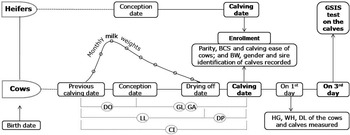
A retrospective cohort study design was used. The outline of the measurements, data collection and blood sampling is shown in Figure 1. The calves were enrolled at birth between August 2011 and April 2013. Twin calves, calves born dead or that died during the first 3 days of life, born following inseminations with semen from non-Holstein bulls or born following an abnormally short (<265 days) or long (>295 days) gestation length were not enrolled. Immediately after birth, the gender of the calves was recorded and its birth weight (BW) was measured in kilograms. On the next day, the heart girth (HG), wither height (WH) and diagonal length (DL) of both dams and calves were measured in centimeters following the procedure described in our earlier study (Kamal et al., Reference Kamal, Van Eetvelde, Depreester, Hostens, Vandaele and Opsomer2014). Body condition score of the dams was determined on a 1 to 5 scale (1=emaciated, 5=obese) with 0.25 increments (Edmonson et al., Reference Edmonson, Lean, Weaver, Farver and Webster1989). The dam’s date of birth, the previous calving date, the date of conception, together with the monthly milk weights of the lactation that started at the calving preceding the one that was included in the study and the dry off date were extracted from the herd databases.
Outline of the measurements, data collection and blood sampling. BCS=body condition score; DO=days open; GL=gestation length; GA=gestational age at delivery; LL=lactation length; DP=dry period; CI=calving interval; BW=birth weight; HG=heart girth; WH=wither height; DL=diagonal length; GSIS=glucose-stimulated insulin secretion.

Sampling and laboratory analyses
All procedures were approved by the concerned Ethical Committee where appropriate. On day 3 of life at least 5 h after a milk meal (in the morning for the Belgian herds and in afternoon for the German herd to be compatible with the herd management), a basal blood sample was collected from all calves (n=481; 169 born to heifers and 312 born to cows). Briefly, after adequate fixation of the calf, a small surface of the skin at the height on the left jugular vein was disinfected with alcohol. A catheter with 18-gauge needle was inserted into the left jugular vein. Stress was avoided as much as possible. Blood samples (±10 ml) were obtained from the catheter in evacuated gel-coated and fluorinized tubes (Vacutainer®; Terumo Europe NV, Leuven, Belgium) for isolation of serum and plasma, respectively. In addition to the basal blood sample, an intravenous glucose-stimulated insulin secretion (GSIS) test was performed in a subset of the calves (n=316; 109 born to heifers and 207 born to cows). In performing the GSIS test, a glucose solution (Glucose 30%®; Eurovet Animal Health, Heusden-Zolder, Belgium) at 150 mg/kg BW was infused immediately after the basal sampling (Bossaert et al., Reference Bossaert, Leroy, De Campeneere, De Vliegher and Opsomer2009). Exactly 10 min after the glucose bolus had been administered, a second blood sample was taken from the right jugular vein in evacuated tubes as described above using a Venoject® (Terumo Europe NV) needle. In a previous study, maximum levels of serum insulin were observed at 10 min after the glucose infusion (Bossaert et al., Reference Bossaert, Leroy, De Campeneere, De Vliegher and Opsomer2009). Therefore, blood samples were taken just prior and exactly 10 min after the calves had been given an intravenous glucose bolus to objectively measure the insulin secretion capacity of the newborn calves. All blood samples were centrifuged at 2460 g for 20 min to isolate plasma and serum that were stored at −20°C until analysis. Plasma glucose was measured using the hexokinase method (GLUC3 Cobas®; Roche Diagnostics GmbH, Mannheim, Germany). The intra- and inter-assay coefficients of variation for glucose measurements were 0.8% and 1.3%, respectively. Insulin in serum was measured using the bovine insulin ELISA test kit (Mercodia®; Uppsala, Sweden), with intra- and inter-assay coefficients of variation 2.9% and 2.7%, respectively.
Calculations and estimations
The gestational age at delivery of the calves was derived from the last recorded insemination of the dam to the birth date of the calves and was restricted to 265 to 295 days as mentioned above. The season of birth of the calves was grouped into four: Winter (21 December to 20 March), Spring (21 March to 20 June), Summer (21 June to 20 September) and Fall (21 September to 20 December). The body condition index (BCI) of the calves was calculated as BW/(WH×DL) (Kamal et al., Reference Kamal, Van Eetvelde, Depreester, Hostens, Vandaele and Opsomer2014). The basal glucose (Glub) and insulin (Insb) levels, and the stimulated (10 min after the glucose infusion) glucose and insulin levels were used to calculate the indices of insulin sensitivity and insulin secretion. The Insb has been described as an important insulin trait in calves (Hammon et al., Reference Hammon, Steinhoff-Wagner, Schonhusen, Metges and Blum2012). Mathematical handling of the basal levels of glucose and insulin concentration has been used for the calculation of the quantitative insulin sensitivity check index (QUICKI, 1/(log Glub+log Insb)) to measure insulin sensitivity in ruminants (Limesand et al., Reference Limesand, Rozance, Macko, Anderson, Kelly and Hay2013) including newborn calves (Bossaert et al., Reference Bossaert, Leroy, De Campeneere, De Vliegher and Opsomer2009). The acute insulin response (AIR, increment of insulin above the baseline following the administration of a standard glucose bolus) was used as a measure of first-phase insulin secretion (Radunz et al., Reference Radunz, Fluharty, Relling, Felix, Shoup, Zerby and Loerch2012; Limesand et al., Reference Limesand, Rozance, Macko, Anderson, Kelly and Hay2013). We also calculated the disposition index (DI, the product of the QUICKI and AIR), an index of first-phase insulin secretion that takes insulin sensitivity into account (Bergman et al., Reference Bergman, Ader, Huecking and Van Citters2002), and which has commonly been used in animal studies (De Blasio et al., Reference De Blasio, Gatford, McMillen, Robinson and Owens2007). Age at calving in heifers was calculated as the interval from the date of birth to the date of calving. Days open (DO), lactation length (LL), length of the dry period (DP) and calving interval (CI) of all cows were calculated. Monthly milk weights were fitted to the MilkBot model (Ehrlich, Reference Ehrlich2011) to summarize the magnitude and shape of each lactation curve. Using the model, cumulative 305 days milk (M305), cumulative milk production during gestation from conception to drying off (MGEST), milk production at lactation peak (MPEAK), cumulative milk production from 15 days before to 15 days after conception (MPCONC), time to peak milk (TPEAK) and time to half of the peak milk (THALF) were calculated (Ehrlich, Reference Ehrlich2011; Kamal et al., Reference Kamal, Van Eetvelde, Depreester, Hostens, Vandaele and Opsomer2014).
Statistical analysis
Statistical analyses were performed using the SAS Enterprise Guide program (version 6.1; SAS Institute Inc., Cary, NC, USA). Data are presented as means±s.d., unless otherwise specified. Differences were declared significant when P<0.05 and tendencies when P⩽0.10. Student’s t test was used to examine differences between means. Pearson correlation coefficients (r) were estimated to describe relationships between variables using the PROC CORR procedure. Generalized linear mixed models were built in PROC GLIMMIX with Lognormal distributions and Identify link functions. Separate models were built for the Insb, QUICKI, AIR and DI. First, the model was fitted for each of the independent variables separately. In each model, herd was included as random effect. Dam parity, calf gender and season were considered as class variables. Table 1 lists the quantitative independent dam variables described above. The BW, HG, BCI and gestational age of the calves were quantitative independent calf variables. Those variables that had an effect on the insulin traits (P⩽0.2 in the Wald statistic for type 3 analysis) were selected for further multivariable analysis. The selected fixed effects and their two-way interactions were included in the initial model, but removed if found non-significant, after which the model was refitted. Modeling was performed using a forward–backward stepwise algorithm with a selection criterion based on Bayesian Information Criterion. The DO and CI were not included in the initial models because of their very high correlation (94% each) with LL. MPCONC was also not included in the initial model because of its high correlation (86%) with MGEST. Separate similar models were built with these variables by replacing LL and MGEST, respectively (data not shown).
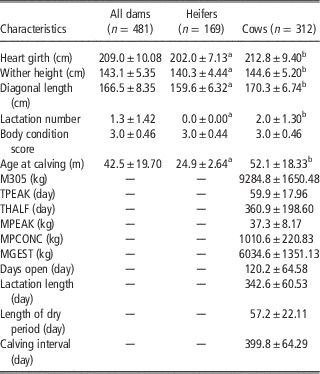
Characteristics of the dams (mean±s.d.)

M305=cumulative 305 days milk production; TPEAK=time to peak milk; THALF=time to half of the peak milk; MPEAK=milk production at lactation peak; MPCONC=cumulative milk production from 15 days before to 15 days after conception; MGEST=cumulative milk during gestation from conception to drying off.
a,bValues within a row with different superscript letters are significantly different (all at P<0.001).
Results
Subject characteristics
Calf characteristics
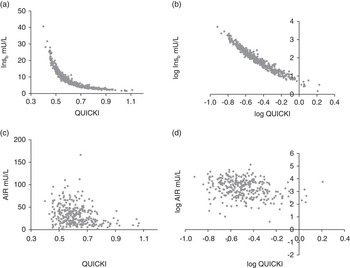
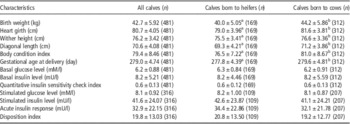
The characteristics of the calves are presented in Table 2. The overall average BW of the calves was 42.7±5.92 kg. The calves born to the heifers (n=169) were significantly smaller in BW, HG, WH, DL and BCI compared with the ones born to the cows (n=312) (P<0.001). Male calves (n=238) were on average 3.5 kg heavier than their female counterparts (n=243; 44.5±6.10 v. 41.0±5.21 kg; P<0.001). The Glub and Insb were positively correlated (r=0.37, P<0.001) in the calves. There was a negative correlation between log QUICKI and log Insb (r=−0.97, P<0.001) and between log QUICKI and log AIR (r=−0.25, P<0.001) (Figure 2). The insulin traits were not correlated with BW of the calves and they were also not significantly different between the calves born to heifers v. the ones born to cows (P>0.05).
Hyperbolic relationships between insulin sensitivity and insulin secretion are linearized by log transformation. Hyperbolic relationship between QUICKI and Insb (a) is linearized by log transformation (b). Hyperbolic relationship between QUICKI and AIR (c) is linearized by log transformation (d). QUICKI=quantitative insulin sensitivity check index; Insb=basal insulin; AIR=acute insulin response.

Characteristics of the calves (mean±s.d.)

Body condition index=birth weight/(wither height×diagonal length).
a,bValues within a row with different superscript letters are significantly different (all at P<0.001).
Dam characteristics
The characteristics of the dams are presented in Table 1. Heifers (n=169) calved at an average age of 24.9±2.64 months. Cows (n=312) completed 2.0±1.30 lactations and aged 52.1±18.33 months when they were measured. The M305, MPEAK and MGEST in the cows were 9284.8±1650.48, 37.3±8.17 and 6034.6±1351.13 kg, respectively. Among the morphometric measures of the dams, HG was the one that showed the highest correlation with their M305 (r=0.29) and MPEAK (r=0.40), respectively (P<0.001). The M305 was positively correlated with the MPEAK (r=0.92, P<0.001) and negatively correlated with TPEAK (r=−0.40, P<0.001). The M305 tended to be positively correlated with LL (r=0.09, P=0.09). Moreover, the LL in cows was correlated with their TPEAK (r=0.25, P<0.001) and THALF (r=0.17, P=0.003), respectively.
Factors significantly associated with major insulin traits in Holstein calves
Calves born to all dams
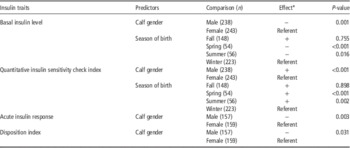
When data of all calves were analyzed (Table 3), insulin traits were significantly associated with gender and season of birth. The Insb was estimated to be lower (P=0.001) and the QUICKI was estimated to be higher (P<0.001) in male v. female calves. The Insb was estimated to be lower in calves born in Spring (P<0.001) and Summer (P=0.016) compared with calves born in Winter. The QUICKI was estimated to be higher in calves born in Spring (P<0.001) and Summer (P=0.002) compared with the calves born in Winter. Moreover, the AIR (P=0.003) and DI (P=0.031) were estimated to be lower in male compared with female calves. The insulin traits in calves born to heifers were not associated with any factor (P>0.05), except the QUICKI which was estimated to be higher in calves born in Spring (P=0.038) compared with those born in Winter.
Factors significantly affecting insulin traits in calves born to all dams

* ‘Referent’ means that this variable was used as the reference; ‘+’ and ‘−’ mean that the concerning variable is associated with a higher, lower value in comparison with the referent, respectively.
Calves born to the cows
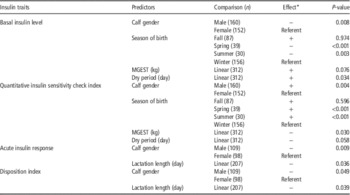
The insulin traits in calves born to cows were significantly associated with gender, season, MGEST, DP and LL (Table 4). The Insb was estimated to be lower (P=0.008) and the QUICKI was estimated to be higher (P=0.004) in male compared with female calves. The Insb was estimated to be lower in calves born in Spring (P<0.001) and Summer (P=0.003) compared with calves born in Winter. The QUICKI was estimated to be higher in calves born in Spring (P<0.001) and Summer (P<0.001) compared with calves born in Winter. The Insb was estimated to be higher in calves born to cows having passed a higher MGEST (P=0.076) and longer DP (P=0.034). QUICKI was estimated to be lower in calves born to cows having passed a higher MGEST (P=0.030) and longer DP (P=0.058). Moreover, the AIR (P=0.009) and DI (P=0.049) were estimated to be lower in male compared with female calves. Furthermore, the AIR (P=0.036) and DI (P=0.039) were estimated to be lower in calves born to cows having passed a longer LL.
Factors significantly affecting insulin traits in calves born to cows

MGEST=cumulative milk production during gestation from conception to drying off.
* ‘Referent’ means that this variable was used as the reference; ‘+’ and ‘−’ mean that the concerning variable is associated with a higher, lower value in comparison with the referent, respectively.
Discussion
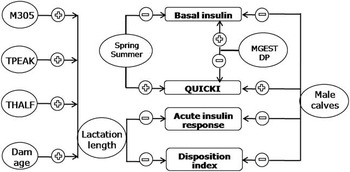
Milk production per cow is increasing annually on behalf of long-term genetic selection and improved management practices. High milk production in cows gives rise to reduced blood glucose, insulin and IGF-I levels and thereby favors a lower energy status (Albarrán-Portillo and Pollott, Reference Albarrán-Portillo and Pollott2013; Bossaert et al., Reference Bossaert, Fransen, Langbeen, Stalpaert, Vandenbroeck, Bols and JLMR2014). We hypothesized that high milk production during gestation in cows affects the intrauterine development of the fetal endocrine pancreas and hence programs reduced insulin secretion in the newborn calves. The rationale behind this hypothesis originates from studies done in a variety of other species including humans (De Rooij et al., Reference De Rooij, Painter, Phillips, Osmond, Michels, Godsland, Bossuyt, Bleker and Rojeboom2006), in which it is found that insulin secretion in newborns is significantly reduced in case of a lack of nutrients during intrauterine development (Owens et al., Reference Owens, Gatford, De Blasio, Edwards, McMillen and Fowden2007; Limesand et al., Reference Limesand, Rozance, Macko, Anderson, Kelly and Hay2013). This lack of nutrients can either be caused by a famine (De Rooij et al., Reference De Rooij, Painter, Phillips, Osmond, Michels, Godsland, Bossuyt, Bleker and Rojeboom2006), a specific physiologic status like lactation (Wu et al., Reference Wu, Bazer, Wallace and Spencer2006; Berry et al., Reference Berry, Lonergan, Butler, Cromie, Fair, Mossa and Evans2008; Funston and Summers, Reference Funston and Summers2013) or adverse environmental conditions (Tao et al., Reference Tao, Monteiro, Hayen and Dahl2014). In a previous study (Bossaert et al., Reference Bossaert, Leroy, De Campeneere, De Vliegher and Opsomer2009), we have shown that in comparison to beef calves, dairy calves show signs of peripheral insulin resistance already early after birth. In that study, we used a limited number of calves in which we performed more extensive tests like the intravenous glucose tolerance test and the intravenous insulin tolerance test. However, the present epidemiological study was performed using a larger number of subjects. The latter, however, limits the use of sophisticated tests. Therefore, we used tests that are easier to perform under field conditions and which had been proven to be satisfying in comparable field studies performed in several other species including ruminants (Bergman et al., Reference Bergman, Ader, Huecking and Van Citters2002; Radunz et al., Reference Radunz, Fluharty, Relling, Felix, Shoup, Zerby and Loerch2012; Limesand et al., Reference Limesand, Rozance, Macko, Anderson, Kelly and Hay2013). The present study is to the best of our knowledge one of the first to specifically address the direct effects of environment and dam characteristics including the level of milk production during gestation, on insulin traits in newborn Holstein calves. A diagrammatic representation of the relationship between insulin traits of the calves and the environmental factors associated with them is presented in Figure 3.
Diagrammatic representation of the relationship between insulin traits of calves (illustrated in rectangles) and environmental and dam variables (in ovals). Signs on the arrows represents the direction of the influence of the variable. M305=cumulative 305 days milk production; TPEAK=time to peak milk; THALF=time to half of the peak milk; MGEST=cumulative milk production during gestation from conception to drying off; DP=length of the dry period; QUICKI=quantitative insulin sensitivity check index;  =positive influence;
 =negative influence.

Calf characteristics including insulin traits
The BW and other size parameters of the calves recorded in the present study are comparable with previous investigations (Muri et al., Reference Muri, Schottstedt, Hammon, Meyer and Blum2005; Bossaert et al., Reference Bossaert, Fransen, Langbeen, Stalpaert, Vandenbroeck, Bols and JLMR2014). However, BW represents fetal growth only at one point in time (at the end of gestation), and does not provide an insight into the pattern of fetal growth throughout gestation. Therefore, it is not surprising that BW and other size parameters are not correlated with any insulin traits of the calves in the present study. This result is consistent with previous studies where the impact of poor fetal growth on insulin secretion was not related to BW (Jaquiery et al., Reference Jaquiery, Oliver, Honeyfield-Ross, Harding and Bloomfield2012; Limesand et al., Reference Limesand, Rozance, Macko, Anderson, Kelly and Hay2013). The Insb is positively correlated with Glub in the present study, which is consistent with a previous investigation (Muri et al., Reference Muri, Schottstedt, Hammon, Meyer and Blum2005). Furthermore, in the present study, a relatively narrow range of Glub is maintained in the calves with a wide range of Insb. This indicates that the calves are able to control glycemia effectively at the expense of variable concentrations of insulin (De Blasio et al., Reference De Blasio, Gatford, McMillen, Robinson and Owens2007). Basal insulin concentrations may depend on the ontogenic development of the endocrine pancreas, the insulin sensitivity of the peripheral tissues, as well as on the amount, time point and frequency of colostrum intake (Hammon et al., Reference Hammon, Steinhoff-Wagner, Schonhusen, Metges and Blum2012). However, the calves in the present study had all been fed 4 l of colostrum within the first few hours after birth by esophageal tube. Moreover, insulin sensitivity and insulin levels are mutually related in such a way that reduced insulin sensitivity is compensated for by an increased insulin production. The latter is illustrated by the fact that Insb is related to QUICKI in a hyperbolic fashion in the present study, with insulin production increasing as insulin sensitivity decreases, as occurs in young lambs (De Blasio et al., Reference De Blasio, Gatford, McMillen, Robinson and Owens2007) and human beings (Bergman et al., Reference Bergman, Ader, Huecking and Van Citters2002). When QUICKI was plotted against AIR, the data points also approximated a hyperbolic curve, as occurs in young lambs (De Blasio et al., Reference De Blasio, Gatford, McMillen, Robinson and Owens2007). The hyperbolic relationship between log QUICKI and log Insb, and between log QUICKI and log AIR in the present study is confirmed by a significant inverse linear relationship. This implies that the product of insulin secretion and sensitivity which is represented by the DI (Bergman et al., Reference Bergman, Ader, Huecking and Van Citters2002) is nearly constant implicating that DI may be a good surrogate measure of β-cell function in relation to the peripheral insulin sensitivity since DI reflects the ability of the endocrine pancreas to compensate for reduced insulin sensitivity. Therefore, this index has been increasingly used in metabolic studies in animals. In the present study, the insulin traits calculated for the calves born to heifers were not significantly different from the ones calculated for the calves born to cows. This finding implies that the calves born to heifers do not display altered intrauterine development of the endocrine pancreas compared with the calves born to lactating cows although significant differences exist in blood metabolite concentrations between heifers and cows during gestation (Bossaert et al., Reference Bossaert, Fransen, Langbeen, Stalpaert, Vandenbroeck, Bols and JLMR2014).
Factors significantly associated with major insulin traits in Holstein calves
Calf gender
We observed sexual dimorphism in insulin sensitivity and insulin secretion in the Holstein calves. Although both sexes showed similar fasting plasma glucose concentrations, serum insulin levels are higher in female than in male calves. In other words, female calves produce more insulin to maintain similar glycemic levels than male calves. Insulin sensitivity correlates positively to the percentage of type I muscle fibers in calves (Sternbauer and Essen-Gustavsson, Reference Sternbauer and Essen-Gustavsson2002). The male calves in the present study are heavier than the female calves. We speculate that a higher amount of muscle fibers may partially explain higher QUICKI and thereby lower Insb in the male calves (Sternbauer and Essen-Gustavsson, Reference Sternbauer and Essen-Gustavsson2002). The latter is furthermore confirmed by the results of our previous study in which we showed that calves of the double muscled Belgian Blue breed had significantly lower Insb and QUICKI values in comparison with Holstein calves (Bossaert et al., Reference Bossaert, Leroy, De Campeneere, De Vliegher and Opsomer2009). Similarly, female babies have higher insulin concentrations at birth (Wilkin and Murphy, Reference Wilkin and Murphy2006) and they are less responsive to the trophic effects of insulin owing to mutations in the glucokinase gene (Wilkin and Murphy, Reference Wilkin and Murphy2006). Furthermore, our data show a significantly lower insulin secretory response following a standard glucose bolus (as indicated by lower AIR and DI) in male calves in comparison with female calves. The gender-specific programming of insulin secretion and action identified in the present study is important in relation to earlier studies showing increased vulnerability of male calves, compared with females, to the later development of adiposity as a consequence of early growth restriction (Jaquiery et al., Reference Jaquiery, Oliver, Honeyfield-Ross, Harding and Bloomfield2012). In addition, in human, male babies are generally known to be more insulin sensitive at birth bringing them at a higher risk to suffer from obesity being a well-known risk factor to suffer from insulin resistance, cardiovascular disease and diabetes mellitus type 2 (Geer and Shen, Reference Geer and Shen2009; Sattar, Reference Sattar2013). The latter further illustrates the lower capacity of the endocrine pancreas of male individuals to compensate for peripheral insulin resistance in adult life (De Rooij et al., Reference De Rooij, Painter, Phillips, Osmond, Michels, Godsland, Bossuyt, Bleker and Rojeboom2006; Morrison, Reference Morrison2008; Fleming et al., Reference Fleming, Lucas, Watkins and Eckert2012).
Season of birth
Our previous research has shown that heifers and cows completing their late gestation during the hotter seasons deliver smaller calves, which reflects a compromised fetal development in utero (Kamal et al., Reference Kamal, Van Eetvelde, Depreester, Hostens, Vandaele and Opsomer2014). The latter is very similar to studies in sheep in which heat stress during gestation has been shown to be associated with the birth of smaller lambs (Morrison, Reference Morrison2008). In addition, the Insb is lower and QUICKI is higher in the calves born in Spring and Summer in comparison with the calves born in Winter in the present study. Our result is consistent with a previous study where reduced insulin levels and enhanced insulin sensitivity have been observed in calves born following maternal heat stress during late gestation (Tao et al., Reference Tao, Monteiro, Hayen and Dahl2014). This implies that calves born in Spring and Summer are more efficient in moving glucose from the circulation into insulin-dependent tissues due to increased insulin sensitivity, leading to a lower pool of circulating glucose (Tao et al., Reference Tao, Monteiro, Hayen and Dahl2014). We speculate that calves born to dams that were subjected to higher ambient temperatures during late gestation have impaired pancreatic maturation in utero (Limesand et al., Reference Limesand, Rozance, Macko, Anderson, Kelly and Hay2013). The late gestation heat stress compromises placental development, which results in fetal hypoxia, malnutrition and eventually fetal growth retardation (Morrison, Reference Morrison2008). Moreover, a decrease in dry matter intake is a hallmark of the heat stress response in animals and malnutrition is a factor in the reduced pancreatic growth (Wu et al., Reference Wu, Bazer, Wallace and Spencer2006). Furthermore, a longer photoperiod during hotter seasons leads to increased plasma prolactin concentrations in cows, supporting higher milk production and thereby limiting nutrient availability for intrauterine growth (Accorsi et al., Reference Accorsi, Govoni, Gaiani, Pezzi, Seren and Tamanini2005). Our data indicate that the basal metabolism of calves is affected by the seasonal stress imposed on the mother during late gestation.
Lactation characteristics in cows
We have tested the hypothesis that intrauterine growth of fetal endocrine pancreas is compromised when the dam is targeting high levels of nutrients into milk production during gestation. However, the effect is at odds with the view that the Insb is higher and QUICKI is lower in the calves born following a greater MGEST in cows in the present study. Such association between the insulin traits and MGEST is rather difficult to explain. However, the energy status during lactation in cows may be affected by cow factors irrespective of the level of MGEST (Sensosy et al., Reference Sensosy, Zain, Abdel-Razek, Uchiza, Tameoka, Izaike and Osawa2012; Piccardi et al., Reference Piccardi, Capitaine Funes, Balzarini and Bó2013). The cows having a higher MGEST had a shorter DO (r=−0.47, P<0.001) and DP (r=−0.52, P<0.001) in the present study, which is in line with previous reports (Atashi et al., Reference Atashi, Zamiri and Dadpasand2013). Perhaps cows having higher MGEST are in a better energy status and, therefore, also provided a better maternal environment for the intrauterine development of the endocrine pancreas giving rise to higher insulin levels and lower insulin sensitivity in the calves. In less productive cows, daily milk production often decreases to low levels before the planned drying off date; therefore, farmers no longer keep these cows in production, which results in longer DP compared with higher producing cows (Atashi et al., Reference Atashi, Zamiri and Dadpasand2013). In our study, the Insb is higher and QUICKI is lower in the calves born to the cows having passed a longer DP. Although no difference exists in serum glucose, insulin and IGF-I levels in cows with short v. longer DP (Pezeshki et al., Reference Pezeshki, Mehrzad, Ghorbani, Rahmani, Collier and Burvenich2007), we speculate that cessation of partitioning nutrients toward milk for extended duration in cows experiencing a longer DP, provides higher amounts of energy and amino acids toward growth and maturation of the pancreatic β-cell, giving rise to higher insulin levels in the calves (Long et al., Reference Long, Prado-Cooper, Krehbiel and Wettemann2010). However, the MGEST and DP are not significantly associated with the insulin secretion at the stimulated state in the present study. This may be due to the fact that only a subset of the calves has employed for the GSIS test.
A longer LL in cows leads to a longer partitioning of energy and nutrients towards the udder and less towards the uterus. The lower partitioning of nutrients to the gravid uterus in cows may lead to less glucose crossing the placenta and hence a retardation in the development of the embryo (Green et al., Reference Green, Meyer, Williams, Newsom, Keisler and Lucy2012; Sensosy et al., Reference Sensosy, Zain, Abdel-Razek, Uchiza, Tameoka, Izaike and Osawa2012). Although the energy requirements for the embryo may be relatively low, metabolic activity is high and this represents a critical period for epigenetic control and organogenesis during fetal development (Wu et al., Reference Wu, Bazer, Wallace and Spencer2006; Fleming et al., Reference Fleming, Lucas, Watkins and Eckert2012). Certainly, β-cells in pancreatic islets develop during the embryonic and early fetal period of the intrauterine development in cattle (Carlsson et al., Reference Carlsson, Heller, Serup and Hyttel2010). Exposure of dams to reduced nutrient intake during early gestation is associated with reductions in insulin concentrations in sheep fetuses (Limesand et al., Reference Limesand, Rozance, Macko, Anderson, Kelly and Hay2013) and in calves (Long et al., Reference Long, Prado-Cooper, Krehbiel and Wettemann2010). The adaptations to nutrient restriction that limit insulin concentrations are not fully known, but a morphological study demonstrated smaller pancreatic islets and a decrease in β-cell mass following early growth restriction in sheep (Limesand et al., Reference Limesand, Rozance, Macko, Anderson, Kelly and Hay2013). Chronic hypoglycemia during later stages of fetal development leads to an intrinsic islet defect that is responsible for the decreased insulin secretion in sheep offspring without significantly decreasing their β-cell mass (Rozance et al., Reference Rozance, Limesand and Hay2006). In the present study, the AIR is lower in calves born following longer LL in cows. The lower insulin secretion in the calves born to the cows with longer LL is even evident after adjusting for the sensitivity, as indicated by a lower DI. We speculate that chronic glucose partitioning towards the udder during the entire period of gestation is present in cows with longer LL which potentially contributes to a reduced β-cell mass due to slower proliferation rates and subsequently a reduced insulin secretion in the newborn calves (Rozance et al., Reference Rozance, Limesand and Hay2006; Limesand et al., Reference Limesand, Rozance, Macko, Anderson, Kelly and Hay2013; Lucy et al., Reference Lucy, Butler and Garverick2014). Substantial evidence suggests that energy restriction before birth is associated with enhanced insulin sensitivity in early postnatal life. However, this dysfunction appears to emerge in case the nutrient restriction in earlier parts of gestation is followed by abundance of nutrients in late part of gestation (Long et al., Reference Long, Prado-Cooper, Krehbiel and Wettemann2010; Radunz et al., Reference Radunz, Fluharty, Relling, Felix, Shoup, Zerby and Loerch2012). In our study, the QUICKI of the calves was not associated with the LL in cows. This observation is consistent with a study in sheep where nutritional restriction throughout gestation was imposed to the fetal lambs by removal of the majority of the endometrial caruncles from the uterus of the dams (Owens et al., Reference Owens, Gatford, De Blasio, Edwards, McMillen and Fowden2007). The latter gave rise to an impaired insulin secretion without any enhancement of insulin sensitivity in the fetal lambs (Owens et al., Reference Owens, Gatford, De Blasio, Edwards, McMillen and Fowden2007). These findings invoke that elongation of LL in cows, or factors associated with the longer LL, impair β-cell responsiveness to glucose stimulation, hence insulin secretion in the newborn calves (Rozance et al., Reference Rozance, Limesand and Hay2006; Owens et al., Reference Owens, Gatford, De Blasio, Edwards, McMillen and Fowden2007; Gutierrez et al., Reference Gutierrez, Espasandin, Astessiano, Casal, Lopez-Mazz and Carriquiry2012).
Conclusions
Major finding of the present study is that major insulin traits in newborn Holstein calves are significantly associated with gender and season of birth. Subsequently, in calves born out of multiparous dams, insulin traits are significantly associated with the amount of milk produced during gestation, lactation length and length of the dry period before their birth. Whether the changes in insulin traits early in life exert long-term effects on the metabolic function in later life is unknown. However, several reports have linked lactation during gestation in the dam with impaired future performance and longevity of the offspring (Berry et al., Reference Berry, Lonergan, Butler, Cromie, Fair, Mossa and Evans2008; Gonzalez-Recio et al., Reference Gonzalez-Recio, Ugarte and Bach2012). If the alterations in insulin traits of the calves persist in later life, as they do in newborns confronted with intrauterine growth restriction in other species, they may contribute to adverse metabolic outcomes in later life.
Acknowledgments
The authors thank both the farm staffs and the veterinary students of the Ghent University, Belgium who contributed to this study. The study was funded by the Special Research Fund (BOF) (Dossier number: 01SF2010), Ghent University, Belgium.