Introduction
Population-based attitude research in psychogeriatrics has made some progress in the last years in shedding light on public knowledge about dementia and public attitudes toward people with dementia (Blay et al., Reference Blay and Peluso2010; Luck et al., Reference Luck2012; Spector et al., Reference Spector, Orrell, Schepers and Shanahan2012; Werner et al., Reference Werner, Goldberg, Mandel and Korczyn2013). In terms of attitudes toward people afflicted, it has been pointed out that emotional reactions (e.g. pity, sympathy, fear, or anger) are one important component of the stigma process (Corrigan and Watson, Reference Corrigan and Watson2002; Link et al., Reference Link, Yang, Phelan and Collins2004; Hinshaw, Reference Hinshaw2007; Angermeyer et al., Reference Angermeyer, Holzinger and Matschinger2010). According to modern conceptualization, the stigma process consists of components of labeling, stereotyping, cognitive separating, emotional reactions, status loss, and discrimination (Link et al., Reference Link, Yang, Phelan and Collins2004). Regarding mental illness, it has been found that emotional reactions have a substantial effect on desire for social distance and discrimination (Angermeyer et al., Reference Angermeyer, Holzinger and Matschinger2010).
One study from Greece shows that emotional reactions toward people with dementia vary according to personal experience and social factors like age, gender, occupational group, and education (Kalaitzaki et al., Reference Kalaitzaki, Kateri and Pattakou-Parasyri2012). Moreover, it is known from studies in social psychiatry that public attitude (including emotional reactions) vary according to the mental illness under study (Angermeyer et al., Reference Angermeyer, Matschinger and Schomerus2013; Knesebeck et al., in print). For example, fearful reactions are more frequent when the public is confronted with a person with schizophrenia compared with a person with depression. Such differences have important consequences for attitudes and behaviors toward people with depression and schizophrenia (Angermeyer and Matschinger, Reference Angermeyer and Matschinger2003; Angermeyer et al., Reference Angermeyer, Matschinger and Schomerus2013).
Against this background, in the present analyses the following research questions will be addressed: (1) What kind of emotional reactions does the German public show toward people with dementia? (2) Do these emotional reactions differ from the reactions toward people with schizophrenia and depression? (3) Are emotional reactions toward people with dementia associated with social factors (age, gender, socio-economic status [SES]) and contact with people concerned? (4) Are emotional reactions associated with attitudes/beliefs about dementia (early detection, consequences for quality of life, willingness to care)?
Methods
Study design and sample
Analyses are based on a national mail survey conducted in fall 2012 (“Gesundheitsmonitor 2013”). Sample consists of persons aged 18 to 79 years living in private households in Germany. Based on the distribution of age, gender, and the federal states in the official German statistics, the sample was stratified. Of the 2,300 randomly selected individuals asked for participation, 1,795 persons filled out the questionnaire, reflecting a response rate of 78%. Survey participation was voluntary; and informed consent was considered to have been given when individuals filled out the questionnaire. Based on German official statistics concerning the distribution of gender, age, and federal states, weights were used to compensate for non-response.
For comparison with schizophrenia and depression (research question 2), data of a previous telephone survey (computer-assisted telephone interviewing, CATI) in two large German cities (Hamburg and Munich) conducted in 2011 were used additionally. Sample consists of adult individuals (18 years and older), living in private households with conventional telephone connection. The sample was randomly drawn from all registered private telephone numbers, and additionally from computer-generated numbers. In all 2,014 individuals agreed for the interview and participated in the study (1,009 in Hamburg, 1,005 in Munich). This reflects a response rate of about 51%. Methodological details of this study are described elsewhere (Knesebeck et al., Reference Knesebeck2013a; Reference Knesebeck2013b).
Measures
According to previous research, three types of emotional reactions toward people with mental and cognitive disorders could be distinguished: fear, anger, and pro-social reactions (Angermeyer and Matschinger, Reference Angermeyer and Matschinger2003). A list of nine items, representing these three types of emotional reactions toward individuals with such illnesses, was used to assess respondents’ emotional reactions to a person with dementia. The list of items was introduced by the following sentence: “How would you react to a person with dementia? Please indicate how you would evaluate the emotional reactions mentioned.” With the items, coded from 1 (“not at all correct”) to 4 (“completely correct”), a factor analysis was carried out (principal component analysis with varimax rotation), which yielded the same three factors that were found in previous studies (Angermeyer and Matschinger, Reference Angermeyer and Matschinger2003; Knesebeck et al., in print). The items “. . .induce fear with me,” “. . .makes me feel uncomfortable,” and “. . . makes me feel insecure,” loaded most strongly on the first factor, i.e. “fear.” The items “I react angrily,” “I feel annoyed by this person,” and “. . . triggers incomprehension with me” loaded most strongly on the second factor, i.e. “anger.” The items “I feel pity,” “I feel sympathy,” and “I feel the need to help this person” were loaded on the last factor, termed “pro-social reactions.” For each factor, a subscale was built based on the sum score of the related factor items.
In terms of attitudes and beliefs about dementia, the perceived consequences of dementia, the willingness to care, and attitudes toward early detection of dementia were assessed (Kofahl et al., in print). Specifically, three items were used: (1) “Despite their disorder, dementia patients have a very high quality of life.” (2) “I would care for a family member with a dementia at home.” (3) “To know early that you have a dementia is not good at all.” These three items were coded from 1 (“do not at all agree”) to 4 (“strongly agree”). For the analyses, the items were dichotomized (agree [values 3 and 4] vs. disagree [values 1 and 2]).
Age, gender, and SES were introduced as social factors that are potentially associated with emotional reactions and beliefs about dementia. SES was measured by using an index of vocational education, occupational position, and income. The values of three SES indicators were transformed into a nine-point scale and then summed up, resulting in an SES index ranging from 3 to 27 points. Based on this index, three status groups were defined: low SES (3 to 10 points), middle SES (11 to 19), and high SES (20 to 27). Finally, respondents were asked, if they ever had contact with a person with dementia (yes/no) and whether they personally care or have cared for a dementia patient (yes/no).
Statistical methods
For the descriptive analyses of emotional reactions toward persons with dementia and for comparison with schizophrenia and depression (first and second research questions), percentages, means, standard deviations and internal consistencies (Cronbach's α) are reported. To test associations between social factors, emotional reactions, and beliefs about dementia (research questions 3 and 4), multivariate logistic regression analyses were conducted. This procedure was chosen due to the distribution characteristics of dependent variables (i.e. emotional reactions and beliefs about dementia were not normally distributed). Odds ratios, 95% confidence intervals, and significances are reported. For logistic regression analyses, subscales of emotional reactions were dichotomized with scores in the upper tertile defining a relatively strong emotional reaction. All analyses were conducted with the statistical program package SPSS 21.
Results
The mean age of the respondents was 49.4 years, and about 52% were females. About 24% of the respondents had a low SES, one-third had contact with a person with dementia, and 12% cared for a dementia patient. Altogether, 40% of the respondents agreed to the statement, “Dementia patients have a very high quality of life”; 80.9% of the sample was willing to care for a family member with dementia at home; and 15.9% of the respondents agreed to the statement that it is not good at all to know early that one has a dementia.
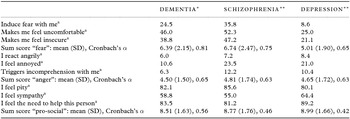
Table 1 shows public's emotional reactions toward people with dementia, schizophrenia, and depression. Fearful reactions were most frequent when respondents were confronted with a person with schizophrenia and least frequent in case of depression. Differences between dementia and schizophrenia in terms of fearful reactions were moderate. In general, respondents rarely reacted with anger. This is especially true for dementia. Regardless of the condition, respondents most frequently showed pro-social reactions. Compared with schizophrenia and depression, the mean of this subscale was slightly lower in the case of dementia.
Emotional reactions toward people with dementia, schizophrenia, and depression

Notes: aPercentage of “rather correct” or “completely correct.”
*Data from a mail survey in Germany 2012, N = 1,795.
**Data from a telephone survey in Hamburg and Munich 2011, N = 2,014 (for details, please see Knesebeck et al. Reference Knesebeck2013a; Reference Knesebeck2013b).
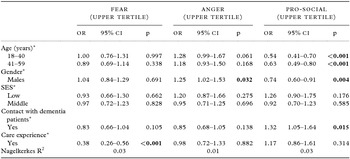
Associations between emotional reactions toward people with dementia and social factors as well as contact with people concerned are shown in Table 2. Respondents who have cared for a person with dementia were significantly less likely to belong to the upper tertile of fearful reactions. Age, gender, SES, and contact with dementia patients were not significantly associated with fear. Male respondents were more likely to react angrily than female respondents when they are faced with a person with dementia. There were no other significant associations with anger, resulting in an explained variance of about 1%. Younger respondents (aged 18 to 59 years) had a significantly lower probability to show pronounced pro-social reactions than respondents who were aged 60 years and older. Moreover, men were less likely to show pro-social reactions, while respondents who had contact with a person with dementia were more likely to show this kind of reaction.
Emotional reactions toward people with dementia regressed on gender, age, socio-economic status (SES), and contact/experiences (N = 1,795): Odds ratios (OR), 95% confidence intervals (CI), and significances (p)

Notes: *Reference categories: Age 60+ years, female gender, high SES, no contact, no care experience.
p-values < 0.05 are in bold.
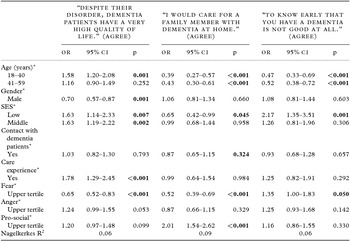
In Table 3, attitudes/beliefs about dementia (consequences for quality of life, willingness to care, and early detection) are regressed on gender, age, SES, experiences, and the three emotional reactions. Young respondents, women, low and middle SES groups as well as respondents who have cared for a person with dementia were more likely to believe that dementia patients had a very high quality of life. In terms of emotional reactions, people who react fearfully were significantly less likely to agree with this statement. Willingness to care was negatively associated with younger age, low SES, and fear. Respondents with strong pro-social reactions were more likely to be willing to care for a family member with dementia. Younger people were less likely to agree to the statement that it was not at all good to know early that one had a dementia. This attitude was more prevalent among respondents with a low SES and respondents who showed pronounced fearful reactions toward people afflicted.
Beliefs about dementia regressed on gender, age, socio-economic status (SES), experiences, and emotional reactions (N = 1,795): Odds ratios (OR), 95% confidence intervals (CI) and significances (p)

Notes: *Reference categories: age 60+ years, gender female, high SES, no contact, no care experience, lower tertiles of fear, anger, and pro-social reaction.
p-values < 0.05 are in bold.
Discussion
One aim of this study was to describe the emotional reactions of the German public toward people with dementia. Results show that a vast majority of the respondents expressed pro-social reactions, i.e. they felt pity, sympathy, and the need to help a person with dementia. People with dementia rarely evoked anger (10% or less). However, between 25% and almost 50% of the population showed reactions indicating fear. Compared with persons with schizophrenia and depression, persons with dementia evoked least anger and pro-social reactions. However, differences in the mean sum scores were moderate. Fearful reactions toward persons with dementia were much more pronounced than in case of depression and less pronounced than in case of schizophrenia. Thus, magnitude of fearful reactions in case of dementia was relatively high. Almost half of the respondents rather or completely agreed with the statement that people with dementia make them feel uncomfortable. This is noteworthy, because it is known from the population-based attitude research in psychiatry that fearful reactions are strongly associated with a desire for social distance (Angermeyer and Matschinger, Reference Angermeyer and Matschinger2003; Knesebeck et al., Reference Knesebeck2013b).
Associations between emotional reactions toward people with dementia and social factors (age, gender, and SES) were generally weak. As an exception, pro-social reactions were more pronounced among older people and women. Previous findings on gender differences in emotional reactions toward people with dementia were also inconsistent (Werner and Davidson, Reference Werner and Davidson2004; Werner et al., Reference Werner, Goldberg, Mandel and Korczyn2013). Respondents who had a contact with a person with dementia or cared for a dementia patient tended to show less negative reactions (fear, anger) and more pro-social reactions. This association between familiarity with the illness and emotional reactions is known from studies dealing with mental disorders (Angermeyer and Dietrich, Reference Angermeyer and Dietrich2006), suggesting that personal contact with persons afflicted may be a way to reduce stigma (Rüsch et al., Reference Rüsch, Angermeyer and Corrigan2005).
Respondents who showed pronounced fearful reactions were less likely to believe that dementia patients had a high quality of life, were less willing to care for a family member with dementia at home, and were more skeptical about early detection of dementia. In contrast, respondents with strong pro-social reactions were more likely to be willing to care for a family member with dementia. Thus, especially fearful reactions were consistently associated with beliefs and attitudes about dementia that have important implications. For example, early detection of dementia provides numerous benefits for patients, caregivers, and the healthcare system, although currently there are no curative treatments available for the most common form of dementia, i.e. Alzheimer's disease (Luck et al., Reference Luck2012). In terms of willingness to care, most dependent elderly people wished to be cared for at home as long as possible (Kane and Kane, Reference Kane and Kane2001). Given the enormous costs associated with residential care, this is also a goal of social policy and long-term care insurance (Schwarzkopf et al., Reference Schwarzkopf2012). Thus, willingness to care is associated both with quality of life of elderly dependent people and cost savings for the healthcare system. When interpreting willingness to care one has to keep in mind however, that many factors can impact on whether a caregiver takes on the care giving role when the time comes (Quinn et al., Reference Quinn, Clare and Woods2010).
We consider emotional reactions as one important component of stigma process (Link et al., Reference Link, Yang, Phelan and Collins2004). Two of the main strategies to reduce stigma are education and contact. In terms of education, awareness campaigns that promote positive views of dementia may help to change people's beliefs. To reduce stigma and fear, education should specifically focus on increasing knowledge that there are marked differences in functioning among individuals with dementia and their self-rated well-being is similar to others of the same age (Mukadam and Livingston, Reference Mukadam and Livingston2012). However, educational programs alone have been found to be of limited effectiveness (Rüsch et al., Reference Rüsch, Angermeyer and Corrigan2005). Personal contact with persons with dementia may help to augment the effects of education on reducing stigma and fear. It has been shown that meeting individuals with mental illness can effectively decrease stereotypes and stigma in the general public (Rüsch et al., Reference Rüsch, Angermeyer and Corrigan2005). These contact-based approaches had a greater effect on modifying attitudes and behavior than educational programs.
Several limitations have to be considered when interpreting our results. First, 22% of the sample did not fill out the questionnaire. Although a response rate of 78% in a national mail survey was quite high and weights were used to compensate for over- or under-represented groups, we cannot rule out a selection bias due to non-response. Second, for comparison with schizophrenia and depression, data of a telephone survey in two large German cities (Hamburg and Munich) were additionally used (Knesebeck et al., Reference Knesebeck2013a; Reference Knesebeck2013b). Due to different populations and different modes of data collection, comparability was limited. Nonetheless, we decided to look at differences between the diseases because the same measure for emotional reactions was used in the two studies. Third, it is possible that the respondents had a notion of dementia and the two mental disorders that differs from scientific conception. This has to be kept in mind when interpreting their emotional reactions and beliefs. Furthermore, some of the subscales of emotional reactions had low internal reliability scores. Finally, as we dichotomized the variables for logistic regression analyses, results on associations to some extent are crude. Nevertheless, we decided to dichotomize the variables and use logistic regression models for the sake of clearness, and due to the distribution characteristics of some variables.
Despite these limitations, this study shows that fearful reactions toward people with dementia are quite common in the German general public. These fearful reactions are consistently associated with beliefs and attitudes about dementia that have important practical implications. To reduce fear, educational programs and (more importantly) contact-based approaches should be considered.
Conflict of interest
None
Description of authors' roles
O.v.d. Knesebeck formulated the research questions, carried out the statistical analyses, and wrote the paper. M.C. Angermeyer was involved in formulating the research questions and contributed to the writing of the paper. D. Lüdecke assisted in analyzing the data and contributed to the writing of the paper. C. Kofahl was involved in designing the study, formulating the research questions, and writing of the paper.
Acknowledgments
We thank Bertelsmann Stiftung for the opportunity to integrate questions on emotional reactions to people with dementia in “Gesundheitsmonitor 2013” and for providing the dataset for the present analyses. The telephone survey on emotional reactions to people with depression and schizophrenia is part of the study supported by the German Federal Ministry of Education and Research (01KQ1002B) in the frame of “Psychenet – Hamburg Network Mental Health” (2011–2014). Further information and a list of all project partners can be found at www.psychenet.de.