Being the child of a teenage mother often involves exposure to a constellation of risk factors that are linked to problematic developmental processes and outcomes. These factors touch on past childhood experiences with primary caregivers, as well as current circumstances related to family organization and dynamics, marital relationships, and parent–child interactions and relationships (Tarabulsy, Moran, Pederson, Provost, & Larose, Reference Tarabulsy, Moran, Pederson, Provost, Larose, Davis and Logdson2011). From a public health perspective, the children of young mothers have been shown to be overrepresented in virtually all spheres involving specialized social and educational services, including those received at school, the medical domain, and social services related to child protection, delinquency, and incarceration (Coyne, Langstrom, Lichtenstein, & D'Onofrio, Reference Coyne, Langstrom, Lichtenstein and D'Onofrio2013), testifying to the degree of developmental risk to which they are exposed. Although some have emphasized that it is important not to overstate the risk involved in adolescent motherhood (SmithBattle, Reference SmithBattle2009), others have sought to understand the intergenerational processes that are involved in this risk in order to articulate more effective and knowledgeable intervention strategies to help both mothers and children (Meade, Kershaw, & Ickovics, Reference Meade, Kershaw and Ickovics2008; Moran, Pederson, & Krupka, Reference Moran, Pederson and Krupka2005). The current study seeks to further our understanding of such intergenerational processes from an attachment paradigm within a sample of adolescent mother–infant dyads, and to compare and contrast such processes with those observed in a low-risk, community sample of adult mother dyads.
The Transmission of Attachment
The notion that parental representations of relationships are transmitted through behavior and interactions with children and eventually internalized by the latter has long been part of the major clinical and theoretical models of human development (Hinde, Reference Hinde1987; Schaffer, Reference Schaffer1971). However, this process has been difficult to document. Nowhere has this hypothesis been more central to theory or more influential in shaping methodology than in the study of attachment. Guided by extant theory, attachment researchers have demonstrated the links between the key elements of this process. This work has shown that parental cognitive organization of attachment-relevant discourse, cognitions, and experiences are associated with infant and child behavioral and emotional organization revealed in different types of attachment assessments (see review by Verhage et al., Reference Verhage, Schuengel, Madigan, Fearon, Oosterman, Cassibba and van IJzendoorn2016). These demonstrations are magnified by the fact that these associations do not feature much shared variance due to methodological confounds. Parental states of mind have been derived from semistructured interviews (e.g., Adult Attachment Interview [AAI]; George, Kaplan, & Main, Reference George, Kaplan and Main1985). Child attachment assessments have been based on a quite distinct methodology that taps into relationship organization observed in the scripted Ainsworth Strange Situation Procedure (SSP; Ainsworth, Blehar, Waters, & Wall, Reference Ainsworth, Blehar, Waters and Wall1978), its preschool adaptation (Cassidy, Marvin, & MacArthur Working Group, Reference Cassidy and Marvin1992), or semistructured home visits using the Attachment Q-Set (Waters, Reference Waters1995). In many studies, several months separate parent and child assessments. This body of research provides compelling evidence of the transmission of attachment organization from parent to child.
Enduring Puzzles in the Study of Attachment Transmission
Research on attachment transmission has revealed three enduring puzzles. The first is that, although models of transmission have provided significant support for the relation among adult states of mind, parental interactive sensitivity, and child behavioral organization, these theory-driven models have also revealed a significant number of mismatches between these variables. As underlined in van IJzendoorn's (Reference van IJzendoorn1995) original meta-analysis and reiterated in Verhage et al.’s more recent work (2016), the association between parental measures of adult autonomy and child measures of security accounts for only a modest proportion of child attachment variance. Verhage et al. estimate that the expected transmission processes linking parental state of mind to attachment security account for 10% of the variance in child security. Thus, although a degree of transmission has been established, the model also clearly leaves much unaccounted for.
It is noteworthy that researchers most commonly test the transmission hypothesis using the correlation between adult autonomy measured in the AAI and child security assessed with the SSP. These are the two anchor points of primary postulates of attachment theory, but they represent only a single possible linkage between maternal state of mind and infant attachment. Another more recent postulate of attachment theory links parental AAI assessments of unresolved loss or trauma with SSP child disorganized attachment. Evidence has also been found for this association but is somewhat weaker than that for the link between parental autonomy and child security (Madigan, Bakermans-Kranenburg, et al., Reference Madigan, Bakermans-Kranenburg, van IJzendoorn, Moran, Pederson and Benoit2006; Verhage et al., Reference Verhage, Schuengel, Madigan, Fearon, Oosterman, Cassibba and van IJzendoorn2016). Beyond these two theory-driven associations, little research has investigated the possibility of other, unpredicted patterns of convergence between adult and child patterns of attachment that may arise in different circumstances. In other words, there may be consistent associations between parental attachment states of mind and child attachment that have not been investigated, because they are not predicted by extant theory.
A second oft-cited unresolved issue in understanding attachment transmission is that, although parental sensitivity is predicted by theory to mediate the association between parental state of mind and child attachment, sensitivity has been found to account for a relatively small portion of this link. Van IJzendoorn (Reference van IJzendoorn1995) labeled this conundrum the “transmission gap.” This term conveys that, although research has repeatedly shown that sensitivity is associated with both maternal attachment autonomy and infant security, solid evidence for its predicted mediational role has proven elusive (Verhage et al., Reference Verhage, Schuengel, Madigan, Fearon, Oosterman, Cassibba and van IJzendoorn2016). This observation has led Atkinson et al. (Reference Atkinson, Goldberg, Raval, Pederson, Benoit, Moran and Leung2005) to describe the process of transmission by way of maternal interactive behavior as ephemeral and to urge that alternative processes be explored.
Researchers have sought to bridge or reduce this transmission gap by improving assessments of sensitivity (Pederson, Gleason, Moran, & Bento, Reference Pederson, Gleason, Moran and Bento1998), by including other aspects of maternal interactive behavior (Bernier, Matte-Gagné, Bélanger, & Whipple, Reference Bernier, Matte-Gagné, Bélanger and Whipple2014) and by controlling for aspects of the environmental ecology that might also contribute to infant attachment security (Tarabulsy et al., Reference Tarabulsy, Bernier, Provost, Maranda, Larose, Moss, Larose and Tessier2005). Although yielding promising results, these efforts have failed to provide consistent evidence that the association between parental state of mind and child attachment is substantially and reliably mediated by parental sensitivity. It should be noted that, as with research exploring the fundamental association between parental state of mind and child attachment, the assessment of this mediational process has focused largely on a limited set of theory-driven parameters: the association between adult autonomy and child security by way of parental interactive sensitivity. The possibility that other patterns of convergence of these key attachment-related factors may be at play remains relatively unexplored. Should other paths exist linking parental state of mind and child attachment, variance relevant to these divergent paths would ultimately serve to weaken associations between variables most commonly investigated.
A third puzzling aspect of attachment transmission research is that both transmission and mediation by sensitivity are lower among dyads that are at high psychosocial risk. This observation, clearly relevant to our understanding of developmental process in vulnerable groups such as adolescent mothers, was first made some time ago (Lyons-Ruth, Yellin, Melnick, & Atwood, Reference Linzer, Lewis, Bronfman, Parsons, Yellin, Melnick and Atwood2005; Ward & Carlson, Reference Ward and Carlson1995) and has recently been highlighted in Verhage et al.’s (2016) meta-analysis. Their results indicate that the transmission of attachment patterns from parent to child is lower in high-risk groups, with a common variance of about 4%. There is no obvious explanation for this difference between lower and higher risk groups. Several possibilities have been investigated, including conceptual and measurement issues (Moran, Forbes, Evans, Tarabulsy, & Madigan, Reference Moran, Forbes, Evans, Tarabulsy and Madigan2008) and the role of other ecological factors in the development of attachment (Tarabulsy et al., Reference Tarabulsy, Bernier, Provost, Maranda, Larose, Moss, Larose and Tessier2005). However, results from these studies have been mixed and not easily replicable. Research regarding the processes of the transmission of attachment remains least compelling in higher risk populations where an understanding of this developmental process is so crucial to devising informed intervention strategies.
A View From a Different Perspective: Variable-Centered Versus Relationship-Centered Research
Attempts to pursue these three important issues concerning attachment transmission, as is typical of research on attachment, have largely featured a variable-centered approach in which theory-driven hypotheses are tested by examining the linear associations between a number of variables characterized by measures of central tendency and sample variability. This approach has provided considerable validation of the basic tenets of the attachment paradigm: the links between adult attachment states of mind and child attachment, and between each of these variables and parental sensitivity. However, it has been argued that because attachment relationships are explicitly conceptualized as dynamic systems featuring multiple reciprocal causal processes (Ainsworth et al., Reference Ainsworth, Blehar, Waters and Wall1978; Bowlby, Reference Bowlby1969, Reference Bowlby1982; Froming, Moser, Mychack, & Nasby, Reference Froming, Moser, Mychack and Nasby1995; Waters, Posada, Crowell, & Lay, Reference Waters, Posada, Crowell and Lay1993), their exploration demands analytic techniques that anticipate more than a unidimensional, linear causal system (see Bailey, Moran, Pederson, & Bento, Reference Bailey, Moran, Pederson and Bento2007; Bergman, Reference Bergman, Pulkkinen and Caspi2002; Richters, Reference Richters1997). A variable-centered approach obscures the possibility that these variables need to be treated as inherent features of a social relationship that cannot be understood except in relation to one another. That is, the unit of analysis may be the relationship itself, characterized by its different components. In this perspective, maternal attachment states of mind, maternal sensitivity, and infant attachment are conceptualized as dimensions of a single relationship. The idea that relationships need to be conceptualized as a multidimensional dynamic system has been explored infrequently in research (but see Ainsworth et al., Reference Ainsworth, Blehar, Waters and Wall1978; Bailey et al., Reference Bailey, Moran, Pederson and Bento2007), likely because it is difficult to operationalize such systems within specific analytic designs.
In pursuit of operationally practical analyses that reflect such a dynamic systems approach, Sterba and Bauer (Reference Sterba and Bauer2010) and von Eye and Bergman (Reference von Eye and Bergman2003; von Eye, Reference von Eye2010) have proposed the more widespread application of person-centered research to questions in developmental psychopathology. These authors argue that person-centered analysis is particularly valuable when variable-centered analyses based on solid theoretical and empirical predictions account for only a small portion of outcome variance. Such analyses investigate broad characterizations of mechanisms thought to apply equally to all individuals within groups that likely are heterogeneous. In such cases, they suggest that underlying competing subgroup-specific models may undermine efforts to identify a single, overarching developmental model. The notable success of past research indicates that such broad associations between variables exist and can provide valuable insight, but the inherent assumption of a single pattern typifying a population reduces the likelihood that distinct patterns among subgroups are likely to be recognized. The modest and inconsistent evidence of attachment transmission mediated by maternal sensitivity produced by variable-centered research nicely meets these criteria and prompts the exploration of an alternative analytic approach where relationships,Footnote 1 and not single variables, are the unit of analysis.
Building on the insight into attachment transmission already provided by the variable-centered approach, the added value of a relationship-centered approach is twofold: to envision groupings of variables outside of the constraints of the traditional transmission model, and to identify potential subgroups that may best be described by relational processes other than the well-established transmission pathway involving parental autonomy, sensitivity, and infant attachment security. To these ends, the relationship-centered approach is seen as complementary to traditional approaches.
A relationship-centered approach, thus, might reveal quite distinct patterns of attachment within high- and low-risk groups. Extant attachment theory postulates, and it has been empirically confirmed, that parental autonomy (as assessed in the AAI; Main, Kaplan, & Cassidy, Reference Main, Kaplan and Cassidy1985) typically is associated with child security observed in the SSP (van IJzendoorn, 1995). The essence of attachment security is a confident reliance on the parent as a secure base from which the child may explore his/her environment, knowing that if something is alarming, he/she may rely on the parent for comfort, help with emotion regulation, and a sense of security (Ainsworth et al., Reference Ainsworth, Blehar, Waters and Wall1978). The child develops such a secure attachment in the context of daily, repeated interactions with his/her sensitive parent. It is possible, however, that this process unfolds differently under the difficult developmental ecologies that characterize high-risk parenthood.
Reflecting such distinctions, attachment theory has been adapted to include the concept of parental unresolved loss or trauma as a critical feature of parental state of mind with respect to attachment (Bakermans-Kranenburg & van IJzendoorn, Reference Bakermans-Kranenburg and van IJzendoorn1993; Hesse & Main, Reference Hesse and Main2000; Madigan, Bakermans-Kranenburg, et al., Reference Madigan, Moran and Pederson2006; Main et al., Reference Main, Kaplan and Cassidy1985; Main & Solomon, Reference Main, Solomon, Greenberg, Cicchetti and Cummings1990). Unresolved loss or trauma are more prevalent in high-risk groups where events that give rise to these states of mind are more likely to occur (Coyne et al., Reference Coyne, Langstrom, Lichtenstein and D'Onofrio2013; Madigan, Wade, Tarabulsy, Jenkins, & Shouldice, Reference Madigan, Wade, Tarabulsy, Jenkins and Shouldice2014). It has been demonstrated that highly insensitive, atypical, frightened, or frightening maternal behavior mediates the association between unresolved state of mind and attachment disorganization (Madigan, Bakermans-Kranenburg, et al., 2006). It is notable, however, that although this path to disorganization can be traced, the transmission process accounts for substantially less variance in high-risk circumstances where this model is perhaps most clinically relevant (Madigan, Bakermans-Kranenburg, et al., 2006). Other links to attachment disorganization also have been documented for such populations, suggesting the presence of distinct, unexplored developmental models linking adult and child attachment (Bailey et al., Reference Bailey, Moran, Pederson and Bento2007; Lyons-Ruth et al., 2005; Moran et al., Reference Moran, Forbes, Evans, Tarabulsy and Madigan2008).
Such distinctive models might be pursued using variable-based moderation analyses, but as argued here, to date such an approach has failed to produce compelling evidence of a pattern of transmission within lower risk groups (thus, the transmission gap) let alone identified distinct patterns between populations. A relationship-centered approach offers the possibility of identifying distinct classes of attachment across generations that reflect divergent themes of relationship transmission occurring within high- and low-risk developmental ecologies.
The Current Study
The purpose of this study is threefold: first, we will apply standard variable-centered analytic techniques and examine the associations between maternal states of mind regarding attachment, maternal sensitive interactive behavior, and child attachment in a low-risk community sample of mother–infant dyads, and a group of mother–infant dyads at higher social risk due to giving birth in adolescence. We expect these associations to be similar to those often reported in the field, including the absence of, or partial mediation by, maternal sensitivity of the parental and child attachment link, and the lower coherence of the model within a relatively high-risk, versus a low-risk, group of dyads.
Second, in a set of exploratory analyses carried out independently within each group, we will take a relationship-centered analytic approach by conducting latent class analysis (LCA) to identify how maternal states of mind, sensitivity, and infant attachment classifications are patterned together within each group (see Collins & Lanza, Reference Collins and Lanza2010). We predicted that this analysis will uncover a contingent of individuals among the lower risk dyads whose patterns reflect the theoretically predicted interrelations of adult autonomy, sensitivity, and infant security. We expect that the LCA also will reveal subgroups of dyads whose relationship organization, reflected in the linkages between maternal, interactive, and child dimensions, are different within both groups.
Third, in an attempt to capture the global differences between the ecologies of high- and low-risk mother–infant dyads, we will consider the moderating impact of belonging to either group in any intergenerational relationship classes identified by the LCA. While it may be helpful to identify specific issues, such as socioeconomic factors and the experience of trauma, differences between the two groups encompass a variety of factors that are included in the high-risk/low-risk distinction. This strategy, where high- and low-risk dyads are compared to paint a broad picture of the manner in which the general developmental ecology may moderate infant and child development, has been successfully used in other studies (Geoffroy et al., Reference Geoffroy, Côté, Giguère, Dionne, Zelazo, Tremblay and Séguin2010; Moffitt & the E-Risk Study Team, Reference Moffitt2002). The current study explores the moderating impact of both individual risk factors and the broad-based risk represented by adolescent motherhood.
The study focuses on differences between adolescent and adult mother–infant dyads. Adolescent mother–infant dyads are typically characterized by a number of risk factors. They have often been exposed to adverse events, including the stresses of growing up in poverty-level homes and important academic challenges, as well as more frequent incidences of loss and trauma than in low-risk groups (Jaffee, Caspi, Moffitt, Belsky, & Silva, Reference Jaffee, Caspi, Moffitt, Belsky and Silva2001; Madigan, Moran, & Pederson, Reference Madigan, Bakermans-Kranenburg, van IJzendoorn, Moran, Pederson and Benoit2006). Their current family lives also involve financial challenges and partner-related conflict, and scarcer educational and professional training opportunities than those of adult, middle-class mothers (Tarabulsy et al., Reference Tarabulsy, Provost, Larose, Moss, Lemelin, Moran, Forbes and Pederson2008). In comparison to lower risk groups of mothers, adolescent mothers tend to more easily neglect or ignore infant needs and behaviors, show less frequent sensitive behaviors, and more often adopt coercive or harsh parenting. They will also engage in face-to-face interaction and speak to their infants less frequently than low-risk mothers (Leadbetter, Bishop, & Raver, Reference Leadbeater, Bishop and Raver1996; Tarabulsy et al., Reference Tarabulsy, Moran, Pederson, Provost, Larose, Davis and Logdson2011). As might be expected, the infants of adolescent mothers more often develop insecure and disorganized attachment with their mothers (Madigan, Moran, et al., 2006; Ward & Carlson, Reference Ward and Carlson1995). They also face other developmental challenges (Rhule, McMahon, & Spieker, Reference Spieker, Larson, Lewis, Keller and Gilchrist1999; Spieker, Larson, Lewis, Keller, & Gilchrist, Reference Spieker, Larson, Lewis, Keller and Gilchrist1999; Spieker, Larson, Lewis, White, & Gilchrist, Reference Spieker, Larson, Lewis, White and Gilchrist1997) and are overrepresented in a variety of social and health related services (Coyne et al., Reference Coyne, Langstrom, Lichtenstein and D'Onofrio2013; World Health Organization, 2014). Many view this research as providing convergent evidence that young motherhood is a marker of past and current adversity and a predictor of problematic child outcome.
Research with adolescent mothers has revealed that two factors reflect certain aspects of the qualitatively distinct ecologies that provide the context for infant development within both groups. First, the characteristic socioeconomic challenges of the families of young mothers may well influence developmental process in many ways (McLoyd, Reference McLoyd1998; Tarabulsy et al., Reference Tarabulsy, Provost, Larose, Moss, Lemelin, Moran, Forbes and Pederson2008) and will be presently considered as a potential moderator of relationship classes that are identified. Second, many researchers have underlined that the developmental antecedents of adolescent mothers are more likely to be characterized by different types of trauma (Bailey et al., Reference Bailey, Moran, Pederson and Bento2007; Madigan et al., Reference Madigan, Wade, Tarabulsy, Jenkins and Shouldice2014) and that such experiences are related to attachment developmental processes (Madigan, Bakermans-Kranenburg, et al., 2006). The moderating role of trauma experiences will therefore be considered, should different patterns of intergenerational relationships be observed.
Method
Participants
The sample consisted of 184 mother–infant dyads. All infants were full-term gestation and physically healthy at birth. Mothers initially expressed an interest in participating in a study of infant social development when approached during their postpartum hospital stay and were paid a nominal fee for their participation. Of these participants, 98 mothers were considered adult and ranged in age from 20 to 44 years (M = 30.9 years) at the time of their infants’ births. A second group of 86 mothers were adolescent and ranged in age from 15.5 to 19.9 years (M = 18.2 years) when giving birth.
Demographic information was obtained during a home visit at infant age 12 months. Approximately 95% of the adult sample was Caucasian; 93% of the adult sample was married or living in common law relationships, whereas the remainder had never married or were single at the time of the study. Adult mothers had an average of 15 years of education (range from 9 to 27 years). Annual family incomes were recorded on a scale from 1 to 8, with 1 = <$5,000 and 8 = >$60,000 (Canadian dollars). For the group of adult mothers, average family income corresponded to 6.39 on the scale (between $50,000 and $60,000).
In the adolescent group, approximately 80% of the sample was Caucasian; the ethnic backgrounds included Native Canadian (n = 5), Middle Eastern (n = 5), Latin American (n = 4), Caribbean (n = 1), and Asian (n =1). Fifty-six percent of the adolescent sample had never married or were single at the time of the study; the remainder were married or living in common law relationships. Adolescent mothers averaged 11.13 years (range = 8–14 years) of education. Mean family income for adolescent mothers corresponded to 3 on the scale (between $10,000 and $20,000). A large majority of adolescent mothers (80%) reported being unemployed or a full-time student. Adolescent mothers had significantly less education than did adult mothers, t (139+) = –12.52, p < .01,Footnote 2 and significantly lower household incomes, t (170+) = –14.66, p <. 01.
Procedure
The AAI (George et al., Reference George, Kaplan and Main1985) was administered when infants were 12 months of age, except in the cases of 49 of the adolescent mothers who served as an untreated control group in an intervention study who were administered the AAI at 6 months infant-age (see Moran et al., Reference Moran, Pederson and Krupka2005). Home visits were conducted approximately 1 week later to obtain Maternal Behavior Q-Sort (MBQS; Pederson & Moran, Reference Pederson and Moran1995b) data. One week later, dyads were seen in the SSP.
Measures
AAI
The AAI (Main & Goldwyn, Reference Main and Goldwyn1998) includes questions addressing the mother's experiences with attachment figures, early childhood and perceptions of her parents at that time, experiences of early emotional and physical upsets, physical and sexual abuse, and deaths of loved ones. Mothers also were asked to reflect on how these past experiences may have affected their present personalities. In accordance with the AAI coding system (Main & Goldwyn, Reference Main and Goldwyn1998), each transcript was classified for state of mind with respect to attachment. Autonomous individuals responded to questions about their childhood in a consistent, relevant, and coherent manner. Dismissing adults often idealized their childhood experiences, had difficulty providing explicit examples to support their overall positive characterizations of childhood relationships, and sometimes appeared oblivious to clear contradictions in their stories. Preoccupied adults, in contrast, typically expressed confusion, passivity, anger, and distress when speaking about their attachment figures; interviews often were incoherent and difficult to follow. Unresolved individuals exhibited lapses in monitoring of reasoning or discourse during discussions of abuse or loss. Thirty-five interviews were classified independently by coders who had passed the Main and Hesse reliability test procedures with 86% agreement (κ = 0.78, p < .001). Differences were resolved by conferencing.
Experience of trauma
Additional information was extracted from the AAI regarding potentially traumatic events with the intent of exploring the possibility that such events might moderate identified patterns of attachment transmission. Participants who reported experiencing any of the following events were assigned a score of 1; those who did not received a score of 0: being badly hit by a parent without reference to fear, pain, or reasons for the event; having been hit hard inappropriately (e.g., slapping repeatedly in the face); having been hit hard to the point of leaving marks; witnessing a parent in frightening rages; being locked in closet; being punished in bizarre ways; parent who attempts suicide in presence of child; parent threatens child with death; parent engages in frightening activity or behavior in front of child; or experiencing any kind of sexual activity.
Socioeconomic status (SES)
Scores for maternal education and income were standardized and aggregated to provide an index of SES.
The MBQS
Two home visitors conducted a 2-hr semistructured home visit when infants were 12 months of age. The visit was structured around completing assessment materials (Pederson & Moran, Reference Pederson and Moran1995b) to reduce observer effects in the home and create a busy period of activity in which, much like a naturalistic context, the mother's attention was divided between attending to her infant and completing other tasks. Mothers were interviewed regarding their infant's health and developmental history, and demographic information was collected. Infants were free to play when they were not being assessed, creating additional demands for mothers whose attention was divided between monitoring and responding to their infants and completing the assessment materials. The mother and infant were also videorecorded during 10–15 min of free play. Throughout the visit, both observers took notes describing infant and maternal behavior and interactions, with particular attention to infant secure base behavior, bids for attention, affective sharing, fussiness, and resistance toward the mother, and to maternal availability, monitoring, and responsiveness to signals. Recent meta-analyses have found that this home visiting procedure has resulted in some of the most robust assessments of attachment security and maternal sensitivity (Atkinson et al., Reference Atkinson, Goldberg, Raval, Pederson, Benoit, Moran and Leung2005; van IJzendoorn, Vereijken, Bakermans-Kranenburg, & Riksen-Walraven, Reference van IJzendoorn, Vereijken, Bakermans-Kranenburg and Marianne Riksen-Walraven2004).
Following each home visit, the observers completed the MBQS, which relies on Q-Sort methodology (Block, Reference Block1961). The MBQS consists of 90 items that describe different aspects of the mother's interactive behavior. Observers progressively sort these cards into nine equal piles from 1 = most unlike the mother's behavior to 9 = most like the mother's behavior (for more detailed descriptions of this procedure, see Pederson & Moran, Reference Pederson and Moran1995a, 1995b). Interobserver agreement for maternal sensitivity in the present study was r = .94 comparable with that found in previous studies (Pederson & Moran, Reference Pederson and Moran1995a, 1995b, 1996; Tarabulsy et al., Reference Tarabulsy, Bernier, Provost, Maranda, Larose, Moss, Larose and Tessier2005, 2008). Continuous scores were used for standard, variable-based mediation analyses. For the purpose of inserting MBQS scores within LCA, three equal groups of maternal sensitivity were created, one reflecting a high level of sensitivity (scores above 0.70), an intermediate level (scores between –0.15 and 0.70), and a group reflecting insensitive maternal behavior (scores below –0.15).
SSP
This laboratory procedure (Ainsworth et al., Reference Ainsworth, Blehar, Waters and Wall1978) consists of a succession of separation and reunion episodes between the mother and her infant, with the goal of heightening infant attachment behavior. The infant's behavior at reunion with the mother is of particular interest. Based on the infant's behavior during the Strange Situation, infant–mother relationships were assigned to one of four attachment relationship classifications: secure, avoidant, resistant, and disorganized/disoriented (Ainsworth et al., Reference Ainsworth, Blehar, Waters and Wall1978; Main & Solomon, Reference Main, Solomon, Greenberg, Cicchetti and Cummings1990). Secure infants responded to the mother's return in the reunion episodes by showing a desire for proximity or contact or a wish for interaction. These infants were effective in obtaining comfort from the mother and were then able to resume exploration. Avoidant infants showed little or no desire for proximity, contact, or interaction with their mothers. They tended to ignore or avoid their mothers during the reunion episodes. Resistant infants displayed resistant or ambivalent behaviors in the reunions. They failed to use their mothers as a source of security, and thus were unable to resume exploration on reunion. Disorganized/disoriented infants exhibited inexplicable and/or odd behaviors in the presence of their caregivers in the Strange Situation. They did not maintain an organized strategy for coping with the stress of the situation. Following conventional Strange Situation coding procedures, infants classified as disorganized were also assigned a best fitting secure, avoidant, or resistant classification: this secondary classification is believed to reflect an attachment strategy that breaks down under stress.
Strange Situations were coded by coders who had passed the Sroufe and Carlson reliability test for secure, avoidant, resistant, and disorganized classifications. Twenty-five Strange Situations were independently coded with 88% reliability for the four classifications (κ = 0.78, p < .001).
Results
Attachment relationships and states of mind in adult and adolescent dyads
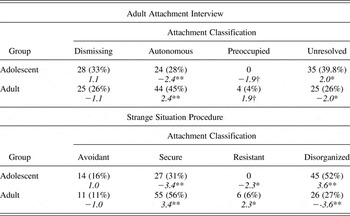
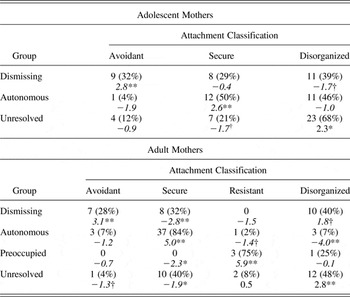
Chi-square analyses indicated that adolescent and adult mothers differed in the distribution of SSP and AAI classifications (see Table 1). Infants of adolescent mothers were more frequently classified as disorganized, whereas their adult counterparts were more often classified as secure and resistant. Adolescent mothers were more often classified as unresolved, whereas adult mothers more frequently received autonomous classifications. We then compared specific associations between AAI and SSP classifications separately by group (Table 2). For both groups, the theoretically expected associations (dismissing–avoidant, autonomous–secure, preoccupied–resistant, and unresolved–disorganized) occurred more frequently than expected by chance.
Descriptive statistics and adjusted standardized residuals for Adult Attachment Interview and Strange Situation classification by adolescent versus adult status

Note: Adult Attachment Interview Fisher exact test = 10.37, p < .01; Strange Situation Fisher exact test = 20.39, p < .01. Numbers in parentheses indicate row percentages, and numbers in italic indicate adjusted standardized residuals.
†p < .10. *p < .05. **p < .01.
Descriptive statistics and adjusted standardized residuals for Strange Situation classification by Adult Attachment Interview classification: Adolescent and adult mothers

Note: Adolescent mothers, Fisher exact test = 12.33**; adult mothers, Fisher exact test = 45.23**. Numbers in parentheses indicate row percentages, and numbers in italic indicate adjusted standardized residuals.
†p < .10. *p < .05. **p < .01.
As expected, adolescent mothers (M = 0.04, SD = .061) were observed to be less sensitive in the home than adult mothers (M = 0.44, SD = 0.51), t (167+) = –4.80, p < .01; 95% confidence interval (CI) [–0.57, –0.24]. Adolescent mothers were more likely to have reported traumatic experiences (52% vs. 29%), χ2 (1) = 10.80, p < .01. They received significantly higher unresolved scores for their discourse specific to trauma (M = 2.74, SD = 2.19) than adult mothers (M = 1.86, SD = 1.79), t (165+) = 2.95, p < .01; 95% CI [0.29, 1.46]. In contrast, adolescent (M = 3.17, SD = 2.22) and adult (M = 3.57, SD = 1.77) mothers did not differ on unresolved loss scores, t (162+) = –1.33, ns; 95% CI [–0.99, 0.19].
Evaluation of evidence of attachment transmission in adolescent and adult mothers
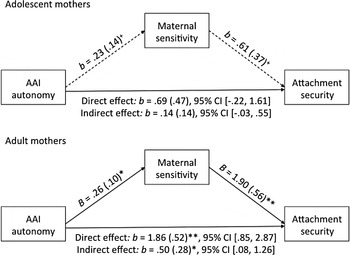
We conducted traditional mediational analyses separately for adolescent and adult mothers to determine whether patterns of associations conformed to those typically found for high-risk and low-risk groups. We used the PROCESS macro for SPSS (Model 4; 10,000 bootstrapped resamples; Hayes, Reference Hayes2013), regressing attachment security (coded as 1 = secure, 0 = not secure) on AAI autonomy (coded as 1 = autonomous, 0 = nonautonomous), with maternal sensitivity as the proposed mediator. As shown in Figure 1, autonomy was related to security in both samples; however, the indirect effect through sensitivity was statistically significant only for adult mother–infant dyads, and substantially stronger than for adolescent mothers. For the models as wholes, Nagelkerke R 2 = .41, 95% CI [0.27, 0.55], for the adult sample, and Nagelkerke R 2 = .09, 95% CI [–0.02, 0.20] for the adolescent sample. Because the 95% confidence intervals do not overlap, these R 2 are significantly different. These results parallel previous findings: within the low-risk sample, relatively strong associations are present between AAI autonomy and attachment security, and the association is partially mediated via sensitivity. Within the sample at higher social risk, similar but markedly weaker associations were found.
Mediational model of the indirect effect of Adult Attachment Interview autonomy on attachment security through maternal sensitivity. Unstandardized regression coefficients; attachment security: 1 = secure, 0 = nonsecure; dashed lines indicate associations that are not statistically significant. +p < .10. *p < .05. **p < .01.

A relationship-based analysis of patterns of attachment
LCA were conducted to identify latent groups characterized by specific combinations of attachment classifications and behaviors. Three variables were included: AAI (dismissing, autonomous, preoccupied, and unresolved), SSP classifications (avoidant, secure, resistant, and disorganized), and ranges of maternal sensitivity (sensitive, intermediate, and insensitive). The resultant matrix included 48 possible combinations. LCA were conducted using poLCA, a statistical package for R (Linzer & Lewis, Reference Linzer and Lewis2011, Reference Linzer and Lewis2013). Multiple fit indices were considered to determine model fit and class viability, including the Bayesian information criterion (BIC; Schwarz, Reference Schwarz1978), and the sample size adjusted BIC (SABIC; Sclove, Reference Sclove1987). Decisions about the number of classes to retain also depended on the coherence of emerging classes within each model (Nylund, Asparouhov, & Muthén, Reference Nylund, Asparouhov and Muthén2007).
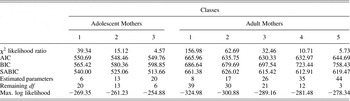
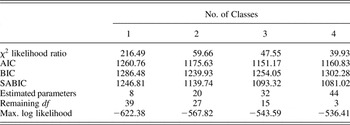
Separate LCA were first conducted to identify the attachment patterns within the adolescent and the adult mother dyads. Based on a comparison of indices (see Table 3) and resultant classes, a three-class model was selected as the best fit for the data from the adolescent sample. Although the BIC increased with the extraction of a third class, the SABIC decreased. Simulation research has indicated that the SABIC is a more reliable indicator of model fit than the BIC when sample sizes are relatively small and class sizes unequal (Nylund et al., Reference Nylund, Asparouhov and Muthén2007). Furthermore, there was a substantial decrease in the likelihood ratio from two to three classes. A four-class model was not viable due to restricted degrees of freedom; it also accounted for negligible additional variance (log likelihood = –253.74).
Latent class analyses, separate samples: Fit indices for models varying by number of classes

Note: AIC, Akaike information criterion; BIC, Bayesian information criterion; SABIC, sample size adjusted BIC.
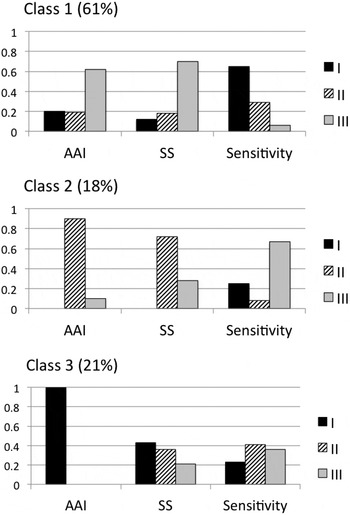
For adolescent mother dyads, the three classes were characterized by distinct patterns among the variables (see Figure 2). Class 1, representing 61% of dyads, was characterized by high probabilities of unresolved attachment representations, disorganized attachment relationships, and maternal insensitivity. The second class, representing 18% of dyads, was characterized primarily by autonomous maternal attachment representations, secure attachment, and maternal sensitivity. Finally, 21% of the sample was best represented by Class 3, involving dismissing adult attachment representations, avoidant and secure but also disorganized attachment relationships, and primarily high or moderate sensitivity but also some insensitivity.
Latent class analysis, adolescent mothers: conditional response probabilities for each class. Adult Attachment Interview, I = dismissing, II = autonomous, III = unresolved; Strange Situation, I = avoidant, II = secure, III = disorganized; sensitivity, I = insensitive, II = moderately sensitive, III = highly sensitive.

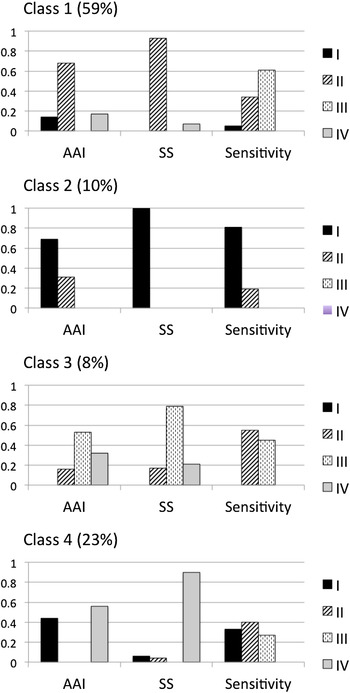
The data for adult mother dyads were determined to best fit a four-class model (see Table 3). Again, the BIC was lowest for the two-class solution; however, the SABIC was lowest for the four-class solution, and the likelihood ratios decreased substantially until the fourth class. The classes, depicted in Figure 3, were characterized as follows: Class 1, accounting for 59% of dyads, had high frequencies of autonomous representations, secure attachment, and either moderate or high maternal sensitivity. Class 2, involving 10% of the sample, was composed primarily of dismissing (with some autonomous) representations, avoidant attachment, and insensitivity at home. A further 8% of the dyads fell into Class 3, involving preoccupied and unresolved representations, resistant attachment, and either moderate or high sensitivity. Finally, 23% of the adult sample formed Class 4 featuring both dismissing and unresolved attachment representations, disorganized attachment, and the full range of sensitivity, with similar proportions of high, moderate, and low sensitivity.
Latent class analysis, adult mothers: conditional response probabilities for each class. Adult Attachment Interview, I = dismissing, II = autonomous, III = preoccupied, IV = unresolved; Strange Situation, I = avoidant, II = secure, III = resistant, IV = disorganized; sensitivity, I = insensitive, II = moderately sensitive, III = highly sensitive.

Summary
These patterns reveal both similarities and differences between adult and adolescent mother–infant dyads. The most prevalent form of relationship in the group of young mothers involved unresolved maternal representations, disorganized attachment relationships, and maternal insensitivity (Adolescent Class 1). This pattern was only partially seen in the adult group of dyads, within Class 4. Likewise, the most prevalent relationship model for the adult group, involving maternal autonomy, attachment security, and high levels of sensitivity (Adult Class 1), was present in the adolescent group (Adolescent Class 2), but with more than three times less probability. A predictable class was found in the adult group, linking maternal dismissing representations, child avoidance, and insensitivity (Class 2). This pattern was partially revealed in Adolescent Class 3, although here, dismissing state of mind co-occurred with both avoidance and security, and with both high and intermediate levels of sensitivity. Finally, a pattern of transmission characterized only adult mother–infant dyads, involving unresolved loss or trauma or preoccupied states of mind, disorganized attachment, and variable interactive behavior.
Moderators
In order to better understand the similarities and differences between these two intergenerational relationship models, a single LCA was conducted on the combined adolescent and adult samples (N = 184). Three moderating variables were included in the analytic model to pursue the possibility that the patterns reflected in both samples might be differentially predicted not only by the adult/adolescent distinction but also by SES and the experience of childhood trauma.
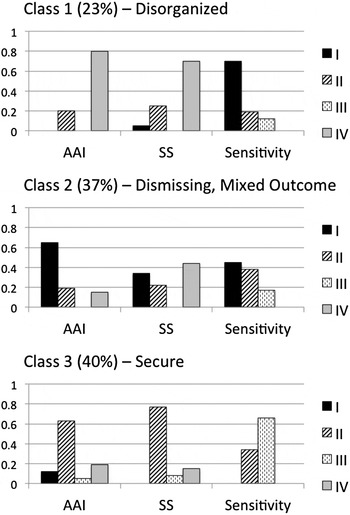
A comparison of indices (Table 4) and resultant classes supported a three-class model (Figure 4). Although a four-class model evidenced better fit via the BIC and SABIC, the model parameters emerged inconsistently, and there were indicators of convergence difficulties, making the accuracy of a four-class model questionable (Finch & Bronk, Reference Finch and Bronk2011).
Latent class analysis, combined adolescent and adult samples: conditional response probabilities for each class. Adult Attachment Interview, I = dismissing, II = autonomous, III = preoccupied, IV = unresolved; Strange Situation, I = avoidant, II = secure, III = resistant, IV = disorganized; sensitivity, I = insensitive, II = moderately sensitive, III = highly sensitive.

Latent class analyses, combined samples: Fit indices for models varying by number of classes

Note: AIC, Akaike information criterion; BIC, Bayesian information criterion; SABIC, sample size adjusted BIC. Covariates: adolescent versus adult status, reported trauma history, income level, and education.
The 23% of dyads falling in Class 1 featured high frequencies of unresolved adult attachment representations, disorganized attachment relationships, and maternal insensitivity. This class, similar to Class 1 emerging within the adolescent mother sample and perhaps also Class 4 of the adult mother group, was labeled “disorganized” for ease of discussion. The second class, typical of 37% of dyads, was characterized primarily by dismissing maternal attachment representations, avoidant and disorganized (and also some secure) attachment, and insensitive or moderately sensitive interactive behavior at home and was labeled “dismissive-mixed outcome.” This class appeared to reflect a combination of classes from the adult and adolescent samples involving maternal dismissing attachment representations (Adolescent Class 3 and Adult Classes 2 and 4). Finally, 40% of the sample was best represented by Class 3, with high probabilities of autonomous attachment representations, secure attachment relationships, and sensitivity at home. This class, labeled “secure,” was similar to the autonomous, secure, and sensitive classes emerging from both the samples of adult (Class 1) and adolescent mothers (Class 2).
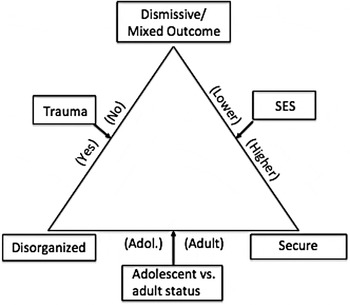
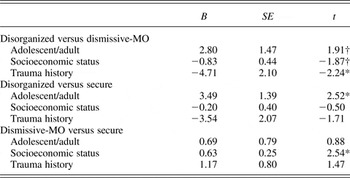
As can be seen in Table 5 and as illustrated in Figure 5, of the three covariates, a history of trauma differentiated between the disorganized and dismissing-mixed outcome classes, with mothers who reported trauma overrepresented in the disorganized class. In contrast, SES distinguished between the dismissive-mixed outcome and secure classes, with mothers with a higher SES more representative of the secure class. Finally, adult versus adolescent status distinguished between the disorganized and secure classes.
Latent class analysis with covariates, combined adolescent and adult samples: moderation effects. Trauma, history of trauma; SES, socioeconomic status; Adol., adolescent.

Latent class analysis of combined samples: Covariates predicting latent class membership (three-class solution)

Note: The values are standardized coefficients and standard errors. MO, Mixed outcomes.
†p < .10. *p < .05.
Discussion
The purpose of this study was to apply a different approach to the study of intergenerational attachment. Linear, variable-centered strategies were used to replicate the often-encountered links between maternal states of mind, sensitivity, and infant attachment, as well as the existence of a transmission gap. In addition, a relationship-based perspective and analytic strategy was used to draw out patterns of relationships across the three variables. This relationship-centered approach involves something of a paradigm shift: the relationship itself, characterized by different patterns of these three variables, is the unit of analysis and characterizes intergenerational relationship organization. This analytic strategy allows us to simultaneously observe multiple patterns based on the tendency for certain categories of variables to co-occur within subsets of mother–infant dyads. By using an exploratory, relationship-based approach, alternative associations between the three sets of variables are not obscured by a unique focus on theory-driven hypotheses. Relevant and meaningful patterns of association that may have been overlooked because they apply to only a subset of the population under study may be observed using such an exploratory approach. Three important sets of findings emerge from this study, within a relatively high-risk group of adolescent mother–infant dyads and a low-risk sample of adult mother–infant dyads.
Confirmation of extant theory and research
The variable-centered results obtained in the current study were consistent with previous research. As recently reviewed by Verhage et al. (Reference Verhage, Schuengel, Madigan, Fearon, Oosterman, Cassibba and van IJzendoorn2016), transmission from maternal autonomous state of mind through interactive sensitivity to security of attachment was observed, although evidence for mediation was stronger within the low-risk group. Disproportionate numbers of insecure and disorganized dyads testified to adolescent mother dyads’ level of risk and the problematic developmental pathways on which children from this group are engaged. These findings are especially noteworthy given that they are the product of a single sample of sufficient size to allow for direct comparisons that were not possible in previous research.
Different patterns of relationships
LCA also confirmed extant theory and research findings by demonstrating a coherent, predictable class involving adult autonomy, maternal sensitivity, and infant security in both groups. However, whereas this pattern was the most prevalent in adult mother dyads, it characterized only 19% of adolescent mother dyads.
Within the adolescent group, the majority model, characterizing 61% of the sample, concerned unresolved loss or trauma, insensitive parenting, and disorganized infant attachment. Its prevalence suggests that within groups at high social risk, intergenerational patterns of attachment may be linked primarily to the elaboration of disorganization, a transmission process that is obscured when attachment transmission models focus on maternal autonomy and mother–infant attachment security. A similar pattern involving unresolved and disorganized attachment described relatively fewer adult mother–infant dyads (23%; Adult Class 4), and was characterized by more variable levels of sensitivity. This is consistent with the theoretical model (Main & Solomon, Reference Main, Solomon, Greenberg, Cicchetti and Cummings1990) in which atypical or frightened-frightening maternal behavior, often associated with traumatic experiences, mediates the association between unresolved loss or trauma and disorganized attachment (see Madigan, Bakermans-Kranenburg, et al., 2006). Theory holds that sensitivity fosters the development of secure (as opposed to insecure) attachment, but is unrelated to attachment disorganization, which instead is associated with maternal atypical or frightened-frightening behavior (Main & Solomon, Reference Main, Solomon, Greenberg, Cicchetti and Cummings1990; Moran et al., Reference Moran, Forbes, Evans, Tarabulsy and Madigan2008). Although this argument may have validity in low-risk samples, among high-risk populations the constructs of maternal sensitivity and atypical, frightened, or frightening maternal behavior overlap, as many of the latter behaviors also are demonstrably insensitive (Lyons-Ruth, Bronfman, & Parsons, Reference Linzer, Lewis, Bronfman and Parsons1999; Moran et al., Reference Moran, Forbes, Evans, Tarabulsy and Madigan2008). A reanalysis of meta-analytic data (van IJzendoorn, Schuengel, & Bakermans-Kranenburg, Reference van IJzendoorn, Schuengel and Bakermans-Kranenburg1999) reveals an association between maternal insensitivity and disorganized attachment in high-risk populations (Bailey et al., Reference Bailey, Moran, Pederson and Bento2007; Bernier & Meins, Reference Bernier and Meins2008), as was observed in the current study. Thus, current findings converge with recent theory to support a broader exploration of the origins of disorganized attachment in high-risk samples, considering how frightened-frightening and also insensitive behaviors may undermine infant development of organized strategies (Bernier & Meins, Reference Bernier and Meins2008; DeOliveira, Bailey, Moran, & Pederson, Reference DeOliveira, Bailey, Moran and Pederson2004; Moran et al., Reference Moran, Forbes, Evans, Tarabulsy and Madigan2008). The broader social context may also serve as an important risk or protective factor: we found that among adolescent mothers, insensitivity was associated with disorganized attachment, whereas maternal insensitivity among adult mothers corresponded to infants’ organized avoidant behavior. It may be that high-risk developmental ecologies, such as that of young mothers, often involving more sources of stress and less predictability (Tarabulsy et al., Reference Tarabulsy, Provost, Larose, Moss, Lemelin, Moran, Forbes and Pederson2008), do not effectively support infant development of an organized avoidant strategy in response to insensitive parenting.
The LCA strategy also revealed the presence of a pattern linking dismissing maternal states of mind, varying levels of sensitivity, and either avoidance or security in the group of young mothers (Class 3, Figure 2; 20%). An intergenerational model involving dismissing states of mind also was found for adult mothers, at a lower frequency (Class 2, Figure 3; 10%), but with maternal dismissing representations more clearly co-occurring with interactive insensitivity and child avoidance. For adult mothers, this pattern is consistent with past demonstrations of the link between the dismissing classification on the AAI and infant avoidance (Verhage et al., Reference Verhage, Schuengel, Madigan, Fearon, Oosterman, Cassibba and van IJzendoorn2016), although the present results also integrate maternal insensitivity. This finding echoes those of others who have consistently shown avoidance in children to be linked to lower levels of parental sensitivity (Pederson & Moran, Reference Pederson and Moran1996). What is particularly new in the current results is that the predicted link between the dismissing category of the AAI and infant SSP avoidance is less clear for young mothers in that the dismissing category also is associated with varying levels of sensitivity and with secure as well as avoidant attachment relationships. These results also suggest that within high-risk contexts, although the dismissing category is predictably linked to avoidance, it may also be related to secure infant attachment. That is, the presence of a dismissing state of mind increases the possibility of infant insecure attachment, but under some circumstances, a subset of dismissing mothers may remain moderately or even highly sensitive and develop secure relationships with their infants. To the degree that such a finding is robust across different kinds of psychosocial risk, it may reflect a “resilient” model of intergenerational attachment, supported by the lack of such a model within the group of adult mothers.
This model of relationship is not usually considered within attachment transmission research and highlights the pertinence of using an exploratory, relationship-based LCA to describe the data. Past research has provided hints that this pattern exists. For example, Atkinson et al. (Reference Atkinson, Goldberg, Raval, Pederson, Benoit, Moran and Leung2005) found that levels of sensitivity moderated (but did not mediate) the association between autonomy and security, indicating that nonautonomous mothers who were sensitive in interactions with their child were able to develop more secure relationships. The conditions under which nonautonomy is related to sensitive parenting have clear theoretical and applied ramifications and require greater attention. That this model of intergenerational attachment is usually missed by standard analytical approaches, but accounted for a meaningful proportion of young mother dyads, requires greater theoretical consideration to the processes that underlie it.
Finally, the LCA conducted within the adult mother group revealed a distinct latent class involving adult preoccupation or unresolved loss or trauma and child ambivalence. This class involved intermediate and highly sensitive maternal interactive behavior underscoring the idea that, within low-risk dyads, sensitivity is a characteristic of preoccupied/ambivalent dyads, a point that we have made elsewhere (Pederson et al., Reference Pederson, Gleason, Moran and Bento1998; Pederson & Moran, Reference Pederson and Moran1996). Although it represented only 8% of the adult sample (Class 3, Figure 3), it was found only within the adult group, suggesting that there may well be something about high-risk adolescent motherhood that precludes the elaboration of ambivalent-resistant attachment. Perhaps, within a more difficult developmental ecology, parental strategies that foster either security or avoidance may have a degree of predictability that children require in such contexts. When the minimal conditions for these types of attachment are not present, high-risk environments may foster intergenerational attachment disorganization (Cyr, Euser, Bakermans-Kranenburg, & van IJzendoorn, Reference Cyr, Euser, Bakermans-Kranenburg and van IJzendoorn2010). The finding that preoccupied states of mind are part of the same pattern of relationship as unresolved trauma and loss echoes some of the findings by Roisman and his collaborators (Haltigan, Roisman, & Haydon, Reference Haltigan, Roisman and Haydon2014; Haydon, Roisman, Marks, & Fraley, Reference Haydon, Roisman, Marks and Fraley2011; Roisman, Fraley, & Belsky, Reference Roisman, Fraley and Belsky2007) with low-risk individuals where factor-analytically derived dimensions grouped together these two aspects of the AAI. The current research is consistent with the view that a preoccupied discourse bears some similarity to that of those reporting unresolved loss or trauma despite the fact that the actual events reported and content are different.
Moderators of patterns of attachment
Three distinct patterns of intergenerational attachment were observed when we performed a relationship-based analysis of the two groups in aggregate. These classes reflected in many ways the major classes found within each group when analyzed separately (Figure 4): a disorganized class (Class 1; 23% of all dyads); a dismissive-mixed outcome class that most prevalently involved a dismissive maternal state of mind but featured almost equally insensitive and moderately sensitive interaction, and a mix of avoidant, secure, and disorganized infants (Class 2; 37%); and a secure pattern involving predominantly parental autonomy, sensitivity, and infant security (Class 3; 40%). The only model of transmission observed in the analyses of individual groups that was not observed in the aggregate analysis was that involving parental preoccupation and child ambivalence. Its absence is likely attributable to its relatively low frequency, even within the adult mother group where it was observed.
Of the three covariates entered within this aggregate, adult versus adolescent parenthood was systematically associated with membership in the secure versus disorganized classes. This finding is consistent with the understanding that maternal age at childbirth is a potential marker of certain types of developmental antecedents and current life circumstances that place the offspring of young mothers at high developmental risk. Given that the majority of the infants of adolescent mothers were disorganized at 12 months, and considering the importance of disorganization for later internalized and externalized developmental outcome (Fearon, Bakermans-Kranenburg, van IJzendrron, Lapsley, & Roisman, Reference Fearon, Bakermans-Kranenburg, van IJzendoorn, Lapsley and Roisman2010; Madigan, Vaillancourt, McKibbon, & Benoit, Reference Madigan, Vaillancourt, McKibbon and Benoit2015), the present findings emphasize the problematic relationships that have a tendency to emerge early on between young mothers and their children. The current findings do not specify the mechanisms accounting for these maternal age-related distinctions; however, they likely include factors that characterize family dynamics and resources that provide a structure, or lack thereof, for child development. The distinction is a general characterization of psychosocial risk that includes many different family and maternal characteristics.
Maternal reports of having experienced trauma distinguished between membership in the disorganized and dismissing mixed classes. The association between trauma history and the disorganized intergenerational attachment pattern is consistent with theory on the developmental implications of parental trauma and unresolved states of mind in the AAI (Hesse & Main, Reference Hesse and Main2000). In our view, this result argues strongly for a greater consideration of the manner in which trauma sets a context for the establishment and elaboration of attachment relationships across generations. Given the high rate of occurrence of trauma within the present group of young mothers, and in light of previous findings that have shown unresolved trauma to nullify the effectiveness of intervention strategies (Moran et al., Reference Moran, Pederson and Krupka2005), the current findings underscore the importance of gaining a clearer picture of the role of trauma in creating the context for the development of attachment. It is important to note, however, that trauma history and the unresolved classification are confounded due to trauma being a necessary precondition for coding lack of resolution of experienced trauma (but not loss). This methodological confound likely inflated statistical associations involving trauma and unresolved attachment. Nonetheless, the confound reflects the reality that it is those who experience trauma who are vulnerable to difficulties resolving such experiences (Bailey et al., Reference Bailey, Moran, Pederson and Bento2007).
The moderation analyses also revealed that SES distinguished between the dismissive-mixed and secure classes, with lower SES mothers more likely to be represented by the dismissive-mixed class. SES is itself a marker of other, more pervasive indices of the quality of the home environment, as has been amply demonstrated in the literature (Duncan, Magnusson, & Votruba-Drzal, Reference Duncan, Magnuson and Votruba-Drzal2014; McLoyd, Reference McLoyd1998). This finding is consistent with the premise that SES can also set conditions for intergenerational attachment organization, as with trauma, although with somewhat more variability in positive and negative child developmental outcome.
Limitations, summary, and conclusions
In addition to using a novel analytic approach to address the issue of intergenerational attachment, the external validity of current findings was enhanced by certain study features, namely, the reliance on sophisticated observational techniques to obtain high-level information regarding the different attachment variables (AAI, SSP, and MBQS) and the comparison between two different groups of dyads, representing different developmental ecologies and characterized by different developmental processes. However, the study design also had some limitations. The design is cross-sectional and requires longitudinal validation. Moreover, assessment of constructs are based on single measures, which, though characteristic of almost all attachment research, may be problematic in properly identifying models of relationships across individuals. There is a degree of instability of attachment processes that may contribute to some variability in findings. Inclusion of repeated measures will be helpful to ensure that constructs are more reliably assessed. Finally, with respect to the disorganized model, an assessment of frightened–frightening maternal behavior would have added an additional layer of interpretation to the relationship models observed (Moran et al., Reference Moran, Forbes, Evans, Tarabulsy and Madigan2008).
It is important also to note the limitations of the analytic procedure used in the current study. LCA proved useful in identifying groups of dyads for whom certain transmission themes may be relatively more dominant; however, current findings do not indicate that the identified groups exist as distinct types. A taxometric approach is better suited to addressing whether such groups are best understood as distinct types or as differing on continuous dimensions (Fraley & Spieker, Reference Fraley and Spieker2003).
The present study recasts questions about attachment transmission, focusing away from sensitivity as a mediator of unidimensional attachment constructs, and toward a more complex portrayal of distinctive classes of intergenerational attachment classifications and processes. These classes reflect parent–child relationships characterized by specific patterns of maternal states of mind, interactive sensitivity, and child attachment. Current results were consistent with traditional research on patterns of transmission, but also revealed important differences, some that may be unique to either low- or high-risk populations. Furthermore, membership within a particular class, some of which clearly marked the beginning of highly problematic developmental trajectories for infants, was systematically related to young versus adult motherhood, the experience of trauma, and SES. Further elaboration of a relationship-centered approach, applied to a variety of populations, is necessary to corroborate and clarify the current findings, and we expect that it would yield additional unique information to bridge remaining “knowledge gaps” regarding intergenerational attachment processes.
The relationship-centered approach is intended to complement, rather than supplant, traditional study of transmission as a process in which parental behavior accounts for associations between parental state of mind and quality of parent–infant attachment relationships. Although results of LCA do not speak to the process of transmission (i.e., that parental sensitivity is thought to act as a mechanism through which parental state of mind influences the attachment relationship), it clearly informs our understanding of attachment relationships across generations and suggests directions for intervention. In more traditional, variable-centered analyses that have limited the conceptualization of transmission to a single path, researchers have paid less attention to other potentially relevant relationship patterns that may exist, especially in high-risk circumstances. Current findings suggest that within high-risk samples, a focus on transmission of organized versus disorganized attachment may capture more of the relevant variability. In addition, more research is needed regarding how parental insensitivity may be experienced quite differently by, and differentially impact, children in high- versus low-risk social contexts. It also would be helpful to understand under what conditions parental dismissing states of mind may be associated with parental sensitivity and/or attachment security. Exploration of the multifaceted nature of attachment transmission through such targeted research agendas may lead to new insights, particularly regarding processes occurring more frequently in high-risk populations that are not captured by our current models.