I. INTRODUCTION
Zirconium carbide (ZrC) belongs to the group of ultra-high temperature ceramics. In addition to a very high melting point (3420 °C), it also possesses attractive properties such as very high hardness (25.4 GPa), modulus (350–440 GPa), metal like thermal conductivity (20.5 W/m K) and electrical resistivity (45 ± 10 μΩ cm), good wear and thermal shock resistance, and low neutron absorption cross-section. Reference Pierson1–Reference Vasudevamurthy, Knight, Roberts and Adams3 The combination of such exceptional traits makes ZrC and its composites prime candidates for use under exacting conditions of space, engines, and nuclear reactors, among many other applications. Reference Vasudevamurthy, Knight, Roberts and Adams3–Reference Zhou and Tang8 Since a fully densified product is essential for structural applications that demand strength and reliability, the challenge lies in processing ZrC, with its exceptional high-temperature properties, at reasonably low temperatures.
Hot pressing (HP) is generally used to produce dense ZrC at ∼2000 °C. Reference Barnier, Brodhag and Thevenot9 Recent work has shown that reactive HP (RHP) yields significantly better densification than conventional HP in the case of ZrC as well as ZrB2–ZrC composites at 1200 °C. Reference Rangaraj10–Reference Chakrabarti, Rangaraj and Jayaram14 While earlier work suggested that transient plasticity of a nonstoichiometric carbide might be responsible, Reference Rangaraj10–Reference Rangaraj, Suresha, Divakar and Jayaram13 it has been shown most recently Reference Chakrabarti, Rangaraj and Jayaram14 that large relative densities may result from plastic flow in the metal alone. In summary, these investigations show that zirconium (Zr) metal in the starting powder is the most significant contributor to densification. Further, from the result of the previous work, it could also be seen that the molar volume reduction in the reaction is also an important factor which is responsible for the de-densification observed during RHP. Reference Chakrabarti, Rangaraj and Jayaram14
The present work seeks to identify the role of reaction and of reaction-derived volume changes during reactive processing of ZrC more closely through modeling of the RHP process. RHP is a complicated phenomenon involving a dynamically evolving phase and pore content that dramatically influences densification. Till now, there has been little modeling effort to understand reactive densification and test its predictive capability. Complexities arise from the multitude of processes operating simultaneously. First, there is densification from HP which itself can occur through a number of pathways ranging from particle rearrangement, time-independent plastic deformation, creep, both dislocation-aided and diffusional. Depending on time, temperature, pressure, or heating rate, the aforementioned mechanisms will be responsible for deformation to different extents. In RHP and especially in systems such as the present Zr and carbon (C) mixtures, there are additional mechanisms. First, as it is a mixture of a soft and a hard phase, i.e., Zr and C, initial densification is severely constrained. As the reaction proceeds, the product phase, also rigid at these low temperatures, develops percolating structures and the extent of load shielding increases dramatically. Thus, the unique challenge in such a system is to be able to take into account these microstructural changes that occur simultaneously with densification, with hard phase increasing and soft phase (Zr) decreasing dynamically. Reaction brings another complication in the form of volume shrinkage which causes de-densification and the shrinkage varies depending on the stoichiometry of the final ZrC phase. Finally, Zr transforms from α to β at around 862 °C. Due to the more open structure, β-Zr creeps faster than α-Zr.
Facing such overbearing complexities, in our model we have adopted the simplest possible assumptions. For guidance in choosing such a model based on simple assumptions, experimental data are used. Thereby, it was possible to remove most of the clutter and see through the complexities and get an understanding into the phenomena, namely the density evolution with stoichiometry. Our model will be described in the next section.
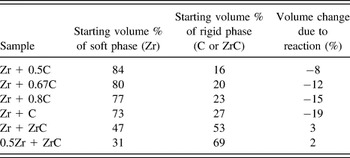
From the result of the previous work, it could also be seen that the molar volume reduction in the reaction is also an important factor which is responsible for the de-densification observed during RHP. Reference Chakrabarti, Rangaraj and Jayaram14 To understand the effect of reaction-derived de-densification, two compositions are RHPed using a mixture of Zr and stoichiometric ZrC for which the molar volume change is non-negative such that the material is not expected to face any de-densification because of the reaction. The two compositions explored in the present study are Zr + ZrC and 0.5Zr + ZrC. The Zr + ZrC and 0.5Zr + ZrC compositions have positive 3 and 2% volume change, respectively, and the final products of this reaction are ZrC0.5 and ZrC0.67. However, these two compositions have two important differences with respect to Zr and C mixtures studied earlier. Reference Chakrabarti, Rangaraj and Jayaram14 First, the amount of metal is much lower while second, they do not undergo any de-densification upon reaction. Therefore, studying the RHP behavior of these two compositions through model and experiments is expected to shed light on the relative role in densification of these two processes: reaction-derived de-densification and the starting amounts of hard and soft phases.
II. EXPERIMENTAL PROCEDURE AND CHARACTERIZATION
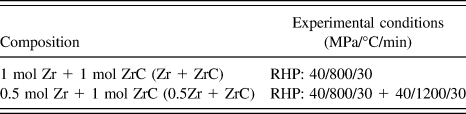
Commercially pure powders of Zr: purity 98% (Hf 1%), particle size 2–10 μm (M/S Yashoda Special Metals, Hyderabad, India) and ZrC: purity 99%, particle size 44 μm (M/S Sigma Aldrich, St. Louis, MO) are used in this study. The starting powder mixtures are Zr–ZrC and 0.5Zr–ZrC. Powder mixtures preparation and RHP experiments conducted at 800 and 1200 °C under 40 MPa and characterization procedures are reported earlier. Reference Chakrabarti, Rangaraj and Jayaram14 The details of the composition and process parameters are shown in Table I.
Composition and processing parameters for the HP/RHP study of powder mixtures.

III. MODEL DESCRIPTION
A. Densification of zirconium by hot pressing
Modeling of HP and hot isostatic pressing (HIP) has been carried out by many groups. Reference Helle, Easterling and Ashby15–Reference Candra, Torralba and Sakai17 Of this multitude of models, one of the most popular and which we have implemented is by Helle et al. Reference Helle, Easterling and Ashby15 in which the total densification observed in the HIP process is imagined as the summation of the contribution of all the densification mechanisms operating, such as plastic yielding, diffusion creep, and power law creep (PLC). They also propose analytical solutions for each of these mechanisms. The deformation mechanism map of Zr Reference Sargent and Ashby18 shows that PLC is the dominant mechanism of deformation for the temperature and pressures of our investigation. Therefore, we have only considered PLC in the present model. During RHP, rigid carbon particles act as matrix strengtheners and hinder the densification. To account for the constraining effect of inclusions we have modified the model of Helle et al. using the approaches of Duva and Dong et al. Reference Duva19,Reference Dong and Schmauder20 The constitutive equations are shown in Eqs. (1)–(4).
 $$\dot D = 5.3{\left( {{D^2}{D_0}} \right)^{{1 \over 3}}}{1 \over {\sqrt 3 }}{\left[ {{{D - {D_0}} \over {1 - {D_0}}}} \right]^{{1 \over 2}}}\left( {{{{{\dot \varepsilon }_0}} \over {\sigma _0^n}}} \right){\left( {{{{P_{{\rm{eff}}}}} \over {3{R_{\rm{C}}}}}} \right)^n},\;D \;\lt\; 0.9\quad ,$$
 $$\dot D = {3 \over 2}\left( {{{{{\dot \varepsilon }_0}} \over {\sigma _0^n}}} \right){{D\left( {1 - D} \right)} \over {{{\left[ {1 - {{\left( {1 - D} \right)}^{{1 \over n}}}} \right]}^n}}}{\left( {{{3P} \over {2n{R_{\rm{C}}}}}} \right)^n},\;D > 0.9\quad ,$$
 $$R_C = \left(1 - {{V_{i} } \over {C1(2 - {1 \over n})}}\right)^{ - ({{c2} \over n} + c3)} - c4(V_i + {1 \over {5n}})$$
 $${P_{{\rm{eff}}}} = {{P\left( {1 - {D_0}} \right)} \over {{D^2}\left( {D - {D_0}} \right)}}\quad .$$
In the equations, D is the instantaneous relative density (RD), D
0 is the starting RD, n is the PLC coefficient, P is the applied pressure, V
i
is the volume fraction of the rigid (C/ZrC
x
) particles, and
 ${\dot \varepsilon _0}$
, σ0 are material specific properties. The values of the modeling parameters are taken from Refs. Reference Sargent and Ashby18 and Reference Knorr and Notis21. Comparison of modeling and experimental results for pure Zr and Zr and C mixtures is shown in Ref. Reference Chakrabarti, Rangaraj and Jayaram14 and displays reasonable agreement in trends.
In addition to the aforementioned effect, inclusions also start to form a touching, percolating network at some critical value volume fraction. The formation of the network inhibits densification. If the network is rigid, densification stops completely. The expression by Dong et al. [Eq. (3), Ref. Reference Dong and Schmauder20] and other expressions do not work very well at higher volume fraction of rigid particles because they do not include the effect of a percolating network and the load shielding effect of the rigid network. Finally, at a particular volume fraction corresponding to the rigidity threshold, densification stops altogether. Reference Rahaman22 Keeping that in mind, we imagine a reverse situation wherein the soft Zr phase controls densification. Down to 16 vol% Zr, the metal will form a percolating connected network of its own and be capable of creeping. Below 16%, the network of Zr will be pinched off and will become isolated and its contribution to creep will vanish.
The volume fractions of rigid (C, ZrC
x
) and soft phases are dynamically changing quantities whose magnitudes can be estimated from the molar volume of the product and reactant, applying mass conservation. The expressions derived for volume fractions are shown in Eqs. (5)–(8). In these equations, ‘x’ is the final stoichiometry of ZrC
x
, α is the reaction conversion, and V
m is the molar volume of the respective constituents.
 ${V_{{{\rm{m}}_{{\rm{Zr}}}}}}$
is taken as 14.02 cc,
 ${V_{{{\rm{m}}_{\rm{C}}}}}$
is 5.29 cc, and
 ${V_{{{\rm{m}}_{{\rm{ZrC}}}}}}$
is calculated using Eq. (9) by linearly fitting the molar volume of ZrC0.5 and ZrC which are calculated from their density and molar weight of Zr and C.
 $${V_{{\rm{Zr}}}} = \left\{ {\left[ {{1 \mathord{\left/ {\vphantom {1 {\left( {1 + x} \right)}}} \right. \kern-\nulldelimiterspace} {\left( {1 + x} \right)}}} \right] - \left[ {{\alpha \mathord{\left/ {\vphantom {\alpha {\left( {1 + x} \right)}}} \right. \kern-\nulldelimiterspace} {\left( {1 + x} \right)}}} \right]} \right\}{V_{{{\rm{m}}_{{\rm{Zr}}}}}}\quad ,$$
 $${V_{\rm{C}}} = \left\{ {\left[ {{x \mathord{\left/ {\vphantom {x {\left( {1 + x} \right)}}} \right. \kern-\nulldelimiterspace} {\left( {1 + x} \right)}}} \right] - \left[ {{{x\alpha } \mathord{\left/ {\vphantom {{x\alpha } {\left( {1 + x} \right)}}} \right. \kern-\nulldelimiterspace} {\left( {1 + x} \right)}}} \right]} \right\}{V_{{{\rm{m}}_{\rm{C}}}}}\quad ,$$
 $${V_{{\rm{ZrC}}}} = \left[ {{\alpha \mathord{\left/ {\vphantom {\alpha {\left( {1 + x} \right)}}} \right. \kern-\nulldelimiterspace} {\left( {1 + x} \right)}}} \right]{V_{{{\rm{m}}_{{\rm{ZrC}}}}}}\quad ,$$
 $${V_i} = {{{V_{\rm{C}}} + {V_{{\rm{ZrC}}}}} \over {{V_{\rm{C}}} + {V_{{\rm{ZrC}}}} + {V_{{\rm{Zr}}}}}}\quad ,$$
 $${V_{{{\rm{m}}_{{\rm{ZrC}}}}}} = 0.66x + 14.92\quad .$$
Similar procedure is used for the reaction of Zr and ZrC.
B. Reaction of zirconium and carbon/zirconium carbide
This section is devoted to the modeling of the chemical reaction between Zr and C to form ZrC.
A frequently used kinetic equation to describe chemical reaction in powder system is the Jander equation. Reference Schmalzried23 Derivation of this equation involves a simplified assumption, i.e., equi-sized spheres of reactant carbon are embedded in a quasi-continuous matrix of reactant Zr. Parabolic growth is presumed for the increase in thickness of the spherical shell of reaction product ZrC x . If the relative amount of C, given by α, transforms into reaction product and R is the radius of the original particles of C, then α is given by Eq. (10).
 $${R^2}{\left[ {1 - {{\left( {1 - \alpha } \right)}^{{1 \mathord{\left/ {\vphantom {1 3}} \right. \kern-\nulldelimiterspace} 3}}}} \right]^2} = 2{K_{\rm{p}}}t\quad .$$
Here K p is the practical parabolic law constant. The Jander equation suffers from limitations coming from its simplified assumptions. Parabolic growth law is valid for diffusion limited one-dimensional reactions, not in a problem with spherical symmetry. It also does not consider the molar volume change to affect the rate of the chemical reaction. Even with such limitations, it is widely used due to its simplicity and reasonable agreement with experimental observations. Reference Schmalzried23 The practical reaction constant, K p, for the reaction type nA + mB = A n B m in which the reaction product A n B m has narrow range of homogeneity, is given by Eq. (11).
 $${K_{\rm{p}}} = \left( {{{{D_{\rm{A}}}} \over n} + {{{D_{\rm{B}}}} \over m}} \right){{\delta G_{{{\rm{A}}_n}{{\rm{B}}_m}}^0} \over {RT}}\quad .$$
Here
 $\delta G_{{{\rm{A}}_n}{{\rm{B}}_m}}^0$
is the standard free energy of formation for A
n
B
m
from elements, D
A and D
B are diffusion coefficients of A (D
Zr) and B (D
C), respectively, R is the gas constant, and T is the temperature. The standard free energy change of this reaction is −174 kJ/mol at 850 °C.
Reference Husseya and Smeltzer24
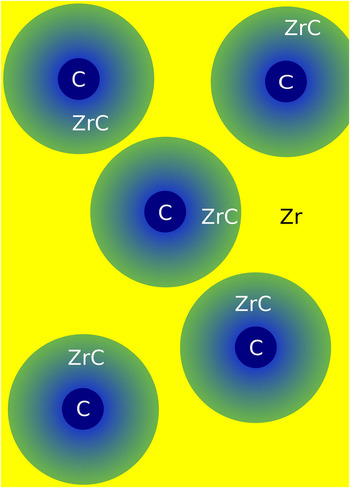
This constant value is used in this model. The values of n and m are taken as 1. In the case of reaction between Zr and C, the product phase ZrC shows wide range of homogeneity. The schematic of the reaction is shown in Fig. 1. In the RHP of Zr and C, Zr forms a continuous matrix and carbon particles are embedded into it. Nonstoichiometric carbide is shown in the schematic by means of a gradient in color. In this system, if we consider equilibrium is maintained, then the carbide in contact with Zr will have a composition close to ZrC0.5 and that in contact with C will be close to stoichiometric ZrC with a smooth variation in between. For simplicity, we have considered the composition of ZrC to be average composition of ZrC0.75. This simplification allows us to use Eq. (11). So we have used D
C as diffusion coefficient of C diffusing through ZrC0.75. There are very few data on diffusivity of Zr through ZrC. But diffusivity of titanium (Ti) through titanium carbide (TiC), which is well studied, is known to be four orders of magnitude slower than that of C through TiC.
Reference Sarian25
There is no reason to believe it will be any different in the case of Zr and ZrC and we have ignored D
Zr in our model.
Schematic representation of reaction between Zr and C.

Diffusivity of C through ZrC (D C) with different stoichiometries has been studied in detail Reference van Loo, Wakelkamp, Bastin and Metselaar26,Reference Sarian and Criscione27 and the expression for diffusivity in ZrC x as established by van Loo et al. is given in Eq. (12) and is used in our model. In the expression, x is the stoichiometry of ZrC and T is the temperature. Reference van Loo, Wakelkamp, Bastin and Metselaar26
 $${D_{\rm{C}}} = 0.0083\exp \left[ {9.2\left( {1 - x} \right)} \right]\exp \left[ { - \left( {{{36600} \over T}} \right)} \right]{10^{ - 4}}{{{{\rm{m}}^2}} \mathord{\left/ {\vphantom {{{{\rm{m}}^2}} {{\rm{sec}}}}} \right. \kern-\nulldelimiterspace} {{\rm{sec}}}}\quad .$$
Reaction rate for ZrC x with different stoichiometries varies. As the C content in starting Zr and C mixture increases with increasing final stoichiometry of ZrC, experimental data show more reaction. To account for that we have scaled the reaction rate by the volume fraction of starting C. So the reaction rate of stoichiometric composition ZrC is ∼1.7 times faster than ZrC0.5 (Table II).
Volume fraction of soft phase (Zr) and rigid phase (C and ZrC) in the starting powder and the volume change due to the reaction.

Our experimental results show largely incomplete reaction at 800 °C and complete reaction at 1200 °C. Modeling results also qualitatively match the experimental observation. But at 800 °C, experimental observations show ∼20% conversion, but model shows ∼5% conversion from ZrC. So it under-predicts. At 1200 °C, both experiment Reference Chakrabarti, Rangaraj and Jayaram14 and model show complete reaction.
In Ref. Reference Chakrabarti, Rangaraj and Jayaram14, two-step RHP at 800 and 1200 °C, Zr + 0.67C and Zr + 0.8C compositions show complete reaction but the ram travel shows a decrease almost till the end. Ram travel can only decrease due to the de-densification associated with the reaction. This shows reaction carries on till almost the end of the experiment. Our model also features a similar reaction trajectory. So atleast at higher temperatures, prediction from the model is not far off from the experimental observations.
For the modeling of reaction between Zr and ZrC, the same equations are used as their Zr and C counterpart. The basic premise is that here also C is the diffusing species and again we imagine that there will be equilibrium established just like the Zr and C counterpart with stoichiometric ZrC at one interface and ZrC0.5 at the other interface in contact with Zr. In the case of Zr and ZrC, experimentally Reference Chakrabarti28 <1% reaction is observed after 800 °C RHP compared to 3% in the case of model prediction. At 1200 °C RHP, on the other hand, the reaction remains a little incomplete in Zr + ZrC, but gets completed in 0.5Zr + ZrC which may be compared to the model prediction of complete reaction in both the cases.
C. Volume contraction in reaction
Chemical reaction between Zr and C occurs with considerably large amount of volume contraction. This is because the mixture of Zr and C has considerably lower density compared to the reaction formed ZrC x . Consequently, this results in volume contraction or de-densification. The volume contraction or de-densification increases with increasing stoichiometry of ZrC.
Again from molar volume of Zr, C and ZrC x of respective stoichiometry, volume contraction in reaction is estimated. By linearly fitting the data, the direct relation between the volume contraction and the stoichiometry of ZrC is estimated and is shown in Eq. (13). In the expression, x is the final stoichiometry of ZrC x as dictated by the initial mixture. If in δt time amount of conversion is given by δα, then the de-densification δD VC is given by Eq. (15). If in the same time period densification by Zr is given by δD PLC, then the total densification is the addition of δD PLC and δD VC as given by Eq. (16). The volume changes are similarly estimated for the reaction between Zr and ZrC as shown in Eq. (14).
 $$\delta V = - 0.22x + 0.03\quad ,$$
 $$\delta V = {{\left( {1.0 - x} \right)} \mathord{\left/ {\vphantom {{\left( {1.0 - x} \right)} {17}}} \right. \kern-\nulldelimiterspace} {17}}\quad ,$$
 $$\delta {D_{{\rm{VC}}}} = \delta \alpha \delta V\quad ,$$
 $$\delta {D_{{\rm{Total}}}} = \delta {D_{{\rm{PLC}}}} + \delta {D_{{\rm{VC}}}}\quad .$$
IV. RESULTS AND DISCUSSION
Combining the above-mentioned contributions, whole model of RHP of ZrC x is constructed. Comparison of the model and the experiment is done in this section. For comparison, pressure and temperature programs used in the experiments are used in the model as well. The starting density is taken as 0.64 RD in all the cases. Experimental results are taken from Ref. Reference Chakrabarti, Rangaraj and Jayaram14.
A. Single-step RHP
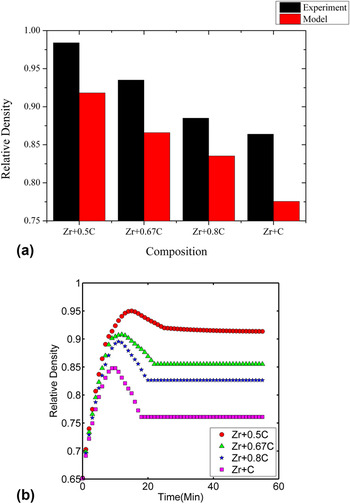
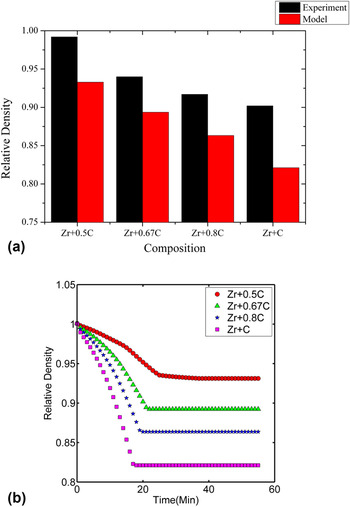
Relative density change with time for 1200 °C RHP as calculated from our model is shown in Fig. 2(b). Experimental data show that relative density decreases monotonously from ∼98 to ∼86% RD with increasing stoichiometry from ZrC0.5 to ZrC in comparison with the predicted density variation from ∼92 to ∼78% RD. Given the simplifications involved in the model, the trends in behavior are well captured and the quantitative agreement is also reasonable.
(a) Comparison of relative density variation with composition after 1200 °C RHP from the experiment and the computational model and (b) RD change with time as predicted by model.

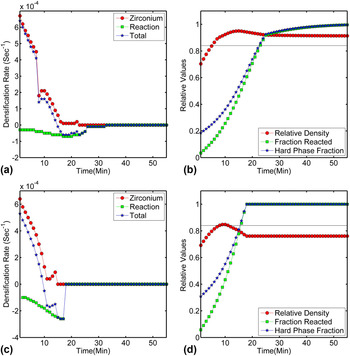
To examine the densification mechanisms more closely, the densification rate, relative density, fraction reaction, and fraction of hard phase with time are plotted for Zr + 0.5C in Figs. 3(a) and 3(b) and Zr + C in Figs. 3(c) and 3(d). The model predicts that for the first ∼10 min, the densification rate remains similar for all the four compositions. From Fig. 3(a), it can be seen that until 10 min have elapsed, the creep densification of Zr is almost an order of magnitude higher than that of de-densification resulting from the reaction between Zr and carbon. As porosity decreases, the decreased driving force for sintering as well as the increasing amount of hard phase leads to the second stage characterized by a sharp reduction in the rate of densification, which, as shown by the graph of reaction conversion in Figs. 3(b) and 3(d), corresponds to a conversion of ∼30–40% of the original Zr and a hard phase content of ∼40–50% as one goes from ZrC0.5 to ZrC. The large amount of rigid inclusion phase and the increasing reaction-derived de-densification start to affect densification from this point onwards, and the densification rate of stoichiometric carbide becomes significantly slower than that of ZrC0.5 even though densification continues until the ∼15 min mark [Fig 2(b)]. At 90% RD, densification rate from creep of Zr decreases abruptly, as the sintering reaches the third stage according to the Helle model in ZrC0.5 [Fig. 3(a) and 3(b)]. From ∼15 min onwards [Fig 2(b)], the relative density starts to decrease for Zr + C composition since reaction-derived de-densification exceeds any residual sintering that comes through Zr creep. From ∼20 min onwards [Fig 2(b)], RD starts to decrease for all four compositions. At this point, the model predicts more than 80% completion of reaction and the hard phase fraction reaches the critical value of 84%, defined as the rigidity threshold, in all the four compositions. So from this point densification becomes zero. However, as reaction continues, the related molar volume contractions de-densify the material by an amount that increases with increasing stoichiometry as shown in Fig. 2(b). Thus, more stoichiometric compositions saturate at a lower final relative density (78% for ZrC and 92% for ZrC0.5), both because the rigidity threshold is reached earlier and also because the volume contractions on reaction are larger.
(a) Relative density, reaction, and hard phase volume fraction change with time, (b) densification rate variation with time at the 1200 °C RHP for the Zr + 0.5C composition, (c) relative density, reaction, and hard phase volume fraction change with time and (d) densification rate variation with time at the 1200 °C RHP for the Zr + C composition.

(a) Comparison of relative density variation with composition after 800 °C and 1200 °C two-step RHP from the experiment and the computational model and (b) RD change with time as predicted by model.

B. Two-step RHP
Figure 4(b) shows the relative density variation with time for two-step RHP with different ZrC stoichiometries. In this process, an isothermal hold at 800 °C when reaction is minimal is followed by a ramp to and hold at 1200 °C. For this calculation, the final relative density and reaction data from the model predictions at 800 °C RHP are taken as input. In the model at 800 °C RHP, all the four compositions reach the ∼100% RD. Experimental results also show similar relative density for all the four compositions, but the relative density is ∼90% rather than the ∼100% predicted in the model. Reference Chakrabarti, Rangaraj and Jayaram14,Reference Chakrabarti28 Two-step HP shows higher relative density compared to single-step HP in experiment Reference Chakrabarti, Rangaraj and Jayaram14 and the same is also predicted by the model [Fig. 4(a)]. Difference in relative density between two-step and single-step RHP in the model is ∼1.5% for ZrC0.5 which increases to ∼5% for ZrC. In the experiment for ZrC0.5 and ZrC0.67 the difference is less than 1%, Reference Chakrabarti, Rangaraj and Jayaram14 but for the other two compositions it is significantly more ∼5%. Thus, the enhancement in densification in two-stage HP is also captured in the model.
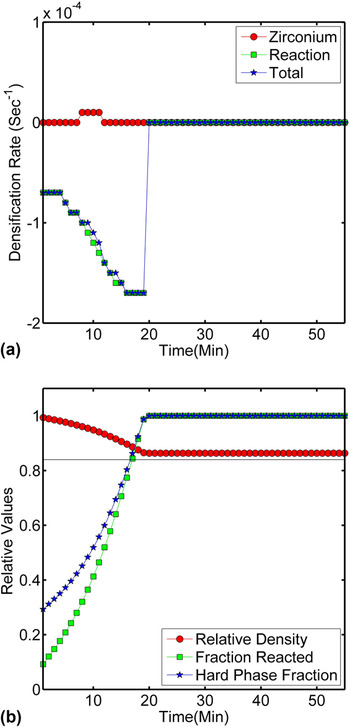
To understand the trends in densification, the relative density, fraction reaction, and fraction of hard phase with time are plotted for one of the middle composition, i.e., Zr + 0.8C in Fig. 5(b). Densification rate of the same composition with time is plotted in Fig. 5(a). From Fig. 5(a), it can be seen that the initial densification due to Zr is zero as the starting material is fully densified. De-densification due to reaction between Zr and carbon continues with progressing reaction, leading to the evolution of porosity and a renewed driving force for densification. Even at this stage, the rate of de-densification outweighs the densification from creep in Zr as the driving force for the latter is low. Consequently, the whole compact continues to get de-densified. With progressing reaction, increase in hard phase content leads densification rate becoming stagnant again, particularly after ∼15 min. Clearly, any increase in driving force for sintering due to the evolution of porosity is counteracted by the rapidly increasing amount of rigid phase. Consequently, the net densification rate becomes more and more negative. Finally, at ∼20 min, densification from creep becomes zero, as the hard phase volume fraction exceeds the rigidity threshold of 84%. Consequently, de-densification continues until the completion of the reaction.
(a) Relative density, reaction, and hard phase volume fraction change with time and (b) densification rate variation with time at the second stage of two stages 800 and 1200 °C RHP for the Zr + 0.8C composition.

Critically, the same trend is shown by the other three compositions as well. Essentially these results point out that even if the Zr and C mixture is fully densified but unreacted, the resultant mixture will, upon further heating end up with residual porosity. The reason is that close to the fully densified stage, the aggregate has very little driving force for densification, but as reaction is not complete, the reaction-derived de-densification will dominate creep in the residual metal. So the resultant mass will experience gradual de-densification. As the material de-densifies, the driving force for densification will increase, but will be mostly negated by the increasing amount of hard phase and de-densification will prevail. Consequently, the final product will always be incompletely densified. This effect will be more severe for the higher stoichiometric carbide compositions and that is why stoichiometric ZrC finishes with almost ∼12% less RD than ZrC0.5, even though both of them have started with the same 100% RD.
In two-step sintering, densification is higher than single-step RHP in all the four cases. It happens because in two-step RHP starting RD is higher at the start of the second RHP. More critically densification is higher because at the critical 84% volume fraction of rigid particle from when densification from Zr is zero, RD is higher in two-step RHP than single-step RHP. This is why two-step RHPed sample end up with higher final RD. More importantly at the critical volume fraction of rigid particle, the RD difference between two-step RHPed and single-step RHPed sample is higher for higher stoichiometric composition. Thus, the RD difference between two-step and single-step RHPed sample increases as sample becomes more stoichiometric.
Coupling the volume contraction upon reaction with the rigidity threshold as a cut-off point for power-law creep, it can be estimated that the maximum density achievable in this process is ∼96% RD for ZrC and ∼98% RD for ZrC0.5. These act as a theoretical limit which cannot be breached, regardless of the pressure, temperature, or particle size used, as long as the reaction formed carbide remains rigid according to this model. In confirmation of this prediction, our RHP experiments show that reaching close to 100% RD is possible for ZrC0.5, but more than 90% RD is not reached for ZrC composition. Even going to two-step RHP does not improve RD much beyond 90%. Similarly, RD beyond 95% is also not achieved for ZrC0.8 composition. The original work on transient plastic phase processing (TPPP) also shows evidence of such limits to densification. Reference Barsoum and Houng29–Reference Barsoum, Zavaliangos, Kalidindi, El-Raghy and Brodkin31 In that work, it has been shown that 3Ti + B4C mixture with stoichiometric final TiC composition only densifies to 92% RD whereas 4Ti + B4C mixture with TiC0.67 final composition can be fully densified. Our predicted value of 96% for ZrC may not be exactly accurate, but the effect that full density cannot be achieved for ZrC0.8 and ZrC compositions after RHP, seems to be real. Therefore, to achieve full densification by RHP (or to surmount the theoretical limit predicted by our model), the final composition should plastically flow to negate the effect of reaction-derived de-densification. Otherwise, full densification will be out of reach. At 1200 °C and 40 MPa, ZrC0.5 can plastically flow and thereby can reach full densification. Reference Chakrabarti28 For the other more stoichiometric compositions, RHP must be carried out at temperature and pressure where the final ZrC x composition can plastically flow and participate in the densification atleast to some extent. The above-mentioned factors can suitably explain the result of TPPP study of 3Ti + B4C and 4Ti + B4C mixtures. Reference Barsoum and Houng29,Reference Brodkin, Kalidindi, Barsoum and Zavaliangos30
C. Reaction between Zr and ZrC
The modeling of RHP of Zr and C mixtures shows that the significance of de-densification during reaction cannot be over-emphasized. For all Zr and C mixtures, even though the Zr content appears adequate to produce near-theoretical density, only ZrC0.5 achieves full density while, in contrast, ZrC only achieves 90% RD. This observation strongly suggests that as the metal becomes exhausted from the reaction, further densification becomes very limited, except from any transient phase close to the ZrC0.5 composition. At this stage, de-densification, which is ever present during reaction, now starts to dominate over any residual sintering arising from the remnant metal. De-densification increases with the C content, both because the metal content is the least and also because the volume shrinkage is the most. ZrC composition, which experiences the maximum de-densification of 19%, consequently achieves the least final density.
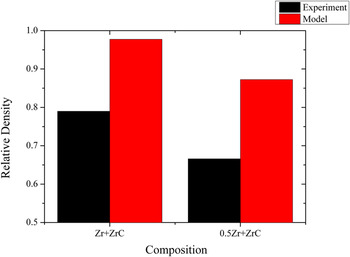
But it is possible to avoid the reaction-derived de-densification during RHP because the molar volumes of Zr in the metal and carbide are very similar and carbon (C) occupies an interstitial position with little disruption of the near close packing in the metal. In this section, the RHP of such two compositions, i.e., Zr + ZrC and 0.5Zr + ZrC is studied through modeling and experiments. After 800 °C RHP, two compositions, i.e., Zr + ZrC and 0.5Zr + ZrC reach the RD of ∼80 and 68%, respectively (Fig. 6). Our model shows RD of ∼98 and ∼88% (Fig. 6). So it shows lowering of RD owing to smaller amount of starting Zr compared to Zr and C mixtures. Though quantitatively it over predicts the densification.
Comparison of relative density variation with composition after 800 °C RHP from the experiment and the computational model for Zr and ZrC compositions.

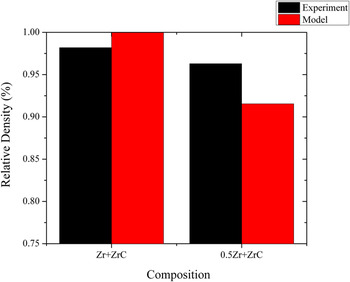
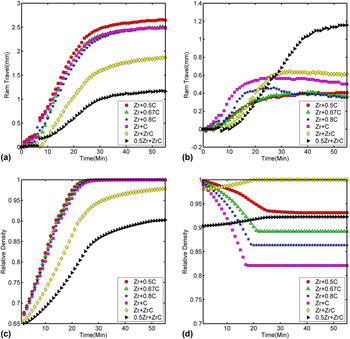
Relative density with time for two-step 800 °C RHP and 1200 °C RHP, estimated from our experiments and model, is shown in Fig. 8. Density variation of ∼98 to ∼96% RD from Zr + ZrC to 0.5Zr + ZrC is observed in the experiments (Fig. 7). Our model predicts RD variation from ∼100 to ∼94% (Fig. 7). Experimental data show small improvement in the RD in 0.5Zr + ZrC and similar RD in Zr + ZrC compositions compared to their Zr and C composition counterparts. The same observation is also replicated by our model. Despite possessing the smallest amount of Zr in the starting mixture and the likely presence of a percolating network of hard phases, they achieve a final density that is comparable to the Zr–C mixtures. The RD versus time (and experimental ram displacement data) [Figs. 8(a) and 8(c)] for Zr + ZrC and 0.5Zr + ZrC displays the least change at 800 °C, signifying the absence of flow in Zr. However, when the temperature is raised to 1200 °C under pressure, the densification is equal or somewhat greater than for the Zr–C mixtures. Therefore, at this temperature, Zr becomes so soft that it can creep and readily negate the effect of the rigid, percolating carbide network. Thus, an alternative route to RHP is the use of what is effectively a reactant in which both the partial molar volume of C and the rate of consumption of metal are small. The present work suggests that RHP of Zr and ZrC mixtures is an effective alternative route to produce highly densified nonstoichiometric ZrC.
Comparison of relative density variation with composition after 800 and 1200 °C RHP from the experiment and the computational model for Zr and ZrC compositions.

Ram travel versus time plot for (a) RHP at 800 °C and 40 MPa and (b) RHP at 1200 °C and 40 MPa following RHP at 800 °C and 40 MPa. (c) RD versus time for RHP at 800 °C and 40 MPa and (d) RHP at 1200 °C and 40 MPa following RHP at 800 °C from the model.

It is worth considering the reason for the discrepancies between the absolute values observed and predicted. The most notable difference lies in the 800 °C RHP of the Zr + ZrC mixtures where the RDs are over-estimated. A likely cause here is that mechanical mixing of such a large volume fraction of hard particles cannot disperse them uniformly and that percolated networks shield the Zr powders from the applied stress more effectively than is assumed in the model. Such over-estimation also occurs but is less pronounced in Zr–C mixtures where the carbon volume fraction is much smaller and ZrC grows outwards from more uniformly distributed carbon particles. The second discrepancy lies in the under-estimation of RD after completion of reaction. Experimentally achieved RDs are greater by a few percentage, suggesting that plastic flow in transient carbide compositions close to ZrC0.5 can contribute to densification, as observed earlier. Reference Chakrabarti28
V. CONCLUSION
This study on RHP of ZrC x leads to the following conclusion:
-
(1) A model of RHP of ZrC has been constructed.
-
(2) Model shows reasonable agreement with the experimental results.
-
(3) Model shows that the progressively lower densification with increasing stoichiometry is due to the increasing amount of starting hard phase and more de-densification.
-
(4) The starting volume fraction of the Zr determines densification more during lower temperature RHP. Its effect is relatively less at higher temperatures such as 1200 °C.
-
(5) Zr + ZrC and 0.5Zr + ZrC compositions, which are powder mixtures of Zr and ZrC, show similar or better densification than Zr–C mixtures that yield the same ZrC0.5 and ZrC0.67 compositions, owing to the absence of reaction-derived volume shrinkage.
ACKNOWLEDGMENTS
This work was made possible by the financial support from Department of Science and Technology, Government of India. The authors are grateful to Mr. V. Babu for the assistance in hot-pressing experiments.