Limpograss is a warm-season perennial grass that is adapted to poorly drained soils, particularly those in Florida in which standing water is common during the summer rainy season (Newman et al. Reference Newman, Vendramini, Sollenberger and Quesenberry2014). In addition, Florida beef cattle producers use this forage species because of its high digestibility, quality, and cool-season growth (Newman et al. Reference Newman, Vendramini, Sollenberger and Quesenberry2014). It can produce approximately 35% of annual herbage accumulation during the winter in Florida (Brown and Kalmbacher Reference Brown and Kalmbacher1998). Its specific attributes, such as active growth in late fall, high digestibility, and slower decline in digestibility with increasing maturity compared to other grasses, make limpograss suitable for use as a stockpiled forage (Newman et al. Reference Newman, Vendramini, Sollenberger and Quesenberry2014).
Similar to other warm-season perennial grass forage species, weed interference can significantly decrease limpograss agronomic responses. However, management of weeds in limpograss pastures can be challenging compared to other grass forage species because of the limited number of herbicides that result in little or no injury to limpograss (Lastinger et al. Reference Lastinger, Sellers, Ferrell, Vendramini and Silveira2016). Dicamba, metsulfuron, and aminopyralid are herbicides that cause little to no injury to limpograss and provide control of many weeds (Sellers and Ferrell Reference Sellers and Ferrell2013). However, none of these herbicides are active on smutgrass [Sporobolus indicus (L.) R. Br.]. Quesenberry et al. (Reference Quesenberry and Dunn1978) stated that smutgrass invasion in limpograss pastures has been observed since limpograss cultivars were released in the 1970s and 1980s. In addition, smutgrass often invades limpograss pastures that are mismanaged; however, smutgrass has been observed to invade limpograss pastures even with proper grazing and clipping management (Brent Sellers, personal observations).
Smutgrass is an invasive perennial grass that is problematic in improved pastures in Florida (Ferrell and Mullahey Reference Ferrell and Mullahey2006; Rana Reference Rana2012; Wilder et al. Reference Wilder, Sellers, Ferrell and MacDonald2011). It can quickly dominate pastures, causing significant reductions in livestock grazing capacity (Davy et al. Reference Davy, Forero, Nader, Ditomaso and Kyser2012). Smutgrass is considered one of the most troublesome pasture weeds in Florida because of its ability to outcompete desirable species (Ferrell and Mullahey Reference Ferrell and Mullahey2006; Rana et al. Reference Rana, Sellers, Ferrell, MacDonald, Silveira and Vendramini2013), prolific seed production (Currey et al. Reference Currey, Parrado and Jones1973), high rate of seed germination (Rana et al. Reference Rana, Sellers, Ferrell, MacDonald, Silveira and Vendramini2013), and limited control options (Brecke Reference Brecke1981; Mislevy et al. Reference Mislevy, Shilling, Martin and Hatch1999).
Considering the lack of efficacy of mechanical control, forage producers have relied on herbicides for smutgrass control (Sellers et al. Reference Sellers, Ferrell and MacDonald2008). Currently, hexazinone is the only selective herbicide available for smutgrass control in perennial grass pastures (Sellers et al. Reference Sellers, Ferrell and Rana2015). Hexazinone has been shown to provide acceptable control of smutgrass at rates ranging from 0.56 to 1.12 kgaiha−1 (Ferrell and Mullahey Reference Ferrell and Mullahey2006; Mislevy et al. Reference Mislevy, Martin and Hall2002). However, application of 0.56 kg ha−1 provided inconsistent control of smutgrass, ranging from 65% to 98% (Ferrell and Mullahey Reference Ferrell and Mullahey2006; Mislevy et al. Reference Mislevy, Martin and Hall2002; Wilder et al. Reference Wilder, Sellers, Ferrell and MacDonald2011). Consistent smutgrass control has been observed following hexazinone at 1.12 kg ha−1 in bahiagrass (Paspalum notatum Fluegg) pastures when applied during midsummer and early fall (Ferrell and Mullahey Reference Ferrell and Mullahey2006; Mislevy et al. Reference Mislevy, Martin and Hall2002; Wilder et al. Reference Wilder, Sellers, Ferrell and MacDonald2011). However, Rana et al. (Reference Rana, Sellers, Ferrell, MacDonald, Silveira and Vendramini2015) suggested that, considering the cost of hexazinone, it may be more economical to apply 0.56 or 0.84 kg ha−1 in the first year followed by 0.56 kg ha−1 in the following year to not only reduce costs, but also to enable the ranchers to potentially treat additional pastures infested with smutgrass at a reduced cost.
Among all the forage species grown in Florida, ‘Pensacola’ bahiagrass (Paspalum notatum Flueggé var. saurae Parodi) is the most widely adopted (Burton et al. Reference Burton, Gates and Gascho1997); therefore, much of the research concerning smutgrass control was performed in bahiagrass pastures (Brecke Reference Brecke1981, Ferrell and Mullahey Reference Ferrell and Mullahey2006, Mislevy et al. Reference Mislevy, Currey and Brecke1980, Mislevy et al. Reference Mislevy, Shilling, Martin and Hatch1999, Mislevy at al. Reference Mislevy, Martin and Hall2002, Wilder et al. Reference Wilder, Sellers, Ferrell and MacDonald2011). Injury from hexazinone at 1.12 kg ai ha−1 has been recorded in bahiagrass and bermudagrass [Cynodon dactylon (L.) Pers.]; however, the injury is transient, and herbage mass accumulation typically recovers within a 12-week period (Sellers et al. Reference Sellers, Ferrell and MacDonald2008; Wilder et al. Reference Wilder, Sellers, Ferrell and MacDonald2011). Research on the role of hexazinone on limpograss tolerance has not been thoroughly examined. Limpograss response to 0.56 and 1.12 kg ha−1 hexazinone has been inconsistent, varying from a slight injury to complete kill (Lastinger et al. Reference Lastinger, Sellers, Ferrell, Vendramini and Silveira2016). Even though plant height can impact herbicide selectivity for some species (Sellers et al. Reference Sellers, Ferrell, MacDonald and Kline2009), previous research has indicated that regrowth height has no impact on limpograss tolerance to hexazinone at 0.56 or 1.12 kgha−1 (Lastinger et al. Reference Lastinger, Sellers, Ferrell, Vendramini and Silveira2016). This is a major concern since hexazinone is the only product available for selective smutgrass control in perennial grass pastures.
Considering that there are only a limited number of herbicides that result in little or no injury to limpograss, as well as the fact that research showing the role of hexazinone on limpograss tolerance is lacking, it is important to further investigate the impacts of hexazinone on limpograss performance. Therefore, our objective was to measure the response of limpograss to increasing rates of hexazinone by determining the doses required to provide 10% (ED10) and 20% (ED20) of visual estimates of injury and herbage mass reduction.
Materials and Methods
Dose-response field trials were initiated on July 25, 2013, and repeated on August 10, 2014, on an established limpograss hayfield at the University of Florida Institute of Food and Agricultural Sciences Range Cattle Research and Education Center, near Ona, FL (27°39′N; 81°94′W, 29 m altitude) on a Pomona fine sand soil. Soil pH was 5.5 and fertilizer was applied according to the Institute of Food and Agricultural Science recommendations in early spring of each year (Newman et al. Reference Newman, Vendramini, Sollenberger and Quesenberry2014). Daily maximum and minimum temperatures, and rainfall throughout the experimental period (July 25 to October 27, 2013, and August 10 to November 13, 2014) were obtained from the weather station located at the research center. The amount and distribution of rainfall differed among the study years. Total rainfall during the experimental period was slightly greater in 2014 (634 mm) than in 2013 (605 mm). Monthly mean daily maximum and minimum temperatures during the study did not vary greatly between 2013 and 2014. The maximum air temperature ranged from 32 to 35 C in 2013 and from 33 to 36 C in 2014, and the minimum air temperature ranged from 13 to 21 C in 2013 and from 11 to 20 C in 2014.
Six weeks prior herbicide application, the top growth was removed from the experimental area to a stubble height of 15 cm using a customized John Deere F935 flail forage harvester (John Deere, Moline, IL 61265). Hexazinone (Velpar™, 240 g ai L−1, E.I. du Pont Nemours and Company, 1007 Market Street, Wilmington, DE 19898) was applied at 0, 0.28, 0.56, 0.84, 1.12, and 1.40 kg ai ha−1 when limpograss reached approximately 30 cm in height using a CO2-pressurized backpack sprayer calibrated to deliver 281 L ha−1. The experiment was established as a randomized complete block design with four replications, and the experimental units were plots measuring 3 by 3 m.
Limpograss tolerance was evaluated qualitatively by visually estimating limpograss injury at 15, 30, and 60 days after treatment (DAT) on a scale from 0 to 100, with 0 equal to no injury and 100 equal to complete death. Limpograss tolerance was also evaluated quantitatively by recording the forage herbage mass at 90 DAT. The harvest was performed in the center 1 by 2 m area of each plot using a flail harvester cutting to a stubble height of 15 cm. Each sample was weighed and subsamples were taken to estimate percent dry matter from each plot. Subsamples were weighed and placed in a forced air dryer at 60 C for 4 days and dry weight was recorded. Forage herbage mass reduction was expressed as a percentage of the nontreated control for statistical analysis.
Data Analysis
Statistical analyses were performed using R Studio© (version 3.3.0; Ritz and Stribig Reference Ritz and Streibig2005). Homogeneity of variance and normality were visually inspected by plotting residuals of all response variables. No data transformation was deemed necessary. Analyses of variance were conducted on all response variables to determine whether the effect of hexazinone rate, year, and their interaction was significant (α = 0.05) using the aov function in R (Pinheiro and Bates Reference Pinheiro and Bates2000). Data were pooled across years when the interaction between year and hexazinone rate was not significant. Linear, quadratic, and quadratic-plateau regression models were fit to the data for each assessment using the lm and nls functions in R. The residual sum of squares was then estimated for each model. The best fit was determined by choosing the model with the lowest residual sum of squares and the highest adjusted R-squared value (Schabenberger and Pierce Reference Schabenberger and Pierce2002).
Results and Discussion
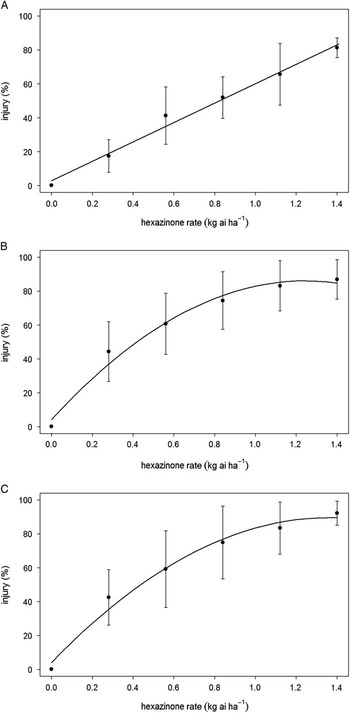
Characteristic symptoms of photosystem II–inhibiting herbicides were observed at all assessment timings, ranging from slight necrosis on leaves to complete desiccation. There was no year by treatment interaction for visual estimates of limpograss injury at any evaluation timing; therefore, data were combined across years. In general, limpograss injury increased as hexazinone rate increased at all evaluation timings (Figure 1).
Visual estimate of limpograss injury (relative to untreated check) as a function of increasing rates of hexazinone at (A) 15, (B) 30, and (C) 60 days after treatment (DAT), averaged over 2013 and 2014. Limpograss response was fit to the following equations: at 15 DAT, Y i=a+bx, where a and b and adjusted R2 were 2.88, 57.22, and 0.84, respectively; at 30 DAT, Y i=a+bx+cx 2, where a, b, c, and adjusted R2 were 4.12, 131.71, −52.98, and 0.81, respectively; and at 60 DAT, Y i=a+bx+cx 2, where a, b, c, and adjusted R2 were 3.98, 125.11, −45.76, and 0.80, respectively.

There was a linear relationship between limpograss injury and hexazinone rate at 15 DAT (Figure 1A). Limpograss injury ranged from 18% to 81% (Figure 1A), and the hexazinone ED10 and ED20 were estimated to be 0.13 and 0.30 kgaiha−1, respectively (Table 1). In general, limpograss injury was higher at 30 DAT than it was at 15 DAT and there was a quadratic relationship between injury and hexazinone rate (Figure 1B). Limpograss injury ranged from 44% to 87%, and the ED10 and ED20 values were estimated to be 0.05 and 0.13 kg ai ha−1, respectively (Table 1). The reason for this increased injury from 15 to 30 DAT is likely due to the mode of action of hexazinone. Hexazinone inhibits electron flow in photosystem II (Shukla and Devine Reference Shukla and Devine2008), and herbicides from this group usually require some time to show complete activity. There was also a quadratic relationship between limpograss injury and hexazinone rate at 60 DAT (Figure 1C). Limpograss injury at 60 DAT was similar to that at 30 DAT, ranging from 43% (at 0.28 kg ai ha−1) to 92% (at 1.4 kgaiha−1). The lowest rate of hexazinone that typically provides some activity on smutgrass (0.56 kg ai ha−1) resulted in nearly 60% injury, and the hexazinone rate most often recommended for smutgrass control (1.12 kgaiha−1) resulted in 83% injury. The ED10 and ED20 were estimated to be 0.05 and 0.14 kg ai ha−1, respectively (Table 1), which is considerably lower than the 0.56 and 1.12 kgaiha−1, the rates recommended for smutgrass control (Ferrell and Mullahey Reference Ferrell and Mullahey2006; Sellers et al. Reference Sellers, Ferrell and Rana2015; Wilder et al. Reference Wilder, Sellers, Ferrell and MacDonald2011).
Hexazinone ED10 and ED20 for visual estimates of injury to limpograss at different assessment timings.Footnote a

a Abbreviations: DAT, days after treatment; ED10, estimated dose, in kgaiha−1, associated with 10% limpograss injury (assessed visually); ED20, estimated dose, in kgaiha−1, associated with 20% limpograss injury (assessed visually).
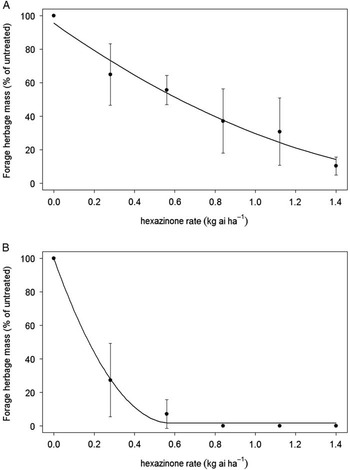
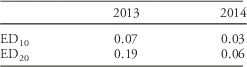
There was a year by treatment interaction for forage herbage mass; therefore, data are presented separately for 2013 and 2014. In general, forage herbage mass decreased as hexazinone rate increased for both years (Figure 2). This decrease in forage herbage mass agrees with our visual estimates of injury. Overall, the reduction in forage herbage mass was less severe in 2013 than it was in 2014. In 2013, forage herbage mass ranged from 100% to 10% that of the untreated check (Figure 2A). Hexazinone at 0.56 and 1.12 kg ai ha−1 resulted in 56% and 31% limpograss forage herbage mass compared to the untreated check, and the ED10 and ED20 were estimated to be 0.07 and 0.19 kgaiha−1, respectively (Table 2). In 2014, forage herbage mass ranged from 100% to 0% of untreated limpograss (Figure 2B). Hexazinone at 0.56 and 1.12 kg ai ha−1 resulted in 7% and 0% of the forage herbage mass of the untreated check, and the ED10 and ED20 values were estimated to be 0.03 and 0.06 kgaiha−1, respectively (Table 2). The reason for the difference in forage herbage mass accumulation between years could be due to the amount of rainfall received after application in 2013 compared to that in 2014. A total of 58.4 mm of rainfall was recorded within the first 7 DAT in 2013, whereas in 2014, only a total of 18 mm of rainfall was recorded within 7 DAT. Hexazinone is highly soluble in water (33,000 mg L−1) and has an intermediate coefficient of adsorption (Koc=54 ml/g) (Shaner Reference Shaner2014), thus, it is a molecule susceptible to leaching. Therefore, the difference in rainfall could have resulted in increased leaching in 2013 compared to 2014, resulting in less limpograss herbage mass accumulation in 2014 than in 2013. Other researchers have suggested that hexazinone leaching caused by excess rainfall has the potential to decrease hexazinone activity (Dias et al. Reference Dias, Sellers, Ferrell, Enloe, Vendramini and Moriel2017; Ferrell and Mullahey Reference Ferrell and Mullahey2006; Rana et al. Reference Rana, Sellers, Ferrell, MacDonald, Silveira and Vendramini2015).
Limpograss dry herbage mass reduction (expressed as percentage of untreated check) as a function of increasing rates of hexazinone at 90 days after treatment in (A) 2013 and (B) 2014. Limpograss response was fit to the following quadratic response equations: in 2013, Y i=a+bx+cx 2, where a, b, c, and adjusted R2 were 95.52, −85.20, 19.35, and 0.82, respectively, and in 2014, Y i=a+bx+cx 2 (x≤0.58), where a, b, c, and adjusted R2 were 99.80, −338, 290, and 0.94, respectively.

Hexazinone ED10 and ED20 for limpograss herbage mass reduction in 2013 and 2014.Footnote a

a Abbreviations: ED10, estimated dose, in kg ai ha−1, associated with 10% limpograss herbage mass reduction; ED20, estimated dose, in kgaiha−1, associated with 20% limpograss herbage mass reduction.
The results of this research are a cause for concern, because hexazinone is the only herbicide labeled for selective smutgrass control in perennial grass pastures. Overall, the lowest hexazinone rates tested, 0.28 and 0.56 kg ha−1, resulted in unacceptable levels of injury as well as herbage mass reduction, especially in 2014. Limpograss is considered to be the most sensitive to herbicides of all forages grown in Florida (Sellers and Ferrell Reference Sellers and Ferrell2013), and these results show that it is sensitive to the herbicide hexazinone. In addition, the rates of hexazinone tested here have been shown to provide minimal control of smutgrass under field conditions (Ferrell et al. Reference Ferrell, Dusky, Mullahey and Roka2006; Mislevy et al. Reference Mislevy, Shilling, Martin and Hatch1999; Wilder et al. Reference Wilder, Sellers, Ferrell and MacDonald2011). Wilder et al. (Reference Wilder, Sellers, Ferrell and MacDonald2011) demonstrated that hexazinone at 0.56 kg ha−1 resulted in variable control ranging from 50% to 70%. Considering that this rate of hexazinone resulted in 56% and 90% reduction in herbage mass in 2013 and 2014, respectively, it is unlikely that rates equal to or higher than 0.56 kg ha−1 of hexazinone can be safely applied to limpograss pastures. Our results generally agree with those of Lastinger et al. (Reference Lastinger, Sellers, Ferrell, Vendramini and Silveira2016), who found that hexazinone at 1.12 kg ha−1 resulted in more than 50% reduction in limpograss herbage mass. Injury from hexazinone has also been observed in bahiagrass and bermudagrass; however, the injury was transient and herbage mass accumulation recovered within a 12-week period (Sellers et al. Reference Sellers, Ferrell and MacDonald2008; Wilder et al. Reference Wilder, Sellers, Ferrell and MacDonald2011), which did not occur in this study with limpograss. Therefore, it is unlikely that there are hexazinone rates with activity on smutgrass that can be safely applied to limpograss pastures. It is important for ranchers to consider the presence or absence of smutgrass in their pastures prior to planting limpograss, as there is no viable herbicide option to selectively remove smutgrass from limpograss swards.