Introduction
Fertilization by intracytoplasmic sperm injection (ICSI) is a manipulative technique in which a single sperm is injected directly into the ooplasm of a matured oocyte using a microscopic needle. This method was pioneered in hamsters in the 1970s (Uehara & Yanagimachi, Reference Uehara and Yanagimachi1976, Reference Uehara and Yanagimachi1977) and has been used subsequently to achieve fertilization and live births in rabbits, cattle, and humans (Iritani et al., Reference Iritani, Utsumi, Miyake, Hosoi and Saeki1988; Lanzendorf et al., Reference Lanzendorf, Maloney, Veeck, Slusser, Hodgen and Rosenwaks1988; Goto et al., Reference Goto, Kinoshita, Takuma and Ogawa1990; Palermo et al., Reference Palermo, Joris, Devroey and Van Steirteghem1992). Presently, ICSI is important for investigating and understanding the early events of fertilization, and is used as an assisted reproductive technique (ART) in humans and other mammals.
The efficiency of ICSI depends on the methods used for micromanipulation, permeabilization of the sperm membrane, and oocyte activation. Mouse ICSI is an ideal model in which to research these methods, because its use avoids the complex ethical issues surrounding investigations in human gametes, and there is a wide availability of information describing murine biology and genetics. In the past, a mechanically driven pipette was used to inject a spermatozoon into the ooplasm during ICSI. However, in mice this resulted in damage to the oolemma and the cytoplasmic structure. More recently, a piezo-driven technique was developed to penetrate the zona pellucida (ZP) and break the oolemma (Kimura & Yanagimachi, Reference Kimura and Yanagimachi1995). This technique is less traumatic to the oocytes, and has become the standard for mouse ICSI; it is also widely used in mouse somatic cell nuclear transfer cloning (Yanagimachi, Reference Yanagimachi2005; Wakayama, Reference Wakayama2007). The overall survival rate of mouse oocytes after piezo-drilled ICSI was 80% (Kimura & Yanagimachi, Reference Kimura and Yanagimachi1995).
Mouse ICSI is especially challenging because the elasticity of the oolemma is higher, and the wound healing ability and the viscosity of the ooplasm is lower than in oocytes of other species (Kimura & Yanagimachi, Reference Kimura and Yanagimachi1995). Evidence suggests that techniques that relax the cytoskeleton can be used to enhance the flexibility of the oocyte, and improve the wound healing ability of the oolemma and the survival rate of the oocyte after manipulation (Sun & Schatten, Reference Sun and Schatten2006). The oocyte cytoplasm contains two cytoskeletal components: microtubules and microfilaments. Polymerization and depolymerization of these cytoskeleton components regulates the localization of cellular organelles, and the growth, maturation and fertilization of oocytes. Previous studies using the microfilament-inhibiting agent cytochalasin B (CB) demonstrated that microfilaments were not necessary for successful fertilization, but were essential for the rotation of the meiotic spindle, extrusion of the polar body, and the migration of pronuclei to the central region of oocytes (Maro et al., Reference Maro, Johnson, Pickering and Flach1984, Reference Maro, Kubiak, Gueth, De Pennart, Houliston, Weber, Antony and Aghion1990). These data indicate that microfilaments are needed for microtubule functions, and that the segregation of homologous chromosomes requires interaction between microtubules and microfilaments.
In nuclear transfer manipulation, CB relaxes the cytoskeleton and enhances the flexibility of the oocyte. Treating oocytes of various species with CB during nuclear transfer prevented damage to the oolemma, allowed the insertion of a glass pipette through the ZP without lysing the oocyte (Baguisi et al., Reference Baguisi, Behboodi, Melican, Pollock, Destrempes, Cammuso, Williams, Nims, Porter, Midura, Palacios, Ayres, Denniston, Hayes, Ziomek, Meade, Godke, Gavin, Overstrom and Echelard1999; Wells et al., Reference Wells, Misica and Tervit1999; Polejaeva et al., Reference Polejaeva, Chen, Vaught, Page, Mullins, Ball, Dai, Boone, Walker, Ayares, Colman and Campbell2000; Choi et al., Reference Choi, Love, Westhusin and Hinrichs2004; French et al., Reference French, Adams, Anderson, Kitchen, Hughes and Wood2008), and resulted in an improved success rate of embryonic development during the cloning of rabbits and sheep (Smith & Wilmut, Reference Smith and Wilmut1989; Collas & Robl, Reference Collas and Robl1990), but not mice (Wakayama & Yanagimachi, Reference Wakayama and Yanagimachi2001). Presently, reports describing the effects of CB-supplemented manipulation media on oocyte and embryonic development following ICSI are limited.
In this study, we supplemented manipulation medium with CB during mouse ICSI. We determined the effects of CB supplementation on the survival rate of oocytes, the survival and in vitro developmental rate of embryos, and the natality, birth weight, and fertility of pups following ICSI. In addition, we observed the dynamic changes of the microtubules and microfilaments in both CB-treated and -untreated control ICSI embryos before the first mitosis.
Materials and methods
Animals and reagents
Six- to 8-week-old CD-1 female and 8- to 12-week-old B6D2F1 (C57BL/6J × DBA/2J) male mice were purchased from Beijing Vital River Laboratory Animal Technology Co. Ltd. All reagents were obtained from Sigma Chemical Company unless otherwise stated. Before ICSI, mouse oocytes were cultured in Chatot-Tasca-Ziomek (CZB) (Chatot et al., Reference Chatot, Ziomek, Bavister, Lewis and Torres1989) medium supplemented with 5.56 mM d-glucose, 1.7 mM CaCl2, and 4 mg/ml bovine serum albumin (BSA; CZB-G). Mouse oocyte collection and microinjection were performed in CZB-G supplemented with 20 mM HEPES, 5 mM NaHCO3, and 0.1 mg/ml polyvinyl alcohol in place of BSA (CZB-HEPES). Mouse ICSI embryos were cultured in potassium simplex optimized medium (KSOM) (Erbach et al., Reference Erbach, Lawitts, Papaioannou and Biggers1994). CB was dissolved as a stock solution (1 mg/ml) in dimethyl sulfoxide (DMSO), stored at −20°C, and later diluted to a final concentration of 5 μg/ml in CZB-HEPES. All studies were approved by the Ethics Committee of Harbin Medical University.
Oocyte recovery and spermatozoa preparation
CD-1 female mice were superovulated by intraperitoneal injection of 5 IU pregnant mare serum gonadotropin (Ningbo, China), followed by 5 IU human chorionic gonadotropin (Ningbo, China) 48 h later. Cumulus–oocyte complexes (COCs) collected from superovulated CD-1 female mice were harvested into CZB-HEPES medium 13 h post-hCG injection. Cumulus cells were dissociated from oocytes by careful incubation of COCs with 200 μl CZB-HEPES medium containing 300 U/ml bovine testis hyaluronidase for 3–5 min. After dissociation, oocytes were washed three times in CZB-G medium and incubated at 37°C under 5% CO2 in air before use. Spermatozoa were recovered from the cauda epididymides of B6D2F1 males in CZB-HEPES medium and prepared for injection.
Intracytoplasmic sperm injection
ICSI was performed with Eppendorf Micromanipulators (Micromanipulator TransferMan; Eppendorf, Germany) and a piezoelectric actuator (PMM Controller, model PMAS-CT150; Prima Tech, Tsukuba, Japan) using previously reported methods with slight modifications (Tesarik et al., Reference Tesarik, Rienzi, Ubaldi, Mendoza and Greco2002; Araki et al., Reference Araki, Yoshizawa, Abe and Murase2004; Heindryckx et al., Reference Heindryckx, Van der Elst, De Sutter and Dhont2005). Briefly, sperm suspension was incubated for 1 h at 37°C. Just before ICSI, a small drop of sperm suspension was mixed thoroughly with an equal volume of CZB-HEPES containing 12% (w/v) polyvinylpyrrolidone (PVP, Mr 360 kDa). Subsequently, the head of a single spermatozoon was separated from the tail by applying one or more piezo pulses to the head–tail junction. The separated head was immediately injected into an oocyte (Stein & Schultz, Reference Stein and Schultz2010). We performed ICSI in mouse oocytes that had been manipulated in medium for 30 min in the presence or absence of 5 μg/ml CB (n = 20–30 in each group). The survival rate of ICSI embryos was examined 0.5 h after injection. All ICSI was complete within 2 h of oocytes collection.
Embryo culture
After ICSI, zygotes were washed three times in KSOM medium, transferred into KSOM droplets, about 30 zygotes in a 30 μl droplet, and cultured for an additional 20–96 h at 37°C in a humidified atmosphere of 5% CO2 and 95% air. Developmental potential of the zygotes was observed and recorded throughout the in vitro culture.
Embryo transfer and birth weight
Two-cell stage ICSI embryos were transferred into the oviducts (8–10 per side) of pseudopregnant CD-1 female (day 0.5 p.c.) mice (Nagy, Reference Nagy2003). Body weights of the pups were recorded 1 day after birth.
Immunofluorescent staining and confocal microscopy
Metaphase II (MII) oocytes and ICSI embryos were examined using immunofluorescence staining and confocal microscopy. MII oocytes were incubated in CZB-HEPES containing 5 μg/ml CB for 30 min, and then they were washed at least three times and transferred into CZB-G droplets. MII oocytes were observed at 0, 0.5, 1, and 2 h after CB treatment; ICSI embryos were analysed at 0.5, 1, 2, 4, 6, 8, and 10 h after CB/non-CB treatment.
All samples were fixed with 4% (v/v) paraformaldehyde for 40 min and permeabilized with 0.3% (v/v) Triton X-100 for 30 min. To determine the distribution of microtubules and microfilaments, fixed oocytes and embryos were incubated with mouse β-tubulin (1:100, T4026; Sigma) monoclonal antibodies for 1 h, followed by TR-goat-anti-mouse IgG (1:80, SC-2781; Santa Cruz). Subsequently, they were incubated in FITC-phalloidin (1:100, P5282; Sigma) for l h, and nuclei were stained with bisbenzimide Hoechst 33342. All samples were mounted on slides with anti-fluorescence-fade medium (DABCO) and examined with a laser-scanning confocal microscope. Each experiment was repeated three times; at least 10 samples were observed each time.
Statistical analysis
All experiments were repeated three to five times. Differences in birth rate and birth weight were evaluated by Student's t-test. Differences in in vitro development and cytoskeletal organization were assessed by chi-square test. A p-value <0.05 was considered statistically significant.
Results
Effect of CB on the survival and in vitro development of ICSI embryos
The survival rate of ICSI embryos treated with 5 μg/ml CB was increased significantly compared with the untreated control group (89.50% vs. 80.74%, p < 0.05, Table 1). There were no significant difference in pronuclear formation, cleavage, and the number of blastocysts that developed from survived CB-treated or untreated ICSI embryos (p > 0.05).
Survival and in vitro development of oocytes following ICSI

a,bValues in the same columns with different alphabetic superscripts are significantly (p = 0.033) different.
Effect of CB on the in vivo development of ICSI embryos
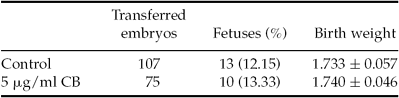
The total number of transferred embryos in the CB-treated and untreated control groups were 75 and 107, respectively (Table 2); the birth rates were 13.33% and 12.15% (p > 0.05). Addition of CB into the manipulation medium did not impair the development of ICSI embryos in vivo, and birth weights were not significantly different between the CB-treated and untreated groups (1.740 ± 0.046 vs. 1.733 ± 0.057, respectively, p > 0.05). All offspring derived from the ICSI procedure showed normal fertility.
In vivo development of ICSI embryos
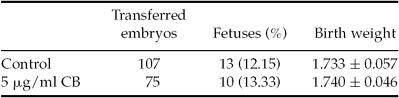
Data were analysed using Student's t-test, with no significance determined at p > 0.05.
Effect of CB treatment on cytoskeleton organization in MII oocytes
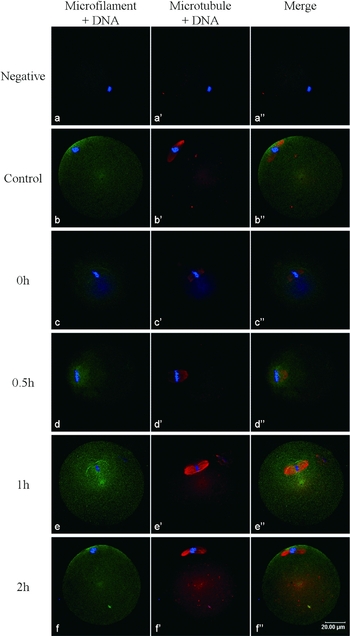
In untreated MII oocytes, microtubules were found in a well organized spindle (Fig. 1). The spindle was symmetrical, bipolar, barrel-shaped, and located near the cortex of the oocyte (Fig. 1b,b″). Immediately after CB treatment, the spindle was parallel with the plasma membrane and the microfilaments (32/32, 100%) were undetectable (Fig. 1c,c″). 0.5 h after CB treatment, the microfilaments (31/34, 91.2%) were observed around the spindle (Fig. 1d,d″); 1 h later, they were gradually re-appearing (31/33, 93.9%) in the cortical region (Fig. 1e,e″); and 2 h after treatment they were fully (34/34, 100%) restored to the untreated level. CB treatment had no effect on the microtubules (Fig. 1f,f″).
Immunofluorescence localization of microfilaments and microtubules in mouse MII oocytes with and without CB treatment. Green, microfilaments; red, microtubules; blue, DNA. Bar = 20 μm. (a,a′,a″) negative control; (b,b′,b″) untreated control; (c,c′,c″) 0 h after CB treatment; (d,d,′d″) 0.5 h after CB treatment; (e, e,′e″) 1 h after CB treatment; (f,f,′f″) 2 h after CB treatment. CB, cytochalasin B.

Effect of CB treatment on cytoskeleton-dependent events after ICSI
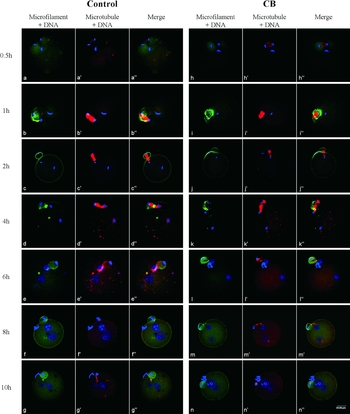
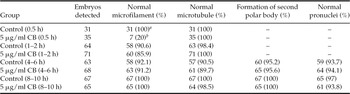
Microtubules and microfilaments were observed at various time points (0.5–10 h) after ICSI with or without CB treatment (Fig. 2; Table 3). 0.5 h after ICSI, microfilament assembly was significantly decreased in the CB-treated group (p < 0.001); however, microtubule assembly was not interrupted (Fig. 2a,a′,h,h″). From 1 to 10 h after ICSI, there were no differences in the assembly of the microtubules and microfilaments between the CB-treated and -untreated control ICSI groups. In all embryos, 1 to 2 h after ICSI (oocytes were at the anaphase of meiosis II), a dense immunofluorescence of microfilaments was detected only in the cortical region of the cytoplasm, the spindle migrated towards the cortex, daughter chromatids separated toward the two poles, and the spindle rotated from parallel to vertical with respect to the surface of the embryo (Fig. 2b,b″,c,c″,i,i″,j,j″); 4 to 6 h after sperm injection (oocytes were at the telophase stage), the spindle was oriented vertically with respect to the embryo's surface, it elongated, and the second polar body was formed and extruded into the perivitelline space (Fig. 2d,d″,e,e″,k,k″,l,l″); and 8 to 10 h after ICSI, a female pronucleus and a male pronucleus were observed in the cytoplasm (Fig. 2f,f″,g,g″,m,m″,n,n″). These data indicated that the resumption of meiosis, spindle rotation, and pronuclear formation and movement were not disturbed by CB treatment.
Immunofluorescence localization of microfilaments and microtubules in mouse zygotes after ICSI. Green, microfilaments; red, microtubules; blue, DNA. Bar = 20 μm. ICSI were performed in CZB-HEPES with or without CB. (a,a′,a″,h,h′,h″) 0.5 h after ICSI; (b,b′,b″,i,i′,i″) 1 h after ICSI; (c,c′,c″,j,j′,j″) 2 h after ICSI; (d,d′,d″,k,k′,k″) 4 h after ICSI; (e,e′,e″,l,l′,l″) 6 h after ICSI; (f,f′,f,″m,m′,m″) 8 h after ICSI; (g,g′,g″,n,n′,n″) 10 h after ICSI. CB, cytochalasin B.

Effect of CB treatment on cytoskeleton-dependent events after ICSI

a,bValues in columns with different alphabetic superscripts are significantly (p < 0.001) different. CB, cytochalasin B.
Discussion
A key factor for successful ICSI is wound healing of the oolemma after it has been pierced by the sperm injection pipette. In the past, attempts to achieve mouse ICSI were not successful, because the mouse oolemma is vulnerable to mechanical damage by micropipettes, and puncture with a piezo-driven pipette without deep insertion causes mouse ooplasm to ooze from the point of insertion and disperse rapidly into the surrounding medium. These phenomena indicated that conventional ICSI techniques result in the degeneration of mouse ICSI oocytes and the loss of many manipulated embryos, because the wound healing capacity and the viscosity of the mouse ooplasm is low. In contrast, most hamster and human oocytes survive ICSI, as the wound healing ability and the viscosity of the ooplasm is much higher in these species (Kimura & Yanagimachi, Reference Kimura and Yanagimachi1995).
In animal nuclear transfer cloning, disruption of plasma membranes by micropipettes is prevented by the microfilament depolymerization agent CB, which greatly improves the rates and efficiency of nuclear transfer (Wakayama et al., Reference Wakayama, Perry, Zuccotti, Johnson and Yanagimachi1998; Ogura et al., Reference Ogura, Inoue, Takano, Wakayama and Yanagimachi2000). CB causes a state of hyper-contraction, detaches the connections between the microfilaments and the cell membrane, and displaces the mesh of cortical microfilaments (Miranda et al., Reference Miranda, Godman and Tanenbaum1974). In oocytes, CB treatment relaxes the cytoskeleton and enhances flexibility.
In this study, we used CB to prevent the disruption of plasma membranes by sperm injection micropipettes during mouse ICSI. To our knowledge, we are the first to report that addition of CB into the manipulation medium successfully increased the survival rate of ICSI oocytes and embryos. In addition, we investigated the latent effects of CB treatment of preimplantation mouse embryos on postimplantation development. We found that pronuclear formation, cleavage, blastocyst formation, pregnancy, and birth rates were not significantly decreased in the CB treatment group (Table 1). These results are in accordance with those reported previously that showed that 1- or 2-cell stage preimplantation mouse embryos treated for 6-12 h with 5-10 μg/ml CB could develop to the blastocyst stage and beyond (Snow, Reference Snow1973, Reference Snow1975; Niemierko, Reference Niemierko1975; Tarkowski et al., Reference Tarkowski, Witkowska and Opas1977); and that the effects of CB on many cell types were completely reversible (Spooner et al., Reference Spooner, Yamada and Wessells1971; Yamada et al., Reference Yamada, Spooner and Wessells1971; Schaeffer et al., Reference Schaeffer, Schaeffer and Brick1973).
Microtubules and microfilaments are the main components of the cytoskeleton in eukaryotic cells. The nucleation and functions of microfilaments have been extensively investigated. Evidence suggests that new actin filaments are formed by the cutting of existing filaments or by the action of specialized nucleating components, and that eukaryotic cells require filamentous actin for migration, growth, polarization, organelle movement, endocytosis/exocytosis, replication, gene regulation, and to maintain their shape. Currently, information describing the roles of actin filaments in germ cell development, fertilization, and the early embryo is limited. Previous reports indicated that meiotic maturation of mammalian oocytes is a complex process that involves extensive rearrangement of microtubules and actin filaments (Roth & Hansen, Reference Roth and Hansen2005); and that the transition from meiosis MI to MII was inhibited and most oocytes were arrested at the MI stage in pig and mouse oocytes exposed to CB or cytochalasin D (CD) (5–10 μg/ml) (Soewarto et al., Reference Soewarto, Schmiady and Eichenlaub-Ritter1995; Wang et al., Reference Wang, Abeydeera, Prather and Day2000; Sun et al., Reference Sun, Lai, Park, Kuhholzer, Prather and Schatten2001). CB is cytotoxic and has harmful effects on early embryo development (Kato & Tsunoda, Reference Kato and Tsunoda1992; Otaegui et al., Reference Otaegui, O'Neill, Campbell and Wilmut1994; Wakayama & Yanagimachi, Reference Wakayama and Yanagimachi2001). However, our results are in contrast to those reported here. We speculated that short time expose to CB is no harm for both in vitro and in vivo development.
The growth, maturation, and fertilization of oocytes require the active movement and correct localization of cellular organelles, which is achieved by the re-organization of microtubules and actin filaments (Sun & Schatten, Reference Sun and Schatten2006). In mouse oocytes, chromosome migration and polar body formation do not occur in the absence of microfilaments, indicating that microfilaments are required to elicit a suitable position for polar body formation (Longo & Chen, Reference Longo and Chen1985). In the present study, we used immunohistochemistry to observe the dynamic changes in the assembly and disassembly of microtubules and microfilaments in CB-treated and untreated control mouse ICSI oocytes and embryos. In MII oocytes, the microfilaments were immediately disassembled by CB treatment; however, they reassembled 0.5 h after treatment and returned to untreated levels within 2 h. Microfilaments in MII oocytes were only detected in the cortical region. In ICSI embryos, the second polar body was normally extruded and the microfilaments were concentrated at the cell surface and around the meiotic spindle in both the CB-treated and control groups. Furthermore, 30-min CB treatment did not inhibit spindle rotation, pronuclei migration, or polar body formation. Previous studies indicate that 2 h CB treatment does not inhibit second polar body extrusion (Zhu et al., Reference Zhu, Chen, Li, Lian, Lei, Han and Sun2003), that microfilaments are not necessary for successful fertilization, and that microfilaments have crucial roles in the rotation of the meiotic spindle, formation of the polar body, and migration of the pronuclei toward the central region of the zygote (Maro et al., Reference Maro, Johnson, Pickering and Flach1984, Reference Maro, Kubiak, Gueth, De Pennart, Houliston, Weber, Antony and Aghion1990). Together with these data, our results suggest that the effects of short-term CB exposure on microfilaments in mouse ICSI oocytes are reversible and do not result in any in vitro or in vivo impairment of development. In addition, microtubules were not affected by CB treatment during our investigations.
Recent studies have found that ART can induce changes in imprinted gene expression and DNA methylation (Shiota & Yamada, Reference Shiota and Yamada2005; Paoloni-Giacobino, Reference Paoloni-Giacobino2006). In our study, the number of ICSI pups per litter was 3–4, and the mean birth weight of the ICSI offspring was 1.7 g. In contrast, control pregnant mice give birth to litters of 10 with a mean pup weight of 1.3 g (Scott et al., Reference Scott, Yamazaki, Yamamoto, Lin, Melhorn, Krause, Woods, Yanagimachi, Sakai and Tamashiro2010). This birth weight variance may be derived from epigenetic changes resulting from the ICSI technique or be caused by the decreased number of ICSI fetuses per litter receiving more nutrition in the uterus; further studies are needed to investigate these differences.
In summary, we determined the effects of CB treatment on the viability and developmental rate of mouse ICSI embryos. The survival rate of the CB-treated group was significantly higher than that of the untreated controls as CB treatment prevented avulsion and effusion of the ooplasm of mouse oocyte. Furthermore, we verified that the development of the ICSI oocytes, the pregnancies, and the ICSI offspring were not affected by CB treatment. These data suggest that the survival rate of mouse embryos after ICSI can be improved by CB treatment without any impairment of in vitro or in vivo development. The results of this study will contribute to the establishment of a reliable efficient mouse ICSI technique, which will be valuable for designing and improving human ICSI protocols in the absence of ethical issues.
Acknowledgements
This study was supported by the Innovative Fund of Harbin Medical University Graduate Student (grant no. HCXS2010002) and the National Natural Science Foundation of China (grant no. 30671025). The authors thank the Department of Pharmacy of Harbin Medical University for providing techniques of confocal microscope used in this study.