


The National Institute for Clinical Excellence (NICE) guidelines on eating disorders (National Collaborating Centre for Mental Health, 2004) highlight the paucity of information available to guide practitioners in the treatment of anorexia nervosa. Interventions that involve the family are recommended for adolescent patients; however, there is less certainty about best practice for adult patients. Previous research has found that the parents of adult patients have high levels of distress (Reference Haigh and TreasureHaigh & Treasure, 2003) and find the caring role burdensome (Reference Treasure, Murphy and SzmuklerTreasure et al, 2001; Reference Perkins, Winn and MurrayPerkins et al, 2004). The aim of our study was to obtain a detailed understanding about the experience of caregiving using a qualitative analysis of carers’ narratives. Our hypothesis was that carers hold models of the illness that may be unhelpful (Reference Treasure, Gavan and ToddTreasure et al, 2003) and that this might both underpin their distress and maintain the illness. The overall aim is to develop a conceptual framework for interventions that optimise carers’ coping, reduce maintaining factors and improve the overall outcome.
METHOD
Setting
The eating disorders in-patient unit of the South London and Maudsley National Health Service (NHS) trust is a national and local referrals unit. All patients admitted to the unit and their families are encouraged to take part in a family-based intervention, part of the in-patient programme.
During the time of this study, patients (all of whom were female) and their families were randomly assigned to one of two family interventions. Families were either seen individually on a weekly basis for approximately 18 weeks (treatment as usual), or in conjunction with another family for an intensive 3-day workshop intervention. The aim of both interventions was to promote carer efficacy by providing psychoeducation and teaching motivational communication skills. The two interventions used similar techniques and were facilitated by the same mental health professionals.
At the end of the first day (or around the fifth session) carers were asked to complete a therapeutic writing task. Carers were instructed to write in their own time a letter describing what it is like to be the mother/father/sister/partner of someone with anorexia nervosa, and to bring it to the following session to read and discuss with the group. Carers were not given any time or length restraints for this exercise. All carers consented to their letters being used for teaching and research purposes. Ethical approval was obtained for this project and written consent was obtained from the participants.
Participants
Letters from 20 fathers and 20 mothers were collected and included in the analysis. For 13 patients, both parents’ letters were included; for the other 14 patients only one parent's letter was available. The mean age of carers was 52.7 years (range 40–66). The mean age of the mothers was 50.8 years (range 40–60) and that of the fathers was 54.4 years (range 45–66). The 27 patients had a mean age of 20.5 years (range 14–31) and a mean body mass index of 13.6 kg/m2 (range 10.8–16.9) at admission. Approximately 45% of the patients had a duration of illness of greater than 5 years, and about 20% had a duration greater than 10 years. Approximately 65% of patients and their families participated in the family intervention offered within the in-patient service. This is a representative sample of families presenting to a local and national in-patient service, as only 10% of patients and their families refused to take part. Others could not participate for reasons such as lack of family and self-discharge.
Qualitative analysis
Letters were analysed using the ‘constant comparative’ method of the grounded theory approach (Reference Glaser and StraussGlaser & Strauss, 1967). Using this approach, no pre-existing category is imposed on the data but themes begin to emerge as the analysis takes place. The researcher generates as many themes as possible, while at the same time comparing them with previous incidents coded under the same theme. Similarities and differences between themes are examined. This allows the researcher to develop hierarchical coding systems and devise a theoretical framework (Reference Glaser and StraussGlaser & Strauss, 1967; Reference WilligWillig, 2001).
Two authors (J.W. and J.T.) initially examined the letters to identify emerging themes. Letters were separated into statements and a line-by-line open coding session was performed to ensure that the analysis was grounded to the data and comprehensive. The coding scheme generated by the lead investigator (J.W.) was used to code all the letters; this author continually checked and modified the coding framework to ensure that it incorporated all information within the transcripts. To ensure reliability of the findings, the devised coding scheme was given to an additional investigator (K.G.) to code a random set of 15 letters. A k coefficient of 0.61 was found, illustrating good interrater reliability of the coding scheme. The coding scheme was shown to be comprehensive and no new theme emerged. Once themes and categories were found, the authors examined models in the mental health and caregiving literature that corresponded with the findings.
Computerised text analysis
The narratives were also analysed using a computerised text analysis program, the Linguistic Inquiry and Word Count (LIWC; Reference Pennebaker and FrancisPennebaker & Francis, 1999). This program is designed to analyse text according to emotional, cognitive, structural and linguistic processes used within the writing. It conducts a word-by-word analysis and assigns words to over 70 categories, and then calculates the percentage of words in each category. Results from 43 individual studies were compiled by Pennebaker & Francis (Reference Pennebaker and Francis1999) to produce mean reference values for ‘emotional writing’ (when individuals are asked to write about deeply emotional topics) and ‘control writing’ (when asked to write about non-emotional topics). These published reference values were used for comparison. Analyses were conducted between genders using robust standard errors to control for the clustering of families.
RESULTS
The endeavour of carers to understand, explain and cope with the illness was evident within their narratives. Sixteen low-order themes emerged. The themes were grouped into six higher-order categories:
-
(a) perceptions regarding illness characteristics;
-
(b) patient, carer and treatment control;
-
(c) illness coherence;
-
(d) effect on the family;
-
(e) emotional response;
-
(f) cognitive strategies.
The higher-order categories and the 16 themes within them are illustrated in the following text and quotations. The six higher-order categories corresponded with several theoretical models within the existing literature: illness perception, burden and coping response. Examination of these theoretical models was used to understand the carers’ stress. Carers’ narratives highlighted some maladaptive appraisals and responses, and significant gender differences.
Carers’ illness perceptions
Perceptions regarding illness characteristics
Most carers discussed their views of the nature or characteristics of the illness. Carers were perplexed about the cause and contributing factors of the illness. Mothers and fathers equally placed blame on themselves, questioning aspects of their daughter's upbringing and what could have been done differently to prevent the illness. Most parents perceived the illness to be chronic, expressing pessimism about their daughter's ability to overcome the illness and readjust to ‘normal life’. One of the most predominant themes concerned the consequences of the illness. Carers perceived negative impacts on the patients’ physical, mental and social well-being. Both mothers and fathers believed that the illness had resulted in their daughter becoming more dependent and demanding, with a lower sense of self-worth. Fathers expressed greater concern regarding the detrimental effects on their daughter's physical health, whereas mothers expressed greater regret over lost opportunities. The following quotations are examples of carers’ perceptions regarding the nature and characteristics of the illness.
Cause
‘Guilt is the most difficult to deal with because we still don't know what has caused the anorexia’ (father 1).
‘Not knowing what I have done to bring this on or what has someone else done’ (father 12).
Illness longevity
‘She will take years to readjust to a normal life; she may never be able to do so’ (mother 1).
‘I realise that the sufferer will always have to live with this condition’ (father 2).
Symptoms and consequences
‘Severe weight loss would lead to chronic malnutrition with long-term effect on health’ (father 5).
‘Anorexia has turned her into a person she sees as worthless’ (father 8).
Patient, carer and treatment control
Several themes regarding control over the illness emerged within carers’ narratives. Although the majority believed that their child had the ability to conquer her illness, others regarded their child as a victim, engulfed by the illness and with no control over the outcome. Most parents expressed their own helplessness in trying to control the illness. They perceived any attempt to help on their part as unproductive. Carers expressed relief that their child was receiving treatment and fathers, in particular, had hope and faith in the outcome of treatment.
Patient control
‘Perhaps I have to accept what she has decided for herself’ (mother 1).
‘The sufferer is the only one who can “do it”’ (father 2).
Carer control
‘I try to do what I think is right at the time but it always seems so wrong’ (mother 17).
‘Nothing you do or say makes a difference’ (father 3).
Treatment control
‘The only time you can relax a little or have any comfort is now when she is in the eating disorders unit because of the methods of treatment she becomes healthier physically’ (father 13).
‘Since [my daughter] has been admitted to hospital I can now see the daylight at the end of the tunnel’ (father 7).
Illness coherence
Despite their attempts to educate themselves about anorexia nervosa, carers were perplexed, particularly by the underlying mechanisms of the illness. As illustrated in the following quotations, carers express bewilderment caused by the pure complexity and seriousness of the illness. Fathers tended to express their own bewilderment, whereas mothers were more inclined to express frustration caused by others’ lack of understanding. Carers felt that although friends and relatives tried to provide support, they could not appreciate the difficulties experienced by both parents and child.
Carers’ illness coherence
‘To live with a loved one refusing to eat is the ultimate to life's very being. We need food in order to survive. Why challenge this basic fundamental?’ (father 4).
‘When the true extent of her illness was explained to us,Ihad noidea she was so desperately ill’ (mother 8).
Others’ understanding of the illness
‘The trouble is that very few people totally understand what you are going through’ (mother 1).
‘As for friends and relatives, until they experience the illness, they just do not understand, and are inclined to ignore her’ (father 7).
Impact of the illness
Effect on the family
Many carers felt that the illness had profoundly affected them, with approximately half expressing a sense of being manipulated and controlled by the illness. Both mothers and fathers described a very dependent relationship, with the patient dominating the carers’ time and making unreasonable demands of them, as illustrated by the statements below. Carers felt that the illness contributed to friction within relationships, arguments between family members and a stressful atmosphere within the household. The impact on their own mental and physical health was noted, and several fathers expressed concern about the impact on their wife and on other family members. Finally, parents were concerned about the effects on the family's social life and difficulties in making future plans.
Interference with family life
‘With a child at home with this illness, one has to make lots of changes to one's lifestyle: going out as a family, going on holiday, seeing friends, etc.’ (father 11).
‘I‘I feel it is putting strain on our marriage feel it is putting strain on our marriage as [my husband] wants to get on with life’ (mother 9).
Control and over-involvement
‘Why give in to her all the time? Why spoil her? Why let her ruin your life? Why let her dominate your life?’ (mother 1).
‘The sufferer has to be given more and more of one's time and energy until the basic element of togetherness is under threat’ (father 1).
Emotional and cognitive processes
Emotional response
All carers, with one exception, expressed some negative emotions, varying from sadness and distress to fear, anger and hostility. Many expressed self-blaming emotions such as guilt, failure and inadequacy. Several parents – primarily mothers – demonstrated an overwhelming emotional response, including sleep deprivation, preoccupation and feelings of hopelessness. There were also positive themes within this domain, with fathers tending to express greater affection towards their daughters, pointing out their admirable qualities and their own desire to support and protect them. Mothers described a sense of support when close friends and relatives provided empathy. However, when referring to acquaintances perceived as less informed, carers expressed reluctance in discussing the illness for fear of stigmatisation. Mothers and fathers felt angry at the stigma associated with eating disorders and the tendency for others to trivialise the illness. The following quotations illustrate the parents’ emotional responses.
Negative emotions
‘Above all there is an abiding and profound sadness’ (father 20).
‘So how does a mother feel? Failed, useless, bad, stupid, guilty, guilty, guilty’ (mother 7).
Love and affection
‘[She] is a talented and intelligent girl who was the life and soul of the family’ (father 8).
‘I just feel how I would like to sit with her, give her a big hug, and tell her how special and muchloved she is’ (mother 10).
Responses to other's reactions (stigma and social support)
‘Luckily I have a fantastic partner who is a rock. I have an incredible sensitive and caring older daughter’ (mother 7).
‘When she was very thin and we were all outto together,I got very angry when people would stop and stare at her, nudge their companion to look as well’ (father 7).
Cognitive strategies
Cognitive coping strategies such as hope and optimism, self-distraction and cognitive reconstruction were described. Wishful thinking was employed – predominantly by fathers – as an attempt to reduce hopelessness and cynicism regarding the future. Fathers were also more likely to articulate their attempts to distract themselves from the situation, often concentrating on work to reduce preoccupation with the illness. Some carers used the strategy of clearly conceptualising the illness as something independent of the patient, describing it as an ‘enemy’ or ‘impostor’. Examples of statements in which the carer uses this method of externalising the illness are included in the following quotations.
Hope and optimism
‘Hope that we will all be able to enjoy life again, for ourselves and each other in a settled and happy time’ (mother 13).
‘You pray for a miracle, and sometimes they happen. Then you pray it willlast’ (father 12).
Self-distraction
‘I am able to immerse myself in work or other projects and for that period of time to put [her] to the back of my mind’ (father 1).
‘I now didn't find mealtimes a pleasure and tried to avoid them by going to the gym and getting back after supper’ (father 14).
Cognitive reconstructions
‘Having to witness my beautiful, kind friend become possessed with an evil, alien personality that made her antisocial, cruel, rude and illogical’ (mother 18).
‘In reality, anorexia is a false, devious enemy posing as a friend to my daughter’ (father 10).
Maladaptive beliefs and responses
Detrimental appraisals were evident within carers’ narratives, highlighting misperceptions about their own or their daughter's role in causing the illness and their lack of efficacy, as illustrated in the following statements.
Self-blame (causal misperception)
‘I feel guilt because I must have influenced this illness in some way; it is inevitable as a parent that I could have been in a position to do something to have helped her sooner’ (father 8).
Patient blame (efficacy misperception)
‘It is appalling because she has chosen it’ (mother 7).
Helplessness (efficacy misperception)
‘You just want to help her as much as you can. Nothing you do or say makes a difference’ (father 3).
Maladaptive responses were also apparent. Carers’ behavioural responses appeared to be exaggerated, as shown by their overprotective and highly anxious responses.
Overprotective response
‘You cling to any sign of eating something, you put up with very lengthy trips to the supermarket, sometimes hours, in the hope that they will actually allow you to buy something, backwards and forwards across the supermarket, putting items in and taking them out of the trolley, and not much atthe end of it’ (father 12).
Over-anxious response
‘I was very emotional and couldn't talk to anyone without crying and I could not sleep very well and often cried myselfto sleep as I could see what was happening to [her] and just felt helpless’ (mother 6).
Gender differences
The main gender difference between the accounts was the tendency for mothers to express greater anxiety, whereas fathers produced more cognitive and detached accounts, with a greater use of cognitive and avoidant coping strategies.
Validation
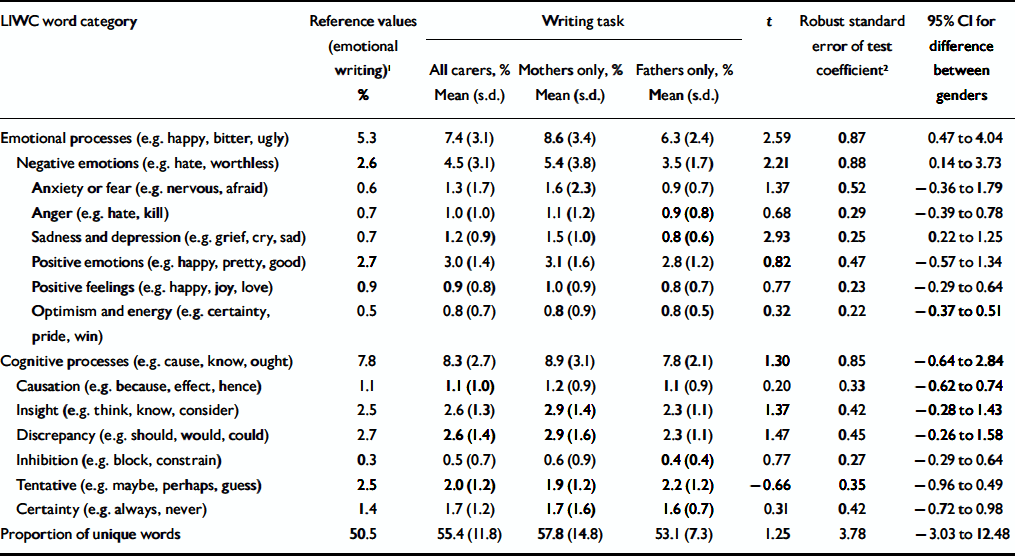
The results of the LIWC analysis are presented in Table 1. The texts included a high proportion of emotional words, particularly negative emotions. The proportions of fear and anxiety words were double those reported in emotional writing norms. There was a significant gender difference in the use of emotional words. Mothers used a significantly higher proportion of emotion words (t=2.59, P=0.015), particularly negative emotions (t=2.21, P=0.036), with the greatest difference in the sadness and depressive domain (t=2.93, P=0.007).
Text analysis using the Linguistic Inquiry and Word Count
| LIWC word category | Reference values (emotional writing)1 % | Writing task | t | Robust standard error of test coefficient2 | 95% CI for difference between genders | ||
|---|---|---|---|---|---|---|---|
| All carers, % Mean (s.d.) | Mothers only, % Mean (s.d.) | Fathers only, % Mean (s.d.) | |||||
| Emotional processes (e.g. happy, bitter, ugly) | 5.3 | 7.4 (3.1) | 8.6 (3.4) | 6.3 (2.4) | 2.59 | 0.87 | 0.47 to 4.04 |
| Negative emotions (e.g. hate, worthless) | 2.6 | 4.5 (3.1) | 5.4 (3.8) | 3.5 (1.7) | 2.21 | 0.88 | 0.14 to 3.73 |
| Anxiety or fear (e.g. nervous, afraid) | 0.6 | 1.3 (1.7) | 1.6 (2.3) | 0.9 (0.7) | 1.37 | 0.52 | -0.36 to 1.79 |
| Anger (e.g. hate, kill) | 0.7 | 1.0 (1.0) | 1.1 (1.2) | 0.9 (0.8) | 0.68 | 0.29 | -0.39 to 0.78 |
| Sadness and depression (e.g. grief, cry, sad) | 0.7 | 1.2 (0.9) | 1.5 (1.0) | 0.8 (0.6) | 2.93 | 0.25 | 0.22 to 1.25 |
| Positive emotions (e.g. happy, pretty, good) | 2.7 | 3.0 (1.4) | 3.1 (1.6) | 2.8 (1.2) | 0.82 | 0.47 | -0.57 to 1.34 |
| Positive feelings (e.g. happy, joy, love) | 0.9 | 0.9 (0.8) | 1.0 (0.9) | 0.8 (0.7) | 0.77 | 0.23 | -0.29 to 0.64 |
| Optimism and energy (e.g. certainty, pride, win) | 0.5 | 0.8 (0.7) | 0.8 (0.9) | 0.8 (0.5) | 0.32 | 0.22 | -0.37 to 0.51 |
| Cognitive processes (e.g. cause, know, ought) | 7.8 | 8.3 (2.7) | 8.9 (3.1) | 7.8 (2.1) | 1.30 | 0.85 | -0.64 to 2.84 |
| Causation (e.g. because, effect, hence) | 1.1 | 1.1 (1.0) | 1.2 (0.9) | 1.1 (0.9) | 0.20 | 0.33 | -0.62 to 0.74 |
| Insight (e.g. think, know, consider) | 2.5 | 2.6 (1.3) | 2.9 (1.4) | 2.3 (1.1) | 1.37 | 0.42 | -0.28 to 1.43 |
| Discrepancy (e.g. should, would, could) | 2.7 | 2.6 (1.4) | 2.9 (1.6) | 2.3 (1.1) | 1.47 | 0.45 | -0.26 to 1.58 |
| Inhibition (e.g. block, constrain) | 0.3 | 0.5 (0.7) | 0.6 (0.9) | 0.4 (0.4) | 0.77 | 0.27 | -0.29 to 0.64 |
| Tentative (e.g. maybe, perhaps, guess) | 2.5 | 2.0 (1.2) | 1.9 (1.2) | 2.2 (1.2) | -0.66 | 0.35 | -0.96 to 0.49 |
| Certainty (e.g. always, never) | 1.4 | 1.7 (1.2) | 1.7 (1.6) | 1.6 (0.7) | 0.31 | 0.42 | -0.72 to 0.98 |
| Proportion of unique words | 50.5 | 55.4 (11.8) | 57.8 (14.8) | 53.1 (7.3) | 1.25 | 3.78 | -3.03 to 12.48 |
DISCUSSION
The qualitative analysis of parents’ accounts of caring for an offspring with anorexia nervosa has identified themes relating to carers’ illness perceptions, impact of the illness on the family, and carers’ emotional and cognitive processes. The themes and categories found within carers’ narratives correspond with existing theoretical models and concepts within mental health and caregiving literature. Illness attributions, carers’ burden and coping responses are predominant concepts within recent stress and coping frameworks.
Coping responses
Carers used a variety of coping responses to manage their anxiety and the demands placed upon them. Although some of the narratives illustrated adaptive coping responses such as focusing on their own interests, showing hope and optimism, seeking social support and externalising the illness, others produced themes suggesting maladaptive coping. For example, some carers, particularly mothers, expressed profound anxiety which in some cases appeared to reach clinical severity. Others expressed negative appraisals of the illness linked to hostility and criticism towards the patient and themself, and an overprotective response to the illness. The computerised text analysis of the narratives confirmed some of the findings from the thematic analysis. The level of emotion expressed within the narratives was higher than has been reported in the literature of other emotional writing settings (Reference Pennebaker and FrancisPennebaker & Francis, 1999), particularly for the mothers.
Previous research
These results are consistent with previous caregiving research which has found that women carers are more emotionally involved (Reference Stern, Doolan and StaplesStern et al, 1999), whereas men tend to distance themselves (Reference Morris, Woods and DaviesMorris et al, 1991) or use cognitive restructuring to manage the emotional impact (Reference Barusch and SpaidBarusch & Spaid, 1989). The heightened anxiety and overprotective response paired with the hostility and criticism correspond to the concept of ‘high expressed emotion’. This emotional response style in carers is widely recognised to be associated with a poor outcome in mental illness (Reference Wearden, Tarrier and BarrowcloughWearden et al, 2000) and has an important impact on the outcome (Reference Van Furth, van Strien and Martinavan Furth et al, 1996), withdrawal rates (Reference Szmukler, Eisler and RussellSzmukler et al, 1985) and response to treatment (Reference Eisler, Dare and HodesEisler et al, 2000) in anorexia nervosa.
Strengths and limitations
This is an exploratory study with a restricted methodology, which limits the conclusions that can be drawn. Parents’ accounts were produced as a therapeutic exercise, allowing open-ended and unguided narratives, although with the purpose of using the material in the process of treatment, which might have led to some bias in reporting. Specifically, there was a clear benefit of highlighting specific perceptions and responses that are viewed as unproductive. We used two approaches for the analysis of the texts. Although the thematic analysis of carers’ accounts allowed a comprehensive, unconfined exploration of the data, reliability and researcher bias are questionable within such approaches. Conversely, the computerised text analysis program LIWC is a widely used tool which provides a reliable, unbiased analysis of the data, but is limited by its rigid categories and purely literal analysis of the text, which restricts its use for meaning. These complementary approaches produced similar findings, suggesting a degree of validation in the results. The generalisability of the findings is uncertain, because the sample consisted of carers of patients who were receiving specialist in-patient care and thus were at the severe end of the illness spectrum. Many wrote about the illness in terms of a medical model (e.g. causes and chronicity of the illness). Their beliefs about the condition are likely to have been influenced by exposure to a psychiatric setting. It is possible that those caring for people with less severe illness, who have not received hospitalised care, would articulate more general or lay beliefs about the illness.
Clinical implications and recommendations
The overall aim of the study was to develop a conceptual framework for an intervention to optimise carers’ coping and reduce any interpersonal maintaining factors. The analysis of the parents’ accounts of caring for someone with anorexia nervosa has identified important clinical considerations for the development of new interventions.
Changing illness perceptions
This study identified several themes related to the carers’ perceptions of the illness which may contribute to carers’ distress. Carers were generally puzzled by the onset and persistence of the illness and tended to blame themselves. They felt helpless regarding control over the illness and were pessimistic about the outcome and long-term consequences. These negative attributions may be linked to anxiety and depression in the carers. An intervention using cognitive–behavioural strategies to modify these hopeless and helpless attributions might improve carers’ coping.
Reducing unhelpful interaction, overinvolvement and criticism
Many letters expressed themes relating to high expressed emotion: overprotection, criticism and hostility. Interventions that include a functional analysis of interactions might decrease these unhelpful responses.
Encouraging coping behaviours
Carers, particularly mothers, experienced a high intensity of negative emotions. A high level of emotional arousal, marked by preoccupation and sleep deprivation, leads to physical and mental exhaustion. Carers articulated some coping strategies that they used. Fathers were generally more likely to be able to distance themselves, whereas mothers were more able to elicit support from close family and friends. Carers also adopted the philosophy used by our service to externalise the illness. Work with families therefore needs to include strategies to reduce carers’ highly aroused state. Teaching carers the skills of reflective listening can decrease confrontational interactions. Carers should also be encouraged to seek services such as support groups and take respite when necessary.
Carers’ bewilderment regarding anorexia nervosa may reflect a lack of consensus among professionals about the underlying factors and treatment methods. There should be a closer relationship between services, in an attempt to come to a shared understanding and philosophy, as promoted by the NICE guidelines.
Developing services
Following from the analysis, we have developed a curriculum that teaches carers the skills required to optimise the management of severe eating disorders. This programme involves modules on coping, medical risk, understanding change, communication, emotion processing, problem-solving, interpersonal relationships and managing eating and other difficult behaviours, supplemented with skills-based workshops teaching parents key elements of motivational interviewing and cognitive–behavioural therapy. Carer workshops allow carers to form support networks while learning skills that help reduce interpersonal maintaining factors and promote patient recovery. We recommend that other services adopt a collaborative approach with carers, offering psychoeducation and providing them with the motivational techniques and skills used by professionals within the field.
Clinical Implications and Limitations
CLINICAL IMPLICATIONS
-
▪ Carers’ appraisals of the causes, consequences and outcomes of anorexia nervosa may be detrimental and contribute to an emotional and behavioural response that may be maladaptive.
-
▪ Some carers, mothers in par particular, ticular, are highly distressed by the illness and might benefit from an assessment of their needs, as recommended by the National Service Framework for Mental Health.
-
▪ Interventions that interrupt overprotective and highly emotional responses to the illness may improve the patients’ outcome.
LIMITATIONS
-
▪ Narratives were collected with the purpose of using the material in the process of treatment. This might have led to some bias in reporting.
-
▪ Although the design facilitated an unguided and open narrative, the material was limited and individual themes could not be examined in greater depth.
-
▪ There is a question of generalisability of the findings, as the sample consisted of carers of patients receiving specialist in-patient care and thus at the severe end of the illness spectrum.
Acknowledgements
This research was funded by Nina Jackson's ‘Research Into Eating Disorders'through the charitable organisation the Psychiatry Research Trust, at the Institute of Psychiatry, and through the Dischma Charitable Trust.
The authors thank all the carers and professionals for their help in conducting this study. Particular thanks are due to Dr Nick Troop, Professor John Weinman, Dr Karen Baistow and Rebecca Walwyn for their advice and assistance in conducting the analysis.




eLetters
No eLetters have been published for this article.