‘Paris has soldiers and it has singers! It has cannons and violins!’
Villiers de L'Isle-Adam, May 1871Footnote 1At 2pm on 1 May 1871, an unlikely assortment of figures from the worlds of music and politics gathered at the Paris Opéra. In March of that year, following the collapse of the Second Empire, a five-month siege of Paris, and military defeat at the hands of the Prussians, Parisian workers had revolted and established a municipal government, the Paris Commune.Footnote 2 Just over a month into their reign the Communards decided to make use of the capital's most famous musical institution: a meeting was called of the Opéra's musical and administrative personnel, to be chaired by the Communard Secretary-General of the ex-Prefecture of Police, Dr Albert Regnard.Footnote 3 Over the course of the next few weeks, the Communards planned what was to be a monumental concert at the Opéra, scheduled for 22 May 1871. On 21 May, the Republican army entered Paris, sparking the semaine sanglante, a week in which between 10,000 and 30,000 Communards were killed and much of the city was burnt and left in ruins. The concert at the Opéra did not take place.
Although much has been written on the relationship between French ruling powers and the Paris Opéra, relatively little attention has been paid to this relationship during the Commune of 1871.Footnote 4 Interest in the music of the Commune has instead tended to concentrate on the wealth of popular song that it inspired: it was, after all, a people's uprising, and the musical genre most closely associated with ‘le peuple’ is song.Footnote 5 This emphasis has played conveniently into the image of the stereotypical revolutionary. More recently, however, scholars such as Jess Tyre and Nicole Wild have begun to redress the balance, demonstrating the interest that the Communard leaders had in promoting more serious musical culture.Footnote 6 The most obvious way for the Commune to do this was to take command of the Opéra, the centre of elite musical life in the French capital: it is the story of this attempted takeover that forms the heart of this article. But controlling the Opéra was by no means the Commune's only foray into promoting serious music. Indeed, many concerts took place in Paris during the spring months of the uprising.Footnote 7 Of these, none could compare in size, ambition and symbolic power with the four extraordinary concerts at the Tuileries Palace between 6 and 21 May.
The Tuileries concerts, the first major musical events of the Commune, provide a useful starting point for understanding the importance of the Opéra to the Communards, and also for understanding their use of serious music and musical events more generally. These concerts prepared the ground for the Opéra through programmes that placed operatic extracts, and orchestral and chamber works, alongside popular songs and poetry readings; the Opéra was to take this further, with a programme largely shorn of the more populist elements.
This period in Parisian musical history benefits from a rich collection of materials held in the Archives Nationales and the Bibliothèque-Musée de l'Opéra in Paris. For the present essay, one of the most valuable sources in this collection is the Journal de la régie for 1871, written by the Opéra's régisseur Georges Colleuille, which provides a detailed, if anti-Commune biased, account of the Commune's direction of the Opéra between 1 and 22 May 1871.Footnote 8 Drawing on this source, alongside a wide range of primary materials, particularly press reports and personal memoirs, this study will begin with a consideration of the organisation, critical reception, and ideological significance of the Tuileries concerts and their audiences as a background against which to investigate the Commune's relationship with the Opéra. An examination of these musical ventures at the Tuileries and Opéra illuminates the ways in which together they exemplified a number of the themes and ideologies that were central to the Commune as a whole, including an obsession with the Revolution of 1789 and a desire to educate the public through the performance of serious music. Perhaps most important, in staging these musical events (and non-events), the workers' government, frequently described by its opponents as barbaric and primitive, sought legitimation through the appropriation of the space and culture of the ousted ruling classes. Ultimately this plan would backfire: far from being taken seriously, the Communards would be described by their critics as little more than characters in their own operatic drama.
La musique aux Tuileries
The Tuileries concerts, organised by the head of the army ambulances (temporary hospitals), Doctor Rousselle,Footnote 9 took place at the Tuileries palace on 6, 11, 18 and 21 May, in aid of the widows and orphans of the Republic.Footnote 10 They were eclectic to say the least: grandes tragédiennes from the Comédie-Française performed alongside boulevard actors, Conservatoire professors rubbed shoulders with cabaret singers. It seems that participation was not always entirely voluntary, and, in some circumstances, would have serious career consequences. The appearance of popular café-concert singers such as Rosalie (Rosa) Bordas – a favourite among the working classes – was only to be expected, but the inclusion of Conservatoire Professor Charles Dancla was more remarkable.Footnote 11 He later described the circumstances:
Some of my excellent colleagues … told me to refuse … How easy it was [to refuse] when the ‘invitation’ was made in a charming and gracious manner by a dozen strapping men more or less bedizened with various costumes and armed to the teeth, who came to the house to kidnap one in order that they be honoured with one's presence and one's violin bow!Footnote 12
But it was more than simply intimidation that encouraged him. Dancla believed that, like doctors, artists also had a duty to put their talent to good use by helping the poor and needy with benefit concerts, no matter who was organising them.Footnote 13 This reasoning was also offered by Marie Léonide Charvin, known as Agar, one of the leading lights of the Comédie-Française, who took part in three of the Tuileries concerts. Agar also made it clear, however, that, charitable duties aside, she was acting under the orders of the general administrator of the Comédie-Française, Edouard Thierry.Footnote 14 Despite these explanations for her participation, Agar was persecuted by the anti-Commune press, with criticism focusing on reports that she had performed the Marseillaise for Communard audiences – an act that she denied.Footnote 15 The police maintained a file on the actress, and allegations about her Communard allegiance continued through the 1870s, including Le Figaro's claim that she had failed to save Georges Darboy, the Archbishop of Paris, who was taken hostage by the Communards and shot on 24 May 1871.Footnote 16 As a result of these persistent allegations, Agar was finally forced to leave the Comédie-Française in 1872.Footnote 17 Interestingly, Agar's male colleague at the Comédie-Française, Ernest Coquelin, had appeared alongside the actress at the Tuileries but suffered no consequences: ‘If I were a man’, Agar wrote, ‘it would be different. But, alas! I am only a woman.’Footnote 18
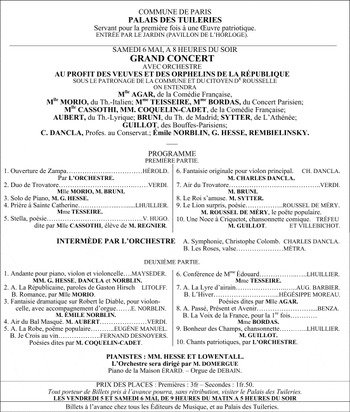
The programmes of the Tuileries concerts matched the eclectic backgrounds of the performers: the first, held in the Salle des Maréchaux (also known as the Salle du Trône), established a template (Table 1).Footnote 19 As can be seen from the programme, operatic numbers appeared alongside popular songs and instrumental works. Interspersed among the musical numbers were poetry readings, ranging from the more serious stanzas of Victor Hugo's ‘Stella’ to the comic ‘Je crois au vin’ by Fernand Desnoyers.Footnote 20 There were also a number of unscheduled performances demanded by the audience: most famously, Rosa Bordas was called upon for the rousing popular song ‘La Canaille’.Footnote 21
Reproduction of the Programme for the Tuileries Concert, 6 May 1871; Archives Nationales AJ13 445 Part 3 ii

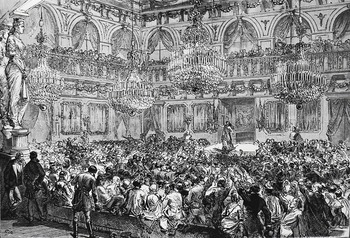
This kind of mixed-genre programme was not unusual – it had been the staple entertainment since the start of the Franco-Prussian War. What was new was the audience: at the start of the Commune many among the aristocracy and bourgeoisie had left Paris, leaving more and more seats at theatrical and musical events open to the lower classes. They were not, however, the only stratum of society present: audiences also contained journalists, intellectuals who supported the Commune, shopkeepers reluctant to abandon their businesses, soldiers, the idle rich, and members of the bourgeoisie who, sympathetic to the Commune at the start, found themselves unable to escape once their sympathy had ebbed.Footnote 22 There were also politicians, although those on the opposing side had to be careful: the Republican deputy and musicologist Victor Schœlcher attended one of the Tuileries concerts only to be spotted and arrested.Footnote 23 Figure 1, an engraving of one of the Tuileries concerts, most likely depicting Rosa Bordas on stage, illustrates the mixed nature of the audiences: men dressed up in top hats and suits appear alongside soldiers, women in fancy dresses next to others covered up in plain white shawls with floppy bonnets.Footnote 24
C. R., ‘Concert au Palais des Tuileries’, in La Guerre et la Commune 1870–1871, dessins par les principaux artistes de la France et de l'étranger, ed. A. Darlet (Paris, 1872), 95. Author's collection.Footnote 25

The majority of reports suggest, however, that it was the workers who formed the core of the audience, and for this group it seems likely that some of the more serious items on the programme would have been unfamiliar.Footnote 26 It is perhaps for this reason that Bordas, performing in front of her usual audience, was, according to Ludovic Hans, the only performer to enjoy great personal success at the Tuileries concerts.Footnote 27
The opening concert was relatively modest, if long. It was also a disaster. Too many tickets were sold, and many patrons were either left standing outside or were led into an adjacent room, the Galerie de Diane, from where they could neither hear nor see anything. Matters were not improved by a National Guard band, which set up in that same side room: apparently it sounded forth at random intervals, forcing the onstage performance to stop.Footnote 28 One report suggested that some of the performers simply gave up and left.Footnote 29 Following this inauspicious start, Rousselle determined that the next concerts should be bigger and better: on 11 May there were three simultaneous concerts in the Tuileries, involving no fewer than 300 musicians.Footnote 30 The third concert, on 18 May, in fact consisted of three separate concerts at three different times: the Salle des Maréchaux at 2pm, the Galerie de Diane at 4pm, and the salle du Théâtre at 6pm.Footnote 31 By the fourth concert, held on the afternoon of 21 May, the number of musicians had rocketed to 1,500.Footnote 32
Everything was designed to overwhelm the spectators: from the visual splendour of the imperial buildings to the sheer volume of the mass orchestras, to the tables laid out with copious quantities of food and drink. The illuminations were also impressive: the gardens were lit by red lanterns threaded through the trees, the palace glistened with the lights of chandeliers.
The barrage of sights, sounds and even tastes imposed on the audiences of the Tuileries concerts meant that any musical incomprehension or lack of interest on the part of the audience would be compensated for by the overall spectacle. These were, in other words, monumental concerts, but their monumentality did more than ensure that audiences would escape boredom. For an unstable government, desperately trying to assert its authority, the size of the entertainment also served as a sign of power.
But the sign was illusory. At the end of the concert on 21 May, a staff officer mounted the stage to make an announcement:
Citizens, M. Thiers had promised to enter Paris yesterday; M. Thiers did not enter; he won't enter. I invite you to our second concert for the benefit of widows and orphans next Sunday, same place.Footnote 33
As he spoke, President Thiers's Republican army was indeed making its way into Paris.
Revolutionary fêtes
The four Tuileries concerts can in some ways be seen as microcosms of the Commune, not least as a further means by which it could project itself as heir to the revolutionary tradition of 1789 and, more particularly, 1793.Footnote 34 The Commune's obsession with the past – inscribed in its very name, borrowed from the insurrectionary government of 1792 – was, and continues to be, a common criticism.Footnote 35 Everything from the formation of the Committee for Public Safety to the planned women's march on the government of Versailles to the reinstatement of the Republican calendar on 15 Floréal, year 79 (5 May 1871) had its model in the first revolution.Footnote 36 The idea of the Commune as an insurrection by numbers led to contemporary accusations that it was unthinkingly aping the past. To many (anti-Communard) contemporaries it was as though the regime was putting on a show, constantly preoccupied with poses and empty theatrical gestures. As a disgruntled Georges Bizet put it: ‘we no longer have revolutions, but rather parodies of revolution!’Footnote 37 And of course Marx had described it all twenty years earlier in The Eighteenth Brumaire of Louis Bonaparte:
The tradition of all the dead generations weighs like a nightmare on the brain of the living. And just when they seem engaged in revolutionising themselves and things, in creating something that has never yet existed, precisely in such periods of revolutionary crisis they anxiously conjure up the spirits of the past to their service and borrow from them names, battle-cries and costumes in order to present the new scene of world history in this time-honoured disguise and this borrowed language.Footnote 38
The spectres of the past were never more present than in 1871, and as obvious descendants of the fêtes révolutionnaires the Tuileries concerts played their part in re-creating the revolution. Although there were significant differences – not least that the Commune, rather than offering free entry to all, charged as much as five francs for the best tickets, thus maintaining a social hierarchy – they were nevertheless perceived by contemporaries as being in the same spirit. Lissagaray, for example, wrote of going to ‘the spectacles that Paris hasn't seen since 1793’.Footnote 39 Small details, such as the handing out of badges in the shape of Phrygian caps in return for a small charitable donation, further alluded to the heritage.Footnote 40 The plans for the fourth concert in particular recalled the outdoor festivals of the Revolution: it was originally scheduled to take place at the Place de la Concorde, but, according to Johannès Weber, it had to be relocated to the Tuileries Palace at the last minute after the Communards failed to construct a stage.Footnote 41
Cultural battlegrounds
In addition to revolutionary significance, the Tuileries concerts also provided a convenient platform for rapportage through which to voice support for, or antagonism towards, the Communards. Almost from the start, the Commune had spawned a set of literary stereotypes that anti-Communard writers relished for years to come. These included the ‘bad worker’ – a drunken, socialist troublemaker – and the demented, vulgar, working-class woman.Footnote 42 Lumped together under such unforgiving labels, the workers were often described as little more than animals. Théophile Gautier claimed that it was not Paris that committed the horrors of the Commune, but a bestial part of the city that had been unleashed from its cage, ‘the hyenas of 93 and the gorillas of the Commune’.Footnote 43 For the Communard press, the concerts presented an opportunity to demonstrate just how unjustified such portrayals were: descriptions abound of the audiences as modest, dignified and proud. The writer Louis Barron (1847–1914) gave one of the finest, albeit biased, accounts of a Tuileries concert, one that included a detailed observation of the spectators:
The crowd is large, diverse, decked out in all its finery, happy and calm: it is triumphant in a modest and dignified way. In all kinds of shape and colour, it hurries towards the entrance gate of the Horloge, whose gaping doors let the glittering chandelier of the vestibule cast sparkling showers onto the sandy path. This streaming light accentuates the odd mix brought together fraternally. There are feather hats, bonnets with ribbons, checked shawls, cashmere shawls, silk dresses, calico skirts, cascades of white muslin, fluffy evening wraps. There are the wrinkled faces and blotchy complexions of the old proletarians all bent over, the white and podgy faces of the well-fed bourgeoises, the pretty little faces of giggling young girls. There are curious people of all fortunes, if not of all classes. And all these people, impressed by the novelty and the grandiosity of the adventure, move forward patiently, without jostling, almost with majesty, a cheerful majesty. Everyone intends to show that they merit the honour that they have bestowed upon themselves. The bonnet tied with ribbons is no less aristocratic than the feather hat. The checked tartan is just as correct as cashmere, and for good manners, the silk dress has nothing to reproach the calico skirt. And everyone everywhere gives greetings, reverences, excuses, politeness … Ah! Citoyenne! … Ah! Citoyen …Footnote 44
Barron's description emphasises the good behaviour of the crowds, implying that they are aristocratic even in their deportment (their majesty), that they are true heirs to the palace. The man who masterminded the events went even further, suggesting that a ‘palace soiled by the orgies of the monarchy and empire has been purified by the presence of the people’: far from turning the concerts into occasions for vandalism and destruction as their opponents had feared, they had done a good deed – orphans and widows were to benefit from the profits.Footnote 45
For the anti-Communard writers, however, these same audiences were the stuff of nightmares. On receiving a flyer from his concierge, Catulle Mendès set off for one concert minus his white gloves, guessing that they would be out of place. He claimed to be horrified by what he found: the Tuileries were overrun with swarms of ruffians and thieves muttering old clichés from 1793; even the pretty girls were faintly repugnant. The public was sinister and sickening, each face ‘reflected the surprise, the pleasure and the fear of equality'.Footnote 46 But the greatest crime, for Mendès, was that le peuple did not know how to behave in these new surroundings. He singled out an ex-coachman turned staff commander who, after years of working with horses, whistled at the singers, thinking it a form of encouragement.Footnote 47 Another critic, Gustave Labarthe, asked where the elegance and distinction of Second Empire audiences had gone, deriding the national guards in the audience for failing to remove their caps:Footnote 48 the actresses of the Comédie-Française were loath to go on stage in the face of such rudeness. In any case, he added:
The classic repertory was hardly within reach of this public, capable at most, of watching a melodrama or of listening to a sentimental romance at a café-concert.
Nevertheless, all these generals, officers in brightly coloured uniforms, put on a bold front, all the while yawning up their sleeves.Footnote 49
Visual depictions of the Tuileries audiences substantiate these descriptions. Figure 1, for example, shows the national guardsmen still wearing their caps; a number of audience members have turned away from the stage to talk to their neighbours, and several men are standing, arms raised in the air.
Some of the performers also apparently complained of the audience's behaviour. In the diary he kept during the siege and Commune, Edouard Thierry noted the experiences of two of his star performers:
Ernest Coquelin went to the Tuileries last night with Mme Agar. The crowd was huge. Noise and disorder in proportion. He [Coquelin] did not say his lines. Mme Agar began, but stopped immediately, unable to continue. The audience was talking, shouting and singing the Marseillaise in the neighbouring galleries.Footnote 50
Elsewhere, it was the performers themselves who came in for criticism: the Illustrated London News reported that ‘the music was badly arranged and indifferently performed’,Footnote 51 though as the pro-Communard musician and scholar Henry George Farmer later observed, ‘everything the Commune did was “bad” in the eyes of the bourgeoisie’.Footnote 52
As these differing versions of events were put forward, musical and theatrical performances became a kind of cultural battleground, a means of proving sophistication or lack of it. For the Communards it was enough that they had not torn the building apart; for the anti-Communards, a misplaced whistle or yawn was evidence of barbarity. Underlying this clash was the idea that the Communards were taking control not only of an alien social space, but also of the culture that inhabited that space, that they were trying to prove their refinement by emulating the tastes of their opponents. Of course, as we have seen, popular music was also included in the concert programmes, but the concert organisers, if not necessarily the audiences, seemed to place as much, if not more, emphasis on serious works.Footnote 53
The concept of a cultural hierarchy and its corresponding social hierarchy can clearly be seen underlying the rival accounts of the Tuileries concerts. For the Communards, the appropriation of bourgeois culture was a way to legitimise themselves, to rise to a higher social level. For the anti-Communards, the evident lack of cultural competence they witnessed in the enemy – the inappropriate behaviour at the concerts – only served to reinforce the distinction between classes: the Communards could attempt to appropriate bourgeois culture, but they could not succeed as they were from a different social category, and therefore did not possess the required competence to understand it.Footnote 54 In this way, the Commune's attempt at legitimising itself through the concerts at the Tuileries continually backfired, providing its opponents with further opportunities for ridicule and mockery. But this did not discourage the Communards. Indeed, the Tuileries concerts were only the start: the heart of the Commune's musical conquests had to lie at the Opéra.
The Commune takes over the Opéra
In his account of music under the Commune, the critic Arthur Pougin observed that one day the Communards ‘remembered that there existed, on the rue Le Peletier, a rather large building, in which quite good music had sometimes been played’.Footnote 55 The Commune was certainly slow in turning its attention to the hallowed institution of the Opéra. This is surprising given that their namesakes of 1793, not to mention most subsequent governments, had made such good propagandistic use of it, but less surprising, given other, more pressing needs. It seems that it was only after a hugely successful benefit performance at the Théâtre de la Porte Saint-Martin, requested by the widow of Citoyen Duval – a Communard general and alleged ticket-touter, killed in battle – that it occurred to the Commune to stage similar fund-raising performances at France's most prominent musical theatre.Footnote 56
The Opéra had been shut since the declaration of the Commune. Emile Perrin, director between 1866 and 1870, had resigned his post after the fall of Napoléon III, but had stayed on as temporary director to oversee the concerts that had taken place at the Opéra during the Siege of Paris. Perrin was thus the first port of call when the Commune finally decided to make use of the theatre for charity performances. He was instructed to summon the Opéra's personnel to a meeting on 1 May. The turnout at this first meeting was small: whilst most musicians had stayed on during the siege – to leave had been widely regarded as an act of betrayal – many had fled at the start of the Commune.Footnote 57 Although the chorus remained almost intact, the orchestra could muster only about a third of its usual strength and was without a conductor (the dancers were not invited to either this, or subsequent meetings organised by the Commune at the Opéra). Numbers continued to fall over the next few days, and the régisseur received a stream of letters from personnel refusing to take part. One particularly emotional letter from a member of the Opéra staff explained that he had heard nothing from his son, a soldier in the Versailles army, for five weeks.Footnote 58
The gaps were filled by recruiting sixty-one musicians from the Opéra-Comique, the Théâtre Italien and the Théâtre Lyrique; Salvador Daniel, the Commune's Director of the Conservatoire also answered the call and took up a place in the orchestra playing second violin.Footnote 59 An incentive was offered in the form of an exemption from the National Guard, although other, more sinister, means were occasionally employed.Footnote 60 For example, when baritone Léon Melchissédec proved difficult to pin down for the part of Leporello, it was noticed that his father, a police commissioner under the Empire, had recently been arrested. The potential for a deal did not escape the administration. Melchissédec turned up for the next rehearsal.Footnote 61
With a patchwork orchestra in place, and the promised return of the conductor George Hainl, the Commune decided to complete its takeover. On 9 May, without prior notice, the Journal officiel de la Commune announced that Perrin had been dismissed for his lack of co-operation, and that Citizen Eugène Garnier had been provisionally appointed as his successor.Footnote 62 Despite the reason put forward for Perrin's dismissal, other theories were later presented by the press. One account, in an example of anti-Communard writers taking every opportunity to mock the Communards' actions, suggested that Perrin had been fired simply because Raoul Rigault, then chief of police, was bored.Footnote 63
Garnier, no relation to the architect Charles Garnier, was an unusual candidate: hardly anybody knew who he was and it remains unclear how he came to be nominated. The satirical journal Le Grelot later took pleasure in mocking his appointment:
Of all the sinister rogues and ambitious monsters who, for two months, appointed themselves to the best positions and highest posts in Paris, there is one who passed like a shadow and disappeared, and who, by himself, was more comic than all the others put together were hideous.
I want to talk about Garnier, that failed ham, who, once upon a time, paraded the old talent and worn out voice of Mme Ugalde round the country, and who the Commune, one day when it was having a laugh, made director of the Opéra.
– Garnier, qui? Garnier, quoi? Garnier, qu'est-ce? Everyone everywhere asked themselves.
And nobody found an answer.Footnote 64
One could well ask the same Figaro-like questions now. Very little is known about Garnier, other than that he was a tenor who had carved out a career in the minor boulevard theatres, and had recently created a role in Hervé's Les Chevaliers de la table ronde at the Bouffes Parisiens, under the direction of the soprano Delphine Ugalde. According to the critic Amalie von Ende, Garnier was in fact Ugalde's cousin, and it was Ugalde herself who was responsible for his appointment as Director of the Opéra: having seen her opportunity to take centre stage, Ugalde put forward Garnier's name, as well as her own. Although Ugalde's voice was already fading by this time, and Garnier was almost completely unknown, her proposals were accepted, von Ende suggested, because she had also promised financial aid through a banker friend.Footnote 65 Garnier later claimed that his appointment had been completely unexpected, and that he had been persuaded to take on the role by a friend, mysteriously named Mr D…, in order to prevent another, more undesirable (also unnamed) candidate from taking up the position.Footnote 66 When the Commune came crashing down, Garnier escaped to Belgium, thus avoiding the punishment to which he was sentenced in absentia.Footnote 67
Ugalde, who had had a successful career as a soprano based mainly at the Opéra-Comique, was appointed the Commune's Director of Musical Studies at the Opéra. Le Grelot later parodied Ugalde's role in the new administration in a bogus programme that its writers claimed to have found amongst Eugène Garnier's papers:
Première Partie
Air de La Favorite Donizetti
Chanté par la citoyenne Ugalde
Scène de La Juive Halévy
Chanté par la citoyenne Ugalde
Sérénade de Gil-Blas Semet
Chanté par la citoyenne Ugalde
Chœur des soldats de Faust Gounod
Chantée par la citoyenne Ugalde
Deuxième partie
‘Le Petit Cousin’, romance
Paroles du citoyen Garnier, musique de la citoyenne Ugalde
Chantée par la citoyenne Ugalde
Duo du Trouvère Verdi
Chantée par la citoyenne Ugalde
‘La Bénédiction des poignards’ Meyerbeer
Chantée par la citoyenne Ugalde
Ballet de Robert le diable Meyerbeer
Dansé par la citoyenne Ugalde
L'orchestre sera conduit par la citoyenne UgaldeFootnote 68
Académie Communeuse de Musique Ce soir: Au bénéfice de la Citoyenne Ugalde Représentation Extraordinaire
This curious parody, does, of course, start off with an unremarkable number for a soprano soloist, and goes on to feature a song for which Ugalde was particularly famous – the Serenade from Gil Blas.Footnote 69 Interspersed between these expected, or at the very least plausible works, however, are the ever more ridiculous claims that Ugalde might also sing all the parts in duos and choruses, as well as performing an entire ballet, and conducting the orchestra, singlehandedly. These mischievous suggestions were perhaps designed to illustrate Ugalde's prominent position in the Communard management of the Opéra. In this context, one of the most intriguing of the entries is the only fictional work on the programme, the romance ‘Le Petit Cousin’. This song was surely intended to point to the family connection between Ugalde and Garnier, and thus, perhaps, to indicate to readers the very reason why the soprano had been appointed to such a prominent role at the Opéra in the first place.Footnote 70
In addition to Garnier and Ugalde, two young musicians were involved in running the Opéra as members of a newly created commission to look after the interests of music and musicians: Johan Selmer and Raoul Pugno.Footnote 71 Selmer was a Norwegian composer who had come to Paris as a student in 1869 and was slowly building a reputation when he became involved in the Commune. He was forced to flee the city at the end of May, but went on to become successful in Norway, albeit permanently in the shadow of Grieg.Footnote 72 By a curious coincidence Selmer was reunited with his Communard colleague, Ugalde, some forty years later in the Musical Times: they died within days of each other and their obituaries lie side by side. In neither case was the Commune mentioned.Footnote 73
The pianist and composer Raoul Pugno, then a recent graduate of the Paris Conservatoire, is perhaps the most famous musical figure (in terms of lasting fame at least) to have been involved in the Commune.Footnote 74 According to Pugno's father, it was on visiting the ex-police prefecture to obtain a laissez-passer that it was made clear to Raoul that he had little choice but to help prepare the Opéra's concert.Footnote 75 In a different version of the events, Pugno's participation stemmed from his friendship with the neighbour of his father's music shop, who happened to be Général Eudes, Delegate for War under the Commune.Footnote 76 Although there are several variations in the story of how Pugno came to be involved, many of the reports agree that the opportunity for this nineteen-year-old to have his music performed by an orchestra at the Opéra was simply too good to pass up, especially as he had recently suffered rejection. The day before the Commune had erupted, Pugno had sent a letter to Camille du Locle, director of the Opéra-Comique, asking him to stage a work he had written for solo baritone, chorus and orchestra, L'Hymne aux immortels. This request had been turned down: the work was subsequently scheduled to be performed at the Commune's Opéra concert.Footnote 77
Pugno strenuously denied any willing involvement in the events, but the Journal de la régie portrays him as a committed Communard: the régisseur records that Pugno, together with Selmer, pronounced that all orchestral musicians currently in Paris who failed to attend meetings convened by the director should consider themselves dismissed.Footnote 78 This, together with the numerous letters Pugno sent under the aegis of the Commune, suggests that he was at the least an active participant. Following the Commune, Pugno appears to have been briefly imprisoned, and for some time received letters denouncing him as a Communard. Despite this, in 1872 he managed to secure the post of organist at the Church of Saint Eugène, before becoming Professor of Harmony, then of Piano, at the Paris Conservatoire in the 1890s; he also found fame as a concert pianist.Footnote 79 It is clear from his obituaries, however, that thirty years later Pugno's involvement in the Commune had not been forgotten.Footnote 80 This once again raises questions concerning how and why certain participants in Commune events were blacklisted while others were not. As with Agar at the Tuileries, a number of Pugno's colleagues who took part in the Communard's running of the Opéra, such as Ugalde, appear to have been largely excused for their involvement.Footnote 81
‘New’ directions
Once all the main posts had been filled, the members of the Opéra's staff were called in to meet their new director. Introducing Garnier, Regnard explained that the Commune had hoped to keep Perrin, but that they had found him to be hostile to the interests of art and artists, as well as to the Commune.Footnote 82 Such thinking was not to be tolerated: the Commune was desperate to be taken seriously, in both the political and artistic worlds. Garnier's maiden speech unashamedly ignored all the work done by Perrin to keep the Opéra going and to bring in money for the personnel since the start of the Franco-Prussian War. During the siege of Paris, Perrin had established the Société des Artistes de l'Opéra, based on the successful model of the artist-run Comédie-Française. This society consisted of two delegates chosen from each group of musical artists – singers, chorus and orchestra – who, together with the three conductors, formed an administrative committee presided over by Perrin himself. Between 6 November 1870 and 12 March 1871, the society put on nineteen concerts of operatic fragments.Footnote 83 In addition to the short-term aim of enabling the personnel to stay together during the difficult time of the siege, Perrin had hoped that this society might also signal a new, democratic way of running the Opéra in the future.Footnote 84 It was therefore with more than a hint of déjà vu that the staff would have heard Garnier describe plans to reopen the theatre on a new basis, one that might realise the dream all artists had so vainly cherished: of working for themselves instead of using their lives and talents to make the fortunes of directors (although Garnier's notion that the Opéra had been a profitable venture for directors was far from accurate).Footnote 85 Garnier added that, whatever happened, his staff could always be proud of having taken the initiative in this artistic revolution, and of having founded the association of the opera's artists on a solid and fruitful base.Footnote 86 This would have been all well and good had the system not already been in place and were Garnier not presenting himself as the new director.
The question of theatre directors had emerged at a meeting of the Commune on 19 May, during which theatrical matters were discussed for the first time. The meeting began with an agreement that theatrical subsidies should be terminated, on the grounds that it was unfair for rural peasants to be paying for dancers at the Opéra.Footnote 87 It was then decided, although not unanimously, that a decree should be passed declaring the absolute liberty of the theatres, thus freeing them from the tyranny of state art.Footnote 88 The Education delegation would deal with any matters pertaining to theatre, a decision based on a similar decree passed under the first Republic, showing yet again a conscious imitation of the first Revolution.Footnote 89 However, it was the decision to place theatres in the hands of the artists themselves – rather than in those of a ‘greedy’ director – that is most relevant here.Footnote 90 The establishment of worker-led associations is often cited as one of the Commune's major concerns. Kristin Ross, for example, writes of the ‘antihierarchical gestures and improvisations entailed in extending the principles of association and co-operation into the workings of everyday life’.Footnote 91 But how does this square with the appointment of Garnier at the Opéra? Admittedly the meeting of the Commune took place after Garnier had been installed, but his position does raise questions as to why the government was so keen to take the theatre over, only to decide a week later against state intervention in the arts. Leaving to one side any possible deals involving Garnier, I would suggest a number of reasons for the Commune's need to command the institution.
The first was, in the manner of the Tuileries concerts, the use of the Opéra to stage a return to revolutionary festivals. As Regnard had told the personnel at their first meeting, they could revive ‘the beautiful performances that were given in 1793’, singing patriotic songs by Gossec as a means of stirring the masses.Footnote 92 Once again, however, as with the Tuileries concerts, the Commune planned to charge an entry fee: according to Colleuille, this fee ranged between 1 and 6 francs.Footnote 93
More important than revolutionary emulation, though, was the question of cultural legitimacy: the need to be associated with the Opéra, the home not only of the Paris elites, but also of the most elite musical genre.Footnote 94 As Regnard went on to tell his staff, he could not allow it to be said that members of the Commune, branded everywhere as vandals, wanted to see art destroyed, simply because of its decision to pull down the Vendôme column.Footnote 95 If the Tuileries concerts had provided a taste of bourgeois and aristocratic culture, the Opéra and its repertory were the ultimate symbols of the ruling classes, and as such could be employed to legitimise even further the Communards. The Opéra's new administration hoped that the concert planned for Monday 22 May would seal this sought-after reputation.Footnote 96
Details of the programme for the Communard concert scheduled to take place at the Paris Opéra on 22 May 1871; as recorded by Georges Colleuille, Journal de la régie, 19 May 1871

Programming legitimacy: a Communard concert at the Opéra
For Henry George Farmer, the programme for the Opéra concert did just what Regnard had hoped it would, providing ‘an excellent foil to the inane talk about the “Vulgar” Communard’.Footnote 97 As the programme for this concert shows (see Table 2), the event provided an opportunity for fresh voices to be heard in the form of Communard talent. The Opéra was a notoriously closed institution: few new works had been performed in the last twenty years, and those that had been were usually by established composers. Under the Commune, for the first time then, a handful of relative unknowns were offered the chance to have their works seen on its hallowed stage. Pugno had two choral works on the programme, his Hymne aux Immortels (apparently dedicated to Sir Richard Wallace, who according to Farmer, had reserved a seat for the concert), and Alliance des peuples.Footnote 98 Johan Selmer was to hear his orchestral work Scène funèbre, which featured a triumphant rendition of La Marseillaise.Footnote 99 Henry Litolff, although not involved in the running of the Opéra, was a member of the Commune's Fédération Artistique: the committee chose to include the final scene of his drame lyrique, Nahel, an opera set in Leipzig in 1631, during the Thirty Years' War.Footnote 100 The soloist in Nahel was to be the soprano Irma Morio, who had earlier sung Litolff's ‘A la Républicaine’ at the first of the Tuileries concerts (she seems to have been the only artist to have performed at both the Tuileries and the Opéra).Footnote 101 Making an even more unusual appearance on a programme for the Opéra was the anti-Bonapartist song, ‘Quatre-vingt neuf’, written in 1866 by Joseph Darcier (music) and Commune member Jean-Baptiste Clément (words): this song, which called for the people to rise up and demand the equality promised to them in 1789, was later dedicated by Clément to fellow Communard Théophile Ferré.Footnote 102 Also of note was the inclusion of ‘Patria’, a poem by Victor Hugo from Les Châtiments that he had set to what he thought was music by Beethoven. This song had been popular during the siege of Paris, though it did lead to some debate over the genuine authorship of the music: it was eventually revealed that the tune derived from a vaudeville song of 1827 entitled Air de Beethoven: La Chatte métamorphosée en femme, with music by Mélesville and words by Eugène Scribe.Footnote 103 Finally, in a further nod to the first Revolution, the concert was to include a revolutionary hymn by Chénier and Gossec, which, as the poster proudly announced, had first been performed at the Opéra on 27 January 1794. Apart from this sprinkling of pro-Commune authored or revolutionary works, the music for the evening comprised standard operatic numbers by the usual suspects, such as Weber, Gounod, Rossini, Donizetti and Verdi.Footnote 104
The Communard works aside, the choice of pieces appears to have been largely dependent on the scores available, on what the singers already knew, and on what they were prepared to sing.Footnote 105 The administration's flexibility about the programme is shown by notes kept in the Journal de la régie, which also reveals an almost daily battle between officials and performers, the latter often refusing to do what they were told.Footnote 106 The original programme for the concert had, for example, included the overture from Auber's La Muette de Portici, Berlioz's Roman Carnival Overture, the second act of Halévy's La Juive and the second act of Don Giovanni.Footnote 107 As one singer had refused to sing La Juive on account of his not approving of the chosen Rachel, and Melchissédec and Michot had declared it impossible to learn their parts for Don Giovanni in time, changes had to be made.Footnote 108 As late as the Saturday before the concert was due to take place, Darcier and Clément's Quatre-vingt neuf and Selmer's Scène funèbre were dropped from the programme owing to lack of rehearsal time.Footnote 109
The interest shown by the Commune in the Opéra recalls its concern to perform serious music at the Tuileries concerts: as with those concerts, by taking over the Opéra, the government was seeking to be legitimised by virtue of its association with high culture. As such, it was important to the Commune that they take over more than just the building. A number of contemporary commentators had noted that the Communards should have sought to put on something new, to avoid ‘blindly following the precedents of tyrants’.Footnote 110 While there were practical reasons why the insurrectionists had to rely on existing and well-known music – not least the time constraints – there seem also to have been ideological matters at hand. The Commune was not interested in a musical revolution, but rather in how the status of a particular repertory of existing music could be used to elevate the government's standing. Notably absent from the Commune's musical selections was operetta: this genre was inextricably linked with the purportedly decadent culture of the Second Empire, which many French had come to blame for the humiliating defeat in the Franco-Prussian War.Footnote 111 The Communards thus wished to distance themselves from operetta, in particular the works of Offenbach, and claimed instead to be embracing a higher culture.Footnote 112 Reporting on the Tuileries concerts, the Communard author Prosper Lissagaray wrote that ‘Mozart, Meyerbeer, the great works of art, have driven out the musical obscenities of the Empire’.Footnote 113 Elsewhere, Henry Maret reported that ‘Rigoletto, Guillaume Tell, Le Prophète appeal to the people; it leaves to its monarchs the charms of La Grande Duchesse de Gérolstein. No quadrilles, nor ba-ta-clan. This, you see, is true art.’Footnote 114 The implication was clear: the Communards possessed a more legitimate taste than their imperial predecessors. The frivolities of Offenbach had been replaced by the more serious works of Meyerbeer, Verdi and Rossini, choices that would help to create a more serious image for the Commune.Footnote 115 Once again, however, this suggests an element of historical rewriting on the part of the Communards. As Jess Tyre has pointed out, the fact that this trio of serious operatic composers, among others, had also enjoyed great success throughout the Second Empire was conveniently ignored.Footnote 116
The concern to put on concerts of art music may also be understood as part of the Commune's belief in the pedagogical potential of theatre and music: if, as many anti-Communards claimed, the great repertory was not within reach of the public, then the Commune could teach them to understand, could give them the necessary cultural competence, could, in short, teach them to adopt the life patterns and social spaces of the very people against whom they had revolted.Footnote 117
Moments musicaux
The fire roared like a basso continuo, interrupted from time to time by sharp crackling sounds. The brightness became so intense that it lit up the whole terrace: a frightful apotheosis … The quadrille from Orphée aux Enfers no longer made the brass roar under the chandeliers of the Opéra; there was nothing but the saraband of the pétroleuses round the ruins, trampling the resplendent shreds of that dazzling and gallant glory: The Second Empire.Footnote 118
In the end the Commune failed in its quest to conquer the Opéra. The day before the concert was due to take place, the Versailles army entered the city and bloody reprisals began. Amidst the fighting and chaos, the Communards abandoned concerns over their reputation as vandals and set to work destroying the social spaces they had briefly made their own: among the many buildings that went up in flames were the Hôtel de Ville and the Tuileries palace.Footnote 119 The Opéra itself escaped: Eugène Garnier later claimed that he had saved it from destruction by forbidding the installation of a military post there as the Versaillais soldiers drew near; Colleuille offered a different, more sceptical version of events, suggesting that members of the Commune had been so preoccupied with planning the concert that they had delayed preparations for setting fire to the theatre.Footnote 120
The Commune may not have succeeded in staging a performance at the Opéra, but, in perhaps yet another echo of the 1789 Revolution, it was itself described by many observers as a drama played out on the streets and in the buildings of Paris.Footnote 121 Indeed, the pervasiveness of theatrical descriptions insistently suggests the Commune as a kind of historical performance akin to a grand opera. Both contemporary and subsequent accounts of the insurrection are strewn with theatrical terms to describe every aspect of the Communards, from their actions to their outfits.Footnote 122 Lucien Nass, for example, suggested that their ‘costumes’ might have been borrowed from Offenbach's Les Brigands, while the journalist Philibert Audebrand thought the insurrectionists evoked a mélodrame by Pixérécourt.Footnote 123 The obsession with the Revolution also fed into this. As suggested earlier, some members of the Commune were described as play-acting, stepping into the shoes of their revolutionary heroes to re-enact earlier events. Louis Magot, an organiser of radical clubs during the Commune, was such a man: he reportedly aspired to be a second Marat.Footnote 124 Repeated allusions to Robespierre and Mirabeau as role models reinforced this sense of established parts, of a script that prescribed which songs to sing, what laws to pass, what names to use.Footnote 125 And even when the insurrectionists were not looking to re-create the past, their actions, Republicans suggested, tended to the dramatic. Indeed, one critic suggested that it was the French obsession with theatre that was to blame for the spectacular climax of the Commune:
The beauty, – an infernal beauty – was not missing from these terrors.
Taking on diverse shades, depending on the fuel that fed it, the fire adopted, at times, the fantastic tones that the chemists at the Opéra excel in giving to their final apotheoses.Footnote 126
Francisque Sarcey similarly suggested that anyone used to attending the theatre had been struck by the resemblance of the fires in the city to theatrical fires. Taking the increasingly blurred line between fiction and reality to an extreme, Sarcey even claimed that the Communards had had a special plan, a ‘monstrous fantasy’, for destroying the Opéra: during a performance of the fifth act of Le Prophète, they intended to set fire to the building just as Meyerbeer's opera reached its final tableau; the walls of the Opéra would collapse just as Jean's palace came tumbling down on the stage.Footnote 127
Arguably such theatrical descriptions of the Commune were employed by the Commune's critics as a further means of trivialising it as something that could not, and should not, be taken too seriously: it was portrayed as little more than a show on which the curtain would inevitably fall. Yet some of the Communards themselves, including Louis Barron, described the events of spring 1871 as a kind of play in which they were the actors:
the actors of this great military drama of the Commune, glorying in their roles, play them as convinced artists … The plot develops, becomes more complex, then tightens, the scenes rush by, the tableaux unfold. The dénouement is approaching …
How is it possible to imagine that so varied but so amusing a play could ever turn into a tragedy?Footnote 128
But from the Communard side, the use of theatrical analogies, and particularly of the idea of replaying the first revolution, may perhaps be understood in other ways. As Maurice Samuels and others have reminded us, the idea that a shift in the perception of time occurred in the wake of the first Revolution is clear: from the storming of the Bastille onwards, the French witnessed an acceleration of social and political change.Footnote 129 Not only did new governments succeed each other with alarming rapidity, following years of relatively stable Bourbon rule, but advances in technology, particularly in communications, meant that news could spread much more quickly, relegating the present almost immediately to history.Footnote 130 As Samuels explains, it was in an attempt to make sense of the shock of the Revolution that various kinds of popular entertainments emerged, particularly wax-works, panoramas and phantasmagoria. All three drew their material from recent history, presenting characters or events from the Revolution: the viewer was effectively invited to enter an episode from the past, to observe Napoléon first hand, to step onto a battlefield or to encounter the ghost of Robespierre. Spectacles of the past allowed Parisians to move sideways, temporarily halting the forward march of time to contemplate a fixed representation of one moment in their nation's history.Footnote 131
Samuels's account of nineteenth-century popular entertainments offers repeated pre-echoes of the Commune. Most obviously, the insurrection may be read as a kind of historical performance in which, as at the panoramas, the distance between the present and the past is erased: this occurred, for example, with the destruction of the Vendôme Column and the reappearance of the revolutionary calendar. But there was also something more complicated going on: a kind of dual history was being presented in the spring of 1871. On the one hand there was the re-enactment of the first revolution. On the other, though, was the living historical event of the Commune itself: simultaneous creation and re-creation of history, a three-month historical spectacle in which the past and the present came together, the historical moment captured and contemplated.
Many observers were baffled at the Commune's increasing attention to entertainment as its position grew ever more perilous. Indeed, the Commune only began to discuss what to do with the theatres two months into their reign, as the Republican forces were closing in. Farmer argued that ‘it was the great error of the Commune that it gave so much time and labour to the better organisation of these [music and theatres], which should have been deferred until victory was assured’.Footnote 132 If the organisers of the Tuileries concerts had spent their time organising batallions instead, Farmer argued, then the history of the Commune might have been quite different. Farmer was, however, perhaps missing the point of these musical events. Once again there is a historical parallel. The extravagance of the Commune concerts increased in tandem with the bombardments, something that seems to chime with Mona Ozouf's description of the original fêtes révolutionnaires:
The Revolution never managed to break with the initial violence that made it possible but that also made its completion impossible. In these circumstances, the festivals were merely a false celebration of peace and unanimity of feeling; they became a camouflage, a façade plastered onto a gloomy reality that it was their mission to conceal.Footnote 133
But the concerts taking place during the Commune arguably served a slightly different purpose – not to camouflage a ‘gloomy reality’ so much as to celebrate the moment while it lasted. The symbolist poet Villiers de L'Isle Adam acknowledged this when, in May 1871, he observed that ‘Paris is fighting and singing! Paris is about to be attacked by a ruthless and furious army and she laughs! … The certitude that tomorrow will bring further dangers does not prevent us from making the most of our brief moment of respite.’ Footnote 134
It is, of course, impossible to ascertain precisely how the majority of Communards viewed their situation and the long-term chances of the government: although a number of Commune leaders later suggested that they had always known that victory was an impossibility, these claims were made largely with the benefit of hindsight.Footnote 135 Nevertheless, it must have become apparent to many, such as Villiers, at least by mid-May, that the government's reign was under serious threat. The outskirts of the city had been subjected to a steady bombardment by the Versaillais since the start of April; by the end of that month Thiers had organised a blockade of food entering the city; there was a constant fear that the Prussians might intervene to give Thiers assistance; and to top it all, the National Guard were far from disciplined, offering their leaders little genuine hope of success.Footnote 136 It was despite, or rather perhaps because of, this situation, with victory a virtual impossibility, that the workers, exhibiting sang-froid to the ousted Republican government, exercised their power while they could, persevering in governing the city and organising cultural and ceremonial events.
Indeed, some years later Louis Barron recalled that ‘a vague, formidable threat’ of the consequences of the end of the uprising had been ever present, but that most of the time, swept up in the movement and momentum, he did not think about the ‘dangers of tomorrow’.Footnote 137 Barron, then, had preferred to enjoy the moment, wanting to hold on to the extraordinary circumstances for as long as possible.Footnote 138 For Communards like Barron, writing played a part in capturing the historical moment, as did, perhaps more significantly, photography. Jeannene Przyblyski has written insightfully about the many photographs that the Communards took of themselves: these were often group shots, the workers standing proudly in uniform on and around the barricades they constructed, their positions always carefully composed to create a kind of tableau vivant, making history visible, and ‘rendering it into an artifact’.Footnote 139 But alongside writing and photography, the ever more grandiose concerts also functioned to prolong the moment, if only fleetingly.
Descriptions of these concerts, together with accounts of the animated life of the city and vibrant atmosphere,Footnote 140 have contributed to the pervasive notion that the Commune not only staged festivals and ceremonies, but was itself a kind of festival or carnival, a theory most famously advanced by the Marxist philosopher and sociologist Henri Lefebvre in the 1960s.Footnote 141 Following Lefebvre, Terry Eagleton proposed that, if not exactly a carnival – the massacre of the final week denying it that status – the Commune displayed a number of carnivalesque qualities. ‘More than most classical revolutions’, Eagleton suggested, ‘the Commune was a question of the rapid, dizzying transformation of everyday life, a dramatic upheaval in commonplace understandings of time and space, identity and language, work and leisure’.Footnote 142 This vision of a society turned on its head was nowhere more vividly displayed than in the Tuileries concerts, where workers took their seats amongst the thrones and imperial décor, where washerwomen listened to Verdi, where high culture could be enjoyed by the masses.
Beyond disruption, however, the carnival is also characterised by its transience. Describing the Renaissance carnival, Bakhtin writes of the ‘temporary suspension of all hierarchic distinctions and barriers among men and of certain norms and prohibitions of usual life’.Footnote 143 If the Commune, as even some contemporaries suggested, was indeed like a festival, it too was temporary – a moment. The Commune's monumental musical events provided an opportunity for audiences to lose themselves in that moment, only slowly to be torn away from their revolutionary dream by the off-stage sound of the Versaillais cannons.
Phantoms of the Opéra
During the Versaillais's semaine sanglante, the Commune's planned show at the Opéra was replaced by a government performance of a very different nature. According to Charles Nuitter, the theatre's archivist, during the final week of May, the Opéra was occupied by two Versailles battalions, located on separate sides of the building.Footnote 144 Nuitter recalled a crowd of prisoners assembled in the courtyard; at every moment, more were brought in. Some had been captured with weapons in hand, some were in uniform; others, though, bore no obvious signs of belonging to the Commune: items as innocent as hobnailed boots were enough to lead to arrest. The captain on the right directed any prisoners presented to him to be locked in the Opéra cellars, the captain on the left ordered his prisoners to immediate execution. It was entirely up to chance whether a prisoner went to the left or the right. Those to the left were shot against a wall at the back of the courtyard.
As audience to these sinister scenes, several young soldiers were resting on the steps to the left, the fatal side of the Opéra. In idle curiosity, a handful roamed through the building, and discovered some accessories from Der Freischütz, the last production that theatre had staged before the start of the siege. They donned the skulls, masks and cloaks used for the wolf's glen scene, and reappeared on the steps to watch the executions. The Commune had hoped to claim the Opéra for itself: the overture from Freischütz was to have opened its first concert. The penalty for such behaviour, for this invasion of cultural and social space, was terrible: Freischütz was indeed resurrected, but the bullets were real.