1. Introduction
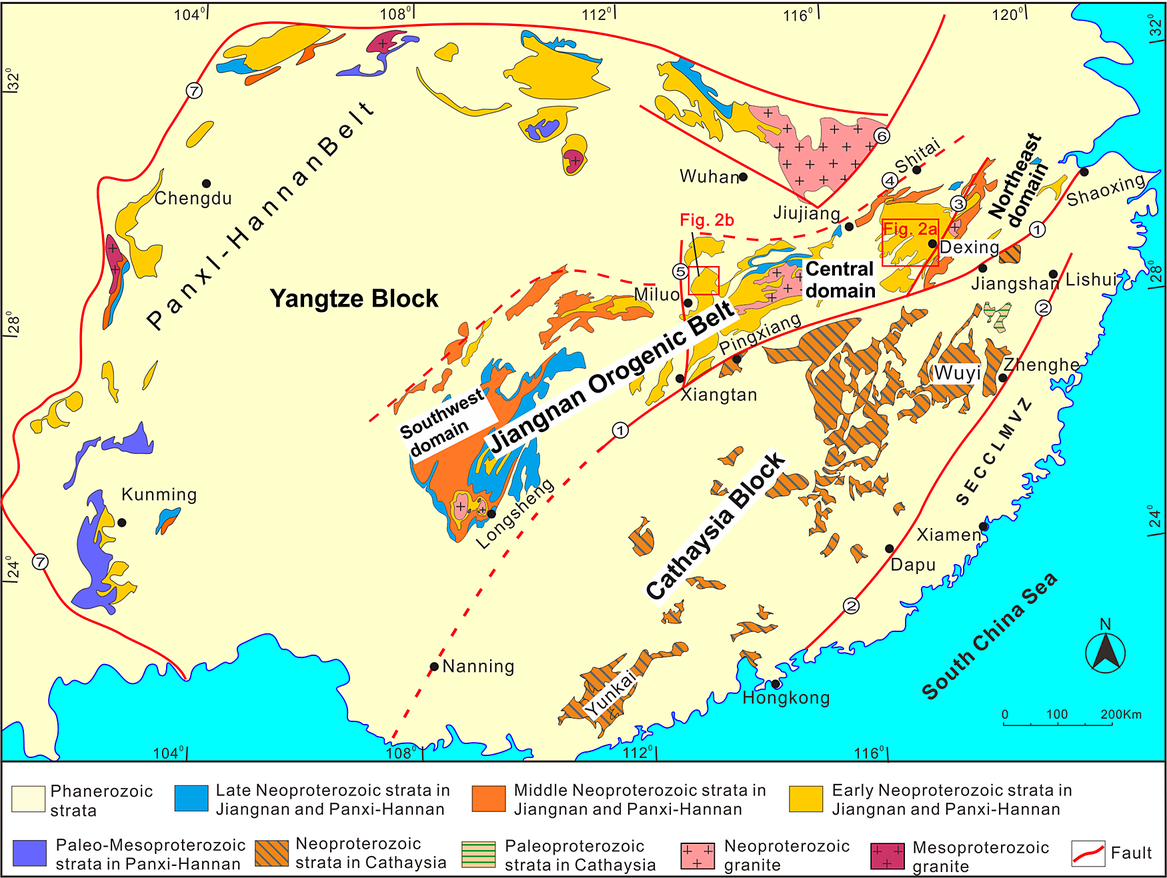
Establishing the distribution and duration of magmatic arc systems and associated basins in ancient mountain belts is fundamental to unravelling regional palaeogeography as well as the global geodynamic processes responsible for the development and stabilization of the continental crust (e.g. Cawood et al. Reference Cawood, Kroner, Collins, Kusky, Mooney, Windley, Cawood and Kroner2009; Zhao et al. Reference Zhao, Wang, Huang, Dong, Li, Zhang and Yu2018). The assembly and stabilization of South China occurred along a Neoproterozoic accretionary belt, named the Jiangnan orogenic belt (Fig. 1). However, in detail, the duration and distribution of the arc–basin systems within the belt, as well as the number and polarity of subduction zones, are poorly constrained (Shu et al. Reference Shu, Shi, Guo, Charvet and Sun1995, Reference Shu, Wang and Yao2019; Shu & Charvet, Reference Shu and Charvet1996; Cawood et al. Reference Cawood, Wang, Xu and Zhao2013, Reference Cawood, Zhao, Yao, Wang, Xu and Wang2018; Wang, X. L. et al. Reference Wang, Zhou, Griffin, Zhao, Yu, Qiu, Zhang and Xing2014; Wang, Y. J. et al. Reference Wang, Zhang, Fan, Geng, Zou and Bi2014; Zhao, Reference Zhao2015; Yang et al. Reference Yang, Li, Wang and Lan2015; Yao et al. Reference Yao, Cawood, Shu and Li2016 a; Xia et al. Reference Xia, Xu, Niu and Liu2017). Two contrasting tectonic models have been proposed for the belt, including a plume rifting model and a subduction collision model (Guo et al. Reference Guo, Shi, Lu, Ma, Dong and Yang1989; Li et al. Reference Li, Li, Kinny, Wang, Zhang and Zhou2003; Zhao & Cawood, Reference Zhao and Cawood2012 and references therein; Shu, Reference Shu2012; Wang et al. Reference Wang, Zhang, Cawood, Fan, Xu, Zhang and Zhang2013 b; Zhao et al. Reference Zhao, Wang, Huang, Dong, Li, Zhang and Yu2018). The former model suggests a convergent plate setting for the belt at c. 970–880 Ma and argues for assembly of South China at c. 880 Ma, followed by a regional extension initiated at c. 860 Ma (Li et al. Reference Li, Li, Kinny, Wang, Zhang and Zhou2003, Reference Li, Bogdanova, Collins, Davidson, De Waele, Ernst, Fitzsimons, Fuck, Gladkochub, Jacobs, Karlstrom, Lu, Natapov, Pease, Pisarevsky, Thrane and Vernikovsky2008; Yang et al. Reference Yang, Li, Wang and Lan2015). In contrast, the subduction collision model suggests that the convergent plate margin setting in the belt continued to c. 830–820 Ma (Wang, W. et al. Reference Wang, Zhou, Yan and Li2012, Reference Wang, Zhou, Zhao, Pandit, Zheng and Liu2016, Reference Wang, Zhao, Zhou, Pandit and Zheng2018 b; Wang, X. L. et al. Reference Wang, Zhou, Griffin, Zhao, Yu, Qiu, Zhang and Xing2014; Yao et al. Reference Yao, Shu, Santosh and Li2013, Reference Yao, Shu, Santosh and Li2015; Zhang & Wang, Reference Zhang and Wang2016; Shu et al. Reference Shu, Wang and Yao2019), followed by the collision of continental fragments, which deformed the lithostratigraphic units of the belt (Wang et al. Reference Wang, Zhou, Qiu, Zhang, Liu and Zhang2006; Zhao et al. Reference Zhao, Zhou and Zhen2013; Xin et al. Reference Xin, Li, Dong, Zhang, Wang and Sun2017). In this paper we focus on the convergent plate margin history of the central domain (Jiuling Terrane) of the Jiangnan orogenic belt (Figs 1, 2), and outline the age, isotopic character and whole-rock compositions of the principal rock units. This information is integrated with age data and compositional patterns throughout the Jiangnan orogenic belt, constraining the overall timing and distribution of the early Neoproterozoic arc systems and associated retro-arc basin and thus offering better constraints on the tectonic evolution of the belt.
Geological sketch map of the Jiangnan orogenic belt, South China Craton. 1 – Shaoxing–Jiangshan–Pingxiang–Guilin fault; 2 – Zhenghe–Dapu fault; 3 – Northeast Jiangxi fault; 4 – Jiujiang–Shitai fault; 5 – Xiangtan–Miluo fault; 6 – Tanlu fault; 7 – Longmenshan–Ailaoshan–Songma fault; SNJ-NL – South Jiangxi–Nanling region; SECCLMVZ – Southeast China costal late Mesozoic volcanic zone.

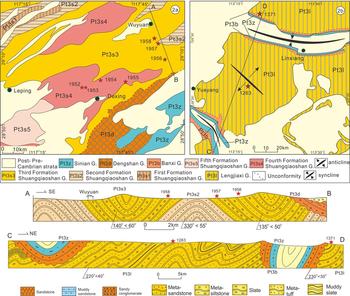
Geological sketch map of the Dexing–Wuyuan and Yueyang areas in the Jiangnan orogenic belt, with sampling cross-sections (Pt3z – Sinian System; Pt3d – Dengshan Group; Pt3b – Banxi Group; Pt3s1, Pt3s2, Pt3s3, Pt3s4 and Pt3s5 – First, Second, Third, Fourth and Fifth formations of the Shuangqiaoshan Group, respectively; Pt3l – Lengjiaxi Group). A–B cross-section of the stratigraphic sequences in the Dexing–Wuyuan area with sample locations; C–D cross-section of the stratigraphic sequences in the Yueyang area with sample locations.

2. Geologic setting
2.a. Tectonic framework
The South China Block is divisible into the Yangtze and Cathaysia blocks separated by the Jiangnan orogenic belt (Fig. 1) (Guo et al. Reference Guo, Shi, Lu, Ma, Dong and Yang1989; Shu et al. Reference Shu, Shi, Guo, Charvet and Sun1995, Reference Shu, Wang, Cawood, Santosh and Xu2015; Shu & Charvet, Reference Shu and Charvet1996; Zhao & Cawood, Reference Zhao1999, Reference Zhao and Cawood2012; Cawood et al. Reference Cawood, Zhao, Yao, Wang, Xu and Wang2018). The Yangtze Block includes isolated exposures of Archaean igneous gneisses and minor metasedimentary rocks enveloped in Palaeo- to Mesoproterozoic metasedimentary and meta-volcanic rocks (Qiu et al. Reference Qiu, Gao, McNaughton, Groves and Ling2000; Zhang et al. Reference Zhang, Zheng, Wu, Zhao, Gao and Wu2006; Zhang, G. W. et al. Reference Zhang, Guo, Wang, Li, Dong, Liu, He, Cheng, Lu and Yao2013; Guo et al. Reference Guo, Wu, Gao, Jin, Zong, Hu, Chen, Chen and Liu2015; Wang, K. et al. Reference Wang, Li, Dong, Cui, Han, Zheng and Xu2018; Wang, W. et al. Reference Wang, Zhao, Zhou, Pandit and Zheng2018b; Chen et al. Reference Chen, Sun, Zhao, Zhao, Zhu, Long and Wang2019). Neoproterozoic rocks of the Panxi–Hannan belt are developed along the northern and western margins of the block (Fig. 1; Zhao & Cawood, Reference Zhao and Cawood2012 and references therein; Dong et al. Reference Dong, Liu, Santosh, Chen, Zhang, Li, He and Zhang2012, Reference Dong, Sun, Yang, Liu, Zhang, Li, Chen, He and Zhang2017; Wang, W. et al. Reference Wang, Bolhar, Zhou and Zhao2018 a). The Cathaysia Block consists of minor gneissic Palaeoproterozoic igneous rocks (e.g. around Wuyi), which are enveloped by a variably metamorphosed Neoproterozoic sedimentary assemblage and are also intruded by Neoproterozoic igneous suites in some localities (Yu et al. Reference Yu, Wang, O’Reilly, Griffin, Zhang, Li and Shu2009; Shu et al. Reference Shu, Deng, Yu, Wang and Jiang2008, Reference Shu, Faure, Yu and Jahn2011; Xia et al. Reference Xia, Xu, Niu and Liu2017; Yao et al. Reference Yao, Shu, Cawood and Li2017). The boundary of the Jiangnan orogenic belt and the Cathaysia Block is inferred to be delineated by the Jiangshan–Shaoxing–Pingxiang–Qidong–Chalin–Guilin fault zone (Fig. 1; Shu et al. Reference Chen, Wang, Wang, Gao, Shu, Zhou and Qi2014, Reference Shu, Wang and Yao2019; Yao et al. Reference Yao, Shu, Cawood and Li2016 b), whereas other studies favour a boundary fault along the Shaoxing–Jiangshan–Chenzhou–Linwu fault or along the Jingdezheng–Yifeng–Wanzai–Anhua–Luocheng fault (Wang et al. Reference Wang, Fan, Zhang and Zhang2013 a and references therein; Wang, Y. J. et al. Reference Wang, Zhang, Fan, Geng, Zou and Bi2014). Some late Mesoproterozoic bimodal volcanic rocks have been reported from the Tieshajie Group within the Shaoxing–Jiangshan fault zone as well (Li et al. Reference Li, Lin, Xing, Davis, Davis, Xiao and Yin2013), but the tectonic affinity of the group remains unclear. The boundary between the Jiangnan orogenic belt and the Yangtze Block is less well constrained and inferred as the Shitai–Jiujiang fault zone according to the distribution of early to middle Neoproterozoic outcrops (Fig. 1; Shu et al. Reference Shu, Shi, Guo, Charvet and Sun1995).
The Jiangnan orogenic belt consists of variably deformed and metamorphosed mafic to silicic volcanic rocks and their intrusive equivalents, and siliciclastic sedimentary rocks, along with a lesser amount of high-pressure blueschists and ophiolitic melange-related mafic–ultramafic assemblages, siliceous limestone and chert (Shu et al. Reference Shu, Zhou, Shi and Yin1994; Gao et al. Reference Gao, Klemd, Long, Xiong and Qian2009; Li et al. Reference Li, Li, Li, Lo, Wang, Ye and Yang2009; Shu, Reference Shu2012; Li, J. Y. et al. Reference Li, Wang, Zhang, Zhou and Shu2016; Yao et al. Reference Yao, Shu, Santosh and Li2016 a). These rocks are ascribed to a variety of lithostratigraphic units (e.g. the Shuangxiwu, Shuangqiaoshan, Xikou, Lengjiaxi, Fanjingshan and Sibao groups from east to west within the belt) and range in age from c. 980 Ma to 820 Ma (Zhou et al. Reference Zhou, Zhou, Yang and Wang1989; Zhao & Cawood, Reference Zhao and Cawood2012 and references therein; Zhang, A. M. et al. Reference Zhang, Wang, Fan, Zhang and Yang2012; Zhang, Y. Z. et al. Reference Zhang, Wang, Fan, Zhang and Ma2012; Cawood et al. Reference Cawood, Wang, Xu and Zhao2013; Wang, X. L. et al. Reference Wang, Zhou, Griffin, Zhao, Yu, Qiu, Zhang and Xing2014; Wang, J. Q. et al. Reference Wang, Shu and Santosh2016; Yao et al. Reference Yao, Cawood, Shu and Li2015, Reference Yao, Shu, Santosh and Li2016 a; Li, J. Y. et al. Reference Li, Wang, Zhang, Zhou and Shu2016; Li, L. M. et al. Reference Li, Lin, Xing, Davis, Jiang, Davise and Zhang2016). S-type granites dated at c. 845–815 Ma intrude these units (Wang et al. Reference Wang, Zhou, Qiu, Zhang, Liu and Zhang2006; Yao et al. Reference Yao, Shu, Santosh and Zhao2014 b; Xin et al. Reference Xin, Li, Dong, Zhang, Wang and Sun2017; Deng et al. Reference Deng, Xu, Chi, Zhu, Wang, Chen, Li, Zhang, Ye and Yu2019). NW-dipping, top-to-the-SE shear zones locally disrupting the belt occur within the Shuangqiaoshan/Sibao and equivalent units (Shu & Charvet, Reference Shu and Charvet1996; Yao et al. Reference Yao, Shu, Santosh and Li2016 a). The lithostratigraphic units in the Jiangnan orogenic belt are unconformably overlain by the middle Neoproterozoic Nanhua succession (e.g. Heshangzheng, Dengshan, Banxi, Danzhou groups and equivalent units) that are essentially undeformed and unmetamorphosed (Figs 2, 3; BGMRJX, 1984; BGMRZJ, 1989; Wang & Li, Reference Wang and Li2003; Yao et al. Reference Yao, Shu, Santosh and Li2015). This overlying younger succession is inferred to have accumulated during a period of crustal extension (Nanhua rift), with initiation of deposition at c. 815–800 Ma as constrained by detrital zircons and tuff layers (Wang et al. Reference Wang, Li, Duan, Liu, Song, Li and Gao2003; Gao et al. Reference Gao, Chen, Ding, Liu, Zhang, Zhang, Liu, Pang and Zhang2011; Shu, Reference Shu2012; Yao et al. Reference Yao, Shu, Santosh and Li2013, Reference Yao, Shu, Santosh and Li2015; Wang, X. L. et al. Reference Wang, Zhou, Griffin, Zhao, Yu, Qiu, Zhang and Xing2014; Ma et al. Reference Ma, Yang, Li, Dai, Zhang and Zhou2016). The Nanhua succession consists of conglomerate, greywacke, sandstone, siltstone and mudstone, along with interbedded tuff and bimodal volcanic rocks (BGMRZJ, 1989; Wang & Li, Reference Wang and Li2003).
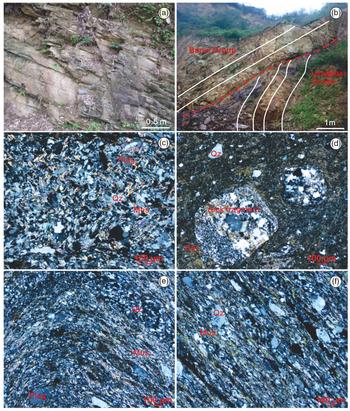
Representative field photographs and photomicrographs of the samples analysed in this study. Plag – plagioclase; Qz – quartz; Ser – sericite. (a) Field photograph of Shuangqiaoshan Group. (b) Field photograph displaying unconformity between the Lengjiaxi and Banxi groups in the Yueyang area. (c) Thin-section micrograph of sample 1953 (crossed nicols). (d) Photomicrograph of sample 1955 (crossed nicols). (e) Thin-section micrograph of sample 1957 (crossed nicols). (f) Thin-section micrograph of sample 1958 (crossed nicols).

The Jiangnan orogenic belt can be divided into the northeastern (also referred to as the Huaiyu or Shuangxiwu Terrane), central (Jiuling Terrane) and southwestern domains, the boundaries between which are the Northeast Jiangxi fault zone (also referred to as the Dongxiang–Dexing–Shexian fault zone) and the inferred Xiangtan–Miluo fault zone, respectively (Fig. 1; Guo et al. Reference Guo, Shi, Lu, Ma, Dong and Yang1989; Shu et al. Reference Shu, Shi, Guo, Charvet and Sun1995; Wang, Y. J. et al. Reference Wang, Zhang, Fan, Geng, Zou and Bi2014). The oldest units in the northeast domain, termed the Shuangxiwu or Qigong groups, contain a series of mafic to felsic volcanic rocks and minor ophiolite suites (Shu et al. Reference Shu, Shi, Guo, Charvet and Sun1995; Li et al. Reference Li, Li, Li, Lo, Wang, Ye and Yang2009; Yao et al. Reference Yao, Shu, Santosh and Li2013). The oldest units of the central domain, the Shuangqiaoshan Group and equivalents, consist predominantly of siliciclastic rocks with minor volcanic rocks, which experienced low-greenschist-facies metamorphism (BGMRJX, 1984; Shu et al. Reference Shu, Shi, Guo, Charvet and Sun1995). The southwest domain of the Jiangnan orogenic belt displays similar lithologies (referred to as the Fanjingshan and Sibao groups) to the central domain (Wang et al. Reference Wang, Zhou, Yan and Li2012; Yao et al. Reference Yao, Shu, Santosh and Zhao2014 b, Reference Yao, Shu, Santosh and Li2016 a and references therein).
2.b. Lithostratigraphy of the central and northeast domains
The Shuangqiaoshan Group (also termed the Xikou Group in southern Anhui Province and the Lengjiaxi Group in eastern Hunan Province) is the oldest exposed unit in the Dexing and Wuyuan areas of the northeastern central domain and is divisible into lower and upper units. The units contain a similar succession of slate, tuffaceous and sandy phyllite, and minor volcanic rocks, with the boundary marked by a unit of interlayered mafic–intermediate meta-volcanic rocks and tuffaceous–sandy phyllite assigned to the Third Formation (Pt3s3) (Fig. 2; BGMRJX, 1984; Shu et al. Reference Shu, Shi, Guo, Charvet and Sun1995; Yin et al. Reference Yin, Lin, Davis, Xing, Davis, Cheng, Xiao and Li2013). The investigated lower Shuangqiaoshan Group can be divided into two formations, the First (Pt3s1) and Second (Pt3s2) formations, while the upper unit contain three formations, including the Third, Forth (Pt3s4) and Fifth (Pt3s5) formations. Diorite and some granodiorite enclaves within mafic suites that occur in the group are dated at 849–846 Ma (zircon U–Pb; Sun et al. Reference Sun, Shu, Santosh and Wang2017). The group underwent regional deformation and greenschist-facies metamorphism inferred at sometime around 830–815 Ma (Figs 2, 3; Yao et al. Reference Yao, Shu, Cawood and Li2016 b), and is intruded by voluminous peraluminous granitoids dated at 845–815 Ma (Li et al. Reference Li, Li, Kinny, Wang, Zhang and Zhou2003; Wang et al. Reference Wang, Zhou, Qiu, Zhang, Liu and Zhang2006; Wu, R. X. et al. Reference Wu, Zheng, Wu, Zhao, Zhang, Liu and Wu2006; Zhao et al. Reference Zhao, Zhou and Zhen2013; Xin et al. Reference Xin, Li, Dong, Zhang, Wang and Sun2017). Early Palaeozoic ductile shearing and folding are also reported from the group within the Jiangshan–Shaoxing fault zone (Li, J. H. et al. Reference Li, Dong, Zhang, Zhao, Johnston, Cui and Xin2016, Reference Li, Zhang, Zhao, Johnston, Dong, Koppers, Miggins, Sun, Wang and Xin2017).
In the northeast domain, the oldest units are the equivalent Shuangxiwu and Qigong groups, and both units were deformed under greenschist-facies conditions (BGMRJX, 1984; BGMRZJ, 1989; Yao et al. Reference Yao, Shu, Cawood and Li2016 b). The Qigong Group, exposed in the southwest area of the domain, contains intermediate-mafic volcanic rocks (871 ± 7 Ma and 864 ± 14 Ma, zircon U–Pb; Yao et al. Reference Yao, Shu, Santosh and Li2015), tuffaceous phyllite (c. 840 Ma; Yao et al. Reference Yao, Shu, Santosh and Li2013), marine volcaniclastic turbidite and an ophiolite suite (c. 1.0–0.83 Ga; Zhou et al. Reference Zhou, Zhou, Yang and Wang1989; Zhang, S. B. et al. Reference Zhang, Wu and Zheng2012; Wang, X. S. et al. Reference Wang, Gao, Klemd, Jiang, Zhai, Xiao and Liang2015). The Shuangxiwu Group in the northeast part of the domain consists of intermediate-acidic volcanic rocks, basic volcanic rocks and turbiditic clastic sedimentary rocks, as well as minor ultramafic blocks (BGMRZJ, 1989; Yao et al. Reference Yao, Shu, Cawood and Li2016 b). At the top of the group is a continental-derived layer of tuff and tuffaceous sandstones. Volcanic rocks within the group are dated at 978–891 Ma, based on zircon U–Pb ages (Chen et al. Reference Chen, Xing, Guo, Dong, Chen, Zeng, Li, He and Zhao2009; Li et al. Reference Li, Li, Li, Lo, Wang, Ye and Yang2009). I-type granite and diorite within the group are dated at 913–855 Ma (zircon U–Pb; Ye et al. Reference Ye, Li, Li, Liu and Li2007; Yao et al. Reference Yao, Shu, Cawood and Li2016 b).
3. Sampling and analytical procedures
3.a. Samples
Sample locations are displayed in Figure 2. Four siliciclastic samples 1952 (GPS: N 28° 59.980′, E 117° 30.294′), 1953 (GPS: N 28° 59.982′, E 117° 30.296′), 1954 (GPS: N 29° 01.344′, E 117° 35.483′) and 1955 (GPS: N 29° 0.874′, E 117° 42.984′) were collected from the Dexing area (Fig. 2), and another three siliciclastic samples 1956 (GPS: N 29° 06.671′, E 117° 54.749′), 1957 (GPS: N 29° 11.070′, E 117° 52.702′) and 1958 (GPS: N 29° 12.436′, E 117° 51.715′) from the Wuyuan area in NE Jiangxi Province (Fig. 2). All seven samples are assigned to the Shuangqiaoshan Group. We also selected sedimentary samples 1263 and 1371 (GPS: N 29° 21.790′, E 113° 19.749′) from the equivalent Lengjiaxi Group in the Yueyang area (Fig. 2).
In thin-section, sandy slate and phyllite samples 1952, 1953, 1954, 1956, 1957 and 1958 display similar mineral compositions, including 30–55 % quartz, 25–50 % muscovite and sericite, 5–15 % feldspar, along with 7–10 % accessory phases (Fig. 3). The meta-greywacke sample (1955) is composed of rock fragments of phyllite (30 %), quartz (20 %), feldspar (5 %) and other small rock fragments in a compact, clay-rich matrix (45 %) (Fig. 3). Meta-sandstone samples 1263 and 1371 from the Lengjiaxi Group display similar mineral contents of c. 60 % quartz, 10 % feldspar, 20 % muscovite and 10 % other accessory minerals.
3.b. Zircon U–Pb dating and Hf-isotope analysis
Cathodoluminescence (CL) images of the detrital zircons were obtained on a Quanta 400 FEG electron microscope equipped with a Mono CL3 (Gatan, USA) detector to identify their internal structures. The CL images were analysed at the State Key Laboratory of Continental Dynamics, Northwest University, China. The detrital zircon U–Pb age analyses were performed on an Agilent 7500a inductively coupled plasma mass spectrometer (ICP-MS) coupled with a New Wave 213 nm laser ablation system at the State Key Laboratory for Mineral Deposits Research, Nanjing University. The details of the procedures are similar to those described in Yao et al. (Reference Yao, Shu and Santosh2011). The 207Pb–206Pb age is chosen to represent the true crystallization ages for zircons with ages older than 1000 Ma, and the 206Pb–238U age for those younger than 1000 Ma.
The zircon Hf isotopes were also analysed at the State Key Laboratory for Mineral Deposits Research, Nanjing University, using a Neptune multi-collector ICP-MS (MC-ICP-MS). The instrument is a double focusing MC-ICP-MS capable of high mass resolution measurements in multiple collector mode. During laser ablation analyses, the isobaric interference of 176Lu on 176Hf is negligible owing to the extremely low 176Lu/177Hf in zircon (normally <0.002). The mean 173Yb/171Yb ratio of the individual spots was used to calculate the fractionation coefficient (β Yb) and then to calculate the contribution of 176Yb to 176Hf, which has proven useful to correct the interference of 176Yb on 176Hf (Wu, F. Y. et al. Reference Wu, Yang, Xie, Yang and Xu2006; Kemp et al. Reference Kemp, Hawkesworth, Paterson and Kinny2006; Yuan et al. Reference Yuan, Gao, Dai, Zong, Günther, Fontaine, Liu and DiWu2008). During analysis, an isotopic ratio of 176Yb/172Yb = 0.5887 was applied. Standard zircon 91500 was used for external correction, with a 176Hf/177Hf value of 0.282300 ± 8 (2σ) (Wu, F. Y. et al. Reference Wu, Yang, Xie, Yang and Xu2006). Initial 176Hf/177Hf values were calculated based on a Lu decay constant of 1.865E-11 (Scherer et al. Reference Scherer, Munker and Mezger2001). The model ages were calculated under the assumption that the 176Lu/177Hf of average crust is 0.015, and the 176Hf/177Hf and 176Lu/177Hf ratios of chondrite and depleted mantle at the present are 0.282772 and 0.0332, and 0.28325 and 0.0384, respectively (Blichert-Toft & Albarede, Reference Blichert-Toft and Albarede1997; Griffin et al. Reference Griffin, Belousova, Shee, Pearson and O’Reilly2004). The model ages (TDM) provide only a minimum age for the source material of the magma from which the zircons crystallized. Therefore, we have also calculated the crustal model age (TCDM), which assumes that the parental magma was produced from an average continental crust (176Lu/177Hf = 0.015) that was originally derived from the depleted mantle. The zircon laser ablation ICP-MS U–Pb isotopic age, trace-element and Hf-isotope determinations in this study are listed in online Supplementary Material Tables S1 and S2.
3.c. Whole-rock major- and trace-elemental analysis
Whole-rock major-element analyses were conducted on an X-ray fluorescence spectrometer (XRF) at ALS Chemex (Guangzhou, China) Co. Ltd, which yields a better than 2 % precision for all major elements. Trace-element abundances were measured at ALS Chemex (Guangzhou, China) Co. Ltd. using a PerkinElmer ICP-MS, which gives a precision better than 5 %. Whole-rock geochemistry determinations are presented in online Supplementary Material Table S3.
4. Analytical results
4.a. Zircon U–Pb ages of the Shuangqiaoshan Group
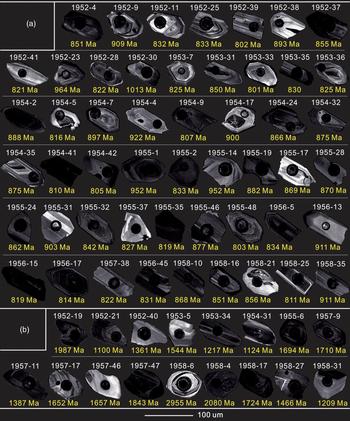
Detrital zircon grains from the seven analysed metasedimentary rock samples of the Shuangqiaoshan Group mostly range from 50 to 150 μm and are generally euhedral (Fig. 4). Most of the grains display oscillatory zoning, indicating a magmatic origin (Fig. 4) and have high Th/U values ranging from 0.33 to 3.56 (online Supplementary Material Table S1).
Cathodoluminescence images of detrital zircons from the Shuangqiaoshan and Lengjiaxi groups in the Jiangnan orogenic belt: (a) Neoproterozoic zircon grains; (b) pre-Neoproterozoic zircon grains.

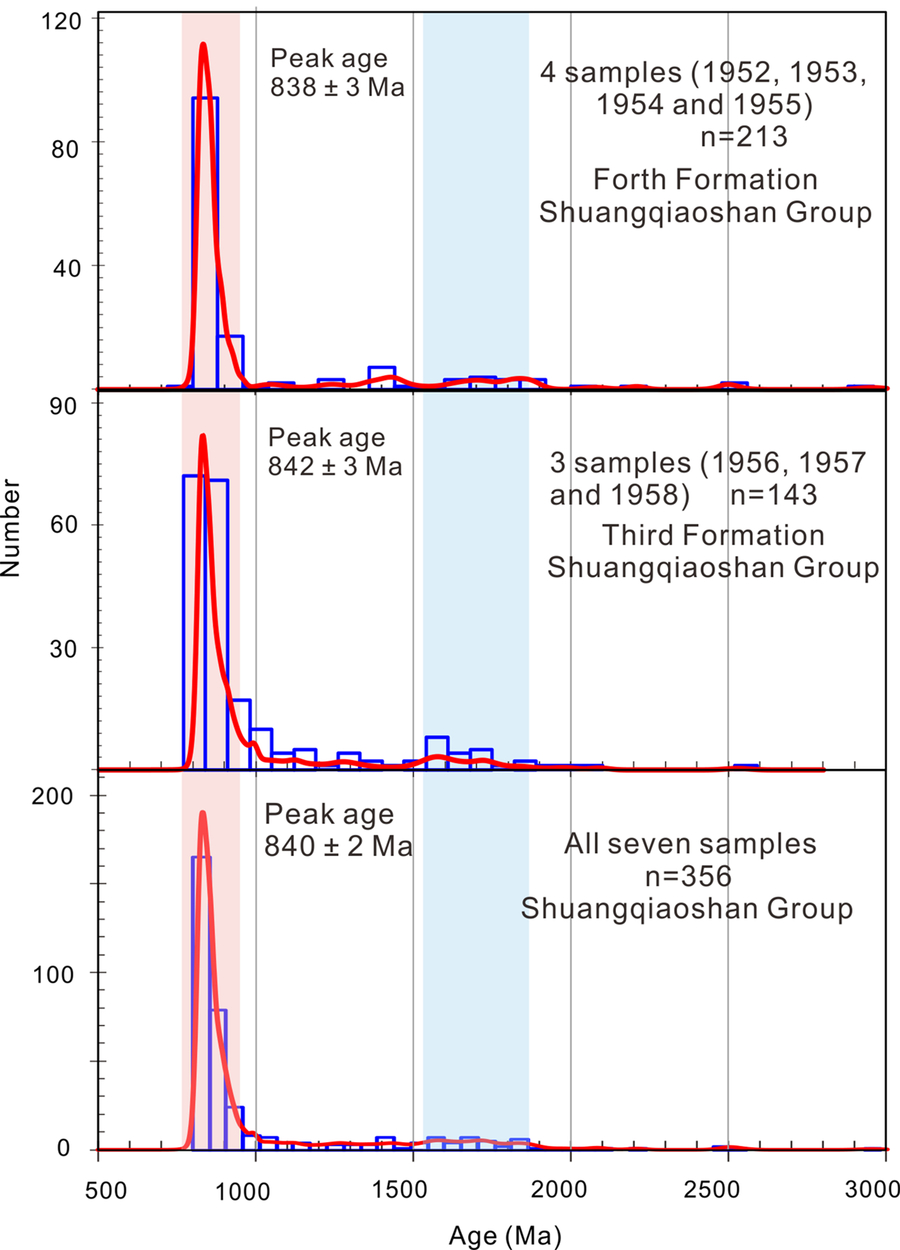
A total of 57 analyses on zircon grains from sample 1952 yield a main age population at 870–819 Ma (peak of 835 Ma, 34 analysis), along with a subsidiary population at 1100–920 Ma (peak at 1000 Ma). Fifty-eight U–Pb age determinations obtained from sample 1953 display age populations at 860–818 Ma (peak at 830 Ma, 22 analyses), 1900–1500 Ma (16 analyses) and 1300–1000 Ma (10 analyses). Fifty grains from sample 1954 were analysed and the ages range from 1435 Ma to 818 Ma, with the majority between 940 Ma and 818 Ma (peak at 830 Ma, 37 analyses). Forty-eight analyses from sample 1955 yield a main population at 880–817 Ma (peak at 845 Ma, 34 analyses; online Supplementary Material Table S1). Six analyses also give Archaean to Mesoproterozoic ages of 2526–1033 Ma. Forty-eight analyses on grains from sample 1956 show ages ranging from 2500 Ma to 817 Ma (online Supplementary Material Table S1), and yield an age range of 875–817 Ma (peak at 840 Ma, 39 analysis). Forty-nine zircon U–Pb ages from sample 1957 yield an age range of 1850–818 Ma and a major age population at 870–818 Ma (peak at 840 Ma, 35 analyses). The second-largest age population is made up of nine ages in the range 1850–1650 Ma (Fig. 5; online Supplementary Material Table S1). Forty-six analyses on grains from sample 1958 yield ages in the range 2955–822 Ma, with a dominant population at 880–822 Ma (peak at 855 Ma, 25 analysis) and a minor one at 1810–1000 Ma (15 analyses). One Palaeoproterozoic grain at 1809 Ma and two Archaean ones at 2506 Ma and 2955 Ma have also been obtained (online Supplementary Material Table S1).
Detrital zircon U–Pb age relative probability plots for samples from the Shuangqiaoshan Group of Dexing–Wuyuan area in the east segment of the central domain. Data details are given in online Supplementary Material Table S1.

In all, 356 zircon grains from the seven samples of the Shuangqiaoshan Group yield concordant ages ranging from 2955 Ma to 817 Ma, and fall into three prominent age populations at c. 875–820 Ma (210 analyses, peak at c. 840 Ma), 1450–980 Ma (41 analyses) and 1880–1500 Ma (36 analyses) (Fig. 5).
4.b. Zircon U–Pb ages and Hf isotopes of the Lengjiaxi Group
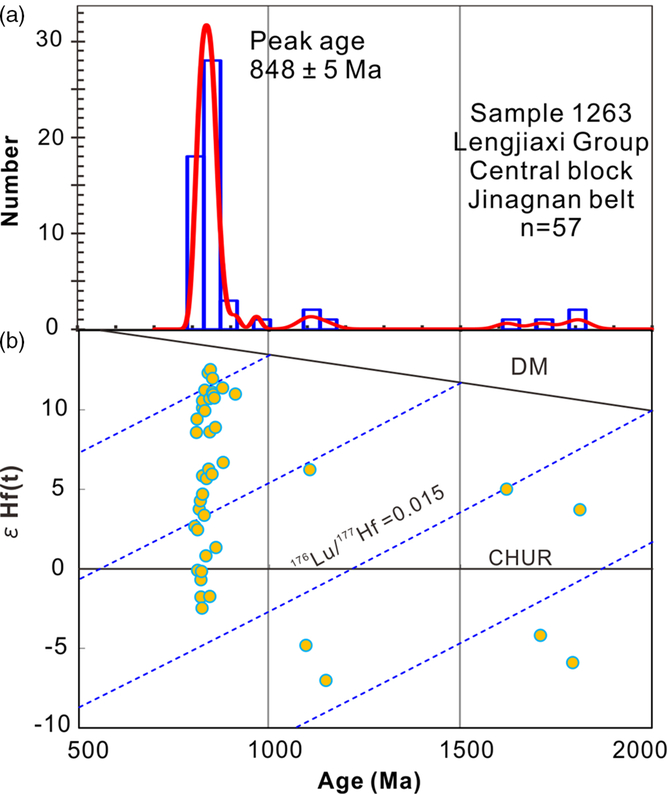
Fifty-seven analyses conducted on grains from sample 1263 range in age from 1812 Ma to 809 Ma, and are mainly within the age range 880–819 Ma (48 analyses, peak at 840 Ma) (Fig. 6). Seven analyses yield Palaeo- to Mesoproterozoic ages. Zircons within the age range of 880–809 Ma display present-day 176Hf/177Hf ratios of 0.2822201–0.282658 and ϵHf(t) values of −2.46 ~ +12.55 (Fig. 6; online Supplementary Material Table S2), which corresponds to Hf model ages of 0.9~1.4 Ga. The majority of grains within the population of 880–820 Ma display positive ϵHf(t) values (29 out of 35) (Fig. 6).
(a) Detrital zircon U–Pb age relative probability plots and (b) U–Pb age versus ϵHf(t) plot for samples from the Lengjiaxi Group in the west segment of the central domain, Jiangnan orogenic belt. Data details are given in online Supplementary Material Table S2. DM – depleted mantle; CHUR – chondritic uniform reservoir.

4.c. Trace elements of zircons
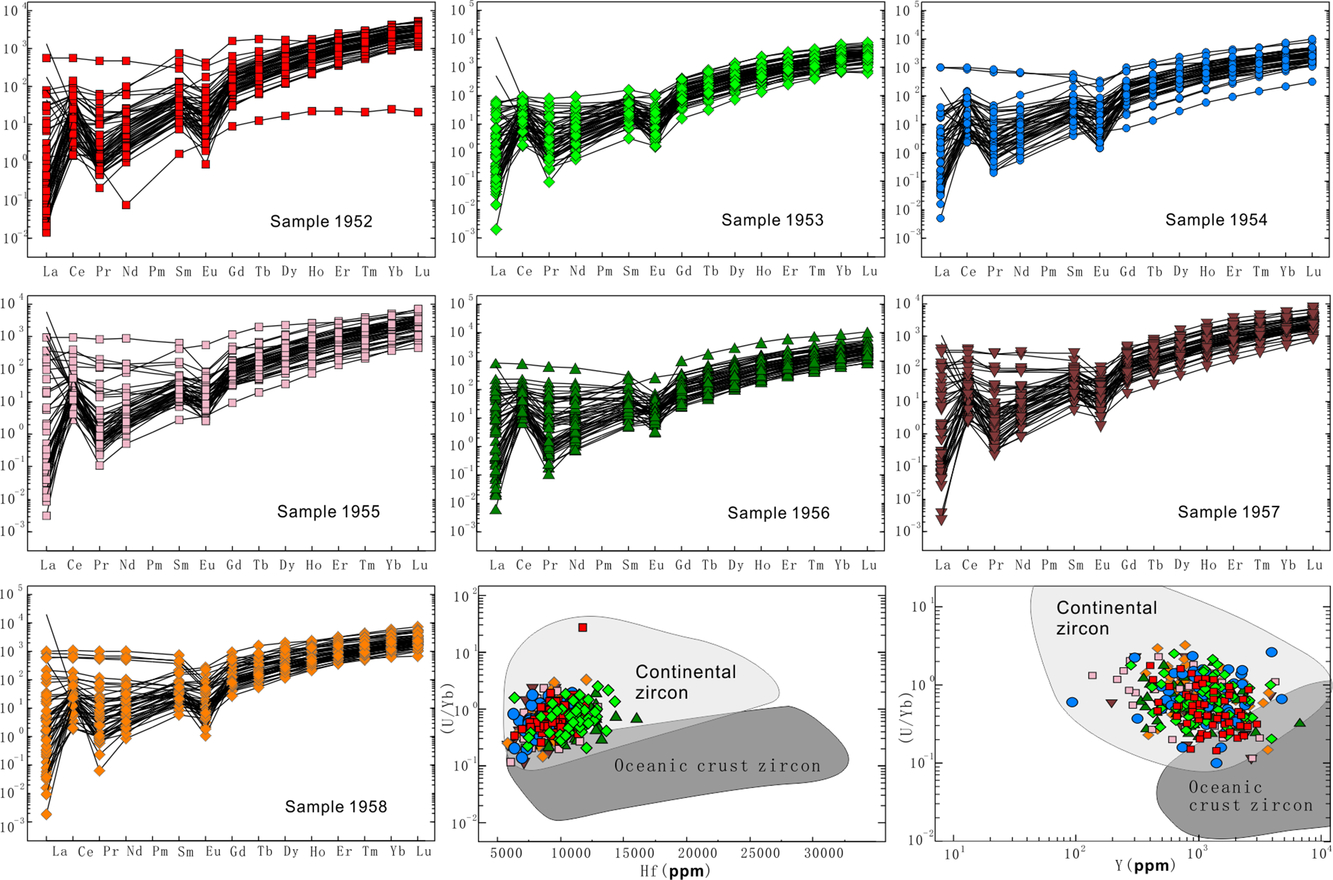
The trace-element analytical results for the detrital zircons from the seven samples are displayed in online Supplementary Material Table S3. The rare earth element (REE) patterns for the grains are similar (Fig. 7), with the majority showing heavy rare earth element (HREE) enriched patterns with negative Eu anomalies and positive Ce anomalies that are considered indicative of crystallization in intermediate to mafic and alkaline igneous rocks (Fig. 7; Belousova et al. Reference Belousova, Griffin, O’Reilly and Fisher2002). A small proportion of grains have flat light rare earth element (LREE) and enriched HREE patterns, with no positive Ce anomaly but a pronounced negative Eu anomaly, resembling grains from granitoid sources (Belousova et al. Reference Belousova, Griffin, O’Reilly and Fisher2002). All the analysed zircons plot in the field of continental zircon or the overlapping field of continental and oceanic zircon (Fig. 7; Grimes et al. Reference Grimes, John, Kelemen, Mazdab, Wooden, Cheadle, Hanghoj and Schwartz2007).
Chondrite-normalized REE patterns for detrital zircons from the Shuangqiaoshan Group, central domain, Jiangnan orogenic belt (normalization values are from Sun & McDonough, Reference Sun, McDonough, Saunder and Norry1989). Data details are given in online Supplementary Material Table S3.

4.d. Whole-rock geochemistry
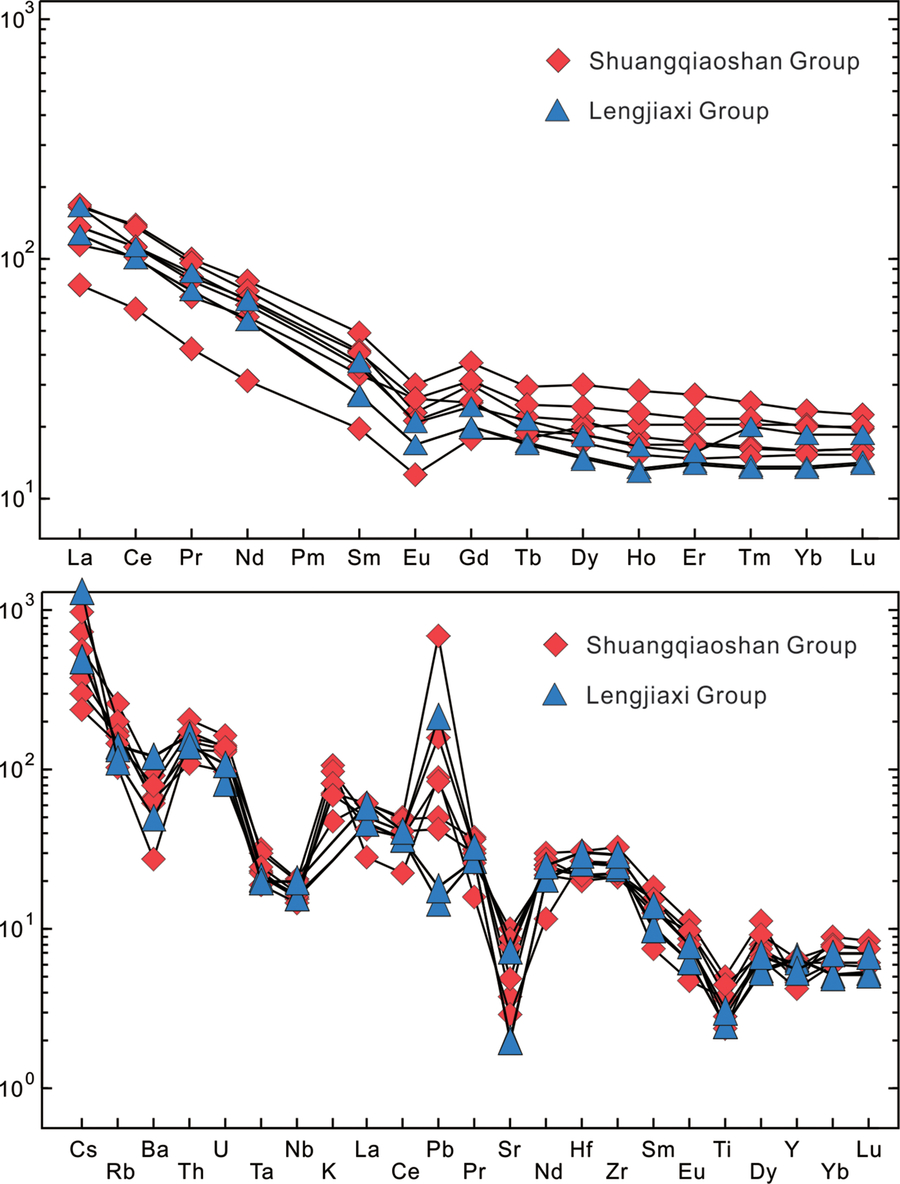
Major- and trace-element analytical results are presented in online Supplementary Material Table S3. The metasedimentary rock samples from the Shuangqiaoshan Group display a wide range of major-element compositions for SiO2 (68.97–83.28 %), FeOt (1.21–6.39 %) and Al2O3 (9.27–15.14 %), and low MgO (0.26–2.02 %) and TiO2 (0.46–1.10 %) (online Supplementary Material Table S3). All seven analysed samples show minor LREE enriched patterns and negative Eu anomalies (Fig. 8). The investigated samples display obvious depletion in high field strength elements (HFSE) such as Nb, Ta, Ti and Rb (Fig. 8).
(a) Chondrite-normalized REE patterns (normalization values are from Sun & McDonough, Reference Sun, McDonough, Saunder and Norry1989), and (b) primitive mantle-normalized incompatible element distribution spider-grams (normalization values are from McDonough & Sun, Reference McDonough and Sun1995) for the sedimentary suite from the central domain, Jiangnan orogenic belt. Data details are given in online Supplementary Material Table S3.

Samples from the Lengjiaxi Group have high contents of SiO2 (77.08–79.66 %) and Al2O3 (8.81–13.27 %), and low contents of MgO (0.53–0.76 %) and TiO2 (0.35–0.56 %) (online Supplementary Material Table S3), as well as varied FeOt compositions (1.39–5.29 %). The Lengjiaxi Group samples, like those from the Shuangqiaoshan Group, display HREE enrichment along with depletion of Nb and Ta (Fig. 8).
5. Discussion
5.a. Depositional ages and settings of the Shuangqiaoshan and Lengjiaxi groups
Our field observations, detrital zircon ages and isotope data, along with whole-rock geochemical data from metasedimentary rock samples of the upper Shuangqiaoshan and Lengjiaxi groups indicate accumulation in a convergent margin setting, with the majority of detritus sourced from continental arc systems.
The age data indicate that the upper Shuangqiaoshan Group was deposited some time after c. 817 ± 9 Ma on the basis of the youngest detrital zircon age. The youngest detrital zircon from the Lengjiaxi Group yielded a similar age of 816 ± 10 Ma. These age constraints, together with those from equivalent sequences elsewhere in the Jiangnan orogenic belt (Gao et al. Reference Gao, Chen, Ding, Liu, Zhang, Zhang, Liu, Pang and Zhang2011; Wang, W. et al. Reference Wang, Zhou, Yan and Li2012, Reference Wang, Zhou, Zhao, Pandit, Zheng and Liu2016; Yao et al. Reference Yao, Shu, Santosh and Li2015) and evidence for regional extension associated with the formation of the Nanhua rift, which commenced by c. 815–810 Ma (Gao et al. Reference Gao, Chen, Ding, Liu, Zhang, Zhang, Liu, Pang and Zhang2011; Zhao & Cawood, Reference Zhao and Cawood2012 and references therein; Yao et al. Reference Yao, Shu and Santosh2014 a; Wang, J. et al. Reference Wang, Zhou, Deng, Fu, Duan and Guo2015), indicate that deposition of the upper Shuangqiaoshan Group and Lengjiaxi Group ceased at some time around 815 Ma.
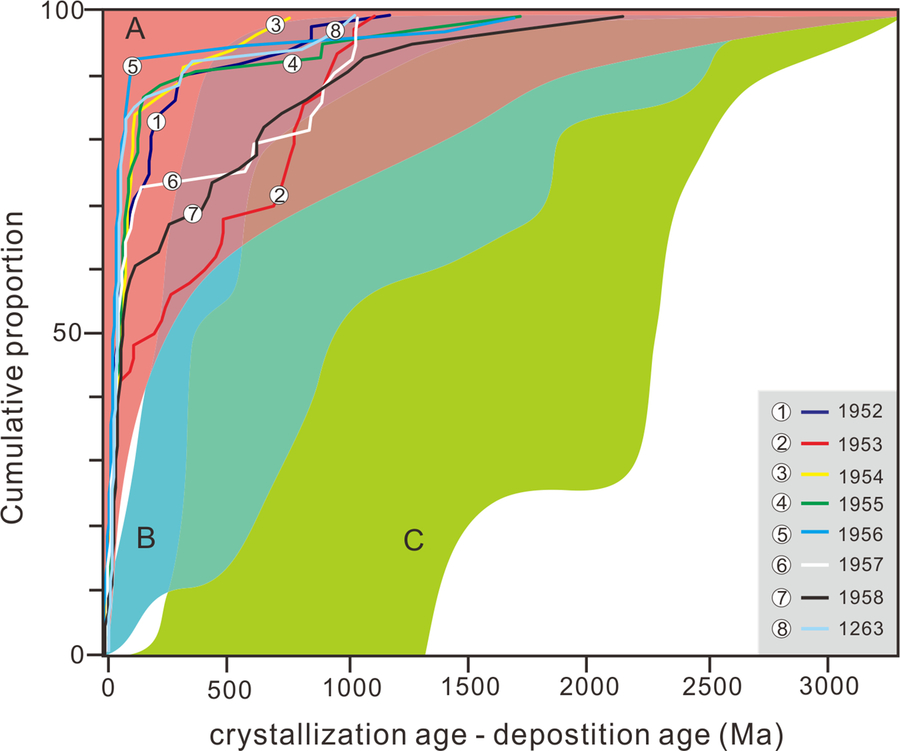
The Shuangqiaoshan and Lengjiaxi groups both yielded single age populations with the majority of detrital zircon ages close to the depositional age of the sediments, comparable to sedimentary units deposited in convergent plate margin settings (Fig. 9; Cawood et al. Reference Cawood, Hawkesworth and Dhuime2012). The mostly positive ϵHf(t) data (Fig. 6), as well as the mostly euhedral morphology of the zircon grains indicate that the grains within the age population of 875–820 Ma were predominantly derived from a nearby juvenile arc source, which is consistent with the fact that some of these grains display weak oscillatory zonation that is typical of zircons within intermediate or mafic rock suites. Zircon Hf model ages also suggest considerable contribution of latest Mesoproterozoic juvenile mantle material into the zircon-hosting magma in this region. On the depositional setting plot for sedimentary units, all the Shuangqiaoshan and Lengjiaxi samples fall within the convergent margin setting (Fig. 9). All analysed samples yielded similar age spectra with only one major age population at c. 875–820 Ma, along with minor Archaean to Mesoproterozoic ages (Fig. 5; online Supplementary Material Table S2). This is consistent with c. 870–830 Ma arc magmatism that occurs in the central and southwest domains of the Jiangnan orogenic belt (Wang et al. Reference Wang, Zhou, Yan and Li2012; Zhang, S. B. et al. Reference Zhang, Wu and Zheng2012; Zhang, Y. Z. et al. Reference Zhang, Wang, Fan, Zhang and Ma2012, Reference Zhang, Wang, Geng, Zhang, Fan and Zhong2013; Chen et al. Reference Chen, Wang, Wang, Gao, Shu, Zhou and Qi2014; Zhang & Wang, Reference Zhang and Wang2016; Sun et al. Reference Sun, Shu, Santosh and Wang2017; Cui et al. Reference Cui, Zhu, Fitzsimons, Wang, Lu and Wu2017).
Depositional setting of the Shuangqiaoshan and Lengjiaxi groups as inferred from discrimination plots of cumulative proportions versus CA–DA of analysed detrital zircons (after Cawood et al. Reference Cawood, Hawkesworth and Dhuime2012). (CA–DA is zircon crystallization ages minus deposition ages, which is also the lag time between zircon ages of crystallization and deposition. Field A (red) – convergent setting; Field B (blue) – collisional setting; Field C (green) – extensional setting). See text for discussion.

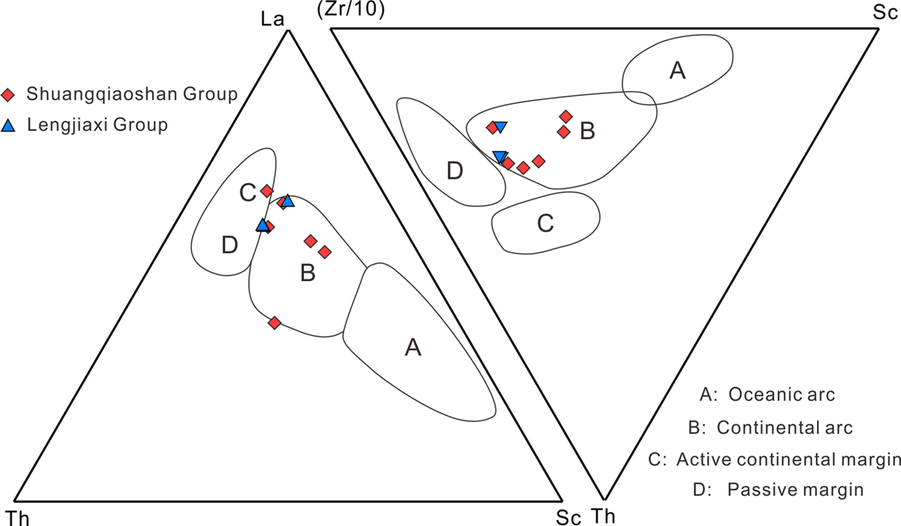
Whole-rock geochemical data also suggest deposition of the Shuangqiaoshan and Lengjiaxi groups in a convergent plate margin setting. The metasedimentary samples display depletion in HFSEs, including Nb and Ta (Fig. 8), indicating a magmatic arc dominated provenance. On tectonic discrimination diagrams for sedimentary rocks, such as the La–Th–Sc and Th–Sc–Zr/10 plots of Bhatia & Crook (Reference Bhatia and Crook1986) (Fig. 10), all the investigated samples plot in the continental arc field.
(a) La–Th–Sc and (b) Th–Sc–Zr/10 diagrams for the investigated sedimentary suite (after Bhatia & Crook, Reference Bhatia and Crook1986).

5.b. Tectonic implications
The Jiangnan accretionary orogenic belt has the following characteristics: (1) the northeast domain consists of a suite of c. 980–850 Ma volcanic–intrusive units that display arc geochemical signatures (Ye et al. Reference Ye, Li, Li, Liu and Li2007; Li et al. Reference Li, Li, Li, Lo, Wang, Ye and Yang2009; Yao et al. Reference Yao, Shu, Cawood and Li2016 b); (2) the central and southwest domains consist of a lithologic assemblage of igneous and sedimentary units that range in age from c. 870–820 Ma and display a convergent plate margin geochemical signature (Zhou et al. Reference Zhou, Wang and Qiu2009; Zhang, Y. Z. et al. Reference Zhang, Wang, Geng, Zhang, Fan and Zhong2013; Yin et al. Reference Yin, Lin, Davis, Xing, Davis, Cheng, Xiao and Li2013; Zhao & Zhou, Reference Zhao and Zhou2013; Chen et al. Reference Chen, Wang, Wang, Gao, Shu, Zhou and Qi2014; Yao et al. Reference Yao, Shu, Santosh and Zhao2014 b, Reference Yao, Cawood, Shu and Li2016 a; Zhang & Wang, Reference Zhang and Wang2016; Li, J. Y. et al. Reference Li, Wang, Zhang, Zhou and Shu2016; Sun et al. Reference Sun, Shu, Santosh and Wang2017); (3) a regional unconformity, constrained to have formed between c. 815 Ma and 800 Ma, separates convergent margin rocks within the orogenic belt from an overlying rift-related succession (Gao et al. Reference Gao, Chen, Ding, Liu, Zhang, Zhang, Liu, Pang and Zhang2011; Wang, J. et al. Reference Wang, Zhou, Deng, Fu, Duan and Guo2015; Yao et al. Reference Yao, Shu, Santosh and Li2015); (4) structural fabrics that indicate a top-to-the-SE sense of movement occur within the Shuangqiaoshan/Sibao and equivalent units, and pre-date the regional unconformity (Shu et al. Reference Shu, Shi, Guo, Charvet and Sun1995; Shu & Charvet, Reference Shu and Charvet1996; Yao et al. Reference Yao, Shu, Santosh and Li2016 a).
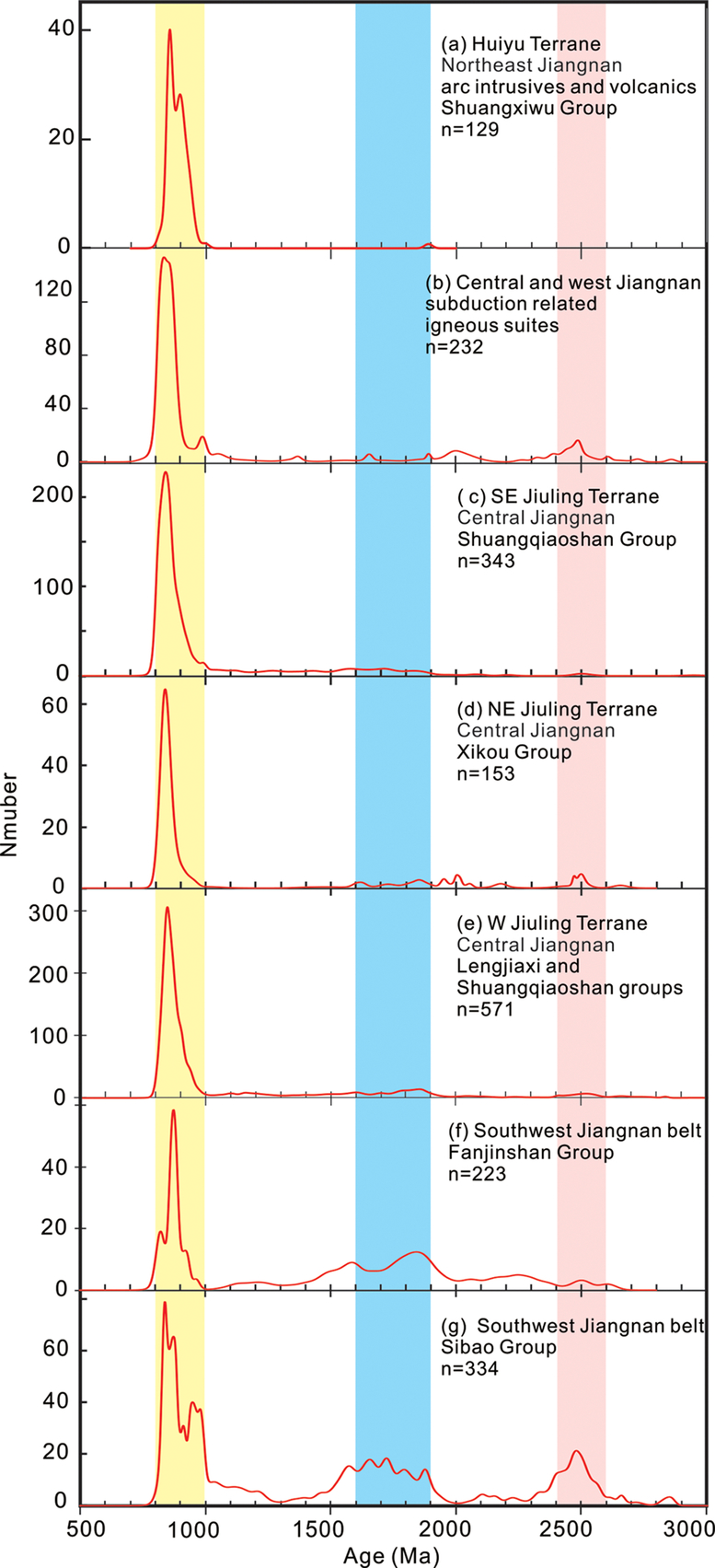
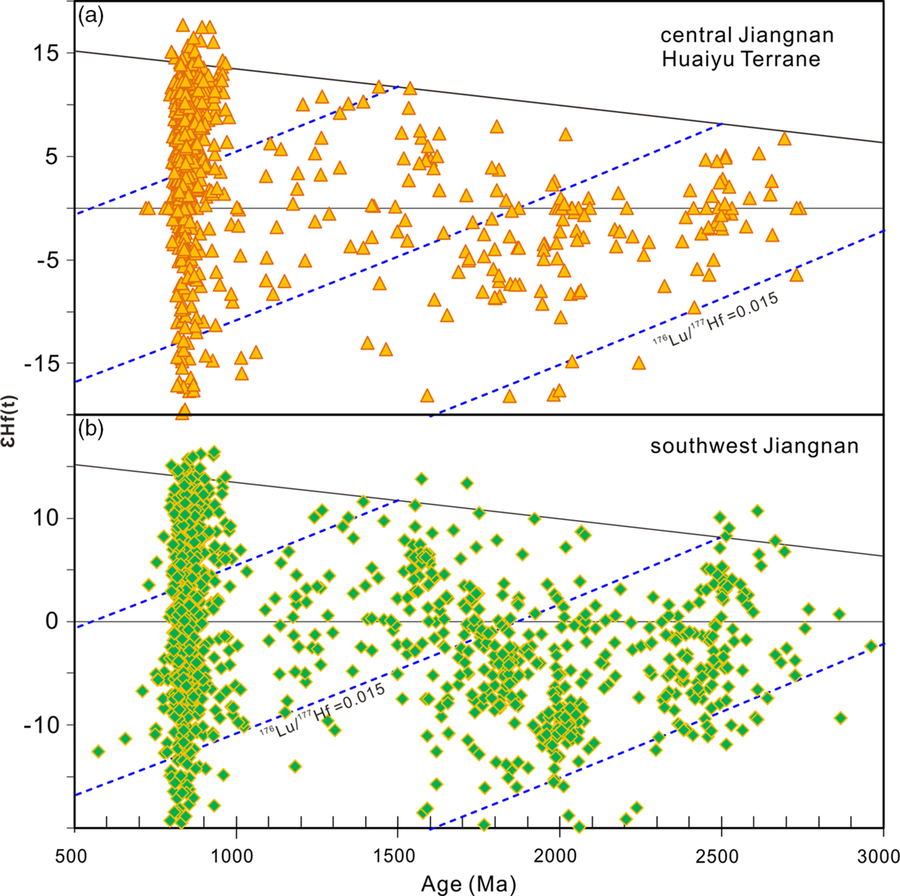
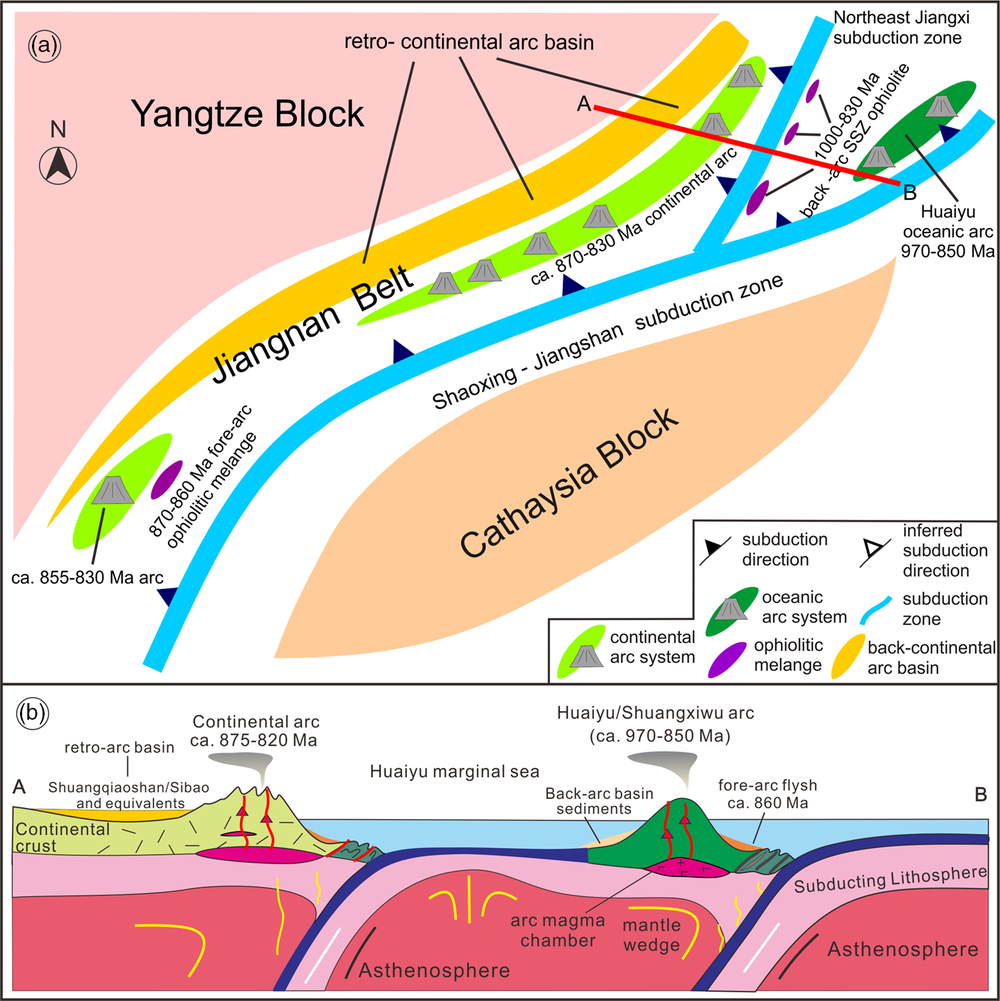
Our data suggest that the Shuangqiaoshan and Lengjiaxi groups were mainly sourced from a continental arc system active from c. 875 Ma to c. 820 Ma. Similar detrital zircon age spectra have been obtained from the other equivalent sediments of the Shuangqiaoshan Group exposed across the central domain (Yin et al. Reference Yin, Lin, Davis, Xing, Davis, Cheng, Xiao and Li2013; Wang, X. L. et al. Reference Wang, Zhou, Griffin, Zhao, Yu, Qiu, Zhang and Xing2014; Xu et al. Reference Xu, Xue, Li, Hu and Chen2014; Cui et al. Reference Cui, Zhu, Fitzsimons, He, Lu, Wang, Ge, Zheng and Wu2015; Fig. 11). Furthermore, the equivalent units in the western Jiangnan orogenic belt, such as the Fanjingshan and Sibao groups, have similar age spectra and arc-sourced geochemical signatures (Fig. 11; Zhou et al. Reference Zhou, Wang and Qiu2009; Zhao & Cawood, Reference Zhao and Cawood2012 and references therein; Wang, W. et al. Reference Wang, Zhou, Yan and Li2012, Reference Wang, Zhao, Zhou, Yang and Chen2014, Reference Wang, Zhou, Zhao, Pandit, Zheng and Liu2016; Wang, X. L. et al. Reference Wang, Zhou, Griffin, Zhao, Yu, Qiu, Zhang and Xing2014; Li, J. Y. et al. Reference Li, Wang, Zhang, Zhou and Shu2016). The central and southwest Jiangnan domains also display similar zircon Hf-isotope features, both indicative of significant juvenile crustal growth in the age range of 875 Ma to 820 Ma and varied Hf isotopes for older detrital grains, consistent with a convergent continental margin setting (Fig. 12). Moreover, the central Jiangnan domain (Jiuling Terrane) contains a higher proportion of grains with a juvenile composition than the southwest Jiangnan domain (Figs 11, 12), suggesting arc magmatism was less developed and/or a thicker crust in the southwest Jiangnan domain, given that arc magmatism is generally juvenile. The conclusion coincides well with c. 870–830 Ma subduction-related magmatism reported from the central and southwest Jiangnan domains (Zhao & Zhou, Reference Zhao and Zhou2013; Chen et al. Reference Chen, Wang, Wang, Gao, Shu, Zhou and Qi2014; Yao et al. Reference Yao, Shu, Santosh and Zhao2014 b; Zhang & Wang, Reference Zhang and Wang2016; Sun et al. Reference Sun, Shu, Santosh and Wang2017), as well as the presence of a c. 870–860 Ma fore-arc ophiolitic mélange (Yao et al. Reference Yao, Shu, Santosh and Li2016 a). In addition, the Shuangqiaoshan and equivalent units all contain some rounded Archaean, Palaeo- and Mesoproterozoic grains, which were likely transported over distances (Figs 4, 11), indicating a continental provenance. The presence of Mesoproterozoic and older zircon grains, both as detritus in sedimentary rocks and as xenocrysts within subduction-related igneous suites, exclude an oceanic island-arc environment. We therefore conclude that the Jiangnan sequences exposed in the central (Jiuling Terrane) and southwest domains of the Jiangnan belt were deposited in retro-arc continental margin basin(s) (Fig. 13), with the older pre-Neoproterozoic grains sourced from the Yangtze continent to the west and syn-sedimentary igneous grains derived from a magmatic arc to the east. The Lengjiaxi sedimentary rocks are well sorted and contain a higher proportion of quartz and inherited zircons, as compared to the greywacke and tuffaceous samples of the Shuangqiaoshan Group, indicating the Lengjiaxi Group likely accumulated closer to the continental margin of the continental retro-arc basin, whereas the Shuangqiaoshan Group was deposited nearer the arc source. Furthermore, strata in the western segment of the Jiangnan orogenic belt contain a larger proportion of continental-derived older detritus, including Archaean to Mesoproterozoic material (Fig. 11), from which we infer the retro-arc basin was either narrower in this region or deposition occurred closer to the inferred Yangtze source region (Fig. 13). The Shuangxiwu and Qigong groups in the northeast domain (Huaiyu Terrane) of the Jiangnan orogenic belt, consisting principally of early Neoproterozoic volcanic rocks and turbidites (Shu et al. Reference Shu, Shi, Guo, Charvet and Sun1995), only yielded an age population at c. 940–850 Ma and lack pre-Neoproterozoic grains (Chen et al. Reference Chen, Xing, Guo, Dong, Chen, Zeng, Li, He and Zhao2009; Li et al. Reference Li, Li, Li, Lo, Wang, Ye and Yang2009; Yao et al. Reference Yao, Shu, Santosh and Zhao2013, Reference Yao, Shu, Cawood and Li2016 b) (Fig. 11). Therefore, the northeast domain is inferred to constitute an oceanic arc setting, consistent with the presence of ophiolitic suites along both the northeast and southwest boundaries of the domain (Shu et al. Reference Shu, Shi, Guo, Charvet and Sun1995; Zhang, A. M. et al. Reference Zhang, Wang, Fan, Zhang and Yang2012; Yao et al. Reference Yao, Shu, Cawood and Li2016 b).
A comparison of age spectra from various locations in the Jiuling Terrane and other regions of the Jiangnan orogenic belt. Sources of data: (a) volcanic rocks and intrusive rocks of the Shuangxiwu Group in the northeast domain (Ye et al. Reference Ye, Li, Li, Liu and Li2007; Chen et al. Reference Chen, Xing, Guo, Dong, Chen, Zeng, Li, He and Zhao2009; Yao et al. Reference Yao, Cawood, Shu and Li2016 a); (b) subduction-related igneous suites in the central and southwestern domains, Jiangnan orogenic belt (Zhou et al. Reference Zhou, Wang and Qiu2009; Zhang, S. B. et al. Reference Zhang, Wu and Zheng2012, Zhang, Y. Z. et al. Reference Zhang, Wang, Geng, Zhang, Fan and Zhong2013; Zhao & Zhou, Reference Zhao and Zhou2013; Zhang & Wang, Reference Zhang and Wang2016; Yao et al. Reference Yao, Cawood, Shu and Li2016 a; Wang, W. et al. Reference Wang, Zhao, Zhou, Yang and Chen2014); (c) Shuangqiaoshan Group in the southeast segment of the central domain (this study); (d) Xikou Group in the northeast segment of the central domain (Yin et al. Reference Yin, Lin, Davis, Xing, Davis, Cheng, Xiao and Li2013; Cui et al. Reference Cui, Zhu, Fitzsimons, He, Lu, Wang, Ge, Zheng and Wu2015); (e) Lengjiaxi and Shuangqiaoshan groups in the west segment of the central domain (this study; Wang, J. Q. et al. Reference Wang, Shu and Santosh2016; Li, J. Y. et al. Reference Li, Wang, Zhang, Zhou and Shu2016); (f) Fanjingshan Group in the southwest domain, Jiangnan orogenic belt (Zhou et al. Reference Zhou, Wang and Qiu2009; Wang, X. L. et al. Reference Wang, Zhou, Griffin, Zhao, Yu, Qiu, Zhang and Xing2014); (g) Sibao Group in the southwest domain, Jiangnan orogenic belt (Wang et al. Reference Wang, Zhou, Yan and Li2012). Data used in plots given in online Supplementary Material Tables S4 and S5.

A comparison of zircon Hf isotopes from the Shuangqiaoshan, Sibao and equivalent groups in the central and southwest Jiangnan Orogen. (a) The central Jiangnan Orogen (Shuangqiaoshan, Xikou and Lengjiaxi groups; data sources include this study, Yin et al. Reference Yin, Lin, Davis, Xing, Davis, Cheng, Xiao and Li2013; Cui et al. Reference Cui, Zhu, Fitzsimons, He, Lu, Wang, Ge, Zheng and Wu2015; Wang, W. et al. Reference Wang, Zhao, Zhou, Yang and Chen2014, Reference Wang, Zhou, Zhao, Pandit, Zheng and Liu2016; Wang, J. Q. et al. Reference Wang, Shu and Santosh2016; Li, J. Y. et al. Reference Li, Wang, Zhang, Zhou and Shu2016). (b) The southwest Jiangnan Orogen (Sibao and Fanjingshan groups; data sources include Zhou et al. Reference Zhou, Wang and Qiu2009; Wang et al. Reference Wang, Griffin, Yu and O’Reilly2010, Reference Wang, Zhou, Yan and Li2012; Wang, X. L. et al. Reference Wang, Zhou, Griffin, Zhao, Yu, Qiu, Zhang and Xing2014; Yang et al. Reference Yang, Li, Wang and Lan2015). Data used in plots given in online Supplementary Material Table S6.

Schematic tectonic model for the Jiangnan orogenic belt. (a) Distribution of arcs and ophiolitic suites, along with inferred continental retro-arc basin systems and subduction direction. (b) An inferred cross-tectonic model for the northeast and central Jiangnan orogenic belt. See text for discussion.

A summary schematic tectonic model for the formation and evolution of the Jiangnan orogenic belt is displayed in Figure 13, which comprises: (1) the inboard retro-arc basin along the central and southwest domains of the Jiangnan orogenic belt, in which the Shuangqiaoshan, Lengjiaxi and equivalent groups are deposited; (2) a continental arc outboard of the retro-arc basin, along the southeast margin of the central and western segments of the Jiangnan orogenic belt; and (3) the Huaiyu oceanic arc in the eastern Jiangnan orogenic belt, which may have formed within its own discrete subduction system and generated island-arc type volcanic rocks of the Shuangxiwu Group.
The field observations and analytical data in this study indicate that the Jiangnan orogenic belt developed within an active convergent plate margin setting between c. 980 Ma and 820 Ma, with the final assembly of the Yangtze and Cathaysia blocks completed by c. 820 Ma.
6. Conclusions
(1) The time-equivalent Shuangqiaoshan, Xikou, Lengjiaxi, Fanjingshan and Sibao groups in the central (Jiuling Terrane) and southwestern domains of the Jiangnan orogenic belt were mainly sourced from a c. 875–820 Ma continental arc system and predominantly accumulated in a retro-arc continental margin basin.
(2) The Shuangxiwu and Qigong groups in the northeast domain of the Jiangnan orogenic belt (Huaiyu Terrane) were deposited at c. 970–850 Ma in an oceanic arc-related fore-arc or back-arc basin.
(3) The northeast domain is an oceanic island-arc terrane, whereas the central and southwest domains of the Jiangnan orogenic belt formed along a convergent continental margin.
Author ORCIDs
Liangshu Shu 0000-0001-6888-7558
Supplementary material
To view supplementary material for this article, please visit http://dx.doi.org/10.1017/S001675681900027X.
Acknowledgements
Reviews by Dr Wei Wang and another anonymous reviewer are gratefully acknowledged for their constructive and valuable comments and suggestions that led to a major improvement of the manuscript. We also wish to express our gratitude to Drs J. Q. Wang, C. L. Yan, and M. J. Song for their help during zircon dating and whole-rock geochemical study. We thank the Major State Research Development Program of China (Grant No. 2016YFC0600202) for financial support, as well as financial support from National Natural Science Foundation of China (Nos. 41772204, 41572200 and 41190070) and Hong Kong RGC GRF (17306217). Peter A. Cawood acknowledges support from Australian Research Council grant FL160100168.