INTRODUCTION
Over the last several decades, biologists have observed dramatic declines in populations of two species of sage-grouse (Centrocercus urophasianus and C. minimus). Currently, the combined ranges of the two species cover a vast portion of 11 western USA states and two Canadian provinces (Stiver et al. Reference Stiver, Apa, Bohne, Bunnell, Deibert, Gardner, M.A. Hilliard, McCarthy and Schroeder2006). Biologists estimate that populations may have declined by 69–99% from historic numbers (United States Federal Register 2004). Fears that the decline of one or both species could lead to a federal Endangered Species Act (ESA) listing have mobilized a diverse community of individuals to engage in small-scale collaborative sage-grouse management efforts, known as local working groups (LWGs). Participants include federal and state agency representatives with wildlife or land management responsibilities, as well as private actors such as ranchers and energy companies hoping to avoid restrictions on their activities. LWGs take proactive measures for sage-grouse conservation by involving local stakeholders. Participants learn together about threats to local sage-grouse habitat and populations, collaboratively create conservation plans and implement projects designed to help protect or increase grouse numbers. Goals outlined in typical conservation plans address the myriad factors thought to contribute to the species' decline, including expansion of energy exploration and infrastructure, wildfires, rural subdivision development, predation, and grazing management practices, the importance of which varies locally (WGA [Western Governors' Association] & NRCS [National Resource Conservation Service] 2004; Stiver et al. Reference Stiver, Apa, Bohne, Bunnell, Deibert, Gardner, M.A. Hilliard, McCarthy and Schroeder2006).
LWGs are just one example of a growing global trend toward collaborative conservation, which involves engaging a wider diversity of participants in planning and implementing conservation actions than do more traditional top-down expert-led models of natural resources management (Weber Reference Weber2000, Reference Weber2008; Daniels & Cheng Reference Daniels, Cheng, Manfredo, Vaske, Bruyere, Field and Brown2004). Collaborative approaches have also been used in other areas, such as watershed management (Genskow Reference Genskow2001; Leach Reference Leach2006) and community forestry (Pagdee et al. Reference Pagdee, Kim and Daugherty2006). Since the mid-1990s, over 60 voluntary LWGs in nine USA states have been convened to develop and implement local sage-grouse management plans (WGA & NRCS 2004). The groups share a common purpose, history, challenges and policy environment. However, because each state implemented the collaborative model differently, and because of the unprecedented scale of the overall sage-grouse LWG effort, these groups provide a rare opportunity to study empirically the impact of various factors on collaborative conservation success. Such evaluations of collaborative groups present a dual challenge: defining appropriate measures of success and understanding the myriad factors that could influence a group's ability to succeed.
In a perfect world, desired changes in natural resource conditions (such as recovering wildlife populations, cleaner water or enhanced forest stands) would always be used as a key measure for evaluating success in collaborative natural resource management. However, the time scale of resource response to management changes and the impact of variables beyond the influence of any collaborative venture make it difficult to link decisively the impact of group activities on environmental conditions (Kenney Reference Kenney2000; Perry & Ommer Reference Perry and Ommer2003; Koontz & Thomas Reference Koontz and Thomas2006). In the absence of good indicators of environmental outcomes, researchers have focused on more easily-measured intermediate accomplishments, such as creation of management plans and/or policy changes (Waage Reference Waage2003; Koontz Reference Koontz2005), or participant reports of their experiences with collaborative processes (Dakins et al. Reference Dakins, Long and Hart2005). The process of local collaborative conservation can be considered to occur in stages (Selin & Chavez Reference Selin and Chavez1995; Margerum Reference Margerum1999; Bentrup Reference Bentrup2001). Theoretical stages of collaborative group development allow the complexity of collaborative work to be conceptualized in a way that facilitates evaluation. Though typologies vary, there are several types of group accomplishments, the earlier of which are often treated as intermediate stages en route to creating better natural resource conditions. Applied to sage-grouse LWGs, five possible stages emerge: (1) bringing together diverse stakeholders and developing working relationships; (2) developing a coherent group vision or purpose (including group learning about relevant issues); (3) creating a locally-adapted plan of action; (4) obtaining resources and implementing projects; and (5) monitoring the impacts of projects to determine their effectiveness (and potentially adapting plans based on those results). Successes at any of these stages might be used as a measure of success.
A large number of studies have sought to identify factors that affect success in collaborative conservation efforts. One meta-analysis of 37 case studies found ‘210 distinct conclusions about what makes watershed partnerships succeed and fail’, in areas such as funding, local leadership and decision-making systems (Leach & Pelkey Reference Leach and Pelkey2001, p. 381). Variables thought to impact collaborative group success generally reflect either external factors (those beyond the control of individual groups), such as socioeconomic setting, resource availability, land tenure, history and regulatory context; or internal factors, such as how groups are structured and led, and who participates in them (Genskow Reference Genskow2001). The majority of factors considered in studies of collaborative groups are internal (Leach et al. Reference Leach, Pelkey and Sabatier2002; Lachapelle et al. Reference Lachapelle, McCool and Patterson2003; Clark et al. Reference Clark, Burkardt and King2005; Leach Reference Leach2006; Hershdorfer et al. Reference Hershdorfer, Fernandez-Gimenez and Howery2007). Internal factors of possible relevance to the sage-grouse context include the composition of collaborative group membership, group age, diversity of stakeholder interests represented, presence of a neutral facilitator, and whether or not the group members are formally appointed or allow general participation by members of the public (Leach & Pelkey Reference Leach and Pelkey2001, Bidwell & Ryan Reference Bidwell and Ryan2006). Fewer studies have addressed the role of external factors such as land ownership arrangements or physical attributes of the landscape (Pagdee et al. Reference Pagdee, Kim and Daugherty2006). Potentially important external factors which vary in the context of sage-grouse LWGs include the size of the geographic area, the relative amount of public versus private ownership of the landscape for which the working group is responsible and the amount of real authority granted to local groups from government authorities (Genskow Reference Genskow2001).
Aside from internal and external characteristics, some have suggested that emergent properties of collaborative groups can be important to generating meaningful changes in conservation behaviors. For example, early-stage group accomplishments, such as successfully forming the group, developing constructive working relationships among diverse stakeholders, and formulating a group vision and/or plan are discussed as important measures of certain types of success, often referred to as ‘outputs,’ versus ‘outcomes’ (Innes & Booher Reference Innes and Booher1999; Koontz & Thomas Reference Koontz and Thomas2006). These output, or early-stage, successes are generally assumed to be important drivers of later-stage successes, such as implementing projects or impacting environmental conditions (Kenney Reference Kenney2000). However, this assumption has not, to our knowledge, been rigorously tested in the research literature. Similarly, the literature on collaborative resource management suggests that considerable transaction costs can be involved with participation in collaborative processes, which may influence participation (Imperial Reference Imperial1999; Margerum Reference Margerum2007). As a result, groups that have been able to motivate their participants to commit or ‘invest’ significant time, money or energy in collaborative group activities may be more likely to achieve their conservation goals. A related theme emerging in the collaborative management literature reflects the potential importance of local participant feelings of ‘ownership’ over the collaborative process. While empirical studies on this issue have been scant, collaborative processes in which participants feel more personal ownership over the work of the group appear to be more effective than processes where such feelings do not develop (Bryan Reference Bryan2004; Lachapelle & McCool Reference Lachapelle and McCool2005). This assumption has been explored in more depth in the literature on organizational development (Pierce et al. Reference Pierce, Kostova and Dirks2003; Mayhew et al. Reference Mayhew, Ashkanasy, Bramble and Gardner2007).
The bulk of the empirical literature on collaborative group impacts has been limited by the difficulty of finding large numbers of groups that are reasonably well matched on core background variables, but that also provide sufficient variability to allow a systematic analysis of the impacts of group characteristics thought to influence success (Bidwell & Ryan Reference Bidwell and Ryan2006). Sage-grouse LWGs afford an extraordinary opportunity to conduct a systematic multiple-group comparison because the many groups focus on the same natural resource issue and share a remarkably standard vision (Stiver et al. Reference Stiver, Apa, Bohne, Bunnell, Deibert, Gardner, M.A. Hilliard, McCarthy and Schroeder2006). At the same time, these groups vary on many indicators of internal, external and emergent characteristics that are of theoretical interest. The similarities make a multiple-group comparison practical and realistic, while the differences provide an unusually robust research environment for testing a predictive model linking group-level attributes with group success.
Here, we use a multiple regression analysis to evaluate the hypothesis that internal, external and emergent group characteristics are systematically related to LWG success. We include as independent variables indicators of three external, four internal and three emergent group characteristics. We use indicators of each LWG's ability to fund and implement projects for sage-grouse conservation as our measure of group success (our dependent variable).
METHODS
To determine what attributes of LWGs are associated with success, we combined results of a mail survey of LWG participants with secondary group-level data. Secondary data were gathered by review of relevant documents (such as management plans) and from data available online. Our analysis includes both descriptive statistics and a hierarchical ordinary least squares (OLS) regression run on SPSS software (v. 16.0.1) to explain variation in LWG implementation success. The LWG was the unit of analysis.
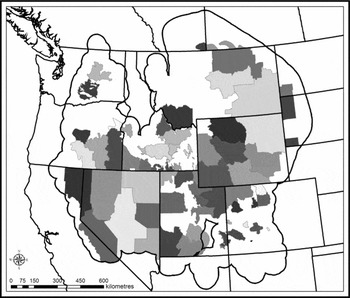
The study area includes the combined area of all the sage-grouse LWGs more than one year old (as of 2007). Current habitat (for both species combined) covers 673 199 km2 across 11 USA states and two Canadian provinces (Schroeder et al. Reference Schroeder, Aldridge, Apa, Bohne, Braun, Bunnell, Connelly, Deibert, Gardner, Hilliard, Kobriger, McAdam, McCarthy, McCarthy, Mitchell, Rickerson and Stiver2004). LWGs occur in nine USA states. The LWGs in our study covered 956 228 km2 in total. The area of individual LWGs varied from 251 km2 to 69 782 km2 (USGS [United States Geological Survey] 2008), depending on local population sizes, available potential habitat and administrative boundaries (Fig. 1).
Geographic boundaries of sage-grouse local working groups in western USA (USGS 2008). The line around the area shows an estimate of historic sage-grouse distribution.

For the mail survey, we obtained lists of current and past meeting attendees for LWGs listed on the USGS's Sage-Grouse Local Working Group Locator website (USGS 2008), which maintains a comprehensive list of sage-grouse LWGs across the western USA. We excluded groups less than one year old and one group for which a participant list could not be acquired. We sent surveys to up to 30 randomly selected participants from each of the remaining 54 groups. If the group participant list contained fewer than 30 individuals, all participants received the survey. Ultimately, 32 of these 54 LWGs were fully sampled, and a majority of participants were sampled in another 13 LWGs.
In order to qualify as a valid survey respondent, an individual needed to have attended at least one LWG meeting. Despite our attempts to obtain only attendees' names, erring on the side of caution dictated that we sent surveys to some individuals who had never attended a meeting but appeared on lists for other reasons. Disqualified respondents were replaced by another randomly selected participant from that group where available.
Survey implementation (between May and November 2007) followed a modified Dillman approach (Dillman Reference Dillman2000). An advance letter, initial survey and reminder postcard were sent to all names in the sample, with approximately one week to ten days between each contact. Up to two additional copies of the survey were sent to non-respondents to increase response rates. Considerable attempts were made to locate (and to resend letters and surveys to) individuals whose forwarding addresses had expired or who had left jobs related to their participation in the group. This was particularly important in groups with <30 participants listed, as no additional individuals could be sampled. In Washington State, the reluctance of group coordinators to provide physical mailing addresses led us to contact participants only by email with a link to a web-based version of the survey. Otherwise the same procedures were followed. Additional details of survey methodology are available in Belton et al. (Reference Belton, Jackson-Smith and Messmer2009).
A total of 1552 individual LWG participants in nine states were contacted to complete surveys. Of these, 717 provided valid responses and another 296 (19.1%) were disqualified because they had not attended any LWG meetings. The overall response rate was 56.8% of the non-disqualified sample frame. Response rates varied considerably by state and group. State responses ranged from 45.3% in Nevada, where several groups are no longer active, to 85.3% in Oregon, where small highly-coordinated groups were encouraged to fill out the survey by key personnel. Group response rates varied more widely (28.6–100%, with a median response rate of 57.6%). No formal non-response study was conducted, but evidence from contacts made while researching bad addresses, as well as the considerable number of surveys returned with ‘did not attend a LWG meeting’ checked, suggested that many of those who chose not to respond did so because they had not actually attended a LWG meeting or had moved on from a job and were no longer reachable. Groups with lower response rates tended to be those that were no longer as active.
We compiled information about additional LWG characteristics from sage-grouse planning documents and the USGS Locator website (USGS 2008), which serves as a clearinghouse for basic standardized information on the sage-grouse LWGs. Sage-grouse planning documents refer to a suite of government documents related to sage-grouse management. Examples include formal state sage-grouse plans, synthesis documents on range-wide sage-grouse conservation strategy (Stiver et al. Reference Stiver, Apa, Bohne, Bunnell, Deibert, Gardner, M.A. Hilliard, McCarthy and Schroeder2006), official memoranda of understanding (appendices in Stiver et al. Reference Stiver, Apa, Bohne, Bunnell, Deibert, Gardner, M.A. Hilliard, McCarthy and Schroeder2006), LWG plans (available online on state wildlife department websites), and a LWG status report (WGA & NRCS 2004). The Locator website (USGS 2008) is a significant source of information about LWGs, including the land area each group covers, broken down by landownership agencies and private land; precipitation and landcover data; and links to local plans and meeting minutes.
We included measures of three external factors that existing research suggested may be linked to collaborative group success, namely per cent private land ownership, degree of authority given to locally-produced management plans and geographic scope. Several other commonly considered external variables, such as nature of the resource issue, motivation for participation and partnership direction setting, were relatively constant across all sage grouse LWGs and thus are not included in our analysis. Data on the percentage of LWG land area managed by private landowners was obtained from the Locator website (USGS 2008). While nearly all LWGs were tasked with creating local sage-grouse conservation plans (adapted to specific local threats and conditions), in some states these local plans are clearly subordinated to the authority and plans of state wildlife agencies. In other states, local plans are considered to be the primary driver of conservation efforts, possibly based on comparative plan content or state-level comfort with a high degree of local autonomy, or both. In our analysis, LWGs were classified as instances of either local or state authority based on information on the Locator website (USGS 2008) and input from state wildlife agency staff. Information about the total land area under consideration by each LWG group was obtained from the Locator site, based on geographic information system (GIS) shape files provided by each state (USGS 2008). Geographic group size was measured as the natural log of area (in km2) to compensate for the skewed distribution associated with a few very large groups. The resulting measure accentuates differences between small- and medium-sized groups.
Three measures of internal LWG characteristics were obtained from secondary data: membership structure, facilitation and duration (age) of group. Following Dakins et al. (Reference Dakins, Long and Hart2005), group membership structure can be viewed as open (anyone can attend meetings and participate in decision-making) or representative (based on voluntary appointments defined in advance to assure representation of all key stakeholders). Some states' LWGs have designated seats for particular interest groups, while others have a more a open membership structure that allows virtually any interested agency, rancher, landowner or interest group representatives to join the LWG. The status of each LWG's membership structure is represented in our analysis by a binary variable: open or representative. We used a binary variable to measure whether or not facilitation in each LWG was done by a neutral (non-stakeholder affiliated) individual. (Importantly, our research did not classify formally designated facilitator/coordinators with agency affiliations as ‘neutral.’ Therefore, a ‘0’ value for this variable could represent instances where no formal facilitator existed for the group, or cases where facilitation was undertaken by an agency employee. We used the year each LWG was started to calculate a continuous measure of the number of years each group had been in existence. We excluded LWGs that started less than one year before the time of our study.
A fourth internal group characteristic, diversity of LWG membership, was calculated from the survey data by averaging individual responses from each LWG to create a group-level score. Respondents self-identified within various categories provided on the survey, such as landowner/rancher; tribal; federal, state or local government; representatives of environmental groups or energy companies. The diversity ratio was calculated by dividing the number of types of representatives in every group by the total number of valid respondents for each group. For example, for a group with eight responses but six types of respondent, the ratio would be 0.75.
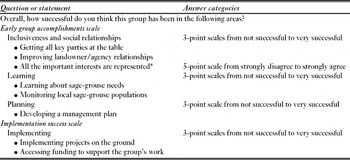
We measured participants' ‘psychological ownership’ as a latent multidimensional scale variable containing elements of perceived control, perceived responsibility and caring (emotional attachment). Questions related to these concepts were asked of individual survey respondents (Table 1), then summed to create an additive scale variable (where higher scores represent greater psychological ownership). Three-point scale items were recoded to have a high value of five, mid-value of three, and low value of one to allow equal weighting in the additive scale. Factor analysis suggested that all seven items loaded on a single dimension and the additive scale appears to have strong reliability (Cronbach's alpha = 0.865). Group-level ownership scores were then computed by averaging the scale values for all respondents in each group. To measure participant commitment, we combined individual responses to two survey questions (one for current, one for former attendees) on how consistently they attended meetings. Answers were coded using a four-point scale: almost all (90% +), most (50–89%), some (26–49%) and few (>25%). Again, group scores were computed as the average of participant responses for each group, with higher numbers indicating that participants attend meetings more regularly on average.
Questions included in the psychological ownership scale. ‘Control’ responses were recoded from 1, 2, 3 to 1, 3, 5 for summing.

While biological data on changes in local sage-grouse populations would be an ideal indicator of LWG success, data on sage-grouse populations are not consistently available at the appropriate geographic scales and timeframes to be useful for comparing the impacts of individual LWG efforts. Therefore, our indicators of group success are based on survey data in which LWG participants rated how successful their group had been in accomplishing eight specific outcomes (Table 2). Respondents rated most items using a three-point Likert scale, though a 5-point scale was used for one item. Factor analysis indicated that several categories of early-stage achievements (relationship building, learning and planning) were distinct from later stage success, such as accessing funding and implementing projects.
Survey questions included in the scales for early accomplishments and implementation success. *This statement was presented in a separate section of the survey and is in response to ‘Please indicate if you agree or disagree with the following statements’.

For our analysis, we computed two additive scales based on these two groupings of variables to capture overall levels of early-stage accomplishments and implementation success. The two scales appear to be quite reliable, with Cronbach's alphas of 0.745 and 0.737, respectively. Scale scores derived from individual survey responses were then averaged at the working group level to obtain a score for each LWG that reflected its level of success. Because implementation of projects on the ground is the one type of activity that would be most directly linked to changes in sage grouse habitat conditions, in the multivariate analysis below we treated early-stage accomplishments as an independent variable and implementation success as our dependent variable.
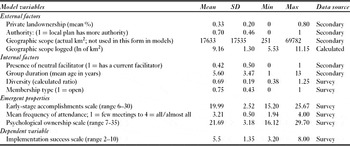
To evaluate the impact of various factors on indicators of LWG success, we regressed group mean implementation scale scores on a suite of group-level independent variables (Table 3). One very small LWG was excluded from the multivariate modelling due to missing data, leaving 53 groups in the analysis presented here. Examination of bivariate correlations for all model variables and multicollinearity diagnostic tests led us to exclude one internal variable, restrictive versus open membership type, because it covaried with several of the other model variables and its variable inflation factor (VIF) value was > 4. We ran four hierarchical ordinary least squares (OLS) regression models to assess the relative contribution of different sets of theoretically important variables to explain variation in group success. Model 1 provided a baseline model which evaluated the impact of commonly studied internal and external group characteristics that have been linked to collaborative group success. Model 2 added a new independent variable to assess whether early-stage group accomplishments were a necessary precondition of achieving implementation success. Model 3 added two more variables to capture the impact of emergent feelings of ownership and investment among LWG participants. As a final exercise, a process of backward model selection was conducted on the full model to identify the optimal combination of variables that most parsimoniously explained variation in the dependent variable (Model 4). Variables were removed only if the probability of F associated with the change exceeded p = 0.1.
Descriptive statistics for group-level variables used in models (n = 53). SD = standard deviation, Min = minimum and Max = maximum.

In all four models, variable coefficients were considered significant at p < 0.05. Model fit was evaluated using both conventional OLS statistics (adjusted R2 to assess the proportion of variance explained by variables in the model, and F-tests for change in R2 between models), as well as alternative indicators of model fit (the Aikake information criterion [AIC] and Mallows'prediction criterion [Cp]) that compared whether nested hierarchical models offered significant improvement over simpler versions but that were less sensitive to the number of model parameters (Norusis Reference Norusis1990; Tabachnick & Fidell Reference Tabachnick and Fidell2001).
RESULTS
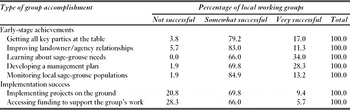
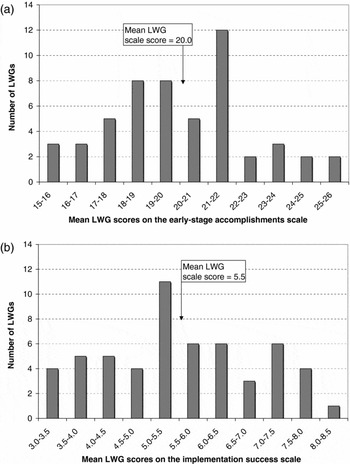
There is considerable variation in the degree to which LWGs have achieved various stages of group accomplishment. We classified LWGs into three categories based on the median value of their individual participants' ratings for each item (Table 4). Using this view, almost all LWGs appeared to have been at least ‘somewhat successful’ at all types of early-stage achievement, and approximately one-third of groups reported being ‘very successful’ at learning about sage-grouse needs and developing a sage-grouse management plan. In general, LWGs have had less success at the implementation stage: c. 20–30% of LWGs reported being unsuccessful at finding funding for projects or implementing projects on the ground, and <10% of LWGs were considered very successful at these tasks. The distribution of mean LWG scores for scales designed to capture overall early-stage and implementation stage success were even more variable (Fig. 2). In both cases, a noteworthy number of LWGs scored both above and below the mean of all groups.
Per cent of LWGs classified as successful at achieving various types of accomplishments, based on median value of each groups' participants' scores.

(a) Distribution of LWGs by score on early-stage accomplishments scale (possible range: 6–30). (b) Distribution of LWGs by score on implementation success scale (possible range: 2–10).

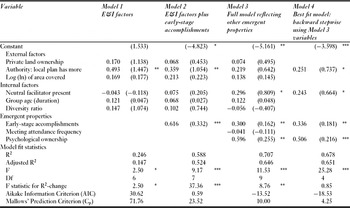
We examined standardized and unstandardized OLS regression coefficients and model fit statistics for four nested models (Table 5). Models 1–3 highlight the contributions of three theoretically distinct blocks of variables to explaining patterns of group implementation success. Model 1 is significant overall (F = 2.5, p = 0.036) with an adjusted R2 of 0.147, suggesting that these internal and external variables explain c. 15% of variation in group success. However, only the coefficient for local plan authority is statistically significant (p = 0.004) and the positive sign suggests that groups whose local plans are seen as driving conservation efforts more than state-level plans are more likely to see implementation of projects. Model 2 introduces an additional variable capturing the influence of early-stage group accomplishments. This model is highly significant (p < 0.001), explains almost half of the variation in implementation success (adjusted R2 = 0.524), and is statistically a better fitting model than Model 1 (p < 0.001). This suggests that groups that have achieved more early-stage accomplishments are significantly more likely to report implementation success (p < 0.001). In this model, the coefficient for local plan authority remains significant and positive (p = 0.006).
Standardized and unstandardized (in parentheses) regression coefficients in nested OLS regressions of implementation success on group characteristics. *p < 0.05, **p < 0.01 and ***p < 0.001. E & I = external and internal.

Model 3 adds two more variables capturing the additional impact of emergent participant commitment and feelings of psychological ownership over the group's work. Model 3 explains almost two-thirds of variation in LWG success and is a significantly better fit than Model 2 (p < 0.001). The measure of psychological ownership is highly significant and positive (p < 0.001), suggesting that groups that cultivate participant feelings of control, responsibility and caring (as encapsulated in the psychological ownership variable) are more likely to report implementation success. The coefficient for meeting attendance frequency is not significant. In this full model, the inclusion of the ownership scale results in a smaller standardized β coefficient for early-stage accomplishments, but that variable remains significant and positive (p = 0.015). Once we control for the effects of emergent properties, the coefficient indicator for local plan authority, while still positive, loses statistical significance (p = 0.060) while the coefficient for presence of a neutral facilitator becomes statistically significant (p = 0.025).
Model 4 represents the results of a backward stepwise selection process run on the full set of Model 3 variables (Norusis Reference Norusis1990). This process finds the statistically ‘best fit’ model that reflects the most parsimonious combination of theoretically important independent variables that explain implementation success. The overall model fit for Model 4 remains high (R2 = 0.651) and the values for alternative indicators of model fit (AIC and Cp) are both significantly improved. Four variables with significant coefficients remain in the reduced model. Groups with more local authority to implement their plans, those with neutral facilitators and those that achieve early-stage accomplishments appear significantly more successful at project implementation (p = 0.019, p = 0.038 and p = 0.002, respectively). The most influential variable in this reduced model is the measure of psychological ownership (β = 0.506; p < 0.001), which is positively related to implementation success.
DISCUSSION
Although LWGs share a similar purpose and policy context, individual groups have experienced different levels of success, particularly with regard to implementation of projects. A sizable percentage (20–30%) of LWGs appear to have been ‘not successful’ at finding funding and implementing projects, while a small group (c. 10%) have been ‘very successful’ at these tasks. A substantial and significant amount of variance in the amount of LWG implementation success can be explained using just four key variables: psychological ownership, early-stage successes, presence of a neutral facilitator and the local plan having more authority.
The distribution of scores on our scales measuring both early-stage accomplishments and implementation success suggest considerable diversity among LWGs in terms of their achievements. Moreover, while we have shown that early-stage successes can increase the chances of implementation success, it is clear that early-stage success does not always lead to on-the-ground project implementation. This implies that studies of collaborative working group success that rely only on measures of early-stage successes may miss important differences among groups in terms of implementation success. The results also suggest that most LWGs have built a foundation for success, but still have room to improve. From the practitioner's viewpoint, this is an encouraging fact, but implies that initial investments of time, energy or money need to be maintained and further leveraged to ensure future implementation successes.
Because implementation success is a critical step toward changes in land use and land management that can improve the prospects for recovery of sage-grouse populations, it is important to identify the organizational, contextual and process factors related to on-the-ground behavioural change. Of the external factors we examined, geographic area and land ownership were found to have no relationship to implementation success among sage-grouse LWGs. Previous literature has suggested that groups that manage small geographic areas are easier to coordinate (Genskow Reference Genskow2001), and therefore might be more successful. Our research did not support this assumption. Because critical sage-grouse habitat areas often occur on private land parcels in the western USA, private landowners are key stakeholders in almost every LWG (WGA & NRCS 2004; USGS 2008). We began our research with the assumption that, while areas with more private land rely heavily on the voluntary cooperation of numerous independent landowners, private land projects might require less government bureaucracy to implement, potentially removing other barriers to project implementation (Genskow Reference Genskow2001). However, land ownership differences across our sample did not appear relevant to implementation success. This may be due to different, but similarly burdensome, challenges to funding and implementing projects on private versus federal land. However, as many private projects done for sage-grouse may involve federal money (such as through the Natural Resources Conservation Service), further research is needed to understand the effect of landownership on group success. Finally, our analysis suggests that groups whose local plans were seen as having more authority were slightly more likely to implement projects on the ground. This supports literature suggesting that it is important for groups to have authority that matches the geographic scope of the underlying resource problem (Leach & Pelkey Reference Leach and Pelkey2001; Pagdee et al. Reference Pagdee, Kim and Daugherty2006). However, because the precise reasoning used in each state to determine where the state or local plans had more authority is unknown to us, but may have differed, this result should be interpreted with caution. While it is unlikely that any of the local plans have more formal authority than the state plans, it is highly likely that local plans in some cases are the primary tools of project implementation.
Of the internal factors we examined in this research, only one (presence of a neutral facilitator) was related to success. This supports previous research that suggests that facilitated groups have better success (Leach & Pelkey Reference Leach and Pelkey2001; Pagdee et al. Reference Pagdee, Kim and Daugherty2006) and that impartial facilitation is a key element of a genuinely democratic process (Leach Reference Leach2006). By design, the collaborative resource management approach requires regular participation and commitment of time from diverse stakeholders. Unlike previous work (Williams & Ellefson Reference Williams and Ellefson1997; Selin et al. Reference Selin, Schuett and Carr2000; Bidwell & Ryan Reference Bidwell and Ryan2006), we did not find that groups with higher levels of internal diversity (for example broader representation of different interests) were any more likely to report implementation success. Leach and Pelkey (Reference Leach and Pelkey2001), however, observed that inclusive (diverse) membership can contribute to, or detract from, success in various situations. This supports our interpretation that diversity in the sage-grouse LWG context may be less important than simply having appropriate individuals involved who contribute to achieving certain types of success: in this case, finding funding or facilitating project implementation. Because the involvement of key individuals is part of the early success measure, the relationship between these two factors could be explored in more detail in future studies. Similarly, while more recently formed groups are generally thought to be less likely to accomplish most key outcomes (Leach et al. Reference Leach, Pelkey and Sabatier2002; Dakins et al. Reference Dakins, Long and Hart2005), we did not find a relationship between group age (>1 year) and implementation success. We suspect that the actual number of years spent in collaborative work may be less important than the quality of those interactions or the ability of the groups to reach important early-stage milestones, supporting Bidwell & Ryan's (Reference Bidwell and Ryan2006) conclusion that even several years out, success may be elusive for a variety of reasons. Because our ‘membership type’ variable (open versus representative membership structure) was highly correlated with several other independent variables, we were unable to include it in our multivariate model. However, a bivariate analysis (not shown) indicated that representative membership type is positively related to group implementation success. Further research should seek to differentiate between the impact of membership type and other group- or state-level characteristics (such as interagency coordination, funding, and management style used by state wildlife agencies).
Two of the three emergent qualities of groups in our study had a strong impact on explaining implementation success. Early accomplishments and psychological ownership were highly significant, while indicators of meeting attendance frequency appear unrelated to implementation success. The literature on collaborative processes often assumes that early-stage successes (sometimes referred to as ‘outputs’) are likely to lead to changes in land management or similar environmental outcomes (Innes & Booher Reference Innes and Booher1999; Koontz & Thomas Reference Koontz and Thomas2006). Our results support the view that typical ‘early-stage’ successes, such as building relationships, learning about the issue and writing a plan, are important predictors of later-stage success, such as project implementation. The most influential variable in our analysis was a measure of psychological ownership. LWGs whose processes have led their members to feel greater personal ownership over their group's work were much more likely to report success at the project implementation stage. This result validates anecdotal references to the importance of psychological ownership (Bryan Reference Bryan2004), and the growing body of scholarship that suggests that successful collaborative processes are able to engender feelings of ownership over the group's work among participants. The strength of association of early accomplishments and psychological ownership in our exploratory research points to the need for additional work on the emergent properties of groups.
Limitations and generalizability
The cross-sectional nature of our research limits our ability to draw firm conclusions about causality. There are likely complex relationships between different types of group accomplishments (for example some early-stage accomplishments may continue to develop after implementation success, particularly in adaptive management scenarios), and between emergent psychological ownership and group activities (for example it is plausible that feelings of ownership are derived from group implementation success, as well as contributing to it) (Innes & Booher Reference Innes and Booher1999). Longitudinal data would be required to tease out the causal relationships among these various factors. Similarly, while we analyse our data at the group level, future analysis might find it useful to combine individual- and group-level data in a hierarchical linear modelling (HLM) framework.
The relatively large number of LWGs share many attributes, while also providing a degree of variability along key factors. However, this limits the generalizability of the results to collaborative group settings that approximate those found in this study. Perhaps the most important of these factors is the policy environment surrounding the sage-grouse, and its influence on how and why individuals participate in LWGs. Across all the groups, the same ‘threat’ exists: the possibility of a formal listing of sage-grouse under the Endangered Species Act. Because sage-grouse are not currently listed, however, participation in sage-grouse LWGs remains a voluntary pre-emptive endeavour, and participant involvement likely follows different patterns than might be found in situations where land management practices and working group decisions are regulated by strict federal mandates. (This statement remains true in light of the recent 5 March 2010 finding by the USFWS that sage-grouse are ‘warranted but precluded’ from ESA listing, which does not technically change the current regulatory context (United States Federal Register 2010). As such, the results of this study may not be generalizable to collaborative wildlife management groups operating in a different policy environment, either with an already listed species, or with a species not under consideration for listing. Outside the wildlife management context, however, some characteristics of sage-grouse LWGs (voluntary incentive-based approaches which seek to prevent future regulatory action) are common in watershed management or other collaborative settings. This suggests that many of the conclusions from this research are likely to be applicable to those types of groups.
To avoid sampling bias, almost all local working groups were included in the study. The only groups not included were newly started groups that were less than a year old. One possible source of bias relates to the lists of LWG participants. When participant lists were requested, we requested that all past participants in the groups be included, regardless of level of participation. In most cases it appeared that this was achieved: nearly half of survey respondents indicated that they no longer actively attend meetings. It was impossible to confirm, however, if all group lists included all past participants. Also, some lists contained many individuals who had never attended meetings. For example, the centrally-maintained Utah list included individuals on the list for information only, or who had been added to the list in the hope that they would attend in the future. As a result, Utah had a considerably higher disqualification rate than other states. Another factor which unavoidably affected our sampling frames and, by extension, group response rates, was variation in membership structure (primarily at the state level). Lists from representative (appointed) groups did not include casual ‘non-member’ attendees who might in other states be considered a participant.
The validity of using participant perceptions to gauge group success has occasionally been questioned (Conley & Moote Reference Conley and Moote2003). However, we argue that the benefits outweigh the potential biases. Specifically, the average participant perceptions of LWG accomplishments are a reasonable measure of group success both because collaborative processes intrinsically require broad involvement of their participants, and also because the breadth of LWG members' awareness of their group's tangible accomplishments (like developing a plan or implementing projects) is a measure of the visibility and importance and not merely the presence of these achievements. Moreover, when we compared results of participant ratings of LWG success with input from key informants, we found that they were consistent with informal independent measures of major group accomplishments and perceptions of the relative success of particular LWGs within and across the states included in our study.
Management implications
Our research suggests several ways to create atmospheres conducive to implementation success. We would encourage supporting collaborative groups at all stages of development, especially older groups, which might otherwise appear less in need of continuing support. Moreover, groups who are given more authority are more likely to implement projects. The positive influence of a neutral paid facilitator for collaborative groups is also well supported by our results. Finally, groups with higher levels of psychological ownership among their members report greater implementation success. Thus, improving understanding of the mechanisms that generate psychological ownership would further contribute to understanding group success.
ACKNOWLEDGEMENTS
This research was funded by the Agricultural Wildlife Conservation Center of the United States Department of Agriculture's Natural Resources Conservation Service. Special thanks to Terry Messmer at Utah State University, and to the myriad LWG participants, facilitators, state coordinators, and others without whom this research would not have been possible.