Something extraordinary occurs in the third scene of Pygmalion, Jean-Philippe Rameau's acte de ballet of 1748. The title character, a sculptor, is creating a marble statue of a woman. She is so beautiful that he falls in love with his own creation. The intervention of L'Amour, the goddess of love, brings the statue to life; the statue, in turn, declares her love for her creator. Jubilations ensue. At the crucial moment of the statue's metamorphosis, Pygmalion sings of his joyous bewilderment, accompanied by the most astonishing orchestral sounds.
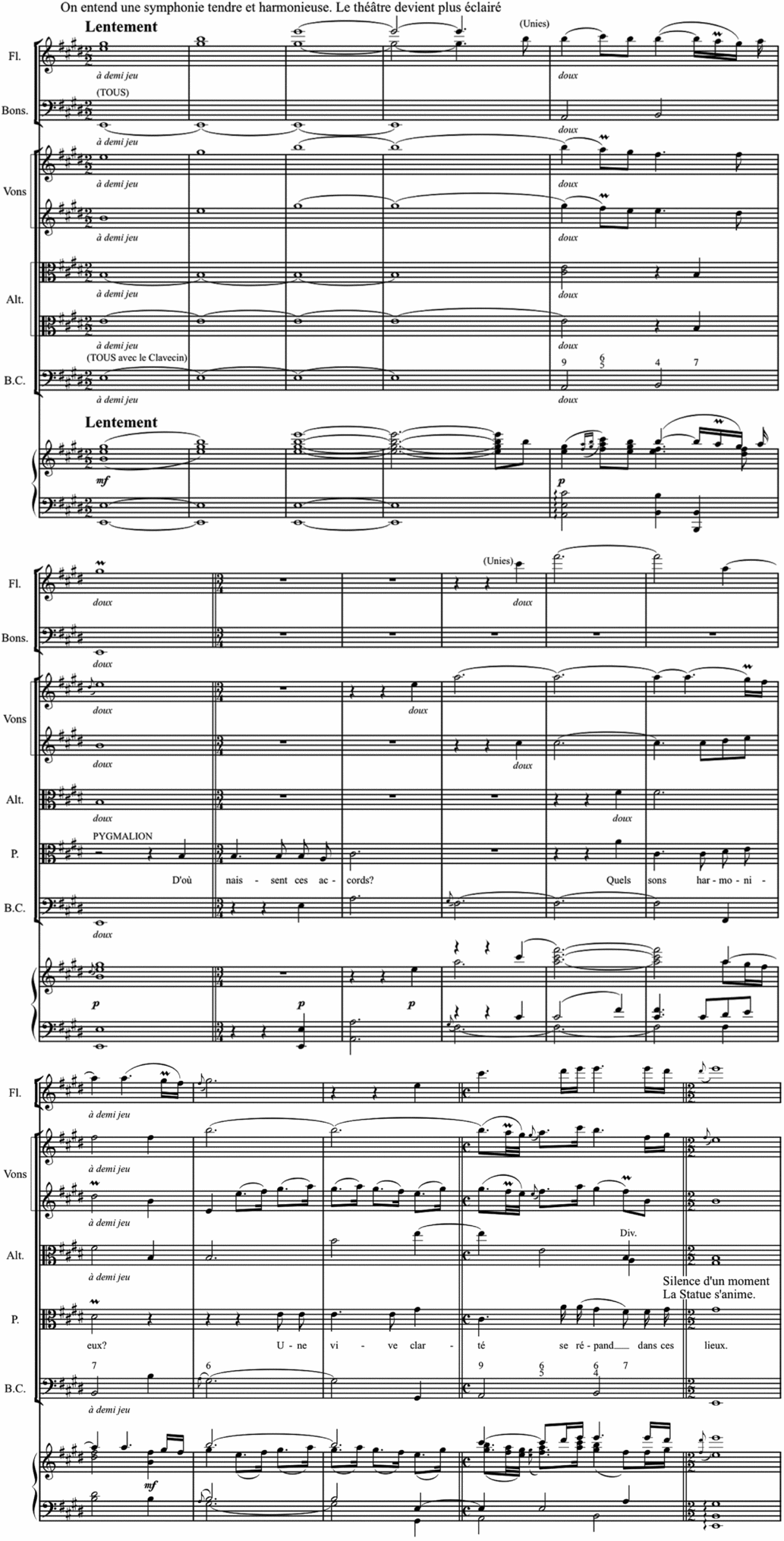
The fact that Pygmalion can actually hear the music rising up from the pit is in itself remarkable (Example 1). With the obvious exception of divertissements, when an orchestra plays music that is audible to those on stage, since they must dance to it, or instances of musical onomatopoeia such as thunder claps and bird song, operatic characters generally remain oblivious to the musical weft that enfolds them. That this illusion, this conventional pact between stage and audience, is broken here signals an exceptional moment.
Jean-Philippe Rameau, Pygmalion, scene 3.

This music is also made to stand apart from its surroundings by the way in which it is framed. A sudden, unexpected tonal shift separates it from the preceding section, and it is followed by silence: the stage instructions call for ‘Silence d'un moment. La statue s'anime’ (‘A moment of silence. The statue comes to life’). Without any kind of transition, the key moves three steps sharpwards round the cycle of fifths, from the prevailing G major to E major. This bright new key is in keeping both with the ‘vive clarté’ of which Pygmalion sings and with the stage instruction that ‘Le théâtre devient plus éclairé’ (‘The stage gets brighter’). It is undoubtedly a dramatic change, and in Rameau's day was perceived as a highly affective moment. Rameau's contemporary Melchior Grimm, for example, wrote that ‘the bold and felicitous change from G major to E major at the moment of the miracle . . . tears at the soul’.Footnote 1 Already in his Traité de l'harmonie (1722) Rameau had commented on the semiotic value of the key of E major – ‘suitable for both tender and gay songs . . . Grandeur and magnificence can also be expressed’Footnote 2 – and while keys clearly do not carry universal meanings, E major was nonetheless often associated in the eighteenth century (and later) with brightness, the uplifting, and the heavenly. Hugo Leichtentritt, for example, associated the sharper keys in Handel with ‘the idea of heaven, with ecstatic visions of a world beyond earthly toil and pain, with eternal peace and heavenly consolation’.Footnote 3 Such transcendence is clearly a part of the intended affect here in Rameau, underlining a sense of going beyond the ordinary, even of some sort of representation of the divine.Footnote 4
The text here, too, is exceptional. The libretto is the work of the eighteenth-century lawyer and man of letters Sylvain Ballot de Sovot,Footnote 5 a retelling of the tale found in Ovid's Metamorphoses, and in large part borrowed from an earlier libretto (1700) by Antoine Houdar de la Motte.Footnote 6 But the words sung at this moment by Pygmalion, and which draw attention directly to the music, do not originate in de la Motte's libretto. Rather, as Thomas Christensen discusses, they seem to have been added by de Sovot at Rameau's own request.Footnote 7 Pygmalion thus becomes the mouthpiece of the composer.
Pygmalion may be confused by the source of these harmonious sounds. But not Rameau. What both the stage character and audience are hearing is a representation of the corps sonore, Rameau's most important and influential idea. Rameau's theoretical works are an expression of his modernity, that is, to put it very generally, they are representative of wider modern thought characteristic of the French Enlightenment, asserting as they do the principles of reason via empirical, rational scientific investigation. Prompted by his discovery of the work in acoustics and intervals of Joseph Sauveur (published, as Rameau notes, in 1701 in the mémoires of the Académie Royale des Sciences Footnote 8), Rameau attempted to demonstrate in the Nouveau système de musique théorique et pratique (1726) how any single note produced by a sounding or vibrating body was in fact made up of a spectrum of overtones above a fundamental frequency, in a similar way to that in which white light had been shown by Newton to be made up of a spectrum of colours. More precisely, he observed that ‘a single string makes all the consonances resonate, among which we distinguish principally the twelfth and the major seventeenth’.Footnote 9 This is what defines the corps sonore for Rameau. And in this moment in the opera we hear a musical realization of this scientific discovery: the position of each note in the initial E major triad coincides with the spacing of the overtones in the corps sonore, to which in subsequent bars the violins and flutes add further partials, ‘as if Rameau were composing out the corps sonore itself’.Footnote 10
Why, then, does the corps sonore appear at this precise moment? It is certainly a striking mise en scène of Rameau's new theory, an enactment of the modern. It is also, argues Christensen, a representation of the ‘sensationalist’ ideas of Locke that were being developed at this time by Diderot and Condillac, that is, the statue gradually becomes a sentient being, the hitherto senseless body (corps) of the statue is animated by the sound of the naturally occurring corps sonore:Footnote 11 she sings, ‘Que vois-je? Où suis-je? Et qu'est-ce que je pense?’ (‘What do I see? Where am I? And what am I thinking?’). If, as Rameau claimed, the corps sonore, drawn from nature, was the source of all music, then, allegorically, it could also be understood to be the source of life itself. By the end of his own life, the corps sonore had become for Rameau something almost pantheistic, metaphysical, mystical. It was to be found everywhere, resonating throughout nature, but also – as revealed in his final unpublished essay – it even took on divine powers.Footnote 12 On the operatic stage, those divine powers bring the statue to life.
The appearance of the corps sonore here defines and delimits a dramaturgical time and space. This moment appears as sacred, in that it is set apart from that which surrounds it. The normal passage of time appears to be suspended as the corps sonore reveals itself; as a result, time takes on a (vertical) spatial dimension. The listener is invited to cross an imaginary threshold in order to enter a different time/space, to engage a different, non-narrative mode of listening. It is as if a bell has sounded, tolling out across the space, ritualizing time. But it is not just the statue that has been ‘sensitized’; it is the entire theatrical space. The corps sonore here creates an espace sensible, a term I adopt from Michel Leiris. In ‘Opera: Music in Action’, Leiris examines ways in which the music of opera ‘carves out and sculpts the space of the theatre’; ‘[i]n this theatre, the very special reason for the work's existence seems to be that it should cause an intensely palpable space [un espace intensément sensible] to blossom forth’. Thus, the music in an opera does not only function to serve character and dramatic situation but also to define space: ‘music lifts into the realm of the unlimited a closed space’.Footnote 13 For Leiris this is a feature of much opera since Mozart. I appropriate the notion of espace sensible here for more specific moments where the appearance within a stage work of sounds derived from the harmonic series distinguish themselves from the music around them and thus articulate differentiated temporal and spatial environments.Footnote 14 These isolated moments in Rameau of the creation of an espace sensible by means of the sounding of the musical spectrum as a staging of modernity are unique in opera before the twentieth century (with the possible exception of the Prelude to Wagner's Das Rheingold), though more broadly the musical representation of an ‘elsewhere’ or even an ‘elsewhen’ is far from uncommon, what Julian Johnson has described as ‘the metaphysical promise of musical modernity’.Footnote 15 But the corps sonore – rediscovered and repurposed by the spectral movement of the 1970s – reappears in more recent stage works in order to animate a late-modern sense of the espace sensible. Instead of crossing a threshold towards the transcendent, the seemingly immobile corps sonore now appears to represent a sense of loss, a portal leading to death; the separateness of the sacred is turned into an articulation of exile and alienation; the modern promise of plenitude often fragments into modernist ruin and failure.
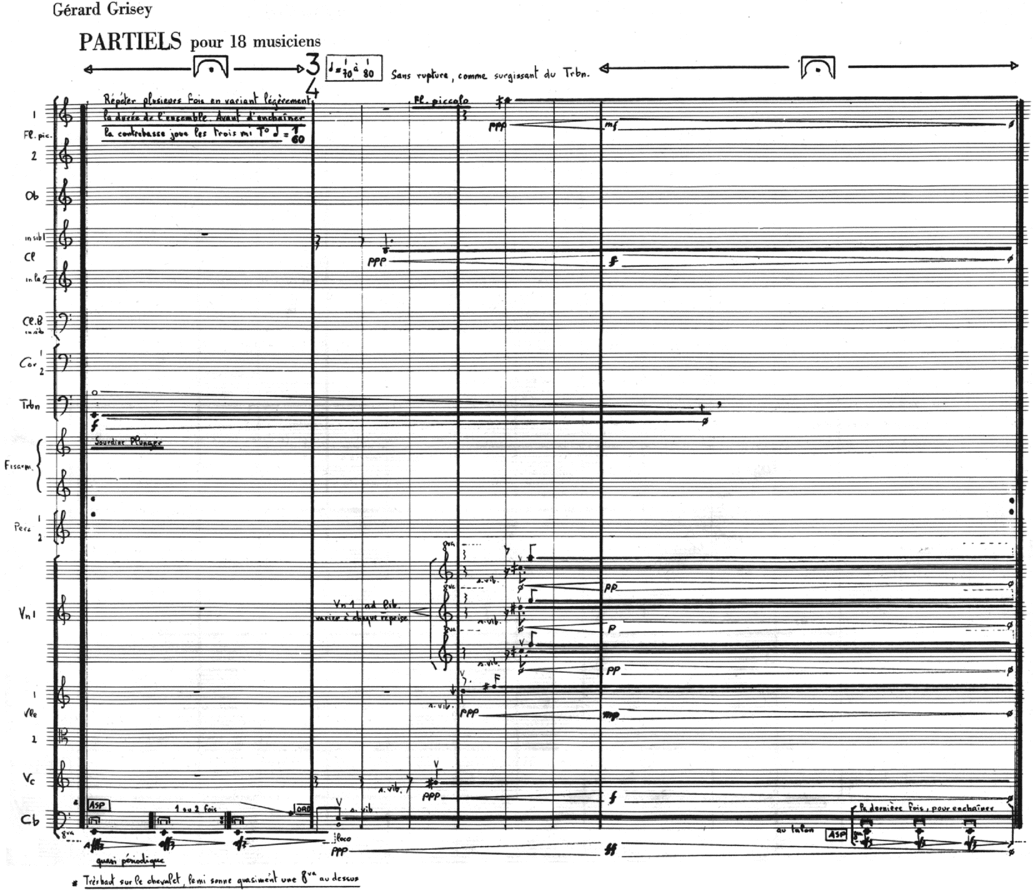
It was ‘as if Rameau were composing out the corps sonore itself’, wrote Christensen (above). Arrived at through rigorous scientific observation, the corps sonore in the third scene of Pygmalion is, as it were, re-synthesized in front of listeners’ ears: the elements of this composite, static body of sound are teased apart and made audible (sensible), temporal. Almost 250 years later, Gérard Grisey repeats this process. The much-discussed opening of Partiels (1975), the third part of Grisey's immense cycle Espaces acoustiques (1974–85), also begins with a kind of chord of E major: it starts on the lowest open E♮ of the contrabass, attacked (sfffz) with controlled decay (dim.), repeated two or three times, softer on each occasion, then fades to ppp, while being doubled by a sustained E an octave higher on the tromboneFootnote 16 (Example 2). What emerges next are sounds just as extraordinary as those in Pygmalion, and which were first received with similar astonishment, in part because it was hard to imagine that they could have been made by acoustic instruments alone. Grisey composes out the corps sonore, the result of an analysis with the aid of a sonograph of the internal structure of a bass trombone E (fundamental frequency 41.2Hz), re-synthesizing its partials across other instruments in the ensemble (a procedure the composer calls ‘instrumental synthesis’). Grisey chooses twelve pitches – odd-numbered harmonics ascending from 1 to 21 (with the addition of partial 2), using microtonal indications in the score to reproduce the spectrum as closely as possible – to produce what he describes as ‘a hybrid being for our perception, a sound that without still being a timbre is already no longer exactly a chord’.Footnote 17 This ‘chord’ is held and then gradually fades to nothing. Thus, Grisey is not just composing out the corps sonore but is attempting to replicate how a sounding body behaves when struck; in other words, he presents not only its spectrum but also its phases of attack, sustain and fade.
Gérard Grisey, Partiels, opening. © Universal Music Publishing Ricordi, Milan; reproduced by permission.

Grisey's continuation is, however, quite different from Rameau's. The appearance of the corps sonore in Pygmalion is the source not just of life for the statue but also of the tonal system: the chord (tonic) calls up its subdominant and dominant before returning to the tonic, a tonally defining cadential progression representing stability, fullness, completeness. By contrast, in the first section of Partiels, the appearance of the corps sonore is restaged many times over, but the chord is slightly different on each appearance: it progressively degrades, it decays from the natural harmonic spectrum towards a spectrum of inharmonic partials and noise.Footnote 18 A parallel process is to be found in the movement from periodic to aperiodic rhythmic organization. Thus, from the same starting point, namely a scientific enquiry into the nature of sound, Rameau and Grisey produce startlingly different music. The fragility of Grisey's music here, the instability of the corps sonore over time, stands in stark contrast to Rameau's certainty, and seems to articulate something of the crises of the age in which it was composed, a world in a state of flux, a loss of faith in what modernity could ultimately achieve.
Similar ideas were being explored at the same time in works by composers associated with Grisey, figures concerned with the creative possibilities and challenges of working with the musical spectrum. Tristan Murail's Mémoire/Erosion (1976), for example, a concerto for horn and nine instruments, begins with a single horn C♮, to whose spectrum the other instruments respond and then gradually deform as the piece descends into chaos. Similarly, Désintégrations (1982) for ensemble and electronics is concerned in part with the decomposition of spectra. Hugues Dufourt's Saturne (1978–79) for twenty-two players is a reflective, melancholic study in timbres and time, a sequence of slowly changing, ‘breathing’ chords (spectral and otherwise). In relation to his next work, Surgir (1984) for orchestra, Dufourt has written in terms of ‘immanence, anxiety and fragmentation’.Footnote 19 More recently he has elaborated, poetically, on the essential character of modernist music as he sees it:
So-called advanced music knows how to recreate, in the same way as in the ancient world, the evocation of floating, undefined representations, the elaboration of the indeterminate and the confused. It unleashes the brute force of nature and revives the oldest gods, monstrous and deformed. Secular nightmares re-emerge, and we see hovering, as elsewhere in the real world, these indistinct masses, dense, thick and harmful vapours and clouds, we see dimly lit horizons, empty spaces, gaping abysses . . . Irremediably ‘modern’ music has no other function than to exhibit these original terrors.Footnote 20
Pascal Rophé has placed Dufourt's work into the wider social and political context of the 1970s, and he writes in terms of the crises of late modernity: ‘Saturne expresses a very profound crisis, its duration symbolizes this decade, its form is linked to a social history . . . We are in the presence of the reflection of one of the grand visions of the 1970s: . . . an individual confronted with surging crowds, with political agitation.’Footnote 21 And he raises one of the central dilemmas of late modernity, one confronted in particular by the spectralists, whose music was born directly of technology: ‘There is for Hugues Dufourt a contradiction between technological progress and the loss of a proper social condition [i.e., the end of les années trentes with the 1973 oil crisis, meaning economic recession and unemployment] for an increasing number of individuals.’Footnote 22 Despite the many differences between the work of Grisey, Murail, Dufourt and other first-generation spectralists in the 1970s, there nonetheless emerge shared concerns with a modernist sense of the collapse and failure of modernity expressed through the often fragile melancholy of their music. Technology enabled both the scientific exploration of the ‘pure’ sound of nature and its ruination. A sense of a new age of uncertainty (social, political, economic, ecological) is poignantly captured in this music.
Partiels is not a stage work. Nonetheless, parallel with the way in which the corps sonore appears in Pygmalion, the opening of the work represents a threshold moment, a moment of metamorphosis, of change, where some sort of boundary is crossed towards the interior of the music, towards new ways of representing time, and towards new modes of listening. Grisey himself often spoke of thresholds. He frequently declared that his music was not spectral but liminal. Further, he asserted that ‘Today, as in the past, music transfigures Time.’Footnote 23 This threshold is a ‘liminal zone’,Footnote 24 which can be at the same time spectral, temporal and spatial, an espace acoustique. Crossing this threshold leads one to an espace sensible beyond the everyday, beyond the habitual.
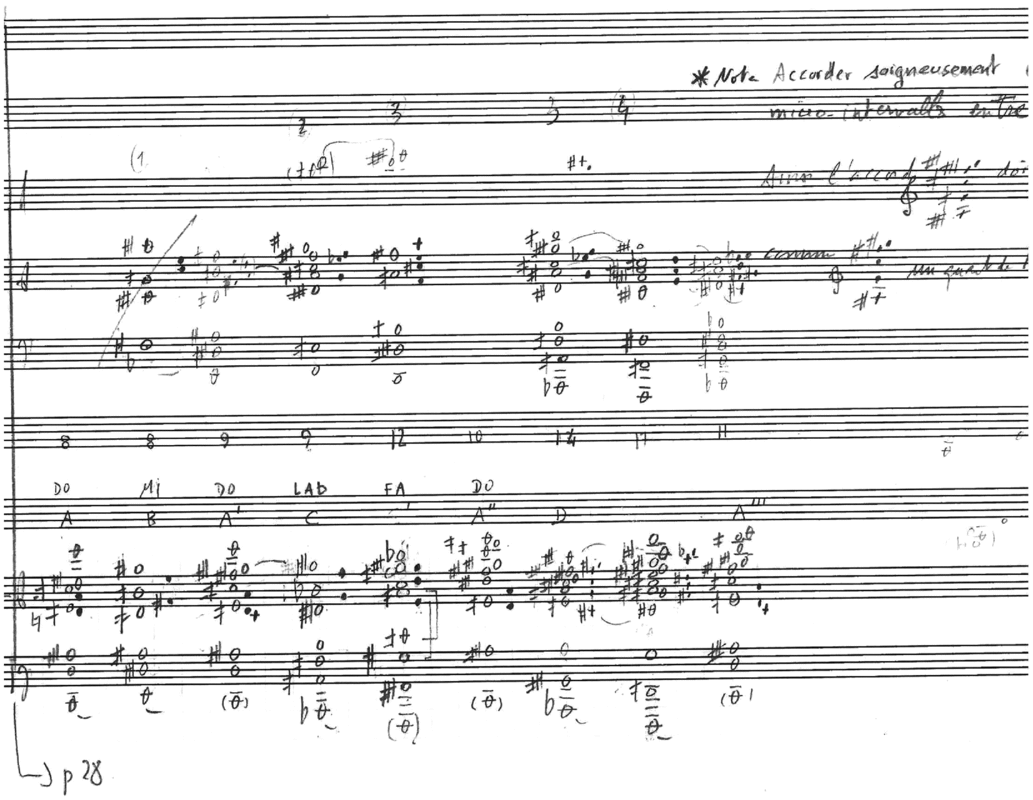
The title of the final work completed by Grisey before his untimely death in 1998 is explicitly concerned with the threshold: Quatre Chants pour franchir le seuil (‘Four songs for crossing the threshold’). Sketches show that its working titles even invoked the spiritual – Chants de Mort et d’Éternité, later Chants de Mort et de Resurrection Footnote 25 – before finally settling on the idea of seuils. Each of the four songs is a meditation on death: the death of, respectively, the angel, civilization, the voice, and humanity, and each uses in turn fragments of texts chosen from Christian, Egyptian, Greek, and Mesopotamian traditions ‘having in common a fragmentary discourse on the inevitability of death’.Footnote 26 The music, too, is often fleeting, fragmentary; there is a silence at the heart of the piece, echoing the concerns of the third song with ‘emptiness, echo, the voice, shadow of sounds and silence’.Footnote 27 Once again, the music articulates a late-modern sense of loss: the ‘shattered, dissolving, collapsing sounds of Quatre Chants draw on the close relationship between modernity and ruin’.Footnote 28 Yet the cycle ends with something different, a kind of postlude, a short, fifth song in fact, a slow, rocking berceuse. A threshold is crossed as a window opens: ‘J'ouvris une fenêtre’, sings the soprano, ‘I opened a window’, but she soon rests on the word ‘immobile’ (‘startled, baroque, intense, exaggerated cantilena’, as Grisey notes on an early sketch). This is ‘music of the dawn of humanity finally ridding itself of the nightmare’, writes Grisey. Time stands still. On the threshold of death, this is a vision of eternity. Once again, an espace sensible is established by means of the corps sonore: the music is essentially a kind of chorale, a sequence of spectral chords that continually move away from and return to the original chord (Example 3). The spectra are slightly distorted, creating a shimmering effect, like an echoing bell, summoning the listener to look through the window inside this acoustic space, ritualizing that space. Grisey dares to hope ‘that this lullaby will not be one of those that we shall sing tomorrow to the first human clones when we are obliged to reveal to them the indefensible genetic and psychological violence committed against them by a humanity desperately in search of originary taboos [tabous fondateurs]’.Footnote 29 It is a space of meditation, of reflection, a space outside past and future.
Gérard Grisey, Quatre Chants pour franchir le seuil, sketch of sequence of spectral chords that form the basis of the ‘Berceuse’, Gérard Grisey Collection, Paul Sacher Stiftung, Basel; reproduced by kind permission of the Paul Sacher Stiftung. The sketch is found in folder 5/7 of sketches for the work (which contains the first full continuity sketch), page numbered ‘28’. Full note-heads relate to the vocal line. The letters above the staves indicate the spectral chord (marked elsewhere on the same page ‘Spectr.’); the letter names in French indicate the fundamental of each chord (marked elsewhere on the page ‘Fond.’); the numerals indicate the total number of distinct notes in each chord (excluding octave equivalents).

The modernist metamorphosis of voice and space
The ‘nightmare’ of which both Dufourt and Grisey speak is a recurrent modernist trope. One classic early modernist representation of such a nightmare is Kafka's grotesque, surreal novella Metamorphosis (1912) in which a man awakes to find himself transformed into a giant insect, no longer able to communicate with those around him. Alone, excluded, the man lives trapped in an inner world of fear and failure leading ultimately to death. Who is he? What is he? As a study in the fragmentation of self, of victimhood, of exile and alienation, of decay and decline, Metamorphosis speaks metaphorically of a world on the threshold of change. Michaël Levinas's fourth opera La Métamorphose (2010) is adapted from Kafka's work, to a libretto by Emmanuel Moses, Benoit Meudic, and Levinas himself.Footnote 30 It essentially follows the trajectory of Kafka's novella and adopts Kafka's language, but in a highly stylized way, where words are used as much for their sound as their meaning, with the result that for the most part the sense of a linear narrative is lost and the work instead becomes a much more static representation of ideas and characters.
La Métamorphose, which runs continuously across 70 minutes, is subdivided not into scenes but into five ‘madrigals’, thereby implying the work in general occupies an expressive space akin to that of the sixteenth-century Italian secular form that had explored the close relationship between text and music. Whether solo or polyphonic, the madrigal often made use of a declamatory style, its dramatic musical gestures (word-painting, and so on) creating a kind of abstract theatre. Here it seems to be employed to suggest something both dramatic and reflective, and is certainly indicative of the focus in so many of Levinas's works on the very sound of language itself: ‘At the same time that I was imagining the dramaturgy of The Metamorphosis, I was working on the phonemes and vowels of the French language.’Footnote 31 More generally, it is clear that Levinas is concerned with the quality of all sounds, whatever their source. Mathilde Vallespir, a former student in Levinas's analysis class at the Paris Conservatoire in the early 2000s, recalls the originality of his interpretations, offering his own take on the sounds he encountered: ‘We thus found in his analyses [of repertoire from Beethoven to Messiaen] a concern with the acoustic dimension of music fitting for one of the principal founders of the spectral school . . . He would analyse the start of the allegro [of Beethoven's Leonora III overture] in terms of the establishment of a resonance around a theme, or more precisely, starting from the idea that the theme was “eaten” by resonance.’Footnote 32 In La Métamorphose, each character is defined by a particular vocal signature (both the music and the sounds of the words they sing), most notably in the strange, surreal colours of the counter-tenor/sopranist voice of Gregor Samsa, which is treated electronically, transformed and resonates outwards. For Levinas, like Leiris, this is all part of what it means to make an opera, setting up something beyond the ordinary:
Starting from the moment there is opera, the moment there is singing, indeed opens up a dimension other than meaning. It is not a matter of ‘setting to music’ nor of dressing up a text with music. Singing, with the effects of polyphony that it authorises, takes the text out of the customary sense of theatrical dialogues. Just think of the madrigal: there is dialogue, admittedly, but through polyphonic abstraction.Footnote 33
Within the broadly ‘palpable space’ defined by the music of opera, a very particular espace sensible is created from the start of this opera. This is the sonic space of Gregor. The opening ‘Madrigal 1’, according to the instruction in the score, ‘must be interpreted in a movement that is both static and retrospective’: despite the apparently narrative character of the text, the sung description of the awaking of the principal character – a slow, free recitation on the single note G, accompanied by its electronic double – appears reflective, non-narrative:
As Gregor Samsa awoke one morning from uneasy dreams he found himself transformed in his bed into a gigantic insect.Footnote 34
This is hardly recitative in the French tradition from Lully to Debussy; rather, it is kind of sacred recitation. Levinas himself has made mention of echoes in the work of Ashkenazi ritual, a psalmody of suffering and Hebrew prayer, and he also admits to ‘Christifying’ Gregor.Footnote 35 Certainly in Stanislas Nordey's original production, in which Gregor stands upright, almost naked, immobile, on a pedestal on a tree, caught among a lattice of black lines, one is confronted with the image of a crucifixion scene.Footnote 36 And the sense of the sacred – of something set apart from the quotidian – is extended by means of the (spectral) electronically treated voice (discussed in greater detail below): once again in parallel with Pygmalion, Gregor's body becomes a corps sonore, and as such represents a threshold, a metamorphosis, where a boundary is crossed towards both the interior of the mind of Gregor and the interior of the voice/music.
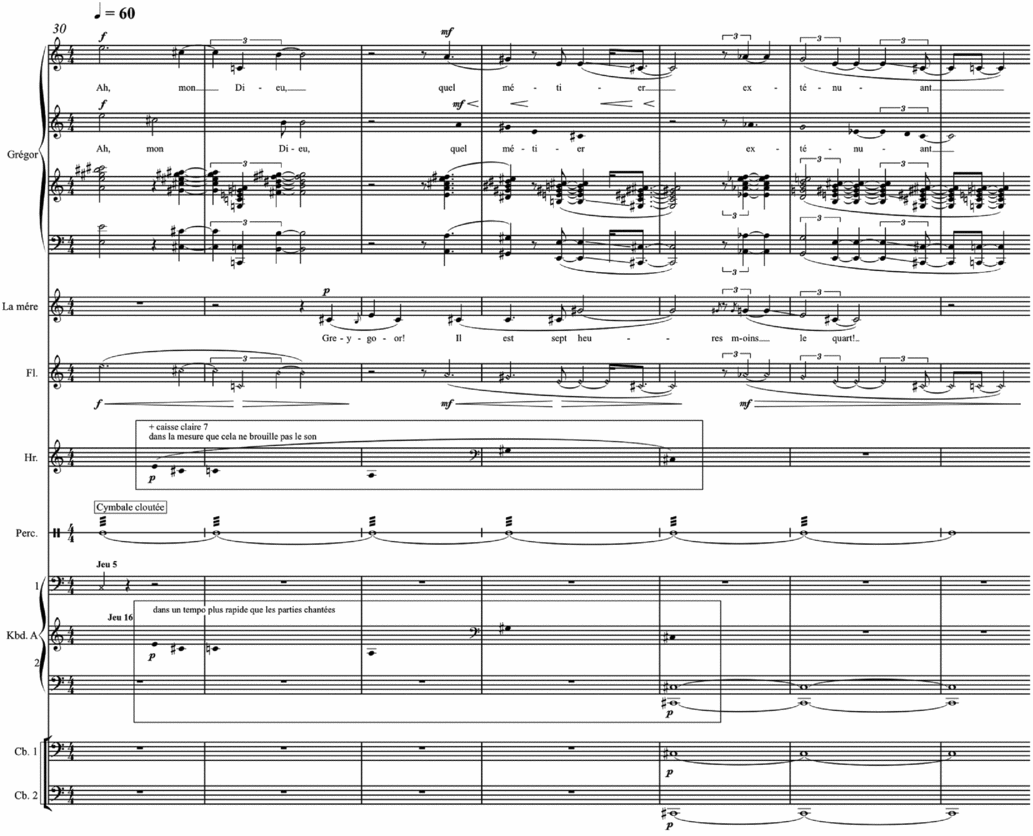
Following this ‘narration’ of his awaking, Gregor begins to sing an interior monologue: ‘Que m'est-il arrivé? Ce qui vient d'arriver n'est pas un rêve!’ (‘What has happened to me? . . . It was no dream.’) He is in his own room, his separate space, while his mother and father sing on the other side of the door. We continue to hear his voice blended with its electronic transformation, delineating that space. Gregor has an essentially descending line, which is in general characteristic of all the lines he sings, taking on a melancholy air (see Example 4). Levinas, having first leafed through the novella, allowed the text to ‘call’ to him, eventually discovering a sound, a sonority appropriate to the work: ‘The “musical” that I hear, that which provokes musical ideas in me, is in the final analysis always linked to the order of the lament. There have to be tears in the sound, it has to be haunted by a “long sob” [“sanglot long”]’.Footnote 37 This lament infuses the entire opera. The start of Madrigal 2, for example, sung by Gregor's mother, occupies for a few moments the espace sensible established by Gregor at the start. In the ‘Imploration de la mère’ (‘The mother's entreaty’), though she is actually singing repeatedly words about the passage of time (‘Il est sept heures’, continuing her line shown in Example 4), time on stage comes to a standstill. Marked ‘ritournelle’, and thus carrying suggestions both of repetition/return and separateness, it is a slow, sad lament for voice alone, quasi modal, supported only by a soft, unchanging cymbal roll. In this context it carries unavoidable connotations of the lamentation of the Virgin at the foot of the Cross.
Michaël Levinas, La Métamorphose, ‘Madrigal 1’, bb. 30–6. © Éditions Henry Lemoine, 2010; reprinted by permission. The voice of Gregor is here given on four staves, the uppermost being the sung part, the lower three giving an indication of its electronic transformations, sounding simultaneously.

Elsewhere in the opera, Gregor maintains his espace sensible, even while the drama is unfolding around him. Following ‘The mother's entreaty’, the bureaucratic chief clerk arrives to harass Gregor. Levinas writes in the score that, at this moment, it is necessary ‘to take account of the different spaces’, which are superimposed or juxtaposed musical blocks differentiated principally by means of the characters’ vocal signatures that then resonate out into the ensemble. The principal layers are:
• the continuation of the mother's lament who, as we have seen, temporarily approaches Gregor in a parallel espace sensible;
• the voice of the father from the other side of the partition pleading with Gregor in a quasi parlando style;
• the voice of the chief clerk, his dotted rhythms, according to the composer, expressing the brutish threat and authority of the character. (The score describes these rhythms as ‘techno’, which ‘must create a feeling of fever and multiplicity’.) In fact, the clerk is made to appear ridiculous, a caricature, with a kind of circus music that could be a moment ripped out of a nineteenth-century operetta, repeatedly alternating chords of B♭ minor and its dominant (Charpentier: a ‘gloomy and terrible’ keyFootnote 38) but in an overall context that is anything but tonal;
• the sonorous space of ‘la plainte et supplication’ (‘the lament and entreaty’) of Gregor, supported by the (sacred) sounds of harp arpeggios – and their microtonal echoes on pre-programmed keyboards – playing a chord of A minor and its dominant (Charpentier: a ‘tender and plaintive key’Footnote 39), that is, defining a tonal zone entirely separate from that of the clerk.
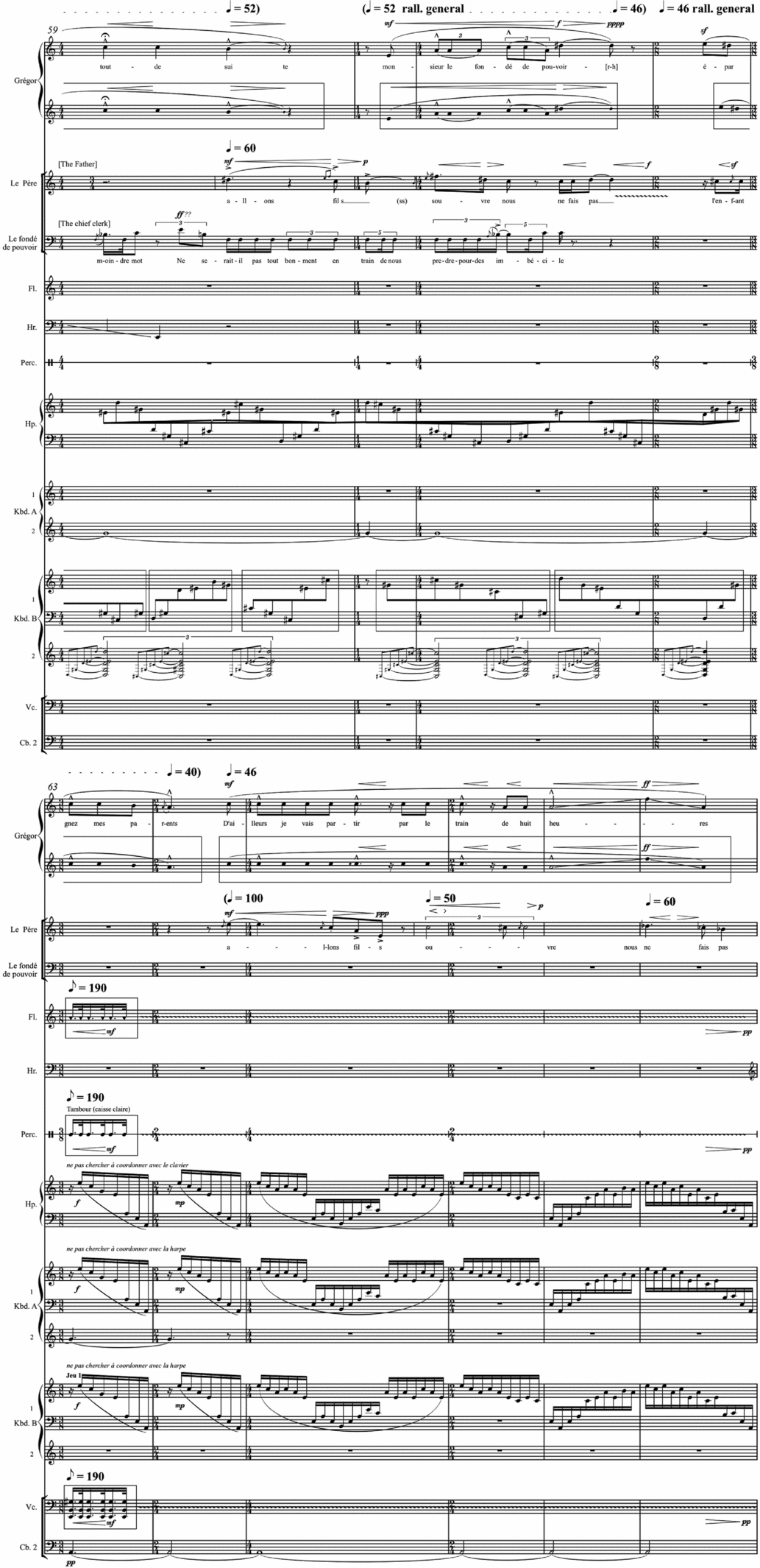
Gregor's music here takes on an almost Baroque character, distanced from what surrounds him (see Example 5). It is as if Gregor, accompanying himself on his lyre, has become another Orpheus, ‘a symbol for late-modern man’. Orpheus, like Gregor, sings ‘melancholic songs of loss and lament [that] came to speak painfully and eloquently for the [twentieth] century . . . His primary mode is that of lament.’Footnote 40
Michaël Levinas, La Métamorphose, ‘Madrigal 2’, bb. 59–68. © Éditions Henry Lemoine, 2010; reprinted by permission. In this excerpt, the mother is temporarily silent.

Levinas's striking realization of the sonority of the voice of Gregor was undertaken with Benoit Meudic at Ircam. It clearly took its cue directly from the novella:
Gregor had a shock as he heard his own voice answering hers [his mother's], unmistakably his own voice, it was true, but with a persistent horrible twittering squeak behind it like an undertone, that left the words in their clear shape only for the first moment, and then rose up reverberating round them to destroy their sense, so that one could not be sure one had heard them rightly.
Levinas and Meudic had previously worked on Évanoui (2009) for double orchestra and electronics, a piece in which ‘rhythm engenders form and the metamorphosis of timbre’, an approach Levinas describes as ‘an inversion in relation to spectral dogma’.Footnote 41 Now they worked to produce a metamorphosed voice for the opera, somewhere on a threshold between man and animal, between man and machine, between word and music, between sense and sound. They attempted to reveal ‘a sort of internal life of the voice. It is not by coincidence that I belonged to a certain musical trend called “spectral”, which was interested in sonority in its concrete, vibratory dimension.’Footnote 42 Gregor's singing voice and the animal/machine voice always sound simultaneously, so that it is generally possible for the audience to make out the words, but they are heard merely as sounds by the characters on stage (‘It was an animal's voice’, sings the chief clerk), just as in Kafka the reader understands perfectly clearly Gregor's inner voice, but he makes no sense to those around him, and they have no idea whether or not Gregor can understand them. Each sung note produces a chord, arrived at through an analysis of its spectrum, mixed with digitized instrumental sounds, each chord is arpeggiated, ‘each note of the arpeggio sculpted according to its own [spectral] curve’ to reveal ‘shadows and delays, [the] inner life of the voice as polyphony’.Footnote 43 The resulting hybrid sounds are not only a representation of the transformed, animal voice of Gregor, but also open up an extraordinary virtual resonance, an acoustic space that defines the character's theatrical space.
Gregor's space, his bedroom, is also central to the novella. It is discussed by Gilles Deleuze and Félix Guattari in terms of its identity as a threshold, a space of alienation or ‘deterritorialization’, a space made strange by the ‘becoming-animal’ who inhabits it, who enacts a modernist paradox: the becoming-animal ‘traces a line of escape, but is incapable of following it’.Footnote 44
To become animal is to participate in movement, to stake out the path of escape in all its positivity, to cross a threshold, to reach a continuum of intensities that are valuable only in themselves, to find a world of pure intensities where all forms come undone, as do all the significations, signifiers and signifieds, to the benefit of an unformed matter of deterritorialized flux, of nonsignifying signs. Kafka's animals . . . correspond to new levels, new zones of liberated intensities.Footnote 45
Gregor as becoming-animal therefore speaks of the crises of modernism, the crises of place and identity that were being played out in the early years of the twentieth century, articulated through the fragmentation of form and meaning, through the defamiliarization of image, word, and sound. And this continues to be played out in Levinas's reading of Metamorphosis too: it is the metamorphosed voice, the spectral voice, the deterritorialized corps sonore, that represents this becoming-animal, which participates in movement (towards the internal life of the voice), which crosses a threshold, and which defines a zone of liberated intensity, of almost sacred immanence – in other words, an espace sensible. This physical, metaphysical, temporal zone of intensity is, as already seen, animated by the voice at the start and continues throughout the opera. At the end, the fifth madrigal that constitutes Gregor's death song, Gregor's voice is heard untransformed. It is as if, in crossing another threshold towards death, his humanity is revealed. It is, in many ways, a traditional operatic lament of falling lines, with the sound of the solo violin woven around it – the sound, perhaps, of his sister's violin, which is prominent in both novella and opera. But Gregor's identity remains in question to the very end. ‘Was he an animal, when music had such an effect upon him?’ he asks of himself in the novella. In the opera, in a strange inversion, the other characters now take over Gregor's horrible insect-like noises. Among the final slow, soft sounds that are heard are a repeated, arpeggiated, spectral chord on harp, and the double basses at the very bottom of their register. The music can only circle around itself, immobile; everything simply attenuates towards silence and nothingness. It is a landscape of ruin.
Gregor's room is thus a modern space, a deterritorialized space of alienation. In spectral music, one can equally speak of a modern space beyond spatialized time, a deterritorialized sound, where ‘time's arrow’Footnote 46 is suspended, and instead where one experiences the duration (Bergson's durée) of the internal life of sounds, voice, spirit. Levinas's La Métamorphose is therefore a fascinating interpretation for the twenty-first century of an idea of modernism incarnated in Kafka's novel from the beginning of the twentieth century. Levinas's work, however, is much darker than Kafka's, the tragedy unalleviated by the humour of the original: the opera carries traces of the unfolding of the terrible history of the twentieth century. Levinas himself has spoken in terms of a work written against the background of deportation and the Holocaust; the librettist Emmanuel Moses finds in reading Kafka's text ‘an anticipation of the animalisation of man, of the Holocaust’.Footnote 47 La Métamorphose essentially inscribes a single, long descent towards death. Verlaine's ‘sanglots longs’ colour not only Gregor's voice but also the entire work. Melancholy, lament, immobility, the ultimate inability to speak meaningfully: these are the signs of the work's modernism. Gregor is thus a product of the failure of modernity. And it is in his espace sensible – displaced, remote, even sacred – that he is able to articulate this.
On the threshold between life and death
Levinas's La Métamorphose is presented here as a case study in the ways in which the musical spectrum, or more generally the idea of the resonating corps sonore, have been appropriated to create a sense of an espace sensible on the opera stage. In La Métamorphose, voice, body, and space are ‘sensitized’, time is transfigured. And there are many other operas of the twenty-first century where spectral music (broadly defined) has been employed to suggest or delineate a space beyond the ordinary. In Georg Friedrich Haas's Morgen und Abend (2015), for example, the threshold is again that between life and death: as the work's one-line synopsis puts it, ‘Morgen und Abend is the struggle of [the central character] Johannes into and out of life.’Footnote 48 Like Kafka's Metamorphosis, it does not present the man's life, it only represents his birth and death; as with Gregor Samsa, one sees an individual in an alienated state, one sees a fractured mind. Through its music the opera offers not a narrative but a meditation, and while it is not microtonal throughout, a spectral attitude to sound sets up an espace sensible for the entire work. As in Grisey's berceuse, the corps sonore resonates outwards (as the physical body recedes) to create a mystical immobility on the threshold of death.
Jonathan Harvey's Wagner Dream (2007) is similarly set on that threshold: here the composer Richard Wagner, faced in February 1883 with his imminent death, dreams his own opera (Die Sieger, for which he actually wrote a synopsis in 1856) derived from an Indian Buddhist story. The opera passes backwards and forwards between the spaces of Wagner in his dying moments (chromatic, conflicted) and the Buddha's India (pentatonic, still). For Harvey, music ‘is a kind of practice for death’, the experience of music ‘leads right into the meaning of death’;Footnote 49 spectral music in particular represents for Harvey ‘a spiritual breakthrough’; spectralism, he argues, ‘is in essence outside the world of linear time’.Footnote 50 Such spectral thinking is clearly in evidence in scene 2, for instance, where a Buddhist monk named Vairochana leads Wagner across a threshold towards transcendence: ‘If you listen to me you'll experience the clear light, wherein all things become one, and you will know yourself.’ Pure triads, immobile, subtly transformed electronically, create an espace sensible in order to represent a sense of joy, love, and faith; a decaying body is transformed by the corps sonore into something spiritual. Harvey here attempts to move beyond the conflicts of modernity into a Buddhist oneness.
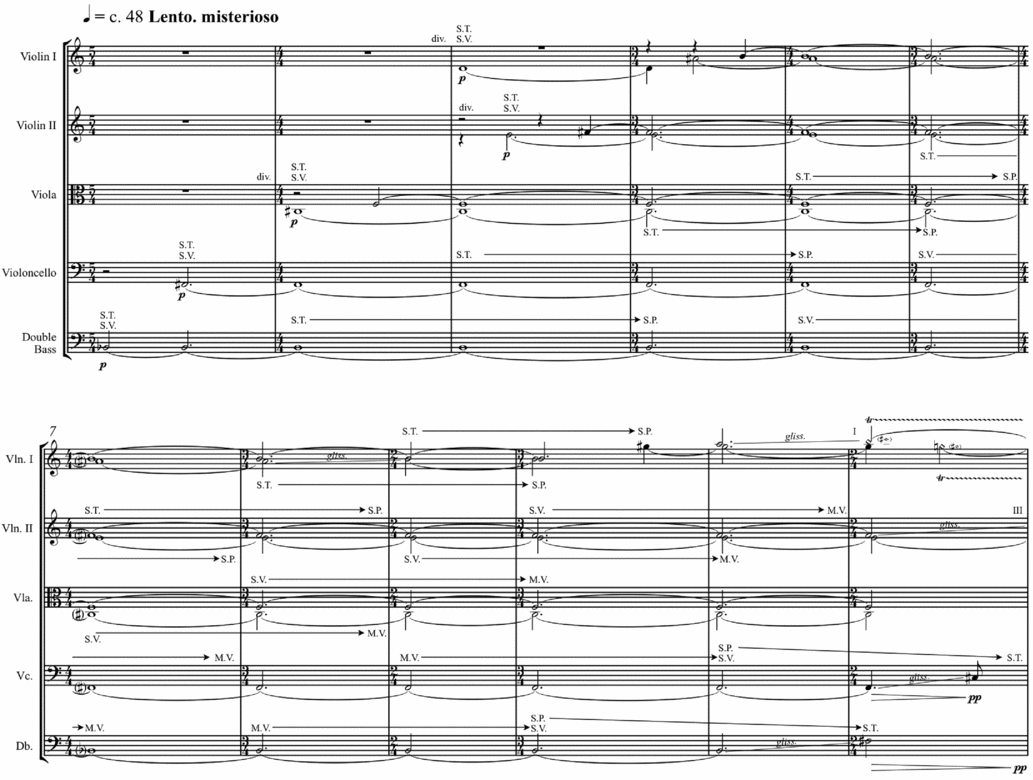
And at the end of Kaija Saariaho's opera L'Amour de loin (2000), when the distant lovers Jaufré and Clémence finally meet, Jaufré is also on the threshold of death. Saariaho writes (in term's similar to Harvey's) that we ‘speak of love and death in a really deep and timeless way’, and therefore she aimed in this work to move towards ‘the great mysteries of our life, those to which we cannot really come close with reason and which I had the feeling could be approached by music’.Footnote 51 Central to the opera is, of course, the notion of distance, which is overlaid here with (modernist) sentiments of longing and nostalgia. A spectralist sensibility infuses all the music of the opera, such that the entire piece seems to open up an espace sensible, a shimmering, fleeting, slow-moving, dream-like soundscape, a meditation on love and death that transcends not only linear distance but also linear time. This is in part achieved through the use of a single corps sonore as the basis for the entire work, a chord presented at the very start, fanning outwards, bell-like, from a low B♭; it returns, over a long B♭ pedal, at the end of the final act (see Example 6) when, after the death of Jaufré, Clémence reaches out in prayer across the threshold (to her god or to her lover is ambiguous), ‘Vers toi qui es si loin’ (‘Towards you who are so far away’).
Kaija Saariaho, L'Amour de loin, opening Act 1, bb. 1–11 (strings only). Libretto by Amin Maalouf. Composed by Kaija Saariaho © 2000 Chester Music Limited. All Rights Reserved. International Copyright Secured. Reprinted by kind permission of Chester Music Limited.

In 1991, Hugues Dufourt wrote a brief history of the notion of space as a central category in new music since 1970, in which ‘the traditional triple division of pitch, timbre and duration that allowed for the description of musical objects of the past gives way to a more general foundational idea, that of acoustic space’. This had in large part been prompted, he argues, by developments in the musical use of computers: ‘From the moment when sound was freed from the mechanical constraints of transmission, we learnt to think of it as a space.’Footnote 52 Already in the late 1970s he had spoken specifically about spectral music as being one of the consequences of this new sense of space, a music that became concerned principally with ‘interiorisation’, ‘with a progress towards immanence and transparency’, and which was ‘charged with new expressive values’ in its exploration of transitions, transformations, oscillations, interferences, and thresholds.Footnote 53 Spectral music, like the music of Rameau 250 years before it, was founded on a scientifically motivated investigation of the internal properties of sound, of nature, of the corps sonore. But where for Rameau in the eighteenth century the corps sonore resonated outwards into the cosmos as a force of unity, wholeness, and divine goodness, for the late-modern spectralists the corps sonore opened up liminal, hybrid spaces of uncertainty: the immanence discovered through technology became a gateway to death, it came to represent the crises of voice, identity, and nature of the late twentieth century. Where Rameau found beauty, the modernists often saw ruin; where Rameau encountered the divine, the modernists often heard the sound of loss.
The presence of the corps sonore in recent opera is fascinating because of the ways in which it has enabled the creation of an espace sensible by means of the interiorization that defines spectral thinking, a spatial, temporal, and musical zone that can, in varying ways, stage the ongoing concerns, conflicts, and anxieties of modernism. While precedents for such a practice may be found in Rameau, this does not make Rameau a spectral composer avant la lettre, any more than one could argue that the spectralists are continuing an unbroken line from Rameau. If anything, the corps sonore disappears underground after Rameau, only to erupt rhizome-like to the surface at the start of the twentieth century as tonality begins to fragment and music turns to sound itself as its fundamental material, be that in the echoing bells of Ravel's ‘La vallée des cloches’ (1905) from Miroirs, or in the single chord from which the third movement (‘Farben’) of Schoenberg's Fünf Orchesterstücke (1909) is built, or in Debussy's realization that the colour and feeling of En blanc et noir (1915) were essentially derived from the sonority of the piano.Footnote 54 Unsurprisingly, early century French music became an explicit source for later spectral composers, in works such as Grisey's Vortex temporum (1994–96), constructed out of a tiny fragment of Ravel's Daphnis et Chloé, or Murail's Feuilles à travers les cloches (1998) after Debussy's ‘Cloches à travers les feuilles’ from Images, vol. 2. The attitude of early twentieth-century modernism to the sounding body as musical object is reconsidered in the late twentieth century, where the very structure of that body is analysed, reconfigured, and restaged. And while that body may appear to be similar to the one encountered and staged by Rameau, its meaning could not be more different. Where, for Rameau, the corps sonore had brought the inanimate body of the statue to life as an allegory of wholeness, for recent composers the immobility engendered by the corps sonore has so often led to a recognition of the fragmented identity of the late-modern body. Yet, in defining a liminal spatial and temporal zone, the interiority of the spectral espace sensible can also allow for still, sombre – even spiritualFootnote 55 – reflection. ‘J'ouvris une fenêtre’. The shimmering corps sonore that rings out across the berceuse at the end of Grisey's Quatre Chants, on the threshold between life and death, opens a window onto a vista of eternal stasis, of pure durée, where space and time themselves are transfigured.