INTRODUCTION
Echinolittorina punctata (Gmelin, Reference Gmelin1791) is a prosobranch gastropod belonging to the family Littorinidae. Its taxonomic history and current status were reviewed by Reid (Reference Reid2011). E. punctata lives in the intertidal zone, on both natural and man-made hard substrates. Its range spans from the Atlantic coast of South Africa to The Gambia, the Canary Islands and the Mediterranean Sea, with the exception of its northernmost sectors. It is in this latter basin that a remarkable range extension has been recorded in the last few decades (see Albano, Reference Albano, Goffredo and Dubinsky2014 for a review). Until approximately 1950, the species was confined to the westernmost Mediterranean Sea (southern Spain and Algeria) and the south-eastern Levantine Sea. Since then, it has been reliably recorded from Tunisia, Turkey, Cyprus and Greece. However, to what extent these records were related to newly settled populations versus newly surveyed areas is not known. On the contrary, the prodigious range extension along the Italian peninsula that brought the species from the southernmost tip of Sicily (Brugnone, Reference Brugnone1850) to the Jonian Sea in Puglia (Albano & Trono, Reference Albano and Trono2008) and at the latitude of Rome along the Tyrrhenian Sea (Albano, Reference Albano2010) is quite certainly not an artefact of poor detection. The Italian shores have been surveyed for decades by one of the most numerous shell collector communities in Europe. E. punctata has always been considered an interesting finding due to its southern distribution; it is easily observable in the intertidal zone and also easily recognizable; it would not have escaped the attention of the several collectors that have beachcombed Italian shores. In this context, I wish to provide further new records in the Mediterranean Sea: (i) from southern Tuscany, the northernmost locality in Italy; (ii) from southern France, the northernmost locality in the Mediterranean Sea; and (iii) from Greece, likely the first record in the Mediterranean Sea. Consequently, the maps provided in Albano (Reference Albano, Goffredo and Dubinsky2014, Figure 17.2) are updated.
MATERIALS AND METHODS
Living individuals were searched for, by eye, on rocky shores. Where found, coordinates were retrieved from Google Earth (datum WGS84) and input into a relational database. In Monte Argentario (Tuscany, Italy) on 27 May 2014, the density was estimated by counts in 1 m2 quadrats haphazardly selected on the shore.
Specimens were then taken to the laboratory, where their size was measured with a stereomicroscope equipped with a high precision measuring stage. Statistical tests and histograms were performed using the statistical programming environment R, version 3.1.1 (R Development Core Team, 2009). Specimens were photographed with a Leica M420 macroscope, shooting photos at different depths of field that were later stacked with the CombineZP software.
Further records were communicated by colleagues on the basis of their field observations (A. Benocci, D. Grech, R. Huet and P. Ovalis). Identification was checked in person or with photos sent by colleagues and further material was retrieved from museum collections (namely, Museum für Naturkunde, Berlin).
RESULTS
New records
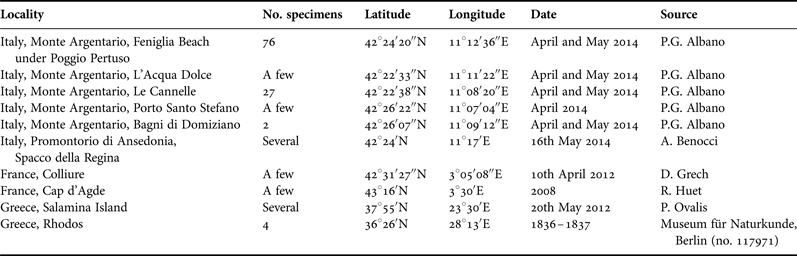
New populations and records are reported from Italy, France and Greece (Table 1). Echinolittorina punctata was found in Italy in Ansedonia, the southernmost part of Tuscany (A. Benocci, personal communication), and all around Monte Argentario, Tuscany (Figure 1A, B), on upper intertidal rocks, 5–20 cm above the water-line. In France, individuals were found in Colliure (D. Grech, personal communication) (Figure 2C, D), close to the border with Spain, and Cap d'Agde (R. Huet, personal communication), approximately 80 km to the north-east. In Greece, the species was found on Salamina Island, near Athens (P. Ovalis, personal communication). Moreover, a lot from Rhodes is reported from the Museum für Naturkunde, Berlin. It was probably collected in 1836–1837.
Echinolittorina punctata (Gmelin, Reference Gmelin1791) from Monte Argentario, Tuscany, Italy (A, B: height 6.2 mm) and Colliure, France (C, D: height 7.3 mm).

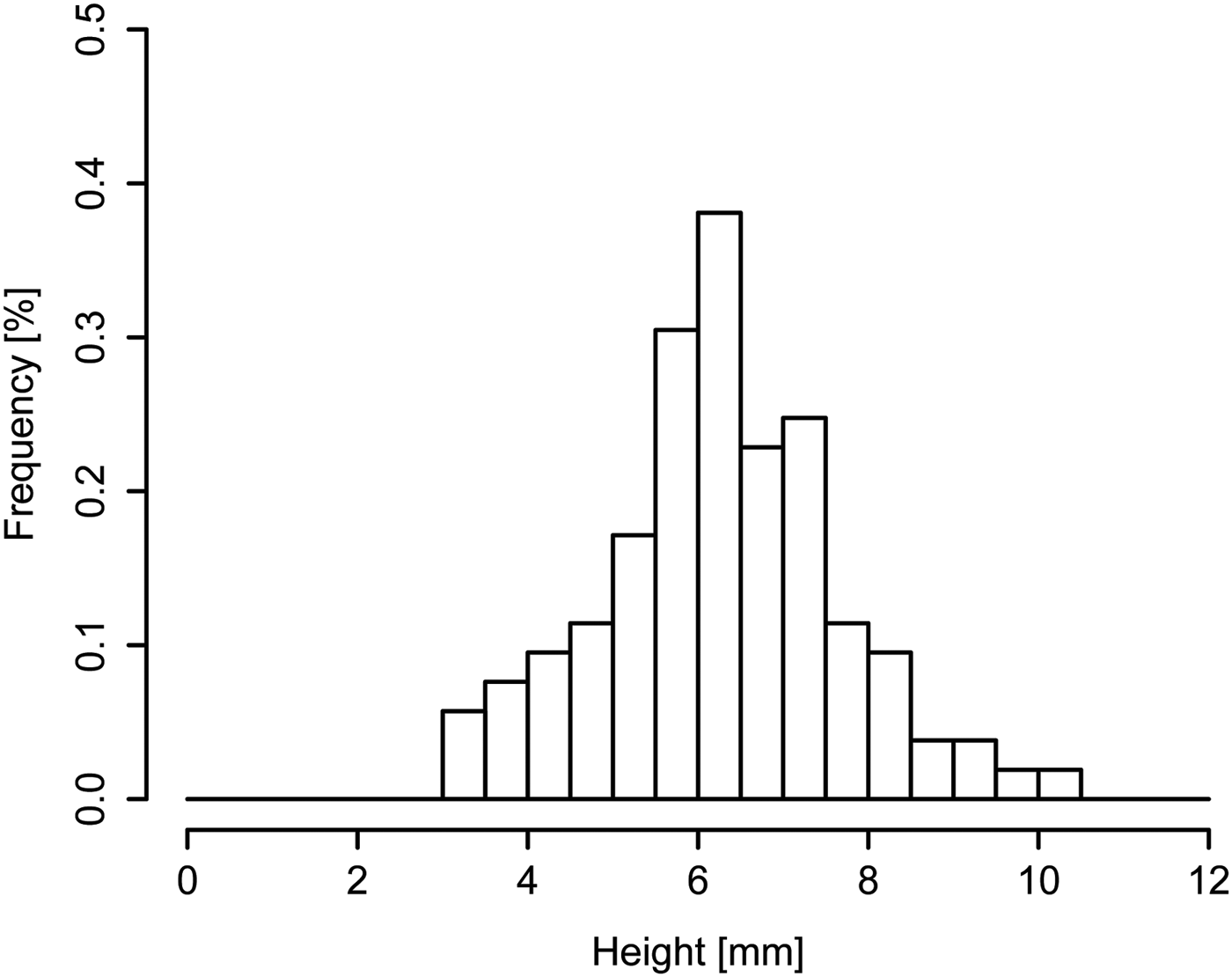
Histogram of the height frequency distribution (N = 105) of Echinolittorina punctata (Gmelin, Reference Gmelin1791) from Monte Argentario, Tuscany, Italy. No individuals below 3 mm were found.
New populations and records of Echinolittorina punctata in the Mediterranean Sea.
Details on the populations at Monte Argentario, Tuscany
In Monte Argentario, species density had a clear south to north trend: the southernmost locality, Feniglia, had a mean density of 25.3 specimen m−2, Le Cannelle had a mean density of 4.5 specimen m−2 and Bagni di Domiziano had only 0.5 specimen m−2. The localities were situated 10 km from each other. Moreover, no specimen had a height measuring less than 3.2 mm (Feniglia) (Figure 2) and the minimum size increased from south to north, being 5.0 mm at Le Cannelle and 5.2 mm at Bagni di Domiziano. The height distributions at Feniglia and Le Cannelle were normal (Shapiro-Wilk test, W = 0.9746 and W = 0.9797 respectively, P ≫ 0.05), while at Bagni di Domiziano they could not be computed because only two specimens were found. Moreover, the height distributions at Feniglia and Le Cannelle were different (Kolmogorov–Smirnov test, D = 0.5171, P ≪ 0.05).
DISCUSSION
New records from Italy
The first record of Echinolittorina punctata in Italy dates back to 1850, when G. Brugnone described Turbo siculus, later recognized as a junior synonym of E. punctata, as an abundant species on the rocks of Pozzallo at the south-easternmost tip of Sicily. The species seemed confined to this area for all of the 19th century. It was then reported from Catania, on the eastern coast of Sicily, by Patané (Reference Patané1946), from the neighbouring coast of Palermo in the 1970s (D'Anna, Reference D'Anna1986), from Calabria in the 1980s (Micali & Giovine, Reference Micali and Giovine1983), in Campania (D'Anna, Reference D'Anna2001), Lazio (Soppelsa et al., Reference Soppelsa, Crocetta and Fasulo2004; Albano, Reference Albano2010) and Puglia (Albano & Trono, Reference Albano and Trono2008) in the 2000s. The populations that are described here from Tuscany represent a further step northward along the Italian Tyrrhenian coast; an advancement of approximately 100 km from the latest records in Lazio, north of Rome, from 2010, which is the northernmost record in Italy (Figure 3B). There is no record in the literature of E. punctata populating Tuscany. Looking at the personal observations carried out in Monte Argentario from 2001 to 2007, where the species was not previously recorded, it is likely that this population is of very recent settlement.
Distribution of Echinolittorina punctata in 1900 (A) and today (B), updating figure 17.2 in Albano (Reference Albano, Goffredo and Dubinsky2014). Sky blue areas represent distributions reconstructed from the literature and collection data. Grey areas represent expected distributions, unconfirmed by the bibliography and collections, probably due to the lack of sampling in the area. Blue points represent single records of interest, most likely due to poor sampling efforts or because they are the first record of successive range extensions. ‘NO’ means the species was not recorded by regional works in the area at the time. Question marks, ‘?’, indicate areas where doubtful records were reported. Text highlights the localities reported in the present paper for the first time.
It is not clear why all the collected individuals were adults and above 3.2 mm in height. One simple explanation could be that smaller (younger) individuals were overlooked due to their small size. However, Monte Argentario hosts another periwinkle, Melarhaphe neritoides (Linnaeus, Reference Linnaeus1758), which is a widespread species in the Mediterranean basin. M. neritoides was collected in the same quadrats, it is usually smaller than E. punctata, and indeed very young specimens of 1–2 mm in size were collected along with E. punctata.
A further explanation might be that juveniles live lower on the shore, maybe even below the water-line. Palant & Fishelson (Reference Palant and Fishelson1968) observed that small individuals (less than 5 mm) of E. punctata lived lower on the shore in Israel, in the regularly wetted zone among Chthamalus, an observation confirmed at a different locality by Lipkin & Safriel (Reference Lipkin and Safriel1971). Indeed, this appears to be a general trend in several littorinids, related to the increasing physical rigor of the environment (temperature, desiccation, salinity) in an upshore direction (Vermeij, Reference Vermeij1972). Small individuals are more susceptible to death from extreme physical conditions than large ones of the same species, particularly area-dependent effects such as desiccation.
However, the reason for this pattern could be related to the dynamics of colonization. Kendall & Lewis (Reference Kendall and Lewis1986) observed that populations of the trochid Gibbula umbilicalis (da Costa, 1778) close to the limit of the species distribution in the north of Scotland were dominated by the larger, older individuals. Subsequently, Kendall (Reference Kendall1987) observed that all populations of the trochid Osilinus lineatus (da Costa, 1778) recently settled in the northern part of the range had low densities, missing year classes and were dominated by older individuals. Two decades later, Mieszkowska et al. (Reference Mieszkowska, Hawkins, Burrows and Kendall2007) observed that O. lineatus showed a larger proportion of juveniles as a result of an increased recruitment success that occurred in recent years. Indeed, the increasing minimum size and the decreasing density of E. punctata from south to north in Monte Argentario may fit a similar pattern of edge-distribution populations. Density might be also influenced by substrate suitability, although E. punctata is known to occur on a wide variety of artificial and natural substrates (Albano & Trono, Reference Albano and Trono2008; Albano, Reference Albano2010; Reid, Reference Reid2011).
New records from France
Echinolittorina punctata was recorded in Southern France by Locard (Reference Locard1886) who reported it from Cannes, Nice and the Maritime Alps, and from the Roussillon, on the basis of Michaud's material and then again in Reference Locard1891, describing it as ‘rare’. However, these records were not confirmed by other contemporary authors: Risso (Reference Risso1826) (Nice and Alpes Maritimes), Roux (Reference Roux1862) (Alpes Maritimes), Dautzenberg (Reference Dautzenberg1881, Reference Dautzenberg1886) (Cannes), Bucquoy et al. (Reference Bucquoy, Dollfus and Dautzenberg1882–1898) (Roussillon) and Claudon (Reference Claudon1902) (Saint-Raphaël) did not report E. punctata. However, they all recorded Melarhaphe neritoides (Linnaeus, Reference Linnaeus1758), evidence that intertidal rocks were inspected in their studies. In more modern times, Buzzurro et al. (Reference Buzzurro, Hoarau, Greppi and Pelorce1999) did not report the species from Agay, considering the records in southern France from previous authors as very questionable. In November 2012, the species was not recorded from Menton, the easternmost part of the French Mediterranean coast (personal observation).
Hence, the records provided here are the first unquestionable ones in modern times from the French coast. They all pertain to the south-westernmost part of southern France, possibly as a range extension from the nearby Spanish coast. The population in Cap d'Agde is currently the northernmost in the whole of the Mediterranean Sea (Figure 3B).
New records from Greece
Notwithstanding the coastal extension of Greece and its position between the Central and the Eastern Mediterranean, its malacofauna has been poorly studied, especially in past research. Echinolittorina punctata is not cited by Forbes (Reference Forbes1844) from the Aegean Sea. In the collection of the Academy of Natural Sciences of Philadelphia, two lots are present; one collected in ‘Greece’ by M. Conemenos, a 19th century collector, and another from Rhodes, probably dating back to the early 20th century (P. Callomon, personal communication). In modern times, the species was reported by Nicolay & Angioy (Reference Nicolay and Angioy1988) from Keratea, south-east of Athens and from Loutro, southern Crete (Reid, Reference Reid2011), although Koutsoubas et al. (Reference Koutsoubas, Koukouras, Karakassis and Doumas1992) cite only Melarhaphe neritoides in their review of the malacofauna of Crete.
The lot of four specimens reported here from Rhodes and preserved in the Museum für Naturkunde (no. 117971), Berlin, is likely to be the oldest record from Greece. It belongs to the collection of W. Dunker (1809–1885), but the label reports the name of Roth, likely Johannes Rudolf Roth (Germany 1814–Lebanon 1858). J.R. Roth was a German naturalist who travelled to Palestine in 1836–1837, visiting several Greek islands along the way to and from the Middle East (Hantzsch, Reference Hantzsch1907). He certainly visited Rhodes too, because several records of land snails from this island are reported in his doctoral dissertation (Roth, Reference Roth1839). Moreover, this is the oldest record of E. punctata in the Mediterranean Sea retrieved so far. It confirms that the species was present in the early 19th century in the whole of the Levantine Sea and not only on the Middle East coasts (Figure 3A). Indeed, the species was reported from Syria in Reference Philippi1847 by Philippi (as Litorina syriaca), but the first record to be retrieved so far from Turkey dates back to 1988 (A. Lugli, private collection). The lot from Rhodes demonstrates that the lack of records along the Turkish coast is likely to be due to the lack of monitoring rather than to true absence. The modern lot from Salamina Island is significant within the context of the poor knowledge of Greek malacofauna.
ACKNOWLEDGEMENTS
Several collectors and researchers continuously contribute to my database with their observations. In particular, Andrea Benocci, Daniele Grech, Raymond Huet and Panayotis Ovalis have provided samples and observations that have proved useful for this short article. Gloria Malavolta measured the specimens from Monte Argentario, Tuscany. The visit to the Museum für Naturkunde was supported by a Synthesys grant (DE-TAF-3510). Matthias Glaubrecht and Christine Zorn helped greatly during their stay at the Museum. Data and useful information was provided by Paul Callomon, Academy of Natural Sciences of Philadelphia.