INTRODUCTION
Radiation plays an important role in the management of breast cancer. One of the most common side effects of radiation to the breast is radiation-induced skin reaction (RISK). It is reported that >90% of women develop some level of skin reaction during the course of radiation treatment to the breast.Reference Porock and Kristjanson1 Using the current accepted fractionation scheme, in the United States, of 4500–5040 cGy in 180–200 cGy per fraction, it has been shown that 80–90% of patients develop varying grades of RISK; 30–50% have more severe erythema and skin tenderness; 5–10% experience patchy moist desquamation confined mainly to skin folds; and <5% develop confluent moist desquamation.Reference Porock and Kristjanson1 Although the Radiation Therapy Oncology Group (RTOG) has an established scale to quantify skin reactions;Reference Freedman, Anderson and Goldstein2 there is no single accepted scheme for reporting on this toxicity. Many of the studies have employed their own toxicity scales for evaluation of skin reactions.Reference White, Joiner, Small and Woloschak3 In spite of the gamut of products marketed as agents to manage RISK, the results of these products are either negative or have a tepid benefit.Reference White, Joiner, Small and Woloschak3 A survey questionnaire to explore variations among radiation oncologists in managing early-stage breast cancer, with an emphasis on the prevention and treatment strategies for RISK, was created. The primary objective of this survey is to assess differences in the management of RISKs of the breast.
METHODS AND MATERIALS
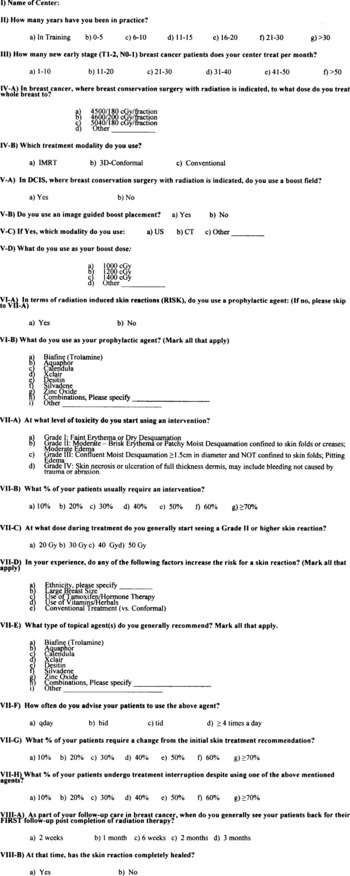
A questionnaire (Figure 1) was internally developed assessing some basic demographics of the participants, their use of radiation doses and techniques in early-stage breast cancer and their management of RISK. Upon approval of this study by the New York Methodist Hospital institutional review board (IRB), a database of 962 oncologists in the United States, self-identified, as ‘interested in the treatment of breast cancer’ was obtained from American Society of Therapeutic Radiology & Oncology (ASTRO). To elaborate, ASTRO was directly approached to provide us with a list of physicians that we would be able to contact, who have expressed an interest in the treatment of breast cancer as part of their profile at ASTRO. The questionnaire was subsequently posted on the website, www.surveymonkey.com. A link to the survey, to be filled out online, was emailed to those with listed email addresses. The remaining group of physicians was mailed a letter with an option, to either, complete and return an enclosed hard copy of the survey or to follow the link to the survey, to complete it online. There were no specific instructions that were provided in order to complete the survey. If a question required more instructions, it was listed directly on the survey as part of that particular question. It is important to note that the survey was targeted at evaluating practice management principles as it applies to whole-breast irradiation, and not partial-breast irradiation. To those who did not respond, three reminders were sent, with a 3-week interval. The survey was closed after 90 days of the initial email, in 2006. There was no independent validation of the responses.
RISK questionnaire.

Statistical considerations
The sample size was determined using a sample size calculator at http://surveysystem.com/sscalc.htm. In order to get a 95% confidence level for a population of 962, with a confidence interval of 5; the sample size was calculated to be 275. The data submitted online and collected on the surveymonkey website showed summary statistics and the corresponding bar graphs. The additional data from the submitted hard copies of the survey were merged with the online data. This information was tabulated and analyzed, each according to its type.
RESULTS
A total of 282 out of the 962 invited participants responded. The overall response rate to the survey was 29.3%.
The survey started with questions about demographics of the participants, as detailed in Figure 1. The survey sample included those who work in academic institutions as well as those in private practice. About 70% were in practice for >10 years. The majority of the participants’ centres (73%) treated up to 20 cases of early-stage breast cancer monthly.
Doses and techniques
Of the 282 respondents, 275 (97.5%) agreed on delivering 4500–5040 cGy. The most frequently employed fractionation was 5040 cGy/180 cGy/fraction (48.2%). However, chemotherapy appears to possibly influence some physicians’ decision in determining the total dose given. Thirteen percent of the respondents reported decreasing the dose to 4500 cGy/180 cGy from 5040 cGy/180 cGy if chemotherapy was administered. As far as treatment planning, 3D-conformal (3DCRT) was used by 55.4%, intensity-modulated radiotherapy (IMRT) by 24.5% and conventional treatment by 20.1% of the respondents.
DCIS boost
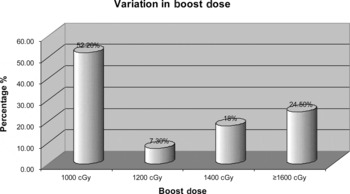
Almost all the respondents (92.5%) use a boost in ductal carcinoma in situ (DCIS). Image-guided boost planning (IGBP) was used by 227 (87.3%); out of them 84.9% used computed tomography (CT) and 10.3% used ultrasound (US). There was a great variation in the given boost dose (Figure 2) in the setting of negative margins. Factors affecting choice of boost doses closer to 2000 cGy were larger tumor size and/or closer margins.
Variations in DCIS boost doses.

RISK
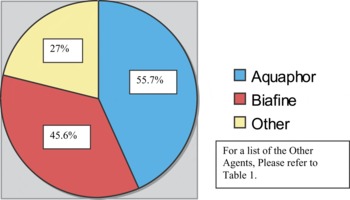
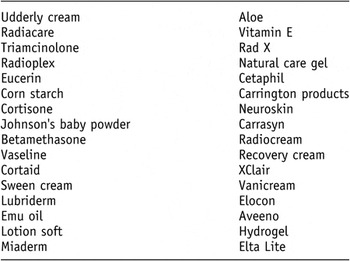
Most respondents (93.5%) reported a Grade 2 reaction (Figure 1 – Question VII-A) or higher at a dose ≥ 3000 cGy. In management of RISK, 74% used a topical agent, as a prophylaxis whereas the rest utilized topical applications only upon encountering RISK. Topical remedies were reported as being used either alone or in combination. In the prophylaxis group, Aquaphor was the most popular agent (55.7%), with Biafine® at a close second (45.6%) (Figure 3). This was also true for treatment of RISK, with Aquaphor at 72.1% and Biafine® at 50%. A minority of respondents utilized other agents (Table 1). A large proportion of the physicians (92%) agreed that the skin reaction is fully healed in >50% of the events by the time of the first follow-up, which tended to be around 6 weeks.
Popular agents of prophylaxis of RISK.

Other topical agents used in management of RISK

Factors affecting incidence of RISK
Almost all (98.5%) agreed that large breast size increases RISK. In addition, 70.2% claimed that other factors can contribute to the increased incidence of RISK namely; concurrent intake of hormonal therapy, patient’s ethnicity and prior use of chemotherapy.
DISCUSSION
The results of the RISK survey represent a sampling of the practice trends in the management of early-stage breast cancer. The population surveyed appears to be relatively experienced with majority of them being in practice for >10 years and treating ∼20 patients monthly. Both academic and private centres were queried.
The survey response rate is close to 30%. Looking at the literature on survey response rates, it is difficult to come to a consensus on what is a good response rate; especially given the wide number of variables that play a role in determining a response rate. Companies that professionally administer surveys quote an average response rate of 30–60%, depending on the type of survey.4 As physician-targeted surveys are known to have a low response rate,Reference Ballou, Roff, Milliner-Waddell and Potter5 30% can likely be inferred to be an acceptable rate of response.
Although most of the randomized trials on which the current treatment strategies are based on,6–Reference Forrest, Stewart, Everington, Prescott, McArdle, Harnett, Smith and George13 used a fractionation scheme of 5000 cGy/200 cGy, the most common fractionation design as per the survey for adjuvant whole-breast irradiation was 5040 cGy/180 cGy. It is important to note that the 5000 cGy/200 cGy was not one of the choices offered in the survey. As mentioned above, one of the reasons for the variation in doses can likely be attributed to whether the patient was exposed to chemotherapy before radiation. If chemotherapy was given, some indicated that the total dose was reduced to 4500 cGy. However, this was reported by only 13.8% of the surveyees. It can be further hypothesized that decreasing the fraction size is an attempt by physicians to decrease the skin toxicity. Nonetheless, four large randomized trials all concluded that there was no difference in toxicity when larger fraction size was used.Reference Bentzen and Agarwal14–Reference Yarnold, Ashton, Bliss, Homewood, Harper, Hanson, Haviland, Bentzen and Owen17 Most recently, a large randomized Canadian study with 12-year follow-up provides further evidence that larger fraction sizes, does not result in worse toxicity, while maintaining good outcomes.Reference Whelan18 It is worthwhile to document that any increase in the number of days on treatment poses an increased inconvenience to patients and potentially adds to the cost of health care.
It was also noted in the survey that the majority of the respondents (55.4%) use 3D-conformal planning. This is a significant shift from the 1999 Patterns of Care Study, which showed that CT planning was only used in 17%.Reference Pierce, Moughan, White, Winchester, Owen and Wilson19 The low prevalence (20.1%) of conventional planning in the survey is encouraging; given that dose inhomogeneity plays a significant role in the severity of the skin reaction.Reference Taylor, Perez and Halverson20,Reference Wazer, DiPetrillo, Schmidt-Ullrich, Weld, Smith, Marchant and Robert21 More conformal techniques have been shown by several investigators to reduce dose inhomogeneity,Reference Donovan, Bleakley and Denholm22–Reference Freedman, Anderson, Li, Eisenberg, Hanlon, Wang and Nicolaou25 which in turn reduces skin toxicity. However, it is important to note that although a physician may use a planning modality more commonly; the survey did not assess if more than one modality would be utilized. Moreover, factors influencing the choice of a particular method of planning were not addressed in the survey. For example, the laterality of the breast (left vs. right), the administration of cardiotoxic chemotherapy, etc. may play a role in the physicians’ decision of RT approach. It is also worthwhile to note that although many of the recent trials have shown superiority of IMRT to conventional 2D planning in reducing skin toxicity,Reference Donovan, Bleakley and Denholm22–Reference Freedman, Anderson, Li, Eisenberg, Hanlon, Wang and Nicolaou25 the question of whether alternative 3D planning can achieve the same has not been adequately studied. This may result in conservation of resources, in terms of both time and cost, while achieving optimal treatment delivery.
Perhaps one of the most interesting points illustrated by the survey is the role of boost therapy in DCIS. Given that boost therapy has been illustrated to affect cosmesis adversely in some studies,Reference Wazer, DiPetrillo, Schmidt-Ullrich, Weld, Smith, Marchant and Robert21,Reference Donovan, Bleakley and Denholm32 and the controversial nature of whether to boost at all, we thought it relevant to probe this subject a bit through the survey. Currently, there is a paucity of data evaluating the role of boost in DCIS. Smaller trials on DCIS boost are retrospective and conflicting.Reference Yerushalmi26–Reference Omlin, Amichetti and Azria27 The current treatment strategy has been adopted based on data extrapolated from the invasive breast cancer trials.Reference Bartelink, Horiot and Poortmans28–Reference Romestaing, Lehingue, Carrie, Coquard, Montbarbon, Ardiet, Mamelle and Gérard30 Our survey found 92.5% of respondents boost in DCIS. Specifically, when asked about the boost dose in the setting of negative margins, about half of the respondents used 1000 cGy, while 25% used between 1200 and 1400 cGy. The question remains whether a boost is necessary in DCIS and if so, what is the appropriate dose. Although the EORTC boost trial showed a differential effect based on age;Reference Bartelink, Horiot and Poortmans28 most recently, an ASCO abstract reviewed data from NSABP-B24 showed that boost does not have an added benefit in reducing ipsilateral invasive or noninvasive breast cancer. Patients with traditionally predictive features for ipsilateral breast tumor recurrence such as age, comedo necrosis and margin status were also not benefited from a course of boost therapy in this analysis.Reference Julian, Land and Wang31 As the data on boost in DCIS remain controversial and the boost treatment in itself has been shown by some studies to affect cosmesis adversely, especially in the context of late toxicity,Reference Wazer, DiPetrillo, Schmidt-Ullrich, Weld, Smith, Marchant and Robert21,Reference Vreling, Collette and Fourquet32 large randomized trials need to be completed to definitively answer the question of boost in DCIS.
In an era of more precise treatment using image guidance, it is not surprising that 87.3% of respondents use IGBP, using either CT or US. The use of image guidance is advocated by several trials, which illustrated clinical boost planning resulted in inadequate target coverage in the majority of cases. In addition, the evolution of the tumor bed with changes in seroma size that can impact RT planning is documented in trials.Reference Oh, Kong, Griffith, Yanke and Pierce33–Reference Bates, Swift, Kwa, Moravan and Aquino-Parsons36 Given these changes, the lack of IGBP runs the risk of inappropriate treatment of breast tissue, which can further add to skin toxicity. Of those that used IGBP, the majority used CT, while only about 10% used US. A small study done at Stanford University comparing CT and US showed that there is no significant difference between the two systems.Reference Smitt, Birdwell and Goffinet37 Ultrasound may also offer advantages over CT given the lack of radiation exposure to the patient, its portability and relative ease to use. But its operator dependability makes it less attractive. There are many questions that remain to be answered regarding breast boost that were not addressed by this survey. These include boost volume delineation, optimal imaging modality and the dose.
Two big studies confirm the correlation between the percent and type of acute skin reaction with the dose.Reference Porock and Kristjanson1,Reference Fisher, Scott and Stevens38 Specifically, these studies showed that the skin reaction is rarely seen in the first 2 weeks; by the third week, at least 50% of patients have mild erythema with 12% having severe erythema; by the fourth week, 80% of patients have mild erythema with 20% experiencing severe erythema. The reaction was seen at its worse by the 5th to 6th week. Most of the respondents seem to notice the same with 93.4% reporting a ≥Grade 2 reaction at a dose level ≥3000 cGy, coinciding with approximately the third week of treatment. It is worthwhile to note here that there is a discrepancy in the toxicity reporting criteria among institutions. Of the 16 prospective modern trials on topical agents for RISK, 8 used institutional based criteria, 2 used a modified version of RTOG and only 6 used the RTOG scale.Reference White, Joiner, Small and Woloschak3 The RTOG toxicity scale was included in the survey to which respondents were asked to refer to answer questions on toxicity reporting. In order to address the issue of toxicity and compare results of studies more accurately, it is paramount a unified toxicity-reporting criteria be adopted by all health-care professionals involved in the evaluation and management of RISK.
Given the high likelihood of developing RISK during the course of treatment, the use of an agent as a prophylaxis is appropriate. Many of the studies evaluating the various topical agents did so with the goal of prophylaxis, rather than treatment of RISK.Reference White, Joiner, Small and Woloschak3 Some of the practices that have been studied prospectively include general washing versus no washing, Bepanthen, hyaluronic acid, Chamomile cream, almond oil, sucralfate cream, aloe vera, topical steroids, Biafine® and Calendula.Reference Fisher, Scott and Stevens38–Reference Pommier, Gomez, Sunyach, D’Hombres, Carrie and Montbarbon52 In the survey, 75% agreed on using a prophylactic agent. Although no prospective trial data exist to support this, the most popular agent used among the surveyees was Aquaphor (55.7%). Biafine® was a close second. The same agents were also the winners for the treatment of RISK with a host of other remedies being prescribed (Table 1), by a much smaller percentage. Our survey assessed for combination treatments by allowing physicians to freehand their recommendations.
There are several points that need to be taken into consideration. First, while on one hand it is commendable that the majority of the physicians are practicing cost-effective medicine by prescribing Aquaphor, at a cost of $7, Biafine® at a cost of $5053 is still being prescribed by a relatively high percentage of physicians, which many insurance companies do not cover. Biafine® has been shown to be no better than best supportive care in an RTOG studyReference Fisher, Scott and Stevens38 and more recently, a French group found Biafine® to be inferior to Calendula.Reference Pommier, Gomez, Sunyach, D’Hombres, Carrie and Montbarbon52 Second, among the large number of agents that are available for the management of RISK, very few have actually been evaluated for their efficacy in well-developed randomized trials. Furthermore, it is unlikely that there will be any such studies in the future given lack of resources and improved tolerability by patients of RISK in the modern era given the new treatment modalities within radiation that minimize RISK, such as IMRT. Third, we acknowledge that varying patient characteristics may make different remedies more amenable to the individual patient. After taking all these into consideration, it still remains apparent physicians can likely afford to improve their skills on practicing cost-effective, evidence based medicine.
Although, the survey did not ask the participants to comment on the factors that influence their decision on picking one agent over another, it did try to assess for factors identified by physicians that contributed to intensifying RISK. As demonstrated in many other studies,Reference Porock and Kristjanson1,Reference Pezner, Patterson, Lipsett, Odom-Maryon, Vora, Wong and Luk54–Reference Taylor, Perez and Halverson57 large breast size was echoed by 98% of the survey participants as being the most important prognosticator for the severity of the skin reaction. Many groups have attempted to address this issue by treating the patient in a prone position,Reference Grann, McCormick, Chabner, Gollamudi, Schupak, Mychalczak, Heerdt, Merchant and Hunt58,Reference Mahe, Classe, Dravet, Cussac and Cuilliere59 by using IMRTReference Donovan, Bleakley and Denholm22–Reference Freedman, Anderson, Li, Eisenberg, Hanlon, Wang and Nicolaou25 and higher energies.Reference Taylor, Perez and Halverson57 As individually none of these have proven to be a complete solution, perhaps a combination of these approaches may be the key.
Lastly, most of the physicians agreed that the patient’s skin reaction is resolved by the time of their first post-treatment follow up, which tends to be within 6 weeks. Although efforts continue to reduce RISK in patients, it is perhaps comforting to know that most patients’ skin does recover.
CONCLUSIONS
In this dynamic era of radiation oncology, where techniques have evolved to reduce RT-induced side effects, we have not been fortunate enough to be rid of them completely. Incongruence between physicians’ and patients’ perceptions of the severity of the side effect and its impact on the patient’s life has been studied. Looking at RISK specifically, over a third of the patients thought their skin reaction was more severe than what was reported by the evaluating radiation staff.Reference Fisher, Scott and Stevens38 This survey offers a glimpse of management practices in early-stage breast cancer amongst a cross-section of radiation oncologists in this country. Although there appears to be an overall congruence on the doses and techniques of radiation delivery, the management of RISK is varied. Additional efforts are warranted to try to standardize practices in order to exercise evidence based medicine in a cost-effective manner.
Acknowledgements
This work was presented in part at the First Annual American Society of Clinical Oncology (ASCO) Breast Conference, San Francisco, September 2007.