Since the 1997 legalization of physician-assisted death (PAD) in Oregon, information has become available about the context in which PAD is typically requested and pursued. Interestingly, many widely held hypotheses about persons who are likely to request PAD have been seriously challenged by these emerging data. For example, evidence from Oregon's experience with legalized PAD indicates that terminally ill persons requesting or pursuing PAD are not primarily motivated by social disadvantage, excessive physical symptoms (including pain), or inadequate palliative care (Ganzini et al., Reference Ganzini, Silveira and Johnston2002, Reference Ganzini, Dobscha and Heintz2003, Reference Ganzini, Goy and Dobscha2008, Reference Ganzini, Goy and Dobscha2009; Bharucha et al., Reference Bharucha, Pearlman and Back2003; Wineberg & Werth, Reference Wineberg and Werth2003). Rather, growing evidence suggests an important role for more static interpersonal styles and personality traits in requests for PAD. Specifically, surveys and qualitative analyses suggest that a request for PAD may often be the culmination of a person's lifelong pattern of concern with issues such as control, autonomy, self-sufficiency, distrust of others, and avoidance of intimate relationships and communications (Ganzini et al., Reference Ganzini, Dobscha and Heintz2003, Reference Ganzini, Goy and Dobscha2007, Reference Ganzini, Goy and Dobscha2009).
Attachment theory is among the most widely studied and applied theoretic constructs available to analyze patterns of personality and interpersonal relatedness. Attachment theory was originally proposed by Bowlby in the 1950s to explain the relationship patterns that he observed between children and their caregivers. Subsequent research proposed different attachment “styles” based upon certain relational patterns in children (Ainsworth et al., Reference Ainsworth, Blehar and Waters1978; Ainsworth, Reference Ainsworth1979). These styles, which included secure, avoidant, and anxious/ambivalent, were later found to also apply to adults (Hazan & Shaver, Reference Hazan and Shaver1987). Subsequent research proposed a four-category model of attachment styles and developed screening questionnaires validated to predict individuals’ underlying attachment styles (Bartholomew & Horowitz, Reference Bartholomew and Horowitz1991). The styles in the four- category model are: “secure” (comfortable with intimacy and autonomy), “preoccupied” (preoccupied with relationships/reaching out to others to fulfill dependency needs), “dismissive” (dismissing of intimacy, counter-dependent), and “fearful” (fearful of intimacy, socially avoidant).
Studies published in the last decade have examined the influence of attachment styles on patients’ ability to interact with the healthcare delivery environment. For example, attachment styles have been shown to mediate individuals’ perception of symptoms, utilization of healthcare services, missed appointments, adherence and respons–e to treatment, and quality of interactions with healthcare providers (Dozier, Reference Dozier1990; Feeney & Ryan, Reference Feeney and Ryan1994; Ciechanowski et al., Reference Ciechanowski, Katon and Russo2001, Reference Ciechanowski, Katon and Russo2002a, Reference Ciechanowski, Walker and Katon2002b, Reference Ciechanowski, Russo and Katon2006).
Qualitative studies suggest that persons who request PAD are highly self-sufficient and wish to avoid dependent relationships (Ganzini et al., Reference Ganzini, Dobscha and Heintz2003), leading us to speculate that they would be less likely to have preoccupied (dependent) attachment styles and more likely to have dismissiveavoidant (compulsively self-reliant) attachment styles. The current study compares family members’ reports of attachment style in Oregonians who have and have not requested PAD.
METHODS
Details of study recruitment have been previously reported (Ganzini et al., Reference Ganzini, Goy and Dobscha2007, Reference Ganzini, Goy and Dobscha2009). The study was approved by the institutional review board at the Portland Veterans Affairs Medical Center and participating medical centers and hospices and all participants gave written informed consent to participate. Subjects in this study included family members of patients who: (1) persistently requested PAD before death (whether or not they received or died by PAD) and (2) were potentially eligible for the Oregon Death with Dignity Act (ODDA—the legislation that legalized PAD), in that they were terminally ill and were Oregon residents. Family members of patients who requested PAD learned about our study through an end-of-life advocacy organization (Compassion and Choices of Oregon), two large medical centers in Portland, Oregon, and the Amyotrophic Lateral Sclerosis (ALS) Association of Oregon. The medical centers kept a centralized registry of people who requested PAD to assure that legal requirements of the law were fulfilled. Between 2004 and 2006, these organizations sent letters about our study to family members of clients or patients who had requested PAD. In instances in which more than one family member was willing to participate, the individual identified by the family volunteers as the person most involved in caring for the patient was designated as the primary informant.
The comparison group was composed of family members of terminally ill Oregonians who died without having requested PAD, but otherwise met the same inclusion and exclusion criteria, and learned about the study from the same sources (excluding Compassion and Choices of Oregon). As with the PAD requestors, each family member received a letter from the referring organization and contacted the research team if he or she was interested in participating.
We collected demographic data on decedents and their families. Family members rated the loved one's relationship style on the Relationship Questionnaire (RQ), which has been validated as a self-report instrument for the purpose of categorizing and measuring attachment style (Bartholomew & Horowitz, Reference Bartholomew and Horowitz1991). The wording of the RQ was modified to be administered to the decedent's identified family member. Family members were asked to (1) to rate to what extent, on a scale from 1–7 (1 = not at all like him/her through 7 = very much like him/her) various characteristics of the four different relationship styles (secure, fearful, preoccupied, and dismissive) applied to their family member, and (2) choose which of the four relationship styles best described their deceased family member's relationships. The secure style was described (all styles are described here are for men) as, “It was easy for him to become emotionally close to others. He was comfortable depending on others and having them depend on him. He did not worry about being alone or not being accepted by others.” The fearful style was described as, “He was uncomfortable getting close to others. He seemed to want emotionally close relationships, but found it difficult to trust others completely or depend on them. He seemed worried about being hurt if allowed to become too close to others.” The preoccupied style was described as, “He wanted to be completely intimate with others but it seemed that others were reluctant to get close as he would have liked. He was uncomfortable being without close relationships but sometimes worried that others did not value him as much as he valued them.” The dismissive style was described as, “He seemed comfortable without close emotional relationships. It was important to him to feel independent and self-sufficient and not to depend on others or have others depend on him.”
Statistical Analysis
Discrete variables were presented as counts and proportions and compared with χ2 test. Continuous variables are presented as means with standard deviations (SD) and PAD requesters and controls were compared with Student's t-test. All tests were two tailed and a was set at 0.05.
RESULTS
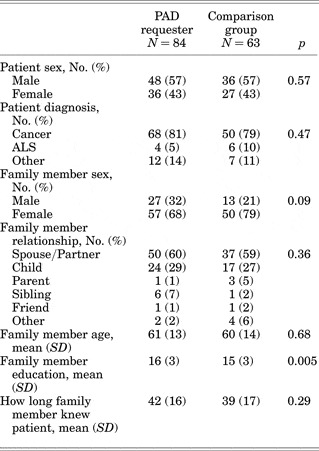
Sixty-nine (38%) of 180 potential cases referred to the study through Compassion and Choices participated in the study. The remaining subjects (cases and controls) were recruited through the other sources. The study sample consisted of 84 family members of persons who requested PAD (including 52 who received a lethal prescription and 32 who died of PAD) and 63 comparison family members. The family members were mostly spouses/partners or children, with a mean age of 61 years, who had known the patient, on average, for 40 years. Family members of PAD requesters had completed more years of education than the family members of the comparison group (p = 0.005). The decedents most often had died of cancer (Table 1).
Characteristics of PAD requesters, comparison patients and their families

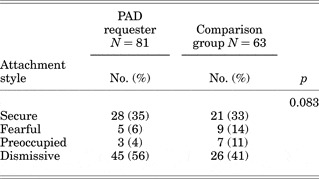
There were marginally significant differences in the proportions of each attachment style when comparing the two groups (p = 0.08) (Table 2). Individuals who requested PAD were most often described as having dismissive personality styles (56%) compared to 41% of comparison individuals. Only 4% of PAD requesters had preoccupied personality styles, compared to 11% of comparison decedents. Six percent of PAD requesters were best characterized by their family members as having fearful relational styles compared to 14% of comparison decedents. In approximately one-third of cases in both groups, family members indicated that their loved ones were best characterized as having secure attachment styles.
Attachment style that best characterizes individuals who request PAD

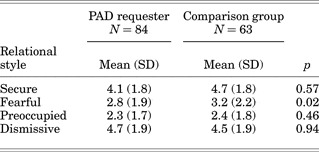
On continuous measures of relational style, which ranged from 1 to 7, the highest mean score among PAD requesters was for dismissive style (mean 4.7) followed by secure (4.1) fearful (2.8) and preoccupied (2.3) styles. The controls were rated as more likely to have fearful relationship styles than PAD-requesting patients (p = 0.02), but there were no differences between the two groups on ratings of secure, preoccupied, or dismissive personality styles (Table 3).
Relational styles in PAD requesters and comparison group

Scores range from “1 = not at all like him/her” to “7 = very much like him/her.”
DISCUSSION
Family members rated Oregonians who requested PAD and those who did not on measures of relational (attachment) style. As predicted, PAD requesters were most likely to have dismissive styles, and least likely to have preoccupied styles. There were, however, only minimal differences between PAD requestors and our comparison group. When family members chose the relational style that best characterized patients, differences were only marginally statistically significant. There were no differences between PAD and non-PAD groups in mean ratings on dismissive and preoccupied styles, though fearful relational style ratings were statistically greater in comparison patients than PAD requesters.
Our finding of high prevalence of dismissive and low prevalence of preoccupied styles among PAD requesters seems consistent with results from previous qualitative studies that showed that PAD requesters are highly concerned with control, autonomy, and self-sufficiency; distrust others; and avoid intimate relationships and communications. This finding is particularly interesting, given that dismissive attachment styles have also been shown to be associated with fewer visits to healthcare professionals (Feeney & Ryan, Reference Feeney and Ryan1994), greater rejection of treatment providers (Dozier, Reference Dozier1990), more missed appointments (Ciechanowski et al., Reference Ciechanowski, Russo and Katon2006), and poorer adherence to treatment recommendations (Dozier, Reference Dozier1990; Ciechanowski et al., Reference Ciechanowski, Katon and Russo2001). Therefore, many requests for PAD may be better understood in the context of lifelong patterns of rejecting or avoiding both healthcare and dependence on others. The choice of PAD may occur when a terminally ill and increasingly vulnerable patient is faced with the likelihood of increased, even round-the-clock, need for care from others who they cannot entirely trust.
An interesting finding in this study was that the pattern of attachment styles in both our study and comparison groups was not consistent with the reported prevalence of various attachment styles in other medical populations. Whereas the prevalence of secure attachment in our two terminally ill groups (35% for PAD requesters and 33% for the comparison group) was fairly similar to published prevalence ranges in other medically ill populations (28–44%), the prevalence of the other attachment styles was not. Specifically, the prevalence of dismissive attachment styles in our study (56%) and comparison groups (41%) was higher than the 23–36% prevalence range that has been reported in other medically ill populations (Ciechanowski et al., Reference Ciechanowski, Katon and Russo2001, Reference Ciechanowski, Katon and Russo2002a, Reference Ciechanowski, Walker and Katon2002b, Reference Ciechanowski, Russo and Katon2006; Maunder et al., Reference Maunder, Panzer and Viljoen2006). In addition, the prevalence of preoccupied attachment styles in PAD requesters (4%) and in comparison groups (11%) also seemed to be lower than the 8–25% prevalence range that has been reported in other medically ill populations (Ciechanowski et al., Reference Ciechanowski, Katon and Russo2001, Reference Ciechanowski, Katon and Russo2002a, Reference Ciechanowski, Walker and Katon2002b, Reference Ciechanowski, Russo and Katon2006; Maunder et al., Reference Maunder, Panzer and Viljoen2006). When compared with the 14.2–21.9% prevalence range of fearful attachment styles in other medically ill populations, our PAD requesters seemed to have a lower prevalence of fearful styles (6.2%), whereas our comparison group (14.3%) seemed more consistent with other medically ill populations (Ciechanowski et al., Reference Ciechanowski, Katon and Russo2001, Reference Ciechanowski, Katon and Russo2002a, Reference Ciechanowski, Walker and Katon2002b, Reference Ciechanowski, Russo and Katon2006; Maunder et al., Reference Maunder, Panzer and Viljoen2006). In general, both our PAD requesters and comparison group were older and more ill that most other populations for whom the prevalence of attachment styles has been studied. It is unclear what role these (or perhaps other demographic or clinical differences) may play in differences in attachment style between populations, and this is a potential area for additional study.
This study has some limitations. First, although the tool that was used to assess attachment styles (RQ) has been validated for administration to patients in several medical settings, its validity when administered to family members has not been examined. It is possible that our alteration of the questionnaire to allow administration to family members might have biased the results. The finding of overall high rates of dismissive styles and low rates of preoccupied styles among the comparison group might also suggest that our comparison group may not be representative of other medically ill people, which might reflect our low response proportion and use of a convenience sample for the comparison groups. It is possible that the topic of the study attracted family members who themselves were more supportive of the option of PAD and were more likely to see their family members as highly independent. A less likely explanation would be that family members view terminally ill persons as, in general, having more dismissive attachment styles. Although attachment style is believed to be fairly consistent across the lifespan, the attachment literature does describe a phased accommodation process of detachment and reorganization that follows loss (Bradley & Caffery, Reference Bradley and Caffery2001). Perhaps the high rate of dismissive styles seen in both terminally ill populations could reflect such a process. A final alternative explanation for this finding might be that having a loved one die of a terminal illness might influence how the decedent's attachment style is remembered or reported.
Despite these inherent limitations, this study has a number of strengths. Although the prevalence of attachment styles has been studied in various medically ill populations, this is the first study to include a validated attachment style assessment of persons requesting PAD. This study also made use of a comparison group that was very similar in its composition to the group of PAD requesters, whereas most other studies of attachment styles in medically ill populations lack such a comparison population (Ciechanowski et al., Reference Ciechanowski, Katon and Russo2001, Reference Ciechanowski, Katon and Russo2002a, Reference Ciechanowski, Walker and Katon2002b, Reference Ciechanowski, Russo and Katon2006; Maunder et al., Reference Maunder, Panzer and Viljoen2006).
Recognition of the dismissive attachment style in a terminally ill patient may improve the physician's ability to anticipate the patient's response to increasing care. As a result, the clinician may experience greater empathy and less frustration. Collaboration with the patient may be improved by adopting a flexible approach with the patient, accepting the need for self-reliance and interpersonal distance, anticipating less self-disclosure, and promoting patient empowerment. These patients may be resistant to efforts to increase care, as offered through hospice. The ability to maintain the patient–physician relationship may form the basis for the patient to consider alternatives to PAD.
CONCLUSION
Patients’ attachment styles may be an important factor in requests for PAD. In this study, PAD requesters were more likely to have dismissive personality styles, and least likely to have preoccupied styles. This finding seems consistent with results from previous qualitative studies showing that PAD requesters are often highly concerned with control, autonomy, and self-sufficiency, and may distrust others and avoid intimate relationships and communications. Recognition of a patient's attachment style may improve the ability of the physician to maintain a constructive relationship with the patient throughout the dying process.
ACKNOWLEDGMENTS
This study was supported by a grant from the Greenwall Foundation, and is the result of work supported with resources and the use of facilities at the Portland Veterans Affairs Medical Center, Portland, Oregon. The views expressed in this article are those of the authors and do not necessarily reflect the position or policy of the Department of Veterans Affairs or the United States government.