Introduction
A major earthquake and tsunami struck eastern Japan on March 11, 2011; 15,844 people were killed, 5,891 were injured and 3,450 were reported missing (National Police Agency, January 6th, 2012). The events also caused a significant loss of infrastructure by destroying and damaging houses, hospitals, water/power supplies, sanitation facilities, roads, and communication links.
Japan is known as a natural disaster-prone country, having been struck by earthquakes, typhoons, and tsunamis. The Japanese people have learned about post-disaster health care, particularly after the Great Hansin-Awaji Earthquake in 1995 and the Niigata Chuetsu Earthquake in 2004.
As members of a Hyogo College of Medicine relief team, the authors were dispatched to one of the more damaged areas, Ishinomaki City in the Miyagi prefecture, from April 4-9, 2011. The team was composed of three doctors, two nurses, one pharmacologist, and one clerk. A local disaster medical commander in the Ishinomaki Red Cross Hospital asked the team to provide medical care in a shelter placed at the Kadzuma Elementary School.
Arriving at the affected area one month after the disaster, team members observed several types of survivor health concerns. Because injured people had already been evacuated to less-affected areas and treated, the team focused on medical problems such as mental stress, sleep disorders, and gastrointestinal symptoms.
Gastrointestinal symptoms greatly impacted the victims’ quality of life. Although toilet construction and water supply in the temporary shelter were well managed, survivors were dissatisfied with the food aid that was provided. Except for warm food (mainly meat) provided by the Japan Self-Defense Forces (JSDF) and cooked outdoors, most of the food aid from local organizations and volunteers was composed of carbohydrates in the form of cold rice balls or bread, possibly because these foods were easy to provide and more abundant in the emergency food pantry.Reference Yoosuf, Prinzo and Atwood 1 , Reference Landman 2 Consumption of imbalanced diets may have caused gastrointestinal symptoms for the survivors. Because of the victims’ hesitation to request more balanced diets, the food aid provided was based on caloric composition or safety, rather than on what would constitute a balanced diet.
The objective of this report is to present observations related to gastrointestinal symptoms of survivors of the March 11, 2011 event.
Methods
Hyogo College of Medicine's Kadzuma Elementary School Shelter Clinic disaster relief team observations and survivors’ responses to a questionnaire were used to assess the disaster's effects on survivors’ lifestyles and gastrointestinal symptoms.
On days two and three of the team's stay, a questionnaire was administered to the patients of the shelter clinic and to the evacuees in the school shelter. A subjective global assessment descriptive survey developed by the authors’ institute was used in this study (see Appendix). It contained six single items to assess gastrointestinal symptoms: body weight loss, nausea, vomiting, loss of appetite, constipation, and diarrhea and one item to assess food requests by category.
Results
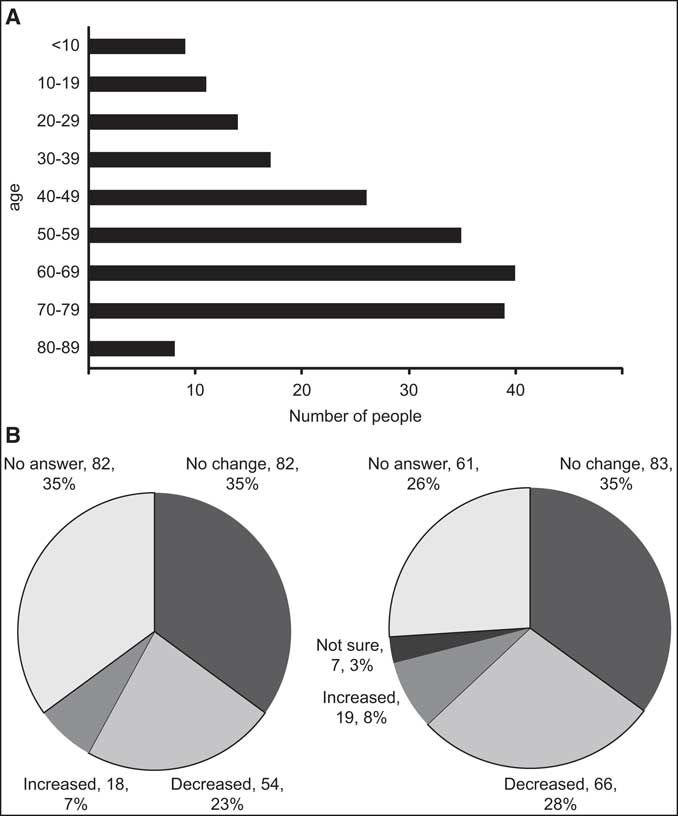
The questionnaire was distributed to 700 evacuees. Four hundred sixty-four evacuees (66%) did not complete surveys or did not consent to participate in the study. Therefore, 236 disaster victims in the shelter were included in the study (93 men, 104 women and 39 unknown sex/did not answer). The mean age of the victims was 52 years (range 9-88 years) (Figure 1A).
A. Subject Age Distribution B. Body Weight Change C. Food Intake

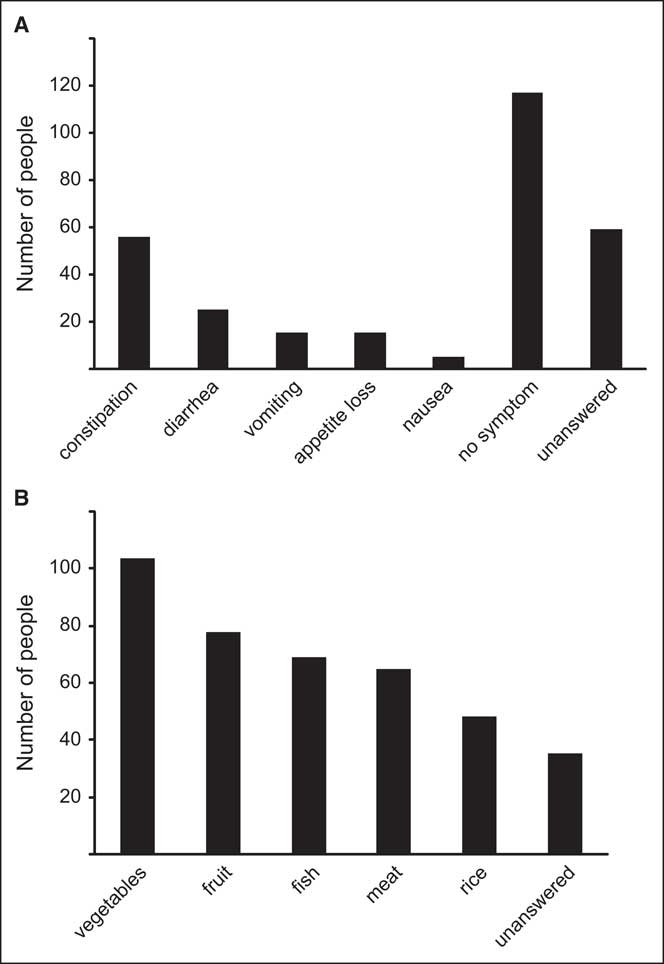
Fifty-four (23%) of the participants lost weight (Figure 1B), and 66 (28%) of them decreased their food intake (Figure 1C). Sixty subjects (25%) reported gastrointestinal symptoms. The main manifestations included constipation (25, or 10%), appetite loss (15 or 6.4%), vomiting (15 or 6.4%), and nausea (5 or 2.1%) (Figure 2A).
A. Victims’ Gastrointestinal Symptoms B. Victims’ Food Requests

Although 104 victims (55%) requested more vegetables and 78 people (33%) requested fruit (Figure 2B), most food, such as rice balls or bread, was carbohydrate-based. Team observations also indicated a long-standing dissatisfaction with food aid, including a desire for more food variety or the inclusion of supplemental vitamins and fiber.
The authors informed the volunteers and JSDF troops of the evacuees’ food requirements based on observations and the results of questionnaires. The menu was improved accordingly.
Discussion
There was a relatively high incidence of gastrointestinal symptoms among survivors one month after the Great East Japan Earthquake. The incidence of gastrointestinal symptoms may have been related to multiple etiologies, including sleep disturbance, anxiety, lack of exercise, and the discomfort of life in the temporary shelters. According to Takahashi et al, survivors should follow general precautions to prevent gastrointestinal disorders: (1) avoid psychological stress; (2) eat substantial meals at regular mealtimes; (3) wash hands; (4) gargle; and disinfect cooking utensils to prevent infectious enteritis.Reference Takahashi, Iijima and Kuzuya 3 Although these measures were properly applied in the affected area, the nutritional aspects of the food aid diets were not adequately addressed. The authors believe that imbalanced diets could be a critical cause of gastrointestinal symptoms based on their assessment.
From a long-term perspective, nutrient deficiency, particularly vitamins B and C, and protein deficiency should be considered, since the evacuees mainly consumed carbohydrate-based food such as rice balls, bread, and noodles.Reference Hashimoto and Sato 4 Food supplies for disaster victims do not typically include protein, oil, and vegetables.Reference Islam, Heijnen and Sumanasekera 5 The authors found that because of survivor guilt, grief, and fear, a number of evacuees did not want to express their emotions, and hesitated to ask for the food they desired. Although no severe malnutrition cases were observed, nutritional experts are encouraged to increase efforts to assess nutrition and supply balanced food during relief efforts. Delivery of supplementary nutrition may be needed to maintain survivors’ health.
Constipation can be caused by a low fiber diet, not drinking enough water, or lack of exercise. Management of severe constipation, including administration of a therapeutic feeding program, should be considered. Dancing sessions provided by the United States Army and local volunteers may have helped to encourage the affected people to exercise.
Since many medical and pharmaceutical records, drug history handbooks, and medical histories of interventions had been lost in the tsunami, it was difficult for the medical relief team to determine the correct medications to administer. Controlling chronic diseases such as hypertension and diabetes mellitus was difficult, as these diseases were closely related to daily diets. Meals high in carbohydrates and sodium result in elevating blood glucose levels and blood pressure, respectively.
Although this report is brief, the lessons learned in this relief effort could potentially be applied to future disasters and may improve global health care for disaster survivors. Assessments to define the food-related needs of the affected population may be essential during the acute-subacute phase following a disaster.
Conclusion
Consumption of imbalanced diets may cause gastrointestinal symptoms for disaster survivors. Professional public health nutritionists should improve emergency food nutrition balance.
Appendix. Survey Questionnaire