I. INTRODUCTION
Cu6Sn5 is an important intermetallic compound (IMC), which commonly forms during interface reactions between most Sn-based solders and Cu substrates.Reference Laurila, Vuorinen and Kivilahti1 The continuous performance demands and minimization of modern electronic products have led to an increased current and accompanying Joule heating.Reference Chan and Yang2 As a result, the operating temperature of lead-free solder joints and the volume fraction of IMCs have increased. The thermal expansion of Cu6Sn5 therefore plays an important role in the thermal fatigue of solder joints. Jiang et al.Reference Jiang, Clum, Chromik and Cotts3 investigated the coefficient of thermal expansion (CTE) of Cu6Sn5 between 60 and 160 °C by step heating dilatometry. Wang et al.Reference Wang, Gan, Hsieh and Chiou4 also studied the CTE of Cu6Sn5 formed at the Sn/Cu interface at temperatures from 100 to 250 °C. Zhou et al. suggested a nonlinear thermal expansion and a CTE value higher than the experimental result for monoclinic Cu6Sn5 by first principle computation.Reference Zhou, Liu and Wu5 In the Sn–Cu phase diagram, there is a monoclinic–hexagonal allotropic transformation at a temperature of 186 °C. Both monoclinic and hexagonal Cu6Sn5 can form in a solder joint depending on the alloy composition and soldering conditions. However, the effect of this allotropic transformation on the thermal expansion behavior of Cu6Sn5 has not been considered in previous studies.
Ni is an important alloying element in Sn–Cu lead-free solders. The addition of Ni has been associated with such benefits as altered solidification microstructures, an increased volume fraction of the eutectic phase, and a lower propensity for interfacial IMCs to crack during service.Reference Nogita, Gourlay and Nishimura6, Reference Nogita, McDonald, Tsukamoto, Read, Suenaga and Nishimura7 Ni is also actively involved in the interface reaction and has a remarkable influence on the formation and properties of Cu6Sn5.Reference Laurila, Hurtig, Vuorinen and Kivilahti8 It has been reported that an increase in Ni concentration reduces the enthalpy of Cu6Sn5 and that (Cu,Ni)6Sn5 has a more negative heat of formation.Reference Gao, Takemoto and Nishikawa9, Reference Yu, Liu, Lu, Li and Chen10 Ni can also increase the Young’s modulus and hardness of Cu6Sn5.Reference Xu and Pang11, Reference Mu, Tsukamoto, Huang and Nogita12 From a crystallographic point of view, the electron diffraction patterns of monoclinic and hexagonal Cu6Sn5 have been reported.Reference Larsson, Stenberg and Lidin13 Recently, Nogita and NishimuraReference Nogita and Nishimura14, Reference Nogita15 found that Ni stabilizes hexagonal Cu6Sn5 at temperatures down to room temperature. The effect of Ni solubility on the thermal expansion behavior of Cu6Sn5, however, remains unknown.
In this research, the effects of phase transformation and Ni addition on the thermal expansion of Cu6Sn5 were investigated by dilatometry. X-ray diffraction (XRD) pole figures were also plotted to investigate the presence or absence of any crystallographic texture in the dilatometery samples. Subsequent to this, the dilatometry results were confirmed with the lattice parameters and unit cell volumes of Cu6Sn5 and (Cu,Ni)6Sn5 measured by synchrotron XRD.
II. EXPERIMENT
Cu6Sn5 and (Cu,Ni)6Sn5 powders were prepared by preferential dissolution of Sn from Sn–4Cu and Sn–4Cu–0.05Ni ingots supplied by Nihon Superior Co., Ltd. (Osaka, Japan) Approximately 60 g of the alloy cubes with a side length about 5 mm were placed in a solution of ortho-nitrophenol (50 g) and NaOH (75 g) in 1.5 L of water at 80 °C for 24 h, during which the Sn phase dissolved. The remaining eutectic Cu6Sn5 and (Cu,Ni)6Sn5 IMCs were collected using vacuum filtration and rinsed, first with water, then ethanol, and dried in air. The dried Cu6Sn5 and (Cu,Ni)6Sn5 were crushed in an agate mortar.
For dilatometry measurements, the crushed IMCs were pressed into a rod shape in a die of 10-mm diameter. The linear thermal expansion of Cu6Sn5 and (Cu,Ni)6Sn5 rods was measured using a NETZSCH 402-C (NETZSCH, Selb, Germany) dilatometer with a temperature range of 25 –250 °C, a heating/cooling rate of 1 °C/min, and 30 min holding time at the end of heating or cooling. In total, three thermal cycles were measured, and the thermal dilations during second and third cycles were used for analysis, using the NETZSCH Proteus software. According to the NETZSCH 402-C user manual, thermal dilation during the first heating cycle was not used for the analysis due to the unstable initial condition. Synchrotron XRD measurements were done at the powder diffraction beam line at the Australian Synchrotron. The Cu6Sn5 and (Cu,Ni)6Sn5 powders were loaded into a quartz capillary sample cell (0.3 mm in diameter) and heated with a hot air gun. Synchrotron XRD was performed using x-ray with wavelengths of 0.0825 nm for Cu6Sn5 and 0.0773 nm for (Cu,Ni)6Sn5, and 10° to 60° 2θ scan angles at temperatures of 30, 170, 200, 220, and 250 °C with a heating rate of 6 °C/min. Once the desired temperature was reached, the sample was kept at that temperature for 11 min, with 1 min for thermal stabilization and 10 min for data collection. A Si standard (NIST640C) cell was measured at room temperature for 3 min and an empty capillary cell was measured for 3 min at each experimental temperature for calibration. Further detailed experimental procedures are described elsewhere.Reference Schwingenschlögl, Di Paola, Nogita and Gourlay16 The lattice parameters and unit cell volume of Cu6Sn5 and (Cu,Ni)6Sn5 were calculated using x-ray peak data obtained at each temperature using RIETAN-FP Rietveld analysis software.Reference Izumi and Momma17 The refinement parameters were optimized to minimize the residual R wp, R p, and S factors. As a reference crystallography and atomic coordination, International Center for Diffraction Data (ICDD) number of 045-1488 (for monoclinic) and 047-1575 (for hexagonal) were used in association with RIETAN-FP.
III. RESULTS AND DISCUSSIONS
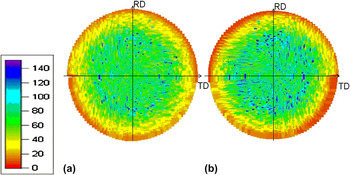
The hexagonal (1 0 1) pole figure of Cu6Sn5 and (Cu,Ni)6Sn5 samples after dilatometry measurement is shown in Fig. 1. The Normal Direction (ND) is parallel to the cylindrical axis of the sample; while Rolling Direction (RD) and Transverse Direction (TD) are perpendicular to this axis. For both Cu6Sn5 and (Cu,Ni)6Sn5, the intensity peaks along both RD and TD directions are randomly distributed and no specific grain orientations exist. Hence, the isotropy of Cu6Sn5 and (Cu,Ni)6Sn5 rods during thermal expansion can be confirmed, and the dilatometry data represents an average thermal expansion, rather than one in a specific crystal direction.
Hexagonal (1 0 1) pole figure of pressed intermetallic compound samples: (a) Cu6Sn5 and (b)(Cu,Ni)6Sn5.

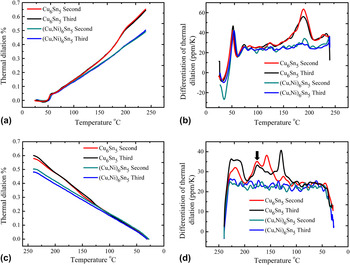
The normalized thermal dilations, expressed as a percentage of initial sample length, during second and third heating/cooling cycles and their differentiations are plotted in Fig. 2. The average linear CTEs were then calculated by linear regression. In doing so, an implicit assumption has been made that only linear thermal expansion occurred during the dilatometry test, which simplifies the comparison of data between Cu6Sn5 and (Cu,Ni)6Sn5. In Figs. 2(a) and 2(c), the thermal dilations during the second and third heating stages are almost identical, while thermal dilation during the cooling stages shows some variations such as the disturbed thermal dilations at highest temperature during cooling stages as shown in Fig. 2(c). This is likely due to the combined effects of temperature change and the allotropic transformation; however, Cu6Sn5 and (Cu,Ni)6Sn5 demonstrated similar overall thermal expansion behaviors during both heating and cooling stages.
(a) Thermal dilation during heating stages, (b) differentiation of thermal dilation during heating stages, (c) thermal dilation during cooling stages, and (d) differentiation of thermal dilation during cooling stages.

The CTEs (per °C) were calculated as 32 ppm for Cu6Sn5 and 24.5 ppm for (Cu,Ni)6Sn5 by the linear regression of thermal dilation data during the heating stages. The calculated CTEs of Cu6Sn5 are higher than the values reported in previous works,Reference Jiang, Clum, Chromik and Cotts3, Reference Wang, Gan, Hsieh and Chiou4 which is partly due to the increase in thermal dilation at approximately 180 °C as shown in Fig. 2(a). In the differentiated thermal dilation for Cu6Sn5, a peak can be clearly observed in Fig. 2(b), starting at 170 °C and finishing at 210 °C, which is associated with the increase in thermal dilation around 180 °C. Considering the monoclinic to hexagonal allotropic transformation of Cu6Sn5 occurs at an equilibrium temperature of 186 °C, it is reasonable to conclude that a volume expansion occurs during the monoclinic to hexagonal transformation. On the differentiation curve of the thermal dilation during cooling stages, as indicated by the arrow in Fig. 2(d), there is another transformation peak at almost the same temperature as observed during heating stages. Moreover, the increase on the differentiation of thermal dilation during the cooling stage also indicates that the hexagonal to monoclinic transformation results in a volume shrinkage at a temperature around 180 °C. This volume shrinkage is undesirable during lead-free soldering because it may result in strain-related mechanical damage of intermetallics during the cooling of soldered joints.Reference Nogita, Gourlay and Nishimura6, Reference Nogita, McDonald, Tsukamoto, Read, Suenaga and Nishimura7
From Figs. 2(a), 2(b), and 2(d), there is a volume expansion during the monoclinic to hexagonal transformation of Cu6Sn5. This is in contrast to a previous theoretical studyReference Ghosh and Asta18 in which the monoclinic to hexagonal transformation resulted in a 2.15% volume shrinkage at room temperature. One possible reason is that the CTE of Cu6Sn5 is strongly dependent on temperature and the room temperature “quenched” hexagonal Cu6Sn5 has a similar or a smaller CTE value than monoclinic Cu6Sn5, but as the temperature increases, the CTE of the hexagonal Cu6Sn5 exceeds that of its monoclinic allotrope. Unfortunately, direct dilatometry evidence is not available yet due to the difficulty in preventing the hexagonal to monoclinic transformation of “quenched” hexagonal Cu6Sn5 at the evaluated temperatures.
It has been reported that the high-temperature hexagonal Cu6Sn5 phase is stabilized by Ni at around 9 at.%Reference Nogita and Nishimura14 or 4–5 at.%.Reference Nogita, Gourlay and Nishimura6, Reference Nogita, McDonald, Tsukamoto, Read, Suenaga and Nishimura7 In this study, the Ni content was measured as around 4 at.% in the dissolved Cu6Sn5 and the stabilization of hexagonal Cu6Sn5 is supported by comparing the data in Figs. 2(b) and 2(d), in which the differentiation curves of Cu6Sn5 demonstrate a volume change that does not occur in (Cu,Ni)6Sn5 and also show more variability at temperatures above 100 °C. In Figs. 2(a) and 2(b), it can also be observed that the (Cu,Ni)6Sn5 shows less thermal expansion and has smaller CTE values than the Cu6Sn5.This is supportive of previous workReference Nogita, Gourlay and Nishimura6, Reference Nogita, McDonald, Tsukamoto, Read, Suenaga and Nishimura7, Reference Nogita and Nishimura14 that Ni can reduce the mechanical damage by preventing the volume change associated with the allotropic phase transformation and reducing the thermal expansion of Cu6Sn5.
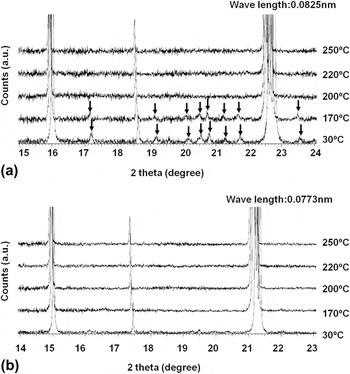
The dilatometry data represents the thermal behavior of both monoclinic and hexagonal Cu6Sn5. To directly investigate the thermal expansion of the monoclinic and/or hexagonal Cu6Sn5 and (Cu,Ni)6Sn5 phases, the IMCs were also investigated by synchrotron XRD as shown in Fig. 3. From this XRD data, it can be seen in Figs. 3(a) and 3(b) that all Cu6Sn5 samples above 170 °C and all (Cu,Ni)6Sn5 samples at all temperatures investigated are hexagonal. It can also be seen in Fig. 3(a) that at temperatures of 170 °C and lower, the Ni free samples (i.e., Cu6Sn5) have a predominantly monoclinic structure. However, previous differential scanning calorimetry resultsReference Ghosh and Asta18 have shown a cooling rate of around 1 °C/min is required to ensure the completion of hexagonal to monoclinic transformation. As our cooling rate was faster than this, some metastable hexagonal phases may be present, and the Cu6Sn5 samples at 170 °C and lower are a mixture of metastable hexagonal and low-temperature monoclinic phases.
X-ray diffraction peak profile for the samples heated from 30 to 250 °C for (a) Cu6Sn5 and (b) (Cu,Ni)6Sn5.

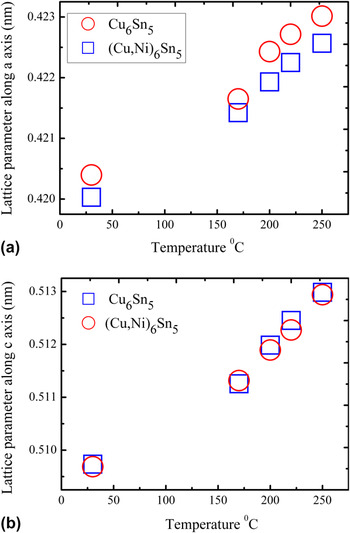
Assuming the hexagonal structure (ICDD 047-1575), the lattice parameters of Cu6Sn5 and (Cu,Ni)6Sn5 along a and c axes are plotted in Figs. 4(a) and 4(b). (Cu,Ni)6Sn5 shows less thermal expansion than Cu6Sn5 along both a and c axes, which is in agreement with the dilatometry results from the bulk sample. Moreover, Ni reduces thermal expansion more along the a axis; while the thermal expansion of Cu6Sn5 and (Cu,Ni)6Sn5 along the c axis is similar. It has been reported that the misfit between Cu atoms in single-crystal Cu substrates and Cu6Sn5 affects the morphology of Cu6Sn5.Reference Zou, Yang and Zhang19 Hence, Ni may modify the morphology of Cu6Sn5 formed during lead-free soldering by changing the lattice parameter and nucleation of Cu6Sn5.
Lattice parameter along (a) a- and (b) c-axes of hexagonal Cu6Sn5 and (Cu,Ni)6Sn5.

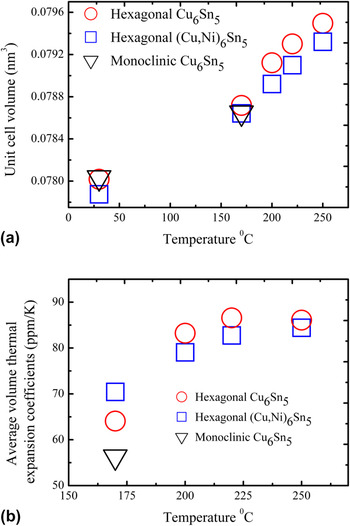
The measured unit cell volumes of Cu6Sn5 and (Cu,Ni)6Sn5 at temperatures of 30, 170, 200, 220, and 250 °C and average volume CTEs (per °C, calculated by taking unit cell volume at 30 °C as the initial condition) at temperatures 170–250 °C are plotted in Figs. 5(a) and 5(b). The unit cell volume is measured as 0.0787 nm3 at 170 °C for monoclinic Cu6Sn5 and 0.0792 nm3 for hexagonal Cu6Sn5 at 200 °C. Hence, the volume expansion of Cu6Sn5 during the monoclinic to hexagonal allotropic transformation observed by dilatometry can be confirmed. The volume CTEs are measured as 56.3 ppm for the monoclinic Cu6Sn5 and 64.0 ppm for hexagonal Cu6Sn5 at 170 °C, which is remarkably lower than the volume CTE of 83.2 ppm for hexagonal Cu6Sn5 at 200 °C. This may suggest that the thermal expansion of hexagonal Cu6Sn5 is sensitive to temperature and there is an increase of volume CTE of Cu6Sn5 as the temperature rises to 200 °C or above.
(a) Unit cell volume and (b) normalized coefficient of thermal expansion of Cu6Sn5 and (Cu,Ni)6Sn5.

Moreover, the effect of Ni on reducing the thermal expansion of hexagonal (Cu,Ni)6Sn5 can be observed from the XRD results. In Fig. 5(a), the unit cell volumes of (Cu,Ni)6Sn5 are smaller than Cu6Sn5 at temperatures 30–250 °C, which is in agreement with the dilatometry results. In Fig. 5(b), the average volume CTE of (Cu,Ni)6Sn5 is 70.4 ppm at 170 °C, which is slightly higher than Cu6Sn5 (64.1 ppm). At temperatures 200 °C or above, the converted volume CTEs of (Cu,Ni)6Sn5 are lower than Cu6Sn5 as shown in Fig. 5(b). Overall, the CTEs directly measured using dilatometry show that Ni reduces the thermal expansion of Cu6Sn5 for all temperatures investigated and this is supported by XRD results for temperatures above 170 °C.
IV. CONCLUSIONS
In summary, the monoclinic to hexagonal transformation of Cu6Sn5 at 186 °C results in a volume expansion, which is in contrast to previous computational results. The XRD results also show an increase of the volume expansion coefficient of hexagonal Cu6Sn5 as the temperature increases from 170 to 200 °C. Assuming a hexagonal structure, Ni is found to reduce the thermal expansion of Cu6Sn5, particularly along a axis. By stabilizing the hexagonal Cu6Sn5 at temperatures below 186 °C and reducing the thermal expansion of Cu6Sn5, the addition of Ni may reduce thermal stresses generated in solder joints during thermal cycling.
ACKNOWLEDGMENTS
Nihon Superior Co. Ltd. (Osaka, Japan) supplied the test samples under the University of Queensland-Nihon Superior collaborative research program. X-ray diffraction (XRD) experiments were performed at the Australian Synchrotron (project IDs: FI_2009/1_ FI1077, 2010/1_ P2249) under the Queensland Foundation Investor beamtime scheme. The authors would like to thank Dr Q. F. Gu of the Australian Synchrotron for XRD experiments, Prof. H. Yasuda in Osaka University and FrontierLab@OsakaU program for the access to pole figure XRD equipment, and Dr. S. D. McDonald and Dr. Y. Q. Wu in the University of Queensland for stimulating discussions and suggestions. D. Mu is financially supported by an Australian Postgraduate Award.