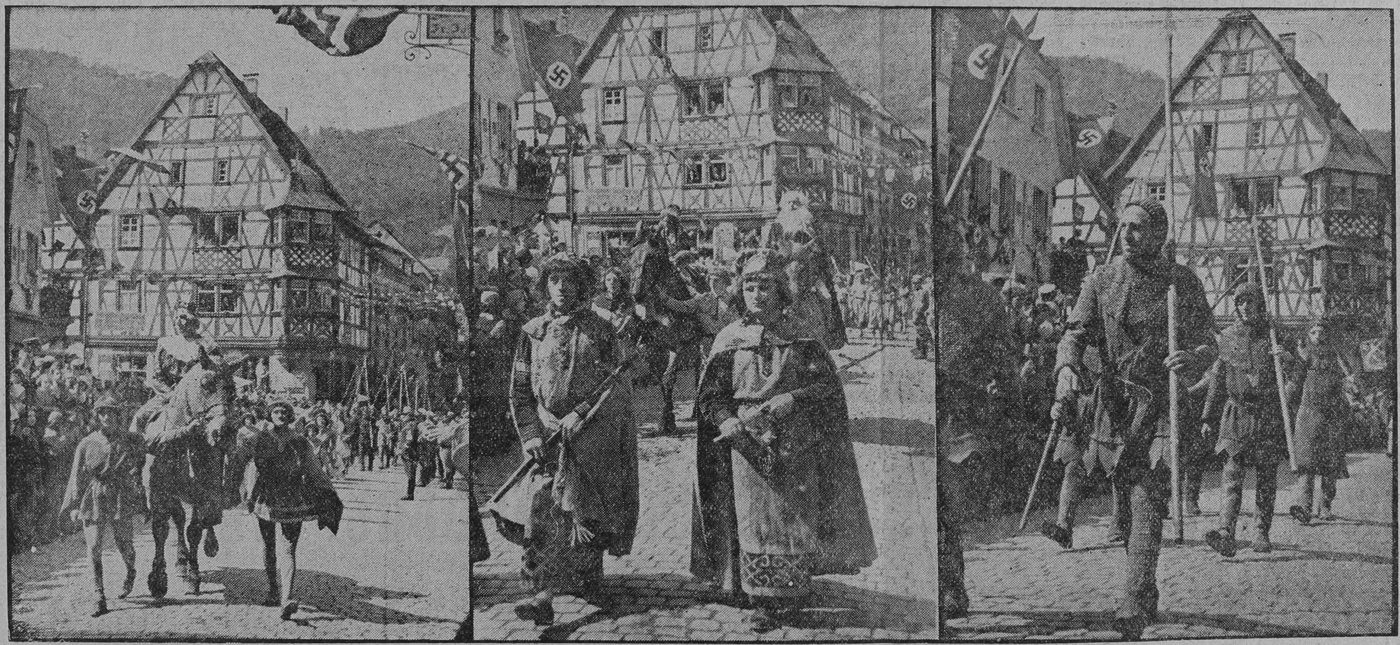
In August 1937, the residents of Annweiler, a small town in the Palatinate region of Germany, decked their houses with fir garlands and swastikas in preparation for the annual festival known as Annweiler Heimattage (the Heimat Days of Annweiler).Footnote 1 Nearly thirty thousand people attended the celebration, which included a colorful parade featuring men and women dressed in medieval costumes marching alongside formations of the Hitlerjugend (HJ), the Sturmabteilung (SA), and the Schutzstafel (SS). [Fig. 1] The festival concluded with a “splendid illumination of the Trifels,” the castle overlooking Annweiler, which, as one of the most storied medieval fortresses of the Hohenstaufen king, Barbarossa, was well known in Germany and especially in the Palatinate.Footnote 2 The Trifels was noteworthy, among other things, for intermittently housing the imperial insignia during the Middle Ages and for serving as a prison for English King Richard the Lionheart following his capture in 1192 by Duke Leopold of Austria.Footnote 3
Historical parade on the occasion of the Heimat Days of Annweiler, August 1937. Source: LASp, H 3 Nr. 1906 III, p. 157.

Staging the medieval Heimattage—a practice that had been part of bourgeois festival culture since the late nineteenth century—was extraordinarily popular among Pfälzers.Footnote 4 Through these historical parades, they demonstrated both their regional historical traditions and their contributions to the greater German Reich.Footnote 5 As a “milieu de mémoire” with a unique “lieu de mémoire,” the Palatinate was home to specific material and symbolic elements that informed Pfälzers' idea of Heimat, i.e., a feeling of belonging to their region.Footnote 6 These Heimat elements, including historical monuments such as medieval castles, churches, and villages, were capable of transcending local identity and culture to help forge identification with the nation-state, the German Reich, and, later, the Volksgemeinschaft (“people's community”).Footnote 7 The dissemination of certain types of media, especially postcards and newspaper articles, as well as cultural practices such as tours, hikes, and festivals like the Heimattage, contributed to this identification of local culture with the broader German realm.Footnote 8 This process, which was essential for the creation of a German nation-state long before the Nazis took power, was crucial under the Third Reich for mitigating the tensions between local culture and the autocratic Führerstaat, and therefore for the creation of a Nazi Volksgemeinschaft in the Palatinate.
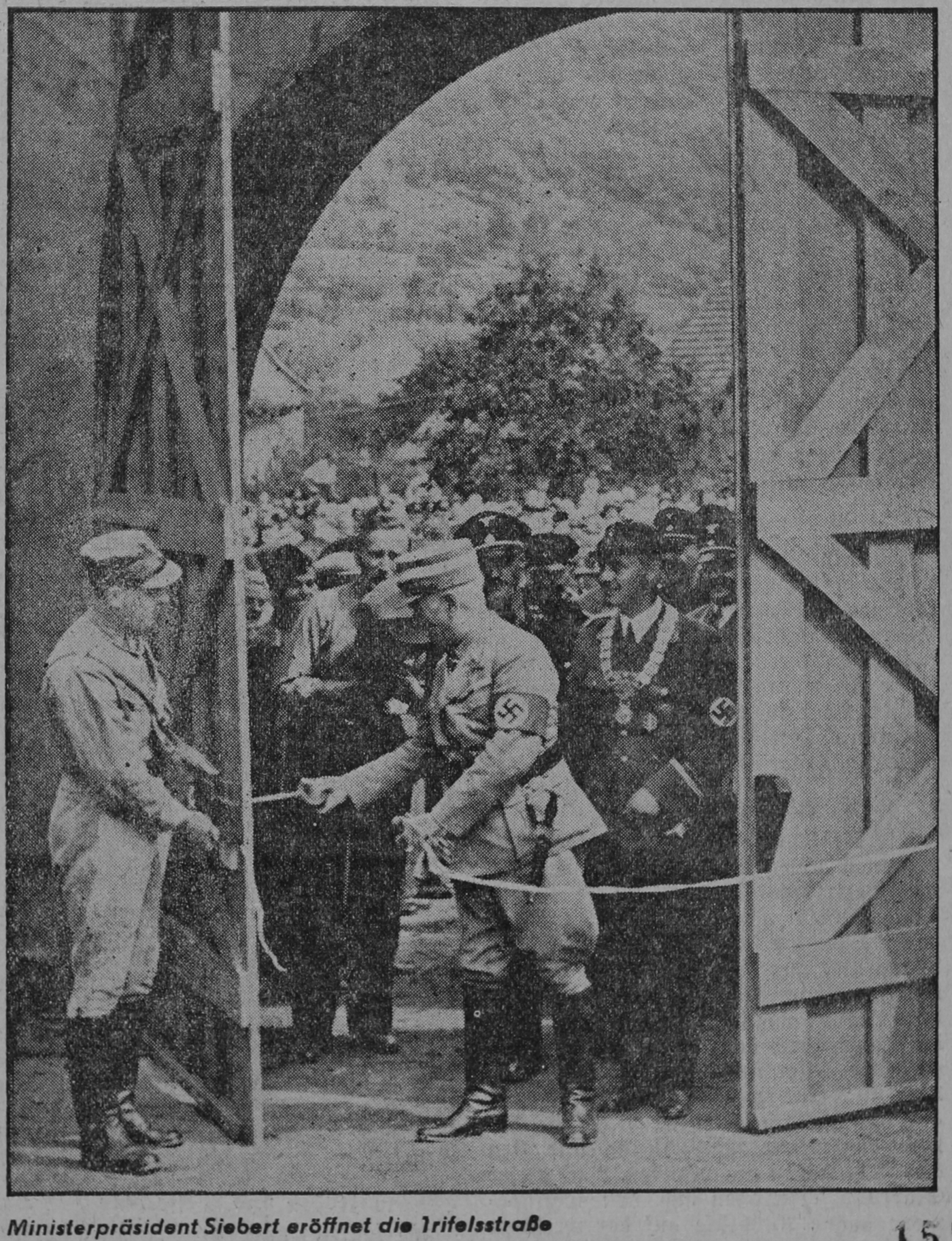
The Annweiler Heimattage of 1937 took place in the context of the opening of “Trifels Street.” [Fig. 2] This newly constructed road, which led from Annweiler to Trifels castle, enabled Germans to visit the castle and other regional medieval monuments by car.Footnote 9 Its construction was part of the Ludwig Siebert program, created by Bavarian Minister-President Ludwig Siebert shortly after the Nazis took power to preserve medieval castles and ruins in Bavaria and the Palatinate, increase regional tourism, and provide jobs for unemployed men, including masons and carpenters, archaeologists, art historians, and curators of historical monuments.Footnote 10 Through a case study of the Siebert program, this article demonstrates that Nazi cultural politics gained energy through the stability of Germany's regional structures and culture and, conversely, that local communities profited from Nazi politics in ways that helped to popularize the new regime and forge the Volksgemeinschaft on the local level.Footnote 11
Ludwig Siebert opens the Trifels Street, August 1937. Source: LASp, H 3 Nr. 1906 III, p. 157.
By generating competing models for the regime's structure and dispersion of power, the long-running debate over what held the Nazi regime together has produced a rich literature concerning the relative roles played by coercion and consensus during the Nazi era. Despite the appeal of the “polycratic” model of the regime, research on the intersection between centralist politics and regional structure in Nazi Germany suggests that the relationship between the Führerstaat and the traditionally decentralized federal structure of the German Reich was not necessarily dysfunctional.Footnote 12 Though Adolf Hitler's state was autocratic, its neofeudal structure, based on a premodern model of leadership and entourage, devolved power to regional functionaries, especially to regional Nazi leaders known as Gauleiter, who successfully established and oversaw the regime in the regions.Footnote 13 The regional political, social, cultural, and even military structures remained relatively stable during the Third Reich, even though several politicians sought to create a more centralist state led by the will of the Führer.Footnote 14 As the following analysis of the Siebert program demonstrates, centralist politics and regional identity were not diametrically opposed elements, but behaved instead as two parts of one complex mechanism for mobilizing the populace and forging the Nazi Volksgemeinschaft.
By deliberately engaging the Nazi conception of a Volksgemeinschaft, this article enters into current debates over this contested term. Until the 1980s, historians largely treated the National Socialist pursuit of a unified “people's community” dismissively, as self-evident Nazi propaganda. More recently, scholars have acknowledged the power that the concept held for many people in German society, while questioning its usefulness as an analytical tool. As recent academic conferences and a spate of new publications attest, the explosion of work on the Nazi effort to create a united Volksgemeinschaft has produced a wide range of explanations for the German populace's attraction to, or acceptance of, the regime, yielding valuable insights into the regime's mechanisms of mobilization.Footnote 15 Among this variegated work, the provocative theses of scholars like Michael Wildt and Thomas Kühne have moved the role of violence in “affective mobilization” to center stage in the debate.Footnote 16 Whereas Wildt highlights the role of antisemitic violence in mobilizing Germans in the provinces through 1939, Kühne argues that a sense of community was created through participation in crimes, particularly during World War II. Christopher Browning has reinforced these arguments by noting the central role that the Volksgemeinschaft played in the biggest Nazi crime of all: the Holocaust.Footnote 17 But the enormous energy unleashed by the regime was not always destructive in nature. In contrast to an approach that emphasizes the role of racism, the politics of inclusion and exclusion, and the attractions of participatory violence, this article—by focusing on a small German town with a vanishingly small Jewish population and a local political leadership uninterested in their persecution—directs attention to the role that more benign enticements played in popularizing the regime in its early stages. An examination of the effort to forge a Volksgemeinschaft in the town of Annweiler argues for a range of approaches that recognizes significantly different factors underlying the popularity of the regime over time and in different regions.
The first section of this article discusses the symbolic functions and uses of castles by Nazi politicians and ideologues. The second section then shifts to the Siebert program and to measures that were implemented by the minister-president and his officials. To help explain why the majority of Annweiler residents welcomed the Nazi regime, the third section provides an overview of the cultural and social history of the Palatinate in general, and of Annweiler in particular, through 1933. The fourth section analyzes the extent to which Siebert's cultural politics influenced the cultural memory practices of Annweiler residents, and looks at how his program contributed to the creation of a local Volksgemeinschaft. As this section shows, the community of Annweiler was far more heterogeneous than Nazi politicians and ideologues suggested, containing not only enthusiasts and opportunists, but also dissenters and malcontents. In the face of such diversity, Siebert's cultural program boosted regional construction and the local tourist industry by restoring ruins and castles, thus creating a symbiotic relationship between the minister-president and the local populace that was decisive for overcoming dissent and forging a unified Volksgemeinschaft.
Nazi Medievalism and the Use of Castles in the Third Reich
It is no coincidence that castles and medieval villages functioned as objects of mediation between the local culture and the nation-state in Germany, at least since the late nineteenth century. Beginning with the Romantic period, castles, ruins, and cathedrals were frequented for excursions and therefore became part of the regional memory culture.Footnote 18 Many nineteenth-century Germans “idealized medieval social and political attitudes, of which castles were symbols. In rebuilding ruined castles, they hoped to revive dying values.”Footnote 19
The castle thus became an instrument of political demonstration and ideological projections during the nineteenth century, a symbol of unity that represented a national “imagined community.”Footnote 20 In southern Germany, where many medieval fortresses were and are part of the regional “mental map,” and where the liberal tradition of the free imperial cities was deeply established, castles could be used to represent progressive politics.Footnote 21 For example, the Hambacher Festival of 1832, held at the famous castle in Neustadt, represented a campaign against conservatism and Christian dogmatism by the liberal bourgeois political opposition, which consisted of students, liberal activists, local farmers, and townspeople.Footnote 22 Castles served in the main, however, as objects of historical legitimization for reactionary nationalist and aristocratic politics. In 1817, politicians and curators of historic monuments began to push for the restoration of Marienburg castle near Danzig, the main seat of the Teutonic Order, to create a symbol of the alleged superiority of German culture in the East.Footnote 23 Likewise, castle researcher and architect Bodo Ebhardt reconstructed Hohkönigsburg castle in Alsace, on the orders of Kaiser Wilhelm II, to demonstrate that this region was of “Germanic origin,” thus signifying the territorial expansion of the Kaiserreich in western Europe.Footnote 24 It was important for the Hohenzollern ruler to construct a symbolic genealogy of the great emperors of the Hohenstaufen, whom Wilhelm II imagined as Germanic cultural heroes who had expanded the German Reich across Europe.Footnote 25 This symbolic use of the Middle Ages as legitimization for contemporary politics “helped secure a suitable historical lineage for the newly forming nation.”Footnote 26
World War I was a pivotal point for medievalism. The war and its aftermath lay the seedbed for imagining a utopian medieval era in opposition to the “age of nihilism,” as many contemporaries had experienced the postwar era. Before World War I, Stefan Goebel writes, “medievalism had essentially been a discourse of identity, fueled by cultural despair in the era of industrialization.” During the war it was transformed into a discourse of mourning closely connected with the creation of a new form of cultural memory, one that melded an idealized medieval past with a commemoration of fallen soldiers.Footnote 27 This cultural memory became “collective memory” through commemorations—for which castles often served as the setting—that were organized by veterans, memorial committees, artists, families, and the state.Footnote 28 Medievalism and the memory of fallen soldiers combined to create a “völkisch community of the dead,” consisting of both Christian and pagan, medieval and Germanic elements.Footnote 29 Memorials for fallen German soldiers, a vast number of which were built after 1918, had a great effect on the popularity of castles. Many of these modern structures were designed in the shape of a medieval castle beginning in the early 1930s and were called Totenburgen (castles of the dead).Footnote 30 The largest and most famous of these was the Tannenberg memorial, inaugurated in 1927 and modeled on the Hohenstaufen Castle del Monte in southern Italy. This soldiers' memorial was dedicated to the memory of the Teutonic Order's lost battle of 1410 and to the victory of Paul von Hindenburg over Russian forces in 1914.Footnote 31
The notion of the “medieval” as an element of a genuine Germanic culture and as a symbol of a better social order developed further during the Weimar Republic, when it was folded into a discourse challenging the despised Versailles Treaty.Footnote 32 Many German tourists who visited German castles in the 1920s “felt that, ruined or reconstructed, the castles were somehow ‘German’ and had relevance to their national experience.”Footnote 33 Castles became particularly popular among members of the German youth movement, for whom the medieval fortresses symbolized a supposedly better world free of any signs of degeneration and adult authority.Footnote 34 Young people occupied many ruins and castles and celebrated midsummer festivals and initiation rituals there.Footnote 35 The medievalism of the youth movement was also connected with plans to increase tourism: the youth movement had begun constructing youth hostels in castles before World War I, but when mass tourism took off in the 1920s, the Reichsverband für deutsche Jugendherbergen (Reich Association for German Youth Hostels) constructed numerous youth hostels in castles.Footnote 36
After 1933, the Nazis incorporated medieval monuments into their Weltanschauung and cultural practices. Even though Nazi politicians had various ideas about what castles meant for their ideology, most agreed that the medieval era was important for demonstrating the alleged cultural and racial superiority of the contemporary German Reich.Footnote 37 Nazi ideologues imagined the Middle Ages as an organic social order composed of a king or leader, the knights in his entourage, and the Germanic peasantry—or as an idealized version of the contemporary neofeudal Führerstaat.Footnote 38 This elided two complicating factors for their Weltanschauung: the fact that castles did not symbolize the Volk, but rather the social elite, and the popularity of Christianity during the Middle Ages. In order to disassociate Christianity from the medieval era, Arthur Rosenberg, Richard Walter Darré, and Heinrich Himmler sought to demonstrate that medieval kings such as Henry I or Henry the Lion were representatives of a “Nordic kingdom” and that the Middle Ages were a genuine Germanic era.Footnote 39 Rosenberg reinterpreted the aristocratic characteristics of castles by propagating the notion of a medieval Volkskönigtum (people's kingdom), which served as the historical legitimization of Hitler's idea of a German Volksgemeinschaft.Footnote 40 This mythical medievalism was informed by the völkisch and eschatological idea of a coming thousand-year Reich that would unite the Germans and herald a golden age.Footnote 41
Castles provided the material evidence of this unification. The Nazis used huge, well-known Reichsburgen, such as the Nuremberg and Kyffhäuser castles, as stages for parades, festivities, and völkisch rituals in order to demonstrate their power and promote a supposedly common Germanic culture and tradition. Hitler thought that monuments—preferably newly constructed ones, but also historical or pseudo-historical buildings—had a symbolic, integrative power for the creation of a German Volksgemeinschaft. “Only the existence of such a place, surrounded by the magic glamor of a Mecca or Rome,” he asserted in Mein Kampf, “is able to give power to a movement, rooted in the inner unity and the acceptance of a vanguard that represents this unity.”Footnote 42
Nazi functionaries used castles as administrative centers in the German Reich and later in the annexed territories in eastern Europe.Footnote 43 Robert Ley, the Reichsleiter (Reich Leader) of the NSDAP and leader of the Deutsche Arbeitsfront (German Labor Front, or DAF), published a book in 1936 on his favorite project, the Ordensburgen (Order Castles). Constructed in concrete and steel in the shape of medieval castles, the Ordensburgen served as sites for the education of the managerial staff of the Nazi Party.Footnote 44 Ley explained that he had built these castles in a completely modern way because Hitler's Weltanschauung should not be taught in “old, moldy, and dusty buildings,” like real medieval castles, but instead in buildings that were “in technological terms… absolutely perfect.”Footnote 45 Ley had no understanding of what castles meant historically, but considered them to be an aesthetic and functionalist tool for creating a new Nazi culture.
As Ley's Order Castles demonstrate, the use of castles for the education of the rising Nazi elite was a well-established practice among Nazi organizations, particularly the HJ and the Nationalpolitische Erziehungsanstalten (National Political Institutions for Education, or NPEA).Footnote 46 Nazi Germany established one Reichsschulungsburg (Reich training castle), as well as forty-seven Gau- and eighty-nine Kreisschulungsburgen (castles for training in the regional and local districts).Footnote 47 Castles were particularly important as education centers for the SS, given that Himmler conceived of his organization as a Sippenorden (clanorder) modeled on the Teutonic Order. He felt that castles should help inculcate values such as leadership, loyalty, community, and racial superiority among members of the SS.Footnote 48 The castles of Bad Tölz and Braunschweig, in which SS-Junkerschulen (Junker schools) were established, are examples of castles used by the SS for such purposes.Footnote 49 Himmler's favorite project was the castle Wewelsburg in Büren-Westfalen, which was first conceived as an education center for SS officers before being reconceptualized as a recreation spot for the SS elite.Footnote 50
Nazi ideologues also used medieval figures such as Henry I, Henry the Lion, and the Knights of the Teutonic Order to justify conquering territories in eastern Europe.Footnote 51 These historical figures had been mythologized since at least the early nineteenth century, but they symbolized for right-wing ideologues the predominance of Germanic culture in eastern Europe during the Middle Ages.Footnote 52 Radicalizing and racializing these ideas, Himmler and other SS ideologues planned the far-reaching colonization of eastern European territories by Germanic peasants and settlers, which—based on the assumption of the racial and cultural superiority of Germans over Slavs—would entail the enslavement, demographic displacement, and extermination of the peoples in these regions.Footnote 53 The Germanic peasants and colonizers were to live in Wehr- und Hegehöfen (“defense yards” and farmyards), whereas castles would be used as outposts for the future cultivation of land and the settlement of the conquered eastern territories.Footnote 54 Himmler argued that these castles were “memorials of the right to life of, and the assertiveness of, the whole German nation in the East.”Footnote 55 One example of such a colonial outpost was the castle Busau (now Bouzov) in today's Czech Republic, in which the SS established an autarkic economic center.Footnote 56 The medieval buildings were therefore part of the so-called Generalplan Ost (General Plan East), the plan for conquering and colonizing eastern European territories developed by Konrad Meyer, a professor of agronomics and SS officer.Footnote 57
By the nineteenth century, castles had become a kind of palimpsest upon which successive generations of Germans inscribed a triumphalist understanding of German history, projecting onto them their hopes for reviving the lost values of the medieval era and for restoring the supposed greatness and influence of German culture. Nazi functionaries were able to build upon this nationalistic understanding of castles, tailoring it to their own needs and goals. Perhaps no Nazi functionary appreciated the symbolic and integrative power of the castles more than the Bavarian Minister-President Ludwig Siebert, who was able to convince the Nazi leadership to support a program he had created to restore castles in Bavaria and the Palatinate.
The Siebert Program
Ludwig Siebert developed ideas about castles and the Middle Ages that reflected his personal biography. The Bavarian minister-president was a go-getter who did not merely lament German society's debased condition, but actually conceived and implemented a program that sought to alleviate Germany's economic and social problems. Siebert was neither a member of the upper Nazi elite nor a subordinate personality in the Nazi system. He had been a civil servant under the Kaiserreich and the Weimar Republic, and became a true believer in National Socialism. Born in 1874 in the Palatinate town of Ludwigshafen, he studied law, graduated from the University of Munich, and served as a long-time civil servant in the Palatinate and Franconian administrations of Bavaria.Footnote 58 In 1931 he joined the NSDAP. Though he was an “old warrior” (Alter Kämpfer), he did not earn a prestigious position but remained an administrator. Siebert initiated the construction of one of the first monuments in honor of the NSDAP in Rothenburg ob der Tauber, where he had been mayor from 1908 to 1919.Footnote 59 He not only dutifully governed the state of Bavaria, but was also convinced that the Nazi movement could truly create a Volksgemeinschaft consisting of “Aryan” people, and that its political agenda would lead to a better Germany.Footnote 60 Because of Siebert's “special merits,” Hitler awarded him the “Golden Party Badge” (Goldenes Parteiabzeichen) of the NSDAP, the regime's third-highest award, in 1938.Footnote 61
Siebert's special merits were not so much his admittedly good managerial skills in the Bavarian administration, but rather his enormous engagement with the so-called Ludwig-Siebert-Programm.Footnote 62 From 1933 to 1934, the newly elected minister of finance (and later minister-president) of Bavaria instituted a program, at a cost of four million reichsmarks (RM), for the preservation of historical buildings, especially castles and ruins in Bavaria and the Palatinate. Like other members of the Nazi elite who competed for Hitler's favor, Siebert sought to present himself as a patron of cultural projects.Footnote 63 This strategy proved successful, for Hitler grew increasingly interested in Siebert's plans and generously supported his cultural program. Several offices of the NSDAP and administrations of the former state bureaucracy of the German Reich supported the program financially as well.Footnote 64
Siebert planned to restore the most important German medieval monuments in Bavaria, including the castle of Nuremberg, the fortress Marienberg in Würzburg, the Plassenburg near Kulmbach, and the medieval village of Rothenburg ob der Tauber.Footnote 65 Because he was born in the Palatinate, and because he considered this region to be extremely important in German history, he also sought to restore the ruins of numerous medieval castles there, including the Trifels near Annweiler. In Siebert's eyes, the castles in the Palatinate served as a bulwark against the French, just as the Westwall was.Footnote 66 In contrast to Himmler, Rosenberg, and Darré, Siebert concentrated on the castles of the Hohenstaufen kings in southeastern and southwestern Germany, which, unlike the castles of the Teutonic Order in the East, supposedly symbolized the superiority of Germanic culture in southern and western Europe.Footnote 67 After 1938, these castles also served to legitimate the axis between Hitler's Germany and Benito Mussolini's Italy, with an eye to the Italian politics of the Hohenstaufen kings during the Middle Ages.Footnote 68 In the writings and speeches of Nazi ideologues such as Siebert, castles in the western territories of the Reich, and particularly the fortresses of the Hohenstaufen kings, functioned as metaphors for the Germanic ethnic space and its boundaries with the French. Siebert felt that the Trifels castle, in particular, served as a symbol of the Germanic Reich, and that the revitalization of this medieval fortress—by constructing it in a completely new shape—meant the resurrection of the great medieval past of the Germans. According to Siebert, the Trifels “was once the epicenter of the Reich, a symbol of German greatness and glory. It will awaken in a new form from its four-hundred-year slumber in the German Reich, to a new, brilliant life, and, as a holy site of the German Volk, it will announce into the far future the resurrection of the old Reich in even greater power and glory.”Footnote 69 Siebert used a well-known saying in the Palatinate—“He who owns the Trifels, owns the Reich”—to integrate the castle into his own imagination of a Germanic medieval past.Footnote 70
Far from functioning as elements of mere propaganda, Siebert's ideas about historical monuments constituted a particularly Nazi concept of culture and history. For Siebert, history did not end with an epoch, since the “values” of a historical period like the Middle Ages could be resurrected. As a consequence, the German people, symbolized through cultural monuments such as castles and medieval villages, could last after “resurrection… into the far future,” i.e., for an eternity, while values such as “greatness” and “glory” could be restored. In Siebert's imaginary, German culture itself was considered an eternal value that should serve to heighten Germans' awareness of their supposed superiority.Footnote 71 His eponymous program was a genuine effort to help create a “better Germany” in which “good old” medieval virtues were revitalized, the German cultural landscape was restored, and no “disturbing elements,” such as decrepit monuments, garbage on cultural sites, or polluted hiking trails, could be seen. In a speech delivered at the opening of the newly restored Nuremberg castle in 1935, Siebert formulated this principle by noting, “Making its historical way, the National Socialist revolution of Adolf Hitler pulled down and trampled everything that was rotten and worm-eaten in Germany.”Footnote 72
For his castle program, Siebert engaged the architect Rudolf Esterer, who had been a higher councilor of construction in the Bavarian government since 1924 and subsequently become Siebert's Hofarchitekt (court architect) in the early 1930s.Footnote 73 Esterer was a representative of the Heimatschutzbewegung (National Cultural Heritage and Protection Movement) and an advocate of a modern, right-wing alternative to the Neue Sachlichkeit (New Objectivity) movement in the Weimar Republic.Footnote 74 Esterer's concept, called Schöpferische Denkmalpflege (Creative Conservation), opposed both the functional-rationalist and “cold” constructions of the New Objectivity movement and the historicist style, which he dismissed as an “antiquated outcome of the artistically uncreative nineteenth century.” According to Esterer, new creative powers were to be found in the Volk, in the tribe, and in German soil. Art had to be returned to and emerge from the Volk in the sense that “the artist becomes the spokesman of the Volk again, and the Volk becomes the basis of resonance for the language of art.” This völkisch concept of architectural design and conservation of historic monuments demanded that local materials and local workers be used for the conservation of a medieval monument such as Trifels castle. Esterer sought to connect traditional handcraft and modern construction techniques: whereas the paneling of the Trifels was carried out in the medieval stonemasonry technique, its armature was constructed in concrete and steel. This enabled the melding of the old and the new, the “worldview of the Hohenstaufen” and the völkische Weltanschauung.Footnote 75 Esterer's plan for the new Trifels was a typical example of what is known as “Nazi construction planning,” a mixture of monumentality, regionalism, and technological modernity.Footnote 76 As was the case for Siebert's castle ideology, the anti-historicist notion that völkisch values could be resurrected by the rebuilding of a medieval castle was also crucial for Esterer's thinking.
One of the most prestigious projects in the Siebert program was the restoration of the Nuremberg castle, carried out by Esterer between 1934 and 1935. Nuremberg became a place of remembrance after the foundation of the German Reich in 1871.Footnote 77 It was thought to be the Kaiserhauptstadt, the former capital of the Merovingian, Carolingian, Ottonian, and Hohenstaufen emperors, and it served as host city for the infamous Nazi party rallies. According to Hitler, “In no other German city are the past and the present of the Greater German Reich connected in such symbolic unity and expressiveness as in Nuremberg, both the old and new capital of the Reich.”Footnote 78 The Nuremberg castle of the Hohenstaufen kings symbolized for Nazi politicians the “glory of the Greater German Reich and the unity of the German Volk.”Footnote 79 This was most obvious in Leni Riefenstahl's 1935 film, Triumph of the Will, in which Hitler is shown riding in a Mercedes through masses of spectators, echoing the entry of the medieval emperor into the city.Footnote 80 It is therefore unsurprising that Hitler ordered the transfer of the imperial insignia from Vienna to Nuremberg castle after the Anschluss in 1938.Footnote 81
Because Nuremberg castle was popular in Germany and Bavaria, the connection of these symbolic rituals with diversions from everyday life was an effective mechanism for mobilizing the German populace as spectators. At the party rally in 1936, Nazi Germany's leisure organization, Kraft durch Freude (Strength through Joy, or KdF), organized a huge folk festival and funfair in Nuremberg with shooting galleries, boxing matches, beer tents, and puppet theaters for children. The city was used as a stage for this event, representing both the German medieval-national tradition and the Heimat tradition.Footnote 82 At the same event, Albert Speer's Cathedral of Light (Lichtdom), which cast shafts of light upward to more than twenty thousand feet, represented the regime's most impressive technical staging of the values of beauty and grandeur, overawing onlookers through the creation of a euphoric and ecstatic atmosphere.Footnote 83 According to Siebert, the Cathedral of Light and the castle symbolized together the “timeless cultural values that were created in our fatherland in past centuries as living evidence of the glorious German history and the immortality of our fatherland.”Footnote 84 The staging of the Middle Ages in Nuremberg proved to be highly attractive for the German populace: the number of attendees at party rallies increased from twenty-two thousand in 1933 to fifty-six thousand in 1939.Footnote 85 Siebert learned much from this experience that he could later apply to his pet project, the new construction of Trifels castle in the small town of Annweiler.
Cultural History of the Palatinate and the Social Structure of Annweiler in the Early 1930s
Siebert's program sought to bind the Palatinate to Bavaria in order to counter German particularism. Politically and historically, the Palatinate had close ties with Bavaria. In 1816, after the Napoleonic Wars and the Congress of Vienna, the territory of the Palatinate left of the Rhine was incorporated into the state of Bavaria. Relations between the two regions were fraught, however, because of the regional patriotism of the Pfälzers.Footnote 86 Separatism was pronounced and Palatine revolutionaries organized an uprising in 1849 after the failed March Revolution of 1848, yet the Palatinate remained under the control of the Bavarian government. Political and cultural attitudes in the Palatinate were diverse from the nineteenth century through the Weimar Republic: pro-Prussian liberals, Social Democratic regionalists, and pro-Bavarian Pfälzers, who tried to draw the Palatinate closer to Bavaria after the foundation of the Kaiserreich in 1871, comprised the political spectrum in a region that also experienced an intermittently strong French influence.Footnote 87 During the nineteenth century, the concept of Heimat became the most important element in creating an awareness of both a German and a Palatinate identity. As Celia Applegate writes, its cultivation became “a way to assert the Germanness of the Pfalz in the realm of culture.”Footnote 88
The fact that the Palatinate is a borderland was relevant for the way that medieval buildings resonated in the region's cultural memory. Because the Palatinate borders on France, it developed an awareness of existing on the outskirts of German culture, which engendered a “shared consciousness of singleness and distinctiveness among the inhabitants of the Rhenish district.”Footnote 89 This was especially pronounced after World War I, when the region was occupied by French troops. After the Treaty of Versailles, the Palatinate was diminished in size and its western territories were integrated into the newly created Territory of the Saar Basin, controlled by the French, and administered by the League of Nations. During the French occupation, nationalist and regional separatists formed several subversive groups, a development that ended in the proclamation of an autonomous Palatinate. Although French troops put down such unrest in 1930 and the region remained under French occupation, the atmosphere in the Palatinate was explosive in the early 1930s, which provided fruitful soil for Nazi politics.Footnote 90
During the Weimar Republic, patriotic and nationalist spectacles—in which castles and ideas of a coming German Reich were prominent—grew in popularity. The “thousand-year celebration” of the Rhineland in Koblenz on June 20, 1925, for instance, demonstrated that the eschatological and millenarian idea of a medieval Germanic Reich as a better, utopian Germany was popular in western German culture well before the onset of the Nazi regime.Footnote 91 Central to the ideas developed by regional art historians and folklore scholars about German medieval architecture was the notion that farmhouses, churches, cathedrals, and particularly castles in western Germany, including those in Alsace and Lorraine, were symbols of the “German defensive will.”Footnote 92 Such practices engendered a völkisch and nationalist, but also a regionalist cultural memory in the Palatinate.
Heimat and history associations in the region were a key ingredient in the development of a medieval heritage culture and memory that were characterized by nationalist and völkisch elements. Through festivals, historic parades, guided city tours, excursions to monuments, public lectures, and ceremonial speeches, these associations educated Pfälzers in regional history and culture.Footnote 93 Though they did not necessarily have a political agenda in the narrow sense of party politics, the outlooks of many of these associations were shaped by moral and political attitudes ranging from democratic-liberal to monarchist-conservative or völkisch-conservative. Overall, a particular form of regional nationalism characterized this social milieu.Footnote 94 The associations “promulgated a regional historical tradition that legitimated both their regional rootedness and their national aspirations.”Footnote 95 In 1904, the largest lay association in the Palatinate, the Pfälzerwaldverein (Association of the Palatinate Forest), founded two years earlier, had three thousand members consisting of predominantly white- and blue-collar workers and craftsmen, as well as members of the local cultural elite, such as parsons, teachers, and local politicians.Footnote 96
Such associations were commonly found in small towns such as Annweiler in the southern Anterior Palatinate. Surrounded by the three castles Trifels, Anebos, and Scharfenberg, the town is located at the edge of the Haardt hills in the valley of the river Queich, which separates the Pfälzerwald from the Waasgau.Footnote 97 In 1933 approximately 4,300 people lived in Annweiler, of whom 1,032 were Catholic and 2,516 Protestant.Footnote 98 According to contemporary witnesses, approximately 10 Jewish citizens lived in Annweiler around 1933.Footnote 99 The town had a strong agricultural and wine-growing sector, as well as some small business enterprises, such as shoe and tool factories, enamel and metal works, breweries, straw manufactures, and a carton factory.Footnote 100 Like many small towns in the Palatinate, Annweiler was known to be a recreation and hiking area, which made tourism a growing part of the economy.Footnote 101
The Palatinate suffered several economic crises beginning in 1923 and climaxing in 1932–1933, and it placed among the regions with the highest number of unemployed persons in 1926. As in other southern German regions, the crisis struck the tourism industry particularly hard.Footnote 102 The government of the Reich adopted several aid programs to relieve the economic stress, but with little success. Once the crisis struck the Palatinate, the financial situation in Annweiler worsened: the town's debt ballooned from 9,300 to 51,000 RM from 1914 to 1933, at a time when revenue from taxes and other sources had decreased from 176,000 RM in 1924 to 65,000 RM in 1932.Footnote 103 Several economic aid programs adopted by the Nazis, as well as the creation of jobs in the armaments industry, helped mitigate the crisis.Footnote 104 This may be the reason why the majority of Annweiler residents supported the regime, even though the proportion of Social Democrats was traditionally high in the Palatinate, and even though moderate conservative voters had a sizeable lobby as well.Footnote 105 In the 1929 election for the Annweiler town council, 975 citizens voted for the Social Democrats, 620 for the liberal Bürgervereinigung (Citizens' Association), 481 for the Sparwirtschaft (Saving Economy), an economic interest group, and 276 for the Bavarian Center Party, the main conservative party in the region.Footnote 106
The schoolteachers, judges, pastors and priests, mayors, and journalists who comprised the local intellectual and political elite (Honoratioren) were important for eventually popularizing National Socialism.Footnote 107 These groups created the local Heimat culture, predominantly represented by the lay associations. The two most important of these in the Palatinate—and in Annweiler more specifically—were the Historischer Verein der Pfalz (Historical Association of the Palatinate) and the Trifelsverein (Trifels Association).Footnote 108 The Historical Association, first founded in 1827, was a regional association closely connected with the Historical Museum of the Palatinate in Speyer, whereas the Trifels Association, founded in 1866, was a small organization located in Annweiler and led by town parson Georg Biundo, a fervent antisemite and supporter of the Nazi regime.Footnote 109 The lay associations were able to direct their cultural activities toward public ends because they had close ties to the local population, which tended to support their projects. As parson, Biundo exerted considerable influence on popular opinion in Annweiler, especially within its large Protestant community.Footnote 110 The local forester and local judge, two schoolteachers, the town clerk, a rafter, and a pensioner comprised the founding committee of the Trifels lay association, which was dedicated to conserving and exploring the history of Trifels castle and which possessed official rights to excavate and restore it.Footnote 111 In 1935, the Trifels Association created a Heimat museum in Annweiler that attracted 2,500 in April of that year alone, of whom 500 were children.Footnote 112
Despite its small size, the town of Annweiler had played a role in the rich history of the Palatinate, situated as it was on the border with France and beneath a storied castle. In particular, French occupation after World War I fueled a separatist and nationalist fervor in the region that was exacerbated by economic crises in the 1920s and 1930s. This background provided fertile ground for Nazi cultural politics, which fruitfully combined the symbolic meanings of a historic defensive structure like Trifels castle in Annweiler with the residents' desire to restore the economic vibrancy of their region. Nazi leaders were able, in this way, to persuade locals that their fortunes were tied to the success of the regime as a whole.
The Siebert Program in Annweiler: Creating a Local Volksgemeinschaft
Although Annweiler's social and political makeup was fairly heterogeneous before 1933, the majority of its citizens welcomed the Nazi regime. In 1933, the town council made honorary citizens of Hindenburg and Hitler; Franz Ritter von Epp, the Reichsstatthalter (Reich Viceregent) of Bavaria; Minister of the Interior Wilhelm Frick; and Josef Bürckel, the Gauleiter of Saarpfalz. In 1936, the town honored Ludwig Siebert as well.Footnote 113 This sympathy for National Socialism reflected the situation in the Palatinate region as a whole. In the national elections of March 1933, 46.5 percent of the electorate voted for the National Socialists, slightly above the national average. In Annweiler itself, the NSDAP received 30.7 percent of the vote in the election of September 14, 1930. But by the election of July 31, 1932, it received 52.3 percent, in the November 1932 election 53.7 percent, and in the March 5, 1933 election 56 percent. These numbers are significantly higher than the party's electoral figures in the Reich as a whole.Footnote 114
The extent of denunciations was also high in the region.Footnote 115 In February 1934, the local newspaper, Annweiler Tageblatt, warned the citizens of Annweiler about “political overeagerness” because locals had denounced communists in high numbers without substantial evidence for their accusations. The Nazi Party found this undesirable, the newspaper noted, because it created unnecessary anxiety among the populace.Footnote 116 The Tageblatt nevertheless emphasized that the majority of locals had behaved as good, enthusiastic Nazis in the period immediately after the so-called seizure of power. Annweiler citizens celebrated Hitler's birthday on April 20 in 1933 and 1934 with pomp and circumstance, decorating the town with swastika flags. They also attended a large rally in April 1934, at which Mayor Richard Bärsch championed the return of the Saarland to the German Reich.Footnote 117 Several streets and buildings in Annweiler were renamed: the “Hintergasse” became “Bürckel-Straße,” “Am Kabig” became “Schlageter-Straße,” and the “House of the Friends of Nature” became the “Adolf-Hitler-Haus.” The local Nazi cultural associations also arranged “German evenings” at which locals presented German poems and stories, sang German folk songs, and celebrated folklore dancers.Footnote 118
Not all residents of Annweiler welcomed the new regime, of course. The Social Democrats were traditionally strong locally, and the most powerful resistance group was thus composed of Social Democratic activists. In June 1933, Franz Bögler, the regional secretary of the Social Democratic Party (SPD) in Speyer, encouraged local groups of the now illegal party to continue their political work in the underground. Heinrich Ober, another party functionary, acted as liaison among the various locally operating groups of the SPD in the Palatinate.Footnote 119 On May 6, 1934, the representative of the SPD in Landau, Heinrich Stützel, organized a clandestine resistance rally at the Asselstein, a well-known rock pinnacle near Annweiler. Camouflaged as hikers, fourteen representatives of the SPD, including Stützel, former SPD city councilman Fritz Hofäcker, Valentin Ort, and Adolf Ludwig from Pirmasens, met to discuss how to continue their work for the SPD.Footnote 120 The group became known as the “Asselstein Circle” and was immediately persecuted by the Gestapo.Footnote 121
The members of the Asselstein Circle were not the only citizens of Annweiler who opposed the regime and collided with its officials. Other locals were arrested or charged with financial penalty because they had insulted the regime and Hitler. For example, Otto Schultz was sentenced to one year and Simon Hagenmüller to two years in prison in July 1934 because they had insulted the Reich government.Footnote 122 Alfons Stoll was sentenced to “fourteen and fourteen days imprisonment” in March 1938 because he had drunkenly replied, “Kiss my ass,” to an Annweiler citizen who had saluted him with “Heil Hitler.”Footnote 123 Similarly, Friedrich Wurster was denounced by a certain baker Diedesfeld in March 1933 because he had supposedly said to him that “Saarlanders can be quite happy when they go to France. The Germans are simply barbarians. During the war, they chopped children's hands and tongues and cut off women's breasts in France and Belgium.” He also called the SA “fools.” Wurster was sent to prison for two months.Footnote 124
These cases demonstrate that the Volksgemeinschaft of Annweiler could not be created without some measure of coercion. The attitude in Annweiler around 1933 was nevertheless largely positive toward National Socialism. According to two contemporary witnesses, Werner Schwartz and Werner Story, who were young boys at the time, the National Socialists had improved the terrible unemployment situation already in the early 1930s, and this was the main reason why residents welcomed the new regime.Footnote 125 In fact, the political atmosphere in Annweiler reflected the overall improved electoral outlook of the National Socialists in the early 1930s. As the number of registered unemployed rose from 3.3 million in the first quarter of 1930 to nearly 5 million a year later, and then to 6.1 million in early 1932, so, too, rose the number of voters for the National Socialists, from approximately 800,000 in June 1928 to 6.4 million in September 1930, and then to 13.7 million in July 1932.Footnote 126 In Annweiler, job-creaton measures began in 1934, i.e., before Siebert put his program into practice, starting with the construction of a new residential estate at the cultural center earlier established by the Social Democrats.Footnote 127
“We demonstrate the National Socialism of the Deed (Nationalsozialismus der Tat)” was a common Nazi catchphrase. Josef Bürckel, Gauleiter of the Saar Territory and later Reichskommissar für die Rückgliederung des Saargebiets (Reich Commissioner for the Reintegration of the Saarland), offered his own version of this in December 1933: “We in the Westmark took the path of the people's socialist self-help.”Footnote 128 This more down-to-earth version of the Nazi revolutionary ethos, peppered with martial words such as Arbeitsschlacht (work-battle), created “a new spirit, a new creative work,” a sense that Annweiler residents now had the power to improve Germany's debased condition through their own creativity.Footnote 129 In fact, this reflected the program of the regional NSDAP in the Palatinate, which was known to represent the socialist branch of the party that advocated activist economic policies.Footnote 130 In July 1937, for example, Annweiler's Mayor Bärsch, along with a committee appointed by the town council, approved the restoration of hiking routes and paths in and around Annweiler. The local newspaper reported that “one already sees success: people work everywhere at restoring the hiking routes. A new and more sober image appears everywhere.”Footnote 131 Other articles announced that the unemployment rate had fallen distinctly and that the town council would reduce taxes and fees for electricity and water.Footnote 132 Because of a lack of corroborating evidence, it is difficult to determine if these measures were actually implemented and such results achieved, and articles in the Nazified media often reflected wishful thinking on the part of the regime more than reality. A “sense of a new beginning” was nevertheless characteristic for the political atmosphere in Annweiler after 1933.Footnote 133
Tourism was another important economic sector boosted by local Nazi measures. From August to December 1934, many articles in the local newspaper reported that domestic German tourism had increased in Annweiler: in August 1934, one article announced, “no less than 1,300 NS ‘Strength through Joy’ tourists from Thuringia [had] arrived in special trains in the Palatinate.” The tourists' enthusiasm for the region, the paper claimed, “confirmed that the Palatinate is an ideal travel destination and that one has to increase advertising for this region.”Footnote 134 According to the Annweiler Tageblatt, 4,997 foreigners stayed overnight in the town a total of 17,039 times between October 1, 1933, and September 30, 1934. Its journalists estimated the number of hikers coming through Annweiler at approximately 100,000.Footnote 135 In December 1934, the newspaper announced that the tourist office of Annweiler would ask the Amt für Reisen, Wandern und Urlaub (Reich Travel Agency) if the town could call itself a “climatic health resort.”Footnote 136 Trifels castle, Annweiler's major landmark, was particularly important for demonstrating the town's beauty to the rest of the German Reich. The Salem cigarette factory used images of the Trifels in its advertisements, while a newspaper decorated its newspaper dispensers with the castle, and the Reichswinterhilfe (Reich Winter Aid Program) used an image of the castle for its lottery in 1934–1935. This commercial use of the town's landmark provided “valuable assistance” for increasing local tourism.Footnote 137
More specific measures aimed at giving a boost to the Palatinate's tourism industry, from which Annweiler also heavily profited, were implemented in 1935. In October, for instance, Gauleiter Bürckel initiated the construction of the Deutsche Weinstraße (German Wine Street), which sought to stimulate the regional wine industry through tourism. Winding through restored medieval villages, the Wine Street allowed tourists to travel from village to village and from tavern to tavern, enjoying regional food specialties along the way while admiring German castles, churches, and half-timber houses.Footnote 138
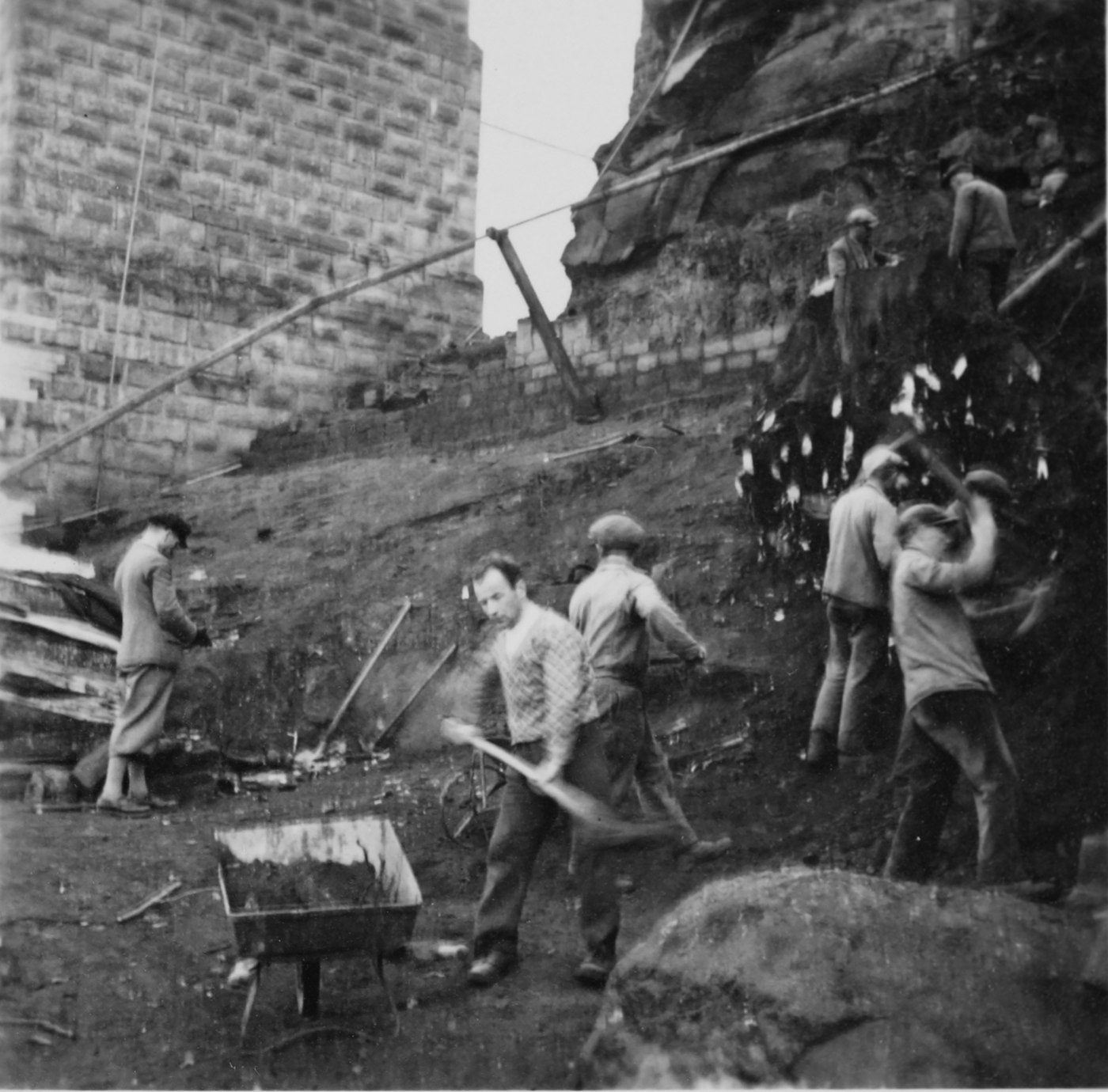
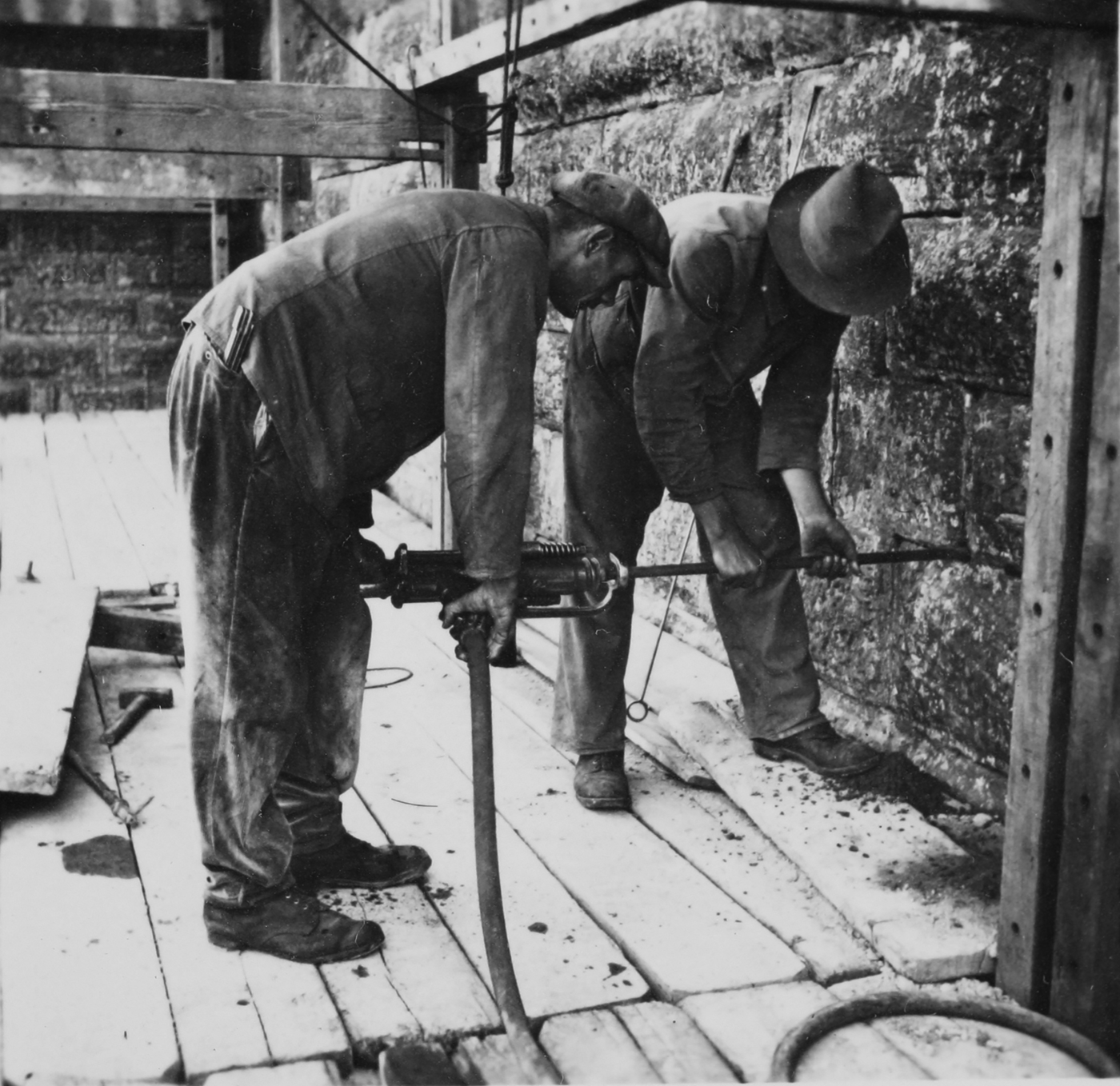
Since 1936, Siebert wanted the new construction of the Trifels castle to be the highlight of his program. The first step was the opening of Trifels Street on the occasion of the Annweiler Heimat Days in 1937. In April of that year, Georg Biundo, director of the museum, Friedrich Sprater, president of the History Association, and castle researcher Bodo Ebhardt began excavating the Trifels to explore the original extent of its masonry. [Fig. 3] After the castle was scientifically investigated, Rudolf Esterer began the new construction of the Trifels.Footnote 139 Esterer needed a team of construction workers because he planned to build a completely new and “modern” castle, including a two-story celebration hall for Nazi rituals to replace the original medieval great hall located in the castle's main building, and several smaller buildings with housing for “especially deserving young people of the Nazi movement.”Footnote 140 The renovation of the Trifels offered local masons, carpenters, construction workers, and Reichsarbeitsdienst (German Labor Service) workers the opportunity to earn good money. According to Esterer's völkisch architectural concept, the “spirit of the Hohenstaufen” should be resurrected by blood (local workers) and soil (local construction materials).Footnote 141 This was fortunate for the building enterprise Hoffmann & Söhne in Ludwigshafen, which received the construction contract. The company had to find blacksmiths who knew about medieval forms, as well as stonemasons, masons, and carpenters who were capable of breaking stones, building walls, and timbering roofs using medieval techniques.Footnote 142 [Fig. 4] Because local craftsmen profited from the Trifels project, local and regional agents unsurprisingly supported Siebert's cultural politics.Footnote 143 In fact, reports from the early 1930s by leaders of local Nazi groups reveal that one of the major reasons that farmers, workers, and members of the petit bourgeoisie voted for the NSDAP was the belief that they could profit from Nazi politics.Footnote 144
Workers excavating Trifels castle, 1937/1938. Source: LASp, X 3 Ü Nr. 339, Nr. 7.
Masons at the construction site of Trifels castle: constructing a medieval castle with modern means. Source: LASp, X 3 Ü Nr. 339, Nr. 106.
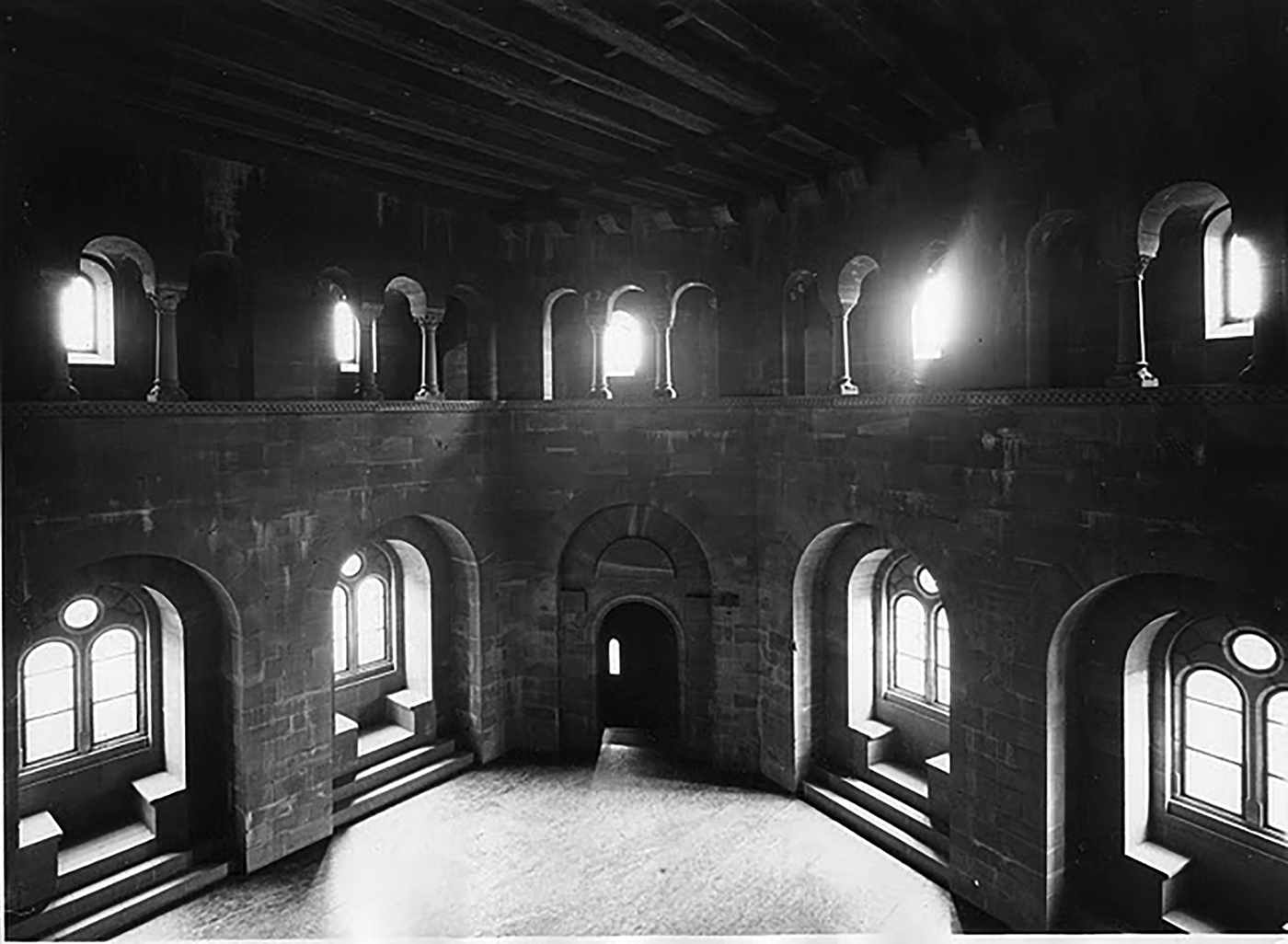
The project was very popular among the Nazi elite. Hitler supported the program with 400,000 RM and requested the construction of a youth hostel at the foot of the Trifels.Footnote 145 The construction of a youth hostel near or in a castle shows that Nazi cultural politicians used ideas that had become part of the popular culture of the Palatinate long before 1933. With the expansion of regional tourism through the creation of hiking trails and the restoration of ruins and castles, Siebert built on what Heimat and history associations had pursued since the early twentieth century.Footnote 146 Providing practical things that German tourists and locals could make use of was central to Nazi cultural politics, in fact. Such policies overlapped with concepts embraced by Esterer and the local Heimat and history associations concerning the revitalization of medieval castles, ruins, and villages to make them more useful for locals. According to Esterer, monuments should not function as sterile museums, but rather be used and experienced by the Volk. The construction of youth hostels in ruins and the use of castles for Nazi concerts, festivals, and theatrical productions reflected this concept.Footnote 147 In fact, the representative entrance hall Esterer built in the newly constructed Trifels castle was designed to enable Nazi politicians and ideologues to hold their celebrations there.Footnote 148 [Fig. 5]
The completed, two-storied celebration hall for Nazi rituals that replaced the original medieval great hall of the castle's main building. Source: HMP Speyer.
Not only did the Siebert program integrate local cultural memory into the ideological and cultural politics of the Nazi regime, but it also mediated between two seemingly contradictory developments in the Third Reich: modernization and anti-modernism. On the one hand, Nazi policy sought to restore values rather than create new ones, and campaigned against aesthetic modernism. On the other hand, elements of aesthetic modernism continued to exist in Nazi Germany, as in the overtly modernist industrial design of many consumer durables. Nazi politicians such as Robert Ley or Joseph Goebbels embraced American production methods, modern mass tourism, and elements of modern lifestyle more generally.Footnote 149
With the Siebert program, this paradoxical tension between modern and anti-modern elements in Nazi policy and ideology became apparent even in a small town like Annweiler. Siebert managed to combine the feudalist, reactionary, conservative anti-modernism maintained by many völkisch Nazi politicians, such as Alfred Rosenberg, with the more socialist-revolutionary and technological-progressive branch of the NSDAP, which wanted to modernize German society through a new and powerful Volksgemeinschaft. This tendency was made manifest in the Trifels project, which created jobs and increased tourism at the same time that it contributed to a reactionary cultural memory politics by using a medieval castle to symbolize the Third Reich.Footnote 150
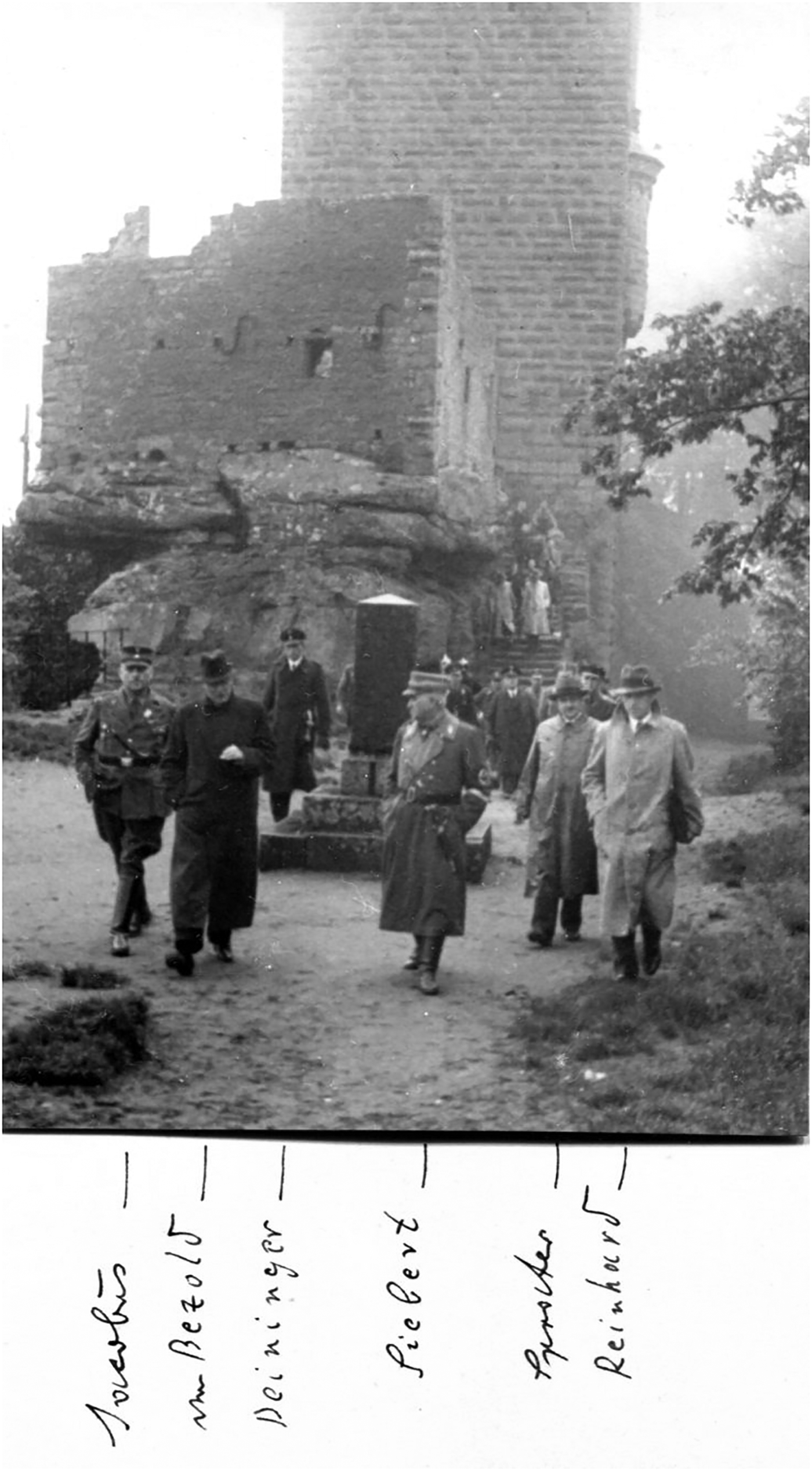
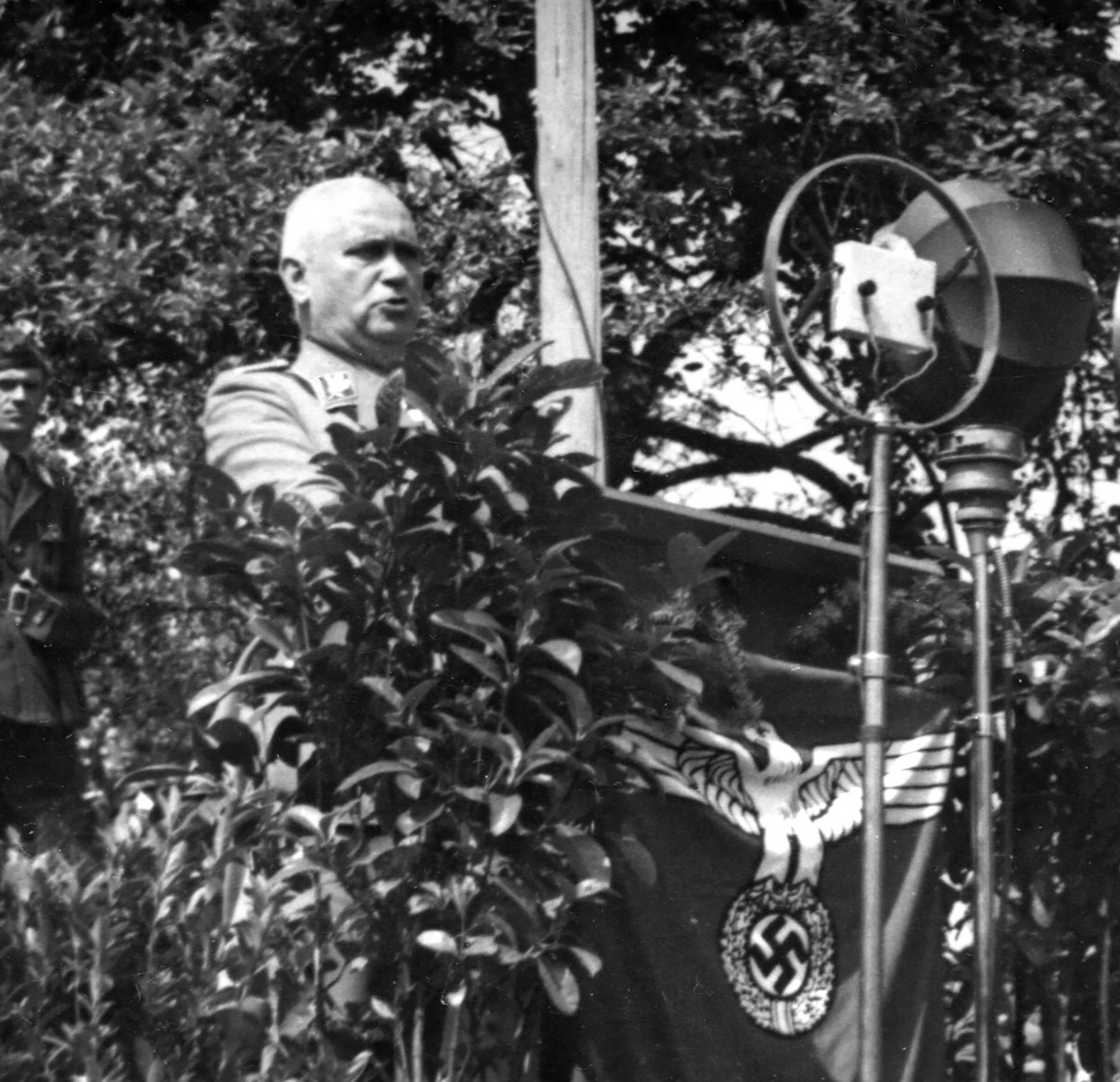
It was important for Siebert to advertise his program to the Nazi elite. To that end, he published an expensive and brilliantly designed book in 1941—which he dedicated to Hitler—that showcased all the successfully completed projects of his eponymous program.Footnote 151Reichsführer SS Heinrich Himmler congratulated Siebert personally in June 1941 and emphasized that “the Führer recently spoke very appreciatively about how much he likes your congenial and successful renovations” of German castles.Footnote 152 Siebert, Esterer, and others who participated in the cultural program paid close attention to public relations in other ways as well, publishing articles in newspapers and cultural journals about their work. [Figs. 6 and 7] Before the Nazis took power in Germany, Bürckel had already established a network of Nazi publishers and newspapers to control the local information system and the production of cultural identity, which accounts for the highly developed state of the Nazi media in the Palatinate.Footnote 153 Siebert made use of this extant media infrastructure to demonstrate to the German people the values of the Third Reich. Part of this strategy was to convince the populace that he was serious about these ideas—that his “great thoughts come from the heart,” as one journalist attested.Footnote 154
Ludwig Siebert with an entourage of local conservationists and politicians visiting the Trifels, 1937/1938. Source: Museum unterm Trifels.
Ludwig Siebert gives a speech at the Heimat Days of Annweiler, 1937. Source: Museum unterm Trifels.
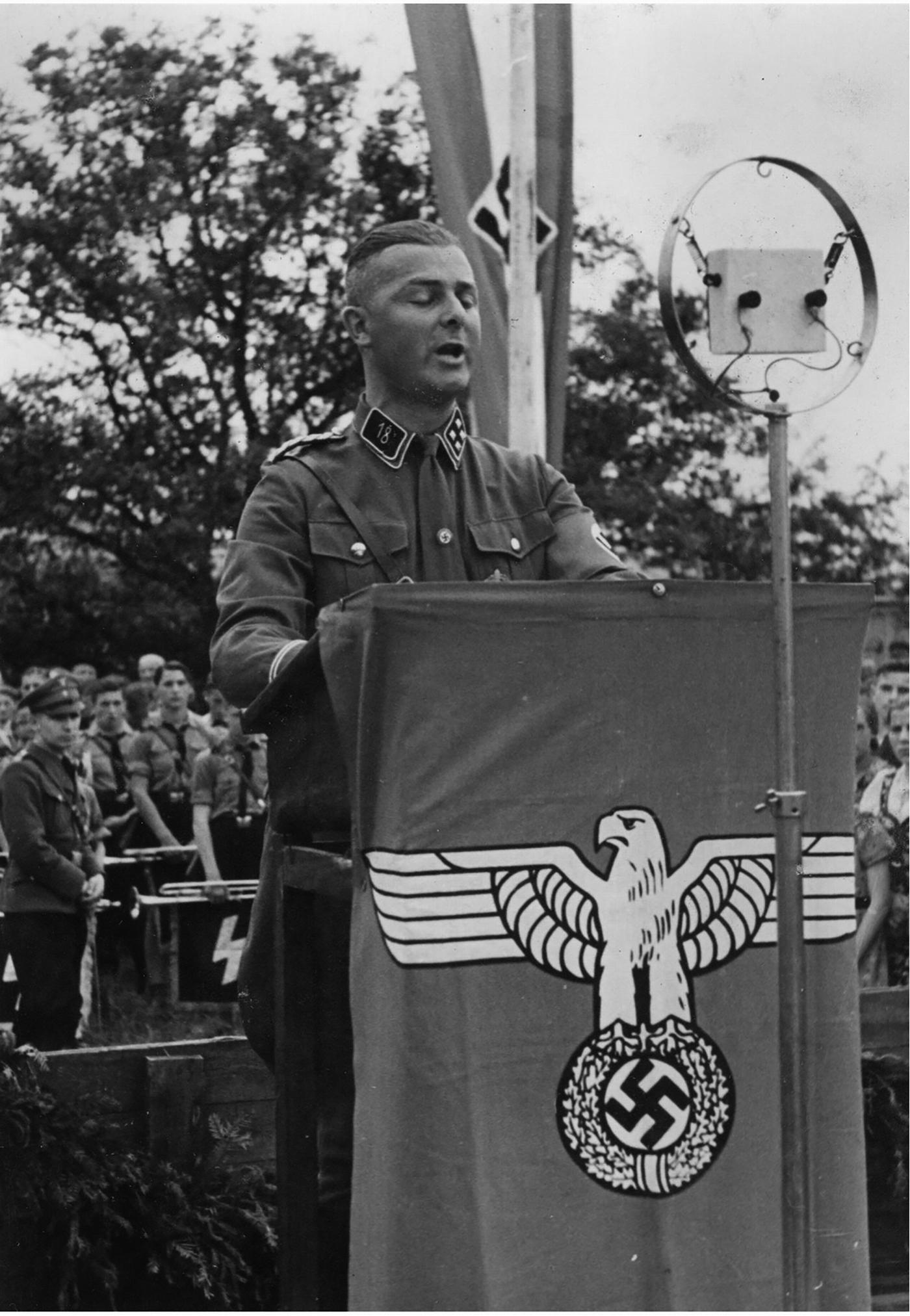
Siebert successfully capitalized on the growing popularity of tourism in the 1930s. In November 1937, the NSDAP Gauleitung in Saarpfalz reported that there was an “extraordinary increase in tourism” there.Footnote 155 The Trifels project was designed, in part, to encourage this trend. During the period in which the Trifels project was undertaken, from 1937 to 1938, local journalists promoted the culture of their Heimat town, focusing particularly on the Trifels project. Articles in the local paper indicated that the name Trifels had become a kind of metaphor for “national resurrection,” “German culture,” and “commitment to the Heimat.”Footnote 156 In a special appendix to the newspaper, reporters wrote about the latest activities concerning the excavation and building of the new castle, as well as the construction of Trifels Street and the Hohenstaufen Hall. Articles such as “In Service of Heimat and History,” which praised the commitment of Mayor Peters to Nazi cultural politics, created a positive image of the cultural projects sponsored by Siebert, Peters, and the Trifels Association, while conveying this idea to Annweiler residents.Footnote 157 One article, published on July 5, 1937, reported that the mayor had invited journalists from other Palatinate newspapers to see the newly created cultural attractions. The journalists especially appreciated Trifels Street and applauded Peters and the local Nazi officials for their efforts, it claimed. In turn, Annweiler residents connected pride in the beauty and high culture of their town with support for Nazi politicians such as Siebert and Peters.Footnote 158 [Fig. 8] In an article first published in another local newspaper, the Südpfälzer Tageblatt, one reporter claimed that even the residents of neighboring towns and villages appreciated how much Peters and Siebert had done for Annweiler and how much better the town now looked in contrast to the Weimar years.Footnote 159
Mayor Fritz Peters of Annweiler talks to the local Volksgemeinschaft during the Heimat Days. Source: Museum unterm Trifels.
Siebert and Peters were successful in promoting Annweiler and mobilizing residents for their aims in part because of their charisma and popularity among the town's citizens. Before his program was even implemented, the native-born Siebert had been very popular in the Palatinate in general and in Annweiler in particular.Footnote 160 When he visited the Palatinate in September 1933, one Annweiler newspaper reported that Siebert's car could hardly drive through the masses of people that had congregated in the town of Pirmasens, noting, “The exultation is indescribable.”Footnote 161 Fritz Peters—who was a Sturmbannführer of the SA beginning on April 1, 1933, led the Sturmbann II/18 Annweiler and the Sturmbann I/18 Landau, and served as assistant district leader of Landau before being elected mayor of Annweiler in September 1935—was even more popular in the town.Footnote 162 Peters became a strong supporter of the cultural politics of the lay associations in Annweiler.Footnote 163 In fact, he enthusiastically promoted the construction of Trifels Street and the new construction of the Trifels castle because he considered such plans to be essential for the resurrection of the Palatinate as an important region in the Nazi state.Footnote 164 Mayor Peters himself was a passionate Nazi activist who had initiated many projects to beautify his town, including the construction of the Hohenstaufen Hall as a new civic center that would provide a venue for Nazi celebrations and serve as a memorial for the fallen soldiers of World War I, the Ludwig Siebert Park at the foot of Trifels castle, renovations of several houses, and the decoration of public spaces.Footnote 165 As the local political leader, Peters was not only the official with whom Siebert had the most direct contact, but also the one who championed the Bavarian minister-president in Annweiler. He was also a close friend of Siebert and on good terms with Gauleiter Bürckel.Footnote 166 Peters cheered Siebert's plan to revitalize Trifels castle and other ruins in the Palatinate, and his bonds with the local populace gave Siebert an opportunity to integrate the local people into the vaunted Volksgemeinschaft.
Peters died in 1940.Footnote 167 In a memorial address held in the Hohenstaufen Hall on July 14, 1940, construction official Ecker eulogized Peters's politics, his personal charisma, and his connections to Annweiler citizens. “Who among us,” he asked the audience, “remains unmoved by the natural power of this personality, which transfixed everyone?” Peters's secret, according to Ecker, was his ability to find “the simplest and shortest way into the hearts of the people.” His deeds were everlasting “because they are rooted deep in the hearts of the people, and his decisions were right because they came from the heart, and his help was more than just financial.”Footnote 168 Peters was, for Ecker, an exemplar of the Nazi movement, who idealized the “immortal community of the Volk.” According to Ecker, his deeds represented an “enormous contribution to the constitution of the Volksgemeinschaft in the local districts, in the towns of Annweiler and Landau.”Footnote 169 Bearing in mind the subjectivity of such opinions, it should be noted that two contemporary witnesses remembered Peters as a good and honest man who helped where he could. They did not recall the repression of any locals, except for those who did not follow the rules of the Nazi regime. It is remarkable that these witnesses also claim that Peters strictly forbade any repression against and defamation of Jewish citizens.Footnote 170
Siebert's and Peters's popularity, coupled with the fact that the Trifels project was appreciated as a valuable cultural endeavor, assured the continued popularity of the Heimat concept after 1945, especially in the Palatinate.Footnote 171 Following the end of the Nazi regime and the establishment of a new political order, the concept was inverted, and came to mean for Pfälzers their resistance to Nazi cultural politics. As this suggests, Heimat was a “flexible, dynamic, and elastic” concept that could be used for various political and cultural purposes, including the representation of the German nation even after its complete bankruptcy.Footnote 172 Several Heimat associations in the Palatinate founded a committee in 1948 to complete the renovation of Trifels castle and, in 1955, they raised 500,000 deutschmarks for the project, which Rudolf Esterer finally completed in 1966. The Trifels subsequently became one of the most popular castles in West Germany.Footnote 173
Conclusion
At the end of 1932, the Nazis were “the only acceptable party for non-Marxist and non-Catholic voters, who constituted the majority of German voters.”Footnote 174 This was partly a result of Nazi aid programs and projects, and partly of propaganda and media strategies adopted by Nazi cultural politicians with a close connection to the local popular culture.Footnote 175 The Nazi regime was not all façade, but provided real opportunities for Germans who corresponded to Nazi ideals. In Annweiler, this meant an increase in local tourism, improved employment opportunities, and the renovation of monuments that local lay associations had long wanted to carry out. That is why it was more or less irrelevant whether local people were committed Nazis or not: the regime could function as long as they agreed sufficiently with its politics and profited enough to achieve higher material and social satisfaction than they had during the Weimar years. In many ways, Hitler did not need to use terror to earn the support of the German people, since he appealed to the desire of many Germans to reverse the terms of the Versailles Treaty, rebuild national strength, revitalize the economy, and reduce the political divisiveness of pluralistic democracy.Footnote 176 At the same time, the provision of “leisure, entertainments and patterns of consumption” could be used to “neutralize the political energy of the population and to satisfy the elemental human desire for fun and sociability.” The Siebert program was an example of “the ways which cultural values, activities and objects are used and given meaning by ordinary people for their own ends,” a mechanism that resulted in the establishment of a particular “Nazi conscience” and “consensus.”Footnote 177 Though the support of Annweiler residents for Nazi politics was strong, the local Volksgemeinschaft could nevertheless only be forged after the regime had disposed of its opponents.
The stabilization of the region during the Nazi regime was, in many respects, the result of a productive encounter of interests. Siebert made use of well-established and common elements of the Palatinate cultural memory, rearranging them to reflect more closely Nazi cultural politics. At the same time, the symbiotic relationship between Nazi politicians and various social groups resulted in an acceptance of Nazi politics in Annweiler. The successful creation of the Volksgemeinschaft in Annweiler was not only the result of this mutually profitable relationship, but was also a product of the charismatic personalities of certain National Socialist politicians. This was especially true in the case of Mayor Peters, who was highly esteemed locally, not only because he took seriously the Nazis' social endeavors to improve the lives of the German population, but also because locals considered him to be an “honest man.” People like Siebert and Peters were important for creating consensus and for mobilizing the people in the Palatinate for the aims of the regime. Testifying to Siebert's success is the fact that he was known in the Palatinate as a “good Nazi,” as someone who seriously wanted to reform German society and was not “corrupt.”Footnote 178 After the war, the local population remembered Siebert and Peters as Nazis who had had “good ideas,” but carried them out in a bad way—a widespread take on the Nazi past during the immediate postwar era.Footnote 179 In the late 1950s, a street in Rothenburg ob der Tauber was named after Siebert, a great patron who had preserved the town's medieval heritage.Footnote 180 The Trifels castle remains a major tourist attraction today and an important element of cultural identification for many Pfälzers.