




No CrossRef data available.
Decisions to adopt new technologies at the hospital level: Insights from Israeli medical centers
Published online by Cambridge University Press: 26 April 2005
Abstract
Objectives: New medical technologies have been identified as the leading cause of increasing health-care expenditures. Adoption of a new technology is one of the most important decisions in medical centers. The objectives of this study were to map and describe the function of hospital decision-makers within the area of new technology assessment and adoption, and to examine relevant considerations, sources of information, and decision-making processes in the adoption of a new technology.
Methods: A questionnaire was mailed to hospital executives and referred to (i) the considerations for and against adoption of a new technology, (ii) the decision-making process, (iii) information sources used in the decision-making process.
Results: The most frequent criteria favoring adoption included increased cost-effectiveness, increased efficacy, and decrease in complication rates. An increase in complication rates or side effects and decreased efficacy were the top ranked criteria against adoption. The final decision-making responsibility varied among technologies; the medical director frequently made the final decision when a new device was involved, but this responsibility decreased when a new drug or a new procedure was considered. Participation in scientific meetings, opinions of local experts, medical journals, and Food and Drug Administration clearance documents were the most important information sources used in the decision-making process. However, these were not necessarily the optimal sources of information. Significant barriers in adoption decision-making are lack of timely data regarding the safety of the new technology, its cost-effectiveness, and efficacy.
Conclusion: To improve the adoption decisions, hospitals must develop criteria upon which the decision-making will be based.
Keywords
Information
- Type
- GENERAL ESSAYS
- Information
- International Journal of Technology Assessment in Health Care , Volume 21 , Issue 2 , April 2005 , pp. 219 - 227
- Copyright
- © 2005 Cambridge University Press
Innovative medical technologies may dramatically improve patient outcomes but are also one of the leading causes of increasing health-care expenditures (11). In many cases, due to lack of budgets allocated for health technology assessment (HTA) and limited data on clinical efficacy and economic merit, assessments are available for decision-makers only after technologies have been adopted and widely used. The acquisition of new technologies and the determination of how and when they should be used are among the most important administrative decisions made in the health-care system in general and by hospital executives in particular, but only a limited number of studies describe the administrative decision making or strategic technology planning in hospital management (2;5;10;17;20–22).
The objectives of our study were to explore the decision-making process in adopting new technologies at the hospital level. We were interested in assessing how accurately theoretical models describing hospitals' behavior are reflected in “real world” decisions. We were particularly interested in understanding the actual considerations that impact the adoption decisions in various technologies, the information used for this process, and barriers for optimal decision making. We first describe briefly the Israeli health-care system, its regulation of medical technology, and provide a conceptual framework to explain decision making in adopting and using new technologies at the hospital level.
ISRAELI HEALTH-CARE SYSTEM AND REGULATION OF MEDICAL TECHNOLOGY
In this section, we summarize the main principles of the Israeli health-care system. For a comprehensive description, please refer to Rosen B. in Thomson S, Mossialos E. (ed.) Health care systems in transition: Israel (Copenhagen, European Observatory on Health Care Systems, 5(1), 2003).
The Israeli health-care system is a semipublic system, largely controlled by the Ministry of Health (MOH) and the country's four not-for-profit health plans (HMOs). In addition to its ministerial responsibilities, the MOH also plays a major role in direct provision of care and it owns and operates almost half of the nation's acute hospital beds.
The largest health plan, Clalit Health Services (Clalit), is responsible for care provision to 55 percent of the population and owns and operates one third of the acute hospital beds. Approximately 5 percent of acute hospital beds are in private for-profit hospitals, and the remaining acute beds are in small church-affiliated hospitals and other voluntary nonprofit hospitals that operate as semipublic facilities.
The National Health Insurance Law (NHIL) enacted in 1995 has made health insurance both compulsory and universal. Health plans are obliged to ensure that their members have access to a benefit package specified by the law. The NHIL determined a basic mandatory National List of Health Services (NLHS), which is meant to guarantee an appropriate level of health care to all citizens. Each year, as part of the annual budgeting process, the government determines if and how much money will be allocated to fund new technologies. A public committee appointed by the minister of health is responsible for the evaluation of new technologies based on the analysis performed by the Medical Technologies Administration in the MOH and recommends which technologies will be added to the NLHS (15;16). These recommendations are based on an assessment and prioritization process and consider social, ethical, and legal aspects. However, because coverage decisions have to be made within a short time period, most assessments do not include a comprehensive HTA or primary cost-effectiveness or benefit-cost analyses. Whereas health plans are obliged to provide services as determined by the NLHS, no parallel “technology basket” is determined for hospitals, and the acquisition of new technology is often made at the individual hospital level.
In Israel, similar to other Western countries, there is a monitoring mechanism for the use of drugs and medical devices, and acquisition of capital-intensive technologies require MOH approval. However, there is almost no control of medical procedures, and the decisions to use one technology or another are usually made at the hospital level.
DECISION MAKING AND CRITERIA FOR ACQUISITION OF NEW TECHNOLOGY: A CONCEPTUAL FRAMEWORK
Technology adoption decisions in hospitals may occur through planned acquisitions or through uncontrolled changes in medical practice. They reflect a complex set of dynamics and incentives (9). Several theories have been suggested to describe hospital behavior and adoption of new technology, yet none of these perspectives alone has been able to satisfactorily explain technology adoption decisions (20).
The first set of models known as the profit-maximization model (4), price competition model (13), or the fiscal-managerial system (7) use traditional economic theory to explain hospital behavior. This approach assumes that hospitals evaluate new technologies from the perspective of hospital profitability, and technologies are acquired when the expected present value of revenues exceeds the expected cost over the useful lifetime of the product, offering a profitable return on investment. A hospital's motivation for profit-maximization is common for both hospitals operating on a commercial and nonprofit basis, the latter acting as though they were for-profit entities, returning their “profits” to the community.
The second perspective known as the technology competition model (1), technological preeminence (20), or the strategic-institutional approach (7) derives from three different theories of hospital behavior: the sales maximization theory (hospitals want to be the largest), the conspicuous consumption theory (hospitals want to show that they are the most technologically advanced), and the physician cooperative theory (hospitals will acquire technology that maximizes physician income) (1). According to this theory, hospitals adopt capital-intensive technologies unrelated to their cost to achieve technological superiority, to enhance their image and prestige as leaders in the technological realm, attracting patients, physicians, and researchers. To obtain a competitive advantage over other hospitals, it is desirable to be the first to acquire a new technology or to demonstrate proficiency with a new medical procedure (1). Nevertheless, hospital managers may occasionally decide to invest in money-losing operations that can increase the hospital's visibility and attract “profit-making” patients for other parts of the hospital (2).
According to the utility-maximization model, hospital managers invest in technology, subject to budget constraints, to enhance the quality and quantity of services the hospital provides (1). The medical-individualistic perspective (7) focuses on delivery of services according to the definition and demands of physicians and hospital medical administrations. This prospect is based on fundamental assumptions that the physicians and the hospital adopt new technologies based on the clinical needs of the population they serve, even if fiscal considerations, competition, or calculation of hospital prestige suggest alternative actions. On the contrary, hospitals will not adopt a technology, even if it is prestigious or highly profitable, if patients cannot derive significant benefits from it.
METHODS
Study Population
The study population consisted of representatives from twenty-six acute care hospitals. We asked each hospital to provide a list of hospital executives who may be involved in decisions to acquire new technologies and compiled a list of 132 executives that consisted of three main subgroups: medical directors and associate medical directors (n = 75), administrative directors (e.g., financial officers, directors of hospital logistics; n = 39), and hospital chief nurses (n = 18). We excluded very small hospitals (mainly church-affiliated charity hospitals), as well as one larger hospital that did not provide a list of executives.
Data Collection
A questionnaire was mailed to the list of executives with a personally addressed letter explaining the purpose of the study. A follow-up mailing was sent 3 weeks later.
Development and Design of the Survey Instrument
The survey questionnaire was developed after exploratory interviews with hospital directors. The design and results of this study are presented elsewhere (6). In brief, we conducted a comprehensive literature review of studies presenting decision-making strategies for assessment and adoption of new technologies, as well as in-depth interviews with decision-makers at different levels of the health-care system. Hospital directors were asked to indicate the relevance of prespecified criteria in the decision-making process regarding the adoption of new technologies. Based on this pilot study and other studies (12;18;19) , our questionnaire consisted of four main parts:
- Considerations in Favor of and Against the Adoption of a New Technology. We compiled a list of thirty-four possible considerations used in technology adoption decision making. This list included the following: Clinical considerations and implications (e.g., efficacy); Impact on the hospital's profitability and other economic considerations (e.g., cost-effectiveness, hospital's profits); The need for personnel training; Available information on the considered technology (e.g., results from clinical trials); Regulatory considerations (e.g., Food and Drug Administration and MOH approval); Influence on the hospital capacity and resource utilization; Prestige and competition among hospitals; Pressures exerted inside and outside the hospitals (e.g., senior physicians, technology suppliers, patients). Hospital executives were asked to rank-order the top five considerations they would use in favor and the top five against the adoption of a new technology. Considerations were listed as complimentary pairs where appropriate, to avoid biasing the list of considerations in favor or against adoption decisions. For example, the complimentary clinical considerations specific to clinical efficacy were listed separately as “the new technology is less invasive than an existing technology” and second as “the new technology is more invasive than an existing technology.”
- Decision-Making Process. Respondents were asked, for each type of technology (medical devices, medical procedures, drugs), to specify the decision-making responsibilities of different members of their hospital management. We also asked respondents about their opinion on the preferred decision-making mechanism (i.e., who should be responsible for the final decision).
- Sources of Information Used in the Decision-Making Process. Respondents were asked to rank-order the most important sources of information used, and the optimal sources to be used in the decision-making process. We were interested in the types of evidence currently used and the importance decision-makers place on each type of evidence. Decision-makers were also asked to state the potential barriers to rational decision making.
- Respondent Characteristics. We asked specific questions regarding their managerial experience, their medical background and specialty, and their training and experience in health administration, health policy, and HTA.
Statistical Analysis
Data collected are reported as frequencies or proportion of respondents. Differences in proportions were estimated, when possible, using a chi-square test. A p value <.05 was considered statistically significant for all analyses.
RESULTS
Response Rate and Characteristics of Respondents
We received responses from twenty-four of the twenty-six hospitals (92 percent) and 61 of the 132 questionnaires sent out (46 percent). Several hospital executives indicated that they were not involved in technology acquisition decision making and, therefore, were unable to answer the questionnaire. In some hospitals, only one representative of the medical management completed the questionnaire. Respondents with a title of medical director (hospital's general director, chief medical director, or associate medical director), completed over two thirds of the questionnaires, 25 percent were completed by respondents with administrative responsibility, and only 8 percent were completed by hospital chief nurses. There were no significant differences in response rates by hospital type or size; however, the response rate among medical directors tended to be higher compared with administrative directors and directors of nursing services (p=.06). All respondents except one had academic training, and the vast majority (68 percent) had advanced training in management or health administration. Only 10 (16 percent) of the respondents indicated that they had some training in HTA or technology policy (most of which was acquired through informal training or during their graduate program studies).
Considerations in Favor of and Against Adopting New Technologies
The most frequently listed consideration in favor of adopting a new technology was increased cost-effectiveness compared with another technology (listed by 58 percent of respondents), increased efficacy (55 percent), and potential decrease in complication rates (45 percent) (Figure 1). Only a few respondents indicated that pressures exerted by patients or the general public may influence the decision-making process (data not shown). The most frequent considerations against adoption were increased complication rates (64 percent), increased side-effects (59 percent), decreased efficacy compared with an existing technology, and decreased cost-effectiveness (57 percent) (Figure 2).

Extent to which hospital executives listed considerations as one of the five most important in favor of adoption of new technology.
The Decision-Making Process
Respondents were asked to describe the decision-making process in adopting medical devices, medical procedures, and drugs. The vast majority of respondents (79 percent) suggested that directors of medical units and senior physicians are the first initiators and supporters of a new technology or are involved in such an initiative. The actual decision-making responsibility differs by the type of technology (Table 1); the medical director is the most dominant role-player when a new device is considered. In some hospitals, decisions are made by ad-hoc committees primarily composed by medical directors, senior physicians, administrative and financial directors, and representative from other disciplines, when needed.


The decision to include a new drug in the hospital's drug formulary is usually made by a committee, which typically includes the medical directors, senior physicians, and the chief hospital pharmacist. When a new medical procedure that does not involve capital investment or increased treatment costs is considered, heads of medical wards or division chiefs are more frequently responsible for the adoption decision. The medical director or a committee is involved in such a decision when the new procedure requires special resources or may increase resource utilization. In this case, the final decision is made after negotiations between the head of the medical ward or the division chief and the hospital's medical directorship.
In a follow-up question, we asked respondents to indicate who should optimally be responsible for making the final adoption decision. Most respondents believe that regardless of the type of technology, the final decision should be the responsibility of the medical director or a committee.
Sources of Information Used in the Decision-Making Process
We asked respondents to list the actual and optimal sources of information used when reviewing a new technology and making adoption decisions. We determined the frequency that each source of information was actually used or judged to be optimal. Overall, the three most frequently stated sources of information were recommendations of local experts in a specific medical field (54 percent), participation in scientific conferences and meetings (48 percent), and leading general medical journals (48 percent) (Figure 3). However, hospital managers stated that these sources of information should be used less often than they actually had been and that specialized medical journals and opinion of international leaders in a specific field should be used more frequently.

Percentage of hospital executives listing each source of information as actual and optimal source when making adoption decisions.
We also assessed the importance of each information source according to its ranking. Respondents were asked to rank-order five sources of information used and five optimal sources (the most important source was assigned a value of 5 and the least important a value of 1). The summary of these results is presented in Table 2.

Extent to which hospital executives listed considerations as one ofthe five most important against adoption of new technology.
Overall, almost all managers (94 percent) listed evidence from randomized controlled clinical trials (RCTs) as important evidence for the decision-making process; large prospective studies were ranked next (91 percent), followed by results of meta-analyses (75 percent). Most respondents did not consider results from case reports and nonrandomized clinical trials sufficient evidence. In addition, only data from RCTs were viewed as sufficient to be used alone by the majority of respondents when making adoption decisions. Results from prospective studies and meta-analyses were viewed as adequate when used in conjunction with evidence from a different source.
Barriers to Making Optimal Adoption Decisions
The lack of timely information is considered one of the most important barriers to an optimal decision-making process. Hospital managers consider the lack of information regarding the safety, the cost-effectiveness and the clinical efficacy as the most important barriers. Other considerations (e.g., legal and administrative barriers inside the hospital) were mentioned infrequently.
DISCUSSION
Medical advances are responsible for a substantial part of the increase in health-care spending and, therefore, are subject to studies to determine whether the use of new technology is “worth the additional cost” (3). In an era of budget constraints, decision-makers are often forced to make timely decisions regarding the adoption and utilization of new technologies, before there is definitive evidence regarding their clinical efficacy and economic merit. Thus, hospitals have to develop their individual set of decision criteria for strategic technology planning with respect to their particular environment (5).
The decision process to adopt new technologies at the national level in Israel has been described previously (14–16). However, the present study is the first attempt to explore and provide a framework to understanding technology adoption decisions at the hospital level.
The Decision-Making Process
The first initiative to use new technology comes in most cases from senior physicians, but the responsibility for the final decision to implement it varies by its nature. When acquiring a new technology involves large capital investments, the authority to make the final acquisition decision is usually given to the hospital's senior executives (medical director or associate medical director). The final decision may also be made by ad hoc committees comprised, in addition to the medical director, from representatives of the nonclinical management, and the chief of the relevant medical division. When a new procedure is assessed, the chief of a medical ward is more frequently authorized to make adoption decisions. However, when the proposed procedure may involve immediate capital investments or high operating costs, the decision has to be approved by the hospital's senior management. Our findings are similar to findings in other health-care systems. A survey carried out among senior administrators at twelve university hospitals in the United States reported that the decision-making process was political, informal, or carried out ad hoc (21).
Participants in our survey asserted that the decision-making process should become more centralized and the responsibility of the medical director should increase. This profound desire is specifically relevant when a new device is involved and less so for other types of technologies. In a similar study, Steiner and colleagues (18) found that the medical director made the final coverage decision for a new medical technology in 27 percent of health plans. However, 76 percent of respondents suggested that a committee should optimally be responsible for final decisions. These differences may be partially explained by the different nature of the two health-care systems and the differences in the health organizations examined (i.e., hospitals vs. health plans).
Factors Affecting Hospital Executives' Decision Making
An insight into the factors that influence technology adoption decisions can be gained from analyzing the important considerations for and against adoption of new technology. Clinical considerations and economic merit appear to dominate the decision-making process. Thus, our study suggests that hospitals act as their customers' agents and will adopt technologies based on clinical needs of the population they serve, supporting the medical individualistic theory (7).
According to the profit-maximization theory of hospital behavior, both for-profit and not-for-profit hospitals would try to minimize their costs and invest only in projects and new technologies that would offer a profitable return. If these were the main motivations for hospital behavior, one would suggest that economic considerations would be the most important factors considered in the decision-making process. However, the view that financial considerations, hospital competition, and prestige enhancement predominate hospital behavior is not supported by our study findings. Several other studies have explored the considerations that influence technology adoption at the hospital. Griner (9) suggested that these factors include capital financing, hospital payment methods, degree of regulation, degree of competition, hospital capacity, evidence of effectiveness, organizational arrangements, and the decision-making process. According to a survey of health-care managers, the following criteria were rated as “very important” by more than half of them: the ability to expand or enhance services (85 percent), receipt of a return on investment (71 percent), and the ability to reduce operating costs (67 percent). The enhanced image of the hospital (47 percent) and medical staff pressures (43 percent) were cited less frequently (2). Of interest, our study supports the findings of a similar study conducted among health plan decision-makers in the United States that found that four of the five most important considerations in favor of coverage decisions relate to clinical or cost-effectiveness factors (19).
Information Used and Barriers to Optimal Decision Making
One of the most important issues in the discussion of adoption and diffusion of a new technology is the communication channel (the means by which messages are disseminated from one individual or one organization to another) (13). Although numerous studies have studied the communication channels at the physician level, only few studies have addressed issues relating to the sources and type of information used at the organizational (e.g., hospital) level. The variety of information sources used to assess the merit of a new technology is remarkable, but the opinion of local experts, participation in medical conferences and meeting, and leading medical journals have been used by approximately half of the decision-makers. One possible explanation of these findings is that, because of the lag in both research and publication of assessment results, these data are not available for decision-makers when adoption decisions are made. Study results are usually presented in major medical conferences and disseminated to experts in the specific medical field before their publication in peer-reviewed journals. Moreover, participation in meetings, and advice from local experts, perceived as opinion-leaders, allow interpersonal communication channels that involve a face-to-face direct data exchange that is usually considered more informative and effective in persuading an individual to adopt an innovation (13). In our study, decision-makers expressed a strong preference to use more information presented in medical journal and stated that they do not desire to use data provided by the industry or health plans. These findings are noteworthy because, in a study by Greer (8), physicians stated that they do not place total confidence in the scientific literature. Early studies examining the efficacy of new technologies are frequently sponsored by the pharmaceutical and medical device industry, may be subject to publication bias, and usually do not provide decision-makers with sufficient information.
There was an agreement among decision-makers regarding the quality of evidence from different types of studies. Randomized controlled trials and prospective cohort studies were ranked highest in the evidence hierarchy. These results are comparable to views of health plan decision-makers in the United States (19).
Decision-makers in our study emphasized that the most important barriers to optimal decision making relate to the unavailability of timely data on safety, cost-effectiveness and efficacy for the considered technology. On the other hand, decision-makers do not perceive legal or administrative barriers inside and outside the organization to impact the decision-making process. These findings, which are comparable with other studies (19), and the lack of relevant and timely data were frequently mentioned as the reason why cost-effectiveness data are frequently not used in hospital pharmacy decisions (17).
Study Limitations
Our study has several limitations. First, the response rate to our survey was 46 percent, causing a potential response bias that may affect the validity of our study results. However, this response rate is typical for studies of this type (18;19), and we received responses from representatives of the vast majority of hospitals. Moreover, we did not find significant differences in response rates according to hospital main characteristics. Only hospital chief nurses were underrepresented in our study. However, our data suggests that it is most likely that executives not involved in technology acquisition were the ones who did not respond to our survey. Second, our study promised absolute respondents' anonymity, but we were aware of the respondent name, title, and organization. Therefore, respondent reports on the questionnaire may not adequately describe what they actually did, or believe, and their responses may have been influenced by social desirability. This methodological issue is common to all survey research, however.
Policy Implications
Our study provides important insights into the decision-making process and the considerations used in technology adoption decisions. Adoption decisions have to be made about a technology with questionable efficacy and economic merit and often before adequate information is available for decision-makers. Given this typical decision-making situation, we propose to establish a structured decision-making mechanism based on predefined criteria (including clinical, epidemiological, and financial) that have to be satisfied before consideration of a new technology is made. The evaluation and adoption decision process should include experts from different disciplines. We are aware that this process may be time-consuming, but it will result in a more evidence-based and rational decision process. In addition, our study suggests that decision-makers in Israel have only limited training in areas of health economics, HTA, and decision making. These may limit their ability to truly understand the nature of the technology and the immediate and future implications of their adoption decisions. We strongly recommend that hospital executives who may be involved in technology policy undergo some training in the above-mentioned fields. Finally, our study suggests that the type of technology considered is linked to the level of responsibility in adoption decisions and suggests that different decision-makers may use different sources of information and processes when making these decisions. Further research is needed to highlight this possible link and the influence of medical department heads on technology adoption and utilization decisions.
CONTACT INFORMATION
Dan Greenberg, PhD (dangr@bgu.ac.il), Senior Lecturer, Yitzhak Peterburg, MD, DrPH (Yitzhakpe@cellcom.co.il), Department of Health Systems Management, Ben-Gurion University of the Negev, P.O. Box 653, Beer-Sheva 84105, Israel
Daniel Vekstein, PhD (veks@bgumail.bgu.ac.il), Senior Lecturer, Department of Management, Achva Academic College, D.N. Shekmim 79800, Israel
Joseph S. Pliskin, PhD (jpliskin@bgu.ac.il), Professor, Departments of Industrial Engineering & Management and Health Systems Management, Ben-Gurion University of the Negev, P.O. Box 653, Beer-Sheva 84105, Israel
This study was supported by a research grant from the Israeli National Institute for Health Policy and Health Services Research.
References
Anderson GF,
Steinberg EP.
1994:
Role of the hospital in acquisition of technology.
In: Holly VD, ed.
Adopting new medical technology.
Washington DC:
National Academy Press;
61–
70.
Anderson HJ.
1990
Survey identifies trends in equipment acquisitions.
Hospitals.
64:
30, 32–
35.Google Scholar
Cutler DM,
McClellan M.
2001
Is technological change in medicine worth it?
Health Aff (Millwood).
20:
11–
29.Google Scholar
Feldstein PJ.
1999.
Health care economics.
5th ed.
New York:
Delmer Publishers;
Focke A,
Stummer C.
2003
Strategic technology planning in hospital management.
OR Spectrum.
25:
161–
182.Google Scholar
Greenberg D,
Pliskin JS,
Peterburg Y.
2003
Decision making in acquiring medical technologies in Israeli medical centers: A preliminary study.
Int J Technol Assess Health Care.
19:
194–
201.Google Scholar
Greer AL.
1985
Adoption of medical technology. The hospital's three decision systems.
Int J Technol Assess Health Care.
1:
669–
680.Google Scholar
Greer AL.
1988
The state of the art versus the state of the science. The diffusion of new medical technologies into practice.
Int J Technol Assess Health Care.
4:
5–
26.Google Scholar
Griner PF.
New technology adoption in the hospital.
1992:
In: Gelijns AC, ed.
Technology and health care in an era of limits.
Washington DC:
National Academy Press;
123–
132.
Menon D,
Marshall D.
1990
Technology assessment in teaching hospitals.
Dimens Health Serv.
67:
26–
28.Google Scholar
Newhouse JP.
1993
An iconoclastic view of health cost containment.
Health Aff (Millwood).
12:
152–
171.Google Scholar
Poulsen PB,
Adamsen S,
Vondeling H,
Jorgensen T.
1998
Diffusion of laparoscopic technologies in Denmark.
Health Policy.
45:
149–
167.Google Scholar
Rogers EM.
1995.
Diffusion of innovations.
4th ed.
New York:
The Free Press;
Rosen B.
2003.
Health care systems in transition: Israel.
In: Mossialos E, ed.
Copenhagen:
European Observatory on Health Care Systems;
Shani S,
Siebzehner MI,
Luxenburg O,
Shemer J.
2000
Setting priorities for the adoption of health technologies on a national level—the Israeli experience.
Health Policy.
54:
169–
185.Google Scholar
Shemer J,
Morginstin T,
Hammerman A,
Luxenburg O,
Shani S.
2003
[Promoting medical technologies in the national list of health services: 1995-2000].
Harefuah.
142:
82–
86.Google Scholar
Sloan FA,
Whetten-Goldstein K,
Wilson A.
1997
Hospital pharmacy decisions, cost containment, and the use of cost-effectiveness analysis.
Soc Sci Med.
45:
523–
533.Google Scholar
Steiner CA,
Powe NR,
Anderson GF,
Das A.
1996
The review process used by US health care plans to evaluate new medical technology for coverage.
J Gen Intern Med.
11:
294–
302.Google Scholar
Steiner CA,
Powe NR,
Anderson GF,
Das A.
1997
Technology coverage decisions by health care plans and considerations by medical directors.
Med Care.
35:
472–
489.Google Scholar
Teplensky JD,
Pauly MV,
Kimberly JR,
Hillman AL,
Schwartz JS.
1995
Hospital adoption of medical technology: An empirical test of alternative models.
Health Serv Res.
30:
437–
465.Google Scholar
Weingart SN.
1993
Acquiring advanced technology. Decision-making strategies at twelve medical centers.
Int J Technol Assess Health Care.
9:
530–
538.Google Scholar
Weingart SN.
1995
Deciding to buy expensive technology. The case of biliary lithotripsy.
Int J Technol Assess Health Care.
11:
301–
315.Google Scholar
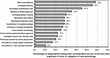
Extent to which hospital executives listed considerations as one of the five most important in favor of adoption of new technology.
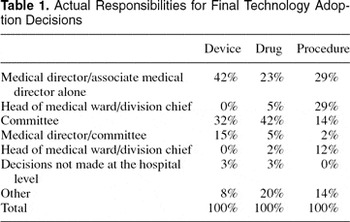
Actual Responsibilities for Final Technology Adoption Decisions
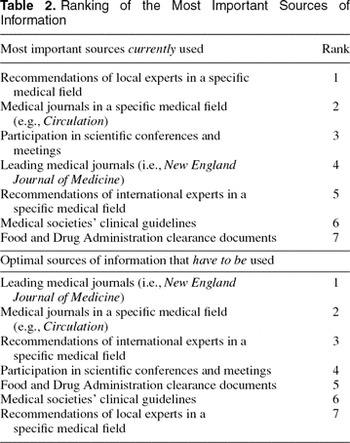
Ranking of the Most Important Sources of Information
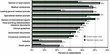
Percentage of hospital executives listing each source of information as actual and optimal source when making adoption decisions.
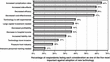
Extent to which hospital executives listed considerations as one ofthe five most important against adoption of new technology.
 You have
Access
- 32
- Cited by