Introduction
In the United States, cancer remains the second leading cause of death among youth 1–14 years of age (Siegel et al., Reference Siegel, Miller and Fuchs2022). Of approximately 15,950 new cancer diagnoses among youth under the age of 19 each year, there are nearly 1,600 cancer deaths expected (Siegel et al., Reference Siegel, Miller and Fuchs2022). The death of a child is an extremely painful event that affects parents, siblings, and other surviving family members for years (Jonas et al., Reference Jonas, Scanlon and Rusch2018). These negative effects on long-term functioning indicate a need for early and ongoing support for bereaved families (Rosenberg et al., Reference Rosenberg, Postier and Osenga2015; Pohlkamp et al., Reference Pohlkamp, Kreicbergs and Sveen2019). However, families often prefer personalized bereavement services and may face barriers to accessing these resources (Lichtenthal et al., Reference Lichtenthal, Corner and Sweeney2015a; Aoun et al., Reference Aoun, Rumbold and Howting2017). Unfortunately, limited research has identified factors related to the use of different services after the death of a child and their impact on adjustment.
A parent's grief journey is complex and stressful, with many parents beginning to grieve their child's impending death at the time of a life-threatening diagnosis (Higgs et al., Reference Higgs, McClaren and Sahhar2016; Snaman et al., Reference Snaman, Kaye and Torres2016). Bereaved parents often experience prolonged grief, in addition to high levels of depression, post-traumatic stress, insomnia, and separation distress (McCarthy et al., Reference McCarthy, Clarke and Ting2010; Pohlkamp et al., Reference Pohlkamp, Kreicbergs and Sveen2019). Although these symptoms vary in intensity over time, parental difficulties after the death of a child can persist for years (Kreicbergs et al., Reference Kreicbergs, Lannen and Onelov2007; Pohlkamp et al., Reference Pohlkamp, Kreicbergs and Sveen2019). Throughout the grieving process, parents experience fluctuations in emotions, including sadness, anger, guilt, and yearning for the deceased (Gilmer et al., Reference Gilmer, Foster and Vannatta2012; Zetumer et al., Reference Zetumer, Young and Shear2015; Jonas et al., Reference Jonas, Scanlon and Rusch2018). Bereaved parents also commonly experience changes in relationships with family members and social networks (Barrera et al., Reference Barrera, O'Connor and D'Agostino2009; Gilmer et al., Reference Gilmer, Foster and Vannatta2012). Some parents describe unstable relationships with their partners due to an inability to understand each other's expressions of grief (Barrera et al., Reference Barrera, O'Connor and D'Agostino2009). Within broader social networks, parents reported feeling the absence of social support or the inability to find comfort in the support they were receiving (O'Connor and Barrera, Reference O'Connor and Barrera2014).
Due to the significance of sibling bonds, which are uniquely characterized by siblings’ connected identities and long-lasting relationships (Packman et al., Reference Packman, Horsley and Davies2006), the bereavement experience can also be distressing for healthy siblings (Bolton et al., Reference Bolton, Au and Chateau2016). Although studies show that behavioral outcomes for bereaved siblings are within normal limits (Greenwald et al., Reference Greenwald, Barrera and Neville2017; Hoffmann et al., Reference Hoffmann, Kaiser and Kersting2018), some suggest elevated internalizing and externalizing problems. McDonald et al. (Reference McDonald, Patterson and Tindle2020) found that high levels of unmet needs (e.g., lack of support from peers, information, recreation) were associated with increased psychological distress in adolescent and young adult (AYA) bereaved siblings. Moreover, research shows that bereaved siblings report higher levels of anxiety and distress in the long-term if they felt unsatisfied with communication from parents and/or healthcare providers (Rosenberg et al., Reference Rosenberg, Postier and Osenga2015; Lövgren et al., Reference Lövgren, Jalmsell and Eilegård Wallin2016; Wallin et al., Reference Wallin, Steineck and Nyberg2016). In one of the few controlled studies, Howard Sharp et al. (Reference Howard Sharp, Meadows and Keim2020) found that bereaved siblings had elevated externalizing problems relative to matched peers, however average scores were still within normal limits. Similarly, other studies show that bereaved siblings report an increase in risky behaviors, such as the use of alcohol and illegal drugs (Barrera et al., Reference Barrera, Alam and D'Agostino2013; Rosenberg et al., Reference Rosenberg, Postier and Osenga2015; Bolton et al., Reference Bolton, Au and Chateau2016).
The actions of healthcare providers before and after the death of a child, such as follow-up calls and offering psychosocial support, can be important in the family adjustment process (Kreicbergs et al., Reference Kreicbergs, Lannen and Onelov2007; Lichtenthal et al., Reference Lichtenthal, Sweeney and Roberts2015b; Stevenson et al., Reference Stevenson, Achille and Liben2017). For example, the introduction of psychosocial support in conjunction with palliative care services can help alleviate the family's long-term grief (Kreicbergs et al., Reference Kreicbergs, Lannen and Onelov2007; Donovan et al., Reference Donovan, Wakefield and Russell2015). However, psychosocial service use remains low among bereaved family members that experience heightened distress. Lichtenthal and colleagues found that although half of bereaved parents expressed a desire for support services, 40% did not receive any services (Lichtenthal et al., Reference Lichtenthal, Corner and Sweeney2015a). Additionally, findings from a bereaved community sample in Australia showed that individuals at high risk for grief-related issues (including those bereaved by the death of a child) felt they did not receive enough support services (Aoun et al., Reference Aoun, Breen and Howting2015). Research shows that even when psychological and psychiatric services are offered at the family's medical institution, few parents utilized these services (Sedig et al., Reference Sedig, Spruit and Paul2020). These parents also underutilized outside services, such as support groups, despite reporting that they would be helpful (Sedig et al., Reference Sedig, Spruit and Paul2020). Many bereaved siblings may feel they lack support from peers with similar experiences, indicating a need for illness-specific support, such as bereavement camps, to help meet these needs (McDonald et al., Reference McDonald, Patterson and Tindle2020).
These findings highlight the important role that healthcare providers play in communicating information about available support services, even before the death occurs. However, the availability, type, and quality of psychosocial services, especially in pediatric oncology, varies widely across institutions (Steele et al., Reference Steele, Mullins and Mullins2015). Evidence supports the provision of psychosocial care throughout the illness trajectory as a standard of care in pediatric oncology (Steele et al., Reference Steele, Mullins and Mullins2015). Common interventions offered include support groups, therapy, and psychotropic medications, or referrals to local providers that could facilitate these services (Steele et al., Reference Steele, Mullins and Mullins2015; Jonas et al., Reference Jonas, Scanlon and Rusch2018). Research also suggests that bibliotherapy could aid in coping skill development and may be effective in conjunction with counseling services in a pediatric palliative care setting (Rusch et al., Reference Rusch, Greenman and Scanlon2020). However, most research has focused on a single service (e.g., specific support group), without delineating the frequency of use and perceived helpfulness of different types of resources, particularly among bereaved children.
Despite the significant and persistent difficulties found among families who have experienced the death of a child, limited research has identified specific factors associated with the use of different bereavement services, as well as the potential benefits of such services on acute and long-term adjustment. Additionally, few studies have examined the use of services among siblings bereaved by pediatric cancer. Thus, we aimed to characterize intervention use (e.g., type, frequency, perceived benefit) among mothers, fathers, and siblings in the first year following the death of a child to cancer and to identify associations with background factors (e.g., demographic characteristics, circumstances related to the illness/death) and psychological adjustment.
Methods
This research was part of a longitudinal study of families after the death of a child from cancer. In the larger study, bereaved families with surviving siblings were recruited from cancer registries at three children's hospitals in the USA and Canada (Gerhardt et al., Reference Gerhardt, Fairclough and Grossenbacher2012). Eligible siblings were: (a) 8–17 years old, (b) in school without full-time special education, (c) English speaking, and (d) living within 100 miles of the hospital. Half-, step-, and adoptive siblings were eligible if they had regular contact with the child who had died. If there were multiple eligible siblings, one was randomly selected from each family using a computer-generated numbers table.
Procedures
Ethics or Institutional Review Board (ERB/IRB) approval was obtained at each of the three children's hospitals prior to recruitment. Three to 12 months post-death, families received a letter introducing the study from their child's oncologist. Approximately two weeks later, study staff called families to describe the study and, if interested in participating, confirm family eligibility. Informed consent/assent was obtained from participants. Data collection included a school-based assessment of the sibling's peer relationships and two home-based assessments, on average in the first- and second-year post-bereavement. Data presented are from the first home-based assessment consisting of a series of questionnaires with bereaved siblings, mothers, and fathers.
Participants
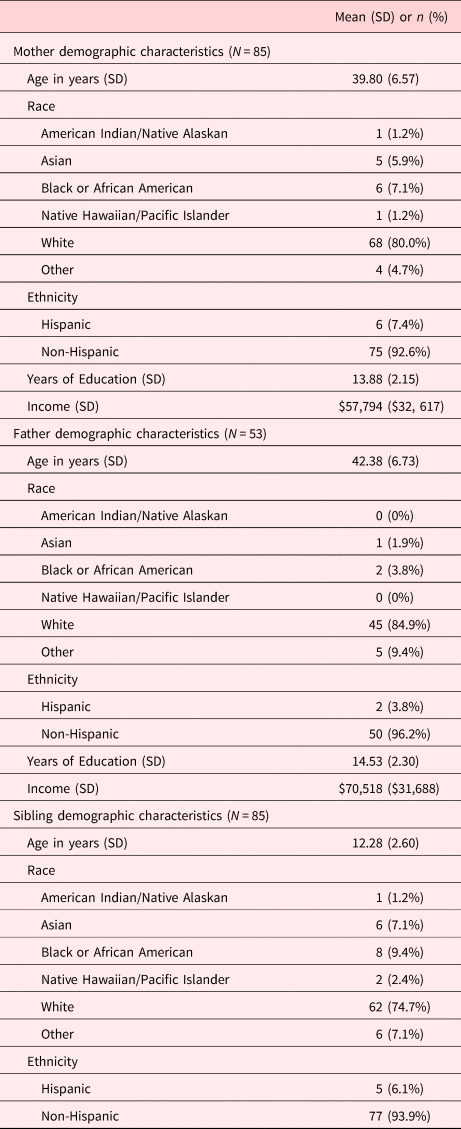
Demographic characteristics of the sample are in Table 1. The sample of bereaved siblings was primarily female (55%, n = 47), White (73%, n = 62), and an average of 12.26 years old (SD = 2.60). Mothers (n = 85) averaged 39.80 years of age (SD = 6.57), and 80% (n = 68) were White. Fathers (n = 53) averaged 42.34 years of age (SD = 6.67), and 85% (n = 45) were White. Mothers’ education level averaged 13.88 years (SD = 2.15), while fathers’ education level averaged 14.53 years (SD = 6.67). Data were collected an average of 11.57 months (SD = 3.48) after the child's death.
Family demographic characteristics

Measures
Intervention use
The Parent Intervention Survey examines prior use of formal and informal bereavement services, frequency or length of use, and perceived benefit in the past year. Based on previous literature (Lichtenthal et al., Reference Lichtenthal, Corner and Sweeney2015a; Aoun et al., Reference Aoun, Breen and White2018; Rusch et al., Reference Rusch, Greenman and Scanlon2020), four types of resources were assessed: books, support groups, therapy, and medication. For each intervention, parents reported whether it was utilized (yes/no), their frequency of attendance/use or length of involvement, and how helpful the intervention was on a three-point scale ranging from 1 (not helpful) to 3 (very helpful). Parents then completed proxy report of the bereaved sibling's use of the same four services.
Internalizing, externalizing, and total problems
Parents reported on sibling's internalizing, externalizing, and total problems using the Child Behavior Checklist (CBCL). This 113-item inventory has established reliability and validity and is widely used for children aged 6–18 years (Achenbach and Rescorla, Reference Achenbach and Rescorla2001). The CBCL yields eight syndrome subscales for emotional and behavioral problems, as well as three subscales for competence. Higher order factors include Total Competence, Total Problems, Internalizing problems, and Externalizing problems. Analyses were conducted using raw scores, but T-scores were calculated using national norms and are reported to aid with interpretation. T-scores ≥ 60 on the broad-band scales were considered in the clinical range based on manual recommendations, as scores in the borderline clinical range can be combined with those in the clinical range to efficiently distinguish between “deviant” and “nondeviant” scores (Achenbach and Rescorla, Reference Achenbach and Rescorla2001).
Similarly, the Adult Self Report (ASR), an upward extension of the CBCL, was used to examine internalizing, externalizing, and total problems in parents. The ASR has well-established reliability and validity (Achenbach and Rescorla, Reference Achenbach and Rescorla2003).
Analysis
Data were analyzed with SPSS version 26. Descriptive statistics were used to characterize family background factors and medical characteristics surrounding the child's death; frequency distributions summarized responses on the Parent Intervention Survey. McNemar's tests (α = 0.05) were used to compare intervention use between family members. Point biserial and Pearson's correlations (α = 0.05, two-way) were used to examine associations between background factors (e.g., race and education level), medical characteristics (e.g., age of child at time of death), the four types of intervention resources, and adjustment (i.e., internalizing, externalizing, and total problems). Hierarchical linear regressions tested if background characteristics, medical factors, and adjustment were associated with the total number of services used. Separate models were examined for mothers, fathers, and siblings.
Results
Intervention use characteristics
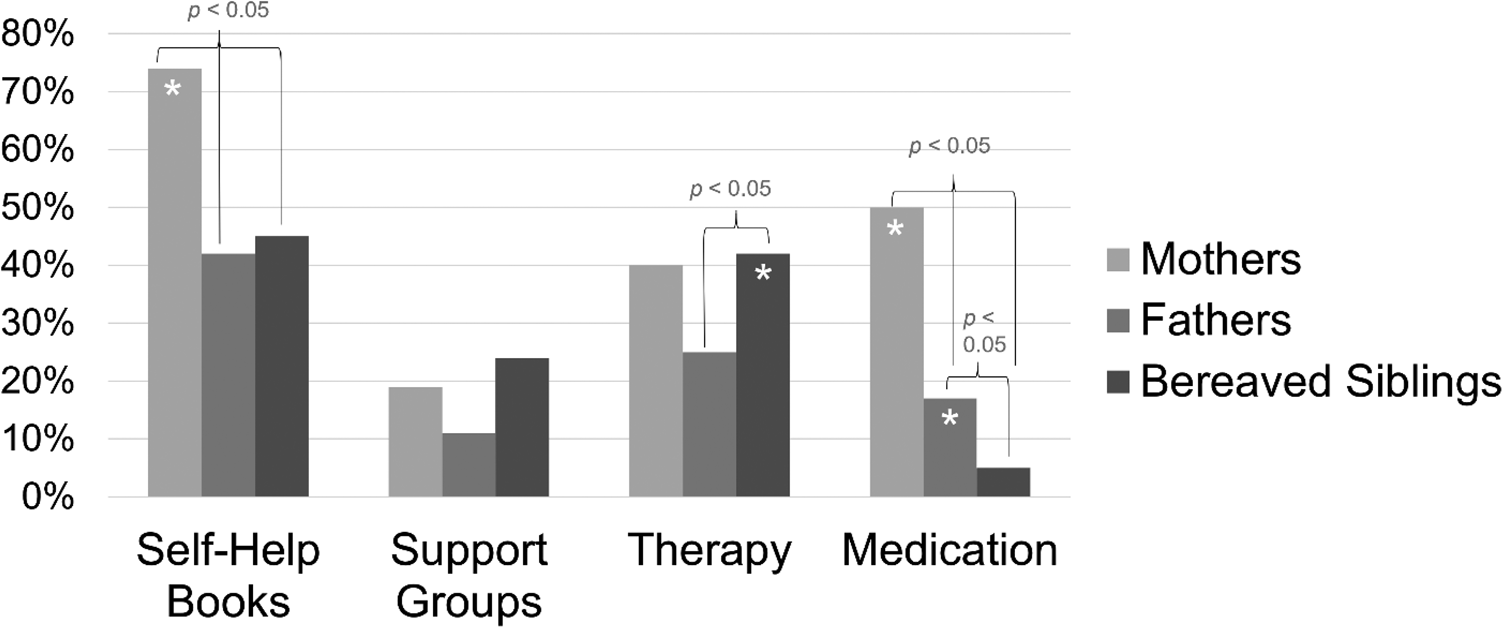
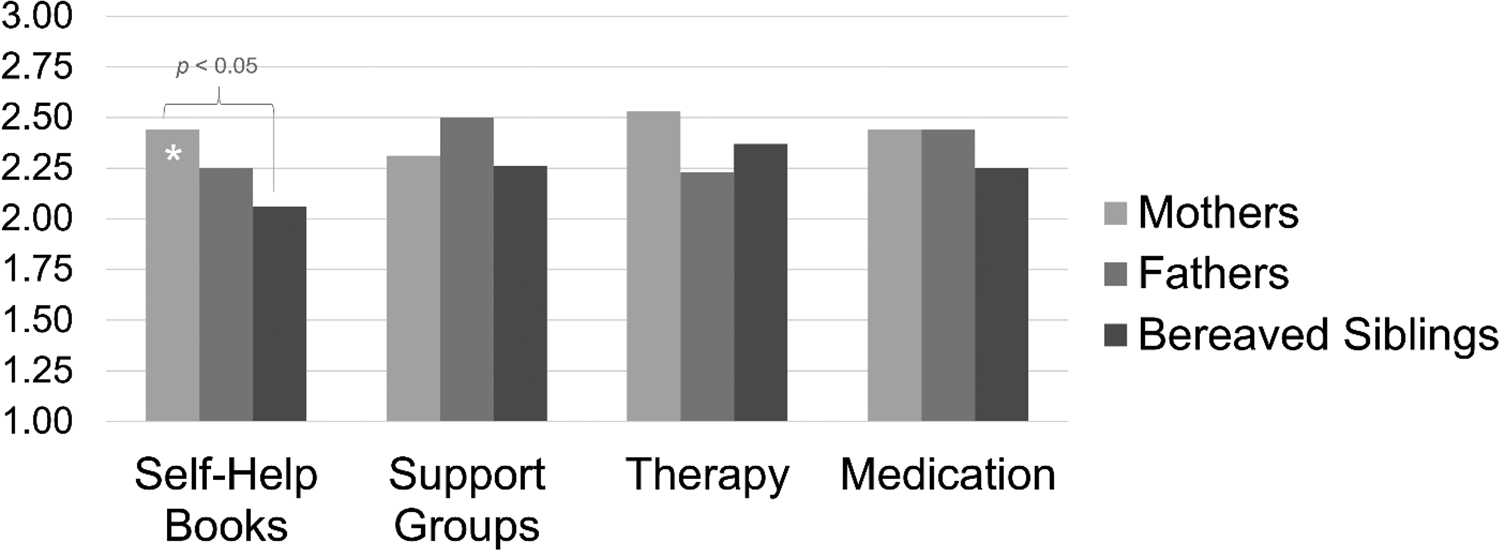
Intervention use and comparisons among family members are shown in Figure 1. The utilization of self-help books was moderate to high for mothers (74%, n = 63), fathers (42%, n = 22), and siblings (45%, n = 38) in the first year after the death. Support group utilization was low for mothers (19%, n = 16), fathers (11%, n = 6), and siblings (24%, n = 20). Formal therapy usage was moderate among mothers (40%, n = 34) and siblings (42%, n = 36), but low for fathers (25%, n = 13). Fifty percent (n = 43) of mothers used medications, while utilization was low among fathers (17%, n = 9) and siblings (5%, n = 4). Of those who reported the type of medication used, anti-depressants were the most frequently endorsed medication type across all family members. Comparisons of intervention use between family members indicated that mothers were significantly more likely than siblings (p < 0.001) and fathers (p = 0.001) to use self-help books (see Figure 1). Additionally, mothers were significantly more likely than siblings (p < 0.001), and fathers (p < 0.001) to use medications. Average helpfulness scores across family members for each type of service are shown in Figure 2. All family members did not find any one service more helpful than any other service (p > 0.05).
Types of intervention use.

Mean helpfulness scores.

Intervention use and background factors
For siblings, demographic and medical factors (e.g., race, age, time since death) were unrelated to intervention use. Mothers used more bereavement services overall if their deceased child was older at the time of death, r(83) = −0.27; p = 0.02. Fathers with more years of education and who identified as White used more bereavement services overall, r(53) = 0.28; p = 0.04 and r(53) = 0.31; p = 0.02, respectively. Because deceased child age at death, race (White vs. non-White), and years of education were significantly correlated with total services used, these variables were included as covariates in hierarchical regression models. Fathers also perceived services to be more helpful closer in time to the child's death, r(30) = −0.41; p = 0.02.
Intervention use and adjustment
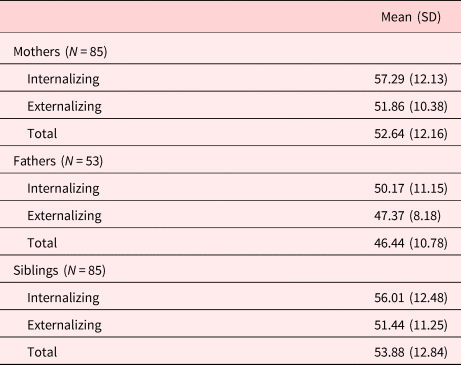
Average internalizing, externalizing, and total problem scores for the sample are listed in Table 2. Mothers and siblings with more total problems used more interventions overall, r(85) = 0.24; p = 0.03 and r(85) = 0.29; p = 0.01, respectively. Individuals with more total problems were also more likely to use medications (mothers: r(85) = 0.27; p = 0.02; fathers: r(53) = 0.32; p = 0.02; siblings: r(85) = 0.26; p = 0.02). Moreover, mothers with more internalizing problems specifically were more likely to use therapy, r(85) = 0.23; p = 0.04.
Internalizing, externalizing, and total problems

Hierarchical linear regressions were used to test if demographic characteristics, medical factors, and total problems were significantly associated with the total number of services used among mothers, fathers, and siblings. Trimmed models were conducted based on significant variables in univariate analyses. For mothers and siblings, step one in the hierarchical regression included the deceased child's age at death, and step two included mean scores for total problems. For fathers, step one in the hierarchical regression included race (White vs. non-White) and years of education, and step two included mean scores for total problems. Among mothers, the overall regression was significant, R 2 = 0.11, F(2, 80) = 4.954, p = 0.01. The deceased child's age at death was the only significant predictor of total services used by mothers (b = 0.052, p = 0.022), such that mothers who had an older child at time of death used more services overall. Among fathers, the overall regression was significant, R 2 = 0.216, F(3, 49) = 4.492, p = 0.007. Race and years of education were significantly associated with total services used by fathers (b = 0.750, p = 0.030 and b = 0.154, p = 0.010), such that fathers who identified as White and had more years of education used more services overall. Among siblings, the overall regression was significant, R 2 = 0.088, F(2, 80) = 3.867, p = 0.025. Greater total problems were significantly associated with more total services used (b = 0.012, p = 0.007).
Discussion
Given the significant risk for distress and under-utilization of bereavement services in families after the death of a child, we examined factors associated with greater use of services among mothers, fathers, and siblings bereaved by childhood cancer. While nearly all mothers utilized at least one service, nearly half of fathers and siblings reported using no services at all. The most commonly used resources were self-help books; mothers were more likely than fathers or siblings to rely on books and medications. Few background factors were associated with service utilization among parents, except White race and higher education level for fathers. Older age of the deceased child was related to more service use among bereaved mothers, while more total problems were associated with service use in siblings. In order to facilitate practitioners’ recommendation for bereavement services, future research should continue to identify factors that may predict mental health service utilization for bereaved families.
Most bereaved family members, particularly mothers, sought out some form of assistance to cope with the child's death. Similar to current literature (Aoun et al., Reference Aoun, Breen and White2018), these services were most often informal (i.e., self-help books), but a substantial portion of mothers and siblings also used formal services, such as therapy and medications. Moreover, most mothers and siblings who utilized therapy and medications reported that they were somewhat or very helpful. However, previous evidence has shown that professional services for bereaved families were utilized less often, or unhelpful when utilized, with therapy being the most frequently discontinued service by parents (Lichtenthal et al., Reference Lichtenthal, Corner and Sweeney2015a, Reference Lichtenthal, Sweeney and Roberts2015b). Although parents have reported that it is too painful to talk about their child's death (Lichtenthal et al., Reference Lichtenthal, Corner and Sweeney2015a), it appears mothers in our sample may have been more open to discussing their experiences in a formal service setting.
It is possible that some families faced potential barriers in accessing formal services, such as therapy or medication prescriptions. In a study examining the implementation of standardized bereavement care in pediatric oncology, 41% of staff reported inconsistent, or absence of, bereavement services in their facility (Wiener et al., Reference Wiener, Rosenberg and Lichtenthal2018). Literature supports the need for pre-death bereavement services to be initiated by the child's healthcare team and for these services to be personalized for each family's unique needs (Donovan et al., Reference Donovan, Wakefield and Russell2015; Helton et al., Reference Helton, Morris and Dole2021). Roberts et al. (Reference Roberts, Jankauskaite and Slivjak2020) examined whether a pre-screener for bereavement services would be helpful for families of an individual with advanced cancer. Many participants supported screening at multiple time points, including before and after the patient's death (Roberts et al., Reference Roberts, Jankauskaite and Slivjak2020). A similar initiative could be applied to a palliative care setting, especially when considering the unique needs of healthy siblings. Other potential barriers to service use in medical settings include difficulty speaking about their loss or difficulty returning to the hospital due to painful or traumatic memories, which highlights the potential of offering services via telehealth (Darbyshire et al., Reference Darbyshire, Cleghorn and Downes2013; Lichtenthal et al., Reference Lichtenthal, Corner and Sweeney2015a). Accordingly, research should examine whether virtual services are beneficial for extended family members, who may not be able or allowed to see the patient at end of life, due to visitor restrictions.
Mental health service utilization rates among fathers are low (Isacco et al., Reference Isacco, Hofscher and Molloy2016), and our sample of bereaved fathers showed similar under-utilization of services. Fathers may face barriers to seeking mental health support due to negative attitudes about help-seeking and a desire for self-reliance (Giallo et al., Reference Giallo, Dunning and Gent2017). The traditional role of a father has been stereotyped as the “breadwinner” or head of household, however this role is often challenged or re-defined after their child is diagnosed with a chronic illness (Goldstein et al., Reference Goldstein, Akré and Bélanger2013). Many fathers struggle to balance financial responsibilities with caring for, and spending time with, their ill child (Goldstein et al., Reference Goldstein, Akré and Bélanger2013). Although research has shown that fathers do experience high levels of distress related to their child's cancer diagnosis (Alderfer et al., Reference Alderfer, Mougianis and Barakat2009; Schepers et al., Reference Schepers, Sint Nicolaas and Maurice-Stam2018), fathers may prioritize the emotional needs of their family members over their own needs. In a study of fathers of children with brain tumors, information about emotional or bereavement support was ranked as their lowest priority (Robinson et al., Reference Robinson, Huskey and Schwartz2019). Instead, fathers focused on receiving information related to their child's diagnosis and stepping into the role of a present and supportive father (Robinson et al., Reference Robinson, Huskey and Schwartz2019). Factors related to fathers’ minimal interest in mental health help-seeking should be further characterized, and alternative support options, such as internet-based information resources, should be explored.
While parents did report some distress for both themselves and for the bereaved sibling, average scores for internalizing, externalizing, and total problems were in the normative range. Rosenberg et al. (Reference Rosenberg, Postier and Osenga2015) found that while anxiety, depression, and other mental health concerns among siblings increased within the first year since death, these levels gradually returned to baseline. Considering our sample completed measures an average of 11 months after the death of their child, family members’ internalizing problem levels could have declined from initial levels. However, other literature indicates that parent mental health problems persist or increase after the first year following their child's death (Lichtenthal et al., Reference Lichtenthal, Corner and Sweeney2015a). Additionally, qualitative studies emphasize that the grief journey is never-ending and that grief may change over time or vary in its presentation (Gilmer et al., Reference Gilmer, Foster and Vannatta2012; Snaman et al., Reference Snaman, Kaye and Torres2016). Despite our findings, literature shows the importance of long-term bereavement support for families over the first full year post-death (Schuelke et al., Reference Schuelke, Crawford and Kentor2021). Although many families do receive support from other family and friends, this support may drop off after the first few months of bereavement (Schuelke et al., Reference Schuelke, Crawford and Kentor2021). Thus, it is important for healthcare providers, as well as other formal support services, to continue to provide resources even beyond the first year (Lichtenthal et al., Reference Lichtenthal, Sweeney and Roberts2015b).
These findings should be considered in the context of several limitations. First, this is a cross-sectional study, limiting the ability to examine the long-term effectiveness of services and whether distress changed over time in these families. Additionally, our sample was predominantly White and non-Hispanic with high reported income, which could explain greater access and therefore higher utilization of services. Bereaved siblings did not provide self-report in this study, and the extent of sibling distress and service use may not be fully captured with the use of only parent-proxy reports. Our intervention survey was limited and only asked respondents about four types of service utilization. It is unclear if participants who reported no service utilization did in fact seek services that were not listed on our survey, such as online resources. Furthermore, we were unable to differentiate if these services were used in the context of hospital-based care or if they were sought in community-based settings. Finally, detailed information about service use, such as when the service was started or potential barriers to accessing services, was not collected.
Future research should further examine predictors of the frequency and helpfulness of mental health services for bereaved families, including prior to the death of the child. Particularly, research should examine how cultural and gender differences may affect the perception and utilization of mental health services in the context of pediatric cancer. Given the high utilization rate of medications by mothers in our sample, more research is needed to examine medication-specific information in a pediatric cancer-bereaved sample, such as when the medication began and who prescribed the medication. The development of family-centered interventions should be long-term to ensure continuity of care for bereaved families. Specifically, these interventions could target fathers to promote mental health help-seeking behaviors and increase service utilization. Healthcare providers should establish relationships with families early in the illness trajectory and continue to initiate contact post-death to offer support. In a pediatric cancer setting, providers should screen for grief and distress before the death of the child so that mental health services may be offered early in the grief journey. Special attention should be paid to healthy siblings in the family, who are often overlooked and may require more individualized bereavement services due to the unique nature of sibling bonds. At present, providers could use existing screening tools such as the Psychosocial Assessment Tool (Kazak et al., Reference Kazak, Hwang and Chen2018) or the Distress Thermometer (Patel et al., Reference Patel, Mullins and Turk2011) to assess psychosocial risk at multiple timepoints, such as at the time of hospice referral and during the last weeks of life. Although a bereavement-specific screening tool has been explored in oncology, more research is needed to validate this measure in a pediatric oncology setting (Roberts et al., Reference Roberts, Holland and Prigerson2017). Incorporation of bereavement services as a standard of care in psycho-oncology can help optimize outcomes among bereaved families and promote resilience over the long-term (Lichtenthal et al., Reference Lichtenthal, Sweeney and Roberts2015b).
Acknowledgments
The authors would like to thank the families who generously participated in this work.
Funding
This work was supported by a grant from the National Institutes of Health (R01 CA98217) to Cynthia A. Gerhardt.
Conflict of interest
The authors have no conflicts of interest to declare.