Introduction
Termites provide critical ecosystem services by recycling dead woody material and contributing to soil formation and turnover (Watson and Gay, Reference Watson, Gay and Naumanni1991). However, some termite species are also major agricultural, forestry and household pests. They can cause severe economic damage to timber and wood products, standing trees, seedlings and even plastics (Rath, Reference Rath2000). Wiseman and Eggleton (Reference Wiseman and Eggleton1994) estimated that termites cause around US$ 40,000 million in damage per year to buildings and are responsible for substantial losses to forestry and agriculture. Arboreal termites, especially Odontotermes spp., are common in timber plantations in India. Their management, using insecticides like chlorpyriphos, is possible only for short periods at a time (Remadevi et al., Reference Remadevi, Sivaramakrishnan and Sarma1998).
Termites could be effectively controlled using pathogenic microbes. Their habitats, which are humid and of a relatively constant temperature, are ideal for microbial growth, while crowded conditions and social interaction in termite nests encourage transmission of the fungus (Delante et al., Reference Delante, Grace and Tome1995; Creffield, Reference Creffield1996).
Many micro-organisms have been associated with termite nests; however, only a few are potential pathogens. Entomopathogenic fungi belonging to the Hyphomycetes group have been isolated from termite body or nest material, and many of these are highly virulent to termites (Zoberi and Grace, Reference Zoberi and Grace1990; Milner et al., Reference Milner, Staples and Lutton1998). Entomopathogenic fungi invade their host through the integument and cause death through depletion of host metabolites, production of toxins, destruction of vital tissues or a combination of the three (Yendol and Paschke, Reference Yendol and Paschke1965; Bao and Yendol, Reference Bao and Yendol1971).
Several reviews have been published on the pathology and ecology of the two most widely studied species of entomopathogenic fungi, Metarhizium anisopliae and Beauveria bassiana (e.g. Almedia et al., Reference Almedia, Alves and Pereia1997; Ferron, Reference Ferron and Burges1981; McCoy et al., Reference McCoy, Samson, Boucias and Ignoffo1988; Goettel, Reference Goettel, Lomer and Prior1992).
The primary objective of this study was to identify promising native isolates of M. anisopliae effective against Odontotermes sp. Development and application of formulations of the identified isolates could supplement existing termite control methods and reduce dependence on synthetic chemicals.
Materials and methods
Fungal culture
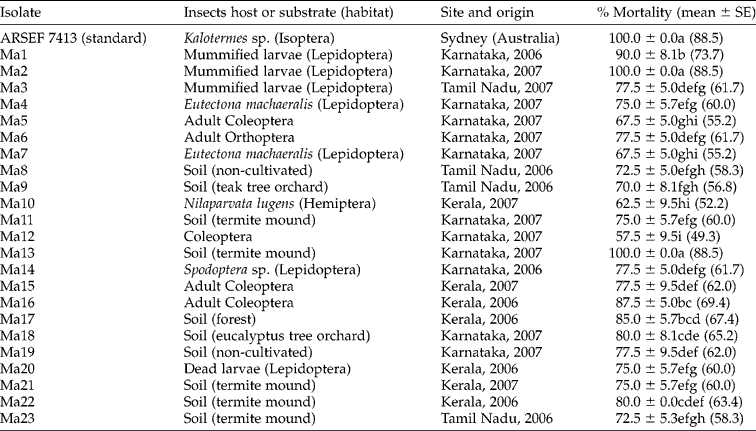
Test isolates of the fungus M. anisopliae used in this study were recovered and purified from soil from different locations (cultivated and fallow land, lake sides, pasture, orchards and forest plantations) and insects from the orders Lepidoptera, Coleoptera, Hemiptera and Orthoptera (Table 1). A selective medium containing 1% glucose, 1% peptone, 1.5% oxgall, 3.2% agar, 10 μg/ml dodine (Sigma Aldrich), 250 μg/ml cyclohexamide and 500 μg/ml chloramphenicol was used for the isolation of the fungus. The isolates were then grown on a potato dextrose agar medium (Hi Media, Mumbai, India) fortified with 1% yeast extract at 26 ± 1 °C in the dark and then stored at 4 °C. The isolates were regularly passed through their respective hosts and re-isolated to maintain virulence. In total, 23 isolates were prepared and tested together with the standard, ARSEF 7413 (USDA-ARS Collection of Entomopathogenic Fungal Cultures).
Metarhizium anisopliae isolates collected from different sources and localities in India and their mortality effects against Odontotermes sp.
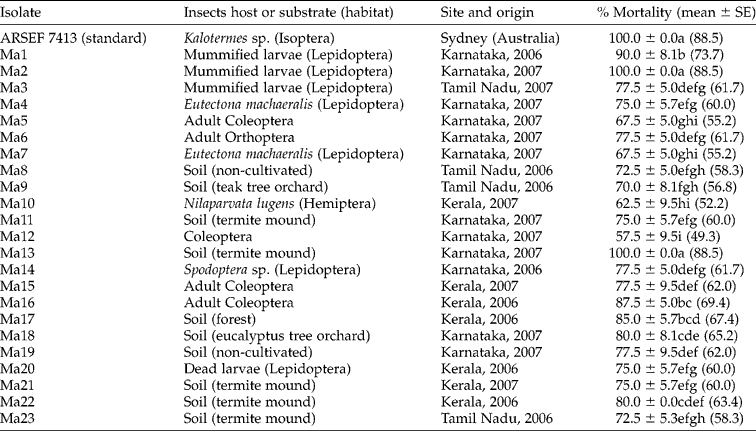
Values in parentheses are angular transformed. Means were separated by least significant difference, where standard error of difference = 3.2874, critical difference (CD) at 5% = 6.5533, CD at 1% = 8.6981. Means followed by different letters differ significantly (P ≤ 0.05, ≤ 0.01).
Termite culture
Workers and soldiers of Odontotermes spp. along with soil from mud galleries on termite-infested trees and termite mounds were collected in plastic boxes (10 cm × 5 cm) and brought to the laboratory. They were kept in glass jars and maintained in a biochemical oxygen demand incubator at 25 ± 1 °C. A glass jar (21 cm diameter × 9 cm height) was filled with soil up to 4 cm height. Soil from the infested tree bark was also mixed in with the soil in the glass jar. Two small pieces of rubber wood were partly buried into the soil to serve as a food source. Fifty worker and twenty soldier termites were placed in the glass jar, whose mouths were then covered with muslin cloth. During establishment of the culture, the soil in the glass jar was periodically moistened to provide humidity for the termites.
Bioassays
An initial pathogenicity test of the 23 M. anisopliae isolates and the standard was carried out at a concentration of 107 conidia/ml. A 1 ml suspension of each fungal isolate was poured into a sterile Petri plate and allowed to dry partially, and worker termites were allowed to walk on the partially dried fungal suspension for 1 min. The contaminated workers were transferred aseptically to sterile Petri plates with small pieces of rubber wood, which were in turn placed in plastic bags containing moist cloth and incubated at 26 ± 1 °C in the dark. Four replicates of each isolate, each with 10 individual workers, were maintained, and mortality was observed at 24 h intervals for up to 6 days. Dead insects were incubated in a humid chamber to confirm growth of the fungus on their cadavers. A batch of uninfected termites was maintained as a control.
The five most effective isolates were selected, as judged from their lethal concentration (LC50) values, and a multiple-concentration assay was conducted using four concentrations of these isolates (104, 105, 106 and 107 conidia/ml) using the method described above. The bioassay was repeated three times.
Data analysis
Mortality observed in the controls was used to correct mortality in the treated groups using Abbott's formula (Reference Abbott1925). The data were subjected to arc sine transformation and analysed using one-way analysis of variance. The least significant difference test was used to compare the means. The median LC50 for the five isolates was estimated by probit analysis (Finney, Reference Finney1971). The cumulative mortality response for each concentration of the isolates across the assessment period was analysed by Kaplan–Meier survival analysis. All the analyses were carried out using SPSS 11.0 for Windows. The relative potency for each isolate was calculated by dividing the LC50 value of each test isolate by that of the standard (Houping et al., Reference Houping, Margaret, Bruce and Michael2002).
Results and Discussion
Single-concentration assay
In the single-concentration assay (107 conidia/ml), the mortality of Odontotermes sp. ranged from 57.5 to 100% after 6 days of treatment (Table 1). Two of the M. anisopliae isolates, Ma2 and Ma13, and the standard were severely pathogenic (100% mortality) to Odontotermes sp., while Ma1, Ma16 and Ma17 gave more than 80% mortality.
Milner and Staples (Reference Milner and Staples1996) tested over 90 isolates of M. anisopliae against Nasutitermes exitiosus and Coptotermes spp. workers and found that many isolates induced over 80% mortality. Khan (Reference Khan1991) reported that among several mycopathogens, M. anisopliae was more virulent to Odontotermes brunneus. Gunner et al. (Reference Gunner, Kane and Duan1994) tested 21 isolates of M. anisopliae against Reticulitermes flavipes workers and observed 80–100% mortality within 3 days of treatment. Changjin et al. (Reference Changjin, Jiamin, Hai, Wugwo and Yuanyang2009) found that conidia from M. anisopliae var. dcjhyium were highly virulent to Odontotermes formosanus, causing approximately 100% mortality after 3 days post-inoculation at a concentration of 3 × 10⁸ conidia/ml.
Multiple-concentration assay
In the multiple-concentration assay, Ma2 and Ma13 were observed to be more virulent than the standard isolate, with significantly lower LC50 values (0.01 × 10⁵ and 0.02 × 10⁵, respectively). The LC50 of Ma1 (0.08 × 10⁵ conidia/ml) was equal to that of the standard, whereas the LC50 values of Ma16 and Ma17 were lower than that of the standard (Table 2). χ2 values were not significant (α = 0.05), indicating a good fit of the regression lines, with regression coefficients for the isolates varying from 1.7 to 2.5. Although in general higher slope values indicate higher virulence, some of the isolates with higher slope values showed lower virulence. This could be due to differences in the nature of the isolates.
Mortality of Odontotermes sp. workers exposed to Metarhizium anisopliae isolates

LC50, lethal concentrations; ARSEF 7413, standard isolate with which all test isolates were compared.
* LC50 value significantly lower than that of the standard (α = 0.05).
** LC50 value significantly higher than that of standard (α = 0.05).
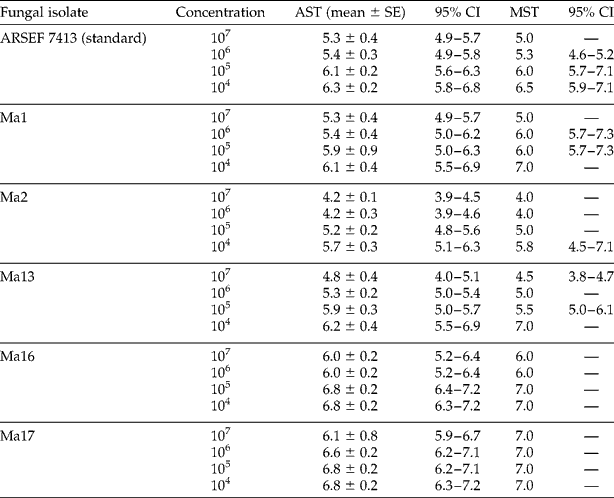
Potency indices for the five isolates calculated based on the LC50 values ranged from 0.12 to 5.75. A lower potency index was correlated with lower LC50 values for all the test isolates (Table 2). Isolates Ma2 and Ma13 had the lowest potency indices (0.12 and 0.25). The average survival time (AST) for the termites treated with the most virulent isolate (Ma2) varied from 4.2 to 5.7 days across the four spore loads, while in the standard isolate AST ranged from 5.3 to 6.3 days (Table 3).
Kaplan–Meier survival analysis for time–mortality response of Odontotermes sp. workers exposed to Metarhizium anisopliae isolates
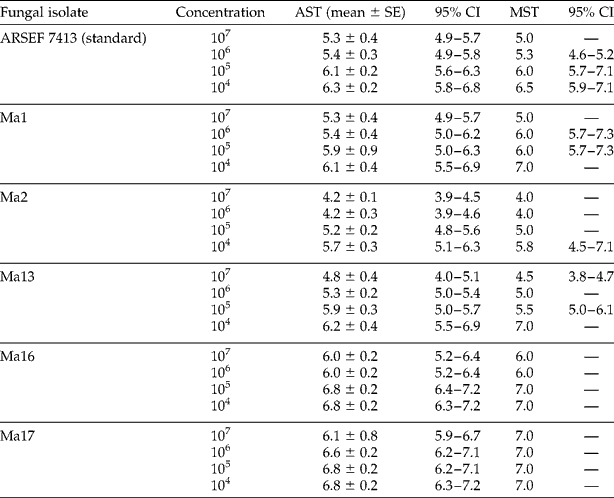
AST, average survival time. AST evaluation was limited to 7 days. α = 0.05% according to the logrank test. MST, mean survival time.
Pathogenicity by source of isolate
Mortality induced by the seven isolates from lepidopteran hosts ranged from 67.5 to 100%, among which Ma1 and Ma2 caused 90 and 100% mortality, respectively (Table 1). Isolates from coleopteran hosts recorded 57.5–87.5% mortality. The isolate from an orthopteran host (Ma6) caused 72.5% mortality and that from Hemiptera caused 62.5%. Of the six isolates obtained from termite mounds, Ma13 and Ma22 induced more than 80% mortality. The isolate from forest soil (Ma17) caused 85% mortality, while two obtained from tree orchards (Ma9 and Ma18) induced 70 and 80% mortality, respectively. Isolates from non-cultivated soil (Ma8 and Ma19) induced 72.5 and 77.5% mortality, respectively. There was significant difference in virulence by source of the isolate.
It has been hypothesized that most virulent fungal strains are generally isolated from the test organism or a closely related species (Latch, Reference Latch1965, Reference Latch1976; Soares et al., Reference Soares, Marchal and Ferron1983; Poprawski et al., Reference Poprawski, Marchal and Robert1985). However, no apparent relationship between pathogenicity and origin of isolates was observed in the present study. Isolates Ma2, Ma13 and Ma1 performed well, although they were not originally isolated from Odontotermes sp. The most pathogenic isolate, Ma2, was from a mummified lepidopteran larva collected from a forest locality. Jones et al. (Reference Jones, Grace and Tamashiro1996) also observed similar LC50 values from three isolates of M. anisopliae recovered from three different species of scarab larvae in Australia, assayed against Coptotermes formosanus. Milner and Staples (Reference Milner and Staples1996) tested more than 90 isolates of M. anisopliae against N. exitiosus and Coptotermes spp. workers, and found that many of the isolates induced over 80% mortality. In a separate study, Milner et al. (Reference Milner, Staples and Lutton1998) also observed only small differences in the mortality caused by several isolates from different sources in these two species.
Applicability in termite control
The tested isolates of M. anisopliae demonstrated high levels of virulence against Odontotermes sp. under laboratory conditions. Biological control with pathogenic fungi, already in use in agriculture, could also provide a long-lasting solution for termite control in areas like urban dwellings or forests. An isolate with low LC50 and short lethal time (LT50) would be more economical, as smaller quantities would be required.
Dissemination strategies for pathogenic fungi are an important consideration. Social interaction, dark and damp habitats and a high relative humidity within a termite colony provide an ideal microenvironment for the germination of fungal spores on infected insects and also their spread to healthy members of the population. The dynamic behaviour of termites also favours infection under field conditions, as workers spend much time moving with soldiers in the nests and galleries. Although some behavioural characteristics of termites help in the removal of fungal spores from the body of contaminated individuals to result in random and low-level infections, grooming is not always effective in removing all fungal conidia and can, indeed, cause further cross-contamination. Intensive applications, however, could assure the spread of fungal infection despite these types of social behaviour.
Conclusion
This study identified virulent isolates of M. anisopliae which could serve as good candidates for development as mycotermiticides against Odontotermes sp. Fungal spores of these isolates could be formulated with non-repellent or attractant constituents or baits to strengthen their efficacy in termite control. This study also indicates that a screening exercise for potential pathogenic isolates against a pest insect should not be limited to isolates from the pest or closely related species. In addition, cultural characteristics and the effects of varying environmental conditions on the pathogen's growth and sporulation should be evaluated before its development into a mycotermiticide.
Acknowledgements
We are grateful to the Department of Biotechnology, New Delhi, for providing financial support to carry out this work. We thank the Directors of the Institute of Wood Science and Technology and the Ashoka Trust for Research in Ecology and the Environment for study facilities. The permission granted by the PCCF (Principal Chief Conservator of Forest) of Karnataka, Kerala and Tamil Nadu Forest Departments to undertake surveys in these states is thankfully acknowledged.