The alignments of new railways should minimize dividing up a city. New railway stations should as far as possible be located in the central city or close to the urban built-up area to ensure that people can travel by high-speed railways conveniently … For newly-built high-speed railway stations, the provision of ancillary municipal public transport routes and intermodal transfer facilities should be strengthened, so these stations can enjoy rapid, direct and convenient connections to urban built-up areas and other important integrated transport hubs … Small and medium-sized cities should not overestimate the trickle-down effect of high-speed railways. They should avoid copying directly from the development experience of large cities to arbitrarily develop new [city] features and blindly construct new towns.Footnote 1
The rapid expansion of China's railway system has attracted worldwide attention. At the end of 2017, its railway operating mileage reached a staggering 127,000 km, the second longest in the world. However, many of the new railways, which are in the form of high-speed railways, have been denounced for the inconvenient siting of their stations in the suburbs rather than in the urban core. Some of these stations are located over 30 km away from the city centre.Footnote 2 In response, in April 2018 three central ministries (the National Development and Reform Commission, the Ministry of Natural Resources and the Ministry of Housing and Urban–Rural Development) and the China Railway Corporation (CRC), the state-owned railway enterprise, jointly issued the above-quoted “Guidelines,” which emphasize the siting of new high-speed railway stations within or close to urban built-up areas, to all provincial governments.
It is often contended that China's railway system is monopolized and centrally regulated by the CRC (formerly the Ministry of Railways (MOR) until March 2013). However, if the CRC was able to dictate railway affairs, then it would not have had to issue guidelines in order to express its dissatisfaction about the siting of railway stations and to ask local governments to support its railway plans. As this paper argues, the distancing of railway stations from the city centre is by no means a random or solely technical-rational outcome. Instead, it reflects something decidedly political – the transformation of the railway regime, a highly centralized institution, through its interactions in a generally decentralizing administrative and economic context. During this process, which began in the 2000s, state agents associated with various scales, such as national, provincial and municipal scales, have entered into the planning of new railways. Geographical variations in the locations of railway stations are symptomatic of, and contingent on, the bargaining between state agents at different scales.
This paper seeks to provide a political economic interpretation of the political and geographical reconfiguration of China's railway system since the 2000s by positing such a reconfiguration as the outcome of a politics of scale, namely a series of bargains made between state agents at different scales. To elaborate, three arguments are in order. First, since Chinese state functions are unevenly distributed across scales, state agents at different scales have different locational preferences for railway stations. Second, state agents at scales empowered to command vital resources for railway development, such as capital and land, tend to dominate the bargaining over station siting. Third, municipal governments with higher administrative and economic statuses tend to bargain more powerfully with actors at other scales on where railway stations should be located within their jurisdictions. Owing to the current nature of the railway planning regime, the focus of the bargaining process between contending state agents might be less on the convenience for passengers than on the socio-political agenda of key state actors, resulting in uneven spatial impacts which have not been observed in other contexts.
To illustrate these arguments, this paper will pursue a case study of the planning for the Pearl River Delta Intercity Railway System (PRD-ICRS), China's first intercity railway (ICR) system. It combines a review of the policy and planning documents with interviews conducted with over 50 government officials, planners and researchers between 2009 and 2018 to reveal how the system was planned. Quantitative analysis of intercity spatial variations in the siting of the PRD-ICRS's stations and the underlying drivers of such spatial patterns uncover how the planning of this ICR system was mediated by asymmetries in the bargaining power of the different state agents.
This paper contains six parts. After this introduction, the next two sections elaborate the perspectives of politics of scale and bargaining power to establish that China's railway regime has become a more pluralized and contentious domain in which state agents across the central–local spectrum have become involved in shaping railway planning. The fourth section introduces the case of the PRD-ICRS, with a focus on the significant intercity variations in the ease of access to its stations. The fifth and sixth sections examine the politics of scale in the PRD-ICRS in detail, unpacking why municipal governments in general have a greater say over the planning of the system and how differences in bargaining power and interests between municipal governments give rise to the foregoing spatial unevenness in the accessibility of ICR stations. Attention is drawn to why, counterintuitively, municipal governments with greater bargaining power achieve lower accessibility to ICR stations for their cities. The paper concludes with a summary of its key findings and an appeal for future inquiries.
China's Evolving Railway Regime: The Rise of Bargaining across Scales
State regulation in post-reform China: a politics of scale
As a key perspective in the scholarship of geographical political economy, politics of scale draws attention to how scale is mobilized as “a relational, power-laden and contested construction” to organize – and reorganize – contemporary political-economic processes in a multi-scalar manner.Footnote 3 One example of such an organization is the state. As incipient studies in Western Europe have shown, state powers often no longer rest with the national government but are spread across authorities at multiple geographical scales.Footnote 4 This interscalar division of labour gives rise to a trend of “scale relativization” in which no single scale prevails as the dominant scale of decision making. State agents at different scales strategically reinforce or challenge prevailing scalar configurations of power to promote their respective aspirations and interests.Footnote 5
As for China, although the notion of politics of scale has only gained momentum recently,Footnote 6 studies on central–local relations have examined the struggle for power between different scalar tiers of the Chinese state since the launch of economic and administrative reforms in 1978.Footnote 7 Prior to the reforms, subnational (i.e. provincial and municipal) governments were branches of the central government, which had direct control over their budgets, resource allocation and economic production. As reforms progressed, the central state devolved various powers and responsibilities to subnational governments.Footnote 8 Both provincial and municipal governments gained more policy and budgetary autonomy and can now claim de facto control of their territorial resources, of which land is a well-rehearsed example. Municipal governments have drawn heavily on their new power to expropriate and lease land within their jurisdictions to finance urban development in order for their leaders to succeed under an economic performance-based system of promotion of government officials.Footnote 9 This has encouraged restless, sometimes ill-planned, urban expansion to the great detriment of the environment.Footnote 10 The growing discretion and disobedience of local governments have stimulated a notable strand of scholarship that has characterized China as moving into an era of “local protectionism.”Footnote 11
Contrasting this emphasis on a unidirectional downscaling of power, an emerging stream of research has appealed for a less dualistic and more dynamic view of central–local relations.Footnote 12 Although departing from an acknowledgement of the emerging recentralizing tendencies in the Chinese state, such studies are cautious that the ensuing political changes are not as simple as swinging the pendulum of power back to the central government. For example, to curb the aforementioned problem of sprawling cities, some central ministries and provincial governments have revived the once abandoned practice of regional planning to coordinate and integrate economic development at the regional scale, that is, across the boundaries of multiple municipalities.Footnote 13 This involves attempts by these state agents to selectively seize back control of land use planning and development of major infrastructure – of which railways is one – from the municipalities. However, municipal governments have not passively accepted these top-down rescaling interventions. Instead, they have adopted various strategies to reassert their interests. The contours of development of Chinese cities have therefore been heavily shaped by a politics of scale in which state agents from multiple scales are on a “bargaining treadmill” to maintain their influence over the municipal agenda.Footnote 14
China's state-led railway regime: decentralizing pressure of a centralized monolith
Sailing against the tidal wave of decentralization, China's railway sector has until recently experienced further centralization, a trend which can be traced back to the pre-reform era.Footnote 15 Before the 1950s, the ownership and management of railways in China were territorially fragmented. Difficulties in coordinating rail transport at the regional scale resulted in the low efficiency of the railway system as a whole. To rectify this problem, in the 1950s the Chinese state centralized control of railways nationwide in the hands of the MOR, which created and controlled several regional railway administrations to run and develop railways in different parts of the country. While each regional railway administration took charge of railway affairs within its clearly demarcated boundaries, the delivery of a complete transport product, which is often cross-jurisdictional, required the MOR to retain central control over the railway regime in aspects such as scheduling, income liquidation and network planning.
The post-reform years saw the formalization of the MOR's monopolistic power over the railway sector, particularly through the enactment of the 1991 Railway Law. Under this law, China's railways were categorized into state railways (owned by the MOR or, after its demise, the CRC), local railways (owned by subnational governments), industrial railways (owned by individual enterprises) and railway private sidings. The MOR was not only entitled to full control of the state railways but also maintained supervisory authority over other, non-state types of railways. It could establish railway technical standards and formulate national railway development plans. Moreover, since trains running on non-state railways often come from or leave for other places through state railways, the MOR could intervene in the operation of non-state railways, notwithstanding their independent ownership, by manipulating the track slot allocations on state railways connected to them. It should be noted that the Railway Law did not make provisions for joint venture railways involving investment from both the MOR and other state or non-state units. This may be explained by the fact that the MOR used to contribute the lion's share of the capital investment in China's railway sector. Between 2000 and 2004, this share consistently stood above 88 per cent.Footnote 16 Although the Railway Law has been revised twice, in 2009 and 2015, these provisions remain largely unaltered.
The MOR's dissolution in March 2013 was followed by the creation of the National Railway Administration, a government unit under the Ministry of Transport, and the CRC. The former has inherited the MOR's administrative functions, including the planning of railway development and the regulation of technical and safety standards of railway operations. The latter has taken over the MOR's business functions and its status as the monopolistic player in China's railway sector. It continues to provide the overwhelming majority of the country's rail transport. It also maintains the national railway fare clearing system, thereby effectively controlling the cash flows of all railway operators.
That said, the hegemony of the MOR or the CRC (depending on the temporal juncture in question) has not been left unchallenged. Instead, since the 2000s, two issues have compelled the MOR to decentralize its powers over railway planning. The first is funding. In 2004, the MOR launched its ambitious Mid-to-Long Term Railway Network Plan (MLTR plan), which aimed to extend China's railway mileage to 100,000 km by 2020, including over 12,000 km of high-speed railways. In 2008, it revised these targets upward to 150,000 km and 30,000 km, respectively. The upshot was the skyrocketing of the country's capital investment in railway infrastructure from 51.6 billion yuan in 2004 to as much as 707.5 billion yuan in 2010. The MOR actually did not have sufficient income to fund its ambitious MLTR plan and had to rely heavily on bank loans and bond financing. As the MLTR plan set into motion, the ministry's cumulative debt snowballed from less than 400 billion yuan before 2004 to 2.79 trillion yuan by the end of 2012. This debt continued to grow after it was passed from the MOR to the CRC, reaching 5 trillion yuan by 2017.Footnote 17
The second issue is land. As noted earlier, municipal governments are the de facto owners of land. Railway expansion requires more land, which unavoidably leads to conflicts at the local level with both municipal governments and land users in land acquisition, household demolition and resettlement. Although the Railway Law mandates municipal governments to assist the MOR in settling land issues pertinent to railway development, they do not necessarily act accordingly because of, inter alia, the loss of land-leasing income with the allocation of land to railway development, which provides them with less or even no revenue. It is nothing new that local governments strategically disobey higher-level mandates on land uses, such as dividing large land parcels to be developed into smaller ones to circumvent pertinent approval from higher-level authorities.Footnote 18
The MOR actively partnered with provincial governments on railway investment during the foregoing period of difficulties. Inscribed through “province–ministry agreements,” these partnerships rested upon a double coincidence of wants. The MOR required help from provincial governments to finance its ambitions for railway expansion and negotiate with local governments on land supply. The provincial governments needed political and technical support from the MOR to develop railways, particularly intercity ones, as part of their aforementioned pursuit of regional formation. After the global financial crisis in 2008, some of them further favoured railway investment as a means to resuscitate economic growth.Footnote 19 The exact terms of these province–ministry agreements, covering details from the distribution of capacities and equities among the agents involved to the technical parameters of the railways to be built, differ across provinces, as each provincial government separately negotiated terms with the MOR. These agreements were often reached through a contentious bargaining process: the MOR had sought to assert its dominant position, while the provincial governments and their local administrations strived to secure their fair share of benefits from their investments.Footnote 20
Bargaining for China's Railway Development: Uneven Power between and within Scales
Insofar as politics of scale is a historically and geographically specific process, the trajectory and outcomes of its unfolding are shaped by the contingent capacity of the participating scalar actors to negotiate with one another for their respective interests. This paper refers to this capacity as bargaining power, which, following Nelson Polsby, draws attention to one's ability to influence the decision making of disputed issues where observable conflicts of interests emerge as an expression of policy preference.Footnote 21 It agrees with Polsby that identifying “who prevails in decision-making” is “the best way to determine which individuals and groups have ‘more’ power in social life, because direct conflict between actors presents a situation most closely approximating an experimental test of their capacities to affect.”Footnote 22
As the above discussion shows, Chinese state agents at different scales have been granted different authorities pertinent to railway development and hence different leverages to bargain for their interests on railways. Although the Railway Law inscribed the MOR with institutional leadership of the railway sector, post-reform devolution has meant that subnational governments can influence railway planning through their control of the budgetary and land resources essential for railway development.Footnote 23 This interscalar variation in bargaining power has constituted the primary analytical focus of prevailing studies on China's central–local relations. Nonetheless, scholars have also increasingly gestured towards the presence of intrascalar variation in the bargaining power of subnational governments. Acknowledging how Chinese localities vary considerably in their immediate historical and geographical contexts, some inquiries have stressed that governments in a subnational tier do not constitute a uniform whole in their political calculations and strategic actions.Footnote 24 For instance, national environmental rules are found to be better enforced in more developed localities because their governments are financially better endowed for enforcement and their economies are driven by sectors which demand a cleaner environment.Footnote 25 The study of the politics of scale of China's railway planning therefore requires a “multi-sited” approach, which compares and causally connects different local territorial units to identify and explain how local governments may bargain for different interests with different levels of effectiveness.Footnote 26
Interested in the city as a key scale for implementing railway plans, this paper proposes that the bargaining power between municipal governments in China differs in at least two aspects. The first is their position in the hierarchical administrative structure. Under China's administration system, cities can take up different administrative ranks, such that their governments may enjoy the authority equivalent to that of, in descending order of rank, a province, a prefecture or a county unit, or even somewhere in between two of them (for example, as a sub-provincial city). Given the relatively strong hierarchical nature of the Chinese state, governments of cities assigned with a higher administrative rank are institutionally better off when bargaining with their upper-level counterparts than those of the lower-ranked cities.Footnote 27
The second aspect is a city's level of economic development. Government officials from cities performing strongly in economic terms tend to bargain more effectively with their upper-level counterparts than those from less developed cities. This is not only because such officials are better aligned with the overarching goal of the central leaders in supporting economic growth but also because national and provincial governments rely on well-developed cities for tax revenue.Footnote 28 Moreover, governments of the economically better-off cities are fiscally more capable of developing their infrastructure, of which railway is a possibility, without relying on investment from upper-level governments. Rather than following the orders from their superiors in exchange for their infrastructure needs, these richer municipal governments may instead develop their own infrastructure to compete with similar provisions made by governments at other scales. To verify these propositions about interscalar and intrascalar differences in bargaining power, this paper now turns to the case of the planning for the PRD-ICRS.
The PRD-ICRS: A System of Uneven Development
The PRD-ICRS started out as a project under a province–ministry agreement between the MOR and the Guangdong government. Its planning took years of intense negotiation between state agents across national, provincial and municipal scales. It embodies the emerging transformation of China's railway regime, from a nationalized monolith to a terrain of interscalar bargaining. The idea to develop this ICR system was first proposed in 2003 to the MOR by Zhang Dejiang 张德江, the-then new Party secretary of Guangdong, to meet the growing transport demand in the Pearl River Delta that derived from the rapid economic growth and urbanization in the region and to achieve a higher level of regional integration. The State Council approved in principle a preliminary plan drafted by the MOR and the Guangdong government together in 2005, and reapproved a revised version of this plan under the title of Intercity Railway Network Plan in the Pearl River Delta Region in 2009.
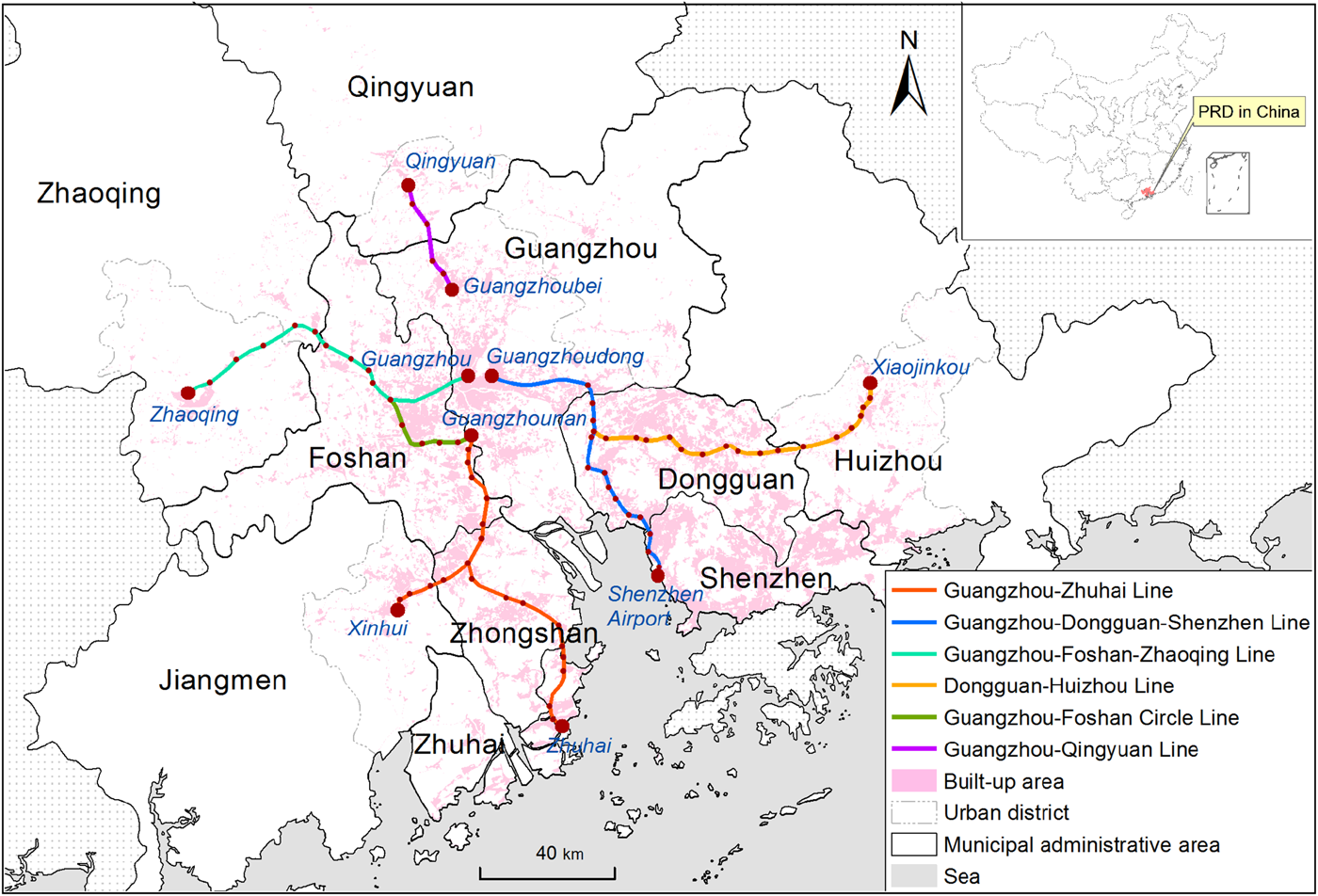
Although the PRD-ICRS consists of 16 railway lines, with a total length of 1,478 km by 2020, this paper concentrates on its six backbone lines, whose alignments and station locations were finalized coincidentally just before the MOR's dismantlement in 2013.Footnote 29 Serving a total of 78 stations across the nine cities of the Pearl River Delta and their northern neighbour Qingyuan 清远, these lines include the Guangzhou–Zhuhai Line 广州–珠海线, Guangzhou–Dongguan–Shenzhen Line 广州–东莞–深圳线 (GDSL hereafter), Dongguan–Huizhou Line 东莞–惠州线, Guangzhou–Foshan–Zhaoqing Line 广州–佛山–肇庆线 (GFZL hereafter), Guangzhou–Foshan Circle Line 广州–佛山环线, and the Guangzhou–Qingyuan Line 广州–清远线 (Figure 1).Footnote 30 At the time of writing in November 2019, only three of these ICRs were operational; the rest were still under construction. Their completed planning processes provide an instructive empirical window through which to analyse both the processes and outcomes of the interscalar bargaining involved in China's railway planning.
The Six Backbone Lines of the PRD-ICRS
Source:
The authors.

As Figure 1 shows, the distribution of the PRD-ICRS stations in the ten cities concerned exhibits rather different patterns. For some cities, the distance between their ICR stations and the existing urban built-up area echoes the criticism reported at the beginning of this paper about the remoteness of railway stations. For example, all four ICR stations in Shenzhen are located at the city's edge. The situation in Guangzhou, served by five ICR lines, is similar. Two lines terminate at Guangzhou Station and Guangzhoudong Station, respectively, both of which are in the city centre, but three other lines only run to Guangzhounan Station and Guangzhoubei Station, which are around 16 km and 30 km away from the city centre, respectively. However, the contrary applies to some other cities. In Huizhou, the Dongguan–Huizhou Line runs exactly along the city's development axis to connect its city centre and main sub-centres. In Zhaoqing, the Guangzhou–Foshan–Zhaoqing Line seamlessly links up its old city centre with the new city centre and high-tech development zone.
For a more nuanced picture of this unevenness, this paper calculates for each city the average travel time (A) required by its urban population to reach the nearest ICR station:
 $$A = \displaystyle{{\sum \lpar {T_iP_i} \rpar } \over {\sum P_i}}$$
where P i is the population in street (jiedao 街道, or its administrative equivalents, such as town) i, and T i is the time required for residents in street i to travel to their nearest ICR station.Footnote 31 Since the ICR is supposed to serve primarily urban areas, measurements are made for 389 street-level units in the urban districts of the ten cities concerned, while less urbanized county units in their jurisdictions are excluded from this analysis.
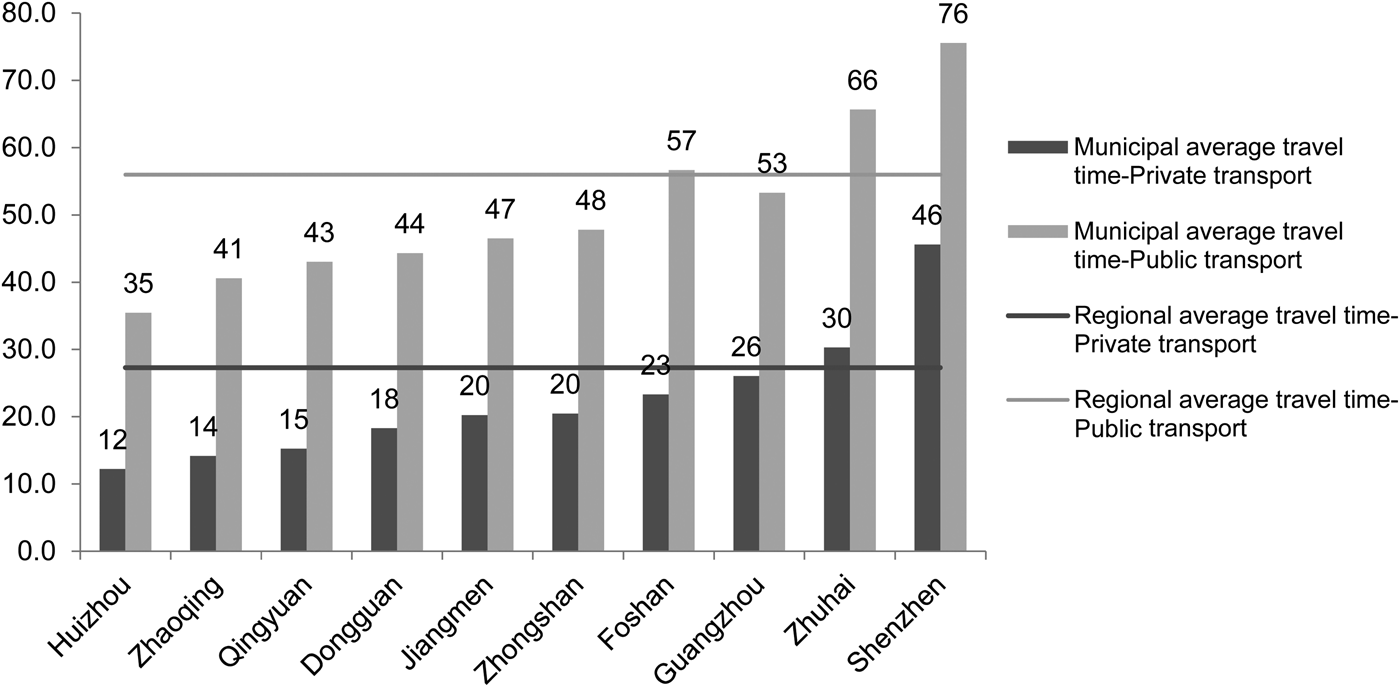
Based on the foregoing approach, this paper ascertains that the average travel times for residents in the Pearl River Delta to reach their closest ICR station by private transport and public transport are respectively 27.3 and 56.0 minutes. It takes about twice as long to travel by public transport as it does by private transport. This corresponds with the frequent complaint that ICR stations are not well connected to public transport. Moreover, verifying our observation at first glance, the average travel times for urban residents in each city to reach their closest ICR station vary significantly (Figure 2). Comparing Shenzhen and Huizhou, the cities with the longest and shortest average travel times, it takes residents in Shenzhen on average about four times as long to reach their closest station by private transport, and more than twice as long by public transport, than it does for the residents of Huizhou to reach their nearest ICR station. This reveals a pattern of spatial unevenness at odds with conventional wisdom: richer cities (whose governments presumably have greater bargaining power) tend to have less accessibility to the ICR, whereas economically lagging cities enjoy greater accessibility.
Average Travel Times (minutes) for Residents in Each City to the Nearest PRD-ICRS Station
Source:
The authors.

Explaining this difference requires a look back at the planning process for the six lines and the decision-making process for all of the 78 stations. To this end, we conducted semi-structured interviews between 2009 and 2018, in both the Pearl River Delta and Beijing, with 36 officials, 16 railway planners and one researcher who took part in formulating the PRD-ICRS plan. Interviewees were asked key questions such as what the initial plan was for line alignments and station locations for the PRD-ICRS, how and why that plan was altered (or not), who was involved in the planning process, and who had the final say on the location of each station. Based on these interviews and a review of pertinent policy and planning documents, this paper now turns to explore the politics that shaped the PRD-ICRS.
Politics of Scale in the Planning of PRD-ICRS
The uneven roles of the MOR, the Guangdong government and the municipal governments are indicative of the evolving interscalar power structure of the railway regime. Four earlier planned lines (namely, the Guangzhou–Zhuhai Line, the GDSL, the GFZL and the Dongguan–Huizhou Line) were joint venture railways and received investment from the MOR and the Guangdong government. The provincial share of investment was partly contributed by the beneficiary cities, whose governments bore the cost of the property demolition and resettlement needed to make way for the railway construction within their respective jurisdictions. The final plans for all four of these lines were the result of much tedious bargaining between the MOR, the Guangdong government and the municipal governments over various parameters such as running speed, line alignment and location of stations. As its debts spiralled owing to its “great leap forward” in nationwide railway development, the MOR was unable to commit further finances to the PRD-ICRS and so pulled out of the two remaining lines (the Guangzhou–Qingyuan Line and Guangzhou–Foshan Circle Line), which were then funded only by the provincial and municipal governments. Despite this financial withdrawal, the Guangdong government still agreed to entrust the operation of all six lines to the Guangzhou Railway Corporation, a MOR subsidiary, in part because it did not want the MOR to treat the railway unfavourably when allocating network slots. This arrangement meant that both the provincial and municipal governments would lose their say over train scheduling and would have little access to crucial information about the railway's profitability. Moreover, they were still subject to the Guangzhou Railway Corporation's demand that they cover any operating losses.
Against this backdrop, these scalar state agents had different priorities in railway development, leading to their contrasting preferences and conflicts over where the ICR stations should be located. In the Pearl River Delta case, these contrasts can be summarized as two sets of conditions. First, although the relations between the MOR and provincial governments were tense, they all favoured city centre locations for the PRD-ICRS stations, albeit for different reasons. The MOR was a debt-heavy entity and its main consideration was to minimize its own costs and maximize passenger volume so it could recoup its costly investment as quickly as possible. It preferred siting stations in or close to city centres where the flow of passengers is highest and the extra costs incurred (for example, for land and resettlement) would most likely be covered by local budgets. The Guangdong government, which also shared the MOR's financial concerns, had high hopes that the PRD-ICRS would promote the economic integration of the Pearl River Delta cities and that the new railway system would meet the growing demand for intercity travel. To this end, the ICR stations again should be located in and around city centres where the largest populations are concentrated.Footnote 32
Second, and conversely, at the municipal level, demand for the ICRs and preferences over station locations have been mixed. To be sure, municipal officials are well aware of the improvements in intercity and even intracity connections which the development of the PRD-ICRS promises. Nonetheless, they have not necessarily supported the locations and even the numbers of ICR stations planned by the MOR and the Guangdong government. As the next section will elaborate, confronted with different local circumstances, municipal governments have developed different preferences regarding the functions and forms of ICRs.
Whether a municipal government could have its preferences met and decide on the final scheme for station location depended on the bargaining process and the city's bargaining power compared with the bargaining power of the upper-level authorities, i.e. the Guangdong government and the MOR, which drew up the initial plan for the PRD-ICRS. Based on our interviews, we were able to identify the bargaining outcome associated with each of the 78 stations under study. We classify these stations into three categories according to the state agent or agents who won the bargaining during the planning process or whose preference dominated in the decision over the final siting of the station concerned.Footnote 33
The first category, “city,” denotes those stations for which the municipal government won the bargaining with upper-level state units. This is the case for over a quarter of the stations surveyed. For each station, the municipal government is considered as the winner if it succeeded in convincing the Guangdong government and the MOR to alter their planned station location or to add a new station to the plan. Conversely, the second category, “MOR–province,” denotes stations for which the MOR and the provincial government of Guangdong were able to defend their preferred siting as the final location for the station, despite disagreement with the municipal government. Only less than 8 per cent of the stations fall under this category.
Meanwhile, close to two-thirds (or 50) of the stations belong to the third category, “draw,” for which neither the municipal government nor the upper-level authorities were able to dominate in the decision making over the planning of station locations. This involved some kind of compromise between the state agents involved. The dispute over whether or not to locate the terminus of the GFZL in Guangzhou Station is illustrative of this point. In the initial PRD-ICRS plan, the GFZL was known as the Foshan–Zhaoqing Line, which would only connect Foshan and Zhaoqing.Footnote 34 Later, the Guangdong government wanted it to run to Guangzhou and terminate at Guangzhou Station, an existing railway station in Guangzhou's city centre, so as to boost the line's passenger flow. The MOR agreed with this opinion for the same reasons about passenger numbers. However, the Guangzhou government was strongly opposed to this idea because of the difficulties that came with the resettlement and demolition needed to make way for the new rail tracks. As a compromise, the MOR proposed extending the Foshan–Zhaoqing Line to Guangzhou Station using the ministry's existing rail tracks instead, which both the Guangdong and Guangzhou governments accepted.Footnote 35 In this case, all parties had their preferences met: the GFZL did run to Guangzhou Station, as the Guangdong government wished, without troubling the Guangzhou government with demolition and resettlement issues.
Bargaining Power of State Agents in the Planning for the PRD-ICRS
The categorization of stations based on the bargaining outcome they represent provides the basis for a quantitative assessment of the bargaining power of the state agents involved in the planning of the PRD-ICRS. Adopting Polsby's definition, this paper considers the bargaining power (B) of each state agent as the ratio of the net number of stations located according to its preference to the total number of stations in which it was involved in the planning.Footnote 36
 $$B = \displaystyle{{\; N_{win}-N_{lose}} \over {N_{involve}}}$$
where N involve is the number of stations in which an actor is involved in the bargaining over location of station, N win is the number of stations where the actor wins the bargaining, and N lose is the number of stations where the actor loses the bargaining. A positive B value indicates that an agent more often wins than loses in the bargaining process, while a negative B value suggests the opposite.
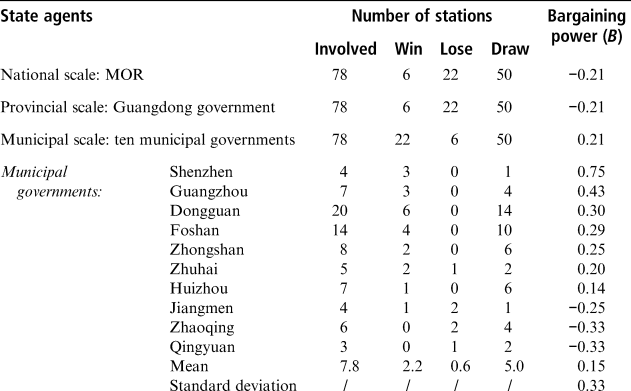
Comparing the bargaining power between scales, municipal governments as a whole (B = 0.21) were more successful than the MOR and the Guangdong government (both with B = −0.21) in bargaining for ICR stations to be sited in their preferred locations (Table 1). This finding contrasts with the common expectation that, as upper-level state agents, the MOR and Guangdong province would prevail in the decision making over the location of railway stations. Planners we interviewed enlightened us on two important reasons for this. First, municipal governments control the land in their jurisdictions. Once there is a plan to run a railway through a city, it is crucial to secure the support of the municipal government in order to acquire the land and approvals needed for the railway development in a timely manner. As an official in Qingyuan argued:
In my opinion, the provincial government has a say (hua yu quan 话语权) over whether a city is connected to the ICRS or not, but the municipal government has a greater say in specific line alignments and station locations. The provincial government can only influence the general direction of a line's alignment. The leverage of the provincial government rests upon macro factors, such as whether it includes [a city] in the ICR, whether it gives policy support [to a city's interests in the ICR], whether it approves the [ICR] project, and the expected benefits from the project … The municipal government has the final say on specific line alignment and station location because the project's implementation must count on local government support. It is impossible to advance the project if there is no local support for land acquisition and demolition, coordination with local agents and planning, supporting facilities and so on.Footnote 37
Bargaining Power of State Agents Involved in the PRD-ICRS

Source:
The authors.
Second, since national and provincial authorities know much less about local circumstances than municipal governments, municipal governments can manipulatively articulate local issues to bargain for their own interests.Footnote 38 Shenzhen's response to the original alignment of the GDSL is a case in point. In the MOR and the Guangdong government's original plan, the GDSL was to connect the urban heartlands of all three developed cities in the Pearl River Delta from which the line earns its name. The Shenzhen government was fiercely opposed to this idea. It claimed that it “really lacks land in the urban area. There is no space for the ICR [to be extended into the city centre, Futian district].”Footnote 39 First, it offered a counter proposal that would cut short the line and terminate it at a remote site near its boundary with Dongguan. It then changed its mind and proposed terminating the line at Shenzhen Airport (Terminal 3).
With this second proposal, the Shenzhen government hoped to kill two birds with one stone. First, it did not want the GDSL to be in competition with Shenzhen's expanding metro system for passengers travelling between Shenzhen's city centre and Shenzhen Airport (Terminal 3). This intention is reflected in the subsequent construction of Shenzhen's Metro Line 11 along the truncated route of the GDSL. Second, the Shenzhen government also hoped that the GDSL would tempt air travellers from Dongguan to use Shenzhen Airport instead of Guangzhou Airport.
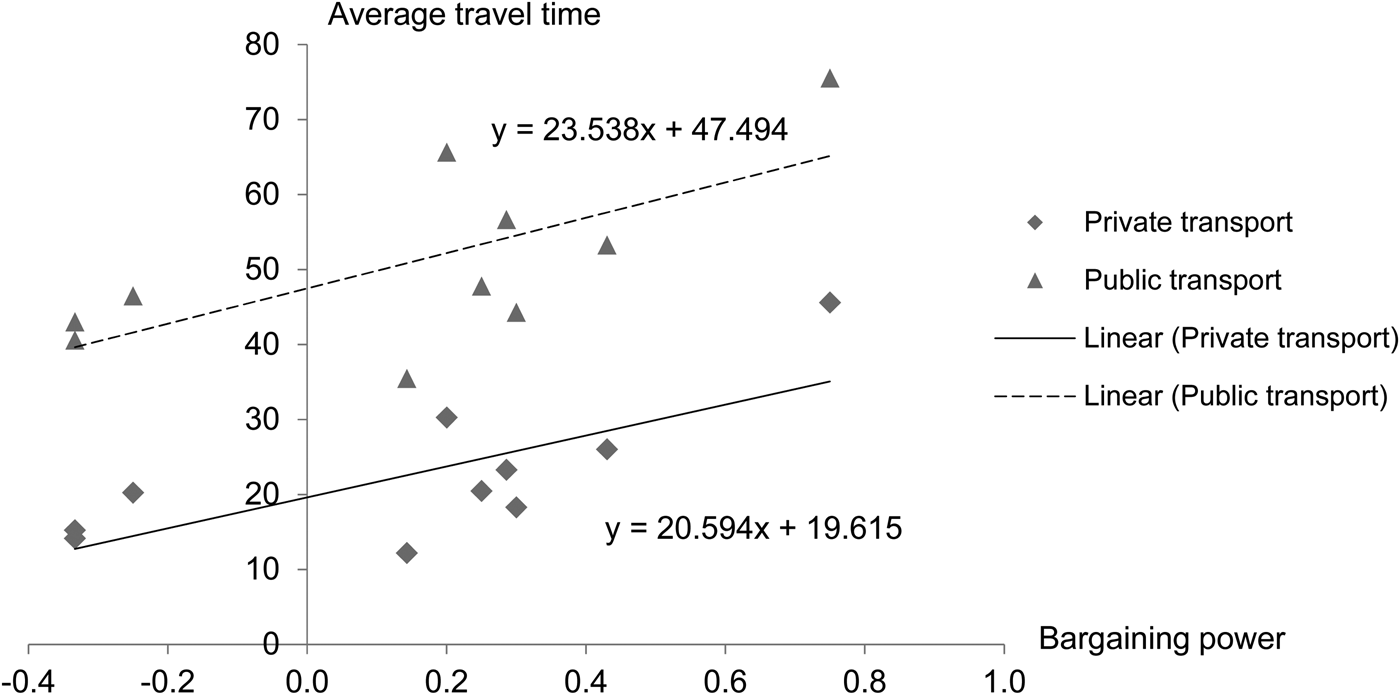
However, if the performance of the ten municipal governments is examined separately, one can observe that some of them are more successful at bargaining than others. The Shenzhen government has the highest bargaining power of all, achieving a B value of 0.75. Three of the four ICR stations in its territory are located according to its preference, while the remaining station reflects a compromise between it and the upper-level authorities. Zhaoqing and Qingyuan shared the last position with the same B value of -0.33. The governments of both cities only achieved partial success in jointly determining the location of two-thirds of their ICR stations with the upper-level authorities, whereas their preferences for the remaining third were not addressed.
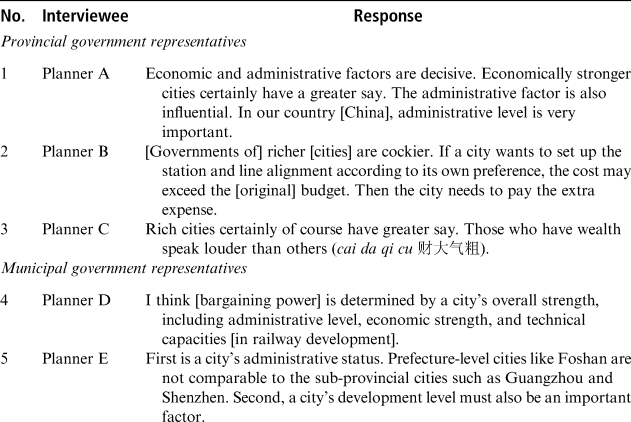
To make sense of this disparity, we asked the following question in our interviews with planners and officials: “what factors determine municipal bargaining power over line alignment and station location in PRD-ICRS planning?” They confirmed that administrative ranking and economic development level are the greatest determinants of bargaining power (Table 2). Consistent with our propositions, governments of cities with higher administrative rank and better economic performance tend to have a greater say in railway planning.
Response (Verbatim) from Interviewees on the Determinants of Municipal Bargaining Power

Source:
Authors’ interviews.
Correlation analysis helps to verify the claims made by these planners and officials about the contributory factors of bargaining power. The cities in the Pearl River Delta are divided into two administrative levels. Guangzhou and Shenzhen have a higher ranking as sub-provincial cities, whereas the other cities are prefecture-level cities. Assigning these two types of cities with the value of 1 and 0 respectively for their administrative status, we calculate that the bargaining power of a municipal government is positively correlated (r = 0.67; p = 0.05) to its city's administrative rank. In terms of economic development level, the bargaining power of a municipal government also bears a strong positive correlation (r = 0.76; p = 0.01) to the per capita GDP of its territory.
Different combinations of bargaining power and station location preferences at the municipal level contribute to various station locations and thus possible distinct spatial impacts. Further investigation of the variation in station accessibility with municipal bargaining power reveals an intriguing phenomenon: municipal bargaining power is positively correlated to the average travel times of a city's urban residents to their nearest ICR station, whether by private (r = 0.74; p = 0.01) or public (r = 0.68; p = 0.05) transport (Figure 3). In other words, ICR stations are less accessible to urbanites living in cities whose governments can bargain more powerfully. This runs counter to the accepted wisdom that the more powerful an agent is, the more benefits – in this case accessibility to ICR services – it secures.
Relationship between Bargaining Power of Municipal Governments and Average Travel Times (minutes) to PRD-ICRS Stations in their Territories
Source:
The authors.

Underlying these observations are the differentiated interests and preferences of the municipal governments. On the one hand, for municipal governments with lower bargaining power, the lower average travel times to ICR stations of urban residents in their jurisdictions are attributable to the willingness of these governments to accommodate ICR development in their urban heartland according to the MOR and Guangdong government wishes. Since less powerful municipal governments tend to have poorer economies, they have a limited budget to support local transport provisions. Poorer municipal governments welcomed the MOR–provincial investment in the ICR lines as it made up for their underinvestment in the transport infrastructure in their cities. There was also the expectation that the ensuing improvement in local commuting capacity and connectivity to the richer cities in the mega-city region would help the poorer cities play economic catch-up.Footnote 40 Meanwhile, the MOR and the provincial government insisted that any additional investment required for changes in line alignment and siting of stations proposed by municipal governments be met by the latter. The prohibitive costs that stemmed from such a proposal discouraged the governments of economically less developed cities, such as Jiangmen and Qingyuan, from opposing the plans for the ICR development in their jurisdictions that were made by higher-level agents.Footnote 41
On the other hand, although municipal governments with greater bargaining power also value the better accessibility brought by the PRD-ICRS, they are less dependent on funding from higher-level authorities for transport development to meet their commuting needs. They can afford to develop their own local railways. As a result, if the MOR–provincial plan did not align with their interests, these municipal governments were more willing to bargain. This involved working against the will of the MOR–province alliance as they insisted on diverting some, if not all, of the ICR stations in their territories to their suburbs, thereby increasing the time it takes for their urban residents to reach the stations.
There are two reasons for municipal governments to bargain in this way. The first one is to maintain their control over local traffic, both in terms of flow patterns and revenue yields. Since the operation of the PRD-ICRS is entrusted to the Guangzhou Railway Corporation, municipal governments in the Pearl River Delta have very little say over ICR service scheduling. This is despite their investment in the construction of the ICR and their financial obligation to shore up any possible operational losses. This contrasts sharply with the situation for subway development, over which the municipal government can exert much greater control. This factor was highlighted earlier in the case of the Shenzhen government's opposition to the GDSL – the municipal government was unwilling to cede the lucrative local passenger flow within the city centre to the PRD-ICRS as a third-party railway system. As another example, the Dongguan government followed suit when it found out that the GDSL's planned alignment in its jurisdiction also overlapped considerably with the city's Subway Line R2, which connects the city centre in the north with southern towns. By withholding construction permits for the GDSL, Dongguan forced the Guangdong government to shift the ICR line westwards to connect several less-developed towns.Footnote 42
The second reason is to promote the development of new growth poles. With highly developed city centres, governments of economically more developed cities may favour diverting ICR lines to suburban areas where development zones and new towns are being constructed. The governments leverage the accessibility and reputational benefits associated with new railways to boost the development prospects of these sites. In Guangzhou, as with the struggle over the terminus of the GFZL, the municipal government objected to the plan to terminate the Guangzhou–Zhuhai Line at Guangzhou Station. It preferred locating the terminus in Guangzhounan Station in the hope that it would stimulate development in the city's new southern economic hub. Being 16 kilometres away from the city centre, Guangzhounan was not acceptable to the Guangdong government and the MOR because of the low passenger flow. However, the two state agents eventually gave way to the public opinion after the Guangzhou government mobilized local state media to highlight the adverse impacts of building another railway line to the very busy Guangzhou Station.Footnote 43
Conclusion
Through the lens of the politics of scale, this paper has investigated how China's railway regime has experienced a fundamental shift, from being a monopolized, national-scaled system to being an open, multi-scalar one, as exemplified by the struggles across multiple tiers of government around railway line alignment and station location. Through comparing the decision-making processes for the siting of each of the 78 stations on the PRD-ICRS's six backbone lines, this paper has demonstrated that the decision making in the railway project has, amid the pressure of a largely administratively and economically decentralized state, evolved from a centralized pursuit at the national level to a negotiation process involving state actors from multiple scales. Specifically, three main sets of conclusions can be made.
First, the rescaling of the Chinese government in the post-reform era has resulted in diversified interests among state agents at different scales in railway planning. In particular, the siting of new railway stations has become subject to intensive interscalar bargaining. As an illustration, in the planning of the PRD-ICRS, both the MOR and the Guangdong government tended to locate the ICR stations in the city centre to capture passenger flow and maximize profits. While the MOR developed this preference owing to investment recovery concerns, the provincial government's priority was for the ICRS to serve as an effective link between populations in different cities in the Pearl River Delta to promote regional integration. Meanwhile, owing to their different levels of economic development and development priorities (see also the third point below), municipal governments demonstrated different locational preferences for the ICR stations in their territories: some wanted stations in the suburbs while others wanted stations in the city centre.
Second, between different scales of governments, the balance of power in railway planning has tilted in favour of the scale which commands the crucial resources for railway development. On the one hand, the MOR's grip on the railway regime was diminished by its lack of capital to fund its ambitious plans to expand China's state railways. As it started forming joint ventures with provincial governments to finance railway construction, it invited challenges to its railway plans – after all, every investor has an opinion about the development of what it invests in. On the other hand, municipal governments are able to exert greater influence over railway planning as they are the de facto owners of land resources, without which railways cannot be built, and because they use their better knowledge of local circumstances to bargain for their interests and preferences to be prioritized over those of the higher-level state units. This is confirmed by the case of the PRD-ICRS, in which municipal governments managed to secure the final say on the final locations of the majority of the stations.
Third, the power of the municipal governments to bargain successfully with state agents at other scales varies with their administrative and economic statuses. In general, municipal governments enjoy greater bargaining power if they are assigned with higher administrative ranks and govern more prosperous economies. In the Pearl River Delta, the Shenzhen and Guangzhou governments top the league for municipal bargaining power as they meet both criteria. It is worthwhile to note that in contrast with accepted knowledge, the bargaining power of a city's government is inversely correlated to its residents’ ease of access to ICR stations. Two economic concerns are pertinent. First, municipal governments in the Pearl River Delta are not in a position to benefit financially from the operation of the PRD-ICRS, because it is entrusted to a MOR-affiliated unit. The municipal governments with greater economic strength – and thus greater bargaining power – have resorted to developing their own subway systems in order to capture the revenue generated by local traffic in the city centre, while attempting to move competing ICR lines to more remote locations. Second, as richer cities spill over into their suburbs, their governments may seek to divert ICR lines to these new growth poles, resulting in higher average travel times to the nearest ICR station for a city's residents.
Our findings on the contentious planning process of the PRD-ICRS offer two broader lessons for the study of Chinese politics, both of which relate to the imperative of discerning differences. First, the accurate assessment of the varying interscalar bargaining powers of local governments hinges upon an appreciation of the contextual idiosyncrasies of local policy preferences. Local governments are not homogeneous entities when it comes to bargaining. What is overwhelmingly viewed as desirable by the general public does not necessarily end up as a priority for the local government. For example, if it was taken for granted that it is economically and socially advantageous for a city to achieve greater railway station accessibility without recognizing the monopolistic interests of the municipal government in subways within its jurisdictions, it is possible to mistakenly view the long travel times to ICR stations in Shenzhen, Zhuhai and Guangzhou as an indicator of the weak bargaining power of their respective municipal governments.
Second, the nature of central–local relations varies not only across localities but also across different policy areas within a locality. While the literature, as reviewed earlier, suggests that the governments of more developed localities respond better to the central government's appeal for more stringent pollution control, this paper instead reveals that they bargain more often against central-level decisions in the development of ICRs. Such competing observations, we argue, reflect the contrasting stakes of the central authorities to local development in different policy areas. In the realm of environmental protection, the richer local governments are eager to align their policies to the central ones because the central government may offer them more policy support as environmental exemplars.Footnote 44 However, in the case of ICR planning, the central railway agency and its provincial allies are in competition with the richer local governments in the intracity railway market. In this respect, a more nuanced understanding of the determinants of the power balance between the Chinese central government and its subordinates could be gained through advancing empirical inquiries of the politics of scale of the Chinese state in more policy areas, as this paper has attempted to do with the railway sector.
Acknowledgements
The authors would like to thank Dr James Jixian Wang from Hong Kong's Greater Bay Area Research Centre for inspiring this research. We also appreciate the insightful comments from the two anonymous reviewers. This research was funded by the Research Grants Council of Hong Kong (project number: CUHK455712) and the Direct Grant for Research 2016–2017, Faculty of Social Science, The Chinese University of Hong Kong (project number: 4052140).
Conflicts of interest
None.
Biographical notes
Mengmeng ZHANG gained her PhD from the department of geography and resource management, The Chinese University of Hong Kong. She is to be a lecturer in the Faculty of Geographical Science, Beijing Normal University. Her research focuses on transport planning, mega-city development and state spaces in China. Previously, she studied in Peking University and worked as a short-term consultant for the World Bank.
Jiang XU is a professor in the department of geography and resource management, The Chinese University of Hong Kong. Her main areas of specialization are in critical urban and regional studies in China. She has received a number of research awards including the Research Output Prize of the University of Hong Kong and the Research Excellence Award of The Chinese University of Hong Kong.
Calvin King Lam CHUNG is an assistant professor in the department of geography and resource management, The Chinese University of Hong Kong. His research focuses on the geographies of state restructuring and the politics of spatial planning in China. His recent works explore the growing environmental dimensions of China's urban and regional planning.
Appendix: Decision Maker(s) of the Locations of PRD-ICRS Stations