


Introduction
In contrast to countries where formal outpatient parenteral antimicrobial therapy (OPAT) programs are well established, OPAT has historically been less commonly implemented in many parts of Asia due to resource constraints, limited infrastructure and specialized teams, and local healthcare and reimbursement structures. Reference Fisher, Michaels and Hase1–Reference Reidy, Breslin and Muldoon4 In August 2025, the National Health Insurance (NHI) of Taiwan officially introduced a reimbursement pathway for outpatient intravenous antimicrobial treatment in clinically stable patients with selected infections. 5 Before this policy, OPAT was reimbursed under the existing outpatient payment structure without dedicated OPAT administration or case management fees. The new pathway added these fees for treatment plans of up to five days initially, which were renewable when clinically required. Existing reimbursement for antimicrobial agents and other medical services remained unchanged. The policy was intended to reduce unnecessary hospitalization or shorten hospital stays, improve hospital bed utilization, and alleviate emergency department crowding. 5 We therefore characterize real-world prereimbursement OPAT practice using our hospital’s preexisting outpatient infusion center as an informal OPAT platform.
Methods
We conducted a single-center observational study at a 303-bed teaching cancer hospital in Taiwan that also provides care for patients without malignancies. Adults with outpatient orders for parenteral antimicrobial therapy from January 1, 2020, to June 30, 2025, were included. The infusion center was available from Monday to Saturday by 6 pm and on Sundays patients received infusions at the urgent care unit/emergency department. No formal OPAT eligibility criteria existed, and treatment decisions were made by treating physicians. Routine infectious diseases (ID) consultation was not required. Selected antibiotics, including teicoplanin, vancomycin, cefepime, piperacillin-tazobactam, carbapenems, and fluoroquinolones, required ID approval. An OPAT case was defined as a course of parenteral antimicrobial therapy for a specific infection indication. Orders targeting the same infection site and pathogen were combined, including antimicrobial switching, temporary hospitalization, or treatment gaps of less than 14 days. A new case was defined by a different infection site or pathogen or a treatment gap of more than 14 days. Patients were excluded for fewer than two doses, prophylactic/topical/irrigation use, a treatment gap of more than 14 days indicating a separate or intermittent treatment case, no documented parenteral prescription, or admission/death within 24 hours of the prescription.
The primary outcome was duration of parenteral antimicrobial therapy, excluding days interrupted by hospitalization, as a measure of the potential to avoid or shorten hospitalization. Secondary outcomes included 30-day clinical improvement, 90-day all-cause unplanned admission, 90-day treatment-related mortality, 180-day loss to follow-up, OPAT clinic visits, positive Clostridioides difficile polymerase chain reaction (PCR) within 90 days, and route- or antibiotic-related complications. Outcome ascertainment was based on manual review. Clinic visits were counted as outpatient encounters regardless of the number of antimicrobial administrations.
Costs were not adjusted for inflation and were converted using 1 NHI point ≈ 0.93 New Taiwan dollars (NTD) and 1 US dollar ≈ 32 NTD. Observed OPAT costs included administration fees (1,031 NHI points for once-daily and 1,234 for more frequent administration), outpatient physician fees, and case management fees (500 NHI points per treatment plan). 5 Hypothetical inpatient costs for the same treatment duration included pharmaceutical service, ward, physician, and nursing fees.
Comparisons between groups with and without malignancy were performed using the Mann–Whitney U test for continuous variables and the χ2 test or Fisher’s exact test for categorical variables. All statistical tests were two-tailed, and statistical significance was defined as P < .05.
Results
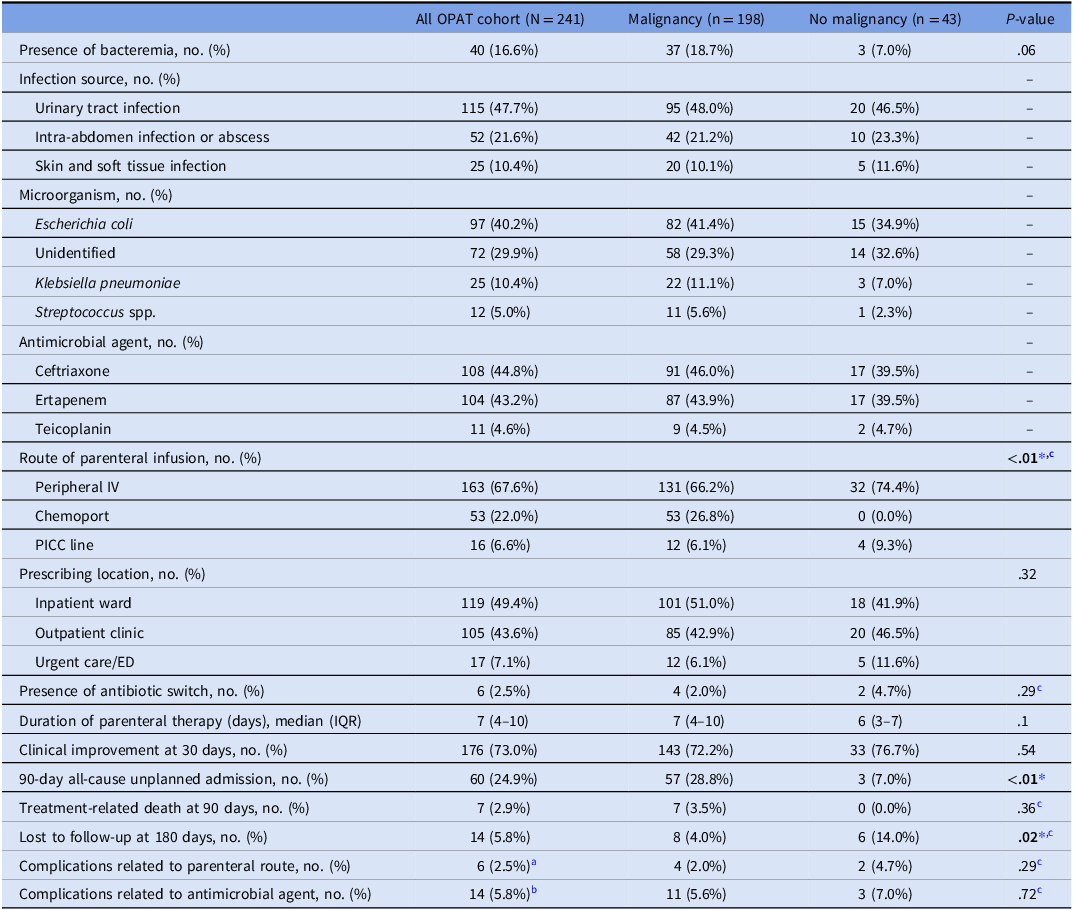
During the study period, 373 antimicrobial orders were analyzed, representing 241 OPAT episodes among 173 unique patients. Among the 173 unique patients, the median age was 64 years and 46.2% were female (Table 1). Malignancy was present in 78.6% of patients. Escherichia coli was the most frequently identified pathogen (40.2%), followed by Klebsiella pneumoniae (10.4%) and Streptococcus species (5%) (Table 2). However, 72 episodes (29.9%) had no identifiable pathogen. Forty cases (16.6%) had concurrent bacteremia. Urinary tract infection (47.7%) was the most common source of infection, followed by intra-abdominal infection or abscess (21.6%) and skin and soft tissue infection (10.4%). Peripheral IVs (67.6%) and chemoports (22.0%) were the most common access routes. Ceftriaxone (44.8%) and ertapenem (43.2%) were the most frequently prescribed antibiotics. Six episodes (2.5%) involved antibiotic switching. Most episodes were initiated from inpatient wards (49.4%) or outpatient clinics (43.6%). The three most frequent prescribing physician specialties were ID (39%), hematology-oncology (21.2%), and internal medicine (12.9%).
Demographic and clinical characteristics of patients receiving OPAT (n = 173)

Table 1. Long description
The table presents demographic and clinical characteristics of 173 patients receiving OPAT. It has 20 rows and 5 columns. The columns are labeled ’All patients’, ‘Malignancy’, ‘No malignancy’, and ‘P-value’. The rows include various characteristics such as the number of patients with OPAT, age, sex, presence of nonmalignancy comorbidity, and specific comorbidities. Row 1: Patients with OPAT, no. (%), 173 (100 percent), 136 (78.6 percent), 37 (21.4 percent). Row 2: Age, median (IQR), 64 (52-72), 66 (56-73), 52 (42-65), <.01. Row 3: Female sex, no. (%), 80 (46.2 percent), 58 (42.6 percent), 22 (59.5 percent), .07. Row 4: Presence of any nonmalignancy comorbidity, no. (%), 118 (68.2 percent), 100 (73.5 percent), 18 (48.6 percent), <.01. Row 5: Comorbidity, no. (%), Mild liver disease, 52 (30.1 percent), 44 (32.4 percent), 8 (21.6 percent). Row 6: Diabetes without chronic complication, 44 (25.4 percent), 36 (26.5 percent), 8 (21.6 percent). Row 7: Peptic ulcer disease, 30 (17.3 percent), 24 (17.6 percent), 6 (16.2 percent). Row 8: Renal disease, 26 (15.0 percent), 22 (16.2 percent), 4 (10.8 percent). Row 9: Chronic pulmonary disease, 24 (13.9 percent), 18 (13.2 percent), 6 (16.2 percent). Row 10: Congestive heart failure, 11 (6.4 percent), 10 (7.4 percent), 1 (2.7 percent). Row 11: Diabetes with chronic complication, 11 (6.4 percent), 9 (6.6 percent), 2 (5.4 percent). Row 12: Cerebrovascular disease, 8 (4.6 percent), 7 (5.1 percent), 1 (2.7 percent). Row 13: Myocardial infarction, 4 (2.3 percent), 3 (2.2 percent), 1 (2.7 percent). Row 14: Peripheral vascular disease, 4 (2.3 percent), 3 (2.2 percent), 1 (2.7 percent). Row 15: Rheumatic disease, 4 (2.3 percent), 2 (1.5 percent), 2 (5.4 percent). Row 16: Moderate or severe liver disease, 4 (2.3 percent), 3 (2.2 percent), 1 (2.7 percent). Row 17: Dementia, 3 (1.7 percent), 2 (1.5 percent), 1 (2.7 percent). Row 18: Hemiplegia or paraplegia, 3 (1.7 percent), 3 (2.2 percent), 0 (0.0 percent). Row 19: HIV/AIDS, 0 (0.0 percent), 0 (0.0 percent), 0 (0.0 percent).
*P value < .05.
Malignancy and comorbidities were considered present if documented by ICD-10 codes during any OPAT case within the study period. Age was defined at the first OPAT case during the study period.
HIV/AIDS, human immunodeficiency virus/acquired immunodeficiency syndrome; IQR, interquartile range; OPAT, outpatient parenteral antimicrobial therapy.
a Malignancy types and percentages (n, %): urologic (30, 22.1%), liver and upper gastrointestinal (29, 21.3%), colorectal (19, 14.0%), lung (16, 11.8%), breast (12, 8.8%), gynecologic (11, 8.1%), head and neck (9, 6.6%), leukemia and lymphoma (6, 4.4%) and sarcoma and connective tissue cancer (4, 2.9%).
Tests used: Mann–Whitney U test for continuous variables and χ2 test for categorical variables.
For non-mutually exclusive variables (comorbidity), no overall p-value was calculated.
Clinical characteristics, antimicrobial treatment, and outcomes of OPAT episodes (n = 241)

Table 2. Long description
The table presents data on clinical characteristics, antimicrobial treatment, and outcomes of OPAT episodes for 241 cases. It is divided into three main columns: All OPAT cohort (N = 241), Malignancy (n = 198), and No malignancy (n = 43), with a P-value column indicating statistical significance. Row labels include presence of bacteremia, infection source, microorganism, antimicrobial agent, route of parenteral infusion, prescribing location, presence of antibiotic switch, duration of parenteral therapy, clinical improvement at 30 days, 90-day all-cause unplanned admission, treatment-related death at 90 days, lost to follow-up at 180 days, complications related to parenteral route, and complications related to antimicrobial agent. Each row provides percentages or counts for each category. Notable trends include higher percentages of bacteremia and urinary tract infections in the malignancy group compared to the no malignancy group. Peripheral IV is the most common route of parenteral infusion across all groups. Ceftriaxone and ertapenem are the most frequently prescribed antimicrobial agents. The table also shows that most episodes were initiated from inpatient wards or outpatient clinics. Clinical improvement at 30 days is high across all groups, while 90-day all-cause unplanned admission rates are lower in the no malignancy group.
* P value < .05.
Microorganisms were reported at the case level and represented clinically relevant pathogens identified from cultures obtained during routine care. Specimen-source stratification was not performed.
For non-mutually exclusive variables (infection source, microorganism, and antimicrobial agent), no overall p-value was calculated.
CNS, central nervous system; ED, emergency department; OPAT, outpatient parenteral antimicrobial therapy; IQR, interquartile range; PICC, peripherally inserted central catheter.
a Specific complications included three cases of allergy around the IV site, two cases of PICC line infection with associated bacteremia, and one case of clinical worsening within 3 days of intra-muscular therapy.
b Specific complications included six cases of allergy and two cases each of diarrhea, generalized weakness, candidiasis, and acute kidney injury.
c Indicates Fisher’s exact test.
Tests used: Mann–Whitney U test for continuous variables and χ2 test for categorical variables.
Median parenteral antimicrobial duration was 7 days. Clinical improvement occurred in 176 episodes (73.0%) at 30 days, while 60 (24.9%) had unplanned admission and 7 (2.9%) had treatment-related death within 90 days. Fourteen episodes (5.8%) were lost to follow-up at 180 days. The mean number of OPAT clinic visits was 1.5; five episodes (2.1%) had positive C. difficile PCR results, and route- and antibiotic-related complications occurred in 2.5% and 5.8%, respectively.
After excluding six patients treated for late latent syphilis that required only three weekly penicillin injections, 235 episodes were included in the cost analysis. In the base-case analysis assuming that all OPAT days substituted for inpatient hospitalization, the observed OPAT cost was 2,845,748 NHI points (administration/procedure, 2,378,662; case management, 304,000; physician fees, 163,086), whereas the estimated inpatient cost was 3,953,588 NHI points (pharmaceutical service, 225,522; ward, 1,211,896; physician, 651,508; nursing, 1,864,662) (Supplementary Table 1). Under 100%, 70%, and 50% inpatient-displacement assumptions, the modeled economic differences were 1,107,840 (4,714 points per case; approximately US$137 per case), −78,236, and −868,954 NHI points, respectively. The break-even inpatient displacement proportion was approximately 72%.
Discussion
This study characterizes real-world OPAT practice before NHI reimbursement in Taiwan and provides insight into a hospital infusion center-based model in an oncology-predominant population, including infections beyond those currently covered by the national reimbursement scheme. OPAT implementation in Taiwan may differ from international models because of the local NHI reimbursement system, relatively low inpatient costs, limited home-infusion infrastructure, and accessible hospital-based outpatient infusion services. Reference Tan, Ho and Hsu6
While 16.2% of ED-initiated OPAT patients in Taiwan were treated for unspecified diagnoses, Reference Chen, Huang, Wang, Chan, Chan and Su7 29.9% of our cases had unidentified pathogens, suggesting that empirical treatment is common in Taiwan’s OPAT. The relatively high use of ertapenem likely reflected its once-daily dosing convenience and antimicrobial susceptibility results or other clinical considerations. This highlights the need for stewardship review and monitoring, Reference Norris, Shrestha and Allison8,Reference Muldoon, Snydman, Penland and Allison9 particularly after the introduction of national reimbursement may lower barriers to outpatient IV therapy.
A prior study found that most antibiotic switches were due to adverse drug events and were managed outpatient without hospitalization. Reference Lee, Tam and Weigel10 In our study, low rates of antibiotic-related and intravenous access complications may have contributed to the low frequency of switching, while limited oral antibiotic options may also have played a role.
This study provides a real-world description of OPAT practice in a complex oncology setting. The cost analysis was based on prereimbursement practice and was not restricted to the eligibility criteria of the current NHI OPAT reimbursement pathway. Under this framework, OPAT would reduce estimated costs when at least 72% of treatment days represent avoided hospitalization. Limitations include retrospective design, single cancer-center setting, case-level analysis without clustering, lack of a comparator group, lack of systematic categorization of unplanned admission causes, lack of antimicrobial susceptibility data, uncertain administration location and whether all ordered doses were actually administered, and simplified cost assumptions.
Future studies should evaluate clinical and economic outcomes after implementation of the National Health Insurance reimbursement program.
Supplementary material
The supplementary material for this article can be found at https://doi.org/10.1017/ash.2026.10938.
Acknowledgements
The authors would like to thank Pei-Chen Hung and Chia-Li Lin from the Business Department for providing the cost analysis results for this study.
Author contributions
KC and AF conceptualized the study. KC, MH, CC, HC, and CT conducted data collection. KC, YLo, YLn, and AF analyzed the data. KC, YLo, YLn, and AF worked on writing the manuscript. All authors approved the final manuscript. All authors meet the ICMJE authorship criteria.
Financial support
None.
Competing interests
None.
Ethical standard
The study was approved by the Institutional Review Board of the Koo Foundation Sun Yat-Sen Cancer Center (approval no. 20250926A), with a waiver of informed consent.
Research transparency and reproducibility
The data that support the findings of this study are available from the corresponding author upon reasonable request, subject to institutional and ethical restrictions.
Declaration of AI and AI-assisted technologies in the writing process
During the preparation of this work, the authors used Gemini and ChatGPT to improve readability and language. No original material was created by AI technologies. The authors reviewed and edited the content as needed and take full responsibility for the content of the publication



 Open access

