


Introduction
It has long been hard to find consensus on a definition of ‘awareness’ both within and outside psychological therapy (Merikle, Reference Merikle1984; Leow et al., Reference Leow, Johnson, Zárate-Sández, Sanz and Leow2011). Indeed, the boundaries with ‘consciousness’ and ‘attention’ are often unclear. Yet, for the sake of simplicity, we will use these terms interchangeably, and we take a pragmatic clinical approach by referring to the immediate phenomenological experience of a client, which they may, or may not, be willing or able to put into words and describe (e.g. Mehling et al., Reference Mehling, Wrubel, Daubenmier, Price, Kerr, Silow and Stewart2011). It is commonly recognized that psychological change appears to be enhanced by sustained present moment awareness (Stern, Reference Stern2004). Such a principle underlies existential-humanistic psychotherapy (Bugental, Reference Bugental1999; Brack and Bugental, Reference Brack, Bugental and Kaslow2002), psychodynamic-interpersonal therapy (Moorey and Guthrie, Reference Moorey and Guthrie2003), mindfulness training (Fissler et al., Reference Fissler, Winnebeck, Schroeter, Gummersbach, Huntenburg, Gaertner and Barnhofer2016), emotion-focused therapy (Geller and Greenberg, Reference Geller and Greenberg2012) and arguably, the process of exposure during behavioural therapies (Carey, Reference Carey2011). Indeed, a range of psychological therapies are directly involved in helping clients to gain more control over how to direct and sustain their awareness. Examples include mindfulness-based cognitive therapy (Moore and Malinowski, Reference Moore and Malinowski2009), attentional training (Wells, Reference Wells2007) and attentional bias modification (Hakamata et al., Reference Hakamata, Lissek, Bar-Haim, Britton, Foz, Leibenluft and Pine2010). Considering this central role of awareness as a key construct in psychological change, it is crucial to research methods of capturing these aspects of therapy ‘live’ as they happen.
It is suggested that research into any change mechanism should be grounded in theory and aimed at the development of tools for identifying key constructs (Kazdin, Reference Kazdin2007; Lutz and Hill, Reference Lutz and Hill2009; Nock, Reference Nock2007). Unfortunately, although most of these therapeutic approaches highlight the role of client’s awareness in effective psychotherapy, the majority of them do not provide explanation for the underlying core mechanisms of change. In order to examine the face-validity of various therapeutic methods it is important to define the theoretical aims first. Instead of examining each therapy separately, it might be important to examine an integrated theoretical explanation for their effectiveness. In fact, literature suggests that ‘common factors’ and transdiagnostic principles might be responsible for the therapeutic effects of different therapies (Alsawy et al., Reference Alsawy, Mansell, Carey, McEvoy and Tai2014; Barlow et al., Reference Barlow, Allen and Choate2004; Craske, Reference Craske2012, Harvey et al., Reference Harvey, Watkins, Mansell and Shafran2004; Mansell, Reference Mansell2005, Mansell, Reference Mansell2008, Mansell, Reference Mansell2009; Mansell et al., Reference Mansell, Harvey, Watkins and Shafran2009, Mansell, Reference Mansell2011, McHugh et al., Reference McHugh, Murray and Barlow2009, McManus et al., Reference McManus, Shafran and Cooper2010; Norton and Paulus, Reference Norton and Paulus2016; Taylor and Clark, Reference Taylor and Clark2009). Perhaps, change process happening in different therapeutic approaches can be explained by one theory that provides a scientifically grounded explanation for the role of awareness. Although currently there is no consensus on a theory that can integrate various therapeutic methods, the emerging literature puts forward Perceptual Control Theory (PCT) as a promising and well-researched model (Alsawy et al., Reference Alsawy, Mansell, Carey, McEvoy and Tai2014; Higginson et al., Reference Higginson, Mansell and Wood2011).
PCT (Powers, Reference Powers1973) proposes that psychological distress is loss of control, and so psychological interventions should be aimed at helping clients to re-establish control. Restoring control occurs via the process of comparison in a closed loop, i.e. the person’s goals or desired states are compared with current goals/states and action is taken to reduce the difference. Any experienced internal conflict (e.g. having two contradicting goals at the same time) results in psychological distress. The process responsible for resolving conflict is known as reorganization. Reorganization is an in-built mechanism that triggers random changes in the person’s hierarchy of goals (Powers, Reference Powers1973). However, importantly to the context of the current paper, the location of the person’s awareness plays a role in how effective reorganization is in resolving conflict.
According to PCT, it would not be sufficient for a client to improve the control over their awareness per se. To facilitate effective change, the client’s awareness needs to be directed to the source of goal conflict and sustained there long enough for reorganization to occur. Each person has a personal hierarchy of goals. The goals at the top of the hierarchy set reference signals for the levels below. A distressing problem is theorized as involving at least three levels. The experience of the problem itself is at the lower level (e.g. ‘feeling anxious and indecisive’); the goals in conflict at the middle level (e.g. ‘wanting to perform perfectly but not wanting to be ridiculed’; the client may be aware of just one of these being a ‘problem’ or aware of both in conflict), and the higher-order goals driving the conflict at the higher level (e.g. ‘to be socially accepted’). From a PCT point of view, if reorganization occurs at the lower level of the hierarchy with no consideration of the involved higher-level goals, this might not produce a lasting reduction in psychological distress (as the chronic conflict at higher-level in the hierarchy would persist). Therefore, according to PCT, effective psychotherapy should involve directing the client’s awareness into higher-order goals and sustaining it there long enough so that reorganization can occur at the source of goals conflict.
The principles of PCT have been directly applied to inform novel psychological interventions, most importantly a form of one-to-one cognitive therapy known as Method of Levels (MOL; Carey, Reference Carey2006). MOL is a psychotherapy that uses brief, but regular, curious questioning to help clients to openly talk about their problem. To answer the therapist’s questions, the client directs awareness towards various aspects of their problem and attends to any fleeting thoughts, images, or feelings. To assist their clients in shifting their awareness to important personal goals the therapist enquires about background thoughts by regularly asking about disruptions in the client’s speech, such as pauses, emphasizing certain words, affect changes, and eye movements. In line with PCT, to facilitate effective change in MOL therapy, the client’s awareness needs to be directed to the source of goal conflict and sustained there long enough for reorganization to occur. Evidence is emerging that MOL is associated with large effect sizes for reduction in distress and that it may be more efficient than benchmarked therapies (Carey et al., Reference Carey, Tai and Stiles2013; for a review, see Alsawy et al., Reference Alsawy, Mansell, Carey, McEvoy and Tai2014).
MOL is a direct application of transdiagnostic and transtheoretical concepts offered by PCT. Still, the functional role of awareness in aiding natural in-built mechanisms for restoring control is relevant to any form of psychotherapy, regardless of whether or not it was informed by PCT. With this in mind, even though this article might be of particular interest to people interested in PCT and MOL, we believe it might also offer an insight to researchers and therapists interested in the concept of awareness and the mechanisms of change in psychotherapy. The objectives of the current paper are to (1) examine the ‘depth’ and ‘duration’ of awareness occurring in three clients of an expert MOL therapist, and (2) to construct a detailed visual representation of these clients’ presumed focus of awareness. We regard this exercise as a source of evidence for future research, and a training tool for scrutinizing the hypothesized effects of MOL. Considering the above aims would allow us to examine the face validity of the theoretical foundations of therapy and to test the feasibility of produced visual representation catching the dynamic process of clients’ shifts in awareness.
To code the MOL sessions and produce visual plots, we used the Depth and Duration of Awareness Coding Scheme (D-DACS, Higginson and Mansell, Reference Higginson and Mansell2016). A detailed description of how D-DACS was developed and the preliminary investigations of the psychometric properties were previously described by Higginson and Mansell (Reference Higginson and Mansell2016, Reference Higginson and Mansell2018). Below we outline the basic elements of the coding scheme to help the reader have a sufficient understanding of the measured concepts, yet to understand the theoretical foundation of this study it might be necessary to refer to the above literature.
D-DACS is an observer-coding scheme shaped by principles of PCT, which aims to infer the current focus of awareness and its duration at each of the components of goal conflict described above. ‘Depth of awareness’ is coded at four ascending levels starting from perceptual experiences, further through awareness of arbitrary control, followed by focus on goal conflict, and finally the awareness of involved higher-order goals. This follows from PCT and MOL, where better awareness of the conflict and higher-level goals driving the conflict is considered important in restoring control. The problem is experienced at the lower-level in the form of perceptual experiences (e.g. feeling anxious). With better understanding of these experiences, the person might become aware of the problem and make arbitrary attempts at resolving it, but not being fully aware of the involved conflicting goals. However, to be able to resolve the issue, they might need to become aware of the conflicting goals, hence goal conflict is higher than arbitrary control. Finally, becoming aware of the involved higher-level goals driving the conflict, is considered as the highest level of awareness of the problem, which can be fruitful in triggering natural processes of change. Assuming the above described role of sustained awareness on these areas in triggering reorganization, the ‘duration of awareness’ is represented by three ascending levels starting from ‘fleeting’ awareness, through ‘sustained’ awareness, to ‘potential reorganization’.
Considering that only the client might know where their attention is at any one time, it would seem highly impractical to require them to report on and measure the duration of this attention using the conceptual framework of PCT. For this reason, D-DACS was developed as an observer-coding scheme. One might regard the coding process as taking the ‘current temperature’ which is indicative of the psychological processes occurring within the individual, but clearly not a direct measure. It has been highlighted that observer-based measures might be advantageous over clients’ self-report (Doss, Reference Doss2004). The available measures focused on observer-rated within-session processes involved in therapeutic change have been reviewed by Higginson and Mansell (Reference Higginson and Mansell2016). Consistently with the content of the current article, the findings suggested that a number of these measures perceive a change in person’s awareness and how the content of awareness is experienced as key processes. However, no previous measures included a way of capturing and visualizing moment-to-moment changes in a client’s awareness. Producing a visual representation of a client’s awareness would allow a test of the feasibility of the given coding scheme and further examine validity of its underlying theoretical foundations. This would offer a more practical and scientifically grounded examination of a therapy session and the related theory, compared with schemes relying only on a static snapshot or overall statistic. Therefore, in the current study, apart from directly applying D-DACS to code the expert MOL therapy sessions, we attempted to present the coded therapy sessions in a visual way to examine the potential benefits and limitations of such a method of condensing complex patterns of clients’ awareness into ‘one view’.
In line with the theoretical foundation set by PCT and the clinical goals of MOL, the focus of the coding and visualizing is to capture how long the clients focused on different areas of D-DACS, and to capture the shifts to and between different areas of D-DACS. Capturing the role of therapy in helping the client shift their attention to D-DACS areas and sustain their awareness on these areas is consistent with the first goal of MOL (i.e. to help the client talk about the problem). In line with PCT, sustaining their awareness on D-DACS areas might trigger ‘shifts’ in their awareness towards involved higher-level goals. These shifts (but also other shifts) are usually externally manifested in a client’s body language, speech or facial expressions. Therefore, the second goal of MOL (i.e. to enquire about disruptions) helps to bring these higher-level thoughts into the forefront of the client’s awareness. Thus, this whole process of shifting awareness to D-DACS areas, sustaining the awareness on these areas, and further shifting awareness to higher-level goals, are considered theoretical aims of therapy which might trigger further ‘shifts’ to potential reorganization as a process of change. Future research might help to directly investigate each of these processes. For example, using the herein applied method for coding and visualizing might help to investigate the role of asking about disruptions in triggering shifts to higher-order goals. However, the purpose of this study is to test the coding, and introduce a method for visualizing the client’s awareness, to examine its initial feasibility. Effective therapy would involve the majority of the session with the focus on D-DACS areas regardless if it is achieved by constantly shifting the attention to these areas or by maintaining the awareness on one of these areas for a longer period of time. Shifting the attention to D-DACS areas and/or sustaining the awareness on D-DACS areas, is expected to produce change that might be visible on the visual graph. For example, multiple shifts in awareness at lower levels of hierarchy, or a long period of time spent on one of these areas might be followed by a shift in awareness to ‘higher-order goal’, or to ‘potential reorganization’. Thus, the particular interest of the visualization is to capture the moments where the client’s awareness shifts towards the right-hand side and the top of the graph, as this would suggest a gradually increased awareness of areas representing conflicting goals, higher order goals, and potential reorganization.
Method
Design
The study involved coding publicly available videos of therapy using an earlier validated scheme and presenting visual displays of these codes to examine for their face validity.
Participants
The study did not directly involve the recruitment of participants. The video recordings were used of three males who volunteered to participate in MOL therapy session recordings published online. The authors of the current paper did not have direct contact with these clients, and hence no other demographic characteristics are known.
Materials
Video recordings
The study used three publicly available video recordings of the MOL therapy. The length of each video in minutes and seconds was as follows: 33:06, 9:42, 1:03:10. These sessions were delivered by Professor Tim Carey, the leading developer of MOL therapy. Tim is a clinical psychologist with background in cognitive behavioural therapy, who worked closely with William T. Powers to apply the principles of PCT to the understanding of psychological functioning and development of effective psychotherapy using a MOL approach. As a part of dissemination and training of MOL, Tim published these videos as examples of a MOL session. The videos are publicly available online under the following links:
Client 1: http://livingcontrolsystems.com/mol/mol_videos.html
Client 2: https://youtu.be/2ybjheDrTrA
Client 3: https://youtu.be/-mPlKFIR8RM
D-DACS
The sessions were coded using the Depth and Duration of Awareness Coding Scheme (D-DACS; Higginson and Mansell, Reference Higginson and Mansell2016). A detailed description of the coding scheme and the underlying principles has been described elsewhere (Higginson and Mansell, Reference Higginson and Mansell2016, Reference Higginson and Mansell2018). In a nutshell, D-DACS is an observer-rated coding scheme designed to indirectly measure within-session shifting in awareness coded on two orthogonal dimensions representing the ‘depth of awareness’ and ‘duration of awareness’. It was designed to attempt to code what is in the forefront of the client’s awareness, that they are able to ‘hold on to’ and put into words, rather than the brief awareness of background thoughts that might be sensed by the observer as disruptions. The depth of awareness describes the client’s shift towards four different components of their difficulties in ascending ‘depth’: (1) present moment perceptual experience, (2) arbitrary control, (3) goal conflict, and (4) higher order goals. Clients’ duration of awareness involves three subcategories of (a) fleeting awareness, (b) sustained awareness, and (c) potential reorganization. Each occurrence of the shift in awareness is coded within one of the possible twelve primary measures of awareness represented by a number and letter representing the categories of both dimensions. The parts of the session with attention not directed at any of these areas remain not coded. The definition of each category and the corresponding codes as described in the D-DACS manual (Higginson and Mansell, Reference Higginson and Mansell2016) is presented below.
The depth of awareness:
1. Present moment perceptual experience – an awareness of a present moment perceptual experience. This may occur in sensory modalities (thoughts, images, memories, feelings emotions and physiological experiences).
2. Arbitrary control – an awareness of ‘doing something’ (e.g. a mental process, action, or pursuing a goal), which they recognize is arbitrary, inflexible or causes difficulties in relation to the problem. It includes processes engaged in too much or those that would be helpful but not carried out sufficiently. It is a paradox of control that any activity that we are involved in has the potential to interfere with goals that we might hold, but we may be unaware that this is going on at the time. For example, worrying may increase fears of ‘losing one’s mind’. We coded arbitrary control when it appeared that the client was aware that this activity was creating significant problems (blocking at least one important goal) but there was no mention of the purpose of this activity (the other side of the goal conflict).
3. Goal conflict – to fit this category, the client’s utterance needed to show evidence of being simultaneously aware of two incompatible, opposing or contradictory goals, thoughts, moods or emotions. For the worry example, they might describe both the reasons for worrying (e.g. ‘to be better safe than sorry’) and the reasons for not worrying (e.g. ‘to be normal’).
4. Higher order goals, values or ideals – this category is used when the client becomes aware of an important goal, value or ideal which relates to their sense of self or the kind of person they want to be, which the client appears to experience no internal conflict about (e.g. ‘I want to be a good dad’).
The duration of awareness:
a. Catching disruptions or fleeting awareness – the client expresses an awareness of a disruption in their flow of dialogue and briefly comments on this. We did not code for disruptions that the client did not notice themselves and verbalize. Alternatively, in the development of their dialogue the client verbally expresses something they become aware of at that moment, however, awareness is fleeting and not sustained, and the client demonstrates limited awareness of any significance.
b. Sustained awareness – the client sustains their awareness on and provides further description of the content of their awareness. The client expresses awareness of the significance of this as indicated by the quality or manner in which the client expresses this or by the amount of time the client sustains awareness on it.
c. Potential reorganization – the client appraises, considers changing, or experiences a transformation in his/her experience of the content of awareness. This may be indicated by choosing new ways of expressing a perceptual experience, process, conflict or goal. The novel facet of reorganization is indicated by what the client says, by the expression of a felt sense that things are better understood or by an accompanying shift in emotional tone.
Codes:
1a – catching a disruption or fleeting recognition of a present moment perceptual experience.
1b – sustained awareness on a present moment perceptual experience.
1c – evaluating and reorganizing a perceptual experience.
2a – catching a disruption or fleeting recognition of control/lack of control and processes related to this.
2b – sustained awareness on control/lack of control and processes related to this.
2c – evaluating and reorganizing arbitrary/inflexible process.
3a – catching a disruption or fleeting recognition of conflict.
3b – sustained awareness on explicit conflict.
3c – evaluating and reorganizing conflict.
4a – catching a disruption or fleeting recognition of a higher-order goal, value or ideal the client is not in conflict over.
4b – sustained awareness on a higher-order goal, value or ideal the client is not in conflict over.
4c – evaluating and reorganizing a higher-order goal, value or ideal.
Graphs
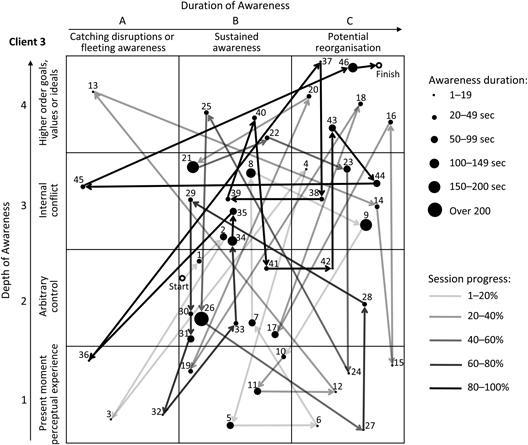
Graphs were used to demonstrate a whole therapeutic session in one view, making it easier for the viewer to observe potential shifts in awareness throughout the session. The graph structure is based on the D-DACS. Hence it involves two orthogonal dimensions with the duration of awareness on the x-axis and the depth of awareness on the y-axis. Each code is placed on the graph with arrows presenting the shift of awareness from one code to another. The duration of sustained awareness on the given code is represented by the size of the dot; i.e. the bigger the dot, the longer duration of sustained awareness. Six dot sizes are used with the following ranges (1–19 s, 20–49 s, 59–99 s, 100–149 s, 150–200 s, over 200 s). The progress of the session from start to finish is shown by the shade of the drawn arrow with five grades as follows: 1–20%, 20–40%, 40–60%, 60–80%, 80–100%.
Procedure
The selected video recordings of the MOL sessions were used alongside the transcripts. The coding procedure was based on the one originally used by Higginson and Mansell (Reference Higginson and Mansell2016) and adapted to meet the aims of the current study. The recordings and the corresponding transcriptions were used as many times as required by the first coder to allow for identification of the areas of the text representing possible codes. The first coder highlighted the text on the transcript capturing the client’s awareness on one of the twelve areas represented by the codes. A decision to highlight the passage of text was based on the coder’s knowledge of PCT and D-DACS, observation of the video, and their judgement on whether a specific area of D-DACS was put into words by the client. At this stage, the document contained only highlights of the text with no information on the code.
In the first stage of coding, both coders independently decided on the code for the highlighted areas by use of twelve categories of awareness and added the code on the transcript together with a short rationale for their decision next to the code. Importantly, when making these decisions, they tried to avoid interpreting client’s words but rather focused on what was on the forefront of the client’s awareness, i.e. the focus of awareness that the client has explicitly put into words. On completion, the raters’ agreement (stage 1) was calculated, and the first coder compared the differences between codes. If both coders used the same code for the highlighted text, this was agreed to be the final code for the given occurrence of awareness. However, if the code was different, considering the provided rationale by both coders, the first coder decided which code better represented the client’s awareness. The coder was watching parts of the video recordings again if this was necessary to make such decision. Consequently, on completion of final code for each occurrence, a rationale for the decisions made was written next to the code.
In the next stage, the full document with both coder’s original codes and proposed final codes for each occurrence was shown to the second coder. If the second coder agreed with the decisions made the code was assumed to be final; however, on disagreement they provided a further rationale and reasons why their original code should be used. The raters’ agreement was measured again (stage 2). At this stage, if the first coder agreed with the proposed changes, the codes were finalized, and any remaining disagreements were resolved verbally. In the final stage, both coders analysed the completed coding and verbally discussed whether any changes were needed such as combining two codes into one, separating one code into two, removing a code, or extending/shortening the highlighted text. Examples of the highlighted passages of text and a description of rationale for the given code are presented in Table 1. All highlighted areas of text were also time-measured, and the duration of time spent on the given code was written next to the highlighted text. Based on the final codes, the visual representation of all three sessions was prepared.
Examples of the highlighted parts of the transcript (in bold) with the corresponding code

Results
Raters’ agreement
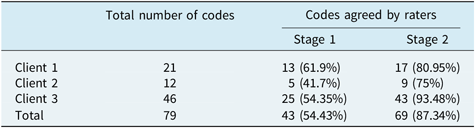
The raters’ agreement at the corresponding stages of coding for all three clients are presented in Table 2. The initial raters’ agreement ranged from 41.7 to 61.9% at the first stage, and from 75 to 93.48% at the second stage of coding. The mean agreement was 54.43% at the first stage and 87.34% at the second stage.
The raters’ agreement for coding of each of the sessions for the three clients

Total occurrences and time spent with awareness on D-DACS categories
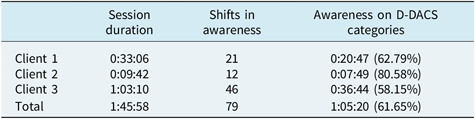
The number of occurrence of shifts in depth of awareness and duration of time spent on D-DACS categories for all three clients is presented in Table 3. Due to the varying length of the MOL session for each client, the number of shifts in depth of awareness significantly varied between clients with the mean number of 26.3 shifts per session. As presented in Table 3, the percentage of the session with the clients’ attention on the categories of D-DACS ranged from 58.15 to 80.58%, averaging at 61.65% per session. The detailed description and statistics regarding occurrences for each D-DACS codes and the total duration of time spent on each of the twelve categories would be outside the scope of this paper, but more information is provided as a supplementary table (see Supplementary Material).
Occurrence of shifts in depth of awareness and duration of time spent on D-DACS categories for all three clients

Visual graphs and session descriptions
Client 1
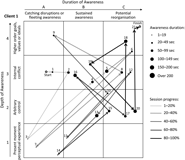
The client attended the session with a clear dilemma he wanted to explore, i.e. trying to decide whether he should move back to Ireland or continue his life in Scotland, which was coded as a conflict, beginning as fleeting (#1) and sustaining over a minute (#2). This discussion of the two alternative choices was followed by the client imagining his parents telling him ‘what to do’ after he moved back to Ireland, which was coded as a fleeting present moment perceptual experience (#3):
‘The first thing that comes into my head is rather than having the parents just telling you what they think you should be doing over the phone, that you’ll actually be there, and they’ll be telling you what you should be doing right in front of them.’
The session returned to the discussion of the conflicting goals (#4). The client spent a longer period on re-framing the reasons for going back to Ireland, as the factors against this decision. Considering the client’s attention shifted from just describing the conflict to evaluation and modification of some of the thoughts, this was coded as potential reorganization of conflict (#5). Continued catching of background thoughts by the MOL therapist was followed by the client’s feeling of guilt when talking negatively about Ireland. He started evaluating his sense of identity:
‘I just think well you’re Irish and you should be proud of it, but I don’t you know… I’m not particularly … proud of it … I guess [Therapist: Proud of being Irish?] I am in a way but … you know … I left Ireland.’
Considering the client was trying to figure out whether he was proud of being Irish, this was coded as a potential reorganization of higher order goals (#6). This was followed by a few shifts in awareness towards aspects of the problem resulting in becoming aware of important values, i.e. not wanting to bring up his children in Ireland (#9). The realization that he had poor knowledge regarding the current state of Ireland was a new perspective with some conflicting goals and therefore was coded as reorganization of conflict (#12). This was followed by a discussion about not liking uncertainty/unknown and for these reasons engaging in the processes of planning. Due to the client’s awareness of the problematic nature of planning but limited insight (no explicit awareness of any contradicting goals about it) this was coded as arbitrary control (#13). The client further evaluated the process of planning with new perspective emerging (coded as reorganization; #15):
‘Maybe the planning is what I need to be doing and that’s what I’m not doing which sounds just so stupid now.’
Subsequently, the client discussed conflicting ideas about planning, i.e. whether or not planning is helpful. This was coded as sustained awareness of conflict (#16) because both sides of the conflict were at the foreground of awareness. Further changes in perspective and re-framing some planning as worrying, and identifying differences between planning and worrying, were coded as reorganization of arbitrary control (#17), as it was showing a change of perspective about something the client is distressed about, but with no full awareness of any underlying conflict. The conversation shifted to the client evaluating self-identification as a worrier and realizing he did not want to be one; this was coded as potential reorganization of a higher-order goal as the client was developing a new perspective on himself as a person (#18). The client then identified conflicting goals about worrying, which the coders coded as internal conflict (#19):
‘I seem stuck in something it’s like you know I’m troubled about worrying, but I don’t think I worry enough.’
Shortly following this, the client realized that he could function well when worrying and reported a further insight that he might have been worrying about the wrong things. Coders treated this occurrence as reorganization of arbitrary control because this was a new perspective on the unhelpful aspects of the process of worrying he engaged in (#20). The session ended with the client realizing how the worrying could help him achieve important goals about the kind of person and the kind of dad he would like to be, which from the coders’ perspective was a new insight involving personally important goals and therefore it was coded as reorganization of higher-order goals (#21). The visual representation of this client’s shifts in awareness throughout the therapy session is presented in Fig. 1.
Client 2
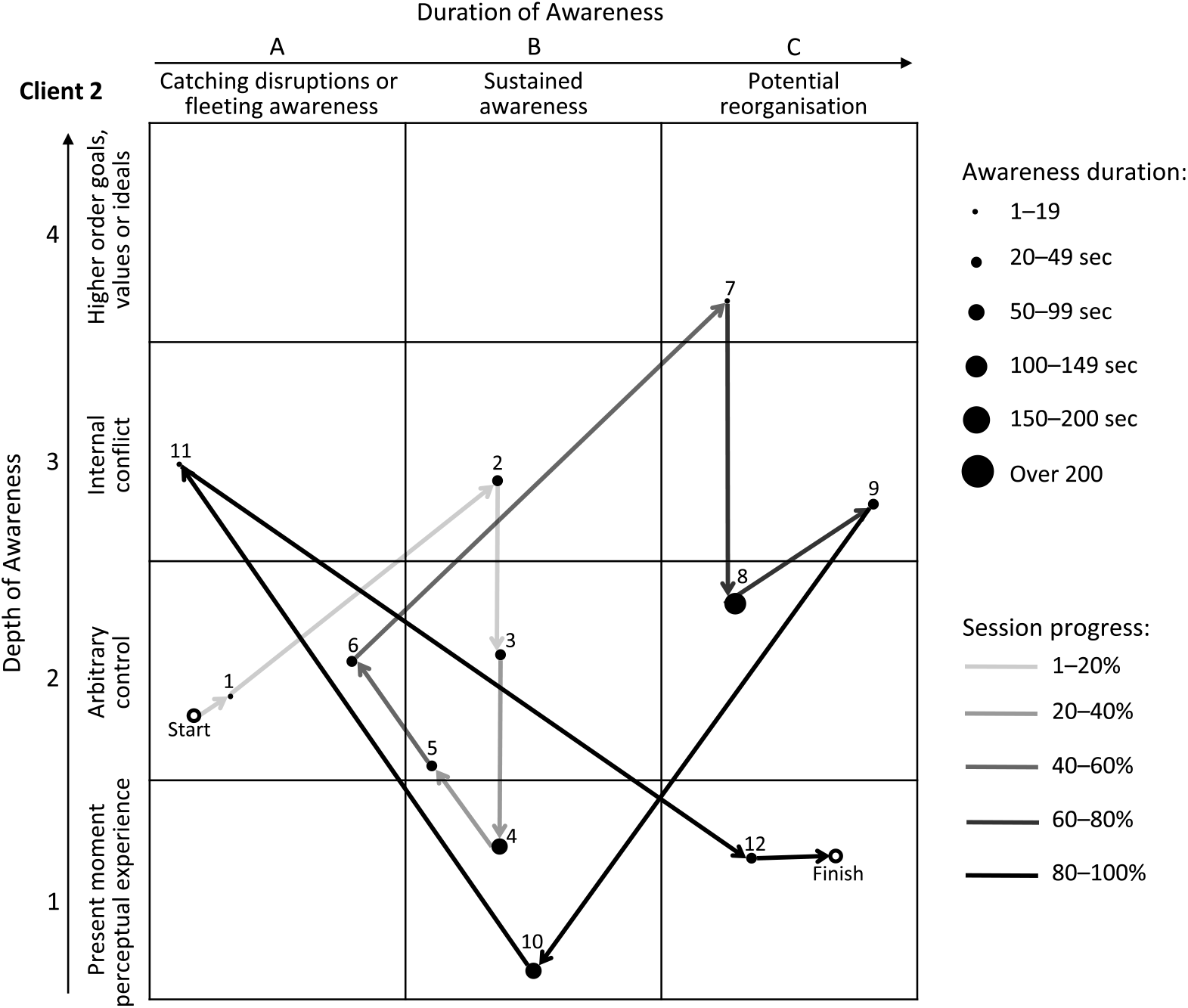
The client started the session with a discussion of the problem he was facing about not being able to enjoy the weekends. This was coded as arbitrary control as the client was aware of something causing him distress but was not yet aware of any other factors that might be conflicting (#1). The conversation quickly shifted into contradictory ideas with sustained attention on the difference between enjoying work but not enjoying the weekend. As the client became aware of contradicting goals, the coders marked it as awareness of internal conflict (#2). This was followed by the client’s realization that although the time off should be earned by working hard, it did not work out for him like this. This was coded as arbitrary control because the client described experiencing distress about such unmet goals without awareness of any other conflicting goals (#3). A further description of working too hard (i.e. ‘overdoing it’) and corresponding tension, was also coded as arbitrary control (#5) as the client was experiencing distress, but no conflicting ideas were present at the foreground of awareness. Speaking about the accumulation of the tension from the weekdays into the weekend was followed by the fleeting awareness of the related consequences on his life:
‘I’m just kind of thinking that one of the ways that it manifests as you end up doing less and less interesting things and you just go down to the pub (…) I don’t mind going to pub once or twice but go to the pub all the time is a bit much isn’t it.’
The above utterance was coded as fleeting awareness of arbitrary control (#6) as the client did not expand on these thoughts and no conflicting goals were standing behind overworking and accumulating tension at the foreground of his awareness. However, this allowed for an important insight about being a mental health professional, which the coders coded as fleeting reorganization of implicit higher-order goal of wanting to be a good therapist (#7):
‘Someone who has a professional mental health… doesn’t look after their own mental health well it ends up going to the pub every night.’
This was quickly followed by realization and reflection on the counterproductive nature of working hard and noticing he should probably change something. This was coded as reorganization of arbitrary control (#8) because the client was getting a new perspective on the things he engages in that caused him distress. Such a realization led to client’s insight into a goal conflict of wanting to change – but at the same time not wanting to change (#9). The MOL therapist helped the client to notice the background image of standing in front of a dam. This image was brought to the forefront of his awareness and was coded as a present moment perceptual experience (#10). Sustained attention on this image unfolded as conflicting emotions about it (laughing but being scared) that were coded as fleeting conflict (#11) and a further clear change of the image:
‘It’s not so bad now that it’s broke in my mind now that it’s broke and it’s swept me away I actually seem to have survived it, so it’s not so bad.’
The above change in the image was coded as reorganization (#12) because the client’s perceptual experiences representing the underlying goals conflict was altered, and a potential change of perspective emerged. The visual representation of this client’s shifts in awareness throughout the therapy session is presented in Fig. 2.
Client 3
The beginning of the session consisted of an exploration of a general underlying internal conflict of wanting to follow the opportunities in life, but also wanting to self-sabotage (#2, #8, #9). Talking about how to be better at following things through (coded as a reorganization of goal conflict; #9) was followed by a shift in attention towards the thoughts, feelings, and physical symptoms at the forefront of his awareness:
‘I felt a bit narcissistic actually (…) it’s uncomfortable to talk about achieving I think (…) it feels like I want to tell a joke or downplay the situation.’
These perceptual experiences seemed to be representing the previously identified internal process of self-sabotaging which was happening ‘live’ when talking about achieving. Considering these were rather distressing experiences, with no full awareness of the exact underlying conflict, the coders marked them as present moment perceptual experiences (#10, #11, #12, #15). The conflict became evident a few minutes later after the client had a chance to evaluate some of the higher-order goals. Firstly, the client identified being a person experiencing aspects of life as physical symptoms in the body (#13) which was coded as fleeting awareness of higher-order goal due to a sense of noticing aspects of self-identity. Furthermore, this was followed by the code of ‘reorganization of a higher-order goal’ because of the realization he would like to be a more reliable person (#16) and that following his childlike qualities was not going to help him achieve his goals. At this stage the underlying conflict was becoming more evident with clear contradictory goals of wanting to do things for himself and wanting to do things for other people (#21):
‘If I’m not involving other people, I’m not benefitting other people, that it’s not valid (…) [Therapist: What do you think when you hear yourself put it like that?] (…) sounds quite calculating, quite cold because I don’t see there is probably anything wrong with people doing something for themselves.’
A few moments later, the client identified a relevant higher-order goal concerning the importance of working with people. The importance of this goal was a reason for the coders to mark it as a higher-order goal (#25). Describing how much he enjoyed this part of life seemed to give way to his understanding of how he attempted to ensure that he does not lose these qualities by trying to keep his life on track by ‘pushing down’. The coders marked this as arbitrary control because there is no explicit conflict, but the client describes an evident distress about engaging in this process (#26). This was followed by reorganization (#28) of arbitrary control as the client started to question whether he would like to continue pushing.
Further shifts in awareness continued to emerge, allowing for a thorough exploration of the need to validate things as a repeating theme in the session. This was previously identified when talking about the need to validate activities by making sure they benefit other people (#21). Here, the client firstly identified that life successes need to be validated by working hard; otherwise they are not worthwhile. The coders marked it as arbitrary control (#31) because the client became aware of ‘something’ that is affecting his control. Secondly, he identified the need to be validated by reassurance from other people, but here there was a clear, explicit conflict of wanting validation from other people but also wanting to be independent (#34). This was also re-framed into a context of work as wanting his work to be altruistic but at the same wanting to benefit from working with people (#35). Allowing the client to reflect on internal conflicting goals about people was followed by the client articulating the new perspective:
‘I don’t like being around people but I love to do things for people you know and I sort of feel that trying to marry those two things together and marry the things in my life that I enjoy together seems an impossible task at times [Therapist: And are you wanting to marry them] It’d be nice to. It would feel like I would have some wholesomeness and some you know oneness to it.’
Considering there was a clear new perspective on the conflict of wanting to ‘marry’ both goals, the coders marked it as reorganization of internal conflict (#38). Within the last few minutes of the session, there were at least four shifts coded as reorganization, suggesting the new perspectives emerging. Firstly, the conflict between wanting to benefit from spending time with other people but at the same time wanting to enjoy his own company was re-framed with a new view of life with both goals present simultaneously as a part of a ‘decent life’ (#43). This was coded as a higher-order goal because it concerned personally important goals about life. Further reorganization consisted of realization that his life could not be so easily derailed because of his resilience:
‘Even if I didn’t have a penny I could go to the library and do the same thing so even questioning the derailing idea [Therapist: What’s happening just now] mmm I’m wondering whether I’m a bit more resilient than I perhaps thought I was.’
The coders marked this occurrence as reorganization of conflict (#44) because it involved evaluation of the previously described conflict of wanting to enjoy life and wanting to self-sabotage (or derail things). The new perspective of being a relatively resilient person was followed by the final evaluations, where the client concluded that although he was feeling uncomfortable in describing the positive aspects of life, this might be more of ‘a struggle of an artist’ where he needed to experience some difficulties to experience the positive aspects of life. This was coded as reorganization of higher-order goal (#46). The visual representation of this client’s shifts in awareness throughout the therapy session is presented in Fig. 3.
Discussion
The aim of the study was to examine the face validity of MOL by coding the shifts in the depth and duration of awareness for three clients who attended a therapy session with an expert MOL therapist and to examine the feasibility of a detailed visual representation of these shifts. The use of the D-DACS as an observer-coding scheme allowed for exploration of the three clients’ shifts in awareness into areas considered to be important from the PCT perspective: present moment perceptual experiences, arbitrary control, internal conflict, and higher-order goals. The results indicated that for all three clients, a high percentage of the session was spent with the client’s attention on one of the D-DACS areas (average of 61.65%). This is consistent with PCT and MOL where an effective therapy session is seen as one helping a client to sustain their awareness on one of these areas (Powers, Reference Powers1973; Carey, Reference Carey2006). In MOL, bringing the relevant background thoughts into the forefront of a client’s awareness allows for exploration of the conflicting goals, shifting the awareness towards higher-order goals, and sustaining the attention on the problem long enough to allow for change to happen spontaneously. Importantly, it has been proposed that the active ingredient of any effective psychological intervention involves this pattern of shifts and focus of awareness (Carey, Reference Carey2011; Carey et al., Reference Carey, Mansell and Tai2015; Higginson et al., Reference Higginson, Mansell and Wood2011; Mansell et al., Reference Mansell, Carey and Tai2012). Thus, the coding scheme developed here may have applications as an integrative tool across psychotherapies.
The current study reported the first attempts at presenting shifts in awareness during therapy sessions visually. The graphs helped to present each session’s complex pattern of shifts in the awareness in one clear view. Although it would not be possible to present all shifts in awareness for the given person, the graphs presenting observed shifts in awareness into the areas of interest in MOL allow for further insight and understanding. For example, maintaining awareness on different categories of D-DACS led the session with the first client to gradually shift towards the right-hand side and the top of the graph, suggesting gradually increased awareness of areas representing conflicting goals, higher-order goals, and potential reorganization. It can also be observed from the dot sizes that most of the time in the session with this client was spent on sustained awareness and reorganization of arbitrary control and conflict, which could be assumed to naturally give way to background thoughts of higher-order goals and potential reorganization. Considering no previous study attempted to create such graphs, we consider this as a useful tool for researchers allowing to view and make sense of the complex array of shifts in awareness occurring in therapy sessions.
Currently, there are no observer-based tools allowing for assessing shifts in client awareness on a moment-to-moment basis within a session and the extent to which the therapeutic session effectively fulfils the clinical and theoretical goals of MOL and PCT. Therefore, we consider the application of the D-DACS as important because it provided strong indications that the effectiveness of MOL therapy might vary depending on the therapist’s skills and expertise. The study presented a visibly higher average percentage of the clients’ attention on the D-DACS codes when therapy was delivered by an expert MOL therapist with 61.65% of total session length compared with an average of 22.3% in a previous study by novice therapists (Higginson and Mansell, Reference Higginson and Mansell2018). These results suggest that an experienced MOL therapist assists the client to successfully shift their attention towards aspects of the goal conflict and facilitates potential change much more effectively than a novice therapist. This also brings up the question of how much training or experience in delivering MOL therapy is enough to deliver effective therapy.
The D-DACS is a newly developed coding system, and although previous research showed good internal consistency (Higginson and Mansell, Reference Higginson and Mansell2018), the coding system and the visual representation of the sessions might require further modifications. With this in mind it is also important to consider the limitations of the current study.
Firstly, the use of D-DACS can be criticized for being inconsistent with the theoretical assumptions of MOL that only the client knows where their awareness is at any one time (Carey, Reference Carey2006). Therefore, it could be argued that the researchers’ attempts at identifying the shifts in awareness resulted in making assumptions about the content of the client’s background thoughts. We agree that such thoughts would be impossible to access. MOL therapists ask about disruption in order to bring background thoughts into the forefront of the person’s awareness. Once verbalized in awareness, they would be coded. However, this process still involves some judgement on the coder’s part and hence can be considered a limitation of the approach. Similarly, the coding procedure involved the first coder’s decision on which areas of text are highlighted. This might be a limitation and future studies should include both coders making such a decision independently with further examination of inter-rater reliability. Secondly, the length of the therapeutic sessions in MOL is controlled by the client, and hence the three recordings used in the current study were of varying duration. This might result in more codes and more complex session plots for longer sessions, which can be observed on the third client’s graph (Fig. 3). Potentially, the use of multiple graphs for different parts of the session might prove more useful in the future. Thirdly, the D-DACS assumes that each shift in attention can only be represented by one code. However, during the coding process, the coders experienced occasional difficulties in distinguishing the codes. For instance, it was not clear how a conflict between higher-order goals should be coded. Although the ‘higher-order goals’ category is designed for goals that are not in conflict, it seems inappropriate to ignore the higher-level nature of the attention by coding it as an ‘internal conflict’, which usually represents internal conflict at a relatively more concrete level. Similarly, a difficulty might be experienced when the client describes a perceptual conflict (e.g. feeling unpleasantly guilty, but at the same time satisfyingly relieved) as this can be coded either as present moment perceptual experience or as an internal conflict. The coders also had to choose between ‘arbitrary control’ and ‘conflict’ when the client’s conflict was implicit because it was not clear whether or not the client was aware of the conflicting goals. The above examples suggest that further modification and development of the coding scheme is needed with clearly defined categories and a way of presenting overlapping codes that would be consistent with D-DACS theoretical assumptions.
The first client’s visual representation of the shifts in awareness throughout the therapy session.

The second client’s visual representation of the shifts in awareness throughout the therapy session.

The third client’s visual representation of the shifts in awareness throughout the therapy session.

In summary, we have presented visualizations of a novel observer-coded scheme for representing shifts in clients’ awareness that are consistent with the theory underpinning Method of Levels therapy. Given the common consensus regarding the importance of helping clients to shift and sustain their awareness, the findings have implications as an integrative tool and as a therapy training resource. We have provided recommendations for improvements and extensions to the scheme for future research.
Author ORCID
Jakub Grzegrzolka, 0000-0001-9172-1281
Supplementary material
To view Supplementary Material for this article, please visit: https://doi.org/10.1017/S1754470X19000199.
Acknowledgements
We would like to thank Phil McEvoy for his comments that greatly improved this manuscript. We would also like to acknowledge and thank Tim Carey for his comments on the limitations of the coding scheme and how it can be improved in future research.
Financial support
This research received no specific grant from any funding agency, commercial or not-for-profit sectors.
Conflicts of interest
The authors have no conflicts of interest with respect to this publication.
Ethical statement
The authors have abided by the Ethical Principles of Psychologists and Code of Conduct as set out by the American Psychological Association. Ethical approval was not needed as the project was considered to be a service/therapy evaluation.
Key practice points
(1) Good practice of Method of Levels psychotherapy involves helping the client to shift their awareness towards goals in conflict and the higher-order goals (values/ideals) that determine them.
(2) A key ingredient of effective therapy may be to use curious questions to help clients shift and sustain their attention to the source of goal conflict.
(3) The use of visual graphs to present moment-to-moment changes in the client’s awareness can be a useful tool for examining the hypothesized clinical and theoretical goals of therapy.





Comments
No Comments have been published for this article.