Dialect contact can result in levelling, which reduces differences between dialects (Kerswill, 2002; Trudgill, 1986). Gilles's (1999) study of regional dialects of Luxemburgish, for example, focused on a dialect levelling resulting in an attenuation of regional diversity; levelling is in favor of a central dialect spoken in an area that includes Luxemburg City. However, dialect contact need not result in dialect levelling. Hinskens (1996) showed that short-term accommodation between speakers of mutually intelligible dialects in the Limburg region of the Netherlands does not reduce interspeaker differences. A primary step towards levelling involves accommodation, the conscious or unconscious modification of speech by speakers. The literature on accommodation has to a greater or lesser extent focused on languages with a spoken standard or a socially prestigious dialect (including variants of social leaders). This is to be expected because accommodation usually implies the dominance of dialects of the latter types. Thus, for example, studies of accommodation in dialect levelling in English have included as one dialect in the speech situation a prestige dialect, whether received pronunciation (RP), Estuary English, or an urban dialect; see, for example, Cobb (1996), Kerswill (2001, 2002), and Foulkes and Docherty (1999). A situation in which there is no spoken standard or socially prestigious dialect is of inherent interest with respect to speaker interaction with potential for modification. Given such a situation with traditionally low contact (Trudgill, 1989) between dialects, but where dialects may come into contact outside of their usual geographical spheres, we may wonder what contact will yield.
Irish, a Celtic language, has no spoken standard, nor can any of the three major spoken dialects be considered more socially prestigious than the others.1
The orthography and morphology of Modern Irish were officially standarized in 1958 with the publication of Gramadach na Gaeilge agus Litriú na Gaeilge [The grammar of Irish and the spelling of Irish]. See Ó Baoill (1988) for an overview and discussion of the history of standardization. The Foclóir Póca [Pocket Dictionary] represents an attempt in 1986 to standardize pronunciation. Southern Irish may have had more prestige in the last century—it was frequently the dialect (nonnative) teachers of Irish imparted to students. This is no longer the case, however, and in the recent years multi-media Irish language material (including self-taught courses) has been published in all three major dialects.
Irish is also spoken in other parts of the country, usually in urban areas, but generally not as a community language. Speakers outside of the official Gaeltacht areas tend to identify with one of the three major dialects.
Keeping in mind the lack of a spoken standard, the experiment described in this article set out to explore the degree to which speakers of Irish modify their phonology when interacting with speakers of another dialect in task-oriented contexts. The focus is exclusively on phonological/phonetic effects; the main experiment was not designed to uncover adjustments involving morphological and syntactic differences between the dialects. The study was restricted to two of the three major dialects of Irish: those that are furthest from each other geographically and linguistically, that is, Northern Irish (represented here by Gaoth Dobhair in Co. Donegal) and Southern Irish (represented by Corca Dhuibhne in Co. Kerry). It focused on two prosodically conditioned variables (prominence and duration) and one segmental variable. The prosodic variables chosen for Irish are salient and involve nonlexically contrastive aspects of the respective dialects that immediately identify a speaker as a speaker of either Northern or Southern Irish. The contrasting prosodic systems described later, which result in contrasts in syllable prominence and duration of nontonic syllables, would lead to the expectation that Irish would prove a compelling empirical focus for a study of accommodation. However, accommodation was not found on a large scale. Nonetheless, interaction was found among various pairs of speakers that raised interesting questions, both linguistic and methodological. These interactions are discussed next.
VARIABLES
The study focused on two prosodically conditioned variables, (a) lexical stress and (b) vowel duration, and one segmental variable, (c) the realization of a lenited voiced nonpalatalized bilabial stop.3
Lenition involves weakening of word-initial segments, and is, for the most part, grammatically conditioned. It is represented orthographically by the addition of ‘h’ immediately after the target segment (e.g., lenited voiced labial stops are represented orthographically as bh/mh). Orthographic bh/mh occur word-internally, but not as the result of lenition.

For more on stress shift in Southern Irish, see Blankenhorn (1981), Doherty (1991), Green (1996), Gussmann (1997), McKone et al. (1994), O'Rahilly (1932), Ó Sé (1989, 2000). In cases in which there is no heavy noninitial syllable, the initial syllable is stressed in Southern Irish.
Because the main experiment involved reading and as the different dialects use common orthographic forms, reference is made here to the orthography. Referring to the orthography allows us to identify this commonality without addressing the question of the phonological representation. The differences alluded to reflect the different diachronic development of the dialects as determined by their contrasting prosodic systems.
Measuring all instances of cailín in same-dialect pair recordings, the average V1 : V2 ratio for the Southern Irish informants was 1 : 2.08, and for the Northern Irish informants 1 : 0.91.
Any secondary velarization that may be present is ignored here. It is necessary to distinguish phonemically nonpalatalized and palatalized labials because lenition of (phonemic) palatalized voiced bilabial stops results in [vj] in all dialects.
Lenition of voiced labial stops is as follows:

THE SUBJECTS/SPEAKERS
Four speakers of each of the two dialects were selected.8
Speaker coding and profiles are as follows. Recordings were made in October 2001.

Recordings were made directly to DAT tape using near-field head-mounted microphones (Shure SM10A).
METHODOLOGY
Data were elicited by means of a reading task in which the subjects were required to read a text in synchrony. The synchronous speech task (Cummins, 2002, 2003) requires subjects to read a practiced text together, attempting to maintain synchrony. The text (reproduced in the Appendix) was constructed so as to contain multiple instances of the chosen variables (also listed in the Appendix). It contained 16 instances of noninitial heavy syllables: (V:) in (S2), where (stress) → 〈S2〉 (Southern Irish), (V:) → 〈V〉 (Northern Irish);9
The text included two additional bisyllabic words, both of whose syllables are heavy, that is, íosfá ‘eat, 2sg cond’ and ólfá ‘drink, 2sg cond’. These words are not included in the analysis because stress in Southern Irish varies between the first and second syllable of these polymorphemic words, in contrast to bheithfeása ‘be, 2sg cond emph’ in which stress falls consistently on the second syllable as a result of the presence of the emphatic morpheme (see Ó Sé, 2000:51).
Within a dialect, this task was perceived by subjects as relatively easy, and a high degree of synchrony was obtainable without extensive practice (lags of about 40 ms were typical). On the other hand, pressure to accommodate/adapt to the dialect of the cospeaker was anticipated in cross-dialect pairings, particularly because the text contained numerous tokens that were likely to result in arhythmy. This occurs, for example, in a bisyllabic word containing an orthographic short vowel in the first syllable and an orthographic long vowel in the second syllable; as indicated previously, such a word has initial syllable stress along with shortening of the second vowel/syllable in Northern Irish, and has final syllable stress with corresponding shortening/reduction of the initial syllable in Southern Irish [e.g., cosán

, cailín

]. Most cross-dialect pairs remarked on the difficulty or the strangeness of attempting to read in synchrony with a speaker of the other dialect (in marked contrast to the same-dialect pairs). In addition, there were a number of forced errors in the cross-dialect recordings, for example, where there was a temporary breakdown in synchrony or the elision of syllables/words.
THE DATA
The phonetic properties measured were10
Measurements were made using Praat [www.praat.org]. Durational measurements were made using broadband spectrograms and aligned waveforms. Intensity and pitch measurements were made using intensity and pitch contours, aligned waveforms, and Praat functions.
Lexical stress
Vowel duration
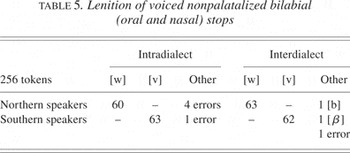
Reflexes of lenited voiced nonpalatalized bilabial (oral and nasal) stops
A sample of the results is presented later with commentary. Where reference is made to individual speakers, the codes used are as follows: Northern (N) speakers, A-D, and Southern (S) speakers, W-Z. Speaker profiles are indicated in note 8. The data in the following sections are interpreted as follows: where there is a distinct contrast between intradialect and interdialect measurements, the intradialect figures are viewed as reflecting some kinds of dialect norms, and deviation from these norms in the cross-dialect pairings is interpreted as accommodation.
Lexical stress
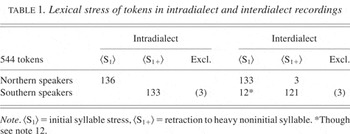
Lexical stress proved robust. Northern speakers stressed initial syllables, whereas with a few exceptions, Southern speakers stressed noninitial heavy syllables. Table 1 reflects the perceptual judgment of the author unaided by instrumental analysis.11
The author is a non-Gaeltacht native speaker of Irish, aligning herself more with Western Irish, which shares the stress pattern of Northern Irish, although not the vowel reduction.
Three tokens were excluded from consideration (represented in parenthesis) because they did not show the expected stress pattern in the intradialect recordings. The form cosúil had unexpected initial stress in three intradialect (Southern) recordings. Initial stress in the interdialect recordings for the same tokens and same speakers could not therefore be attributed to accommodation. Six of the twelve tokens in the cross-dialect recordings of Southern Irish speakers involving initial syllable stress may potentially be excluded from consideration. Younger speakers may be influenced by the English forms of the relevant words (feirmeoir ‘farmer’ and Nóirín ‘Noreen’), which have initial stress. More generally, younger speakers have more of a tendency towards a nontraditional speech pattern (with various simplifications of inflections, for example).
Lexical stress of tokens in intradialect and interdialect recordings

It is apparent that no categorical shift of stress was perceived. Southern speakers generally did not accommodate by stressing the initial syllable (although see discussion further on); likewise Northern speakers did not accommodate by shifting stress to a heavy noninitial syllable.
However, instrumental analysis revealed less perceptible effects involving the phonetic correlates of stress. The generalizations set out next are necessarily tentative, because the basic research on this topic has yet to be carried out.
13However, Blankenhorn (1981) explored the patterning of intensity, duration, and pitch in Southern Irish, suggesting that the copatterning of length and pitch on noninitial syllables can lead to ambiguity in the perception of stress placement.

, V2 was longer, of greater intensity and higher pitch; in words of the form

V2 was longer, and V1 and V2 did not contrast in intensity; however, the F0 (fundamental frequency/pitch) peak in intradialect pairings was on V2, whereas in interdialect pairings the F0 peak was either level across both syllables or carried on V1 (the latter forms were perceived to be different but nevertheless have final stress); in words of the form

, V2 was longer and of greater intensity, while the F0 peak was carried by either V1 or V2. Thus length and intensity copatterned and were reliable cues for stress, whereas pitch did not necessarily copattern with the former two cues.
In relation to the instances of accommodation noted earlier, interdialect recordings of words of the form [V V:] in the case of two southern speakers (X and Z) were perceived to have initial stress. Where this occurred, measurements revealed a shortening of the duration of the second vowel (measured as the ratio of the duration of the vowel to the overall word duration), which nonetheless remained longer and of higher intensity than the first vowel. It must be noted that all [V V:] tokens (in both intradialect and interdialect recordings, nonaccommodating and accommodating) had F0 peaks on the first syllable in the case of these two speakers. The latter patterning (which contrasts with the pattern set out for W earlier) may already have predisposed these speakers to accommodate. In addition, in the case of cosán the duration of the fricative following the initial vowel increased (as a ratio of the overall word-duration) in the accommodating instances, that is, those in which the initial vowel was perceived as stressed.14
The absence of copatterning of duration, intensity, and pitch evokes Williams' (1985, 1989) work on Welsh stress patterns in which she reports no significantly greater intensity or higher F0 on stressed vowels, but statistically significant lengthening of a post-tonic consonant. Blankenhorn (1981:236–237) also identified the role of consonants in determining overall syllable duration. The data here differ in that speakers were aiming for synchrony, a goal that could lead to segment lengthening that might not be attested elsewhere in the language. This remains to be investigated.
Duration
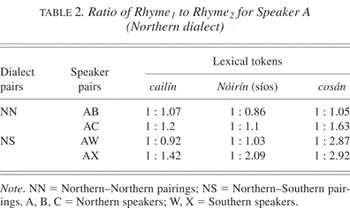
As the goal of the reading task was to achieve synchrony, and given the contrasting metrical effects between the two dialects (contrasting stress placement and the associated reduction in unstressed positions), some durational effects were anticipated. Measurements of duration involve rhyme duration. Examples are given in Table 2 for one Northern speaker (A). The figures given are the ratio of Rhyme1 to Rhyme2 of three disyllabic words. The data given involves the same word (i.e., same position in the passage, referred to as tokens in same context, discussed later) in four separate paired-recordings. Stress was consistently on the initial syllable of all tokens referred to, as would be expected in this dialect. What differed was the relative duration of the second rhyme (highlighted for extreme cases). All noticeable lengthening occurred in interdialect recordings, suggesting a degree of accommodation. However, lengthening was not consistent, and was not evident for all Northern Irish speakers.
Ratio of Rhyme1 to Rhyme2 for Speaker A (Northern dialect)

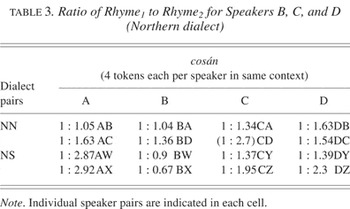
When Speaker A read with a fellow northern speaker there was relatively little durational difference between the first and second syllable. This can be interpreted as reflecting the historical shortening of (phonemically) long vowels in unstressed syllables. However, when Speaker A read with speakers of the Southern dialect, the second syllable in some instances was lengthened. Because cosán ‘path’ showed the greatest susceptibility to second syllable lengthening, Table 3 shows the relevant figures for all Northern speakers; one anomalous figure is excluded (shown in parenthesis).15
The anomaly here is a result of speaker hesitancy. The speaker had an unusually long syllabic nasal in this token.
Ratio of Rhyme1 to Rhyme2 for Speakers B, C, and D (Northern dialect)

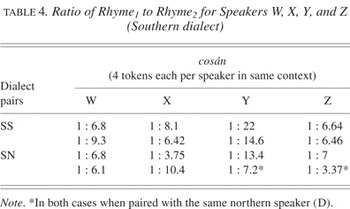
The durational accommodation was not exclusively in one direction, however. Recall that in the case of speakers of Southern Irish, stress is shifted to the second syllable when it contains a long vowel. We would interpret as accommodation, a shortening of the second, albeit stressed, syllable. This is what appears to be happening in the highlighted cases in Table 4. It should be pointed out that some of the ratios (e.g., those in the Y column) are potentially misleadingly large because the initial unstressed syllable is greatly reduced, in some instances to the extent that it is difficult to detect any nucleus. Nonetheless, a change in the ratio of rhyme length for Southern speakers in interdialect pairings can be the result of either (1) shortening of the long vowel in the second syllable or (2) the lack of such drastic reduction of the first syllable, both of which can be interpreted as accommodation.
Ratio of Rhyme1 to Rhyme2 for Speakers W, X, Y, and Z (Southern dialect)

The claim for accommodation can only be supported by comparing recordings for each speaker. Thus in the case of Z, when reading with D (the bottommost figures in the column), the ratio of the first and second rhymes alters significantly in comparison with Z's other recordings.
Although there appears to be evidence of shortening of stressed syllables by Southern speakers when paired with Northern speakers, the obvious variation in measurements points to the need to devise alternative methods of investigating these adjustments.
Lenition
Lenition proved robust, as evidenced in Table 5. Lenited voiced nonpalatalized bilabial stops (both oral and nasal) were, for the most part, realized as glides [w] by Northern speakers and as fricatives [v] by Southern speakers. Thus it cannot be said that there was any degree of accommodation.16
This is not always the case. In other contexts (e.g., pedagogical situations), some Northern speakers can be heard to use a fricative instead of a glide, most commonly if the addressee is thought to be more familiar with Southern Irish.
Lenition of voiced nonpalatalized bilabial (oral and nasal) stops

SUMMARY AND DISCUSSION
The prosodic patterns of the different dialects of Irish are what most readily identify a speaker of any particular dialect. Stress is therefore a salient variable, and one that proved robust in the experiment discussed. However, the phonetic correlates and effects (lengthening or shortening/reduction) of stress appear to be less so. Stress-dependent durational adjustments and variable pitch patterns were highlighted for speakers of both dialects, seemingly motivated by the pressure to remain in synchrony. Despite such adjustments, however, and although the reading task was anticipated to exert pressure on cross-dialect pairs of speakers to adjust their speech, there was not enough evidence to yield generalizations or to be amenable to statistical scrutiny. This may be the result of experiment design, but may also be the result of the linguistic situation.
A number of issues need to be considered. (1) Most of the participants were either Irish language instructors or students of Irish, and as a result, may perhaps have been more familiar than many speakers might be with the differences between dialects. This may have influenced their linguistic behavior in that the contrasts might be consciously anticipated and thus accommodation resisted. (2) A passage containing a sufficient number of the relevant variables risked using lexical items that were atypical in one dialect. However, those chosen were forms that would appear in standardized texts. (3) More generally, reading tasks may prove unsuitable for exploring accommodation in Irish because the orthography alone has been standardized and does not reflect dialectal norms. Though not always the case, this can cause difficulties for dialect readers (e.g., feirmeoir ‘farmer’ in Northern Irish can be bisyllabic and end on a nonpalatalized consonant

, whereas an epenthetic vowel is present in the medial cluster in Southern Irish (making the form trisyllabic), along with the (orthographically signalled) final palatalized consonant

. The standardized orthography does not reflect such contrasts and may exert pressure to produce nondialect forms that do not necessarily reflect accommodation between speakers. This did not appear to be the case, but it is a factor that cannot be discounted. (4) Because there is no spoken standard, it is difficult to devise controlled social situations that exert pressure on speaker pairs to modify their speech. One potential alternative to a reading task would be to study speakers of one dialect who have moved to another dialect area, preferably having lived in the latter area for some years. Such a study may give more insight into the robustness or otherwise of specific phonological properties, and particularly into the question of whether the robustness, or lack thereof, is dialect, speaker, or context dependent. (5) Explanations of the inconsistencies among speakers point to the need to consider a greater number of nonlinguistic factors, for example, age, gender, social ranking/relationship, or familiarity of subjects with each other and/or each other's dialect. Because this was a pilot project and as it was not clear in advance whether accommodation would be detected, and if it were, to what degree, the focus was predominantly on linguistic factors. A broader study would include all relevant factors.
APPENDIX