

1.1 Types of Ship-Shaped Offshore Installations
Various types of engineering structures have been developed over the course of human civilisation. One type is the ship-shaped offshore installation, which is a floating structural system located at sea. As a result of their multiple functionalities, these installations are widely used in the production, processing and storage of energy derived from marine sources and electrical power generation in a marine environment.
1.1.1 Offshore Oil and Gas Development
The availability of energy has been central to the progress of civilisation. Industrial advances were first stoked by coal, and then by oil and gas. Initially, oil and gas production occurred onshore and then spread into offshore areas. Production was initially conducted in shallow waters, but it is now conducted in waters with depths of more than 1,000 m because of the decreased possibility that new fields will be discovered in shallower waters.
Figure 1.1 shows the process of offshore oil and gas exploration and production using ship-shaped offshore installations. Specially outfitted vessels are used for exploration, which begins with seismic surveys. Then, exploratory drilling of promising fields is conducted using jack-up, semi-submersible or ship-shaped drilling rigs. Development drilling is used to identify fields that contain profitable amounts of oil and gas, based on the number of wells and the amount of subsea equipment (i.e., various combinations of platforms, accommodations and supplies) that would be required for production.
The process of offshore oil and gas exploration and production using ship-shaped offshore installations

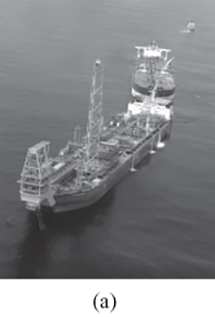
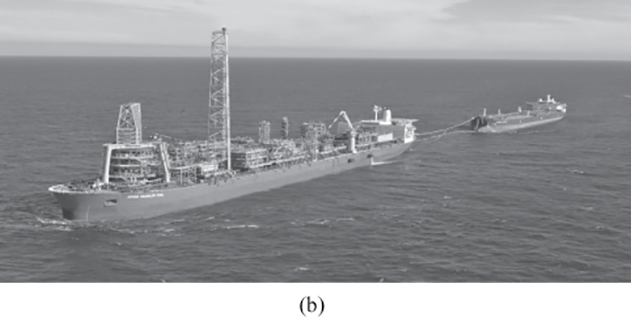
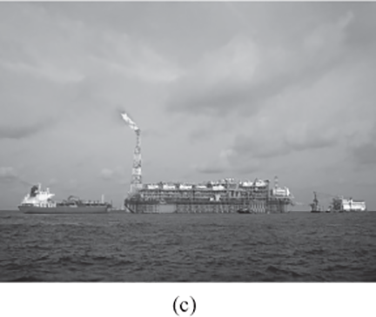
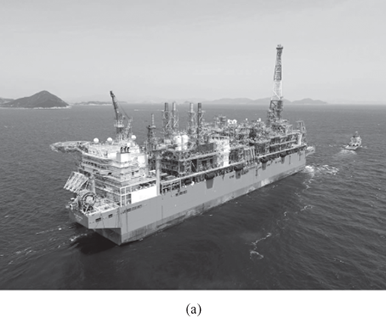
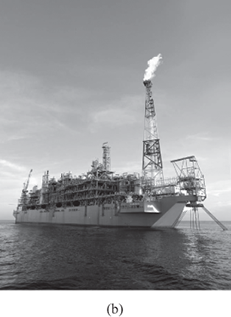
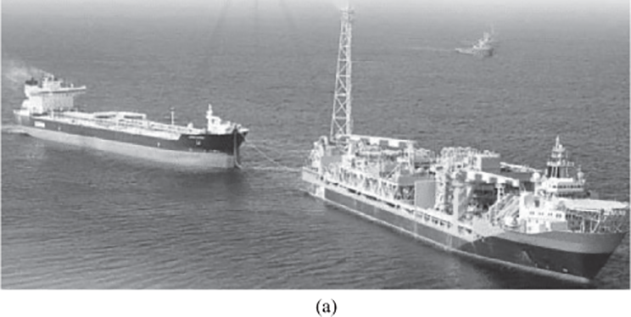
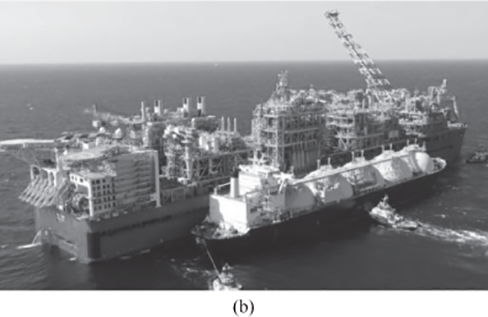
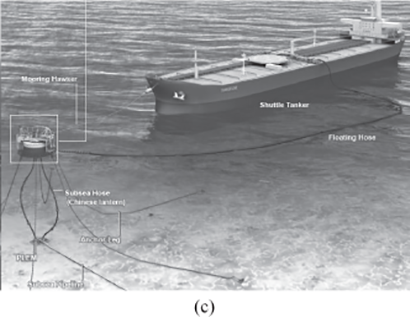
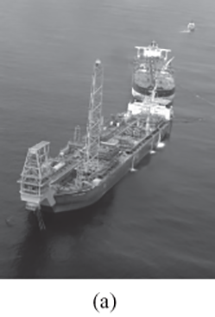
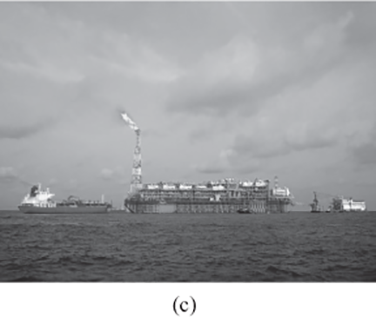
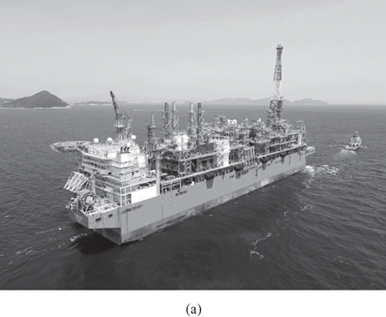
Ship-shaped offshore installations known as floating production, storage and offloading (FPSO) units enable the production, processing and storage of oil, and its offload into shuttle tankers for transportation to land-based terminals. Floating liquefied natural gas (FLNG) units, which are also known as LNG FPSO units, are FPSO units associated with facilities for the liquefaction of produced natural gas. The resulting LNG cargo is transported ashore by LNG carriers. Floating storage and offloading (FSO) units are non-production ship-shaped offshore installations used to store processed oil before it is shipped ashore via pipelines. Figure 1.2 depicts FPSO units with an external turret, an internal turret or a single-point mooring. Figure 1.3 shows an FLNG unit installation.
Floating production, storage and offloading (FPSO) units.
An FPSO with an external turret mooring
An FPSO with an internal turret mooring
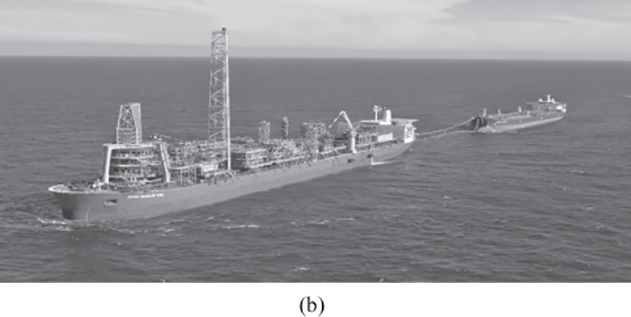
The FPSO AKPO, which was built in 2008, is secured via a single-point mooring and in operation 200 km south of Port Harcourt off the coast of Nigeria in West Africa
The Petronas floating liquefied natural gas unit SATU, which was built in 2015.
In tow
In operation at the Satu site in Malaysia

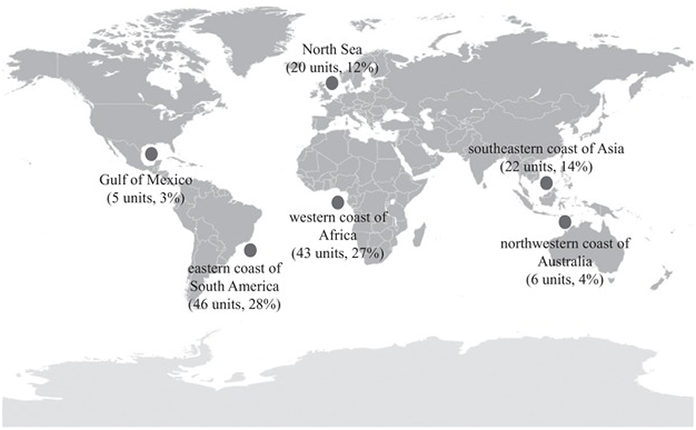
FPSO units are now found in all offshore areas where floating production systems are used. They range in size from 50,000-barrel tankers, which can process 10,000–15,000 barrels per day, to very large crude carrier (VLCC)-sized units, which can process more than 200,000 barrels per day and store 2 million barrels. Figure 1.4 shows the worldwide site distributions of the new-build and trading tanker conversion FPSO units in operation in 2020.
Worldwide distribution of floating production, storage and offloading units in operation in 2021
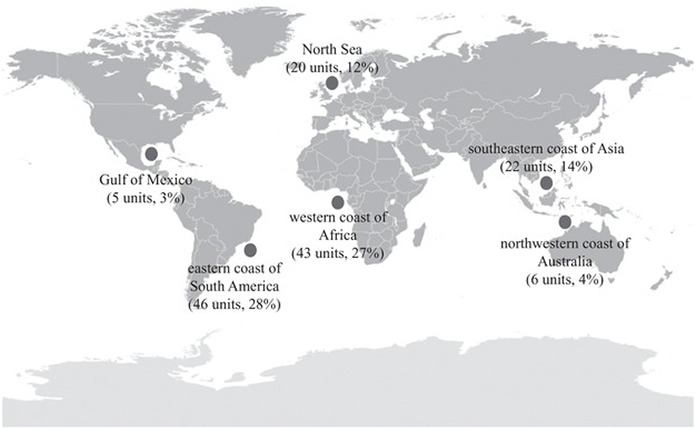
The highest concentrations of FPSO units are off the east coast of South America and the west coast of Africa. Although many FPSOs have been installed in relatively benign environmental areas, such as southeastern coast of Asia, western coast of Africa and offshore Brazil near the equator, the use of FPSO units for oil and gas exploration in deeper waters and some geographic areas (e.g., the northwestern coast of Australia, which experiences tropical cyclones and storms) is challenging. The effects of hurricanes on the station-keeping capabilities and structural failures of the mooring systems of FPSO units are a major concern of regulatory bodies, as operators use FPSO units in deep-water developments. A mooring-system failure in an FPSO unit can lead to collisions with adjacent offshore installations, resulting in major oil spills. The application of FLNG units (or LNG FPSO units) is even more challenging, as it requires the liquefaction of produced gas, and storage and offloading under cryogenic conditions. This is detailed in Section 1.1.2.
1.1.2 Liquefied Gas Storage and Regasification
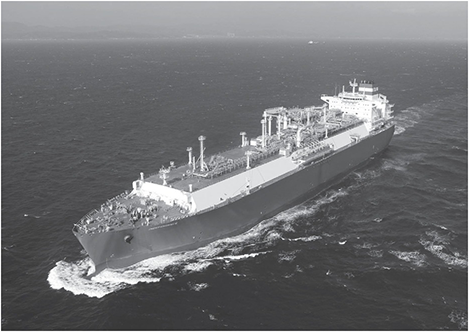
Demand for natural gas is increasing, as natural gas has become an important energy source associated with various advantages in environmental friendliness and easy storage compared to other fossil fuels. Figure 1.5 shows the value chain of natural gas. Production and processing may be performed on land or at sea. Produced natural gas is liquefied by cooling to −163°C under atmospheric pressure. The resulting LNG occupies 600 times less volume than natural gas, thereby facilitating its transport by ship. Liquefaction is also performed in land-based facilities when natural gas is produced on land, but LNG FPSO units (or FLNG units) are used to fully process offshore gas, in terms of its production, liquefaction, storage and offloading into ships, for transportation to terminals ashore. Floating storage and regasification units (FSRUs) are used as LNG terminals to distribute and transport LNG to consumers, such as power plants, factories or homes. Figure 1.6 shows a floating storage and regasification facility in self-propelled transit to operation.
Value chain of liquefied natural gas

The liquefied natural gas floating storage and regasification unit TURQUOISE P, which was built in 2019, in self-propelled transit to operation in Aliaga, Turkey

1.1.3 Oil Terminals
As mentioned, ship-shaped offshore installations are also used as FSO facilities that function as marine-based oil terminals for oil storage and export purposes. FSOs are usually unmanned and operated remotely, and the main electrical power is supplied via cables from its turret. Typically, oil is produced by a floating installation, such as a tension leg platform (TLP), from whence it is transferred via a flexible riser and swivelling turret to FSO tanks for storage. Oil is offloaded to a shuttle tanker via a flexible hose in the stern of an FSO. Dynamic positioning systems are used during offloading operations to ensure that the FSO hull is maintained in the correct heading. FSOs are useful because they can be moored near cities in coastal waters, which obviates the need for oil depots in residential areas on land. They are also able to treat and warm oil to optimise its storage and transport.
1.1.4 Wave Energy Harvesting
The utilisation of renewable energy sources, such as waves, is increasing rapidly. Waves are a renewable energy source because they are generated by wind action. Thus, the generation of energy from waves depends on the height and period of the waves; deep-water ocean waves, for example, offer large energy fluxes.
Wave energy has unique advantages in addition to its renewability, as it is widely distributed in the ocean, recurrent, regular and pollution-free; accordingly, the development of wave energy will not affect the marine and atmospheric environments (McCormick Reference McCormick2013; Cong et al. Reference Cong, Haiying and Zaijin2018). Wave energy can be harvested using wave energy extraction converters, such as oscillating water columns, oscillating bodies and overtopping systems. The conversion of wave energy to electrical power is achieved via power take-off system-based devices. A novel approach for harvesting wave energy is based on the use of decommissioned ships, and it is described next.
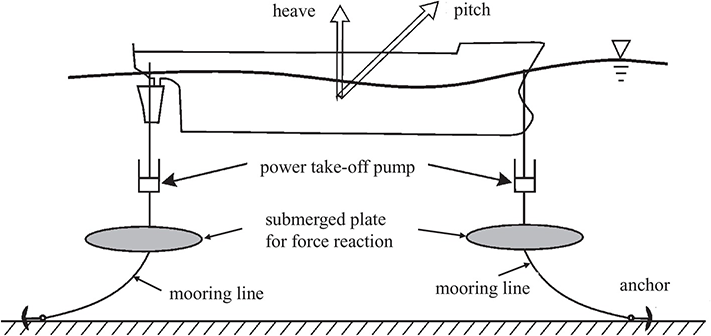
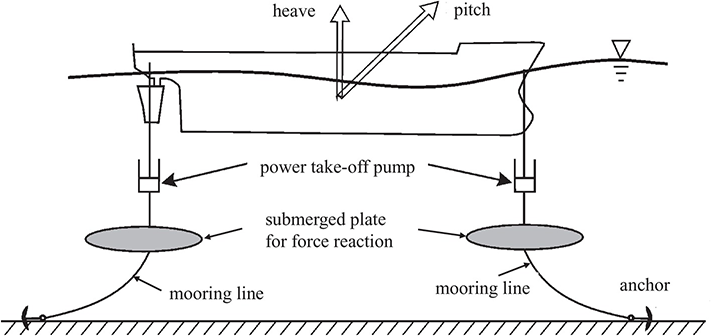
More than 400 large merchant ships are decommissioned and scrapped every year. Not all of these ships are weakened and degraded, and some retain significant levels of strength. The decommissioning and scrapping of such ships are not only expensive, but generate many environmental and toxic hazards. As such, the reuse of decommissioned ships is superior to the recycling of their steel via scrapping, as the ships can, for example, be used to generate wave energy (Mansour et al. Reference Mansour, Pedersen and Paik2013). First, an unmanned decommissioned ship is placed in approximately 50 m of water, where deep-water swells have an average wave period of 6–15 seconds. Then, the ship is ‘tuned’ to have a large wave-motion response, particularly in heave and pitch. In small-wave conditions, the ship therefore serves as a platform for secondary energy absorption. It is also tuned to have near-rigid body resonance, such that it resists wave motion to absorb power. This power is stored by hydraulic ramps connected to an accumulator-fed hydraulic motor. Figure 1.7 shows a schematic of wave energy extraction using a decommissioned ship (Mansour et al. Reference Mansour, Pedersen and Paik2013), although commercial operations are not yet in progress.
Wave energy extraction using a decommissioned ship
1.1.5 Liquefied Natural Gas–Fuelled Power Plants
Ship-shaped offshore installations are also used as LNG-fuelled power plants, and they are thus useful for providing electricity and heat to remote or relatively inaccessible sites. Moreover, the hull structures of these installations can be built at a shipyard and towed to the site of operation. The LNG is drawn from storage tanks for floating storage and power plants or is supplied by LNG bunkering ships.
1.1.6 Nuclear Power Plants
Despite the ongoing debate about nuclear power’s waste and safety hazards versus its economics and environmental friendliness, it is recognised as a clean and cheap energy for resolving the issues associated with global warming (Devanney Reference Devanney2020). Ship-shaped nuclear power plants are non-self-propelled vessels that generate electrical power from one or more nuclear reactors installed inside a hull. Similar to LNG power plants, the hull structures are built at a shipyard and towed to the site of operation, eliminating the need for a special construction site. However, sensitive equipment may be installed in the plant after its arrival on site. These offer more advantages than land-based nuclear power plants, as their environmental impact is low during both operation and dismantling, although it must be ensured that radioactive material never leaks into the sea.
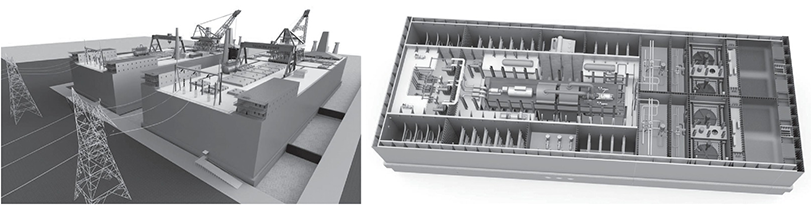
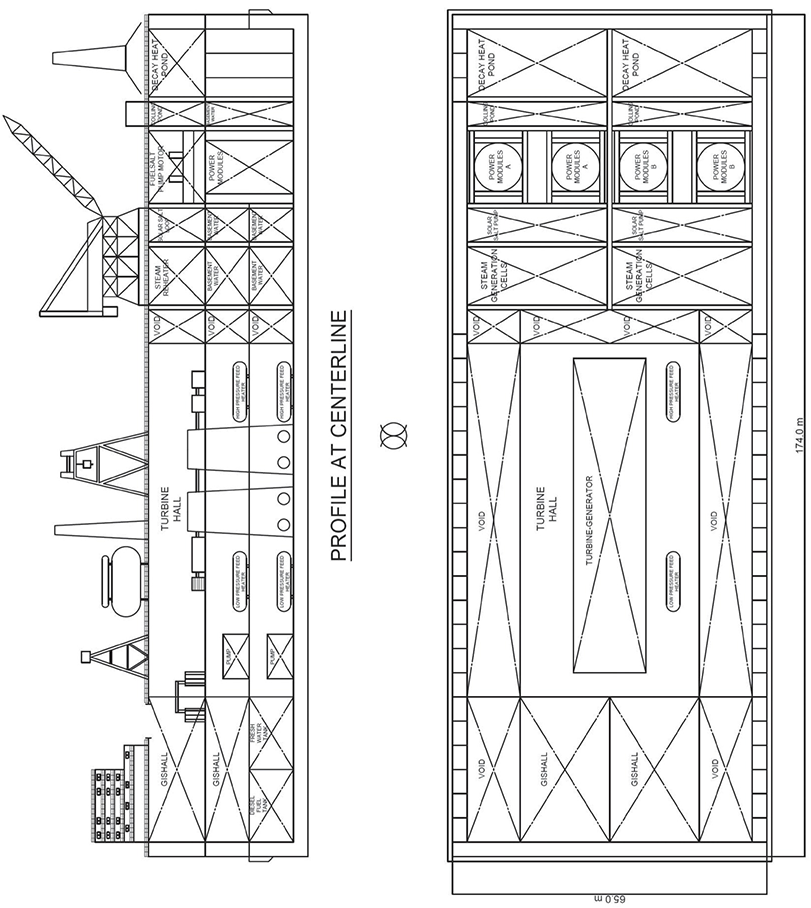
Figure 1.8 shows a ship-shaped nuclear power plant developed by ThorCon (2019; see thorconpower.com), which is composed of a generator and power modules. The hull structure of the plant is similar to that of a double-hull tanker, as it comprises a double bottom and double sides. The central working portion of the hull is flanked by ballast tanks. The deck features several large hatches to allow access for the extraction and replacement of various components. The ThorCon plant is a gravity-based platform, and it is towed to a site in shallow water (approximately 10 m) and ballasted down onto the seabed by the addition of water, concrete or sand into the double sides and double bottom.
A ship-shaped nuclear power plant

1.1.7 Deep-Sea Mineral Mining
Ship-shaped offshore installations offer a practical basis for mining minerals, such as manganese nodules, from deep-sea sources. These deep-sea mining installations may have a similar hull structure as that of the FPSO units used for offshore oil and gas collection. However, commercial ship-shaped deep-sea mining operations are not yet in progress, as the development of this sector depends on an array of social, political, legal and economic factors, similar to the development of energy resources (Sparenberg Reference Sparenberg2019).
1.2 Trading Tankers versus Ship-Shaped Offshore Installations
Trading tankers are often converted to ship-shaped offshore installations. These may retain the original structure and form of the trading-tanker hull, although modifications and repairs are made to the structural scantlings. Although the hull structural arrangement in a newly built installation is similar to that of a trading tanker, the former has a block coefficient close to unity to maximise the cargo storage volume, instead of a hull form optimised for passage at sea. In addition, as a ship-shaped offshore installation remains at a specific site, there is no risk of grounding accidents, and therefore a single-bottom structure is feasible. However, a double-bottom space may be required to host ballast tanks or heating units to warm cargo tanks in a ship-shaped offshore installation operating within the Arctic Circle.
Trading tankers and ship-shaped offshore installations differ in various ways, as indicated in Table 1.1. In particular, the design considerations for ship-shaped offshore installations are more complex than those for trading tankers. This is not because the trading-tanker design is any less complicated in principle, but because of the relative importance of site-specific offshore conditions for ship-shaped offshore installations, and the need to consider the towing and commissioning of these installations at sea. Environmental conditions are also considered differently when designing trading tankers and ship-shaped offshore installations. Specifically, the North Atlantic wave environment is typically adopted as the design premise for a trading tanker, as this results in a vessel that is strong enough to navigate any ocean conditions and thereby enables worldwide trade. However, the design load of a ship-shaped offshore installation is based on the environment at its intended operational site and on the requirements for its transportation to this site, prior commissioning and mooring.
| Parameter | Trading tanker | Ship-shaped offshore installation |
|---|---|---|
| Hull block coefficient | 0.8–0.9 | Approx. 1.0 (new build) |
| Hull structural arrangement | Double bottom and double sides | Double sides and single bottom |
| Design condition | North Atlantic wave environment | Site- and tow route–specific environments |
| Return period (years) | 25 | 100 |
| Actions (loads) | Wave and wind | Wave, wind, current, etc. |
| Loading and offloading cycle frequency | Limited number; loading and unloading occur in harbour | Frequent; relatively more environmental effects |
| Operating location | On open sea ~70% of the time | Offshore 100% of the time |
| Weathervaning | Weather comes from any direction; weather routing for rough-weather avoidance possible | Highly directional weather and weathervaning; rough-weather avoidance not possible once fixed on site |
| Mooring | Not applicable | Single-point mooring in harsh environment and spread mooring in benign environment |
| Dry-docking | Dry-docking every 5 years | Continuous operation, usually without dry-docking |
| Topside | No topside | Has topside; subject to effects of interaction between hull and topside |
For historical reasons, the return period of waves is typically set at 100 years when designing the hull girder strength of a ship-shaped offshore installation, whereas it is set at 25 years when designing a trading ship. Wind and current are also considered as important parameters in the engineering of ship-shaped offshore installations, whereas waves are regarded as the primary source of environmental actions on trading tankers. Trading tankers are loaded and unloaded in still-water conditions in harbour, whereas ship-shaped offshore installations are unloaded offshore and are thus subject to significant environmental loads during loading and offloading. The latter also undergo more frequent loading and offloading cycles than trading tankers. Thus, the fatigue failure characteristics of ship-shaped offshore structures differ from those of trading tankers, as the former are more likely to experience low-cycle fatigue. Indeed, industry experience shows that such frequent loading and offloading operations on ship-shaped offshore installations cause fatigue at the structural joints that is not observed in trading tankers. Moreover, ship-shaped offshore installations are offshore for 100 per cent of their design life, while trading tankers are on the open sea for approximately 70 per cent of theirs. Trading tankers operate in either full-load or ballast conditions, while ship-shaped offshore installations operate in various load and offload conditions. These characteristics mean that ship-shaped offshore installations have larger draught variations between fully loaded and minimally loaded or ballast conditions than do trading tankers. It follows that ship-shaped offshore installations must have sufficient strength to cope with various loading conditions at a range of draughts, and with the various environmental conditions of different return periods.
Unlike trading tankers, ship-shaped offshore installations have features such as topsides, mooring systems (single-point or spread mooring), flare towers, riser porches and drill towers. These are items that have a large mass, high centre of gravity and large windage area, which affect the installation’s motions and its responses to the environment. Trading tankers may use weather routing to avoid rough weather or alter their operational headings (Olsen et al. Reference Olsen, Schroter and Jensen2006; Dickson et al. Reference Dicson, Farr, Sear and Blake2019; Szlapczynska and Szlapczynski Reference Szlapczynska and Szlapczynski2019; Gkerekos and Lazakis Reference Gkerekos and Lazakis2020; Kurosawa et al. Reference Kurosawa, Uchiyama and Kosako2020), but ship-shaped offshore installations are fixed in the same location and are constantly subject to site-specific environmental conditions. Single-point mooring systems are used to secure ship-shaped offshore installations that operate in harsh environmental conditions. These systems allow installations to move to face into the weather, thus minimising the environmental loads placed by winds, waves and currents. In addition, single-point mooring systems can be disconnected prior to storm conditions to enable ship-shaped offshore installations to be towed or sail to sheltered areas and then return to restart operations when the weather calms (Cabrera-Miranda et al. Reference Cabrera-Miranda, Sakugawa, Corona-Tapia and Paik2018; Ma et al. Reference Ma, Luo, Kwan and Wu2019).
Notably, ship-shaped offshore installations that operate in the North Sea and those with single-point mooring systems must have significantly greater hull girder strength than those of trading tankers in unrestricted service. In contrast, in areas such as West Africa, the wave environment is largely benign, which means that the strength requirements are less rigorous and spread mooring can be used. Finally, trading tankers and ship-shaped offshore installations each have their own characteristics with respect to undesirable hull motions that lead to sloshing, slamming, green water damage, mechanical downtime on equipment and crew discomfort.
Trading tankers are regularly dry-docked at five-year intervals. Ideally, ship-shaped offshore installations are never dry-docked during their entire production period in the field, which ranges from 20 to 40 years. This is often because of the economic unviability of repairing a ship-shaped offshore installation in dry dock, primarily because of interruptions to production. In addition, hot works (such as welding or flame cutting) are commonly performed when trading tankers are repaired in dry dock. However, these techniques are obviously unsafe for use during the in situ repair of offshore structures, because of the high risk of fire or explosion.
1.3 New Builds versus Tanker Conversions
Table 1.2 indicates the number of FPSO units that are in use for the development of offshore oil resources in deep waters as of 2020 (Boggs et al. Reference Boggs, Barton, Albaugh and Davis2020, www.offshore-mag.com). More than 70 per cent of these operating installations are trading tanker conversions, and the number of on-order conversions is almost the same as the number of on-order new builds.
| Type | Operating | Available | On order | Total |
|---|---|---|---|---|
| Conversion | 110 | 17 | 8 | 135 |
| New build | 52 | 6 | 19 | 77 |
| Total | 162 | 23 | 27 | 212 |
When an FPSO unit is required, the advantages and disadvantages of new builds versus trading tanker conversions must be evaluated to determine which option best fits the requirements of a particular situation.
The advantages of a new build are that:
field-appropriate design and fatigue lives are more easily achieved;
technical, commercial and environmental risks are more easily managed;
systems intended to survive harsh environments are more easily designable;
re-sale and residual values are maximised and
reusability opportunities are improved.
Conversely, the advantages of a trading tanker conversion are that:
capital costs are reduced;
more construction facilities are available and
overall project-supervision requirements are reduced.
One of the key drivers when selecting an FPSO unit is field life, which is often determined by the economic life of the oil or gas reservoir. When the design life for a continuous on-site operation is greater than 20 years, a new build is invariably desirable. For marginal fields where the reservoirs are not necessarily abundant, the design life may be 5, 10 or 15 years, and thus a trading tanker conversion option is more economical. Notably, the design life of a new-build installation is much longer than that of a trading tanker conversion, although new-build costs vary according to many factors, such as the capacity of production and storage. A project to build a ship-shaped offshore installation is divided into different work packages, such as those related to the hull, the topsides, hull–topside integration and overall project management. Construction contracts for these packages may be awarded separately or as a whole.
1.4 Tanker Conversions
Table 1.3 lists the trading tanker conversion FPSO units that have been built since 2000. Most of them are converted VLCC-class tankers. DNV (Det Norske Veritas) and ABS (American Bureau of Shipping) are the two major classification societies that certify tanker conversion FPSO installations.
| No. | Name | IMO No. | Class | L (m) | B (m) | D (m) | T (m) | First year in oil development |
|---|---|---|---|---|---|---|---|---|
| 1 | P-76, Replicant | 9005223 | DNV | 332 | 58 | 31 | 22 | 2019 |
| 2 | P-77, Replicant | 8906913 | ABS | 322.07 | 56.04 | 31.4 | 20.3 | 2019 |
| 3 | P-74, Replicant | 9012824 | DNV | 326.2 | 56.6 | 28.6 | 20 | 2018 |
| 4 | P-75, Replicant | 9005273 | ABS | 322.07 | 56.04 | 31.4 | 20.6 | 2018 |
| 5 | BW ADOLO (AZURITE) | 861831 | DNV | 312 | 56 | 30 | 18 | 2018 |
| 6 | TURRITELLA | 9269087 | ABS | 274 | 48 | 24 | 17 | 2016 |
| 7 | CIDADE DE ITAGUAI (MV 26) | 9179713 | ABS | 332 | 58 | 32 | 22 | 2015 |
| 8 | P-58 | 9012238 | ABS | 331 | 56 | 30.2 | 20.8 | 2014 |
| 9 | P-62 | 9044217 | DNV | 328 | 57.2 | 30.4 | 21.3 | 2014 |
| 10 | CIDADE DE MANGARATIBA (MV 24) | 9001007 | ABS | 332 | 58 | 28.1 | 18.9 | 2014 |
| 11 | P-63 | 9385124 | ABS | 334 | 58 | 28 | 22.3 | 2013 |
| 12 | CIDADE DE SAO PAULO (MV23) | 9005211 | ABS | 332 | 58 | 28 | 21 | 2013 |
| 13 | PSVM FPSO | 9077800 | ABS | 318 | 57 | 32 | 23 | 2012 |
| 14 | BW PIONEER | 8918265 | DNV | 242 | 42 | 20 | 14 | 2012 |
| 15 | CIDADE DE ANCHIETA | 7382249 | ABS | 344 | 52 | 28 | 22 | 2012 |
| 16 | KWAME NKRUMAH MV21 | 9003861 | ABS | 359 | 59 | 30 | 20 | 2010 |
| 17 | P-57 | 8617225 | ABS | 311 | 56 | 29.5 | 20.2 | 2010 |
| 18 | CIDADE DE SANTOS (MV 20) | 7325899 | ABS | 334 | 51 | 26 | 20 | 2010 |
| 19 | CAPIXABA | 7370193 | ABS | 346 | 55 | 27 | 21 | 2010 |
| 20 | BW CIDADE DE SAO VICENTE | 7380693 | DNV | 254 | 44 | 23 | 14 | 2009 |
| 21 | FRADE | 7522318 | ABS | 337 | 55 | 27 | 21 | 2009 |
| 22 | CIDADE DE NITEROI (MV 18) | 8500123 | ABS | 315 | 60 | 28.45 | 19.2 | 2009 |
| 23 | ALVHEIM | 9170078 | DNV | 252 | 42 | 23 | 16 | 2008 |
| 24 | ARMADA PERKASA | 7383401 | ABS | 201 | 32 | 18 | 13 | 2008 |
| 25 | SAXI-BATUQUE (KIZOMBA C) | 7379993 | ABS | 369 | 56 | 29 | 22 | 2008 |
| 26 | P-53 | 7385136 | ABS | 346 | 57 | 28 | 22 | 2008 |
| 27 | POLVO | 7822122 | DNV | 325 | 55 | 28 | 17 | 2007 |
| 28 | UMUROA | 8017815 | DNV | 232 | 46 | 23 | 15 | 2007 |
| 29 | YÙUM K’AK’ NÁAB | 7708302 | DNV | 325 | 65 | 32 | 23 | 2007 |
| 30 | P-54 | 7391812 | ABS | 337 | 54 | 28 | 22 | 2007 |
| 31 | MONDO | 7370246 | ABS | 370 | 54 | 27 | 21 | 2007 |
| 32 | SENDJE BERGE | 7360057 | DNV | 350 | 52 | 27 | 22 | 2005 |
| 33 | P-48 | 7391824 | ABS | 337 | 55 | 27 | 21 | 2005 |
| 34 | P-50 | 7391824 | ABS | 337 | 55 | 28 | 21 | 2005 |
| 35 | P-43 | 7370208 | ABS | 337 | 55 | 27 | 21 | 2004 |
| 36 | ABO | 7374046 | DNV | 269 | 54 | 20 | 15 | 2003 |
| 37 | CURLEW | 8124046 | LR | 236 | 40 | 20 | 15 | 2002 |
| 38 | ESPOIR IVOIRIEN | 7373949 | DNV | 269 | 54 | 20 | 15 | 2002 |
| 39 | PETROLEO NAUTIPA | 7380629 | DNV | 256 | 44 | 23 | 16 | 2002 |
| 40 | SENDJE CEIBA | 7360069 | DNV | 265 | 52 | 27 | 22 | 2002 |
IMO = International Maritime Organization; L = length of all; B = breadth; D = depth and T = draught.
1.4.1 Selection of a Suitable Tanker for Conversion
The selection of a trading tanker for conversion and the subsequent conversion engineering are based on the unique requirements of a ship-shaped offshore installation. In particular, servicing of a ship-shaped offshore installation is more arduous than that of a trading tanker and depends on the operational environment. For example, factors such as a higher tank temperature, which leads to a higher risk of hot water generation in tanks, and a greater number of loading and offloading cycles create more severe service conditions on ship-shaped offshore installations than on trading tankers. In addition, the deck structures of ship-shaped offshore installations must bear heavier topside modules than those of trading tankers, and this may cause design challenges related to the deck and freeboard deck strength, stability and deflection. A ship-shaped offshore installation is also not designed to undergo dry-docking for maintenance during its service life. All of these aspects must be borne in mind when converting a trading tanker to a ship-shaped offshore installation.
It is also important to identify and evaluate which trading tanker systems can be reused or renewed, and which systems must be newly installed during conversion. Useful summaries of the information and practices associated with the conversion of trading tankers to ship-shaped offshore installations are given by Johnson (Reference Johnson1996), Assayag et al. (Reference Assayag, Prallon and Sartori1997), da Costa Filho (Reference da Costa Filho1997), Park et al. (Reference Park, Jang, Shin and Yang1998), Parker (Reference Parker1999a, Reference Parker1999b), Neto and de Souza Lima (Reference Neto and de Souza Lima2001), Terpstra et al. (Reference Terpstra, d’Hautefeuille and MacMillan2001), Lane et al. (Reference Lane, Bryans and Preston2004), Mones (Reference Mones2004), Terpstra et al. (Reference Terpstra, Schouten and Ursini2004) and Biasotto et al. (Reference Biasotto, Bonniol and Cambos2005).
The basic features and vessel-related factors that are relevant when selecting a trading tanker for conversion are its
price;
tank volume (e.g., oil storage capacity);
year of construction (i.e., tanker age);
hull construction (e.g., single skin, double sides/single bottom or double sides/double bottom);
hull structural condition and systems condition and
Generally, Suezmax or VLCC class trading tankers are considered candidates for conversion. A key structural consideration is whether a vessel can be converted to its new service form while using relatively modest amounts of steel for modifications and repairs. This has led trading tankers that were constructed in the 1970s to be favoured for conversion, as these have heavier scantlings and contain a higher proportion of mild steel than more recently built vessels.
Some structural design trends of VLCCs built before and after the 1980s are listed in Table 1.4. Useful regression formulas for main dimensions of as-built tankers are available in the literature (Kristensen Reference Kristensen2012). The conditions of trading tankers vary, depending on the level of fatigue damage and corrosion wastage accumulated during their service lives and the initial construction quality. Trading tankers that were constructed in the 1970s are now more than 40 years old and are thus unsuitable for conversion, although their thicker scantlings are relatively more resistant to corrosion than those of younger vessels, which have thinner scantlings that contain greater amounts of high tensile steel. These thinner scantlings are more susceptible to fatigue cracking and corrosion wastage over the long service life of a ship-shaped offshore installation, that is, 10 years or longer.
| Location | 1970s | 1980s or after | ||
|---|---|---|---|---|
| Thickness (mm) | Material | Thickness (mm) | Material | |
| Main deck | 35 | Mild steel (grade A) | 20 | AH32 or AH36 |
| Side shell | 23 | Mild steel (grade A) | 17 | AH32 or AH36 |
| Bottom panels | 36 | Mild steel (grade A) | 20 | AH32 or AH36 |
Therefore, the structural health and design condition of a trading tanker is assessed carefully to determine whether it is suitable for conversion, and the required amount of steel renewal is estimated. Consequently, only a structurally sound vessel that meets the minimal requirements for in situ on-site maintenance is selected. All of the trading tanker machinery must also be suitable for the expected functions, service life and maintenance programme of the planned ship-shaped offshore installation.
Since the adoption of the US OPA (Oil Pollution Acts) 90, trading tankers have been built with double hulls that incorporate varying amounts of high tensile steel. The MARPOL Annex I requirements (IMO 2003) are mandatory for ship-shaped offshore installations and are required by some national or regional statutory bodies, although these do not stipulate the use of a double hull. Double sides are also preferred for ship-shaped offshore installations to improve collision resistance but are not usually required by regulations. Single-skin trading tankers are most commonly refurbished and converted to ship-shaped offshore installations, as double-hull tankers are typically more expensive. Single-skin trading tankers can be converted to double-hull vessels by the addition of sponsons, which act as a new outer hull.
1.4.2 Inspection of an Aged Tanker’s Hull Prior to Conversion
A trading tanker is subjected to a close up visual inspection and non-destructive examination prior to its conversion in order to detect and quantify fatigue cracking and corrosion wastage (described in Chapter 15). Inspectors are likely to be more familiar with the five-year trading tanker inspection requirements of classification societies and related surveys, and must therefore be made aware that a trading tanker is intended for conversion and that a different function is to be performed. In this regard, the operations of various ship-shaped offshore installations converted from trading tankers have demonstrated that the inspection procedures of classification societies must be augmented using special surveys and comprehensive inspections, which must be performed in a shipyard before the repair and refurbishment plan is finalised and the refurbishment and conversion work is begun.
These comprehensive inspections involve a close examination of the structures of a trading tanker in dry dock, and numerous measurements of the external and internal hull thickness losses or corrosion wastage to identify construction defects and in-service damage, such as cracking and denting. This process is carried out after the hull has been properly cleaned and made accessible. Close up visual inspections of the cargo, slop and ballast tanks are also performed from scaffolding erected inside the tanks. Local pitting, grooving and knife-edging damage is difficult to repair offshore, and thus it is critical to identify as much of this damage as possible to enable its gauging and shipyard-based repair or refurbishment prior to conversion. The key aspects of this comprehensive inspection process are given here.
Visual inspection of the structure in all cargo, slop, ballast, fuel oil, forepeak, aft peak and void spaces.
Close up visual inspection (
 0.5 m) of the toes of all transverse bottom webs and horizontal girders. Toes that are directly connected to an oil-tight bulkhead should be subject to magnetic particle inspection.
Close up visual inspection of the collar plates of all longitudinal stiffeners protruding through watertight or oil-tight bulkheads. Approximately 20 per cent of the welds should be subject to magnetic particle inspection.
Ultrasonic thickness measurements and close up inspection of the entire main deck, the entire bottom deck and selected strakes in the side shell plating (at ballast and, when fully loaded, at the waterline).
Ultrasonic thickness measurements and close up inspection of all horizontal stringers and centreline girders.
Ultrasonic thickness measurements and close up inspection of representative sections of selected web frames and all transverse bulkheads. One or more web frames should be inspected in each cargo, slop and ballast tank.
Ultrasonic thickness measurements and close up inspection of one entire transverse girth belt in each tank (including the slop tank).
Detailed measurements and mapping of all areas of significant pitting in the cargo, slop and ballast tanks.

Heavily corroded areas must be renewed and enhanced to the required levels during the conversion process. The renewal plate thickness is estimated as the sum of the net plate thickness required for the new service demands and the corrosion margin value. The net plate thickness of the structural components is determined based on their respective strength (stress and buckling) and fatigue requirements, and the corrosion margin value should reflect the intended lifetime of the ship-shaped offshore installation to which the trading tanker is to be converted.
1.4.3 Repair of an Aged Tanker’s Hull Prior to Conversion
Structural defects in the hull of an aged trading tanker must be repaired, as in-service damage will also occur during the service life of a derived ship-shaped offshore installation. If the depth of local denting is greater than the plate thickness, insert plates are used for repairs. If the indentations in the plates of web frames or the longitudinal stiffeners of side shell plates are greater than the thickness of the plates, these sections are replaced. Sharp dents are impermissible, and the affected structures must be renewed. All visible cracks are repaired, and critical areas are inspected for crack-like defects, which are also repaired irrespective of their sizes. All pits and grooves are repaired by welding or with insert plates. Any weld overfill (crown) that has been lost by pitting is renewed. Pitting or grooving to a depth of 15–33.3 per cent of the plate thickness is repaired by infill welding, provided that a layer (e.g., 6 mm) of the original plate remains at the bottom of the pit/groove, the nominal diameter of the pit/groove does not exceed a certain limit (e.g., 300 mm) and individual pit/grooves are spaced at least 75 mm apart. Pitting or grooving corrosion outside these limits is repaired using insert plates.
The renewal criteria for the general corrosion of a member are based on the limits described next. The renewal thickness for the overall corrosion of plating and stiffeners, which dictates the corroded areas to be renewed at conversion, is defined to ensure that substantial corrosion conditions are not reached within the on-site life of the structure. Accordingly, this renewal thickness takes into account the expected losses to corrosion during the service life of a ship-shaped offshore installation derived from a trading tanker. The substantial corrosion margin is defined as 75 per cent of the corrosion allowance. The maximum allowable corrosion loss is therefore defined as 20–30 per cent, depending on the location of the member. The renewal thickness is defined by industry practice as follows: renewal thickness = required thickness  (1 – 0.75
 allowed corrosion percentage) + (expected service life in years
 yearly corrosion loss). This relates to general corrosion on a local structural level. Finally, reductions in hull girder section moduli and gross strength properties of panels over the expected service life should not exceed approximately 10 per cent.
1.4.4 Reuse of Existing Machinery and Equipment during Tanker Conversion
The existing equipment and machinery of a trading tanker may be partly or fully reusable, with or without refurbishment, over the expected service life of a ship-shaped offshore installation. This reusability is important because it reduces the capital cost, but key considerations are needed.
The components that may warrant refurbishment and upgrading are:
main and auxiliary engines;
electrical generators;
boilers and economisers;
starting air and instrument air systems;
piping systems (cargo and ballast);
deck hydraulic systems;
bilge, seawater and fireman systems;
steam, inert gas and crude oil washing systems;
lubricating oil systems;
cargo or ballast pumps, and related control systems;
communication systems;
electric cables and switchgear;
heaters, motors and light fittings;
fire- and gas-detection systems;
firefighting systems and lifesaving appliances;
accommodation facilities.
These components must remain functional and safe during the required service life of a ship-shaped offshore installation. A detailed examination of the conditions of these components and follow-up refurbishment and testing, if necessary, are required prior to conversion. This process depends on the age and previous levels of maintenance of a trading tanker and the operational requirements and constraints of the ship-shaped offshore installation to which it may be converted. However, some components are usually reusable, either with or without modification, and this may provide a unique cost advantage of a trading tanker conversion compared to a new build. To varying degrees, such refurbishment, modification or reuse is successful for components involved in power generation, cargo handling, inert gas management, ballast, crude oil washing, steam generation and supply, utilities, firefighting and accommodation.
1.4.5 New Component Addition in a Tanker Conversion
The following new components are added during the conversion of a trading tanker to a ship-shaped offshore installation:
a process plant;
a turret and riser porch;
a flare system;
a mooring system (e.g., a spread mooring or turret mooring);
control and instrumentation systems;
an offloading system;
a helideck;
cranes and their coverage and
green-water protection, such as bulwarks and breakwaters.
The determination of an appropriate mooring system depends on various aspects, such as the trading tanker size, the number and type of riser paths required in a ship-shaped offshore installation and any mooring disconnectability requirements, in addition to the ocean environment and water depth at the planned installation site. A mooring system may comprise
fixed spread moorings, forward and aft;
an internal turret, forward-fixed or disconnectable;
a submerged turret production buoy;
an external bow or stern turret, cantilevered at the deck or keel;
an external stern turret, yoked to a catenary anchor leg mooring buoy;
rigid and articulated yokes connected to buoys;
an articulated buoyant column and yoke or
a mooring tower and yoke.
In most mooring systems (except fixed spread moorings), the riser paths terminate via a fluid swivel, which enables weathervaning into the environment. If active heading control will be required for offloading to a shuttle tanker or because of the environmental conditions at the proposed site, a thruster is fitted aft. This requires complex conversion work to ensure that sufficient space is created at the aft end to accommodate the thruster.
A process plant is supplied in the form of skids, packages, modules and similar pre-assembled units, which are ready for onboard hook-up and pre-commissioning. The sizes of pre-assembled units depend on the shipment, crane or load-out facilities available at the conversion yard. The location of process equipment on the upper deck is determined by various factors, such as the longitudinal hull girder strength, stability, deck structure deflection and green water requirements. The weight and centre of gravity of a topside are determined at an early stage of conversion and are monitored throughout the conversion process to ensure that these properties do not change. The maximum extreme wave-induced bending moments and shear forces, which are related to longitudinal strength, are determined from environmental data recorded at the intended site, based on waves of the 100-year return period. The still water bending moments and shear forces of the design are calculated for various loading and offloading conditions, such as full load, ballast and intermediate conditions.
During the in situ inspection of tanks in a ship-shaped offshore installation, certain sets of tanks are emptied in turn to minimise disturbances to production. In such situations, the additional weight of the processing equipment – even though it may not significantly increase the still water load – may affect the stability of a ship-shaped offshore installation, as this additional weight will alter its centre of gravity. Accordingly, it will be more difficult to meet damage stability requirements. The free surface effect in slack cargo tanks is another aspect that may affect stability and sloshing.
If a ship-shaped offshore installation is destined for use at a site where severe green water loading may occur because of harsh environments and low freeboard situations, structures are added to secure the process equipment. Deck structures must invariably be strengthened around heavy process plants, as the supports of process equipment are vulnerable to deformation and overstress. Such structures are designed with consideration for hull girder bending and the interaction between the hull and topside structures.
1.4.6 Appraisal of the Conversion Yard
While a trading tanker is undergoing conversion to a ship-shaped offshore installation, the process plant facilities may be fabricated in the same yard or elsewhere. In the latter case, the pre-assembled units are transported to the conversion yard to be fitted, or the vessel is transported to the process plant fabrication site where fitting is performed. Thus, a conversion yard is appraised in terms of its
health, safety and environmental aspects;
past experience of conversions;
physical facilities and trade resources;
staffing, discipline and labour aspects;
corporate aspects associated with management experience and fiscal stability;
ability to manage technical problems and changes during design and conversion;
experience in planning fast track project execution and
ability to manage complex projects.
1.5 Front-End Engineering and Design for New Builds
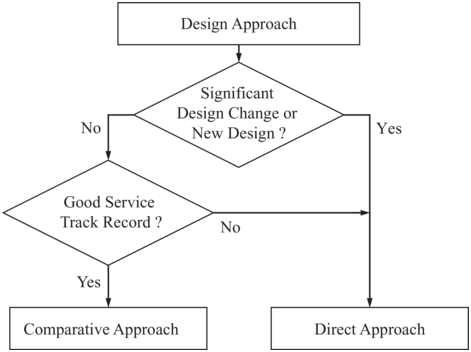
The design approach for a new-build ship-shaped offshore installation is classified as a comparative or direct approach, as shown in Figure 1.9. In a comparative approach, the design is based primarily on existing (or as-built) systems, while a direct approach is based on the use of direct analysis methods to determine the actions and action effects under ocean environmental and operational conditions. For an existing ship-shaped offshore installation, a good track record of service, which indicates that no significant design changes have been required, can be used as a reference for a comparative design approach. In contrast, the direct approach is used if a ship-shaped offshore installation will incorporate significant design changes or new designs. In general, most trading tankers are designed using a comparative approach, whereas most ship-shaped offshore installations are designed using a direct approach.
Decision tree for the comparative approach versus the direct approach for a new-build design of a ship-shaped offshore installation

Many problems associated with the costs and scheduling of new-build ship-shaped offshore installations result from inadequate project definitions and requirements, which lead to expensive changes being required during the project execution phase. Therefore, front end engineering and design (FEED), which involves substantial engineering analyses, must be performed at the outset of any new-build project, prior to the development of specifications, the issuing of an invitation to tender a package and (usually) the bidding phase. As a new-build project may take three to four years to complete, and its success is dependent on the orchestration and scheduling of a variety of key tasks, such as front-end engineering, the development of a design basis, the determination of performance specifications and detailed specifications, the vetting and selection of candidate yards and contractors, the awarding of the construction contract, the performance of a detailed engineering process, construction, pre-commissioning (dock trials), sea trials, delivery, on-site commissioning and acceptance.
The complexity and sizes of ship-shaped offshore installations have been gradually increasing. Accordingly, aspects of the design, building and operation of each new build may need revision, relative to previous designs, to ensure that a high level of system integrity is achieved. The requirements for the design and construction of a ship-shaped offshore installation differ from those applied to trading tankers, as the former must exhibit excellent on-site reliability over a long operational life, without requiring dry-docking-based repair (described in Section 1.2). Furthermore, ship-shaped offshore installations are much more complex facilities than trading tankers, and their successful construction requires a coordinated effort from all parties, namely the owners, shipyards, topsides integration contractors, hull engineering contractors, classification societies and operators. A detailed engineering process is crucial for the design, construction and commissioning of a new-build project.
This section describes the front-end engineering involved in building a new ship-shaped offshore installation, with a focus on the construction of FPSO units used for offshore oil development. The construction of other types of ship-shaped offshore installations may follow similar procedures.
1.5.1 Initial Planning and Contracting Strategies
In the initial stage of planning the construction of a ship-shaped offshore installation, a company must decide whether to own or lease the installation, and whether it should be a new build or a trading tanker conversion. These decisions are made based on the following aspects that are relevant to owners:
economics;
field life and installation amortisation over this period;
residual value of the used installation and
opportunities for redeployment.
Companies that plan to operate an FPSO unit usually purchase rather than lease a new build or tanker conversion, whereas they tend to lease drilling rigs because the latter are required for relatively intermittent periods. However, FPSO units may also be leased for long and short periods. The decision to purchase or lease is primarily based on economics. It is actually very rare for a company to design and build an FPSO unit for use in multiple fields over its design life, primarily because of the substantial investment required and the needs and regulations of the host country.
Contracting plans are also established in the initial planning stage. Ship-shaped offshore installations are constructed with shipyard involvement to ensure that construction is performed within a culture and atmosphere that are similar to that of typical shipbuilding. For cost and scheduling reasons, a ship-shaped offshore installation hull is built using ordinary shipbuilding practices, with specific enhancements where needed. However, topside processing facilities are designed and fabricated by a separate contractor, using offshore practices that are more akin to those used in the construction of fixed platforms than in the construction of ships, and are integrated onto the ship-shaped hull by the shipyard.
The process of newly designing and constructing a ship-shaped offshore installation is unique and more complex than that used for a trading tanker. In addition, a new build or trading tanker conversion ship-shaped offshore installation project involves many elements, such as the engineering of the hull, topsides and mooring system; the integration of the topsides onto the hull; the towing of the installation to the site; the establishment of the installation on site and the commissioning. In contrast to the construction of trading tankers in shipyards, several major interfaces must be managed during the construction of a ship-shaped offshore installation, such as those between the design of the topside facilities and the hull, and between the multiple contractors involved. To share costs and spread risk during construction, a consortium is formed that comprises an owner, joint venturers and operators, which allows all parties to be involved in planning the work elements of a contract. The success of such a contract depends on the optimisation of the following three major factors:
engineering capability;
fabrication capability, including quality control systems and
Not all shipyards have the required expertise in all aspects of design, custom engineering or project management, and thus it is critical to select the best shipyard to fulfil a ship-shaped offshore installation construction contract. Key aspects of the success of a project include good FEED; comprehensive technical specifications; a clear scope of work; the clear identification and management of all interfaces; effective and accurate communications between the owner, the fabrication yards and classification societies; an adequate and detailed construction plan; sufficient site teams for construction supervision; adequate systems for health, safety and environment and quality control; standardisation of equipment and materials; appropriate planning for long lead item procurement and supply and the avoidance of changes after a contract is settled.
1.5.2 Detailed Engineering
After a contract is awarded and before construction starts, certain detailed aspects of engineering must be completed. Preliminary safety studies of process facilities, including fire and explosion analyses and gas dispersion analyses, significantly affect the layout and design of a ship-shaped offshore installation and must be conducted as part of the FEED. That is, detailed and specific safety studies are part of the detailed design phase. Both the FEED and detailed engineering deal with the following aspects at different degrees of sophistication:
principal particulars and general arrangement of a vessel;
hull stability and strength analyses;
vessel motion analysis;
mooring system and station-keeping analyses;
riser system analysis;
turret system analysis, and design where required;
design process plant layout and support load determination;
operational and safety philosophies and relevant plan development and
risk assessment and management planning.
The specifications for a ship-shaped offshore installation are developed based on operational factors to achieve optimal levels of on-site reliability and minimal downtime. An owner must have an installation classified to ensure that it meets the classification society rules and various offshore industry standards that stipulate the minimum requirements for structural integrity. In addition, an owner invariably has requirements that are not adequately covered by classification society rules, such as detailed prescriptive requirements for functional and performance features and items. Similarly, certain structural aspects must be enhanced to ensure on-site safety and integrity. Finally, an owner is also involved in design review during the plan approval process and in monitoring the construction quality to ensure that all of the requirements are met satisfactorily.
1.5.3 Principal Factors That Affect Project Costs
The principal factors that affect the costs of FPSO unit construction projects are the
field production profile over time;
water depth at the proposed site;
unit size and capacities;
operational requirements for uptime and reliability;
subsea design and manifold arrangements;
support functions, such as power generation and utilities;
design life, and related structural integrity management philosophy;
classification, verification and regulatory compliance and
safety in design.
Table 1.5 lists a sample breakdown of the costs involved in ship-shaped offshore installation construction projects. The overall costs are proportional to the hull size, which depends on the required production, storage and offloading capacities. The construction friendliness of a project also affects the fabrication costs. Cost specifications and relative cost proportions vary from project to project, and also according to the operational philosophies and management priorities and whether a new build or trading tanker conversion is being performed.
| Item | Cost division (%) |
|---|---|
| Engineering and management | 10 |
| Vessel hull and systems | 40–50 |
| Process topsides | 20–30 |
| Moorings and installation | 4–5 |
| Commissioning | 2–3 |
1.5.4 Selection of Storage, Production and Offloading Capabilities
The key factors that affect the storage capacity of a planned FPSO installation are its
required rate of production;
export cargo parcel size;
number of grades of production or export fluids;
offloading system efficiency and other characteristics and
required buffer storage capacity.
The simplest way to determine the required buffer storage capacity is to first identify the commonest large export parcel size and then add extra capacity to contain the volume generated at the greatest production rate. This ensures that sufficient additional storage capacity is available in an FPSO unit to cope with delays resulting from the export shuttle tanker arrival or weather conditions unsuitable for offloading. Additional storage flexibility can also be obtained by decreasing the production rate during adverse conditions. The optimal storage capacity is identified by performing a cost-benefit analysis that considers the hull size, export system capacity and lifetime production profile, together with the related costs. If more than one grade of production is planned, separate piping configurations are used to segregate the different areas of production.
1.5.5 Site-Specific Metocean Data
The meteorological and oceanographic (metocean) data for a proposed operational site inform the design of a ship-shaped offshore installation. Wind, wave and current data are obtained by measurements, hindcasting or extrapolation from comparable situations. Bathymetric and geophysical data are obtained for anchoring, piling and subsea construction designs. The design parameters vary according to the return period (e.g., 1, 10, 50 or 100 years). All of these data are collated in a design basis document, which typically includes
wind data (extremes of speed and direction, vertical profile, gust speeds and spectra);
wave data (joint probability of a significant wave height and period, extreme wave crest elevation, extreme wave height, direction and range of the associated period, cumulative frequency distributions of individual wave heights and steepness and wave spectra and direction spreading);
water depth data (depth below the mean sea level and extreme still water level variations);
current data (extremes of speed and direction, variations with depth, mean current speed for fatigue design and joint probability of the co-occurrence of wave and current extremes);
sea surface temperature data (maximum and minimum air and sea temperatures);
snow and ice accretion data (densities and maximum thicknesses of snow and ice) and
marine growth data (type of growth, permitted thickness and terminal thickness profile).
These parameters are used to establish the environmental conditions of a site, which are factored into the engineering calculations of operational and extreme responses in the context of, for example, mooring forces, hull bending moments, green water loading, bow slamming and steep wave impacts. Ship-shaped offshore installations have far more complex behaviours than fixed offshore platforms with respect to their responses to the wave period and the joint occurrence of waves, currents and winds.
1.5.6 Process Facility Design Parameters
The parameters that affect the design of the process facility of an FPSO installation are the
maximum oil, gas and water production;
well fluid characteristics;
water and gas injection rates and pressures and
storage temperature of produced oil.
The design of the process facilities depends on whether minimal or full offshore processing will be implemented. In the former scenario, all produced fluids are sent to onshore terminals for final processing, while the latter scenario involves the generation of all saleable products on the FPSO installation.
1.5.7 Limit State Design and Engineering
Limit state–based methods are used for structural design because they are superior to methods based on allowable working stress. The key benefit of these methods is that they enable a rigorously designed yet economical FPSO unit to be obtained by taking into account the various modes of failure associated with four types of limit states (i.e., serviceability limit states, ultimate limit states, fatigue limit states and accidental limit states) (Paik Reference Paik2018). An FPSO structure is designed to exhibit high structural integrity throughout its service life, such that it will achieve uninterrupted and safe operation on site. As mentioned earlier, this design accounts for the fact that dry-docking for repairs is impractical for a ship-shaped offshore installation because of the high costs and the constraints on hot work, in marked contrast to the dry-docking of trading tankers at five-year intervals. Limit states design and engineering comprise the following aspects:
vessel motion analysis (of the interactions of the hull, topsides and mooring system and the omni-directional and non-collinear features associated with winds, waves and currents);
load (action) effect analysis at the global and local levels;
serviceability limit states (SLS) engineering;
ultimate limit states (ULS) engineering;
accidental limit states (ALS) engineering.
A vessel motion analysis reveals the site-specific actions on a proposed ship-shaped offshore installation and is followed by an action effect analysis to determine the required action effects (e.g., working stresses and deformation allowances). SLS engineering identifies the criteria where exceedance will prevent the normal functional or operational use of an installation. For example, function-diminishing structural damage may be caused by impact pressures resulting from (a) steep wave impacts on the bow; (b) wave slamming impacts on the fore-body; (c) sloshing impacts on internal structures or (d) green water loading impacts on the deck structures and topsides. ULS engineering involves an examination of the buckling and collapse of individual structural components and the hull to ensure local and global structural safety. FLS engineering involves the examination of fatigue cracking in (a) the bottom, deck and side shell structural assemblies; (b) the internal structures that are subjected to stress ranges from loading or unloading cycles; (c) the hull openings; (d) the mooring turret and connections to the hull; (e) the process plant and pipe run seatings to the hull and (f) the interface structures, such as the module support stools and the flare tower base. ALS engineering involves examining the effects of accidental or abnormal events, such as unintended flooding (which may lead to progressive hull collapse or a loss of stability or survival buoyancy), collisions, impacts due to dropped objects, overheating, fires and gas explosions.
Thus, the loading conditions determined by the limit state design and engineering of a ship-shaped offshore installation represent the inherent and modelling uncertainties associated with the ocean environment and other operational scenarios. These conditions are determined for
functional loads at normal conditions;
maximum (i.e., most unfavourable) environmental loads and associated functional loads;
accidental loads and associated functional loads and
environmental loads and associated functional loads after accidental events.
An additional factor that complicates the design of a ship-shaped offshore installation is the lack of long-term service data related to certain design aspects. For example, even benign environments may experience high year-round temperatures and humidity, and limited data on coating durability and corrosion wastage under such conditions are available.
1.5.8 Quantitative Risk Assessment and Management
Accidents may occur when engineering structures are exposed to extreme conditions, and these may have catastrophic effects on personnel, the structure and the environment. Axiomatically, that risk exists wherever potential hazards exist. The use of risk-based methods is recognised as the best way to effectively manage such challenges (Paik Reference Paik2020). Quantitative risk assessment and management are used to manage the risks of various hazards, such as
the unintended release of flammable or explosive materials;
hydrocarbon fires and explosions;
the effects of extreme weather and structural failure;
an impact due to a dropped object;
the ingress of smoke and gas into safe refuge areas;
a loss of mooring and station-keeping integrity;
an impact caused by sloshing in partially filled liquid tanks;
an impact because of green water;
Risk assessment and management are used to make decisions about the overall characteristics and performance of protective and emergency systems, such as accommodation facilities and temporary safe refuges; passive and active fire protection systems; explosion and blast protection; escape, evacuation and rescue protocols; fire- and gas-detection systems; emergency shutdown systems; emergency power generation systems and relief, blow-down and flare systems.
1.5.9 Project Management
Project management dictates the success of a project, as it controls and manages any restraints on the project that result from other concurrent projects, production and construction limitations within shipyards and several other factors.
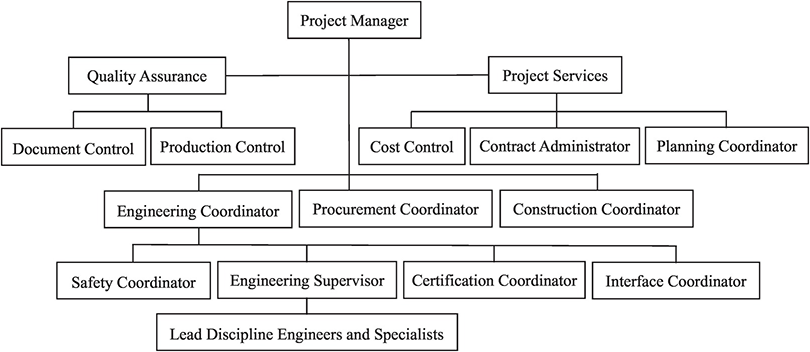
Figure 1.10 depicts a possible organisational chart for project management, which encompasses various aspects of project engineering, procurement, construction, planning, contracting, monitoring and cost control. Each key function is supported by an adequately staffed team equipped with the correct resources and expertise.
A possible organisational chart for project management

1.5.10 Post-Bid Scheduling and Management
One of the most important elements in the success of a project is effective monitoring, with follow-up action as necessary, to ensure that a project adheres to the planned schedule of construction and delivery. The planned schedule itself is a function of various factors, such as the capabilities of the shipyard and its contractors. Prior to the awarding of a final commercial contract to a shipyard, its construction facilities are evaluated in terms of the physical facilities (e.g., steelwork pre-fabrication and dry-dock facilities), management systems (e.g., project management system, quality assurance and control organisation, procurement and pre-outfitting experience), discipline and trade resources (e.g., engineering manning levels, steelwork and outfitting trade levels, and hook-up and commissioning resources) and corporate considerations (e.g., previous offshore sector experience and fiscal stability).
The construction schedule for a typical project is broken down into four quartiles, (1) engineering and procurement, (2) prefabrication and pre-outfitting, (3) vessel erection, outfitting and process installation and (4) final outfitting, hook up, commissioning and completion. Any schedule slippage in an earlier quartile may delay the entire project, and the recovery of a delayed schedule during the next quartile can be difficult. Thus, a primary function of project management is to remain alert to possible schedule slippages and prevent these from occurring. Delay recovery is costly, as it invariably requires additional resources and a greater than planned work volume to be performed within a shorter than planned period of time.
1.6 Characteristics of As-Built Ship-Shaped Offshore Installations
The general arrangement of a ship-shaped offshore installation depends on its intended function, in terms of the process plant size, footprint and complexity. The capacity of an installation is also project-specific and dependent on field economics. The determination of the optimal capacity is complex, as it involves the assessment of overall field development costs that are affected by multiple factors, including the plant capacity and characteristics, and the required gas handling, water injection, flow assurance and chemical treatment facilities.
This section describes the characteristics of the facilities of as-built ship-shaped offshore installations, with a focus on those of a hypothetical hull structured FPSO unit that is used for offshore oil development. The factors that affect the general arrangement of an FPSO installation are the
capacity of its process modules;
size of its cargo tanks;
location and size of its mooring systems;
location and size of its accommodation facilities;
capacity and distribution of its ballast;
arrangement of its escape, evacuation and rescue facilities;
arrangement of its offloading facilities and
margins for future upgrading and expansion of its processes.
1.6.1 Layout of Facilities in an FPSO Installation
The layout of an FPSO installation is configured to maximise separation between the accommodation facilities (including the principal evacuation systems) and the major hydrocarbon hazards. The main facilities of an FPSO installation are
topside facilities, such as process modules;
cargo and ballast tanks;
riser facilities;
mooring systems;
accommodation facilities;
a flare tower;
machinery and utility systems;
escape routes and
export facilities.
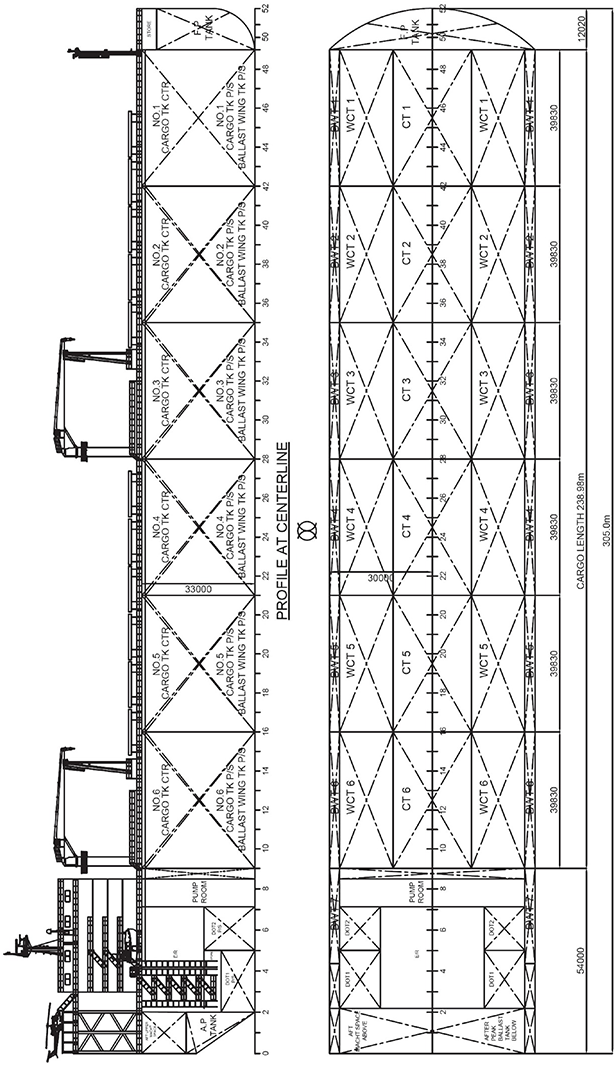
Accommodation facilities are located in the bow or stern area; if they are placed in the former location, they are separated as much as possible from the single-point mooring systems that are arranged with risers. This configuration is optimal because it enables the motion of single-point mooring systems to be minimised while simultaneously maximising the weathervaning capacity. If the accommodation facilities are equipped with a helideck and are located at the stern of an FPSO unit that has been converted from a trading tanker, the proximity to the engine room can be an advantage, as it enables rapid access to many of the major vessel systems such as utility systems.
Single-point mooring systems are usually located as far forward as possible, whereas accommodation facilities equipped with a helideck are sited aft. The process modules and power generation areas are located in the cargo length, and the flare tower is located in the forward area. This location of the single-point mooring system facilitates active heading control by the thrusters. However, the forward location of an internal single-point mooring system in a trading tanker conversion depends on the size of the system and the number of risers that must be served. Larger single-point mooring systems are sited in the section 0.2–0.35 L from the forward end (where L = vessel length), and the accommodation facilities are sited forward of this. This is done to maximise the length of the cargo region aft of the mooring system.
The topside facilities are located above the main deck in between the single-point mooring system and the accommodation facilities. The main deck must be strong enough to hold the support columns of the topside modules, with sufficient space to house the piping required for cargo loading and offloading and inerting and venting, and to accommodate hatches for tank access. The main deck also typically contains the two main cranes (one each on the port and starboard sides) and the oil-metering skid for fiscal metering during offloading (usually located in front of the accommodation facilities). Shielded escape routes run from the bow along the port and starboard sides of the main deck, in front of the accommodation facilities. Stairways and ladders are installed to permit intermediate access from the elevated process deck to the escape routes.
The topside modules are divided into a process area and a utility area. The process area contains the hydrocarbon-containing equipment, flare tower, compression equipment and separation equipment. The utility area contains the utility equipment and power generation equipment. It is crucial to ensure that the layout of the topside facilities maximises the safety of the onboard personnel. As such, the process equipment hazards must be minimised. Accordingly, a minimal amount of piping is used and is itself protected from hazards, such as dropped objects and dynamic hull flexing. The process area is located as far as possible from the accommodation facilities, while the utility area is located in between the process area and the accommodation facilities.
1.6.2 Principal Dimensions of As-Built FPSO Installations
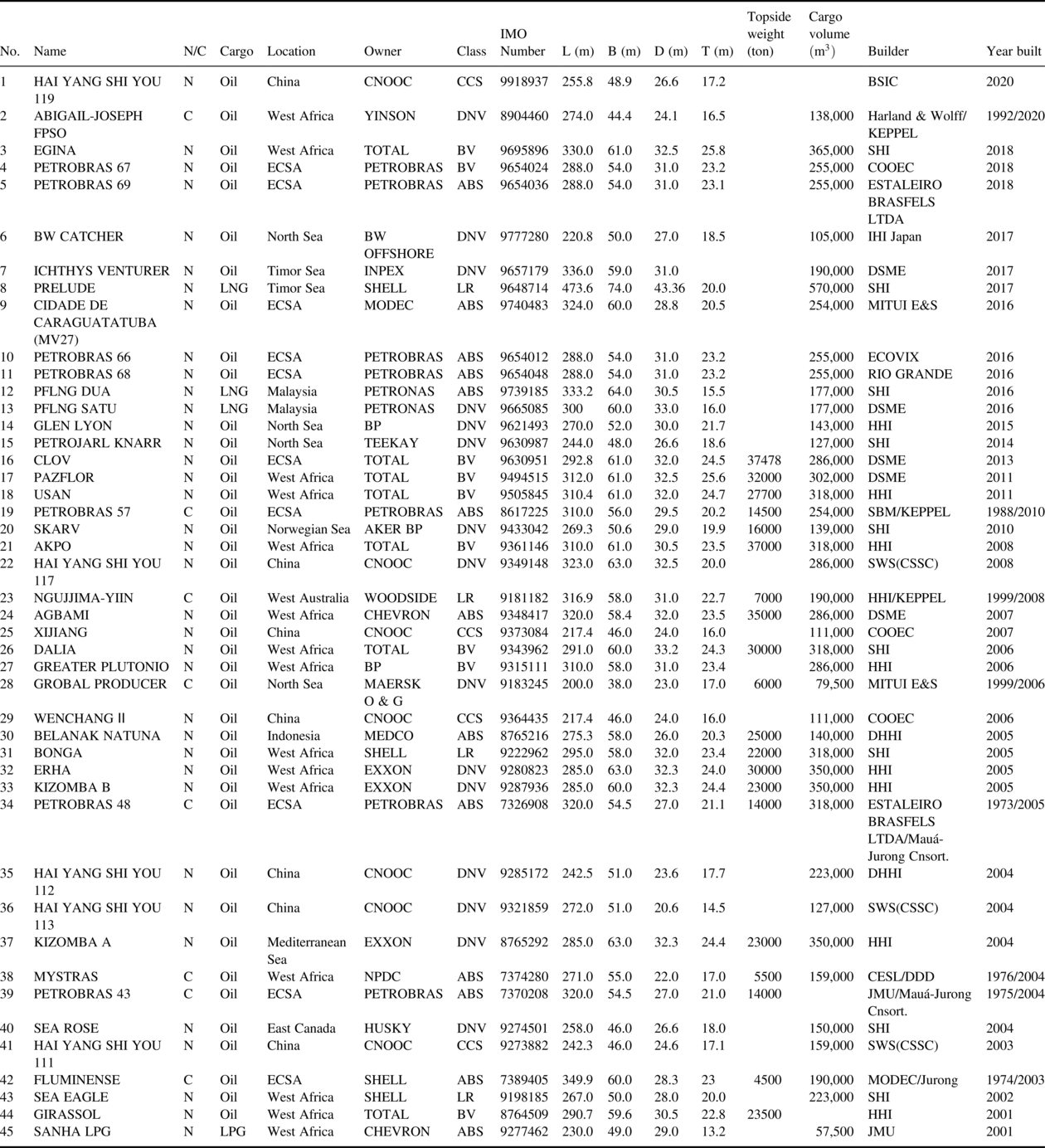
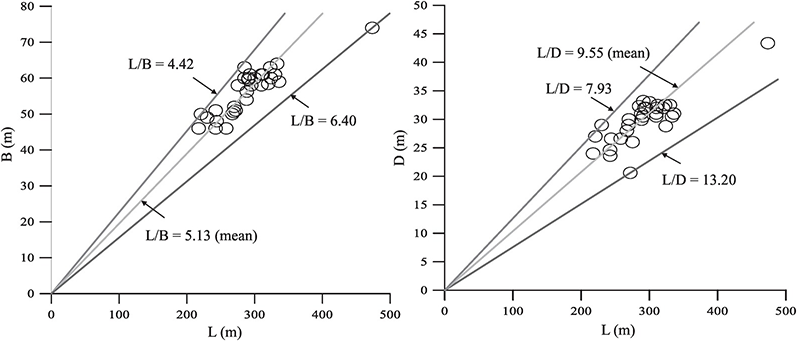
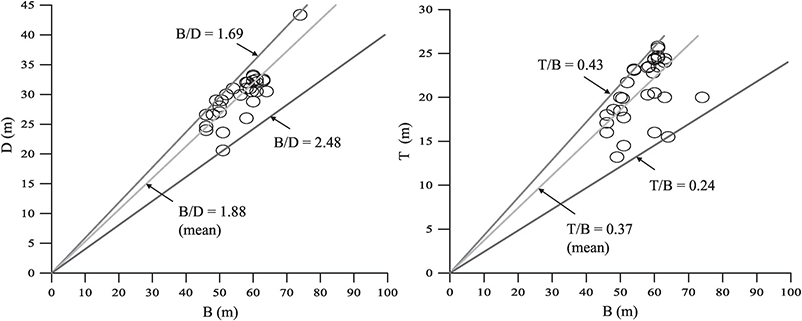
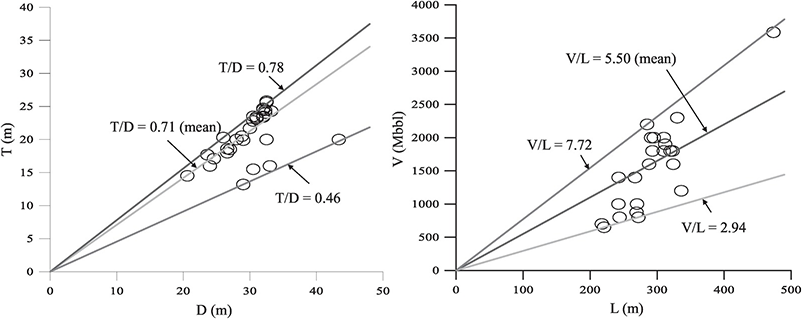
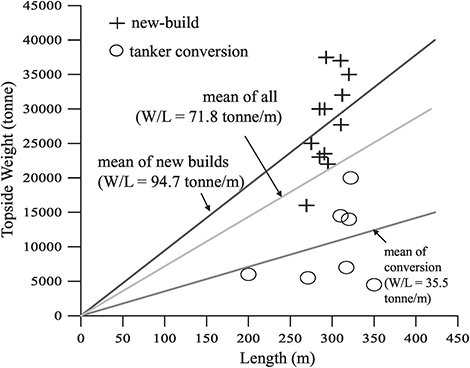
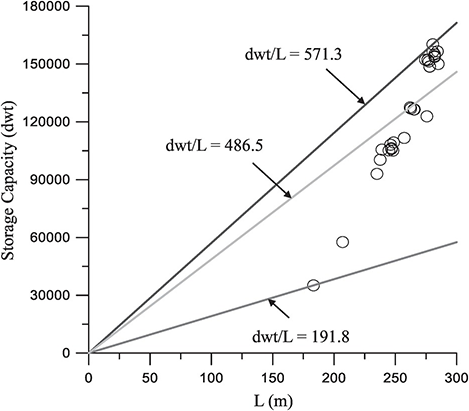
The dimensional relationships of an FPSO installation depend on and affect its storage capacity, stability, motion characteristics, mooring and station keeping, and the environmental actions to which the vessel is subjected. The interrelationships between the principal dimensions of an FPSO installation affect various features of its design. For example, an increase in the length of an installation for a given storage capacity will increase the mooring forces and the extent of the hazardous zones, and will thus affect the construction costs. The lowest building cost for an FPSO installation is obtained for the lowest L/B ratio (B = vessel breadth), where L and B are maximised with respect to vessel depth and B is also maximised to obtain the greatest deck area. While the draught is the smallest dimensional parameter, it is maximised for overall storage efficiency and must be sufficiently deep to minimise bottom slamming. The block coefficient of the vessel is maximised for storage capacity and construction efficiency. Table 1.6 lists forty-five FPSO installations that have been built since 2000, including new builds and trading tanker conversions. Table 1.7 details the characteristics of the principal dimensions for FPSO installations (new builds and trading tanker conversions) and trading tankers built since 2000. Figures 1.11–1.14 show plots of the relationships between the principal dimensions and capacities of FPSO installations built since 2000.
| No. | Name | N/C | Cargo | Location | Owner | Class | IMO Number | L (m) | B (m) | D (m) | T (m) | Topside weight (ton) | Cargo volume  | Builder | Year built |
|---|---|---|---|---|---|---|---|---|---|---|---|---|---|---|---|
| 1 | HAI YANG SHI YOU 119 | N | Oil | China | CNOOC | CCS | 9918937 | 255.8 | 48.9 | 26.6 | 17.2 | BSIC | 2020 | ||
| 2 | ABIGAIL-JOSEPH FPSO | C | Oil | West Africa | YINSON | DNV | 8904460 | 274.0 | 44.4 | 24.1 | 16.5 | 138,000 | Harland & Wolff/KEPPEL | 1992/2020 | |
| 3 | EGINA | N | Oil | West Africa | TOTAL | BV | 9695896 | 330.0 | 61.0 | 32.5 | 25.8 | 365,000 | SHI | 2018 | |
| 4 | PETROBRAS 67 | N | Oil | ECSA | PETROBRAS | BV | 9654024 | 288.0 | 54.0 | 31.0 | 23.2 | 255,000 | COOEC | 2018 | |
| 5 | PETROBRAS 69 | N | Oil | ECSA | PETROBRAS | ABS | 9654036 | 288.0 | 54.0 | 31.0 | 23.1 | 255,000 | ESTALEIRO BRASFELS LTDA | 2018 | |
| 6 | BW CATCHER | N | Oil | North Sea | BW OFFSHORE | DNV | 9777280 | 220.8 | 50.0 | 27.0 | 18.5 | 105,000 | IHI Japan | 2017 | |
| 7 | ICHTHYS VENTURER | N | Oil | Timor Sea | INPEX | DNV | 9657179 | 336.0 | 59.0 | 31.0 | 190,000 | DSME | 2017 | ||
| 8 | PRELUDE | N | LNG | Timor Sea | SHELL | LR | 9648714 | 473.6 | 74.0 | 43.36 | 20.0 | 570,000 | SHI | 2017 | |
| 9 | CIDADE DE CARAGUATATUBA (MV27) | N | Oil | ECSA | MODEC | ABS | 9740483 | 324.0 | 60.0 | 28.8 | 20.5 | 254,000 | MITUI E&S | 2016 | |
| 10 | PETROBRAS 66 | N | Oil | ECSA | PETROBRAS | ABS | 9654012 | 288.0 | 54.0 | 31.0 | 23.2 | 255,000 | ECOVIX | 2016 | |
| 11 | PETROBRAS 68 | N | Oil | ECSA | PETROBRAS | ABS | 9654048 | 288.0 | 54.0 | 31.0 | 23.2 | 255,000 | RIO GRANDE | 2016 | |
| 12 | PFLNG DUA | N | LNG | Malaysia | PETRONAS | ABS | 9739185 | 333.2 | 64.0 | 30.5 | 15.5 | 177,000 | SHI | 2016 | |
| 13 | PFLNG SATU | N | LNG | Malaysia | PETRONAS | DNV | 9665085 | 300 | 60.0 | 33.0 | 16.0 | 177,000 | DSME | 2016 | |
| 14 | GLEN LYON | N | Oil | North Sea | BP | DNV | 9621493 | 270.0 | 52.0 | 30.0 | 21.7 | 143,000 | HHI | 2015 | |
| 15 | PETROJARL KNARR | N | Oil | North Sea | TEEKAY | DNV | 9630987 | 244.0 | 48.0 | 26.6 | 18.6 | 127,000 | SHI | 2014 | |
| 16 | CLOV | N | Oil | ECSA | TOTAL | BV | 9630951 | 292.8 | 61.0 | 32.0 | 24.5 | 37478 | 286,000 | DSME | 2013 |
| 17 | PAZFLOR | N | Oil | West Africa | TOTAL | BV | 9494515 | 312.0 | 61.0 | 32.5 | 25.6 | 32000 | 302,000 | DSME | 2011 |
| 18 | USAN | N | Oil | West Africa | TOTAL | BV | 9505845 | 310.4 | 61.0 | 32.0 | 24.7 | 27700 | 318,000 | HHI | 2011 |
| 19 | PETROBRAS 57 | C | Oil | ECSA | PETROBRAS | ABS | 8617225 | 310.0 | 56.0 | 29.5 | 20.2 | 14500 | 254,000 | SBM/KEPPEL | 1988/2010 |
| 20 | SKARV | N | Oil | Norwegian Sea | AKER BP | DNV | 9433042 | 269.3 | 50.6 | 29.0 | 19.9 | 16000 | 139,000 | SHI | 2010 |
| 21 | AKPO | N | Oil | West Africa | TOTAL | BV | 9361146 | 310.0 | 61.0 | 30.5 | 23.5 | 37000 | 318,000 | HHI | 2008 |
| 22 | HAI YANG SHI YOU 117 | N | Oil | China | CNOOC | DNV | 9349148 | 323.0 | 63.0 | 32.5 | 20.0 | 286,000 | SWS(CSSC) | 2008 | |
| 23 | NGUJJIMA-YIIN | C | Oil | West Australia | WOODSIDE | LR | 9181182 | 316.9 | 58.0 | 31.0 | 22.7 | 7000 | 190,000 | HHI/KEPPEL | 1999/2008 |
| 24 | AGBAMI | N | Oil | West Africa | CHEVRON | ABS | 9348417 | 320.0 | 58.4 | 32.0 | 23.5 | 35000 | 286,000 | DSME | 2007 |
| 25 | XIJIANG | N | Oil | China | CNOOC | CCS | 9373084 | 217.4 | 46.0 | 24.0 | 16.0 | 111,000 | COOEC | 2007 | |
| 26 | DALIA | N | Oil | West Africa | TOTAL | BV | 9343962 | 291.0 | 60.0 | 33.2 | 24.3 | 30000 | 318,000 | SHI | 2006 |
| 27 | GREATER PLUTONIO | N | Oil | West Africa | BP | BV | 9315111 | 310.0 | 58.0 | 31.0 | 23.4 | 286,000 | HHI | 2006 | |
| 28 | GROBAL PRODUCER | C | Oil | North Sea | MAERSK O & G | DNV | 9183245 | 200.0 | 38.0 | 23.0 | 17.0 | 6000 | 79,500 | MITUI E&S | 1999/2006 |
| 29 | WENCHANG Ⅱ | N | Oil | China | CNOOC | CCS | 9364435 | 217.4 | 46.0 | 24.0 | 16.0 | 111,000 | COOEC | 2006 | |
| 30 | BELANAK NATUNA | N | Oil | Indonesia | MEDCO | ABS | 8765216 | 275.3 | 58.0 | 26.0 | 20.3 | 25000 | 140,000 | DHHI | 2005 |
| 31 | BONGA | N | Oil | West Africa | SHELL | LR | 9222962 | 295.0 | 58.0 | 32.0 | 23.4 | 22000 | 318,000 | SHI | 2005 |
| 32 | ERHA | N | Oil | West Africa | EXXON | DNV | 9280823 | 285.0 | 63.0 | 32.3 | 24.0 | 30000 | 350,000 | HHI | 2005 |
| 33 | KIZOMBA B | N | Oil | West Africa | EXXON | DNV | 9287936 | 285.0 | 60.0 | 32.3 | 24.4 | 23000 | 350,000 | HHI | 2005 |
| 34 | PETROBRAS 48 | C | Oil | ECSA | PETROBRAS | ABS | 7326908 | 320.0 | 54.5 | 27.0 | 21.1 | 14000 | 318,000 | ESTALEIRO BRASFELS LTDA/Mauá-Jurong Cnsort. | 1973/2005 |
| 35 | HAI YANG SHI YOU 112 | N | Oil | China | CNOOC | DNV | 9285172 | 242.5 | 51.0 | 23.6 | 17.7 | 223,000 | DHHI | 2004 | |
| 36 | HAI YANG SHI YOU 113 | N | Oil | China | CNOOC | DNV | 9321859 | 272.0 | 51.0 | 20.6 | 14.5 | 127,000 | SWS(CSSC) | 2004 | |
| 37 | KIZOMBA A | N | Oil | Mediterranean Sea | EXXON | DNV | 8765292 | 285.0 | 63.0 | 32.3 | 24.4 | 23000 | 350,000 | HHI | 2004 |
| 38 | MYSTRAS | C | Oil | West Africa | NPDC | ABS | 7374280 | 271.0 | 55.0 | 22.0 | 17.0 | 5500 | 159,000 | CESL/DDD | 1976/2004 |
| 39 | PETROBRAS 43 | C | Oil | ECSA | PETROBRAS | ABS | 7370208 | 320.0 | 54.5 | 27.0 | 21.0 | 14000 | JMU/Mauá-Jurong Cnsort. | 1975/2004 | |
| 40 | SEA ROSE | N | Oil | East Canada | HUSKY | DNV | 9274501 | 258.0 | 46.0 | 26.6 | 18.0 | 150,000 | SHI | 2004 | |
| 41 | HAI YANG SHI YOU 111 | N | Oil | China | CNOOC | CCS | 9273882 | 242.3 | 46.0 | 24.6 | 17.1 | 159,000 | SWS(CSSC) | 2003 | |
| 42 | FLUMINENSE | C | Oil | ECSA | SHELL | ABS | 7389405 | 349.9 | 60.0 | 28.3 | 23 | 4500 | 190,000 | MODEC/Jurong | 1974/2003 |
| 43 | SEA EAGLE | N | Oil | West Africa | SHELL | LR | 9198185 | 267.0 | 50.0 | 28.0 | 20.0 | 223,000 | SHI | 2002 | |
| 44 | GIRASSOL | N | Oil | West Africa | TOTAL | BV | 8764509 | 290.7 | 59.6 | 30.5 | 22.8 | 23500 | HHI | 2001 | |
| 45 | SANHA LPG | N | LPG | West Africa | CHEVRON | ABS | 9277462 | 230.0 | 49.0 | 29.0 | 13.2 | 57,500 | JMU | 2001 |
L = length of all; B = breadth; D = depth; T = draught; N = new build; C = conversion and ECSA = eastern coast of South America.
| Vessel type | L/B | B/D | T/D | T/B |
|---|---|---|---|---|
| New-build FPSO installations | ||||
| North Sea | 4.90 | 1.80 | 0.70 | 0.39 |
| West coast of Africa | 5.05 | 1.86 | 0.73 | 0.39 |
| East coast of South America | 5.26 | 1.83 | 0.74 | 0.41 |
| Worldwide | 5.12 | 1.89 | 0.68 | 0.36 |
| Tanker conversion FPSO installations (worldwide) | 5.86 | 1.99 | 0.72 | 0.37 |
| Trading tankers | ||||
| 50,000–70,000 dwt | 6.3 | 2.5 | – | – |
| 70,000–100,000 dwt | 5.6 | 3.0 | – | – |
| 100,000–200,000 dwt | 5.6 | 2.8 | – | – |
L = length of all, B = breadth, T = draught ; D = depth and dwt = deadweight tonnage.
Relationships between the breadth (B) or depth (D) versus length (L) of the hulls of floating production, storage and offloading installations built since 2000

Relationships between the depth (D) or draught (T) versus breadth (B) of the hulls of floating production, storage and offloading installations built since 2000

Relationships between the draught (T) versus depth (D) and cargo volume (V) in Mbbl versus length (L) of the hulls of floating production, storage and offloading installations built since 2000 (where Mbbl = 1,000 barrels)

The relationship between the topside weight (W) versus length (L) of the hulls of floating production, storage and offloading (FPSO) installations built since 2000

1.6.3 Double-Bottom and Double-Side Arrangements
The safe design and operation of an FPSO installation require that cargo tanks are protected from damage resulting from collisions with shuttle tankers, particularly when a side-by-side configuration is to be used for exporting cargo. Supply boats or passing vessels are also sources of collisions. The hull of a new-build FPSO usually has double sides, but its bottom may be single skinned. During the conversion of a single-skin trading tanker, double sides are created by attaching sponsons, which act as an extra outer hull.
A double bottom is usually not required for an FPSO installation, as damage from hull grounding is unlikely to occur. However, a disconnectable FPSO installation may need to leave its site periodically under its own power, in which case regulations may require it to have a double bottom. Similarly, a double bottom may be necessary if an FPSO installation is located in a relatively shallow location where there is a greater chance of contact with the sea bottom than in deeper locations. Finally, an FPSO installation that processes heavy oil, especially in cold climates, may require a double bottom to reduce its heating load. If double bottoms that contain complex bottom-shell stiffeners are incorporated into cargo tanks, difficulties may arise during tank stripping and cleaning. Consequently, double-bottom tanks are left void or are used for water ballast.
1.6.4 Tank Arrangement
The hull in a new built FPSO contains several centrally located cargo tanks and several port- and starboard-side ballast water wing tanks. The number of cargo and ballast water tanks depends on the production capacity and the location where a shuttle tanker is to be moored to offload the produced oil. The areas for mooring and offloading contain a hose storage area, a handling reel and a mooring hawser. An FPSO installation must include a range of tanks, such as cargo oil tanks, ballast tanks, slop tanks, potable water tanks, fresh water tanks, diesel oil tanks, methanol tanks and hydraulic oil storage tanks.
The factors that affect the tank design and layout of an FPSO installation are
the number, location and size of cargo and ballast tanks;
the location and size of tanks required for special services (such as methanol tanks, slop tanks, chemical tanks, reception tanks and off-specification oil tanks);
the pumping arrangement for tanks and
the strength of, corrosion protection for and access to tanks.
The factors that affect the cost of tank designs are
the number of cargo production grades;
the export parcel size and production rate;
the hull stresses of various loading scenarios, particularly those related to onsite maintenance and repair and
the flexibility required for operations, inspections and maintenance, with special considerations needed for hot work isolation.
1.6.5 Longitudinal Strength Characteristics of FPSO Hulls
As in the design of trading tankers, longitudinal hull strength is a key aspect of the design of FPSO installations. Figure 1.15 lists the thicknesses of bottom and side shell plates in single-hull and double-hull trading tankers (Wang Reference Wang2003), demonstrating that both may be converted to FPSO installations, particularly for siting in benign wave environments. However, the hull cross-sectional properties of new-build FPSO installations are largely determined by site-specific factors. For example, the wave-induced vertical bending moments of FPSO installations designed for specific environments differ from those of trading tankers, as the latter are typically designed for unrestricted service worldwide and across a range of environments. Furthermore, the ratio of sagging to hogging wave-induced vertical bending moments is 1.0–1.33 for new-build FPSO installations, which is higher than that for converted tankers. Presumably, this difference is attributed to the different hull forms (HSE 2003).
Relationship between the thickness (t) and length (a) of the bottom and side shell plates on trading tankers

Based on seakeeping analyses, Wang (Reference Wang2003) collected useful data on the wave-induced bending moments of new-build FPSO installations at various sites and compared these to the data of trading tankers, as shown in Table 1.8. The wave-induced bending moments of FPSO installations in harsh environments are greater than those of trading tankers. Conversely, the wave-induced bending moments of FPSO installations in benign environments are much smaller than those of trading tankers, because the extreme wave environments of the North Atlantic are commonly used for the design of trading tankers to enable worldwide trade.
| North Sea | Gulf of Mexico | Eastern coast of South America | Western coast of Africa |
|---|---|---|---|
| 1.1–1.7 | 0.8–1.1 | 0.5–0.7 | 0.3–0.7 |
1.6.6 Export Facilities
Two methods are used to export produced oil or gas from ship-shaped offshore installations, namely shuttle tankers and high pressure pipelines, where the latter feed into a larger pipeline-gathering system onshore. Export via shuttle tankers requires high capacity cargo-transfer pumps for the offloading of cargo from storage tanks within the required turnaround times. Export is conducted using risers that are appropriate to the depth of water, the rate of flow and the involved pressures. Cargo pumps are deep-well hydraulically powered units, and installations converted from trading tankers may use existing pumps located in machinery spaces, where the dismantling and removal of pumps for maintenance purposes may be required.
The oil cargo is directed to a shuttle tanker via a transfer hose that is deployed at the stern of the installation, and the hose diameter depends on the flow rate. During the period between offloading operations, the transfer hose is stowed appropriately, that is, away from accommodation facilities, temporary refuges, escape routes and lifeboat embarkation stations, to minimise the risks of accidental leakage and spillage during offloading. It is also important to establish procedures and install support devices for the removal and repair of damaged hose sections. The vibrations from hydraulic power systems must be minimised to reduce vibration and noise in the hull machinery spaces and on deck in the vicinity of accommodation facilities. Vibrations are transmitted via the structure, pipe work and piping supports, and may cause fatigue cracking at stress concentration areas. Environmental concerns and related regulatory requirements mean that flaring or venting surplus gas into the air is permitted only in an emergency. Instead, separated gas must be reinjected into the reservoir or adjacent suitable geological formations for storage, and may or may not be recovered in the future. The gas may also be exported if a pipeline infrastructure exists, assuming economic feasibility.
Shuttle tanker export operations are performed via one of three systems (shown in Figure 1.16): in tandem, side-by-side or with a catenary anchor leg-mooring buoy located at a distance from the installation. Which system is used depends on various factors, and an available back-up system in case of a failure of the primary system is highly desirable. Most fields use export operations as the means to monetise oil production, and thus an export system must safely offload oil or gas from the installation and accurately measure the quantity and quality of the exported product. The oil or gas must be exported at a sufficient rate to avoid incurring demurrage of the tankers involved. For example, a million-barrel oil parcel may need to be offloaded in a period of fewer than thirty-six hours, which is measured from the time of arrival of the shuttle tanker or when the shuttle tanker indicates its readiness to berth at the terminal, to its time of departure, once all of the post-offloading paperwork has been completed. The offloading rate should thus allow for the connection time; slowdown during starting and finishing (topping-up) operations; and paperwork completion and disconnection times. An export system must therefore enable the offloading of a full parcel within twenty-four to twenty-six hours, with the remaining time being used for the related activities. Longer periods are required for offloading larger parcel sizes, for example, seventy-two hours for offloading a two million barrel parcel. Figure 1.17 shows the relationship between the size and storage capacity of a shuttle tanker.
Types of shuttle tanker export systems (courtesy of Samsung Heavy Industries).
Tandem export

Side-by-side export

Export by shuttle tanker with a catenary anchor leg-mooring buoy

The relationship between the storage capacity (deadweight tonnage; dwt) and length (L) of shuttle tankers

The use of dynamic positioning systems attached to ship-shaped offshore installations or shuttle tankers can help to achieve the required station-keeping accuracy, disconnection limits and weather downtime prevention during production and/or offloading. Most dynamic positioning systems use thrusters to control vessel motion.
1.7 Hypothetical Designs of Ship-Shaped Offshore Installations
1.7.1 An FPSO Hull
Here, a hypothetical ship-shaped FPSO installation hull based on an ultra-large crude carrier (ULCC) is designed. This hull is used in this book to illustrate the examples of structural safety assessments. The principal dimensions and important features of this hypothetical vessel are as follows:
L (length of all) = 305 m;
B (breadth) = 60 m;
D (depth) = 32 m;
cargo capacity at 90 per cent full load condition = 2,400,000 barrels;
estimated dwt (deadweight tonnage) = 334,500 tonne;
estimated full-load T (draught) = 23.3 m;
estimated light ship T (draught) = 3.3 m;
- (block coefficient) = 0.975;
slop tank capacity at 98 per cent full-load condition = 90,000 barrels;
estimated process-deck weight = 31,000 tonnes;
estimated total production riser weight = 3,200 tonnes and
mooring loads = 1,900 tonnes.

The principal dimensions of this hypothetical FPSO installation hull fall within the mean values (described in Section 1.6.2), with an L/B = 5.08, L/D = 9.53, B/D = 1.88, T/B = 0.39 and T/D = 0.73 at a 90 per cent full-load condition. Figure 1.18 shows the general arrangement of the hull, while Figure 1.19 shows the designs of the midship section of the hull. The vessel has double sides and a single-skin bottom. Ordinary steel (grade A) is used in most parts of the hull, while the deck and bottom areas are made of high strength steel (AH32). Figure 1.20 shows the three-dimensional configurations of the midship section for a hypothetical FPSO hull and an entire hull.
General arrangement of a hypothetical floating production, storage and offloading installation hull

Midship section design of a hypothetical floating production, storage and offloading installation hull

Three-dimensional configurations of the entire hull and the midship section of a hypothetical floating production, storage and offloading installation hull

Table 1.9 indicates the midship sectional properties of a hypothetical floating production, storage and offloading installation hull, where the values from the H-CSR minimum requirement (IACS 2020) for trading ships are also compared. The ultimate vertical bending moments in hogging or sagging were calculated by the ALPS/HULL software (www.maestromarine.com) using the intelligent supersize finite element method (described in Section 7.4.3). Figure 1.21 shows the ALPS/HULL model for a one-bay hull section between two transverse frames. In the ALPS/HULL method modelling, the effects of welding-induced initial imperfections were accounted for, where an average level of residual stress from Equation (2.11) and an average level of initial deflection from Equation (2.12) were applied for plating between longitudinal stiffeners, while a low level of initial deflection from Equation (2.12) and zero residual stress were applied for webs and flanges of longitudinal stiffeners.
| Property |  |  |  | 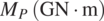 | 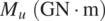 | |
|---|---|---|---|---|---|---|
| Hog | Sag | |||||
| Gross scantling | 1650.542 | 98.768 | 101.330 | 33.243 | 27.613 | –27.153 |
| Net scantling | 1517.491 | 90.494 | 93.493 | 30.496 | 24.868 | –23.998 |
| H-CSR minimum requirement for net scantling | 827.633 | 70.552 | 70.552 | – | 20.790 | –19.830 |
The gross scantling indicates the values with corrosion margins and the net scantling is without corrosion margins.  = moment of inertia;
 = section modulus at deck;
 = section modulus at bottom;
 = full plastic bending moment and
 = ultimate vertical bending moment. The H-CSR minimum requirement (IACS 2020) indicates the values for trading tankers.
ALPS/HULL one-bay section model for the midship hull structure between two transverse frames of a hypothetical floating production, storage and offloading installation

1.7.2 A Nuclear Power Plant Hull
Next, a hypothetical ship-shaped nuclear power-plant hull is designed (Paik Reference Paik2019). It is also used in this book to illustrate examples of structural safety assessments. The principal dimensions of this hypothetical hull are as follows:
L (length of all) = 174 m;
B (breadth) = 65 m;
D (depth) = 33 m;
- (block coefficient) = 1.0;
Hull weight of high-strength steel (AH36) = 3,842 tonnes;
Total hull weight = 47,187 tonnes and
Total equipment weight = 20,179 tonnes.

Figure 1.22 shows the general arrangement of the hypothetical ship-shaped nuclear power plant hull (thorconpower.com). Figure 1.23 shows the numbers of the hull cross sections associated with transverse frames. The vessel has double sides and a double bottom, which are used for ballasting. Ordinary steel (grade A) is used in most parts of the hull, while the bustle around the hull and support members in the deck and bottom areas are made of high strength steel (AH36). Figure 1.24 shows the structural configurations of the midship section (containing turbine hall) and an entire hypothetical ship-shaped nuclear power plant hull.
General arrangement of a hypothetical ship-shaped nuclear power plant hull

Numbers of the cross-sections for a hypothetical ship-shaped nuclear power plant hull

Structural configuration of a hypothetical ship-shaped nuclear power plant hull

Table 1.10 indicates the sectional properties of a hypothetical ship-shaped nuclear power plant hull, where the values from the H-CSR minimum requirement (IACS 2020) for trading tankers are also compared. The ultimate vertical bending moments in hogging or sagging were calculated by the ALPS/HULL software (www.maestromarine.com) using the intelligent supersize finite element method (described in Section 7.4.3). Figure 1.25 shows the ALPS/HULL models for a one-sliced midship hull section between two transverse frames at section numbers 20 and 22 (shown in Figure 1.23). In the ALPS/HULL method modelling, the same conditions of welding-induced initial imperfections as those of Section 1.7.1 were applied.
| Property |  |  |  |  | 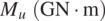 | |
|---|---|---|---|---|---|---|
| Hog | Sag | |||||
| Net scantling (section no. 20) | 2604.412 | 128.219 | 205.269 | 50.899 | 42.415 | −35.674 |
| Net scantling (section no. 22) | 2870.926 | 146.260 | 214.711 | 55.434 | 45.406 | −40.427 |
| H-CSR minimum requirement for net scantling | 146.735 | 28.110 | 28.110 | − | 6.387 | −6.082 |
The gross scantling indicates the values with corrosion margins and the net scantling is without corrosion margins.  = moment of inertia;
 = section modulus at deck;
 = section modulus at bottom;
 = full plastic bending moment and
 = ultimate vertical bending moment. The H-CSR minimum requirement (IACS 2020) indicates the values for trading tankers.
ALPS/HULL one-bay section models for the hull structure between two transverse frames at sections 20 and 22 for a hypothetical ship-shaped nuclear power plant