Introduction
The lights are hot, the smoke is thick, and the crowd is being whipped into a frenzy by the performance. The music approaches 105 decibels and the bass is heavy. Masses of people in tight quarters scream with their arms extended towards the stage, reaching past the barricades that separate them from the performers. A foolhardy few are crowd surfing.
Many of those attending the concert have imbibed alcohol and other drugs throughout the evening and soon, the inevitable happens. The medical dispatcher receives a call from event security, “We have a female down, found unconscious near stage left. We require immediate assistance.” A medical team is dispatched using the handheld two-way radio system. At the receiving end, the radio squawks but goes unanswered – no one acknowledges receipt of the dispatcher's transmission. Members of the stage front team, unaware they are being called urgently, continue to scan the crowd for signs of trouble.
The above scenario is descriptive of music concerts and festivals that take place around the world each year. Other mass-gathering (MG) and mass-participation events that involve high levels of ambient noise (HLAN) include air shows, finish lines at sporting events, and stadiums stands full of noisy fans. Each of these settings presents unique communication challenges for those providing on-site medical support.
Although definitions vary, in general, MGs are defined as pre-planned events involving crowds numbering in the thousands, occupying one site or location.Reference Feldman, Lukins, Verbeek, MacDonald, Burgess and Schwartz1-3 Unfortunately when members of a healthy population are in a temporary, unfamiliar environment, injury and illness rates may increase.Reference Feldman, Lukins, Verbeek, MacDonald, Burgess and Schwartz1 Minor first aid complaints such as lacerations, abrasions, sprains, heat-related illnesses and asthma are common presenting complaints, but major medical emergencies such as drug overdoses, cardiac arrest, anaphylaxis, and traumatic injuries also occur.Reference Feldman, Lukins, Verbeek, MacDonald, Burgess and Schwartz1-Reference Grange4 During the 2011 event season, several stages collapsed, causing serious injuries and fatalities for spectators (eg, Ottawa Bluesfest Brady District Block Party in Oklahoma; Indiana State Fair; Pukkelpop Festival in Belgium).5-8 Although thankfully rare in the setting of MGs, mass-casualty incidents have the potential to overwhelm on-site and local emergency services.
When available, members of a multi-disciplinary team consisting of a combination of first aid attendants, nurses, firefighters, paramedics and/or physicians are positioned at fixed medical stations (or a central medical tent) and in roving teams.Reference Grange4 Medical teams at MG events are there to provide assessment and care on-site for injured or ill persons, and then to stabilize and transport the severely injured or ill.Reference Feldman, Lukins, Verbeek, MacDonald, Burgess and Schwartz1-Reference Arbon9 These goals require reliable methods of communication that can be used in the field, often under challenging conditions such as those created by mobile crowds and HLAN.
Ambient noise or background noise is the background sound pressure level at a given location and is measured in decibels (dB). Occupational hearing loss studies have led to the creation of maximum noise exposure scales aimed at reducing damage to hearing when exposed to intense noise. A decibel reading of ∼80 dB for an eight-hour period would be a low risk for hearing damage. Pop concert noise levels may reach levels ∼109 dB over two hours of exposure.Reference Goines and Hagler10An increase of 10 dBs on a sound level meter indicates that sound is 10 times more intense. The louder the sound, the shorter amount of time before noise induced hearing loss occurs.11
Communication Devices and Challenges
Although communication using two-way radios is the most common form of communication in use today to reach health care providers (HCPs) and other emergency services, challenges in using these types of devices in emergency response have been reported.Reference Arbon9, 12-16 Radio users who rely solely on voice transmissions to reach emergency workers complain of sudden spikes in volume from feedback12 and interference,13 as well as garbled and unreadable transmissions when background noise is present.14 Incompatible frequencies being used among various agencies 16 and team members without radios are also reported.15, 16
HLAN can further complicate voice communications via radio, cell phone, and landline. In the context of MG events with HLAN, dispatchers and other staff are sometimes unable to pick up voice transmissions from responders in the field; voice transmissions are obscured when co-mingled with loud background noise. In the reverse, transmissions from a dispatch center may be inaudible by responders in the HLAN environment, even with specialized headsets or earpieces. Given the identified challenges of radio-based communication, the hypothesis was that text-based communications would be an effective alternative.
The purpose of this feasibility study was to formally evaluate whether text-based communications using wireless handheld devices such as smart phones could safely and reliably provide a means of communication among HCPs at MG events with HLAN. The results of provider and dispatcher satisfaction surveys are reported.
Methods
Equipment and Infrastructure
This study used outcome survey methods to evaluate the performance (ie, effectiveness and acceptability) of text-based communication at MG events with HLAN. Ethical approval was obtained through the University of British Columbia Behavioral Research Ethics Board. Through an in-kind grant from Telus, 10 standardized smart phones were used at local community events by HCPs from February 2010 through December 2011. Unlimited airtime and data packages for use in Canada were included in the grant. Special permission was given on two occasions to use the smart phones in the United States (year 1 included voice communications only and year 2 was all inclusive). Each smart phone, identical in color and model, was given a unique call sign, signifying either the location of the phone or the role of the user, including “Doc1,” “MedTent2,” “OPS1,” and so on.
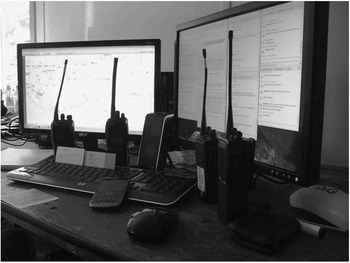
For each event, a medical dispatch was set up in a designated area, usually co-located in the main medical tent (see Figure 1). Dispatchers had access to laptop computers during events. Internet connections for computer use were provided by team members and internet keys were employed if site-wide Wi-Fi access was unavailable. One to three medical dispatchers were required depending on the size and type of event. Marathons and long distance cycling events often required additional dispatch support, especially when using multiple methods of communication (two-way radio, personal cell phone, push-to-talk or “mic” phone, and/or text messaging).
Dispatch Communications Center in Main Medical Tent

Various platforms were trialed using laptop computers and handheld devices over the study period, including Google Talk, BlackBerry Messenger, instant messaging, texting, SMS, and email push. Real time global positioning system (GPS) tracking of the HCPs was also utilized using InstaMapper and Google Latitude. Platforms such as Google Talk required each smart phone device to initially open a Google email account, which was done using each phone's unique call sign. Google Talk software was downloaded and installed on each dispatching laptop. Commercially available, portable, digital, two-way radios were provided and radio dispatch was set up “as usual.”
Recruitment
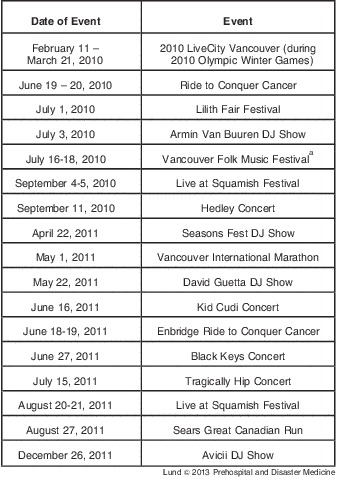
Medical teams providing coverage for events with HLAN in the Lower Mainland of British Columbia and surrounding communities were invited to participate via an email request (see Table 1). Informed consent was obtained prior to event enrollment. At each event, information posters were hung in visible locations explaining the nature of the research project to event attendees and to patients.
Mass-Gathering Events Included in the Study

aThis event was enrolled in the study but the medical team did not use the devices.
Study Procedures
Team members were asked to supplement existing radio-based communication systems with a handheld text messaging device, the smart phone. The smart phones were distributed by research staff at the beginning of each event, and basic verbal and written instructions on how to use the device were provided to participants at that time. Personal devices were also used by team members in some instances, and airtime/data plan use was compensated with a gift card (∼Can$15). Patient confidentiality was maintained by ensuring no personal identifying data was transmitted via text messaging.
At the conclusion of each event a 14-question survey (see http://mgm.sites.olt.ubc.ca/surveys/) was distributed to each participating HCP. A separate 10-question survey was provided to the medical dispatcher(s) at each event. Study participants completed the survey either in print or using an online link to the electronic version of the survey. In the absence of validated survey questions in the existing literature, the questions for this study were developed by the primary investigators (AL, DW). Prima facie validity was confirmed by a colleague with expertise in mass-gathering health (SG). The focus was on evaluating both effectiveness and user satisfaction with text messaging in the context of MGs. Perceived satisfaction was measured using a Likert scale of 1-5 with “1” representing “strongly disagree” and “5” representing “strongly agree.” The surveys also solicited narrative comments with regard to perceived advantages and limitations related to text messaging when compared with standard radio communications. Survey Monkey was used to summarize and analyze the data.
Results
Text messaging devices were used at 17 events covering 40 event days in 2010 and 2011, for a total of approximately 460 hours of device use. The overall completion rate for the surveys was unknown due to the recruiting strategy employed.
Health Care Provider Survey Responses
HCP survey responses (n = 177) were analyzed. Among survey respondents, 96.5% (n = 164) sent or received text messages using the wireless handheld devices provided and 70.3% (n = 121) spent time in areas with HLAN “frequently” or “almost always.” Fifty-six percent (n = 87) of respondents admitted to difficulty understanding audio-based messages in areas with HLAN either “frequently” or “almost always.” Eighty-two percent (n = 140) respondents “agreed” or “strongly agreed” that they were comfortable sending/receiving messages using the wireless handheld device provided.
Eighty-six percent (n = 145) of respondents “agreed” or “strongly agreed” that use of a text-based handheld device as a means of secondary (ie, backup) communication improved their ability to understand and respond to calls from dispatch when compared to radio alone. Four percent (n = 7) of respondents “disagreed” or “strongly disagreed” with this statement. The majority (88.8%, n = 151) of respondents “agreed” or “strongly agreed” that they would feel comfortable using a text-based handheld device as a means of communication at mass-gathering events. Ninety-three percent (n = 158) of respondents felt that use of a text-based handheld device as a means of secondary communication should be used at future MG events with HLAN.
Health care providers were asked to describe possible advantages of text messaging as a means of communication over radio alone. Responses focused on the improved ability to understand messages when radio voice communications were difficult to understand. Privacy of conversation, decrease in the amount of “radio chatter,” and the ability to look back on messages were other commonly cited advantages.
The most commonly cited disadvantage of using text messaging as an alternate means of communication between HCPs was the amount of time required to enter and send a text (in comparison to communicating by voice via radio). Other commonly identified limitations included the difficulty in typing with cold fingers, difficulty in feeling the vibration or hearing a new message signal when near the stage front, concerns about appearing unprofessional while texting, and the inability to treat a patient or move/walk while trying to send a text.
Eighty-seven percent (n = 137) of respondents wanted to see short codes introduced for common communications, as an alternative to typing out each word of a given entry. Several respondents thought radio 10-codes (eg, “10-4” meaning “understood”) would be appropriate. Other respondents felt that texted short codes would improve overall usability.
Dispatcher Survey Results
A total of twenty-six dispatcher surveys were collected. Forty-eight percent (n = 11) of dispatchers that responded felt that HLAN “frequently” or “almost always” interfered with their ability to communicate with the health care team, while another 39.1% (n = 9) indicated that HLAN “occasionally” interfered with communication. Ninety-five percent of all dispatchers (n = 21) who responded indicated they “agreed” or “strongly agreed” that use of text messaging as an alternate means of communication improved their ability to communicate with health care team members in settings with HLAN when compared to radio alone. Ninety-one percent (n = 21) of dispatchers “agreed” or “strongly agreed” that disseminating messages via text messaging in addition to standard voice communication via radio would be a valuable means of communicating with health care team members at future events in settings of HLAN.
When asked to describe advantages of using text messaging as an alternate means of communication when compared to radio alone, dispatchers noted less radio ‘chatter’ and improved ability to keep radio channels open, as well as clear communication of messages. Respondents also noted that text messaging was helpful when radios malfunctioned, batteries died, or radio communications were ineffective due to long distances.
The most common limitation identified by dispatcher respondents was the failure of roving HCPs to check their phone regularly for new messages, or the potential to miss a message due to the inability to feel the vibrations from the phone. Dropped/delayed messages and time required to respond were also mentioned as text messaging limitations.
As was the case with HCP respondents, dispatchers felt that having a list of short form codes would improve the ability to efficiently communicate via text messaging.
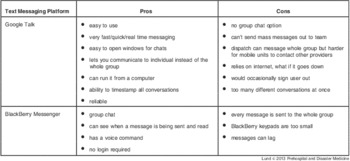
The advantages and disadvantages of the Google Talk platform and BlackBerry Messenger are summarized in Table 2.
Survey Comments Regarding Advantages and Disadvantages of Text Messaging Platforms (All Respondents)

Discussion
Strengths of Text Messaging
This feasibility study utilized survey methodology to evaluate the acceptability and effectiveness of using text-based communications in parallel with standard audio radio communications at MG events when in the setting of HLAN. The survey data indicated that the majority of health care providers and medical dispatchers who participated in the study not only felt comfortable using text-based communications as an alternate form of communication, but also felt that use of text-based messaging improved their ability to communicate when in areas of HLAN. Text messaging may be a viable form of primary or secondary communication at MG events and merits further study.
Of interest, in addition to the improved ability to communicate when in the setting of HLAN, four unanticipated benefits were identified. First, at events occurring over long distances (eg, Ride to Conquer Cancer, a mass participation cycling event during which participants ride from Vancouver, British Columbia, Canada to Redmond, Washington USA) text messaging became an important form of communication among members of the health care team as the limited range of radios rendered them ineffective in many instances. Second, dispatchers were able to use Google Map and Google Latitude to track the location of health care provider smart phones using GPS to more efficiently coordinate a response to medical emergencies. Third, although the study primarily focused upon the use of text messaging for events with HLAN levels, late in the study text messaging was found to be useful for MG events with very low levels of ambient noise. For example, in a theater setting, radio communications represented a disturbance potentially disruptive to artists and members of the audience, and text-based communications were an effective alternative. Finally, although not part of the present study, medical organizers found utility in the history keeping features included in some text-messaging platforms, which provided a printable, time stamped, account of dispatched communications and responses.
Limitations of Text Messaging
A number of potential limitations to the use of text messaging as an alternate form of communication are worthy of discussion. Cost is a potential limiting factor, as providing smart phone devices with airtime and data plans to HCPs could quickly become cost prohibitive. This issue could potentially be overcome by asking participants to use their own devices, with reimbursement of data costs as needed. In relation to overall usability, depending upon the location of the event, the type of text platform and the service provider used, significant delays (ie, minutes to hours) in transmitting messages could be experienced. Minor delays were an issue infrequently; when treating a patient, a health care provider might not have had hands free to text-message a response to dispatch.
Confidentiality is another potential issue to consider with the use of text-based communications, as a number of text platforms (SMS, Google Talk) are not entirely secure. All forms of text communication, however, likely offer more privacy than open radio channels. Furthermore, by avoiding potential patient-identifying information while texting, confidentiality concerns could be minimized. In order to successfully employ text messaging as an alternate form of communication, users must be comfortable using smart phone and text-messaging technology, and in this study a small but not insignificant proportion of health care providers did not feel comfortable using the handheld devices to communicate via text. Dispatchers must also be comfortable simultaneously dispatching by radio and text; the dispatchers who participated in this study were able to multitask without difficulty.
Effective communications are crucial to the provision of medical care at MG events and in disaster or mass-casualty scenarios.Reference Garshnek and Burkle17-20 The lack of efficient and timely communications has been described as the “Achilles heel” of disaster response in mass-gathering events.21 Communication strategies can play a critical role in facilitating timely and effective short and longer term responses; communication problems are identified as one of the most common challenges associated with disaster medicine responses.Reference Garshnek and Burkle17 Ideally, back-up systems should be in place.19-21 Thus, reliable communication technology, whether radio or text-based, is a small but vitally important piece of overall communication plans in the setting of mass gatherings. Without reliable and redundant communication technology, intra-agency and interagency collaboration cannot occur.19-20
Limitations
The results of this study must be interpreted with some caution. Text messaging was used in the context of MG events with HLAN; results are not generalizable to other settings. As well, duplicate surveys were an issue in this study as providers who were members of the medical teams for multiple events were asked to complete the survey more than once. This was permitted, as the event conditions varied, and responses could have been different. Because not all questions were answered by every respondent, there was an incomplete data set. Both incomplete surveys and an unknown survey response rate could affect the accuracy of the results. A relatively small number of medical dispatchers participated in the majority of the study events, which may affect the generalizability of dispatcher survey results.
Future Considerations
Communications in environments with HLAN will continue to be challenging. However, receivable messages, whether audio or text-based, are only one part of the puzzle. In the context of MG, the goal is a synergistic blend of applications—or a “smart platform”— for handheld devices such as tablets. This type of system would include tools such as instant messaging (as proven effective in the present study), medical records, live video communications, and automatic record transfers to emergency health services (EHS) and the event main medical tent. This system would link to a long-range encrypted Wi-Fi network that would only be used by the medical staff. A Wi-Fi network is much needed to reduce delayed messages and loss of cellular service and would be essential during mass casualty incidents or disasters. Within a stressful, chaotic environment with HLAN (as is the case in disaster situations), such a system would make communication with local and national emergency agencies more efficient. Agencies could not only share patient information, but could also use this system as a tool to send and receive critical information live, avoiding jammed public telecommunication towers. The future of secure and effective communication in the context of MGs lies in mobile technology.
Technology is evolving constantly and numerous new or improved systems are available. It is now possible to eradicate standard radios, if so desired, by using smartphone applications that will mimic push-to-talk radio functionality. Ideal areas of expansion for this study would be to implement a local Wi-Fi network (thereby taking dependency off of cellular towers and cellular data), developing standards and protocols for utilizing personal phones/devices effectively, expanding upon GPS tracking options, and exploring data sharing (photos of locations, injuries, participant medical information, etc) among health care providers in the field.
Conclusions
Mass-gathering and mass-participation events will likely continue to increase in popularity. Many events will include HLAN, creating communication challenges for medical teams, and perhaps delaying necessary medical services for ill or injured participants and spectators. Although standard two-way radio communication is rapid, easy to use, and usually reliable, this study confirmed the value of being able to transmit and receive written messages when voice communications were incomprehensible due to HLAN. As “smart” technology increasingly becomes part of our lives, further exploration into using written messages to communicate during MG events would be appropriate. Based on the results of this study, the use of smart phone technology for text-based communications is a feasible tool for MG events.
Acknowledgements
The authors thank the Vancouver Folk Music Festival and Rockdoc Consulting Inc. for inviting our research team to travel behind the scenes and implement this study, and Mr. Tom Skinner for his early involvement in preparing the equipment for use by various medical team members, as well as for his thoughtful edits to this manuscript.