INTRODUCTION
The rational planning of interventional programmes is critical to identify aspects of behaviour, knowledge, attitudes and practices of the population that relate to health problems (Uchôa et al. Reference Uchôa, Lobo, Bastos and Matos2001). Communities should share and participate in formulating choices of actions in health programmes, which must be ethical, efficient and sustainable (Briceño-León, Reference Briceño-León1996). The promotion of health is an ongoing educational process for improving development, acquisitions and skills. The central objective is the development of healthy habits that allow the full exercise of citizenship (Ippolito-Shepherd, Reference Ippolito-Shepherd2005).
Programmes based on knowledge, attitudes and practices (KAP) have previously been adopted in low-income communities to prevent and reduce intestinal parasitic infections (IPIs) (Garg et al. Reference Garg, Lee, Beach, Wamae, Ramakrishnan and Deming2002; Omoigberale and Airauhi, Reference Omoigberale and Airauhi2006). These studies took advantage of the school environment as an operational base, were cost-effective, encouraged public involvement and instigated changes in habits that led to healthy behavioural practices (Montresor et al. Reference Montresor, Crompton, Gyorkos and Savioli2002; Mascie-Taylor et al. Reference Mascie-Taylor, Karim, Karim, Akhtar, Ahmed and Montanari2003; World Health Organization, 2005). In Brazil, however, an asynchrony among the three levels of government (municipal, state and federal) and a lack of political involvement will hinder the implementation of effective preventive measures. Resolution 19 of the 54th World Health Assembly (WHA-54.19) of 2001 and the 49th Directing Council at the 61st Session of the Regional Committee of the World Health Organization establish that efforts must be employed to promote the eradication of, or at least a reduction in, neglected and poverty-related diseases by 2015, primarily those caused by soil-transmitted helminths (STHs), in Latin America and the Caribbean, where 13 of the 14 countries present at least one area with an STHs prevalence higher than 20% (World Health Organization, 2009). Other factors hinder the prevention of IPIs in Brazil: (i) truancy, where only 5% of students entering school in Grade 1 complete primary education, (ii) school health curricula are poorly elaborated and the contents are compartmentalized, (iii) educators and health professionals are poorly prepared for promoting health through dialogue and the sharing of knowledge of regional peculiarities and (iv) some localities lack the Family Health Program of primary care.
A recent report (Moraes Neto et al. Reference Moraes Neto, Pereira, Alencar, Souza-Júnior, Dias, Fonseca, Santos and Almeida2010) claimed that residents of the community of Parque Santuário, although expressing correct notions about IPIs, were neglectful in their attitudes and practices, in conjunction with local environmental conditions, for the transmission of IPIs. Joint measures were thus undertaken to assist in the prevention and control of IPIs by the collective construction of knowledge with the local residents concerning health education. These efforts were aimed at strengthening public policies for the control of these diseases. We surveyed and examined the residents of Parque Santuário and compared their responses and parasitological status before and after the health education.
MATERIALS AND METHODS
Study area and population
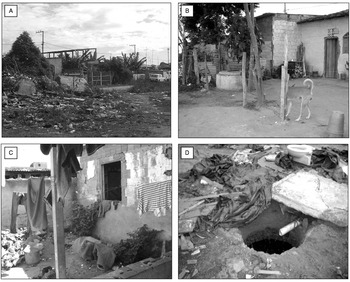
As previously described by Moraes Neto et al. (Reference Moraes Neto, Pereira, Alencar, Souza-Júnior, Dias, Fonseca, Santos and Almeida2010), Parque Santuário is located in the Travessão District, 18 km from downtown Campos dos Goytacazes, in the north of Rio de Janeiro State, southeastern Brazil (21°36′54″S, 41°18′37″W). The average annual temperature, relative humidity and precipitation from 2004 to 2008 were 22·9°C, 80·1% and 1186·5 mm, respectively, according to data obtained from the Empresa de Pesquisa Agropecuária weather station of the Laboratório de Engenharia Agrícola, Campos dos Goytacazes. Parque Santuário has approximately 3000 inhabitants, who live in poverty without city water or sewage treatment. Most residents consume well water exposed to environmental contamination and often discard their waste in improperly constructed, improvised septic tanks. The streets are unpaved and muddy. Most of the houses are precariously built with minimum comfort (Fig. 1). The survey was conducted over a 4-year period, from 2004 to 2008, in a sample population (n=316) of 75 households registered in Parque Santuário by the staff of the Programa Parasitoses do Norte Fluminense (PPNF) of the Universidade Estadual do Norte Fluminense.
(A–D) Overview of Parque Santuário, Travessão District, Campos dos Goytacazes, Rio de Janeiro State, Brazil. (A) Wasteland where many residents discard their waste. (B) Outside view of a house showing a shallow pit as a means of obtaining water for consumption. (C) Internal view of a residence featuring unfinished construction (poor). (D) Domestic sewage in the backyard of one of the residences.

Survey of resident socio-economic conditions
A questionnaire obtained socio-economic data on the number of people per household, age, gender, education, income, domestic characteristics, source of water for human consumption and garbage collection.
Collection and processing of data of knowledge, attitudes and practices for IPIs
The questionnaire of Mello et al. (Reference Mello, Pripas, Fucci, Santoro and Pedrazani1988) was used to obtain data from the parents or legal guardians (respondents) in each of the families studied (n=75). This information identified the KAP of inhabitants before (pre-test) and after (post-test) the health education. The questionnaire is composed of 23 subjective and multiple-choice questions addressing various issues related to IPIs, such as species, parasitic aetiology, aspects of the life cycle, epidemiological importance, diagnosis, symptoms, treatment and prevention measures. The answers to the questionnaire were first distributed in a frequency table and later categorized according to the parasitological concepts adopted by Rey (Reference Rey2002) as correct, partly correct, incorrect and unknown (quantitative analysis).
Collection of data from fecal samples
Fecal material was collected from the homes, which were visited by students and researchers from PPNF and from the Laboratório de Inovações em Terapias, Ensino e Bioprodutos, Instituto Oswaldo Cruz (FIOCRUZ). In total, 181 individuals from Parque Santuário returned fecal samples for this study. The samples were analysed using a sedimentation procedure (Lutz, Reference Lutz1919) by experienced laboratory technologists from the Laboratório Regional de Patologia Clínica in Hospital Geral de Guarús and the Laboratório de Análises Clínicas Plínio Bacelar, both with ISO 9001 certification.
Educational health actions
In a previous report (Moraes Neto et al. Reference Moraes Neto, Pereira, Alencar, Souza-Júnior, Dias, Fonseca, Santos and Almeida2010), we conducted an epidemiological and socio-economic survey of the inhabitants of Parque Santuário. We also investigated how the residents codified and perceived, from their own point of view, the problems of health and disease, mainly those related to IPIs. These data were used to construct the parameters that dictated our educative actions. Based on the most prevalent parasites, the most common means of contamination within the community and the residents' concepts and perceptions about these subjects, we created a teaching strategy in compliance with the language, customs and practices of the community.
Upon registration of households, participants were consulted about their cooperation with the PPNF team. The majority (97%) agreed to attend lectures and discussions. The other 3% preferred to watch theme-related movies. The PPNF team together with some residents developed educational activities, derived from the responses to the questionnaires, comprised of lectures, workshops and debates, with the participation of residents, health professionals and educators from public and private institutions in the area. The dissemination of the programme was achieved through broadcasts by the local radio station, announcements by vehicles equipped with loudspeakers circulating throughout the community, leaflets and publicity bulletins in schools, churches and public squares.
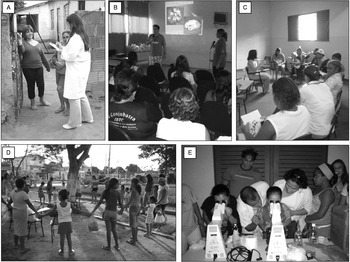
During the programme of health education, team members re-enacted typical situations depicting everyday habits that facilitate the transmission of IPIs, as identified through fieldwork or answers to the questionnaire. In addition, slide shows presented images and concepts related to the theme. At the end of the programme, microscope slides containing fixed cysts and eggs of intestinal parasites frequently present in the feces of individuals were made available for observation (Fig. 2).
(A–E) Health educational actions in Parque Santuário, Travessão District, Campos dos Goytacazes, Rio de Janeiro State, Brazil. (A) Survey of knowledge, attitudes and practices (KAP) of inhabitants about intestinal parasitic infections (IPIs): application of a questionnaire to identify the KAP of inhabitants about IPIs. (B) Lecture about IPIs. (C and D) Meeting with residents and workshop on self-care. (E) Viewing through optical microscopes, after the lectures, of the parasites found in stool tests of the inhabitants.

Sampling procedures
Based on the frequency of individual participation in the actions of health education, the samples were divided into 2 groups: (i) control group (n=46) – individuals who returned stool samples before (pre-test) and after (post-test) the health educational programme but who did not attend the activities developed for our study community by PPNF in 2006 and (ii) experimental group (n=135) – individuals who returned stool samples before (pre-test, 2004–2005) and after (post-test, 2007–2008) the health educational programme and who attended these activities in 2006. Both sample groups together represented 57% of the participants.
Treatment of parasitized individuals
The treatment drugs were provided by Farmanguinhos, FIOCRUZ, and the public health authorities of Campos dos Goytacazes. Every parasitized individual in this survey was treated at home by physicians of the PPNF. The treatment protocol was as follows: individuals parasitized by STHs were given, under supervision, 2 oral 100 mg doses per day of mebendazole for 3 days, repeated after 10 days, whereas individuals with protozoan infections (giardiasis and amoebiasis) were given 3×250 mg doses per day of metronidazole for 7 days. Individuals with mixed infections were first treated with mebendazole and later with metronidazole. Pregnant women and those with amenorrhea were excluded from the survey.
Data management and statistical analysis
During data collection, completed questionnaires were regularly checked to rectify any missing information or discrepancies. Data from questionnaires were entered in an EXCEL datasheet, and data from stool examinations were entered in ACCESS (Microsoft Office 2007 for Windows), and the data were then exported to Epiinfo version 3.5.1 and the Statistical Package for the Social Sciences (SPSS) version 15.0, respectively, for statistical analysis. The McNemar-Bowker test was adopted to verify associations. The level of statistical significance was set at P<0·05, and for each statistically significant factor, a prevalence ratio (PR) and 95% confidence interval (CI) were computed.
Strengths and limitations
The stool samples were tested by routine methods for the concentration and identification of ova and parasites to ensure the validity of the data. Absent individuals and those refusing to cooperate were limitations that must be considered when interpreting the results. In Parque Santuário, 14% of the total residences refused to participate in the programme. Some subjects did not provide fecal samples, which reduced the sample size and decreased the precision of the estimates of infection.
Ethics
The person legally responsible for each family recruited for the survey signed a standard consent form. The protocol of this research was approved by the FIOCRUZ Committee for Ethics on Research (Protocol Number 404/07).
RESULTS
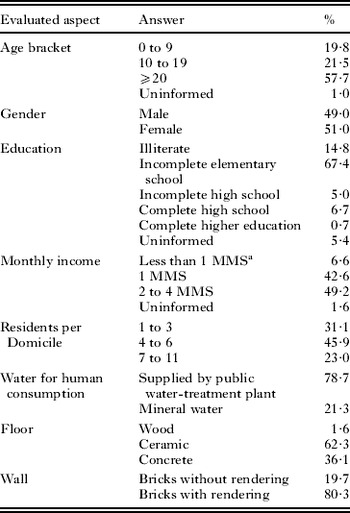
The socio-economic data for the residents of Parque Santuário who participated in the study are listed in Table 1. The socio-economic profile of the typical respondent was: over 20 years of age, educational level equivalent to incomplete elementary school, monthly family income of 2–4 minimum monthly salaries, 4–6 individuals sharing a domicile, water consumption from unreliable sources, indoor plumbing and tiled or masonry floors and walls. Garbage was collected 3 times a week, but the garbage was suspended in open buckets where vectors such as flies, mice and cockroaches concentrated and to which stray pets in search of food had access.
Socio-economic profile of residents of Parque Santuário located in the Travessão District, Campos dos Goytacazes, Rio de Janeiro, Brazil (n=75)

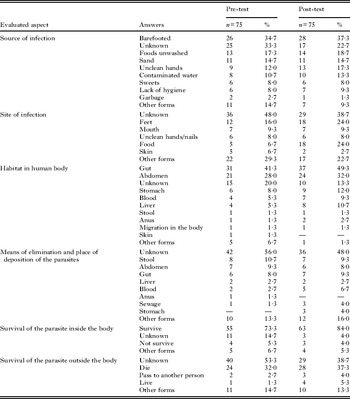
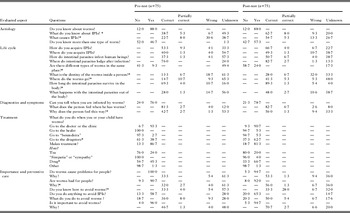
The answers to pertinent questions of the questionnaire on knowledge, attitudes and practices for IPIs, before (pre-test) and after (post-test) the health educational programme, are listed in Tables 2 and 3. The frequencies of responses related to parasitic life cycles are given in Table 2, and a quantitative analysis of classified responses of the 23 questions of the questionnaire are in Table 3. The analysis of responses from the questionnaire revealed that the population had its own codification for intestinal parasites, most commonly ‘bicha’, ‘lombriga’, ‘solitária’, ‘giardia’ and ‘tênia’.
Frequencies of the multiple answers to the questionnaire on knowledge of the inhabitants of Parque Santuário, Travessão District, Campos dos Goytacazes, Rio de Janeiro, Brazil, concerning some aspects of the life cycles of intestinal parasites (n=75)

Quantitative analysis of the answers to the questionnaire given to the inhabitants of Parque Santuário, Travessão District, Campos dos Goytacazes, Rio de Janeiro, Brazil, about knowledge, attitudes and practices related to intestinal parasitic infections (IPIs) (n=75)

The post-test revealed that respondents had gained significant knowledge and/or changes in attitudes (P<0·05) to the questions: What do you know about IPIs? What causes IPIs? Are there different types of worms in the same place? What is the destiny of the worms inside a person? Where do the worms go? How long do intestinal parasites survive in the body? Why does the person feel this way? What do you do when you or your child have worms? Why are IPIs bad for people? Do you know how to avoid worms? (Table 3).
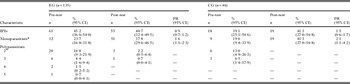
No reduction in the prevalence of IPIs was seen in the post-test for both groups. However, the parasitological profile was modified: the cases of multiple parasitic infections were reduced and cases of monoparasitism increased (P<0·05) (Table 4).
Prevalence of intestinal parasitic infections (IPIs) in the inhabitants of Parque Santuário, Travessão District, Campos dos Goytacazes, Rio de Janeiro, Brazil, before (pre-test) and after (post-test) the health educational actions

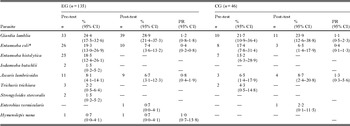
In this study, stool samples contained the protozoa Entamoeba histolytica, Entamoeba coli, Giardia lamblia and Iodamoeba butschlli as well as the helminths Ascaris lumbricoides, Trichuris trichiura, Strongyloides stercoralis, Enterobius vermicularis and Hymenolepis nana (Table 5). The most frequent association among the parasites was E. histolytica with E. coli (n=11).
Comparison of the frequencies of intestinal parasitic infections before (pre-test) and after (post-test) the health educational actions in Parque Santuário, Travessão District, Campos dos Goytacazes, Rio de Janeiro, Brazil

DISCUSSION
In this study, we evaluated the influence of health education on the prevalence of IPIs in Parque Santuário, Travessão District, Campos dos Goytacazes, RJ, Brazil, with the methodology of research-action in an attempt to establish an interactive dialogue with the community. Research-action, as proposed by Thiollent (Reference Thiollent2008), is based on a conversational relationship among groups (Freire, Reference Freire1996). The goal is to not only inform but also to promote social, sanitary and environmental awareness among the members of the community to improve general living conditions.
In the present report, we exploit our experience in sanitary education developed with the residents of Parque Santuário, Campos dos Goytacazes, RJ. We evaluated the results of our intervention by comparing our earlier data (Moraes Neto et al. Reference Moraes Neto, Pereira, Alencar, Souza-Júnior, Dias, Fonseca, Santos and Almeida2010) on the prevalence of intestinal parasitic infections and KAP of the population concerning these issues with data collected before and after our educative action in the community.
The socio-economic profile of households in Parque Santuário revealed the need to develop a strategic housing plan for lowering the density of housing and remodelling the facilities for sanitation and water supply. The implementation of social policies, income generation and education are also prime targets, since most residents are at an optimal productive age (over 20 years of age) with an educational equivalent of elementary school (less than 8 years of schooling) but are living in substandard housing and consuming water from shallow, improperly constructed wells subject to fecal contamination from nearby defective septic tanks.
Previous studies have correlated the prevalence of intestinal parasitic infections with KAP (Mehraj et al. Reference Mehraj, Hatcher, Akhtar, Rafique and Beg2008; Curtale et al. Reference Curtale, Pezzotti, Sharbini, Al Madat, Ingrosso, Saad and Babille1998; Mello et al. Reference Mello, Pripas, Fucci, Santoro and Pedrazani1988). Our KAP survey conducted with respondents from the study community disclosed that the practice of going barefoot was the most often cited cause of infection, both before and after the actions of health education. Upon completion of the educational work, the residents appeared more conscious of the sources of IPIs (contaminated water and food as well as improper hygiene), although the popular misconception that eating sweets caused infection prevailed among a substantial number of the inhabitants.
Another important issue was that, even after the health educational programme, respondents said they knew several aspects related to the life cycle of parasites: (i) What would be the gateway for intestinal parasites?; (ii) What are the routes of elimination, rather than deposition, of parasites? and (iii) How do parasites survive outside the body? These aspects are directly related to the transmission of IPIs and should be better exploited in campaigns for prevention in schools throughout Brazil through the School Health Program (MEC, 2004). They should also be further developed as established by the Ministério da Educação (MEC) through convergent themes (environmental and health) of the National Curriculum Parameters (NCPs/MEC, 1997) as well as through the evaluation and revision of training and technical curricula related to the biomedical field.
Moreover, in the post-test, respondents had acquired substantial knowledge and/or changes in attitude (P<0·05) of the following questions: What do you know about IPIs? What causes IPIs? Are there different types of worms prevalent in the same place? What is the destiny of the worms inside a person? Where do the worms go? How long do intestinal parasites survive in the body? Why does the person feel this way? What do you do when you or your child have worms? Why are IPIs bad for people? Do you know how to avoid worms? This improvement is probably related to the ease of understanding these aspects, since they involve a cause-effect relationship, and may have been facilitated by examples related to the daily routine of the residents, empirically verified and elucidated through play performances by our staff during the meetings, which promoted audience identification with the problem.
Several studies (Valla and Stotz, Reference Valla and Stotz1993; Briceño-León, Reference Briceño-León1996; Reis et al. Reference Reis, Gazzinelli, Silva and Gazzinelli2006) have related that the use of social and educational technologies, constructed from dialogue and popular participation, contribute effectively to the promotion of health, because the ethical and cultural dimensions are essential to the health care of individuals and populations. Moreover, informal dialogue enhances human virtues such as communal solidarity and gradually eases the formality of the biomedical model emphasizing welfare, which imposes a barrier between common experience and erudite knowledge (Matraca et al. Reference Matraca, Wimmer and Araújo-Jorge2010).
The parasitological survey indicated no reduction in the number of infected individuals in either the experimental or the control group, but cases of multiple parasitic infections decreased, and monoparasitism increased. These results may be associated with a significant increase in pharmaceutical practices and drug intake upon suspicion of contracting IPIs, as reported by respondents when asked “What do you do when you or your child have worms?”. Furthermore, the dangers of self-medication and the misuse of drugs for prevention rather than cure are possible. These issues were addressed during the health education, and many respondents stated that they used anti-helminthic drugs every 6 months to avoid IPIs.
Although our health educational programme re-flected neither a statistically significant reduction in the prevalence of IPIs nor an enhancement in the knowledge of respondents on issues concerning the life cycle of parasites, the study population sample exhibited a greater awareness of the importance of IPIs, as evidenced by the significant difference (P<0·05) in attitudes and practices related to prevention before and after the shared health educational actions. Residents initially considered IPIs to be common and normal diseases, acquired by everyone, and attributed a much greater importance to other health problems such as cardiovascular diseases. These findings are consistent with those of Gazzinelli et al. (Reference Gazzinelli, Gazzinelli, Santos and Gonçalves2002).
In conclusion, this study allowed for the shared construction of knowledge that reflected the true needs of the residents of the Travessão District, Campos dos Goytacazes, RJ, Brazil. In this country, the unequal distribution of knowledge imposes serious consequences on the ethical and political conflict between popular and academic knowledge, hindering the effective transformation of living conditions and health in areas with social and environmental vulnerabilities, where the transmission of IPIs is formidable. Thus, the relationship between theory and practice, based on benchmarks for the promotion of health, requires popular participation, the involvement of the scientific community and awareness by the authorities. This relationship facilitates the empowerment of social factors, reflecting not only a better quality of life but also a consolidation and improvement of the current model of health-care law in Brazil, which advocates the social virtues of universality, fairness, integrity, decentralization, impartiality and popular participation.
ACKNOWLEDGMENTS
The authors are very grateful to the administrative staff of the Centro de Biociências e Biotecnologia, Universidade Estadual do Norte Fluminense Darcy Ribeiro; Coordinator Professor Christovam Cardoso and the Nursing Course students of the Universidade Salgado de Oliveira, UNIVERSO, Campos dos Goytacazes, for their participation in collecting data from the residents of the communities; Dr José Carlos Mendonça of the Laboratório de Engenharia Agrícola for the climatic data from the weather station, Campos dos Goytacazes, RJ; Dr Sérgio Luís de Andrade Peixoto and the technical staff from the Hospital de Travessão; Dr José Manuel Moreira, Director of Fundação Dr João Barcellos Martins; Luciana Cordeiro de Araújo and the technical staff from the Laboratório Regional de Patologia Clínica, Hospital Geral de Guarús, Fundação Dr Geraldo da Silva Venâncio and the technical staff of the Laboratório de Análises Clínicas Plínio Bacelar for making the clinical and laboratory examinations of individuals possible; Dr Eduardo Costa, Director of Farmanguinhos, FIOCRUZ, for the donation of anti-parasitic drugs used in the treatment of infected individuals; Mitchell Raymond Lishon, Chicago, IL, USA (UCLA 1969) and Ms Kelly Pereira de Carvalho (Laboratório de Inovações em Terapias, Ensino e Bioprodutos/Instituto Oswaldo Cruz/FIOCRUZ), for reviewing and revising the English; Dr Wiliam Blackhall, PhD and Editor of Global Biological Editing for reviewing and revising the parasitological data.
FINANCIAL SUPPORT
This work was supported by Fundação Oswaldo Cruz (FIOCRUZ), Conselho Nacional de Desenvolvimento Científico e Tecnológico (MCT-CNPq), Fundação Carlos Chagas Filho de Amparo à Pesquisa do Estado do Rio de Janeiro (FAPERJ) Grants E – 26/170.711/2007 and E-26/100.226/2009 and Pró-Reitoria de Extensão e Assuntos Comunitários (PROEX) Universidade Estadual do Norte Fluminense Darcy Ribeiro (UENF).