On April 25, 2015, Nepal was hit by a 7.8 magnitude earthquake, which destroyed 0.3 million houses and left more than 8 million people in desperate need of assistance. The earthquake devastated several vulnerable portions of the country’s infrastructure and debilitated 90% of the local health care system and social welfare institutions.Reference Peleg 1 Subsequently, many international nongovernmental organizations (NGOs) like China International Search & Rescue (CISAR), the Red Cross, the World Health Organization (WHO), UNICEF, Qatar Red Crescent Society, and others moved to Nepal to provide humanitarian assistance.
One of the NGOs that was actively involved in the relief operations in the aftermath of the Nepal earthquake was Doctors For You (DFY), a pan-India humanitarian organization with an international presence that focuses on providing medical care to vulnerable communities during crisis and noncrisis situations. 2 The members of DFY used the popular social networking platform WhatsApp (WhatsApp Inc, Mountain View, CA), which allows formation of a discussion group and exchange of short messages via smart phones, to communicate among themselves and plan their relief operations. The present study was an in-depth analysis of these WhatsApp messages exchanged among the medical personnel of DFY. The primary advantage of these data is that because the data were derived from conversations among medical experts, there was a significant amount of micro-level information about the requirements for different medical resources. In analyzing these data, our primary objectives were twofold: (1) to identify the requirements for different types of medical resources in the aftermath of an earthquake, taking the Nepal earthquake as a case study, and (2) to analyze the temporal aspect of the requirements, such as what resources are required at what stage of the relief operations. Overall, the motivation of this study was to provide guidelines to governments and NGOs about the medical requirements in the aftermath of an earthquake, which might help in better preparedness and resource mapping during future disasters.
A few prior studies have reported on various aspects of the relief operations after the 2015 Nepal earthquake, eg, on the medical rescue operations by Chinese medical teamsReference Yang, Yang and Lv 3 , Reference Wang, Ding and Lv 4 and on damages to buildings as a result of the earthquake.Reference Goda, Kiyota and Pokhrel 5 Extensive research has also been carried out by medical experts on preparedness and hazard mitigation strategies in the area of disaster management.Reference Fukasawa, Suzuki and Nakajima 6 - Reference A Schultz, Koenig and Noji 8 However, none of the prior studies have used social media data for the purpose. In contrast, the present work relied on social media (WhatsApp) data from medical experts who were actually present at the site of the disaster. Hence, the data are reliable and contain detailed descriptions of resource requirements. To the best of our knowledge, no prior study has reported the requirements for medical resources after a disaster in such diminutive detail as in this study.
METHODS
A WhatsApp group was formed among the members of DFY on April 27, 2015 (2 days after the earthquake struck Nepal), for intraorganizational interactions. The messages posted in this group during the first 3 months after the disaster, ie, from April 27 to July 30, 2015, were collected and analyzed. Each message contained the timestamp when the message was posted, the mobile number from which the message was posted, and the message text. The messages were first cleaned and pre-processed by using computer programs. Also, personal identifiable information (PII) in the messages (eg, names, cell numbers) was substituted to preserve the privacy of the members posting the messages. The sanctified set of messages was then given to 3 volunteers, who were asked to identify the various types of medical resources that were reported as required in the dataset.
It can be noted that, apart from medical resources, the dataset also contained information about requirements and availability of other types of resources, such as tents, electrical power sources, and so on. In the present study, however, we focused specifically on the medical resources.
Stages of the Relief Operation
As stated earlier, one of the objectives of this work was to analyze the temporal aspects of the resource requirements, such as what resources are required at what stage of the relief operations. To this end, the guidelines set down by the American Red Cross 9 were followed, which state that during the first 3 months after a disaster, relief operations transit through the following (overlapping) stages: the heroic phase (that occurs immediately after a disaster strikes), the honeymoon phase (from about 1 week to 6 months after the disaster), and the disillusionment phase (that begins a couple of months after the disaster).
Limitations of the Study
The observations made in this study are limited to the information contained in the messages exchanged among the DFY members and do not reflect an exhaustive picture of the relief efforts in the aftermath of the Nepal earthquake. Hence, the observations in this study should be considered as indicative and not exhaustive.
RESULTS
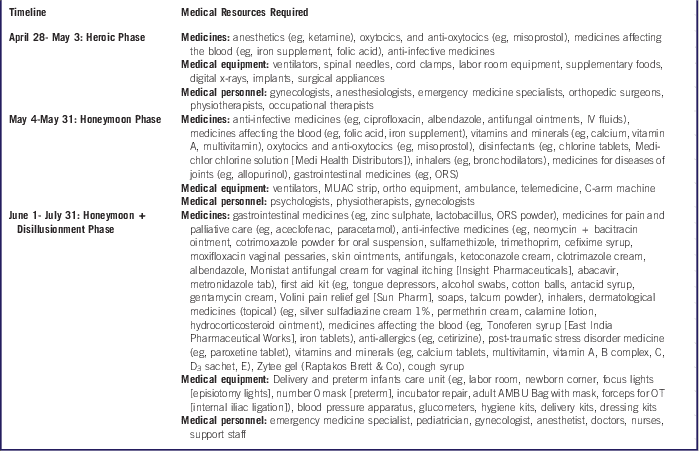
Table 1 describes the detailed phase-wise requirements of different types of medical resources, eg, medicines, medical equipment, and medical personnel, during the different phases of the relief operation. The medicines were categorized considering the essential medicine classification of the World Health Organization. 10
Timeline of Aggregated Requirements for Different Medical ResourcesFootnote a

a Abbreviations: MUAC, mid-upper arm circumference; ORS, oral rehydration solution; OT, operation theater.
Heroic Phase
During the heroic phase (immediately after the earthquake), the primary focus was to deal with earthquake-allied injuries, which essentially needed surgical dressing and debridement. Thus, the requirements included appliances typically related to surgical support and orthopedics, like x-rays, implants, implant fixators, plasters, spinal needles, and anesthetics. Moreover, anti-infective medicines were also required for rapid recovery of surgical patients.
Urgent necessity for ventilators was evident, because a large number of trauma patients from several earthquake-affected districts of Nepal were in need of ventilator support. Requirement for supplementary food for infants was also manifest.
There was also a huge requirement for doctors and medical personnel, because a large fraction of the resident medical personnel were themselves affected by the earthquake. Primarily, orthopedic surgeons, anesthetists, gynecologists, and emergency medicine specialists were required to deal with earthquake-related injuries and maternal death. Occupational therapists were also needed to help people recover from trauma resulting from the disaster.
Honeymoon Phase
One week after the earthquake, in the honeymoon phase, infections of the respiratory tract, gastrointestinal tract, and skin were the most common ailments, leading to the requirement for anti-infective medicines, gastrointestinal medicines, and inhalers. Furthermore, some aftershocks of the original earthquake hit Nepal, regenerating the need for maternal health care medicines and surgical equipment. The multiple earthquakes had a large impact on water quality. Consequently, disinfectants like chlorine tablets and chlorine solution were needed to disinfect the water to avert the probable spread of diarrheal diseases. Orthopedic equipment and consumables were required in this phase owing to the large number of secondary infection and wound infection cases coming to hospitals from various districts of Nepal.
Among medical personnel, primarily psychologists and physiotherapists were sought, along with gynecologists. However, the need for orthopedic doctors was not as acute as in the heroic phase, because most injuries had been operated on within the first week after the earthquake.
Additionally, preventing maternal deaths, antenatal care, safe delivery services, and postpartum care for pregnant woman were of prime concern during the heroic and honeymoon phases. Hence, resources like cord clamps, labor room equipment, oxytocics, and anti-oxytocics were in demand. According to UNICEF, three-fourths of the pregnant women in Nepal were anemic; thus, requirements for medicines affecting the blood, ie, drugs like iron supplements, folic acid tablets, and calcium tablets for antenatal care, were prevalent.
Disillusionment Phase
In the disillusionment phase also, several aftershock earthquakes hit Nepal, leading to the need for first aid kits and medicines for pain and palliative care. Additionally, as a result of the trauma of the aftershocks, several DFY team members as well as earthquake victims could not sleep peacefully at night. Therefore, medication for post-traumatic stress disorder was needed to improve the mental health of both victims and volunteers. Furthermore, owing to heavy rainfall and flooding from the monsoon, food-borne and water-borne diseases spread, as did vector-borne diseases. Therefore, gastrointestinal medicines and anti-infective medicines were sought. A wide range of medicines and kits were also required during this phase, including hygiene kits, inhalers, delivery kits, dressing kits, dermatological medicines, medicines affecting the blood, anti-allergins, and kits for the delivery and preterm infant care unit. There was still a large requirement for medical personnel, especially pediatricians, gynecologists, emergency medicine specialists, nurses, anesthetists, and other support staff.
DISCUSSION
In this research, we attempted to analyze the requirements for medical resources that emerge after an event like the Nepal earthquake. Apart from the requirement for resources, the dataset also indicated various auxiliary problems faced by the DFY members, such as contamination of water sources, problems in transportation of medical personnel and supplies, difficulty in operating hospitals owing to a lack of electrical power, and stress-related issues of the relief workers themselves. These observations indicate typical problems that might be faced by any medical team working in an area affected by an earthquake and may help other medical teams and government agencies be more prepared for such problems. For instance, it is not sufficient to only dispatch medical resources and medical personnel; rather, alternative power sources also need to be arranged so that hospitals can operate even without electricity.
The findings from this research might aid in strengthening the National Strategy for Disaster Risk Management in Nepal. Furthermore, the study can provide invaluable inputs for preparatory provisioning of various medical resources in earthquake-prone regions, so that they can be readily available in the event of a disaster. Thus, it is hoped that the observations in this study will help authorities not only in Nepal but also in other earthquake-prone regions to better prepare for resource mapping during similar disasters in the future.
CONCLUSION
This post-hoc study analyzed a dataset of WhatsApp messages exchanged among DFY members in the aftermath of the Nepal earthquake in April 2015. In contrast with prior works, the data in this study are more reliable because they were obtained from medical experts who were known to have been present at the disaster site. The main contribution of the study is the identification of requirements for various medical resources in the different phases after a disaster.
The study also demonstrates that real-time (ie, actually during the disaster) analysis of such online data would aid decision-makers in forming resource-mapping strategies dynamically. These results could then assist disaster management authorities in assessing requirements, allocating resources, and providing logistics support in real time, which in turn would reduce the loss of human life during disasters.
Acknowledgment
This research was partially supported by a grant from the Information Technology Research Academy (ITRA), DeITY, and the Government of India (ref. no. ITRA/15(58)/Mobile/DISARM/05). We also acknowledge our human volunteers for their sincere effort in annotating the data.