1 Introduction
The present article develops an approach that combines modern cognitive linguistics and historical data. Often very little is known about the writing processes of historical texts and even less can be said about the cognitive processes guiding their production. There is an obvious reason for this: there are no speakers of historical language stages with whom any experiments could be conducted to access speakers’ or hearers’ minds. The older the texts, the less information we have regarding their production or reception circumstances. This article argues that when we look at cognitive (and also psycholinguistic) processing strategies that explain specific language use for Present-day English (PdE) and check the predictions these strategies make for historical texts, we may be able to reveal more details about the said circumstances. Underlying this approach is the assumption that text production (and reception) is guided by the same processing principles and constraints now and in the past; an assumption that in turn is based on the Uniformitarian Principle (see section 2.1).Footnote 1 Eventually such studies may result in two types of feedback for present-day theories. If linguistic structures follow the predictions made by processing principles identified for PdE, not only would we be able to conclude something about the text itself regarding, for instance, its production, but at the same time historical data would support PdE theories. If we use this approach to study different structures for the same historical data set, this will ultimately help us to increase our knowledge about the data. Generally, this method can either be applied to entire registers (e.g. private letters) or to individual works or authors. The present article serves as a case study for the latter approach. One of the aims is to test this historical cognitive approach by scrutinizing one Early Modern English (EModE) text about which comparatively much is known, namely The Diary of Samuel Pepys (DSP), so as to check whether such studies can render fruitful results with regard to the PdE processing strategies. As the present article focuses only on one subtype of adverbial clauses (AdVCs), namely temporal clauses, it will mainly concentrate on the information we can gain for PdE cognitive processing theories from the data studied.
The linear order of main and adverbial clause has been the focus of numerous PdE studies (e.g. Altenberg Reference Altenberg1984; Chafe Reference Chafe, Brugman and Macaulay1984; Quirk et al. Reference Quirk, Greenbaum, Leech and Svartvik1985; Ford & Thompson Reference Ford, Thompson, Traugott, Meulen, Reilly and Ferguson1986; Prideaux Reference Prideaux1989; Diessel Reference Diessel, Johnson, Juge and Moxley1996, Reference Diessel2001, Reference Diessel2005, Reference Diessel2008; Thompson, Longacre & Hwang Reference Thompson, Longacre, Hwang and Shopen2007; Wiechmann & Kerz Reference Wiechmann and Kerz2013). Research suggests relatively stable tendencies for the position of the adverbial clause, depending on the semantic type (temporal, causal, conditional, concessive) and/or the text type. Concerning historical language stages there are fewer studies which focus on adverbial clauses (e.g. Claridge & Walker Reference Claridge and Walker2001; Claridge Reference Claridge, Lenker and Meurman-Solin2007; Iyeiri Reference Iyeiri, Jucker, Landert, Seiler and Studer-Joho2013). The present study will be concerned with the question whether the suggested cognitive and psycholinguistic processing principles that predict the adverbial clause position are valid across time for (at least) one language and individual language users.
2 Background and aim
2.1 Connecting historical data and cognitive strategies
Recently there have been several approaches that combine cognitive linguistics and diachronic studies or, as Winters puts it, studies ‘approaching historical matters though a cognitive lens’ (Reference Winters2010: 4). The framework of historical cognitive linguistics, as elaborated in Winters, Tissari & Alan (Reference Winters, Tissari and Allan2010), looks, for instance, at metaphor and metonymy, semantic change (e.g., Dirven Reference Dirven, Paprotté and Driven1985; Fabiszak Reference Fabiszak2001; Traugott & Dasher Reference Traugott and Dasher2002) and grammaticalization (e.g. Bybee Reference Bybee and Tomasello2003; Langacker Reference Langacker, Narrog and Heine2011). Yet the present study differs from historical cognitive linguistics in so far as it focuses on a specific syntactic variable and one individual speaker and his linguistic behaviour. Further, the approach developed here would also allow us to include psycholinguistic aspects and findings, if needed. It is of course impossible for any historical study to be psycholinguistic in the actual sense, as there are no historical language users to conduct experiments with, which is why the term historical psycholinguistics, developed by Bergs & Pentrel (Reference Bergs, Pentrel, Adams, Fulk and Brinton2014), may be misleading and premature. Hence a paraphrase or addition to ‘historical cognitive linguistics’ such as ‘historical cognitive linguistics including psycholinguistics findings’, may be more accurate. Regardless of any label, integrating the three areas, diachronic studies, psycholinguistics and cognitive linguistics, is very intuitive; in synchronic studies there is often necessary exchange between psycholinguistics and cognitive linguistics (see McEnery & Hardie Reference McEnery and Hardie2012: 195). Usually, psycholinguistic findings need to be anchored in reality, i.e. outside the laboratory, with the help of corpus analyses of the actual use of linguistic items (McEnery & Hardie Reference McEnery and Hardie2012: 195).
This approach, i.e. assuming that PdE processing strategies are also valid for historical data, is largely based on the Uniformitarian Principle (for detailed information see, e.g., Christy Reference Christy1983; Lass Reference Lass1980, Reference Lass1997; Nerlich Reference Nerlich1990; Bergs Reference Bergs, Hernández-Campoy and Conde-Silvestre2012). As Croft points out, most historical linguists ‘use a working hypothesis of linguistic uniformitarianism; that is, it is assumed that the rules that govern language structure today are the same that governed language structure yesterday and will be the same that will govern language structure tomorrow’ (Reference Croft2003: 49). Originating in geology, the Uniformitarian Principle was transferred to linguistics; Lass refines it in his Uniform Probabilities Principle, stating: ‘The (global, cross-linguistic) likelihood of any linguistic state of affairs (structure, inventory, process, etc.) has always been roughly the same as it is now’ (Lass Reference Lass1997: 29). It is hence not categorically ruled out that some ‘linguistic states of affairs’ may have been different in the past, but it is rather unlikely. According to the Uniform Probabilities Principle, PdE processing strategies should have guided language processing in the past given the same cognitive preconditions, especially if we assume that these strategies are grounded in the ‘cognitive make-up of the language user’ (Prideaux & Baker Reference Prideaux and Baker1986: 27).
2.2 The Diary of Samuel Pepys
The present study looks at the position of temporal adverbial clauses in relation to the associated matrix clause in The Diary of Samuel Pepys (Wheatley Reference Wheatley1893).Footnote 2 This was originally a private diary, consisting of ten volumes, written in shorthand between 1660 and 1669 by the Londoner naval administrator Samuel Pepys (see, e.g., Latham & Matthews Reference Latham and Matthews1970; Tomalin Reference Tomalin2003). The electronic version used for this study contains about 1,189,000 words.
The reasons for choosing the diary of a single speaker are manifold. Looking at a text which involves little editing and which is not constrained by too many rhetorical considerations during its production seems to be a good choice in order to study which processing principles influence the linear order of matrix and temporal adverbial clauses. Yet the DSP is not the immediate, unconscious ideal of a diary pertaining more towards the spoken end of the oral–written continuum (see Koch & Oesterreicher Reference Koch and Oesterreicher1985) as one might assume. As Latham & Matthews point out:
The appearance of most of the manuscript, the regularity and even spacing of symbols and lines, the straightness of the lines, the even colour of the ink over large sections, the neat disposition of the daily entries on the pages, all suggest that this is in fact largely a fair copy . . .The manuscript provides clear evidence that some parts of the diary were first written as rough notes. (Latham & Matthews Reference Latham and Matthews1970: xcviii)
Pepys wrote his diary in shorthand presumably to prevent others from reading it, which means that during the transcription process for the posthumously published editions errors may have been introduced to the text.Footnote 3 Nevertheless, these errors most likely only affect the levels of orthography and meaning rather than syntax and are thus negligible for the present study. Another issue that deserves mentioning is the fact that Pepys hardly used any punctuation. The punctuation displayed in the subsequent examples was added by the respective editor(s). In spite of the fact that the manuscript might be a copy occasionally containing post scriptum added content (see Latham & Matthews Reference Latham and Matthews1970: xcviii), Pepys's diary contains more intimate and self-reflecting entries than many other EModE diaries, such as that of John Evelyn (see Matthews Reference Matthews1950). Additionally, the narrative style used by Pepys to document events promises comparatively more occurrences of adverbial subordination indicating temporal sequences than can be expected in other text types.Footnote 4 Further, Pepys's diary offers a sufficient number of words for a quantitative analysis in comparison to other possible texts, such as the Diary of Henry Machyn (Nichols Reference Nichols1848), which only contains about 100,000 words (including some editorial notes).
A text from the Early Modern English period was selected for two main reasons. On the one hand, its syntax is sufficiently modern in order to be comparable with PdE, in contrast to other periods of English, especially Old English. On the other hand, many EModE texts have survived due to a general increase of text production during this period. Both factors allow for follow-up studies of other text types to complete the picture.
Focusing on the idiolect of one single speaker allows us to draw conclusions for (individual) cognitive processing strategies without interfering factors, such as age, gender or text type, which, even if considered to be irrelevant, would have to be accounted for in a multi-speaker corpus study. Corpora are usually selected for specific purposes; studying the data of a single speaker, especially a diary, grants us perhaps the most immediate access to the actual mind of a historical speaker we can get. Moreover, assuming that general cognitive processing principles are at work for all speakers, a single speaker and a cross-section of society in a corpus should exhibit similar patterns of language use.
2.3 The position of temporal clauses: predicting processing strategies
The position of temporal adverbial clauses has been widely studied from psycholinguistic, cognitive and pragmatic angles for PdE (see references above). The basic question is why speakers place the adverbial clause sometimes before and sometimes after the associated matrix clause. On a purely semantic level it does not make a difference whether the clauses are ordered as in example (1a) or (1b):
-
(1)
-
(a) After I came home, I had dinner.
-
(b) I had dinner after I came home.
-
From a cognitive perspective the processing load may be smaller for one of the clause orders.Footnote 5 Concerning the ‘relative ease of processing’, Prideaux claims that: ‘If two or more alternative structures representing the same basic message are available and if a given principle predicts that one is easier to process (comprehend or produce), then, everything else being equal, the easier structure should be more frequent in texts’ (Reference Prideaux1989: 28). He then explains that if this were the case we would not expect to find the more difficult structure at all, but since we do find the alternative in use we have to assume that ‘different principles can make differential predictions as to the relative ease of processing of competing structures’ (Prideaux Reference Prideaux1989: 28). Depending on the circumstances some principles may oppose or complement each other (Prideaux Reference Prideaux1989: 28).
PdE studies of adverbial clause position (e.g. Prideaux Reference Prideaux1989; Diessel Reference Diessel, Johnson, Juge and Moxley1996, Reference Diessel2008) have identified several such cognitive/psycholinguistic principles that predict a specific linear order. The principles relevant for the present article are briefly summarized in the following paragraphs.
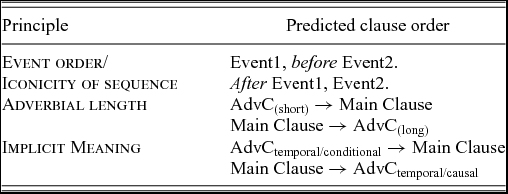
The event order principle basically predicts that clausal orders that follow the real-life event order are easier to produce and comprehend (see Prideaux Reference Prideaux1989: 30–1). Hence the temporal adverbial clause should be in initial position if the situation it describes happens, happened or would have happened before the situation in the matrix clause and it should be in final position if it was the other way around. This principle is also known as the ‘order of mention’ principle (e.g. Clark Reference Clark, Flores d'Arcais and Levelt1970; Clark & Clark Reference Clark and Clark1977). Evidence comes from psycholinguistic experiments showing that sentences coinciding with the event order result in superior performances (e.g. Johnson Reference Johnson1975; Clark Reference Clark, Flores d'Arcais and Levelt1970). Generally, it is assumed ‘that there is a universal human perceptual and cognitive organization of the events of the world, and that linguistic structure is constrained by these general perceptual and cognitive bases’ (Jou & Harris Reference Jou and Harris1990: 25). Clark & Clark even formulate an underlying ‘order of mention contract’, which speakers unconsciously follow and which states: ‘[m]ention two events in the order in which they occur’ (Reference Clark and Clark1977: 129). This is also the underlying idea of many approaches to iconicity in language (e.g. Haiman Reference Haiman1980). The iconicity of sequence principle makes the same prediction but originates in cognitive linguistics rather than in psycholinguistics. Diessel (Reference Diessel2008) studied iconicity with regard to adverbial clauses, drawing on Croft's definition of iconicity:
The intuition behind iconicity is that the structure of language reflects in some way the structure of experience, that is to say, the structure of the world including the perspective imposed on the world by the speaker. The structure of language is therefore motivated or explained by the structure of experience to the extent that the two match. (Croft Reference Croft2003: 102)
In essence, both event order and iconicity of sequence make the same prediction with regard to the position of the adverbial clause. Event order/iconicity of sequence is likely to reduce ‘the overall processing load of a complex sentence construction because a non-iconic order is difficult to plan and interpret’ (Diessel Reference Diessel2008: 484).
Another principle frequently discussed with regard to the processing load is adverbial length, which is associated with heavy constituents and the principle of end weight (e.g. Behagel Reference Behagel1930; Quirk et al. Reference Quirk, Greenbaum, Leech and Svartvik1985). Several studies claim that shifting longer constituents to the end of a sentence facilitates parsing (e.g. Bever Reference Bever and Hayes1970; Hawkins Reference Hawkins1990, Reference Hawkins1994, Reference Hawkins2004). For the temporal adverbial clauses such ordering can avoid misidentification of main and subordinate clause and crucially decreases the short-term memory load. Such explanations (e.g. Hawkins's Early Immediate Constituent principle; see Hawkins Reference Hawkins1994: 57–106) are usually hearer oriented; however, as Wasow (Reference Wasow1997a, Reference Wasow1997b) points out, it is also beneficial for the speaker as ‘saving longer constituents for later is also helpful in utterance planning and production’ (Reference Wasow1997a: 94). Hence adverbial length predicts that longer adverbials are more likely to follow the matrix clause, whereas initial adverbial clauses should be relatively shorter.
The implied meaning of a clause can be considered a third principle which has a potential influence on the clausal order. Apart from the purely sequential meaning, temporal clauses can also have an implicit conditional or causal meaning. In his study of PDE temporal adverbial clauses Diessel (Reference Diessel2008: 484) points out that
Like ordinary conditional clauses, temporal clauses with an implicit conditional meaning tend to precede the main clause, and like ordinary causal and purposive clauses, temporal clauses with an implicit causal or purposive meaning almost always follow it.
He identified three types of temporal adverbial clauses: ‘(i) purely temporal, (ii) temporal with an implicit conditional meaning, and (iii) temporal with an implicit causal or purposive meaning’ (Reference Diessel2008: 479). In his corpus ‘[a]bout one third of all adverbial clauses [when, after, before, once, until] . . . imply a conditional, causal or purposive relationship between the events expressed by main and subordinate clause’ (Reference Diessel2008: 483–4).
Table 1 summarizes the predictions made by each of the processing principles (the arrow symbolizes ‘followed by’).
Predictions for the position of temporal adverbial clauses

3 Temporal adverbial clauses in the Diary of Samuel Pepys
3.1 Method
Both adverbial subordinators, before and after, indicate a linear order of two events and were already in use during the Early Modern English period (e.g. Kortmann Reference Kortmann1997: 293; Rissanen Reference Rissanen and Lass1999: 313). After typically denotes events which happen prior to the event described in the associated matrix clause, whereas before-clauses indicate an event which happened after the one in the matrix clause, as illustrated in the following examples taken from the DSP:
-
(2) After he was gone I went home, and found my friends still at cards, and after that I went along with them to Dr. Whores (sending my wife to Mrs. Jem's to a sack-posset), where I heard some symphony and songs of his own making, performed by Mr. May, Harding, and Mallard. (DSP, 07.01.1660)
-
(3) I did many things this morning at home before I went out, as looking over the joiners, who are flooring my diningroom, and doing business with Sir Williams both at the office, . . . (DSP, 04.09.1660)
For the present analysis all before- and after-clauses and their respective matrix clauses were extracted from the electronic version of the DSP and subsequently manually categorized. For the sake of comparison with the findings of Diessel and Prideaux for PdE, non-finite adverbial clauses were excluded, as were medial clausesFootnote 6 (4); before and after used as temporal prepositions (5), or entries containing code mixing (6), which Pepys employed to further obscure the content. The latter were excluded since the construction of these clauses is likely to be a more conscious process than the construction of sentences written only in English, as employing words from foreign languages deserves conscious selection.
-
(4) At night home with her by water, where I made good sport with having the girl and the boy to comb my head, before I went to bed, in the kitchen. (DSP, 14.08.1660)
-
(5) Before noon some gentlemen came on board from the shore to kiss my Lord's hands. (DSP, 14.5.1660)
-
(6) She do tell me that this child did come is ‘meme jour that it ought to hazer after my avoir ete con elle before her marid did venir home . . . (DSP, 18.12.1666)
3.2 Results
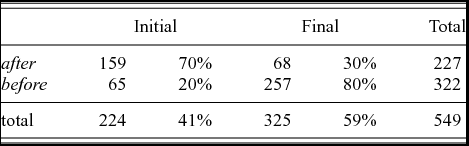
Table 2 displays the overall results for temporal after- and before-clauses in the DSP. In total, there are 227 after-clauses and 322 before-clauses, of which 224 (41%) occur in initial and 325 (59%) in final position.
Raw frequencies of after- and before-clauses in the DSP and their position

A Pearson's chi-square test (with Yates's continuity correction) reveals that the association between position and clause type is significant (χ² = 134.96, 1df, p < 0.0001). After-clauses are more than twice as likely to appear in initial position and before-clauses occur about four times as often in final position as opposed to the clauses preceding the matrix clause. Since this distribution is not likely to be due to chance, it can be expected that there are factors influencing the linear order. The results for each of the factors introduced above will be discussed separately in the following sections before a logistic regression analysis looks at possible interdependencies and the overall strength of each predictor. As the number of clauses with an implicit clausal/conditional meaning is very low (N = 15), these clauses were excluded in the subsequent analysis. They will, however, be discussed briefly in section 3.2.3 below.
3.2.1 Event order/Iconicity of sequence
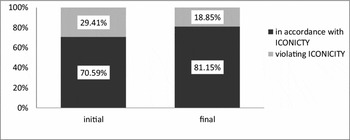
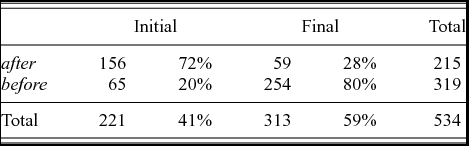
Figure 1 displays the percentages of temporal clauses that are in accordance with the event order/iconicity principle and those which violate it. The raw frequencies are given in the table 3. The chi-square test for these frequencies still shows a significant association (χ² = 142.0268, 1df, p < 0.0001). As can be easily seen, the majority of temporal clauses in the DSP, namely 76.78 per cent, follow the predicted order, whereas roughly a quarter of all clauses do not behave as predicted, i.e. 23.22 per cent. Summarizing, it can be said that temporal adverbial clauses expressing an event that happened prior to the situation in the matrix clause are significantly more often found initially, i.e. in 70.59 per cent of the cases, and the majority of posterior events is expressed by clauses in final position, i.e. 81.15 per cent. However, the reason why 29.41 and 18.85 per cent of the clauses are violating the principle remains unexplained by looking at event order/iconicity only.
event order/iconicity and temporal adverbial clauses in the DSP

Raw frequencies of purely temporal AdvCs

3.2.2 Adverbial length
In order to establish the role of the length of the adverbial clause the relative length of each temporal clause was calculated. Studying length involves at least two major methodological problems. First, the units that are to be counted need to be defined. There are several possibilities: words, phrases or nodes (see Hawkins Reference Hawkins1990), but also clauses, syllables or even phonemes (see Best Reference Best, Köhler, Altmann and Piotrowski2005) may be possible units. The latter two are traditionally less often applied, although Gries compared measuring the length of direct objects in words and syllables and found syllables to have a higher explanatory power for the construction studied (Reference Gries2003: 83–4). Shih & Grafmiller (Reference Shih and Grafmiller2011) compared several measures of weight, among them also nodes, words and syllables, and found that the different measures vary in their predictive force depending on the construction studied (in their case genitive and dative alternation). The present study utilizes orthographic words as one unit each. This decision is based on the findings by Szmrecsányi (Reference Szmrecsányi, Purnelle, Fairon and Dister2004), who compared the accuracy of ‘node counts, word counts, and a so-called “Index of Syntactic Complexity”’. His analysis showed ‘that the most economic method – determining length in words – to assess syntactic complexity is by all means one that is nearly as accurate as the more sophisticated and cognitively, conceptually, or even psychologically “more real” methods’ (Szmrecsányi Reference Szmrecsányi, Purnelle, Fairon and Dister2004: 1037–8).Footnote 7
Second, it is hard to delimit long from short (or heavy from light) clauses. Every concrete number of units involves a rather arbitrary decision. Yevseyev (Reference Yevseyev2013), for instance, categorizes adverbial clauses as long when they are at least 25 per cent longer than the associated main clauses. However, it seems more useful to employ a method which relates main and adverbial clause in a graded nature (an approach which was also suggested by Wasow (Reference Wasow1997b) in his discussion of Heavy Noun Phrase Shifting).
In order to arrive at the relative length of each adverbial clause the number of words in the before- or after-clause was divided by the total number of words of the bi-clausal structure. In example (7) the adverbial clause consists of five words and the total number of words is seven, the relative length of the after-clause is thus 5/7 = 0.7143.
-
(7) After we had drunk hard we parted . . . (DSP, 26.07.1660)
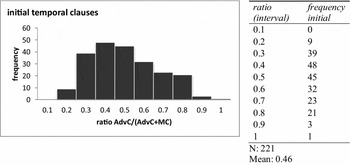
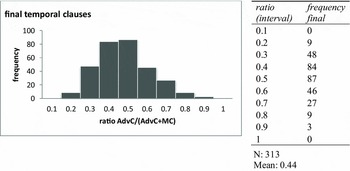
The relative length for all temporal clauses was calculated accordingly. The overall distribution is displayed in the histograms in figures 2 and 3.Footnote 8
Relative length of initial temporal before- and after-clauses

Relative length of final temporal before- and after-clauses

The observed pattern does not coincide with the prediction made by adverbial length. For the initial clauses a left skewed pattern was expected, and in fact there are slightly more clauses which are relatively shorter, as displayed in figure 2. However, we would also expect fewer longer initial clauses (>50%). The mean relative length of the initial adverbial clauses is 0.459.Footnote 9 For the final temporal clauses the principle predicts a right skewed distribution, i.e. we would expect to find more longer (>0.5) clauses in this position. However, the majority of final clauses are rather shorter or roughly as long as the matrix clause; the mean is 0.443.
This isolated analysis of adverbial length suggests that length is not a good predictor for the sequential order of temporal adverbial clause and matrix clause. This is in accordance with Diessel's observation, that length was ‘a significant predictor’ only for once- and until-clauses but that it was not sufficiently operative for the other subordinators (including before and after) (Diessel Reference Diessel2008: 484) in his study of PdE. However, in his data ‘adverbial clauses that precede the main clause are shorter than adverbial clauses that follow it’ but the ‘difference was relatively small’ (Diessel Reference Diessel2008: 484).
3.2.3 Implicit meaning
As mentioned above a possible third factor determining the position of the AdvC is an underlying implied meaning, i.e. meanings other than purely temporal. There are only very few temporal clauses in the DSP with more than a sequential meaning (n = 15). Example (8) illustrates one of the rare implied causal relationships. Here the woman ‘would not suffer [Pepys] to have to do in any manner with her [because] she saw [he] had no money’:
-
(8) The woman indeed is a most lovely woman, but I had no courage to meddle with her for fear of her not being wholesome, and so counterfeiting that I had not money enough, it was pretty to see how cunning she was, would not suffer me to have to do in any manner with her after she saw I had no money, but told me then I would not come again, (DSP, 23.07.1664)
There are even fewer, if any, implied conditional meanings. In (9), substituting before with unless highlights the conditional relationship:
-
(9) and then I abroad to the Atturney Generall, about advice upon the Act for Land Carriage, which he desired not to give me before I had received the King's and Council's order therein; (DSP, 13. 05.1665)
In total, only ten clauses with an implied causal relationship and five that allow for a broad conditional reading were found. Although hardly any generalizations can be made given the small number of occurrences, it may still be of interest to note that twelve of these clauses are placed after the matrix clause, the position suggested to be usually occupied by causal adverbial clauses.
4 Interrelation of different factors
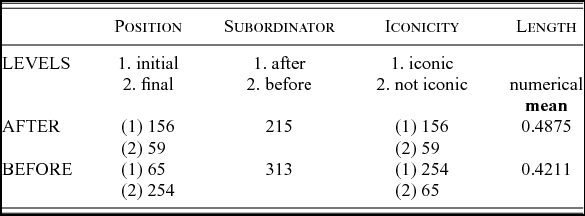
So far, each predictor has been discussed in isolation. This section will check whether or not these factors make a significant contribution when predicting the position of the temporal adverbial clause in the DSP. The data were analysed with a standard logistic regression analysis (for details see, e.g., Baayen Reference Baayen2008: 214–27; Gries Reference Gries2010: 291–306). Table 4 summarizes the factors and levels submitted to the analysis.
Summary of predictors

Since Iconicity is indirectly coded via subordinator and position it was not included in the model. The results for subordinator as a predictor can be taken as being the same for the event order/iconicity principle.
In a stepwise logistic regression analysis the starting point is the maximal model which includes all factors and their interactions; non-significant factors and interactions are then step by step eliminated until the minimal adequate model is found (see Gries Reference Gries2010: ch. 5).
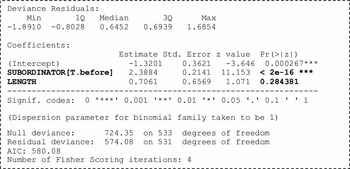
The difference between the null model, which does not include any predictors, and the maximal model was significant. This indicates that the position of the temporal clause is distinguished by the predictors. The maximal model (see figure 4) shows that length is not a significant predictor – which is not a surprising result given the distribution displayed in the histograms above.
Summary maximum model for temporal AdvCs in the DSP

In an independent logistic regression model possible interaction effects of length and subordinator were tested. The model showed that the interaction length: subordinator was not significant. An ANOVA test showed that the complex model including this interaction is not significantly better than the simpler model. This supports the conclusion that there are no significant interactions.
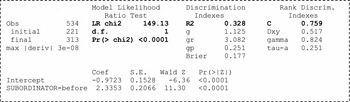
length as a variable can thus be removed from the model, as only subordinator is significantly related to position. The resulting minimally adequate model summarized in Figure 5 fits the observed data significantly better than the null model (χ2 = 149.13, df = 1, p < 0.0001).
Summary logistic regression analysis: minimal adequate model

The model's explanatory power, Nagelkerke's R² = 0.328, is almost as good as that of the maximal model (R² = 0.330). If R² > 0 then the null-hypothesis (H0), i.e. that the factors cannot predict the position of the adverbial clause sufficiently, can be rejected. The index of concordance (C) between the predicted probability and the actual observation indicates the predictive capacity of the model. A value of 1 indicates perfect prediction, a C value of 0.5 shows that the prediction is random, i.e. the model is not strong. A value of 0.8 and above indicates predictive potential (see Baayen Reference Baayen2008: 223; Gries Reference Gries2010: 297). The C value of the current model is 0.759, and therefore reasonably high.
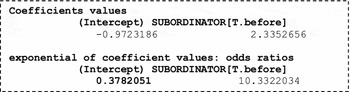
The positive regression coefficient of subordinator predictor increases the likelihood for the adverbial clause to follow the associated matrix clause if the subordinator is before (2.3353).
The odds ratios were calculated as the exponential of the predictor's coefficient value (figure 6). The value shows the change in odds for the outcome to be final. Values bigger than 1 indicate that as the predictor increases, the odds of the outcome increase too. Values smaller than 1 indicate that as the predictor increases, the odds of the outcome decrease (see Field et al. Reference Field, Miles and Field2012). Hence, subordinator(before) increases the odds of the outcome to be final. Since the odds ratios derive from the regression coefficients the effect shown is the same.
Coefficients and odds ratios

The regression analysis thus supports the individual factor analysis above, i.e. iconicity is an influential factor while length is not a good predictor for the position of the AdvC.
5 Discourse functions
As we have seen, iconicity as a factor can fairly well explain the overall behaviour of the two subordinators after and before. However, since this processing factor cannot entirely account for the distribution of pre- and postponed adverbial clauses, it is likely that other factors are involved. Several studies suggest that discourse-pragmatic functions influence the distribution of adverbial clauses (e.g. Altenberg Reference Altenberg1984; Chafe Reference Chafe, Brugman and Macaulay1984; Prideaux Reference Prideaux1989; Ford Reference Ford1993; Diessel Reference Diessel, Johnson, Juge and Moxley1996, Reference Diessel2005, Reference Diessel2008; Verstraete Reference Verstraete2004). Discourse factors discussed for PdE relate mainly to information structure or discourse organization.
Although there have been suggestions that information structure, or, more precisely, the distribution of given or new information, is a driving force for the position of adverbial clauses (see, e.g., Prideaux who suggested a ‘given-new constraint’ (Reference Prideaux1989: 32, table 1)) an analysis in terms of given vs new is not very economical for several reasons (e.g. the text type (diary), the problematic definition of given/new, etc.).
Still, given and new is also to some extent part of the second function identified, i.e. temporal framing. Diessel points out that ‘[t]emporal clauses are used to organize the temporal structure of narratives and other genres with a temporal contour. Initial temporal clauses frequently resume information from the preceding discourse; they establish a temporal reference point for the information that is expressed in the following main clause’ (Diessel Reference Diessel, Johnson, Juge and Moxley1996: 80). Similarly, Verstraete provides this summary:
Adverbial clauses in final position often have a local function, elaborating on the State of Affairs (henceforth SoA) of their main clause by specifying reasons, temporal circumstances, etc. Adverbial clauses in initial position, on the other hand, usually do not have such a strictly local function but take up wider discourse-organizing functions, by specifying a new frame for upcoming discourse or linking back to preceding discourse. (2004: 821)
And, at least for conversational data, Ford found that ‘one common use of initial temporal clauses is for the presentation of time frames in reports of sequenced events. Initial temporal clauses establish temporal or situational frames for assertions that follow’ (Reference Ford1993: 28).
Obviously, all of the temporal adverbial clauses discussed in this article have temporal meaning and hence indicate a certain temporal reference. Yet it seems as if the function of some of the clauses is mainly to provide the ‘temporal frame’ whereas others elaborate on the State of Affairs, in Verstraete's sense, or add crucial information to the narrative. The following passage from the DSP illustrates both discourse functions:
-
(10) So to the office till night, and so home, and then come Mr. Davis, of Deptford (the first time that ever he was at my house), and after him Mons. L'Impertinent [Mr. Butler], who is to go to Ireland to-morrow, and so came to take his leave of me. They both found me under the barber's hand; but I had a bottle of good sack in the house, and so made them very welcome.
Mr. Davis sat with me a good while after the other was gone, talking of his hard usage and of the endeavour to put him out of his place in the time of the late Commissioners, and he do speak very highly of their corruption.
After he was gone I fell a reading ‘Cornelianum Dolium’ till 11 o'clock at night with great pleasure, and after that to bed. (DSP, 03.12.1660)
The first after-clause not only contains some sequential information but also adds some new information, i.e. that ‘Mons. L'Impertinent’ has left at some point but not Mr. Davis. For the second after-clause the temporal organizational function is much stronger (that a visitor will leave again at some point is something that can be inferred by the (implied) reader), so here the function of the clause is primarily to establish the temporal narrative and link the two paragraphs. The second adverbial clause could easily be substituted by, for instance, after that, later, at 9 o'clock etc. without a loss of information since the reader can infer that Mr. Davis most likely left before Pepys started reading. The first after-clause, on the other hand, cannot be easily substituted without any loss of information, indicating that its function must go beyond that of temporal framing.
Operationalizing the identification of discourse functions for the given amount of data is rather difficult due to the text type and the quantity of data. Pending a more objective and reliable coding system to conduct a thorough quantitative analysis, an initial study of the before- and after-clauses seems to support the idea that final clauses more often contain crucial information (yet not necessarily discourse new) than initial clauses. For a number of after-clauses this would explain why they violate iconicity and follow the matrix clause. Similarly, some of the initial before-clauses may be explained with a temporal framing, as in example (11), or a linking function, as in (12).
-
(11) Thence to W. Joyce's, where by appointment I met my wife (but neither of them at home), and she and I to the King's house, and saw ‘The Silent Woman’; but methought not so well done or so good a play as I formerly thought it to be, or else I am nowadays out of humour. Before the play was done, it fell such a storm of hayle, that we in the middle of the pit were fain to rise; and all the house in a disorder, (DSP, 01.06.1664)
-
(12) With that they consulted, and told me that if I would promise to stay in the house they would go and refresh themselves, and come again, and know what answer I had: so they away, and I home to dinner, whither by chance comes Mr. Hawley and dined with me. Before I had dined, the bayleys come back again with the constable, and at the office knock for me, but found me not there; (DSP, 21.02.1663)
6 Conclusion
The present article discussed the linear order of main and temporal before- and after-adverbial clauses in the DSP. The major aim of this study was to check whether processing principles discussed for PdE temporal adverbial clauses are also valid for historical texts, providing evidence for language-specific diachronic universality in terms of the Uniformitarian Principle. The discussion and statistical analysis of event order/iconicity, adverbial length has shown that the observed distribution of pre- and postponed before- and after-clauses in the DSP generally coincides with the results of PdE studies. Overall length is not a good predictor for the position of the temporal clause. Excluded from the statistical analysis was implied meaning as a factor due to the low number of non-purely temporal clauses, even though this may have had some influence. Certainly the best predictor is event order/iconicity. Non-iconic orders occur significantly less often than iconic orders. The analysis has shown that after-clauses are more likely to precede the associated matrix clause, whereas before-clauses are more likely to follow it.
Since meaning and iconicity cannot predict all of the clauses correctly, e.g. final after-clauses, it is very likely that additional factors influence the position. A variety of discourse-pragmatic factors relating to the position of adverbial clauses have been suggested for PdE. An initial analysis of possible pragmatic functions of adverbial clauses shows a tendency for initial clauses to have a temporal framing function whereas final clauses often add more (new) information which cannot be easily substituted by, for instance, a temporal preposition. Of course, we may never be able to identify exactly which information was crucial or important to the author of historical texts. However, it may also not be necessary to explain every single example that violates cognitive principles. We cannot expect that all instances show the predicted pattern, neither today nor in the past. Moreover, every author may experiment with language and violations may also result from creative and experimental language use.Footnote 10 There might also be other constraints at work, such as syntactic complexity, which have not been included in the present analysis.
To complete the picture, it will be necessary to include other semantic types of adverbial clauses in the discussion in order to relate these results to the text production of the DSP, for example, with regard to immediacy. For now, the present study completes only one part of the feedback loop which approaches testing the validity of processing principles for historical texts may offer, i.e. the large consistency of the distribution of temporal adverbial clauses in the DSP and in PdE texts. These findings suggest that the same processing constraints underlying the production of PdE texts were at work in the past.