Introduction
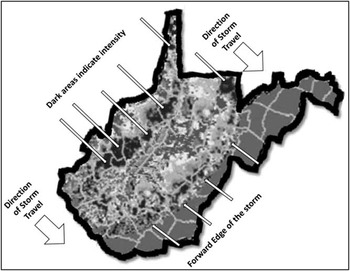
During late June 2012, West Virginia and neighboring states (USA) were dealing with a prolonged heat wave. Throughout the day on June 29, a line of devastating thunderstorms developed in northwest Indiana USA, just outside of Chicago (Illinois USA). This line of thunderstorms grew dramatically and moved southeast to the Atlantic Ocean. As the storm rapidly expanded and the forward speed increased, the National Weather Service (NWS) reported that conditions suggested this may become a derecho and West Virginia was directly in the path.1 As the storm moved across the area, wind speeds were recorded at 100-160 kilometers per hour (kph) with an average speed of 105 kph (65 miles per hour [mph])2 throughout the evening (Figure 1). By the morning of June 30, destruction was substantial and the storm was deemed to have been one of the worst to strike the state.
This composite image was created using map outlines and time lapse weather data from the NWS. The labels represent data from the NWS. Abbreviation: NWS, US National Weather Service.

The aim of this report was to review the demand and utilization of Emergency Medical Services (EMS) and the impact on the hospital system during the time of the disaster. This report will also examine EMS and hospital disaster response activities during the days that followed the storm.
Background
West Virginia is a predominately rural state with a population of 1,855,4133 spread over 62,258 square kilometers3 with much of the state lying in the heart of the Appalachian Mountains. There are 55 counties served by 63 hospitals and 213 EMS agencies.4
At the peak of the June 29-30 storm, 643,284 homes (more than half of the state) were without electric power5 and approximately 620,000 homes were without water due to power failures leaving water treatment plants inoperable. The extent of the damage was such that 226,483 homes were still without power one week later on July 5.5
The NWS Weather Forecast Office located in Charleston, West Virginia lost power and communications just before midnight on June 29. Electricity remained out, or was intermittent, for much of the next several days, requiring other offices (Pittsburgh, Pennsylvania USA and Jackson, Kentucky USA) to assume alert and notification obligations for the area.5
Report
Event Implications and Impact
Before the disaster, most West Virginians were unaware of the threat posed by a derecho because of the rarity of such an event (on average, occurs once every two years)6 in this region of the USA. Derechos are more commonly found in the Midwest and Southwest USA. “Derecho” is a term used to describe thunderstorms with strong straight line winds which differentiate them from thunderstorms with tornados. A “derecho” is defined as a storm system that produces damage across an area of approximately 400 km (or more), wind gusts of more than 90 kph, and includes multiple episodes of wind gusts that are greater than 121 kph.1
This storm was massive in size and, at one point, stretched across most of the state. By the time it pushed into the neighboring states of Maryland and Virginia, injuries and damages were being reported across West Virginia and other states. The area impacted by the derecho was approximately 500,000 square kilometers.5
Data Access
For this report, data were obtained to compare the same periods of time prior to, during, and after the disaster, with the year of the storm (2012) being compared to the years prior and post disaster. The specific disaster period was based on the Federal Emergency Management Agency (FEMA) declared disaster7 period of June 29 through July 8, 2012. Utilization of these data for research was approved by the West Virginia Office of EMS. These data were obtained pursuant to Institutional Review Board Study #13-3605 at the University of North Carolina, home of the Emergency Medical Services Performance Improvement Center which serves as the EMS data management system for West Virginia EMS.
The Federal Emergency Management Agency declared West Virginia a disaster area designated as DR-4071-WV.8 Of the 55 West Virginia counties, 47 were impacted by sufficient damage and eligible to participate in either the FEMA public assistance9 or individual assistance programs.
EMS Impact
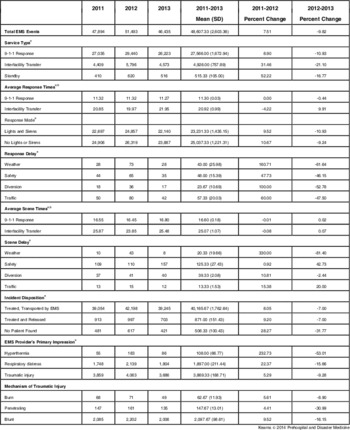
The report data were obtained by query of the Prehospital Medical Information System for West Virginia through the EMS Performance Improvement Center.4 Findings revealed that the types of requests for EMS increased substantially, from EMS scene responses to interfacility transfers and standbys increasing > 50% over the previous year. Emergency Medical Services response dispositions for all categories also rose, including treated/transported by EMS, treated and released, and no patient found. The types of unusually high demand patient care findings during the disaster included hyperthermia, respiratory distress, and trauma. The increase in reported trauma included blunt, penetrating, and burn injuries. Overall, response times and scene times remained basically unchanged with one exception. A closer look at the data revealed a numerically small but statistically significant finding regarding on-scene delays for weather during the period of the disaster; an increase of 430% compared to prior and post year comparison periods was found. For those areas where there were response and scene time delays, additional factors included safety, traffic, hospital diversion, and vehicle failure (Table 1).
West Virginia EMS Data Comparing the Year Prior to the Storm (2011) and the Year After the Storm (2013) with the Year of the Storm (2012), Over the Period of the West Virginia Declared State of Emergency (June 29 through July 8)

Abbreviation: EMS, Emergency Medical Services.
aCategories displayed selected based on relevance to disaster operations.
bReported in minutes.
Hospital Impact
The State Medical Asset Resource Tracking Tool4 was queried for alerts posted during the disaster. Three hospitals in different regions of the state reported problems from loss of power with notification of EMS agencies to divert EMS transports to other hospitals. These three hospitals included two Level 4 trauma centers and each represented the sole hospital provider for its community. One of the hospitals lost power for approximately 48 hours.
Discussion
Meteorological anomalies such as the derecho that struck West Virginia can strike hospitals and leave emergency services struggling to meet the sudden and unique demands created by the event. Weather disasters that strike with little to no notice can be catastrophic.Reference Martin10, Reference Ablah, Tinius, Konda, Synovitz and Subbarao11 Overall, warning times by official government offices were greater than 30 minutes, especially on the eastern end of the warning polygons. Most of the offices were issuing large warning polygons to cover the widespread nature of the event and the fast storm motion. All deaths occurred within several thunderstorm warning polygon boundaries.5 Damage from the derecho created personal dilemmas for staff on duty concerned about those at home in the path of the storm. It also created a challenge for off-duty staff at home, trying to navigate the damage to report for duty at an EMS station or a hospital.Reference Carlton and Bringle12
While demand for services rose significantly during the disaster period, response times and time on scene did not significantly change from the typical day-to-day activities. In response to the disaster, response agencies bolstered capability and capacity by recalling employees and utilizing more volunteers to staff additional resources.
The extensive loss of power (and subsequent loss of air conditioning) during a period of unseasonably hot weather created an environment of significant hardship which exacerbated respiratory ailments and heat-related emergencies.Reference Kouadio, Aljunid, Kamigaki, Hammad and Oshitani13 With the widespread loss of power, many home oxygen users (relying on an oxygenator) were left without oxygen which also contributed to the increase in respiratory emergencies. Traumatic injuries also rose during the disaster, as would be expected given the nature of the disaster. An increase in hyperthermia cases was associated with the loss of air conditioning and other climate control factors.Reference Fayard14, Reference Hartmann, Creel, Lepard and Maxwell15
The storm experience reinforced the value of recalling staff and volunteers to meet the surge in demand for EMS and health care services. While the event (derecho) was unexpected, the consequences were similar to other severe weather events with shared experiences and responsibilities. This disaster reinforces the need for critical facilities to have access to an auxiliary power supply. These facilities include water and sewer plants, as well as hospitals and health care facilities, EMS, and fire and rescue bases of operations. Critical connections to auxiliary power include the heating, ventilation, and air conditioning system, as well as connections to and powering the Internet.
Internet protocol telephone systems are commonly found in emergency service operations. However, when Internet connectivity fails because of power loss, both Internet and telephone access is lost. In addition to two-way radio systems, it is necessary to have an alternate access to communications which include an analogue telephone connection, cellular, or amateur radio. In this event for some instances, communications were relayed through the state emergency operations center to the local emergency management agency and then to provider agencies.
Other essential contingency planning for materiel included vendor agreements for resupply with minimal delay, including access to fuel sources and meals for staff and responders. The fueling process should focus on generators and response vehicles, and this may include parking the emergency vehicle on a grade below a tanker to refuel relying on gravity. Home medical vendors did not uniformly contact or stay in touch with their patients. This added to the demand on emergency service personnel who ended up stockpiling and delivering oxygen tanks to stranded patients.
Conclusion
A derecho is an atypical, high wind speed weather phenomenon. The event described in this report resulted in loss of essential services, such as electricity, over a wide area. There was substantial demand for EMS and hospital-based services both during and in the aftermath of the storm.
Acknowledgements
These data were obtained at the University of North Carolina, home of the Emergency Medical Services Performance Improvement Center which serves as the EMS data management system for West Virginia EMS.
In addition to the co-author, Ginger Zuidgeest, information related to the derecho was reviewed and edited by Samantha M. Wnek, Weather Producer/Meteorologist and Production Coordinator for the American Broadcasting Company (ABC) News.