Infantile haemangiomas are benign neoplasms composed of vascular endothelium. They are the most common childhood tumour. Haemangiomas often appear early, and most are noted by parents within the first month of life. The early, rapid proliferative period is usually completed by 5 months of age. Growth then slows and is completed in a large majority of cases by 9 months of age. They enter a phase of slow involution starting at 1 year of age.Reference Chang, Haggstrom and Drolet 1 Approximately 90% of haemangiomas involute by 9 years of age. Given their benign course, most haemangiomas do not require treatment. A minority of infantile haemangiomas may lead to complications. Periorbital haemangiomas may lead to visual impairment and airway haemangiomas may cause obstruction. Those on the nose, ear, or lip can result in residual deformity. Haemangiomas that ulcerate may be painful or become infected.
Currently, there are no treatments for infantile haemangiomas approved by the United States Food and Drug Administration. Oral corticosteroids have been the first-line therapy for haemangiomas requiring aggressive treatment. Corticosteroids have numerous side effects including adrenal suppression and cardiac hypertrophy. In 2008, Leaute-Labreze et alReference Leaute-Labreze, Dumas de la Roque, Hubiche, Boralevi, Thambo and Taieb 2 described a patient with a nasal haemangioma who was initially treated with corticosteroids. When obstructive cardiac hypertrophy developed, apparently because of the corticosteroids, the patient was started on propranolol. Within 1 day, the haemangioma lightened in colour and became softer. The haemangioma continued to improve with propranolol even after the steroids were discontinued. Propranolol as a treatment for infantile haemangiomas was thus a fortuitous discovery. Numerous subsequent studies have confirmed its efficacy, although the optimal dose and monitoring regimen have yet to be established.
Propranolol has been used for the treatment of cardiac conditions in children for over 30 years.Reference Gillette, Garson, Eterovic, Neeches, Mullins and McNamara 3 Side effects of propranolol include bronchospasm, bradycardia, hypotension, and hypoglycaemia. Several authors have reported complications in infants treated with propranolol for haemangiomas.Reference Lawley, Sigfried and Todd 4 – Reference Holland, Frieden, Frommelt, Mancini, Wyatt and Drolet 6 In an effort to prevent such adverse events, we devised a protocol for initiating treatment in a monitored, outpatient setting for infants under 1 year of age. This study was a retrospective chart review to determine the safety and efficacy of the protocol.
Methods
Infants were identified by our institution's paediatric dermatologist or a referring ophthalmologist. The patients then underwent a baseline cardiac evaluation including a physical examination, electrocardiogram, and echocardiogram with a single paediatric cardiologist. If there was no contraindication to propranolol, patients under 1 year of age were then admitted to the hospital's Day Accommodation Suite or emergency room (if there was significant ulceration). After admission, a baseline blood pressure and heart rate measurement were obtained. Subsequently, 1 milligram per kilogram of propranolol was administered orally. Patients were then observed for 6 hours. The heart rate and blood pressure were taken hourly with an Accutorr Plus device (Datascope Corporation, Mahwah, New Jersey, United States of America). Two pre-prandial glucose levels were checked with an Accu-Chek Inform device (Roche, Basel, Switzerland). If no abnormalities were observed, the infant was discharged home on a regimen of 1 milligram per kilogram per dose three times a day.
The patients were followed up by the cardiologist 2 weeks later and subsequently every one to two months. At each visit, the pulse, blood pressure, and weight were obtained. The propranolol dose was increased to account for weight gain. Patients followed up by the dermatologist were also seen 2 weeks after the start of treatment and subsequently on a monthly basis. Photographs were obtained at each visit.
After approval was obtained from the hospital's institutional review board, patients were identified retrospectively from a hospital database. To be included in the study, infants had to have a haemangioma treated with propranolol, be under 1 year of age, and be treated according to the protocol outlined above. Infants over 1 year of age or treated with propranolol according to any other regimen were excluded from analysis. Patient charts were reviewed for pertinent demographic information, history, heart rate, blood pressure, and physical examination findings, along with cardiac and laboratory testing results. Heart rates were compared with published normal ranges for age.Reference Custer and Rau 7 A single dermatologist reviewed photographs of the haemangiomas. Improvement was measured on a previously published scale.Reference Buckmiller, Munson, Dyamenahalli, Dai and Richter 8
Statistical analysis included determination of the median, range, and interquartile range for demographic data that were continuous. For categorical data, frequencies (percentages) were reported. Analysis of the safety parameters was performed on two separate levels: (1) longitudinally from before the first dose to the 6 hours of observation afterwards and (2) longitudinally from the observation period to the follow-up visits. Under both of these settings, changes in heart rate, systolic blood pressure, and diastolic blood pressure after propranolol administration were examined using mixed regression model analysis, with repeated measurements observed hourly and by visit. Further, to determine which changes were significantly different from the baseline levels, pairwise comparisons with multiple testing adjusted by Dunnett's procedure were conducted. The mean time from the dose of propranolol to the two blood glucose levels during the observation period and the standard deviation were calculated. A paired t-test was conducted to examine whether there was a significant difference between the two blood glucose levels. Analysis was performed using SAS 9.2 (SAS Institute Inc., Cary, North Carolina, United States of America).
Results
A total of 15 patients were treated according to this protocol between September, 2009 and September, 2010; 13 were female patients. The median age at the start of treatment was 116 days, with an interquartile range of 75–141 days and a range of 56–257 days. The infants were referred for treatment with propranolol because their haemangiomas presented a risk of visual impairment, residual deformity, or complications due to ulceration. There were five haemangiomas in the periorbital region, eight located elsewhere on the face, and two on the buttocks. Before starting treatment, one of the patients with a haemangioma on the buttock had a large ulceration and one infant with an eyelid haemangioma had astigmatism; the one patient with a facial segmental haemangioma had a normal magnetic resonance angiogram of the head and neck to rule out features of PHACES syndrome; two patients had previously been treated with triamcinalone injections; and one had received topical timolol drops. The cardiac evaluations were unremarkable except for one infant who had a murmur and was found to have a small, clinically insignificant muscular ventricular septal defect, which was not a contraindication for propranolol.
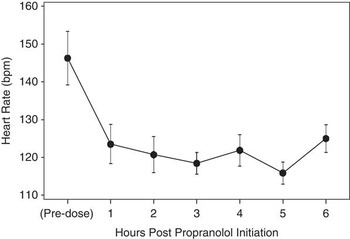
All patients tolerated the initiation of propranolol without complications. Heart rates, blood pressures, and glucose levels were available for review in 14 patients. There was a statistically significant reduction in heart rate after the administration of propranolol (Table 1). This reduction in heart rate was seen within 1 hour after the dose of propranolol (Fig 1). The heart rates reached their nadir at 5 hours after the propranolol administration, although the variation in hourly heart rates after the first hour was not statistically significant. There were seven patients with mild bradycardia, which was not clinically significant. The lowest observed heart rate was 90 beats per minute.
Heart rates and blood pressures before and after initial dose of propranolol.

bpm = beats per minute; DBP = diastolic blood pressure; hr = hour; SBP = systolic blood pressure; SD = standard deviation
Values in bold indicate measurements that were statistically significant from the pre-dose value. All pairwise comparisons, adjusted for multiple testing by Dunnett's procedure, between pre-dose and subsequent hourly heart rate measurements, were significant
*A p-value less than 0.05 was considered statistically significant
Mean and standard error of the mean for heart rates before and 1 to 6 hours after propranolol administration. During the initial administration visit, there was a statistically significant change in heart rate over time with a p-value of 0.01. All pairwise comparisons, adjusted for multiple testing by Dunnett's procedure, between pre-dose and subsequent hourly heart rate measurements were significant, with a p-value of less than 0.05.

During the 6-hour observation period, there was no statistically significant overall effect on the systolic blood pressure. There was, however, a significant overall effect over time on the diastolic blood pressure. The largest effect was seen 1 hour after propranolol administration (Table 1). No patient developed hypotension.
No hypoglycaemia occurred during the observation period. The mean time to the first pre-prandial glucose level was 1.33 hours, with a standard deviation of 0.92. The mean time from propranolol administration to the second glucose level was 3.89 hours, with a standard deviation of 1.28. The mean change in blood glucose concentration measured by paired difference was 1.64 milligrams per decilitre, with a standard deviation of 11.8. This change was not statistically significant, with a p-value of 0.611 (Table 2). No patient developed bronchospasm.
Blood glucose levels during propranolol initiation.

hrs = hours; mg/dl = milligrams per decilitre; SD = standard deviation
A paired t-test was conducted to examine whether there was a significant difference between the first and second blood glucose readings. This test did not reveal any significant difference with a p-value of 0.611
*A p-value less than 0.05 was considered statistically significant
The 13 patients for whom at least one follow-up visit was available were followed up for a median of 2.8 months, with an interquartile range of 1.5 to 6.9 months and a range of 0.2 to 10.0 months. There were no significant adverse events. Possible side effects included cool extremities in one patient, gastro-oesophageal reflux in one patient, and increased sleep in two patients. In the one patient with cool extremities, the dose frequency was reduced to twice a day to alleviate parental concern. All side effects were transient and no other interventions were required. The mild decrease in heart rate continued throughout the follow-up period (Table 3).
Summary of heart rates measured at baseline and subsequent visits.

SD = standard deviation
For the purpose of this analysis, baseline was the pre-dose heart rate. The 6 hours post first dose heart rate was used as a subsequent reading along with those from the 6 monthly visits. Mixed regression analysis was performed to examine the changes in heart rate over time from the baseline to the subsequent visits
All pairwise comparisons, adjusted for multiple testing by Dunnett's procedure between pre-dose and subsequent heart rate measurements, were significant
*A p-value less than 0.05 was considered statistically significant
Photographs were available for analysis in 10 patients. All demonstrated improvement in their haemangiomas by the first follow-up visit. The haemangiomas continued to improve throughout the follow-up period (Supplementary Figure S1). The parents of the three patients for whom photographs were not available also reported subjective improvement. The large ulceration on the buttock of one patient began to heal rapidly after 2 weeks of treatment (Supplementary Figure S2). Shortly after being started on propranolol, the patient with the facial segmental haemangioma developed a mild fissure on the lip, which resolved quickly. No infections or ophthalmologic complications occurred while patients were being treated with propranolol.
Discussion
The treatment of infantile haemangiomas with propranolol is an exciting example of a new application for an established medication. Before the discovery of this new application, most practitioners who treated infantile haemangiomas had little to no experience using propranolol. For that reason, many have sought to collaborate with cardiologists when treating patients with propranolol. Most publications to date have recommended a cardiac evaluation ranging from an electrocardiogram alone to consultation with a cardiologist including an electrocardiogram and an echocardiogram before starting propranolol. While the currently accepted dose of propranolol for the treatment of haemangiomas is 2 milligrams per kilogram per day, the results of a double-blind, randomised, placebo-controlled study are still pending. Physicians have chosen to initiate therapy with propranolol in many different ways. These range from slowly escalating therapy on an outpatient basis to admitting patients for monitoring for up to 72 hours. Protocols for following up patients on propranolol also vary.
In this study, although the number of patients was small, the propranolol dose was effective in all subjects. A major strength of this study was the fact that all the infants were started on propranolol before the age of 9 months. These infants would therefore be expected to be in the proliferative phase of haemangioma growth. No significant adverse events such as hypotension, hypoglycaemia, bronchospasm, or clinically significant bradycardia were encountered. The observed reduction in heart rate was expected given the known negative chronotropic effects of propranolol. The possibility that the change in heart rates was due to a decrease in patient anxiety over time cannot be entirely excluded, however. Mild side effects were seen in a minority of patients, consistent with other studies. The dose was reduced in only one patient. The few infants with haemangiomas who were identified but excluded from this analysis because they were treated according to a different protocol had been assigned to another cardiologist within the institution with a different practice style, not because of any difference in haemangioma characteristics. This study was also limited by a relatively short duration of follow-up, as many patients remain on propranolol until the proliferative phase of haemangioma growth is likely to have resolved.
Cushing et alReference Cushing, Boucek, Manning, Sidbury and Perkins 9 used a protocol similar to the one described here to initiate treatment with propranolol on an outpatient basis in 39 patients. In that study, the first dose of propranolol was 0.5–0.7 milligrams per kilogram, slightly smaller than the 1 milligram per kilogram used here. On the basis of previous studies that found that the maximum effect of oral propranolol on heart rate and blood pressure occurred at 2 hours after the dose was administered, they initially measured vital signs 1 and 2 hours after the dose. After initial results indicated that the maximum decrease in blood pressure and heart rate occurred at the 2-hour measurement, an additional measurement was added at the 3-hour mark. In the final analysis from that study, the authors found that the peak effect on heart rate and blood pressure did occur at 2 hours and had improved by 3 hours after the propranolol administration. The current study found that the maximum effect on diastolic blood pressure occurred at 1 hour after administration. The peak effect on heart rate, however, occurred 5 hours after drug administration, which suggests that if propranolol is initiated in a monitored setting then a longer period of observation may be warranted.
Many investigators have chosen not to check blood glucose levels during the initiation of treatment with propranolol. One justification cited for this is the relatively rare incidence of hypoglycaemia. This study suggests that if blood glucose levels are checked, one would be sufficient.
This study provides further evidence that treatment with propranolol for infantile haemangiomas at a dose of 3 milligrams per kilogram per day can safely be initiated on an outpatient basis in a single day. This dose was used because at the time this protocol was devised no standard dose had been established. Existing publications cited doses between 2 and 3 milligrams per kilogram per day. Anecdotal evidence suggested that higher doses might be more effective.Reference Buckmiller, Munson, Dyamenahalli, Dai and Richter 8 A dose of 3 milligrams per kilogram per day was also within the accepted range for the treatment of cardiac conditions and safe in our prior experience. The results of this study suggest that the lower, currently accepted dose of 2 milligrams per kilogram per day could also be safely initiated in the same manner.
The absence of adverse effects during the monitored initial treatment does not preclude the possibility of developing serious adverse events from propranolol later in the course of treatment. Educating parents is therefore important for patient safety. A recent review of published cases of hypoglycaemia associated with propranolol use found that a high percentage of the episodes occurred during periods of decreased oral intake such as when the patient was ill or before surgery.Reference Holland, Frieden, Frommelt, Mancini, Wyatt and Drolet 6 Parents should therefore be instructed not to administer propranolol when patients have a significant illness or decreased oral intake. Physicians should also inform parents to bring infants for medical attention if they observe signs of hypoglycaemia, such as sweating, shaking, anxiety, lethargy, hypothermia, or seizures. At the end of therapy, propranolol should be weaned off over a period of at least 2 weeks and possibly longer. In some cases, rebound growth is observed and propranolol may need to be restarted.
The optimal dose and monitoring regimen for propranolol when treating patients with infantile haemangiomas are only two of many issues yet to be resolved. The electrocardiograms and echocardiograms did not discover significant pathology or preclude treatment with propranolol in any of our patients. Owing to the fact that sinus node disease and second and third heart block are contraindications to the use of propranolol, pre-treatment screening with an electrocardiogram remains justified. An echocardiogram, however, may not be indicated in the absence of a murmur or other evidence of cardiac disease.
The effect of propranolol on haemangiomas is thought to be due to the combined effects of vasoconstriction, inhibition of angiogenesis, and the induction of apopotosis.Reference Storch and Hoeger 10 The exact mechanism of action has not been established. Recent case reports have documented the efficacy of propranolol in treating tumours other than haemangiomas.Reference Ozeki, Fukao and Kondo 11 , Reference Hermans, van Beynum, van der Vijver, Jan Schultze Kool, de Blaauw and van der Vleuten 12 Further study is needed to optimise this new and effective therapy.
Supplementary material
The supplementary material referred to this article is available online at http://www.journals.cambridge.org/cty