Because antisocial and disruptive behavioral trajectories tend to emerge early, to remain relatively stable, and to be linked to a variety of costs for individuals, families, and societies, interest in their early origins has grown exponentially (e.g., Dishion & Patterson, Reference Dishion, Patterson, Cicchetti and Cohen2006; Hyde et al., Reference Hyde, Shaw, Gardner, Cheong, Dishion and Wilson2013; Shaw, Reference Shaw2013; Wakschlag, Tolan, & Leventhal, Reference Wakschlag, Tolan and Leventhal2010). There is a consensus that to substantially inform our understanding of risks for antisocial trajectories, research needs to integrate constructs assessed at the level of the child's biological individuality, behavior, and the parent–child relationship, especially in longitudinal designs (Burnette & Cicchetti, Reference Burnette and Cicchetti2012). We propose such a multilevel developmental approach, bridging several literatures: research on children's early internalization of rules of conduct, their psychophysiology, and the parenting they receive. We test our model in a study of community families (mothers, fathers, and children) followed longitudinally from preschool age to early preadolescence. These families represented a normative community sample, and children were not screened for the presence of elevated behavior problems; we believe, however, that understanding processes unfolding in typically developing children can potentially inform clinical research, consistent with tenets of developmental psychopathology.
Research has increasingly considered emotional and behavioral aspects of young children's emerging regard for rules of conduct (guilt and concern about transgressions and fledgling adherence to adults' prohibitions, particularly without surveillance) to be markers of adaptive early development (Kochanska, Koenig, Barry, Kim, & Yoon, Reference Kochanska, Koenig, Barry, Kim and Yoon2010; Thompson, Reference Thompson2012, Reference Thompson, Killen and Smetana2014). In developmental and socialization literatures, children's lack of concern about their transgressions, poor adherence to standards for behavior, and rule breaking have long been considered the most common triggers for parental deployment of broadly ranging discipline techniques, beginning in the second and third years of life, including occasional harsh discipline and power assertion (Gralinski & Kopp, Reference Gralinski and Kopp1993; Grusec & Kuczynski, Reference Grusec and Kuczynski1980; Hoffman, Reference Hoffman1975; Smetana, Reference Smetana1989).
In developmental psychopathology, the child's disregard for rules, for example, failing to feel discomfort after misbehavior or engaging in rule breaking, is a key component of oppositional, disruptive conduct problems. High levels of disregard for rules in childhood are often seen as early signs of an emerging trajectory toward disruptive conduct problems (Bufferd, Dyson, Hernandez, & Wakschlag, Reference Bufferd, Dyson, Hernandez, Wakschlag and Cicchetti2016; Callender, Olson, Kerr, & Sameroff, Reference Callender, Olson, Kerr and Sameroff2010; Frick & Viding, Reference Frick and Viding2009; Frick & White, Reference Frick and White2008; Petitclerc, Boivin, Dionne, Perusse, & Tremblay, Reference Petitclerc, Boivin, Dionne, Perusse and Tremblay2011; Petitclerc, Boivin, Dionne, Zoccolillo, & Tremblay, Reference Petitclerc, Boivin, Dionne, Zoccolillo and Tremblay2009; Wakschlag et al., Reference Wakschlag, Briggs-Gowan, Carter, Hill, Danis and Keenan2007). Such trajectory is now believed to begin early and be relatively stable (Shaw, Reference Shaw2013).
Bringing those converging literatures together may be productive. It is quite likely that the often-observed link between young children's disregard for conduct rules and future antisocial behavior is mediated through harsh or power-assertive discipline that parents deploy toward children who display high level of disregard for rules. Links between parental power assertion and antisocial behavior are well established (e.g., Bender et al., Reference Bender, Allen, Boykin Mcelhaney, Antonishak, Moore and O'Beirne Kelly2007; Dodge, Coie, & Lynam, Reference Dodge, Coie, Lynam, Damon and Eisenberg2006; Gershoff, Reference Gershoff2002; Kimonis & Frick, Reference Kimonis, Frick, Murrihy, Kidman and Ollendick2010; McCord, Reference McCord1997; Patterson, Dishion, & Bank, Reference Patterson, Dishion and Bank1984). Consequently, studying the cascade from the child's disregard for rules to future antisocial behavior problems as mediated by parental power-assertive discipline may provide insights into one mechanism explaining complex etiology of conduct problems and the stability of disruptive problems from childhood to adolescence and beyond.
In this article, we propose a more complex conditional process model, in which the developmental cascade from early disregard for rules to parental power assertion to future antisocial behavior is expected to occur for children who have low skin conductance level (SCL). Such children presumably fail to respond to subtle, gentle levels of parental discipline, in contrast to children with high SCL. Few, if any, studies have examined children's SCL as a potential moderator of the process leading from early disregard for rules of behavior, to parental power-assertive discipline, to future antisocial behavior problems. We believe that such a model, consistent with recent biopsychosocial perspectives on parenting (Calkins, Propper, & Mills-Koonce, Reference Calkins, Propper and Mills-Koonce2013), could substantially enhance our understanding of etiology of conduct problems, improve our ability to make prognostic predictions from preschoolers' disregard for rules to future antisocial behavior, and inform translational hypotheses about effective parenting interventions.
Conceptually, children's biologically founded temperament characteristics, including low SCL, have been broadly implicated as a general risk factor for antisocial trajectories (Blair, Peschardt, Budhani, Mitchell, & Pine, Reference Blair, Peschardt, Budhani, Mitchell and Pine2006; Fowles & Kochanska, Reference Fowles and Kochanska2000; Frick & Morris, Reference Frick and Morris2004; Nigg, Reference Nigg2006; Raine, Reference Raine2002; Raine, Venables, & Williams, Reference Raine, Venables and Williams1990). SCL, a classic measure of the functioning of the autonomic nervous system, reflects variations in the ease with which electrical current passes across the skin due to fluctuations in sweat gland activity. Low SCL represents a psychophysiological diathesis for and a correlate of antisocial externalizing problems (Crowell et al., Reference Crowell, Beauchaine, Gatzke-Kopp, Sylvers, Mead and Chipman-Chacon2006; Fowles, Reference Fowles, Roy, Boucsein, Fowles and Gruzelier1993; Lorber, Reference Lorber2004; Lykken, Reference Lykken1995; Posthumus, Bocker, Raaijmakers, Van Engeland, & Matthys, Reference Posthumus, Bocker, Raaijmakers, Van Engeland and Matthys2009; Raine, Reference Raine2002).
One reason, perhaps the main reason, why low SCL is a risk factor for antisocial trajectories is its potential link to children's responsiveness to socialization (Dadds & Salmon, Reference Dadds and Salmon2003). Children with low SCL, due to their relative insensitivity to punishment compared to children with high SCL, likely fail to respond to subtle parenting pressure in the context of transgressions (Raine, Reference Raine2002). Consequently, over time, they likely elicit gradually increasing parental pressure and more forceful, power-assertive discipline. Thus, physiologically based punishment insensitivity may lead to the gradual unfolding of mutually adversarial, power-assertive parent–child cycles that undermine an adaptive, normative course of socialization and launch the dyad on a maladaptive course, leading to antisocial developmental trajectories. In contrast, children with high SCL respond positively to subtle parental socialization, before the pressure reaches a high level.
This developmental account converges with the somatic marker hypothesis, proposed by Damasio, Tranel, and Damasio (Reference Damasio, Tranel, Damasio, Levin, Eisenberg and Benton1991), Sobhani and Bechara (Reference Sobhani and Bechara2011), and Tranel (Reference Tranel, Fowles, Sutker and Goodman1994). That hypothesis holds that most people's choices of actions, including morally relevant decisions, are regulated by an automatic guiding system that activates “somatic markers.” Those markers are associated with one's past affective experience, and they involve an uncomfortable “gut feeling” that occurs while one ponders an act that has been punished or disapproved of in the past. Such negative somatic state, activated by the marker, consequently aids in inhibiting the relevant behavior. Note that SCL reflects the behavioral inhibition system, which governs sensitivity to or avoidance of aversive circumstances (Erath, El-Sheikh, & Cummings, Reference Erath, El-Sheikh and Cummings2009; Fowles, Reference Fowles1980). Higher SCL is involved in amplifying the process of “somatic marking” (Carter & Pasqualini, Reference Carter and Pasqualini2004; Damasio, Reference Damasio1994). Together, those convergent bodies of work suggest that for children with temperamentally based propensity to experience higher autonomic arousal, even subtle parenting discipline and the resulting discomfort lead to rule-breaking behavior becoming strongly somatically marked. Thus, those children become particularly attuned to the possible negative consequences of rule violations. The process is much less effective for children with lower SCL.
Multiple works in the literature have conceptualized and supported the child's evocative role in coercive parenting and future maladaptive developmental outcomes (Bates, Schermerhorn, & Petersen, Reference Bates, Schermerhorn, Petersen, Zentner and Shiner2012; Beauchaine, Gatzke-Kopp, & Mead, Reference Beauchaine, Gatzke-Kopp and Mead2007; Bell, Reference Bell1968; Blair et al., Reference Blair, Peschardt, Budhani, Mitchell and Pine2006; Briggs-Gowan et al., Reference Briggs-Gowan, Nichols, Voss, Zobel, Carter and McCarthy2014; Dadds & Salmon, Reference Dadds and Salmon2003; Dishion & Patterson, Reference Dishion, Patterson, Cicchetti and Cohen2006; Erath et al., Reference Erath, El-Sheikh and Cummings2009; Kimonis & Frick, Reference Kimonis, Frick, Murrihy, Kidman and Ollendick2010; Pardini, Reference Pardini2008; Raine, Reference Raine2002; Shaw, Gilliom, Ingoldsby, & Nagin, Reference Shaw, Gilliom, Ingoldsby and Nagin2003). However, very little of that research has relied on physiological measures of children's autonomic responses and behavioral observations of parenting in longitudinal designs, and very few studies have examined different sequences, unfolding over time, in children with varying biological profiles.
There is some empirical support for components of the model. Children's SCL has been found to moderate the link between parenting and antisocial behavior, with negative effects of adverse experiences typically found for children with low SCL but not for those with high SCL. Erath et al. (Reference Erath, El-Sheikh and Cummings2009) found concurrent (at age 8) associations between parent- and child-reported harsh parenting and children's externalizing problems for children with low, but not high, SCL. Erath, El-Sheikh, Hinnant, and Cummings (Reference Erath, El-Sheikh, Hinnant and Cummings2011) found that harsh parenting (reported by parents and children) in conjunction with low SCL was associated with boys' high and stable level of externalizing behavior from age 8 to 10. In those studies, the difference between the child's SCL during a challenging or stressful task (e.g., an audiotaped argument or star tracing) and at baseline was typically used.
In the present sample, we found significant relations between variation in the history of parental care and children's externalizing behavior problems across the first 10 years, but only for low-SCL children (Kochanska, Brock, Chen, Aksan, & Anderson, Reference Kochanska, Brock, Chen, Aksan and Anderson2015). In another sample, we focused on the absence of children's externalizing problems (i.e., mature conscience) at age 4 as the outcome, and we found effects of parenting for children with low SCL, but not for those with high SCL (Fowles & Kochanska, Reference Fowles and Kochanska2000). In our studies, we have used a tonic measure of SCL that was averaged across the child's responses to a variety of scripted stimuli, episodes, and tasks (e.g., rest, deep breaths, anticipation, and bursts of noises). Such an approach has also been supported in the literature (Crider et al., Reference Crider, Kremen, Xian, Jacobson, Waterman and Eisen2004; Dawson, Schell, & Filion, Reference Dawson, Schell, Filion, Cacioppo, Tassinary and Berntson2007; see Fowles & Missel, Reference Fowles, Missel, Fowles, Sutker and Goodman1994, for review), including studies that have linked children's SCL to their observed temperament. For example, Scarpa, Raine, Venables, and Mednick (Reference Scarpa, Raine, Venables and Mednick1997) used an average SCL across auditory stimuli (six recorded standard orienting tones).
To our knowledge, however, the entire conditional process model has not yet been tested using behavioral methods and in a longitudinal design. To do so was the goal of this study. Toward that goal, we examined the cascade from children's observed disregard for conduct rules at preschool age, to parents' (mothers' and fathers') observed power assertion at early school age, to children's antisocial behavior problems, rated by parents in early preadolescence. We anticipated that the cascade would be present for children with low SCL, assessed at age 8, but that the cascade would be absent for children with high SCL.
Method
Participants and overview
Two-parent families of typically developing infants (N = 102) responded to ads distributed in several counties in Iowa, advertising a longitudinal study. To be accepted, the biological parents had to be living together, both willing to participate, able to speak English during sessions, and not planning to move in the next 5 years. The parents ranged in education (25% of mothers and 30% of fathers had no more than high school education, and 21% of mothers and 20% of fathers had postgraduate education) and annual income (25% made less than $40,000, and 49% made over $60,000). Ninety percent of mothers and 84% of fathers were White, 3% and 8% Hispanic, 2% and 3% African American, 1% and 3% Asian, 1% of mothers Pacific Islanders, and 3% and 2% “other” non-White. In 20% of families, one or both parents were non-White. The study was approved by the University of Iowa Institutional Review Board; parents completed informed consent, and children (at age 8) completed assent.
This article draws from the following assessments. At 4.5 years (N = 99), children's disregard for rules of conduct was observed in multiple paradigms in lengthy sessions in a psychology laboratory, one with each parent; at 5.5 and 6.5 years (Ns = 92 and 90), parental power-assertive discipline was observed, again in separate sessions with each parent at each age (power-assertive discipline was also observed at 15 months, N = 101, and treated as a covariate); at age 8 (N = 81), SCL was assessed in a psychophysiology laboratory; and at ages 10 and 12 (Ns 82 and 79), children's antisocial behavior was rated by mothers and fathers. Female experimenters (FEs) conducted all sessions.
All behavioral data were coded from videotapes. Reliability was typically established on approximately 15%–20% of cases, followed by frequent realignments, and depending on the type of code, relied on alphas, intraclass correlations, or kappas. Data were aggregated at multiple levels to produce robust final constructs (Rushton, Brainerd, & Pressley, Reference Rushton, Brainerd and Pressley1983).
Measures of children's disregard for rules of conduct at age 4.5 years
Children's lack of concern or remorse following rule violations
Paradigms
Children were observed during two highly scripted, contrived “mishaps” at each session (Kim, Kochanska, Boldt, Koenig Nordling, & O'Bleness, Reference Kim, Kochanska, Boldt, Koenig Nordling and O'Bleness2014). FE asked the child to be “very careful” while handling her “special object” (a doll and alarm clock). As soon as the child began to handle the object, it fell apart in a fairly dramatic way. At that point, FE expressed mild regret (e.g., “Oh, my clock.”), sat silently for 60 s, and then asked the child scripted questions (e.g., “What happened?” and “Who did this?”). FE then left the room with the object for 30 s “to fix it,” and returned with an exact undamaged replica, reassuring the child that he or she was not at fault for the damage (e.g., referring to a preexisting damage that was easily fixed).
Coding
Behavioral codes applied to 5-s segments included avoiding gaze, presence of facial tension, and bodily tension. Avoiding gaze was coded when the child looked away, downward, or askance (if gaze avoidance lasted throughout the entire segment, it was multiplied by 2). Facial tension was coded as present when the child displayed the following: twisting or biting lips, raising/furrowing eyebrows, squinting eyes, or crinkling nose. Bodily tension was coded when the child showed squirming, backing away, hanging head down, hunching shoulders, hugging self, or covering face with hands (0 = no codeable signs of tension, 1 = one sign of tension, and 2 = multiple and/or strong signs of tension).
Several codes were applied to the entire longer epochs (60 s after the mishap, 60 s during FE's queries, 30 s during FE's absence to “fix” the toy, and 60 s after FE's return with the “fixed” object): the child's overall distress response (for the first three epochs) and affect (for all four epochs). Overall distress response was rated as 1 = child oblivious to, not distressed or affected by the mishap in any way, 2 = child notices mishap, briefly, mildly distressed or affected, 3 = child distressed or affected by mishap, stilling, uneasy, concerned, and 4 = child strongly distressed or, affected, freezes, cries, very uncomfortable or uneasy. Affect was rated as strong negative (multiplied by 2), negative, strong positive (multiplied by 2), positive, or neutral (not used in this report). The reliability κs were 0.61–0.73, and the αs were all >0.94.
Data aggregation
For each mishap, instances of each 5-s code were totaled and divided by the number of coded segments. The scores for overall response were summed across the three epochs. The strong negative and negative affect scores, and strong positive and positive affect scores were summed, respectively. The codes cohered within each mishap (αs = 0.64 and 0.67). Therefore, a composite guilt score for each mishap was produced by aggregating across those (standardized) scores: avoiding gaze, facial tension, bodily tension, overall distress response, negative affect, and (reversed) positive affect. Those composite guilt scores correlated across the mishaps, r (99) = .52, p < .001, and thus were aggregated. To denote the child's overall lack of remorse, that final score was reversed (M = 0.00, SD = 0.87, range = –4.58 to 1.53).
Children's disregard for parents' rules
Paradigms
Children's (dis)regard for parents' standards of behavior was observed when children were alone (for 8 min) with objects designated as off-limit by the parents (both maternal and paternal prohibition was observed), at the end of the session with each parent. Those objects, very attractive to young children, were located on a low shelf in the laboratory; the parent had been asked to prohibit the child from touching those objects at the outset and to enforce the rule throughout the session. Procedural details have been published in multiple studies (e.g., Kochanska, Coy, & Murray, Reference Kochanska, Coy and Murray2001; Kochanska & Kim, Reference Kochanska and Kim2014).
Coding
The child's behavior was coded for each 5-s segment. The reliability κ was 0.95. For the current purpose, we used the code of rule violations, the instances when the child played with the objects, divided by the number of segments (data with mothers first, with fathers second; M = 0.09, SD = 0.22, range = 0.00–0.91, M = 0.08, SD = 0.19, range = 0.00–0.82). Those scores were standardized.
Children's disregard for another adult's rules
Paradigms
Children's behavior was observed when they were alone playing two games, having been given rules by the FE that made the games essentially impossible to win (e.g., Kochanska & Kim, Reference Kochanska and Kim2014). Before each game, the FE described the rules and promised rewards for winning, and asked the child to follow the rules and not to “cheat,” in a friendly but serious manner. The child was then left alone for 3 min. Then, FE returned, apologized for having given “the wrong rules,” and invited the child to play again (every child won a prize). One game involved throwing darts into a small ring, without leaving the designated space, moving the ring, or retrieving darts once they were thrown. The other game involved finding a small plastic fish of a certain shape in glass jars that were covered with cloths, only by haptic exploration, without lifting the cloth, looking, or returning fish to a jar once picked.
Coding and data aggregation
Child behaviors (multiple types of rule violations, for example, leaving the designated space, lifting cloth, retrieving darts or fish, or moving the ring) were coded for every 3-s segment. Latencies to violate rules were also coded. The reliability αs ranged from 0.76 to 1.00. Those codes were standardized, and first aggregated within each game (the dart game, M = 0.00, SD = 0.59, range = –0.86 to 2.25, α = 0.73; the fish game, M = –0.02, SD = 0.57, range = –0.83 to 1.35, α = 0.83), then across the two games, r (98) = .19, p < .06, into an overall score of disregard of FE's rules (M = 0.00, SD = 0.77, range = –1.43 to 1.67).
Overall measure of disregard for conduct rules
Children's lack of concern following rule violations, disregard for the mother's, father's, and the FE's rules were aggregated (all the scores were standardized, see above; M = 0.01, SD = 0.66, range = –1.72 to 2.38). The Cronbach α value for the four scores was satisfactory (0.66), and the average interitem correlation was 0.33.
Measures of mothers' and fathers' power assertive discipline at ages 5.5 and 6.5 years
Observed contexts
Parents and children were observed during several naturalistic but scripted control contexts encompassing a request, “Do” (toy cleanup, 10 min), and a prohibition, “Don't” (not touching the very attractive, off-limits objects displayed on a low shelf in the laboratory, 60 min). Thus, the total coded times were 70 min with each parent at each age (total of 280 min for each child).
Coding and data aggregation
Parental style of control was coded for every 30-s segment (throughout the entire toy cleanup and whenever the parent and/or child were involved with the prohibited objects). The codes used to produce the power assertion measure included, for each segment, global ratings (“no interaction,” “social exchange,” “gentle guidance,” “control,” and “forceful, negative control”) and records of all physical techniques (“assertive interventions,” such as holding the child's hand firmly, physically preventing the child from leaving the chore, blocking access to toys, and “forceful interventions,” such as handling the child roughly, wresting a toy angrily away from the child). The reliability κs ranged from 0.66 to 0.83 across several teams.
For each context (“Do” and “Don't”), each code was tallied and divided by the number of segments. Then weights were applied to reflect the amount of power used: –2 = no interaction, –1 = social exchange, 1 = gentle guidance, 2 = control, 3 = forceful control, 4 = physical assertive, and 5 = physical forceful. Those figures were summed, creating weighted power assertion composites for “Do” and for “Don't.” Those two composites were then standardized and averaged across “Do” and “Don't,” into one overall power assertion score for each parent at each age. Then, the four scores were combined into the overall amount of parental power-assertive discipline the child received (M = 0.01, SD = 0.60, range = –1.21 to 3.54, Cronbach α = 0.77).
An analogous measure was observed and computed when children were 15 months. This measure served as a covariate (M = 0.00, SD = 0.62, range = –1.11 to 1.89).
Measures of children's SCL at age 8
Procedure
The detailed description is in Kochanska et al. (Reference Kochanska, Brock, Chen, Aksan and Anderson2015). Data on children's SCL were obtained in five tasks, presented in fixed order: rest 1 (3 min), deep breathing (2 min), startle (3 min, acoustic startle probes, 90 db white noise, 500 ms, with the intervals between the probes lasting 15–25 s), rest 2 (3 min), and gift anticipation (child was asked to wait for a gift while a timer on the computer screen showed the countdown, 2 min).
Data acquisition
SCL data were acquired using BIOPAC MP100 system at the sampling rate of 1000 Hz. Two Ag/AgCl electrodes were placed on the thenar and hypothenar eminences of the child's left hand. Data from 74 out of 81 children were of good quality. SCL data were first downsampled to 100 Hz (centisecond); artifacts were identified manually by a trained research assistant blind to hypotheses, and corrected using Ledalab software (Benedek & Kaernbach, Reference Benedek and Kaernbach2010). Centisecond by centisecond SCL data were averaged for each task and then were log-transformed. Data from Tasks 1–5 were aggregated to represent the child's SCL (Fowles, Reference Fowles, Schmidt and Segalowitz2008; Fowles & Kochanska, Reference Fowles and Kochanska2000). The Cronbach α was 0.95. That composite was standardized (M = 0.00, SD = 1.00, range = –1.97 to 2.17).
Note that in the extant studies of interplay between SCL and parenting, SCL has been approached as either a dichotomous (low vs. high) construct (Fowles & Kochanska, Reference Fowles and Kochanska2000; Kochanska et al., Reference Kochanska, Brock, Chen, Aksan and Anderson2015), or a continuous construct (e.g., Erath et al., Reference Erath, El-Sheikh and Cummings2009). In our past work with this and another sample, we have adopted the former approach. Of note, recent studies using sophisticated analytical approaches to children's SCL data have produced evidence supporting the feasibility of two distinct groups. For example, Gao, Raine, Venables, Dawson, and Mednick (Reference Gao, Raine, Venables, Dawson and Mednick2010), using latent class growth analyses of children followed from age 3 to 8, identified “good conditioners” and “poor conditioners.” Buodo, Moscardino, Scrimin, Altoe, and Palomba (Reference Buodo, Moscardino, Scrimin, Altoe and Palomba2013) examined 9- to 12-year-old children, using cluster analyses, and identified “lower SCRs” and “higher SCRs.”
Consequently, we again examine SCL as low versus high (using the median split of the overall standardized composite) as our primary approach in the main conditional process analyses; however, we complement those analyses with secondary analyses, in which SCL is treated as a continuous construct (the average across the five tasks, see above). This approach provides consistency with our past work while also allowing us to pinpoint more precisely the levels of SCL where the conditional effects are present.
Measures of children's antisocial behavior at ages 10 and 12
Parents rated children's behavior problems in the well-established clinical instruments: at age 10, the Child Symptom Inventory (CSI-4; Gadow & Sprafkin, Reference Gadow and Sprafkin2002) and the Inventory of Callous–Unemotional Traits (ICU; Frick, Reference Frick2003; Frick, Bodin, & Barry, Reference Frick, Bodin and Barry2000; Frick & White, Reference Frick and White2008), and at age 12, the Adolescent Symptom Inventory (ASI-4R; Gadow & Sprafkin, Reference Gadow and Sprafkin2008) and the ICU.
In the CSI-4 and ASI-4R, we used the symptom severity scoring, with each item rated from 0 (never) to 3 (very often). We selected oppositional defiant disorder (e.g., defies, refuses, or deliberately annoys; 8 items; at age 10 for mothers and fathers, αs = 0.85 and 0.89, respectively; at age 12, αs = 0.90 and 0.88, respectively) and conduct disorder (e.g., bullies others or lies; 15 items; at age 10, αs = 0.77 and 0.59, respectively; at age 12, αs = 0.80 and 0.64, respectively). At age 12, we also included antisocial personality disorder (five items, αs = 0.087 and 0.076, respectively). At each age, the scores were added into one antisocial behavior rating for each parent (age 10, mothers and fathers, M = 6.73, SD = 4.31, range = 0–21, respectively, and M = 6.17, SD = 4.24, range = 0–19, respectively; age 12, mothers and fathers, M = 6.60, SD = 6.46, range = 0–47, respectively, and M = 5.76, SD = 5.15, range = 0–23, respectively).
The ICU has 24 items, rated from 0 (not at all true) to 3 (definitely true), targeting the absence of guilt and empathy and disregard for rules and standards of behavior (e.g., “does not care if s/he is in trouble,” “does not like to put time into doing things well,” and “feelings of others are unimportant”). We computed the mean of all items for each parent (age 10, mothers and fathers, M = 0.69, SD = 0.32, range = 0.13–1.83, and M = 0.74, SD = 0.35, range = 0.13–1.83, respectively; age 12, mothers and fathers, M = 0.73, SD = 0.36, range = 0.00–2.50, and M = 0.73, SD = 0.31, range = 0.21–1.88, respectively). The Cronbach αs were 0.84 and 0.87 at age 10 and 0.86 and 0.83 at age 12 for mothers and fathers, respectively.
To create the final antisocial score, we standardized and averaged the eight scores (four for each parent: age 10 CSI-4 and ICU, and age 12 ASI-4R and ICU; M = 0.03, SD = 0.79, range = 11.14–3.62). Even though this score integrated items from two different instruments that differ somewhat in emphasis, it was highly coherent (α = 0.87). There was no item whose dropping would have increased coherence.
Data analyses
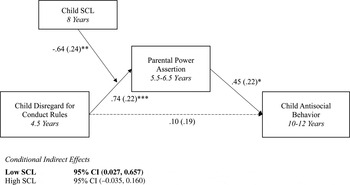
Data were analyzed using Mplus software (Muthén & Muthén, Reference Muthén and Muthén2010) to address missing data using full information maximum likelihood, considered superior to other methods of handling missing data (Enders & Bandalos, Reference Enders and Bandalos2001). Thus, the complete sample of 102 families was retained for the analyses. Preliminary regression analyses suggested that the first path in the cascade (child disregard for conduct rules at 4.5 years to parental power assertion at 5.5–6.5 years) was moderated by SCL (B = –0.64, SE = 0.22, p = .004), but that the second path (parental power assertion at 5.5–6.5 years to child antisocial behavior at 10–12) was not moderated by SCL (B = –0.37, SE = 0.34, p = .269). Consequently, in the analyses that follow, a first-stage conditional process model (Preacher, Rucker, & Hayes, Reference Preacher, Rucker and Hayes2007) was tested such that only the first path in the cascade (from child disregard for rules to power assertion) varied as a function of SCL. Parental power assertion at 15 months and child gender were included as the covariates.
The comparative fit index (CFI; Bentler, Reference Bentler1990) was selected to assess incremental fit of the tested models given it performs especially well in relatively small sample sizes. We also examined the root mean square error of approximation (RMSEA; Browne & Cudeck, 1992) and the standardized root mean residual (SRMR; Hu & Bentler, 1995) to further assess global fit.
Conditional indirect effects of child disregard for rules (4.5 years) on child antisocial behavior (10–12 years) via parental power assertion (5.5–6.5 years) were estimated for high- versus low-SCL children. A bootstrap approach (Shrout & Bolger, Reference Shrout and Bolger2002) was implemented, which provides an empirical approximation of sampling distributions of indirect effects to provide confidence intervals (CIs) of estimates. The presence of an indirect effect is detected if zero does not fall within the CI (i.e., the indirect effect is different than zero). A bootstrapping sampling method is the preferred method for testing indirect effects because no assumptions need to be made about the shape of the sampling distribution, and power is maximized while minimizing Type I error rate (MacKinnon, Lockwood, & Williams, Reference Mackinnon, Lockwood and Williams2004; Preacher et al., Reference Preacher, Rucker and Hayes2007; Shrout & Bolger, Reference Shrout and Bolger2002). We performed a nonparametric resampling method (bias-corrected bootstrap) with 5,000 resamples drawn to derive the 95% CIs for the indirect effects at various levels of SCL.
Results
Preliminary analyses
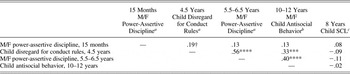
We examined the correlations among the studied constructs (using the continuous measure of SCL). Those data are in Table 1. As anticipated, children's stronger disregard for rules of conduct at 4.5 years was associated with more parental power-assertive discipline at ages 5.5–6.5 years (but only marginally with earlier parental power-assertive discipline at 15 months) and with more parent-rated antisocial behavior at ages 10–12 years. Parents' more power-assertive discipline (only at 5.5–6.5 years) was also associated with their ratings of their children as more antisocial at 10–12. SCL was not associated with any other variable.
Intercorrelations among the constructs

Note: M/F, Mother/father; SCL, skin conductance level.
a Composite of observed measures.
b Composite of parent-rated measures.
c Physiological assessment, composite across all episodes (continuous score).
†p < .10. ***p < .01. ****p < .001.
Variations in the cascade from child disregard for conduct rules at 4.5 years to parental power assertion at 5.5–6.5 years to child antisocial behavior at 10–12 as a function of SCL
We tested the proposed, first-stage conditional process model for the measure of SCL (coded 1 = high, above median, 0 = low, below median). Global model fit was deemed adequate (CFI = 0.937, SRMR = 0.029, RMSEA = 0.202), although it was not excellent. Results of this model are reported in Figure 1. The overall conditional indirect effect of child disregard for conduct rules at 4.5 years on child antisocial behavior at 10–12, as mediated by parental power assertion at 5.5–6.5 years, was present for the low-SCL children, but not for the high-SCL children. Conditional indirect effects are reported with bias-corrected bootstrap 95% CI, and significant indirect effects are bolded in Figure 1. Approximately 21% of the variance in child antisocial behavior and 46% of the variance in parental power was accounted for by the model.
Results of first-stage conditional process model. Significant conditional indirect effects are in bold. *p < .05. **p < .01. ***p < .005. Child gender and parental power assertion at 15 months were covaried but are not depicted. Unstandardized coefficients and standard errors are presented for the direct paths. Solid lines indicate significant paths. Dashed line indicates a nonsignificant path. The indirect effect of child disregard for conduct rules (4.5 years) on child antisocial behavior (10–12 years) via parental power assertion (5.5–6.5 years) was present for the low skin conductance level children (bolded) but not high skin conductance level children, as indicated by the 95% confidence intervals.

Next, we conducted complementary analyses of the first-stage conditional process model, using a continuous measure of SCL. Global model fit was excellent (CFI = 1.00, SRMR = 0.004, RMSEA = 0.000). The findings essentially replicated those for SCL conceptualized as low versus high, in that a conditional indirect effect from disregard for conduct rules to parental power to antisocial behavior were present at very low SCL (1.5 SD below the mean), 95% CI = (0.039, 0.753), low SCL (1 SD below the mean), 95% CI = (0.031, 0.644), and average SCL (at the mean), 95% CI = (0.013, 0.463). There was no indirect effect at high SCL (1 SD above the mean), 95% CI = (–0.013, 0.414), or very high SCL (1.5 SD above the mean), 95% CI = (–0.052, 0.422). Of note, the parameter representing the interaction between child disregard for conduct rules and the continuous measure of SCL did not reach statistical significance (B = –0.15, SE = 0.11, p = .176) within the conditional process model; however, as stated by Hayes (Reference Hayes2013), “statistically significant moderation of a path in a mediation model is not a necessary condition for an indirect effect to be moderated” (p. 396). Approximately 21% of the variance in child antisocial behavior and 35% of the variance in parental power were accounted for by the model.
Discussion
Within a developmental psychopathology framework, researchers have been urged to adopt a multilevel approach to the study of antisocial behavior (Burnette & Cicchetti, Reference Burnette and Cicchetti2012). There is a growing consensus, fueled by the rapidly growing research on differential susceptibility (Belsky & Pluess, Reference Belsky and Pluess2009), that socialization processes may operate differently depending on the child's physiology. As well, developmental psychopathology researchers have been urged to examine cascades that unfold in the origins of antisocial behavior, including the specific causal processes and conditional factors that influence their occurrence (Masten & Cicchetti, Reference Masten and Cicchetti2010). Modern statistical tools aid in the pursuit of such questions.
Embracing those tenets, this multiple-method, multiple-trait, multiple-informant, and multiple-wave study examines a socialization mechanism that accounts for developmental links between children's early disregard for rules of conduct and future antisocial behavior problems, and the child's biological characteristics that moderate conditions under which that mechanism operates. An integration of research on children's internalization of rules, on parents' discipline style, and on children's biological individuality can enhance a developmentally informed approach to understanding a long-term unfolding trajectory to antisocial behavior problems.
The findings elucidate diverging developmental pathways from disregard for conduct rules at preschool age to antisocial outcomes in preadolescence for children with distinct physiological profiles, illustrating the principle of multifinality (Cicchetti & Rogosch, Reference Cicchetti and Rogosch1996). Researchers typically assume that children's early compromised guilt, callousness, and disregard for parents' and other adults' rules and standards for behavior, if sufficiently intense or frequent, uniformly foreshadow future antisocial outcomes (Wakschlag et al., Reference Wakschlag, Briggs-Gowan, Carter, Hill, Danis and Keenan2007). However, disregard for rules is quite common at toddler and preschool age, and the prediction is vastly imperfect because of the absence of objective norms for early behaviors reflecting regard for rules. Behavioral research on young children's responses to transgression and rule breaking is challenging, and observational studies are sparse, although promising (Callender et al., Reference Callender, Olson, Kerr and Sameroff2010). Moreover, observational research allows only for comparing children's relative rankings within the studied samples. Consequently, it is important to understand under what conditions and through what processes early disregard for rules may foreshadow future behavior problems.
Bufferd et al. (Reference Bufferd, Dyson, Hernandez, Wakschlag and Cicchetti2016) recently emphasized that internalization of rules, reflected in guilt and rule-compatible behavior, is a key developmental task in the preschool period, and its substantial, pervasive, and extreme disruptions indicate early risk for disruptive and antisocial psychopathology. They also, however, point out that the prediction is a dynamic and complex process, impacted by child temperament. This is consistent with our findings, based on a biological temperament characteristic: although early disregard for conduct rules was not associated with the child's SCL, the sequence toward future antisocial problems that it triggered was different for children with different levels of skin conductance. The indirect effect of early disregard for rules on children's antisocial behavior in preadolescence was present only for children with relatively lower SCL scores. Moreover, we elucidated the mechanism mediating the links between early disregard for rules and future antisocial problems for those children. Early disregard for rules elicited increased parental power assertion, presumably due to those low-SCL children's history of failing to respond to subtle, gentle punishment (Bates et al., Reference Bates, Schermerhorn, Petersen, Zentner and Shiner2012; Bell, Reference Bell1968; Blair et al., Reference Blair, Peschardt, Budhani, Mitchell and Pine2006; Dadds & Salmon, Reference Dadds and Salmon2003; Dishion & Patterson, Reference Dishion, Patterson, Cicchetti and Cohen2006; Matthys, van Goozen, Snoek, & van Engeland, Reference Matthys, van Goozen, Snoek and van Engeland2004; Pardini, Reference Pardini2008; Raine, Reference Raine2002), and the increased power assertion, in turn, led to future antisocial behavior.
In contrast, as hypothesized, such cascade was absent for children who had relatively higher SCL scores. For those children, there was no indirect effect from disregard for rules to future antisocial behavior. In particular, early disregard for rules by those children did not appear to elicit parental power assertion. Children with high SCL presumably respond positively to subtle parental socialization before the pressure reaches a high level (Blair et al., Reference Blair, Peschardt, Budhani, Mitchell and Pine2006; Briggs-Gowan et al., Reference Briggs-Gowan, Nichols, Voss, Zobel, Carter and McCarthy2014; Dadds & Salmon, Reference Dadds and Salmon2003; Kimonis & Frick, Reference Kimonis, Frick, Murrihy, Kidman and Ollendick2010; Raine, Reference Raine2002).
This study has several limitations. The families were demographically diverse, but relatively homogeneous ethnically (although 20% had at least one non-White parent). Given the evidence of differential effects of power assertion on externalizing problems in different ethnic groups (e.g., Deater-Deckard & Dodge, Reference Deater-Deckard and Dodge1997; Deater-Deckard, Dodge, Bates, & Pettit, Reference Deater-Deckard, Dodge, Bates and Pettit1996; Lansford, Deater-Deckard, Dodge, Bates, & Pettit, Reference Lansford, Deater-Deckard, Dodge, Bates and Pettit2004), a replication in a more ethnically diverse sample will be crucial.
The children in this low-risk, two-parent community sample were generally functioning well. At early age, most showed what appeared to be typical tension and discomfort following the mishaps, and they mostly adhered to the rules set by parents and others adults (although again, observational studies of young children's disregard for rules are rare, and no objective norms exist). In addition, parental ratings of antisocial behaviors were generally low and consistent with normative samples. The aggregation across informants, assessments, and instruments produced a reasonably distributed and highly coherent measure. Of course, a replication in a clinical sample, perhaps enriched for inclusion of children with elevated psychopathology, may produce additional important insights. However, we note that the anticipated effects were found even for those typically developing children and their low-risk families.
By and large, parents deployed adaptive discipline techniques, and power assertion was rare. This is a well-known problem and a challenge in observational research, often handled by various aggregation techniques (see, e.g., Joosena, Mesman, Bakermans-Kranenburg, & van IJzendoorn, Reference Joosena, Mesman, Bakermans-Kranenburg and van IJzendoorn2012). Our data aggregation approach, based on multilevel aggregation across contexts, assessments, and parents, and on a weighing system that assigns lower weights to parental behaviors that use no or little power, and higher weights to more power-assertive behaviors, has produced reasonably distributed scores that reflected differences in the overall amount of parenting pressure the child received from age 5.5 to 6.5 years. Again, the expected effects were present, despite the generally low level of forceful discipline. A replication in populations in which power assertion is more common (e.g., in families referred for child maltreatment), however, would be very useful.
We should note that, although we found the expected indirect effect from child disregard for rules to parental power assertion to antisocial behavior only for the low-SCL children, the conditional nature of the indirect effect was due to SCL moderating the link between disregard for rules and power assertion. In other words, for low-SCL children, disregard for rules triggered parental increased power assertion, thus initiating the cascade from disregard for rules to power assertion to antisocial behavior. The link from power assertion to antisocial behavior, however, was not moderated by SCL: that direct effect was present for all children regardless of SCL, such that more power assertion predicted more antisocial behavior (consistent with the large literature on detrimental effects of power-assertive discipline).
However, our past work found a moderating effect of SCL on the link between parental power assertion and children's antisocial behavior, with variation in power assertion associated with antisocial behavior for low-SCL children, but not high-SCL children (Kochanska et al., Reference Kochanska, Brock, Chen, Aksan and Anderson2015). Most likely, the absence of the interaction effect in the current analyses was due to the power assertion measure being substantially less robust, compared with the past work. In that past work, power assertion scores had been based on data from six assessments (from 15 months to 6.5 years), whereas in the current work they were based on two assessments (at 5.5 and 6.5 years only, covarying 15 months). This may have reduced our statistical power to detect the interaction. Of course, the present longitudinal analyses required the mediator (power assertion) to be assessed after the independent variable (disregard of conduct rules at 4.5 years) and before the outcome measure (antisocial behavior at age 10 and 12). In addition, in the previous work, externalizing behaviors were assessed closer in time, in part concurrent to SCL (at ages 8 and 10), but in the current analyses, they were assessed at ages 10 and 12. As well, although similar, the measures of those behaviors were not the same in the past and present analyses. Perhaps even more important, previous analyses did not include children's disregard for rules in the model.
Several limitations were associated with our measure of SCL. One was its timing. Because of the logistical constraints of the overall study, we were only able to conduct one psychophysiological session. Note that El-Sheikh (Reference El-Sheikh2007) reported that, at least between ages 6 and 13, SCL appears to reflect stable individual differences. However, SCL may be influenced by the child's experiences (Raine et al., Reference Raine, Venables, Dalais, Mellingen, Reynolds and Mednick2001), and thus may be open to change. The parent–child relationship and the child's physiology represent systems that dynamically interact over time and influence each other (Calkins et al., Reference Calkins, Propper and Mills-Koonce2013). In this study, we did not find significant correlation between earlier power assertion and the continuous measure of SCL (and only a modest relation, r = –.29 with the dichotomous measure); nevertheless, collecting multiple and parallel measures of child behavior, psychophysiology, and parenting repeatedly over time would be highly desirable in future longitudinal research. Such designs could address key questions of the interplay between parental socialization and child biology, unfolding over time.
Another issue was our specific psychophysiological paradigm and data aggregation. Although we believe that our tonic SCL measures, based on past work, were appropriate and robust, alternative approaches are certainly possible and may yield promising results. As discussed earlier, an alternative approach, adopted by other laboratories investigating links among electrodermal activity, parenting, and developmental outcomes (Erath et al., Reference Erath, El-Sheikh and Cummings2009, Reference Erath, El-Sheikh, Hinnant and Cummings2011), involves analyses of change in SCL response from the baseline to an emotionally challenging task. In particular, assessments that would deploy an emotional challenge due to experience of a transgression and the following discomfort (thus parallel to our mishap paradigms) may be especially revealing in future research. Those assessments, however, may pose difficulty associated with artifacts due to children's movement.
The findings have translational implications. Although parents and clinicians do not have routine access to children's measures of autonomic functioning (and in any event, no norms for “low” or “high” SCL exist; D. C. Fowles, personal communication, April 2015), they can be made aware of observed characteristics of temperament that are typically associated with autonomic hyporeactivity, such as fearlessness, and tendency toward uninhibited, impulsive, and risk-taking behavior (Scarpa et al., Reference Scarpa, Raine, Venables and Mednick1997). The gist of our findings is that emotions and behaviors indicating low regard for conduct rules shown by young children with such temperaments may be more of a concern than similar behaviors in their peers without such temperament characteristics. That concern may be particularly heightened if disregard for rules triggers parental forceful response. Over time, forceful discipline may contribute to an adversarial, mutually coercive parent–child cascade, leading ultimately to antisocial behavior problems. Parents of children with fearless, hyporeactive temperaments would be well advised to avoid being drawn into coercive exchanges and to rely instead on alternative socialization strategies, such as warmth, use of positive affect and rewards, responsiveness, and other techniques that create an affectively positive relationship. Growing literature has shown that such alternative strategies may be especially effective for behaviorally fearless and physiologically hyporeactive children, and may result in lowering their risk for antisocial problems (Fowles & Kochanska, Reference Fowles and Kochanska2000; Kochanska, Reference Kochanska1997; Kochanska, Aksan, & Joy, Reference Kochanska, Aksan and Joy2007; Shaw, Reference Shaw2003).
Future research will likely reveal further complexities. A continuing integration of research on children's biological individuality, their behavior, the parenting they receive, and the unfolding adaptive and maladaptive developmental trajectories remains a promising enterprise.