Introduction
Delirium is a serious neuropsychiatric condition, characterized by acute and fluctuating disturbance in attention, and orientation to the environment, alteration in other cognitive domains and in the level of consciousness (American Psychiatric Association, 2013). It occurs across all health-care settings and populations, but it is especially common in medical–surgical patients, in palliative care services and in intensive care units (ICUs), with prevalence ranging from 15% to 80% (Ely et al. Reference Ely2001; Ouimet et al. Reference Ouimet2007; Inouye et al. Reference Inouye2013; Lindner et al. Reference Lindner2013).
Delirium is independently associated with a number of adverse clinical outcomes, including increased risk of institutionalization, higher mortality and cognitive impairment, and/or progression to dementia (Witlox et al. Reference Witlox2010; Davis et al. Reference Davis2012; Pandharipande et al. Reference Pandharipande2013). Delirium is also distressing for patients and caregivers, as highlighted by several studies (Partridge et al. Reference Partridge2012).
Studies have also shown that early recognition can improve outcomes (Tabet et al. Reference Tabet2005), indirectly suggesting that the correct identification of delirium is the prerequisite for an appropriate management by healthcare professionals. Indeed, early recognition of its symptoms may facilitate the timely approach to medical causes underlying delirium and the prevention of recurrences and complications. However, delirium is commonly underdetected in clinical practice, including acute hospital (Collins et al. Reference Collins2010), emergency department (Elie et al. Reference Elie2000), and ICU (Spronk et al. Reference Spronk2009). Underdetection is especially related to non use of screening tools (National Institute of Clinical Excellence, 2012).
In Italy, guidelines for the diagnosis, management, and treatment of delirium are lacking. Furthermore, there are no studies on the awareness of delirium among health professionals caring for patients at high risk.
During the last years, the European Delirium Association (EDA) has promoted an international survey among clinicians with special interest in delirium (Morandi et al. Reference Morandi2013), to assess how they manage patients with this clinical condition. As a consequence of the participation of Italian researchers in this survey, the interest in delirium care has also increased in our country. The Italian Association of Psychogeriatrics (AIP) has therefore decided to carry out a survey among its members, with the aim to detect the presence of potential barriers to delirium care and to evaluate their attitudes toward delirium diagnosis and management. The AIP is a multidisciplinary society of 1,500 members – academics, researchers, health providers, and policy makers –, who are interested in promoting and understanding psychogeriatric diseases.
For this purpose, the AIP created a study group (AIP delirium study group) and started a nation-wide project of education, with the aim to increase awareness of delirium by various healthcare providers. The present survey is the first-step of this project.
Methods
The questionnaire was constructed through an iterative process, including item generation, construction, pilot testing, and refinement from multidisciplinary (doctors, nurses, psychologists, and physiotherapists) experts in delirium management. The generation of the items followed these steps: two authors (GB and AM) identified the issues to be presented and developed the survey. They identified pertinent questions as the result of a comprehensive literature review and because of their training and clinical experience. The initial survey was therefore administered to the other authors (EZ, MB, EL, MT, MT) who were deliberately not involved in the initial survey construction. These authors provided the first two with significant feedback and comments, which were incorporated. This process led to modifications and addition to the survey. Using the feedback received by the other authors, GB and AM were able to discern the extent to which the survey adequately sampled the domains of knowledge it purposed to measure and to make changes accordingly. The correct answer was the gold reference for each single question and the gold standards were the same for the various healthcare workers. The final survey consisted of 11 questions, which were common for all healthcare professionals involved in this survey. The items included the assessment and the diagnosis of delirium, the identification of its causes, and the management of hyperactive and hypoactive delirium. The Diagnostic and Statistical Manual of Mental Disorders-IV (DSM-IV) criteria and the Confusion Assessment Method (CAM) score were considered the gold standard methods to diagnose delirium. Three questions regarding their specialization and how they manage both hypokinetic and hyperkinetic delirium with pharmacological treatment were reserved only to doctors. (Appendix A for the full questionnaire).
Additionally, there were two case vignettes, common for all healthcare professionals, which were developed as a way to assess healthcare provider knowledge of hypokinetic delirium and delirium superimposed on dementia.
The survey period was 1st June 2013 to 30th November 2013. The invitation to participate in the online survey was sent via email to all AIP members, with publication on the AIP website. Each member was free to verbally publicize the survey within his/her work setting and to invite participants by other staff members. There was not pre-existing plan for recruiting participants in this survey, but all who agree to participate in this survey were recruited. Reminders were sent out every two months from the start to the end of the survey. No incentives were offered to participants. The questionnaire was accessible on the AIP webpage by clicking in a special area. After clicking in that area, the participants were asked to indicate their occupation and email address. Then, an automatic message allowed participants to start the survey. Each participant was allowed to return the completed questionnaire only after clicking on the “Finish survey” button. All transcripts were anonymized.
Results
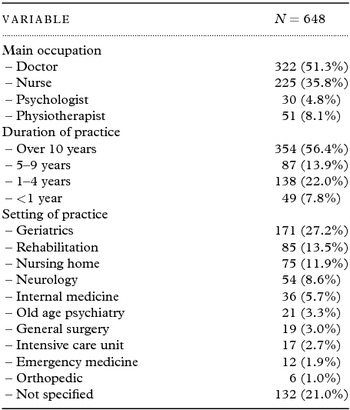
A total of 648/1,500 responses were collected (Table 1). The majority of responders were doctors (51.3%), followed by nurses (35.8%), physiotherapists (8.1%), and psychologists (4.8%). Overall, most participants had more than 10 years duration of practice (56.4%), while 22.0% had a duration ranging from 1 to 4 years, 13.8% ranging from 5 to 9 years, and 7.8% with less than 1 year.
Characteristics of responders
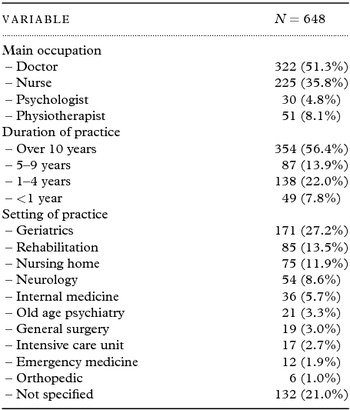
The majority of the responders worked in geriatric medicine (27.2%) and rehabilitation settings (13.5%), followed by nursing home (11.9%), neurology (8.6%), internal/acute medicine (5.7%), old age psychiatry (3.9%), ICUs (2.7%), emergency medicine (1.9%), and orthopedic setting (1.0%). In 21% of cases, we were not able to ascertain the working setting since the item was not completed (Table 1).
Definition and identification of delirium
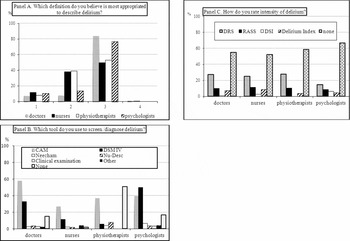
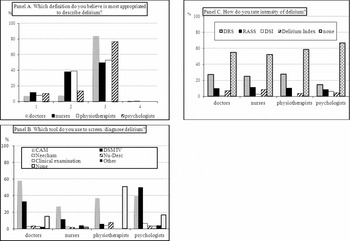
Responses to the proposed definition of delirium suggest that a wide proportion of participants had poor knowledge of the core features of this syndrome. Indeed, while 84.5% of doctors defined delirium correctly, only 49.8% of nurses, 52.9% of physiotherapists, and 76.7% of psychologists provided the correct answer (Figure 1 – Panel a.). For a large proportion of nurses (38.2%) and physiotherapists (39.2%), delirium was a cognitive disorder characterized by a spatial and/or temporal disorientation with memory relatively spared.
Comparison between the responses of doctors, nurses, psychologists, and physiotherapists with regard to the definition of delirium (Panel a: 1 = behavioural disorder which often, although not always, accompanies the natural history of dementia; 2 = Cognitive disorder with spatial and/or temporal disorientation; memory is relatively spared; 3 = acute or subacute cognitive disorder which tends to fluctuate over time, with inability to maintain and shift attention; 4 = Behavioural disorder NAS, typical of atypical dementias (e.g. Lewy-Body disease), the tool used to screen/diagnose delirium (Panel b; DRS = Delirium Rating scale, RASS = Richmond Agitation and Sedation Scale; DSI = Delirium Symptom Inventory) and the tool used to assess its intensity (Panel c; CAM = Confusion Assessment Method, DSM-IV = Diagnostic and Statistical Manual of Mental Disorders-IV; Nu-Desc = Nursing Delirium Screening scale).
The greatest majority of respondents (90.4% of doctors, 84.4% of nurses, 82.4% of physiotherapists, and 80% of psychologists) described delirium as a widespread condition among all settings of acute and chronic care, including medical and surgical wards, long-term care and nursing homes (data not shown).
The Figure 1 – Panel b shows the percentage of use of delirium screening and or diagnostic instruments for delirium. Doctors reported using the CAM in 58.4% of cases and/or the DSM-IV criteria in 32.6%. Obviously, some doctors used both the CAM and the DSM-IV criteria. A minority of them reported using the Neecham scale, the Nursing Delirium Screening scale (Nu-Desc) and/or to assess the presence of delirium based on a clinical examination, while 14.9% acknowledged not using the screening tools for delirium. CAM was the preferred tool by geriatricians (51.7%), while the DSM-IV-TR by non-geriatric medical specialists (35.5%). The CAM was also used by 27% of all nurses, 37% of physiotherapists, and 40% of psychologists. The DSM-IV-TR was used by 50% of psychologists, while 50.9% of physiotherapists and 16.6% psychologists did not use any tool to screen for delirium. In general, doctors reported using the correct methods to diagnose delirium (i.e. DSM-IV-TR criteria or CAM) in the majority of cases, while nurses and physiotherapists did not. Psychologists had an intermediate score between doctors and other professionals.
The intensity of delirium was generally under-assessed (Figure 1 – Panel c). In fact, only 45% of doctors assessed the intensity of delirium. Interestingly, 47.5% of nurses, 41.4% of physiotherapists, and 33.3% of psychologists reported using a tool to evaluate the intensity of delirium. The scale most widely used was the Delirium Rating Scale-Revised-98 (DRS-R-98) (27.3% of doctors, 24.9% of nurses, 27.6% of physiotherapists, and 14.6% of psychologists). A minority of doctors, nurses, physiotherapists and psychologists used the Delirium Symptom Inventory (DSI) or the Delirium Index (DI).
Management of hypoactive and hyperactive delirium
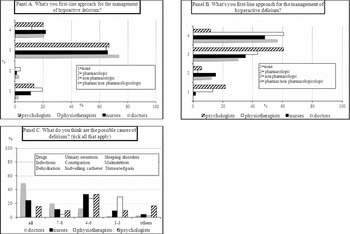
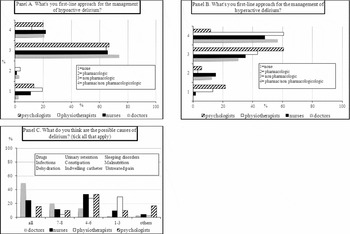
A non-pharmacological approach was the most common management of hypoactive delirium for doctors (73.9%), nurses (65.8%), physiotherapists (64.7%), and psychologists (66.7%). However, 20% of doctors, 11.8% of nurses, 21.8% of physiotherapists, and 20.8% of psychologists reported using a combination of pharmacological and non-pharmacological approaches. It is worthy of note that 11.1% of nurses, 13.3% of psychologists, and 19.6% of physiotherapists declared using preferably neither the pharmacological nor the non-pharmacological approach for hyperactive delirium (Figure 2 – Panel a).
Comparison between the responses of doctors, nurses, psychologists, and physiotherapists with regard to the interventions for the management of hypoactive delirium (Panel a), hyperactive delirium (Panel b) and its potential causes (Panel c). In Panel c the x axis reports the number of possible delirium causes listed by the responders.
A combination of non-pharmacological and pharmacological strategies was the dominant approach to the management of hyperactive delirium among all healthcare professionals (Figure 2 – Panel b). However, 12.7% of doctors, 15.1% of nurses, 3.3% of physiotherapists, and 5.9% of psychologists reported using a purely pharmacological management.
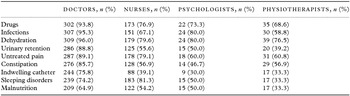
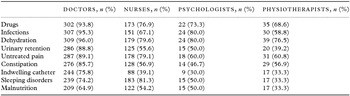
With regard to the possible causes of delirium (Figure 2 – Panel c), only 50.3% of doctors, 24.4% of nurses, and 15.7% of psychologists indicated all the nine conditions (i.e. drugs, infections, dehydration, urinary retention, constipation, use of indwelling catheter, sleeping disorders, malnutrition, and untreated pain) as implicated in its etiology. None of the physiotherapists reported all the nine possible causes. All the potential causes of delirium were indicated by 51.2% of doctors with a geriatric speciality, while by 46.1% of non-geriatric medical specialists. A significant proportion of respondents indicated 4 to 6 causes (13.3% of doctors, 33.3% of nurses, 27.4% of physiotherapists and 33.3% of psychologists) and a lower proportion indicated seven or eight causes (20.4% of doctors, 11.5% of nurses, 1.5% of physiotherapists, and 10% of psychologists). The individual causes of delirium by different categories of healthcare providers are shown in Table 2. Doctors reported dehydration, infections, and drugs as individual cause of delirium in most cases (96.0%, 95.3%, and 93.8%, respectively), while malnutrition and sleeping disorders were reported as possible cause only in 64.9% and 74.2%, respectively. Among nurses, the most cited individual causes of delirium were sleeping disorders and dehydration (81.3% and 79.6%, respectively), while the use of indwelling catheter was cited as a potential cause by 39.1%. Infections and dehydration were reported as causes of delirium by 80.0% of psychologists while the presence of indwelling catheter by 30%. Drugs were recognized as cause of delirium by 68.6% of physiotherapists while indwelling catheter, sleeping disorders and malnutrition by 33.3%.
Individual causes of delirium recognized by the different categories of health professionals
While most of them (64.4%) admitted not using drugs and 8.7% did not answer this question, there were a significant proportion of doctors (26.1%) who approached hypoactive delirium with various drugs (Appendix B.1). The most commonly used drugs were haloperidol alone (12.4%) or in combination with melatonin (0.6%) and atypical antipsychotics alone (9.4%) or in combination with either haloperidol or melatonin (1.5%).
A drug for the treatment of hyperactive delirium was used by most respondents: in fact, only 1.6% reported not using drugs and 1.2% did not answer the question (Appendix-B.2). Haloperidol, alone (43.5%) or in combination with melatonin (1.2%), was the most widely used antipsychotic, followed by the atypical antipsychotics alone (21.7%) or in combination with either haloperidol or melatonin (19.8%). However, a notable proportion of respondents reported using benzodiazepine with atypical antipsychotics (8.6%), haloperidol with melatonin (1.2%) or benzodiazepine alone (1.6%).
Case vignettes
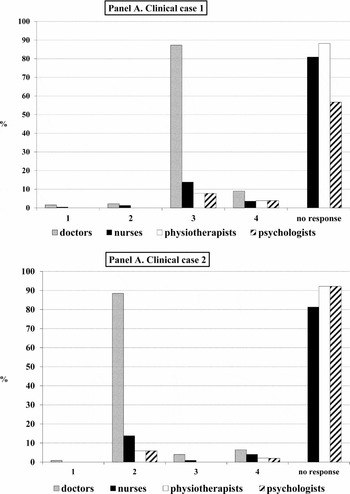
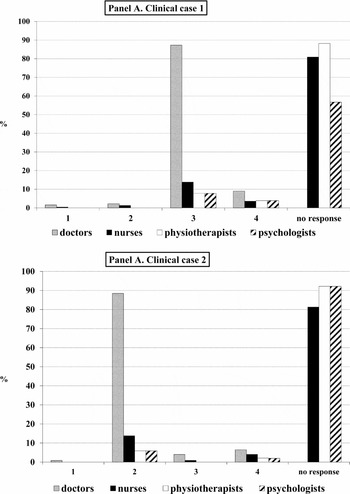
The two vignettes focused on the ability of healthcare professionals to identify hypoactive delirium and delirium superimposed on dementia. With the exception of doctors, the majority of the healthcare providers did not answer both the first (80.9% of nurses, 88.2% of physiotherapists, and 56.7% of psychologists) and the second (81.3% of nurses, 92.9% of physiotherapists, and 92.2% of psychologists) case vignette (Figure 3 – Panel a and Panel b). The hypokinetic delirium vignette was correctly identified by 87.3% of doctors, 13.8% of nurses, 7.8% of physiotherapists, and 7.8% of psychologists, while the delirium superimposed on dementia vignette was correctly identified by 88.5% of doctors, 13.8% of nurses, 5.9% of physiotherapists, and 5.9% of psychologists.
Comparison between the responses of doctors, nurses, psychologists, and physiotherapists with regard to the diagnosis for the clinical cases 1 (Panel a) and 2 (Panel b).
Discussion
This is the first Italian survey assessing the healthcare providers’ knowledge regarding the diagnosis and management of delirium in various settings of care. To the best of our knowledge it is also the first survey conducted among various categories of health care providers involved in the management of patients with delirium, including not only doctors and nurses but also psychologists and physiotherapists.
The importance of a multidisciplinary management of delirium by a team of health care provider experts in this field has been repeatedly highlighted by recent guidelines (O’Mahony et al. Reference O’Mahony2011; National Institute of Clinical Excellence 2012). The competence to diagnose and manage delirium should not pertain exclusively to doctors, but also to nurses and all other professionals who care for delirious patients in various clinical settings, including, for instance, physiotherapists and psychologists. In fact, the association between delirium and functional status has been repeatedly demonstrated in previous studies (Kiely et al. Reference Kiely2006; Bellelli et al. Reference Bellelli2011) and a sudden decline of functional status has been claimed as a prodromal sign of imminent delirium in frail patients (Bellelli et al. Reference Bellelli2012), indirectly suggesting that physiotherapists play a crucial role in improving delirium recognition and management. The relevance of psychologists in this area has not been fully demonstrated, although a recent study suggests that a perioperative psycho-educational intervention could reduce postoperative delirium in patients following cardiac surgery (Lee et al. Reference Lee2013). This might support the notion that psychologists are important in delirium prevention and also that they need to be kin in delirium detection during neuropsychological assessment. Therefore, the current study is particularly noteworthy because it provides preliminary evidence regarding delirium awareness in two groups of health care providers, which have never been considered as a target for education in previous studies. Indeed, previous surveys to evaluate delirium knowledge have been conducted in various settings of care, among doctors (Ely et al. Reference Ely2004; Fang et al. Reference Fang, Chen, Liu, Lin, Tsai and Lai2008; Van Eijk et al. Reference Van Eijk2008; Cadogan et al. Reference Cadogan2009; Davis and MacLullich Reference Davis and MacLullich2009; Patel et al. Reference Patel2009; Ceraso et al. Reference Ceraso2010; Forsgren and Eriksson Reference Forsgren and Eriksson2010; Mac Sweeney et al. Reference Mac Sweeney2010; Devlin et al. Reference Devlin2011; Morandi et al. Reference Morandi2013), nurses (McCrow et al. Reference McCrow2013), pharmacists (Devlin et al. Reference Devlin2011), nurses and doctors (Van Eijk et al. Reference Van Eijk2008), or among an audience of doctors, nurses, pharmacists, physician assistants, and respiratory care practitioners (Ely et al. Reference Ely2004; Patel et al. Reference Patel2009), but none of these surveys have specifically targeted psychologists and physiotherapists.
The results of our study suggest that Italian health care providers largely recognize that delirium is a widespread clinical problem in various settings of care, and that a therapeutic approach is feasible and useful. However, respondents generally lacked competence in diagnostic and management skills. The majority of the doctors correctly defined delirium and reported using predominantly the DSM-IV and CAM criteria to screen/diagnose delirium; however, a large proportion of them admitted not assessing the intensity of delirium and half of them were inappropriate in identifying the potential causes of this syndrome. Indeed, quantifying the intensity of delirium is essential to understanding its clinical course and recovery and may be useful to select pharmacological treatment. (Inouye et al. Reference Inouye2014) Furthermore, the identification of the potential causes of delirium is recommended by the clinical guidelines for delirium as a key element for the good clinical practice. (National Institute of Clinical Excellence, 2012) Therefore, although approaching delirium with appropriate instruments of screening, the doctors who responded to this survey are likely to fail in recognizing specific clinical conditions associated with delirium and probably confuse underlying somatic causes and its psychiatric complications. In general, it could be argued that some doctors might say, for instance “This is a patients with hyponatremia” but are reluctant to also diagnose delirium. It is also of interest that only half of nurses and physiotherapists correctly defined delirium and only a small portion of them reported using both DSM-IV and CAM criteria to screen/diagnose delirium. This observation is clearly in contrast with the indications from European guidelines, which recommend that this syndrome be screened for in all older people admitted to hospital using specific assessment tools (National Institute of Clinical Excellence, 2012) and suggests that some professionals may be hesitant to make the diagnosis since they can view delirium as a transient state. Furthermore, the ability to correctly identify all potential causes of delirium was very low in these two groups (i.e. nurses and physiotherapists). Possible explanations for underdetection of delirium may include socio-economic reasons, as once delirium is diagnosed the patient may not be easily transferred to another facility or discharged from hospital, which in turn leads to more costs. However, the psychologists were able to correctly define delirium in about two thirds of cases and nearly the half of them reported using the CAM and/or DSM IV criteria. In contrast, they neither rated intensity of delirium nor were they appropriate in identifying all potential causes of delirium. Differences among responses of psychologists, nurses and physiotherapists may be related to different practice of care in the settings in which they work. The lack of recognition of any cause of delirium by nurses can expose the patients to greater clinical risks and it is a important information which should be considered by nurses instructors in the nursing curriculum. Physiotherapists and psychologists are not asked or trained to identify clinical conditions, which could cause or expose the patients to the risk of developing delirium. However, it might be worth including in the training of physiotherapists and psychologists specific information on this topic, given the importance of early recognition of this important syndrome. Physiotherapists are indeed in contact daily with the patients, so have the possibility to provide the trigger for a correct delirium work up, together with nurses and physicians. On the same line, psychologists would benefit of more accurate delirium training in their clinical practice. In fact they might be facing a differential diagnosis between delirium and dementia during the first-time evaluation of a patient in the clinic. Obviously, a correct identification of this condition can lead to a different management; in fact while patients with dementia after a neuropsychological evaluation can be followed-up in a memory clinic, a patient with delirium needs a prompt evaluation because delirium is a medical emergency.
There was substantial consensus among health care providers in many aspects of the management of hypoactive and hyperactive delirium. More than two thirds of all respondents indeed reported using a non-pharmacological approach for hypoactive delirium and rarely a pharmacological treatment. Similarly, the large majority of respondents mainly approached hyperactive delirium with a combination of non-pharmacological and pharmacological treatments. However, there was inconsistency among doctors on the use of antipsychotic drugs. Indeed, 26.9% of doctors reported using drugs (one or more) for hypoactive delirium, with haloperidol or atypical antipsychotics being the preferred. Moreover, although haloperidol was the most frequently used drug for hyperactive delirium, there were a relevant proportion of doctors using benzodiazepines, alone or in combination with other drugs. These behaviors are clearly unaligned with the recommendations of NICE guidelines (National Institute of Clinical Excellence, 2012), that indicate a non-pharmacological approach as the first step for hypoactive delirium, including the identification and management of the underlying causes, and providing reorientation and involving family and caregivers. For hyperactive delirium, the NICE guidelines support the use of haloperidol or olanzapine only to control patients who are considered at risk for themselves or others and when a non-pharmacological approach (i.e. verbal and non-verbal techniques) has failed (National Institute of Clinical Excellence, 2012). However, it should be considered that in a recent survey on European delirium's experts, about 66% of the participants indicated haloperidol as their first choice to treat delirium (Morandi et al. Reference Morandi2013). Therefore, the observation about haloperidol and atypical antipsychotic use in our survey may be interpreted in the view that real-world practice is challenging and doctors are generally driven in their clinical decision by the belief that sedation is better than agitation in delirious patients.
The high rate of unresponsiveness to case vignettes by non-doctor health care providers clearly suggests a lack of confidence with this type of survey. However, it may also indicate lack of competence in this area. It is important to note that only doctors responded to case vignettes while the other health providers did not. This result seems to be in contrast with a recent study showing that nurses generally appreciate case vignettes as a method of improving recognition of delirium (Fick et al. Reference Fick2007).
The major strength of this survey was the inclusion of a mixed group of health care providers including doctors, nurses, physiotherapists, and psychologists. Nonetheless, several limitations should be mentioned. We were able to reach a relevant number of doctors and nurses, while the number of physiotherapists and psychologists was limited. This might reflect our inability to reach all potential providers with an interest in delirium or it may simply reflect a low level of interest in delirium in these healthcare providers. A second limitation was that the majority of doctors belonging to AIP are geriatricians and internists, neurologists and psychiatrists, while other specialties are underrepresented. However, the AIP is planning to extend in the future similar surveys to other scientific associations in order to reach different clinical specialties (e.g. cardiologists, surgeons, palliative care specialties, etc.). A third important limitation is that study results may have been influenced by the method of selecting participants in the survey. Indeed, they have been invited through advertisement and email invitation and not after a pre-planned selection of professional characteristics. As a result, their decision to participate may correlate with personal motivation and other traits that affect the generalizeability of the study to the general health professions in care settings. A fourth limitation relates to the possible contrast between self-report practice and actual practice, and this could be the base for future quality improvement projects. Finally, we have not addressed which are the main interventions for the prevention of delirium, the dosage of drug delivery and non-pharmacological therapies. This information should be included in future investigations.
In conclusion this is the first survey involving a group of Italian healthcare providers who routinely deal with delirious patients. Across the different responses we found both areas of good clinical practice and lack of competence, underlying the needs of education in this area. As recently stated by Jones, continuing work is needed to understand the problem and minimize its consequences. (Jones Reference Jones2014)
Members of the AIP delirium study group were: Bakri Joumana (Tregnago, Verona); Boffelli Stefano (Brescia); Bonamidan Fabio (Trento); Bonati Pietro (Parma); Boschi Federica (Forlì); Bruni Amalia (Lamezia Terme); Calabrò Massimo (Treviso); Canonico Vincenzo (Napoli); Carbone Pasqualina (Sospiro, Cremona); Castiglia Rosanna (Palermo); Ceretti Arcangelo (Abbiategrasso, Milano); Cester Alberto (Dolo, Venezia); Corno Alice (Monza); Cotroneo Antonino Maria (Torino); Dalzocchio Serena (Milano); De Gave Francesco (Roma); Del Pesce Maria (Senigaglia Ancona); Di Fazio Ignazio (Gussago, Brescia) Di Stefano Fabio (Verbania); Fabbo Andrea (Modena); Falanga Lina (Brescia); Ferrannini Luigi (Genova); Finotto Luciano (Padova); Frau Maria Rosa (Cagliari); Gabelli Carlo (Padova); Gandelli Monica (Milano); Gaspardo Pietro (Pordenone); Ghianda Diego (Lumezzane, Brescia); Gregoretti Cesare (Torino); Ivaldi Claudio (Genova); Lazzaro Angela Teresa (Latina); Limone Giuseppe (Enna); Lombardi Alessandra (Trento); Lostorto Mario (Padova); Lubian Francesca (Bolzano); Lucchetti Lucio (Piacenza); Lunardelli Maria Lia (Bologna); Marelli Eleonora (Milano); Mazzone Andrea (Monza); Mistraletti Giovanni (Milano); Morabito Daniela (Reggio Calabria); Mossello Enrico (Firenze); Motta Susanna (Monza); Noro Gabriele (Trento); Ortone Elena (Biella); Pasqui Lino (Monselice, Padova) Pelucchi Loris (Milano); Piovani Laura (Brescia); Pozzi Giuditta (Lodi); Putzu Paolo Francesco (Cagliari); Soattin Lucia (Vicenza); Stefinlongo Pierluigi (Venezia); Tomassini Pia Francesca (Macerata); Toselli Paolo (Fossano, Milano); Tripi Gabriele (Trapani); Vischia Flavio (Torino); Vitale Enrico (Mirano, Venezia); Zappa Sergio (Brescia); Zarattini Franco (Milano).
Conflict of interest
All the other authors report no financial conflicts of interest. Funding/Support
Description of authors’ role
Study conception and design – All authors. Acquisition of data – Bellelli, Morandi, Data analysis: Bellelli, Morandi. Interpretation of results – All authors. Drafted manuscript – Bellelli. Critically revised the manuscript – All authors. Final approval of manuscript – All authors
Supplementary material
To view supplementary material for this article, please visit http://dx.doi.org/10.1017/S1041610214001653.
Acknowledgments
We thank Carlo Mozzetti for the generation of the online survey.