INTRODUCTION
The family Ophichthidae consists of 59 genera with about 290 species, eight of which have been found to occur in the Mediterranean (McCosker et al., Reference McCosker, Böhlke, Böhlke and Böhlke1989; McCosker, Reference McCosker1998, Reference McCosker1999, Reference McCosker2007; McCosker et al., Reference McCosker, Loh, Lin and Chen2012). Ophisurus serpens (Linnaeus, 1758), a serpent eel, buries its body and exposes only its head in sandy or muddy bottoms, from shallow waters to depths of 300 m (Golani et al., Reference Golani, Ozturk and Basusta2006; Froese & Pauly, Reference Froese and Pauly2014). It is a cosmopolitan species, is widely distributed in the Atlantic (northern coast of Iberian peninsula to South Africa, and also Madeira) and the Indo-Pacific (southern Mozambique to South Africa; north to Japan, south to Australasia) (Bauchot, Reference Bauchot, Whitehead, Bauchot, Hureau, Nielsen and Tortonese1986). This species has been reported from the western and central Mediterranean coasts: Italy (Biagi et al., Reference Biagi, Sartor, Ardizzone, Belcari, Belluscio and Serena2002), the Alboran Sea (Abad et al., Reference Abad, Preciado, Serrano and Baro2007), the Ligurian Sea (Relini et al., Reference Relini, Relini, Palandri, Merello and Beccornia2007), Tunis Southern Lagoon (Ben Amor et al., Reference Ben Amor, Ben Souissi, Ben Salem and Capapé2009), the Adriatic Sea (Dulcic et al., Reference Dulcic, Matic-Skoko and Kraljevic2005), the Ionian Sea (Kaspiris, Reference Kaspiris1984; Maiorano et al., Reference Maiorano, Sion, Carlucci, Capezzuto, Giove, Costantino, Panza, D'Onghia and Tursi2010); and also form the Greek waters of the north and central Aegean Sea: the Evvoikos Gulf (Papaconstantinou et al., Reference Papaconstantinou, Petrakis, Mytilineou, Politou and Vassilopoulou1994; Stergiou et al., Reference Stergiou, Politou, Christou and Petrakis1997), the Korinthiakos Gulf (Kaspiris, Reference Kaspiris1973) and the Saronikos Gulf (Papaconstantinou & Tsimenidis, Reference Papaconstantinou and Tsimenidis1979).
The finding of O. serpens from Gökova Bay is the first record of this species for the Southern Aegean waters of Turkey and fills the distributional gap between the Aegean Sea and the Mediterranean Sea.
MATERIAL AND METHODS
On 5 January 2015, a single specimen of Ophisurus serpens (Figure 1) was collected by purse seine from Gökova Bay (36°59′N 27°53′E) at a depth of approximately 55 m (on a sandy and muddy bottom). Samples were fixed in 4% buffered formalin and deposited in the Museum of the Faculty of Fisheries, Mugla Sitki Kocman University (MUSUM/PIS/2015-1). Metric characters of the specimen were measured with a digital calliper (to the nearest 0.01 mm), whilst the meristic characters were counted under a stereo zoom microscope with 20× magnification. For identification of the specimen, we followed the counts and morphometric measurements given by Bauchot (Reference Bauchot, Whitehead, Bauchot, Hureau, Nielsen and Tortonese1986), Golani et al (Reference Golani, Ozturk and Basusta2006) and Froese & Pauly (Reference Froese and Pauly2014).
Specimen of Ophisurus serpens from the South Aegean Sea.

RESULTS
A brief description of the specimen in formalin
Body scaleless, very elongate, cylindrical and slender; long acute snout and tapered with the upper jaw projecting. Anterior nostril small at midsnout. Posterior nostril located on outer lip at midway between anterior nostril and anterior edge of eye and covered by an upper flap. Eyes relatively small. Premaxillae covered by large caniniform and curved teeth, small and biserial on maxillae. Small and uniserial teeth on lower jaw. Vomerine teeth uniserial, enlarged anteriorly. Well-developed dorsal and anal fins ending near to the hardened caudal tip. Body colouration olive green to brown above, paler below; head and lateral pores black. Selected morphometric (in mm) and meristic values of Ophisurus serpens were measured as noted in the following: Weight 363.14 (g), total length (TL) 1212, predorsal length 136 (11.2% TL), preanal length 446 (36.74% TL), maximum body depth 22 (1.8% TL), head length (HL) 93 (7.7% TL), orbit diameter 5.4 (5.8% HL), preorbital length 24.1 (25.9% HL). Dorsal-fin rays 422, anal-fin rays 234, pectoral-fin rays 14, pores on lateral line 195.
The maximum lengths of specimens in the previous records along the Turkish coasts are presented in Table 1.
Areas of Ophisurus serpens in the Aegean and Mediterranean-based literature.
a Approximate air distance to previous sampling locations.
DISCUSSION
Ophisurus serpens can be easily distinguished from all other Mediterranean snake eels by its very long snout, its slender and elongate jaws that are incapable of closing completely in adults, the presence of temporal, post-orbital and interorbital pores, and the absence of a caudal fin with a hard caudal tip (McCosker, Reference McCosker1977; Smith & McCosker, Reference Smith, McCosker, Gomon, Bray and Kuiter2008).
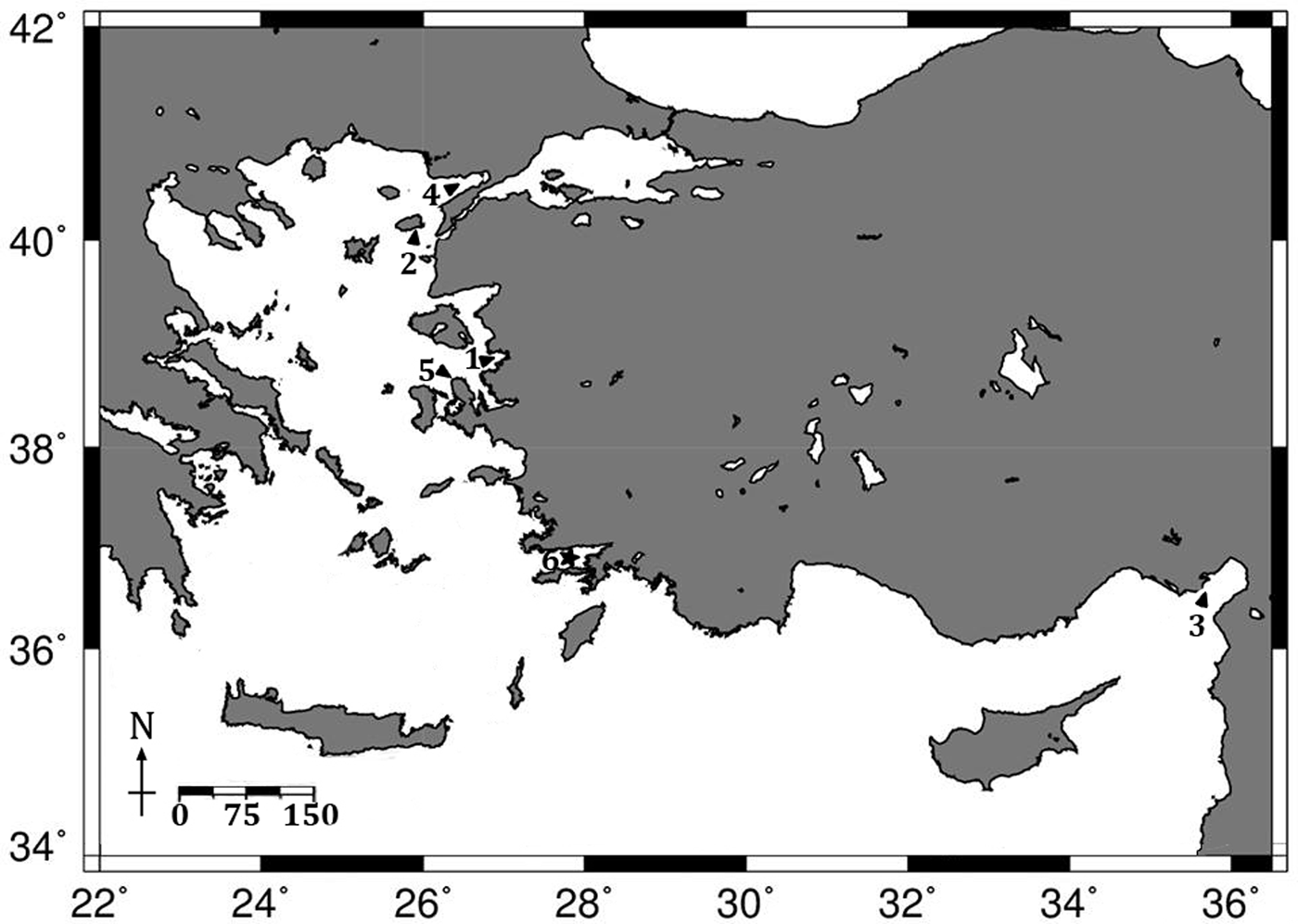
The species is common throughout the northern Aegean Sea of Turkey: Çandarlı Bay (Geldiay & Mater, Reference Geldiay and Mater1968), Gökçeada (Karakulak et al., Reference Karakulak, Erk and Bilgin2006), Saros Bay (Cengiz et al., Reference Cengiz, İşmen, Özekinci and Öztekin2011) and Karaburun (Ulaş & Akyol, Reference Ulaş and Akyol2015), however, its distribution is not documented in the southern Aegean Sea of Turkey, and it was only reported by Sangun et al. (Reference Sangun, Akamca and Akar2007) in the eastern part of the Mediterranean basin, where its occurrence is considered as rare. The reported locations of Ophisurus serpens on the Turkish coasts are given in Figure 2 and Table 1.
Distribution of Ophisurus serpens in the Aegean and Mediterranean Sea (information on the numbered locations is given in Table 1).
Ophisurus serpens has cryptic behaviour and is rarely collected, unlike other ophichthid eels in world, although it has been characterized as a probable cosmopolitan species by many authors (e.g. Bauchot, Reference Bauchot, Whitehead, Bauchot, Hureau, Nielsen and Tortonese1986; Golani et al., Reference Golani, Ozturk and Basusta2006). However, it has been doubted for a while whether Ophisurus serpens is a cosmopolitan species or not. McCosker (Reference McCosker1977) suggested that distributions of ophichthid species are directly affected by two major geological events. One was the Miocene closure of the Tethyan Seaway through the convergence of European and African continental plates, isolating the Mediterranean and the Atlantic from the Indo-Pacific. As a matter of course, there were divergences between the Atlantic and the Pacific populations. Nevertheless, McCosker (Reference McCosker1977) suggested that Ophisurus serpens is a circumglobal species because its presence occurred prior to the closure of the Tethyan Seaway, and it may have also passed through the Central American Seaway and transgressed both oceans. Therefore, he stated that it is, presumably, a single species and that the Atlantic and the Pacific populations of Ophisurus serpens, if indeed conspecific, represent the most separated of ophichthid distributions. In contrast to McCosker, Machida (Reference Machida, Okamura and Kitajima1984) and Yoda et al. (Reference Yoda, Tokimura, Horikawa and Yamada2002) claimed that the Indo-Pacific population differs from those of the Mediterranean, the Atlantic and the South African. These authors considered Indo-Pacific populations as Ophisurus macrorhynchos. Therefore, they proposed separating species and suggested that Ophisurus serpens is not a cosmopolitan species. Because of this conflict, Smith & McCosker (Reference Smith, McCosker, Gomon, Bray and Kuiter2008) pointed out that a worldwide revisionary study would be necessary to determine if it really is a single species or if it consists of different species. According to R. Fricke (personal communication), it would be premature to treat the Pacific populations as Ophisurus macrorhynchus, however, he also mentioned the necessity of the revision.
The present record confirms the first occurrence of this species in the Anatolian coasts of the South Aegean Sea, representing a southward georeferenced record and increasing the number of ichthyofauna in the Turkish Aegean Sea.
ACKNOWLEDGEMENTS
We would like to thank Prof Dr Taçnur Baygar and Ümit Acar from the Muğla Sıtkı Koçman University, and the captain of the F/V Gökovalı 5 for providing a biological sample and logistic support. Also, our thanks to Dr Ronald Fricke for his helpful and critical comments and for also providing some literatures. Finally, we would like to thank the anonymous referees for the revision of the manuscript.