Introduction
The linguistic competence of adult second language (L2) learners (late bilinguals) and heritage speakers (early bilinguals) has been a topic of great interest in the field of bilingualism, and many studies have tried to account for how age of acquisition and other experiential factors contribute to the development of a second language (see, among many others, Håkansson, Reference Håkansson1995; Montrul & Ionin, Reference Montrul and Ionin2012; Albirini & Benmamoun, Reference Albirini and Benmamoun2014; Lee, Moon & Long, Reference Lee, Moon and Long2009). Heritage language (HL) acquisition resembles L1 acquisition as early exposure to naturalistic input leads to the development of basic linguistic competence, but it also resembles L2 acquisition as the subsequent reduced input conditions of “interrupted acquisition” (Montrul, Reference Montrul2002, Reference Montrul, Chan, Jacob and Kapia2008) result in either inability to reach full development of native-like competence (due to incomplete acquisition) or the loss of L1 features that have been already acquired (due to L1 attrition). While some have found that HL acquisition exhibits similar linguistic features and developmental characteristics of L2 acquisition at different stages of development (Polinsky, Reference Polinsky2006; Silva-Corvalán, Reference Silva-Corvalán, Montrul and Ordóñez2003; O'Grady, Lee & Choo, Reference O'Grady, Lee and Choo2001), others have shown that heritage speakers possess more native-like knowledge in certain linguistic domains like phonology (Knightly, Jun, Oh & Au, Reference Knightly, Jun, Oh and Au2003; Lukyanchenko & Gor, Reference Lukyanchenko, Gor, Danis, Mesh and Sung2011; Saadah, Reference Saadah2011), morphosyntax (Montrul, Reference Montrul2013; Pires & Rothman, Reference Pires and Rothman2009; Montrul, Reference Montrul2010; Albirini & Benmamoun, Reference Albirini and Benmamoun2014), lexical competence (Montrul & Foote, Reference Montrul and Foote2014), and processing speed (Montrul, Foote, Perpiñán, Thornhill & Vidal, Reference Montrul, Foote, Perpiñán, Thornhill, Vidal, Sagarra and Toribio2006). Moreover, Montrul (Reference Montrul2009) observes that early and late bilinguals have different advantages depending on the type of task (written vs. oral) and knowledge (explicit vs. implicit). The results of Montrul, Foote and Perpiñán, (Reference Montrul, Foote and Perpiñán2008), Bowles (Reference Bowles2011), and Davidson, de la Fuente, Montrul and Foote (Reference Davidson, de la Fuente, Montrul, Foote, Danis, Mesh and Sung2011) indicate that L2 learners are more accurate than heritage speakers on untimed written tasks that test explicit metalinguistic knowledge, while heritage speakers are more accurate than L2 learners on time-sensitive oral narrative tasks that measure more automatic and implicit knowledge. Such task and knowledge effects reflect the differences in contexts of acquisition and type of input: L2 learners usually receive formal instruction in a classroom setting, whereas heritage speakers receive naturalistic aural input at home with little or no literacy and schooling. As Montrul (Reference Montrul2009) puts it, different contexts of acquisition seem to “impinge upon how language is attended to, internalized, practiced, and more efficiently processed from naturalistic input” (p. 24).
With such differences in mind, many studies have examined how different types of bilinguals acquire linguistic phenomena involving the integration of syntactic, semantic, and discourse-pragmatic information (Sorace & Serratrice, Reference Sorace and Serratrice2009; Hopp, Reference Hopp2006, Reference Hopp2009; Keating, VanPatten & Jegerski, Reference Keating, VanPatten and Jegerski2011; Montrul, Reference Montrul2010; Slabakova & Garcia Mayo, Reference Slabakova and Garcia Mayo2015). A series of distinct modules comprise the language faculty, and these modules are seen to be connected via “interfaces” (Jackendoff, Reference Jackendoff2002). The Interface Hypothesis proposed by Sorace and colleagues (Sorace, Reference Sorace2011; Sorace & Filiaci, Reference Sorace and Filiaci2006) claims that acquiring linguistic properties at the interfaces that require integration of multiple types of information is more challenging than acquiring properties within a specific module. More specifically, this claim posits that external interfaces in which the grammar interfaces with other aspects of cognitive domains such as discourse/pragmatics pose problems and result in indeterminacy in L2 acquisition (Belletti, Bennati & Sorace, Reference Belletti, Bennati and Sorace2007; Sorace & Filiaci, Reference Sorace and Filiaci2006) and L1 attrition (Tsimpli, Sorace, Heycock & Filiaci, Reference Tsimpli, Sorace, Heycock and Filiaci2004). Much research has been conducted especially on the syntax-pragmatics/discourse interface to test the claims of the Interface Hypothesis, and both L2 and heritage speakers were found to show persistent difficulty in such domains: Heritage speakers exhibited L1 attrition and developmental instability when they were required to integrate multiple types of information in linguistic phenomena like the production and interpretation of null and overt subjects (Tsimpli et al., Reference Tsimpli, Sorace, Heycock and Filiaci2004; Montrul, Reference Montrul2004), agreement morphology (Bolonyai, Reference Bolonyai2007; Albirini & Benmamoun, Reference Albirini and Benmamoun2014), tense/aspect distinctions (Montrul, Reference Montrul2002, Reference Montrul, Chan, Jacob and Kapia2008), the use of clitics (Montrul, Reference Montrul2010; Rinke & Flores, Reference Rinke and Flores2014), and differential object marking (Montrul & Bowles, Reference Montrul and Bowles2009; Montrul, Bhatt & Girju, Reference Montrul, Bhatt and Girju2015) that all require integration of syntax and pragmatics/discourse. Similarly, L2 learners exhibited difficulty in such linguistic phenomena despite possessing native-like grammatical representations and constraints (Slabakova & Montrul, Reference Slabakova, Montrul, Skarabela, Fish and H-J2002; Slabakova, Reference Slabakova, Caunt-Nulton, Kulatilake and Woo2007, Reference Slabakova2008; Sorace & Keller, Reference Sorace and Keller2005), and the acquisition of discourse/interpretative properties was found to be problematic even in L2 end state grammars of near-native speakers (Tsimpli & Sorace, Reference Tsimpli and Sorace2006; Belletti et al., Reference Belletti, Bennati and Sorace2007; Lozano, Reference Lozano, Torrens and Escobar2006; Valenzuela, Reference Valenzuela, Slabakova, Montrul and Prévost2006).
Despite a general consensus that constructions involving the syntax-discourse interface are vulnerable to (and often result in) optionality and instability in bilingual acquisition, such claims have been challenged (Dekydtspotter & Hathorn, Reference Dekydtspotter and Hathorn2005; Ivanov, Reference Ivanov, Bowles, Ionin, Montrul and Tremblay2009; Slabakova & Ivanov, Reference Slabakova and Ivanov2011; Parodi, Reference Parodi, Snape, Leung and Smith2009; Slabakova, Reference Slabakova2010; Rinke & Flores, Reference Rinke and Flores2014), and the difficulty is increasingly viewed in terms of computational complexity and processing limitations (Sorace & Serratrice, Reference Sorace and Serratrice2009; Hopp, Reference Hopp2007, Reference Hopp2009; Sorace, Reference Sorace2011; White, Reference White2011). That is, bilinguals’ variability in the interfaces does not arise from the external interfaces per se but from processing multiple interfaces and integrating discourse-pragmatic constraints with other syntactic and semantic information to the computation of meaning. Integrating multiple types of information in real-time is more costly than processing only syntactic dependencies even for monolingual speakers (Burkhardt, Reference Burkhardt2005; Piñango & Burkhardt, Reference Piñango, Burkhardt, Branco, McEnery and Mitkov2005), and this challenge has been found to be greater for bilinguals compared to monolinguals (Roberts, Gullberg & Indefrey, Reference Roberts, Gullberg and Indefrey2008). Computational difficulty and processing limitations, therefore, can explain why bilingual speakers experience difficulties when rapidly coordinating multiple sources of information from different linguistic domains, and studies have indeed found bilingual learners to be much less efficient and slower to process interface-related phenomena than monolinguals despite possessing intact grammatical representations (Hopp, Reference Hopp2007; Sekerina & Trueswell, Reference Sekerina and Trueswell2011; Akker & Cutler, Reference Akker and Cutler2003).
While previous research highlights the challenges faced by heritage speakers and L2 learners when integrating multiple types of information, it is not entirely clear at present how similar or different the two types of bilinguals are in processing and acquiring such phenomena. Keating et al. (Reference Keating, VanPatten and Jegerski2011) examined bilingual judgments of anaphora resolution of null/overt subjects in Spanish and found that heritage speakers and L2 learners behave differently from each other and the native controls: Heritage speakers overwhelmingly demonstrated pragmatically inappropriate antecedent biases for an overt pronoun, and L2 learners failed to show a clear antecedent bias for both null and overt subjects. The authors conclude that early exposure to the language does not necessarily lead to target-like behavior and that factors other than input are also at play. On the other hand, Montrul (Reference Montrul2010) found that the heritage speakers outperform the L2 learners and were more native-like overall especially in their knowledge of clitic left dislocation and differential object marking in Spanish that lie at the interfaces of syntax and semantics/pragmatics. L1 transfer effects were stronger for L2 learners, and the errors were manifested differently in the two populations. More research is needed to further investigate the nature of such differences between the two bilingual groups, and thus the present study aims to reveal how bilinguals with different age, context, and mode of acquisition process and acquire a linguistic phenomenon that involves the interaction of syntactic, semantic, and discourse principles.
Korean case drop
The specific phenomenon of investigation is case drop in Korean that refers to the omission of case-markers on noun phrases (NPs). Korean case plays a central role in argument licensing, in the signaling of grammatical functions, and also in marking properties of information structure. Yet, the nominative case (-ka/-i) on subjects and accusative case (–lul/-ul) on objects can be dropped especially in informal casual speech, which results in subtle differences in pragmatics and information structure but usually does not result in ungrammaticality as shown in (1).
-
(1)
Footnote 1

Case drop has been shown to be regulated by various linguistic and non-linguistic factors: Stylistic factors such as formality of the extralinguistic context, style of discourse, and familiarity in experience, context, or cultural background between the communicators (Ko, Reference Ko2000; Lee & Thompson, Reference Lee and Thompson1989), pragmatic factors in which bare objects trigger idiomatic, figurative, or metaphorical meanings (S-B. Lee, Reference Lee2006), semantic notions of definiteness and specificity (D-B. Kim, Reference Kim1993; D-Y. Lee, Reference Lee2002), focus and information structure status of nominals (Kwon & Zribi-Hertz, Reference Kwon and Zribi-Hertz2008; Ko, Reference Ko2000), and the syntactic position of the NP (Ahn & Cho, Reference Ahn and Cho2007; T. Kim, Reference Kim2008) have all been identified as variables that are involved in Korean case drop. While such investigations capture various aspects and functions of case drop, many of these individual claims and analyses tend to be valid for only a restricted set of data, and an explicit unified characterization of the phenomenon remains elusive.
In a series of corpus and experimental studies, however, H. Lee (Reference Lee2006a, b, Reference Lee2010, Reference Lee2011a) found three factors – Focus, Animacy, and Definiteness – to have a significant effect on the variation between case-marking and case drop. The workings of Animacy and Definiteness are described in terms of Aissen's (Reference Aissen2003) animacy and definiteness hierarchies in Optimality Theory in which subjects are assumed to have features high in both hierarchies (i.e., Human and Definite) and objects features lower on the hierarchies (i.e., Inanimate and Indefinite). In H. Lee's (Reference Lee2006a, Reference Lee2006b) findings, prototypical subjects with animate and definite features were more prone to drop case than those with features that are less frequently associated to subjecthood, and prototypical objects with inanimate and indefinite features were more prone to drop case than those with features that are less frequently associated to objecthood. In other words, case drop occurred significantly more frequently with prototypical arguments, and such quantitative patterns reflect “the crosslinguistic tendency to mark more marked or less prototypical types of arguments” (H. Lee, Reference Lee2006b, p. 214). The effect of Focus, which has been suggested to be one of the strongest factors affecting case drop in previous studies (Ko, Reference Ko2000; Kwon & Zribi-Hertz, Reference Kwon and Zribi-Hertz2008), is also integrated in H. Lee's analysis (H. Lee, Reference Lee2006a, Reference Lee2011a). Contrastive focus that assumes a) membership in a set, b) limited set of alternatives, c) exhaustiveness, and d) explicit contradiction of alternatives is assumed to be more complex in pragmatic import than non-contrastive, informational focus which involves new information such as a response to a yes-no or WH-question and does not have a contrast set. In terms of processing, contrastive focus requires activation of a set of referents to be held in working memory until the focus is conveyed and has been found to use up more processing resources than informational focus (Reichle & Birdsong, Reference Reichle and Birdsong2014; Cowles, Reference Cowles2003). Being more complex and counter-presuppositional, contrastively focused arguments rarely incur case drop and are usually case-marked at a significantly higher rate than arguments with non-contrastive focus (H. Lee, Reference Lee2011a).
In elicitation experimental studies with adult native speakers of Korean, Focus, Animacy, and Definiteness were all found to simultaneously determine case drop, with Focus having a greater effect than Animacy or Definiteness in both object and subject case drop (H. Lee, Reference Lee2006a; Chung, Reference Chung2015a). Speakers’ judgments and elicitation patterns formed a gradient cline, which suggests that judgments on case drop are statistical preferences rather than categorical knowledge. In light of such findings, H. Lee (Reference Lee2010) provides a probability-based (i.e., usage-based) account that explains these judgment patterns in terms of economy. The inverse relationship between probability/frequency and linguistic form indicates that case-markers signal less prototypical and less predictable arguments. Therefore, the more predictable and prototypical an argument is, the more likely it is to be case-dropped. Such account of case drop is corroborated in H. Lee's subsequent studies of contrastively focused arguments (Reference Lee2011b) and subject-object asymmetry (Reference Lee2012), and has also been used to examine monolingual (Chung, Reference Chung2015b) and bilingual acquisition (Chung, Reference Chung2012) of Korean case drop. Therefore, as a reliable theoretical framework for Korean case drop, H. Lee's multi-factor analysis will also be employed in the present paper.
While native speakers generally agree on the contexts of case-marking and case drop (H. Lee, Reference Lee2006a; Chung, Reference Chung2015a), this phenomenon is suspected to be difficult for bilingual learners because a) it straddles multiple levels (i.e., syntactic, semantic, and discourse-pragmatic) of linguistic analysis and requires integration of contextual information with structural information, b) it forms gradient statistical preferences in native judgments while lacking an explicit unified characterization even by native speakers of Korean, c) it poses a problem in form-meaning mapping for the learner, as the alternating presence or absence of case-markers “in the presence of the same meaning except for subtle aspects of pragmatics makes the form-meaning link even harder to establish” (DeKeyser, Reference DeKeyser2005, p. 8), and d) it is not subject to explicit instruction despite variable input. In light of such challenges, the present study will investigate whether or not early and late bilingual learners can attain implicit native-like knowledge of Korean case drop. Object case drop rather than subject case drop is the topic of interest, because the syntactic and topical status of bare subjects has been under much debate leading some to argue that bare subjects act as topics, not subjects (Kwon & Zribi-Hertz, Reference Kwon and Zribi-Hertz2008; Ahn & Cho, Reference Ahn and Cho2007; Kanno, Reference Kanno1996). Moreover, objects are more likely to undergo case drop than subjects (Kim & Kwon, Reference Kim and Kwon2004; Lee & Song, Reference Lee, Song, Ide and Xia2012) and bare objects are deemed more felicitous than bare subjects in general (Chung, Reference Chung2015a). In fact, some argue that subject NPs cannot undergo case drop (Kanno, Reference Kanno1996) and offer a different structural analysis for bare subjects vs. objects (Ahn & Cho, Reference Ahn and Cho2007). Therefore, the present study will focus on the phenomenon of case drop in object arguments only. I discuss studies on bilingual acquisition of case drop in the next section.
Bilingual acquisition of Korean case drop
To date, only Chung (Reference Chung2012) carried out an experimental study of bilingual acquisition of Korean case drop in both object and subject NPs. Fifteen native speakers of Korean, 14 heritage speakers, and 13 L2 learners of Korean participated in a written elicited production task that was similar to the one used in H. Lee (Reference Lee2006a), in which participants are asked to choose either a case-marked or a bare NP within the context of a short conversation. Chung found that both heritage and L2 learners diverged from native-like patterns but were also quite different from each other. The bilingual groups heavily relied on a single factor for the most part unlike the native controls whose gradient judgments reflected sensitivity to all three factors. The bilingual groups heavily depended on Animacy in object case drop, but heritage speakers showed greater sensitivity to the workings of Definiteness and Focus than L2 learners. Most importantly, heritage speakers’ performance in subject case drop was not significantly different from that of the native controls, while L2 learners showed divergent patterns. When controlled for proficiency, heritage speakers’ judgments became more native-like with increasing proficiency whereas no such proficiency effect was present for L2 learners. Chung underlines the qualitative differences in the two groups’ knowledge of the phenomenon and concludes that heritage speakers, but not L2 learners, seem capable of attaining native-like knowledge of Korean case drop with increasing proficiency. Despite the significant findings, Chung (Reference Chung2012)’s study is not without limitations: a) The number of participants in each group was quite small, b) the factor of Focus was not controlled for subtypes of contrastive focus, and c) the tasks were conducted only in the written modality despite the fact that case drop occurs primarily in the spoken register. There are no other works on bilingual acquisition of Korean case drop, but a few studies have examined L2 acquisition of Japanese case drop, a phenomenon that is almost identical to that of Korean. The results have been inconclusive, however, which can be attributed to the use of oversimplified theoretical assumptions that focus on structural considerations alone (Kanno, Reference Kanno1996; Kellerman & Yoshioka, Reference Kellerman and Yoshioka1999; Mazzotta, Reference Mazzotta2005; Yoo, Kayama, Mazzotta & White, Reference Yoo, Kayama, Mazzotta, White, Do, Domínguez and Johansen2001).
The present study
The present study will investigate L2 and HL acquisition of Korean case drop using a multi-factor framework that integrates information structural and semantic/grammatical factors (H. Lee Reference Lee2006a) while controlling for subtypes of contrastive focus (H. Lee, Reference Lee2011a) and employing both written and spoken modalities. The research questions can be stated as the following:
-
1) Are bilingual learners sensitive to multiple factors of object case drop (Focus, Animacy, and Definiteness) in their judgments (written task) and production (spoken task)?
-
2) What are the similarities and differences between L2 and HL learners, and how do they compare to native speakers of Korean?
Based on previous findings that have found L2 and HL variability when integrating syntactic, semantic, and discourse-pragmatic constraints (e.g., Tsimpli et al., Reference Tsimpli, Sorace, Heycock and Filiaci2004; Montrul, Reference Montrul2010; Belleti et al., Reference Belletti, Bennati and Sorace2007), I hypothesize that bilingual learners will show difficulty accessing and integrating multiple levels of information in object case drop. The factor of Focus, in particular, which assumes knowledge of information structure and necessitates integration of contextual information, is predicted to be harder to integrate than other types of information as discussed in previous works (Slabakova & Montrul, Reference Slabakova, Montrul, Skarabela, Fish and H-J2002; Sorace & Serratrice, Reference Sorace and Serratrice2009; Sorace & Filiaci, Reference Sorace and Filiaci2006). Despite the fact that Focus is a universal property, and that bilingual learners possess mature cognitive mechanisms, the learners are predicted to give primacy to basic syntactic-semantic operations and diverge from native patterns especially in their integration of Focus (Chung, Reference Chung2012). If they are only sensitive to a single factor, they are unlikely to show the gradient patterns observed in native judgments and production. While difficulty is predicted for both bilingual groups, HL learners who were exposed to aural naturalistic input since childhood are expected to show greater sensitivity to the multiple factors than L2 learners, and such advantage is expected to be more evident in the oral than in the written task (Montrul et al., Reference Montrul, Foote and Perpiñán2008; Bowles, Reference Bowles2011). Proficiency is expected to have a significant effect with advanced learners possessing a better grasp of the phenomenon than low proficiency learners, but such effect may be absent for L2 learners as has been found in Chung (Reference Chung2012). In the following sections, I will examine the bilinguals’ behavior in Korean case drop in two experimental tasks of different modalities (written vs. spoken).
Methods
Participants
Forty-three adult native speakers (NS) of Korean, 41 adult HL learners, and 39 adult L2 learners participated in the study. All participants were undergraduate or graduate students at various universities. Out of the 43 native speakers of Korean, 22 were recruited and tested at a university in the US, and 21 at three different universities in Seoul. Of those recruited in the US, none arrived in the US before the age of 18. Out of the 41 HL learners, 21 were students at a university in the US, and 20 were students enrolled in exchange or university language programs at a university in Seoul. All HL learners were Korean-Americans who came to the US before the age of three and were raised in Korean-speaking homes but were schooled in English since childhood. All 39 L2 learners were native speakers of English who were enrolled in exchange or university language programs in Seoul.
A written and an oral proficiency test were administered to control for proficiency effects in the bilingual populations. The written test consisted of a total of 40 questions that tested participants’ knowledge of 1) vocabulary, 2) tense, 3) verb morphology, 4) conjunctions, 5) negation, 6) delimiters, and 7) case-markers. Five HL learners, seven L2 learners, and one native speaker whose responses for more than half of the items on case-markers were incorrect were excluded from subsequent analysis. All three groups were significantly different in their written proficiency with L2 learners scoring the lowest: HL vs. L2 (t(66) = 4.385, p < .001), NS vs. HL (t(76) = 10.132, p < .001), and NS vs. L2 (t(72) = 18.629, p < .001).
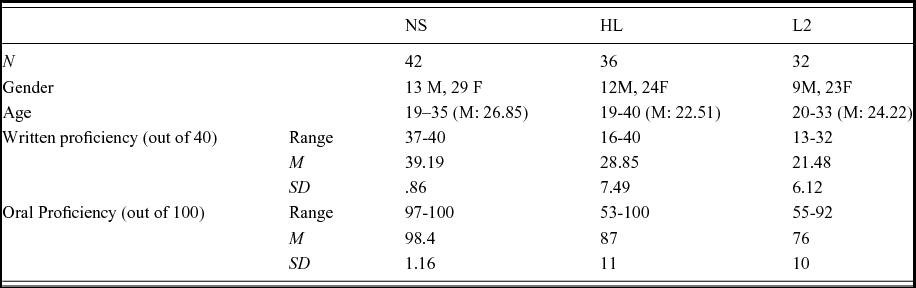
The oral proficiency test was conducted in the form of story-telling in which the participants were asked to narrate a story after reading a picture book (frog story). The narrated stories were audio-recorded on a digital voice recorder and transcribed. The score was calculated based on the rate (%) of error-free utterances, and the following types of responses were excluded from analysis: a) exact self-repetitions, b) repetitions of the experimenter's utterance, and c) incomplete utterances or single-word response. Mixed utterances with both L1 and the target language were included unless half or more of the words were in the L1. Similar to what has been found for written proficiency, all three groups were significantly different in their oral proficiency with L2 learners scoring the lowest: HL vs. L2 (t(66) = 3.925, p < .001), NS vs. HL (t(76) = 6.620, p < .001), and NS vs. L2 (t(72) = 13.827, p < .001).Footnote 2 Participant description and proficiency scores are displayed in Table 1.
Description of participants

Materials and procedures
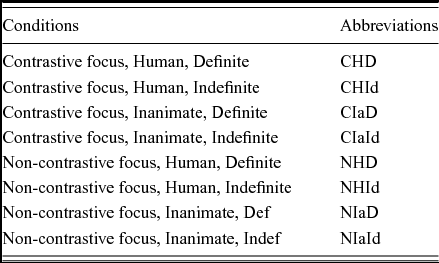
The experiment consisted of two tasks: a written elicited production task and an oral picture description task. The written elicited production task was identical in format to the one used in H. Lee (Reference Lee2006a), in which the participant has to choose either a case-marked or a bare NP within the context of a short conversation. The individual test items, however, were significantly different from previous studies. The same variables of Focus, Animacy, and Definiteness generated eight experimental conditions, and there were six items per condition resulting in a total of 48 test items. No filler items were included. The experimental conditions can be found in Table 2, together with the abbreviations used to refer to the distinct test conditions.
Experimental conditions

Overall, the conditions of Focus, Animacy, and Definiteness were set up as maximal opposites that are either strongly favorable or strongly averse to case drop in light of previous findings (H. Lee, Reference Lee2006a, Reference Lee2011a). Contrastive Focus (CF) involved selecting an entity within a limited set of alternatives (i.e., a mutually/contextually known contrast set) with contrastive effects. Based on H. Lee's (Reference Lee2011a) work on subtypes of contrastive focus that has found contrastiveness and accessibility/predictability to work in different directions (i.e., strongly contrastive objects tend to be case-marked while highly predictable objects tend to undergo case-drop), the Focus conditions were set up to control the effect of accessibility/predictability and maximize the contrast between the two conditions. Because a contrastively focused object that has a mutually known contrast set is more predictable than an object with information focus, a non-contrastively focused object with information focus was explicitly mentioned in the preceding context to control the degree of predictability. In other words, contrastively focused objects had lower predictability than non-contrastively focused objects so that CF conditions’ resistance to case drop would not be compromised by a high degree of predictability. For Definiteness conditions, strong definite arguments such as pronouns (‘we,’ ‘you,’ ‘I’) or proper nouns (‘Mina,’ ‘Korea University’) appeared as Definite objects, and nonspecific general arguments (‘student,’ ‘person,’ ‘book’) appeared as Indefinite objects. The degree of Animacy was also controlled by contrasting human vs. inanimate objects. To better control for other semantic and discourse factors, there was no NP modifier, no NP in the beginning of the sentence, no semantic incorporation, no previous mention for contrastively focused NPs, and all sentences were in the present tense. The context of the conversation was given in English for the bilinguals and in Korean for the NS in parentheses prior to the conversations themselves. The participants were asked to select one answer that sounded more natural in the context of the conversation as quickly as possible and were told that there is no right or wrong answer for all questions. The order of the stimuli was pseudo-randomized using blocking, and the items were presented in the same order for all participants. Sample items are provided in (2) and (3) below.
-
(2)
-
(3)


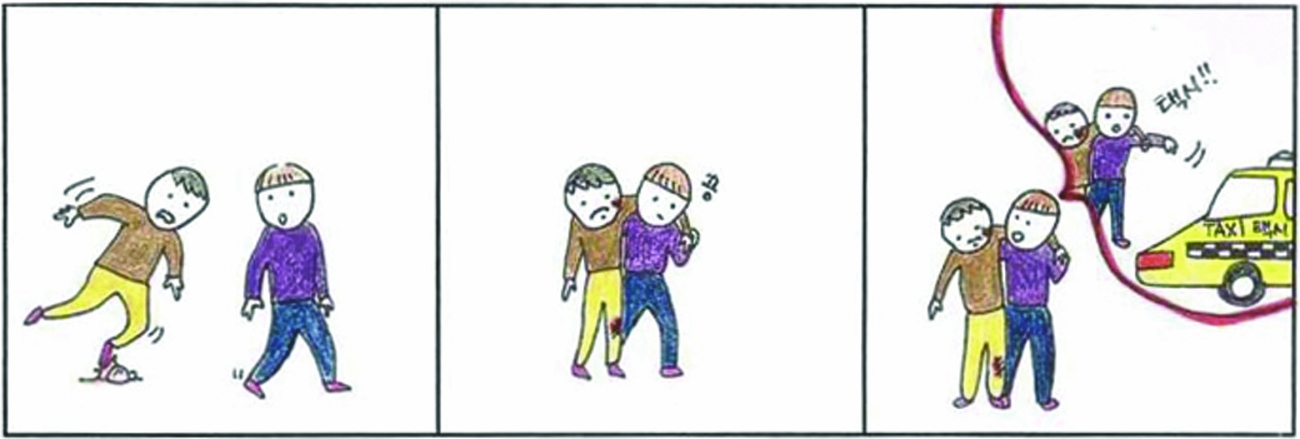
The oral picture description task was identical to the one used in Chung (Reference Chung2015b) with L1-acquiring Korean children. The task used the same variables and experimental conditions as the written task and examined participants’ usage of case marking and case drop in spoken utterances. There were four items per condition and no fillers, resulting in a total of thirty-two test items. In this task, participants saw a series of comic strips each of which had three consecutive pictures. The third/last picture in each item always contained a speech bubble with pictures, and the participants were asked to imagine what the character is saying and to say it out aloud using natural informal speech as if they were the character him/herself. As with the written task, the degree of Definiteness (proper noun vs. nonspecific NP) and Animacy (human vs. inanimate) was controlled, and CF involved explicitly contradicting an entity within a limited set of alternatives that is shown in one of the first two pictures. A sample item is provided in Figure 1 below.
Oral description task: NIaId (Non-CF, Inanimate, Indefinite) condition.

In this particular test item, an expected response would be “Let's call a taxi!” or “Should I call a taxi?” After the response, the participants were given two word cards with the relevant noun thayksi (‘taxi’) and the verb pwulu-ta (‘to call’) in Korean and were asked to use these two words in their utterance to describe the character's speech if they have not done so in the previous utterance. If they had already used the identical words in their utterance, they were instructed to go on to the next item. Instructions and four practice items were provided in the beginning of the task. All responses were audio-recorded on a digital voice recorder, transcribed, and coded for analysis.
Participants were first asked to complete a brief language background questionnaireFootnote 3 followed by the oral and written proficiency tests, the oral description task, and then the written elicited production task. The questionnaire, written proficiency test, and written task were all administered using an online survey tool called Surveygizmo, while the oral proficiency test and the picture description task were administered using presentation slides on a computer screen and a digital voice recorder. The whole procedure took about forty minutes for native speakers and about an hour for bilingual learners and could be completed in one visit.
Results
Written elicited production task
All responses were coded as ‘1’ when the object NP in the answer was accompanied by a case marker and ‘0’ when the NP was bare. Frequency counts in each condition and within-factor conditions were calculated using this quantified data (0 or 1), and the binary data was further analyzed using logit mixed models in R to examine the main effect and interaction of Focus, Animacy, and Definiteness. Separate analysis was conducted for each group holding the three factors as fixed effects and participants and test items as random effects.
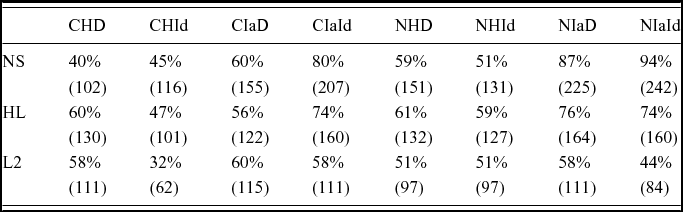
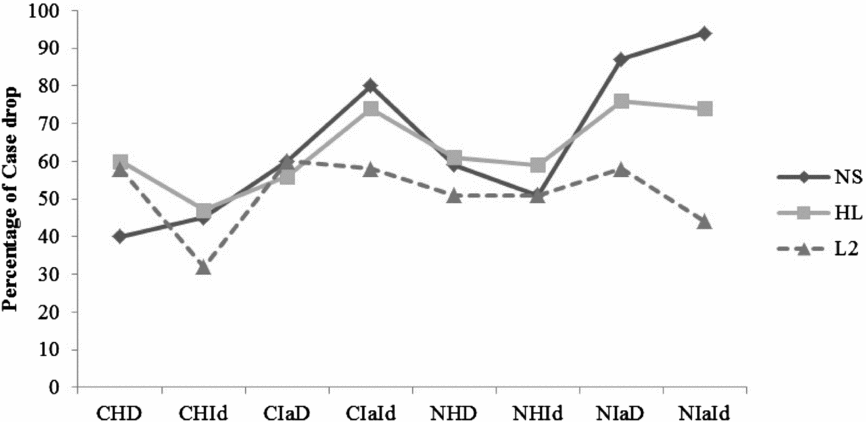
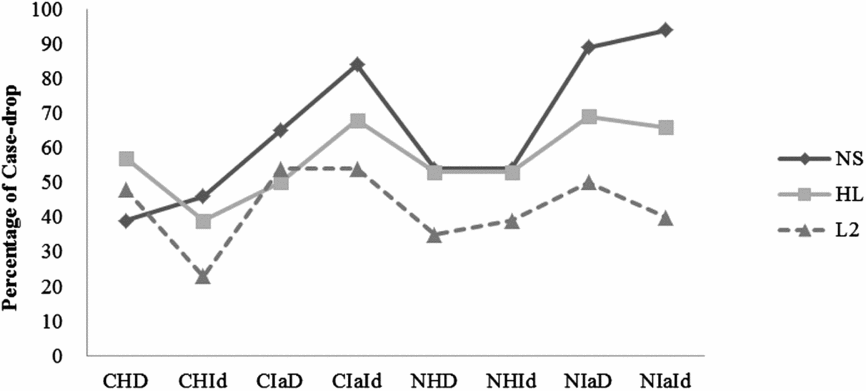
The percentage of case drop in each condition in Table 3 shows NS dropping case most frequently in [Non-CF, Inanimate, Indefinite] and least frequently in [CF, Human, Definite], which matches the results of previous studies (Lee, Reference Lee2006a; Chung, Reference Chung2015a). HL judgments differed from those of NS in the direction of Definiteness. HL learners dropped case most frequently in [Non-CF, Inanimate, Definite] and least frequently in [CF, Human, Indefinite]. L2 learners, on the other hand, exhibited quite different judgments in which [CF, Inanimate, Definite] had the highest rate of case drop, and [CF, Human, Indefinite] the lowest. As displayed in Figure 2, NS and HL exhibited similar gradient patterns of judgments in which case drop is preferred in Non-CF and Inanimate conditions, while L2 hovered around 50% (i.e., chance performance) for the most part with no distinct pattern.
Percentage (and raw frequency) of case drop (Written task)

Note. C: Contrastive focus, N: Non-contrastive focus, H: Human, Ia: Inanimate, D: Definite, Id: Indefinite
Percentage (%) of case dropped objects in written elicited production task (C: Contrastive focus, N: Non-contrastive focus, H: Human, Ia: Inanimate, D: Definite, Id: Indefinite).

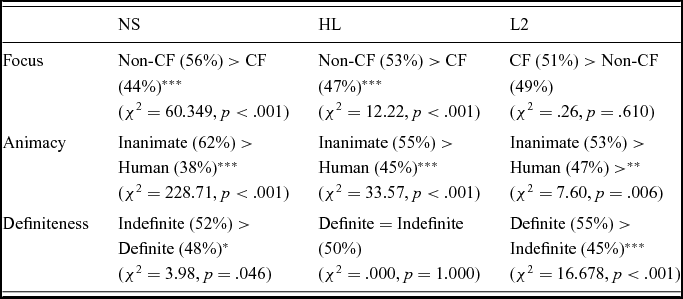
When the relative frequency of case drop was examined within each factor as shown in Table 4, NS and HL judged bare objects to be significantly more felicitous in Non-CF than CF and in Inanimate than in Human conditions. The L2 learners did not significantly differentiate the Focus conditions, but there was a significantly higher number of bare objects in Inanimate than Human conditions as found for other groups. All three groups differed in their judgments of Definiteness with NS preferring to drop case in Indefinite than Definite conditions, HL not having a particular preference, and L2 preferring to drop case in Definite than Indefinite conditions.
Frequency (%) of bare objects within each factor (Written task)

Note. p < 1.0,*p < .05,**p < .01,***p < .001
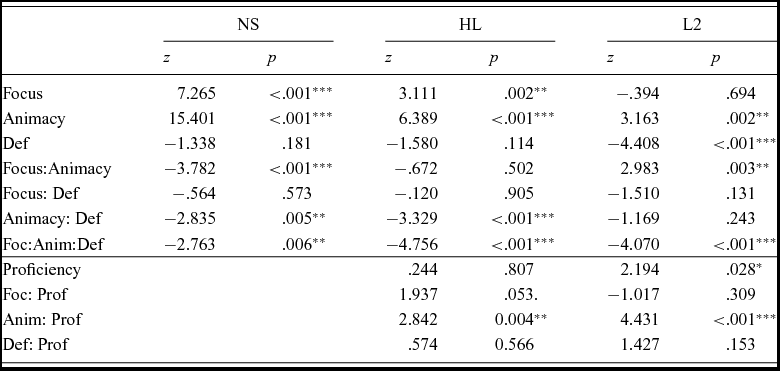
Next, the main effect and interaction of the three factors were examined using logit mixed models in R. Animacy (z(2061) = 15.401, p < .001) and Focus (z(2061) = 7.265, p < .001) were highly significant for the NS group, with Animacy having a greater influence than Focus contra previous findings in which Focus had the strongest effect (H. Lee, Reference Lee2006a; Chung, Reference Chung2015a). There were also significant interactions between Focus and Animacy (z(2061) = −3.782, p < .001), Animacy and Definiteness (z(2061) = −2.835, p < .01), and Focus, Animacy, and Definiteness (z(2061) = −2.763, p < .01). Similarly, HL were significantly influenced by Focus (z(1723) = 3.111, p < .01) and Animacy (z(1723) = 6.389, p < .001), and significant interactions were present between Animacy and Definiteness (z(1723) = −3.329, p < .001) and Focus, Animacy, and Definiteness (z(1723) = −4.756, p < .001). L2 learners, on the other hand, were not significantly influenced by Focus, but by Animacy (z(1526) = 3.163, p <.01) and Definiteness (z(1526) = −4.408, p <.001) instead. Definiteness had a stronger effect than Animacy, and significant interactions were present between Focus and Animacy (z(1526) = 2.983, p <.01) and Focus, Animacy, and Definiteness (z(1526) = −4.070, p <.001). When written proficiency scores were added to the mixed model as a fixed effect, a main effect of Proficiency and a significant interaction between Proficiency and Animacy (z(1526) = 4.431, p < .001) was found for L2 (z(1526) = 2.194, p = .028). In comparison, results for HL showed no main effect of Proficiency, but significant interactions between Proficiency and Animacy (z(1723) = 2.842, p = .004) and marginally significant interactions between Proficiency and Focus (z(1723) = 1.937, p = .053) were found. The significant interactions indicate that the bilingual learners exhibited greater sensitivity to these factors with increasing proficiency. These results are summarized in Table 5.
Main effect and interaction of factors (Written task)

Note. p < 1.0,*p < .05,**p < .01,***p < .001
When ‘Group’ was added to the mixed model as another fixed effect, NS were significantly different from the bilingual groups (z(5316) = 2.213, p = .027), and the two bilingual groups were different from each other (z(5316) = 2.480, p = .013) in the use of all three factors: More specifically, post-hoc group comparisons between NS and HL showed no main effect of Group but significant differences in the use of Focus (z(3786) = 3.953, p < .001), Animacy (z(3786) = 7.110, p < .001), and Definiteness (z(3786) = 2.656, p = .008) as well as in the interactions between Focus and Animacy (z(3786) = −2.441, p = .015) and Focus, Animacy and Definiteness (z(3786) = 3.046, p = .002). In the comparison between NS and L2, there was a main effect of Group (z(3590) = 3.428, p < .001) as well as significant differences in not only all three factors (Focus: z(3590) = 6.891, p < .00l; Animacy: z(3590) = 9.289, p < .001; Definiteness: z(3590) = 5.999, p < .001) but also all interactions of these factors (Focus x Animacy: z(3590) = −5.040, p < .001; Focus x Definiteness: z (3590) = 2.557, p = .011; Animacy x Definiteness: z(3590) = 2.557, p = .019; Focus x Animacy x Definiteness: z(3590) = 3.325, p < .001). The comparison between the two bilingual groups also showed a main effect of Group (z(3252) = −2.280, p = .023) and significant differences in the use of all three factors (Focus: z(3252) = 3.040, p = .002; Animacy: z(3252) = 2.389, p = .017; Definiteness: z(3252) = 3.415, p < .001) as well as in the interaction between Focus and Animacy (z(3252) = −2.765, p = .006). Marginal differences were also found in the interactions between Focus and Definiteness (z(3252) = 1.915, p = 0.055) and Animacy and Definiteness (z(3252) = −1.881, p = .06). In sum, all groups were significantly different in their sensitivity to the three factors. The difference between NS and L2 was especially salient as they significantly differed in all factors and their interactions. While no main effect of group was found between NS and HL, significant differences could still be found in the use and interaction of factors.
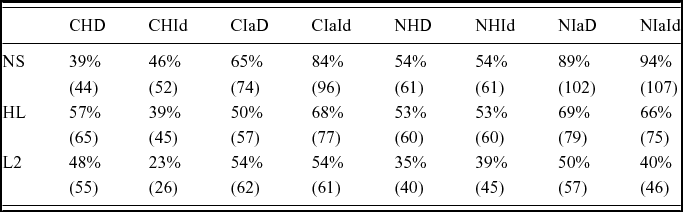
In light of the fact that the HL group's written proficiency scores were significantly higher than those of the L2, proficiency-matched learners were compared to control for proficiency effects. Nineteen participants from HL (M = 26.05, SD = 3.54, R = 20–33) and L2 (M = 26.16, SD = 3.80, R = 21–32) with matching intermediate proficiencies were compared. The proficiency-matched HL and L2 subgroups were not significantly different from each other in their scores for Korean case-marking (t(35) = 0.35, p > .05) in the written proficiency test. Out of 8 possible points, the average score for HL was 6.47 (SD: 1.02, Range: 5–8) and the average for L2 was 6.37 (SD: 0.81, Range: 5–8). Nineteen participants from NS (M = 39.47, SD = 0.69, R = 38–40) were also randomly selected and compared to the bilinguals as the control group. The overall judgment patterns by these bilinguals were quite similar to what was found in the results for the whole group: NS dropped case most frequently in [Non-CF, Inanimate, Indefinite] and least frequently in [CF, Human, Definite] while HL judgments differed from those of NS in the direction of Definiteness and dropped case most frequently in [Non-CF, Inanimate, Definite] and least frequently in [CF, Human, Indefinite]. HL judgments, however, did not match NS judgments as closely as they did in the whole group results and showed greater ambivalence overall. Nevertheless, NS and HL exhibited similar gradient patterns of judgments in which case drop occurs frequently in Non-CF and Inanimate conditions as in the whole group results. L2 judgments showed much ambivalence and showed the highest rate of case drop in [CF, Inanimate, Definite] and [CF, Inanimate, Indefinite] conditions and the lowest in [CF, Human, Indefinite]. As displayed in Table 6 and Figure 3, NS exhibited the highest rate of case-drop followed by HL and then L2 learners.
Percentage (and raw frequency) of case drop by proficiency-matched bilinguals (Written task)

Note. C: Contrastive focus, N: Non-contrastive focus, H: Human, Ia: Inanimate, D: Definite, Id: Indefinite
Percentage (%) of case dropped objects by proficiency-matched bilinguals in written elicited production task (C: Contrastive focus, N: Non-contrastive focus, H: Human, Ia: Inanimate, D: Definite, Id: Indefinite).

Similar to what has been found in the whole group results, NS chose a significantly higher number of bare objects in Non-CF than CF (χ2= 20.49, p < .001), in Inanimate than Human (χ2= 125.71, p < .001), and Indefinite than Definite (χ2= 5.94, p = .009) conditions. HL were native-like in their use of Focus (χ2= 4.02, p = .026) and Animacy (χ2= 15.03, p < .001) but did not differentiate the Definiteness conditions. L2 were also native-like in their use of Animacy (χ2=16.11, p < .001) conditions, but did not differentiate the Focus conditions and showed an opposite tendency in Definiteness conditions with a significantly higher rate of case drop in Definite than Indefinite conditions (χ2= 5.79, p = .01). In addition, the main effect and interaction of the three factors in proficiency-matched bilinguals’ judgments were quite representative of the whole group results. All three factors were significant in native judgments (Focus: z(912) = 24.85, p < .001, Animacy: z(912) = 114.62, p < .001, Definiteness: z(912) = 7.59, p = .006). HL were also significantly influenced by Focus (z(912) = 3.99, p = .046) and Animacy (z(960) = 15.29, p < .001), and L2 were significantly influenced by Animacy (z(912) = 16.86, p < .001) and Definiteness (z(912) = 6.37, p = .012). Post-hoc comparisons showed no significant difference between NS and HL (z(1822) = −1.58, p = .12), marginal differences between the two bilingual groups (z(1822) = −1.937, p = .053), and significant differences between NS and L2 (z(1824) = −3.329, p < .001). Such similarities between the results of the whole group and the proficiency-matched groups indicate that the significant differences between the two bilingual groups may not be an effect of proficiency but of group itself.
The overall results of the written elicited production task revealed differences in all three groups but notable similarities between NS and HL, who generally relied on Focus and Animacy to guide their judgments. The L2 learners, on the other hand, showed variable patterns in Focus and Definiteness, which led to salient differences in the selection of case-marked vs. bare objects.
Oral picture description task
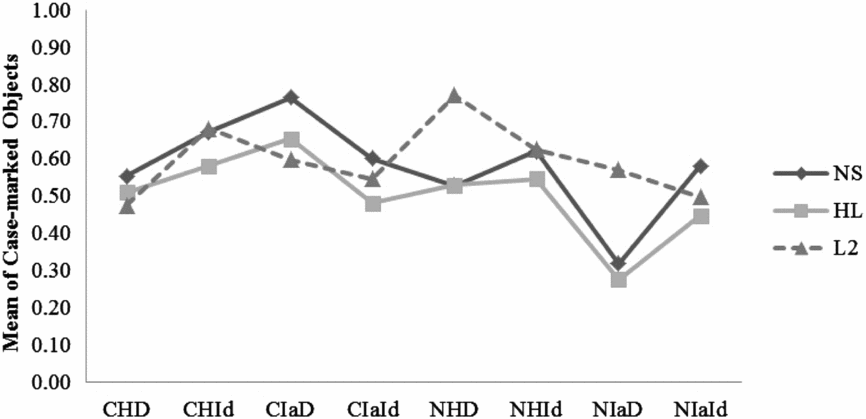
Similar to what was done for the written task, participants’ answers were coded as ‘1’ when the object NP in the utterance was accompanied by a case-marker and ‘0’ when it was bare. Mean scores of case-marked objects rather than overall frequency counts served as a more accurate measure of the variability because approximately 5% of participants’ responses were unintelligible or inappropriate and had to be discarded in the analysis. As shown in Table 7, even NS displayed a lot of individual differences across the eight conditions as suggested by large SD values, but there was an evident effect of Focus with a higher rate of case drop occurring in Non-CF than CF conditions. HL exhibited a higher rate of case drop than NS overall but closely followed the NS production pattern. L2, on the other hand, exhibited a pattern in which the workings of the three factors were unclear as can be seen in Figure 4.
Mean and standard deviation values of case-marked objects (Oral task)

Note. C: Contrastive focus, N: Non-contrastive focus, H: Human, Ia: Inanimate, D: Definite, Id: Indefinite
Mean scores of case-marked objects in oral production task (C: Contrastive focus, N: Non-contrastive focus, H: Human, Ia: Inanimate, D: Definite, Id: Indefinite).

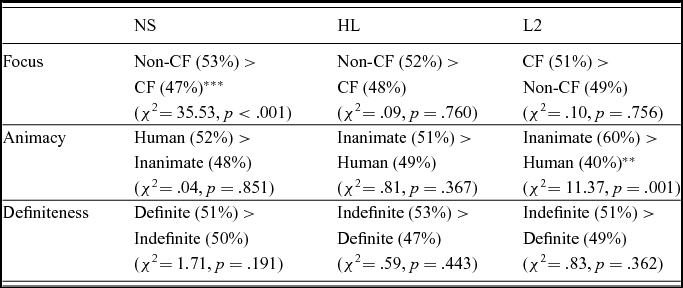
When the relative frequency of case drop within the conditions of each factor was examined, not many significant differences could be found across all groups. A significantly higher rate of case drop occurred in Non-CF than CF conditions (χ2= 35.53, p < .001) in NS utterances and in Inanimate than Animate conditions (χ2= 11.37, p = .001) in L2 utterances, but all other comparisons were not significantly different as shown in Table 8.
Frequency (%) of bare objects within each factor (Oral task)

Note. p < 1.0,*p < .05,**p < .01,***p < .001
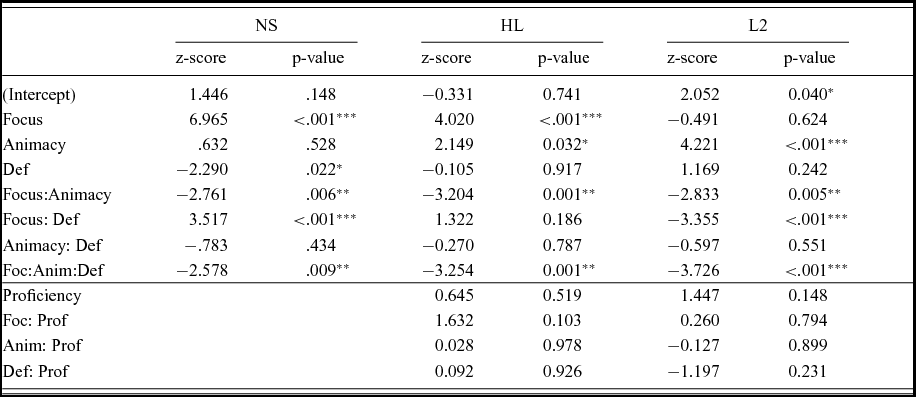
Nevertheless, main effects and interactions of factors could be found in all three groups when further analyzed using logit mixed models in R. There was a main effect of Focus (z(984) = 6.965, p < .001) and Definiteness (z(984) = −2.290, p < .05) in NS utterances with Focus having a stronger effect than Definiteness. There were also significant interactions between Focus and Animacy (z(984) = −2.761, p < .01), Focus and Definiteness (z(984) = 3.517, p < .001), and Focus, Animacy, and Definiteness (z(984) = −2.578, p < .01). For HL, there was a main effect of Focus (z(869) = 4.020, p < .001) and Animacy (z(869) = 2.149, p < .05) with Focus having a greater effect than Animacy. Significant interactions were present between Focus and Animacy (z(869) = −3.204, p < .01) and Focus, Animacy, and Definiteness (z(869) = −3.254, p < .01) in the same direction as the native speakers. L2 learners were primarily sensitive to Animacy (z(935) = 4.221, p <.001) with case drop occurring more frequently in Inanimate conditions and appeared to have failed in developing sensitivity to and integrating Focus and Definiteness in the expected direction. However, significant interactions like those of the native speakers were present between Focus and Animacy (z(935) = −2.833, p <.01) as well as Focus, Animacy, and Definiteness (z(935) = −3.726, p <.001). There were also significant interactions between Focus and Definiteness (z(935) = −3.355, p <.001) but in the opposite direction to native speakers. When oral proficiency scores were added to the mixed model as a fixed effect, none of the groups showed a main effect of proficiency.Footnote 4 These results are summarized in Table 9.
Main effect and interaction of factors (Oral task)

Note. p < 1.0,*p < .05,**p < .01,***p < .001
When ‘Group’ was added to the mixed model as another fixed effect, the overall difference between the two bilingual groups was marginally significant (z(2793) = −1.887, p = .059), but sensitivity to Focus was significantly different (z(2793) = 3.081, p = .002). When NS were compared to the bilinguals as a whole, they differed in their use of Focus (z(2793) = 4.275, p < .001), Animacy (z(2793) = −2.081, p = .037), and Definiteness (z(2793) = −2.364, p = .018). More specifically, post-hoc group comparisons show significant differences between NS and HL on Focus (z(1855) = 2.070, p = .038) and an interaction between Focus and Definiteness (z(1855) = 1.894, p = .058), albeit marginal. Significant differences between L2 and HL were also found with Focus (z(1807) = 3.132, p = .002) and the interaction between Focus and Definiteness (z(1807) = 3.059, p = .002). NS and L2 were significantly different in all three factors of Focus (z(1922) = 5.249, p < .001), Animacy (z(1922) = −2.623, p = .009), and Definiteness (z(1922) = −2.392, p < .017) as well as the interaction between Focus and Definiteness (z(1922) = 4.876, p < .001). As such, L2 production of bare objects diverged from NS production in all three factors, but HL differed from NS mainly in their use of Focus. Such results could be somewhat puzzling, since both NS and HL use Focus in a similar manner and direction. A closer look at the mean and frequency data reveals that the difference appears to rise from the degree of contrast between CF vs. Non-CF conditions with the contrast being significantly stronger and more evident in NS than HL utterances.
Overall, all three groups relied on the factors regulating case drop somewhat differently in the oral picture description task. Definiteness was a significant factor for NS but not for HL, while Animacy was significant for HL but not for NS. Focus was significant for both groups, but NS showed a greater contrast between CF vs. Non-CF conditions. Despite such differences, however, HL and NS exhibited similar patterns of production overall. In contrast, L2 learners were highly variable in their use of case drop and often showed tendencies that are opposite to those of NS and HL. They were especially divergent in their sensitivity to Focus and primarily relied on Animacy to guide their use of bare objects.
Discussion
The present study examined bilingual acquisition of Korean case drop and has found that both L2 and HL learners are different from native speakers in their judgments and production of object case drop. However, HL showed notable similarities with NS, while L2 exhibited a more variable pattern that significantly diverged from the other groups. A closer look at the responses of the bilingual groups is suggestive of qualitative differences in the underlying linguistic knowledge of early vs. late bilinguals with HL having an advantage over L2 in the acquisition of the present phenomenon.
First of all, it must be noted that the native speaker data in this study did not wholly match the results of previous studies (Lee, Reference Lee2006a; Chung, Reference Chung2015a). Previous L1 studies found Focus to have the strongest effect followed by Animacy and then Definiteness and reported significant main effects of all three factors. In the native speaker data of the present study, however, Animacy had a stronger effect than Focus in the written task, and there was no main effect of Definiteness in the written task and of Animacy in the oral task. Such discrepancy between previous findings and the present results may be surprising because the same test format, factors, and conditions were used. Unlike previous studies, however, the present study additionally introduced the variable of predictability within the Focus conditions, which may have generated a different way of processing Focus. Moreover, the degree of predictability is directly related to how accessible the NP is in context, which in turn may have interacted with Definiteness. Notwithstanding such differences, multiple factors and their interactions still had a significant effect on NS behavior resulting in gradient patterns of case drop. Moreover, Focus played a crucial role in both oral and written tasks with a significantly higher rate of case drop appearing in Non-CF conditions as previously found.
When compared to NS, HL exhibited greater ambivalence and especially differed in their use of Definiteness. However, they showed similar patterns in frequency (or mean), relative strength of factors, and interaction of factors. Contra predictions that Focus will not have a consistent effect in HL responses, Focus had a strong and significant effect. Moreover, multiple factors and their interactions were significant, and gradient statistical preferences similar to those of NS could be found. Significant group differences between NS and HL arose primarily from the difference in the overall frequency of case drop, and the difference between NS and HL was more quantitative than qualitative in nature. As such, HL seemed to have attained a certain degree of implicit knowledge of case drop. In fact, parallels can be drawn between HL and L1-acquiring children (Chung, Reference Chung2015b): Both groups are sensitive to and integrate the relevant factors in an almost native-like manner but show greater ambivalence and provide fewer case-markers than adult native speakers. Such difference appears to be characteristic of a developmental stage that both monolinguals and early bilingual learners pass through. In contrast, L2 learners exhibited patterns that are qualitatively different from those of others and seemed to have adopted an analysis that is predominantly determined by Animacy. The most notable difference from the other groups was their lack of sensitivity to Focus or use of this factor in the opposite direction. Focus was not significant in L2 judgments and production, and bare objects appeared more frequently in CF than Non-CF conditions. That is, the discourse/pragmatic domain of integrating contextual information (i.e., Focus) was significantly more problematic and vulnerable to incomplete acquisition than other domains for L2. Even when controlled for proficiency, L2 were notably different from the other groups, and HL reached a higher level of acquisition than L2.
The present data shows that the two bilingual groups were challenged by different types of information. L2 learners were often native-like in the use of Animacy but displayed an opposite tendency to NS in the use of Definiteness and a highly variable pattern in the use of Focus. The L2 subgroup with matching intermediate proficiency exhibited notable difficulty with Focus, and the lack of interaction between Focus and proficiency is suggestive of residual indeterminacy in this domain even at an advanced stage of learning. Such results would be in agreement with the claim of the Interface Hypothesis that the acquisition of discourse/interpretative properties is problematic even in L2 end state grammars (Sorace & Filiaci, Reference Sorace and Filiaci2006), but highly proficient L2 learners will need to be tested in future work to confirm such speculations. Alternatively, one could argue that the context of acquisition rather than the external interfaces per se may be the source of difficulty for L2 learners who may not have had sufficient exposure to rich input with contextual cues. These learners who usually receive formal instruction in a classroom setting would depend heavily on semantic/grammatical cues as shown in their dependence on the factors of Animacy and Definiteness that are based on universal principles of markedness and whose semantic features are inherent to the NP.Footnote 5 By simplifying the multidimensional phenomenon as one that is determined by a basic grammatical cue such as Animacy, L2 learners would fail to develop sensitivity to context-inferred discourse-pragmatic cues and adopt a categorical analysis where the relevant multiple cues are not integrated in a native-like manner. This explanation is consistent with the discussion in Chung (Reference Chung2013) and Laleko and Polinsky (Reference Laleko and Polinsky2016) that L2 learners’ preoccupation with basic syntactic-semantic processes and access to meaning may result in an oversight of discourse-pragmatic or contextual information. As such, L2 learners’ failure to integrate Focus may be reflective of their tendency to give primacy to a basic grammatical cue(s) that is more familiar and readily available to them from the context of acquisition when processing a multi-factor phenomenon like case drop.
As for HL learners, Focus and Animacy served as strong cues and they employed and integrated these factors in a native-like manner, but their use of Definiteness was not as consistent or native-like. HL learners did not seem to be particularly challenged by the external interfaces contra the Interface Hypothesis and were noticeably more comfortable employing context-inferred subtle discourse-pragmatic cues than L2 learners. If the bilingual difficulty in the present phenomenon is not so much shaped by the external interfaces as the context of acquisition as previously mentioned, then HL learners who have received aural naturalistic input in the home since childhood would find it easier to employ discourse-pragmatic cues than L2 learners whose exposure to the language mainly occurs in the form of formal instruction in the classroom. Given the relative importance of the role of Focus in Korean case drop and the fact that case drop predominantly occurs in informal casual speech, HL learners’ language background would better equip them in acquiring the phenomenon compared to L2 learners (Montrul, Reference Montrul and Ionin2012), which is what we find in the results. While HL learners employ Focus and Animacy in a native-like manner and show gradient patterns in their analysis like the NS, they less effectively integrate Definiteness as indicated by their variable sensitivity to this factor. HL learners’ inconsistent use of Definiteness suggests that despite being “on the right track” overall, they also may be experiencing difficulty coordinating multiple constraints into their analysis. It is unclear why Definiteness should pose a challenge for HL, but it can be speculated that their use of Focus and Animacy as strong cues for case drop preclude them from employing a third factor in a native-like manner possibly due to processing limitations as suggested by previous studies (Hopp, Reference Hopp2007; Sorace, Reference Sorace2011). Future work should investigate this possibility and examine how much of the present bilingual difficulty can be attributed to computational resource limitations by using online research methods that involve timed oral/written responses to similar tasks. Meanwhile, the present results show that bilingual difficulty in the present phenomenon may not lie in particular interface domains but mainly arises from learners primarily resorting to cues that are more readily available to them in their respective context of acquisition and failing to effectively incorporate multiple levels of information and constraints in a native-like manner.
Strong task effects were found in the current study especially in the use of Animacy and Definiteness even for native speakers. Both NS and HL employed the factor of Definiteness in opposing directions depending on the task mode, and the effect and strength of Animacy and Definiteness were not consistent in the two tasks. L2 learners also employed the factors of Animacy and Definiteness in opposing directions depending on the task mode, and Definiteness was a significant factor in the written but not the oral task. The role of Focus, however, was strong and significant in both tasks for NS and HL and negligible in both tasks for L2. As such, the effects of Animacy and Definiteness were not as consistent as the effect of Focus in different task modes for all groups. It seems likely that the representation of objects and people in pictures vs. writing give rise to variance in the degree of definiteness and accessibility/saliency that result in such differences. Future work should investigate ways to control these factors more effectively and should also consider ways to make the test items in the two tasks as equivalent as possible. These results not only suggest that task modality has a profound effect on how speakers conceptualize Animacy and Definiteness but also that the phenomenon itself could have been influenced by factors other than the ones examined in the study. The oral production task in particular should be better controlled for other variables such as the speakers’ use of adverbs, adjectives, delimiters, or quantifiers in their utterances. Despite such task effects, gradient statistical preferences and significant relationships among multiple factors could be found in the results, and the current tasks were able to successfully capture substantial differences between the three groups’ judgment/production patterns.
Conclusion
The primary goal of this study was to examine whether and how bilinguals can attain implicit knowledge of Korean case drop – a multi-factor linguistic phenomenon that necessitates the integration of different types of information. The present research reveals qualitative differences in the underlying linguistic knowledge of early vs. late bilinguals with HL learners achieving a higher level of mastery than L2 learners. Although not identical to the native speakers, HL learners attained a certain degree of implicit knowledge of the phenomenon whereas L2 learners adopted an analysis with variable patterns that question their ability to acquire the phenomenon. The present findings suggest that bilingual difficulty does not necessarily lie in developing sensitivity to particular domains or interfaces but in effectively integrating multiple types of information and constraints in a native-like manner.
Supplementary material
For supplementary material accompanying this paper, visit https://doi.org/10.1017/S1366728916001218