Over the past four decades, new archaeological data and advances in method and theory have greatly revised our understanding of the structure and functioning of Classic Maya economies and their articulation with political authority and process. Much recent research has highlighted variation in the organization of craft production at Classic Maya sites, particularly with regard to the role of elites in directing the production and distribution of utilitarian and wealth/prestige goods (Demarest Reference Demarest2013; Foias Reference Foias, Masson and Freidel2002; Hruby et al. Reference Hruby, Braswell and Chinchilla2011; Mason and Freidel Reference Masson and Freidel2002; McAnany Reference McAnany2010; Potter and King Reference Potter, King, Ehrenreich, Crumley and Levy1995; Rice Reference Rice, Brumfiel and Earle1987; Tourtellot and Sabloff Reference Tourtellot III and Sabloff1972; Wells Reference Wells2006). Although the role of elites in organizing or controlling the production or distribution of utilitarian goods is widely debated (Aoyama Reference Aoyama1999; Clark Reference Clark and Hirth2003), scholars have generally portrayed wealth goods as being under the direct control of Classic Maya elites (Ball Reference Ball, Sabloff and Henderson1993; Foias Reference Foias, Masson and Freidel2002; Halperin and Foias Reference Halperin and Foias2010; Inomata Reference Inomata2001; McAnany Reference McAnany2010; Potter and King Reference Potter, King, Ehrenreich, Crumley and Levy1995).
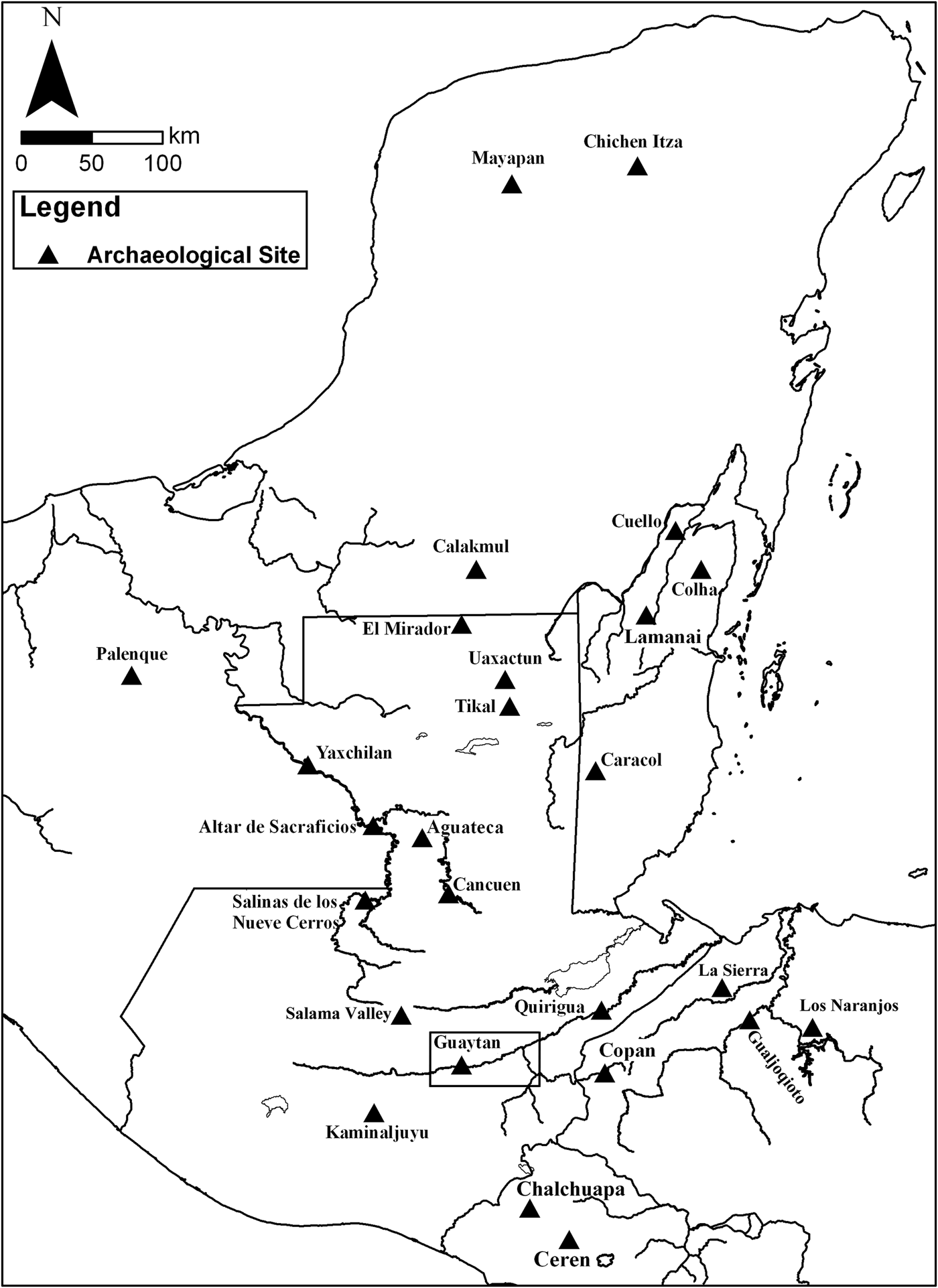
This article examines current arguments about the control of wealth goods production in ancient Maya society through an investigation of the organization of Classic period jade artifact production in the middle Motagua Valley, Guatemala—the primary source region for jadeite in Mesoamerica (Figure 1). Objects crafted from jade played a prominent social, political, and ritual role in all pre-Columbian Mesoamerican civilizations. Beyond its economic value, jade was revered for its cosmological associations, being considered a physical representation of fertility, water, maize, centrality, breath, and the soul (Fields Reference Fields, Roberston and Fields1991; Freidel Reference Freidel, Clancy and Harrison1990; Miller and Samayoa Reference Miller and Samayoa1998; Taube Reference Taube, Clark and Pye2000, Reference Taube2005). The importance of jade for the Classic period Maya is demonstrated by the inclusion of elaborate jade objects in many elite burials and from the many murals, stelae, and painted pottery vessels depicting elites wearing abundant jade jewelry (Digby Reference Digby1964; Garber et al. Reference Garber, Grove, Hirth, Hoopes and Lange1993; Krejci and Culbert Reference Krejci, Culbert and Grube1995; Proskouriakoff Reference Proskouriakoff1974; Taube Reference Taube2005). Despite this conspicuous use, we know little about how jade was acquired, how it was shaped into objects of value, and how this production was organized. Archaeological survey and excavation (Pellecer and Rochette Reference Pellecer and Rochette2006; Rochette Reference Rochette and Hirth2009a, Reference Rochette2009b; Rochette and Pellecer Reference Rochette and Pellecer2006) suggest that jade artifact production in the middle Motagua Valley during the Late Classic period does not conform to expectations of wealth goods production derived from general archaeological models (see, for example, Brumfiel and Earle Reference Brumfiel, Earle, Brumfiel and Earle1987; Peregrine Reference Peregrine1991) or from more recent arguments that propose elite involvement or control of wealth goods production for the Classic Maya (Aoyama Reference Aoyama1999, Reference Aoyama2007; Demarest Reference Demarest2013; Inomata Reference Inomata2001; McAnany Reference McAnany, Wells and McAnany2008; Wells and Davis-Salazar Reference Wells and Davis-Salazar2007; Widmer Reference Widmer and Hirth2009). In contrast to these models, current evidence from the middle Motagua Valley suggests that models of wealth goods production need to be adjusted to recognize the diversity and “gradations of value” (Lesure Reference Lesure and Robb1999) that characterized many goods often glossed with the term “wealth goods.”
Map of Maya area with major archaeological sites. Middle Motagua Valley is indicated by box surrounding Guaytan.

I begin by examining expectations of wealth goods production derived from general archaeological models and then continue with a discussion of the specific arguments made about wealth goods production and distribution for the Classic period Maya. This is followed by the presentation of data from recent survey and excavations in the middle Motagua Valley and elsewhere that call into question some of the central assumptions of some of these arguments. Based on this evidence, I suggest that we need to reevaluate arguments that assign a strong role of wealth goods production and distribution to elites, at all places and times, for Classic period Maya sites.
WEALTH GOODS AND POLITICAL ORGANIZATION
All economic systems are made up of three components: production, distribution, and consumption. The study of production systems can yield information relevant to a broad range of theoretical issues, such as domestic and political economy, social organization, and sociocultural evolution, among others. Furthermore, in many instances economic activity associated with production is easier to identify because of the material remains that are created as a byproduct of production activity.
Most studies of preindustrial craft production systems make distinctions between classes of goods based on their perceived value, utility, and meaning in past societies. Commonly, a distinction is made between two general classes of goods: so-called prestige or wealth goods and utilitarian, or necessary, goods. In drawing this distinction, scholars posit a fundamental divergence in the nature, production, and value of the goods in question. Utilitarian goods are often defined as those that satisfy basic household subsistence needs and are valued and used by all members of a given society for biological and social ends (Brumfiel Reference Brumfield, Brumfiel and Earle1987; Brumfiel and Earle Reference Brumfiel, Earle, Brumfiel and Earle1987:4).
In contrast, wealth goods are artifacts that are used in “display, ritual, and exchange” (Brumfiel and Earle Reference Brumfiel, Earle, Brumfiel and Earle1987:4), particularly as markers of social identity (Peregrine Reference Peregrine1991:1), and are limited in their distribution to certain classes of people. Wealth goods have also been referred to as “prestige goods” (Costin Reference Costin, Feinman and Price2001; Frankenstein and Rowlands Reference Frankenstein and Rowlands1978; Hayden Reference Hayden1998; Junker Reference Junker1993; Peregrine Reference Peregrine1991), “luxuries” or “luxury goods” (Appadurai Reference Appadurai and Appadurai1986; Blanton and Feinman Reference Blanton and Feinman1984; Childe Reference Childe1951; Inomata Reference Inomata, Hruby and Flad2007), “primitive valuables” (Arnold and Munns Reference Arnold and Munns1994; Earle Reference Earle, Kennedy and Edgerton1982), and “preciosities” (Wallerstein Reference Wallerstein1976). In the archaeological literature on craft production, these terms are often used interchangeably and are rarely explicitly defined, despite the fact that each term implies a particular kind of value, meaning, or use for the goods or objects being described (Flad and Hruby Reference Flad and Hruby2007:10).
Following the work of Helms (Reference Helms1993), some scholars have argued that wealth goods are typically manufactured from exotic, nonlocal raw materials or involve high inputs of labor to produce (Earle Reference Earle, Brumfiel and Earle1987:89; Flannery Reference Flannery and Benson1968:100; Peregrine Reference Peregrine1991; Rathje Reference Rathje and Leone1972). Wealth goods manufactured from nonlocal raw materials are seen as enhancing social status because of the messages that they communicate regarding ties to foreign (and mystical) lands and peoples (Helms Reference Helms1993:7), while those requiring high labor inputs or great skill to manufacture testify to an enhanced ability to control or otherwise direct the labor of others (Meillassoux Reference Meillassoux and Seddon1978). The common assumption of these models is that they argue that wealth goods are those that involve great labor input, either in the procurement of materials or the manufacturing of the finished goods. Furthermore, they posit that these characteristics allow them to be more easily controlled by elites, thus reinforcing their value.
Brumfiel and Earle (Reference Brumfiel, Earle, Brumfiel and Earle1987; also Earle Reference Earle1981) dichotomize craft production based on the nature of the goods produced and the degree to which production is controlled by political elites. They argue that everyday utilitarian goods tend to be produced by independent specialists who produce for general demand, while prestige or wealth goods tend to be produced by attached specialists who produce for patrons on demand (Brumfiel and Earle Reference Brumfiel, Earle, Brumfiel and Earle1987:5; also Costin Reference Costin and Schiffer1991:71–72). Thus, independent production is depicted from the perspective of the producer and seen as motivated by a desire for profit (however defined), while attached production is often viewed from the perspective of the sponsor and seen as being motivated by the desire to control the production process (Costin Reference Costin, Feinman and Price2001:298). As Hayashida (Reference Hayashida1995:12) points out, however, these are two different kinds of production, not ends on a continuum (as they are often depicted), and it is often difficult to fit particular cases within this framework. It is better, therefore, to examine ways in which the motivation for production and the control of final products varied individually rather than assuming that they varied uniformly.
Archaeologists have long recognized that elites often seek to maintain and increase their power by controlling the production or distribution of valuable or necessary resources, materials, or finished goods (Brumfiel and Earle Reference Brumfiel, Earle, Brumfiel and Earle1987; D'Altroy and Earle Reference D'Altroy and Earle1985; Earle Reference Earle1997; Frankenstein and Rowlands Reference Frankenstein and Rowlands1978). Despite the variety of means by which elites might achieve these ends, more studies focus on defining the role of elites in controlling the distribution and exchange of wealth goods rather than on how production was organized within particular polities or societies (Hirth Reference Hirth, Chase and Chase1992, Reference Hirth1996). This may result from the notion, expressed by Carol Smith (Reference Smith and Smith1976:311), that control of the distribution of scarce or valuable resources rather than their production is the critical basis by which ranking and stratification are upheld in agrarian societies.
Yet even in sociopolitical systems where control of the distribution of necessary raw materials or crafted goods is vital to sociopolitical and socioeconomic inequality (Frankenstein and Rowlands Reference Frankenstein and Rowlands1978; Sinopoli Reference Sinopoli2003), the manner in which production is organized is still important for understanding the nature of political power and economic organization within those societies. For example, while some valuable goods may have served disproportionately to validate and symbolize elite authority within the political economy, we cannot assume that their production was directly controlled by elites (Arnold and Munns Reference Arnold and Munns1994).
The organization of craft production, whether “specialized” or not, may vary along a number of important dimensions (Costin Reference Costin and Schiffer1991, Reference Costin, Feinman and Price2001, Reference Costin, Maschner and Chippindale2005). These include the identity of the producers, the technology of production, the social and spatial organization of production, the types of objects produced, and the relationship between producers and consumers. Any particular society may contain multiple overlapping systems of craft production and consumption, ranging from highly valuable goods consumed by only a limited segment of the population, to more widely consumed goods produced for more utilitarian or mundane purposes. The social, political, spatial, and technological contexts of craft production may similarly vary, but there may be little correspondence between variation in the contexts of production and the type of goods being produced.
CLASSIC MAYA WEALTH GOODS PRODUCTION
Many arguments concerning Classic Maya economic organization posit that the production of wealth or prestige goods was organized in a different manner than the production of subsistence or utilitarian goods (see, for example, Foias Reference Foias, Masson and Freidel2002; Inomata Reference Inomata2001; King and Potter Reference King, Potter, Schwartz and Falconer1994; McAnany Reference McAnany, Sabloff and Henderson1993, Reference McAnany2010; Potter and King Reference Potter, King, Ehrenreich, Crumley and Levy1995). Central to many of these models is the role of elites in controlling the production and distribution of wealth goods that they used to enhance or otherwise validate their position within society. In particular, some scholars have characterized Classic Maya elite authority and political economy as being based on, or significantly enhanced by, the production, consumption, and display of elaborate prestige goods such as jade bead necklaces, jade ear spools, carved jade body ornaments, polychrome ceramics, and feathered headdresses (Foias Reference Foias, Masson and Freidel2002; Halperin and Foias Reference Halperin and Foias2010). Based on this line of reasoning, they suggest that the production of such goods would have taken place in or near the residences of elites and may have been undertaken by elites themselves (Inomata Reference Inomata2001; McAnany Reference McAnany2010). By extension, these models posit a system of circulation in which jade artifacts were produced on command and circulated among elites and their followers as a form of political patronage (McAnany Reference McAnany2010:298–300). According to these models, by controlling wealth goods and their production, Maya elites effectively controlled the “materialization” of ideologies and rituals that legitimated their elevated position within society (DeMarrais et al. Reference DeMarrais, Castillo and Earle1996; but see Graham Reference Graham, Masson and Freidel2002 for problems with positing “control”).
Taken together, Classic period Maya wealth goods production is viewed as (1) highly skilled, involving production methods that are difficult to master (Reents-Budet Reference Reents-Budet, Costin and Wright1998:73), (2) often involving the use of exotic (nonlocal) raw materials, (3) requiring a mastery of esoteric knowledge about aesthetic and moral values (Inomata Reference Inomata, Hruby and Flad2007:135–136), and (4) under the direct control of elites (Foias Reference Foias, Masson and Freidel2002; Inomata Reference Inomata2001; McAnany Reference McAnany2010). Scholars have generally relied on three lines of evidence to characterize the organization of Classic Maya wealth goods production: (1) depictions or references from pictorial or epigraphic sources; (2) indirect evidence from stylistic and compositional studies of painted polychrome pottery; and (3) direct evidence, including the presence of production debitage, tools, and broken or unfinished wealth goods.
Items identified as wealth or prestige goods by Mayanists include objects and ornaments of jadeite, shell, and other stone, chert and obsidian eccentrics, pyrite mirrors, fine textiles, and painted polychrome pottery. Despite decades of excavations, direct evidence of Classic period production contexts for these goods has proved difficult to recover. Some contexts match the expectations of models that posit control or supervision of production in elite contexts, including evidence of polychrome production at Buenavista (Ball Reference Ball, Sabloff and Henderson1993) and Motul de San Jose (Halperin and Foias Reference Halperin and Foias2010), and shell ornament production at Aguateca (Aoyama Reference Aoyama2007; Inomata Reference Inomata2001) and Copan (Widmer Reference Widmer and Hirth2009). Some of the most extensive evidence of Late Classic period wealth goods production comes from recent research at Cancuen (Andrieu et al. Reference Andrieu, Rodas and Luin2014; Demarest et al. Reference Demarest, Andrieu, Torres and Forné2014; Kovacevich Reference Kovacevich2006, Reference Kovacevich, Wells and Davis-Salazar2007), which suggests that jade artifact production was performed by nonelite producers in domestic structures that included simple, but laborious initial-stage tasks (shattering, pecking, sawing), while the distribution and final stages of production of these materials was under the control of elite supervisors at both Cancuen and the final destination for these jade preform artifacts.
In contrast to these elite production loci, evidence of Late Classic period shell working at Caracol was found more often in nonelite, rural households than in elite contexts (Chase and Chase Reference Chase, Chase, Inomata and Houston2001:132; Cobos Reference Cobos, Chase and Chase1994; Pope Reference Pope, Chase and Chase1994), leading Chase and Chase (Reference Chase, Chase, Chase and Chase1994:10) to conclude that the producers “were not attached specialists.” Similarly, cut fragments from marine shell ornament production were recovered at a rural nonelite group in the San Lorenzo settlement cluster in the Xunantunich hinterland (Yaeger and Robin Reference Yaeger, Robin, Lohse and Valdez2004:154). Other scholars have argued for nonelite participation in the production of wealth goods (Ball Reference Ball, Sabloff and Henderson1993; Potter and King Reference Potter, King, Ehrenreich, Crumley and Levy1995; Rands and Bishop Reference Rands, Bishop and Fry1980), but the evidence for this participation is not straightforward and is open to interpretation.
The current evidence, though limited, provides a general picture of the organization of Classic period Maya wealth goods production. Scholars have emphasized the high degree of artistic and technological skill that was required to produce most items used as wealth goods, particularly for painted polychrome vessels and elaborately crafted jade and shell ornaments (Inomata Reference Inomata2001; Reents-Budet Reference Reents-Budet, Costin and Wright1998; Rice Reference Rice2009). In doing so, they have emphasized the highly symbolic aspects of wealth goods, arguing that appropriate production of these goods would have required either well-trained, highly skilled producers supported by patrons or elites that produced these goods themselves. Nevertheless, the tools required for this production do not seem to have been highly specialized, and in some cases particular tools or even expedient flakes were used to craft objects of different raw materials (Aldenderfer Reference Aldenderfer1991; Aldenderfer et al. Reference Aldenderfer, Kimball and Sievert1989; Aoyama Reference Aoyama1995, Reference Aoyama2007; Emery and Aoyama Reference Emery and Aoyama2007). Evidence of large scale, specialized production units is largely absent, and most crafting of wealth goods appears to have taken place in or near residential, domestic architecture. Recent archaeological field research from the middle Motagua Valley suggests a similarly diverse set of jade artifact production contexts and suggests that a reassessment of current models of pre-Columbian Maya wealth goods production and distribution is necessary (Rochette Reference Rochette and Hirth2009a, Reference Rochette2009b).
GEOGRAPHIC AND ARCHAEOLOGICAL SETTING OF THE CURRENT STUDY
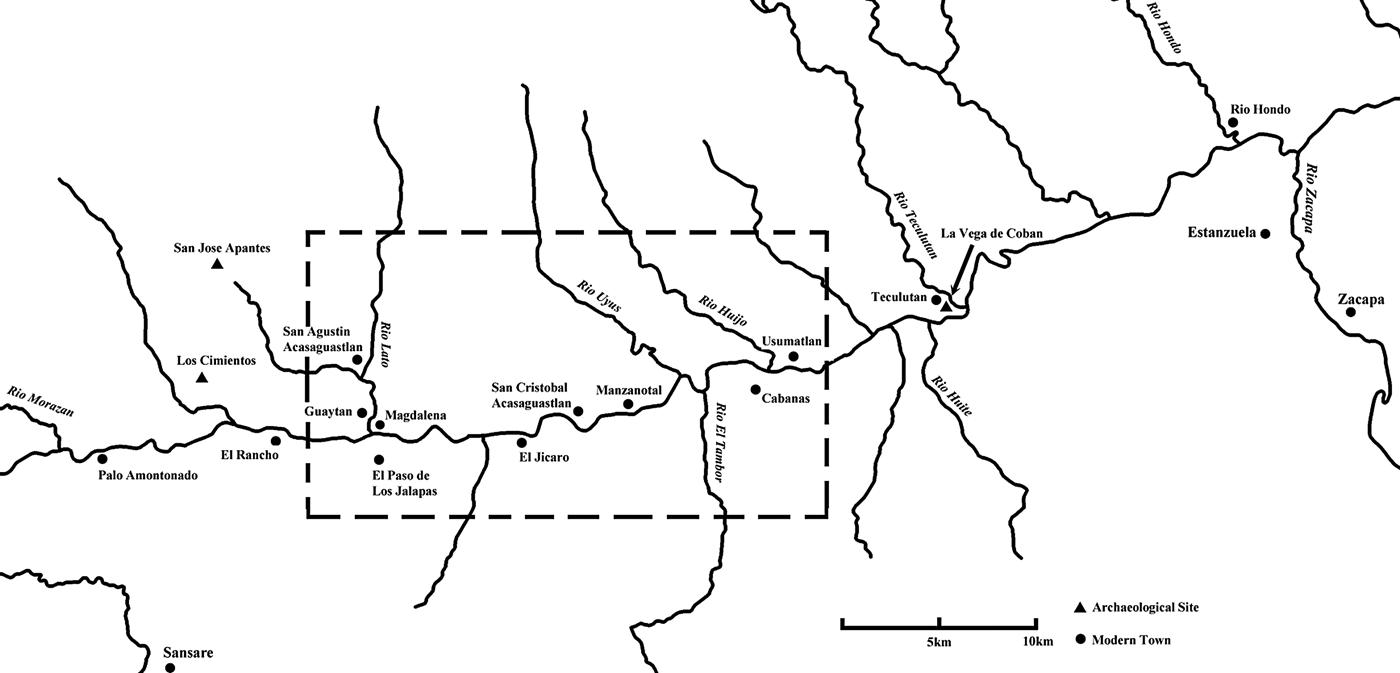
The middle Motagua Valley (Figure 2) is located in east-central Guatemala and includes the Motagua River Valley between the modern communities of Paloamontonado on the west and Rio Hondo on the east (Smith and Kidder Reference Smith and Kidder1943) and is generally considered an extension of the southeastern zone of the Maya lowlands (Smith and Gifford Reference Smith, Gifford and Willey1965). The valley is bounded to the north by the Sierra de las Minas—a rugged, metamorphic formation created by tectonic activity from the Motagua Fault, a strike-slip fault that runs generally parallel to the Motagua River. To the south, the valley is bounded by rugged terrain that forms the foothills of two mountain ranges: the Sierra del Espiritu Santo to the east and the Sierra the Chuacus to the west.
Extent of the Middle Motagua Valley. Box indicates extent of map in Figure 3.
Importantly, the Sierra de las Minas is part of the only positively identified source region for jadeite exploited in pre-Columbian Mesoamerica (Foshag and Leslie Reference Foshag and Leslie1955; Harlow Reference Harlow and Lange1993). Outcrops occur in the mountains surrounding the valley, and jadeite cobbles and boulders can be found in the Motagua River and most of its tributaries. Today, local independent prospectors collect jadeite to sell to shops in Antigua by exploiting outcrops and collecting cobbles in the many quebradas that scar the region. Although not often mentioned in discussions of the source region, jadeite sources have also been documented south of the Motagua River, including a large outcrop of “Olmec” blue and blue-green translucent jadeite in the Upper Rio El Tambor region (Taube et al. Reference Taube, Hruby, Romero, Hruby, Braswell and Mazariegos2011), and have been recently reported in the Alta Verapaz region to the north of the Sierra de las Minas (Andrieu et al. Reference Andrieu, Jaime-Riverón, Tenorio, Calligaro, Ocampo, Jiménez, Ostrooumov, Arroyo, Palma and Aragón2011).
The middle Motagua Valley lies entirely within the tierra caliente climate zone, with an average annual temperature of 32° centigrade and an average annual rainfall of 500 mm, which occurs almost exclusively during the rainy season between May and October (Simmons et al. Reference Simmons, Tarrano and Pinto1959). The environment on the valley floor is arid and semi-desert, where low, thorny scrub brush and other xerophytic vegetation dominate.
PREVIOUS RESEARCH IN THE MIDDLE MOTAGUA VALLEY
Although the earliest reports of ancient remains in the middle Motagua Valley date back to the late nineteenth century (Brinton Reference Brinton1887), it was not until the early twentieth century that the first archaeological research was carried out in the region (Kidder Reference Kidder1935; Smith and Kidder Reference Smith and Kidder1943). Based on these initial explorations, Kidder concluded that the architecture at sites in the valley was unlike any previously reported for the Maya area. Data from ceramic collections indicated a long period of occupation and included ceramics associated with neighboring regions in Guatemala and Honduras. These two observations led Smith and Kidder (Reference Smith and Kidder1943:109) to undertake further “exploration and excavation” in 1940 that consisted of two months of excavation at the site of Guaytan and 10 days devoted to a hasty survey of the valley in search of additional archaeological sites. This research led to the designation of the area between the towns of Paloamontonado and Rio Hondo as the “Middle Motagua Culture” based on the presence of a unique tomb style and the lack of carved stelae. While not wholly similar to the Classic Maya culture of the central Peten, sites in the middle Motagua Valley were involved in larger exchange spheres with “Classic Maya” sites.
Interestingly, Smith and Kidder reported relatively few remnants of jade artifact production debitage from their excavations, the majority of which came from mortuary contexts. Evidence of large-scale ancient Maya jade artifact production was not identified until the 1970s during research conducted by Hammond and colleagues (Hammond et al. Reference Hammond, Aspinall, Feather, Hazelden, Gazard, Agrell, Earle and Ericson1977) and Walters (Reference Walters1980a, Reference Walters1980b, Reference Walters1982; Feldman et al. Reference Feldman, Terzuola, Sheets and Cameron1975). Based on surface survey and limited excavations at Guaytan, Walters (Reference Walters1982, Reference Walters and Clark1989) proposed a tentative model in which small workshops at nonelite sites passed raw or partially worked jadeite to higher-order sites with more complex workshops, which performed the final stages of artifact production. In his model, the most complex workshops were associated with the most highly ranked centers, and production was done by attached specialists.
Walters’ research ended in 1981 with the spread of fighting from the Guatemalan Civil War to parts of the middle Motagua Valley. Research picked up again in the late 1980s and continued into the 1990s, with various projects directed by Guatemalan archaeologists. The Proyecto de Arqueologico Sansare, initiated in 1986 and directed by the Universidad de San Carlos de Guatemala, undertook a program of surface survey south of the Motagua River in the department of El Progresso, including investigation in the municipios of Sansare and El Jicaro. The project produced an inventory of sites in the region and made preliminary plan maps of every site, including 22 new sites along the margins of the Motagua River (Román-Ramírez Reference Román-Ramírez2006:18). In 1997, the project continued under the direction of Jose Hector Paredes and Luis Romero under the title Programa de Aqueologia del Motagua Medio (PAMM). Research focused on a continued program of surface survey further east in the municipios of Rio Hondo and Estanzuela (Romero Reference Romero1999), as well as systematic excavations at a number of sites including La Vega del Coban, the largest site in the eastern part of the middle Motagua Valley. Excavations in Plaza 3 of Group D at La Vega de Coban uncovered a small jade workshop, although this was the only jade production evidence recovered by the PAMM (Paredes Reference Paredes2003:3). More intriguing is the fact that, despite the extensive survey and excavations undertaken by the project, jade artifacts were rarely recovered from funerary contexts (Román-Ramírez Reference Román-Ramírez2006:31), although looting of tombs throughout the region has been extensive.
Despite the important contributions of these projects, we are left with a vague and incomplete description of the organization of jadeite artifact production in the middle Motagua Valley and how it articulated with the broader economy. Walters (Reference Walters1980a, Reference Walters1980b, Reference Walters1982) provided only general descriptions of the sites he encountered but did not include detailed information about their spatial configurations or the areas of the sites where evidence of jade artifact production was recovered. Further, he did not provide information about the location of particular stages of jadeite artifact production at each site. For example, we do not know whether production was situated close to “elite” residences or compounds, or even at site centers.
FIELD METHODS AND STUDY AREA
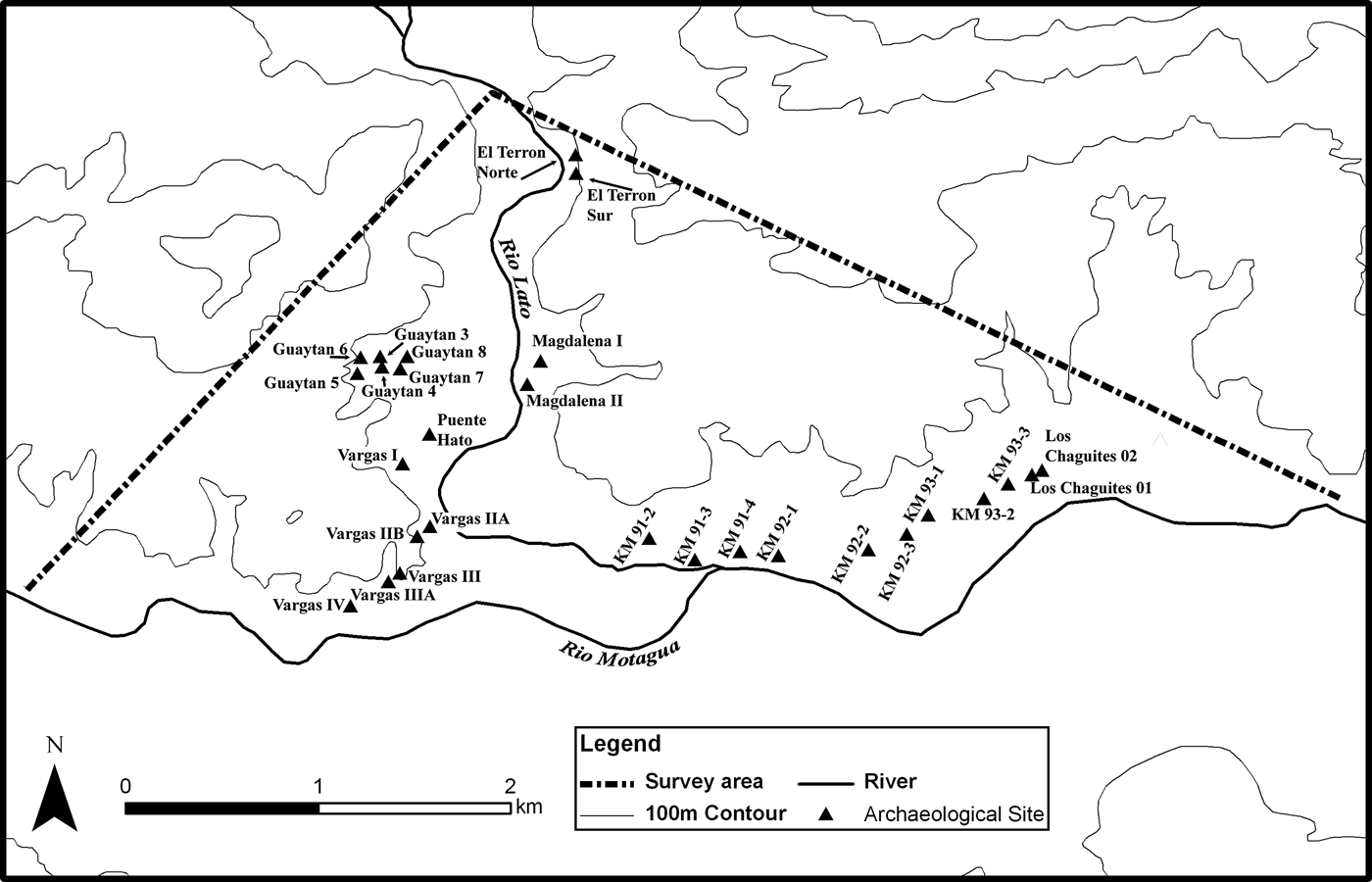
From October to December 2005, Mónica Pellecer Alecio and I (Rochette and Pellecer Reference Rochette and Pellecer2006, Reference Rochette, Pellecer, Laporte, Arroyo and Mejía2008) carried out a program of archaeological survey and excavation as part of the Proyecto de Investigación Sobre la Producción de Jade en el Río Lato in the middle Motagua Valley, centering on the region around the lower Lato River Valley (Figure 3). The principal goals of the archaeological survey were to identify and define the extent of all sites in the survey area and their periods of occupation and to locate and surface collect evidence of lithic production, particularly of jadeite artifacts. For the purposes of the survey, I defined a “site” as a collection of cultural material (regardless of the presence of architectural remains) that was separated from the nearest such collection by at least 50 m or by some natural feature, such as a quebrada.
Lower Lato Valley survey area.
We attempted to make complete surface collections of all jadeite production debris at each surveyed site, which is possible in the middle Motagua Valley because of the arid climate and dearth of surface vegetation. If dense concentrations of jadeite production debris were found, however, collection was halted so that their locations could be recorded before collection. This allowed us to identify particular loci at individual sites where jadeite artifact production potentially took place.
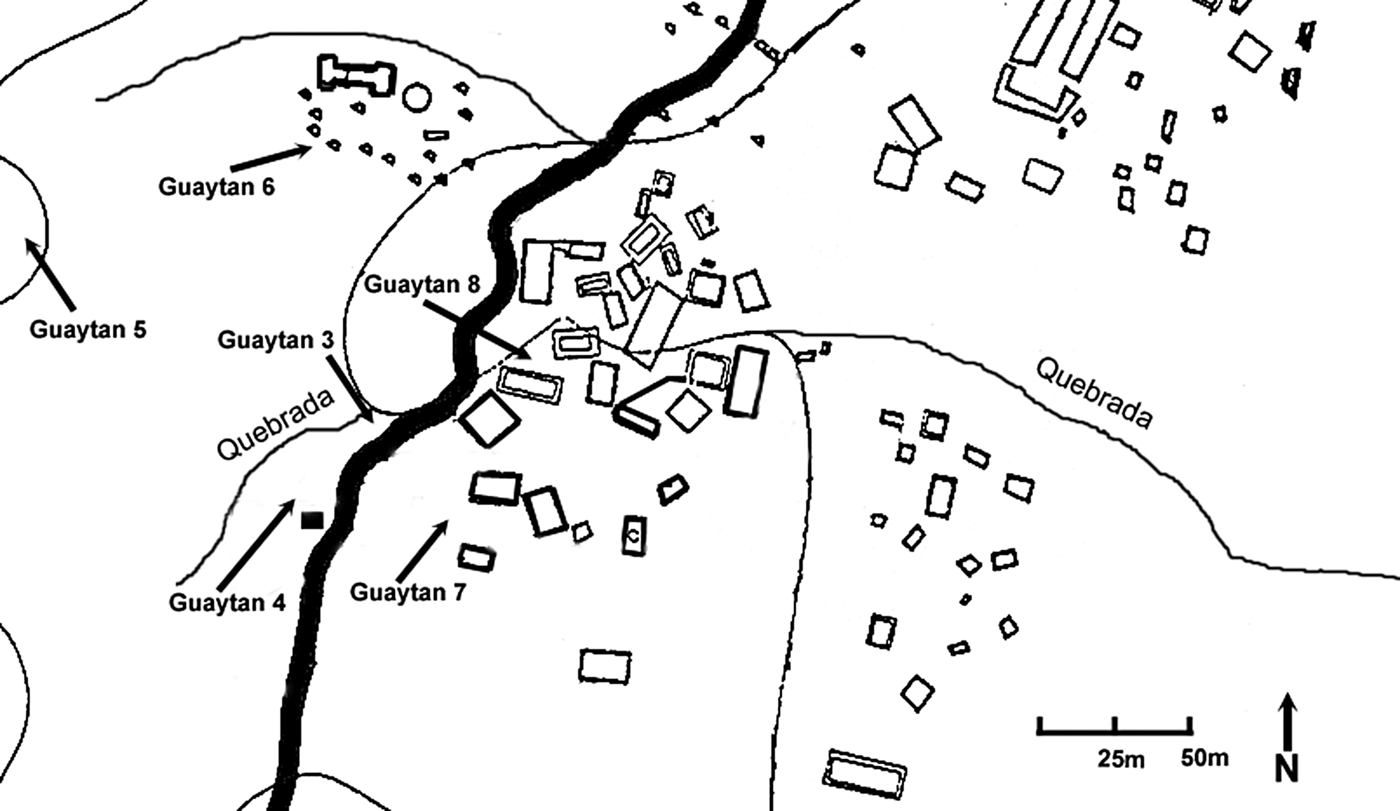
In addition to surface survey, we completed a series of test excavations in areas identified as possible jadeite workshops during a pilot survey in July of 2004. The goals of these excavations were (1) to determine whether the surface evidence was indicative of in situ jadeite workshops, and (2) to collect evidence regarding the social context of jadeite artifact production (for example, elite versus nonelite contexts). Excavations focused on three of these previously identified areas: Guaytan 3, Guaytan 4, and Magdalena I. In addition, eight test units were excavated at Guaytan 5 (three test pits), Guaytan 7 (two test pits), Guaytan 8 (two test pits) and KM 93-I (one test pit) (Figures 4 and 5). All test excavations consisted of 1-x-1 m units and were expanded as needed. Excavations proceeded by arbitrary 10-cm levels unless clear depositional layers were encountered. All excavated material was screened through 3.175 mm mesh screens to ensure the collection of all size grades of jadeite debitage and other archaeological material.
Map of Guaytan showing location of sites with jade debitage scatters where test excavations were conducted. Modified from Lopez (in Román-Ramírez Reference Román-Ramírez2006).
Map of southern portion of Guaytan 4, showing location of excavation units.
SURVEY AND EXCAVATION RESULTS
A total of 28 sites were identified over 8.5 km2, ranging from artifact scatters without associated architecture to clusters of residential and civic-ceremonial architecture (Figure 3). All sites had been extensively looted, and many have been partially destroyed by modern construction or agriculture. Sites along the Motagua River are generally located along the southern edge of the bluffs that overlook the river (about 15 m above the river's flood plain) and are found on level or gently sloping terrain, often immediately adjacent to steep quebradas (ravines). Ceramic surface collections indicated periods of occupation at 23 sites; five sites did not yield temporally diagnostic ceramic sherds. All sites show evidence of occupation during the Late Classic period (a.d. 550–900), in the Manzanal (a.d. 550–650) and Magdalena (a.d. 650–900) ceramic phases.
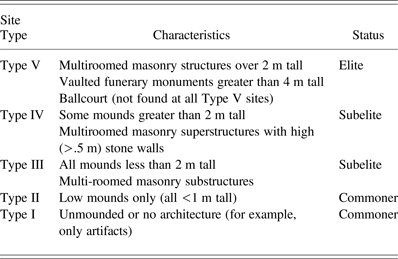
In general, sites in the middle Motagua Valley consist of small groups of four to six structures, sometimes organized around plazas. Sites range from simple (nonelite) residential house mound groups to larger ceremonial/residential (elite) groups with more elaborate architecture. Based on the survey results, we created a five-level settlement hierarchy for the middle Motagua Valley based on: the number of mounds/structures, mound/substructure heights, the presence of multiroom masonry superstructures, and the presence of “elite/ceremonial” features such as ballcourts and stelae (Table 1). These criteria were chosen because larger, more elaborate residential architecture is generally taken as indicative of greater social rank of the inhabitants. All sites, regardless of their designation within the local site hierarchy, contained structures and artifacts that suggest residential functions. Type I sites aside, all other sites contain low mounds that likely served as substructures for perishable, thatched superstructures; low mounds ranging from 1 to 2 m in height are the most common mound types within the survey area. The principle of abundance suggests that the most frequent structures in any settlement pattern are domestic, residential structures. Additionally, many of these structures are grouped around patios, a pattern typical of domestic households in the Maya area (Ashmore Reference Ashmore and Ashmore1981). Finally, all sites contained domestic artifacts, including manos and metates, and domestic ceramic forms, such as comales, bowls, and jars.
Definition of site hierarchy in the middle Motagua Valley
Test excavations focused on the southern periphery of the site of Guaytan (Guaytan 3, Guaytan 4), as well as adjacent areas (Guaytan 5, Guaytan 7, Guaytan 8) that showed evidence of jadeite artifact production (Figure 4). In addition, we excavated multiple test pits in concentrations of debitage at Magdalena I.
Our most intensive test excavations were carried out at Guaytan 4 (Type II site), which consisted of a small group of domestic structures laid out over a series of small platforms built into gently sloping terrain (Figure 5). In 2004, archaeological reconnaissance identified a dense concentration of jadeite debitage on the southwestern portion of the structure group. This group is of modest construction and size, although the structure group is located within 100 m of the portion of the site that Walters (Reference Walters1982) identified as a possible elite residential area. Although we did not recover in situ evidence of jade artifact production, we recovered a large amount of jadeite and other lapidary and shell production evidence, mostly found within subfloor and structure fill. The majority of the excavated contexts date to the Magdalena phase of the Late Classic period (a.d. 650–900).
Excavations at the elite residential/ceremonial district of Magdalena I (Type V site) also failed to produce in situ evidence of jade artifact production (Figure 6). None of the excavations reached more than 60 cm before terminating in sterile soil. Nevertheless, excavations yielded artifacts comparable to those found on the surface, while the majority of the excavated ceramics date to the Late Classic period. Test excavations at Guaytan 3, Guaytan 5, Guaytan 7, and Guaytan 8 did not yield significant amounts of jade production debitage.
Southern portion of Magdalena I indicating locations of test excavations.
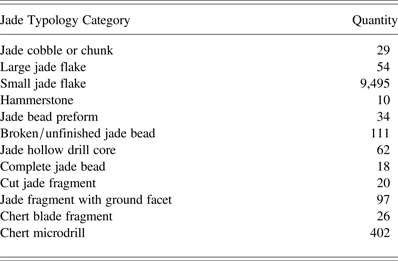
I examined all lithic artifacts from surface collections and excavations related to jadeite artifact production from a technological perspective, measuring artifact attributes that might provide insight into the technological processes involved in their production. All non-flake jadeite artifacts were measured and weighed as part of artifact analysis; jade flakes were measured and weighed in aggregate. Based on this analysis (Rochette Reference Rochette and Hirth2009a), I created a technological typology of jadeite artifacts and associated tools with twelve categories: jade cobble or chunk, large jade flake (>5 cm), small jade flake, hammerstone, jade bead preform, broken/unfinished jade bead, jade hollow drill core, complete jade bead, cut jade fragment, jade fragment with ground facet, chert blade fragment, and chert drill (Table 2). In cases where an artifact had characteristics of more than one category, the artifact was assigned to only one category, but its characteristics were recorded in notes. For example, a hollow drill core that showed evidence of grinding on one or more ends was categorized as a hollow drill core and counted in the category but was noted to have evidence of grinding.
Technological categories of jadeite artifacts and associated production tools from middle Motagua Valley surface collections and excavations
Based on the results of the artifact analyses, a number of insights and observations can be made about the technological process and organization of jadeite artifact production in the middle Motagua Valley during the Late Classic period. I focus on the Late Classic period for two reasons. First, all excavated contexts contained Late Classic ceramics, making the associated jade production evidence a reflection of that time period. Second, the Late Classic period is the only temporal period represented in the surface ceramics at all sites in this study. Therefore, the most parsimonious assumption is that the majority of the evidence represents the structure of jade production during the Late Classic period.
LATE CLASSIC JADE ARTIFACT PRODUCTION IN THE MIDDLE MOTAGUA VALLEY
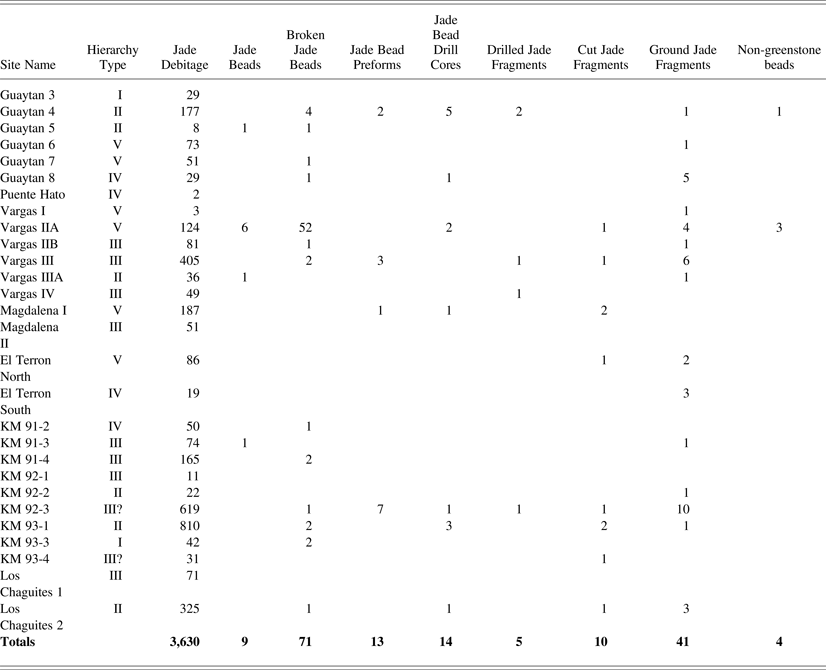
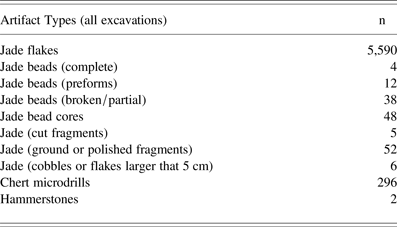
In total, 9,920 jadeite artifacts and 438 tools associated with jade artifact production were recovered from survey and excavations in the middle Motagua Valley (Table 2). This collection of jadeite artifacts is the largest reported in the Maya area, even exceeding the total from the Tikal excavations (Moholy-Nagy Reference Moholy-Nagy2008). The survey data and test excavations demonstrate that jadeite artifact production occurred at all levels of the site hierarchy (Tables 3 and 4). While it is possible that higher-order sites reflect length of occupation or site function rather than the social status of its inhabitants, the important point is that no matter how the site hierarchy is constructed, there is evidence of jade artifact production at all sites in the middle Motagua Valley.
Raw counts of jade and lapidary production debitage from surface collections
Artifact totals from all excavations at all sites
As discussed earlier, Classic Maya wealth goods production is characterized as (1) being highly skilled, involving production methods that are difficult to master, (2) often involving the use of exotic (nonlocal) raw materials, (3) requiring a mastery of esoteric knowledge about aesthetic and moral values, and (4) under the direct control of elites. Given this characterization, we should expect to find greater quantities of production-related activities and evidence of more complex production techniques at more highly ranked sites in the local site hierarchy, with evidence of less sophisticated or skillful production at lower-ranked, nonelite sites. Evidence along these lines might include the presence of different tools or differences in technological steps (for example, percussion versus sawing) at higher versus lower-ranked sites (compare against Kovacevich Reference Kovacevich, Wells and Davis-Salazar2007).
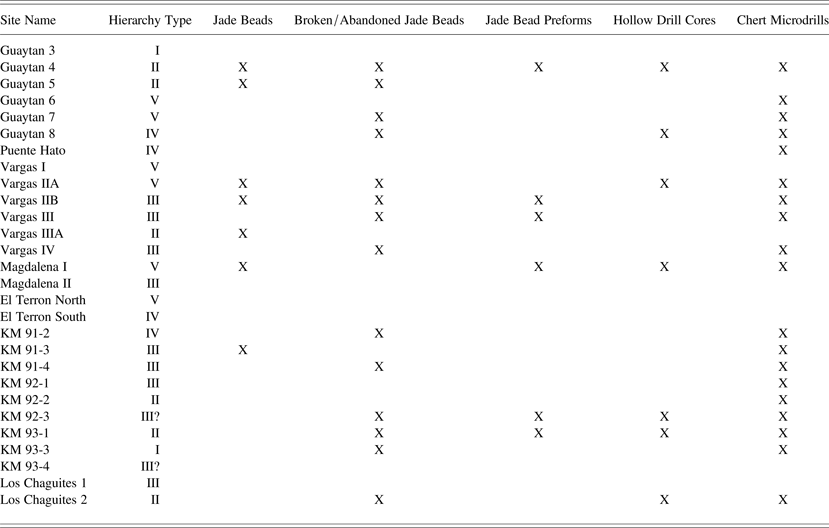
Evidence linked to jade bead production was found at sites in all levels of the local site hierarchy, suggesting that bead production was a widespread activity in the middle Motagua Valley. Almost all sites (75%; n = 21) contained evidence linked to jade bead production (Table 5), either in the form of complete beads (in association with jade flake debitage), beads broken or abandoned during drilling, preform beads or the presence of chert microdrills (Figures 7 and 8).
Examples of artifact types associated with jade artifact production.
Jadeite hammerstone (left) and chert microdrills (right) from middle Motagua Valley sites.
Evidence linked to possible jade bead production from excavations and surface collections
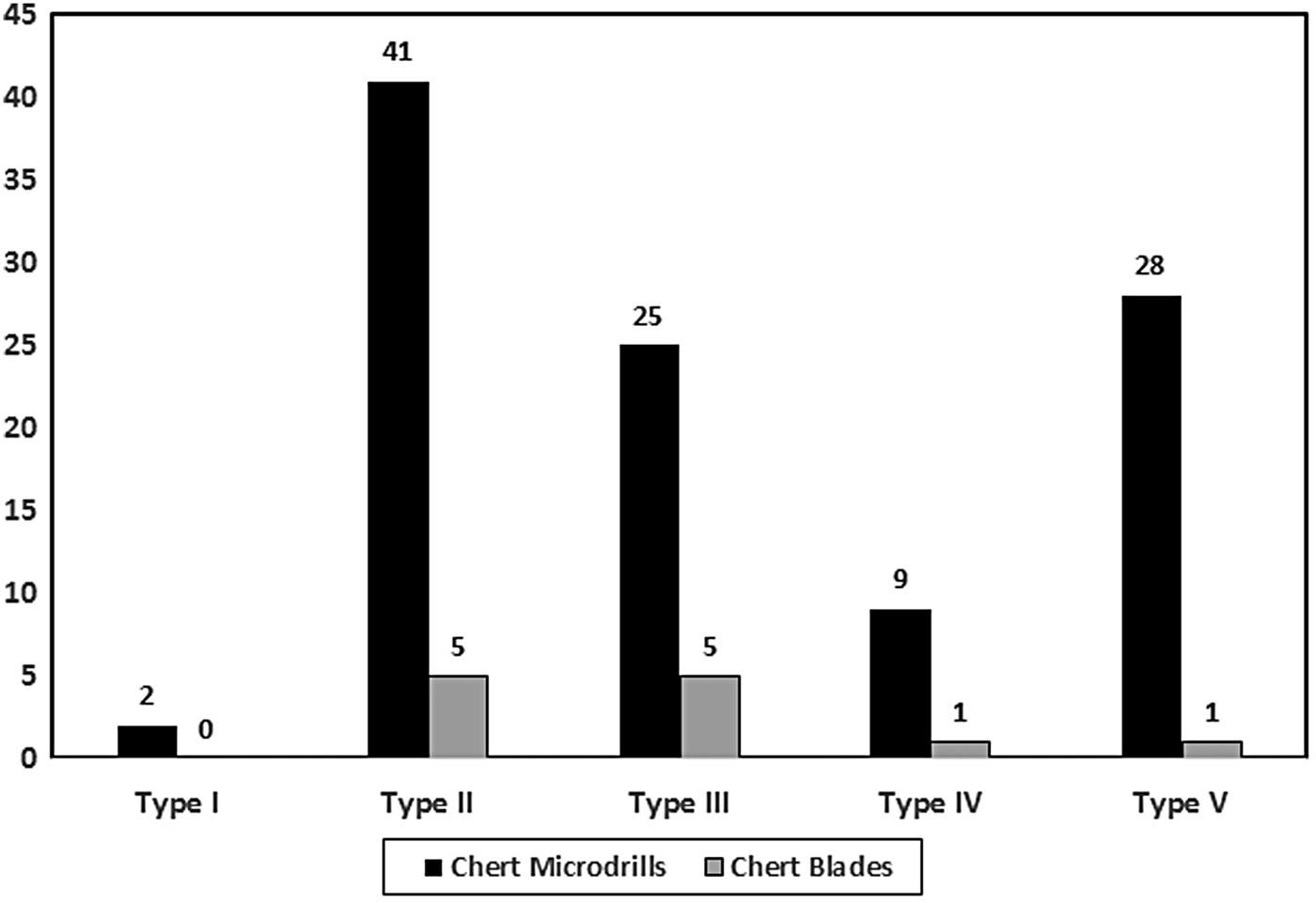
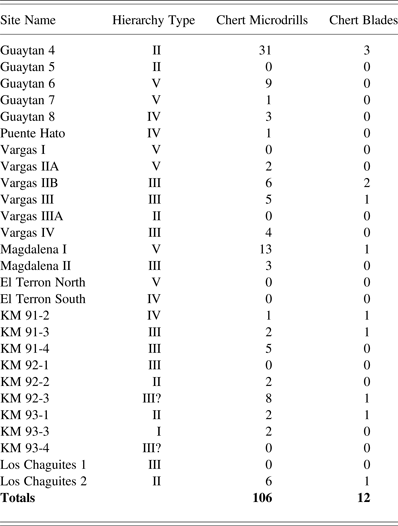
Chert microdrills are one formal tool category associated with drilling of jadeite and shell (Aldenderfer Reference Aldenderfer1991; Aldenderfer et al. Reference Aldenderfer, Kimball and Sievert1989; Feinman Reference Feinman, Skibo and Feinman1999; Feinman and Nichols Reference Feinman, Nicholas, Feinman and Manzanilla2000, Reference Feinman, Nicholas, Feinman and Nicholas2004; Hirth Reference Hirth2005; Hirth et al. Reference Hirth, Puche, Arce, de León and Hirth2009). Chert microdrills were recovered in surface collections at all but nine sites in the survey area (Table 6). Although they may have been used to drill materials other than jade (other stone or shell), their presence at most sites suggests that these tools were a widely available technology. Examining the frequency of surface collected chert microdrills by site type further underscores this point and shows that the technology was not restricted to the most highly ranked sites in the middle Motagua Valley (Figure 9). Overall, the majority of chert microdrills from surface collections (65%; n = 69) was recovered from sites in the three lowest tiers of the local site hierarchy.
Chert microdrills and blades from surface collections, by site type. This suggests that chert drill technology was available to most (if not all) producers and that households may have produced their own microdrills from chert blades.
Chert microdrills and blades from surface collections
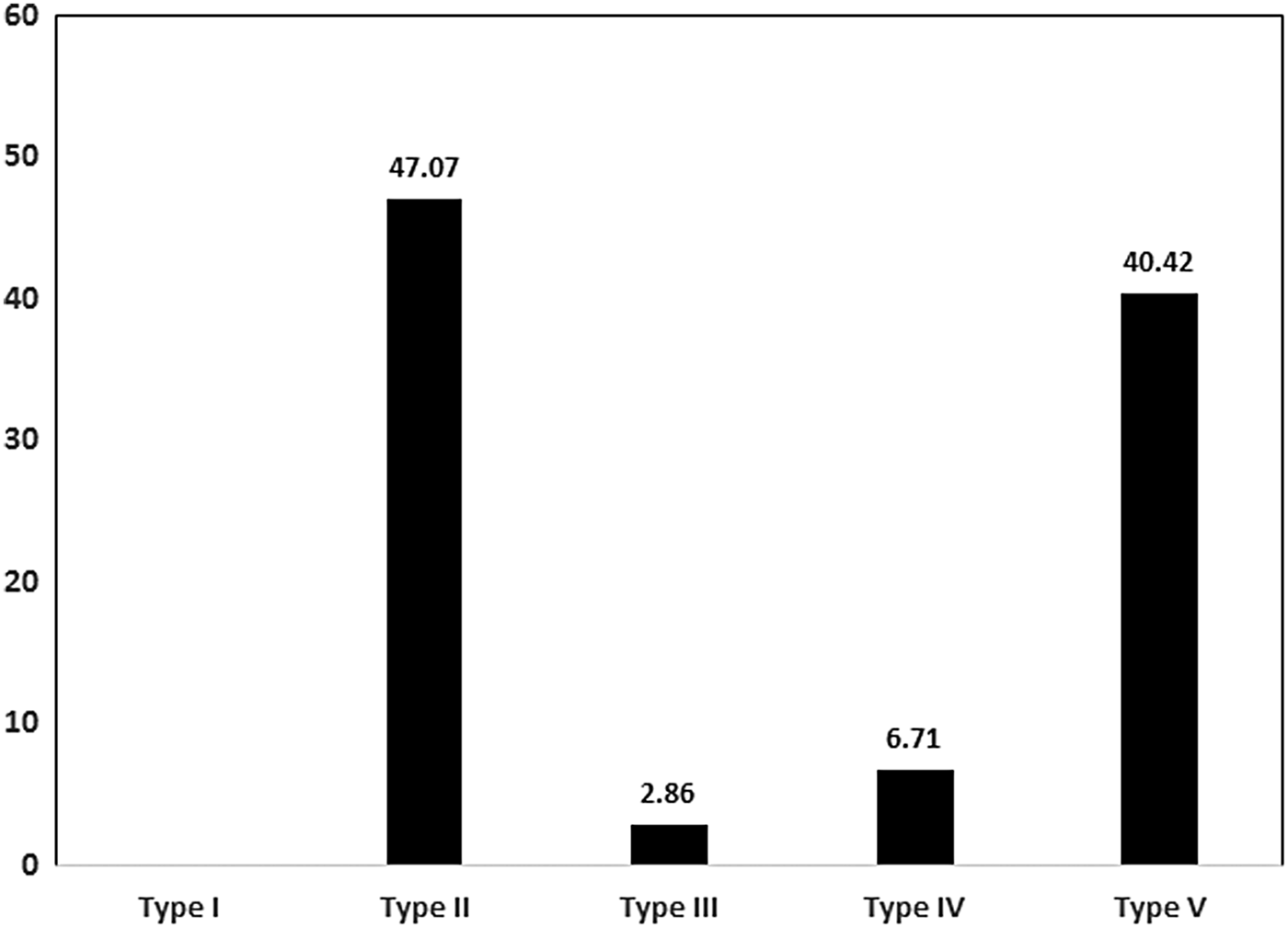
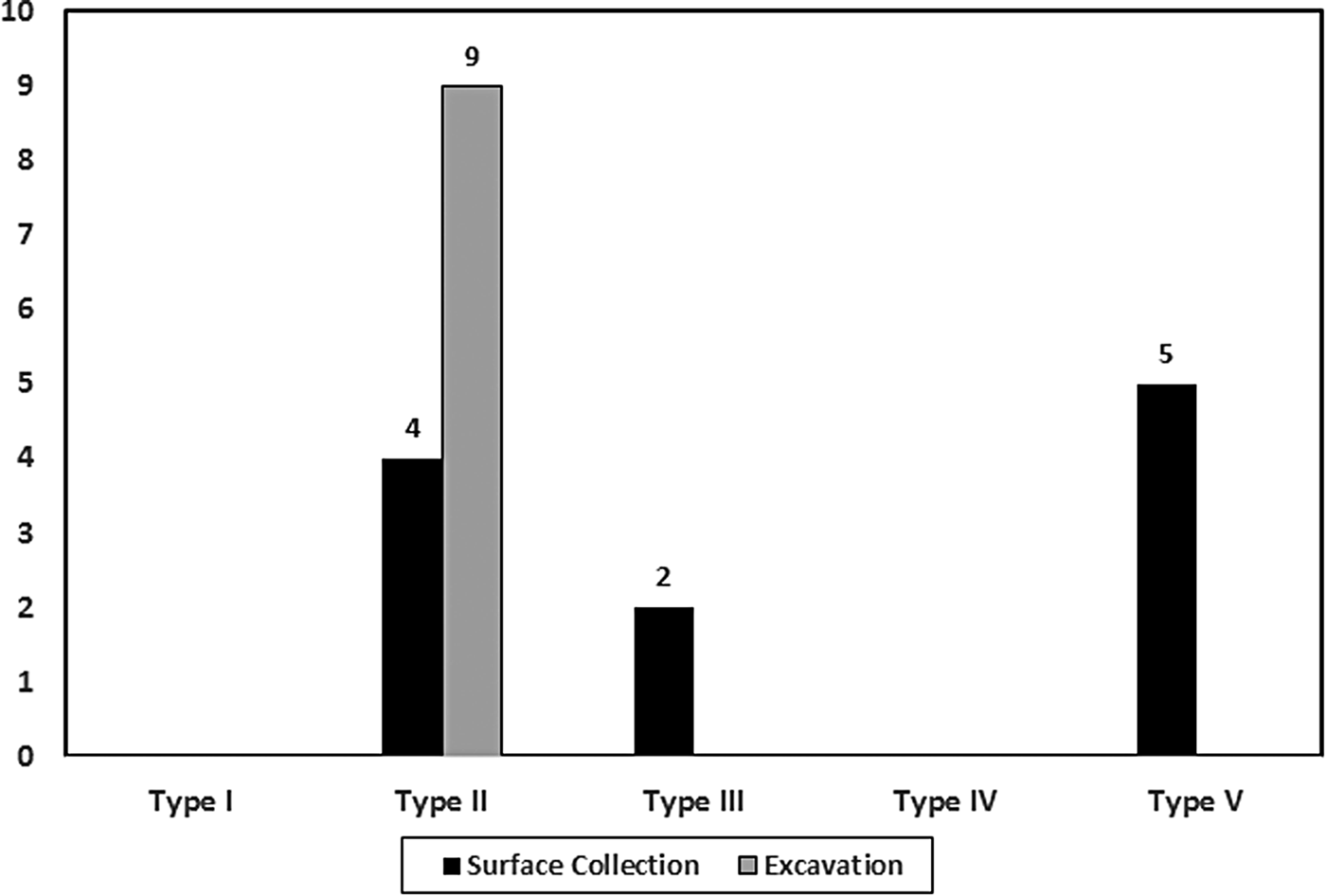
Chert microdrills were recovered from six of nine sites in which test units were excavated. Controlling for differences in total volume of excavation, the average number of chert microdrills recovered per cubic meter for each hierarchical site type shows that the highest number were recovered from Type II and Type V sites (Figure 10). The low rate of recovery at Type III sites is partially attributable to the few test pits that we were able to excavate at these sites. Nevertheless, the data show that chert microdrills were recovered in similar quantities in association with both nonelite (Type II) and elite (Type V) sites, contrary to expectations that technological differences would exist between them.
Chert microdrills per cubic meter from excavations, averaged per site rank.
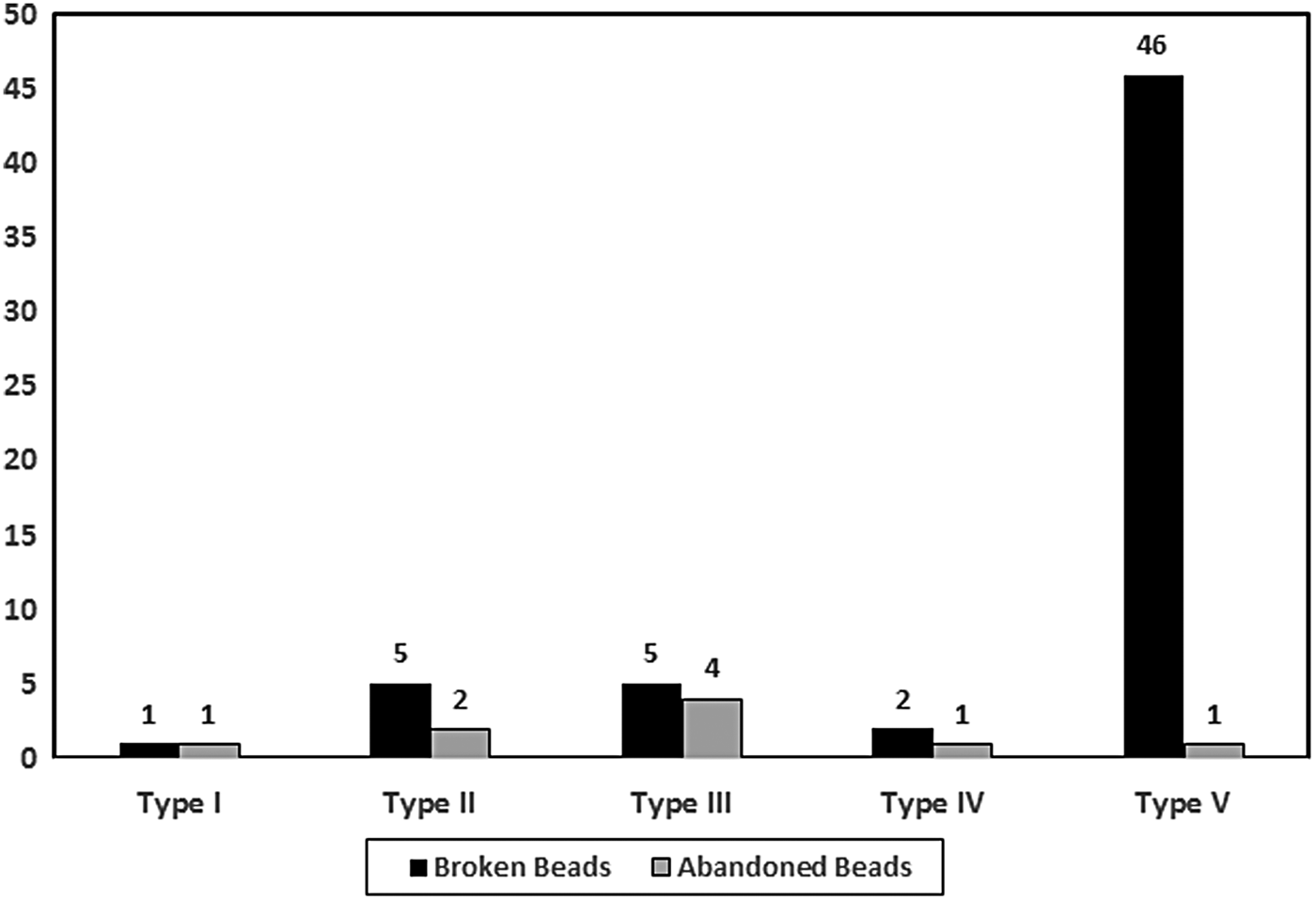
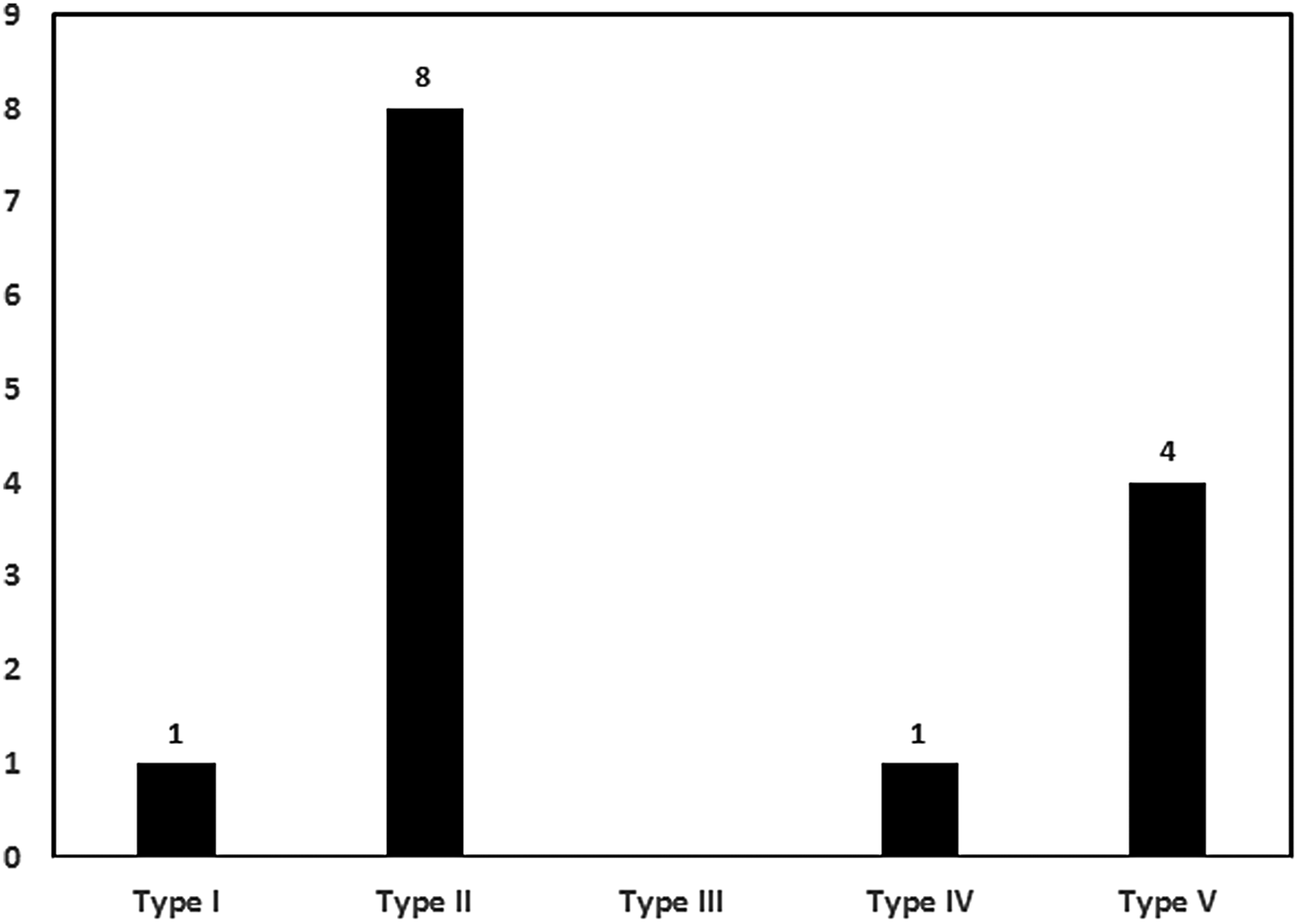
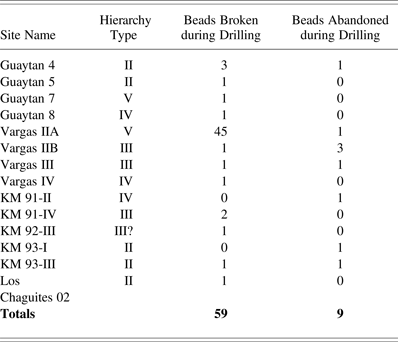
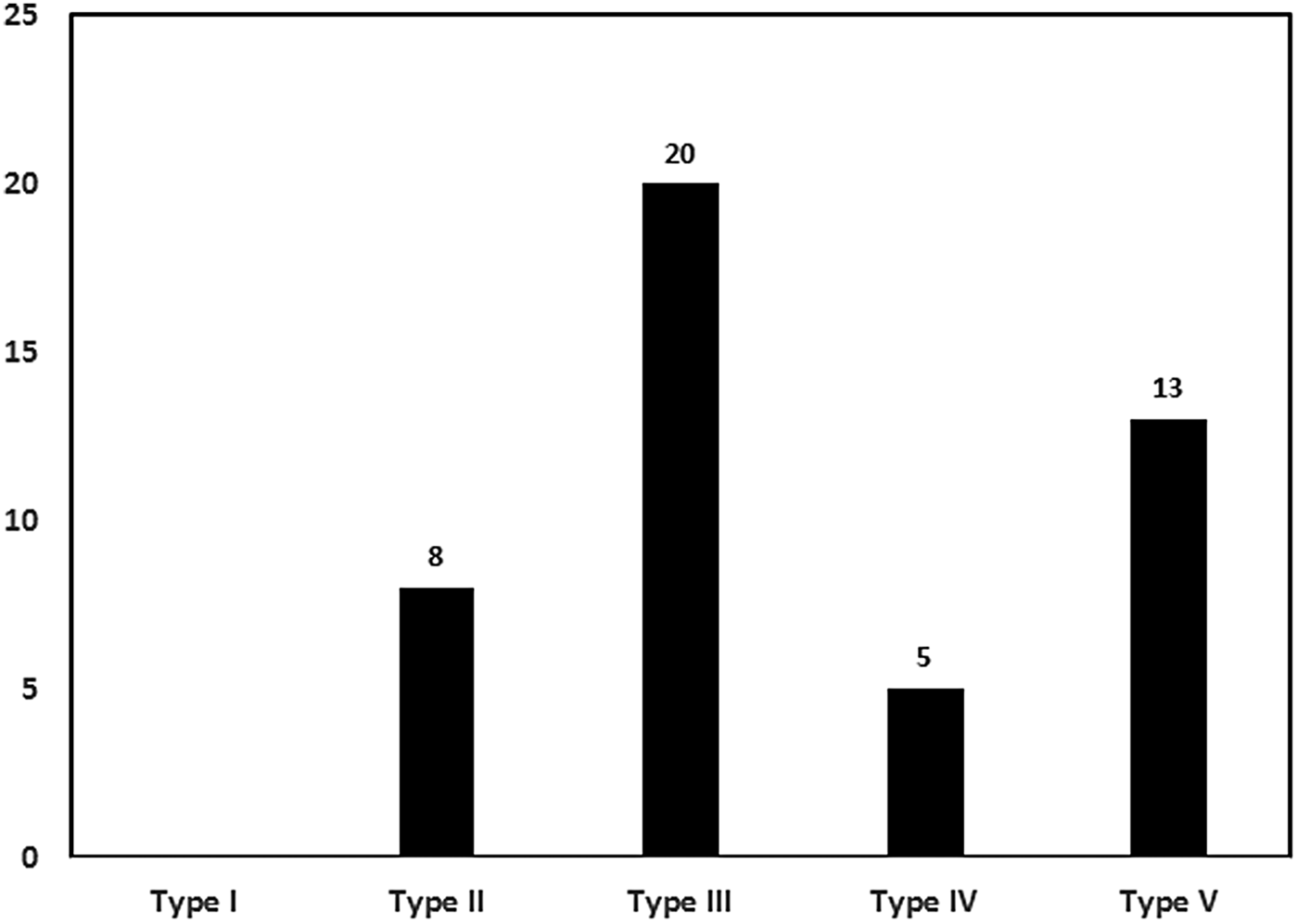
More direct evidence of the diffuse character of drilling of jadeite at middle Motagua Valley sites comes from an examination of beads broken or abandoned during the process of drilling. A total of 59 jade beads broken during drilling were recovered from surface collections and screening of looter's backdirt at 12 sites (Table 7). The majority of these (76%) were button beads of a mica-rich jadeite collected from looter's backdirt behind the largest structure at Vargas IIA; broken beads were recovered from only one other Type V site (Guaytan 7). Comparing the quantities of broken or abandoned drilled beads by site type demonstrates that drilling of jadeite beads took place at all site types, although the majority of evidence was recovered from Type V sites (Figure 11). Finally, while evidence of the use of hollow drills (in the form of hollow drill cores) was rarely recovered from surface collections, they were collected at all site types (Figure 12), further underscoring the fact that hollow tubular drilling was a widespread activity—not one limited to higher level, presumably elite site types because of constraints of technology or skill.
Surface collected beads broken or abandoned during drilling, quantified by site type.
Hollow drill cores recovered from surface collection, quantified by site type.
Sites at which beads broken or abandoned during the process of drilling were recovered from surface collections
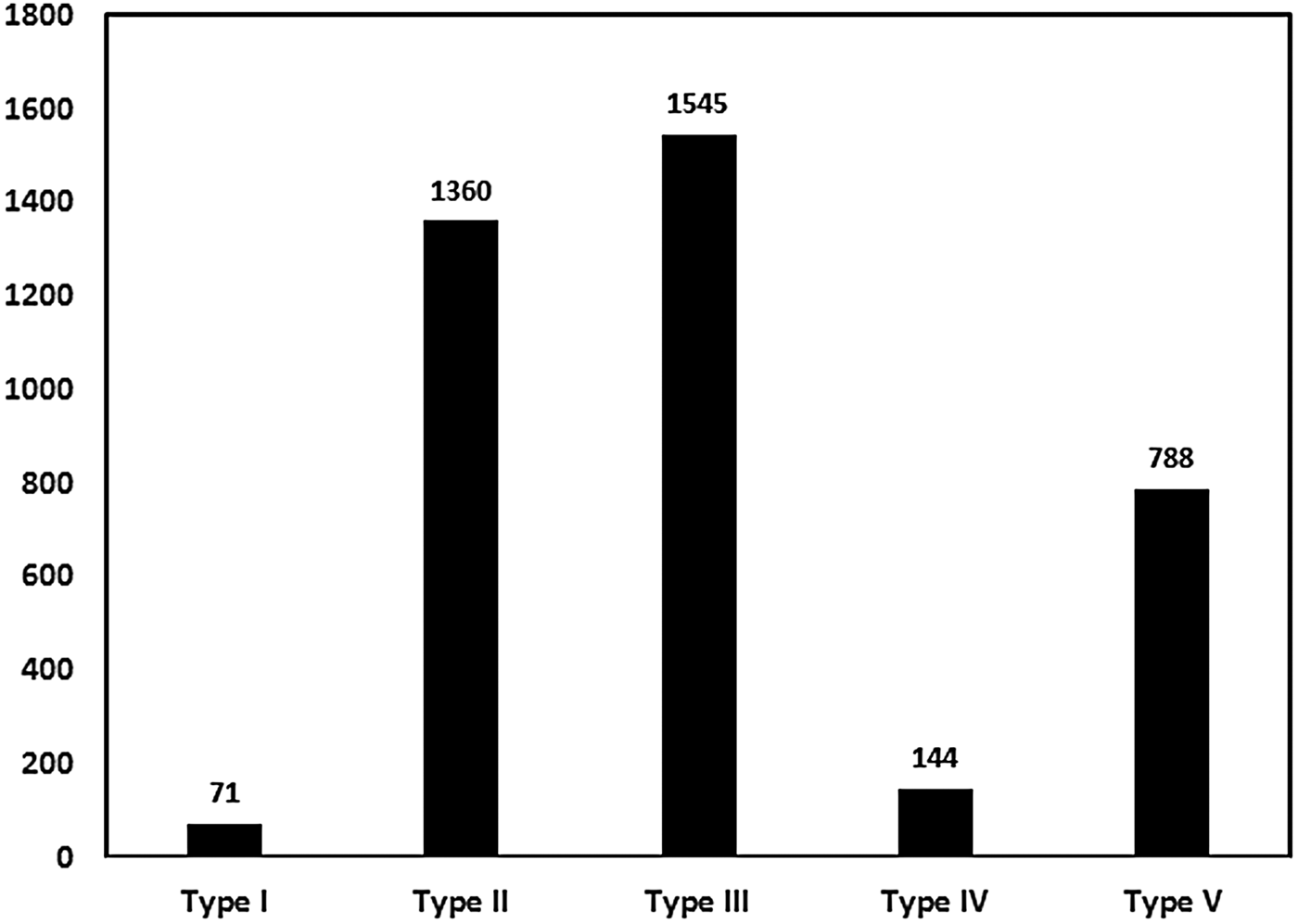
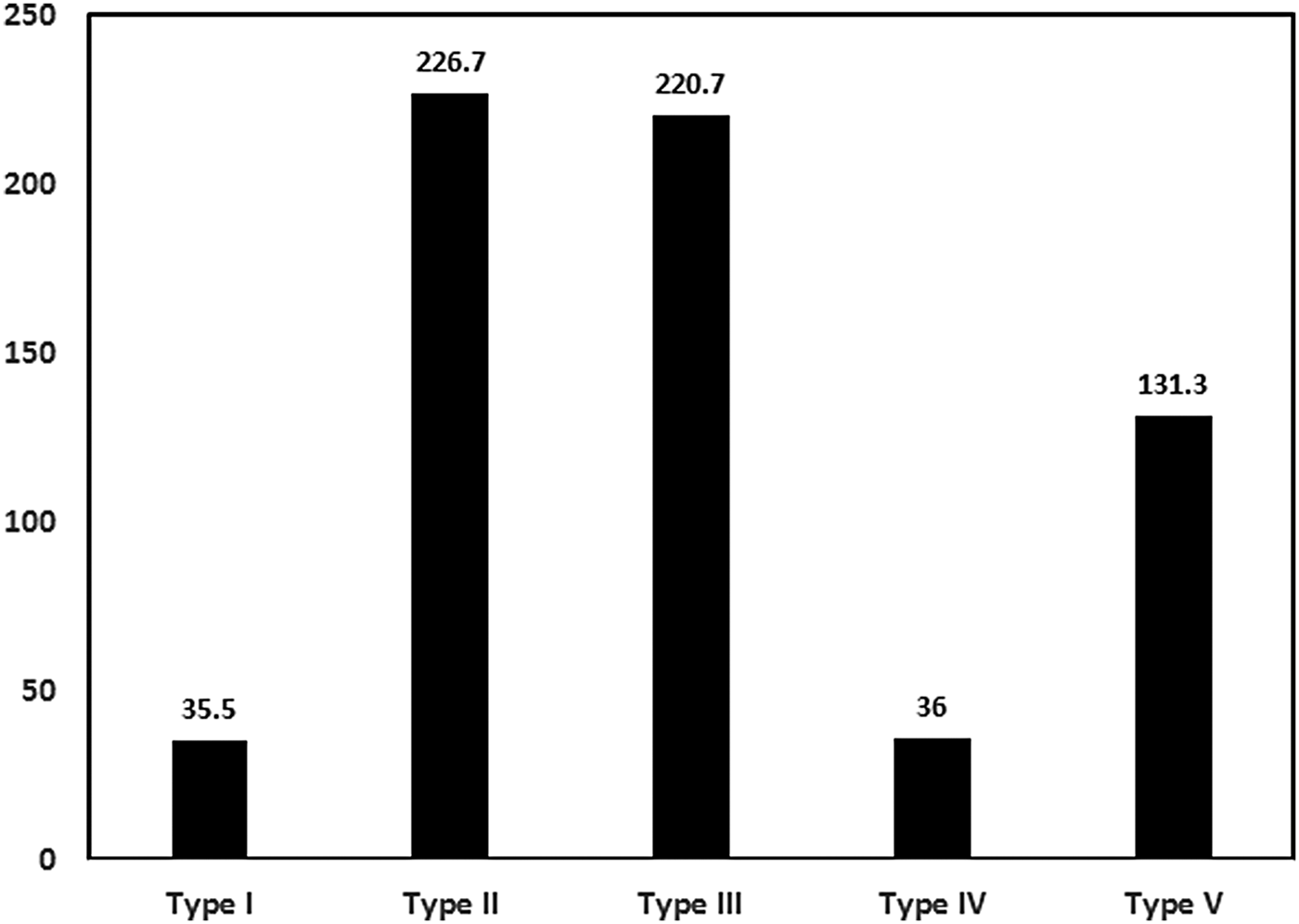
Jadeite percussion debitage, representing the initial stages of jade bead production (Hirth Reference Hirth and Hirth2009; Rochette Reference Rochette and Hirth2009a), was by far the most frequently recovered technological artifact category in surface collections and excavations. Comparing the quantity of small jade flakes from surface collections, there is evidence of percussion production at all site types, with the highest totals from Type II, III, and V sites (Figure 13). Examining the average quantity of small jade flakes recovered per site within each site type reveals the same basic pattern (Figure 14). The important point is that percussion flakes were found at all levels of the site hierarchy.
Small jade flake surface collections by site type. Note that flakes were recovered from all site types.
Average quantity of small jade flakes recovered from surface collections per site in each site type.
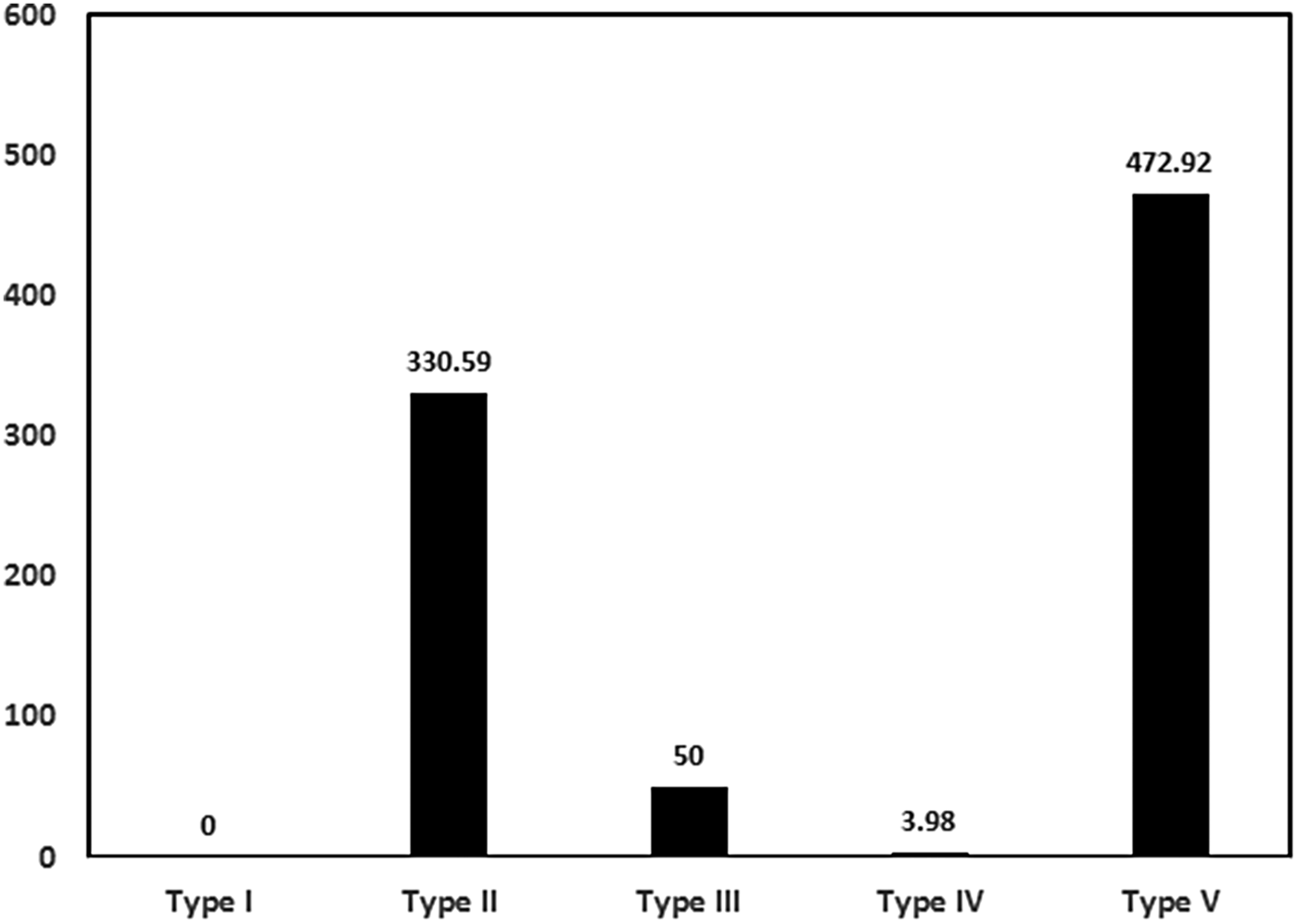
Jade flakes recovered from excavations provide a slightly different picture of jade percussion activity when examining the frequency of jade flakes recovered per cubic meter of soil (Figure 15). The frequency of jade flakes was calculated by dividing the total amount of flakes recovered in each excavation unit by the volume of soil excavated in each excavation unit. The frequency of jade flakes per site type was then calculated by averaging the frequencies of jade flakes of excavation units at each site type. The highest frequencies are found at Type II and Type V sites, which is a reflection of the location of excavations into dense surface scatters of jade artifacts at Guaytan 4 and Magdalena I. In fact, the Type V frequency is greatly inflated by the extremely dense debitage deposit in unit 8A-1, where 817 jade flakes were recovered in only 0.4 m³ of soil.
Average quantity of small jade flakes per cubic meter recovered from excavations, organized per site type.
Considered together, the evidence from excavation and surface collections indicates that the technology and skills necessary for drilling jade artifacts were largely redundant across different site types in the middle Motagua Valley. Furthermore, drilling and percussion reduction was performed at sites throughout the local hierarchy. If the site hierarchy reflects differences in social status, then there is no evidence from the current data to suggest that different tasks associated with jade artifact production were carried out at sites occupied by elites versus those occupied by nonelites. It should be noted, however, that no evidence of the production of elaborately carved jade artifacts was recovered at any of the middle Motagua Valley sites, nor was any evidence of incising encountered. Nevertheless, these data still run counter to expectations regarding the organization of wealth goods production in general and particularly to many models of Classic Maya wealth goods production discussed earlier.
NATURE OF THE JADE OBJECTS PRODUCED IN THE MIDDLE MOTAGUA VALLEY
Archaeological studies of wealth goods production have often paid insufficient attention to the possible gradations of value of the goods being produced, often characterizing wealth goods as a monolithic category of nonutilitarian goods. In recent studies of Classic Maya wealth goods production, however, some scholars have suggested that nonelites may have been involved in the production of wealth goods in general (McAnany Reference McAnany, McAnany and Isaac1989) or in the production of blank vases upon which painted polychromes were executed (Ball Reference Ball, Sabloff and Henderson1993). For jade artifact production, some scholars argue that non-elite participation was limited to the production of less “valuable” artifacts, such as beads or jade artifact “blanks” (Andrieu et al. Reference Andrieu, Rodas and Luin2014; Demarest et al. Reference Demarest, Andrieu, Torres and Forné2014; Kovacevich Reference Kovacevich, Wells and Davis-Salazar2007), or that nonelites were involved only in particularly laborious or unskilled stages of production, such as percussion (Walters Reference Walters1982) or grinding and polishing (Moholy-Nagy Reference Moholy-Nagy1997). Although the present data cannot fully address these propositions (particularly in the case of unique, highly crafted or incised artifacts), they do allow for some tentative observations to be made about possible differences in jade crafting between elite and nonelite sites in the middle Motagua Valley.
The distribution of evidence of non-bead jade artifact production shows a number of interesting patterns. While evidence of sawing is found infrequently, it is found at every level of the local site hierarchy, indicating that it was not a production step limited solely to elite site types (Figure 16). Because it was a laborious task, craft producers would have been unlikely to saw jadeite in the process of producing beads. Instead, sawing was more frequently involved in the production of artifact forms such as plaques and earflares (Digby Reference Digby1964; Proskouriakoff Reference Proskouriakoff1974). While jade beads are found in nonelite contexts (albeit in small numbers) at Classic period Maya sites (Guderjan Reference Guderjan2007; Palka Reference Palka1997; Tomasic Reference Tomasic2009; Zeleznik Reference Zeleznik2002), the distribution of plaques and ear flares is more restricted, indicating that these objects may have had greater “value.” Therefore, it is possible that nonelites were involved in the production of some of these more valuable goods, contrary to expectations of some models of Classic Maya wealth goods production.
Jade fragments showing evidence of sawing by site type.
Representing the final stages of jadeite bead and non-bead artifact production, evidence of grinding and polishing tasks (in the form of fragments with ground or polished facets) show a similarly widespread distribution among different site types (Figure 17). The activity was not carried out solely in elite or nonelite sites types but was a crafting activity carried out at sites of varying status. Many of these fragments were likely from the production of non-bead artifacts as well and thus add further support to the argument that nonelites in the middle Motagua Valley were not just producing “low value” jade beads, but were also producing other artifact forms as well, just as they may have been doing at Cancuen (Andrieu et al. Reference Andrieu, Rodas and Luin2014; Demarest et al. Reference Demarest, Andrieu, Torres and Forné2014).
Fragments with ground/polished facets from surface collections, by site type.
Drilling was not a technological step performed solely for the production of jade beads but was also done to create suspension holes for other artifact forms, such as plaques, earflares, and pendants. If holes in these items were created by the use of a hollow drill, the resulting hollow drill cores would likely have different morphological characteristics than those produced from drilling beads. For example, the ends of hollow drill cores from the perforation of plaques would be flat from the grinding or polishing of the plaque prior to drilling. This is likely the case for two of the cores recovered from the Guaytan 4 excavations, which appear to have been the byproducts of plaque and ear flare perforations (Figure 18). If this is indeed the case, then their presence at a Type II site would lend further support to the notion that nonelites in the middle Motagua Valley were producing both “low” and “high value” jade artifacts, in contrast to the expectations of previous models of Classic Maya wealth goods production.
Hollow drill cores recovered from Guaytan 4 excavations. (a) Likely from drilling of a plaque, as the core was removed from a thin, flat object. (b) Possibly from the production of an earflare, as one end of core is finely ground flat, while other end is only roughly pecked and rounded.
The general redundancy of sawing, grinding, and possible non-bead production evidence across the local site hierarchy provides multiple lines of evidence to suggest that the types of goods being produced at lower-ranked (nonelite) sites were the same as those being produced at more highly ranked (elite) sites. These data contradict models of Classic Maya wealth goods production in two ways. First, contrary to the expectations of these models (Moholy-Nagy Reference Moholy-Nagy1997; Walters Reference Walters1982), nonelites were not simply performing the early stages of jade artifact production, but appear to have engaged in the same types of production activities as those carried out at elite sites. Second, nonelites were producing items that Mayanists would consider more valuable than small jade beads (see, for example, Ball Reference Ball, Sabloff and Henderson1993), such as plaques, earflares, or large beads and were therefore more fully involved in the production of wealth goods than previously believed.
DISCUSSION
The evidence from the middle Motagua Valley suggests that we need to reevaluate a number of previous assumptions about Classic period Maya economies. That Maya elites during the Classic period were involved in or controlled/supervised some aspects of the production and distribution of jade wealth goods is beyond question, but what we need to know more specifically is at what points in the process of jade artifact production and distribution were elites directly involved. It is clear that nonelites were involved in the production of jade wealth goods within domestic contexts in the middle Motagua Valley. Evidence of jade artifact production was recovered at all sites, including at low-ranking site types. This runs contrary to one of the central assumptions of models of wealth goods production, which argues that attached production of these goods would be located within or near elite residences or sites.
During the Late Classic period in the middle Motagua Valley, wealth goods production was a widespread activity undertaken at all levels of the local site hierarchy. Likewise, there is no evidence to support the notion that production at elite sites was more abundant, more highly skilled, or required different technologies or tools than craft production at nonelite sites. The artifact forms produced at high-ranking and low-ranking sites were similar, suggesting that production of more valuable artifacts was not a task restricted to more highly ranked sites. In addition, the colors, quality, and translucency of jades worked at all levels of the local site hierarchy were similar and included a range of hues. Production evidence included green hues of jadeite, such as the highly valued “Imperial Green” (although rare in the overall sample), to lighter green and even greenish-white shades of jadeite. Finally, the evidence suggests that wealth goods production was an activity that frequently occurred within the context of domestic structures or households, regardless of the sociopolitical status of the site. Thus, the data suggest a system in which wealth goods production was an activity carried out by all levels of society, geared toward the production of a variety of artifact forms and involving broadly similar technologies and skills. The question, then, is why the data from the middle Motagua Valley during the Late Classic period appear to be so anomalous and fail to match expectations of current models of the organization of wealth goods production.
Another question is whether this production was controlled in any direct way by local or regional elites. The current evidence from the middle Motagua can be interpreted from two different perspectives. From the perspective of models that stress elite authority and political economy, jade artifact production could have been encouraged or required by elites (locally or regionally) as part of tribute obligations. Alternatively, from a domestic economy perspective, households may have been involved in the production of jade wealth goods as independent producers (Rochette Reference Rochette and Hirth2009a).
A number of lines of evidence suggest that wealth goods production in the middle Motagua Valley was only loosely controlled or directed by elites, if it was at all. First, the raw materials, technology, and skills necessary for jade artifact production were widespread. The widespread nature of production makes it unlikely that elites would have directly controlled or supervised production itself. Just as it is today, raw jadeite was an abundantly available local resource that could be easily obtained (and not easily controlled) as cobbles in the many tributaries of the Motagua River flowing from the surrounding mountains. The most critical element in bead manufacture would have then been sufficient time to grind, drill, and polish beads, which were laborious tasks. In the context of both extended and nuclear family households, however, sufficient labor for these tasks could have been harnessed within the household. During the agricultural season, children and household members too old to work in the fields could have helped produce beads (Hagstrum Reference Hagstrum2001). Additionally, during the agricultural off-season, all household members could have devoted some time to these activities (Kenoyer et al. Reference Kenoyer, Vidale and Bhan1991).
Second, the presence of multicrafting (Hagstrum Reference Hagstrum1992; Hirth Reference Hirth and Hirth2006, Reference Hirth and Hirth2009; Shimada Reference Shimada2007) in addition to jade artifact production at the Type II site of Guaytan 4 (shell beads and other artifacts and stone beads) and the Type III site of Vargas IIB (stone beads) fits well with what would be expected from a domestic economy model in which households used whatever resources were available to them (see Rochette Reference Rochette and Hirth2009a, Reference Rochette2009b for more detail). I find such multicrafting inconsistent with a political economy model because when found in nonelite households, it fits more readily within a domestic economy model in which households diversify by whatever means available to meet their needs. Evidence of multicrafting of “non-utilitarian” goods has been found in an urban household compounds at Teotihuacan (Widmer Reference Widmer1991) and in a household at a rural village site at Ejutla in Classic period Oaxaca (Feinman Reference Feinman, Skibo and Feinman1999; Feinman and Nicholas Reference Feinman, Nicholas, Feinman and Manzanilla2000, Reference Feinman, Nicholas, Feinman and Nicholas2004), neither of which appear to have been controlled by elites in any discernable way.
Of course, the two possibilities (elite control versus independent nonelite production) need not be mutually exclusive, and jade wealth goods may have been produced as part of the domestic and political economies. With such abundantly available raw material, households could have produced some goods independently for exchange and yet still have been required to provide some goods as tribute to local or regional elites. If we view the production of jadeite artifacts in this manner, it provides a better explanation for the existing data than the traditional dichotomies of full-/part-time and attached/independent specialization. Nonelite households could have fit craft activities within their normal production cycles by practicing these crafts when there was time available to do so. If they could exchange or otherwise transfer their finished or semi-finished products to elites or others for agricultural produce that they could not produce (domestic economy), the production of jade artifacts may have been one way to mitigate risk in the eventuality that their own agricultural production failed. This is a hypothesis that will require a great deal of further research, but it provides intriguing possibilities for explaining the unique system of wealth goods production in the middle Motagua Valley.
While the control of wealth goods production may have been a strategy for the maintenance of elite authority elsewhere in the Maya area, such a strategy does not appear to have been a key part of the political economy in the middle Motagua Valley. The evidence suggests that Classic Maya jade artifact production and distribution varied from region to region and prompts a number of important questions regarding Classic period Maya economic organization. First, we must ask the question of whether all wealth goods were used in the same manner by ancient Maya elites and commoners. Decades of research at ancient Maya centers has demonstrated the disproportionate consumption of highly crafted exotic objects by the elite. Emphasis is often placed on the raw material from which they were produced rather than on the stylistic characteristics of particular forms of wealth goods. Jadeite objects were certainly of high value in the Maya world and beyond, but not all of these objects were treated with the same reverence or used in the same contexts (Freidel Reference Freidel and Lange1993; Taube Reference Taube2005).
Jadeite wealth goods were crafted into a variety of artifact forms, and although they are found predominantly in elite contexts during the Late Classic period, they are sometimes recovered in nonelite contexts. As Zeleznik (Reference Zeleznik2002:18) notes for Late Classic period Copan, “many individuals were buried with one jade bead, but it was the rare individual who was found with an entire jade necklace.” As Chase and Chase (Reference Chase and Chase1992) note, we need to distinguish between wealth goods that served as sumptuary goods and those that served as direct symbols of elite authority. Therefore, scholars should be careful when discussing wealth goods as a single, monolithic analytic category.
Another related implication is that scholars need to consider the role that independent specialists played in the production of wealth goods in the Maya area. Discussions of the production of wealth goods have often focused on the role of “palace artisans” that were attached to the royal courts at Maya centers (Inomata Reference Inomata2001; Widmer Reference Widmer and Hirth2009). While such highly skilled artisans certainly performed a central role in the production of the elaborate regalia of high-ranking elites, I argue that they were unlikely to have been able to meet all of the consumptive needs of elites (both royal and subroyal) in Classic Maya polities (see Demarest et al. Reference Demarest, Andrieu, Torres and Forné2014 for a similar point).
Discussing the production of utilitarian goods, Foias (Reference Foias, Masson and Freidel2002:236) suggests that it would have been difficult for elites to control production if it was dispersed outside of major centers. I suggest that a similar difficulty would apply to the control of jade artifact production in the middle Motagua Valley, which was widely dispersed among different site types in the survey area. Nevertheless, the dispersal of production loci does not preclude the possibility that elites controlled the distribution of wealth goods that were produced independently by households. Arnold and Munns (Reference Arnold and Munns1994) argue that in the Channel Islands in California, production of shell beads used as both units of value (currency) and display goods was performed by nonelite, independent producers using locally available resources (for example, chert for microdrills and marine shell). While the production of these wealth goods was unlikely to have been directly controlled, elites still exercised control over the distribution of shell goods through their ownership of canoes necessary for bringing them to the California mainland, where they could be exchanged for other goods. Although the present data are insufficient for determining the mechanisms of distribution of jadeite wealth goods during the Late Classic period, it is possible that nonelites produced goods independently but did not control the ultimate distribution of these goods.
As McAnany (Reference McAnany2010:287) notes, finished jade artifacts appear to have been part of the tribute burdens placed upon sites by elites at dominant royal courts. If this is the case, then these courts would have required a supply of raw jade or preformed jade artifacts in order to meet these obligations. Such demands could have spurred production of jade artifacts in the middle Motagua Valley, where jadeite was abundant and the types of goods manufactured likely did not require a great deal of skill or esoteric knowledge to produce. Thus, it is possible that evidence of nonelite domestic production of jadeite wealth goods was a response to elite needs at distant lowland Maya centers, without any direct control of this production by elites. This production system differs markedly from that argued for jade artifact production at Cancuen (Andrieu et al. Reference Andrieu, Rodas and Luin2014; Demarest et al. Reference Demarest, Andrieu, Torres and Forné2014).
The production of wealth goods by nonelites for use in the political economy by political elites in contexts that were not directly supervised by elites is demonstrated in the ethnohistoric and archaeological record in Mesoamerica (Berdan Reference Berdan, Hodge and Smith1994; Nichols Reference Nichols, Hodge and Smith1994; Otis Charlton Reference Otis Charlton, Hodge and Smith1994; Otis Charlton et al. Reference Otis Charlton, Charlton, Deborah L., Santley and Hirth1993) and elsewhere (Sinopoli Reference Sinopoli1988, Reference Sinopoli2003; Wattenmaker Reference Wattenmaker and Brumfiel1994, Reference Wattenmaker, Costin and Wright1998). In many of these instances, the items mobilized as tribute were goods that were either locally available or that utilized skills already produced by those paying tribute. During the Postclassic period, Aztec tribute lists included wealth goods (including jade, feathers, and fine textiles) that were sometimes produced within nonelite contexts and mobilized to elites at Tenochtitlan (Berdan Reference Berdan, Berdan and Anawalt1992; Gasco Reference Gasco, Smith and Berdan2003).
As Hirth (Reference Hirth1996) notes, elites use whatever mix of strategies is available to them to maintain and expand their position within society. This research demonstrates that scholars need to elucidate the particular mix of strategies that elites employed at particular Classic Maya sites, which likely varied with available resources. Even in light of this variation, however, we need to recognize that not all production or distribution was likely to have been under the control of elites.
CONCLUSION
In this paper, I have presented data from recent archaeological research in the middle Motagua Valley that is not easily explained within the framework of existing models of Classic period Maya wealth goods production. I argue that the difficulty in conceptualizing independent, domestic production of wealth goods stems from misconceptions that all wealth goods had the same “value” or meaning and end use. Elaborate, highly crafted and unique jadeite artifacts with iconographic imagery were certainly items that were restricted in their distribution to elites and may even have been crafted as part of sponsored production arrangements by elites. Nevertheless, the types of jadeite artifacts (particularly beads) produced in the middle Motagua Valley appear to have predominantly been “simple,” “low-value” artifacts that were used in bulk by elites to signify their status but are also recovered in nonelite contexts in the Maya lowlands (Zeleznik Reference Zeleznik2002). Therefore, we should not assume that all jadeite artifacts would have been produced by elites or within elite contexts but rather that their contexts of production may have varied in the same manner as their value. Future reconstructions of Classic Maya economies need to recognize the diversity of production arrangements that likely existed for both utilitarian and wealth goods.
RESUMEN
Los objetos de jade jugaron un papel prominente en Mesoamérica precolombina desde por lo menos el periodo formativo medio (1000–400 a.C). Basado principalmente en el consumo de artefactos de jade por los élites mayas clásicos, los estudiosos han sostenido que su producción estaba bajo el control directo de los miembros de la élite de la sociedad. La investigación reciente en la cuenca media del Motagua y en otras partes de Mesoamérica que sugieren que la producción de bienes de prestigio variaron mucho más ampliamente que antes se suponía. Estos datos y los análisis tecnológicos posteriores sugieren que la producción de objetos de jade se llevó a cabo en una variedad de contextos domesticos y contextos no-domesticos, así como los contextos élite y no élite. Esta evidencia es contraria a muchos de los modelos anteriores de la riqueza la producción de bienes de prestigio, que han visto la producción como una actividad dominada por la élite. Este trabajo reune la evidencia reciente de proponer nuevas maneras de conceptualizar el papel de la élite de la riqueza en el período clásico maya de la producción de bienes y la extensión de su papel en el control de las economías antiguas.
Este artículo presenta los datos de la encuesta reciente y excavaciones arqueológicas recientes en la cuenca medio del Motagua, que sugieren que varios segmentos de la sociedad en la región han participado en la producción de cuentas de jade y placas simples de jade. Esta situación es diferente a la sugerida para muchas otras regiones del mundo clásico maya, donde a menudo la producción de bienes de prestigio se ha visto como bajo el estricto control de los élites mayas clásicos. Se argumenta que la falta de reconocimiento que los sistemas múltiples de producción de bienes de prestigio existieron en el período maya clásico se debe a dos problemas de interpretación. Primero, muchos modelos de la producción y la distribución de bienes de prestigio no llegan a distinguir entre los objetos únicos de gran valor (como colgantes tallados) y otros tipos de objetos de jade se encuentran más ampliamente en la sociedad maya clásica (por ejemplo, cuentas de jade). En segundo lugar, muchos de estos modelos no reconocen que los sistemas de producción y distribución de bienes de prestigio eran muy diversos, tanto temporal y regionalmente entre los mayas del período clásico.
ACKNOWLEDGMENTS
The research presented here was made possible by the generous support of the Foundation for the Advancement of Mesoamerican Studies, Inc. (FAMSI) and the Research and Grants Office (RGSO) of the Pennsylvania State University. The help of the Instituto de Antropología e Historia de Guatemala (IDAEH) was indispensable to the success of this research. The comments by reviewers of this paper have been especially helpful in clarifying substantive and theoretical issues, and to them I owe much gratitude. Although many other people have provided valuable feedback regarding many of the ideas presented in this paper, I would especially like to thank Kenneth Hirth, Craig Goralski, Jason De Leon, and Brigitte Kovacevich. Special thanks also to Mónica Pellecer Alecio, and to all who helped make this research a success, especially Karl Taube, Zachary Hruby, Erika Gomez, Elisa Mencos, Selket Callejas, Don Gustavo Guillen, and Sergio Gonzalez Castro. I would also like to thank the editorial staff of Ancient Mesoamerica for their comments, which have enhanced the clarity of this article. Any errors or omissions are solely the responsibility of the author.