Affrication in Arabic is a well-known phonological process most often attested to in modern Arabic dialects in the Gulf, Yemen, and Central and North-Central Arabia (see Holes, Reference Holes1991, for a detailed account of the distribution of affrication in Arabia). In Arabic dialects in Central and North-Central Arabia (currently called Najd), the velar stops /k/ and /g/ are realized as two dental and affricated variants [ ] and [
 ], respectively. This process is noted often to occur in the environment of the front vowels (Holes, Reference Holes1991; Johnstone, Reference Johnstone1963, Reference Johnstone1967), as in [ail] ‘food’ and [bri:] ‘teapot’. For /k/, affrication can affect the stem and/or the suffix. For affrication affecting the suffix, the second-person singular feminine object/possessive suffix /-k/ is affricated into [-], as in [mints] ‘from you’.
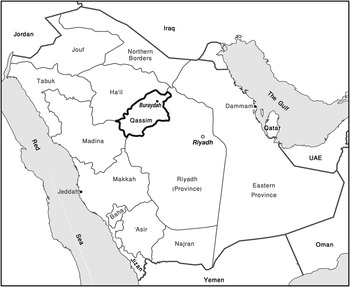
The present study examines sociolinguistic variation and change in the use of [k] affrication as employed in QaṣimīFootnote 1 Arabic (henceforth QA), a variety of Najdi Arabic mainly spoken in the Qaṣīm province in central Saudi Arabia (see Figure 1). In particular, this study attempts to identify possible correlations of that variation with the linguistic environment and with social factors of speaker's age, gender, and educational level. It provides a glimpse at the effect of recent socioeconomic change on language use in this particular dialect.
The location of the Qaṣīm province.

A fair number of studies have examined sociolinguistic variations and changes in a range of Arabic dialects in many Arab countries, including Egypt (e.g., Haeri, Reference Haeri1991, Reference Haeri1994; Schmidt, Reference Schmidt1974, Reference Schmidt1986), Jordan (e.g., Abd-el-Jawad, Reference Abd-el-Jawad1981, Reference Abd-el-Jawad1987; Al-Khatib, Reference Al-Khatib1988; Al-Wer, Reference Al-Wer1997, Reference Al-Wer and Rouchdy2002), Iraq (e.g., Abu-Haider, Reference Abu-Haider1989), Bahrain (Holes, Reference Holes1983, Reference Holes1986, Reference Holes1987), and Syria (e.g., Daher, Reference Daher, Benmamoun, Eid and Haeri1999; Jassem, Reference Jassem1987; Kojak, Reference Kojak1983). However, most of the available research on Najdi Arabic has been carried out by traditional dialectologists by describing the general patterns of the linguistic use of certain dialects across particular regions and tribes (e.g., Abboud, Reference Abboud1964, Reference Abboud1979, Reference Abboud, Jazayery, Polome and Winter1987; Al-Sweel, Reference Al-Sweel1987, Reference Al-Sweel1990; Ingham, Reference Ingham1982, Reference Ingham1994; Lehn, Reference Lehn and Stuart1967; Prochazka, Reference Prochazka1988). Therefore, this study is motivated by the need to investigate and analyze linguistic variations and changes in Najdi Arabic, particularly following the massive socioeconomic changes that Saudi Arabia has experienced during the last few decades.
The influence of social factors on linguistic variation and change is more evident and significant in communities that are undergoing a process of urbanization and modernization (Miller, Reference Miller2005:903; Milroy & Gordon, Reference Milroy and Gordon2003:130). In such situations, people often experience intense and abrupt social changes, particularly those relevant to social mobility, migration, and dialect contact.
In the Arab world, it has been suggested that the social changes brought about by urbanization have had a major linguistic impact in the 20th century (Holes, Reference Holes1995; Miller, Reference Miller, Haack, De Jong and Versteegh2003, Reference Miller, Miller, Al-Wer, Caubet and Watson2007). In Saudi Arabia, Al-Shehri (Reference Al-Shehri1993) has examined the effect of social urbanization on the use of six linguistic variables in the speech of rural immigrants in Hijaz (Western Saudi Arabia). The results indicate that speakers converge on and systematically diverge from the urban speech pattern based on linguistic and extralinguistic factors. A similar study by Kahtani (Reference Kahtani1993) investigated the impact of social changes on phonological variation in spoken Arabic in Asir (southern Saudi Arabia). The findings show a number of emerging linguistic changes linked with the social changes and the urbanization process.
In many situations in urban and rural contexts, sociolinguists have identified dialect leveling as the driving force behind linguistic changes. Dialect leveling can be defined broadly as “a process whereby differences between regional varieties are reduced, features which make varieties distinctive disappear, and new features emerge and are adopted by speakers over a wide geographical area” (Williams & Kerswill, Reference Williams, Kerswill, Foulkes and Docherty1999:149). According to Kerswill (Reference Kerswill, Britain and Cheshire2003), when dialect leveling is observed in a wide geographical area, it should be referred to as regional dialect leveling. Torgersen and Kerswill (Reference Torgersen and Kerswill2004:26) have expanded earlier definitions of regional dialect leveling by emphasizing three issues involved in this process: (1) geographical diffusion, (2) leveling, and (3) noncontact-oriented, extralinguistic factors. Geographical diffusion refers to the spreading of linguistic features from a populous, economically dominant center to the surrounding areas (Britain, Reference Britain, Chambers, Trudgill and Schilling-Estes2002; Trudgill, Reference Trudgill and Trudgill1983, cited in Torgersen & Kerswill, Reference Torgersen and Kerswill2004:26). Leveling can be narrowly defined here as “the reduction of the number of variants following speaker accommodation through face-to-face interaction” (Torgersen & Kerswill, Reference Torgersen and Kerswill2004:26). Extralinguistic factors include social-psychological issues, such as identity, attitude, and ideology, leading to the adoption of attractive features and the avoidance of stigmatized and marked forms.
The geographical diffusion of linguistic changes described herein is usually termed urban hierarchical diffusion (Britain, Reference Britain2005). Trudgill (Reference Trudgill1974) has developed a more complex hierarchical model, known as the gravity model, based on size, distance, and linguistic similarity to explain the spatial diffusion of linguistic features from London into towns and villages in East Anglia. In addition to urban hierarchical diffusion, linguistic diffusion may follow one of three different geographical patterns: (1) wave diffusion, whereby innovations spread outward from a focal area, reaching geographically close locations before those at greater distances; (2) contrahierarchical diffusion, in which linguistic features spread against the urban hierarchy, that is from the countryside into the town and finally to the cities; and (3) cultural hearth diffusion, whereby a linguistic form takes hold in one speech locality before spreading to other parts of the country.
In contemporary Arabic dialects, several sociolinguistic studies have demonstrated that dialects spoken in the main cities, particularly the capital cities, are emerging as national or regional (supralocal) standards, and their variants are imposed on the surrounding areas (e.g., Abd-el-Jawad, Reference Abd-el-Jawad1986; Abu-Haider, Reference Abu-Haider1989). In these situations, linguistic change follows an urban hierarchy model, with changes often beginning in major metropolitan centers (mostly capital cities), then spreading out to nearby smaller centers, and eventually diffusing outward to rural and Bedouin dialects. However, the urban hierarchy model is not the only one observed in Arabic dialects. In several other contexts, pre-existing urban dialects have receded in the face of newly migrated forces with rural or Bedouin backgrounds, mainly due to the political dominance and prestige associated with those individuals (e.g., Abu-Haider, Reference Abu-Haider1991; Holes, Reference Holes1983, Reference Holes1986).
BACKGROUND
Affrication of [k] in Old Arabic dialects
Sībawaih, the medieval Classical Arabic grammarian, was the scholar responsible for the original description of the early Arabic phonological phenomenon, later called kashkasha/kaskasa, which was observed mostly in certain tribal dialects in Arabia (‘Anīs, Reference ‘Anīs1992:121, see Watson, Reference Watson1992, for a review). It involved the second-person feminine singular object/possessive pronoun [–ki], which was realized with the addition or (more rarely) the replacement either by /ʃ/, yielding [-kʃ] (called kashkasha), or /s/, yielding [–ks] (called kaskasa). It was observed predominantly in pauses, but its use within the phrase was also attested (Watson, Reference Watson1992:64). To Sībawaih, it was primarily motivated by the need to preserve the vowel in the feminine singular object pronoun [–ki] in the pause, and thus, to maintain the distinction between this pronoun and the masculine one [–k]. Historically speaking, it is not yet clear whether the phenomena of kashkasha/kaskasa, described by Sībawaih and many early Classical Arabic grammarians, are related to the process of affrication affecting the same pronoun, [–ki], which in some modern Arabic dialects is currently realized in the form of the affricated reflexes [] or [ ] depending on the area (see Watson, Reference Watson1992, for a discussion on the argument about this issue).
The perception of the affricated dialects and their linguistic features was not explicitly noted by early Arab grammarians such as Sībawaih, whose accounts are restricted purely to description. However, later Arab grammarians view these as deviant, infelicitous, and peculiar phonological features that should be avoided (Watson, Reference Watson1992:63). These prescriptive views are part of the grammarians’ efforts to produce pedagogical grammars of the classical Arabic language, but they did not inhibit the use of the phonological features in Arabic dialects.
Affrication of [k] in modern Arabic dialects
According to Johnstone (Reference Johnstone1963:210–211), /k/ is affricated in modern Arabic dialects in the Arabian Peninsula to either [] or []. Whereas [] is widely used in Bedouin dialects and urban centers in Najd, [] is mainly used in urban dialects in the Gulf, Baghdad, Basra, Oman, Ḥaḍramawt, Ḍofār, Northern Yemen (Watson, Reference Watson1992:60), Najran and Abha (Prochazka, Reference Prochazka1988:126), and Syria (Jassem, Reference Jassem1987). Affrication is not attested in some dialects on the peninsula, such as the Hijazi/Western dialects of Saudi Arabia.
In Najdi Arabic, there are two types of [k] affrication: (1) affrication in the stem and (2) affrication in the suffix form. Whereas stem affrication is a phonological feature occurring mostly in the environment of front vowels, affrication in the suffix is a morphophonological feature that affects the second-person feminine suffix. Affrication in the suffix has also a syntactic function in that it signals the gender of the speaker: [–ik] for the masculine and [–its] for the feminine. Because these types of affrication involve two variables, (k) and (–ik), with a different function and variable context, they will be analyzed and discussed separately in the present study.
Descriptions of the synchronic distribution of stem and suffix affrication in Najdi Arabic by traditional dialectologists (e.g., Ingham, Reference Ingham1994; Johnstone, Reference Johnstone1963; Prochazka, Reference Prochazka1988) tend to be outdated and even inaccurate in some cases. Although [k] affrication is a common feature of Najdi Arabic in general, one cannot assume that it is the norm in each dialect of Najdi Arabic, particularly following the huge socioeconomic changes that this region has undergone in the past few decades. For example, whereas [] is often heard in the dialects of Qassim and Ha'il and other surrounding areas in North-Central Arabia (see Figure 1), it is rarely heard in the modern dialect of Riyadh (the country's capital), as the deaffricated variant [k] is increasingly adopted in both the stem and suffix form. In a recent study, Al-Azraqi (Reference Al-Azraqi, Miller, Al-Wer, Caubet and Watson2007) indicated that speakers from Riyadh have the highest rates of [k] use in the second-person feminine suffix, as compared with rates among speakers from other cities, including Dammam, Skaka, Abha, and Būraydah. Similarly, Al-Essa (Reference Al-Essa, Al-Wer and de Jong2009:220), in her study of Najdi affrication in contact situations with Hijazi Arabic speakers, noted that speakers who were born and raised in Riyadh produced the highest number of tokens with [–k] in the suffix form than did speakers from other Najdi cities. These observations of the increased use of the deaffricated variants in the modern dialect of Riyadh suggest that shifting to /k/ in Najdi is possibly the outcome of a leveling process that has emerged and developed in Riyadh.
Qaṣīmī: A profile of the dialect
As stated earlier, QA is a local variety of Najdi Arabic spoken mainly by the sedentary population (ḥaḍar) of the Qaṣīm province (Ingham, Reference Ingham1994:4–5). Unfortunately, there is very little information about the historical formation and evolution of this dialect and the linguistic situation in terms of present-day use. However, one can assume that its origin dates back to the first centuries when people began establishing new settlements in Qaṣīm, that is, the period between the 13th and 16th centuries. It shares some linguistic features with other neighboring dialects, such as Sūdair and al-Washim in central parts of Najd, but some of its features (particularly its phonological and morphological ones) are shared by the Ḥā'il dialect.Footnote 2 Both the Najdi and Ḥā'il dialects preserve features originally used in Old Arabic dialects dating back to the pre-Islamic era, namely those of the ancient Arab tribe Ṭaī.
Qaṣīm: A social profile
The QaṣīmFootnote 3 province is located in the north-central region of Saudi Arabia, situated about 300 km directly northwest of Riyāḍ, the county's capital (see Figure 1). It is bordered on the north by the Ha'il province, on the south and east by the Riyadh province, and on the west by the Medina province. Until the early 1960s, Qaṣīm formed a cluster of villages and oases. It has traditionally been an agricultural region, with the majority of its inhabitants working as palm cultivators.
The establishment of Saudi Arabia in 1932, followed by the discovery of enormous petroleum reserves in the late 1930s, brought huge socioeconomic changes to the new country. Oil revenues, especially the high oil prices in the 1970s and early 1980s, created an economic boom followed by great and sudden social changes (Salaam, Reference Salaam2000). Accordingly, people in Saudi Arabia generally have undergone a rapid process of modernization and urbanization that has transformed nearly all aspects of their lives (Al-Jehani, Reference Al-Jehani1994). The people in Qaṣīm are no exception in this sense, but such changes took place at a relatively slower rate than they did in larger cities such as Riyadh, Jeddah, and Dammam. The population of Qaṣīm is almost one million (based on the 2004 census), almost 50% of whom live in Būraydah (the regional capital). The people in Qaṣīm have generally exchanged their traditional and rural lifestyle for a modern, urban one. Cities in Qaṣīm have expanded at all levels, changing a traditional environment associated with small towns surrounded by palms and oases into a set of contemporary and metropolitan urban centers.
The city of BūraydahFootnote 4 is the regional administrative capital of Qaṣīm and the second largest city in Central Arabia after Riyadh. Its population has risen from almost 70,000 (1974 census) to nearly half a million (2004 census). According to Al-Abdul-Munaiem, Al-Sudani, Al-Jabr, and Al-Mugbl (Reference Al-Abdul-Munaiem, Al-Sudani, Al-Jabr and Al-Mugbl2002), it is estimated that more than 50% of the population in Qaṣīm is under the age of 20.
Education has developed rapidly in Saudi Arabia during the last half century. Before the economic boom, the vast majority of people were illiterate because of the country's lack of a public educational system. Today, a new educational system has been established and developed. Schools have been opened nationwide, raising the rate of literacy to more than 80% (2004 census). Standard Arabic is now the medium of instruction in all educational settings, and that has influenced people's use and perception of their spoken dialects.
An important outcome of the socioeconomic changes for the people of Qaṣīm and their dialect is increased dialect contact with other speech communities in neighboring regions, particularly Riyadh. Increased dialect contact has resulted because many families from Qaṣīm have migrated to Riyadh; this process began in the early 1970s and has accelerated rapidly since the late 1970s. The reasons for migration are the same for most families: better jobs and education opportunities. Most of these families have also kept contact with their relatives and friends in Qaṣīm.
THE PRESENT STUDY
Definition of the variables
Dependent variables
For the purpose of the present study, two dependent variables are delimited. The first variable is the use of the variants of /k/, [], and [k], in the stem, as illustrated in [atsil] ‘food’ for [] and [barkih] ‘cistern’ for [k]. The second variable concerns the use of [k] and [] in the second-person singular feminine object/possessive pronoun /-ik/, as illustrated in [kita:bik] ‘your book (fem.)’ for [k] and [mints] ‘from you (fem.)’ for [].
Independent variables
One linguistic independent variable concerns the phonological environment, that is, whether the [k] affrication is phonologically conditioned in the environment of front vowels (i.e., before or after front vowels), as stated in some previous studies (e.g., ‘Anīs, Reference ‘Anīs1992; Cantineau, Reference Cantineau1936/1937; Johnstone, Reference Johnstone1963, Reference Johnstone1967). It also seeks to examine the narrower phonetic conditioning, that is, whether the affrication of [k] applies more before high [i, i:] than low [a, a:] front vowels. For this purpose, this linguistic constraint has three levels: no front vowel adjacency, for example, [warts] ‘upper part of thigh’; low front vowel adjacency, as in [tsarʃih] ‘belly’; and high front vowel adjacency, as in [di:ts] ‘cock’.
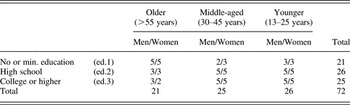
In addition, three social variables are included: age, gender, and education level. With respect to age, the 72 participants were divided into three predetermined groups: younger, 13–25 years old (i.e., individuals born after 1985, who thus grew up after the socioeconomic changes); middle-aged, 30–45 years old (i.e., individuals born between 1965 and 1980, and so grew up during the socioeconomic changes); and older, over 55 years old (i.e., individuals born before 1955, who thus grew up before the beginning of the socioeconomic changes). For the variable of education, speakers are divided into three groups: those with no or minimal education (Ed.1), those with high school–level education (Ed.2), and those with college-level education or higher (Ed.3) (see Table 1).
The distribution of participants by age, gender, and level of education (N = 72)

Many previous studies on a range of Arabic speech communities demonstrate that linguistic changes are highly correlated with gender, particularly in dialects for which there is interplay between local and regional features. Regarding education level, it should be noted that Classical Arabic is often adopted as the standard mode of teaching in the Saudi educational system. Thus, it is essential for the present study to examine whether a higher level of education increases a speaker's use of [k] as an indication of a shift toward standard forms.
METHOD
Interviews
The data used in this study have been gathered via sociolinguistic interviews, all of which were conducted by the author, with female assistants, over nearly nine months. The interviews were recorded using a digital tape recorder and lasted an average of 50 minutes, with a total duration of about 56 hours.
Because the purpose of the interviews was to elicit frequent use of /k/ with its variants in natural data, two measures were taken to maximize the likelihood of eliciting this variant. First, the author, a native speaker of QA, carried out all of the interviews, as it was thought that this would encourage the speakers to use their natural vernacular. Second, to ensure that the participants used the second-person feminine singular object/possessive suffix in addressing or referring to women, a woman (the author's wife, mother, sister, or aunt) attended and participated in each interview, interacting with both male and female participants. This procedure was also helpful in expanding the circle of participants who met the selection criteria used in this study.
Participants
Due to Saudi social traditions, including local understanding of religious teachings associated with men's immediate contact with women other than their relatives, it was impossible for the author, as a man, to interview women randomly in the speech community of Būraydah, Qaṣīm. Instead, the author's female informants were relatives who fit the criteria for selecting participants as illustrated herein.
The most important selection criterion for participants was that they had been born and raised in Būraydah, Qaṣīm. They also had to be speakers of QA. Because QA is primarily spoken by settled (ħaḍari) people, the author limited the participants to members of settled families. Although a detailed and up-to-date census was not available for Būraydah, the author attempted to make the distribution of the sample for each social factor as close as possible to the actual distribution of the population in Būraydah. Furthermore, as suggested by Feagin (Reference Feagin, Chambers, Trudgill and Schilling-Estes2002:29), the author labored to include five persons per cell. However, as shown in Table 1, it was difficult to find speakers over the age of 55 with a high school or a college degree, especially women, because such degrees are very rare among older speakers in Būraydah. Finding illiterate middle-aged or younger speakers was also not an easy task. Thus, the number of illiterate or minimally educated speakers was a bit lower (n = 21) than that of participants with high school (n = 26) or college and higher degrees (n = 25). Five speakers with graduate degrees were interviewed: two older men with PhDs, two middle-aged men with PhDs, and one woman with an MA.
Analysis
Each instance of every lexical item containing /k/ was recorded and classified as belonging to one of the two variants, [k] or [], and coded according to the dependent and independent variables described earlier. Close examination of the variability patterns of the lexical items indicates that some do not display variation regardless of the context in which they occur. For example, there are cases in the present data in which the phonological condition for affrication is met but affrication does not occur, as in [kita:b] ‘book’, [takjji:f] ‘air conditioning,’ [ʃarika] ‘company’, [tawki:l] ‘authorization’, [ki:mmja] ‘chemistry’, [kirsi] ‘chair’, [taðkira] ‘ticket’, etc. These exceptions can be explained as the result of their being borrowed from Modern Standard Arabic. The same observation applies to borrowings from European languages, as in [tanki:] ‘tank’, [kakaw] ‘chocolate’, [kalu:ba] ‘hair clip’, [djake:t] ‘jacket’, [bre:k] ‘brake’, [ e:k] ‘jug’, [kabsu:la] ‘capsule’, etc. For this reason, these tokens were excluded from the quantitative analysis. In addition, affrication does not apply in the context of emphatic or doubled segments, even if the phonological environment is met, as in [dikkan] ‘shop’, [sikkar] ‘sugar’, [sikkan] ‘inhabitants’, etc. These tokens were also excluded from the analysis.
Following these protocols, 2396 tokens (908 realized with []: 668 in the stem and 237 in the suffix) and 1488 with [k] (all in the stem) were retained for multivariate analysis. A variable rule analysis was then performed using Goldvarb 3.0 (Sankoff, Tagliamonte, & Smith, Reference Sankoff, Tagliamonte and Smith2005), a probability-generating multivariate analysis application program. Factor weights above .5 are taken to indicate a factor that favors affrication, whereas weights under .5 disfavor affrication.
RESULTS
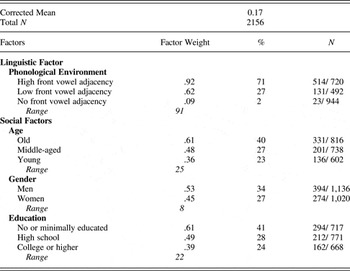
Affrication of [k] in the stem will be presented first, followed by suffix-based affrication. The results for affrication in the stem, comprising raw numbers, percentages, and probabilities are listed in Table 2.
Variable rule analysis of the contribution of significant linguistic and social factors to the probability of affrication of [k] in the stem

Affrication in the stem
Linguistic constraint
One linguistic factor group was examined in the present study, the phonological context, namely whether affrication of [k] occurs in the adjacency of high front vowels, low front vowels, or no front vowels. The probabilities in Table 2 show that adjacency to high and low front vowels contribute statistically significant effects to [k] affrication. Specifically, affrication of [k] is most highly favored by adjacency to high front vowels with a relative weight of .92, followed by low front vowels (.62), whereas no front vowels disfavors it (.09) very strongly (only 2% affrication in this environment). Such results further support the phonological rule proposed in the literature (e.g., ‘Anīs, Reference ‘Anīs1992; Cantineau, Reference Cantineau1936/1937; Johnstone, Reference Johnstone1963, Reference Johnstone1967).
Social constraints
Table 2 shows that all social factors examined—age, gender, and level of education—have significant main effects. Of these, age and education are more important based on the range between the factor weights.
The results in Table 2 show clearly an age pattern suggesting a language change in progress, with old speakers more likely to affricate, the young less likely, and the middle-aged falling in between. In terms of gender, men appear to favor affrication more than women do. Education exhibits a pattern congruous with the results for age, in which the use of affrication is correlated with the speakers’ level of education. Not or minimally educated speakers are the most likely users of affrication, whereas college-level educated speakers are the least likely, and high school diploma holders are in between.
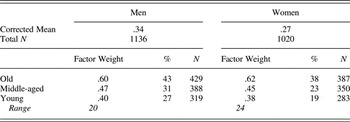
To explore possible interactions between factor groups, separate variable rule analyses were conducted to investigate the effects of age by gender, gender by education, age by education, and age by gender by education). Table 3 presents the results for age in separate analyses by gender. These indicate that both older men and older women favor affrication, whereas the other age groups from both sexes disfavor it. However, women appear slightly ahead of men in disfavoring it, more so in the young and middle-aged groups.
Age and gender interaction: Two independent variable rule analyses for men and women

Note: Other factor-group(s) included in these analyses: phonological environment.
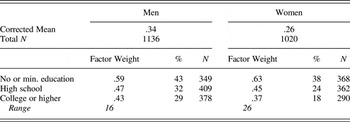
Examining the interaction of gender and education is quite revealing. Table 4 shows that, regardless of age, the least educated speakers from both sexes are most likely to affricate. In contrast, the educated groups are the least likely users of affrication, and the tendency not to affricate increases as the speakers' educational level rises, especially in women's speech at the college level.
Gender and education interaction: Two independent variable rule analyses for men and women

Note: Other factor-group(s) included: phonological environment.
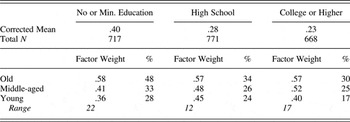
The interaction analysis of age and education sheds additional light on the speakers' use of affrication. The first point to note from the results in Table 5 is that the use of [k] affrication by speakers from all levels of education increases as their age rises; that is, the two effects are independent. Even though the analysis reported earlier in Table 2 shows that speakers with high school and college or higher level of education disfavor affrication, this does not hold true for the older speakers because, as shown in Table 5, compared with speakers with no or minimal education, older speakers with high school and college level of education favor [k] affrication. The same can be noted about speakers with no or minimal education; although they were reported in Table 2 as a whole to strongly favor affrication, the results in Table 5 show that, compared with older speakers, middle-aged and young speakers with limited education disfavor it. These results suggest that the speakers' level of education alone is not sufficient to predict the proportion of stem affrication.
Age and education interactions: Three independent variable rule analysis by level of education

Note: Other factor-group(s) included: phonological environment.
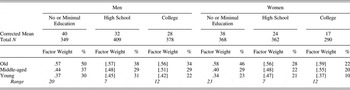
The results of the interaction analysis of all social factor groups: age, gender, and educational level are presented in Table 6. Only the results of no or minimally educated groups from both sexes are selected as significant. That is, age differences are more important among speakers with no or minimal education than among more educated speakers, for both men and women. The analysis confirms the results reported in which the [k] affrication is most prevalent among no or minimally educated older speakers from both sexes, with rates close to 50%. The other age groups with no or minimal education appear to disfavor affrication, and their use is correlated with their age level in that the youngest speakers are least likely to use the affricated variant.
Age, gender, and education interactions: Six independent variable rule analyses for men and women, by level of education

Notes: Factor groups not selected as significant are in square brackets. Other factor-group(s) included: phonological environment.
Affrication in the clitic [-k]
The results indicate that the second-person singular object/possessive feminine suffix /-k/ is categorically used as [-] in all the collected tokens. Furthermore, unlike stem-based affrication, there is no phonological conditioning system for the use of suffix-based affrication. Among the 237 tokens collected, there were 149 tokens (63%) in which suffix-based affrication was used in postconsonantal environments, as in [min] ‘from you (fem.)’, [kita:b] ‘your book (fem.)’, etc. The remaining tokens were used following vowels, including high front vowels (53 tokens, 22%), as in [fi:] ‘in you (fem.)’, [j-kfi:] ‘to meet the requirements (fem.)’, etc, low front vowels (35 tokens, 15%), as in [j-jiza:] ‘to reward you (fem.)’.
Neither was social variation observed in the use of the clitic form as all speakers with no exception used the affricated variant 100% of the time. Such findings indicate that speakers still rely on the affricated clitic to signal the feminine gender in the second person.
DISCUSSION
Overall, the findings indicate that there has been an active gradual shift to deaffricate [k] in QA, particularly in the speech of younger educated female speakers. This sound change, however, appears to be confined to the stem form, as the second-person singular feminine suffix -ik is still categorically used as -its among all social groups. Why is this shift happening? Why is the suffix form not influenced by this change? Are there linguistic, social, and/or sociopsychological (extralinguistic) factors influencing and accelerating this shift? If so, what are they? To seek explanation of the driving forces behind the variation patterns, we need first to explore the linguistic situation not only in the Qassim province but also in other neighboring regions. The following section presents a discussion of the main results and discusses linking them with those found in previous studies of Arabic sociolinguistics.
The present findings are rather typical of patterns reported in other studies of dialect leveling, as evidenced by the low usage of the traditional and socially marked form by younger speakers as compared to older ones, combined with a rise in younger speakers' use of the less marked form common in the broader regional community. Recalling the model of regional dialect leveling suggested by Torgersen and Kerswill (Reference Torgersen and Kerswill2004), the following describes how it can be applicable to the variation patterns observed in the present data. This model also will help to understand the mechanisms of the spatial diffusion of [k] in a wide geographical and social space such as Central Saudi Arabia. An attempt will be first made to identify the origin of the change, followed by a description of the possible pattern of geographical diffusion of [k] in central Saudi Arabia.
Riyadh, the capital of and the largest metropolitan center in Saudi Arabia, has begun to play a key role in cultural, social, and linguistic changes in the past few decades, particularly in Central Arabia (Najd). This is primarily due to the city's rapid population growth, economic prosperity, and political dominance. Linguistically, it is becoming the focal point of change, playing the same role observed in other Arab urban centers such as Cairo, Baghdad, Damascus, and Amman. The features of these large cities' dialects are associated with modernity and the urban cultural model, particularly for the neighboring local speech communities, and even for former important regional cities (Miller, Reference Miller, Miller, Al-Wer, Caubet and Watson2007:8). Therefore, the dialect of Riyadh is emerging as the supralocal standard associated with a new urban identity on the regional level in central Arabia, and its features are diffusing outward at the expense of localized smaller centers' dialects. The deaffrication of [k] in the stem and suffix form is one such feature.
On the other hand, Būraydah, as the second largest city in central Saudi Arabia, and the closest to Riyadh (with a similar linguistic system), is increasingly influenced by Riyadh, more so than any other major city in Saudi Arabia. Moreover, the strong ties between the Qaṣīmī families that moved to Riyadh, and their families and friends remaining in Qaṣīm may also have enforced acceleration of such an influence. The observed pattern of linguistic change fits the urban hierarchical pattern of linguistic diffusion situations (Britain, Reference Britain2005). Therefore, the Buraydah speakers approximate the Riyadh form, as it can be associated in local ideology with urban personae, modernization, progress, and social mobility.
Although investigating the social and symbolic significances that underlie these patterns of variation was not part of the scope of the present work, there are indications of a shift in the social meanings and the types of perceptions that the speech community in question attaches to the local and supralocal variants. For example, on one occasion during data collection, I heard a mother asking her daughter not to use [] at any time. In her explanation of this practice, she claimed that [] has recently become associated with provinciality and old-fashioned speech; hence, her children should avoid using it. In another informal conversation with a young female speaker, she repeatedly linked the use of [k] with the new urban style associated with being modern, correct, and normal. She even used a new verb [tsatsi] ‘to use [] frequently’ in her description of how it had become inappropriate for girls at her age to use [k] affrication in casual speech. These comments clearly suggest that the Būraydah speech community in their local ideology have developed a social meaning for the deaffrication of [k] associated with urban style, and that they use this variation as a linguistic resource to index their locally constructed urban identity. Further support for this argument comes from my observation of other linguistically distinctive features of QA, such as the deletion of /-i/ in the first-person object pronoun –ni, and the pronunciation of the third-person masculine object and possessive pronoun as /-uh/. Specifically, I noted that speakers in my interviews have not changed their use of these features despite their regional distinctiveness. This would suggest that these features, unlike the deaffrication of [k], have not yet been associated with a social value. Furthermore, the observation that affrication to [] in Arabic dialects in the Gulf region and Iraq remains the norm generally adds further support to the potential effect of social meaning for the two variants. However, this remains speculative for all speakers, and we cannot be more certain about the local indexical potential of [k] and [] without explicit information about the speakers' attitudes and perceptions toward using them.
To understand why the shift to [k] diffuses in an urban hierarchical pattern requires an understanding of the role of social variables in such a process. The three social factors selected in the present study were found generally to be amplifiers of the spread of [k]. The pattern of variation among age generations simply indicates that the deaffrication of [k] is a linguistic change in progress. The same is true for gender. As with many other situations of change in progress, women with similar age and education level are significantly leading men in their adoption of the new form. However, an interaction of these social factors can better account for its spread. The youngest generation, particularly female and educated speakers, who grew up after the socioeconomic changes, were more likely than the other groups to be influenced by the linguistic diffusion.
The present patterns of variation are consistent with the conclusion reached in many previous studies, reviewed herein, in urban areas of the Arabic-speaking world. In these communities, younger women are found to favor the supralocal urban variants, whereas men, particularly older ones, opt for localized and older variants. The difference between the present and previous studies in some Arabic-speaking communities is that whereas the standard variant and the supralocal urban variant happen to be identical, as with [k] in the present study, the linguistic change in some prior studies involves a movement away from the requirement of Modern Standard Arabic, as with [j] in Bahrain (Holes, Reference Holes1986); [ʔ] in Nablus (Abd-el-Jawad, Reference Abd-el-Jawad1987) and in Damascus (Daher, Reference Daher, Benmamoun, Eid and Haeri1999); and [t], [s], [d], and [z] in Mecca (Al-Ahdal, Reference Al-Ahdal1989; Al-Jehani, Reference Al-Jehani1985). The present findings also accord with the pattern found in previous studies concerning the effect of education (e.g., Al-Wer, Reference Al-Wer and Rouchdy2002; Daher, Reference Daher, Benmamoun, Eid and Haeri1999; Haeri, Reference Haeri1997; Jabeur, Reference Jabeur1987; Jassem, Reference Jassem1987; Sallam, Reference Sallam1980). It has been found that the more educated the speaker is, the higher the frequency of use of the innovative linguistic features, regardless of whether the innovative features are in agreement with Classical Arabic.
The important finding that none of the speakers changed their local pronunciation of the variable when it occurred in the suffix indicated a high level of maintenance of the localized feature by all social groups. (Note that in Riyadh, the same suffix is often deaffricated.) This pattern can be explained in terms of the morphosyntactic function that suffix affrication performs in QA. As mentioned earlier, suffix affrication has a syntactic function in the dialect under investigation, namely signaling gender distinction: the second-person feminine clitic [-ts] versus the second-person masculine clitic [-k]. Therefore, unlike stem affrication, deaffrication of [-k] in the suffix is not a simple phonetic process that requires only the straightforward substitution of /ts/ by /k/; it is a complex process involving the risk of losing the gender information in the second-person feminine suffix.
The observed findings are similar to those obtained in Al-Essa's (Reference Al-Essa, Al-Wer and de Jong2009) study, which investigates Najdi affrication in contact situations with speakers of Hijazi Arabic, but contradict Al-Azraqi's (Reference Al-Azraqi, Miller, Al-Wer, Caubet and Watson2007) finding that men use [k] more frequently than women do in five urban centers in Saudi Arabia. A plausible explanation for these contradictory results lies in the different degrees of formality of data collection in the two studies. In the present study, data collection involved spontaneous and informal speech among family members. However, in Al-Azraqi's (Reference Al-Azraqi, Miller, Al-Wer, Caubet and Watson2007) study, the participants did not have the same close relationship with each other, and their interaction with the researcher appears to have been more formal, particularly for male speakers. This difference may have influenced the speech behavior of the participants in the two studies, especially with a local variant that is expected to be used more frequently in informal settings. This can also be linked to what Al-Azraqi (Reference Al-Azraqi, Miller, Al-Wer, Caubet and Watson2007) has pointed out concerning the more formal way that Saudi men interact with women to whom they are not related. Within the family circle, in contrast, men often shift to the local dialect variant.
CONCLUSIONS
The foregoing findings have demonstrated that the patterns of linguistic variation and change in the use of the variants [k] and [] are primarily correlated with the social factors of age, gender, and education. Such patterns are suggestive of a regional dialect leveling situation in which the supralocal variant(s) associated with the nearest large town is (are) spreading outward, at the expense of traditional and locally marked variant(s), by speakers of surrounding smaller towns' dialects. The relative dynamics of the current linguistic change are related to an interaction of linguistic and social factors. This linguistic change is proposed to be a result of the last half century of Saudi Arabia's rapid urbanization and modernization.
However, several issues deserve additional investigation. One concerns the possibility of the effect of other factors, such as socioeconomic class, local identity, and social mobility. Other factors may also include the context of the interaction, accommodation, and the personal attitudes of the speakers. Study of these factors will further our understanding of the actual process of linguistic change and its relation to these social variables.
Another issue is the diachronic distribution of the use of the variants of /k/ in the Riyāḍ dialect, which may determine whether the contemporary use of [k] as the normal form is the result of a sound change from [] to [k] that preceded the spread to other neighboring dialects as the regional standard, or whether there has been no change at all, and [k] was and remains the norm in the Riyāḍ dialect. No specific information about this issue has been revealed yet, although Al-Azraqi (Reference Al-Azraqi, Miller, Al-Wer, Caubet and Watson2007) has found that [] is now rarely used in the Riyāḍ dialect because its speakers have adopted [k] more than have speakers of other dialects in Saudi Arabia where affrication is often used.
A final point that merits further examination is whether this is a true change in progress or age grading (i.e., one correlated with a particular phase in life and repeated in successive generations) (Bailey, Reference Bailey, Chambers, Trudgill and Schilling-Estes2002:324). One of the best ways to answer this question is to compare earlier findings with current ones. Indeed, in extensive literature reviews, this author has not come across any evidence regarding the use of affrication in Central Arabia that claims it to be the result of age grading. Rather, all earlier studies conducted by traditional dialectologists indicate that affrication of [k] is the norm not only in Qaṣīm, but also in all of Central Arabia.
In conclusion, the current study contributes to the continual investigation of the effect of social factors on a sound change in the use of the [] and allows the understanding of its social motivation based on the interplay between local varieties and emerging regional standards.
APPENDIX
A list of all lexical items included in the study where affrication occurs in the stem (in alphabetical order).