1. Introduction
For coherent systems consisting of n independent and identically distributed (i.i.d.) components with an absolutely continuous lifetime distribution, the system signature was originally defined in [Reference Samaniego22] as a vector
 $\boldsymbol{s} = ({s_1}, \ldots ,{s_n})$
, where
 $s_i$
is the probability that the system fails due to the failure of the ith ordered component. The system signature plays an important role in describing structures of reliability systems, and it can be more efficient than the traditional structure function for some large complex systems. Comparisons between different system structures can be carried out based on stochastic orderings of their corresponding system signatures [Reference Kochar, Mukerjee and Samaniego15], while transformation formulas for signatures of different sizes established in [Reference Navarro, Samaniego, Balakrishnan and Bhattacharya21] facilitate the comparison of systems with different numbers of components. Elaborate discussions on the theory and applications of system signature can be found in [Reference Samaniego23], while comparisons of different computational methods for system signature can be seen in [Reference Yi and Cui31].
Some other concepts related to system signatures have also been introduced based on different types of systems; for example, maximal/minimal signature for coherent systems with exchangeable components [Reference Navarro, Ruiz and Sandoval19], dynamic signature for used working coherent systems with known numbers of component failures [Reference Samaniego, Balakrishnan and Navarro24], joint signature for two coherent systems with shared components [Reference Navarro, Samaniego and Balakrishnan20], survival signature for coherent systems with multiple types of components [Reference Coolen and Coolen-Maturi6], joint survival signature for multiple coherent systems with multiple types of shared components [Reference Coolen-Maturi, Coolen and Balakrishnan7], ordered system signature for several independent and identical coherent systems under a life-testing experiment [Reference Balakrishnan and Volterman5], and progressive censoring signature for coherent systems with censoring plans [Reference Cramer and Navarro8, Reference Cramer and Navarro9]. For multi-state coherent systems with binary/multi-state components, concepts such as multidimensional D-spectrum [Reference Gertsbakh and Shpungin13], bivariate signature [Reference Da and Hu10], multi-state survival signature [Reference Eryilmaz and Tuncel12, Reference Yi, Balakrishnan and Cui29], and multi-state ordered signature [Reference Yi, Balakrishnan and Cui28] have also been introduced and studied in detail by a number of authors.
In the present work, we mainly focus on the notion of ordered system signature due to [Reference Balakrishnan and Volterman5], which is quite useful in developing inference for component lifetime distribution based on system lifetime data [Reference Yang, Ng and Balakrishnan26, Reference Yang, Ng and Balakrishnan27]. This concept was originally defined in [Reference Balakrishnan and Volterman5] for several independent and identical coherent systems under a life test, but the assumption of identical systems is really not necessary. Here, we first extend this notion of ordered system signature to the case of independent and non-identical systems, then use it to develop the concept of dynamic ordered system signature, which is then used to study dynamic properties of coherent systems.
To investigate residual lifetimes of used systems, [Reference Navarro, Balakrishnan and Samaniego18] considered representations of their reliability functions and found that the residual lifetime of a used system is indeed a mixture of residual lifetimes of several k-out-of-n systems. As in [Reference Navarro, Balakrishnan and Samaniego18], but under a particular condition on the number of failed components, [Reference Samaniego, Balakrishnan and Navarro24] introduced the notion of dynamic signature through distribution-free coefficients of the reliability representation for used working systems. Similar concepts and related properties of used coherent systems were further investigated in [Reference Mahmoudi and Asadi17] under different conditions on the system lifetime. Subsequently, different types of used systems have been investigated using some concepts similar to dynamic signature, such as networks under nonhomogeneous Poisson processes [Reference Zarezadeh, Asadi and Balakrishnan32], three-state networks under different conditions on system and components [Reference Ashrafi and Asadi1], coherent systems with dependent components [Reference Eryilmaz, Coolen and Coolen-Maturi11, Reference Kelkinnama, Tavangar and Asadi14], and multi-state coherent systems with shared components [Reference Yi, Balakrishnan and Cui30]. More discussions on related stochastic ordering results can be found in [Reference Lindqvist, Samaniego and Wang16, Reference Toomaj, Chahkandi and Balakrishnan25].
In this paper, some properties of used coherent systems are studied using a newly introduced concept called dynamic ordered system signature, which is defined in terms of a general ordered system signature based on independent and non-identical coherent systems under a life-testing experiment. The rest of the paper proceeds as follows. In Section 2 we first extend the notion of ordered system signature to independent and non-identical coherent systems and then establish some of its key properties which assist in simplifying its computation. In Section 3 we propose the dynamic ordered system signature that is useful in studying dynamic properties of several coherent systems under a life test. Next, in Section 4, we present several examples to illustrate all the developed results. An application of these concepts to the evaluation of aging properties of used systems is demonstrated in Section 5. Finally, we present some concluding remarks in Section 6.
2. Ordered system signature for independent and non-identical systems
Based on a life test of several independent and identical coherent systems, [Reference Balakrishnan and Volterman5] introduced the concept of ordered system signature as follows.
Definition 2.1. (Ordered system signature.) For a life test of n independent and identical coherent systems, each of which has m i.i.d. components and a common system signature
 $\boldsymbol{s}$
, the ith
 $(i=1,\ldots,n)$
ordered system signature is defined as the vector
 ${\boldsymbol{s}^{(i:n)}} = \big(s_1^{(i:n)}, \ldots ,s_m^{(i:n)}\big)$
, where, for
 $j = 1, \ldots ,m$
,
 \[s_j^{(i:n)} = \sum\limits_{k = 1}^n {\mathbb{P}\Big\{ {T_{i:n}} = X_{j:m}^{(k)}\Big\} } = \sum\limits_{k = 1}^n {\mathbb{P}\Big\{ {T_{i:n}} = X_{j:m}^{(k)}\mid {{T_{i:n}} = {T_k}} \Big\} } \]
is the probability that the ith ordered system failure corresponds to a system that failed due to its jth ordered component failure. Here, for system k
 $(k=1,\ldots,n)$
, component lifetimes
 $X_1^{(k)}, \ldots ,X_m^{(k)}$
are assumed to have a common continuous distribution function F, and
 $X_{1:m}^{(k)}, \ldots ,X_{m:m}^{(k)}$
are the corresponding ordered (in ascending order) lifetimes; similarly, the system lifetimes
 ${T_1}, \ldots ,{T_n}$
are ordered (in ascending order) as
 ${T_{1:n}}, \ldots ,{T_{n:n}}$
.
Even though this definition was given in [Reference Balakrishnan and Volterman5] for the case of independent and identical coherent systems, it can easily be directly extended to the case of independent and non-identical coherent systems of the same size, and then subsequently to independent and non-identical coherent systems of different sizes by using the idea of equivalent systems and related transformation formulas developed, for example, in [Reference Navarro, Samaniego, Balakrishnan and Bhattacharya21]. The use of equivalent systems, of course, hides information about components in the systems, such as the expected number of failed components and possible maintenance policies in the original system. However, since equivalent systems of the same size share the same system lifetime distribution and component lifetime distribution, the generalization can be quite useful for describing system structures and in developing statistical inferences. Here, we first discuss some important properties of ordered system signature for the case of independent and non-identical coherent systems.
Let us consider a life test of n independent coherent systems with all their components i.i.d., and assume that they can be divided into N groups according to their equivalent systems of size m, namely, the
 $k_i$
systems in each group
 $i=1,\ldots,N$
have the same equivalent system with m components and a system signature
 ${\boldsymbol{s}^{(i)}} = \big(s_1^{(i)}, \ldots ,s_m^{(i)}\big)$
. Note that m is often chosen to be the largest number of components in the n independent coherent systems. Also,
 ${k_i} \in \{ 1, \ldots ,n\} $
for all
 $i = 1, \ldots ,N$
, with
 $\sum\nolimits_{i = 1}^N {{k_i}} = n$
, and
 ${\boldsymbol{s}^{(i)}}$
are different for different i
 $(i=1,\ldots,N)$
. The component lifetimes and the system lifetimes are defined and ordered exactly as explained in Definition 2.1. Then, along the lines of [Reference Balakrishnan and Volterman5], associated properties of their ordered system signatures can be presented. The first of these is the distribution-free property, as established in the following proposition.
Proposition 2.1. The ordered system signature
 ${\boldsymbol{s}^{(i:n)}} = \big(s_1^{(i:n)}, \ldots ,s_m^{(i:n)}\big)$
is a distribution-free measure, i.e. free of the underlying component lifetime distribution F.
Proof. In each group
 $i = 1, \ldots ,N$
, assume that there are
 ${l_{i,j}}$
 $(j = 1, \ldots ,m)$
of the
 ${k_i}$
i.i.d. coherent systems that failed due to the jth ordered component failure. Evidently, all possible combinations of those
 ${l_{i,j}}$
can be given as
 \[{\mathcal{L}_\boldsymbol{k}} = \{ \boldsymbol{l} = ({l_{i,j}},\,1 \le i \le N,\,1 \le j \le m) \,:\, {l_{i,1}} + \cdots + {l_{i,m}} = {k_i}{\rm{\,for\,all\, }}i\} .\]
Then, as in the discussions of [Reference Balakrishnan and Volterman5],
 $({l_{i,1}}, \ldots ,{l_{i,m}})$
are distributed as multinomial with parameters
 $\Big( {{k_i},s_1^{(i)}, \ldots ,s_m^{(i)}} \Big)$
,
 $i = 1, \ldots ,N$
, so that, for
 $i = 1, \ldots ,N$
and
 $j = 1, \ldots ,m$
we have
 \[s_j^{(i:n)} = \sum\limits_{\boldsymbol{l} \in {\mathcal{L}_\boldsymbol{k}}} {p_{j\,|\, \boldsymbol{l}}^{(i:n)} \cdot \prod\limits_{w = 1}^N {\Bigg\{ {\Bigg( \begin{matrix} {{k_w}} \\ {{l_{w,1}}, \ldots ,{l_{w,m}}} \end{matrix}\Bigg) \prod\limits_{r = 1}^m {{{\big[ {s_r^{(w)}} \big]}^{{l_{w,r}}}}} } \Bigg\}}} ,\]
where
 $p_{j\,|\, \boldsymbol{l}}^{(i:n)}$
is the conditional probability that the ith system under test failed due to the jth ordered component failure, given a fixed value of
 $\boldsymbol{l}$
, that is, given that
 ${l_j} = {l_{1,j}} + \cdots + {l_{N,j}}$
 $(j = 1, \ldots ,m)$
systems failed due to the jth ordered component failure. Note that
 $p_{j\,|\, \boldsymbol{l}}^{(i:n)}$
depends on
 $\boldsymbol{l}$
only through
 ${l_1}, \ldots ,{l_m}$
, which means that it can also be denoted as
 $p_{j\,|\, {{l_1}, \ldots ,{l_m}}}^{(i:n)}$
. Clearly,
 $p_{j\,|\, \boldsymbol{l}}^{(i:n)}$
can be expressed as probabilities of orderings of
 $X_{{j_k}:m}^{(k)}$
, which are independent of the component lifetime distribution F. Hence, the proposition.
According to Proposition 2.1, the ordered system signature
 ${\boldsymbol{s}^{(i:n)}}$
can be computed directly from system signatures
 ${\boldsymbol{s}^{(1)}}, \ldots ,{\boldsymbol{s}^{(N)}}$
. The required computation can be simplified by utilizing some properties of the conditional probabilities
 $p_{j\,|\, \boldsymbol{l}}^{(i:n)}$
presented in the following lemma.
Lemma 2.1. For any
 $i = 1, \ldots ,n$
, the conditional probabilities
 $p_{j\,|\, \boldsymbol{l}}^{(i:n)}$
,
 $j = 1, \ldots ,m$
, satisfy the following:
-
(i) For
 ${l_{1,j}} + \cdots + {l_{N,j}} = n$
, we have
$p_{j\,|\, \boldsymbol{l}}^{(i:n)} = 1$
;
-
(ii) For
${l_{1,j}} = \cdots = {l_{N,j}} = 0$
, we have
$p_{j\,|\, \boldsymbol{l}}^{(i:n)} = 0$
; -
(iii)
$\sum\nolimits_{i = 1}^n {p_{j\,|\, \boldsymbol{l}}^{(i:n)}} = \sum\nolimits_{s = 1}^N {{l_{s,j}}} $
; -
(iv)
$p_{j\,| \boldsymbol{l}}^{(i:n)} = p_{m - j + 1\,|\, {\mathrm{rev}\,\boldsymbol{l}}}^{(n - i + 1:n)}$
, where
$\mathrm{rev}\,\boldsymbol{l} = ({l_{i,m - j + 1}},\,1 \le i \le N,\,1 \le j \le m)$
is simply the reverse ordering of
$\boldsymbol{l} = ({l_{i,j}},\,1 \le i \le N,\,1 \le j \le m)$
.


Proof. (i)
 ${l_{1,j}} + \cdots + {l_{N,j}} = n$
means that all failures of the n coherent systems are caused by the jth ordered component failure, which clearly implies that the ith failure is in them, i.e.
 $p_{j\,|\, \boldsymbol{l}}^{(i:n)} = 1$
.
(ii)
 ${l_{1,j}} = \cdots = {l_{N,j}} = 0$
means that all failures of the n coherent systems are not caused by the jth ordered component failure, which clearly implies that the ith failure is not in them, i.e.
 $p_{j\,|\, \boldsymbol{l}}^{(i:n)} = 0$
.
(iii) Given the value of
 $\boldsymbol{l}$
, there should be
 $\sum\nolimits_{s = 1}^N {{l_{s,j}}}$
 $(j = 1, \ldots ,m)$
failures among the n coherent systems that are caused by the jth ordered component failure. The same number can also be given as
 $\sum\nolimits_{i = 1}^n {p_{j\,|\, \boldsymbol{l}}^{(i:n)}} $
(with
 $p_{j\,|\, \boldsymbol{l}}^{(i:n)} = 1$
for the case that the ith ordered system failure is caused by the jth ordered component failure and
 $p_{j\,|\, \boldsymbol{l}}^{(i:n)} = 0$
for the case that it is not, under any possible realization of related order statistics), leading to the fact that
 $\sum\nolimits_{i = 1}^n {p_{j\,|\, \boldsymbol{l}}^{(i:n)}} = \sum\nolimits_{s = 1}^N {{l_{s,j}}} $
.
(iv)
 $p_{j\,|\, \boldsymbol{l}}^{(i:n)}$
is the probability of a class of orderings of n order statistics from distribution F. If we use a transformation
 $X \to M - X$
(where M is a large positive number greater than all the realizations of the order statistics) to reverse all the realizations of order statistics, then the ith smallest one in each ordering will become the
 $(n-i+1)$
th smallest one, and each system that failed due to the jth ordered component failure would then become a system that failed due to the
 $(m-j+1)$
th ordered component failure. This then implies that, for any
 $i = 1, \ldots ,N$
, if there are
 ${l_{i,j}}$
 $(j = 1, \ldots ,m)$
systems that failed due to the ordered component failure before the transformation, then following the transformation there will be
 ${l_{i,m - j + 1}}$
 $(j = 1, \ldots ,m)$
systems that failed due to the jth ordered component failure. Now, as the probability
 $p_{j\,|\, \boldsymbol{l}}^{(i:n)}$
is distribution-free, we will clearly have
 $p_{j\,|\, \boldsymbol{l}}^{(i:n)} = p_{m - j + 1\,|\, {\mathrm{rev}\,\boldsymbol{l}}}^{(n - i + 1:n)}$
. Hence the lemma.
Based on Proposition 2.1 and Lemma 2.1, we can simplify the computation of ordered system signature in the following manner.
Corollary 2.1. For any signature vectors
 ${\boldsymbol{s}^{(1)}}, \ldots ,{\boldsymbol{s}^{(N)}}$
, for all
 $n = 1,2, \ldots $
and
 $j = 1, \ldots ,m$
we will have
 $s_j^{(1:n)} = \cdots = s_j^{(n:n)} = 0$
if and only if
 $s_j^{(1)} = \cdots = s_j^{(N)} = 0$
.
Proof. For
 $s_j^{(1)} = \cdots = s_j^{(N)} = 0$
, the terms in the expression
 \[s_j^{(i:n)} = \sum\limits_{\boldsymbol{l} \in {\mathcal{L}_\boldsymbol{k}}} {p_{j\,|\, \boldsymbol{l}}^{(i:n)} \cdot \prod\limits_{w = 1}^N {\Bigg\{ {\Bigg( \begin{matrix} {{k_w}} \\ {{l_{w,1}}, \ldots ,{l_{w,m}}} \end{matrix} \Bigg)\prod\limits_{r = 1}^m {{{\big[ {s_r^{(w)}} \big]}^{{l_{w,r}}}}} } \Bigg\}} } \]
can be classified into two classes: for
 $\boldsymbol{l} \in {\mathcal{L}_\boldsymbol{k}}$
such that
 ${l_{1,j}} = \cdots = {l_{N,j}} = 0$
, corresponding terms will all be 0 with
 $p_{j\,|\, \boldsymbol{l}}^{(i:n)} = 0$
according to Lemma 2.1(ii), and for
 $\boldsymbol{l} \in {\mathcal{L}_\boldsymbol{k}}$
such that
 $\sum\nolimits_{w = 1}^N {{l_{w,j}}} \ne 0$
, the corresponding terms will all be 0 with
 $$\prod\limits_{w = 1}^N {{{\big[ {s_j^{(w)}} \big]}^{{l_{w,j}}}}} = {\big[ {s_j^{(1)}} \big]^{\sum\nolimits_{w = 1}^N {{l_{w,j}}} }} = 0.$$
Then, it is clear that we have
 $s_j^{(i:n)} = 0$
for any i, i.e.
 $s_j^{(1:n)} = \cdots = s_j^{(n:n)} = 0$
.
For
 $s_j^{(1:n)} = \cdots = s_j^{(n:n)} = 0$
, we have
 \begin{align*} 0 = \sum\limits_{i = 1}^n {s_j^{(i:n)}} & = \sum\limits_{\boldsymbol{l} \in {\mathcal{L}_\boldsymbol{k}}} {\Bigg[ {\sum\limits_{i = 1}^n {p_{j\,|\, \boldsymbol{l}}^{(i:n)}} } \Bigg] \cdot \prod\limits_{w = 1}^N {\Bigg\{ {\Bigg( \begin{matrix} {{k_w}} \\ {{l_{w,1}}, \ldots ,{l_{w,m}}} \end{matrix} \Bigg)\prod\limits_{r = 1}^m {{{\big[ {s_r^{(w)}} \big]}^{{l_{w,r}}}}} } \Bigg\}} } \\ & = \sum\limits_{\boldsymbol{l} \in {\mathcal{L}_\boldsymbol{k}}} {\Bigg( {\sum\limits_{s = 1}^N {{l_{s,j}}} } \Bigg) \cdot \prod\limits_{w = 1}^N {\Bigg\{ {\Bigg( \begin{matrix} {{k_w}} \\ {{l_{w,1}}, \ldots ,{l_{w,m}}} \end{matrix} \Bigg)\prod\limits_{r = 1}^m {{{\big[ {s_r^{(w)}} \big]}^{{l_{w,r}}}}} } \Bigg\}} } \\ & = \sum\limits_{s = 1}^N \sum\limits_{{\boldsymbol{l}_s} \in {{\mathcal{\tilde L}}_s}} {\Bigg\{ {{l_{s,j}} \cdot \Bigg( \begin{matrix} {{k_s}} \\ {{l_{s,1}}, \ldots ,{l_{s,m}}} \end{matrix} \Bigg)\prod\limits_{r = 1}^m {{{\big[ {s_r^{(s)}} \big]}^{{l_{s,r}}}}} } \Bigg\}} = \sum\limits_{s = 1}^N {{k_s}s_j^{(s)}} , \end{align*}
since vectors
 ${\boldsymbol{l}_s} \in {\mathcal{\tilde L}_s} = \{ ({l_{s,1}}, \ldots , {l_{s,m}})\,:\,{l_{s,1}} + \cdots + {l_{s,m}} = {k_s}\} $
are distributed as multinomial with parameters
 $\big( {{k_s},s_1^{(s)}, \ldots ,s_m^{(s)}} \big)$
for
 $s = 1, \ldots ,N$
. Then, we clearly have
 $s_j^{(1)} = \cdots = s_j^{(N)}=0$
.
In addition to the above-stated properties, there are also some other interesting symmetry properties for ordered system signatures that could be used to further simplify the computational process.
Proposition 2.2. The ordered system signatures
 ${\boldsymbol{s}^{(1:n)}}, \ldots ,{\boldsymbol{s}^{(n:n)}}$
satisfy
 \[\sum\limits_{i = 1}^n {{\boldsymbol{s}^{(i:n)}}} = \sum\limits_{s = 1}^N {{k_i}{\boldsymbol{s}^{(s)}}}, \qquad {\mathrm{rev}}\,{\boldsymbol{s}^{(i:n)}} = {(\mathrm{rev}\,\boldsymbol{s})^{(n - i + 1:n)}}, \qquad i = 1, \ldots ,n,\]
where
 $\boldsymbol{s} = \big({\boldsymbol{s}^{(1)}}, \ldots ,{\boldsymbol{s}^{(N)}}\big)$
and
 $\mathrm{rev}\,\boldsymbol{s} = ({\mathrm{rev}}\,{\boldsymbol{s}^{(1)}}, \ldots ,{\mathrm{rev}}\,{\boldsymbol{s}^{(N)}})$
, with
 ${\mathrm{rev}}\,{\boldsymbol{s}^{(s)}} = \big(s_m^{(s)}, \ldots,$
 $s_1^{(s)}\big)$
 $(s = 1, \ldots ,N)$
given by the reverse ordering of
 ${\boldsymbol{s}^{(s)}} = \big(s_1^{(s)}, \ldots ,s_m^{(s)}\big)$
.
Proof. From the proof of Corollary 2.1, we have
 \[\sum\limits_{i = 1}^n {s_j^{(i:n)}} = \sum\limits_{s = 1}^N {{k_s}s_j^{(s)}} ,\qquad j = 1, \ldots ,m,\]
which clearly leads to
 $\sum\nolimits_{i = 1}^n {{\boldsymbol{s}^{(i:n)}}} = \sum\nolimits_{s = 1}^N {{k_s}{\boldsymbol{s}^{(s)}}} $
. This means that the summation of all ordered system signatures equals the summation of all system signatures of the original equivalent systems of size m.
From the formula of
 $s_j^{(i:n)}$
 $(i = 1, \ldots ,n,\,j = 1, \ldots ,m)$
in Proposition 2.1, we have
 \begin{align*} s_{m - j + 1}^{(n - i + 1:n)} & = \sum\limits_{\boldsymbol{l} \in {\mathcal{L}_\boldsymbol{k}}} {p_{m - j + 1\,|\, \boldsymbol{l}}^{(n - i + 1:n)} \cdot \prod\limits_{w = 1}^N {\Bigg\{ {\Bigg( \begin{matrix} {{k_w}} \\ {{l_{w,1}}, \ldots ,{l_{w,m}}} \end{matrix} \Bigg)\prod\limits_{r = 1}^m {{{\big[ {s_r^{(w)}} \big]}^{{l_{w,r}}}}} } \Bigg\}} } \\ & = \sum\limits_{\boldsymbol{l} \in {\mathcal{L}_\boldsymbol{k}}} {p_{j\,|\, {\mathrm{rev}\,\boldsymbol{l}}}^{(i:n)} \cdot \prod\limits_{w = 1}^N {\Bigg\{ {\Bigg( \begin{matrix} {{k_w}} \\ {{l_{w,1}}, \ldots ,{l_{w,m}}} \end{matrix} \Bigg)\prod\limits_{r = 1}^m {{{\big[ {s_r^{(w)}} \big]}^{{l_{w,r}}}}} } \Bigg\}} } \\ & = \sum\limits_{\boldsymbol{l} \in {\mathcal{L}_\boldsymbol{k}}} {p_{j\,|\, \boldsymbol{l}}^{(i:n)} \cdot \prod\limits_{w = 1}^N {\Bigg\{ {\Bigg( \begin{matrix} {{k_w}} \\ {{l_{w,1}}, \ldots ,{l_{w,m}}} \end{matrix} \Bigg)\prod\limits_{r = 1}^m {{{\big[ {s_{m - r + 1}^{(w)}} \big]}^{{l_{w,r}}}}} } \Bigg\}} } = ({\mathrm{rev}}\,s)_j^{(i:n)}, \end{align*}
which leads to
 ${\mathrm{rev}}\,{\boldsymbol{s}^{(i:n)}} = {({\mathrm{rev}}\,\boldsymbol{s})^{(n - i + 1:n)}}$
 $(i = 1, \ldots ,n)$
.
Corollary 2.2. If the system signatures
 ${\boldsymbol{s}^{(1)}}, \ldots ,{\boldsymbol{s}^{(N)}}$
are all symmetric (i.e.
 ${\boldsymbol{s}^{(i)}} = {\mathrm{rev}}\,{\boldsymbol{s}^{(i)}}$
for all
 $i = 1, \ldots ,N$
), then the ordered system signatures satisfy
 ${\mathrm{rev}}\,{\boldsymbol{s}^{(i:n)}} = {\boldsymbol{s}^{(n - i + 1:n)}}$
 $(i = 1, \ldots ,N)$
.
Proof. This can be established directly from Proposition 2.2.
The ordered system signatures also possess another important property: stochastic orderings between them, as presented in the following proposition.
Proposition 2.3. For any
 $1 \le {i_1} < {i_2} \le n$
, the ordered system signatures
 ${\boldsymbol{s}^{(1:n)}}, \ldots ,$
 ${\boldsymbol{s}^{(n:n)}}$
satisfy the stochastic ordering
 ${\boldsymbol{s}^{({i_1}:n)}} \le _{{\rm{st}}} {\boldsymbol{s}^{({i_2}:n)}}$
. In addition, if
 ${\boldsymbol{s}^{({i_1}:n)}} \ge _{{\rm{st}}} {\boldsymbol{s}^{({i_2}:n)}}$
for any
 $1 \le {i_1} < {i_2} \le n$
, then
 ${\boldsymbol{s}^{(1)}} = \cdots = {\boldsymbol{s}^{(N)}}$
is the signature of a
 $\kappa$
-out-of-m system.
Proof. For
 $1 \le {i_1} < {i_2} \le n$
, the property that
 ${\boldsymbol{s}^{({i_1}:n)}} \le _{{\rm{st}}} {\boldsymbol{s}^{({i_2}:n)}}$
can be proved similarly to [Reference Balakrishnan and Volterman5, Proposition 3], and the only change caused by the difference in system signatures
 ${\boldsymbol{s}^{(1)}}, \ldots ,{\boldsymbol{s}^{(N)}}$
is in the formula for probability
 $C(S,u,v,{j_U},{j_L})$
. For this reason, the corresponding proof is omitted here for brevity.
If
 ${\boldsymbol{s}^{({i_1}:n)}} \ge _{{\rm{st}}} {\boldsymbol{s}^{({i_2}:n)}}$
for any
 $1 \le {i_1} < {i_2} \le n$
, then clearly we have
 ${\boldsymbol{s}^{({i_1}:n)}} = {\boldsymbol{s}^{({i_2}:n)}}$
. Let
 ${\kappa _s}$
,
 $s = 1, \ldots ,N$
, be the smallest k such that
 $s_k^{(s)} > 0$
, and
 ${\kappa}$
be the smallest among the
 ${\kappa _s}$
,
 $s = 1, \ldots ,N$
. We then have
 \begin{equation*} 0 = s_\kappa ^{({i_1}:n)} - s_\kappa ^{({i_2}:n)} = \sum\limits_{\boldsymbol{l} \in {\mathcal{L}_\boldsymbol{k}}} {\Big( {p_{\kappa \,|\, \boldsymbol{l}}^{({i_1}:n)} - p_{\kappa \,|\, \boldsymbol{l}}^{({i_2}:n)}} \Big) \cdot \prod\limits_{w = 1}^N {\Bigg\{ {\Bigg( \begin{matrix} {{k_w}} \\ {{l_{w,1}}, \ldots ,{l_{w,m}}} \end{matrix} \Bigg)\prod\limits_{r = 1}^m {{{\big[ {s_r^{(w)}} \big]}^{{l_{w,r}}}}} } \Bigg\}} } . \end{equation*}
To prove
 ${\kappa _1} = \cdots = {\kappa _N} = \kappa $
, we assume that there exists at least one
 ${\kappa _s}$
such that
 ${\kappa _s} > \kappa $
. Let
 $\boldsymbol{l}$
be such that
 ${l_{i,{\kappa _i}}} = {k_i}$
 $(i = 1, \ldots ,N)$
. Then, by an argument similar to that in [Reference Balakrishnan and Volterman5], we have
 $p_{\kappa \,|\, \boldsymbol{l}}^{({i_1}:n)} - p_{\kappa \,|\, \boldsymbol{l}}^{({i_2}:n)} > 0$
, which implies an impossible result that
 $\prod\nolimits_{w = 1}^N {{{\big( {s_{{\kappa _w}}^{(w)}} \big)}^{{k_w}}}} = 0$
, i.e.
 $s_{{\kappa _1}}^{(1)} = \cdots = s_{{\kappa _N}}^{(N)} = 0$
. Thus, we conclude that
 ${\kappa _1} = \cdots = {\kappa _N} = \kappa$
. As discussed above, for any
 $s = 1, \ldots ,N$
and any
 ${\kappa} < {\kappa^{\prime}_{s}} \le m$
, let
 $\boldsymbol{l}$
be such that
 ${l_{s,\kappa^{\prime}_{s}}} = {k_s}$
and
 ${l_{i,\kappa }} = {k_i}$
 $(i \ne s)$
, and we then have
 $${\big[ {s^{(s)}_{\kappa^{\prime}_{s}}} \big]^{{k_s}}}\prod\limits_{w = 1}^N {{{\big( {s_\kappa ^{(w)}} \big)}^{{k_w}{{\textbf{1}}_{\{ w \ne s\} }}}}} = 0,$$
i.e.
 $ {s^{(s)}_{\kappa^{\prime}_{s}}} =0$
. This implies that
 ${\boldsymbol{s}^{(s)}} = (\underbrace {0, \ldots ,0}_{\kappa{-}1},1,\underbrace {0, \cdots ,0}_{m - \kappa })$
for all
 $s = 1, \ldots ,N$
.
3. Dynamic ordered system signature
As mentioned in Section 2, the concept of ordered system signature is applicable for independent and non-identical coherent systems of any sizes. In this section we introduce a new concept, called dynamic ordered system signature, which will be useful in examining dynamic properties of used coherent systems.
Consider a life test of n independent coherent systems with all their components being i.i.d., and assume that they can be divided into N groups such that the
 ${k_i}$
systems in each group,
 $i = 1, \ldots ,N$
, have the same system size
 ${m_i}$
and the same system signature
 ${\boldsymbol{s}^{(i)}} = \Big(s_1^{(i)}, \ldots ,s_{{m_i}}^{(i)}\Big)$
. Note that
 ${k_i} \in \{ 1, \ldots ,n\} $
for all
 $i = 1, \ldots ,N$
, with
 $\sum\nolimits_{i = 1}^N {{k_i}} = n$
, and the
 ${\boldsymbol{s}^{(i)}}$
 $(i = 1, \ldots ,N)$
are different for different i. The component lifetimes and the system lifetimes are defined and ordered exactly as explained in Definition 2.1. Let us further use
 ${E_\boldsymbol{k}}(t)$
,
 $\boldsymbol{k} = ({k_{i,j}},\,1 \le i \le N,\,1 \le j \le {m_i})$
, to denote the event that there are
 ${k_{i,j}}$
 $(i = 1, \ldots ,N,\, j = 1, \ldots ,{m_i})$
working systems in group i with exactly j working components at time t, i.e. there are exactly
 ${k_0} = n - \sum\nolimits_{i = 1}^N {\sum\nolimits_{j = 1}^{{m_i}} {{k_{i,j}}} } $
failed systems at time t with
 $0 \le \sum\nolimits_{j = 1}^{{m_i}} {{k_{i,j}}} \le {k_i}$
for
 $i = 1, \ldots ,N$
. Let
 $\tilde n = \sum\nolimits_{i = 1}^N {\sum\nolimits_{j = 1}^{{m_i}} {{k_{i,j}}} } $
be the total number of working systems at time t,
 $m = \sup \{ j\,:\,{k_{i,j}} \ne 0,\,i = 1, \ldots ,N,\,j = 1, \ldots ,{m_i}\} $
denote the largest number of working components in each of the
 $\tilde n$
working systems at time t, and
 ${\tilde m_i} = \min \{ {m_i},m\} $
denote the smaller number between
 ${m_i}$
and m. Then, the concept of dynamic ordered system signature can be introduced as follows.
Definition 3.1. (Dynamic ordered system signature.) The ith
 $(i = 1, \ldots ,\tilde n)$
dynamic ordered system signature is given by
 ${\boldsymbol{s}^{(i\,|\, \boldsymbol{k})}} = \big(s_1^{(i\,|\, \boldsymbol{k})}, \ldots ,s_m^{(i\,|\, \boldsymbol{k})}\big)$
, where, for
 $j = 1, \ldots ,m$
,
 \[s_j^{(i\,|\, \boldsymbol{k})} = \sum\limits_{k = 1}^n \mathbb{P}\Big\{{T_{i + {k_0}:n}} = \tilde X_{j:m}^{(k)}\mid {{E_\boldsymbol{k}}(t)}\Big\} = \sum\limits_{k = 1}^n \mathbb{P}\Big\{ {T_{i + {k_0}:n}} = \tilde X_{j:m}^{(k)}\mid {{E_\boldsymbol{k}}(t),{T_{i + {k_0}:n}} = {T_k}}\Big\} \]
is the conditional probability that the failure of the
 $(i + {k_0})$
th system corresponds to the failure of a system whose equivalent system (of size m) at time t fails due to the jth ordered component failure, given that there are
 ${k_{i,j}}$
 $(i = 1, \ldots ,N,\,j = 1, \ldots ,{m_i})$
working systems in group i with exactly j working components at time t. Here, for system k
 $(k = 1, \ldots ,n)$
, the component lifetimes
 $\tilde X_1^{(k)}, \ldots ,\tilde X_m^{(k)}$
of its equivalent system (of size m) at time t also have a common continuous distribution function F and are ordered (in ascending order) as
 $\tilde X_{1:m}^{(k)}, \ldots ,\tilde X_{m:m}^{(k)}$
, and similarly the (equivalent) system lifetimes
 ${T_1}, \ldots ,{T_n}$
are ordered as
 ${T_{1:n}}, \ldots ,{T_{n:n}}$
.
Then, along the lines of Section 2, some properties of dynamic ordered system signature can be presented as follows.
Proposition 3.1. The dynamic ordered system signature
 ${\boldsymbol{s}^{(i\,|\, \boldsymbol{k})}} = \Big(s_1^{(i\,|\, \boldsymbol{k})}, \ldots ,s_m^{(i\,|\, \boldsymbol{k})}\Big)$
is distribution-free, i.e. free of the underlying component lifetime distribution F.
Proof. Given event
 ${E_\boldsymbol{k}}(t)$
, there are
 $\tilde n = \sum\nolimits_{i = 1}^N {\sum\nolimits_{j = 1}^{{m_i}} {{k_{i,j}}} } = \sum\nolimits_{i = 1}^N {\sum\nolimits_{j = 1}^{{{\tilde m}_i}} {{k_{i,j}}} } $
working systems in the life test at time t. For the
 ${k_{i,j}}$
 $(i = 1, \ldots ,N,\,j = 1, \ldots ,{\tilde m_i})$
working systems in group i with exactly j working components and
 ${m_i} - j$
failed components, according to [Reference Samaniego, Balakrishnan and Navarro24], their dynamic signature can be given from the system signature
 ${\boldsymbol{s}^{(i)}} = \Big(s_1^{(i)}, \ldots ,s_{{m_i}}^{(i)}\Big)$
as
 \[{\boldsymbol{s}^{(i,j)}} = \frac{1}{{\sum\nolimits_{w = {m_i} - j + 1}^{{m_i}} {s_w^{(i)}} }} \cdot \Big(s_{{m_i} - j + 1}^{(i)}, \ldots ,s_{{m_i}}^{(i)}\Big),\]
with the corresponding component lifetime distribution
 $\tilde F$
being the left-truncated form of F given by
 $\tilde F(x\mid t) = [F(x) - F(t)]/[1 - F(t)]$
,
 $x > t$
. According to [Reference Balakrishnan, Beutner and Cramer2], the signature of their equivalent system (of size m) at time t is given by
 , where, for
 $r = 1, \ldots ,m$
,
 \[\tilde s_r^{(i,j)} = \sum\limits_{l = \max \{ 1,j + r - m\} }^{\min \{ j,r\} } {\Bigg[ {{\frac{s_{{m_i} - j + l}^{(i)}}{\sum\nolimits_{w = {m_i} - j + 1}^{{m_i}} {s_w^{(i)}} }} \cdot {{\Bigg( \begin{matrix} m \\ j \end{matrix} \Bigg)}^{ - 1}}\Bigg( \begin{matrix} {r - 1} \\ {l - 1} \end{matrix} \Bigg)\Bigg( \begin{matrix} {m - r} \\ {j - l} \end{matrix} \Bigg)} \Bigg]} .\]
Then, the distribution-free property of
 ${\boldsymbol{s}^{(i\,|\, \boldsymbol{k})}} = \Big(s_1^{(i\,|\, \boldsymbol{k})}, \ldots ,s_m^{(i\,|\, \boldsymbol{k})}\Big)$
follows directly as
 $s_j^{(i\,|\, \boldsymbol{k})}$
 $(j = 1, \ldots ,m)$
can be expressed as
 \[s_j^{(i\,|\, \boldsymbol{k})}{\rm{ = }}\sum\limits_{\boldsymbol{l} \in {\mathcal{L}_\boldsymbol{k}}} {p_{j\,|\, \boldsymbol{l}}^{(i\,|\, \boldsymbol{k})} \cdot \prod\limits_{u = 1}^N {\prod\limits_{v = 1}^{{{\tilde m}_u}} {\Bigg\{ {\Bigg( \begin{matrix} {{k_{u,v}}} \\ {{l_{u,v,1}}, \ldots ,{l_{u,v,m}}} \end{matrix} \Bigg)\prod\limits_{r = 1}^m {{{\big[ {\tilde s_r^{(u,v)}} \big]}^{{l_{u,v,r}}}}} } \Bigg\}} } } ,\]
with
 $p_{j\,|\, \boldsymbol{l}}^{(i\,|\, \boldsymbol{k})}$
,
 $\boldsymbol{l} \in {\mathcal{L}_\boldsymbol{k}}$
, as defined in Proposition 2.1,
 \begin{align*} {\mathcal{L}_\boldsymbol{k}} = \{ \boldsymbol{l} = ({l_{u,v,r}},\,1 \le u \le N,\,1 \le v \le {\tilde m_u}, \,1 \le r \le m)\,:\, {l_{u,v,1}} + \cdots + {l_{u,v,m}} = {k_{u,v}}{\rm{\ for\ all\ }}u,v\} , \end{align*}
and
 $p_{j\,|\, \boldsymbol{l}}^{(i\,|\, \boldsymbol{k})}$
is the conditional probability that the failure of the
 $(i + {k_0})$
th system corresponds to the failure of a system whose equivalent system (of size m) at time t is due to the jth ordered component failure, given a fixed value of
 $\boldsymbol{l}$
, i.e. given that
 ${l_j} = \sum\nolimits_{u = 1}^N {\sum\nolimits_{v = 1}^{{{\tilde m}_u}} {{l_{u,v,j}}} } $
 $(j = 1, \ldots ,m)$
systems failed due to the jth ordered component failure. Note that
 $p_{j\,|\, \boldsymbol{l}}^{(i\,|\, \boldsymbol{k})}$
depends on
 $\boldsymbol{l}$
only through
 ${l_1}, \ldots ,{l_m}$
and is independent of
 $\boldsymbol{k}$
, which implies that it can also be denoted as
 $p_{j\,|\, {{l_1}, \ldots ,{l_m}}}^{(i:n)}$
. Clearly, similar to Proposition 2.1,
 $p_{j\,|\, \boldsymbol{l}}^{(i\,|\, \boldsymbol{k})}$
is independent of the component lifetime distribution F. Hence, the proposition.
As in Corollary 2.2, the elements in the dynamic ordered system signatures
 ${\boldsymbol{s}^{(1\,|\, \boldsymbol{k})}}, $
 $\ldots ,{\boldsymbol{s}^{(\tilde n\,|\, \boldsymbol{k})}}$
are zero if and only if the corresponding elements in the system signatures
 ${\boldsymbol{s}^{(1)}}, \ldots ,{\boldsymbol{s}^{(N)}}$
are zero.
Proposition 3.2. For any signature vectors
 ${\boldsymbol{s}^{(1)}}, \ldots ,{\boldsymbol{s}^{(N)}}$
, for all
 $\tilde n = 1, \ldots ,n$
and
 $j = 1, \ldots ,m$
, clearly
 $s_j^{(1\,|\, \boldsymbol{k})} = \cdots = s_j^{(\tilde n\,|\, \boldsymbol{k})} = 0$
if and only if
 ${k_{u,v}}\tilde s_j^{(u,v)} = 0$
for all
 $u = 1, \ldots ,N$
and
 $v = 1, \ldots ,m$
, i.e.
 $\max \Big\{ {k_{u,{m_u} + 1 - l}}, \ldots ,{k_{u,\min \{ {{\tilde m}_u},{m_u} + j - l\} }}\Big\} \cdot s_l^{(u)} = 0$
for all
 $u = 1, \ldots ,N$
and
 $l = \max \{ 1,{m_u} + j - m\} , \ldots ,{m_u}$
.
Proof. As for Proposition 2.2, we can prove that
 $s_j^{(1\,|\, \boldsymbol{k})} = \cdots = s_j^{(\tilde n\,|\, \boldsymbol{k})} = 0$
if and only if
 $\tilde s_j^{(u,v)} = 0$
for all
 $u = 1, \ldots ,N$
and
 $v = 1, \ldots ,{\tilde m_u}$
such that
 ${k_{u,v}} \ge 1$
, i.e.
 ${k_{u,v}}\tilde s_j^{(u,v)} = 0$
. Then, from the expression of
 $\tilde s_j^{(u,v)}$
, it is clear that
 ${k_{u,v}}\tilde s_j^{(u,v)} = 0$
is equivalent to
 ${k_{u,v}}s_{\max \{ {m_u} - v + 1,{m_u} + j - m\} }^{(u)} = \cdots = {k_{u,v}}s_{\min \{ {m_u},{m_u} - v + j\} }^{(u)} = 0$
. Then, for fixed u,
 ${k_{u,v}}\tilde s_j^{(u,v)} = 0$
for all
 $v = 1, \ldots ,{\tilde m_u}$
should be equivalent to
 ${k_{u,v}}s_l^{(u)} = 0$
for all v, l such that
 $\max \{ {m_u} - v + 1,{m_u} + j - m\} \le l \le \min \{ {m_u},{m_u} - v + j\}$
, i.e.
 $\max\! \big\{ {k_{u,{m_u} + 1 - l}}, \ldots ,{k_{u,\min \{ {{\tilde m}_u},{m_u} + j - l\} }}\big\} \cdot s_l^{(u)} = 0$
 $(l = \max \{ 1,{m_u} + j - m\} , \ldots ,{m_u})$
.
Similarly, as in Proposition 2.3, the dynamic ordered system signatures
 ${\boldsymbol{s}^{(1\,|\, \boldsymbol{k})}}, \ldots$
,
 ${\boldsymbol{s}^{(\tilde n\,|\, \boldsymbol{k})}}$
are also stochastically ordered, and any two of them are the same only when the corresponding elements in the system signatures
 ${\boldsymbol{s}^{(1)}}, \ldots ,{\boldsymbol{s}^{(N)}}$
are zero.
Proposition 3.3. For any
 $1 \le {i_1} < {i_2} \le \tilde n$
, the ordered system signatures satisfy
 ${\boldsymbol{s}^{({i_1}\,|\, \boldsymbol{k})}} \le _{{\rm{st}}} {\boldsymbol{s}^{({i_2}\,|\, \boldsymbol{k})}}$
. In addition, if
 ${\boldsymbol{s}^{({i_1}\,|\, \boldsymbol{k})}} \ge _{{\rm{st}}}{\boldsymbol{s}^{({i_2}\,|\, \boldsymbol{k})}}$
for any
 $1 \le {i_1} < {i_2} \le \tilde n$
, then
 is the signature for a
 $\kappa$
-out-of-m system, for all
 $u = 1, \ldots ,N$
and
 $v = 1, \ldots ,{\tilde m_u}$
such that
 ${k_{u,v}} \ge 1$
, i.e.
 $\max \{ {k_{u,{m_u} + 1 - l}}, \ldots ,{k_{u,\min \{ {{\tilde m}_u},{m_u} + j - l\} }}\} \cdot s_l^{(u)} = 0$
for all
 $(j = 1, \ldots ,\kappa - 1,\kappa + 1, \ldots ,m,\,l = \max \{ 1,{m_u} + j - m{\rm{\} }}, \ldots ,{m_u})$
.
Proof. As in Proposition 2.3, for any
 $1 \le {i_1} < {i_2} \le \tilde n$
, we can prove that
 ${\boldsymbol{s}^{({i_1}\,|\, \boldsymbol{k})}} \le _{{\rm{st}}} {\boldsymbol{s}^{({i_2}\,|\, \boldsymbol{k})}}$
and
 is the signature of a
 $\kappa$
-out-of-m system for all
 $u = 1, \ldots ,N$
and
 $v = 1, \ldots ,{\tilde m_u}$
such that
 ${k_{u,v}} \ge 1$
, if
 ${{{s}}^{({i_1}\,|\, {{k}})}} \ge _{{\rm{st}}}{{{s}}^{({i_2}\,|\, {{k}})}}$
. Then, from the expression of
 $\tilde s_j^{(u,v)}$
, it is clear that, for any fixed u,
 ${k_{u,v}}\tilde s_j^{(u,v)} = 0$
 $(v = 1, \ldots ,{\tilde m_u}, \, j = 1, \ldots ,\kappa - 1, \kappa + 1, \ldots ,m)$
, which is equivalent to
 ${k_{u,v}}s_l^{(u)} = 0$
, for all v, l such that
 $\max \{ {m_u} - v + 1,{m_u} + j - m\} \le l \le \min \{ {m_u},{m_u} - v + j\}$
, with any
 $j = 1, \ldots ,\kappa - 1,\kappa + 1, \ldots ,m$
, i.e.
 $\max\! \big\{ {k_{u,{m_u} + 1 - l}}, \ldots ,{k_{u,\min \{ {{\tilde m}_u},{m_u} + j - l\} }}\big\} \cdot s_l^{(u)} = 0$
 $(j = 1, \ldots ,\kappa - 1,\kappa + 1, \ldots ,m,\,l = \max \{ 1,{m_u} + j - m\} , \ldots ,{m_u})$
. Hence, the proposition.
4. Some illustrative examples
In this section, for a clear understanding of the theoretical results established in the preceding sections, we discuss the computation of the dynamic ordered system signatures for two independent coherent systems (System 1 and System 2) with three components, when they are both series-parallel systems with a common signature
 $\boldsymbol{s} = \big( {\frac{1}{3},\frac{2}{3},0} \big)$
, parallel-series systems with a common signature
 $\boldsymbol{s} = \big( {0,\frac{2}{3},\frac{1}{3}} \big)$
, and parallel systems with a common signature
 $\boldsymbol{s} = (0, 0, 1)$
; and when they are a series-parallel system and a parallel-series system, a series-parallel system and a parallel system, and a parallel-series system and a parallel system. Assume that both systems are working at time t. Then, for example, we shall consider the number of failed components in each system to be as follows:
-
Case 1: There is no failed component in any of the two systems at time t, i.e.
${k_{11}} = 0$
,
${k_{12}} = 0$
,
${k_{13}} = 1$
and
${k_{21}} = 0$
,
${k_{22}} = 0$
,
${k_{23}} = 1$
, for which case the pertinent calculations are presented in Example 4.1. -
Case 2: There is no failed component in System 1 but one failed component in System 2, i.e.
${k_{11}} = 0$
,
${k_{12}} = 0$
,
${k_{13}} = 1$
and
${k_{21}} = 0$
,
${k_{22}} = 1$
,
${k_{23}} = 0$
, for which case the pertinent calculations are presented in Example 4.2. -
Case 3: There is no failed component in System 1 but two failed components in System 2, i.e.
${k_{11}} = 0$
,
${k_{12}} = 0$
,
${k_{13}} = 1$
and
${k_{21}} = 1$
,
${k_{22}} = 0$
,
${k_{23}} = 0$
, for which case the pertinent calculations are presented in Example 4.3. -
Case 4: There is one failed component in each of the two systems, i.e.
${k_{11}} = 0$
,
${k_{12}} = 1$
,
${k_{13}} = 0$
and
${k_{21}} = 0$
,
${k_{22}} = 1$
,
${k_{23}} = 0$
, for which case the pertinent calculations are presented in Example 4.4. -
Case 5: There is one failed component in System 1 but two failed components in System 2, i.e.
${k_{11}} = 0$
,
${k_{12}} = 1$
,
${k_{13}} = 0$
and
${k_{21}} = 1$
,
${k_{22}} = 0$
,
${k_{23}} = 0$
, for which case the pertinent calculations are presented in Example 4.5.


Before presenting these five examples, we need to provide some basic discussions first. For System i with signature
 ${\boldsymbol{s}^{(i)}} = \big(s_1^{(i)},s_2^{(i)},s_3^{(i)}\big)$
 $(i = 1,2)$
, according to [Reference Samaniego, Balakrishnan and Navarro24], its dynamic signature with two failed components and one failed component are given by
 ${\boldsymbol{s}^{(i,1)}} = 1$
if
 $s_3^{(i)} \ne 0$
and
 $${\boldsymbol{s}^{(i,2)}} = \Bigg( {{\frac{s_2^{(i)}}{s_2^{(i)} + s_3^{(i)}}},{\frac{s_3^{(i)}}{s_2^{(i)} + s_3^{(i)}}}} \Bigg)$$
if
 $s_1^{(i)} \ne 1$
, respectively. Also, from [Reference Navarro, Samaniego, Balakrishnan and Bhattacharya21], system signatures of their equivalent systems with three components are given by

and

respectively. Moreover, as presented in [Reference Balakrishnan and Volterman5], Systems 1 and 2 have their ordered system signatures as
 ${\boldsymbol{s}^{(1:2)}} = \big(s_1^{(1:2)},s_2^{(1:2)},s_3^{(1:2)}\big)$
and
 ${\boldsymbol{s}^{(2:2)}} = \big(s_1^{(2:2)},s_2^{(2:2)},s_3^{(2:2)}\big)$
, where
 \begin{align*} s_1^{(1:2)} & = s_1^{(1)}s_1^{(2)} + \frac{4}{5}\Big[s_1^{(1)}s_2^{(2)} + s_2^{(1)}s_1^{(2)}\Big] + {\frac{19}{20}}\Big[s_1^{(1)}s_3^{(2)} + s_3^{(1)}s_1^{(2)}\Big], \\ s_2^{(1:2)} & = \frac{1}{5}\Big[s_1^{(1)}s_2^{(2)} + s_2^{(1)}s_1^{(2)}\Big] + s_2^{(1)}s_2^{(2)} + \frac{4}{5}\Big[s_2^{(1)}s_3^{(2)} + s_3^{(1)}s_2^{(2)}\Big], \\ s_3^{(1:2)} & = \frac{1}{20}\Big[s_1^{(1)}s_3^{(2)} + s_3^{(1)}s_1^{(2)}\Big] + \frac{1}{5}\Big[s_2^{(1)}s_3^{(2)} + s_3^{(1)}s_2^{(2)}\Big] + s_3^{(1)}s_3^{(2)}, \\ s_1^{(2:2)} & = s_1^{(1)}s_1^{(2)} + \frac{1}{5}\Big[s_1^{(1)}s_2^{(2)} + s_2^{(1)}s_1^{(2)}\Big] + \frac{1}{20}\Big[s_1^{(1)}s_3^{(2)} + s_3^{(1)}s_1^{(2)}\Big], \\ s_2^{(2:2)} & = \frac{4}{5}\Big[s_1^{(1)}s_2^{(2)} + s_2^{(1)}s_1^{(2)}\Big] + s_2^{(1)}s_2^{(2)} + \frac{1}{5}\Big[s_2^{(1)}s_3^{(2)} + s_3^{(1)}s_2^{(2)}\Big], \\ s_3^{(2:2)} & = {\frac{19}{20}}\Big[s_1^{(1)}s_3^{(2)} + s_3^{(1)}s_1^{(2)}\Big] + \frac{4}{5}\Big[s_2^{(1)}s_3^{(2)} + s_3^{(1)}s_2^{(2)}\Big] + s_3^{(1)}s_3^{(2)}. \end{align*}
For the computation of dynamic ordered system signatures, the probability that an order statistic
 ${X_{i:m}}$
is less than another order statistic
 ${\tilde X_{j:m}}$
when they arise from two independent groups of m i.i.d. component lifetimes with the same distribution F can be given, for
 $i = 1, \ldots ,m$
and
 $j = 1, \ldots ,m$
, with
 $m = 2,3$
, as follows:
 \begin{align*} \mathbb{P}\{ {X_{i:m}} < {{\tilde X}_{j:m}}\} & = \int\limits_0^\infty {j\Bigg( \begin{matrix} m \\ j \end{matrix} \Bigg){F^{j - 1}}(x){{\bar F}^{m - j}}(x)\mathbb{P}\{ {X_{i:m}} < x\} \, {\mathrm{d}} F(x)} \\ & = \int\limits_0^\infty {j\Bigg( \begin{matrix} m \\ j \end{matrix} \Bigg){F^{j - 1}}(x){{\bar F}^{m - j}}(x)\sum\limits_{k = i}^m {\Bigg( \begin{matrix} m \\ k \end{matrix} \Bigg){F^k}(x){{\bar F}^{m - k}}(x)} \, {\mathrm{d}} F(x)} \\[-5pt] & = \sum\limits_{k = i}^m {j\Bigg( \begin{matrix} m \\ j \end{matrix} \Bigg)\Bigg( \begin{matrix} m \\ k \end{matrix} \Bigg)\int\limits_0^1 {{u^{k + j - 1}}{{(1 - u)}^{2m - k - j}}\,{\mathrm{d}} u} } \\[-5pt] & = {\sum\limits_{k = i}^m {\frac{j}{k + j}\Bigg( \begin{matrix} m \\ j \end{matrix} \Bigg)\Bigg( \begin{matrix} m \\ k \end{matrix} \Bigg)\Bigg( \begin{matrix} {2m} \\ {k + j} \end{matrix} \Bigg)} ^{ - 1}}, \end{align*}
which is clearly free of F, i.e. the probability remains the same if F is replaced by
 $\tilde F$
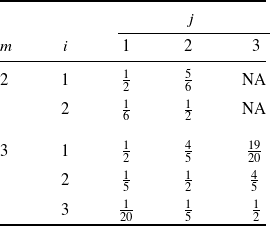
. (See [Reference Balakrishnan, Beutner and Cramer2, Lemma 1] for an alternate proof.) Table 1 presents values of these probabilities (with NA meaning ‘not applicable’).
Probabilities
 $\mathbb{P}\{ {X_{i:m}} < {\tilde X_{j:m}}\} $
for
 $i = 1, \ldots ,m$
,
 $j = 1, \ldots ,m$
,
 $m = 2,3$
.

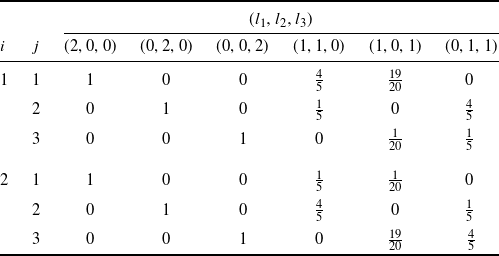
Values of
 $p_{j\,|\, {{l_1},{l_2},{l_3}}}^{(i:2)}$
for different i, j and
 ${l_1},{l_2},{l_3}$
.

Then, according to the discussions in Proposition 3.1, for
 $m=3$
(Cases 1–3), we have
 \begin{align*} p_{1\,|\, {(2,0,0)}}^{(1:2)} & = p_{1\,|\, {(2,0,0)}}^{(2:2)} = p_{2\,|\, {(0,2,0)}}^{(1:2)} = p_{2\,|\, {(0,2,0)}}^{(2:2)} = p_{3\,|\, {(0,0,2)}}^{(1:2)} = p_{3\,|\, {(0,0,2)}}^{(2:2)} = 1, \\ p_{1\,|\, {(1,1,0)}}^{(1:2)} & = p_{2\,|\, {(1,1,0)}}^{(2:2)} = {\mathbb P}\{ {X_{1:3}} < {{\tilde X}_{2:3}}\} = \tfrac{4}{5}, \\ p_{1\,|\, {(1,1,0)}}^{(2:2)} & = p_{2\,|\, {(1,1,0)}}^{(1:2)} = {\mathbb P}\{ {X_{1:3}} > {{\tilde X}_{2:3}}\} = \tfrac{1}{5}, \\ p_{1\,|\, {(1,0,1)}}^{(1:2)} & = p_{3\,|\, {(1,0,1)}}^{(2:2)} = {\mathbb P}\{ {X_{1:3}} < {{\tilde X}_{3:3}}\} = \tfrac{19}{20}, \\ p_{1\,|\, {(1,0,1)}}^{(2:2)} & = p_{3\,|\, {(1,0,1)}}^{(1:2)} = {\mathbb P}\{ {X_{1:3}} > {{\tilde X}_{3:3}}\} = \tfrac{1}{20}, \\ p_{2\,|\, {(0,1,1)}}^{(1:2)} & = p_{3\,|\, {(0,1,1)}}^{(2:2)} = {\mathbb P}\{ {X_{2:3}} < {{\tilde X}_{3:3}}\} = \tfrac{4}{5}, \\ p_{2\,|\, {(0,1,1)}}^{(2:2)} & = p_{3\,|\, {(0,1,1)}}^{(1:2)} = {\mathbb P}\{ {X_{2:3}} > {{\tilde X}_{3:3}}\} = \tfrac{1}{5}, \end{align*}
and
 $p_{j\,|\, {{l_1},{l_2},{l_3}}}^{(i:2)} = 0$
for other i, j,
 ${l_1}$
,
 ${l_2}$
,
 ${l_3}$
. With these, we find the values of
 $p_{j\,|\, {{l_1},{l_2},{l_3}}}^{(i:2)}$
as presented in Table 2.
Similarly, for
 $m = 2$
(Cases 4 and 5), we have
 \begin{align*} p_{1\,|\, {(2,0)}}^{(1:2)} & = p_{1\,|\, {(2,0)}}^{(2:2)} = p_{2\,|\, {(0,2)}}^{(1:2)} = p_{2\,|\, {(0,2)}}^{(2:2)} = 1, \\ p_{1\,|\, {(1,1)}}^{(1:2)} & = p_{2\,|\, {(1,1)}}^{(2:2)} = {\mathbb P}\{ {X_{1:2}} < {{\tilde X}_{2:2}}\} = \tfrac{5}{6}, \\ p_{1\,|\, {(1,1)}}^{(2:2)} & = p_{2\,|\, {(1,1)}}^{(1:2)} = {\mathbb P}\{ {X_{1:2}} > {{\tilde X}_{2:2}}\} = \tfrac{1}{6},\end{align*}
and
 $p_{j\,|\, {{l_1},{l_2}}}^{(i:2)} = 0$
for other i, j,
 ${l_1}$
,
 ${l_2}$
. With these, we find the values of
 $p_{j\,|\, {{l_1},{l_2}}}^{(i:2)}$
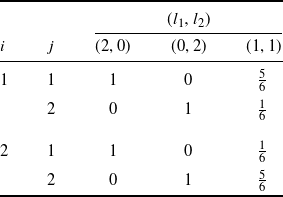
as presented in Table 3.
Values of
 $p_{j\,|\, {{l_1},{l_2}}}^{(i:2)}$
for different i, j and
 ${l_1},{l_2}$
.

We now proceed to the computation of dynamic order system signatures for the five cases listed at the start of this section.
Example 4.1. To present the dynamic ordered system signatures of the two coherent systems at time t in Case 1, values of
 $p_{j\,|\, \boldsymbol{l}}^{(i\,|\, {0,0,1;0,0,1})}$
 $(i = 1,2,\,j = 1,2,3,\, \boldsymbol{l} \in {\mathcal{L}_{0,0,1;0,0,1}})$
need to be presented first by
 $$p_{j\,|\, \boldsymbol{l}}^{(i\,|\, {0,0,1;\,0,0,1})} = p_{j\,|\, {{l_1},{l_2},{l_3}}}^{(i:2)} = p_{j\,|\, {{l_{1,3,1}} + {l_{2,3,1}},{l_{1,3,2}} + {l_{2,3,2}},{l_{1,3,3}} + {l_{2,3,3}}}}^{(i:2)},$$
with the values of
 $p_{j\,|\, {{l_1},{l_2},{l_3}}}^{(i:2)}$
in Table 2 and
 \begin{align*} \mathcal{L} _{0,0,1;\,0,0,1} & = \{ \boldsymbol{l} = ({l_{1,3,1}},{l_{1,3,2}},{l_{1,3,3}};\,{l_{2,3,1}},{l_{2,3,2}},{l_{2,3,3}})\,:\, \\ & \qquad {l_{1,3,1}} + {l_{1,3,2}} + {l_{1,3,3}} = 1, {l_{2,3,1}} + {l_{2,3,2}} + {l_{2,3,3}} = 1\} \\ & = \{(1,0,0;\,1,0,0),(1,0,0;\,0,1,0),(1,0,0;\,0,0,1),(0,1,0;\,1,0,0), \\ & \qquad\!\! (0,1,0;\,0,1,0), (0,1,0;\,0,0,1),(0,0,1;\,1,0,0),(0,0,1;\,0,1,0),(0,0,1;\,0,0,1)\} . \end{align*}
Then, for
 $\boldsymbol{k} = (0,0,1;\,0,0,1)$
, the dynamic ordered system signatures
 ${\boldsymbol{s}^{(1\,|\, \boldsymbol{k})}} = \Big(s_1^{(1\,|\, \boldsymbol{k})}$
,
 $s_2^{(1\,|\, \boldsymbol{k})},s_3^{(1\,|\, \boldsymbol{k})}\Big)$
and
 ${\boldsymbol{s}^{(2\,|\, \boldsymbol{k})}} = \Big(s_1^{(2\,|\, \boldsymbol{k})},s_2^{(2\,|\, \boldsymbol{k})},s_3^{(2\,|\, \boldsymbol{k})}\Big)$
are given by

that is,

From these expressions, we have, for different
 ${\boldsymbol{s}^{(1)}}$
and
 ${\boldsymbol{s}^{(2)}}$
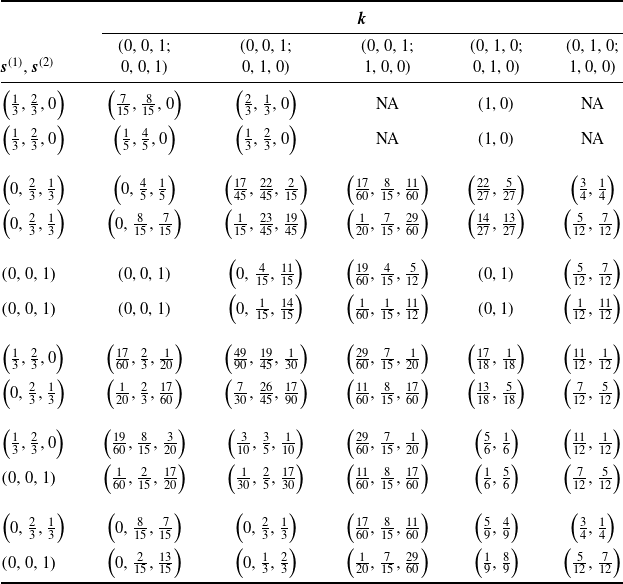
, the dynamic ordered system signatures in Case 1, as presented in Table 4. From the results in Table 4, theoretical results like Propositions 3.2 and 3.3 can be readily verified.
Dynamic ordered system signatures
 ${\boldsymbol{s}^{(1\,|\, \boldsymbol{k})}}$
,
 ${\boldsymbol{s}^{(2\,|\, \boldsymbol{k})}}$
in Cases 1–5 for different
 ${\boldsymbol{s}^{(1)}}$
,
 ${\boldsymbol{s}^{(2)}}$
.

Example 4.2. To present the dynamic ordered system signatures of the two coherent systems at time t in Case 2, values of
 $p_{j\,|\, \boldsymbol{l}}^{(i\,|\, 0,0,1;0,1,0)}$
 $(i = 1,2,\,j = 1,2,3,\,\boldsymbol{l} \in {\mathcal{L}_{0,0,1;0,1,0}})$
need to be presented first by
 $$p_{j\,|\, \boldsymbol{l}}^{(i\,|\, {0,0,1;0,1,0})} = p_{j\,|\, {{l_1},{l_2},{l_3}}}^{(i:2)} = p_{j\,|\, {{l_{1,3,1}} + {l_{2,2,1}},{l_{1,3,2}} + {l_{2,2,2}},{l_{1,3,3}} + {l_{2,2,3}}}}^{(i:2)},$$
with the values of
 $p_{j\,|\, {{l_1},{l_2},{l_3}}}^{(i:2)}$
in Table 2 and
 \begin{align*} {\mathcal{L}_{0,0,1;\,0,1,0}} & = \{ \boldsymbol{l} = ({l_{1,3,1}},{l_{1,3,2}},{l_{1,3,3}};\,{l_{2,2,1}},{l_{2,2,2}},{l_{2,2,3}})\,:\, \\ & \qquad {l_{1,3,1}} + {l_{1,3,2}} + {l_{1,3,3}} = 1,\, {l_{2,2,1}} + {l_{2,2,2}} + {l_{2,2,3}} = 1\} \\ & = \{ (1,0,0;\,1,0,0),(1,0,0;\,0,1,0),(1,0,0;\,0,0,1),(0,1,0;\,1,0,0), \\ & \qquad\!\! (0,1,0;\,0,1,0),(0,1,0;\,0,0,1),(0,0,1;\,1,0,0),(0,0,1;\,0,1,0),(0,0,1;\,0,0,1)\} . \end{align*}
Then, the dynamic system ordered system signatures
 ${\boldsymbol{s}^{(1\,|\, {0,0,1;0,1,0})}}$
,
 ${\boldsymbol{s}^{(2\,|\, {0,0,1;0,1,0})}}$
can be given by replacing the signature
 ${\boldsymbol{s}^{(2)}} = \Big(s_1^{(2)},s_2^{(2)},s_3^{(2)}\Big)$
of System 2 in Example 4.1 by

namely,
 \begin{align*} {\boldsymbol{s}^{(1\,|\, {0,0,1};0,1,0)}} & = \Big(s_1^{(1\,|\, {0,0,1};0,1,0)},s_2^{(1\,|\, {0,0,1};0,1,0)},s_3^{(1\,|\, {0,0,1};0,1,0)}\Big) \\ & = {\frac{1}{30\Big[s_2^{(2)} + s_3^{(2)}\Big]}} \cdot \Big( {28s_1^{(1)}s_2^{(2)} + 27s_1^{(1)}s_3^{(2)} + 16s_2^{(1)}s_2^{(2)} + 19s_3^{(1)}s_2^{(2)},} \\ & \qquad \quad 14s_2^{(1)}s_2^{(2)} + 26s_2^{(1)}s_3^{(2)} + 2s_1^{(1)}s_2^{(2)} + 2s_1^{(1)}s_3^{(2)} + 8s_3^{(1)}s_2^{(2)} + 8s_3^{(1)}s_3^{(2)}, \\ & \qquad \quad {22s_3^{(1)}s_3^{(2)} + s_1^{(1)}s_3^{(2)} + 3s_3^{(1)}s_2^{(2)} + 4s_2^{(1)}s_3^{(2)}} \Big), \\ {\boldsymbol{s}^{(2\,|\, {0,0,1};0,1,0)}} & = \Big(s_1^{(2\,|\, {0,0,1};0,1,0)},s_2^{(2\,|\, {0,0,1};0,1,0)},s_3^{(2\,|\, {0,0,1};0,1,0)}\Big) \\ & = \frac{1}{{30\Big[s_2^{(2)} + s_3^{(2)}\Big]}} \cdot \Big( {22s_1^{(1)}s_2^{(2)} + 3s_1^{(1)}s_3^{(2)} + 4s_2^{(1)}s_2^{(2)} + s_3^{(1)}s_2^{(2)},} \\ & \qquad \quad 26s_2^{(1)}s_2^{(2)} + 14s_2^{(1)}s_3^{(2)} + 8s_1^{(1)}s_2^{(2)} + 8s_1^{(1)}s_3^{(2)} + 2s_3^{(1)}s_2^{(2)} + 2s_3^{(1)}s_3^{(2)}, \\ & \qquad \quad {28s_3^{(1)}s_3^{(2)} + 19s_1^{(1)}s_3^{(2)} + 27s_3^{(1)}s_2^{(2)} + 16s_2^{(1)}s_3^{(2)}} \Big). \end{align*}
From these expressions, we have, for different
 ${\boldsymbol{s}^{(1)}}$
and
 ${\boldsymbol{s}^{(2)}}$
, the dynamic ordered system signatures in Case 2 as presented in Table 4.
Example 4.3. To present the dynamic ordered system signatures of the two coherent systems at time t in Case 3, values of
 $p_{j\,|\, \boldsymbol{l}}^{(i\,|\, {0,0,1;1,0,0})}$
 $(i = 1,2,\,j = 1,2,3,\,\boldsymbol{l} \in {\mathcal{L}_{0,0,1;1,0,0}})$
need to be presented first by
 $$p_{j\,|\, \boldsymbol{l}}^{(i\,|\, {0,0,1;\,1,0,0})} = p_{j\,|\, {{l_1},{l_2},{l_3}}}^{(i:2)} = p_{j\,|\, {{l_{1,3,1}} + {l_{2,1,1}},{l_{1,3,2}} + {l_{2,1,2}},{l_{1,3,3}} + {l_{2,1,3}}}}^{(i:2)},$$
with the values of
 $p_{j\,|\, {{l_1},{l_2},{l_3}}}^{(i:2)}$
in Table 2 and
 \begin{align*} {\mathcal{L}_{0,0,1;\,1,0,0}} & = \{ \boldsymbol{l} = ({l_{1,3,1}},{l_{1,3,2}},{l_{1,3,3}};\,{l_{2,1,1}},{l_{2,1,2}},{l_{2,1,3}})\,:\, \\ & \qquad {l_{1,3,1}} + {l_{1,3,2}} + {l_{1,3,3}} = 1, {l_{2,1,1}} + {l_{2,1,2}} + {l_{2,1,3}} = 1\} \\ & = \{ (1,0,0;\,1,0,0),(1,0,0;\,0,1,0),(1,0,0;\,0,0,1),(0,1,0;\,1,0,0), \\ & \qquad\!\! (0,1,0;\, 0,1,0), (0,1,0;\,0,0,1),(0,0,1;\,1,0,0),(0,0,1;\,0,1,0),(0,0,1;\,0,0,1)\} . \end{align*}
Then, the dynamic ordered system signatures
 ${\boldsymbol{s}^{(1\,|\, {0,0,1;1,0,0})}}$
,
 ${\boldsymbol{s}^{(2\,|\, {0,0,1;1,0,0})}}$
can be given by replacing the signature
 ${\boldsymbol{s}^{(2)}} = \big(s_1^{(2)},s_2^{(2)},s_3^{(2)}\big)$
of System 2 in Example 4.1 by
 :
 \begin{align*} {\boldsymbol{s}^{(1\,|\, {0,0,1;1,0,0})}} & = \Big(s_1^{(1\,|\, {0,0,1;1,0,0})},s_2^{(1\,|\, {0,0,1;1,0,0})},s_3^{(1\,|\, {0,0,1;1,0,0})}\Big) \\ & = \frac{1}{60} \cdot \Big( {55s_1^{(1)} + 16s_2^{(1)} + 19s_3^{(1)},4s_1^{(1)} + 40s_2^{(1)} + 16s_3^{(1)},} {s_1^{(1)} + 4s_2^{(1)} + 25s_3^{(1)}}\Big), \\ {\boldsymbol{s}^{(2\,|\, {0,0,1;1,0,0})}} & = \Big(s_1^{(2\,|\, {0,0,1;1,0,0})},s_2^{(2\,|\, {0,0,1;1,0,0})},s_3^{(2\,|\, {0,0,1;1,0,0})}\Big) \\ & = \frac{1}{60} \cdot \Big( {25s_1^{(1)} + 4s_2^{(1)} + s_3^{(1)},16s_1^{(1)} + 40s_2^{(1)} + 4s_3^{(1)},} {19s_1^{(1)} + 16s_2^{(1)} + 55s_3^{(1)}}\Big). \end{align*}
From these expressions, we have, for different
 ${\boldsymbol{s}^{(1)}}$
and
 ${\boldsymbol{s}^{(2)}}$
, the dynamic ordered system signatures in Case 3 as presented in Table 4.
Example 4.4. To present the dynamic ordered system signatures of the two coherent systems at time t in Case 4, values of
 $p_{j\,|\, \boldsymbol{l}}^{(i\,|\, {0,1,0;0,1,0})}$
 $(i = 1,2,\,j = 1,2,\,\boldsymbol{l} \in {\mathcal{L}_{0,1,0;0,1,0}})$
need to be presented first by
 $$p_{j\,|\, \boldsymbol{l}}^{(i\,|\, {0,1,0;\,0,1,0})} = p_{j\,|\, {{l_1},{l_2}}}^{(i:2)} = p_{j\,|\, {{l_{1,2,1}} + {l_{2,2,1}},{l_{1,2,2}} + {l_{2,2,2}}}}^{(i:2)},$$
with the values of
 $p_{j\,|\, {{l_1},{l_2}}}^{(i:2)}$
in Table 3 and
 \begin{align*} {\mathcal{L}_{0,1,0;\,0,1,0}} & = \{ \boldsymbol{l} = ({l_{1,2,1}},{l_{1,2,2}};\,{l_{2,2,1}},{l_{2,2,2}})\,:\, {l_{1,2,1}} + {l_{1,2,2}} = 1,{l_{2,2,1}} + {l_{2,2,2}} = 1\} \\ & = \{ (1,0;\,1,0),(1,0;\,0,1),(0,1;\,1,0),(0,1;\,0,1)\} . \end{align*}
Then, the dynamic ordered system signatures
 ${\boldsymbol{s}^{(1\,|\, {0,1,0;0,1,0})}} $
and
 ${\boldsymbol{s}^{(2\,|\, {0,1,0;0,1,0})}}$
are given by replacing
 ${\boldsymbol{s}^{(1)}} = \big(s_1^{(1)},s_2^{(1)}\big)$
and
 ${\boldsymbol{s}^{(2)}} = \big(s_1^{(2)},s_2^{(2)}\big)$
in
 \begin{align*} s_1^{(1\,|\, {0,1,0;\,0,1,0})} & = p_{1\,|\, {(2,0)}}^{(1:2)} \cdot s_1^{(1)}s_1^{(2)} + p_{1\,|\, {(1,1)}}^{(1:2)} \cdot \Big[ {s_1^{(1)}s_2^{(2)} + s_2^{(1)}s_1^{(2)}} \Big], \\ s_1^{(2\,|\, {0,1,0;\,0,1,0})} & = p_{1\,|\, {(2,0)}}^{(2:2)} \cdot s_1^{(1)}s_1^{(2)} + p_{1\,|\, {(1,1)}}^{(2:2)} \cdot \Big[ {s_1^{(1)}s_2^{(2)} + s_2^{(1)}s_1^{(2)}} \Big], \\ s_2^{(1\,|\, {0,1,0;\,0,1,0})} & = p_{2\,|\, {(0,2)}}^{(1:2)} \cdot s_2^{(1)}s_2^{(2)} + p_{2\,|\, {(1,1)}}^{(1:2)} \cdot \Big[ {s_1^{(1)}s_2^{(2)} + s_2^{(1)}s_1^{(2)}} \Big], \\ s_2^{(2\,|\, {0,1,0;\,0,1,0})} & = p_{2\,|\, {(0,2)}}^{(2:2)} \cdot s_2^{(1)}s_2^{(2)} + p_{2\,|\, {(1,1)}}^{(2:2)} \cdot \Big[ {s_1^{(1)}s_2^{(2)} + s_2^{(1)}s_1^{(2)}} \Big] \end{align*}
with
 $${\boldsymbol{s}^{(1)}} = \Bigg( {{\frac{s_2^{(1)}}{s_2^{(1)} + s_3^{(1)}}},{\frac{s_3^{(1)}}{s_2^{(1)} + s_3^{(1)}}}} \Bigg), \qquad {\boldsymbol{s}^{(2)}} = \Bigg( {{\frac{s_2^{(2)}}{s_2^{(2)} + s_3^{(2)}}},{\frac{s_3^{(2)}}{s_2^{(2)} + s_3^{(2)}}}} \Bigg),$$
that is,
 \begin{align*} {\boldsymbol{s}^{(1\,|\, {0,1,0;\,0,1,0})}} & = \big(s_1^{(1\,|\, {0,1,0;\,0,1,0})},s_2^{(1\,|\, {0,1,0;\,0,1,0})}\big) \\ & = \frac{1}{{6\big[s_2^{(1)} + s_3^{(1)}\big]\big[s_2^{(2)} + s_3^{(2)}\big]}} \cdot \Big( {6s_2^{(1)}s_2^{(2)} + 5s_2^{(1)}s_3^{(2)} + 5s_3^{(1)}s_2^{(2)},} \\ & \qquad \qquad {6s_3^{(1)}s_3^{(2)} + s_2^{(1)}s_3^{(2)} + s_3^{(1)}s_2^{(2)}} \Big), \\ {\boldsymbol{s}^{(2\,|\, {0,1,0;\,0,1,0})}} & = (s_1^{(2\,|\, {0,1,0;\,0,1,0})},s_2^{(2\,|\, {0,1,0;\,0,1,0})}) \\ & = \frac{1}{{6\big[s_2^{(1)} + s_3^{(1)}\big]\big[s_2^{(2)} + s_3^{(2)}\big]}} \cdot \Big( {6s_2^{(1)}s_2^{(2)} + s_2^{(1)}s_3^{(2)} + s_3^{(1)}s_2^{(2)},} \\ & \qquad \qquad {6s_3^{(1)}s_3^{(2)} + 5s_2^{(1)}s_3^{(2)} + 5s_3^{(1)}s_2^{(2)}} \Big). \end{align*}
Then, their equivalent systems with three components have the following signatures:

From these expressions, we have, for different
 ${\boldsymbol{s}^{(1)}}$
and
 ${\boldsymbol{s}^{(2)}}$
, the dynamic ordered system signatures in Case 4 as presented in Table 4.
Example 4.5. To present the dynamic ordered system signatures of the two coherent systems at time t in Case 5, values of
 $p_{j\,|\, \boldsymbol{l}}^{(i\,|\, {0,1,0;1,0,0})}$
 $(i = 1,2,\,j = 1,2,\,\boldsymbol{l} \in {\mathcal{L}_{0,1,0;1,0,0}})$
need to be presented first, where
 \begin{align*} {\mathcal{L}_{0,1,0;\,1,0,0}} & = \{ \boldsymbol{l} = ({l_{1,2,1}},{l_{1,2,2}};\,{l_{2,1,1}},{l_{2,1,2}})\,:\, {l_{1,2,1}} + {l_{1,2,2}} = 1,\,{l_{2,1,1}} + {l_{2,1,2}} = 1\} \\ & = \{ (1,0;\,1,0),(1,0;\,0,1),(0,1;\,1,0),(0,1;\,0,1)\} . \end{align*}
Then, the dynamic ordered system signatures
 ${\boldsymbol{s}^{(1\,|\, {0,1,0;1,0,0})}} $
and
 ${\boldsymbol{s}^{(2\,|\, {0,1,0;1,0,0})}}$
are given by replacing
 ${\boldsymbol{s}^{(1)}} = \big(s_1^{(1)},s_2^{(1)}\big)$
and
 ${\boldsymbol{s}^{(2)}} = \big(s_1^{(2)},s_2^{(2)}\big)$
in Example 4.4 with
 ${\boldsymbol{s}^{(1)}} = \big( {\frac{1}{2},\frac{1}{2}} \big)$
and
 ${\boldsymbol{s}^{(2)}} = \big( {\frac{1}{2},\frac{1}{2}} \big)$
, respectively, that is,
 \begin{align*} {\boldsymbol{s}^{(1\,|\, {0,1,0;\,1,0,0})}} & = \frac{1}{{12\Big[s_2^{(1)} + s_3^{(1)}\Big]}} \cdot \Big( {11s_2^{(1)} + 5s_3^{(1)},s_2^{(1)} + 7s_3^{(1)}} \Big), \\ {\boldsymbol{s}^{(2\,|\, {0,1,0;\,1,0,0})}} & = \frac{1}{{12\Big[s_2^{(1)} + s_3^{(1)}\Big]}} \cdot \Big( {7s_2^{(1)} + s_3^{(1)},5s_2^{(1)} + 11s_3^{(1)}} \Big). \end{align*}
Then, their equivalent systems with three components have the following signatures:

From these expressions, we have, for different
 ${\boldsymbol{s}^{(1)}}$
and
 ${\boldsymbol{s}^{(2)}}$
, the dynamic ordered system signatures in Case 5 as presented in Table 4.
5. Applications to evaluation of aging properties of used systems
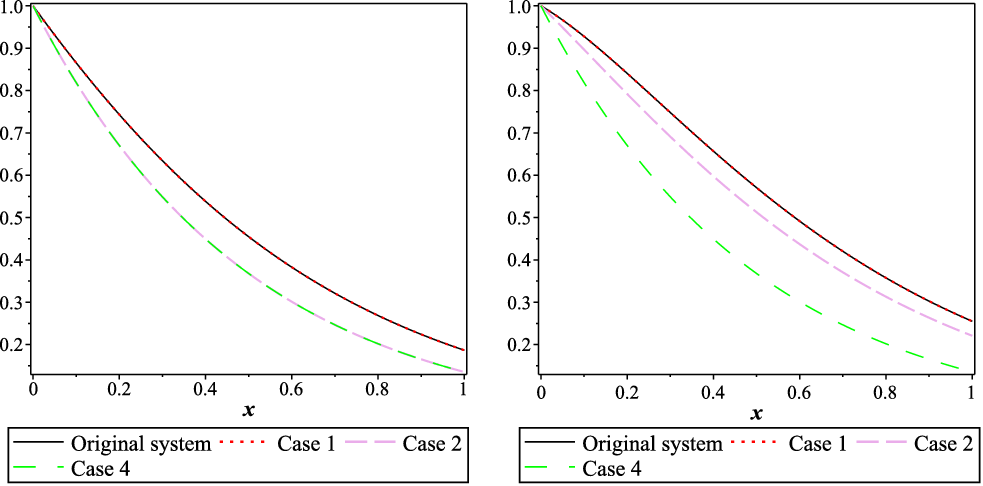
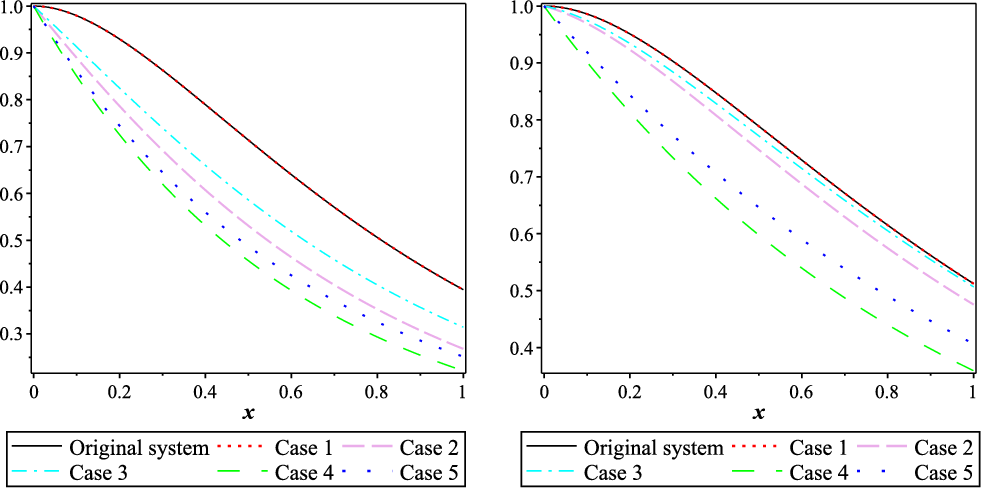
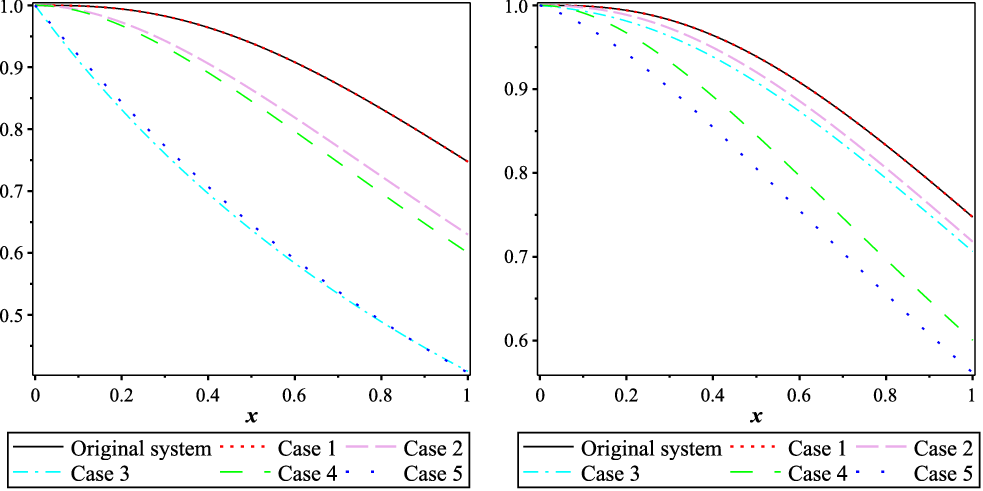
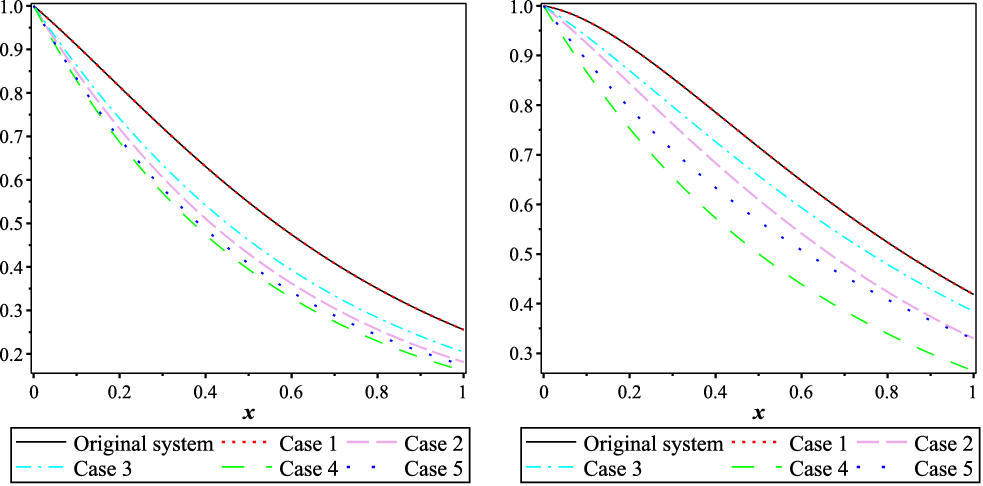
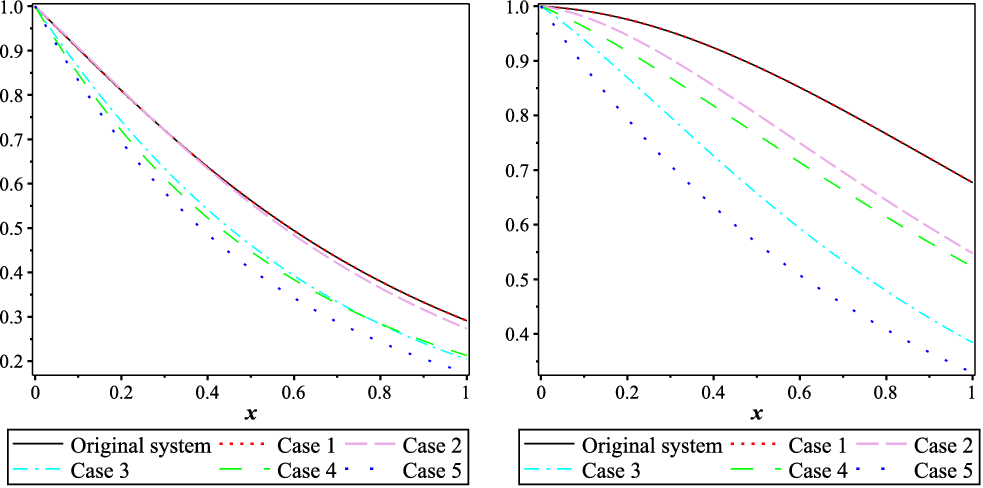
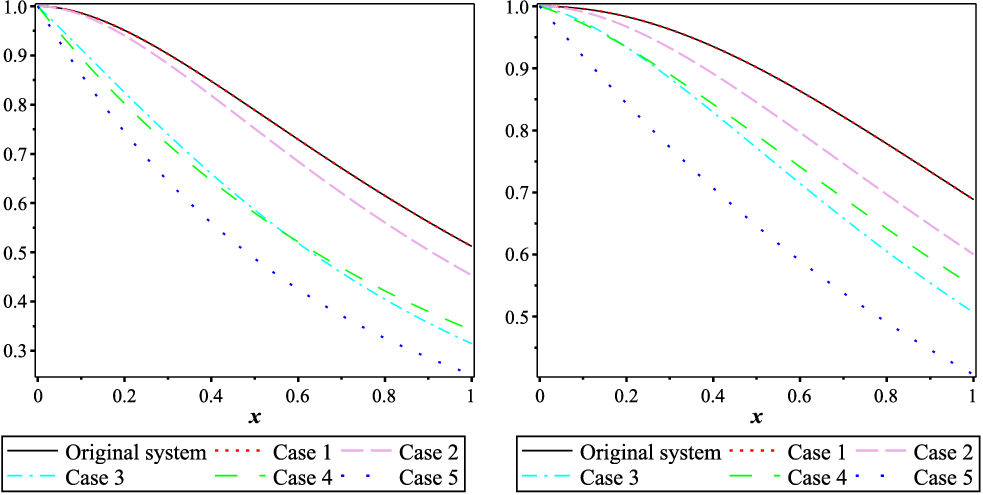
The computation of dynamic ordered system signatures discussed in the preceding sections facilitates comparison of used systems at time t in different cases (see Table 4 for their dynamic ordered system signatures). Suppose the component lifetimes in each system are all i.i.d. from an exponential distribution F with
 $F(x) = 1 - {{\mathrm{e}}^{ - x}}$
,
 $x \ge 0$
, which leads to the corresponding residual lifetime distribution as
 $\tilde F(x\mid t) = 1 - {{\mathrm{e}}^{ - (x - t)}}$
,
 $x > t$
. In this case, the respective conditional survival probabilities in Cases 1–5 that the first/second failed system among the two used systems fails after time
 $x+t$
, given
 ${E_\boldsymbol{k}}(t)$
, are plotted in Figs. 1–6 for different
 ${\boldsymbol{s}^{(1)}}$
and
 ${\boldsymbol{s}^{(2)}}$
, along with the survival probability that the first/second failed system among the two original systems, with signatures
 ${\boldsymbol{s}^{(1)}}$
and
 ${\boldsymbol{s}^{(2)}}$
and component lifetime distribution
 $\tilde F(x\mid t) = 1 - {{\mathrm{e}}^{ - (x - t)}}$
,
 $x > t$
, fails after time
 $x+t$
. As seen in Figs. 1–6, for any
 ${\boldsymbol{s}^{(1)}}$
and
 ${\boldsymbol{s}^{(2)}}$
in Table 4, the best systems are the original systems or the systems in Case 1.
Conditional survival probabilities of the first (left) and second (right) failed coherent systems in Cases 1–5 for
 ${\boldsymbol{s}^{(1)}} = {\boldsymbol{s}^{(2)}} = \big(\frac{1}{3},\frac{2}{3},0\big)$
.

Conditional survival probabilities of the first (left) and second (right) failed coherent systems in Cases 1–5 for
 ${\boldsymbol{s}^{(1)}} = {\boldsymbol{s}^{(2)}} = \big(0,\frac{2}{3},\frac{1}{3}\big)$
.

Conditional survival probabilities of the first (left) and second (right) failed coherent systems in Cases 1–5 for
 ${\boldsymbol{s}^{(1)}} = {\boldsymbol{s}^{(2)}} = (0, 0, 1)$
.

Conditional survival probabilities of the first (left) and second (right) failed coherent systems in Cases 1–5 for
 ${\boldsymbol{s}^{(1)}} = \big(\frac{1}{3},\frac{2}{3},0\big)$
,
 ${\boldsymbol{s}^{(2)}} = \big(0,\frac{2}{3},\frac{1}{3}\big)$
.

Conditional survival probabilities of the first (left) and second (right) failed coherent systems in Cases 1–5 for
 ${\boldsymbol{s}^{(1)}} = \big(\frac{1}{3},\frac{2}{3},0\big)$
,
 ${\boldsymbol{s}^{(2)}} = (0, 0, 1)$
.

Conditional survival probabilities of the first (left) and second (right) failed coherent systems in Cases 1–5 for
 ${\boldsymbol{s}^{(1)}} = \big(0,\frac{2}{3},\frac{1}{3}\big)$
,
 ${\boldsymbol{s}^{(2)}} = (0, 0, 1)$
.

6. Concluding remarks
In this paper, we first generalized the notion of ordered system signature from independent and identical coherent systems to the case of independent and non-identical coherent systems, and then established some related properties for the purpose of simplifying its computation. Based on such a general ordered system signature, a new concept, called dynamic ordered system signature, was then proposed for several coherent systems under a life-testing experiment. Then, several examples were presented to illustrate the established results. The usefulness of these results in the evaluation of aging properties of used systems was also demonstrated.
It is important to mention here that the notions introduced and their properties would be quite useful in developing parametric/non-parametric inferential methods for component lifetimes in coherent systems along the lines of [Reference Balakrishnan, Ng and Navarro3, Reference Balakrishnan, Ng and Navarro4, Reference Yang, Ng and Balakrishnan26, Reference Yang, Ng and Balakrishnan27]. As shown in [Reference Yang, Ng and Balakrishnan26], the ordered system signature leads to a more efficient method than the system signature for inferences on component lifetimes based on system lifetime data in a life test of several i.i.d. coherent systems. With the use of ordered system signature generalized in this paper, inferential methods can be developed for a life test of several independent and non-identical coherent systems, which would be a less restrictive life test in practice. Furthermore, the concept of dynamic ordered system signature can be applied to study dynamic properties of used systems in a life test, which would assist in studying maintenance policy, for example. We are currently working on these problems and hope to report the findings in a future paper.
Acknowledgements
Our sincere thanks go to the Editor and the anonymous reviewers for their useful comments and suggestions on an earlier version of this manuscript which led to this much improved version.
Funding Information
This work was supported by the National Natural Science Foundation of China (Nos. 72001016, 71931001, and 71722007), the Fundamental Research Funds for the Central Universities (buctrc202102) and the Funds for First-class Discipline Construction (XK1802-5), and the Natural Sciences and Engineering Research Council of Canada (to the second author) through an Individual Discovery Grant (RGPIN-2020-06733).
Competing Interests
There were no competing interests to declare which arose during the preparation or publication process of this article.