Introduction
There has been a growing interest in the differentiation of functional decline between normal and pathological aging such as in individuals diagnosed with MCI. By definition, the concept of MCI recognizes individuals to have neither cognitively normal status nor dementia. It refers to an intermediary stage of cognitive impairment which is frequently, but not always, a transitional phase from cognitive alterations associated with normal aging to those characteristically observed in dementia (Petersen et al., Reference Petersen, Caracciolo, Brayne, Gauthier and Jelic2014). In terms of its subtypes, individuals with impairments in memory are referred to as amnestic MCI (aMCI) and those with non-memory deficits, including language, executive functioning, attention, processing speed, etc., as non-amnestic MCI (naMCI) (Winblad et al., Reference Winblad2004). These two subtypes have been additionally delineated as “single” or “multiple domains” based upon the number of cognitive domains involved. The aMCI is often viewed as an incipient stage of Alzheimer's disease (AD) (Petersen et al., Reference Petersen2001). The non-amnestic subtype is believed to have a more heterogeneous outcome, such as vascular dementias, frontotemporal dementia or dementia with Lewy body (Mariani et al., Reference Mariani, Monastero and Mecocci2007).
It has not been fully elucidated how functional performance is affected in individuals with MCI. The earlier operational criteria of MCI did not consider difficulties in the activities of daily living (ADL) as they have been a crucial part of the diagnostic criteria for dementia (Petersen et al., Reference Petersen2001; Petersen and Morris, Reference Petersen and Morris2005). Evidence has emerged over the previous years, which has underscored that individuals with MCI may not have intact functional abilities, especially, in the performance of IADLs (Perneczky et al., Reference Perneczky2006a; Reference Perneczky2006b; Giovannetti et al., Reference Giovannetti2008; Burton et al., Reference Burton, Strauss, Bunce, Hunter and Hultsch2009). The IADLs include such activities as managing finances, preparing meals, traveling, using the phone, taking medication and going shopping (Njegovan et al., Reference Njegovan, Hing, Mitchell and Molnar2001). Therefore, functional performance appears to be difficult to use/operationalize as a key criterion to differentiate MCI from dementia, as it can be affected in both conditions (Jefferson et al., Reference Jefferson2008). The functional impairment threshold, which may delineate between these two conditions, might have clinical implications in rapid communication about the disease, in management related decisions, and in counseling of the individual and his family. The latest operational criteria proposed by Petersen (2004) and Winblad et al. (2004) have pointed out that “very mild problems” in IADLs are consistent with MCI. However, no guidelines have been provided to ascertain the type and to quantify the extent of these functional impairments.
The IADLs are associated with a higher intricacy of cognitive organization, and they are perceived to be more vulnerable for early changes in cognition, as compared to the basic ADLs (Artero et al., Reference Artero, Touchon and Ritchie2001). In fact, decline in IADLs has been associated with higher progression to dementia (Luck et al., Reference Luck2010). Furthermore, the preliminary changes in IADLs tend to be subtle in the MCI population and it can be challenging to evaluate them sensitively and accurately. It is believed that the detection of these changes in IADLs is dependent upon the type of assessment used for functional evaluation (Farias et al., Reference Farias, Mungas and Jagust2006). Frequently employed methods include performance-based measures and self-or-informant report questionnaires (Gold, Reference Gold2012). The performance based measures offer an objective and accurate method of assessing the subtle deficits in functional performance, and have been critically appraised elsewhere (Belchior et al., Reference Belchior2015). Whilst performance-based measures are employed for an in-depth functional evaluation, questionnaires tend to offer a quick evaluation and are convenient when time does not allow for an extensive assessment. However, no evidence exists in the literature to establish whether the available questionnaires adhere to the methodological rigor in either content development or psychometric validation for the MCI population. The questionnaires, which possess good psychometric properties and have been developed rigorously, can be an asset in the clinical practice and research for accurate evaluation of functional decline. Therefore, the goal of this study was to identify assessment tools (questionnaires) that have been validated in the MCI population, and to appraise the quality of validation studies and psychometric attributes of these tools.
Methodology
A systematic review was carried out to summarize and assess the evidence available on the psychometric properties of questionnaires used in MCI. To evaluate the methodology of the psychometric studies, the COSMIN checklist (Terwee et al., Reference Terwee, Mokkink, Knol, Ostelo, Bouter and de Vet2012) was employed. The psychometric properties of the assessment tools were appraised using Terwee's criteria (Terwee et al., Reference Terwee2007). The PRISMA guidelines were taken into consideration whilst reporting the systematic review process (Moher, et al., Reference Moher, Liberati, Tetzlaff and Altman2009).
Search strategy
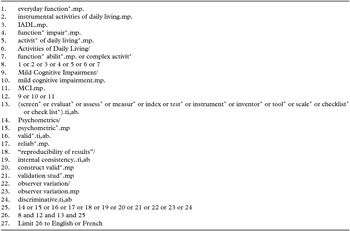
A comprehensive search of three electronic databases, including PsychINFO (1999–May 2014), Ovid MEDLINE (1999–May 2014) and CINAHL (1999–May 2014), was conducted. The search strategy was limited to articles published from 1999 onward as the operational criteria for MCI were first proposed in this year (Petersen et al., Reference Petersen, Smith, Waring, Ivnik, Tangalos and Kokmen1999). The database search was accomplished using relevant medical subject headings and synonyms for functional impairment or functional limitation or complex ADL or IADLs and MCI and questionnaire or assess* or scale or index or measure* and valid*, reliab*, psychometric*, discriminat*, questionnaire development or measurement*. Search terms which could possibly identify the pertinent studies were initially explored using the key literature on functional performance in MCI under the supervision of a qualified librarian. The search terms employed in Ovid MEDLINE have been illustrated in Table 1.
Search terms used in ovid medline

Study selection
Inclusion criteria included peer-reviewed articles which (1) evaluated one or more psychometric properties: internal consistency, reliability, content validity, construct validity, and predictive validity of assessment tools; (2) included individuals with MCI diagnosed as per a published criteria (e.g. Petersen, 2004, Winblad et al., Reference Winblad2004); (3) focused on IADLs; and (4) were published in English or French with an objective of psychometric validation of a tool. Interview-based, informant and self-report measures were deemed acceptable. Finally, questionnaires were considered eligible if they were available in English or French and comprised predominantly of domains representing activity and participation in accordance with the leading conceptual framework of International Classification of Function, Disability and Health (ICF) (WHO, 2001). For instance, the questionnaires which had items on cognitive processes, such as “remembering the appointments”, were excluded as they fall under “Body Functions”. On the other hand, “shopping” and “medication management” can be classified as “Activity and Participation” and questionnaires with predominance of such items were included in this review Exclusion criteria included: (1) cross-cultural or language validation studies; (2) grey literature including scientific meeting abstracts and dissertations; (3) performance-based tools; (4) presence of medical, psychiatric or neurologic illness or physical handicaps (apart from those associated with dementia) which may be severe enough to hinder the performance of ADL; and (5) ecological measures of cognition i.e. real world measures focusing predominantly on cognitive domains and/or processes
To determine the relevance of studies, titles and abstracts were initially scanned and then review of full manuscripts against the specified inclusion criteria followed. To minimize the selection bias, this process was carried out by two independent reviewers (NK and PB). Any differences of opinions or disagreements were resolved through discussion with a third reviewer (IG). To supplement the search, Google Scholar was used and the reference lists of the retrieved articles were manually screened for identification of additional potentially pertinent studies. Authors were contacted if any clarifications or further details were required in relation to their studies.
Data extraction
For each assessment tool, data on the number of items, types of IADLs assessed, setting, mode of administration, MCI diagnostic criteria, study population, response categories, and psychometric properties, including reliability, internal consistency, content validity, construct validity, i.e. structural validity and hypotheses testing (convergent validity and/or discriminative validity), were retrieved.
Evaluation of methodological quality
The COSMIN checklist was employed to assess the methodological quality of the eligible articles (Terwee et al., Reference Terwee, Mokkink, Knol, Ostelo, Bouter and de Vet2012). It has been developed and validated by a global consortium of 43 expert professionals specifically for the assessment of health measurement instruments. Previous literature has demonstrated its content validity and inter-rater reliability to be adequate (Mokkink et al., Reference Mokkink2010a; Reference Mokkink2010b). The checklist evaluates the methodological quality of psychometric studies and offers an appraisal criterion to analyse the methodology used to study each measurement property (i.e. reliability and validity) separately. The psychometric properties were operationalized as per the definitions given by the COSMIN developers (Mokkink et al., Reference Mokkink2010b). Each property was rated on a four-point scale (i.e. poor, fair, good, or excellent). The rating was assigned by taking the lowest achieved score for any question on the checklist related to the property assessed. To minimize the subjectivity whilst interpreting the checklist items, three independent reviewers (NK, PB and IG) were required to reach a consensus of their individual appraisal ratings through discussions.
Evaluation of psychometric properties
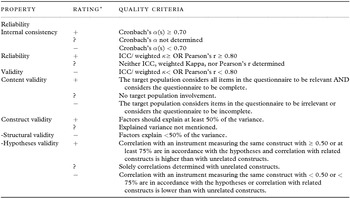
To determine the quality of the instruments identified in the systematic review (i.e. in terms of content validity, reliability, internal consistency, and construct validity), the rating system proposed by Terwee et al. (Reference Terwee2007) was used (Table 2). Each measurement property is assigned a positive (+), negative (-), or indeterminate (?) rating based on a pre-defined criterion. The diagnostic accuracy of an instrument was assessed as low (0.5 < area under curve (AUC) < 0.7), moderate (0.7 < AUC < 0.9), and high (0.9 < AUC < 1) (Swets, Reference Swets1988). Two independent raters (NK and PB) were involved in determining the quality rating for the study methodology and psychometric results. Any disagreements were resolved by taking another reviewer's opinions into consideration (IG).
Adapted from Terwee's criteria (Terwee et al., Reference Terwee2007)

*+ = positive rating, ? = indeterminate rating, − = negative rating.
ICC = intraclass correlation coefficient.
Results
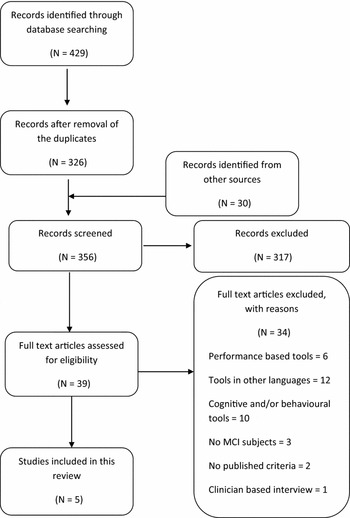
The electronic search returned a total of 429 citations. After removal of the duplicate records and addition of relevant records using Google Scholar, 356 studies were retrieved. Of these, 321 articles were excluded by reviewing either title or abstract. A total of five full text articles were chosen for the critical appraisal. The selection process for the articles has been summarized in Figure 1. Five assessment tools were identified, namely the Advanced Activities of Daily Living (a-ADL) (de Vriendt et al., Reference de Vriendt, Gorus, Cornelis, Bautmans, Petrovic and Mets2013), the Disability Assessment in Dementia -6 (DAD-6) (de Rotrou et al., Reference de Rotrou2012), the FAQ (Teng et al., Reference Teng, Becker, Woo, Knopman, Cummings and Lu2010), the Bayer's Activities of Daily Living Scale (Bayer's ADL) (Reppermund et al., Reference Reppermund2011), and the Alzheimer's Disease Cooperative Study /Activities of Daily Living (ADCS/MCI/ADL-24) (Pedrosa et al., Reference Pedrosa2010). Pedrosa et al. (Reference Pedrosa2010) compared the 18 and 24 item versions of the ADCS/MCI/ADL scales. As it was considered superior in discriminating MCI from healthy controls, only the 24-item version has been reviewed in this manuscript. Both scales had similar discriminatory power to distinguish between MCI and AD. In the following text, only acronyms of the individual questionnaires have been used.
Selection process of articles included in this review.

General characteristics of the questionnaires
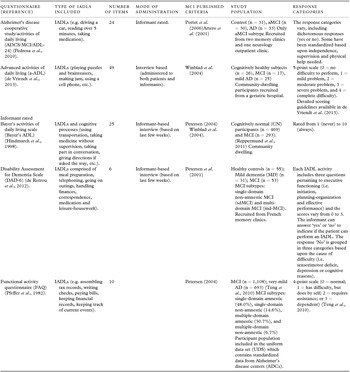
The characteristics of individual questionnaires have been presented in Table 3. The total number of items varied from 6 to 49 across the reviewed instruments.. The ADCS/MCI/ADL scale encompassed both ADLs and IADLs. With regards to the mode of administration, the retrieved questionnaires were mostly based on the informant or collateral reports. The a-ADL scale, which is an interview-based questionnaire, was administered to both informants and MCI participants. Varied published criteria were used across the chosen studies to diagnose MCI. Three scales (i.e. ADCS-MCI-ADL, DAD-6 and FAQ) were evaluated among MCI subtypes, where division on the basis of involvement of memory and non-memory deficits was available, whereas no classification was seen in the evaluation of Bayer's ADL and a-ADL scales. Only two questionnaires (DAD-6 and FAQ) grouped MCI participants based upon the number of domains affected. The majority of questionnaires were examined either in a clinical or a community sample. The Likert scales were frequently employed as response categories in the retrieved questionnaires.
Summary of general characteristics of chosen questionnaires

Quality of study methodology and psychometric properties of questionnaires
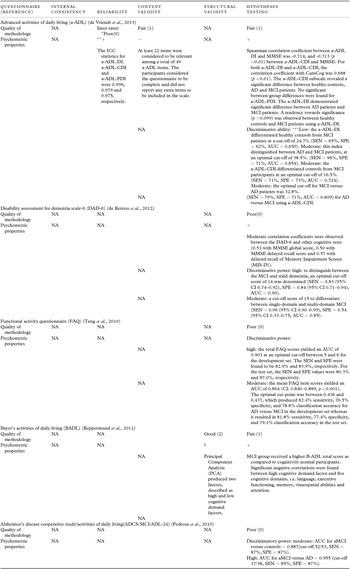
The methodological quality of the chosen studies and the specific psychometric properties of the questionnaires have been appraised and listed in Table 4. To ease the reporting of results, individual scales have been discussed in context of the available psychometric properties (given in italics). Initially, the COSMIN rating for the methodological quality of studies has been described. This is followed by the quality rating of the psychometric findings based upon Terwee's criteria. The criteria proposed by Swets (Reference Swets1988) for rating the discriminatory power based upon the AUC values were applied where receiver operating curve analyses (ROC) were available for the retrieved scales.
Summary of quality ratings of methodology of psychometric studies and psychometric properties of questionnaires

*Methodology rating based upon COSMIN checklist.
**+: Positive rating, ?: indeterminate, −: negative (rating based upon Terwee et al., Reference Terwee2007).
*** Rating for assessing the discriminatory power based upon Swets (Reference Swets1988): low (0.5<area under curve (AUC) <0.7), moderate (0.7<area under curve<0.9) and high (0.9<area under curve<1).
Acronyms used – AUC: Area under the curve, a-ADL-DI: Disability Index of Advanced Activities of Daily Living Scale, a-ADL-CDI: Cognitive Disability Index of Advanced Activities of Daily Living Scale, a-ADL-PDI: Physical Disability Index Advanced Activities of Daily Living Scale, aMCI: amnestic MCI subtype, CamCog: Cambridge Cognition Examination, CDR: Clinical Dementia Rating Scale, CI: Confidence Intervals, FAB: Functional Assessment Battery, IRT: Item Response Theory Method, MMSE: Mini-Mental Status Examination, NA: Not Available, PFAQ: Pfeffer Functional Activity Questionnaire, SEN: Sensitivity, SPE: Specificity.
A-ADL scale
This scale was developed and psychometrically evaluated by de Vriendt et al. (Reference de Vriendt, Gorus, Cornelis, Bautmans, Petrovic and Mets2013). The following properties were appraised for this questionnaire: (1) Content validity: the quality of the study was found to be Fair (1). The authors employed a sample of 68 participants to establish the comprehensiveness and feasibility of the items. The range of activities included was based upon a qualitative investigation of functional decline in the target population. As required by the COSMIN criteria, it was not clear whether all included items were assessed for their relevance to the purpose of the measurement instrument. The scale received a negative rating using Terwee's criteria. At least 22 items were deemed relevant out of total 49 a-ADL items by majority of the participants. Overall, the questionnaire was considered complete by the participants. (2) Inter-rater reliability: the reliability study included only 24 subjects. However, Terwee et al., (Reference Terwee2007) recommend a sample size of 50 subjects for estimation of reliability. Therefore, the COSMIN score for study quality was determined Poor (0). Intra-class correlation coefficients (ICC, model 2, 1) were found to be greater than 0.95 for all three subscales of a-ADL Scale. Therefore, a positive rating was allocated to the quality of the psychometric property as per Terwee's criteria. (3) Hypotheses validity: the COSMIN rating for the methodological quality was graded as Fair (1) for the handling of missing items was not mentioned. As for the quality of psychometric findings, they were found to be positive since the hypotheses were formulated before data collection and the results were in accordance with them. Based on the AUC values, moderate discriminatory power was assigned to the “cognitive disability” index (a-ADL-CDI) for discriminating between healthy controls versus MCI and MCI versus AD. The discriminatory power of the “global disability” index (a-ADL-DI) was considered to be moderate for distinguishing between AD and MCI. However, it was graded as low for discerning healthy controls from MCI.
ADCS/MCI/ADL scale
This scale was examined by Pedrosa et al. (Reference Pedrosa2010). Hypotheses testing: the methodological quality of the study was rated as Poor (0) as hypotheses were not clearly specified. No rating could be assigned based upon Terwee's criteria as none of the three grading points applied to the findings. The discriminatory performance of the 24-item version of this scale was found to be moderate for differentiating between aMCI versus healthy controls (AUC = 0.887; cut-off 52/53 with sensitivity of 87% and specificity of 87%) and high discriminatory power was observed for distinguishing between aMCI versus AD (AUC = 0.955; cut-off 37/38 with sensitivity of 85% and specificity of 87%).
Bayer's ADL
Reppermund et al. (Reference Reppermund2011) studied the psychometric properties of this tool. The measurement properties are specified as under: (1) Structural validity: the proposed factor structure was evaluated using principal component analysis. The study quality was assessed as Good (2). Based upon Terwee's criteria, an indeterminate rating was assigned to the quality of results as the explained variance of the factors was unclear. (2) Hypotheses testing: the COSMIN rating for the study methodology was Fair (1) due to lack of clarity on handling of missing items. A positive rating was allocated using Terwee's criteria since the partial correlations between cognitive domains and total Bayer's ADL scores, and factor scores were in coherence with the predefined hypotheses.
DAD-6
Only one study evaluated the psychometric properties of this scale (de Rotrou et al., Reference de Rotrou2012). Hypotheses testing: the study quality was assigned a rating of Poor (0). This was primarily based upon lack of pre-defined hypotheses between the scale and comparator instruments. The quality of the results was rated positive since moderate correlation coefficients were observed between the DAD-6 and other cognitive tests. The scale showed a moderate discriminatory power between mild dementia and MCI based upon the AUC value (i.e. 0.83), whereas its ability to discriminate between single and multiple domain MCI was found to be high (AUC = 0.96).
FAQ
Teng et al. (Reference Teng, Becker, Woo, Knopman, Cummings and Lu2010) examined the discriminative ability of the FAQ to discern from MCI and AD. Construct validity (Hypotheses testing): the quality of the study methodology was graded as Poor (0) using the COSMIN checklist since the hypotheses were unclear. The ROC of development set was validated with the test set. Based upon grading criteria proposed by the Swets (Reference Swets1988), the total FAQ scores were found to have high discriminatory power to differentiate between AD and MCI in the development set. The discriminatory power of the mean FAQ scores was found to be moderate in the development set in AD versus MCI.
Discussion
The main purpose of this review was to identify and appraise questionnaires used in the MCI population in the context of the quality of their psychometric properties and methodologies used. A total of five tools met our inclusion criteria and were critically appraised. This review indicates that majority of the questionnaires have been evaluated for their construct validity (hypotheses testing). However, the reliability, internal consistency and content validity of the questionnaires were overlooked among most of the scales. It is vital to mention that some questionnaires included in this review were originally developed for use in other clinical populations. For instance, the DAD-6 (de Rotrou et al., Reference de Rotrou2012) reviewed in this study was a modification of the DAD Scale (Gelinas et al., 1999), which was primarily devised and evaluated for AD. However, the former was not pre-tested for the appropriateness of its content coverage and comprehensibility before its validation in MCI.
The critical appraisal of the reviewed questionnaires indicates that most of the psychometric properties were evaluated without much methodological rigor. None of the questionnaires achieved the best possible rating for quality of methodology used as allocated by the COSMIN checklist. Often times, the quality of hypotheses testing was deemed to be weak due to deficient information on percentage of missing items and lack of pre-formulated hypotheses. A range of psychometric properties were available only for the a-ADL scale. Positive ratings were assigned for its inter-rater reliability and hypotheses testing (convergent validity), although the methodological quality was weak as per the COSMIN standards. It was found that none of the questionnaires have been assessed for their predictive validity. Moreover, all the scales included in this review used the classical test theory methods to conduct the psychometric validation of concerned questionnaires. The use of modern psychometric methods such as item response theory needs to be encouraged as these can produce sensitive tools for detecting functional deficits, for instance, by assigning an optimal rating scale for each item rather than commonly used ordinal scoring.
Four questionnaires were evaluated for their discriminative ability in differentiating MCI from other diagnostic groups. Based upon the AUC values of the appraised questionnaires, the DAD-6, FAQ, and ADCS-MCI-ADL scale exhibited high discriminative ability. The 24-item version of ADCS-MCI-ADL scale distinguished between aMCI and AD (AUC = 0.955), and between MCI and controls (AUC = 0.887). However, its reliability and other forms of validity remain untested. The DAD-6 was able to differentiate between MCI and mild dementia groups very well (AUC = 0.90). Only the DAD-6 was evaluated for its discriminative ability to distinguish between single versus multi-domain MCI. Although these tools seem to have promising discriminatory power, the application of these tools should be done with caution due to the methodological flaws in their evaluation procedures. It is essential to acknowledge that the performance of ROC depicted by these tools is likely to change when they are applied in varied clinical situations (e.g. patients with different sub-types of MCI).
It was seen that majority of the reviewed measurement tools relied on reports of informants or proxy sources. It is well established that such reports are subject to systematic bias (Farias et al., Reference Farias2008). Various characteristics of the informants, for instance, mood and extent of caregiver burden, are likely to affect the responses (Jorm et al., Reference Jorm, Christensen, Henderson, Korten, Mackinnon and Scott1994). It has been argued that informants might not be accompanying or available for all patients examined in primary care services (Wolff and Roter, Reference Wolff and Roter2008). There are also some areas of functional ability such as financial skills which an informant could consider relatively hard to judge. de Rotrou et al. (Reference de Rotrou2012) have suggested that the informants are able to recognize any deficiencies in “concrete” ADLs as compared to IADLs. This can possibly lead to false-negative cases. Previous literature has also demonstrated that self-reports can lead to under-reporting of the symptoms, whereas, the proxy reports may exaggerate the symptoms, thereby underestimating the functional abilities (Tabert et al., Reference Tabert2002). Therefore, whilst interpreting the findings of self-and/or informant reports, clinicians should keep heed of the inherent shortcomings of these measures.
There is substantial evidence (Perneczky et al., Reference Perneczky2006a; Reference Perneczky2006b; Giovannetti et al., Reference Giovannetti2008; Burton et al., Reference Burton, Strauss, Bunce, Hunter and Hultsch2009), which purports the fact that individuals with MCI face difficulties in IADLs, and the majority of the questionnaires used in assessing functional impairment are reflective of these activities. However, the ADCS-MCI-ADL scale incorporated ADLs as well, which is rather questionable. Also, despite the conceptual understanding of IADLs, there seems to be a lack of consensus concerning the precise domains which should always be examined in this clientele. Some researchers emphasize that including the domain of finance management can improve the sensitivity of the tools (Gold, Reference Gold2012). However, the specific threshold which delineates between MCI and mild AD remains undefined. Moreover, there is a dire need to standardize the extent of decline in IADLs in MCI population.
The clinical heterogeneity of MCI is an important issue which merits consideration in light of the results. The majority of studies classified study participants into the amnestic and/or non-amnestic subtypes. However, further stratification based upon the number of cognitive domains involved seems to be scarce. Future investigations should estimate the discriminative ability of the available questionnaires in distinguishing between the clinical phenotypes of MCI as well. The source of recruitment for study participants is another factor, which is of concern. The features of MCI individuals recruited from a memory clinic can vary from the community samples. Subjects attending memory clinics or AD centers have a higher likelihood to have considerable cognitive impairment at the time of evaluation (Petersen et al., Reference Petersen, Caracciolo, Brayne, Gauthier and Jelic2014). Also, individuals’ progression rates to further cognitive impairment or dementia have been reported to be higher when chosen from referral clinics as compared to the general population (Farias et al., Reference Farias2009). Additionally, the clinical samples include individuals who seek active treatment and thus seem incomparable to those in the general population who do not ask for medical help for their memory loss. Hence, it is deemed important to investigate functional decline in a sample which is representative of the entire spectrum of the MCI clientele such that findings can be generalized to a wider population.
A rigorous methodology of this review, which involves comprehensive evaluation checklists designed for determining the quality of psychometric studies and assessment tools, offers it a major strength. Nonetheless, there are several caveats of the review which need to be considered. It aimed at including those studies which had an objective of examining psychometric attributes of a structured questionnaire. Those studies which provided an indirect evidence of these attributes were not considered for this review. On this account, it is likely that some evidence may have not been captured. Excluding such studies was deemed necessary as the checklists used in this review are quite rigid and would have assigned worst scoring to them as they were not primarily intended for psychometric evaluation. Some scales did not specify the MCI operational criteria, for instance, Extended IADLs Scale (Fieo et al., Reference Fieo, Manly, Schupf and Stern2013), (which used IRT methods to evaluate its psychometric properties) had to be excluded. The Everyday Technology Use Questionnaire (ETUQ) (Nygard et al., Reference Nygard, Pantzar, Uppgard and Kottorp2012) and the Seoul Instrumental Activities of Daily Living (SIADL) (Ahn et al., Reference Ahn2009) had to be excluded as their original questionnaires have not been translated in English, although their psychometric properties have been published in English. This could be considered as a major limitation of this review. Also, some assessment tools, for instance, Frenchay Activity Index (Hedman et al., Reference Hedman, Nygard, Kottorp and Almkvisit2013), which have been used for measuring IADLs in individuals with MCI were excluded as their psychometric properties have not been studied. Publication bias can also adversely affect the internal validity of this review. However, it was tried that the non-significant or unfavorable findings related to measurement properties were also given to prevent the selective reporting of the appraised studies. The COSMIN checklist itself may have limitations. For instance, the criteria used for determining the final rating for each psychometric property relies on the worst score obtained on any particular item which adversely affects the overall score. This renders potential restrictions in the identification of item importance.
Conclusion
Based upon the inclusion criteria, five questionnaires were found to have been validated to assess functional impairment in MCI. Three of them demonstrate high discriminatory power to differentiate MCI from other diagnostic groups and healthy controls although some methodological flaws were seen. Considering the fact that IADL decline has been associated with dementia, the early detection of functional difficulties in MCI needs to be encouraged as it will allow suitable and timely interventions to prolong the functional independence. For better assessment of functional impairment in MCI, it is essential that the future investigations should employ rigorous methods to fill the gaps associated with psychometric properties of the existing tools. Also, as indicated by some of the tools appraised in this review, it is likely that different patterns of functional limitations emerge when distinct MCI subtypes are studied. The future research should emphasize on ascertaining these patterns by involving varied subtypes of MCI.
Conflicts of interest
None.
Description of authors’ roles
N. Kaur, P. Belchior, and I. Gelinas designed the study, and reviewed the articles. N. Kaur drafted the initial manuscript which was further revised by P. Belchior and I. Gelinas. N. Bier provided input in the critical revision of the manuscript.
Acknowledgments
N. Bier is supported by the Fonds de la recherche du Québec – Santé. This project was funded by the Richard and Edith Strauss Canada Foundation.