INTRODUCTION
The diagnosis of a terminal illness is well documented as a cultural and personal catastrophic life stress that carries with it a high degree of threat (Ezell et al., Reference Ezell, Anspaugh and Oaks1987; Holmes & Rahe, Reference Holmes and Rahe1967). Cancer is the leading cause of death in young and middle-aged adults between the ages of 20 and 59 in the United States, killing over 110,000 individuals in 2004 (National Center for Injury Prevention & Control, 2007). The diagnosis of a terminal cancer begins one of the most complex and challenging individual experiences of continual adjustment that includes multiple coping responses. Hope, as an example, has been identified as an important and effective coping mechanism associated with positive coping and adaptation and quality of life (Hickey, Reference Hickey1986; Miller, Reference Miller1989; Felder, Reference Felder2004) in adolescent and elderly patients with terminal cancer (Herth, Reference Herth1989; Post-White et al., Reference Post-White, Ceronsky and Kreitzer1996; Hinds, Reference Hinds2004). However, the concept of hope as it applies to clinical practice and palliative care in the terminally ill young or middle-aged adult cancer patients has not been examined and is not well understood. As such, the purpose of this research study was to describe the nature of hope as defined and experienced by young and middle-aged adults, 20–59, with advanced stage cancer.
METHODS
Design
A descriptive, longitudinal research design was used to generate descriptions and definitions of hope over time as experienced by hopeful adults, ages 20–59, with advanced stage cancer. Specific research questions for this study were:
1. How do young and middle-age adults define/describe hope?
2. What influences the presence or maintenance of hope in this population?
3. What do young and middle-aged adults hope for?
4. Does hope remain constant or change over time?
Setting and Sample
Twelve individuals recruited from local Hospice organizations and Cancer Centers located in northern Utah and central Washington consented to participate in the study. Criteria for participation in the study included: (1) English speaking, (2) ages between 20 and 59, and (3) predicted life expectancy due to an advanced stage cancer of less than 12 months. The 12 adults who participated in the study comprised a convenience sample.
Data Collection
Three interviews took place once a month over three consecutive months. The time between interviews ranged from 17 days to 65 days with a mean of 39 days. During the initial interview, an informed consent was signed and demographic data obtained. Each interview was tape-recorded and semistructured with simultaneous, unobtrusive participant observation. The semistructured interview guide included open-ended questions designed to elicit descriptions and definitions of hope, influences of hope, hope goals, and hope outcomes. Demographic data obtained included information about current health status, ongoing treatments, and personal activities and plans. The interview guide remained constant throughout the interview process. Each interview lasted approximately 1 h. After each interview subjects were ask to complete single subjective measurements using a visual analogue scale (VAS) of hope (VAS-hope; 0 = no hope and 10 = high hope) and VAS-pain (0 = no pain and 10 = the worst pain). VAS are considered to be reliable and valid single measures (de Boer et al., Reference de Boer, van Lanschot and Stalmeier2004). The data from the VAS was used to contribute to individual descriptions only and overall trends. Ten of the 12 participants completed all three interviews and questionnaires, 1 completed two interviews, and 1 completed one. Both of the latter 2 participants died prior to completing the requisite three interviews.
Data Analysis
Descriptive statistics were use to examine all demographic data and measures of central tendency for interval level data generated from the VAS. A Wilcoxin matched pairs signed rank test was done on VAS scores at Time 1 and Time 2 and Time 3 in an effort to capture changes of hope and pain over time. Qualitative data were transcribed and formatted using Ethnograph© for analysis. Data were reduced and displayed and conclusions were drawn, verified, and organized based on the research questions of descriptions of hope, influences of hope, hope goals, and changes over time as described by the participants (Miles & Huberman, Reference Miles and Huberman1994).
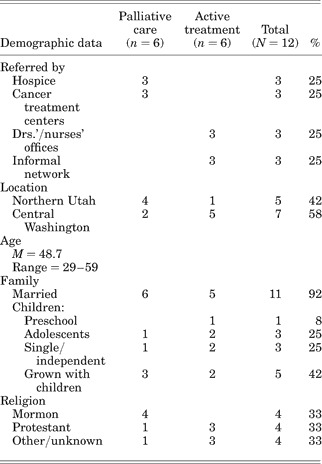
Results of the 10 completed data sets (three interviews over a period of 2 months and two incomplete data sets [less than all three interviews] for a total of 33 narratives) were analyzed. The study included 2 men and 10 women, all Caucasian. Mean age was 48.7 years (range 29–59 years). Eleven of the 12 were married and living with spouses, 1 participant was divorced. All had children, 5 had grown children with grandchildren, 3 had single independent college-aged children living away from home, 3 had teenagers living at home, and 1 had two children under 3 years old. Eleven of the 12 had completed high school. Fifty percent had some post-high-school education. Ten (83%) were employed at the time of their diagnosis. At the time of data collection 2 participants were working regularly, 1 full-time and one part-time (see Table 1).
Demographics

All subjects were diagnosed with a cancer that carried a predictably fast and fatal course. Diagnoses included breast, brain, liver, and ovarian cancers. All subjects had a predictive life expectancy of less than 12 months. Half (n = 6) of the participants were receiving palliative care only and six (50%) of the subjects were continuing to receive aggressive medical and surgical chemotherapies or interventions or both to either slow down the progress of the disease or to put them into remission. Overall, participants were eager and willing to share their cancer experiences, good and bad.
RESULTS
How Do Young and Middle-Age Adults Define/Describe Hope?
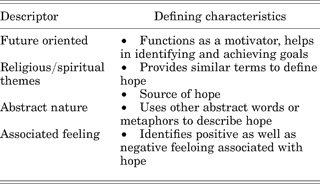
The presence of hope was quickly established. In response to “do you have hope?” all (100%) said “yes.” Their verbal responses were strongly supported by their ability to quantify their hope using the VAS-hope where 0 means no hope and 10 represents high hope. Overall VAS-hope mean was 8.67, with a range of 5.3–10. Because of the abstract nature of hope it was more difficult to articulate their definition of hope, and participants often used ambiguous or similarly abstract terms. As a collective, several qualities of hope emerged that included future related, religious, abstract, and associated feelings (see Table 2).
Key descriptors of hope

Future-related themes were words or phrases that reflected planning or anticipation of the future but not necessarily in the temporal sense. For several, hope was viewed as a motivator that helped in identifying and planning goals—not in a temporal sense but as defined by tasks. Hope was associated with “learning something new.” When hope was described using religious or spiritual words or phrases the origin appeared to be derived primarily from a secular orientation and did not necessarily reflect an organized religion. For example: “Hope is faith in Christ,” or “I get faith and hope mixed up.” The abstract nature of hope represents the difficulty individuals have in articulating their personal meanings of hope. In other words, hope was “just there,” “can't prove it,” and “it is really intoxicating.” Hope was also described using an affective quality, such as hope feels “right” or “OK,” or “I'm alive today, I'm here.” One participant captured the complexities of the description of hope:
Hope is looking for things that you're not sure of. And looking for things to come that you can't prove out by any rational or concrete means. The quality of life that you've got now. There's also the future part of it; you can't prove that in any way. But hope is the faith of things that are pretty much a state and strong in the faith. I know, pretty much that I'll feel better for at least a few months. And that's really intoxicating to me. So there's that hope.
What Influences the Presence or Maintenance of Hope in This Population?
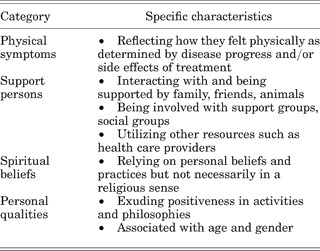
Several factors, positive and negative, were identified that influenced hope, including physical symptoms, other people, spiritual beliefs, and personal qualities. The most frequently identified influence of hope was related to the physical symptoms associated with a disease progression or therapeutic interventions (see Table 3). As symptoms decreased or laboratory values or test results reflected positive progress, perceived hope increased. One client observed that the “better your body feels, the more you can hope.” Conversely, fatigue, nausea, and pain negatively influenced hope. Two subjects specifically said that pain was an “annoyance,” but that it did not specifically impact their hope in a negative way. Despite comments related to the effect of symptoms and physical health on hope, the consistently high VAS-hope scores over time and verbal responses to the presence of hope did not change over time even as there were obvious declining or changing health patterns and symptoms.
Key categories of influences of hope

The second most frequently identified factor to influence hope was other people, including family and friends, group involvement, and social activities. All subjects gave examples of how immediate family members influenced their hope, especially spouses and children. One participant's husband gave her hope and encouragement by the fact that he will “reach out and touch me, and he goes to work at 4:30 a.m. so he can go with me to chemotherapy.” Several women commented that their husbands' “lack of understanding or insensitivity” influenced their hope negatively. One husband had an “end of chemotherapy pizza and beer party” even though the participant could not physically tolerate pizza or beer. Three participants discussed how they learned to avoid people who tended to be negative or wanted to discuss only the cancer. One participant went out of her way to avoid an especially negative friend, because she “didn't have time or the energy to waste on negative thoughts.”
Eleven out of the 12 participants continued to be involved (in varying degrees) in family routines and regular group/social activities, including church groups, community classes, and personal interest or hobby groups such as singing, painting, and shopping. Maintaining these activities was important to each. One subject scheduled her chemotherapy around her weekly dance classes. One woman's painting group would meet monthly at her house when she was unable to go out. Only one person attended a cancer support group, and two were very negative about cancer support groups, explaining that the support groups just want to “talk about the cancer.” Health care providers who had nurturing behaviors such as good listening skills and humor and who treated their patients like “real people” were reported to nurture hope. For example, “One nurse treated me like a normal person with two kids at home and dirty dishes and laundry to do,” and “When you arrive or when they speak to you, they call you by name and know who you are.”
Personal qualities such as spirituality, optimism, problem solving, and being actively involved in their cancer care were highly apparent in this population. Ten out of the 12 subjects reported that hope was influenced by their spiritual beliefs. These beliefs did not always reflect an organized religion but rather a personal philosophy of life. For them, spirituality was not a new experience, but something that had been part of their lives before being diagnosed with cancer and was now an important way to cope with the experience. “Even when you can't go out, you can pray.” Two suggested that nurses “should just go in and say a little prayer with them.”
All subjects portrayed positive or optimistic attitudes and philosophies relating to life and life events and their illness and prognosis, regardless of the phase of their cancer. Comments included “I made up my mind to do it, you either bring it forward or it just sits there.” This was reflected in their active involvement in treatment decisions and care. Comments included “It's about me making choices for myself. I want to know things. When you go out the door, there is a high possibility that you are going to get rained on. Well, maybe I'll get my umbrella. It gives me some options here,” and “This cancer is mine. Nobody owns it but me. If I decide that I don't want to take any treatment, then I ask for your support. I do not ask for you to agree with me. It is my choice.” All of the subjects stressed the importance of maintaining normal schedules and activities as much as possible such as shopping, vacations, and family time together.
When participants were asked if their age influenced their cancer experiences and their hope, five saw age as a motivator, especially if they had kids at home. Those with teenagers (n = 3) had a particular need to “be there for them.”
What Do Young and Middle-Aged Adults Hope For?
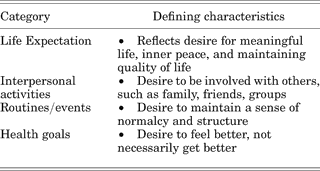
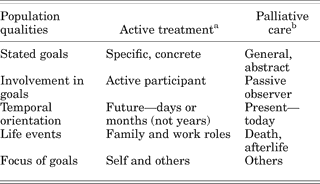
Participants responded easily to the question, “What do you hope for?” Analyses of their responses identified four categories: life expectations, interpersonal activities, routines and events, and health goals. Most goal-related categories reflect development issues such as family, finances, and usual activities (see Table 4). In addition, two distinct “types” of goals were identified that were based solely on the phase of the illness (see Table 5). The goals for the six participants receiving aggressive therapy tended to be more specific and concrete. The goals were often defined in temporal terms or specific and normal activities in which they were generally active participants, such as those typical of a younger adult managing family roles. Participants receiving palliative care described goals in more general and abstract terms and identified themselves as an observer of “others,” usually family members, who were the focus of their goals. Temporal orientation was of the “present” or today.
Key categories for hope goals/outcomes

Comparison of hope goals based on treatment groups

aActive interventions to slow disease progression or put into remission.
bTerminal stage of disease, receiving supportive care only.
Life expectations focused on quality of life-related goals. They included individual life goals and general life satisfaction. Participants who were receiving active treatment wanted to live a “good life,” “the best life,” whereas those who were receiving palliative care were ready to move on, asking for “peace within myself—just that peaceful feeling.” Interactions with others were important hope goals to all subjects. “If you are touching anybody's life at all, you are not in a hopeless situation.” All participants expressed a desire to help others. Those receiving active treatment hoped to be an active participant with their families—not necessarily to live forever: “I want to build memories.” Participants who were receiving palliative care hoped to be able to actively help their families rather than be a passive observer or outsider. One participant said, “I really would like to go, but I will not go until I've been able to do what I need to do to help the people who need help.” Another participant said, “If you are touching anyone's life at all, I don't think you are in a hopeless situation.”
All subjects reported that they wanted to maintain activities related to routines and normalcy. For those receiving active treatment, many of them stayed active with tasks associated with their ages that included parenting, being part of a marriage, and even being able to return to work. For one participant, making her daughter's sack lunch everyday was often her only activity, but it was a very important one for her to complete.
Does Hope Remain Constant or Change over Time?
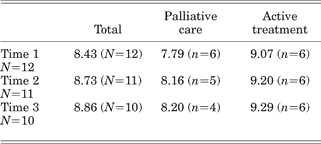
As a collective, verbal responses and VAS-hope scores did not change over time (see Table 6). VAS-hope at Time 1 was 8.43, at Time 2 was 8.73; and at Time 3 was 8.86. Participant observation also supports the stability and ongoing presence of hope that did not waiver as noted by their ability to quantify their hope easily on the VAS-hope as well as their enthusiastic responses to the question, “Do you have hope?” One subject said, “I never thought of hope as something that could change—like one continuous thing. It is or it isn't.”
Visual analogue hope scores at Time 1, Time 2, and Time 3

CONCLUSIONS/SUMMARY
Overall, this was a population with high levels of hope, and the study findings strongly support the presence of hope in a potentially hopeless patient population. This study confirms other study findings that hope is present at high levels in individuals with advanced stage cancer. Participants in this study were able to define and describe hope, identify what influenced hope, and clearly state hope-related goals. Hope goals are individually defined and are unique to the patient population, influenced by the phase of the illness and developmental stage of the individual. Hope goals also vary in degree of expectancy and concreteness and require reassessment as conditions change. By identifying an individual's hope goals, nurses can plan and implement interventions to move toward individual hope goals.
Limitations
Qualitative research generally deals with small samples, nested in their context and studied in depth (Miles & Huberman, Reference Miles and Huberman1994). With a study sample size of 12, the results of this study need to be viewed cautiously and as a first step to identifying and evaluating specific hope-related interventions. The data do provide general descriptions and trends that may be used to provide ideas or direction for future palliative care research.
It had not been anticipated that the convenience sample would reflect such a homogeneous group. Subjects had similar high levels of hope, and they demonstrated as a collective strong spiritual, social, economic, and family support. What cannot be concluded from this study is whether these qualities are common in all adults with advanced stage cancer. This limits the applicability of hope to individuals with patients that are less “hopeful.”
Clinical Implications
Knowing that patients with advanced stage cancer, as well as other palliative care patient populations regardless of diagnosis, have hope is important for clinicians caring for these populations. Recognizing that a patient has hope provides the provider with a new perspective or attitude in establishing a therapeutic relationship as well as planning interventions that focus and build on the patient's positive experiences and qualities. Important contributions to palliative care clinicians from this study address the unique needs of the young and middle-aged adult cancer patient.
One of the most valuable findings of this study is the importance and ease of identifying hope goals as they relate to life expectations, relationships, routines/events, and spiritual goals. Clinicians need to ask each individual, “What do you hope for?” Answers to this question will allow clinicians to identify hope goals and create a plan and implement activities to meet and/or address specific hope goals. A palliative care goal for the terminally ill cancer patient is to facilitate coping processes and instill hope and other strategies that lead to positive adaptation (Watson, Reference Watson1979).
The findings of the study suggests that a combination of assessment techniques can be used in the clinical setting, namely, the use of VAS-hope and questioning. The VAS-hope is an easy and reliable way to assess the presence of hope and can be used as a screening tool in identifying patients' needs. Although a VAS-hope does not appear to discriminate between close levels of hope, it may be a valuable screening tool to identify extremely “hopeless” patients.
It is equally important to ask patients about their hope. Do they have hope? What influences their hope? What do they hope for? Such questions could be easily answered. An assessment must also include evaluating and reevaluating those hope factors that change as a cancer progresses.
This study adds new knowledge to the hope literature and to palliative and supportive care. Important in this study is the finding that hope goals are individually defined and are unique to the patient population and are influenced by the phase of the illness and developmental stage of the individual. Hope goals also vary in degree of expectancy and concreteness. By identifying an individual's hope goals, palliative care clinicians can plan and implement more realistic interventions to move toward individual hope goals.