


Introduction
Chronic musculoskeletal pain (CMP), defined as persistent or recurrent pain in the muscles, bones, joints, or tendons, most commonly affects the neck and low back and is a leading cause of disability worldwide [Reference Treede, Rief and Barke1–3]. In the United States, it affects millions of adults annually and is associated with an estimated economic burden of $560–635 billion [Reference Kennedy, Roll, Schraudner, Murphy and McPherson4–Reference Gaskin and Richard7]. Chronic pain is also linked to increased risk of opioid exposure, substance use disorders, physical and mental health comorbidities, disability, greater healthcare utilization – including recurrent emergency department (ED) visits – and mortality [Reference Vowles, McEntee, Julnes, Frohe, Ney and van der Goes8–Reference Foley, Knight, Ploughman, Asghari and Audas13]. Despite longstanding recognition of the importance of prevention, efforts targeting the transition from acute to chronic pain remain limited, accounting for only 2% of published research over the past 50 years [14–Reference Grol-Prokopczyk, Huang and Yu16]. There is a critical need to identify modifiable risk factors early in the pain trajectory, when intervention may help delay or even prevent the development of chronic pain and high-impact chronic pain (≥1 activity limitation) [Reference Zelaya, Dahlhamer, Lucas and Connor5].
EDs represent a key but underutilized setting for early intervention. Musculoskeletal conditions account for approximately 9.5 million ED visits annually in the United States, and an estimated 12–27% of patients presenting with acute pain transition to chronic pain, nearly double the incidence observed in the general population [17–Reference Nahin, Feinberg, Kapos and Terman21]. For many individuals, particularly those with limited access to primary care, the ED serves as the first, and sometimes only, point of medical evaluation during an acute pain episode. ED encounters also influence early management decisions, including imaging, medication prescribing, and referral patterns, which may shape subsequent pain trajectories [17,18,Reference Downie, Hancock and Jenkins22,Reference Barnett, Olenski, Jena and Med23].
Although psychosocial factors such as pain catastrophizing (PCS), fear-avoidance beliefs, and low pain self-efficacy are well-established predictors of pain chronification in surgical and outpatient populations, these factors remain less well characterized in ED populations, which differ in acuity, socioeconomic vulnerability, and healthcare access [Reference Theunissen, Peters, Bruce, Gramke and Marcus24–Reference Coninx, Ray and Stilwell29]. As a result, important gaps remain in understanding how to identify high-risk patients and implement early interventions within the ED context.
Longitudinal cohort studies are essential to inform risk stratification and intervention development; however, the feasibility of recruiting, characterizing, and retaining ED patients for longitudinal pain research remains uncertain. PREVENT was designed to establish ED-based recruitment and follow-up procedures and to characterize baseline risk factors relevant to chronic pain prevention among adults presenting with acute musculoskeletal pain. For the purposes of PREVENT, acute musculoskeletal pain was defined as neck or low back pain of ≤4 weeks’ duration, whereas chronic pain was defined as neck or low back occurring on most days or every day for at least 3 months [Reference Ray, Meltzer, McCall and Meldrum30]. The objective of this first-year analysis was to evaluate recruitment, retention, and baseline characterization during initial cohort implementation and to identify opportunities to refine PREVENT procedures for future ED-initiated chronic pain prevention research. Secondary objectives were to characterize social needs burden (SNB), pain-related cognitions, psychological factors, and functional outcomes relevant to risk-informed screening and intervention development.
Materials and methods
Study design and setting
This study uses data from the PREVENT cohort, a prospective observational study designed to examine biopsychosocial predictors of pain outcomes following ED visits for acute musculoskeletal pain [Reference Ray, Meltzer, McCall and Meldrum30]. The study was conducted in an urban academic ED with approximately 75,000 annual visits, serving a diverse patient population. The study was approved by the George Washington University institutional review board and conducted under ongoing ethical oversight. All participants provided electronic informed consent prior to enrollment.
Participants
Adult patients aged 18 years and older presenting to the ED with acute (≤4 weeks) musculoskeletal pain involving the neck or low back were screened for eligibility. PREVENT was designed to enroll patients whose primary complaint was musculoskeletal pain without another condition that better explained the presenting symptoms, such as malignancy, systemic rheumatologic disease, renal colic, or infection. Medical and psychiatric comorbidities were not exclusionary unless the patient was medically unstable, had altered mental status, or was otherwise unable to provide informed consent. Individuals whose primary language was not English were eligible if they could speak and read English sufficiently to complete the consent process and study procedures. Because language interpretation and translated study materials were not consistently available throughout the study, individuals unable to complete these procedures in English were excluded. Eligibility criteria evolved across three phases of study implementation based on feasibility findings from screening and recruitment. From study initiation through early April 2025, eligibility was limited to patients whose acute neck or low back pain followed a motor vehicle crash. Beginning in mid-April 2025, qualifying mechanisms were expanded to include other recent traumatic events, such as falls. In March 2026, the trauma requirement was removed, allowing enrollment of patients presenting with acute neck or low back pain regardless of mechanism.
Study procedures
Participants were enrolled during the ED encounter and completed baseline assessments capturing demographic, clinical, and psychosocial characteristics. Routine clinical pain assessment included documentation of pain location and pain intensity at triage using a 0−10 numeric rating scale. PREVENT data collection extended beyond these routine clinical measures to assess biopsychosocial factors previously associated with pain chronification, such as pain beliefs, coping, self-efficacy, and related psychosocial constructs. Study procedures evolved over time; financial reimbursement was implemented in February 2025, and the Tampa Scale of Kinesiophobia was added to study assessments in April 2025.
Participants were invited to complete longitudinal follow-up assessments at 1, 3, and 6 months after the index ED visit. These timepoints were specified a priori to capture early post-ED changes while the index encounter remained relatively recent, identify new-onset chronic pain at the 3-month threshold, and evaluate longer-term persistence, recovery, and pain trajectories at 6 months. The nominal timepoints were maintained throughout the study to preserve consistency and comparability across participants. Follow-up data were collected using electronic surveys and/or telephone outreach. Follow-up procedures became increasingly structured over the study period and incorporated multimodal outreach strategies, including prescheduled text or email reminders and manual phone calls. Digital reminders were scheduled in REDCap for 7 days and 1 day before the target follow-up date, and phone outreach was tracked using a separate follow-up workflow with sequential contact attempts [Reference Harris, Taylor, Thielke, Payne, Gonzalez and Conde31,Reference Harris, Taylor and Minor32]. Call #1 was scheduled on or near the target visit date when possible, with additional call attempts generated after missed contacts or voicemail messages. In March 2026, a voicemail option was added to facilitate participant callback, scheduling, and survey completion.
Outcomes
The primary outcomes for this analysis were feasibility metrics related to recruitment and longitudinal follow-up. These included (1) number of patients enrolled during the study period; (2) completion rates for follow-up assessments at 1, 3, and 6 months; and (3) patterns and timing of follow-up participation over time, including completion relative to target follow-up dates and within allowable assessment windows. Secondary exploratory analyses described baseline psychosocial, functional, and social need characteristics relevant to refinement of later PREVENT survey content and future intervention development.
Data analysis
For follow-up analyses, eligibility for each follow-up time point was defined based on index visit date at the time of analysis. Completion timing was further characterized relative to the nominal target follow-up date and protocol-defined allowable follow-up windows. These windows were intended to balance temporal relevance with the flexibility needed for longitudinal follow-up of an ED-recruited population. The allowable window for 1-month follow-up was completion within 8 weeks of the index ED visit, and the allowable window for 3-month follow-up was completion within 18 weeks. No upper limit was imposed for the 6-month follow-up because the primary longer-term outcome of interest in PREVENT is pain chronification. Rather than modifying the nominal assessment timepoints during implementation, flexibility was provided through these allowable windows and continued outreach after missed assessments. Analyses of recruitment, retention, and baseline cohort characteristics were primarily descriptive. Baseline characteristics were summarized using counts and proportions for categorical variables and means with standard deviations for continuous variables. To evaluate potential differential retention, baseline characteristics were compared between participants who completed at least one eligible follow-up and eligible participants who completed none. Categorical variables were compared using Fisher’s exact tests, whereas numerical scale scores and counts were compared using exact Wilcoxon rank-sum tests. Analyses used available data without imputation; adjusted models were restricted to participants with complete outcome and covariate data. Sample sizes varied because the 11-item Tampa Scale of Kinesiophobia (TSK-11) was introduced after enrollment began and because measures were administered according to pain region. The Back Pain Attitude Questionnaire (BPAQ) and Oswestry Disability Index (ODI) were administered to participants with low-back pain, whereas the Neck Pain Attitudes Questionnaire (NPAQ) and Neck Disability Index (NDI) were administered to participants with neck pain. Analysis-specific sample sizes are reported in the tables.
As an exploratory secondary analysis intended to inform survey refinement and identify early patterns in the PREVENT cohort, SNB was operationalized as a three-level ordered variable representing the number of endorsed social need domains (0, 1, or ≥2). Baseline pain-related cognitive, psychological, and functional outcomes were first examined descriptively across SNB categories using summary statistics for continuous variables and cross-tabulation for categorical variables. Group differences were assessed using general linear models for continuous outcomes and Fisher’s exact tests for categorical outcomes because of sparse cell counts. Continuous outcomes showing notable associations in unadjusted analyses were subsequently examined using general linear models adjusted for age, gender, race, ethnicity, and current pain intensity. Age, gender, race, and ethnicity were included as core demographic covariates to account for potential sociodemographic variation in these associations. Current pain intensity was included because the analytic objective was to estimate associations between SNB and pain-related psychological and functional outcomes independent of concurrent pain severity. To reduce the number of model parameters, age was modeled continuously, and models were restricted to main effects without interaction terms. SNB was entered as a categorical predictor, and adjusted mean differences comparing participants with one and ≥2 social needs with those reporting no social needs were estimated with 95% confidence intervals. As sensitivity analyses, parallel adjusted models were fit using the original 5-level social needs burden variable (range, 0–4) to evaluate the robustness of findings to alternative coding of the exposure. Given the exploratory purpose and number of comparisons, no correction for multiple testing was applied; findings should be interpreted as hypothesis-generating. Analyses were performed using SAS version 9.4 (SAS Institute Inc., Cary, NC). This study was reported in accordance with the Strengthening the Reporting of Observational Studies in Epidemiology (STROBE) guidelines [Reference von Elm, Altman and Egger33].
Results
Recruitment & enrollment
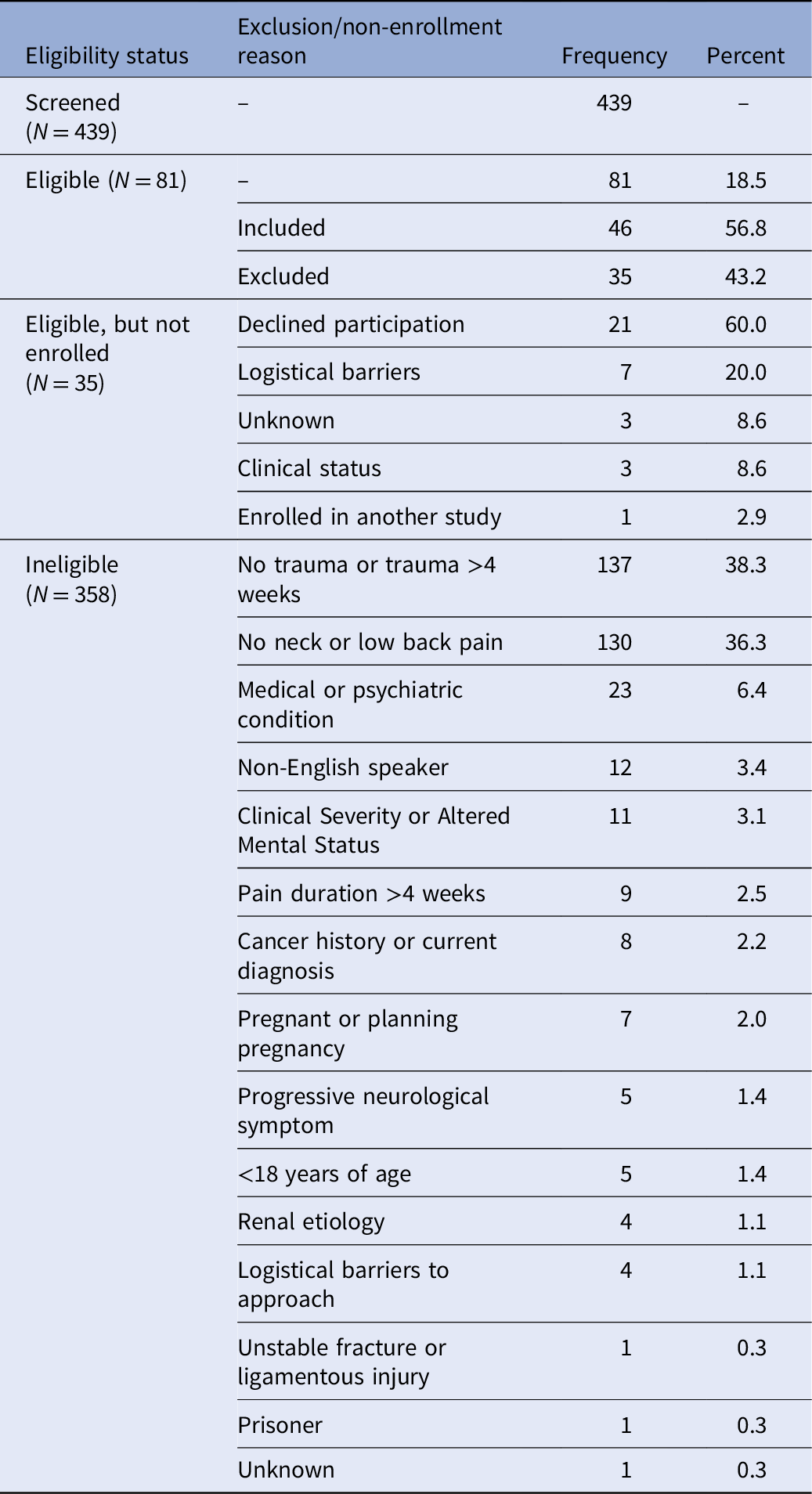
Between January 21, 2025 and March 22, 2026, a total of 439 individuals were screened. Of these, 81 were eligible and 358 were excluded (Figure 1). Among the 81 eligible, 46 were enrolled and 35 were not enrolled. Of those not enrolled, 21 declined participation; specific reasons for declining were not systematically recorded. Screening logs indicated that the most common reason for ineligibility was absence of a qualifying traumatic mechanism, followed by absence of neck or low back pain (Table 1).
Study flow diagram for participant screening, eligibility, enrollment, and follow-up in the PREVENT cohort. Flow diagram illustrating patient screening, reasons for ineligibility, enrollment, and completion of follow-up assessments at 1, 3, and 6 months after the index ED visit. *Clinical exclusion includes altered mental status, comorbid medical or psychiatric conditions, progressive neurologic symptoms, cancer, renal etiology, unstable fracture or ligamentous injury, and other non-eligible clinical presentations. Detailed reasons for exclusion are provided in Table 1.

Eligibility & enrollment outcomes (January 2025 – March 2026)

Table 1. Long description
A table detailing eligibility and enrollment outcomes for a study. The table has 13 rows and 4 columns. Column headers are Eligibility status, Exclusion/non-enrollment reason, Frequency, and Percent. Row labels include Screened, Eligible, Included, Excluded, Eligible but not enrolled, and Ineligible. The table lists reasons for exclusion or non-enrollment with corresponding frequencies and percentages. Notable reasons for ineligibility include no trauma or trauma over 4 weeks, no neck or low back pain, and medical or psychiatric conditions.
Note: Percentages were calculated using the applicable denominator: all screened participants for eligibility (N = 439), eligible participants for inclusion or exclusion (N = 81), eligible participants not enrolled for non-enrollment reasons (N = 35), and ineligible participants for ineligibility reasons (N = 358). The category “No trauma or trauma >4 weeks” combines trauma-related exclusions across changes in screening-form wording, including trauma >4 weeks (January 2025–March 2026), no motor vehicle crash (January–March 2025), and no trauma mechanism (April 2025–March 2026).
Follow-up completion
Follow-up completion rates were evaluated among participants eligible for each time point based on index date. Among 40 participants eligible for 1-month follow-up, 9 (22.5%) completed the assessment. Among 38 participants eligible for 3-month follow-up, 5 (13.2%) completed the assessment. Among 28 participants eligible for 6-month follow-up, 5 (17.9%) completed the assessment.
Patterns of follow-up participation over time
In addition to time-point-specific completion rates, participant-level follow-up trajectories were examined across eligible assessment windows. Among the 40 participants eligible for follow-up, 26 (65.0%) did not complete any follow-up assessments. Fourteen participants (35.0%) completed at least one eligible follow-up, although most completed only a single timepoint (9/40, 22.5%). Completion at multiple timepoints was uncommon, with 5 participants (12.5%) completing more than one follow-up assessment and no participants completing all three follow-ups. Among participants who completed follow-up assessments, completion commonly occurred after the nominal target follow-up date rather than on the scheduled date itself. At 1 month, all 9 completed assessments occurred after the target date, with delays ranging from 2 to 50 days (median, 12 days). However, 6 of these 9 assessments were still completed within the allowable 8-week window from the index visit, whereas 3 occurred outside that window. At 3 months, 1 of 5 completed assessments occurred before the target date (10 days early), and 4 occurred after the target date, with delays ranging from 2 to 14 days (median, 6.5 days); all 5 were completed within the allowable 18-week window from the index visit. At 6 months, all 5 completed assessments occurred after the target date, with delays ranging from 5 to 88 days (median, 28 days); no upper time limit was imposed for 6-month follow-up given the outcome of interest was pain chronification. Additionally, 7 of 14 participants (50.0%) who completed any eligible follow-up demonstrated re-engagement, completing a later assessment despite missing an earlier timepoint.
Among the baseline characteristics examined for potential differential retention, only insurance coverage differed significantly between participants who completed at least one eligible follow-up and eligible non-completers (Fisher’s exact test p = .022). Among participants with available insurance data, completers were more frequently privately insured than non-completers (64.3% vs 16.7%) and less frequently covered by Medicaid (14.3% vs 45.8%) or uninsured (7.1% vs 25.0%).
Baseline characteristics of the cohort
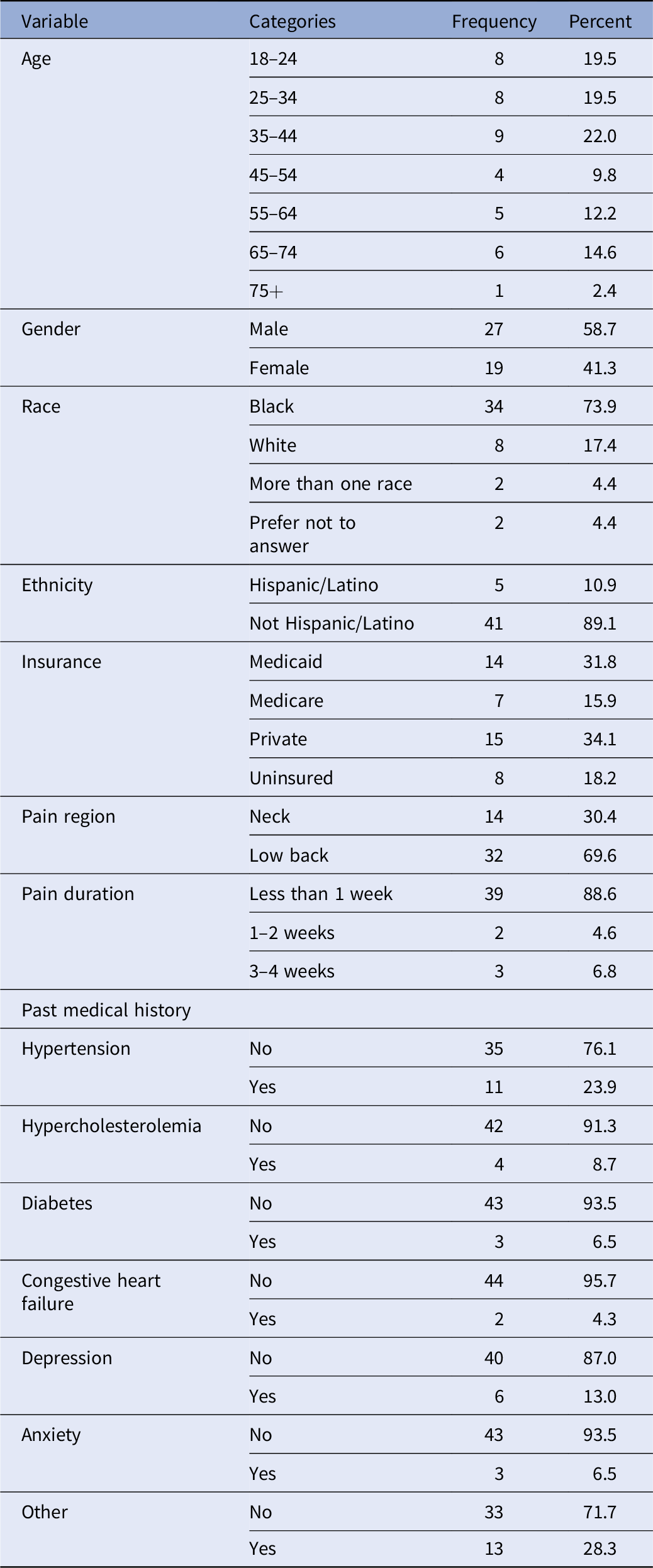
Participants were primarily in early and mid-adulthood, with 61.0% aged 18–44 years. Most identified as male (58.7%), Black/African American race (73.9%), and non-Hispanic/Latinx (89.1%) (Table 2). The majority of participants reported low back pain (69.6%) and symptom duration of less than one week (88.6%); mean current pain intensity at enrollment was 6.9 (SD 2.0). Insurance coverage was most commonly private insurance (34.1%) or Medicaid (31.8%), while 18.2% reported being uninsured. Common self-reported comorbidities included hypertension (23.9%) and depression (13.0%) (Table 2). In addition, 15.6% of participants screened positive for depressive symptoms, including five who did not report a prior depression diagnosis. Four participants screened positive for anxiety symptoms, all of whom did not report a prior anxiety diagnosis.
Baseline characteristics of PREVENT cohort

Table 2. Long description
A table summarizing baseline characteristics of a cohort with 8 rows and 4 columns. The columns are labeled Variable, Categories, Frequency, and Percent. The table includes data on age, gender, race, ethnicity, insurance, pain region, pain duration, and past medical history. Each row provides specific categories, frequencies, and percentages for each variable. For example, age categories range from 18-24 to 75+, with frequencies and percentages listed. Gender categories include Male and Female, with frequencies and percentages provided. Race categories include Black, White, More than one race, and Prefer not to answer. Ethnicity categories are Hispanic/Latino and Not Hispanic/Latino. Insurance categories include Medicaid, Medicare, Private, and Uninsured. Pain region categories are Neck and Low back. Pain duration categories are Less than 1 week, 1-2 weeks, and 3-4 weeks. Past medical history includes Hypertension, Hypercholesterolemia, Diabetes, Congestive heart failure, Depression, Anxiety, and Other.
Note: Frequencies and percentages are based on available data for each variable. Age was available for 41 participants, while insurance and pain duration were available for 44 participants; all other characteristics shown were available for all 46 participants. No imputation was performed.
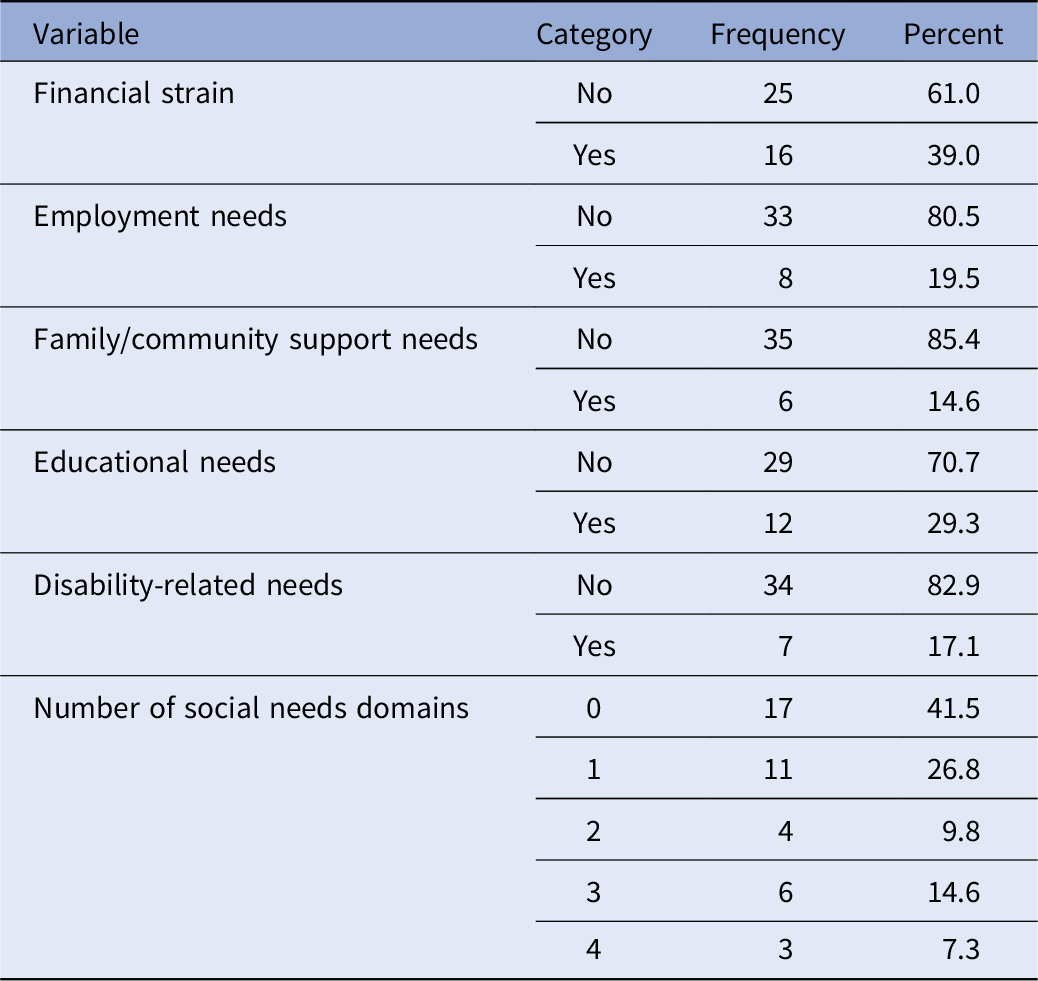
Indicators of social vulnerability were common at baseline (Table 3). Financial strain (39.0%) and educational support needs (29.3%) were the most frequently reported domains, followed by employment-related needs (19.5%), disability-related needs (17.1%), and family or community support needs (14.6%). Overall, 58.5% of participants endorsed at least one social needs domain (Table 3).
Baseline social vulnerability characteristics of PREVENT cohort

Table 3. Long description
A table comparing the frequency and percent of various social vulnerability characteristics among the PREVENT cohort. The table has six rows and four columns. The columns are labeled Variable, Category, Frequency, and Percent. The variables include Financial strain, Employment needs, Family/community support needs, Educational needs, Disability-related needs, and Number of social needs domains. Each variable is divided into categories with corresponding frequency and percent values. For Financial strain, 25 participants reported No (61.0 percent) and 16 reported Yes (39.0 percent). For Employment needs, 33 reported No (80.5 percent) and 8 reported Yes (19.5 percent). For Family/community support needs, 35 reported No (85.4 percent) and 6 reported Yes (14.6 percent). For Educational needs, 29 reported No (70.7 percent) and 12 reported Yes (29.3 percent). For Disability-related needs, 34 reported No (82.9 percent) and 7 reported Yes (17.1 percent). The Number of social needs domains ranges from 0 to 4, with 17 participants reporting 0 domains (41.5 percent), 11 reporting 1 domain (26.8 percent), 4 reporting 2 domains (9.8 percent), 6 reporting 3 domains (14.6 percent), and 3 reporting 4 domains (7.3 percent).
Note : Social-needs data were available for 41 of 46 participants. Frequencies and percentages use 41 as the denominator. No imputation was performed.
Pain cognition & function
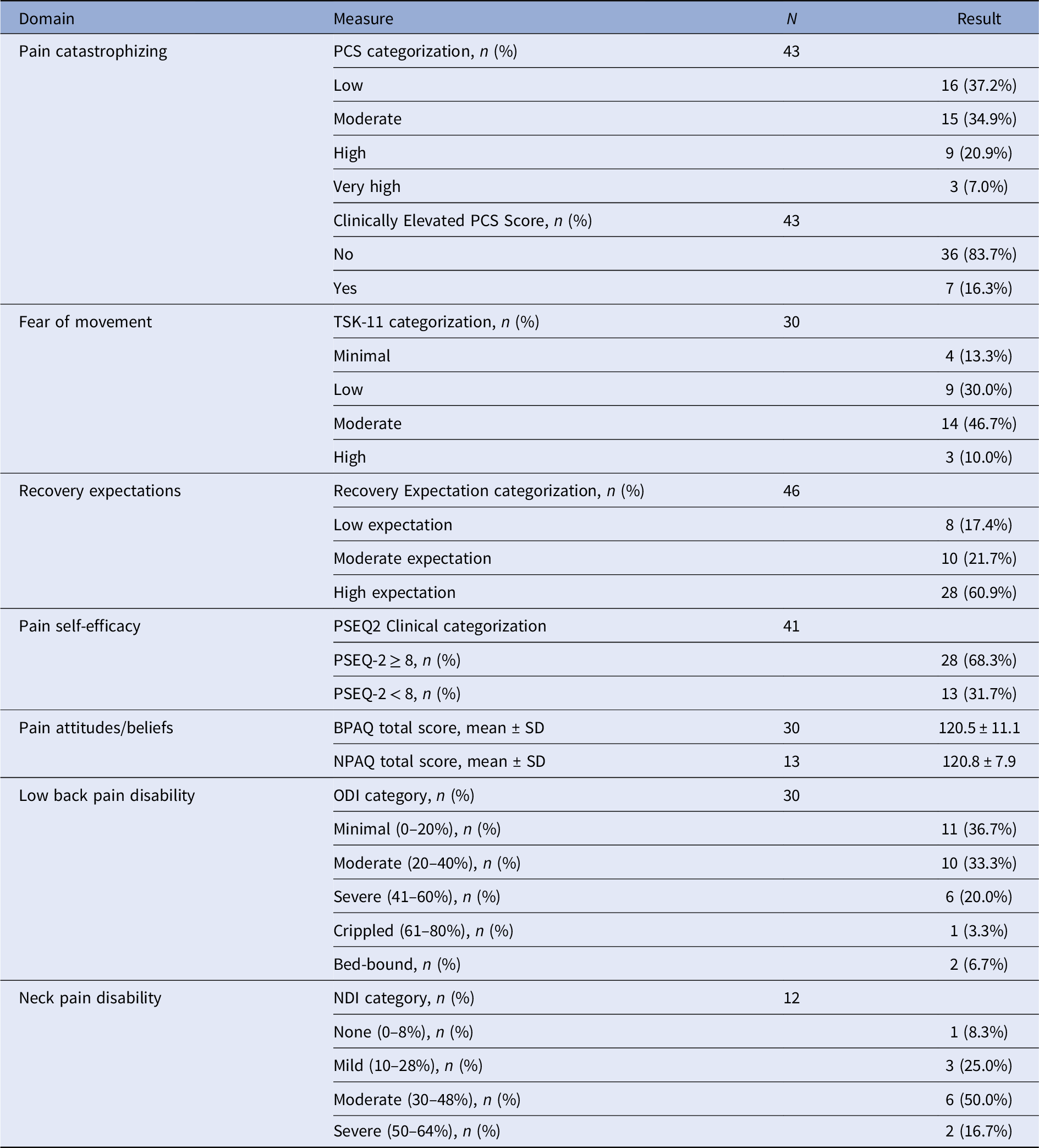
Among the PREVENT cohort, pain-related distress and maladaptive pain beliefs were common at baseline (Table 4). The mean baseline PCS score was 15.9 (SD 12.9; range 0–52; n = 43). PCS scores were most often in the low and moderate categories (37.2% and 34.9%, respectively), while 20.9% were categorized as high and 7.0% as very high. Using the clinical PCS cutoff (≥30), 16.3% met criteria for clinically elevated PCS. Among participants with available data, the mean TSK-11 score was 28.8 (SD 5.8; range 17–41; n = 30), and 56.7% were categorized as having moderate to high fear of movement. Recovery expectations were generally favorable, with a mean score of 6.9 (SD 3.2; range, 0–10; n = 46); 60.9% of participants were categorized as having high expectations for recovery, compared with 21.7% with moderate expectations and 17.4% with low expectations. Among participants with available data, the mean PSEQ score was 8.4 (SD 3.1; range 1–12; n = 41), with 31.7% scoring below the clinically meaningful threshold for pain self-efficacy. Mean BPAQ and NPAQ scores further suggested elevated misinformed beliefs regarding pain, its management, treatment, and recovery within each respective body region (BPAQ: 120.5 ± 11.1; NPAQ: 120.8 ± 7.9).
Pain cognition & functional status in the PREVENT cohort

Table 4. Long description
A table with 8 rows and 4 columns. The columns are labeled Domain, Measure, N, and Result. The table categorizes various aspects of pain cognition and functional status. Row 1: Pain catastrophizing, PCS categorization, n (%), 43. Row 2: Low, 16 (37.2 percent). Row 3: Moderate, 15 (34.9 percent). Row 4: High, 9 (20.9 percent). Row 5: Very high, 3 (7.0 percent). Row 6: Clinically Elevated PCS Score, n (%), 43. Row 7: No, 36 (83.7 percent). Row 8: Yes, 7 (16.3 percent). Row 9: Fear of movement, TSK-11 categorization, n (%), 30. Row 10: Minimal, 4 (13.3 percent). Row 11: Low, 9 (30.0 percent). Row 12: Moderate, 14 (46.7 percent). Row 13: High, 3 (10.0 percent). Row 14: Recovery expectations, Recovery Expectation categorization, n (%), 46. Row 15: Low expectation, 8 (17.4 percent). Row 16: Moderate expectation, 10 (21.7 percent). Row 17: High expectation, 28 (60.9 percent). Row 18: Pain self-efficacy, PSEQ2 Clinical categorization, 41. Row 19: PSEQ-2 greater than or equal to 8, n (%), 28 (68.3 percent). Row 20: PSEQ-2 less than 8, n (%), 13 (31.7 percent). Row 21: Pain attitudes/beliefs, BPAQ total score, mean plus or minus SD, 30, 120.5 plus or minus 11.1. Row 22: NPAQ total score, mean plus or minus SD, 13, 120.8 plus or minus 7.9. Row 23: Low back pain disability, ODI category, n (%), 30. Row 24: Minimal (0-20 percent), n (%), 11 (36.7 percent). Row 25: Moderate (20-40 percent), n (%), 10 (33.3 percent). Row 26: Severe (41-60 percent), n (%), 6 (20.0 percent). Row 27: Crippled (61-80 percent), n (%), 1 (3.3 percent). Row 28: Bed-bound, n (%), 2 (6.7 percent). Row 29: Neck pain disability, NDI category, n (%), 12. Row 30: None (0-8 percent), n (%), 1 (8.3 percent). Row 31: Mild (10-28 percent), n (%), 3 (25.0 percent). Row 32: Moderate (30-48 percent), n (%), 6 (50.0 percent). Row 33: Severe (50-64 percent), n (%), 2 (16.7 percent).
Note: Values are presented as mean ± SD or n (%), using available data without imputation. Sample sizes vary because of staged instrument introduction and region-specific administration. The TSK-11 was introduced after enrollment began. The BPAQ and ODI were administered to participants with low-back pain, whereas the NPAQ and NDI were administered to participants with neck pain. Limited item-level missingness was present for selected measures. Percentages use the number of participants with an available score for each measure. Abbreviations: PCS = Pain Catastrophizing Scale; TSK-11 = Tampa Scale of Kinesiophobia, 11-item version; PSEQ-2 = 2-item Pain Self-Efficacy Questionnaire; BPAQ = Back Pain Attitudes Questionnaire; NPAQ = Neck Pain Attitudes Questionnaire; ODI = Oswestry Disability Index; NDI = Neck Disability Index.
Pain-related disability was substantial among participants with available data (Table 4). The mean ODI score was 31.5 (SD 24.0; range 2.0–90.0; n = 30). ODI severity categories were distributed as 36.7% minimal, 33.3% moderate, 20.0% severe, 3.3% crippled, and 6.7% bedbound. Among participants with neck pain, the mean NDI score was 32.9 (SD 16.9; range 4.4–58.0; n = 12), with most categorized as having moderate (50.0%) disability; smaller proportions had no disability (8.3%) or mild disability (25.0%).
Social needs burden association with psychological and functional outcomes
In exploratory descriptive analyses, participants with greater social needs burden (SNB) generally exhibited worse pain-related cognitive, psychological, and functional profiles at baseline. Mean GAD-2, PHQ-2, PCS, TSK, BPAQ, NPAQ, and ODI scores were higher among participants with ≥2 social needs than among those with 0 or 1 need, although patterns were less consistent across measures. Full descriptive statistics by SNB category, including variable-specific sample sizes, means, and standard deviations, are presented in Supplemental Table 1. In unadjusted general linear models, statistically significant differences across SNB categories were observed for GAD-2 total score (F = 11.33, p = 0.0001) and ODI total score (F = 4.32, p = 0.0250), whereas the association for PHQ-2 total score approached statistical significance (F = 3.24, p = 0.0507). No statistically significant differences were observed for the other measures (Supplemental Table 2).
In exploratory analyses adjusted for continuous age, gender, race, ethnicity, and current pain intensity, SNB category was associated with PCS, GAD-2, PHQ-2, and ODI scores (Figure 2; Supplemental Table 3). Compared with participants reporting no social needs, those reporting ≥2 needs had higher adjusted scores across all four outcomes, whereas differences between participants reporting one versus no social needs were not statistically significant. Sensitivity analyses using the original 5-level SNB classification supported the overall associations, although estimates across individual burden levels were imprecise and not consistently monotonic (Supplemental Tables 4A and 4B).
Selected comparison of adjusted mean baseline pain-related cognitive, psychological, and functional outcome scores by social needs burden. Panel A presents anxiety (GAD-2) and depressive symptom (PHQ-2) scores, and Panel B presents pain catastrophizing (PCS) and disability (ODI) scores. The figure displays the selected comparison between participants reporting no social needs (SNB 0) and those reporting multiple social needs (SNB ≥ 2); the underlying models included SNB 0, 1, and ≥2. Points represent adjusted least-squares means, and horizontal error bars represent 95% confidence intervals. Models were adjusted for continuous age, gender, race, ethnicity, and current pain intensity; the ODI model was restricted to participants with low-back pain. Estimates for all three SNB categories are presented in Supplemental Table 3.

In categorical analyses using Fisher’s exact tests, positive GAD-2 screen status and clinically elevated PCS differed significantly across SNB groups. Positive GAD-2 screens were observed in 30.8% of participants with ≥2 social needs, compared with 0.0% in those with 0 or 1 social need (p = 0.0114). Similarly, clinically elevated PCS was present in 38.5% of participants with ≥2 social needs, compared with 6.3% and 0.0% in the 0- and 1-SNB groups, respectively (p = 0.0206). NDI category also differed across SNB groups (p = 0.0152), although this finding should be interpreted cautiously given the small sample size. Other categorical measures were not statistically significant (Supplemental Table 5).
Discussion
Emergency departments remain an important but underused setting for identifying patients early in the transition from acute to CMP. As a first-year effort to build an ED-based cohort for chronic pain prevention research, PREVENT adds to a limited body of prospective ED-based work by showing that recruitment and baseline psychosocial characterization are feasible, while also demonstrating how strongly cohort yield depends on eligibility design and how difficult longitudinal retention remains in this population.
Feasibility of recruitment & enrollment
Recruitment and enrollment findings suggest that the ED is a feasible setting in which to identify and characterize patients early in the acute pain trajectory, but they also underscore how strongly study yield depends on eligibility design. During the early phase of PREVENT, many screened patients were excluded because they did not meet the qualifying trauma criterion, despite otherwise representing clinically relevant presentations of acute neck or low back pain. The large number of exclusions for absence of a qualifying traumatic mechanism, followed by absence of neck or low back pain, suggested that a trauma-restricted approach was overly narrow for the broader objective of identifying early biopsychosocial risk in patients with acute musculoskeletal pain. These screening findings directly informed refinement of the cohort design. Eligibility criteria have since been revised to remove the trauma requirement and now include patients presenting with acute (≤4 weeks) neck or low back pain regardless of mechanism.
Follow-up challenges
In contrast, follow-up retention emerged as the major feasibility challenge. Completion rates at 1, 3, and 6 months were low, and most participants eligible for follow-up did not complete any longitudinal assessments. Even among participants who did complete follow-up, completion commonly occurred after the nominal target date rather than on schedule. At the same time, later re-engagement after a missed earlier timepoint was not uncommon, suggesting that missed interim follow-up should not necessarily be interpreted as permanent attrition. Taken together, these findings suggest that while longitudinal follow-up in this ED population is possible, standard follow-up procedures are unlikely to be sufficient on their own.
These retention challenges are not unique to PREVENT, and prior work has described strategies to improve retention in longitudinal studies [Reference Teague, Youssef and Macdonald34]. Teague reviewed retention strategies in longitudinal studies and evaluated their effectiveness. The authors identified four common domains across included studies: (1) barrier-reduction strategies (e.g., transportation or child care assistance); (2) community-building (e.g., recognizable study branding, newsletters, or participant updates); (3) follow-up and incentive strategies (e.g., cash or voucher incentives and multiple communication methods); and (4) tracking approaches (e.g., collecting alternative contact persons). Our findings are consistent with this literature and suggest that retention in ED-based cohorts may benefit from similarly flexible and sustained approaches.
Notably, follow-up patterns were not strictly monotone, as some participants completed later assessments despite missing earlier timepoints. This suggests that apparent loss to follow-up may, in part, reflect delayed completion rather than true disengagement. The frequency of delayed responses and evidence of re-engagement support the use of flexible follow-up windows and continued outreach even after missed assessments. These findings directly informed iterative refinements to PREVENT follow-up procedures, including identifiable study branding (Figure 3), expanded multimodal outreach through text message, email, and telephone contact, voicemail options to facilitate participant callbacks and scheduling, and a post-enrollment flyer outlining study participation and scheduled follow-up assessments. Planned engagement strategies also include plain-language study updates that explain how participants’ contributions support patient-centered pain research and explicitly acknowledge and express appreciation for their time and volunteerism.
Branding for the PREVENT study.

Baseline cohort characteristics
The baseline profile of this cohort reinforces the importance of the ED as a setting for early identification of risk factors relevant to pain chronification. Although patients presented with acute neck or low back pain, pain catastrophizing, fear of movement, low pain self-efficacy, maladaptive pain beliefs, and disability were already common at the time of ED presentation. In addition, several participants screened positive for depressive or anxiety symptoms despite not reporting a prior diagnosis, suggesting that clinically relevant psychological distress may be underrecognized during acute pain presentations. These findings are consistent with the BioPsychoSocial model of pain, in which pain experience and recovery are shaped not only by nociceptive input, but also cognitive, emotional, and functional factors [Reference Engel35–Reference Raja, Carr and Cohen37]. They are also broadly consistent with prior studies in surgical, outpatient, and ambulatory populations identifying PCS, fear-avoidance, and low self-efficacy as predictors of worse pain outcomes and pain chronification [Reference Theunissen, Peters, Bruce, Gramke and Marcus24–Reference Coninx, Ray and Stilwell29].
Social vulnerability was also common, with more than half of participants endorsing at least one social need domain and financial strain and educational support needs reported most often. Although descriptive, these findings suggest that acute musculoskeletal pain in the ED frequently occurs in the context of broader social disadvantage. This is important because social context may influence symptom interpretation, coping, treatment adherence, and access to follow-up care during a period when pain trajectories may still be modifiable. The high prevalence of social needs in this cohort is particularly notable given prior evidence linking socioeconomic disadvantage with chronic pain occurrence and burden [Reference Prego-Domínguez, Khazaeipour, Mallah and Takkouche38–Reference Weissman, Russell and Taylor40].
Against that background, the observed associations between greater social needs and worse psychological symptoms, pain catastrophizing, and disability are clinically meaningful. In adjusted analyses, higher SNB was associated with higher PCS, GAD-2, PHQ-2, and ODI scores, and these findings were generally robust in sensitivity analyses. Rather than demonstrating a uniform dose–response, the findings point to a concentration of vulnerability among participants reporting multiple social needs. Although these analyses are exploratory and cross-sectional, they suggest that social needs burden may help identify a subgroup of ED patients with acute musculoskeletal pain who are already experiencing layered vulnerability across psychological, cognitive, and functional domains. The categorical findings were directionally consistent, with higher-burden groups showing greater proportions of positive GAD-2 screens and clinically elevated PCS.
Practical implications
Practically, these findings may have implications for how early screening and intervention are structured in the ED. Rather than relying solely on pain intensity or anatomic location, an initial screening pathway may need to incorporate both social needs burden and pain-related cognitive risk [Reference Ray, Meltzer, McCall and Meldrum30]. One possible approach would be to use social needs burden as an early signal prompting more targeted assessment of PCS and related constructs, with elevated scores then triggering a brief ED-deliverable intervention analogous to approaches used for substance use disorders [Reference Barata, Shandro and Montgomery41]. Such an approach may be especially relevant in populations for whom the ED encounter represents one of the few opportunities to provide updated pain education, reinforce adaptive self-management strategies, and connect patients to additional support. In this context, social needs burden may be useful not only as a descriptive characteristic, but also as a pragmatic screening tool to help prioritize limited intervention resources [Reference Karran, Cashin and Chiarotto42].
Limitations
Several limitations should be considered. This was a single-site study conducted in an urban academic ED, which may limit generalizability to other settings and populations. The sample size was modest, and follow-up completion was low, limiting inference about longer-term trajectories and increasing the likelihood of selection bias in longitudinal participation. In addition, specific reasons for declining participation were not systematically recorded, limiting our ability to identify barriers to enrollment among otherwise eligible patients. Study procedures evolved over time, including removal of the trauma requirement, implementation of reimbursement, and the addition of the TSK, which may have affected enrollment patterns and contributed to missing data for some measures. The social needs burden analyses were exploratory, cross-sectional, and based on baseline data only; accordingly, they cannot establish temporal or causal relationships. Finally, some categorical analyses were constrained by sparse cell counts and small subgroup sizes, particularly for neck-specific disability outcomes, and should therefore be interpreted cautiously.
Despite these limitations, this study provides useful early evidence for both cohort refinement and future intervention development. The findings suggest that ED-based identification and baseline characterization of patients with acute musculoskeletal pain are feasible, but that longitudinal retention remains a major operational challenge. They also support continued refinement of screening approaches that integrate social and pain-related risk factors and may help guide future efforts aimed at preventing the transition from acute to chronic or high-impact chronic pain [Reference Zelaya, Dahlhamer, Lucas and Connor5].
Conclusion
ED-based recruitment and baseline characterization of patients with acute musculoskeletal pain were feasible, but longitudinal follow-up retention presented substantial challenges during the first year of study implementation. Social vulnerability, pain-related distress, maladaptive pain beliefs, and disability were common at presentation, and exploratory analyses suggested that greater social needs burden may identify patients with worse psychological, cognitive, and functional profiles. These findings support continued refinement of ED-based cohort methods and may help inform future screening and early intervention strategies to prevent pain chronification.
Supplementary material
The supplementary material for this article can be found at https://doi.org/10.1017/cts.2026.10829.
Acknowledgments
The authors used ChatGPT, GPT-5.5 Thinking (OpenAI) to assist with manuscript editing and journal-specific formatting suggestions. The authors reviewed and revised all AI-assisted text and are fully responsible for the scientific content of the manuscript.
Author contributions
Michael Ray: Conceptualization, Data curation, Formal analysis, Funding acquisition, Investigation, Methodology, Project administration, Resources, Software, Supervision, Validation, Visualization, Writing – original draft, Writing – review & editing; Keith Meldrum: Conceptualization, Investigation, Writing – original draft, Writing – review & editing; Timothy McCall: Conceptualization, Investigation, Methodology, Writing – review & editing; Emma Talley: Data curation, Investigation, Project administration, Software, Writing – original draft, Writing – review & editing; Aditya Loganathan:Investigation, Project administration, Supervision, Writing – original draft, Writing – review & editing; Isabella Lagunzad: Investigation, Project administration, Supervision, Writing – original draft, Writing – review & editing; Ryan Heidish: Investigation, Project administration, Supervision, Writing – original draft, Writing – review & editing; Taylor Bolden: Investigation, Project administration, Writing – original draft, Writing – review & editing; Charlotte Jewell: Investigation, Project administration, Writing – original draft, Writing – review & editing; Sadichhya Shahi: Investigation, Project administration, Writing – original draft, Writing – review & editing; Andrew C. Meltzer: Conceptualization, Investigation, Methodology, Project administration, Resources, Supervision, Validation, Writing – original draft, Writing – review & editing.
Funding statement
MR research is supported through a National Research Scientist Award as a T32 distributed by the Primary Care and Research Training program at George Washington University School of Medicine & Health Sciences.
Competing interests
The authors declare none.



 Open access

