The poverty rate among the general Chinese population has been on the decline for the past few decades, sinking to about 2.8 per cent, based on the official poverty line in 2007.Footnote 1 Indeed, most Chinese have been lifted out of poverty.Footnote 2 However, a wide income gap still exists between the rich and the poor in China, and the widest gap is amongst those in education, especially in tertiary education.Footnote 3
Despite higher education being free for decades, fees for college tuition were introduced in China in the mid-1990s and have increased ever since. The rise in fees and the overall costs of a college education have led to increasing concerns about poverty on campuses. Education, particularly higher education, is a way to escape poverty and improve social mobility. If poverty prevents poor college students from completing their studies, income inequality among the young generation will more likely persist. The consequences of poverty can be more severe if students are unable to attend college owing to financial difficulties. Not only does poverty increase the likelihood of poor students dropping out of college,Footnote 4 but it can also cause health problems (physical or psychological) and even lead to crime.Footnote 5 These issues can adversely affect the labour market performance of poor students later on.
Although on-campus poverty is prevalent in developing countries, there has been little research devoted to understanding the issue.Footnote 6 Concerns over student poverty have prompted the development of the financial aid system in China in recent years. However, few empirical studies calculate the post-aid poverty rate and evaluate the effectiveness of the financial aid system in Chinese colleges. This article attempts to fill this gap by examining poverty on Chinese college campuses and by employing newly collected data on college students in China. In particular, we examine the extent of poverty and its variations, the targeting effectiveness of financial aid and the funding sources of college students.
Our data are derived from the first round of the Chinese College Student Survey (CCSS), which was carried out by the China Data Center and the School of Higher Education at Tsinghua University in May and June 2010. Our sample was composed of a total of 6,059 students. The questionnaire not only collected basic information such as individual characteristics and family background, but also included questions on college entrance examination (CEE) scores, student placement after graduation, and college expenses and funding sources.
Our findings show that there is severe poverty on China's campuses. College expenses represent 67 per cent of the average Chinese household income. With the poverty line defined as the college-specific expenditures a student needs to maintain a basic living standard on campus, we find that 22 per cent of college students have a household income below the poverty line.Footnote 7 As expected, the poverty rate is higher among students from rural areas and from central and west China. Moreover, the poverty rate is higher in elite colleges than in other colleges, as elite colleges require higher costs.
The financial aid system covers just under half of all college students in China, with aid averaging 2,547 yuan per student in 2010. Overall, the allocation of the need-based aid targets low-income students, whereas college grade point average (GPA) matters most for merit-based scholarships. However, the probabilities of obtaining need-based aid and merit-based scholarships also vary according to the student's demographic characteristics, college quality, pre-college hukou 户口 (household registration) status and geographical area of origin.
We also examine the targeting accuracy of need-based aid, and note that targeting is far from perfect. We find that more than half of poor students cannot access need-based aid. Moreover, the targeting count error is 64 per cent, which indicates that 64 per cent of the beneficiaries are not the neediest students. So, although financial aid helps to reduce the poverty rate, its effects are moderate because it is misdirected and the pool of aid recipients is small. We find that the post-aid poverty rate is only 4.6 percentage points lower than the pre-aid poverty rate. Moreover, 79 per cent of poor students remain in poverty ex post.
Finally, we examine how students from poor families pay for their college education given the inadequacy of financial aid. Although on average family contributions are still the main source of support, poor students depend less on family contributions compared with non-poor students, but rely more on loans (14 per cent), earnings from work while studying (8 per cent), and financial aid (18 per cent). In fact, more than one-third of college students borrow money to finance their education and have unpaid debts amounting to approximately 5,291 yuan. In addition, about three-quarters of students work while studying.
This article contributes to the literature on poverty in higher education in three ways. First, to our knowledge, we are the first to formalize and calculate the poverty rate on Chinese campuses with the aim of benchmarking income to college expenses. Discussions in the literature normally focus only on income, comparing low-income to high-income families.Footnote 8 Although the magnitude of poverty depends on the definition of the poverty line, our analyses are not sensitive to the use of different definitions. Second, we are also the first to examine financial-aid targeting in Chinese colleges, and find that the present targeting is not accurate. The existing literature focuses on the effects of financial aid on college entry and persistence,Footnote 9 and on who receives more financial aid.Footnote 10 Finally, we investigate the determinants of financial sources, whereas only scattered evidence on this topic exists in the literature.Footnote 11
The rest of the article is organized as follows. The next section presents a background to China's poverty and financial aid system in colleges. It is followed by a description of the data and then goes on to show the extent of poverty on Chinese campuses. The article then focuses on financial aid targeting and its effects. In the last two sections, we examine the financial sources open to college students and finally present our conclusions.
Background and Literature
Higher education was offered for free in China until 1993, when families were asked to share the cost. Since then, the cost of attending college has increased sharply. Figure 1 illustrates that college tuition and other required fees rose by about 4.75 times from 1996 to 2008 – a much faster rate than the rise of the consumer price index and disposable income. According to statistics from the Ministry of Education, average tuition and required fees amounted to about 7,000 yuan in 2008. After adding other necessary living expenses, the total annual cost of attending college exceeded 10,000 yuan (about US$1,458). This value was much higher than the average income per capita in rural areas (4,761 yuan) for that period. According to the Ministry of Education, in 2009 about 5.27 million college students lived in poverty, accounting for 23 per cent of the total number of students. Of these, 1.66 million were categorized as “extremely poor.”Footnote 12
Tuition and Required Fees for Chinese Colleges (Year 1996 = 100)

The rapid increase in the cost of attending college has triggered debates about whether the high cost prevents poor students from gaining access to higher education, thereby causing greater educational inequality. A few studies (mainly in Chinese) use micro data to show that the cost of college is far beyond the average per capita income, and that the cost varies substantially across demographic groups and locations.Footnote 13 For example, Li Wenli 李文利 finds that the average college expenditure is 14,900 yuan,Footnote 14 and that for poor families, despite receiving financial aid, the cost of attending college was extremely high relative to income.Footnote 15
To help impoverished students, the Chinese government established a financial aid system that has expanded tremendously. In 2005, the government set up a special state grant of 800 million yuan (US$98.77 million) annually to help poverty-stricken college students. In 2009, the need-based financial aid system gave 9.53 billion yuan to 6.75 million students (29.5 per cent of the total number of college students). Merit-based aid has also grown since 2005, and 9.3 billion yuan was awarded to 7.24 million students in 2009. The subsidized loan programme was implemented nationally in 2000 and lent 9.36 billion yuan to 1.71 million students nine years later. In 2009, the government spent a total of 37 billion yuan to support college students; the amount was more than thrice the amount spent in 2004 (11.5 billion yuan). Other types of financial aid such as food subsidies, work-study benefits, and tuition waivers or reductions were provided on a much smaller scale.
Despite the expansion of financial aid, no explicit national formula is in place to determine the eligibility of students and the amount of financial aid each one needs. Discretion mainly rests with the colleges. Specifically, the central and provincial governments allocate the poverty quota and the amount of aid for each college on the basis of enrolment.Footnote 16 Most colleges determine eligibility based on the official definition of poor students stipulated by the Ministry of Education, which states that a student is poor if the expected family and student contributions are less than the necessary expenditure (including living costs) in each college. The amount of financial aid is generally based on a student's family income, which is reported by the student.Footnote 17
Nevertheless, the effectiveness of financial aid in targeting poor students, the extent to which such aid has helped to reduce poverty, and the ways in which Chinese students finance their college education, all remain unknown. Our study attempts to fill this gap using newly available micro data.
Survey and Data
Our data are derived from the first round of the CCSS. The stratified random sampling method was employed, with locations (Beijing, Shanghai, Tianjin, north-eastern China, east China, central China and west China),Footnote 18 and type of college (tiers 1–7) as stratifying variables. Out of the 2,305 colleges in China, we randomly selected 100 colleges that served as the ultimate sample for the CCSS. The sampling of students within a college was randomized.
As a pre-test, the first-round survey included 19 colleges selected from the full sample of 100, approximately half (ten) of which were elite colleges or were covered by the “211 project”Footnote 19 (including four colleges covered by the “985 project”Footnote 20). We intentionally oversampled the elite colleges to pre-test our survey instruments and organizations. The sampled colleges were located in 11 provinces, covering six out of seven geographical areas. To draw statistical inference using this small sample, we weighed all of our statistical analyses by reassigning our sampled colleges into eight categories according to two variables: elite colleges (those belonging to the 211 project) and regions (north-east, east, west and central).Footnote 21 The weight of each college was the number of that category of colleges in the population represented by the number of the same category in our sample.Footnote 22
Approximately 300 students were randomly selected from the graduating class of each college. A total of 6,059 students from the graduating classes of all the colleges were selected: 3,167 from elite colleges and 2,892 from other colleges. Among the nine non-elite colleges, six were public colleges (2,201 students), two were private colleges (415 students), and one was a vocational college (276 students).
We designed the questionnaire in collaboration with experts in other disciplines, such as sociology and education. As mentioned above, it not only collected basic information such as individual characteristics and family background, but also contained questions regarding CEE scores, college activities and student placement after graduation. Most importantly, we gathered detailed information on college expenses and income sources.
The survey in each college was managed by one to three college administrators in charge of teaching or student activities. We intensively trained these survey administrators in Beijing for several days. Once students had completed the questionnaires, they placed them inside coded envelopes to guarantee anonymity. The survey administrators then collected the submitted questionnaires. The survey was conducted with considerable care, with our team closely monitoring both the survey in each college and the data entry process.
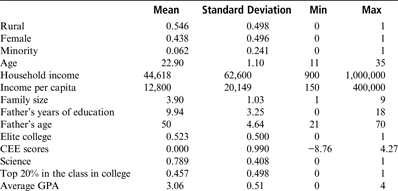
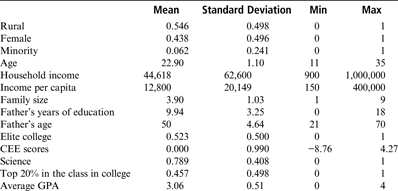
Table A1 in the Appendix summarizes the characteristics of the students. The average age of the entire sample is 23 years old; 55 per cent of the students are from rural areas; 44 per cent are female; and 6 per cent are from ethnic minority groups.Footnote 23 The average annual family income is 44,618 yuan, and the average family size is four. The average per capita income is 12,800 yuan.Footnote 24 The average age of the students’ fathers is 50 years; on average, the fathers have received 9.9 years of schooling. In addition, 52 per cent of the students are from elite colleges, which is the result of our oversampling of these colleges in the pre-test.
Poverty on Campus
For the purposes of this article, we define the poverty line as the expenditure a college student needs to make in order to maintain a basic standard of living on campus.Footnote 25 These expenditures include tuition, board and necessary living costs (food, clothing, transportation and other miscellaneous expenses). Our definition is consistent with the official definition of poverty stipulated by the Ministry of Education, which defines that a student is poor when the expected family and student contributions are less than the necessary college expenditure (including living costs).
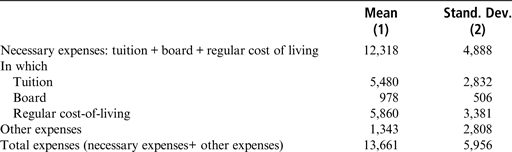
As shown in Table 1, in 2010, the average necessary college expenditure was 12,318 yuan, annually. This amount included 5,480 yuan for tuition fees,Footnote 26 978 yuan for board and 5,860 yuan for regular living expenses. As this expenditure is averaged across the nation, it may not reflect the variations in local costs, and so to take into account the variations in the cost of living expenses across colleges, we construct a college-specific poverty line, using the average college-level necessary expenditures.Footnote 27 This serves as our main definition of the poverty line here.
College Expenses, 2010 (Unit: yuan per year; number of observations = 5947)
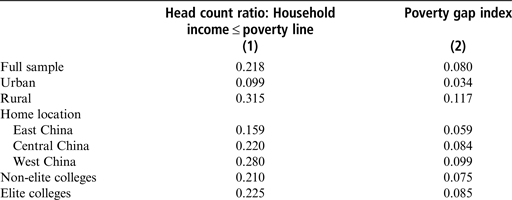
According to this college-specific poverty line, the poverty rate in China's colleges is high. The first column in Table 2 shows that the head count ratio, or the percentage of students with family incomes below the poverty line, is as high as 21.8 per cent.Footnote 28 This rate indicates that more than one-fifth of college students live in poverty. As expected, the poverty rate is higher for students from rural areas and from central and west China. The poverty rate in the elite colleges is higher than that in the non-elite colleges, but the difference is modest.
Poverty Indices
Note: The poverty line is defined as the college-specific average necessary expenditures (tuition + boarding + regular cost of living) over all the students.
To measure the degree of poverty, we construct a poverty gap index, which is defined as the average gap between the poverty line and the student's family income (counting those not in poverty as having a zero gap) as a percentage of the poverty line. As shown in Table 2, the poverty gap in 2010 was 0.080,Footnote 29 and the cross-group differences are similar to those using the measure of poverty rate.
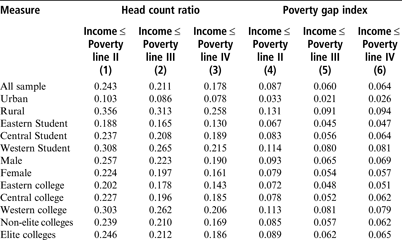
In Table A2 in the Appendix, we also explore three alternative definitions of the poverty line to validate the sensitivity of our definition. First, we define a naive poverty line, which is the average necessary expenses for all the colleges, or 12,318 yuan per year in 2010. Second, we follow Meng, Greg and Wang and construct the poverty line using the average necessary expenditures of the poorest 20 per cent of students.Footnote 30 This is to address the potential over-estimation of the minimum expenditures needed for the basic standard of college living by the average college expenditures. Finally, we construct the college-specific poverty line using the average necessary expenditures of the poorest 20 per cent of students in each college. Results using these alternative definitions are qualitatively similar; thus, we focus our analysis on the main definition of the poverty line.
On-campus poverty in China is more severe than in many other countries. Figure 2 shows the ratios of tuition fees in public colleges to the GDP per capita for both developed and developing countries. China ranks second (with a ratio of 0.23) among these countries, suggesting that China's colleges are some of the most expensive.
Tuition Fees in Public Colleges as a Proportion of GDP per Capita
Who is in poverty?
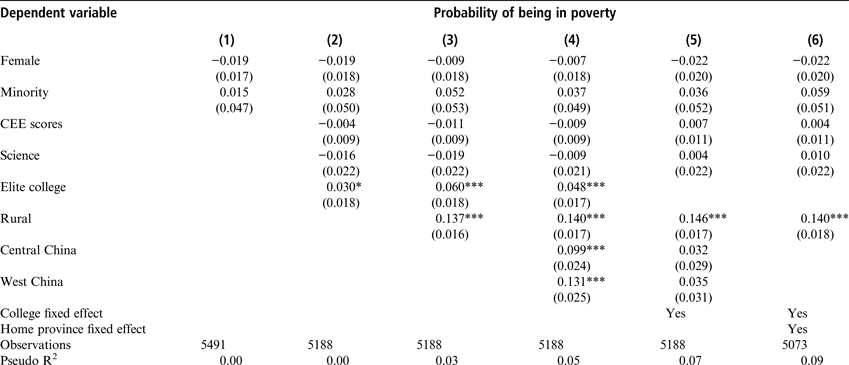
This section examines the poverty profile. Specifically, we estimate the probability of a student being in poverty as we define poverty using a college-specific poverty line (i.e. household income is less than the necessary expenditure needed for a specific college). We employ the Probit model for these estimations and report the marginal effects and robust standard errors in Table 3.
Probit Regressions Estimating the Determinants of Living in Poverty for Chinese College Students
Notes: We report the marginal effect from the Probit estimates. Robust standard errors are in parentheses. *denotes statistical significance at the 10% level, ** at the 5% level, *** at the 1% level.
Among a number of student characteristics (except home location), only being in an elite college can explain poverty. In Column 1 of Table 3, we include in the regression only a female dummy and a minority dummy. No evidence proves that females and minorities are more likely to be in poverty, as the coefficients on the female dummy and the minority dummy are not significant. In Column 2, we add three more variables: students’ CEE scores, a dummy indicating whether students took a natural science track (versus an arts or social sciences track) in high school, and another dummy signifying whether a student is in an elite college (that is covered by the 211 project). Although the CEE scores and a specialization in science cannot explain poverty, being in elite college can. Interestingly, the poverty rate in elite colleges is three percentage points higher, which suggests that elite colleges have more students whose family income cannot cover the necessary college costs.
By contrast, a student's home location is very important in explaining poverty. Specifically, students from rural areas or from western and central areas are more likely to be in poverty. In Column 3 of Table 3, we add in the regression a dummy indicating a student from a rural area. The coefficient on the rural student dummy is 0.137, and it is significant at the 1 per cent level; thus, rural students are 13.7 percentage points more likely to be in poverty. In Column 4, we add dummies indicating whether students are from central or west China (relative to those from east China). As expected, the poverty rate is about 10 percentage points higher among students from central China and 13 percentage points higher among students from west China. With the inclusion of these new variables, the estimated coefficient on the rural dummy barely changes.
The rural effect cannot be explained by either college or home province fixed effects. In Column 5, we add college fixed effects and drop the elite college dummy. In Column 6, we also control for home province fixed effects and drop the central and west China dummies. With these modifications to the model, the estimated coefficient of the rural dummy barely changes.
Financial Aid: Targeting and Its Effects
As shown above, poverty in Chinese colleges is severe. To help impoverished students, the Chinese government established a financial aid system, which has expanded tremendously in the past decade. In this section, we examine whether the college aid programme has targeted poorer students effectively. We investigate both need-based aid and merit-based scholarship.
Who gets financial aid?
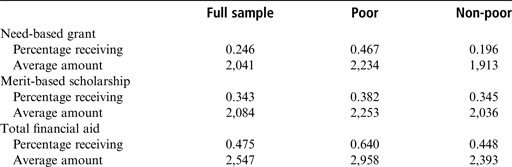
Table 4 shows that, in 2010, about 25 per cent of students received need-based grants averaging at 2,041 yuan each. In the same period, about 34 per cent of students received merit-based scholarships of, on average, 2,084 yuan. In total, 48 per cent of students received either need-based grants or merit-based scholarships of, on average, 2,547 yuan, which accounted for only 46 per cent of the tuition fees.Footnote 31 This coverage rate and the amount of financial aid given are low compared to that of many other countries. In OECD countries in particular, more than 75 per cent of students receive public aid.Footnote 32 In 2010, 82 per cent of students in public four-year institutions in the United States were covered by financial aid, with each student receiving on average grants and scholarships worth $6,931, which accounted for 86 per cent of their tuition fees.Footnote 33
Financial Aid, 2010
Overall, the need-based aid targets low-income students. Table 4 shows that students in poverty are more likely to receive need-based aid than non-poor students (46.7 versus 19.6 per cent). Poor students also get more (2,234 yuan versus 1,913 yuan). Figure 3 also indicates that the distribution of need-based aid is directed towards low-income students.
The Distribution of Need-based Aid
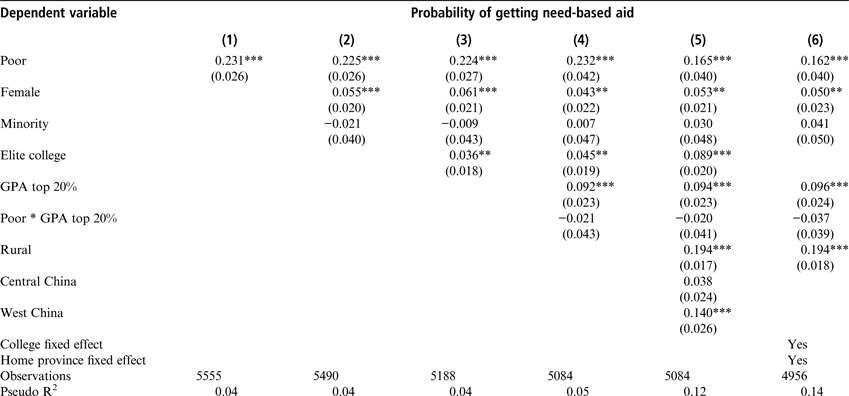
Probit regressions (see Table 5) that estimate the probability of getting need-based aid confirm the descriptive results. In Column 1 of Table 5, we report a simple regression with only one covariate, the dummy for being poor (in poverty). The poor dummy is significant at the 1 per cent level, and the estimated coefficient suggests that poor students are 23 percentage points more likely to get aid than non-poor students.
Probit Regressions Estimating the Determinants of Getting Need-based Aid for Chinese College Students
Notes: Robust standard errors are in parentheses. *denotes statistical significance at the 10% level, ** at the 5% level, *** at the 1% level. The coefficients for the Probit model are the marginal effects.
The probability of getting need-based aid also varies according to a student's demographic characteristics, college quality and performance in college. In Column 2, we add the female dummy and the minority dummy to the regression. Female students are 5.5 percentage points more likely to get need-based aid, whereas minorities do not differ from Han Chinese in terms of receiving aid. In Column 3, we add the elite college dummy, the coefficient of which is positive and significant at the 1 per cent level, suggesting that students in elite colleges are more likely to get need-based aid. In Column 4, we include a dummy for having a GPA in the top 20 per cent of the class and its interaction with the poor dummy. Students with good GPAs are more likely to get need-based aid, as the dummy for the top 20 per cent of GPA is positive and significant at the 1 per cent level. This finding results from the fact that many schools require a student's GPA to be above certain criteria in order to qualify for the need-based financial aid. The interaction term is insignificant, suggesting that the GPA-related criteria of aid eligibility do not change with students’ poverty status. When we compare Columns 1 to 4, the coefficient on the poor dummy almost remains unchanged after including these other variables.
Finally, the probability of getting financial aid also varies with geography. In Column 5, we include the rural, central and west China dummies to indicate a student's home location. Students from rural and western areas are more likely to get need-based aid. With the inclusion of these dummies, the coefficient on the poor dummy drops to 0.162, although it remains significant at the 1 per cent level. In Column 6, we include the college dummies and home province dummies, and we exclude the central and west China dummies. With these changes, the coefficient on the poor dummy changes only slightly.
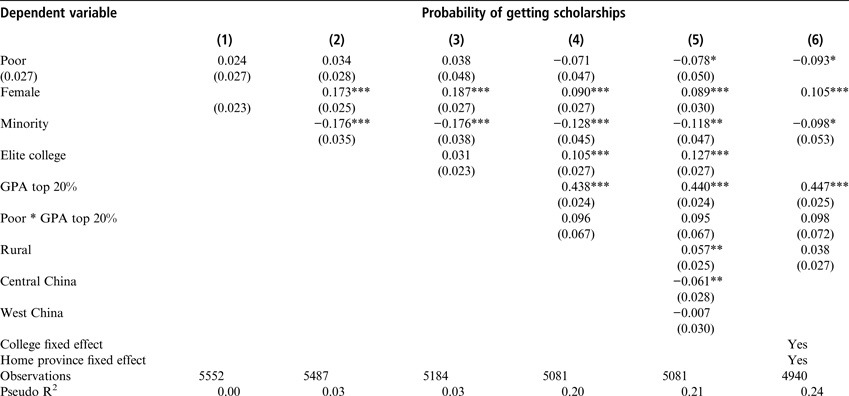
By contrast, being poor has no bearing in getting a merit-based scholarship. In Table 6, we estimate the probability of getting a merit-based scholarship using the same regression specification. Throughout the table, the estimated coefficient on the poor dummy is either insignificant or significantly negative, which is consistent with the merit-based nature of scholarships. Moreover, student characteristics matter. Female students, Han Chinese and students in elite colleges are more likely to get scholarships (Columns 2–3), and these results remain consistent even after we control for a student's GPA (Column 4). Students with GPAs ranking in the top 20 per cent of the class are significantly more likely to get scholarships. We add location dummies in Column 5, and find that students from rural areas are more likely to get a scholarship. However, the rural effect becomes insignificant after we control for the college and home province fixed effects in Column 6.
Probit Regressions Estimating the Determinants of Getting Scholarships for Chinese College Students
Notes: Robust standard errors are in parentheses. *denotes statistical significance at the 10% level, ** at the 5% level, *** at the 1% level. The coefficients for the Probit model are the marginal effects.
Targeting and poverty reduction
Regression results show that the overall allocation of the need-based aid is targeted at low-income students. However, the coverage rate of need-based aid among the poor, defined as the percentage (out of students in poverty) of students covered by the aid, is only 47 per cent, which means that more than half of the poor students cannot get need-based aid. The leakage rate, or the percentage (out of those students who get need-based aid) of students who are not poor, is also high – 57 per cent of the aid recipients are non-poor students. The numbers are similar despite the use of other poverty line definitions.Footnote 34
One problem with the previous targeting measures is their sensitivity to the number of designated beneficiaries. For example, if the number of designations is less than the number of poor students, the coverage rate among the poor is less than 100 per cent by design. Similarly, if designations exceed the number of poor students, the leakage rate is always positive, even when targeting is perfect in the sense that all designations go to the poorest students.
Following Park, Wang and Wu, we also examine the targeting count error (TCE), which counts mistargeting given the number of beneficiaries.Footnote 35 Using this measure, we can assess targeting by comparing the distribution of the need-based aid with the distribution under perfect targeting given the number of beneficiaries. More specifically, the TCE is the percentage of need-based financial aid not given to students who would receive the aid under perfect targeting. The formula for TCE is: TCE = (Number of students with family income below Z*, who do not get aid)/D, where D is the number of available designations, and Z* is the income level of the marginal student when targeting is perfect. Perfect targeting means students are ranked based on their family income, in which only the poorest D number of students gets financial aid.
The TCE measure depends on the definition of perfect targeting. When we define perfect targeting as delivering financial aid to the poorest students out of the whole sample, the TCE is about 64 per cent, which means that 64 per cent of the beneficiaries are not the neediest ones. When we focus on within-college mistargeting by defining perfect targeting as delivering aid to the poorest students in each college, TCE decreases but is still as high as 58 per cent.
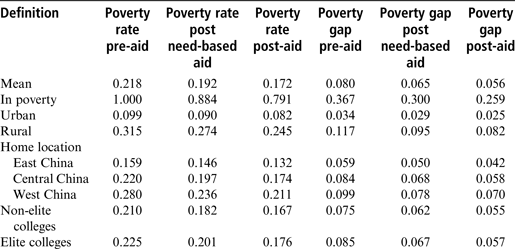
In summary, financial aid does not target well for all targeting measures used. As a result, the effectiveness of financial aid in reducing the poverty rate is moderate. Table 7 shows that the post need-based aid poverty rate declines to 19.2 per cent, which is only 2.6 percentage points lower than the pre-aid poverty rate. After taking scholarships into account, the post-aid poverty rate declines to 17.2 per cent, which is 4.6 percentage points lower than the pre-aid poverty rate. Moreover, 79 per cent of poor students remain in poverty ex post. The post-aid poverty rate is still as high as 25 per cent among rural students and 21 per cent among students from west China.
The Effect of Financial Aid on Reducing Poverty
Notes: Poverty rate post need-based aid is the poverty rate calculated using income that accounts for need-based aid.
Financial Sources
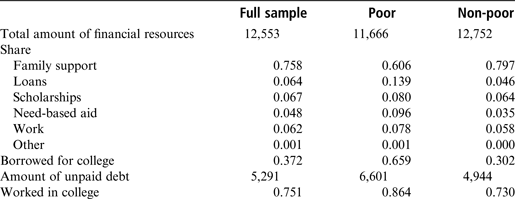
Our results indicate that many students remain in poverty even after receiving financial aid. Consequently, the question arises how do students finance their college education? Table 8 shows that family support is still the main source of funding, contributing 76 per cent to college expenses on average. Loans, need-based aid, scholarships and earnings from work each contribute 5–6 per cent. More than one-third of college students borrow money to pay for their education, and have on average unpaid debts of 5,291 yuan. In addition, about three-quarters of the students work while in college.
Financial Sources
The composition of financial sources also differs substantially between poor and non-poor students. For non-poor students, 80 per cent of the income comes from family support, but the number is only 60 per cent for poor students. Up to 30 per cent of non-poor students borrow money for college education. Conversely, 66 per cent of poor students resort to borrowing. Poor students are also more likely to work while studying compared with non-poor students (86 per cent versus 73 per cent).
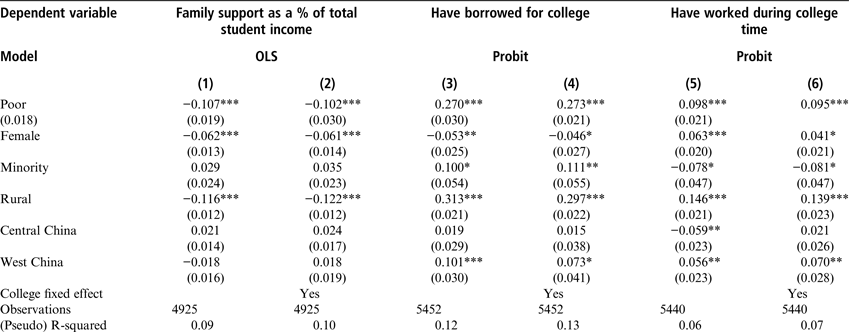
Multivariate regressions reported in Table 9 confirm that poor students rely less on family support and more on bank loans and working while studying. In the first two columns of Table 9, we report the ordinary least squares estimates of the determinants of family contributions to student income. The poor dummy is negative and significant at the 1 per cent level, suggesting that poor students rely less on family support. Interestingly, female and rural students also have less family support. We report the estimated Probit models on the probability of having borrowed money in college in Columns 3–4, and on the probability of having worked in college in Columns 5–6. Consistent with the descriptive results, poor students are 27 percentage points more likely to have resorted to borrowing, and are 10 percentage points more likely to have worked in college. Male students, minority students and those from rural and west China are more likely to have borrowed money. Female students, Han Chinese students and those from rural and western areas are more likely to have worked in college.
OLS and Probit Estimates of the Determinants of Financial Sources of Chinese College Students
Notes: Robust standard errors are in parentheses. *denotes statistical significance at the 10% level, ** at the 5% level, *** at the 1% level. The coefficients for the Probit model are the marginal effects.
Conclusion
We find that on-campus poverty is severe in China. Overall, 22 per cent of college students live in poverty, and the poverty rate is 32 per cent for students from rural areas and 28 per cent for students from west China.
Despite the Chinese government's efforts to improve the financial aid system, the post-aid poverty rate is still about 17 per cent, which is only 4.6 percentage points lower than the pre-aid poverty rate. Moreover, the post-aid poverty profile is similar to the pre-aid profile, such that students from rural and western areas are much more likely to be in poverty. This could be the result of an overall lack of financial aid and imprecise targeting. The coverage rate and the amount of financial aid received on average in China are quite low compared with those in many other countries. Although students in poverty are more likely to receive need-based aid, the coverage rate among the poor is only 47 per cent, the leakage rate is 57 per cent, and the targeting count error is 64 per cent. These results call for additional and more effectively designed financial aid systems.
Furthermore, our results suggest that the current financial aid system is merit-based to a certain extent. A student's academic performance in college is an important factor in determining whether that student receives financial aid and how much they receive; students in elite colleges are more likely to receive financial aid and obtain a larger amount. Moving towards a need-based system will be important for equity.
Finally, students fund their education using different financial sources. Poor students rely less on family contributions and more on other sources including loans, earnings from work, and financial aid. For them, family support only constitutes 61 per cent of their total financial sources. For the whole sample, 37 per cent of the students borrow money to pay for their college education, and 66 per cent of the poor students resort to borrowing. In addition, 75 per cent of the students work during college.
Rising poverty in China's colleges and its associated social and economic problems have attracted a lot of attention from the media, policymakers and academics. As our results show, imprecise targeting and a lack of funds are the two biggest problems of the current financial aid system. To alleviate student poverty, the government should improve the targeting accuracy and increase the amount of financial aid given. Aside from the need-based aid and the merit-based scholarship, well-functioning financial markets or loan programmes can also help students.
Student poverty partly results from the excessively high cost of attending college. Therefore, controlling tuition fees or the salaries of college teachers can help. This issue has also prodded the government to implement policies prohibiting any rise in tuition fees since 2006. However, people care most about the post-aid poverty rate rather than the pre-aid poverty rate; the latter can be because of the enrolment of many relatively poor students in college, which is an improvement on educational inequality. The most effective and politically feasible way to reduce post-aid poverty rate is for the government to expand the financial aid system and provide sufficient funding for the poorest students.
Appendix
Descriptive Statistics (Number of Observations = 5947)
Poverty Indices Calculated Using Alternative Poverty Lines