




No CrossRef data available.
Article contents
MS patients with depressive symptoms exhibit affective memory biases when verbal encoding strategies are suppressed
Published online by Cambridge University Press: 26 August 2005
Abstract
As many as 50% of multiple sclerosis (MS) patients experience clinical or subclinical depression. A voluminous literature has documented affective memory biases (AMB) among depressed individuals. Despite this, little is known regarding how depressive symptoms may affect MS patients' ability to recall positive and negative material. The present study employed an affective list-learning task that increased cognitive load and inhibited the use of higher order encoding strategies. The purpose of the study was twofold: to determine whether MS patients exhibit AMB and to examine whether subvocal repetition and other higher order encoding strategies are essential to the formation of AMB among people experiencing depression. Results indicated a strong relationship between depression and AMB in MS. The results are discussed in relation to existing biological research that indicates limbic and/or other subcortical systems may play a role in the formation of AMB. (JINS, 2005, 11, 514–521.)
Information
- Type
- Research Article
- Information
- Journal of the International Neuropsychological Society , Volume 11 , Issue 5 , September 2005 , pp. 514 - 521
- Copyright
- © 2005 The International Neuropsychological Society
INTRODUCTION
Multiple sclerosis (MS) is a demyelinating disease of the central nervous system (CNS) that afflicts roughly 1 in 1000 people in Northern regions of Europe and North America (Pryse-Phillips & Costello, 2001). The majority of scientific literature has focused on the physical and cognitive sequelae of MS. Emotional problems are also common in MS. Anxiety, anger, pathological laughing and weeping, mania, and depression are frequently observed symptoms of MS. By far, the most studied of these emotional difficulties is depression. Lifetime prevalence rates for depression are as much as 10 times higher than that of the general population (Schubert & Foliart, 1993). Point prevalence rates for depression among patients with MS have been estimated to be between 14 and 57 percent (Mohr & Cox, 2001). Despite these high rates, some authors speculate that major depression in MS may be underdiagnosed (Minden et al., 1987; Mohr et al., 1997).
Depression in MS may be characterized by atypical symptoms like irritability, anger, and worry. Depression has been shown to adversely impact MS patients in a number of ways. Fruehwald and colleagues (2001) found that depressed MS patients were far more likely to report lower quality of life than nondepressed MS patients. Additional studies have documented a relationship between depression in MS, decreased medication adherence, and compromised immune function—factors that may adversely affect disease course (Foley et al., 1988; Mohr et al., 1997).
Several studies have demonstrated that people with negative cognitive and attributional styles are prone to subsequent episodes of depression (Abela, 2002; Abramson et al., 1999; Alford et al., 1995; Hankin et al., 2001). Moreover, studies have demonstrated that depression-prone people exhibit increased negative cognitive biases when placed under cognitive load (Rude et al., 2003). The present study examines the role affective memory bias (AMB), in combination with cognitive load, may play in the formation of depression in MS.
Affective memory bias is defined as the tendency for people in negative moods to recall more negatively valenced information and less positively valenced information. Conversely, people in positive moods recall more positive information and less negative information. Typical studies present participants with lists of negative and positive words. In tests of explicit memory, participants are asked to recall as many words as they can remember. Implicit memory tasks often involve word-stem completion. In word-stem completion paradigms, participants are presented with the first few letters of a word and are asked to produce the first word that comes to mind. Numerous researchers have found evidence for the differential explicit recall of affectively laden words according to mood state (see Blaney, 1986). An implicit recall bias has also been found, though somewhat less consistently (Watkins et al., 2000).
Segal (1988) theorized that AMB tasks are better predictors of vulnerability to depression than traditional self-report questionnaires. Self-report questionnaires require participants to tap conscious cognitive phenomena that may not be easily verbalized. Indeed, according to Beck's theory, cognitive schemata are not always readily accessible to consciousness. Nondepressed people who are vulnerable to depression often employ complicated encoding schemes designed to suppress biases for negative stimuli (Wenzlaff et al., 2001). People experiencing increased levels of cognitive load have fewer resources to employ complex encoding schemes. Despite this, no tests to date have examined AMB with working memory tasks that tax higher order thinking skills. It is possible that AMB results when depressed participants employ subvocal repetition to rehearse and selectively encode negatively valenced words. For example, a depressed person who was asked to remember the words “death” and “glee” might subvocally repeat “death” more frequently than “glee” when attempting to encode the two words into memory. Depression-prone individuals also may produce increased verbal associations between the negative words presented during AMB tasks and negative autobiographical life events. For example, a depressed person may think about the “death” of a loved one. As a result of these processes, depressed individuals may encode negative words like “death” more deeply than positive words like “glee.”
The limbic system likely plays a dominant role in emotion and memory (Kandel et al., 2000). For instance, PET and fMRI studies have consistently found a relationship between the presentation of negatively valenced material and activation in the amygdala (Cahill & McGaugh, 1998; Canli et al., 1999). Moreover, there is evidence to suggest that, on viewing negatively valenced words, depressed participants are more likely to have sustained amygdalar responses than nondepressed participants. Siegle and colleagues (2002) asked depressed and nondepressed participants to identify positive, negative, and neutral words. After the presentation of words, participants performed nonemotional interference tasks. Event-related functional magnetic resonance imaging indicated that depressed participants' had longer sustained bilateral amygdalar responses to negatively valenced words than nondepressed participants. Unlike nondepressed participants, depressed participants also continued to exhibit sustained amygdalar arousal during nonemotional interference tasks.
It could be that AMB are primarily mediated by subcortical mechanisms. If so, this would be consistent with cognitive models of depression that assert that cognitive schemata may lie below the level of consciousness (Beck et al., 1979). Indeed, assessing AMB may be one means of tapping latent schemata that predispose individuals to depression. The present investigation employed a working memory task that required participants to read sentences after the presentation of positively and negatively valenced words. Reading sentences with such a task inhibits subvocal repetition and other higher order cognitive processes (Hupet et al., 1997). With these considerations in mind, the purpose of the present study was twofold. First, no study to date has examined AMB among depressed and nondepressed patients with MS. It was hypothesized that depressed MS patients would exhibit negative memory biases. Second, no study to date has examined AMB with a task that simultaneously taxes cognitive load. If pronounced AMB exist in the absence of higher order encoding processes, it would suggest that limbic or other subcortical encoding systems play a role in the selective retrieval of emotional information.
METHOD
Research Participants and Procedure
One-hundred-and-one patients with definite or probable MS were recruited from an ad placed in a newsletter distributed to individuals with MS in Western Pennsylvania, MS support groups in the Central Pennsylvania Region, and flyers distributed in the State College, Pennsylvania community. Patients who contacted the study team were subsequently administered a telephone screening interview to rule out exclusionary criteria (see below). Those participants not excluded were then scheduled for testing. Diagnoses and MS course types were assigned by board-certified neurologists based on established guidelines for research protocols in MS (Lublin & Reingold, 1996; Poser et al., 1983). None of the patients included in the current study were experiencing a clinical exacerbation at the time of the evaluation. Participants were not included in the study if they had a history of: (a) neurological disease other than MS; (b) drug or alcohol abuse; (c) learning disability; or (d) visual or motor impairments that would significantly alter test administration procedures. After establishing informed consent, graduate students trained by a licensed clinical neuropsychologist (P.A.) administered a variety of measures assessing physical, cognitive, and emotional functioning. In return for their participation, patients with MS were given 75 dollars and a brief neuropsychological report characterizing their cognitive functioning. Of the 101 patients assessed, 2 participants were not included in the current study: 1 had a history of electro-convulsive therapy and 1 reported a history of stroke after testing was completed. Furthermore, 2 participants had significant difficulty reading during the AMB test and 2 were unable to recall any words at the delay. These participants were not included in analyses pertaining to AMB. Consistent with our previous work examining mood biases in MS (Bruce & Arnett, 2004), participants were split into three groups representing the lower, middle, and upper third of patients' scores on the Chicago Multiscale Depression Inventory (Nyenhuis et al., 1998).
Measures
Chicago Multiscale Depression Inventory
Because more traditional measures may overestimate depression in neurological samples (Nyenhuis et al., 1995), the Chicago Multiscale Depression Inventory (CMDI) was used to assess depressive symptomatology in this study. The CMDI has been shown to be a reliable and valid measure of depression (Nyenhuis et al., 1998). The CMDI is a 42-item, five-point Likert-style self-report measure that includes Mood (sad, glum), Evaluative (hated, useless), and Vegetative (sluggish, unable to concentrate) subscales. Consistent with Nyenhuis et al.'s (1995) recommendation and the precedent set by prior work (Arnett et al., 1999a; Arnett et al., 1999b), vegetative subscales were not included in analyses. Higher scores on the CMDI indicated higher levels of depression.
Beck Depression Inventory
The Beck Depression Inventory–2nd Edition (BDI-II) was used to help validate cut-off scores obtained with the CMDI. The BDI-II is one of the most commonly used measures of self-reported depression among psychiatric samples (Beck et al. 1996). It consists of 21 items on which participants rate themselves on a 0–3 scale. Higher scores reflect greater depression. Scores for all 21 items were used in the analyses.
Affective reading span task
The affective reading span task (ARST) is a modified version of the Daneman and Carpenter (1980) test of working memory. An extensive neuropsychological and cognitive literature has substantiated the validity of using reading span tasks to increase cognitive load and measure working memory (Daneman & Carpenter, 1980; LaPointe & Engle, 1990; Li, 1999; Whitney et al., 2001). People experiencing increased levels of cognitive load have fewer resources to employ complex encoding strategies (Naveh-Benjamin & Jonides, 1984). The AMB task employed in this study increases cognitive load and decreases the use of complicated encoding schemes.
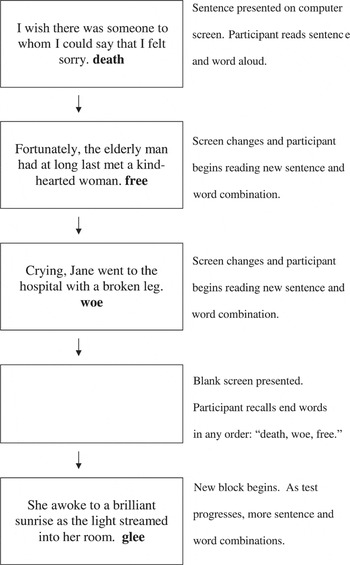
The ARST was designed to tax working memory and assess affective memory bias. Participants were instructed to orally read affectively laden sentences that were presented on a computer screen. Each sentence was followed by either a positive or negative word that matched the affective content of the sentence. Participants were instructed to remember the word after the sentence. After the participant read the affective word following the sentence, a new sentence and word combination was immediately presented. Every so often, a blank screen was shown. When participants saw a blank screen, they were instructed to recall the affective endwords in the preceding block. Initial blocks were only 2 sentence/word combinations long. As the test progressed, participants were asked to recall more end words (see Figure 1). In all, 28 positive and 28 negative sentence/word combinations were presented. The presentation of positive and negative sentence/word combinations was alternated to reduce the potential influence of positional effects. After the task was completed, participants were asked to recall as many of the endwords as they could remember from all of the blocks. The positive and negative endwords used in the ARST were matched for frequency of use in the English language and word length (Francis & Kucera, 1982). Moreover, positive and negative endwords did not differ significantly by word type (e.g., noun, verb, adjective). A similar version of the ARST produced overall recall scores (positive and negative) that were highly correlated with established measures of working memory in a sample of patients with MS (see Arnett et al., 1999a). Initial bias, delayed bias, total bias, and retention bias indices were utilized as measures of AMB for this investigation. On each of the bias indices, positive scores indicate positive bias and negative scores indicate negative bias.

Schematic of the Affective Reading Span Task.
Initial bias: Initial recall bias was calculated by subtracting the number of negative words recalled during the task from the number of positive words recalled.
Delayed Bias: Delayed recall bias was calculated by subtracting the number of negative words recalled at the delay from the number of positive words recalled at the delay.
Total Bias: Initial and delay bias indices were transformed to z-scores and combined. This index measured the potential additive nature of initial and delay biases.
Retention Bias: This index was designed to measure the extent that positive or negative recall changes over time. The retention bias was calculated by dividing the number of positive words recalled at the delay by the number of positive words recalled during the task. Similarly, the number of negative words recalled at the delay was divided by the number of negative words recalled during the task. Finally, the ratio of negative words retained was subtracted from the ratio of positive words retained.
Expanded Disability Status Scale
The Expanded Disability Status Scale (EDSS) is a measure of MS disease progression and neurological impairment (Kurtzke, 1983). It is commonly used in both clinical practice and MS research. Participants were asked to rate their functional abilities in a number of different physical domains. Scores on the EDSS range from 0 (no neurological impairment) to 10 (death from MS).
Estimate of intellectual functioning
Premorbid intellectual functioning was estimated from the Vocabulary subscale of the Shipley Institute of Living Scale; the Abstraction subscale of this measure was also administered (Zachary, 1986).
RESULTS
Preliminary Analyses
Participant characteristics are outlined in Tables 1 and 2. ANOVA revealed a significant difference between the groups' scores on the CMDI. Tukey's HSD test revealed that each of the three groups differed significantly from one another. To examine the extent to which the groups conformed to more traditional measures of minimal depression, mild depression, and moderate depression, the three groups were also compared using the BDI. ANOVA revealed a significant difference between the groups. Tukey's HSD test revealed that each of the three groups differed significantly from one another. Scores for the 3 groups fell within the minimal, minimal to mild, and mild to moderate ranges of depression, respectively. To facilitate communication of the results, the groups have been nominally described as nondepressed, mildly depressed, and moderately depressed. The three groups did not differ significantly on measures of age, education, intellectual ability, diagnosis duration, symptom duration, EDSS, sex, or MS course type.
Characteristics and F-values for nondepressed, mildly depressed, and moderately depressed MS patients

Characteristics and chi-square analyses for course and sex among nondepressed, mildly depressed, and moderately depressed MS patients

Hypothesis Testing Analyses
ANOVA revealed a significant difference between groups for the delayed recall of negative words, F(2,92) = 3.6, p < .05. Tukey's HSD revealed that moderately depressed MS patients recalled more negative words at the delay than nondepressed MS patients. Groups did not differ significantly on positive, negative, or total words for the initial or retention portions of the ARST. Similarly, group membership was not related to recall of positive words or total words on the delayed portion of the task.
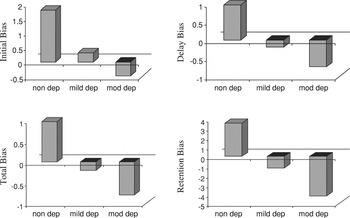
Table 3 outlines the means, standard deviations, and F-values for the initial, delay, total, and retention bias indices. Relative to nondepressed MS patients, mildly and moderately depressed MS patients exhibited a significant negative initial memory bias (Figure 2). A follow-up paired sample t test revealed that nondepressed MS patients recalled significantly more positive than negative words during the immediate recall portion of the ARST, t (31) = 3.74, p < .01. No significant differential immediate recall of positive or negative words was found among mildly or moderately depressed participants.
Means, standard deviations, and F-values for the ARST bias and composite indices for nondepressed, mildly depressed, and moderately depressed MS patients


Mildly and moderately depressed MS patients demonstrated a negative initial, delayed, and total bias when compared to nondepressed MS patients. Moderately depressed MS patients demonstrated a negatively skewed retention bias when compared to nondepressed MS patients. Initial bias = number of positive words minus number of negative words recalled during the immediate recall portion of the ARST. Delay bias = number of positive words minus number of negative words recalled during the delayed recall portion of the ARST. Total bias = z-transformed Initial bias plus z-transformed Delayed bias. Retention bias = percent positive retained from immediate recall to delayed recall minus percent negative retained from immediate to delayed recall.
At the delayed recall, mildly and moderately depressed participants again demonstrated a negative recall bias when compared to nondepressed participants (Figure 2). A paired sample t test revealed that nondepressed MS patients recalled significantly more positive than negative words at the delay, t (31) = 2.77, p < .01. In contrast, moderately depressed MS patients recalled significantly more negative than positive words at the delay, t (30) = 2.20, p < .05. Mildly depressed MS patients recalled a statistically similar number of positive and negative words at the delay. Mildly and moderately depressed participants demonstrated a negative recall bias when compared to nondepressed participants on an index of total recall bias, accounting for 23% of the between groups variance.
Moderately depressed MS patients demonstrated a negative retention bias when compared to nondepressed participants (Figure 2). Follow-up paired sample t tests revealed that moderately depressed MS patients retained significantly more negative than positive words, t (30) = 2.05, p < .05. Nondepressed and mildly depressed MS patients did not differentially retain positive or negative words at the delay.
Follow-up Analyses
The designated groups in this study did not neatly conform to pre-established nominal criteria for minimal, mild, and moderate depression. As a result, follow-up continuous correlational analyses were conducted between CMDI and initial, delayed, total, and retention bias indices. Kolmogorov-Smirnov testing revealed that depression as measured by the mood and evaluative subscales of the CMDI was not normally distributed in this sample, p < .05. Furthermore, the error variance of the aforementioned correlations was not normally distributed. An inverse transform of the CMDI corrected for these violations. CMDI was then multiplied by −1 to maintain directionality; higher scores indicated increased depressive symptomatology. Initial bias (r = −.30), delayed bias (r = −.36), total bias (r = −.43), and retention bias (r = −.30) were all significantly correlated with CMDI, all p's < .01. These follow-up analyses were consistent with their categorical counterparts.
Additional analyses examining the relationship between BDI and AMB were also conducted. As stated previously, the BDI may overestimate depression among people with MS. The BDI measures physical and cognitive symptoms of depression that are commonly seen among nondepressed MS patients. A Pearson correlation revealed a strong relationship between CMDI and BDI (r = .75, p < .01). However, BDI was also significantly correlated with physical disability as measured by EDSS (r = .41, p < .01). In contrast, CMDI was not significantly related to patients' EDSS scores (r = .17, p > .05). These results confirm that BDI scores may be confounded by MS patients' physical disability. Nonetheless, partial correlations controlling for EDSS yielded significant relationships between BDI and delayed (r = −.28, p < .01) and retention biases (r = −.23, p < .05). In contrast, no significant relationship was found between BDI and initial bias (r = .14, p > .05). This last, contrasting, finding further suggests that the BDI and CMDI may measure separate, though overlapping, constructs among patients with MS.
DISCUSSION
Consistent with hypotheses, depressed MS patients exhibited negative AMB on a task designed to tax higher order thinking skills. Initial bias, delayed bias, total bias, and retention bias were all significantly related to depression group. Both the mildly and moderately depressed groups exhibited a negative bias when compared to the nondepressed group on the initial bias index. Nondepressed individuals tended to recall more positive than negative words during the immediate recall portion of the task. Mildly and moderately depressed groups did not differentially recall positive or negative words during the immediate recall portion of the ARST. Given this, it may be more accurate to state that during the initial encoding phase, nondepressed patients exhibited a positive bias whereas mildly and moderately depressed patients did not exhibit any bias. This finding is consistent with the theory of depressive realism (see Dobson & Franche, 1989). Nondepressed people may view (or remember) their world through rose-colored glasses. At the initial encoding phase, mildly and moderately depressed MS patients may recall positive and negative information equally.
Both the mildly and moderately depressed groups again demonstrated a negative bias when compared to the nondepressed group at the delay portion of the ARST. Nondepressed patients again recalled significantly more positive than negative words. At the delay, however, moderately depressed patients recalled more negative than positive words. Nondepressed patients maintained a positive recall bias at the delay; moderately depressed MS patients developed a negative recall bias. This suggests that AMB in depression may be related to the consolidation of memory over time. In support of this explanation, moderately depressed MS patients demonstrated a significant negative retention bias.
The ARST taxes higher order thinking skills. It increases cognitive load and decreases the probability that patients will use higher order encoding strategies. The obtained findings support the notion that subvocal repetition and other higher order forms of elaboration are not necessary for the emergence of AMB among depressive patient populations. Although speculative, it may be that limbic or other nonverbal areas of the brain could account for encoding and consolidation biases among depressed MS patients. As much as 23 percent of the variance between depressed groups could be accounted for by AMB. These results offer tentative behavioral support to studies that have documented sustained amygdalar activity during interference tasks among depressed patients who view negatively valenced stimuli (Siegle et al., 2002). Sustained activation of the amygdala while reading sentences may account for the results found in this study. In theory, increased and sustained amygdalar activity for negative words during the ARST may contribute to depressed patients' nonbiased immediate recall pattern and their negative biases at the delay.
The development of negative biases in depressed individuals when presented with negative information without the opportunity for reflection and conscious appraisal supports a cardinal assumption of Beck's theory of depression. Beck hypothesized that depressed patients have negative, often unconscious, cognitive schemata that skew perception (Beck et al., 1979). The current investigation found that lower order encoding mechanisms may account for AMB among depression patients with MS. If, as was found in this study, AMB exists in the absence of higher order thinking skills, one may suppose that skewed biases can be encoded without self-reflection or conscious cognitive appraisal. Thus, these findings support the idea that negative cognitive schemata can emerge without full conscious awareness. This knowledge may lend some insight into the mechanisms and processes of cognitive therapy. One of the first steps in cognitive therapy is for patients to monitor their thoughts. This monitoring process may bring AMB into conscious awareness. Once aware of AMB, patients can learn to encode information in a manner that is more consistent with mental wellness.
As many as 57 percent of MS patients experience clinical depression at some point in their lives (Mohr & Cox, 2001). Depression is related to impaired neuropsychological functioning and poor quality of life, and may hasten the course of MS (Arnett et al., 1999b; Fruehwald et al., 2001; Mohr et al., 1997). A number of studies have found that depression in MS can be successfully treated with psychotherapy and/or antidepressants (see Mohr & Goodkin, 1999). This investigation shows one possible means by which these treatments may have their therapeutic effects. Both psychological and pharmacological interventions may decrease AMB (Harmer et al., 2003).
Because no significant differences emerged between groups on measures of total recall, one might safely assume that the more traditional cognitive deficits often observed in depression were not responsible for the AMB observed in this sample. Similarly, groups were matched for age, MS course, EDSS, intellectual ability, education, diagnosis duration, symptom duration, and sex. Despite this, it is important to highlight the quasiexperimental nature of this study. It is possible that some as yet unknown third variable accounts for the relationship observed between AMB and depression. Furthermore, the directionality of the relationship between AMB and depression was not directly assessed in this study. It is possible that AMB contributes to depression, depression contributes to AMB, or that AMB and depression form a reciprocal relationship. Future studies may wish to employ prospective longitudinal designs, examine models of depressive vulnerability, and/or use mood induction to measure the link between AMB and depression with a true experimental design. Finally, future studies may wish to employ the ARST in patient populations without significant neurological abnormalities. Replication of the aforementioned findings in non-MS, depressed populations would bolster the idea that AMB can result from lower order encoding mechanisms. Finally, we were unable to directly monitor subvocal repetition during the ARST. It is possible that the ARST was unable to completely prevent participants from employing higher order encoding strategies. Future studies may wish to employ paradigms that can directly measure the use of complex verbal encoding strategies.
In conclusion, the present investigation demonstrated that AMB exist among depressed MS patients when higher order encoding strategies are suppressed. Put simply, depressed individuals may continue to process and therefore encode and consolidate negative information long after they have stopped “thinking” about it. These findings have implications for the treatment, cause, and biological and behavioral underpinnings of depression in MS.
References
REFERENCES
Abela, J.
(2002).
Depressive mood reactions to failure in the achievement domain: A
test of the integration of the hopelessness and self-esteem theories of
depression.
Cognitive Therapy and Research,
26,
531–552.Google Scholar
Abramson, L.,
Alloy, L.,
Hogan, M.,
Whitehouse, W.,
Donovan, P.,
Rose, D.,
Panzarella, C., &
Raniere, D.
(1999).
Cognitive vulnerability to depression: Theory and evidence.
Journal of Cognitive Psychotherapy: An International
Quarterly,
13,
5–19.Google Scholar
Alford, B.,
Lester, J.,
Patel, R.,
Buchanan, J., &
Guinta, L.
(1995).
Hopelessness predicts future depressive symptoms: A prospective
analysis of cognitive vulnerability and cognitive content
specificity.
Journal of Clinical Psychology,
51,
331–339.Google Scholar
Arnett, P.,
Higginson, C.,
Voss, W.,
Bender, W.,
Wurst, J., &
Tippin, J.
(1999a).
Depression in multiple sclerosis: Relationship to working memory
capacity.
Neuropsychology,
13,
546–556.Google Scholar
Arnett, P.,
Higginson, C.,
Voss, W.,
Wright, B.,
Bender, W., &
Wurst, J.
(1999b).
Depressed mood in multiple sclerosis: Relationship to
capacity-demanding memory and attentional functioning.
Neuropsychology,
13,
434–446.Google Scholar
Beck, A.,
Rush, A.,
Shaw, B., &
Emery, G.
(1979).
Cognitive therapy of depression.
New York:
Guilford Press.
Beck, A.T.,
Steer, R.A., &
Brown, G.K.
(1996).
Beck Depression Inventory–2nd edition manual.
New York:
Psychological Corporation.
Bruce, J. &
Arnett, P.
(2004).
Self-reported everyday memory and depression in patients with
multiple sclerosis.
Journal of Clinical and Experimental Neuropsychology,
26,
200–214.Google Scholar
Cahill, L. &
McGaugh, J.
(1998).
Mechanisms of emotional arousal and lasting declarative
memory.
Trends in Neurosciences,
21,
294–299.Google Scholar
Canli, T.,
Zhao, Z.,
Desmond, J.,
Glover, G., &
Gabrieli, J.
(1999).
FMRI identifies a network of structures correlated with retention of
positive and negative emotional memory.
Psychobiology,
27,
441–452.Google Scholar
Daneman, M. &
Carpenter, P.
(1980).
Individual differences in working memory and reading.
Journal of Verbal Learning and Behavior,
19,
450–466.Google Scholar
Dobson, K. &
Franche, R.
(1989).
A conceptual and empirical review of the depressive realism
hypothesis.
Canadian Journal of Behavioural Science,
21,
419–433.CrossRefGoogle Scholar
Foley, F.,
Miller, A.,
Traugott, U.,
LaRocca, N.,
Scheinberg, L.,
Bedell, J., &
Lenox, S.
(1988).
Psychoimmunological dysregulation in multiple sclerosis.
Psychosomatics,
29,
398–403.Google Scholar
Francis, N. &
Kucera, H.
(1982).
Frequency analysis of English usage: Lexicon and grammer.
Boston:
Houghton Mifflin.
Fruehwald, S.,
Loeffler-Stastka, H.,
Eher, R.,
Saletu, B., &
Baumhackl, U.
(2001).
Depression and quality of life in multiple sclerosis.
Acta Neurologica Scandinavia,
104,
257–261.Google Scholar
Hankin, B.,
Abramson, L., &
Stiler, M.
(2001).
A prospective test of the hopelessness theory of depression in
adolescence.
Cognitive Therapy and Research,
25,
607–632.Google Scholar
Harmer, C.,
Hill, S.,
Taylor, M.,
Cohen, P., &
Goodwin, G.
(2003).
Toward a neuropsychological theory of antidepressant drug action:
Increase in positive emotional bias after potentiation of norepinephrine
activity.
American Journal of Psychiatry,
160,
990–992.Google Scholar
Hupet, M.,
Desmette, D., &
Schelstraiete, M.
(1997).
What does Daneman and Carpenter's reading span really
measure?
Perceptual and Motor Skills,
84,
603–608.Google Scholar
Kandel, E.,
Schwartz, J., &
Jessell, T.
(2000).
Principles of Neural Science.
New York:
McGraw-Hill.
Kurtzke, J.
(1983).
Rating neurological impairment in multiple sclerosis: An expanded
disability status scale (EDSS).
Neurology,
33,
1444–1445.Google Scholar
LaPointe, L. &
Engle, R.
(1990).
Simple and complex spans as measures of working memory
capacity.
Journal of Experimental Psychology: Learning, Memory, and
Cognition,
16,
1118–1133.Google Scholar
Li, K.
(1999).
Selection from working memory: On the relationship between
information processing and storage components.
Aging, Neuropsychology, and Cognition,
6,
99–116.Google Scholar
Lublin, F. &
Reingold, S.
(1996).
Defining the clinical course of multiple sclerosis: Results of an
international survey.
Neurology,
46,
907–911.Google Scholar
Minden, S.,
Orav, J., &
Reich, P.
(1987).
Depression in multiple sclerosis.
General Hospital Psychiatry,
9,
426–434.Google Scholar
Mohr, D. &
Cox, D.
(2001).
Multiple sclerosis: Empirical literature for the clinical health
psychologist.
Journal of Clinical Psychology,
57,
479–499.Google Scholar
Mohr, D. &
Goodkin, D.
(1999).
Treatment of depression in multiple sclerosis: Review and
meta-analysis.
Clinical Psychology: Science and Practice,
6,
1–9.Google Scholar
Mohr, D.,
Goodkin, D.,
Likosky, W.,
Gatto, N.,
Baumann, K., &
Rudick, R.
(1997).
Treatment of depression improves adherence to interferon beta-1b
therapy for multiple sclerosis.
Archives of Neurology,
54,
531–533.Google Scholar
Naveh-Benjamin, M. &
Jonides, J.
(1984).
Cognitive load and maintenance rehearsal.
Journal of Verbal Learning and Verbal Behavior,
23,
494–507.Google Scholar
Nyenhuis, D.,
Luchetta, T.,
Yamamoto, C.,
Terrien, A.,
Bernardin, L.,
Rao, S., &
Garron, D.
(1998).
The development, standardization, and initial validation of the
Chicago Multiscale Depression Inventory.
Journal of Personality Assessment,
70,
386–401.Google Scholar
Nyenhuis, D.,
Rao, S.,
Zajecka, J.,
Luchetta, T.,
Bernardin, L., &
Garron, D.
(1995).
Mood disturbance versus other symptoms of depression in multiple
sclerosis.
Journal of the International Neuropsychological Society,
1,
291–296.Google Scholar
Poser, C.,
Paty, D.,
Scheinberg, L.,
McDonald, I.,
Davis, F.,
Ebers, G.,
Johnson, K.,
Sibley, W.,
Silberberg, D., &
Tourtellotte, W.
(1983).
New diagnostic criteria for multiple sclerosis: Guidelines for
research protocols.
Annals of Neurology,
13,
227–231.Google Scholar
Pryse-Phillips, W. &
Costello, F.
(2001).
The epidemiology of multiple sclerosis. In
S. Stuart (Ed.),
Handbook of multiple sclerosis.
New York:
Marcel Dekker.
Rude, S.,
Valdex, C.,
Odom, S., &
Ebrahimi, A.
(2003).
Negative cognitive biases predict subsequent depression.
Cognitive Therapy and Research,
27,
415–429.Google Scholar
Schubert, D. &
Foliart, R.
(1993).
Increased depression in multiple sclerosis: A meta-analysis.
Psychosomatics,
34,
124–130.Google Scholar
Segal, Z.
(1988).
Appraisal of the self-schema construct in cognitive models of
depression.
Psychological Bulletin,
103,
147–162.Google Scholar
Siegle, G.,
Steinhaer, S.,
Thase, M.,
Stenger, A., &
Carter, C.
(2002).
Can't shake that feeling: Event-related fMRI assessment of
sustained amygdala activity in response to emotional information in
depressed individuals.
Biological Psychiatry,
51,
693–707.Google Scholar
Watkins, P.,
Martin, C., &
Stern, L.
(2000).
Unconscious memory bias in depression: Perceptual and conceptual
processes.
Journal of Abnormal Psychology,
109,
282–289.Google Scholar
Wenzlaff, R.,
Rude, S.,
Taylor, C.,
Stultz, C., &
Sweatt, R.
(2001).
Beneath the veil of thought suppression: Attentional bias and
depression risk.
Cognition and Emotion,
15,
435–452.Google Scholar
Whitney, P.,
Arnett, P., &
Driver, A.
(2001).
Measuring central executive functioning: What's in a reading
span?
Brain and Cognition,
45,
1–14.Google Scholar
Zachary, R.
(1986).
Shipley Institute of Living Scale: Revised manual.
Los Angeles:
Western Psychological Services.
Schematic of the Affective Reading Span Task.

Characteristics and F-values for nondepressed, mildly depressed, and moderately depressed MS patients

Characteristics and chi-square analyses for course and sex among nondepressed, mildly depressed, and moderately depressed MS patients

Means, standard deviations, and F-values for the ARST bias and composite indices for nondepressed, mildly depressed, and moderately depressed MS patients
Mildly and moderately depressed MS patients demonstrated a negative initial, delayed, and total bias when compared to nondepressed MS patients. Moderately depressed MS patients demonstrated a negatively skewed retention bias when compared to nondepressed MS patients. Initial bias = number of positive words minus number of negative words recalled during the immediate recall portion of the ARST. Delay bias = number of positive words minus number of negative words recalled during the delayed recall portion of the ARST. Total bias = z-transformed Initial bias plus z-transformed Delayed bias. Retention bias = percent positive retained from immediate recall to delayed recall minus percent negative retained from immediate to delayed recall.
 You have
Access
- 23
- Cited by