INTRODUCTION
Data from morphologically rich languages show that morpheme use in such languages appears relatively early in acquisition, and morphological marking is easier to learn than more distributed ways of expressing grammatical functions, such as syntax (Bates & MacWhinney, Reference Bates, MacWhinney, MacWhinney and Bates1989; Slobin, Reference Slobin, Wanner and Gleitman1982). In one of the earliest demonstrations of the phenomenon, Slobin (Reference Slobin, Wanner and Gleitman1982) found that children whose native language marks agent–patient relations with case inflections comprehend agent–patient syntax earlier than those who learn languages in which these relations are marked by word order. Slobin attributes this to the significance of inflections as ‘local cues’. A case marker attached to a noun is easy to extract and learn because it is a local marker, which can be processed without taking the entire sentence into account. That is, the explanation for productive use (i.e. earlier productivity in morphology than in syntactic constructions) is that, unlike syntax, morphology typically marks grammatical functions locally, which facilitates the extraction of patterns and, consequently, their generalization to new forms, thus allowing the earlier emergence of morphological marking. A further argument for the relative ease of acquisition of morphology is the limited variability in morphological markers: a morpheme has relatively few allomorphs, while syntactic constructions vary greatly (potentially infinitely) in their actual realization.
These well-known observations have since been supplemented by several findings suggesting that morphology is acquired relatively early regardless of whether it has a central role in marking grammatical functions in the language or not. Studies on early use of morphology in English show that although morphological acquisition is a gradual process, morpheme use might become productive by the age of three (Akhtar & Tomasello, Reference Akhtar and Tomasello1997). In English, however, studies are constrained by relatively low morphological complexity and the small number of grammatical morphemes in the language, affixes not being the most prominent cues in marking grammatical functions. For morphologically rich languages like Polish, it has also been shown that grammatical morpheme use appears early, and young children perform better with words having more densely populated phonological neighbourhoods, which provide sufficient data to extract low-level schemas (Dąbrowska, Reference Dąbrowska2006). Dąbrowska also shows that children under three (in fact, even under two) are productive with Polish case marking, and that their performance is predicted by word frequency rather than by inflectional regularity (Dąbrowska & Szczerbiński, Reference Dąbrowska and Szczerbiński2006), which suggests that early morphological learning is not a simple rule-like mechanism. Wittek and Tomasello (Reference Wittek and Tomasello2002; Reference Wittek and Tomasello2005) tested German children on their productivity with the transitive construction. They show that German children are productive with noun and verb morphology before the age of three, whereas syntactic constructions are not used productively until after three years of age (although they also show that local morphological productivity at the phrase level does not imply earlier productivity with the syntactic constructions relying on the same morphological marking).
When testing productivity in early child language, most studies perform detailed analyses of the spontaneous speech of young children, and use more or less stringent criteria for classifying occurrences of a grammatical morpheme as productive. When analyzing children's spontaneous language use, however, it is difficult to decide whether a construction is abstract and productive or not just by observing spontaneous utterances in isolation. To get around this problem we either need to analyze all the utterances of a child or at least those containing a given word, or we have to examine the linguistic input in full in order to identify all child utterances that may be imitations of or generalizations from the input. An alternative to systematically observing all the linguistic input to a child is to use experimental methods. A popular method of controlling for linguistic input is to teach the children novel words (i.e. words that they have not heard before). The easiest way to do this is to teach nonsense words and, following a training session, test children's comprehension and use of the novel word in the target constructions, as in the classic wug-test (Berko, Reference Berko1958).
The novel word paradigm can be effectively combined with elicited production methods. During an elicited production task, the experimenter asks questions to prompt the use of the novel word in the target grammatical construction. The main advantage of this method is that it is the most direct way of assessing the productivity of children's grammatical knowledge. However, the elicited production task also has its drawbacks. A major drawback is that it is difficult to create a context in which it is impossible to give an acceptable answer without using the target structure (Thornton, Reference Thornton, McDaniel, McKee and Cairns1998), and children can be extremely creative in avoiding structures the experimenter would like to hear.
Although a lot is known from classic data from several languages (Turkish, Serbo-Croatian, Italian, etc.: Bates & MacWhinney, Reference Bates, MacWhinney, MacWhinney and Bates1989; Slobin, Reference Slobin, Wanner and Gleitman1982), more recently a growing number of studies have started to expand this body of observations by testing early morphological productivity in morphologically rich languages experimentally, using the novel word paradigm. These studies focus on Slavic languages (Polish, Russian, Lithuanian and Serbian), all of them focusing on how diminutives might help bootstrap the acquisition of inflectional systems, especially in languages where suffixes are often morphophonologically non-transparent. Dąbrowska (Reference Dąbrowska2006) compared elicited production of the case marking of diminutive versus simplex nouns in Polish children and adults. She found that diminutive endings facilitate the use of target case inflections. This effect was strongest in the younger group (in two-year-olds) and got weaker with the advance of age. This result is interpreted as a manifestation of the phonological neighbourhood effect: diminutives form a dense phonological neighbourhood and a homogeneous and salient class; they are strongly entrenched, making it possible for children to extract low-level, phonologically specific schemas. In Polish, this process is also assisted by the relatively high frequency of diminutives in child-directed speech, and gains further support from children's observed tendency to substitute the diminutive for less transparent nouns or nouns that do not belong to an existing schema.
These results in Polish have been replicated by Kempe, Ševa, Brooks, Mironova, Pershukova and Fedorova (Reference Kempe, Ševa, Brooks, Mironova, Pershukova and Fedorova2009), using the same methodology with Russian-speaking children: in Russian, children made fewer errors in case marking diminutives of novel nouns than in marking bare noun stems. Importantly, this study also extended the above findings to Serbian, where diminutives are far less common in child-directed speech, yet the diminutive advantage was observed. These studies all draw attention to the potential importance of diminutives in morphologically rich languages: diminutives can help the acquisition process by regularizing noun endings, making non-transparent marking more transparent and creating stronger schemas for low-level generalizations. Besides case marking, diminutives can play an important role in the acquisition of other areas of grammar as well. In both Russian and Serbian, children also find gender agreement easier when the novel noun is in the diminutive form, as shown by elicited production tasks by Ševa, Kempe, Brooks, Mironova, Pershukova and Fedorova (Reference Ševa, Kempe, Brooks, Mironova, Pershukova and Fedorova2007) . The same effects were observed in Lithuanian, for both case marking paradigms (Savickiene, Reference Savickiene and Gillis1998) and gender agreement (Savickiene, Kempe & Brooks, Reference Savickiene, Kempe and Brooks2009).
This paper aims to extend cross-linguistic results on morphological acquisition by testing the productivity of grammatical morpheme use in Hungarian, a language with a rich system of suffixes, in a novel verb paradigm combined with elicited production tasks. Besides addressing the general question of early productivity, we also undertake to the test the following issues in an attempt to reveal more specific effects on the learning and productive use of suffixes:
1. Noun–verb differences. We included both nominal and verbal suffixes in order to explore differences between the acquisition of noun and verb morphology. In most languages nouns are acquired earlier and more easily than verbs (but, importantly, there is cross-linguistic evidence from languages with a verb-initial word order, such as Chinese, Korean and Japanese, arguing against the universality of the noun bias; Childers, Vaughan & Burquest, Reference Childers, Vaughan and Burquest2007; Choi & Gopnik, Reference Choi and Gopnik1995; Tardif, Reference Tardif1996; Snedeker, Li & Yuan, Reference Snedeker, Li and Yuan2003). Although the noun advantage is usually explained by the linguistic and conceptual simplicity of nouns – nouns label objects, while verbs label actions (Gentner, Reference Gentner1979) – even conceptually complex abstract nouns are acquired quite early and without any prominent effort. It is also true that children need more cues to recognize verbs than nouns. A verb's meaning, syntax and grammar can only be extracted with reference to its clausal context specifying its argument structure, through understanding the meaning of the noun phrases and the verb at the same time, and identifying the thematic roles of the noun phrases as verb arguments. In this sense, verb acquisition relies on understanding complex linguistic contexts (Gillette, Gleitman, Gleitman & Lederer, Reference Gillette, Gleitman, Gleitman and Lederer1999). Tomasello's verb-island hypothesis also assigns a simpler role to nouns than to verbs (Tomasello, Reference Tomasello2000, Reference Tomasello2003). While nouns are single linguistic items which have a concrete or abstract referent, verbs are frames with open slots for nouns as arguments. Based on these results and arguments, our hypothesis is that noun morphology should be easier for Hungarian children. Similarly to children learning most other languages, young Hungarian children acquire more nouns than verbs, and thus they have more linguistic evidence on their usage. Also, a local mechanism is sufficient for processing an inflected noun, requiring only the noun phrase, while processing an inflected verb has to take the entire clause containing it into account. To our knowledge, there is no direct comparison of productivity with noun versus verb morphology using the novel word paradigm in the literature.
2. Effects of input variability. Type frequency (i.e. the number of different words a suffix can be used with) is an important factor in the productivity of suffixes (see e.g. Bybee, Reference Bybee2001), and data from acquisition also shows that in a novel word paradigm children are more productive with suffixes that apply to large or diverse classes of words (see e.g. Dąbrowska and Szczerbinksi, Reference Dąbrowska and Szczerbiński2006, but also the vast literature on the debate concerning regular vs. irregular morphology). Previous research, however, did not directly test the effect of variability by manipulating it in the experimental situation itself. To address this problem, we had two conditions of morphological variability (low vs. high) of the novel word in the input in order to test whether higher variability (i.e. using the novel word with different suffixes) facilitates the identification of the syntactic category of the new word. When processing a sentence with a novel word, children have to analyze the syntactic and morphological environment of the word to be able to recognize the cues that may help them guess its grammatical category (MacWhinney, Reference MacWhinney and MacWhinney1987). Hungarian provides a good opportunity for testing the effects of input variability by presenting a child with various morphological forms. We predict that the increased availability of cues provided by greater morphological variability will increase the children's grammatical productivity with a freshly learned word.
3. Novel affix learning. Before an affix can be used productively, its meaning or grammatical function also has to be learned. In the vast literature on morphological acquisition, almost all studies focus on testing knowledge and productivity with real grammatical morphemes of the language with which the child has more or less experience; there are very few studies testing the learning of new suffixes and their functions at an early age. Grammatical morphemes form a closed class, and children treat items belonging to this class differently from referential expressions at a very early age, although differences can be at least partly explained by the processing properties of function words and affixes (length, frequency, variation or lack of perceptual correlates). Yet there is a stage in acquisition when children add new items to closed classes, and some of the rare or complex forms can be relatively late acquisitions. We were interested in whether young children acquiring a morphologically rich language are attuned to learning novel suffixes and using them productively. We also wanted to find out whether they can map a relatively transparent meaning to a suffix following exposure to only a few examples, as they can do with new nouns, verbs or adjectives, or whether extensive training is required before a new affix can be used productively, and the form–function mapping can be learned. We also tested whether children are able to treat these items as suffixes, i.e. to apply them to other (familiar) words appropriately, and how this ability compares to their productive use of existing noun and verb suffixes. It is also possible that this ability varies with age, and older children, having more experience with language, are better at recognizing and extracting grammatical morphemes; on the other hand, it is also possible that for the same reasons, they are less willing to accept new forms as grammatical markers. In an earlier study, Pléh, Vinkler and Kálmán (Reference Pléh, Vinkler and Kálmán2001) taught novel spatial suffixes to children (aged 3 ; 6 in the younger group) and found that children had no difficulty learning some of the suffixes. As this result suggests that the system of suffixes might not be closed at the age of 3 ; 6, our experiments attempt to investigate the process of learning a new grammatical morpheme at younger ages. In addition to testing the comprehension of new affixes, we also explore whether children can successfully generalize a new suffix in production (which can only be tested in an elicited production task). We do not know of any study that tested novel suffix learning at this early age and in a production test in a language where morphology is a central component of the grammar.
To address these issues in a developmental context, we tested children in three age groups (mean ages were 2 ; 7, 3 ; 7 and 4 ; 7) with novel verbs, nouns and novel noun suffixes, using a novel word paradigm first with elicited production in Experiment 1, and then with a sentence repetition task in Experiments 2 and 3.
A brief description of Hungarian
Hungarian is a non-configurational language with a very rich system of suffixes. Since word order is relatively free (in the sense that many configurations yield grammatical sentences, but in most cases there is at least a slight difference in meaning), suffixes are of central importance in encoding grammatical information and they play a more important role in grammar than they do in configurational languages like English. This makes Hungarian an especially suitable language for studying morphological productivity.
In Hungarian, a word stem can be followed by a number of suffixes. Suffixes can combine, and many combinations are possible, both in the nominal and in the verbal paradigm (e.g. a noun can have 756 inflectional forms), but the order of suffixes within a word is fixed. In a morphologically complex word each suffix has a different (though not necessarily a single) grammatical function. In the following example the stem hattyú ‘swan’ is followed by a plural suffix -k, which is followed by an accusative case marker -Vt:
(a) János szereti a hattyúkat.János like-pres.def.sg3 the swan-pl.acc‘John likes swans.’
while in the following example only the accusative case suffix is present:
(b) Péter még sosem látott hattyút.Péter yet never see-past.indef.sg3 swan-acc‘Peter has never seen a swan.’
Although Hungarian is often categorized as an agglutinative language, paradigms in most cases are a mixture of agglutinative and non-agglutinative elements.Footnote 1 Most suffixes have several allomorphs that agree with the stem in vowel frontness and sometimes also in roundness, according to the rules of vowel harmony. Besides vowel harmony, suffixation is also governed by other complex morphophonological patterns of stem and suffix classes, resulting in several types of irregularity.Footnote 2 Verbal inflections mark mood, tense, number, person and the definiteness of the object. Verb inflections agree with both the subject (in person and number) and the object (in definiteness), and they also mark tense and mood. Indicative mood, present tense and third person singular subject agreement are not overtly marked. In example (c), an inflection marking past tense is followed by an inflection marking agreement (person, number and definiteness), both attached to the verb stem. In example (d), tense is unmarked, as the sentence is in the present:
(c) Te olvastál egy könyvet.You read-past.indef.sg1 a book-acc‘You were reading a book.’
(d) Te olvasol egy könyvet.You read-pres.indef.sg1 a book-acc‘You are reading a book.’
As for other languages, it has also been observed for Hungarian that the use of morphology precedes syntax in language development: morphologically complex words are produced in isolation before the appearance of multiword sentences. The earliest morphologically complex words (produced around age 1 ; 6), are arguably rote-learned forms rather than creative morphological combinations (MacWhinney, Reference MacWhinney and Slobin1985), but productive use of suffixes is also claimed to appear early (see data and references below). The first systematic studies of Hungarian morphology by MacWhinney (Reference MacWhinney1975, Reference MacWhinney1978) show that suffixes do not appear all at the same time, but there is an order of acquisition determined by distributional and pragmatic factors (reliability and availability). The plural and the accusative are the first to emerge, although when they first appear at approximately age 1 ; 6, they form an unanalyzed unit with the stem. As MacWhinney's results of elicited production show, by three years of age, children perform with 90% accuracy with these suffixes even with novel words.Footnote 3 The use of diminutive and the illative and allative case markers is also an early achievement, followed by the dative and instrumental case markers, and the verbal suffixes marking past tense, third person singular indefinite and so on. Pléh, Vinkler and Kálmán (Reference Pléh, Vinkler and Kálmán1997) examined the use of locative case suffixes in the spontaneous speech of three children between ages 1 ; 7 and 2 ; 4 in the Hungarian CHILDES corpus. Of the 12,609 utterances in the corpus 612 were case-marked noun phrases, i.e. locative noun phrases constituted 5% of all utterances. Notwithstanding these valuable observations, no exhaustive (or non-exhaustive) analysis is available on the age and order of acquisition or the productivity of either the nominal or the verbal suffix system, whether we are looking for experimental studies or detailed analysis of spontaneous speech samples.
EXPERIMENT 1
METHOD
Participants
Thirty-three children participated in the study, from two age groups. The younger group had sixteen children from 3 ; 4 to 3 ; 11, mean age 3 ; 7, and there were seventeen children in the older group from 4 ; 1 to 5 ; 3, mean age 4 ; 7. All children were monolingual speakers of Hungarian, and they were tested in their nursery school in Budapest. During the training session the experimenter repeatedly asked questions to elicit the newly learned word/suffix. At the end of the training session, the child was asked again to repeat the novel word in the/one of the inflected forms in which it was presented during training (e.g. for the novel word lipe, “Please repeat: lipébe” ‘lipe, illative’). Only those children who successfully repeated the novel item at least once were included in the next phase of the experiment. Sometimes young children are too shy to produce the novel word and find ways of substituting it with a familiar word. By excluding participants who refused to repeat the novel item we tried to minimize the distorting effect of shyness.
Procedure
Children were first taught a novel linguistic item and were then tested to see whether they were able to produce that novel item in morphological constructions (the target forms) different from the ones in which they had heard them. In the training phase, the novel item was presented several times (until the child was able to repeat it confidently), and this was followed by test phases in which production and comprehension of the target forms (which had not been presented during the training phase) of the novel word were tested.
The novel item introduced in the training session was either a word or a suffix. The words included both nouns and verbs. The suffixes were all noun suffixes. During the training phase the novel item was presented in either only one morphological form (one-form condition), or in multiple morphological forms (multiple-forms condition). In the word/one-form condition, the novel word was heard with only one suffix, and in the suffix/one-form condition, the novel suffix was presented with only one stem. In the multiple-forms condition the novel word/suffix was used with a number of different suffixes/stems during the training. The suffixes in the word conditions, and the stems in the suffix conditions were all familiar items known by the children; the experiment did not include conditions in which both the stem and the suffix were novel. Both the novel words and suffixes were easily pronounceable and phonetically clearly distinct from real words and suffixes.
To summarize, there were a total of six different conditions with three categories of items and two categories of input variability (see Table 1.). In each condition there was one novel item. In Experiment 1, each child heard six novel items altogether: two novel nouns, two novel suffixes and two novel verbs. In each condition there were two production trials and one comprehension trial for the familiar form and one for the novel form. In total, there were four production and two comprehension questions per condition.
Experimental conditions in Experiment 1

The six conditions were within-subject conditions, split between two experimental occasions. The conditions were randomly ordered between the two sessions. For each experimental condition, an experimental session was based on the following script:
1. Control question. First we checked whether the child could produce the target morphological form with a familiar stem and suffix combination.
2. Training phase 1. During the training phase the experimenter taught the child the novel item in an interactive situation using toys. Next, nine sentences were presented, each containing the novel word in an inflected form, which was different from the target form. The experimenter played with the puppets, and commented on what they were doing. The comments constituted the training sentences, e.g. for the novel noun gaku: “Nézd, a nyuszi bebújt a gakuba.” ‘Look, the bunny slipped into the gaku.’ As mentioned above, there were two conditions manipulating input variability. In the one-form condition the experimenter used the same morphological form of the novel item in all nine training sentences, while in the multiple-forms condition different forms were presented, each of which appeared in three training sentences distributed across the two training phases.
3. Production test 1. We investigated the productivity of a morphological construction with the novel item in an elicited production task. Children were asked two questions to test whether they could produce the novel item (i) in a previously presented form (henceforth familiar form) and (ii) in the target form, which had not been presented during training. In the noun and verb conditions we also tried to elicit the stem of the novel word; this test, however, does not have a natural analogy in the noun suffix condition, since asking children to produce a suffix without a stem would have been a meta-linguistic task.
4. Training phase 2. Same as the first training phase.
5. Production test 2. Same as the first production test.
6. Comprehension test. To investigate comprehension of the novel item in the target construction, we designed a simple act-out comprehension task with sentences containing the target form. The comprehension test was only performed after the second production test, since during the comprehension test the experimenter produces the target form, and including this test after the first production test would have rendered the second production test invalid.
In the one-form noun condition the familiar form contained the illative suffix -ba ‘into’, while the target form was marked with the elative suffix -ból ‘out of’. In the one-form verb condition the familiar form was the infinitive -ni, and the target form had the suffix -nAk (present indicative indefinite third person plural marker (henceforth pr.indef.pl3). In the multiple-form conditions, the target forms were the same as in the one-form conditions and the following suffixes were used for nouns: -bA (‘into’, illative), -bAn (‘in’, inessive), -hOz (‘to’, allative), -rA (‘onto’, sublative), -On (‘on’, superessive), -tÓl (‘from’, ablative), -nÁl (‘at’, adessive), -rÓl (‘off’, delative), and for verbs (subj: subjunctive; cond: conditional; other forms are in the indicative): -0 (base form, pres.indef.sg3), -ni (infinitive), -tAk (pa.indef.pl3), -j (subj.indef.sg3), -jAtOk (subj.indef.pl2), -jAnAk (subj.indef.pl3), -nA (cond.indef.sg3), -nÁnAk (cond.indef.pl3). For both nouns and verbs, we chose suffixes that are reasonably frequent, and that have a meaning that is easy to demonstrate clearly in videos and provides a basis for pragmatically relevant training and test sentences.
Materials
Each participant was tested in all six conditions. For each item category there were two novel morphemes and two meanings, which were randomly paired and selected either for the one-form or for the multiple-forms condition. The order of the conditions was also randomized and split between two or three sessions (depending on the how many tests the children could handle). Only children who could produce the control items participated in the test.
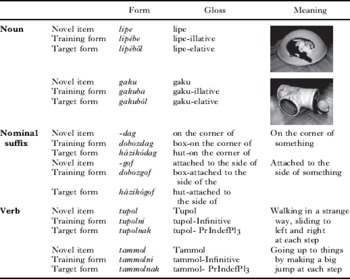
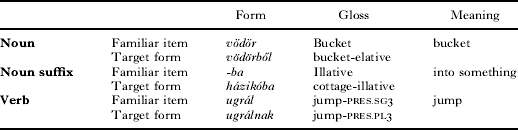
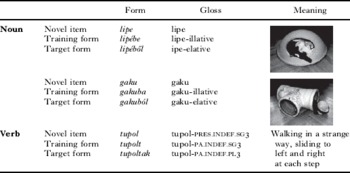
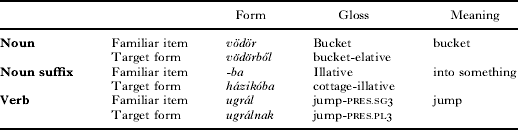
For a detailed list of novel and control items see Tables 2 and 3.
Test (novel) items in Experiment 1

Control items in Experiments 1, 2 and 3
Let us look at two detailed examples of the experimental conditions: the novel item is a word in the first one, and it is a suffix in the second one. For the sake of clarity and ease of exposition, we do not give morpheme-by-morpheme glosses for the sentences. Hungarian suffixes are translated by prepositions in English. For the same reason, we use standard Hungarian orthography and do not give phonetic transcriptions.Footnote 4
For ease of exposition, the different linguistic elements are distinguished by typeface in the examples below. The novel item and its suffix (in Hungarian) or preposition (in English) appear in italics. In the novel word conditions the suffix/prefix is given in bold but the stem is not, while in the novel suffix condition the stem is bold and the suffix/prefix is not.
Example 1
Novel item:gaku (noun)
Input variability: multiple forms
Control question:
• Honnan bújt ki a nyuszi? ‘From where did the bunny climb out?’
∘ Correct answer: a vödör ből ‘from the bucket’
Training phase:
• Nézd, a nyuszi hová bújt? A nyuszi bebújt a gakuba. Most benn van a gakuban, jól elbújt. Közben nézd, a maci is idejött a gakuhoz. … ‘Look, where is the bunny hiding? He slipped into the gaku. Now he is in the gaku. Look, now the bear also came here to the gaku …’
Production test:
• Stem question: Mi ez? ‘What is this?’
∘ Correct answer: gaku ‘a gaku’
• Familiar form question: Hová bújtak be az állatok? ‘Where did the animals slip into?’
∘ Correct answer: a gaku ba ‘into the gaku’
• Target form question: Honnan mászott ki a nyuszi? ‘From where did the bunny climb out?’
∘ Correct answer: a gaku ból ‘out of the gaku’
Comprehension test:
• Játszd el azt, hogy a nyuszi kimászik a gaku ból! ‘Show me how the bunny climbs out of the gaku.’
Example 2
Novel item:-dag (noun suffix)
Input variability: one form
Control question:
• Hol van most a dobókocka? ‘Where is the dice now?’
∘ Correct answer: a házikóban ‘in the house’
Training phase:
• Nézd, itt ez a doboz! Nézd iderakom ezt az üveggolyót, így az üveggolyó a dobozdag van. Most leszedem, és felrakom a dobókockát, most a dobókocka van a dobozdag … ‘Look at this box. I put this ball here, now the ball is dag the box. I take it off, and I put the dice here, look, now the dice is dag the box …’
Production test:
• Familiar form question: Hol van most a dobókocka? ‘Where is the dice now?’
∘ Correct answer: a dobozdag ‘dag the box’
• Target form question: Hol van most az üveggolyó? ‘Where is the ball now?’
∘ Correct answer: a házikódag ‘dag the house’
Comprehension test:
• Tedd úgy a dobókockát, hogy a házikódag legyen! ‘Place the ball so that it's dag the house.’
Scoring
For each production test (stem, familiar form, target form), and each combination of linguistic item (noun, nominal suffix, verb) and input variability (one form, multiple forms) children could receive a score of 0, 1 or (maximum) 2, reflecting the number of correct answers they had produced during the two production test phases. This way, production of stem forms, familiar forms and target forms were scored separately. Since there was only one comprehension test in each condition, children scored 1 for a correct answer and 0 if they failed the comprehension test.
RESULTS
Production
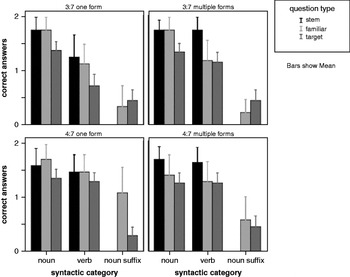
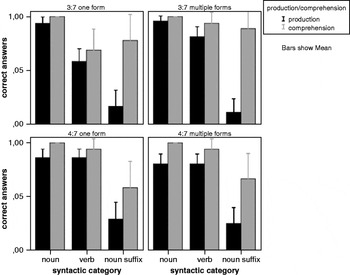
Figure 1 shows the results of the production tests. The top left chart displays the results of the older group in the one-form condition. Children successfully used the novel noun and the novel verb both in the form they heard during the training and with the target suffix, which they used productively. However, only half of the answers were correct on the novel suffix with the familiar stem, and none of the children used the suffix productively in the target form. The multiple-forms condition yielded similar results. The children aged 3 ; 7 were successful with the nouns in both input variability conditions, and just as the older group, they failed to use the novel noun suffixes productively, but their performance with verbs lagged behind the older group.
Since there were only three score values (0, 1, 2) we applied non-parametrical statistical tests (Wilcoxon paired samples test, unless stated otherwise) to evaluate the results.
Differences between syntactic categories
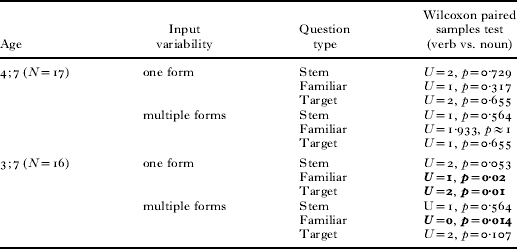
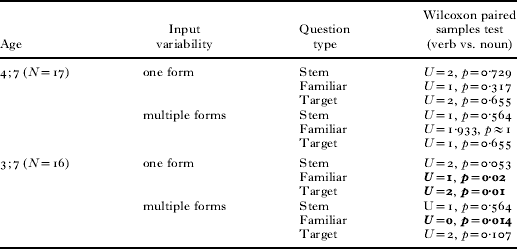
There were no significant item category effects in the older group. The performance of the children aged 3 ; 7 on verbs was below nouns in the one-form condition, both with the familiar form (p<0·05) and with the target form (p<0·01). In the multiple-forms conditions, the younger group performed better on nouns than on verbs with the familiar form, but there were no differences between the two categories in the target form. See Table 6 (in the Appendix) for statistical details.
Differences due to input variability
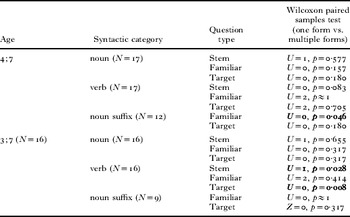
The results for the younger group show that input variability only affected verbs in the target form: children's performance improved significantly when they heard the verb in multiple different forms during training (p<0·05), but performance on nouns did not differ. The children aged 4 ; 7 performed better with the familiar form of noun suffix in the one-form than in the multiple-forms condition (p<0·05), but neither verbs nor nouns showed an effect of input variability. See Table 7 (in the Appendix) for details.
Differences between age groups
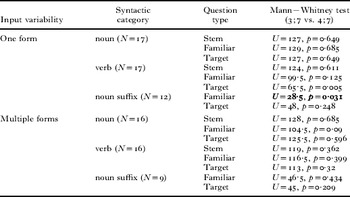
The only significant difference between the two age groups was in their performance on familiar forms of the noun inflections in the one-form condition (p<0·01). The age effect for target forms with novel verbs in the one-form condition was marginally significant (p=0·05). See Table 8 (in the Appendix) for details.
Differences between the familiar and target forms
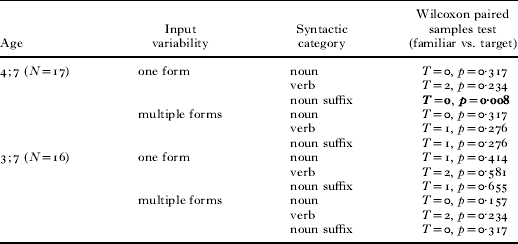
The only significant difference between familiar and target forms was in the performance of the older group on novel noun suffixes in the one-form condition. They performed significantly better on the familiar form than on the target form (p<0·05). This difference disappeared in the multiple-forms condition. See Table 9 (in the Appendix) for details.
Production results in Experiment 1. notes: The upper two charts show results for younger children (3 ; 7), the two charts below show results for older children (4 ; 7). The charts on the left display performance in the one-form conditions, the charts on the right show results for multiple-forms conditions. In all four charts, the first clusters of bars show the mean number of correct answers with respect to novel nouns, the second clusters show children's performance with novel verbs, while the third clusters display noun suffix results. In the noun and verb clusters the first bar shows performance on the novel words' stem, the second bar indicates results concerning the familiar form and the third bar visualizes productivity on the target form. In the noun suffix clusters there are only two bars, showing the familiar and target form results, respectively. Error bars show 95% confidence intervals.

Comprehension
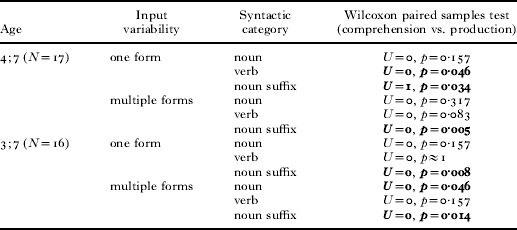
Figure 2 compares the comprehension and the production results for target forms. Since there was only one comprehension test in a session, we reduced the production data to a binary variable to make the statistical comparison of production and comprehension results viable: production was successful if the child could correctly answer at least one of the two production questions.Footnote 5
Comparison of production vs. comprehension performance in Experiment 1. note: Under this coding scheme for production, a child got a score of 1 if s/he answered one or two of the production questions correctly, and 0 if s/he failed to give a correct answer to either.

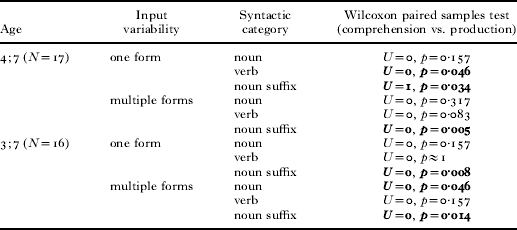
Comprehension was at the same level as production with nouns and verbs, and all children in all conditions and all age groups performed at ceiling with nouns. Both age groups in both input variability conditions performed significantly better in the comprehension than in the production trials for new noun suffixes (p<0·05, p<0·001). The younger group performed better on the comprehension of noun/multiple forms, the older group's comprehension was better in the verb/one-form condition (p<0·05). See Table 10 (in the Appendix) for statistical details.
DISCUSSION
The results of Experiment 1 show that children in both age groups use familiar noun suffixes productively. They performed just as well on target forms of novel nouns as on familiar forms, and input variability did not have any effect on results either. However, this does not mean that these factors do not play a significant role in morphological acquisition in nouns; the ceiling effect observed for nominal suffixes in both age groups prevents input variability from exerting its influence.
Performance was poor with the novel suffix. The low scores on the familiar form show that not even the children in the older age group succeeded in acquiring the suffixes. This might indicate a problem with acquisition rather than with productivity. The older group performed better on the familiar form than on the target form in the one-form condition, which suggests that they in fact learned the novel suffix. Since this difference vanished, however, in the multiple-forms condition, there might be an alternative interpretation. In the production test of the one-form condition children could simply reproduce the familiar form, which they had heard several times during training, without necessarily analyzing its morphological structure. In the multiple-forms condition the suffix was presented with several different stems, and hearing any one stem+suffix combination a smaller number of times naturally made it more difficult to memorize and reproduce the combination in a response.
We should also note that the children's answers to our questions were usually grammatically correct, even when they failed to use the novel suffix and replaced it with a semantically appropriate (although sometimes overgeneral) Hungarian paraphrase (for example instead of dag the house they said on the corner of the house or just on the house). Suffixes form a closed class, and the three- to four-year-old children in our experiments had heard many of them a great number of times. Statistically, therefore, the available linguistic evidence supports existing suffixes or paraphrases, and also lowers the probability of new suffixes entering the language (which is not the case for nouns or verbs). These properties of suffixes (the existing ones forming a closed class and occurring very frequently in the language) might explain why children of this age are not as willing to learn and use a new suffix as they are to acquire a novel noun or verb. Also, the methodological problem of choosing the right meaning for a novel suffix might have contributed to poor performance. Ideally, one would need a meaning which is clear enough for young children but is not easily substituted by an existing linguistic construction; but easily learnable concepts are usually already expressed in alternative ways by existing forms. A longer training with more repetitions of the suffix might have also helped successful production. The comprehension results show that in spite of the poor production results, children somehow understood the meaning of the novel suffix. This result is consistent with findings from previous studies on the comprehension of novel suffixes in Hungarian (Király, Pléh & Racsmány, Reference Király, Pléh and Racsmány2001), although here children might have been simply imitating a previously observed action without any contribution from the semantics of the suffix. Further experiments are needed to test children's ability to learn novel suffixes.
Looking at verb morphology, the older group showed productive use of suffixes with novel verbs. Although performance was not at ceiling, it was relatively high and did not allow room for improvement in the multiple-forms condition for the older group. The children aged 3 ; 7 had difficulties with verb morphology. Both within- and between-subject comparisons revealed differences in the one-form condition: noun morphology was easier for children aged 3 ; 7 than verb morphology, and their performance on verbs was lower than that of the children age 4 ; 7. The younger group, however, benefited from the multiple-forms condition: while they could not categorize the word as a verb after hearing it in only one form, they were successful after hearing it with several different suffixes. The younger group also had problems with the familiar form, which did not vanish in the multiple-forms condition. There is a plausible pragmatic explanation for this: the familiar form was the infinitive, and it is not possible to form a question in Hungarian which does not allow correct answers other than the infinitive of the target verb. It is important to point out, though, that this effect was only present in the younger group, and only for verbs, since in this case neither ceiling nor floor effects prevented input variability from helping the learning process.
EXPERIMENT 2
OVERVIEW
Having tested the two age groups in Experiment 1, we attempted to conduct the same experiment with children below the age of three, but without success: we had to exclude too many children either because they refused to produce the novel item or because they were unable to answer the control questions. Such heavy selection makes experimentation very time-consuming and it may also bias the results. We therefore decided to drop the elicited production paradigm and developed a new method of investigating morphological productivity in younger children. Since the novel word paradigm is the best way to test the productivity of grammatical constructions, we continued to train the children on novel words but we modified the test phase. In the new design, during the training phase the children were taught novel nouns and verbs just like in Experiment 1. During the test phase, we used a new elicited production task disguised as a sentence repetition task. The children were shown videos in which an action scene was described in a short sentence containing the novel word. The children's task was to answer questions concerning the actions seen in the video. The correct answer was always the previously presented narration sentence, which the children simply had to repeat. The task was transformed into a production test by masking the suffixes on the novel words with a cough in the narration sentence (this method was developed for an agreement task in Lukács et al., Reference Lukács, Leonard, Kas and Pléh2009. to test verb forms that are pragmatically difficult to elicit).
We decided against a simple repetition instruction and kept the elicitation question because our pilot studies showed that two- to three-year-old children were more prone to refusing to repeat a sentence than to answer a meaningful question. Furthermore, since they had just heard the answer to that question, they could be confident enough that they would be able to provide the answer without the uncertainty and hesitation we frequently observed in the case of the old design. Most children were not even aware of the coughs, and they were certainly not troubled by them. Two of the children noted that the person talking on the computer coughed a lot, but they did not seem to worry about it, and they did not realize that the cough was masking part of a word.
METHOD
Participants
The subjects were sixteen Hungarian monolingual children with a mean age of 2 ; 7 (ranging from 2 ; 3 to 3 ; 3). They were recruited and tested in a nursery school in Budapest.
Procedure
The experimental conditions were loosely based on Experiment 1, although for the sake of simplicity we dropped some conditions and focused on the ones that, based on the results of Experiment 1, promised to be not too difficult even for younger children. The experiment had three different conditions. First, the novel word could be a noun or a verb. The second factor was input variability: the novel noun could be presented in one form or in multiple forms during the training phase (we only included a multiple-forms condition for nouns; the verb/multiple-forms condition is included in Experiment 3). Thus the three conditions were:
• noun/one form;
• noun/multiple forms;
• verb/one form.
The familiar and target forms of the novel nouns were the same as in Experiment 1, but we changed the forms of the novel verbs. The familiar form (i.e. the one presented in the training phase) contained the suffix -t (past indicative indefinite third person singular marker; henceforth pa.indef.sg3), while the target form was the past indicative indefinite third person plural, marked by the suffix -tAk (henceforth pa.indef.pl3).
All conditions were within-subject conditions, and children were tested in three sessions for the three conditions. The procedure of the experimental sessions was the following:
1. Training phase with toys. During the training phase the experimenter taught the novel word to the child in an interactive play session using toys. If the novel word was a noun, it referred to an unfamiliar object, and if it was a verb, it referred to an unusual action performed by a puppet. Children were asked to repeat the novel word several times.
2. Training phase with videos. During the second training phase children watched videos in which simple actions were performed by the same puppet toys that had been used in the first training phase. The actions were always described in a simple sentence. In the noun conditions the narration ran in parallel with the action, but in the verb condition the narration followed the action. This ensured that the videos were pragmatically appropriate, as the novel verb was in the past tense. After playing the video the child was asked a question to which the correct answer was a repetition of the narration sentence previously presented. If the child was unable to answer the question, the video was replayed and the same elicitation question was asked again. Three different training videos were used, and, for each video, the training question was asked before moving to the next phase of the experiment. If the child refused to answer the questions or failed to use the novel word, training continued for three more sessions. If s/he was still unable to answer the questions, s/he was excluded from the experiment.
3. Production test. The production test was the same as the video training phase, except that the suffixes in the narrations were masked with a cough. The materials had been prepared by recording the sentences in full and replacing the target suffix (and only the target suffix) with a prerecorded cough using a sound editor program. This ensured that the pronunciation of the target word was natural.Footnote 6 There were three test videos (i.e. three trials) containing the novel word in the familiar form and there were three videos (another three trials) in which the target form was used (see Experiment 1; noting that in Experiment 2 suffixes were masked in both conditions).
Note that Hungarian marks all six person/number combinations with a different suffix both in the present and in the past tense paradigms of verbs, so the familiar and target forms of the novel verb are different from each other (unlike in English). The cough is marked by XXX in the example below.
Example:
Novel item:tupol (verb)
Input variability: one form
Training video:
• Video narration: A nyuszi tupolt a létrán. ‘The bunny tupol ed on the ladder.’
∘ Question: Mit csinált a nyuszi? ‘What did the bunny do?’
Test video:
• Video narration (familiar form): A róka tupol XXX a dobozon. ‘The fox tupol XXX on the box.’ (cough on the verb suffix)
∘ Question: Mit csinált a róka? ‘What did the fox do?’
∘ Correct answer: A róka tupolt a létrán. ‘The fox tupol ed on the box.’
• Video narration (target form): A majmok tupol XXX a vödrön. ‘The monkeys tupol XXX on the bucket.’ (cough on the verb suffix)
∘ Question: Mit csináltak a majmok? ‘What did the monkeys do?’
∘ Correct answer: A rókák tupol tak a létrán. ‘The foxes tupol ed on the box.’
List of novel words and suffixes
Once again, each participant was tested in each condition/word, so each child participated in three sessions. Within each condition, the two word forms and two meanings were randomly paired for each subject. The order of the sessions was also randomized and split between two or three occasions (depending on how many sessions the child could handle). Only children who successfully produced the control items were included in the test.
For a detailed list of novel items in Experiment 2, see Table 4; the control items were the same as in Experiment 1.
Test (novel) items in Experiment 2

RESULTS
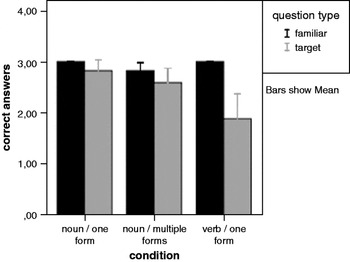
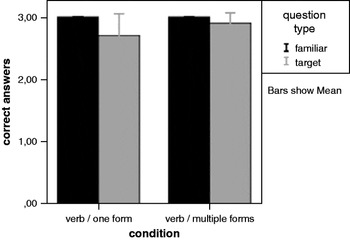
Figure 3 shows the results for Experiment 2. Children performed at ceiling with the familiar form in all three conditions. With the target form, however, performance was poorer in the verb condition. Since performance with the target forms of nouns was already at ceiling in the one-form condition, input variability did not have a significant effect.
Difference between syntactic categories
Children's performance dropped for the target form of the novel verb relative to the target form of the novel noun in the one-form condition (U=2, p<0·05). For the familiar form, there were no significant differences between the two syntactic categories (U=0, p≈1).
Sentence repetition results of children aged 2 ; 7 in Experiment 2. note: The figure shows mean number of correct answers in the three conditions.

Difference between the familiar and the target forms
Performance was lower for the target form than for the familiar form in the verb/one-form condition (U=0, p<0·01). In the noun conditions (one form and multiple forms), participants did not show a significant difference between the familiar and the target forms (U=0, p=0·18 and U=0, p=0·102, respectively).
DISCUSSION
An important methodological conclusion of Experiment 2 is that the sentence repetition task with masked suffixes is a novel tool well suited to testing morphological knowledge and productivity in young children: restoration of missing suffixes works even in this age group, as the ceiling performance of children aged 2 ; 7 show. There are many factors that play a role in how a child aged 2 ; 7 performs in an experimental situation. Although control conditions and questions try to minimize the distorting effects of various factors, it is often difficult to decide whether low performance is indeed due to a deficit in grammatical knowledge on the children's part. Grammatical knowledge is not an all-or-nothing phenomenon: even if children are able to produce an answer using a given syntactic construction, this can involve substantial computational load. Thus if a test situation presents (as it usually does) linguistic and non-linguistic challenges – such as learning and remembering the form and meaning of the new word, understanding the question, pronouncing the novel word correctly, producing a syntactically well-formed utterance, inflecting the novel word, etc. – they may fail to give a correct answer even if the control questions suggest that they are competent at every single task in isolation. The tasks in combination may constitute a computational load and overall complexity beyond the capacity of very young children, with the result that non-target responses are given when as-yet fragile constructions are tested.
The results of our experiment fit into the picture of early morphological acquisition emerging in the literature. Noun morphology (at least for the suffixes tested in this experiment) is productive for Hungarian children aged 2 ; 7. Ceiling performance on both noun conditions precludes any conclusions concerning the effect of input variability.
Verb morphology proved to be more difficult for younger children as well. Their performance on verbs lagged behind the results for nouns for the target form but not for the familiar form. This pattern suggests a lack of morphological productivity rather than a word learning difficulty with verbs. Another possible reason behind lower productivity is that the suffix of the familiar form is more frequent in the language than the target form suffix. Frequency counts in the Hungarian Webcorpus (Halácsy, Kornai, Németh, Rung, Szakadát & Trón, Reference Halácsy, Kornai, Németh, Rung, Szakadát and Trón2004; Kornai, Halácsy, Nagy, Oravecz, Trón & Varga, Reference Kornai, Halácsy, Nagy, Oravecz, Trón, Varga, Kilgarriff and Baroni2006) reveal that the frequency of the pa.indef.sg3 form is 8,972,835 tokens, while the frequency of the pa.indef.pl3 form is 3,411,547 tokens, i.e. the familiar form is more than twice as frequent as the target form (although the frequencies in child-directed speech can differ). As there is room for improvement in productivity with verb morphology in this age group (the children were not at ceiling), higher variability in the input might help children produce the target forms. If it does, the poor performance in Experiment 2 is probably not due to difficulties with suffixation, but to problems categorizing the new word as a verb. Our next experiment addresses these issues.
EXPERIMENT 3
METHOD
Participants
The subjects were ten Hungarian monolingual children with a mean age of 2 ; 7 (2 ; 1–3 ; 1). They were recruited and tested in a nursery school in Budapest.
Procedure
The design was the same as in Experiment 2, with the following differences:
• Experiment 3 had two conditions: verb/one form and verb/multiple forms.
• The suffixes were assigned randomly to the familiar versus the target condition. This way we eliminated the possible biasing effect of the frequency differences between the two suffixes.
List of words and suffixes
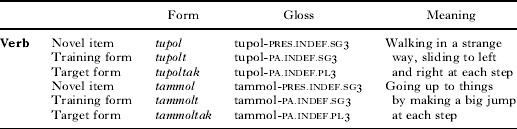
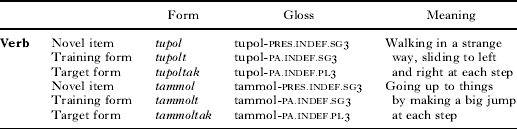
The items used in Experiment 3 are displayed in Table 5.
Test (novel) items in Experiment 3
RESULTS
Contrary to the results for verbs in Experiment 2, there were no significant differences between productivity with the familiar and the target forms, not even in the verb/one-form condition (U=0, p=0·18). As the children's performance in the one-form condition was already relatively high, the multiple-forms condition did not make a significant difference (U=0, p=0·317). Figure 4 shows the results of Experiment 3.
Sentence repetition results in Experiment 3. Mean number of correct results in the two verb conditions.

DISCUSSION
Experiment 3 demonstrated that a deficit in morphological productivity cannot explain weaker performance on verbs in Experiment 2. The plural/third person form is less frequent in Hungarian than the singular/third person form, which could have been a factor contributing to the discrepancy between the children's performance on familiar and target forms in Experiment 2. The data from Experiment 3, however, do not support this conclusion: children were able to produce the plural form as well, as the ceiling performance on the familiar forms show. We suggest that the main obstacle to productivity is not related to the production of the correct morphological form, but to the categorization of the novel item based on the training form(s). This claim would receive support if the children's performance had improved significantly in the multiple-forms condition relative to the one-form condition. In this experiment, a ceiling effect in the one-form condition prevents us from observing such an effect and clarifying the issue.
GENERAL DISCUSSION
Taken together, the results of these three experiments provide evidence that Hungarian nominal and verbal suffixes are used productively before the age of three. However, as we saw in Experiment 1, low input variability of verb suffixes in the training session can complicate the task of using suffixes productively for children under the age of four, whose performance deteriorates in an elicited production task under such conditions. If we compare our results on morphology to the thoroughly investigated syntactic phenomenon of the English transitive construction (Abbot-Smith, Lieven & Tomasello, Reference Abbot-Smith, Lieven and Tomasello2001; Akhtar, Reference Akhtar1999; Akhtar & Tomasello, Reference Akhtar and Tomasello1997; Childers & Tomasello, Reference Childers and Tomasello2001; Dodson & Tomasello, Reference Dodson and Tomasello1998), we see that morphology, or at least the morphological constructions we examined, are easier and are acquired earlier than the syntax of transitive sentences. This is in line with Dąbrowska's results on Polish case suffixes (Dąbrowska & Szczerbiński, Reference Dąbrowska and Szczerbiński2006), which show that two-year-old Polish children are productive with almost all noun case inflections, and are corroborated by results in other Slavic languages (Kempe et al., Reference Kempe, Ševa, Brooks, Mironova, Pershukova and Fedorova2009; Ševa et al., Reference Ševa, Kempe, Brooks, Mironova, Pershukova and Fedorova2007; Savickiene, Reference Savickiene and Gillis1998; Savickiene et al., Reference Savickiene, Kempe and Brooks2009). When the characteristics of the input (local cues in the case of morphology) allow it, generalization, abstraction and thus productivity can be present at an earlier age.
Verb morphology proved to be more difficult than noun morphology in the experiments presented in this paper. Taken together, findings from the three experiments show that the main factors potentially contributing to the poorer performance with verbs are the following. First, the elicited production paradigm is not ideal for studying children below three. While the method works with the older age group, task difficulty may bias the results of the younger children by reducing their performance through higher task demands. The sentence repetition method seems to eliminate the high performance load of the elicited production task, and this way it provides a more reliable measure of the level of morphological productivity in younger children as well.
Second, the pattern of results suggests that the main difficulty with these tasks was not the production of the target form of the novel linguistic item, but the recognition of its syntactic category, which is the basis of productive suffixation. Children showed evidence of having reliable mechanisms for producing different morphological forms of both familiar and unknown words. Their knowledge of the suffixes tested in the experiment was abstract enough to be successfully extended to novel words, and for the children to produce an unheard morphological form of the new verb. Without this abstract category they would not have been able to perform so well in all multiple-forms conditions. It was also shown that input variability is crucial to morphological acquisition: children seem to have problems with categorizing the new item if they do not hear it in diverse suffixed forms, or at least in one salient form which is representative of its category.
As far as we know, this study was the first to directly compare productivity in noun versus verb morphology in young children in a novel verb paradigm. Our findings show that children aged 2 ; 6 do not show any difficulty with the productive use of noun morphology, while they have greater problems with extending their morphological knowledge to inflecting new verbs. Certainly, this result does not imply that they know all nominal suffixes and use them productively. It is possible that in the verb conditions with no input variability and less salient suffixes (-t), the input did not provide enough cues to identify the novel word as a verb. In the noun conditions, even in the one-form conditions, the suffix in the familiar form (-bA suffix) was salient enough to be a sufficient cue for categorizing the novel word as a noun. Similarly, in Experiment 3, extending the use of the more recognizable verbal suffix to the familiar forms made the formerly difficult verb/one-form condition easier for even the youngest group.
The results of the novel suffix condition in Experiment 1 demonstrate that a short training session is not enough for introducing a new grammatical marker, suggesting that fast mapping only works for referential expressions, but not for function words, suffixes or grammatical constructions. A few pairings of the suffix and its meaning cannot replace the enormous amount of linguistic experience children accumulate with grammatical markers. Despite the good comprehension results in the oldest group, the children were reluctant to use the nonsense suffix, which is reasonable from a statistical learning point of view, since they had gathered a large amount of evidence on the real suffixes that are good candidates for replacing the novel suffix in the experiment, while they had only been exposed to a couple of examples of the nonsense ones during the experiment. They did not have any difficulty expressing themselves using real suffixes and paraphrases. While children learn new words every day, they encounter relatively few suffixes during their lifetime. It seems reasonable from the child's point of view to reject the use of a new suffix, especially one supported only by scarce evidence. The children in the experiment seemed to ignore the training session, which for them was just noise included with the large amount of linguistic experience they had had.
Although production performance was poor, the oldest age group showed good performance on the comprehension of the new suffix in the familiar form. This suggests that they understood the meaning of the new suffix, they just did not analyze its linguistic function, and could not use it productively. The weaker performance in the multiple-forms condition shows that children simply rote-learned the familiar form, and in the multiple-forms condition they could not learn all the familiar forms, each of which was presented a smaller number of times.
Finally, we would like to point out once more the especially good performance of the children aged 2 ; 7 in Experiments 2 and 3, highlighting the viability of the method of sentence repetition with masked inflections in studying young children's morphological productivity. The low computational load of the task reduces the biasing effect of attentional, memory or other performance demands of the experiment, and makes this method a real alternative to traditional elicitation procedures used in child language research.
APPENDIX: DETAILS OF STATISTICAL RESULTS
Comparison of noun and verb production results of Experiment 1 in different age groups and conditions
Comparison of one form and multiple form production results of Experiment 1

Comparison of production results of the two age groups in Experiment 1

Comparison of production performance with familiar and target forms in Experiment 1

Comparison of production and comprehension performance on the target form in Experiment 1