The important role of banks in financing industrialization in Britain, Germany, and the United States is well established. The literature stretches back at least as far as Walter Bagehot in the 1860s and is being carried forward on the basis of painstaking research by (amongst others) Liam Brunt and Edmund Cannon; Lance Davis and Larry Neal; Stephen Haber and Noel Maurer; Philip Hoffman, Gilles Postel-Vinay and Jean-Laurent Rosenthal; Naomi Lamoreaux; Peter Rousseau; and Peter Temin and Joachim Voth.1
Notable early contributions were made by Schumpeter, Theory; Gerschenkron, Economic Backwardness; Kindleberger, Financial History; Cameron, Banking; and Bagehot, Lombard Street. Recent research includes Brunt and Cannon, “Do Banks”; Davis and Neal, “Why did Finance Capitalism”; Haber, “Industrial Concentration”; Haber and Maurer, “Related Lending”; Hoffman, Postel-Vinay, and Rosenthal, Priceless Markets; Lamoreaux, Insider Lending; Rouseau, “Financial Intermediation”; and Temin and Voth, “Banking.”
Several important stylized facts are emerging from this work. On the one hand, the banks studied by Haber, Maurer, Lamoreaux, Temin, and Voth all approximated to what we, as modern observers and consumers, would call banks. That is, they fulfilled the essential functions of taking deposits and making loans. Generally, they also provided the type of additional services that we also associate with modern banks—offering safety deposit services, means of remittance such as checks and bankers' drafts, holding and trading in securities for clients, overdraft facilities, and so on. On the other hand, these banks did not run their financial affairs quite as a modern bank would do. In particular, a common theme emerging in the literature is that much of the bank lending was to “insiders”; that is, people who had some kind of link to the bank in addition to their role as a customer. For example, that person could be a substantial shareholder, or on the board of directors, or a relative of someone high up in the bank, or a government official involved in regulating the bank.
The literature on modern banking practice takes a very dim view of insider lending because it can lead to rapacious management practices that divert to insiders the income that rightfully belongs to “outsiders.” However, Haber and Maurer and Lamoreaux all argue that insider lending was not pernicious.2
Haber and Maurer, “Related Lending,” pp. 1–5; and Lamoreaux, Insider Lending, pp. 157–65.
On the contrary, it was a sound business strategy when it was hard to find reliable information on prospective borrowers. When accounting practices are unreliable and property rights are uncertain, then it makes a lot of sense—and may be profit-maximizing for the bank—to lend to insiders. The bank has a lot of information about insiders, and if they default then the insiders will have to face unpleasant social sanctions in addition to economic penalties. Hence insider lending is a way to reduce risk in a very uncertain world, and the management practices of early banks can be seen as a rational, effective, and desirable strategy that promoted the stability and growth of the banking system. Leslie Pressnell's classic work on banking during the first Industrial Revolution reveals that the same practices were widespread in England during the eighteenth and early nineteenth centuries, probably often for the same reasons.
3 Pressnell, Country Banking, pp. 291–92, 334–37.
The Haber-Lamoreaux-Pressnell characterization is undoubtedly accurate for many banks in a variety of periods and places, including many English banks during the Industrial Revolution. But the argument of this article is that an important subset of English banks does not fit so readily into this framework of risk reduction via insider lending. Here we are not trying to argue that insider lending was not common; rather, we are pointing out that some bankers (and their customers) may not have been so interested in minimizing risk. There is a danger that we are writing risk-taking behavior out of the historical record of early industrialization and, in that sense, the purpose of this article is to “rediscover risk.” The argument is that some of the country banks were actually more like modern venture capital firms than banks. Instead of being deposit and loan institutions open to the public they were really closely held, high-risk investment vehicles for wealthy people who were looking for high returns in growth industries.
The most striking implication of this venture capital perspective is that we cannot so easily interpret the occurrence of bank failures—which were common—as a sign of inherent weakness in the system. In a banking system, stability is prized above all things. But venture capitalists know that (and readily accept the risk that) sometimes their firm will lose money: this is the inevitable corollary of undertaking speculative investment. In that sense, the early English banking collapses of the first Industrial Revolution can been seen in a more favorable light. They may represent the negative realizations of risky investment strategies, rather than a failure to competently manage banks or to adequately monitor the banks' managers. A second implication of this argument is that the reduction in bank failures that we observe in England in the late nineteenth century may not have been a net benefit for the British economy because it may well indicate that more English banks were indeed acting like banks and fewer were acting like venture capital firms. This would be consistent with the view that bankers in the late Victorian period were hindering technological innovation and depriving start-up firms of capital. By contrast, Davis and Neal argue that it was in precisely this period that local U.S. banks were financing the small-scale innovators who would come to dominate the second Industrial Revolution.4
Davis and Neal, “Why did Finance Capitalism,” pp. 2–5.
It is natural to think of the English country banks as “banks” for two reasons. First, it was the term used by contemporaries that has been universally adopted by historians. Second, many of the country banks bear a strong resemblance to modern deposit banks. To a first approximation, this conceptualization is correct and is certainly useful in helping us to understand the origins of modern banking: modern banks indeed developed from country banks. But the problem with this conceptualization is that it encourages the historian to bring to country banking a large amount of inappropriate intellectual baggage and imposes a framework that is far from being a perfect fit: the best way to understand the country banks is not necessarily to look at them as prototypes of modern banks. Eighteenth-century banks were not necessarily learning to be twentieth-century banks, as Temin and Voth argue.5
Temin and Voth, “Banking.”
In fact, for many of them such a development may not have been seen as desirable even if they had had a twentieth-century bank in their midst to emulate. Hence the fact that the country banks do not compare well with twentieth-century banks in terms of diversified lending and stability may not be a valid criticism of their management practices.
This point will be made more concrete by comparing one country bank—Praed & Co. of Truro—to modern venture capital firms. In the late eighteenth century Praed & Co. seemed to be making all the classic mistakes that would end in a liquidity crisis and bankruptcy. They were lending to a restricted sent of customers, many of whom were engaged in the same industry (copper mining); the loans that they made were for extended periods and involved a highly speculative technology (steam engines); and their deposit base was probably very limited (the local middle classes). But Praed & Co. turned out to have picked the winning firms in a winning industry: England became the world's largest producer of copper in the nineteenth century, and both the mine owners and Praed & Co. became very rich. This is the stuff of which venture capital dreams are made.
VENTURE CAPITAL FIRMS, MODERN BANKS, AND COUNTRY BANKS
Fundamentally, banks and venture capital firms perform the same function. They collect money from people who want to save and lend it to people who want to invest. Because the value of the money is greater to the investor than to the saver, the investor is willing to pay a sufficiently high price to borrow the money that the saver can be compensated for his or her postponed consumption and the intermediary (the bank or the venture capital firm) can be remunerated for his or her organizational input. However, the differences between these two types of institution are actually quite marked. Because the argument of this article is that some English country banks during the Industrial Revolution looked more like venture capital firms than banks, it is important to be clear what the differences are between the two types of financial intermediary. Only then can we assess the argument that some country banks looked like one rather than the other.6
The following discussion offers stylized views of both modern banks and modern venture capital firms. This is inevitable, because entire books could be written about both the variation across banks and the variation across venture capital firms. The focus is on the “classic” venture capital firms that operated in the United States in the period between the Second World War and the mid-1980s. At some points in the discussion specific comparisons are drawn with other types of venture capital firms. For a discussion of different types of venture capital firms, see Bygrave and Timmons, Venture Capital, especially chapters 2 and 3.
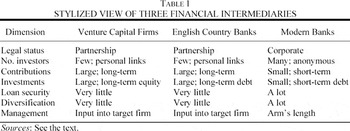
One important difference between venture capital firms and banks lies in their financial structure. There are contrasts in terms of the number of contributors of funds, the level of involvement of each contributor, and the legal status of their contribution. A limited liability joint-stock bank (which is the typical financial structure of deposit banks in Europe and the United States) raises funds from two sources. The bank raises equity from shareholders (who also own the bank and are the residual claimants on any profits), and it collects deposits from savers (who merely give loans to the bank and carry no legal responsibility for the management of savings). In large modern banks there are thousands or hundreds of thousands of shareholders; and there are hundreds of thousands or millions of depositors. The shareholders may monitor the firm and are nominally in control of it through their ownership of the voting stock; however, the day-to-day management is undertaken by professional managers whose interests and actions are not necessarily well aligned with the shareholders' interests. By contrast, venture capital firms raise funds on a private basis from a very limited number of contributors, with each contributor being a partner in the venture capital firm. The people who manage the firm on a day-to-day basis are called general partners; they have unlimited liability and contribute around 1 percent of the investment fund (around $0.5 million).7
Sahlman, “Structure,” p. 495.
They draw a salary from the firm, they get a return on the personal funds that they have contributed to the investment fund, and they get an additional portion of any profits.
8 Sahlman, “Structure,” p. 475.
Most of their income comes from their portion of the profits rather than their salary.
9 Sahlman, “Structure,” p. 495.
In 1988 in the United States there were 658 venture capital firms employing 2,474 professional managers, or just under four general partners per venture capital firm.
10 Sahlman, Structure,” p. 475. In fact, these 2,474 professionals comprise both general partners and their “associates,” who are effectively apprentice venture capitalists; see Sahlman, “Structure,” p. 488.
The other contributors to the venture capital investment fund are called limited partners; they are sleeping partners and have limited liability. There are probably around 30 limited partners in a typical venture capital firm, and they tend to be recruited through the personal contacts of the general partners—business associates, acquaintances, and so on.
11 This is calculated as follows. In 1988 the median size of the investment fund for an independent private venture capital firm was $30 million (Sahlman, “Structure,” p. 476). Because each limited partner contributes upward of $1 million to the investment fund, the total number of unlimited partners in the median fund must be fewer than 30. Because the mean fund is rather larger than the median—and therefore probably has more investors—a figure of about 30 limited partners per fund is probably not far from the truth.
Thus, in terms of financial structure, the English country banks were much more akin to venture capital firms than modern banks. They were legally restricted to being partnerships of up to six people who had to have unlimited liability; these partners are analogous to the general partners in the venture capital firms. The partners in the bank took care of the day-to-day management of the bank's investment fund and made a contribution towards it both through their own deposits in the bank (which were often large) and their equity stake in the bank. The partners were remunerated in the same way as the general partners in a modern venture capital firm: they drew a salary, they earned a return on their personal deposits and they got an additional portion of any profits (in the form of a return on their equity).12
See, for example, LloydsTSB archive item A19b/1 “Partners' ledger.”
Most of their return came from the return on their equity. The partners in the bank then collected additional funds from depositors in order to increase the size of the bank's investment fund. If the bank failed then the depositors could not lose more than the value of their deposit; hence the depositors are analogous to the limited partners in the venture capital firm.
13 Note that the English could not have structured their eighteenth-century venture capital firm simply as a limited partnership (i.e., with the general partners having unlimited liability and the sleeping partners having limited liability). Limited partnerships were explicitly outlawed in England until 1907; see Harris, Industrializing English Law, pp. 273–74. That is why alternative legal structures, such as the country bank format, had to be used in order to generate limited liability for the sleeping partners. There is also some similarity here to the French commandite form of business organization; see Lamoreaux and Rosenthal, “Legal Regime.”
It must be emphasized that in many banks all of the depositors would have been known personally to the bankers: they were neighbors, relations, and local business people. Although the evidence is fragmentary, it is also clear that the total number of deposit accounts in each bank was often very small. For example, Awdry's of Melksham had 31 deposit accounts in 1803; the Bristol Exchange Bank had 53 in 1779; and Barnard's of Bedford had “very few” in the early 1800s.
14 Pressnell, Country Banking, pp. 245, 250; and records of the Exchange Bank in D1086/B12.
So the number of contributions to the country bank investment fund was much more comparable to that of a venture capital firm than a modern bank, and so was the manner in which those contributions were collected (through personal contacts).
15 Banks were not the only financial structures that depended heavily on personal contacts to raise money. Newton has shown that the earliest joint-stock companies were also very closely held by small networks of friends, relations and business partners. See Newton, “Capital Networks,” pp. 153–54.
The massive difference between modern banks and venture capital firms in terms of the number of contributors is inevitably mirrored by a massive difference in the size of the contribution from each saver. If it were not, then the size of the investment fund operated by the venture capital firm would be ridiculously small. Most bank deposits are small compared to (say) average annual incomes. In 1988 the median salary for a male worker in the United States was $20,687 per annum, and median savings in a deposit account were $11,000.16
By contrast, individual investments in venture capital firms are large compared to average annual incomes. In 1988 limited partners were investing upwards of $1 million dollars in each venture capital firm, nearly 50 times the median salary.
17 Sahlman, “Structure,” p. 502.
Again we find that the English country banks were more like venture capital firms than modern banks. The median salary for a male worker in England in 1770 was around £20 per annum. Most banks took minimum deposits of £10 or £20, and some banks set a minimum of £100. Naturally, the average deposit was considerably larger than the minimum, being £188 at Awdrey's of Melksham and £314 at the Bristol Exchange Bank—nearly 16 times the median salary.
18 Pressnell, Country Banking, pp. 250–51.
There is also an important distinction to be made between banks and venture capital firms in terms of the length of time that contributions have to be invested and the way in which returns accrue to those contributions. Let us consider each issue in turn.
First, banks offer different types of time deposits that lock up savings for different periods of time, anything between seven days and seven years. However, most time deposits are of quite a short duration and may then be rolled over for a longer period. The distinctive feature of time deposits is that they incur a rate of interest, which is generally guaranteed in advance by the bank. Hence savers know exactly what return they are going to make. By contrast, contributions to a venture capital fund are definitely long term. The average life of a venture capital partnership is nearly nine years.19
Sahlman, “Structure,” p. 483.
Not all the funds are collected at the beginning of the partnership—instead they are taken in several tranches. The partners have to commit themselves at the outset to providing a certain amount of money whenever it is called upon, and there are severe penalties if they fail to do so.
20 Sahlman, “Structure,” p. 491.
Hence membership of a venture capital partnership is definitely a long-term investment.
The lack of detailed evidence makes it difficult to know the duration of individual contributions to English country banks, particularly because there were no standard types of deposit account and the duration and interest offered on each deposit was therefore a matter of personal negotiation between the banker and the depositor. But there are several interesting points to note here. First, the rate of interest on deposits varied enormously. In 1779 the Exchange Bank of Bristol paid 2, 3, 4, and 5 percent on different deposits; between 1808 and 1813 Raikes, Currie & Co. in East Yorkshire paid 3, 4, 4.5, and 5 percent on different deposits.21
Pressnell, Country Banking, p. 252.
In general, people who left their deposits for a longer period received a higher rate of interest. This is consistent with the difference that we observe between modern banks and venture capital firms—people tie up their savings for longer in the venture capital firms and earn a higher rate of interest. We also know that when a bank such as the Bristol Exchange Bank was seeking to raise funds in order to make a specific loan it was willing to pay a higher rate of interest.
22 Pressnell, Country Banking, pp. 252–53.
On the one hand this is not surprising because the price of savings will rise when demand exceeds supply. But on the other hand this is similar to the activities of venture capitalists because they find out what investment possibilities are available and go out and collect an investment fund in order to take advantage of those possibilities.
Second, the really marked difference in the contributions made to banks and venture capital firms is in terms of the nature of the returns that accrue to them. Banks make loans to firms and individuals; therefore they take their returns in the form of debt interest payments. By contrast, venture capital firms—and hence the partners who contribute to the firm's investment fund—take equity in the target firm. The venture capital firms typically hold a preferred equity claim. This has the advantage that it acts like debt in the early stages of firm growth, when the prospects of the firm are most uncertain, because it is senior to the common stock claim of the entrepreneur. But if the firm is successful and is sold or floated on the stock market then this equity claim can still rise dramatically in value, unlike debt. This is how venture capital firms share in the upside of the investment. The return to the venture capital firm is consequently highly volatile. If the firm does very well then the venture capital partners may make a 1,000 percent return on their original contribution; if the firm completely fails then the venture capital partners may lose 100 percent of their investment in that project.23
Sahlman, “Structure,” p. 484. Similar figures can be found in Zider, “How Venture Capital,” p. 136.
Given the high level of risk associated with each project, it is desirable for venture capital firms to spread risk by funding a number of different projects. One way in which they achieve this is by joining syndicates to invest in each other's target firms.
24 It should be noted that there are additional reasons for syndication stemming from the desire to encourage information collection and revelation. See Lerner, “Syndication.”
Although a few venture capital investments make a very high return, this is not a general phenomenon. In a sample of 383 investments, 35 percent of them made a loss and 30 percent made between zero and 1.9 times their initial outlay.
25 Sahlman, “Structure,” p. 484.
If we consider the returns made by venture capital firms (rather than individual projects) then we find from a sample of 29 venture capital firms that the median compound rate of return was 29 percent per annum, with the lowest being 6 percent per annum.
26 Sahlman, “Structure,” p. 483.
In fact, this probably paints an excessively flattering picture of the industry because returns were particularly high in the early 1980s and this is the period from which much of William Sahlman's data are drawn. Longer term trends are mapped by William Bygrave and Jeffrey Timmons, who find that the median annual compound rate of return was typically “in the teens”; in the 1970s it was rarely above 10 percent.
27 Bygrave and Timmons, Venture Capital, pp. 153, 157.
The financial claims that the English country banks held in the firms in which they invested definitely looked more like those of modern banks than those of modern venture capital firms. This is an important dimension of financial intermediation and needs to be stressed. The country banks did not hold equity and instead derived their returns only from the interest that they charged on loans. However, in some sense this is not a fair test of whether the English country banks were acting more like venture capitalists or modern banks. There was simply no equity for them to take, so they could not have taken their returns in the form of equity. Joint-stock companies were outlawed in England after the collapse of the South Sea Bubble in 1728. As a result, virtually all businesses were either sole proprietorships or partnerships.28
In fact, a joint-stock company could be founded by a special Act of Parliament (i.e., the passing of a law specifically authorizing that particular company to have a joint-stock legal form). Obtaining such an act was very time consuming and expensive and was in practice reserved for companies that required a huge amount of capital (such as canals or railways) and which were deemed to be in the wider public interest (such as transport infrastructure).
Because it was not legally possible for a bank (which was itself a partnership) to become a partner in another firm, there was generally no way that the bank could take equity.
29 In fact, in the case that we are going to consider in detail there was a form of equity available because metalliferous mining companies were subject to special laws of business organization—the “stannary laws”—which permitted a form of quasi-stock ownership called the “cost book system.” The problem with this system was that all the shareholders had to have unlimited liability. Obviously, this would be rather unattractive to a bank because losses by the mining company could result in the forfeiture of the entire bank and all the personal wealth of the bankers, even if the bank owned only a single share. We show below that metalliferous mining was extremely risky, so losses on this scale were by no means impossible. For a fuller discussion, see Harris, Industrializing English Law, pp. 190–93; Burke and Richardson, “Decline”; and Burt and Kudo, “Adaptability.”
Instead the bank had to make investments in the form of loans. Moreover, the usury laws were still in place in England in the eighteenth and early nineteenth centuries, which limited the rate of interest that could be charged to 5 percent per annum. So it was not possible for the country banks to benefit fully from the upside risk and make the extraordinary returns that modern venture capitalists sometimes make, say 1,000 percent or more. Presumably, this made venture capital investing less attractive on average, because truncating the distribution of returns on the upside lowered the overall expected return. We would therefore expect venture capital funding to have been underprovided, compared to what would have happened if the country banks had been free to take equity with limited liability.
30 It should be noted that in the late eighteenth century inflation was zero because the currency was on a de facto gold standard. Hence a nominal rate of return of 5 percent was also a real rate of return of 5 percent. Inflation rose after 1797, when convertibility of the currency to gold was suspended; this was followed by deflation after 1815 until convertibility to gold was once again restored at the old parity in 1821. See Feveryear, Pound, chapters 8 and 9. The capped rate of return of 5 percent compares to a return on Consols of 3 percent. Note that this 5 percent may have been effectively supplemented by charging fees for additional services such as discounting commercial paper.
There is some evidence that, like venture capital firms, the country banks engaged in syndicated lending. For example, in the period 1763–1769 six of the Bristol banks were involved in financing a smelting business called the Bristol Copper Company. For five years the Bristol Copper Company borrowed substantial amounts of money (averaging £5,376 per annum) and there were generally two banks involved in making the loan, sometimes three.31
Pressnell, Country Banking, p. 329.
It should be stressed that evidence of syndicated lending is inherently difficult to find. If we were looking for syndicated lending in bank records then we would find it only if we happened to have contemporaneous records of several banks that all lent to the same business; given the scarcity of bank records for this early period, we are very unlikely to find such a selection of records. The evidence quoted instead comes from the records of the company that was borrowing money; but firm records from the nonbank sector are even rarer than those from the bank sector.
32 This point is made also in Caunce, “Banks,” pp. 114–15.
For these reasons it seems likely that syndicated lending was much more common than we can prove using the business records that have been left to us.
The volatile nature of returns to venture capital investments makes it risky to invest in them. But another reason that investing in a venture capital firm is more risky than investing in a bank is the different nature of the regulatory regime. The degree of government oversight of venture capital firms is much lower than that of banks, and there is no government safety net for investors in venture capital firms that would be analogous to deposit insurance. In this respect also the English country banks looked more like venture capital firms than modern banks. There was absolutely no regulation of the country banks by the government whatsoever and no deposit insurance. If the bank failed then the only recourse open to the depositors was to seize the personal assets of the partners of the bank in order recoup their losses.
Let us turn from the savings side of the business to the investment side of the business. Here the major differences between venture capital firms and modern banks revolve around diversification and liquidity. Modern banks invest in an extremely wide range of assets: cash and government bonds, as well as thousands of loans to individuals and businesses. Some of these loans will be secured on property (either of the person or the business) and some will be unsecured (such as overdrafts). The majority of the loans to people and businesses will typically be fairly small compared to median salaries, maybe a few thousand dollars. These assets owned by the bank have different levels of risk and also different levels of liquidity; cash is totally liquid whereas mortgages on property may be very illiquid. Liquidity is an important issue to banks because deposits are generally fairly short term and the total volume of savings held by the banks can thus fluctuate even in the short term. The banks must be able to meet demands for funds and therefore need a stock of liquid assets that can be readily converted into cash. By contrast, the contributions made to venture capital firms cannot be recalled under any circumstances until an agreed date. This permits the venture capital firms to invest in very illiquid projects, particularly young companies that are developing a new product or technology that may not be marketable for some years. These are precisely the kind of investments that modern banks avoid and that English country banks had come to avoid by the late nineteenth century, as Forrest Capie and Michael Collins and Francesco Galassi and Lucy Newton show.33
Capie and Collins, “Industrial Lending,” pp. 33–34, 40–43; and Galassi and Newton, “My Word,” pp. 14–15.
The average life of an individual investment held by a venture capital firm is five years, and the average size is quite large, being $2.48 million in 1988.
34 Sahlman, “Structure,” pp. 487, 477.
Finally, note that loans made by venture capital firms are generally unsecured: most target firms do not have physical assets that would raise enough money at resale to pay off a high fraction of the money that the venture capital firms put into the firm. The investment funding has usually been spent on product development, such as a drug or a computer or software; if that product fails or is never completed then its liquidation value may be close to zero. Many of the loans made by the English country banks were similarly unsecured.
35 Capie and Collins, “Industrial Lending,” p. 42.
A major criticism of the English country banks is that many of them were not very diversified and were invested in assets that were illiquid.36
Banham, “Backhouses' Bank,” pp. 20–21, 27; and Pressnell, Country Banking, pp. 294–309.
This frequently caused bank failures and brought many other banks to the brink of catastrophe.
37 Newton, “Regional Bank-Industry Relations,” pp. 68, 73–74; and Ashton, “Economic History,” p. 184. Pressnell, Country Banking, p. 447, comments that, “There is a strong suggestion of underlying structural weakness in the steady trickle of failures… .”
At first glance, the country banks' portfolios were highly liquid; in particular, virtually all lending to businesses was in the form of overdrafts that could be recalled at short notice.
38 See, for example, Pressnell, Country Banking, pp. 326, 335; and Galassi and Newton, “My Word,” p. 9. Note that there is a gray area between overdrafts and loans. We usually think of overdrafts as being flexible short-term accommodations whereas loans are for certain sums of money over a set period. But sometimes the bank would grant an overdraft facility of a certain amount for a set period, say £1,000 for one year. If the firm immediately exercised the whole of that facility then the overdraft effectively became a loan.
However, these overdrafts were liquid only if the businesses were in a position to repay the money. If the only option for the bank was to force the business into bankruptcy then the overdrafts were extremely illiquid: the money would take a long time to be repaid and might never be repaid in its entirety, particularly if the overdraft had been used to fund a project with a low liquidation value.
39 For several examples of this in the late nineteenth century, see Galassi and Newton, “My Word,” pp. 28–29.
In the case that we are going to examine in detail—the use of steam engines in Cornish mines—the liquidation value would probably have been very low and the loan effectively unsecured.
40 The steam engines themselves were bespoke and difficult to move, so their resale value would have been low. Moreover, the purpose of the engines was to pump the mines dry and allow mining to continue. If this failed and the mine was unable to repay its loan then the mine itself would become worthless (because it would be full of water), so the mine would have essentially no other marketable assets that the bank could liquidate.
The illiquidity of overdrafts was accentuated by the fact that news that a bank had had to initiate bankruptcy proceedings against a client could start a run on the bank itself. This would make the bank reluctant to undertake such an action and thereby reduce its ability to recall funds lent on overdraft—so overdrafts were then not very liquid at all.
41 A similar situation was prevalent in the early New England banking industry, where short-term accommodation notes were constantly renewed; Lamoreaux, Insider Lending, pp. 68–69.
Thus the country banks may have looked like modern banks at first glance because their portfolios appeared to be liquid; but actually they were often more like venture capital firms and perforce ended up investing in firms for the long haul. It may make sense to look at these overdrafts as a type of equity. If the business succeeds then the bank will earn a high rate of return (capped, of course, by the usury rate at 5 percent) and if it fails then the bank could lose its original financial stake. It is also analogous to equity in the sense that the bank gains control rights over any firm that cannot instantly repay its overdraft (which must have been virtually all of them—otherwise the firms would not have needed to borrow the money in the first place). The bank is in a position to influence the business plan of the firm by threatening to recall the loan and bankrupt the firm. In this sense, the country banks again look more like venture capital firms than modern banks. This is also true in terms of the size of the loans, which were often very substantial. Borrowings of 250 times the median male annual salary were not at all uncommon around 1770, compared to modern venture capital loans averaging 125 times the median male annual salary in 1988.
42 In 1770 loans of £5,000 were not unusual; see, for example, Pressnell, Country Banking, pp. 331, 335, 339.
Modern banks and venture capital firms also differ in terms of the involvement of the investor in the management of the target firm. Modern banks generally do not have the time, expertise, or inclination to involve themselves in the determination of the strategy and tactics of the firms to which they lend.43
Of course, one can think of places and periods when banks were much more involved in this type of activity, such as the United States and Germany in the late nineteenth century or Britain in the interwar period. See, for example, Hannah, Rise, pp. 64–65; Tolliday, Business; and Bamberg, “Rationalization.”
By contrast, a distinguishing feature of venture capital firms (at least until recently) was that they were very involved in monitoring and advising the firms that they were funding. This was particularly the case for startup firms, which were typically managed by entrepreneurs who had brilliant technical training but very little business training.
44 Bygrave and Timmons, Venture Capital, chapter 4.
It is not clear to what extent the English country bankers monitored and advised the firms in which they invested. In the case of Praed & Co., we know that the partners were experts on the Cornish copper industry, were partners in some of the mines, and also had good contacts in London. The latter would have been a useful source of information on the state of the copper market, the attitude of the government towards intervention (which was mooted in the late eighteenth century) and legal issues (Watt was fighting a patent case in London pertaining to his new steam engines). So it is highly likely that the partners in Praed & Co. offered information and advice to the mining companies. We know that some other country banks, at least, made a point of having board members who were also experts on the local industry. For example, Newton shows that bank directors in Sheffield were often purposely drawn from the steel trade because they would have superior knowledge about the prospects of the steel market in general and local producers in particular.
45 Newton, “Regional Bank-Industry Relations,” pp. 68–69. Godley and Ross go further and argue that the structure of information acquisition could determine whether banks or local lending networks were the more efficient method of raising capital; Godley and Ross, “Introduction,” pp. 2–3.
Much recent venture capital investment has focused less on startups and new technology and more on leveraged buyouts (LBOs), often involving loans to managers of a publicly traded company who want to buy out the other shareholders and take the company private because they believe that with a freer hand to manage the company they can increase profitability.46
Bygrave and Timmons, Venture Capital, chapter 3.
The English agricultural enclosure movement of the late eighteenth and early nineteenth centuries provided a parallel situation. Typically, it was the larger owners who were keen to enclose the land because they were better able to implement capital-intensive land improvements such as improved drainage. The smaller landowners generally sold their lots to one of the larger landowners because it was not economic to cultivate small lots. Thus the enclosure movement concentrated equity ownership in the enterprise in the hands of the largest owners, who were also effectively the managers of the common land. In this sense an enclosure was like a modern LBO. Many of these enclosures were financed by loans from the English country banks.
47 Pressnell, Country Banking, pp. 349–55.
Enclosure was an expensive and time-consuming business; legal and surveying fees had to be paid up front whilst the land might not be allocated to private ownership for several years owing to legal and administrative delays. The landowners borrowed on the security of the land and then repaid the loans out of the profit increase. This is a leveraged buyout. A good example of this type of activity is that of Raikes, Currie & Co. of Beverley.
48 Pressnell, Country Banking, pp. 351–52.
They financed large enclosures of common land in East Yorkshire during the agricultural boom. In 1808–1811 they had an average of £1,100 invested in two ongoing enclosure projects, which is comparable to $1 million today.
In almost all respects many English country banks looked a lot more like venture capital firms than they looked like modern banks, as summarized in Table 1. The notable exception is that the financial claims of country banks were in the form of debt rather than equity, owing to legal constraints.
But were some of the country banks, at least, really fulfilling the function venture capital firms? Were they involved with target firms intent on developing or commercializing a risky new product or technology? The next section strengthens the argument by looking in more detail at the case of one particular country bank, Praed & Co. of Truro, which staked its future on the introduction of new steam technology into the Cornish copper industry.
PRAED & CO. AND THE CORNISH COPPER INDUSTRY
Through most of the eighteenth century fortuitous natural advantages made Cornwall the world's largest producer of copper.49
Newell, British Copper Ore Market.
It had large deposits of copper ore; was relatively close to the metallurgical center of the Industrial Revolution (Birmingham); was relatively close to the very large coal deposits of South Wales (which were essential for smelting the ore into copper); and benefited from cheap transportation of both coal and copper ore (via the Bristol Channel). Despite these advantages, by the late 1700s the Cornish copper industry was in its death throes. The copper ores in Cornwall are found in three distinct layers in the earth. By the late 1700s the top two layers had been worked out in most Cornish mines and the miners had begun to exploit the third, deepest layer. As a result the mines kept filling up with water, and the deeper and longer the shafts became the faster they filled.
Flooding was not a new problem in Cornish mining and the standard solution was to pump out the water. In 1712 a Devonian engineer, Thomas Newcomen, had invented a steam engine that could be used to pump the water out of the mines.50
Barton, Cornish Beam Engine, pp. 15–20.
The Newcomen engine was the ancestor of all modern steam engines but had two serious drawbacks. First, producing sufficient steam to power the engine required a huge quantity of coal, which had to be imported from South Wales at considerable expense.
51 It was noted previously that one of the advantages of the Cornish copper mines was that there was a good water link between South Wales and Cornwall. This was true in the following sense. Ore could be transported overland from the mines (which lay in the middle of Cornwall) to the coast and then smelted by coal that was unloaded straight from the ships arriving from South Wales. This was relatively inexpensive because it was cheaper to transport the ore overland to the coal rather than the other way around. This is because the mass of coal needed to smelt copper is greater than the mass of copper ore. But the coal for the steam engines had to be transported overland from the coast to the mines; this was very expensive and hence made it expensive to run the steam engines at the mines.
Second, the absolute power of the Newcomen engine was limited. As the mines became deeper it became impossible for the Newcomen engines to keep pace with the water.
By 1768 James Watt had developed a vastly more efficient engine that became commercially viable around 1775, whereupon Matthew Boulton and Watt began to produce them and install them in the Staffordshire collieries.52
The discussion here follows Smiles, Lives, especially chapters 5, 7, and 9. It was when Watt received his patent extension that his troubles really began. He had to fight constantly to avoid having his patent encroached upon or overturned; he finally won his case in court in 1799, the year before his patent expired.
The first engine orders came from Cornwall in 1776, for the Ting Tang Mine at Gwenapp and the Wheal Busy Mine at Chacewater. Watt designed all the parts for the engines and had them manufactured at the Birmingham factory, subsequently shipping them to Cornwall for installation. It was essential for Boulton and Watt (who were in severe financial difficulties at this time) that they break into the Cornish market. Therefore Watt himself went to Cornwall to supervise the installation and initial working of the engines.
53 For an extensive account, see Smiles, Lives, chapter 10.
It must be understood that Boulton and Watt's entry into the Cornish market was by no means easy. The local engineers—whose careers were built on designing, installing, and servicing Newcomen engines—were extremely hostile towards them. They advised the local miners that the Watt engines would never work and that they should stick with the Newcomen engines. The installation of the first engine at Chacewater was a great local event and people came from all around to witness it begin working. One of the eminent local engineers, Jonathan Hornblower, was particularly disparaging and commented, “Pshaw! She's just a bauble. I wouldn't give twopence halfpenny for her.” This was in reference to an engine that had cost £2,000, equivalent to $2 million in 1988 using our earlier yardstick of multiples of the median salary. Of course, Hornblower was forced very quickly to eat his words: the Watt engine pumped more water at a lower cost than the old Newcomen engine. Typically, the savings in coal alone from switching to a Watt engine were around £2,000 per annum.54
Barton, Cornish Beam Engine, p. 23.
Indeed, one way in which Boulton and Watt made money on the engines was by charging a royalty equal to one-third of the value of the coal saved; this was in addition to charging for the production and installation of the engine itself.
Naturally, following the success at Chacewater many more orders came in from the Cornish mines. By 1800 Boulton and Watt had installed 52 engines in Cornish mines, in addition to 444 other engines elsewhere in Britain. It should be stressed, however, that this process was not entirely straightforward and the success of the technology was still highly uncertain for two reasons.
First, there were potential design problems. Boulton and Watt did not produce standardized engines. This is partly because the engines were built bespoke for each mine according to the amount of water that had to be pumped. But also Watt was continually seeking to improve upon his engine design and his customers were, to a great extent, his guinea pigs.55
Barton, Cornish Beam Engine, pp. 26–27.
So each design was different to the last and engines that did not work so well were sometimes remodeled at a later date. The importance of Cornish mining to the early success of Boulton and Watt can be seen by the fact that by 1780 they had installed a total of 40 pumping engines in the whole of Britain and 20 of those were in Cornish mines.
56 Smiles, Lives, p. 204. For a recent analysis of the diffusion of Watt steam engines in different English counties, in which the early importance of Cornwall is very apparent, see Nuvolari et al., “Diffusion.”
If their Cornish endeavors had turned out badly then Boulton and Watt would probably never have had the opportunity to install their engines elsewhere in England and would almost certainly have been bankrupted.
The second source of technological uncertainty revolved around installation and maintenance. There were often delays in installing the engines on site and they sometimes broke down. These problems usually arose out of sloppiness on the part of the Boulton and Watt workforce, who sometimes made the parts imperfectly or failed to attend to the machines properly once they were in operation.57
For example, see Smiles, Lives, pp. 183, 194–96.
It is scarcely surprising that some kind of problem should arise because the Watt engines were a new technology and they had great demands placed on them. Once they were installed they had to work 24 hours per day every day to keep the mines free of water. With hindsight, we know that Watt's steam engine was an engineering breakthrough that performed better than anyone could have hoped. But this was not at all obvious to his contemporaries. The Cornish miners could have been making a huge technical and financial mistake.
Although the prospects for the Cornish mines suddenly improved with advent of the Watt engines, many of the mines were in such a poor financial condition that they could not afford to purchase the engines or the coal needed to run them. Even though the Watt engines were much more efficient than the Newcomen engines, they still required thousands of tons of coal per annum to power them. The Great Consols Mine was spending over £4,000 per annum on coal even after it switched to Watt engines in 1783. There was also a long time lag between ordering a Watt engine and getting paid for the additional ore that could be mined as a result. As a consequence many mines borrowed from a bank, and this is the market into which Praed & Co. moved.
Praed & Co.—also known as The Cornish Bank—was founded in 1771 by Sir John Molesworth, Sir Francis Basset, Sir Humphrey Mackworth Praed, and his son William Praed.58
Matthews and Tuke, History of Barclays, 264–65.
Basset and Mackworth Praed had already founded one bank in Truro in 1771—the Miners' Bank—but for unknown reasons withdrew almost immediately to set up the new Cornish Bank. All of the partners were involved in the copper industry directly and were certainly very familiar with its technical problems, its financial state and its economic potential. For example, Basset and his wife (later ennobled as Lord and Lady De Dunstanville) owned a quarter of one mine and a tenth of another.
59 This is important because there was uncertainty regarding the state of the copper market as well as the technology of the new steam engines.
Uncertainty came from both the demand and supply sides of the market. Demand was set to rise persistently and very substantially over the next 100 years owing to the advent of the Industrial Revolution in England but the mine owners and bankers obviously could not foresee this in 1776. Instead they were concerned with the severe short- and medium-term gyrations of the industry resulting from macroeconomic shocks. In particular, copper was used intensively by armaments manufacturers, so demand for copper spiked during wars and slumped in peacetime. This is demonstrated by (but was not restricted to) changes in the Royal Navy's demand for copper. In the peacetime years of 1788–1792 the Royal Navy consumed an average of 359 tons per annum, whereas this jumped to 942 tons per annum in the wartime years of 1793–1799.60
For more on the relationship between copper production, steam engines, and military demand, see Trebilcock, “Spin-off,” pp. 476–79.
These are large fluctuations compared the Birmingham copper and brass manufacturing sector (which accounted for the majority of civilian copper consumption in the kingdom), which is estimated to have consumed 1,100 tons per annum.
61 BPP, Report, p. 728; and evidence by Thomas Williams.
With hindsight, 1776 was a great time to get into the industry because 32 out of the next 39 years would be spent waging war, whereas England had been at peace for the previous 13 years.
62 The American War of Independence was waged 1776–1783; the French Revolutionary War was waged 1793–1802; and the Napoleonic Wars were waged 1803–1815.
There was even more uncertainty on the supply side of the market. Traditionally, Cornwall had been the only domestic source of copper in the British market. But in 1768 Thomas Williams opened a copper mine at Anglesey in North Wales. The open-cast Anglesey mine produced copper ore at a much lower cost than the deep Cornish mines and its development resulted in much higher levels of total output and increased competition. The Cornish miners responded by seeking to carve up the market between themselves and Williams, but forming an effective cartel proved difficult.63
The following description draws on Hamilton, English Brass, chapters 7 and 8.
First, the Cornish mineowners were a very diverse set of people and they found it difficult to present a united front in negotiations. In order to overcome this problem they set up the Cornish Metal Company in 1785 to buy the ore output of all the Cornish mines, thereby increasing their bargaining power with Williams by creating a sole outlet for Cornish copper. However, not all of the Cornish mines agreed to sell through the Cornish Metal Company so its bargaining power was always constrained by the actions of a competitive fringe. Second, over time it became clear that lower production costs and better management put Williams in a much stronger economic position than the Cornish Metal Company, which he exploited in periodic price wars designed to adjust the collusive agreement in his favor.
64 The Cornish Metal Company seems to have been a joint-stock company with unlimited liability and dubious legal standing. This further contributed to instability in the industry because the company almost collapsed on several occasions when the major shareholders (particularly its president) came close to winding it up in order to limit the scale of their potential personal losses. See Hamilton, English Brass, chapters 7 and 8.
These demand and supply shocks resulted in substantial swings in the copper price and contributed to the high volatility of mine profits. The coefficient of variation of the price of Cornish copper ore in the years 1784–1797 was 16 percent; this compared to a coefficient of variation of the price of coal of 8 percent over the same period.65
Calculated from BPP, Report, p. 702; and Mitchell, Abstract, p. 480.
Four interesting facts become apparent from the balance sheets of the Cornish copper mines in the years 1792–1798.
66 The 1803 Parliamentary report on the copper industry contains information on the balance sheets of all the Cornish copper mines in the years 1792–1798. See BPP, Report, pp. 709–15.
First, production in the industry was highly skewed. For example, in 1796 the largest 20 mines produced 98 percent of the output and the other 58 produced virtually zero.
67 The year 1796 is representative of the other years for which I have data. The largest mine produced 20 percent of total output and the largest eight mines produced 74 percent of total output.
Second, most of the mines made small losses in most years; either they survived by making the occasional handsome profit that offset the regular losses, or they were in long-term decline. It was important for the bank to choose the right mines in which to invest because most of them were never going to turn a substantial profit. Third, Watt's engines significantly raised mine revenue. In the period 1792–1798 six of the mines purchased Watt engines.
68 Cook's Kitchen, Cardrew, North Downs, Wheal Jewell West, New Roskeare and Herland. There were also two other purchases by mines that I was unable to identify (Hewas and Halebeagle) that were perhaps also known under some other name. See Barton, Cornish Beam Engine, pp. 272–73.
For each mine one can regress the annual revenue on a dummy for whether the mine purchased a Watt engine during the period of observation (i.e., the dummy went from zero to unity when a machine was purchased). All of the dummies were positive: Wheal Jewell West and North Downs were statistically significant at the 1 percent level and saw revenues rise by 10,422 percent and 49 percent respectively; New Roskeare and Herland were statistically significant at the 5 and 20 percent levels respectively and saw revenues rise by 652 percent and 64 percent respectively.
69 The effect on profits was also positive but generally not statistically significant. In general, the lack of statistical significance is not surprising because profits were highly volatile and we have very few observations. Including the price of copper did not improve the precision of the results, probably because we then lose one year of data out of seven (the copper price series runs only up to 1797).
Fourth, profitability was highly volatile even for the firms that made regular profits. For the period 1792–1798 the coefficient of variation of profits averaged 226 percent for the largest 15 firms in the industry and 155 for the industry as whole. The extreme volatility of the copper market implied that, even if the technical problems were solved satisfactorily, investing in expensive bespoke capital equipment such as Watt's steam engines was a risky proposition.
Praed & Co.'s background in the copper industry obviously made them very aware of the industry's volatility. Nonetheless, they lent heavily both to the copper miners and those who were heavily invested in mining activities. Between 1771 and the 1830s they made loans to customers with interests in at least 11 copper mines.70
Much of the following evidence is drawn from Pressnell, Country Banking, pp. 330–31.
During the credit squeeze of 1782 Praed & Co. sought to reduce the volume of their loans. At that time they had outstanding loans of £29,602 to 24 borrowers (that is, £1,235 each on average), many of whom were engaged in the copper industry. The Cornish Copper Company, in particular, had an overdraft limit of £3,000. The bank's relationship with the Cornish Copper Company was long term, with an increased overdraft limit of £5,000 by the early 1800s. In 1795 Mr. Nicholas—who was engaged in the Cook's Kitchen Mine near Chacewater—owed £1,700 to the bank; a Watt engine had been installed at the mine in 1793.
71 Data on purchases of Watt steam engines comes from Barton, Cornish Beam Engine, pp. 272–73.
In 1815 the Cornish Miners' Company sought an overdraft of £8,000, and there were also substantial loans to other mining companies such as the Herland Adventurers (who had purchased Watt engines in 1792 and 1798) and the Old Union Mines (who had purchased a Watt engine in 1801).
72 The argument here would be strengthened by linking the timing of Praed & Co.'s. loans to the timing of engine purchases. In principle, the evidence exists to do this because the Order Book of Praed & Co. spanning the years 1774 to 1830 was inherited by Lloyds Bank (the large commercial clearing bank that ultimately took over Praed & Co.). This Order Book details all the loan transactions and was used extensively by Pressnell in the late 1940s. However, the Order Book does not seem to have made it into the later LloydsTSB archive and is currently unavailable.
It is also noteworthy that Praed & Co. were briefly involved in financing Boulton and Watt themselves. In the late 1770s and early 1780s Boulton and Watt were in serious financial difficulties. The installed base of engines was still relatively small, so they were receiving only modest royalty payments derived from the amount of coal that the engine owners were saving.73
Smiles, Lives, pp. 192, 204–05, 218–20.
At the same time they were involved in several drawn-out legal battles over patents. In 1781 Praed & Co. extended a loan of £2,000 to Boulton and Watt for one year, which enabled them to stave off the demands of their London bankers.
74 Pressnell, Country Banking, pp. 330–31.
We might ask whether Praed & Co. really had the freedom of action ascribed to them in this account of their investment activities. Were they really seeking aggressive, risky investments in high-growth industries? Or was it instead the case that the partners of Praed & Co. were all local men who inevitably collected local funds and then fell naturally into lending to local businesses? After all, Truro is a remote part of England and there were few local businesses apart from the copper mines. There are two responses to this point.
First, there is absolutely no doubt that Praed & Co. could—and did—make investments outside Cornwall. Like all country banks, Praed & Co. had a correspondent bank in London to whom they could send money to be invested in government securities at a return of 3 percent per annum or lent to the bill brokers at higher rates of interest. In fact, sending money to London was less risky for Praed & Co. than for most other country banks because William Praed was also a partner in the London bank that held the Cornish balances, Biddulph, Cocks, Eliot & Praed.75
Price, Handbook, pp. 38–39; Orbell and Turton, British Banking, p. 156; and LloydsTSB archive item A19b/1 “Partners' ledger.”
Hence there would have been no problems in managing the account of Praed & Co. of Truro. Eventually, William Praed and John Eliot (later the Earl of St. Germains) left Biddulph & Cocks and set up their own London bank in 1802, also to be known as Praed & Co.
76 Price, Handbook, pp. 112–13; Sayers, Lloyds Bank, p. 352; and Orbell and Turton, British Banking, p. 440.
Second, it has been argued that venture capital firms do not succeed by picking winning firms in which to invest their funds. Rather, they succeed by picking winning industries in which to invest their funds.77
Zider, “How Venture Capital,” p. 133.
The venture capital firms are certainly trying to pick the firms that will have the highest returns; but they make their task a lot easier by funding only firms that belong to an industry that will have very high returns. To some extent this is what distinguishes the strategy of venture capital firms from that of banks—the venture capital firms invest in a relatively narrow range of industries and tend to steer clear of traditional industries where the market is already saturated and growth is likely to be slow. This is exactly what was happening in Cornwall in the late eighteenth century. Praed & Co.—and almost certainly other banks also—saw the possibility that the Cornish copper industry could harness a new technology to massively reduce costs and increase output. They took advantage of their local knowledge to invest in a winning industry.
78 One might ask whether country banks, owing to a stronger home bias, had access to a more limited set of investment opportunities than do modern venture capital firms. This is difficult to measure directly but notice that U.S. venture capital firms are concentrated quite heavily in California and Massachusetts because the basic scientific and technological advances that led to the creation of computing and biotech were also concentrated there. Local financiers had ready access to information about the new technological advances and the people who could turn them into successful businesses, and they found it easier to monitor the startup companies and their management. Doubtless some Massachusetts venture capital firms invest in projects based in other regions; but some country banks, too, invested in projects that were a long way from home. For example, Praed & Co. lent money to Boulton and Watt in order to support their Birmingham engine manufacturing operation. Because investment possibilities are determined, even today, by personal contacts and local information rather than global communications, home bias may well be as important now as it was in the eighteenth century.
The later history of Praed & Co. seems to fit nicely into the traditional story about country banks being poorly managed, unstable, and prone to collapse. In 1846 Praed & Co. declared bankruptcy. There are only two possible reasons for such a collapse: either the bank was insolvent or it was too illiquid and could not pay out its depositors. Either circumstance is strong prima facie evidence of bad management. But, in fact, the case is more complex than it appears at first sight.79
The following discussion follows Benson, Trefoil, pp. 236–38.
The first point to note is that Praed & Co. was fundamentally sound. Even after all the bank's creditors had been paid out in full and there had been a costly legal process of bankruptcy there was a positive asset balance left to the partners. Moreover, confidence in those partners was apparently still high in the local community because the bank was immediately re-established and carried on its earlier business. In later years it was again re-established, this time as a joint-stock bank called the Cornish Bank Limited.
80 LloydsTSB archive item A/53/56a/1 “Certificate of incorporation” and item A/53/56a/2 “Memorandum and articles of association.” From 1826 onwards the country banks were allowed to change their ownership structure to a joint-stock format, which became the norm through the late nineteenth century; after 1858 they were additionally permitted to become limited liability organizations.
The second point to note is that the run on the bank was caused when some of the depositors of the bank received anonymous letters alleging that the bank was insolvent. Naturally, their response was to withdraw their money and this started a run. Praed & Co. could not liquidate its assets quickly enough to pay out its depositors and it was forced to declare bankruptcy. It could be argued that the partners had over-committed themselves to long-term investments at the cost of short-term liquidity, with the inevitable result of such poor management being a collapse. But Praed & Co. could hardly be expected to keep sufficient cash on hand to quell a run caused by completely unforeseeable malicious rumors because the quantity of cash required to meet such an eventuality might well amount to 100 percent of assets (which would then preclude the bank from making any loans and earning a return on the money deposited in the bank). Moreover, if Praed & Co. were in the business of acting like a venture capital firm, rather than a modern bank, then tying up their investment funds in long-term loans was the very nature of their business. The collapse occurred only because a large proportion of the depositors tried to withdraw their deposits simultaneously in response to false adverse information about the bank.
CONCLUSIONS
The English country banks were not exactly like modern venture capital firms; nor were they exactly like modern banks. It is clear from a moment's reflection that if we think of the country banks as being either of these modern financial institutions then we are likely to mislead ourselves by bringing a whole set of expectations and benchmarks to our historical analysis that are not warranted and not helpful in furthering our understanding. Yet the literature has done this by implicitly and explicitly comparing the country banks to modern banks. This is an easy slip to make because both the historical and contemporary literature refers to both of these institutions as “banks.” The objective of this article has been to draw attention to the inappropriate nature of the comparison to modern banks by introducing an alternative comparator, namely venture capital firms. This can redirect our thinking and improve our understanding of the English country banks.
The point of this article is then two-fold. First, some country banks, at least, shared more characteristics with modern venture capital firms than with modern banks. They had a very small client base, both in terms of the number of people from whom they collected funds and the number of businesses to which they loaned them. The savings of each person and the borrowings of each business were often very large. The ownership structure of the country banks was more like a venture capital firm than a modern bank; and so was their relationship with their borrowers, over whom they had considerable influence. The banks were investing in high-risk and sometimes innovative industries that offered the prospect of a high payoff. The main difference between these country banks and modern venture capital firms is that the country banks were constrained to hold debt rather than equity, which limited their potential for upside gain. These points are illustrated by the activities of Praed & Co. of Truro, who engaged heavily in financing the Cornish copper mining industry at a time when the mines were borrowing to purchase the new Watt steam engines. Other banks offer similar evidence, operating in different locations and industries but also acting like venture capitalists. A good example is Raikes, Currie & Co. of Beverley, who financed large enclosures of common land in East Yorkshire during the agricultural boom.
Second, if we think of the country banks as being proto–venture capital firms, rather than proto-banks, then their activities become much more comprehensible and reasonable. Some of the country banks offered high-risk investment vehicles for rich people. These country banks invested in a narrow range of businesses that might earn a high return or might go bankrupt; in cases where these businesses went bankrupt it could bring down the bank itself. But this was not necessarily a sign of incompetence or lack of caution of the part of the bank. Rather, it could be a rational investment strategy that offered a useful portfolio alternative in a financial market that was already saturated with low-risk securities. It must be emphasized that if investors wanted low risks and steady incomes in the late eighteenth century then they had many types of government bonds in which they could invest in the London market. This could be achieved easily by purchasing securities through the local country bank or its London correspondent. Not only were there 3 percent Consols available to investors in this period (which were essentially riskless and in almost unlimited supply owing to the war) but there were also a host of other government bonds that were somewhat more risky, such as navy bonds and army bonds. These bonds earned progressively higher rates of return as their level of risk increased.81
The risk varied because sometimes the navy and army would declare default on their bonds. The bonds would be paid out but not at the date specified on the bond because the finance office had temporarily run out of money. The uncertainty about the date at which they would actually be redeemed meant that these bonds traded at a lower price in the market and earned a higher implicit return than Consols.
It should also be noted that investors would have found it very costly—and very risky—to invest in businesses other than through a bank. Private investors could not simply buy equities because virtually all businesses were partnerships, as required by law. So investing directly in a business would involve setting up a partnership and bearing unlimited personal liability, which was obviously a lot more risky than depositing money in a bank. The bankruptcies of some country banks, at least, may not have been the teething problems of a young industry, nor the product of inadequate government regulation. Rather, they may well have been the outcome of a rational investment strategy in which the payoff to the investor had a negative realized value but had had a positive expected value. Being a proto–venture capitalist was a risky business.
The evidence presented in this article supports the idea that English banking became more conservative during the nineteenth century in a way that may have hindered economic growth.82
For an excellent summary of this view, see Collins, Banks, pp. 25–34.
We have seen that in the early nineteenth century some of the country banks were investing aggressively in speculative new technologies. But after the legalization of joint-stock banks in 1826 the country banks gradually ceased to exist. Many of them merged to form joint-stock banking companies, some were taken over, some failed, and others naturally exited the industry as their partners died out. Between 1825 and 1913 the total number of all types of bank in England and Wales declined from 715 to 70, whilst at the same time the number of banking outlets (branches) rose from around 750 to around 6,600. By 1920 the top five banks controlled 80 percent of bank deposits.
83 1825 data come from the Post Office Directory; 1913 data come from Collins, Banks, p. 20.
The number of bankruptcies declined accordingly and the last major bankruptcy of a deposit bank occurred in 1878. By the late nineteenth century the English banking system had attained a pinnacle of stability and sound professional management. The industry was no longer characterized by local country bankers taking risks based on their local knowledge and personal judgment; instead, it was characterized by professional managers appointed by a head office that gave them very little discretionary power. The general consensus is that the investment strategy of banks became correspondingly conservative and the health of a bank came to be judged by the proportion of liquid assets in its portfolio.
84 Goodhart, Business, pp. 167–91.
This was a fillip for safe and sound banking, but was a death blow to the type of risky venture capital investment that had characterized some of the early country banks. Thus banking stability may have come at a cost in terms of innovation and growth. Of course, one might ask why the country banks died out if they were indeed providing venture capital services that were not being offered by the competing joint-stock banks; or one might ask why no other type of financial intermediary grew up to fill the venture capital void left by the exit of the country banks. This issue is really beyond the scope of the present article. But it is worth bearing in mind that the country banks provided multiple services and operated in a complex economic environment. Now perturb this environment by allowing powerful joint-stock entrants who are more efficient than the country banks at providing some services; it is not obvious that the country banks can continue to provide profitably the remaining services such as venture capital funding. For example, if the country banks no longer discount the bills or hold the overdrafts of local businessmen then they may no longer have access to the information flows that they need in order to operate successfully as venture capital firms.
This article has a further implication. We have known for a long time that the English financial market was sophisticated and far in advance of that of any other country. But the evidence presented here suggests that the English financial market was even more sophisticated than we had previously thought. Some of the country banks were analogous to modern banks. And some of the country banks were analogous to venture capital firms. But what about the others? If we were to get inside the archives of more of these country banks then for how many other modern financial institutions would we find an identifiable precursor already in the late eighteenth century? Just how fully formed was the English financial system during the Industrial Revolution? This is an important avenue for further research that may further deepen our understanding of the relationship between the nature of financial intermediation and the process of economic growth.
I would like to thank the archive staff at Gloucester Public Library and LloydsTSB Bank Limited for access to the records of the Exchange Bank of Bristol and Praed & Co. of Truro and London respectively. I would also like to thank three anonymous referees, James Foreman-Peck, Josh Lerner, Larry Neal, Peter Temin and—especially—Lucy White for helpful comments. Any remaining errors are entirely my own responsibility.